



7 min read
SATANAMA: The Mantra and the Word
author: High Priest Zevios Metathronos
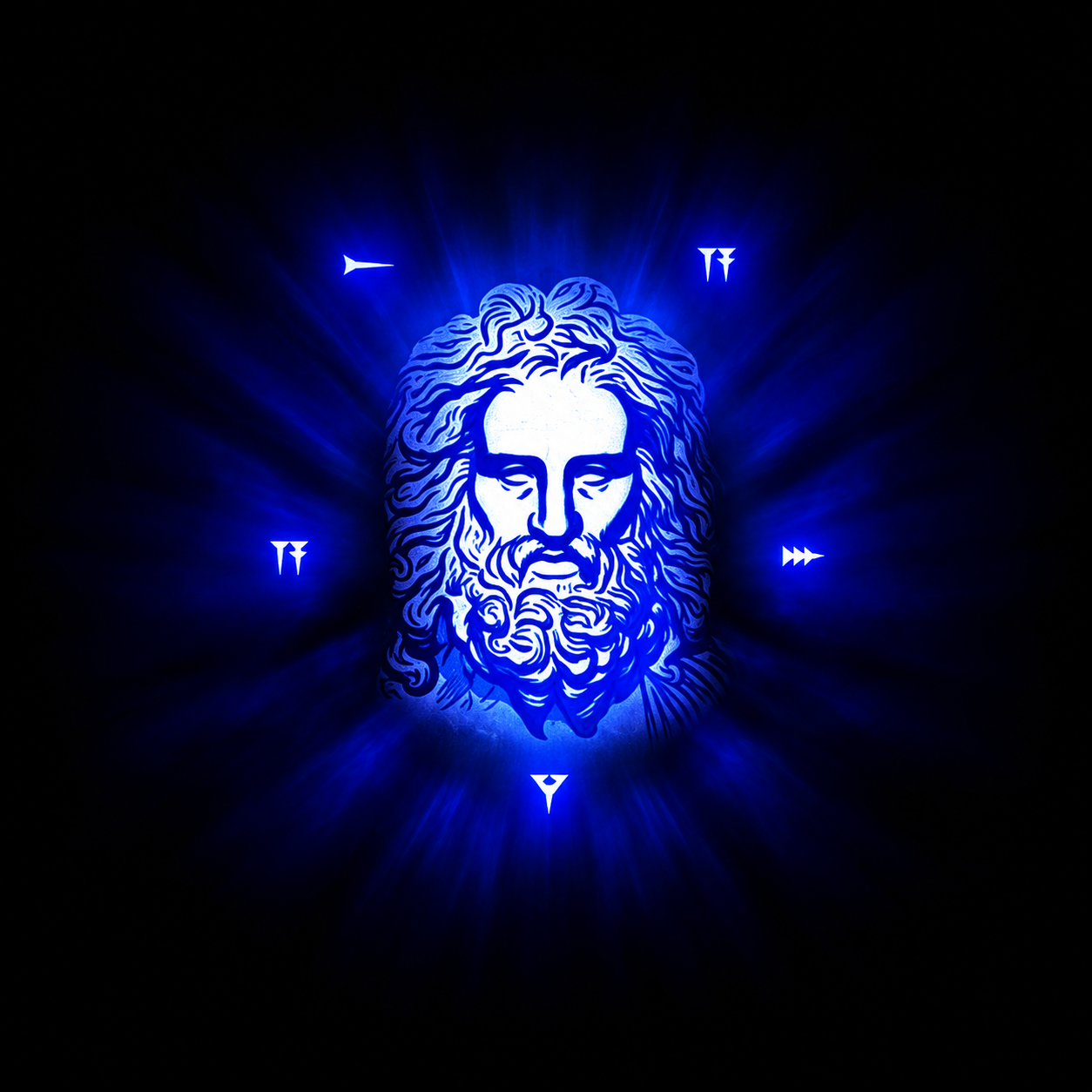
SATANAMA, chanted as four syllables, SA TA NA MA, is a core mantra of Kundalini Yoga. It is the sound of Kirtan Kriya, a meditation taught by Yogi Bhajan, and the Temple's own Void Meditation gives it as an example of a chant the practitioner may use. Some religions have taken its sound out of context, because the syllables run together resemble the name they gave to their Devil. This page sets down what the mantra is, where the word "satan" comes from, and an old observation of Greek letter mysticism about ΣΑΤΑΝΑΣ. It records them as occult knowledge and as observation.
SATANAMA: The Mantra of Kirtan Kriya
Yogi Bhajan (1929 to 2004) came to North America in 1968, and in 1969 founded 3HO in Los Angeles, through which he taught Kundalini Yoga to Western students. Kirtan Kriya, the meditation on SA TA NA MA, is one of the central meditations of that teaching. The Kundalini Research Institute, which keeps his teachings, calls the mantra the five primal sounds (panj shabd): S, T, N, M and A, the A sounding in every syllable. It gives the meaning of each syllable as follows:1
SA: Infinity, cosmos, beginning.
TA: Life, existence.
NA: Death, change, transformation.
MA: Rebirth.
The Institute calls this "the cycle of Creation": from the Infinite comes life, from life comes death or change, and from death comes the rebirth of consciousness. The four syllables are the seed form of SAT NAM, "True Name", or "Truth is the Name". Sat Nam stands in the opening words of the Sikh scripture, the Guru Granth Sahib (Ik Onkar, Sat Nam), and sat is the Sanskrit for being and truth, the root of Satya, Truth.2
In practice the meditator sits straight with the eyes focused at the brow point and touches each fingertip in turn to the thumb: the index finger on SA, so that the syllable of Infinity falls on the finger the Institute calls the Jupiter finger, after the Roman name of Zeus; the middle (Saturn) finger on TA; the ring (Sun) finger on NA; the little (Mercury) finger on MA. The mantra is chanted aloud for five minutes, whispered for five, repeated silently for ten, then whispered for five and spoken aloud for five, and the sound of each syllable is felt entering at the crown and going out through the brow point, in the shape of an "L".1
The meditation has also been studied clinically. In a preliminary study of fourteen people with memory loss, Andrew Newberg and his colleagues reported increased blood flow in the prefrontal, superior frontal and superior parietal cortex and better scores on tests of verbal fluency and memory after eight weeks of daily practice, and Dharma Singh Khalsa has reviewed this and related work on meditation and Alzheimer's disease.3 The studies are small, and the Temple cites them as observations.
The Word "Satan"
The Hebrew śāṭān (שָׂטָן) is an ordinary noun meaning "adversary", from a verb meaning to oppose or to accuse. In the Hebrew Bible it is used of men and of the messenger of the Hebrew God alike. The angel who blocked Balaam's road stood "for an adversary against him" (Numbers 22:22); the Philistine lords feared that David would become "an adversary to us" in battle (1 Samuel 29:4); Hadad the Edomite was raised up as "an adversary unto Solomon" (1 Kings 11:14). In Job (chapters 1 and 2) and Zechariah (3:1 to 2), "the satan" is an accuser in the heavenly court, and in 1 Chronicles 21:1, where it stands without the article, it is usually read as a name.4 The Greek of the New Testament took the word over as Σατανᾶς (Satanas), and there it became the name of the Devil, the enemy of the Christian God.5
Once it was the Devil's name, the word was turned against the Gods of other peoples. The Greek translators of the Psalms wrote that "all the gods of the nations are daimonia" (Psalm 95:5 in the Septuagint), and Paul wrote that what the Gentiles sacrificed, they sacrificed to daimonia (1 Corinthians 10:20), a word the King James Version renders "devils".6 The Book of Revelation calls Pergamon the city "where Satan's seat is" (2:13). Many scholars, Adela Yarbro Collins among them, identify that throne with the Great Altar of Pergamon, probably dedicated to Zeus and Athena; others read it as the imperial cult of Rome.7 On this history see also How Zeus Became the "Devil" and Daemon.
The mantra has no part in this history. Its syllables come from Sat Nam, through the Sikh and yogic traditions of India. Yet in Italian, Romanian and Russian the Devil is called Satana, and in modern Greek Satanas (Σατανάς), and an ear trained in those religions hears that name in SA TA NA before it hears the mantra. That is how the sound was taken out of context: a meditation on Truth and on the cycle of creation is easily heard as a call to the adversary. The Temple notes the likeness of sound as an observation and builds no claim of common origin on it.
ΣΑΤΑΝΑΣ and ΑΝΑΣΤΑΣ: An Occult Observation
The Greeks played with the letters of names. Lycophron, a poet at the court of Ptolemy II in Alexandria, rearranged ΠΤΟΛΕΜΑΙΟΣ into ἀπὸ μέλιτος, "from honey", and ΑΡΣΙΝΟΗ, the name of the queen, into ἴον Ἥρας, "violet of Hera".8 Such anagrams belong to the old lore of letters and names that Franz Dornseiff gathered in Das Alphabet in Mystik und Magie.9
Read in the same way, the seven letters of ΣΑΤΑΝΑΣ (three alphas, two sigmas, a tau and a nu) can be set in another order to form another Greek word:
ΣΑΤΑΝΑΣ = ΑΝΑΣΤΑΣ
ἀναστάς (anastas): "having risen", "he who stood up".
Ἀναστάς is the aorist participle of ἀνίστημι, "to raise up, to make stand". Its noun, ἀνάστασις (anastasis), means a standing up, a raising up, and the rising from the dead.10 The participle is the very word the longer ending of Mark's Gospel uses of the risen Jesus (Mark 16:9), so the same seven letters spell, in one order, the name the New Testament gives its adversary and, in another, the word it uses of rising from the dead.
In the Temple's reading, the rising named by ἀνάστασις is also the rising of the Kundalini serpent from the base of the spine to the crown, by which the soul is set upright again, and the cycle of SA TA NA MA, from beginning through life and death to rebirth, describes the same passage. The Temple records the anagram as an observation of the kind letter mysticism has always made, and draws from it no claim about the origin of the word. The Temple of Zeus does not worship Satan, the adversary of the Abrahamic religions. We worship Zeus and the Gods, whom that word was made to slander.
Sources
1 Kundalini Research Institute, "Kirtan Kriya", The Teachings of Yogi Bhajan (KRI, 2008), pp. 1 to 3.
2 Guru Granth Sahib, p. 1, the Mul Mantar.
3 Andrew B. Newberg, Nancy Wintering, Dharma S. Khalsa, Hannah Roggenkamp and Mark R. Waldman, "Meditation Effects on Cognitive Function and Cerebral Blood Flow in Subjects with Memory Loss: A Preliminary Study", Journal of Alzheimer's Disease 20.2 (2010), 517 to 526; Dharma Singh Khalsa, "Stress, Meditation, and Alzheimer's Disease Prevention: Where the Evidence Stands", Journal of Alzheimer's Disease 48.1 (2015), 1 to 12.
4 Numbers 22:22 and 22:32; 1 Samuel 29:4; 1 Kings 11:14; Job 1 to 2; Zechariah 3:1 to 2; 1 Chronicles 21:1 (King James Version). Peggy L. Day, An Adversary in Heaven: śāṭān in the Hebrew Bible (Harvard Semitic Monographs 43; Atlanta, 1988).
5 Elaine Pagels, The Origin of Satan (New York, 1995).
6 Psalm 95:5 in the Septuagint (Psalm 96:5 in the Hebrew numbering), ὅτι πάντες οἱ θεοὶ τῶν ἐθνῶν δαιμόνια; 1 Corinthians 10:20 (King James Version).
7 Revelation 2:13 (King James Version; Greek ὅπου ὁ θρόνος τοῦ Σατανᾶ). Adela Yarbro Collins, "Satan's Throne: Revelations from Revelation", Biblical Archaeology Review 32.3 (May/June 2006); Steven J. Friesen, "Satan's Throne, Imperial Cults and the Social Settings of Revelation", Journal for the Study of the New Testament 27.3 (2005), 351 to 373.
8 John Tzetzes, Life of Lycophron, prefaced to his commentary on Lycophron's Alexandra (twelfth century).
9 Franz Dornseiff, Das Alphabet in Mystik und Magie (Stoicheia 7; Leipzig, 1922; 2nd ed., 1925).
10 H. G. Liddell, R. Scott and H. S. Jones, A Greek-English Lexicon, 9th ed. (Oxford, 1940), under ἀνάστασις and ἀνίστημι; Mark 16:9 (Greek Ἀναστὰς δὲ πρωῒ πρώτῃ σαββάτου; King James Version "Now when Jesus was risen early the first day of the week").