



11 min read
Zeus Horkios: El-Berith, Lord of the Covenant
author: High Priest Zevios Metathronos
Zeus Horkios (Ζεὺς Ὅρκιος), Zeus of Oaths, is the Father as the witness and guardian of the sworn word. The Greeks called on Him first when they swore, and they held that no perjury escaped Him. In Canaan, the city of Shechem kept the house of a God it called El-Berith and Baal-Berith, "God of the Covenant" and "Lord of the Covenant". The Temple's Pantheon gives this God the names El-Berith and Zeus Horkios. This page sets out what the Greek writers, the Book of Judges and the excavations at Shechem tell of Him, and then the Temple's reading.
The God Who Witnesses the Oath
The Greek word for an oath is ὅρκος (horkos), and Ὅρκιος, "of the oath", is the title Zeus bears as its keeper. Homer shows the oath at work. When the Achaeans and the Trojans agreed that Paris and Menelaus should fight alone for Helen, Agamemnon cut hair from the heads of the sacrificial lambs, lifted up his hands and prayed:1
"Father Zeus, that rulest from Ida, most glorious, most great, and thou Sun, that beholdest all things and hearest all things, and ye rivers and thou earth, and ye that in the world below take vengeance on men that are done with life, whosoever hath sworn a false oath; be ye witnesses, and watch over the oaths of faith."
Then the wine was poured out on the ground, and the men of both armies prayed that whichever side first broke the oaths would have its brains poured out on the earth like the wine, "theirs and their children's".2 When the Trojan archer Pandarus broke the truce and wounded Menelaus, Agamemnon held his brother's hand and said that an oath sworn with sacrifice is never void:3
"For even if for the moment the Olympian vouchsafeth not fulfillment, yet late and at length doth he fulfill them, and with a heavy price do men make atonement, even with their own heads and their wives and their children."
Agamemnon swore again when he made peace with Achilles, this time over a boar: "Be Zeus my witness first, highest and best of gods". The herald then flung the boar into the sea, because no one might eat a victim over which an oath had been sworn.4 In Sophocles' Philoctetes, Neoptolemus gives his word in the same way; the Greek line is Ζῆνα δ᾽ ὅρκιον καλῶ, "I call Zeus Horkios to witness".5
Hesiod states the law plainly. Zeus gave justice to mankind, and the oath belongs to it:6
"For whoever knows the right and is ready to speak it, far-seeing Zeus gives him prosperity; but whoever deliberately lies in his witness and forswears himself, and so hurts Justice and sins beyond repair, that man's generation is left obscure thereafter. But the generation of the man who swears truly is better thenceforward."
For Hesiod, Oath (Horkos) is also a power in his own right. "Oath keeps pace with wrong judgements", he warns the judges who take bribes, and he tells that Horkos was born on a fifth day, with the Erinyes attending, "to trouble the forsworn".7 In the Theogony Horkos is the one "who most troubles men upon earth when anyone wilfully swears a false oath".8 The Gods themselves are bound. Zeus made the water of Styx "the great oath of the gods", and a God who swears falsely by it lies breathless for a full year and is then shut out of the councils and feasts of Olympus for nine years more.9
Zeus Horkios at Olympia
The greatest festival of Zeus began with an oath to Him. Pausanias, who described Olympia in the second century CE, tells of the statue that stood in the Council Chamber (Bouleuterion) of the sanctuary:10
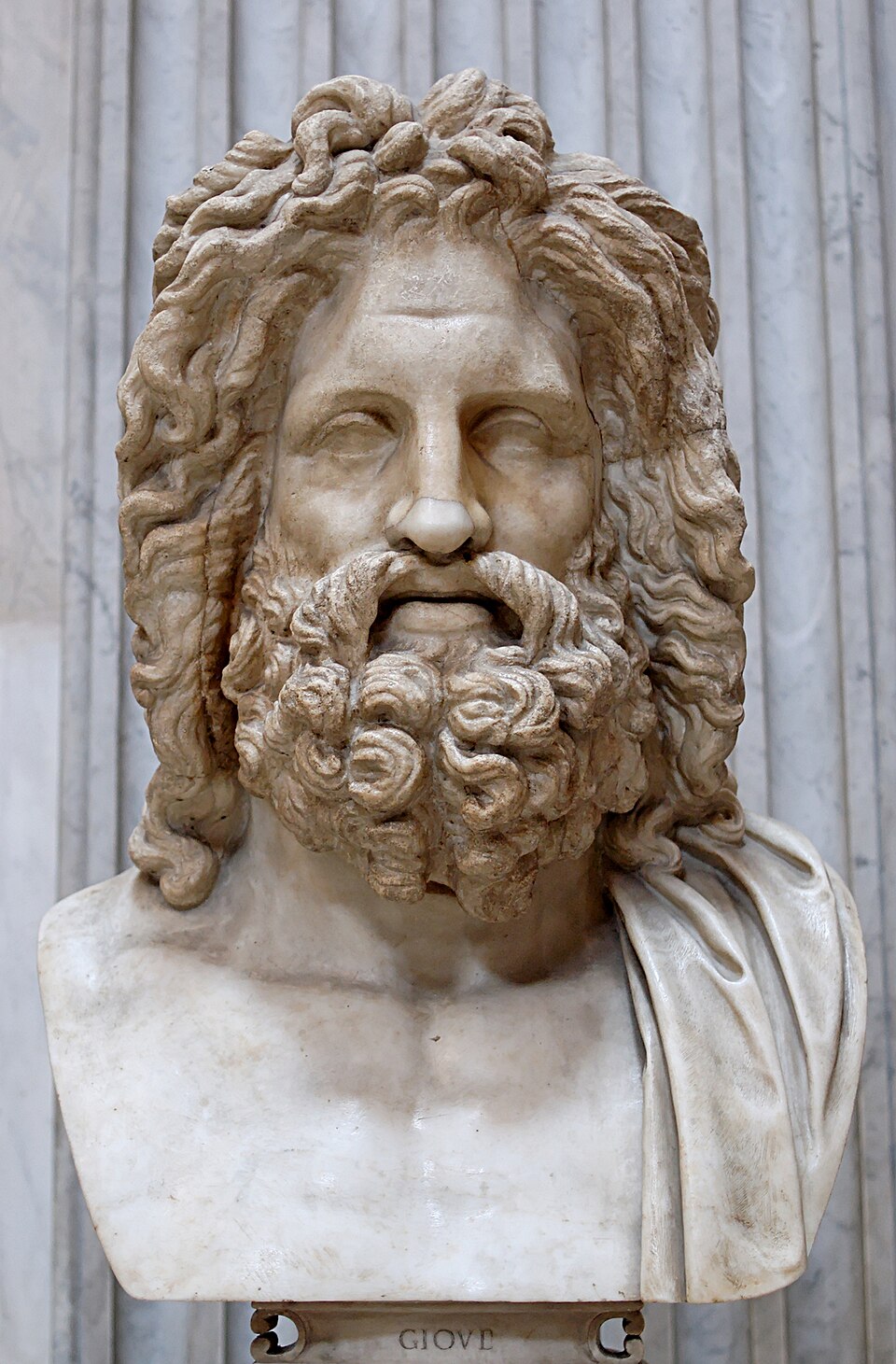
"But the Zeus in the Council Chamber is of all the images of Zeus the one most likely to strike terror into the hearts of sinners. He is surnamed Oath-god, and in each hand he holds a thunderbolt. Beside this image it is the custom for athletes, their fathers and their brothers, as well as their trainers, to swear an oath upon slices of boar's flesh that in nothing will they sin against the Olympic games. The athletes take this further oath also, that for ten successive months they have strictly followed the regulations for training."
The judges who examined the boys and the foals entered for the races swore as well: to decide fairly, to take no bribes, and to keep secret what they learned about each candidate. Before the feet of the statue was a bronze plate inscribed with elegiac verses, set there to strike fear into anyone who would forswear himself.11
Those who broke faith paid for it in bronze. On the road to the stadium, at the foot of the Hill of Kronos, stood a row of bronze statues of Zeus that the Eleans called the Zanes. They were made from the fines laid on athletes who cheated. The first six were set up in the 98th Olympiad (388 BCE), after Eupolus of Thessaly bribed the boxers he faced, and the first of their inscriptions declared that "an Olympic victory is to be won, not by money, but by swiftness of foot and strength of body".12 The Games were also held under the sacred truce of Zeus, which the Temple discusses in Love and Strife.
El-Berith, Lord of the Covenant, at Shechem
Shechem stood in the pass between Mount Gerizim and Mount Ebal, at Tell Balata on the eastern edge of modern Nablus. The Book of Judges names the God of the city. Baal-Berith (בַּעַל בְּרִית) means "Lord of the Covenant", and El-Berith (אֵל בְּרִית) "God of the Covenant"; a berit is a covenant, a bond sworn before a God. After the death of Gideon, Judges says, the Israelites "made Baal-berith their god" (8:33).13
The house of this God held a treasury. The men of Shechem gave Gideon's son Abimelech "threescore and ten pieces of silver out of the house of Baal-berith", and with it he hired the followers who carried him to power (9:4); the men of Shechem then made him king by the oak of the pillar at Shechem (9:6), the sacred oak and standing stone of the city.14 At the grape harvest the men of Shechem went "into the house of their god", ate and drank there, and cursed Abimelech (9:27). When he came against the city, the men of the tower of Shechem took refuge in the stronghold "of the house of the god Berith" (9:46), where the Hebrew reads El-Berith. Abimelech piled boughs against it and set it on fire, and about a thousand men and women died (9:47 to 49).15
The Temple on the Acropolis of Shechem
Ernst Sellin's Austro-German expedition uncovered a great temple on the acropolis of Tell Balata in 1926, and the American Drew-McCormick expedition led by G. Ernest Wright excavated it again from 1956.16 It was built about 1650 BCE on a platform of fill laid against the city's new wall: a single hall about 26 by 21 metres, with walls more than five metres thick and two great towers flanking the entrance, which gave it the name "fortress temple" (migdal). Before it lay an open forecourt with an altar and standing stones (masseboth). The temple was destroyed about 1550 BCE, and a smaller temple was built about a century later on the old walls, turned a few degrees, with a new altar and a great stone slab set up facing the altar and the entrance. The excavators suspected that the new orientation let the rising sun of the equinox shine full into the temple. The last temple on the site was destroyed about 1100 BCE.17
Wright identified the building with the house of El-Berith and the tower of Shechem of Judges 9.18 Lawrence Stager, who reexamined the evidence, called it the largest temple yet found in Canaan and argued that it stood from the seventeenth century BCE until Abimelech destroyed it in the twelfth.19 Eugene Stockton went further. He noted that the covenant Joshua made at Shechem was sealed with "a great stone" set up "under an oak, that was by the sanctuary" (Joshua 24:25 to 26), and suggested that Joshua's covenant may have continued a covenant cult long established in Canaan.20
Zeus on the Mountain of Shechem
The name of Zeus returned to the hills of Shechem in later centuries. Mount Gerizim, which rises over the city, carried the temple of the Samaritans. In the reign of Antiochus IV (175 to 164 BCE) that temple was renamed for Zeus: 2 Maccabees says it was to be called the temple of Zeus Xenios, Zeus the Protector of Strangers, "as they did desire that dwelt in the place",21 and Josephus preserves a petition from "the Sidonians, who live at Shechem" asking that their temple on Gerizim be named for Zeus Hellenios, which the king granted.22 Some seven centuries later the philosopher Damascius wrote that his teacher Marinus came from Neapolis, the Roman city built beside old Shechem, near the mountain Argarizos (Gerizim), on which stood a most holy sanctuary of Zeus Hypsistos, Zeus the Most High; Marinus said that Abraham himself had been consecrated to this God.23
The Temple's Reading
In the Temple's reading, El-Berith of Shechem and Zeus Horkios are one God known to two peoples: the Father who stands witness when people bind themselves by oath and covenant, and who repays the forsworn. The Greeks gave Him the title of the oath, the Canaanites the title of the covenant. The Temple reads El, the Father of the Canaanite Gods, as a name of Zeus (see Names of Zeus: El), and the Lord of the Covenant as the same Father in His office as guardian of sworn faith. The Book of Judges itself tells the end of the house of El-Berith as the price of broken faith: the men of Shechem who had made Abimelech king "dealt treacherously" with him, and the curse of Jotham came upon them both (Judges 9:20, 23 to 24, 56 to 57). It is the pattern Agamemnon described at Troy, of oaths that the Olympian fulfills "late and at length".
The title was slandered long afterwards. Johann Weyer's Pseudomonarchia Daemonum (1577), put into English by Reginald Scot in 1584, listed a "Berith" among its demons, the biblical God's title turned into a demon's name, and the later grimoires copied the entry.24 None of what those books say of "Berith" comes from Shechem or from any ancient source. The Temple names Him by His own titles, Zeus Horkios and El-Berith, and does not use the grimoires' name for Him.
The Oath in Zevist Practice
The Pythagorean Golden Verses open with two commands: honor first the immortal Gods, as the law ordains, and reverence the oath (Ἀθανάτους μὲν πρῶτα θεούς, νόμῳ ὡς διάκειται, τίμα, καὶ σέβου ὅρκον).25 Pythagoras told his disciples not to call the Gods to witness at all, "man's duty being rather to strive to make his own word carry conviction".26 The Temple keeps both rules (see Noble Speech, Good Conduct, and Reverence to the Gods). A Zevist swears seldom, and an oath sworn before the Gods is kept.
The Temple's own rites are sworn in the presence of Zeus: the Dedication, in which the initiate dedicates their soul to Zeus and the Gods, and the oath of the Ephebeia, the rite of passage into adulthood. Those who swear them make their promise as the athletes did at Olympia, before Zeus Horkios with a thunderbolt in each hand.
Sources
1 Homer, Iliad 3.264 to 280, tr. A. T. Murray (Loeb Classical Library, 1924).
2 Homer, Iliad 3.295 to 301, tr. Murray.
3 Homer, Iliad 4.155 to 162, tr. Murray.
4 Homer, Iliad 19.258 to 268, tr. Murray; Pausanias, Description of Greece 5.24.10 to 11.
5 Sophocles, Philoctetes 1324; Greek text and translation after R. C. Jebb (Cambridge, 1898), Perseus Digital Library.
6 Hesiod, Works and Days 276 to 285, tr. H. G. Evelyn-White (Loeb Classical Library, 1914).
7 Hesiod, Works and Days 219 and 802 to 804, tr. Evelyn-White.
8 Hesiod, Theogony 231 to 232, tr. Evelyn-White.
9 Hesiod, Theogony 399 to 400 and 775 to 806, tr. Evelyn-White.
10 Pausanias, Description of Greece 5.24.9, tr. W. H. S. Jones and H. A. Ormerod (Loeb Classical Library, 1918 to 1935).
11 Pausanias 5.24.10 to 11.
12 Pausanias 5.21.2 to 4.
13 Judges 8:33 (King James Version, as in all the biblical quotations on this page).
14 Judges 9:3 to 6. For "the oak of the pillar" the King James Version reads "the plain of the pillar".
15 Judges 9:26 to 27 and 9:46 to 49.
16 G. Ernest Wright, Shechem: The Biography of a Biblical City (New York, 1965).
17 E. D. Stockton, "The Fortress Temple of Shechem and Joshua's Covenant", Australian Journal of Biblical Archaeology 1.1 (1968), 24 to 28, summarizing the results of Wright's expedition (Wright 1965, chapters 6 to 8).
18 Wright 1965, chapters 6 to 8; Stockton 1968, 27.
19 Lawrence E. Stager, "The Shechem Temple: Where Abimelech Massacred a Thousand", Biblical Archaeology Review 29.4 (2003), 26 to 35, 66, 68 to 69; and "The Fortress-Temple at Shechem and the 'House of El, Lord of the Covenant'", in P. H. Williams Jr. and T. Hiebert (eds.), Realia Dei: Essays in Archaeology and Biblical Interpretation in Honor of Edward F. Campbell, Jr. (Atlanta, 1999).
20 Stockton 1968, 27 to 28; Joshua 24:25 to 27.
21 2 Maccabees 6:2 (Greek Διὸς Ξενίου; the King James Version reads "Jupiter the Defender of strangers").
22 Josephus, Jewish Antiquities 12.257 to 264, tr. William Whiston.
23 Damascius, Life of Isidore, in the excerpts preserved by Photius, Bibliotheca, codex 242.
24 Johann Weyer, Pseudomonarchia Daemonum, appended to De praestigiis daemonum (Basel, 1577); English in Reginald Scot, The Discoverie of Witchcraft (London, 1584), book 15.
25 Golden Verses 1 to 2, Greek text in Johan C. Thom, The Pythagorean Golden Verses (Leiden, 1995).
26 Diogenes Laertius, Lives of Eminent Philosophers 8.22, tr. R. D. Hicks (Loeb Classical Library, 1925).