



65 min read
Theosis: The Magnum Opus
author: High Priest Zevios Metathronos
The Greeks called it ὁμοίωσις θεῷ, being made like God; the later schools called it θέωσις, being made God; the popular word is Godhead. Egypt wrote it into the tombs, where the justified dead rises as a God among the Gods. The Vedic seers set it in 1 line: being Brahman, he goes to Brahman. Zevism names it the Magnum Opus, the Great Work, and holds it to be the single reason a human life is given. This teaching sets out how the Ancients saw it, why it is no procedure, how Heracles walked the whole road from a cradle in Thebes to a seat on Olympus, what his 12 labours mean, and why Meditation, Theurgy, Education and above all pious works are the 4 hands that do the Work, across more than 1 lifetime if it must be so, each life reaching its full worth in the pursuit.
The Great Work in Plain Words
The teaching has 5 parts, and each answers a plain question.
What it is. Theosis is the transmutation of a human essence into a divine essence: the making of a God out of a man. Plato states the aim in the Theaetetus as ὁμοίωσις θεῷ κατὰ τὸ δυνατόν, likeness to God as far as is possible, and defines the likeness as becoming just and holy with wisdom.1 The Hermetic Poimandres names the end with a verb: θεωθῆναι, to be made God.2 The Temple's teaching on Plato's sentence stands on its own page; this page takes the next step and treats the whole Work.3
What it is not. It is not a procedure. No rite, breath, posture or formula produces a God on completion. The Work is a whole life ordered to 1 end, and the Gods, who are free, take the hand that reaches toward them. The rites and disciplines are the hands of the Work, and hands do nothing without a body behind them.
Who did it. Heracles. Born of Zeus and a mortal woman, educated by the best teachers of his age, tested at a crossroads, driven into labours that were set him by an enemy, initiated at Eleusis, burned on Oeta and taken up in thunder: the Greeks worshipped him as a God and made offerings to him as a hero at the same time, because both were true of him.4
How it is done. By 4 disciplines working as 1: Meditation, which builds the capacity; Theurgy, which joins the human intelligence to that of the Gods; Education, which turns the soul toward what is; and pious works, which is to say the worship of Zeus and the Gods carried into deeds, which build the Arete that lifts the soul. The works come first in weight, because the Gods give nothing good or fair to men without toil.5
How long it takes. More than 1 lifetime, as a rule. Plato counts the circuits in thousands of years, Empedocles counts the births, the Gītā counts the lives of the yogi who falls short and rises again.6, 7, 8 Yet no life spent on the Work is spent in vain. Each life reaches its highest worth in the pursuit, and the Gods count what is done.
Greece, Egypt and India each name the Work in their own tongue:
| Aspect | In Plain English | Hellenic | Ancient Egyptian | Vedic and Sanskrit |
|---|---|---|---|---|
| The aim | To become a God. | ὁμοίωσις θεῷ, likeness to God; θεωθῆναι, to be made God; ἀπαθανατισμός, immortalization.1, 2, 9 | To become an akh, a transfigured spirit; to be addressed as "the Osiris N."; "N. is a God older than the eldest."10, 11, 12 | Brahmabhūya, becoming Brahman; madbhāvam āgatāḥ, "they have come to my being."13 |
| The pattern | The man who did it. | Heracles, ἥρως θεός, hero and God.14 | Imhotep and Amenhotep son of Hapu, historical men worshipped as Gods.15 | Janaka and the royal sages who "by works alone reached perfection."16 |
| The measure | As far as is possible, and no part left undone. | κατὰ τὸ δυνατόν; "leave no part of it undone."1, 17 | "A man remains after death, and his deeds are set beside him in heaps."18 | "Perfected through many births, he then reaches the highest goal."8 |
| The witness | The Gods receive the one who arrives. | Hebe given in marriage; a seat at the feast of the immortals.19, 20 | The justified soul boards the Bark of Ra and sails with the Sun.11 | "In saying, Here I pass from untruth into truth, he passes from men to the Gods."21 |
The Word: Ὁμοίωσις, Θέωσις and the Godhead
The Work has 3 names, and the Greek carries the whole doctrine inside them.
Ὁμοίωσις is built from ὅμοιος, "like," through the verb ὁμοιόω, "to make like." The ending -σις names an action under way, as in γένεσις, coming into being, or κίνησις, motion. The dative θεῷ, "to God," gives the direction of the making. The phrase is a process with a destination: a human nature being worked into the likeness of a divine one. Plato adds the measure, κατὰ τὸ δυνατόν, "according to what is possible," which is an order to reach the limit and not an excuse to stop short of it.1
Θέωσις drops the "like" altogether. It is built from θεός through the verb θεόω, "to make God," with the same -σις: the making of a God. The verb is older than the noun. The Poimandres, written in Greek-speaking Egypt in the early centuries CE, closes its revelation with it: "this is the good end for those who have gained knowledge, θεωθῆναι, to be made God."2 The compound ἀποθέωσις, apotheosis, is the word the Greeks used for what happened to Heracles on Oeta. The noun θέωσις itself is first attested in Gregory of Nazianzus in the 4th century CE, and the definition that the Christian tradition took for its own was written down a century later by the author who signs himself Dionysius:
Pseudo-Dionysius, Ecclesiastical Hierarchy 1.322
ἡ δὲ θέωσίς ἐστιν ἡ πρὸς θεὸν ὡς ἐφικτὸν ἀφομοίωσίς τε καὶ ἕνωσις.
"Theosis is the being made like God and the union with him, as far as is attainable."
Read the definition against Plato. Ἀφομοίωσις is ὁμοίωσις with a prefix; ὡς ἐφικτόν is κατὰ τὸ δυνατόν in other words; ἕνωσις, union, is the term of Plotinus and Proclus. The author of the definition studied Proclus and carried the Platonic doctrine, vocabulary and all, into a tradition that then posted a guard in front of it.22, 3 The word was taken; the Work was declared impossible for anyone but 1. Zevism takes the word back to its makers and reads it as they meant it.
Godhead is the popular English term. In common use it means the state of being God, and that is the sense in which the Temple uses it: the condition the Work arrives at. The word itself is Germanic, formed like "knighthood," and names a state rather than a process; it is the noun for the summit, where θέωσις is the noun for the climb. Both are needed. The climb is the Work; the Godhead is what the Work makes.
Plotinus gives the doctrine its sharpest Greek. The goal, he writes, is "not to be free of sin, but to be God," θεὸν εἶναι.23 Porphyry, his pupil, counts the grades: the civic virtues make a good man, the purifying virtues a daimonic man, the contemplative virtues a God, and the paradigmatic virtues "a father of Gods."24 A magical papyrus of the same centuries names its own rite ἀπαθανατισμός, "immortalization," and has the initiate, "born of mortal womb," reborn and carried up through the gates of heaven.9 The Greek-speaking world of late antiquity had 4 words for the Work and no doubt about its reality.
Οὐδεὶς θεὸς γίγνεται ὃς ἂν μὴ πρότερον ἄνθρωπος τέλειος γένηται.
No one becomes a God who has not first become a complete man.
How the Ancients Saw It
The Work is older than every word for it. Three civilizations wrote it down, and they agree on its shape.
Greece: One Race of Men and Gods
Pindar opens a victory ode with the premise: the race of men and the race of Gods are 1, and from 1 mother both draw breath, though all power divides them.25 The division is of power, not of kind. A man is a God with the power withheld, and the Work is the gaining of the power.
The oldest Greek witnesses say it as a promise. The Pythagorean Golden Verses close with the soul that leaves the body for the free aether: "you will be an immortal God, undying, no longer mortal."26 Empedocles of Acragas, in the 5th century BCE, announced it as accomplished: "I go among you an immortal God, no longer mortal." He also gave the order of the final births: the purified soul returns as seer, singer of hymns, physician or prince, "and from these they rise up as Gods, highest in honour, sharing hearth and table with the other immortals."7 Heraclitus packed both conditions into 1 line, "immortals mortal, mortals immortal."27 The Orphic initiates of Thurii carried the promise into the grave, engraved on gold and laid on the tongue: "a God you have become, out of a man."28
Pythagorean Golden Verses 70 to 7126
ἢν δ᾽ ἀπολείψας σῶμα ἐς αἰθέρ᾽ ἐλεύθερον ἔλθῃς, ἔσσεαι ἀθάνατος θεὸς ἄμβροτος, οὐκέτι θνητός.
"And if you leave the body behind and come to the free aether, you will be an immortal God, undying, no longer mortal."
Plato made the promise a definition and a method, and his successors made it a science. In the Timaeus the highest part of the soul is a daimon that lifts a man toward his kindred in heaven, "a plant not of earth but of heaven"; the one who tends it "must of necessity think immortal and divine thoughts" and, as far as human nature can share in immortality, "leave no part of it undone."17 In the Symposium the one who has begotten true Arete "becomes dear to the Gods, and if any man can be immortal, he can."29 Aristotle, who disagreed with Plato about most things, agreed about this: a man must not take the advice of those who tell him to think mortal thoughts because he is mortal, but "make himself immortal as far as possible."30
Plotinus set the rule of the Work in 1 image. "Never did eye see the Sun unless it had first become sunlike, nor can a soul see beauty unless it has become beautiful. Let each one first become godlike and beautiful, if he means to see God and beauty."23 The seeing follows the becoming. That is why the Work is a work and not a sight.
Egypt: The God Older Than the Eldest
Egypt wrote the Work on the walls of the tombs 2,000 years before Plato. The Pyramid Texts of the 24th century BCE say of the dead king, "N. is a God older than the eldest," and in the same hymn, "N. is he who eats men and lives on Gods": the powers of the Gods are taken into the king and become his own.12 The Coffin Texts and the Book of the Dead carry the pattern to every Egyptian who could afford a burial. The justified dead is addressed as "the Osiris N.," his heart is weighed against the feather of Ma'at, he declares his innocence before 42 judges and is found mꜣꜥ-ḫrw, "true of voice," and the spells of transformation let him take the forms of the falcon, the heron, the lotus and the God.11 Jan Assmann, the historian of Egyptian religion, calls the state the dead reaches transfiguration: the mortal becomes an akh, an effective spirit, and sails with Ra.10
Egypt also supplied the pattern in historical men. Imhotep, the architect of Djoser's pyramid in the 27th century BCE, was worshipped as a God by the Late Period, with temples of his own, and the Greeks knew him as Imouthes and equated him with Asclepius. Amenhotep son of Hapu, the scribe and overseer of Amenhotep III, received the same honour and gave oracles at Deir el-Bahari more than 1,000 years after his death.15 Herodotus reports that the Egyptians counted a Heracles among their 12 Gods, older by thousands of years than the son of Alcmene, and praises the Greeks who worship Heracles twice over.4
India: Being Brahman, He Goes to Brahman
The Vedic texts draw the same line and give it the same end. The Śatapatha Brāhmaṇa sets the vow of the sacrificer: "the Gods are truth and men are untruth; in saying, Here I pass from untruth into truth, he passes from men to the Gods."21 The Soma hymns of the Ṛgveda ask for the destination outright: "where there is inexhaustible light, in the world where the Sun is set, in that immortal, imperishable world place me."31
The Upaniṣads give the Work its metaphysics. "Whoever knows that highest Brahman becomes Brahman himself," says the Muṇḍaka.32 The Bṛhadāraṇyaka describes the one whose desire is the Self alone: "being Brahman, he goes to Brahman," and "when all the desires that dwell in the heart are let go, then the mortal becomes immortal."33 The Chāndogya shows the serene soul rising from the body to the highest light and standing "in his own form; that is the supreme Person."34 The Taittirīya puts it in 3 words: brahmavid āpnoti param, the knower of Brahman attains the highest.35
Bṛhadāraṇyaka Upaniṣad 4.4.633
atha yo 'kāmo niṣkāma āptakāma ātmakāmo na tasya prāṇā utkrāmanti, brahmaiva san brahmāpyeti.
"But the one who is without desire, free of desire, whose desire is fulfilled, whose desire is the Self: his breaths do not depart. Being Brahman, he goes to Brahman."
The Gītā makes the end personal and gives it a God's voice. Those purified by the tapas of knowledge "have come to my being," madbhāvam āgatāḥ; the one who serves with unswerving devotion "is fit to become Brahman"; the one who knows the divine birth and action of the God leaves the body and does not return.13 The Tantric tradition that followed states the rule of the Work as plainly as Plotinus did: "by meditating on Vishnu, man becomes Vishnu; by meditating on Devi, man becomes Devi."36
For Zevism: 3 civilizations in 3 languages describe 1 Work. A human being, by truth, by purification, by knowledge and by right deeds, becomes what the Gods are. The agreement is the signature of a single source. The Gods taught it to every people in its own tongue, and Zevism restores the teaching at its source.37
Not a Procedure
A procedure is a sequence of steps that yields its result when the steps are done. A recipe is a procedure; a surgical operation is a procedure; an initiation ceremony, taken by itself, is a procedure. Theosis is none of these, and the ancient witnesses say so in 4 ways.
First, the Work is a growth and not an assembly. Plato's soul has wings, and the wings are nourished. They feed on the beautiful, the wise and the good and they waste on the ugly and the bad; the soul rises as far as its plumage carries it and no further.6 Aristotle says the same of virtue without the image: it "comes from habit," and a habit is built act by act over years.30 A wing can't be installed. A habit can't be performed once.
Second, the Work is paid for in toil. Hesiod set the price in the 7th century BCE: "before Arete the immortal Gods have set sweat; long and steep is the road to it and rough at first."38 Arete herself, in the fable Prodicus told and Xenophon preserved, says to the young Heracles that the Gods give nothing good or fair to men without toil and care, and that whoever wants the Gods gracious must serve the Gods.5 A procedure has a cost; the Work has a price, and the price is a life.
Third, the Gods are free. Iamblichus answered Porphyry's question about theurgy with the point that matters: the rites do not drag the impassible Gods down to men; they make the human soul fit to be raised to the Gods.39 The Kaṭha Upaniṣad says it from the other side of the world: "this Self is not won by instruction, nor by intellect, nor by much learning; he is won by the one whom he chooses, and to him this Self reveals his own form."40 Plato's soul follows a God and imitates him "as far as it can"; the God leads.6 No procedure binds a free being. The Work makes a person worth leading, and the Gods lead.
Fourth, the Work is a whole and not a part. Plato's measure, "leave no part of it undone," closes the door on the idea that 1 practice can be perfected while the rest of the life is left as it was.17 Porphyry's grades run through the civic virtues before they reach the purifying ones; nobody skips a grade.24 Epictetus is blunt about the order: before anyone cleanses the world of its monsters, "cleanse what is your own."41 Plato quotes the founders of the Mysteries to the same effect: "many are the wand-bearers, but the bacchoi are few," and the bacchoi are those who have practised philosophy rightly; the wand is carried by everyone who attends the rite, and the rite by itself makes nobody a bacchos.42
Modernity has misread this in 2 directions. One school treats the Work as an event, an "awakening" or "ascension" that happens to a person and after which nothing more is required; the other treats it as a technique, a method of breath or visualization that will produce the state on schedule. Both are procedures, and both leave out the price, the freedom of the Gods and the whole of the life. The ancient path is longer and surer. It asks for everything and gives everything.
For Zevism: the Great Work is the ordering of a whole life, in all of its 4 dimensions, toward the Godhead, measured by Plato's κατὰ τὸ δυνατόν. The disciplines of the Temple are the instruments of that ordering. They are not the Work; the Work is the life that uses them.3
Μὴ ζήτει τὸν θεὸν ἔξω πρὶν ἂν ἐν σοὶ στῇ.
Do not seek God outside before he stands within you.
Heracles: The Man Who Became a God
Every doctrine needs a case in which it was carried out. Greece had one, and built his temples in every city. Heracles is the pattern of the Work: the whole road from birth to Godhead, walked once and recorded, so that the road could be seen.
The Birth and the Prophecy
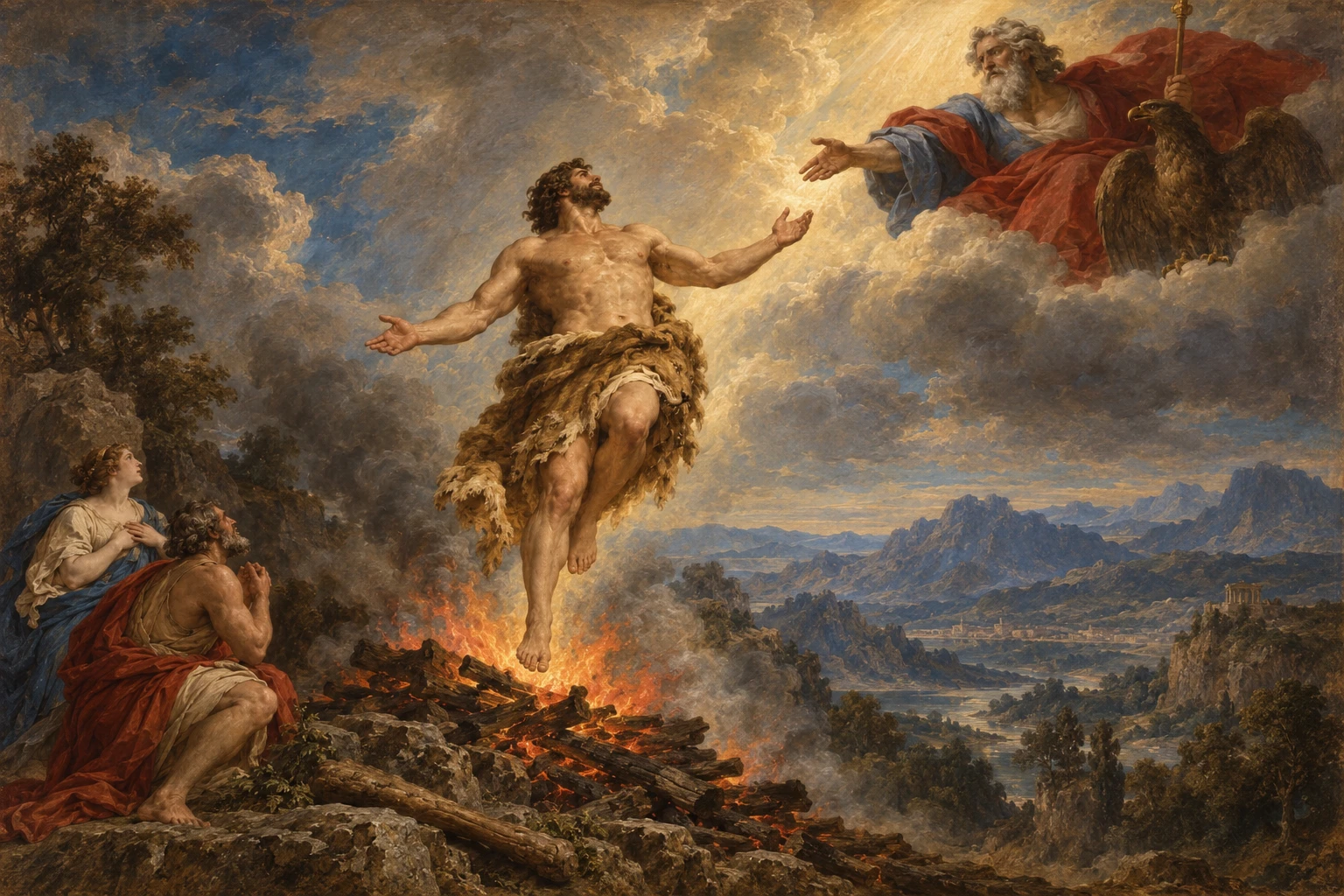
He was born in Thebes to Alcmene, the wife of Amphitryon, and his father was Zeus. Hera, the queen of the Gods, set herself against him before he was a day old. Theocritus tells how she sent 2 serpents into the nursery where the 10-month-old infant slept beside his twin Iphicles, and how the child took them by the throats and strangled them. Alcmene called the seer Teiresias, and Teiresias told her what her son was:
Theocritus, Idyll 24.79 to 8443
τοῖος ἀνὴρ ὅδε μέλλει ἐς οὐρανὸν ἄστρα φέροντα ἀμβαίνειν τεὸς υἱός, ἀπὸ στέρνων πλατὺς ἥρως, οὗ καὶ θηρία πάντα καὶ ἀνέρες ἥσσονες ἄλλοι. δώδεκά οἱ τελέσαντι πεπρωμένον ἐν Διὸς οἰκεῖν μόχθους, θνητὰ δὲ πάντα πυρὰ Τραχίνιος ἑξεῖ. γαμβρὸς δ᾽ ἀθανάτων κεκλήσεται.
"Such a man is this son of yours, destined to mount to the heaven that bears the stars, a broad-chested hero, to whom all beasts and all other men will be inferior. Twelve labours accomplished, it is fated for him to dwell in the house of Zeus, and all that is mortal in him the Trachinian pyre will have. He shall be called the son-in-law of the immortals."
The prophecy contains the whole doctrine in 3 clauses. The labours come first; the mortal part is given to the fire; the immortal part is taken into the family of the Gods. Pindar has Teiresias say the same at the same cradle: when the labours are done, Heracles will have peace in the house of the blessed, Hebe for his bride, and will praise the law of Zeus.14
The Education of a God
The Greek sources are exact about his schooling, and the exactness matters. Linus, a son of Apollo, taught him letters; Eurytus taught him the bow; Eumolpus taught him song and the lyre; Harpalycus, a son of Hermes, taught him wrestling, boxing and the all-in fight; Amphitryon taught him to drive the chariot; Castor taught him arms and the order of battle.43 Apollodorus gives the same list with Autolycus for wrestling.44 Letters, music, the body and the arts of war: the full Greek παιδεία before the first labour. The hero who later cleansed the world began as a boy who was taught to read.
The Gods completed the education with their gifts. Hermes gave him a sword, Apollo a bow, Hephaestus a golden breastplate, Athena a robe; the club he cut for himself at Nemea.44 Every power the initiate carries is given by a God, except the plain wooden instrument of his own effort, which he makes.
The Crossroads
Prodicus the sophist, in the 5th century BCE, told the story of the young Heracles at the crossroads, and Xenophon wrote it down. Two women came to him as he sat deliberating which road his life should take. One was Vice, dressed to be looked at, who promised him every pleasure without labour. The other was Arete, who promised him nothing without labour and told him why:
Xenophon, Memorabilia 2.1.285
τῶν γὰρ ὄντων ἀγαθῶν καὶ καλῶν οὐδὲν ἄνευ πόνου καὶ ἐπιμελείας θεοὶ διδόασιν ἀνθρώποις, ἀλλ᾽ εἴτε τοὺς θεοὺς ἵλεως εἶναί σοι βούλει, θεραπευτέον τοὺς θεούς.
"Of the things that are good and fair the Gods give nothing to men without toil and care. If you wish the Gods to be gracious to you, you must serve the Gods."
Dio Chrysostom retold the scene 5 centuries later with Hermes as the guide and Royalty and Tyranny as the 2 enthroned women; Heracles chose Royalty and Zeus made him king of mankind.45 In both tellings the labours are preceded by a choice, and the choice is made in full view of the alternative. The Work begins at a crossroads, with the easier road open.
The Madness and the Oracle
Then the road turned downward. Hera sent madness on him, and in it he killed his own children by Megara. He condemned himself to exile, was purified by Thespius, and went to Delphi to ask the God where he should live. The Pythia answered, and in answering gave him his name:
Apollodorus, Library 2.4.1246
ἡ δὲ Πυθία τότε πρῶτον Ἡρακλέα αὐτὸν προσηγόρευσε· τὸ δὲ πρώην Ἀλκείδης προσηγορεύετο. κατοικεῖν δὲ αὐτὸν εἶπεν ἐν Τίρυνθι, Εὐρυσθεῖ λατρεύοντα ἔτη δώδεκα, καὶ τοὺς ἐπιτασσομένους ἄθλους δέκα ἐπιτελεῖν, καὶ οὕτως ἔφη, τῶν ἄθλων συντελεσθέντων, ἀθάνατον αὐτὸν ἔσεσθαι.
"The Pythia then first called him Heracles; before that he was called Alcides. She told him to live in Tiryns, serving Eurystheus for 12 years and performing the 10 labours that would be set him, and so, she said, when the labours were completed, he would be immortal."
Four facts stand in this passage. The name Heracles, "the glory of Hera," is given at Delphi by Apollo, and given to the man whom Hera persecuted: the enemy's name becomes the title of the victory. The labours are service, λατρεύοντα, to a lesser man, Eurystheus, who held the throne that should have been his. The term is fixed at 12 years. And the reward is stated once, by the God, before the first labour: ἀθάνατον ἔσεσθαι, he would be immortal. Diodorus records the same oracle in the same terms.47 Heracles knew the end of the road before he set out on it, and the knowledge didn't shorten the road by a day.
Epictetus drew the moral for his students at Nicopolis. "If Heracles had sat at home, what would he have been? Eurystheus and not Heracles." Nothing was dearer to him than God; "therefore he was believed to be the son of Zeus, and he was," and in obedience to his father he went about the earth "cleansing away injustice and lawlessness."41 The sonship was proved by the obedience. That is the Zevist order of things as well: the Gods call their own children by what their children do.
The Pyre on Oeta
The end came through the poisoned robe. Deianeira, deceived, sent her husband a garment soaked in what she believed was a love charm and was the blood of the Hydra; it ate into his flesh, and Sophocles gives his agony a whole act. The dying Heracles ordered his son Hyllus to carry him to the summit of Oeta, "the sacred mountain of Zeus most high," to build a pyre there and to set him on it.48 Nobody would light it. Poeas, passing in search of his flocks, did, and received the bow for it. Then:
Apollodorus, Library 2.7.749
καιομένης δὲ τῆς πυρᾶς λέγεται νέφος ὑποστὰν μετὰ βροντῆς αὐτὸν εἰς οὐρανὸν ἀναπέμψαι. ἐκεῖθεν δὲ τυχὼν ἀθανασίας καὶ διαλλαγεὶς Ἥρᾳ τὴν ἐκείνης θυγατέρα Ἥβην ἔγημεν, ἐξ ἧς αὐτῷ παῖδες Ἀλεξιάρης καὶ Ἀνίκητος ἐγένοντο.
"While the pyre was burning, it is said that a cloud came under him and with a peal of thunder sent him up to heaven. There he obtained immortality, was reconciled with Hera, and married her daughter Hebe, by whom he had the sons Alexiares and Anicetus."
Diodorus adds that when Iolaus and his companions came to gather the bones they found none, and concluded that Heracles had passed from men to the Gods; that his companions and then the Athenians honoured him with the rites of a God, and brought first the Greeks and then all mankind to do the same; and that Zeus persuaded Hera to adopt him by a rite that imitated birth, so that the Goddess who had set the labours became his mother.50 Ovid describes what the fire did: whatever the flame could ravage it took, so that no likeness of Hercules remained that could be recognized, "and he kept only the traces of Jove"; stripped of his mortal limbs "he flourished in his better part."51 Teiresias had said it at the cradle: the pyre would have everything mortal, and nothing else.
Τὸ μὲν θνητὸν τῷ πυρὶ δίδοται, τὸ δὲ κρεῖττον ἄνω φέρεται.
The mortal part is given to the fire; the better part is carried upward.
Hero and God
The oldest Greek poetry already knows the outcome. Odysseus in Hades meets the phantom of Heracles and says at once that it is only the phantom, εἴδωλον: "but he himself among the immortal Gods takes his pleasure at the feast and has Hebe of the fair ankles."19 Hesiod closes the catalogue of divine marriages with him:
Hesiod, Theogony 950 to 95520
ἥβην δ᾽ Ἀλκμήνης καλλισφύρου ἄλκιμος υἱός, ἲς Ἡρακλῆος, τελέσας στονόεντας ἀέθλους, παῖδα Διὸς μεγάλοιο καὶ Ἥρης χρυσοπεδίλου, αἰδοίην θέτ᾽ ἄκοιτιν ἐν Οὐλύμπῳ νιφόεντι, ὄλβιος, ὃς μέγα ἔργον ἐν ἀθανάτοισιν ἀνύσσας ναίει ἀπήμαντος καὶ ἀγήραος ἤματα πάντα.
"And the valiant son of Alcmene of the fair ankles, the strength of Heracles, having completed his groaning labours, made Hebe, the child of great Zeus and of Hera of the golden sandals, his revered wife on snowy Olympus: blessed, who having accomplished a great work among the immortals dwells unharmed and ageless for all days."
The phrase is Hesiod's: μέγα ἔργον ἀνύσσας, having accomplished a great work. The Latin alchemists who later spoke of the magnum opus were using a Greek poet's words for a Greek hero's deed. Zevism uses them in Hesiod's sense. The Magnum Opus is the great work that ends on Olympus.
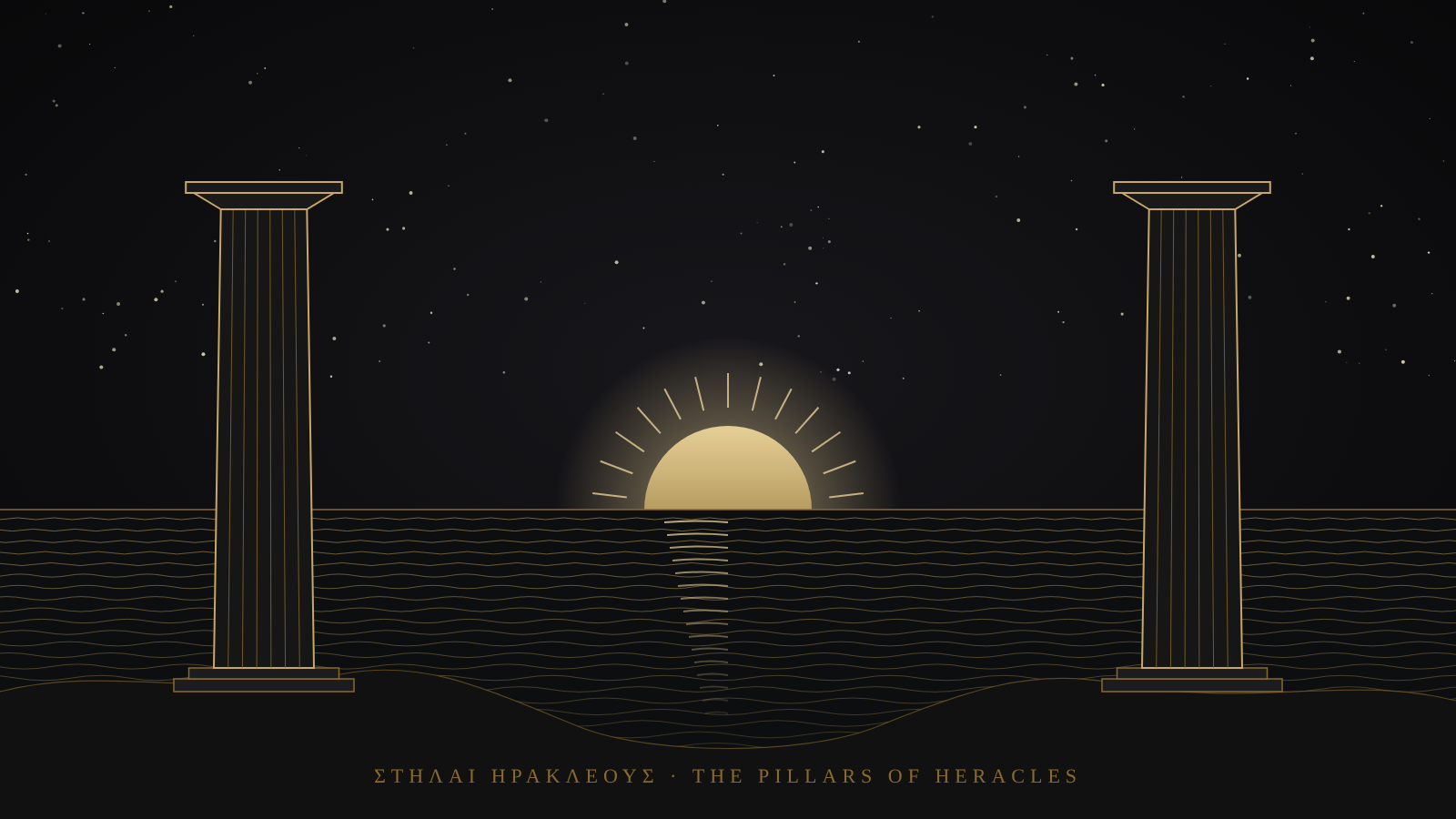
Pindar calls him ἥρως θεός, "the hero God," in a single breath, when he names the Pillars that Heracles set at the end of the world as witnesses of the furthest voyage.14 Sophocles brings him onto the stage in the Philoctetes, descending from "the heavenly seat" to speak the plans of Zeus, and gives him the sentence that sums up the whole Work: "having toiled through and passed through so many toils, I have won immortal Arete, as you can see."52 Immortal Arete, ἀθάνατον ἀρετήν: the vehicle of ascent, built to completion, has carried him home, and he stands in sight of men as proof.
The Greeks honoured both halves of the fact. Herodotus praises those cities that kept 2 sanctuaries of Heracles and "act most correctly of the Greeks," worshipping him in the one as an immortal under the title Olympian and making the offerings due to a hero in the other.4 Plotinus read the 2 Heracleses of the Odyssey as the 2 levels of 1 soul: the shade in Hades is the lower soul that still remembers the labours, and the self among the Gods is the higher soul that has risen past them.53 Macrobius, at the end of antiquity, gave the name itself a rank. Many men were called Heracles before the son of Alcmene, he writes, and he was the last to be judged worthy of it, "because by his surpassing courage he earned the name of the God who governs virtue"; for Hercules "is that power of the Sun which supplies the human race with virtue in the likeness of the Gods."54 The name is a degree, and the son of Alcmene took it by examination.
For Zevism: Heracles is the Work completed and attested. Son of Zeus, pupil of the best teachers, chooser of the hard road, servant of a lesser man for 12 years, initiate of Eleusis, burned clean on Oeta and received on Olympus: every stage of the Zevist path is in his life, and the Greeks who built his temples knew it.3
The 12 Labours and Their Meaning
The oracle ordered 10 labours. Eurystheus refused to count 2 of them: the Hydra, because Iolaus had helped, and the stables of Augeas, because Heracles had asked the king for pay. So 2 more were set, and the 10 became 12.55 The 2 rulings are the first lesson of the sequence. A labour done with help from outside is not the labourer's own, and a labour done for a wage is not a labour of the Work. The inner Work cannot be delegated and cannot be sold, and the Gods, who keep the count, don't credit what was.
The number is the second lesson. Twelve is the number of the completed cycle: the months of the year, the signs of the Sun's road, the Twelve Ruling Gods of Olympus, into whose house Heracles was received.56 Herodotus found a Heracles among the 12 Gods of Egypt as well.4 A Work of 12 is a Work that has gone all the way round and left nothing out.
The ancients read the labours as the Work from the beginning. The grammarian Heraclitus, in the 1st century CE, called Heracles "a man of understanding, an initiate of heavenly wisdom" who cleared philosophy of its errors, and read the Boar as incontinence, the Lion as blind impulse, the Hind as cowardice, the stables as the filth of the passions, the Birds as windy hopes and the dog of Hades as the many-headed power of pleasure.57 Cornutus the Stoic saw in Heracles the Logos itself, strong and unconquered, distributing power to every part of nature.58 Epictetus turned the labours inward for his students: cast out of your own mind, instead of Procrustes and Sciron, "grief, fear, desire, envy, malice, avarice, softness, incontinence."41 Boethius sang the labours as the pattern of the brave and closed with the line that holds the whole doctrine: "the earth overcome gives the stars."59 The Emperor Julian, the last Platonist on a throne, wrote that Zeus begot Heracles to be the saviour of the world, gave him Athena as his guardian, and at the end received him into heaven in the lightning.60
The Zevist reading follows the ancient one and completes it. Each labour is a stage in the ordering of a human being toward the Godhead: the first 6, set in the Peloponnese, are the Work on the self; the last 6, set across the sea, at the ends of the earth and under it, are the Work on the world and the Cosmos. Apollodorus supplies the deeds; the readings are the Temple's.55
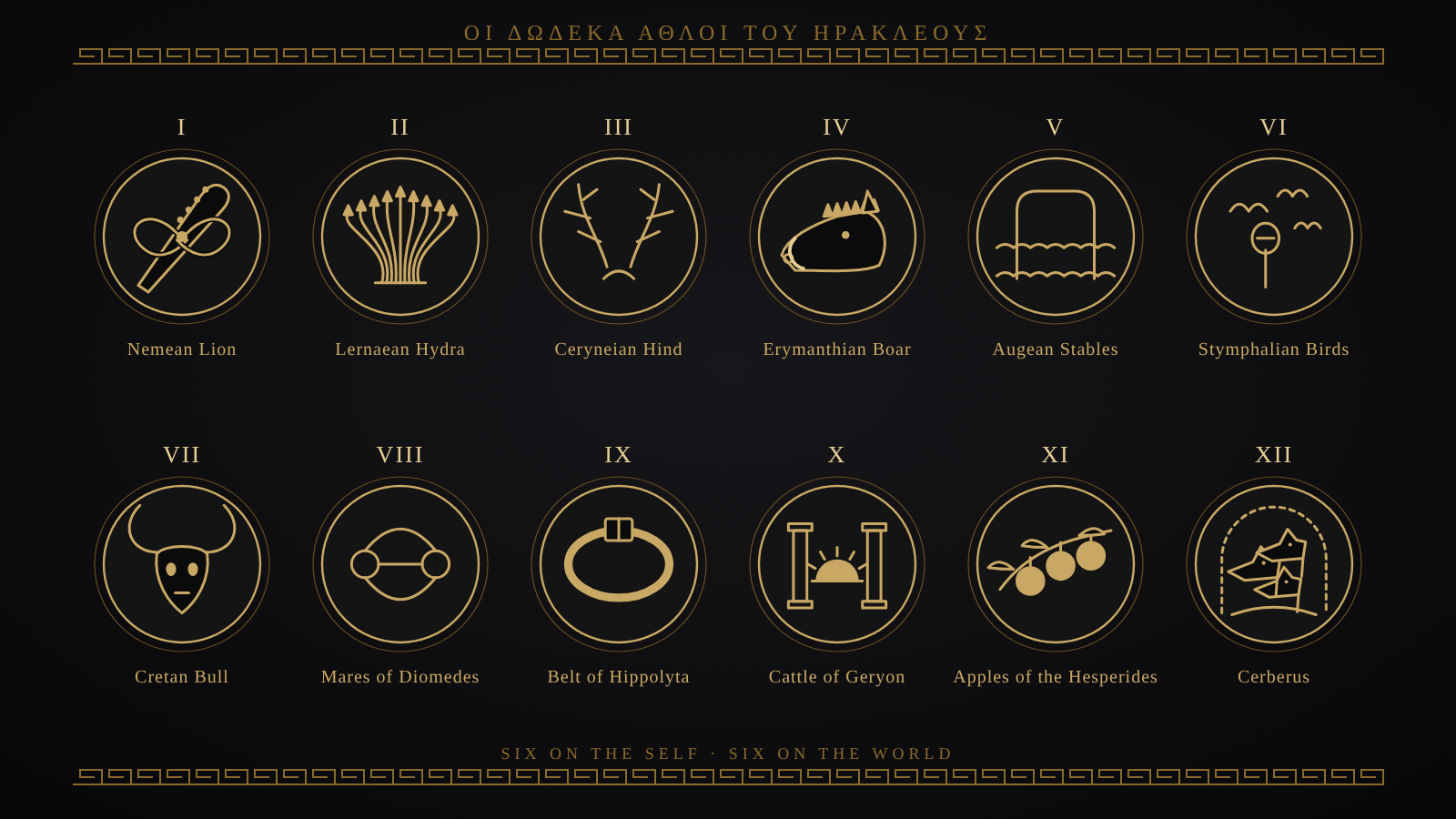
| Labour | What Heracles Did | The Zevist Reading |
|---|---|---|
| I. The Nemean Lion | Finding arrows useless, he blocked 1 mouth of the lion's cave, entered by the other, and strangled it with his arms. He wore the skin after. | The first victory is over one's own animal strength, won by one's own force and no instrument. The conquered nature is not thrown away; it becomes the armour. |
| II. The Lernaean Hydra | Each head cut grew 2. Iolaus burned the stumps with fire; the immortal head Heracles buried under a rock. He dipped his arrows in the gall. | The passions multiply when attacked piecemeal. Fire, which is knowledge, seals them; the root appetite cannot be killed, only held down under the weight of a rule. What is conquered is turned into a weapon. Not counted: the inner Work accepts no helper. |
| III. The Ceryneian Hind | The golden-horned hind sacred to Artemis; he pursued it for a whole year, wounded it with an arrow as it was crossing the Ladon, and took it alive. Artemis and Apollo met him and let him pass when he told the cause. | The swift thing is the mind. It is caught alive by patience and purity, over a long time, with the least force that will hold it: the labour of Meditation. The Gods examine the motive before they allow the capture. |
| IV. The Erymanthian Boar | He drove the boar into deep snow, snared it and carried it alive to Mycenae, where Eurystheus hid from it in his bronze jar.47 | Rage is not fought with rage; it is driven into cold until it slows, then bound. The man who ordered the labour cannot bear to look at the captured beast: the unprepared fear even a mastered vice. |
| V. The Stables of Augeas | The dung of the whole herd cleared in a single day by turning the rivers Alpheus and Peneus through the yard. Augeas refused the promised pay. | Purification. The accumulated filth of years is not cleaned by hand but by redirecting the great currents of Nature through the self: breath, blood, the waters of the body and the soul. Not counted: purification sought for reward is not purification. |
| VI. The Stymphalian Birds | Man-eating birds in a marsh; Athena gave him bronze rattles made by Hephaestus; the noise raised them and he shot them as they flew. | The swarm of harmful thoughts cannot be reached in the marsh where they sit. The instrument of Athena, discernment given sound, drives them into the open, and there they are struck one by one. |
| VII. The Cretan Bull | The bull Poseidon had sent up from the sea for Minos; he took it alive, brought it over the water to Mycenae, and it was let go. | The generative power is not killed. It is ridden across the sea, which is the realm of generation, and set free when the crossing is made. Power harnessed, used and let go. |
| VIII. The Mares of Diomedes | Man-eating mares of the Thracian king; Heracles killed Diomedes and, as Diodorus tells it, fed him to his own mares, which grew tame; he brought them to Eurystheus.47 | The appetites that devour others are made to devour their master, the tyrant who fed them. Once the tyrant is gone they are tame and serve the king, which is reason. The lower rules the lower until the higher takes the reins. |
| IX. The Belt of Hippolyta | The Amazon queen offered the belt, the gift of Ares; Hera, disguised, stirred the Amazons to war; Heracles killed Hippolyta and took the belt. | The belt is the girdle, the mark of self-command, held by the opposite polarity. It is offered freely to the one who asks rightly, and the war is the work of the adversary alone. The Work gathers the power of both polarities into 1 man. |
| X. The Cattle of Geryon | To Erytheia in the far West; he set the Pillars at the strait, aimed his bow at the Sun, received the Sun's golden cup to cross the ocean, killed the 3-bodied Geryon, and drove the cattle home for Hera. | The edge of the material world, marked with pillars by the man passing beyond it. The Sun, challenged, lends his own vessel: the initiate is carried by the God he dared to face. The gathered power is driven home and consecrated to the Goddess who opposed him. |
| XI. The Apples of the Hesperides | The golden apples of the garden of the Gods; he freed Prometheus on the way, held the sky for Atlas while Atlas fetched the fruit, and tricked him into taking it back. Athena returned the apples to the garden. | The fruit of immortality grows in the Gods' own garden. To reach it the initiate unbinds knowledge, bears the Cosmos on his shoulders for a moment, and stands in a God's office without staying in it. What is sacred is not kept; it is returned by the Goddess to its place. |
| XII. Cerberus | He was initiated at Eleusis by Eumolpus before going down; Hermes and Athena stood by him in Hades; he freed Theseus, took Cerberus without a weapon, showed him to Eurystheus and returned him to Hades. | The descent and the return: the initiate faces death while alive, under the guidance of the Gods, and comes back. The last labour of the self is the Mystery. What is brought up from below is shown and sent back; nothing of Hades is kept. |
The Six Labours on the Self
The first 6 labours are set within a few days' walk of Tiryns, in the Argolid and the mountains of Arcadia and Elis. The nearness is the point. The first field of the Work is the labourer himself.
The Lion is the strength of the untrained self: force without direction. Heracles kills it with his hands, because the first mastery is of one's own force by one's own force, and then puts on its skin, because the conquered nature is not discarded but worn. The Hydra is the multiplication of the passions when they are attacked 1 at a time; each cut breeds 2. Fire, which in Zevism is knowledge and Light, seals the wound, and the head that cannot die is buried under a rock: the root of appetite is not killed in a mortal life but held under the weight of a rule. The Hind is the mind itself, swift and sacred, hunted for a year and taken alive: the labour of Meditation, which holds without destroying and is tested by Artemis and Apollo before it is allowed. The Boar is anger, driven into cold until it slows. The stables are purification, and the method is the whole secret of the Zevist purifications: the filth of years is not scrubbed by hand but washed out by turning the great currents of Nature through the body and the soul. The Birds are the swarm of thoughts that feed on a man, raised from their marsh by the bronze instrument of Athena and struck in the open air.
Two of these 6 were not counted, and the uncounted 2 are the 2 inner labours most often faked: the mastery of the passions, which men try to delegate to a teacher, a rite or a drug, and purification, which men try to buy. Eurystheus, an unjust judge, ruled rightly for once.
The Six Labours on the World
The second 6 send Heracles across the sea to Crete, north to Thrace, east to the Amazons, west to the Ocean, to the garden of the Gods and under the earth. The field widens from the self to the Cosmos, and the Work changes character: the beasts are no longer killed, they are ridden, tamed, carried and returned.
The Bull is the generative power, ridden across the water of generation and released on the far shore. The Mares are the appetites that eat men, fed on their own master until they are tame. The Belt is self-command held by the other polarity, offered to the one who asks rightly and fought over only because Hera intervened. The Cattle lie at the edge of the world, and Heracles marks the edge with his Pillars, threatens the Sun with his bow and is lent the Sun's own cup to cross the Ocean: the initiate who dares the God is carried by the God. The Apples grow in the garden of the Gods, and to reach them Heracles frees Prometheus, bears the sky for Atlas and gives the sky back; the fruit of immortality is touched and returned to its place by Athena, because what is divine is not possessed. Cerberus is the last and the key to the rest. Heracles is initiated at Eleusis first, goes down living under the guidance of Hermes and Athena, and comes up again.55 The Work ends where the Mysteries begin: in the descent made in full knowledge and the return.
Then the pyre. The labours did not make Heracles a God; they made him a man whom the fire could not reduce to nothing. The mortal part had been worn down to the traces of Zeus, and the fire took the rest.51
Ἕκαστος ἆθλος βαθμὸς τῆς κλίμακος· ἡ δὲ κλῖμαξ εἰς τὸν Ὄλυμπον φέρει.
Each labour is a step of the stair, and the stair leads to Olympus.
For Zevism: the 12 labours are the curriculum of the Work in the form of a life, 6 on the self and 6 on the Cosmos, each one a stage of the ordering that Plato defined and Porphyry graded. They are read in the Temple as a map and not a legend.3, 24
The Four Hands of the Work
The Temple teaches the Zevist path in 4 dimensions, and the Great Work uses all 4 at once, the way a craftsman uses both hands and both eyes. Plato named each in the Theaetetus and the Republic; Heracles lived each; the Vedic texts confirm each.3
| Hand of the Work | Platonic Name | In the Life of Heracles | In the Sanskrit Witnesses | What It Builds |
|---|---|---|---|---|
| Meditation | δυνατόν, the capacity of power; the tending of the daimon in the Timaeus.17 | The year-long hunt of the Hind, the mind taken alive. | The chariot of the Kaṭha; the yoga of the Gītā, perfected over many births.40, 8 | The vessel strong enough to hold what the Gods give. |
| Theurgy | σοφία and θεουργία; following one's God in the Phaedrus.6 | The gifts of the Gods; Eleusis before Hades; Hermes and Athena at his side below. | "He is won by the one whom he chooses"; devotion to the Lord as the road to samādhi.40, 61 | The connection of the human intelligence to that of the Gods. |
| Education | παιδεία, the turning of the soul toward what is.62, 63 | Linus, Eurytus, Eumolpus, Harpalycus, Amphitryon, Castor: letters, music, the body, arms. | The teacher at the fire: "that is the Self; you are that."34 | The knowledge of the road, so that the climb is made with open eyes. |
| Pious works | δίκαιον καὶ ὅσιον, the just and the holy, done; θεραπευτέον τοὺς θεούς.1, 5 | The 12 labours themselves, done in service, unpaid and alone. | "By works alone Janaka and others reached perfection."16 | Arete, the spiritual power that is the Vehicle of ascent.37 |
Meditation: The Vessel
Meditation is the inner hand. It builds what Plato calls δυνατόν, the capacity, and the capacity is what the whole measure of the Work turns on: likeness to God as far as is possible, and the possible grows with the vessel. In the Timaeus the man who exercises the divine part of his soul above all others "must of necessity think immortal and divine thoughts," and is the happiest of men.17 The Kaṭha Upaniṣad draws the chariot: the Self is the rider, the body the car, the intellect the charioteer, the mind the reins, the senses the horses; the man whose charioteer is understanding "reaches the end of the road."40 The Hind is the figure of it in the labours: the swift and sacred thing taken alive by patience, over a year, and shown to the Gods.
The Gītā adds the long view. The yogi who strives and falls short in 1 life is born again into a house where the Work can continue, "there regains the understanding of his former body and strives again for perfection," and "perfected through many births, then reaches the highest goal."8 Nothing built in Meditation is lost at death. The vessel is carried over.56
Theurgy: The Company of the Gods
Theurgy is the hand that reaches up. Iamblichus defined its working against the misunderstanding that still surrounds it: the rites don't compel the Gods, who are impassible; they make the soul fit to be lifted into their company, and the hieratic art leads it upward by stages to union with them.39 Proclus ranked the theurgic power above all human wisdom and knowledge, and his biographer records the Goddess herself coming to his house.64, 65 The Chaldean Oracles state the fruit in 1 line: "theurgists do not fall under the herd of fate."66
Heracles is the theurgist of the labours. Every instrument he carries is a God's gift; before the last labour he is initiated at Eleusis; in Hades Hermes and Athena stand beside him; and when he threatens the Sun with his bow at the edge of the world, the Sun lends him his cup.44, 55 The Gods meet the one who works, and the meeting is the theurgy. The Temple's rites of Magick and worship are the trained form of what Heracles did by nature: the human intelligence joined to the intelligence of the Gods, by acts the Gods recognize.56
Education: The Open Eyes
Education is the hand that holds the lamp. Plato defines it as the art of turning the soul around, περιαγωγή: the organ of knowledge is present in everyone and needs only to be turned from darkness toward the light.62 In the Laws he narrows the word to what matters, "the education toward Arete from childhood":
Plato, Laws 643e63
τὴν δὲ πρὸς ἀρετὴν ἐκ παίδων παιδείαν, ποιοῦσαν ἐπιθυμητήν τε καὶ ἐραστὴν τοῦ πολίτην γενέσθαι τέλεον, ἄρχειν τε καὶ ἄρχεσθαι ἐπιστάμενον μετὰ δίκης.
"The education toward Arete from childhood, which makes a man desire and love to become a perfect citizen, knowing how to rule and to be ruled with justice."
Heracles was educated before he laboured, and by the best: letters from a son of Apollo, the bow, the lyre, the wrestling-ground, the chariot and the arts of war.43 The Work is not done in ignorance. The Zevist studies the sources, the Gods, the numbers, the figures and the Mysteries of the Temple, because a man who does not know the road climbs blind, and the blind climber mistakes every ledge for the summit. Uddālaka teaches his son at the fire until the son can be told "you are that"; the teaching comes before the knowing.34 Education is also what keeps the Work from becoming a procedure: the educated man knows what the rites are for.
Pious Works: The Labours Themselves
Pious works are the hand that lifts, and they weigh more than the other 3 together. Plato's definition of likeness to God is not "to know" but "to become just and holy": δίκαιον καὶ ὅσιον γενέσθαι, a verb of becoming attached to 2 words for conduct.1 Arete tells Heracles that whoever wants the Gods gracious "must serve the Gods," θεραπευτέον τοὺς θεούς, and the labours are what that service looked like in a life.5 Hesiod set the sweat before Arete; the Gītā says that "by works alone Janaka and others reached perfection," and that a man attains perfection "devoted each to his own work" when he worships by that work the One from whom all beings proceed.38, 16 Egypt put the whole ethics of the Work into 2 words, "do Ma'at," and told its kings that a man remains after death "and his deeds are set beside him in heaps."18, 37
The worship of Zeus and the Gods, the service of the Temple, the keeping of the festivals, the just dealing, the kept word, the help given to the one who has less, the raising of children toward the Gods: these are the labours of a Zevist, and they are not counted when they are done for pay or by proxy. The 2 labours Eurystheus struck out are the standing warning. Arete, the Vehicle, is built by acts and by nothing else, and Arete is what carries the soul up.37 Meditation fills the vessel, Theurgy joins it to the Gods, Education shows the road; works move the feet.
Ὁ τὸ θεῖον ἐν ἑαυτῷ θεραπεύων ὑπὸ τοῦ θείου θεραπεύεται.
Whoever tends the divine within himself is tended by the divine.
The Gods Lead the Initiate
The Work is a labour, and it is also a being led. Both are true at once, and the ancient witnesses never separate them.
In the Phaedrus every soul marches in the train of a God, and the souls that were followers of Zeus seek a Zeus-like nature and honour and imitate their God "as far as they can."6 The God goes first; the soul follows, and in following is drawn upward. Heracles never laboured alone. The Gods armed him before the first labour, Athena handed him the instrument for the Birds, the Sun lent him his cup, Hermes and Athena walked beside him in Hades, and Zeus sent the cloud to the pyre.44, 55, 49 Julian says Zeus gave him Athena as guardian from the start.60 The labours were his; the guidance was theirs.
The Kaṭha Upaniṣad makes the same point from the side of the Gods: the Self "is won by the one whom he chooses; to him this Self reveals his own form."40 The choosing is not arbitrary. Patañjali sets devotion to the Lord as a direct means to samādhi; the Lord answers the one who turns to him.61 Apuleius, initiated into the Mysteries of Isis in the 2nd century CE, records that the Goddess appeared to him first and called him, and that the priest would admit no one until "the Goddess herself appoints the day," because the rite is "in the likeness of a voluntary death and of a salvation obtained by grace."67 Marinus records that when the statue of Athena was taken from the Parthenon, the Goddess came to Proclus in a dream and announced that "the Lady of Athens wishes to live with you."65 In the Egyptian judgment scene Anubis leads the dead by the hand to the balance.11
This is what the Temple means by Initiation. When a Zevist is initiated, the Gods take the hand. From that moment the Work has 2 labourers: the man, who does his part with every faculty he has, and the Gods, who guide him toward the end they have appointed. The guidance is real. It comes as the right teacher at the right time, as the obstacle set in the path of a wrong turn, as the labour that arrives when the man is ready for it and not before, as the sudden clarity in Meditation and the answered rite. Heracles was given the oracle before the first labour and the cloud at the last; between them, every God of Olympus had a hand in the Work. The Gods lead the initiate toward Theosis because Theosis is what the Gods are for: Plato says the Gods "never neglect" the man who strives to become like them, and a God who has made a God has done the work of a God.62
Οἱ θεοὶ τὸν ἑπόμενον ἄγουσιν· τὸν δὲ μένοντα οὐδεὶς ἄγει.
The Gods lead the one who follows; no one leads the one who stays where he is.
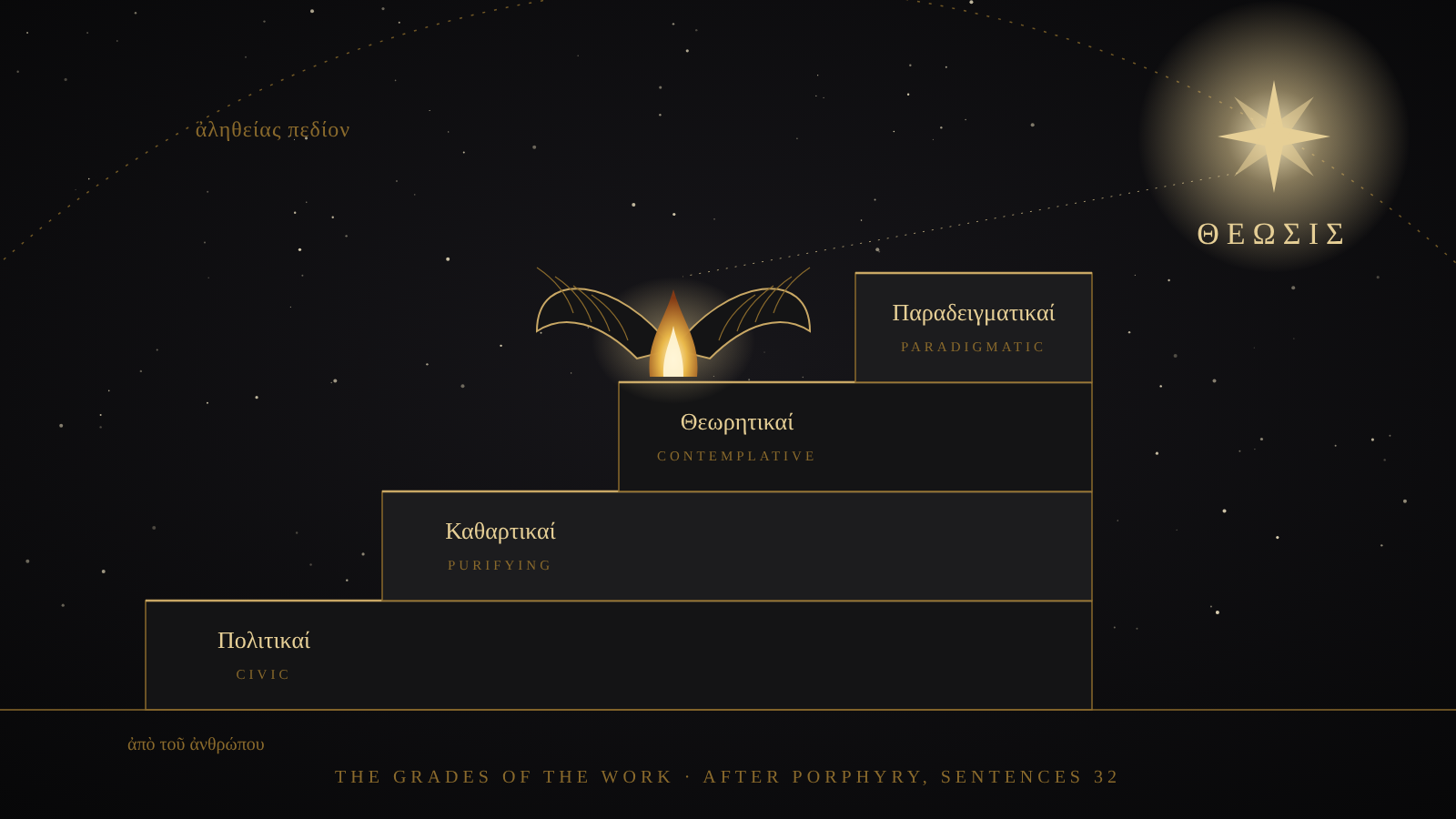
More Than One Lifetime
The Work is longer than a life, and the Ancients said so without embarrassment. Plato gives the figures. The soul that has lost its wings regains them in 10,000 years; the soul that chooses the philosophic life 3 times in succession regains them in 3,000, and at each turn of 1,000 years the soul chooses its next life.6 Pindar sings of those "who have 3 times on either side kept their soul wholly from wrong" and travel the road of Zeus to the tower of Kronos.25 Empedocles lists the final births, seers, singers, physicians and princes, and then the rising up as Gods.7 Herodotus records that the Egyptians were the first to teach that the soul is immortal and passes through its circuit of 3,000 years.68 The Gītā promises the yogi who falls short "a pure and prosperous house" or "a family of yogis" for his next birth, and the goal "at the end of many births."8
Bhagavad Gītā 6.43 and 6.458
tatra taṃ buddhisaṃyogaṃ labhate paurvadehikam, yatate ca tato bhūyaḥ saṃsiddhau kurunandana. ... prayatnād yatamānas tu yogī saṃśuddhakilbiṣaḥ, anekajanmasaṃsiddhas tato yāti parāṃ gatim.
"There he regains the understanding of his former body, and strives again for perfection, joy of the Kurus. ... The yogi who strives with effort, cleansed of sin, perfected through many births, then reaches the highest goal."
Two errors follow from this doctrine when it is half understood, and the Temple rejects both. The first is despair: if the Work takes 3,000 years, why begin? The second is delay: if there are many lives, this one can be spent otherwise. Both mistake the arithmetic for the Work. Plato's 3 philosophic lives must be consecutive, ἐφεξῆς; a life spent otherwise breaks the sequence and sends the soul back into the long circuit.6 The Gītā's yogi is reborn into a house where the Work continues because he was at the Work when he died. Heracles himself, the son of a God, took 12 years of service, a lifetime of labour and a pyre, and Teiresias knew at the cradle that the pyre would be needed. Nobody is exempted from the length of the road, and nobody is excused from walking it today.
Each life reaches its highest worth in the pursuit. This is the Zevist position, and it follows from the sources. The Timaeus calls the man who tends his divine part "happy above all men," in this life, before any question of the next.17 The Symposium says that the one who has begotten true Arete is dear to the Gods now.29 A life ordered toward Theosis is not a life postponed; it is the only life that is fully lived, because it is the only one that spends itself on what the human being is for. The soul that dies at the Work has lost nothing. It has raised its place in the next life, and the Gods, who count, have the count.
Βραχὺς ὁ εἷς βίος· ἀρκεῖ δὲ πᾶς βίος πρὸς τὸ ἔργον τῆς αὑτοῦ ἡμέρας.
A single life is short; yet every life suffices for the work of its own day.
Objections and Replies
Objection I: "Theosis is a Christian word, and the Temple is borrowing it."
The noun is attested first in a Christian author of the 4th century CE; the verb, the doctrine and the definition are older and belong to the Gods. Θεωθῆναι stands in the Hermetic Poimandres; "to be God" is the goal of the virtues in Plotinus; ὁμοίωσις θεῷ is Plato's; the gold tablets of Thurii say "a God you have become" a century before Plato wrote it down; Empedocles said it of himself a century before that.2, 23, 1, 28, 7 The definition that the Church uses, "being made like God and union with him, as far as is attainable," is Plato's sentence rewritten by a reader of Proclus.22 The borrowing ran the other way, and the borrowers then declared the Work impossible for anyone but 1 person. The Temple takes the word back and reads it as its makers did.3
Objection II: "Heracles is a myth. No man has become a God."
The Greeks who built his temples knew the difference between a story and a cult, and they gave him both cults, the God's and the hero's, in the same cities.4 Diodorus records the spread of the divine honours from Athens to all mankind.50 Egypt supplies 2 men whose careers are documented in stone, Imhotep and Amenhotep son of Hapu, who were worshipped as Gods for 1,000 years and more.15 The Ancients did not treat Theosis as a figure of speech. They treated it as something that had happened, and they arranged their worship accordingly. Zevism follows them, and it follows them on the point that matters most: whether or not every detail of the labours is history, the pattern the Gods gave in Heracles is the pattern of the Work, and a pattern is followed, not argued with.
Objection III: "To seek to become a God is hubris."
It would be, if the Gods had forbidden it. They command it. Plato has the Gods "never neglect" the man who strives to be made like them; the Theaetetus gives the striving as the whole purpose of a human life; the Pythia promised Heracles immortality in the God's own words.62, 1, 46 Hubris is the Giants, whom Heracles fought beside the Gods: an impious race, Macrobius writes, who denied the Gods and thought to drive them from heaven.54 The Work is the opposite of that. It is 12 years of service to a lesser man, purification before Delphi, initiation before Hades, labours done for no pay and a pyre at the end. The man who does the Work serves the Gods in everything and is measured by Plato's κατὰ τὸ δυνατόν; the man who denies the Gods and seizes heaven is a Giant. Zevism knows the difference, and so did the Greeks: Heracles's name was given to him by Apollo and his seat on Olympus by Zeus.
Conclusion: The Imperative
Theosis is the ultimate imperative of the Zevist path, and it is an imperative in the plain sense: a command, given by the Gods, to become what they are, as far as is possible, and to leave no part of it undone. Plato wrote the command in Greek, Egypt carved it in the tombs, the Vedic seers chanted it, and Heracles carried it out in a body, in a life, in 12 labours and a fire.
The Work is not a procedure. It is the ordering of a whole life, with 4 hands: Meditation that builds the vessel, Theurgy that joins it to the Gods, Education that shows the road, and pious works, the worship of Zeus and the Gods carried into deeds, which build the Arete that lifts the soul. It takes longer than a life, and every life spent on it is a life that has reached its highest worth. The Gods lead the one who sets out; they armed Heracles before his first labour and sent the cloud at his last.
The Greeks had a word for the man who finished, and Hesiod used it of Heracles: ὄλβιος, blessed, "who having accomplished a great work among the immortals dwells unharmed and ageless for all days."20 That is the Magnum Opus. That is what the Temple of Zeus exists to teach, and that is what each Zevist is for.
Plato, Theaetetus 176b1
φυγὴ δὲ ὁμοίωσις θεῷ κατὰ τὸ δυνατόν· ὁμοίωσις δὲ δίκαιον καὶ ὅσιον μετὰ φρονήσεως γενέσθαι.
"The flight is likeness to God as far as is possible; and likeness is to become just and holy, with wisdom."
Ἄρχου σήμερον· ὁ γὰρ Ὄλυμπος οὐ φεύγει, ἀλλὰ μένει τὸν ἀναβαίνοντα.
Begin today. Olympus does not run away; it waits for the one who climbs.
High Priest Zevios Metathronos
Temple of Zeus Foundation
Sources & References
- Plato, Theaetetus 176a to c: φυγὴ δὲ ὁμοίωσις θεῷ κατὰ τὸ δυνατόν· ὁμοίωσις δὲ δίκαιον καὶ ὅσιον μετὰ φρονήσεως γενέσθαι; God is in no way unjust, and nothing is more like him than the one who becomes as just as possible. Ed. J. Burnet, Oxford Classical Texts, 1900. The Temple's page ὁμοίωσις θεῷ: Becoming a God sets out this text with Republic 613a to b, Laws 716c to d and Phaedrus 252e to 253a.
- Corpus Hermeticum I (Poimandres) 26: "this is the good end for those who have gained knowledge: to be made God" (τοῦτό ἐστι τὸ ἀγαθὸν τέλος τοῖς γνῶσιν ἐσχηκόσι, θεωθῆναι). X.25: "one must dare to say that the man on earth is a mortal God, and the God in heaven an immortal man." XIII: the discourse on rebirth (παλιγγενεσία). Ed. A. D. Nock and A.-J. Festugière, Budé, 1945 to 1954; English, B. P. Copenhaver, Cambridge, 1992.
- Temple of Zeus, ὁμοίωσις θεῷ: Becoming a God, the Temple's teaching on Plato's statement of the aim, on the prohibition that later closed it, and on the 4 dimensions of the Zevist path.
- Herodotus, Histories 2.43 to 44: the Egyptian Heracles is 1 of the 12 Gods and far older than the Greek hero; the Greeks who have 2 sanctuaries of Heracles "act most correctly" (ὀρθότατα Ἑλλήνων ποιέειν), worshipping the 1 as an immortal under the name Olympian and making offerings to the other as a hero (τῷ μὲν ὡς ἀθανάτῳ Ὀλυμπίῳ δὲ ἐπωνυμίην θύουσι, τῷ δὲ ἑτέρῳ ὡς ἥρωι ἐναγίζουσι, 2.44.5). Greek text ed. Hude, Oxford; English, A. D. Godley, Loeb, 1920.
- Xenophon, Memorabilia 2.1.21 to 34: the fable of Prodicus, Heracles at the crossroads between Vice and Arete. 2.1.28: "of the things that are good and fair the Gods give nothing to men without toil and care; if you wish the Gods to be gracious to you, you must serve the Gods" (τῶν γὰρ ὄντων ἀγαθῶν καὶ καλῶν οὐδὲν ἄνευ πόνου καὶ ἐπιμελείας θεοὶ διδόασιν ἀνθρώποις, ἀλλ᾽ εἴτε τοὺς θεοὺς ἵλεως εἶναί σοι βούλει, θεραπευτέον τοὺς θεούς). Ed. E. C. Marchant, Oxford Classical Texts, 1921.
- Plato, Phaedrus 246a to 249d: the soul as winged chariot; Zeus drives first and the Gods follow; the wing is nourished by the beautiful, the wise and the good; the ordinary soul regains its wings after 10,000 years, the soul that chooses the philosophic life 3 times in succession after 3,000 (248e to 249a); the follower of each God honours and imitates that God as far as he can (252e to 253a). Ed. Burnet, 1901.
- Empedocles, fragments B112, B146 and B147 Diels-Kranz: "I go among you an immortal God, no longer mortal" (ἐγὼ δ᾽ ὑμῖν θεὸς ἄμβροτος, οὐκέτι θνητός); at the end the purified souls become seers, singers of hymns, physicians and princes among men, "and from these they rise up as Gods, highest in honour" (ἔνθεν ἀναβλαστοῦσι θεοὶ τιμῆισι φέριστοι), "sharing hearth and table with the other immortals." Ed. H. Diels and W. Kranz, Die Fragmente der Vorsokratiker, 6th ed., 1951.
- Bhagavad Gītā 6.41 to 45: the yogi who falls short is born again into a pure and prosperous house or into a family of yogis, "there he regains the understanding of his former body and strives again for perfection" (tatra taṃ buddhisaṃyogaṃ labhate paurvadehikam, yatate ca tato bhūyaḥ saṃsiddhau, 6.43); "the yogi who strives with effort, cleansed of sin, perfected through many births, then reaches the highest goal" (anekajanmasaṃsiddhas tato yāti parāṃ gatim, 6.45). 7.19: "at the end of many births the man of knowledge comes to me" (bahūnāṃ janmanām ante jñānavān māṃ prapadyate). Ed. and trans. W. J. Johnson, Oxford World's Classics, 1994; Sanskrit text, S. K. Belvalkar, critical edition, Poona, 1945.
- Greek Magical Papyri, PGM IV.475 to 829 (the so-called Mithras Liturgy), with the rite's own name at lines 741 and 747, ἀπαθανατισμός, "immortalization": the initiate, "born of mortal womb," is reborn and ascends through the gates of heaven to stand before the God. Ed. K. Preisendanz, 2nd ed. A. Henrichs, Teubner, 1973; English, H. D. Betz, The Greek Magical Papyri in Translation, Chicago, 1986.
- J. Assmann, Death and Salvation in Ancient Egypt, trans. D. Lorton, Cornell University Press, 2005, chs. 3 and 15, on the dead "becoming Osiris" and on the Egyptian idea of transfiguration (the akh).
- Book of the Dead, spells 76 to 88 (the transformations) and spell 125 (the judgment in the Hall of the Two Truths, the heart weighed against the feather of Ma'at, the declaration of innocence before 42 judges); the justified dead is mꜣꜥ-ḫrw, "true of voice," and is addressed as "the Osiris N." Trans. R. O. Faulkner, The Ancient Egyptian Book of the Dead, ed. C. Andrews, British Museum Press, 1985. Papyrus of Hunefer, British Museum EA 9901, sheet 3: Anubis leads the dead by the hand to the balance.
- Pyramid Texts, Utterances 273 to 274 (the so-called Cannibal Hymn), §400a and §408a: "N. is he who eats men and lives on Gods"; "N. is a God older than the eldest." Trans. S. A. B. Mercer, The Pyramid Texts in Translation and Commentary, Longmans, 1952; R. O. Faulkner, The Ancient Egyptian Pyramid Texts, Oxford, 1969.
- Bhagavad Gītā 4.9 to 10: whoever knows the divine birth and action of the God, leaving the body, "comes to me"; many, purified by the tapas of knowledge, "have come to my being" (madbhāvam āgatāḥ). 14.26: the one who serves the God with unswerving devotion "passes beyond the strands and is fit to become Brahman" (brahmabhūyāya kalpate). 8.15 to 16: having come to the God there is no rebirth.
- Pindar, Nemean 3.21 to 23: the Pillars of Heracles beyond which no one sails, set as witnesses of the furthest voyage by "the hero God" (ἥρως θεός). Nemean 1.69 to 72: Teiresias foretells that Heracles, his labours done, will receive peace for all time in the house of the blessed, take Hebe as his bride and praise the law of Zeus. Ed. J. E. Sandys, Loeb, 1915.
- D. Wildung, Egyptian Saints: Deification in Pharaonic Egypt, New York University Press, 1977: the cults of Imhotep, architect of Djoser, and of Amenhotep son of Hapu, scribe of Amenhotep III, both historical men later worshipped as Gods, with temples at Deir el-Bahari and elsewhere. For Imhotep as the Greek Imouthes-Asclepius: P.Oxy. XI 1381 (2nd century CE), ed. B. P. Grenfell and A. S. Hunt, The Oxyrhynchus Papyri XI, 1915.
- Bhagavad Gītā 3.19 to 20: "by works alone Janaka and others reached perfection" (karmaṇaiva hi saṃsiddhim āsthitā janakādayaḥ). 18.45 to 46: "devoted each to his own work, a man attains perfection" (sve sve karmaṇy abhirataḥ saṃsiddhiṃ labhate naraḥ), when he worships by that work the One from whom all beings proceed.
- Plato, Timaeus 90a to d: the highest part of the soul is a daimon given by God, which raises man from the earth toward his kindred in heaven, "as being a plant not of earth but of heaven"; whoever tends it must think immortal and divine thoughts and, insofar as human nature can share in immortality, leave no part of it undone, and is happy (εὐδαίμονα) above all men. Ed. Burnet, 1902.
- Instruction for Merikare, Papyrus Leningrad 1116A, lines 53 to 57: "the court that judges the wretch, you know they are not lenient ... a man remains after death, and his deeds are set beside him in heaps"; "do Ma'at, that you may endure on earth." Trans. M. Lichtheim, Ancient Egyptian Literature, vol. I, University of California Press, 1973, pp. 99 to 109.
- Homer, Odyssey 11.601 to 604: Odysseus sees in Hades the phantom (εἴδωλον) of Heracles, "but he himself among the immortal Gods takes his pleasure at the feast and has Hebe of the fair ankles" (αὐτὸς δὲ μετ᾽ ἀθανάτοισι θεοῖσι τέρπεται ἐν θαλίῃς καὶ ἔχει καλλίσφυρον Ἥβην). Greek text: T. W. Allen, Oxford Classical Texts; English, A. T. Murray, Loeb, 1919.
- Hesiod, Theogony 950 to 955: Heracles, "having completed his groaning labours" (τελέσας στονόεντας ἀέθλους), takes Hebe as his wife on snowy Olympus, "blessed, who having accomplished a great work among the immortals dwells unharmed and ageless for all days" (ὄλβιος, ὃς μέγα ἔργον ἐν ἀθανάτοισιν ἀνύσσας ναίει ἀπήμαντος καὶ ἀγήραος ἤματα πάντα). Ed. H. G. Evelyn-White, Loeb, 1914.
- Śatapatha Brāhmaṇa 1.1.1.4: "the Gods are truth, and men are untruth; in saying, Here I pass from untruth into truth, he passes from men to the Gods" (satyam eva devā anṛtaṃ manuṣyā ... tan manuṣyebhyo devān upaiti). Ed. A. Weber, Berlin, 1855; trans. J. Eggeling, Sacred Books of the East XII, 1882.
- Pseudo-Dionysius, Ecclesiastical Hierarchy 1.3 (PG 3, 376A): "theosis is the being made like God and the union with him, as far as is attainable" (ἡ δὲ θέωσίς ἐστιν ἡ πρὸς θεὸν ὡς ἐφικτὸν ἀφομοίωσίς τε καὶ ἕνωσις); the definition reproduces Plato's ὁμοίωσις θεῷ κατὰ τὸ δυνατόν and the Proclean union. On the vocabulary: N. Russell, The Doctrine of Deification in the Greek Patristic Tradition, Oxford University Press, 2004, ch. 7 on Gregory of Nazianzus, who first uses the noun θέωσις, and Appendix 2, "The Greek Vocabulary of Deification."
- Plotinus, Enneads I.2.6: "our concern is not to be free of sin, but to be God" (ἡ σπουδὴ οὐκ ἔξω ἁμαρτίας εἶναι, ἀλλὰ θεὸν εἶναι). I.6.9: "never did eye see the Sun unless it had first become sunlike, nor can a soul see beauty unless it has become beautiful; let each one first become godlike and beautiful if he means to see God and beauty" (γενέσθω δὴ πρῶτον θεοειδὴς πᾶς καὶ καλὸς πᾶς, εἰ μέλλει θεάσασθαι θεόν τε καὶ καλόν). Ed. Henry and Schwyzer; English, Armstrong, Loeb.
- Porphyry, Sentences 32: the 4 grades of the virtues; the civic make a good man, the purifying a daimonic man, the contemplative a God, and the paradigmatic a father of Gods (θεῶν πατήρ). Ed. E. Lamberz, Teubner, 1975.
- Pindar, Olympian 2.68 to 77: those who have 3 times on either side kept their soul wholly from wrong travel the road of Zeus to the tower of Kronos, where the Isle of the Blessed lies. Nemean 6.1 to 7: 1 is the race of men and of Gods, and from 1 mother both draw breath, though all power divides them. Ed. Sandys, Loeb, 1915.
- Pythagorean Golden Verses 70 to 71: "if you leave the body behind and come to the free aether, you will be an immortal God, undying, no longer mortal" (ἔσσεαι ἀθάνατος θεὸς ἄμβροτος, οὐκέτι θνητός). Ed. J. C. Thom, The Pythagorean Golden Verses, Brill, 1995. Hierocles, Commentary on the Golden Verses 27, on the ascent of the purified soul.
- Heraclitus, fragment B62 Diels-Kranz: "Immortals mortal, mortals immortal, living the death of the others, dead in the life of the others."
- Orphic gold tablets from Thurii, 4th century BCE, OF 487 and 488 Bernabé: "a God you have become, out of a man" (θεὸς ἐγένου ἐξ ἀνθρώπου); "happy and blessed one, a God you shall be instead of a mortal" (θεὸς δ᾽ ἔσῃ ἀντὶ βροτοῖο). Ed. A. Bernabé, Poetae Epici Graeci II.2, Teubner, 2005; A. Bernabé and A. I. Jiménez San Cristóbal, Instructions for the Netherworld, Brill, 2008.
- Plato, Symposium 212a: the one who has begotten and nurtured true Arete becomes dear to the Gods and, "if any man can be immortal, he can" (τεκόντι δὲ ἀρετὴν ἀληθῆ καὶ θρεψαμένῳ ὑπάρχει θεοφιλεῖ γενέσθαι, καὶ εἴπέρ τῳ ἄλλῳ ἀνθρώπων ἀθανάτῳ καὶ ἐκείνῳ). Ed. Burnet, 1901.
- Aristotle, Nicomachean Ethics 10.7, 1177b26 to 1178a2: the life of Nous is divine in comparison with human life; a man must not follow those who tell him to think mortal thoughts because he is mortal, but "make himself immortal as far as possible" (ἐφ᾽ ὅσον ἐνδέχεται ἀθανατίζειν). 2.1, 1103a17: ethical virtue comes from habit. Ed. I. Bywater, Oxford Classical Texts, 1894.
- Ṛgveda 9.113.7 to 11: "where there is inexhaustible light, in the world where the Sun is set, in that immortal, imperishable world place me, O Pavamāna" (yatra jyotir ajasraṃ yasmin loke svar hitam, tasmin māṃ dhehi pavamānāmṛte loke akṣita). Ed. T. Aufrecht, 1877; trans. S. W. Jamison and J. P. Brereton, The Rigveda, Oxford University Press, 2014.
- Muṇḍaka Upaniṣad 3.2.9: "whoever knows that highest Brahman becomes Brahman himself" (sa yo ha vai tat paramaṃ brahma veda brahmaiva bhavati). 3.1.5 to 6: the Self is won by truth, tapas, right knowledge and chastity; by truth is laid the road the Gods travel. Ed. Olivelle, 1998.
- Bṛhadāraṇyaka Upaniṣad 4.4.6 to 7: of the one who is without desire, whose desire is the Self, the breaths do not depart; "being Brahman, he goes to Brahman" (brahmaiva san brahmāpyeti); "when all the desires that dwell in the heart are let go, then the mortal becomes immortal and attains Brahman here." Ed. and trans. P. Olivelle, The Early Upaniṣads, Oxford University Press, 1998.
- Chāndogya Upaniṣad 6.8.7: "that is the Self; you are that" (tat tvam asi). 8.12.3: the serene one, rising out of this body and reaching the highest light, "is established in his own form; that is the supreme Person" (svena rūpeṇābhiniṣpadyate, sa uttamaḥ puruṣaḥ). Ed. Olivelle, 1998.
- Taittirīya Upaniṣad 2.1.1: "the knower of Brahman attains the highest" (brahmavid āpnoti param). Ed. Olivelle, 1998.
- J. Woodroffe (Arthur Avalon), Shakti and Shākta, 3rd ed., Ganesh & Co., 1929, ch. 21, "Hindu Ritual": "By meditating on Vishnu, man becomes Vishnu. By meditating on Devi, man becomes Devi"; ch. 23, "The Psychology of Hindu Religious Ritual": "by the worship of Vishnu, man becomes Vishnu."
- Temple of Zeus, Satya, Ma'at and Arete: The Cosmos Around the Throne of Zeus, on Arete as the Vehicle of ascent and on Ma'at as the Order that flows from Truth.
- Hesiod, Works and Days 289 to 292: before Arete the immortal Gods have set sweat; long and steep is the road to it and rough at first, but when a man reaches the top it becomes easy. Ed. Evelyn-White, Loeb, 1914.
- Iamblichus, On the Mysteries I.12: the theurgic rites do not drag the impassible Gods down to men; they make the human soul fit to be raised to the Gods. II.11: it is not thought that joins the theurgist to the Gods, but the accomplishment of the ineffable works. X.5 to 7: the hieratic art leads the soul upward by stages to union with the Gods. Ed. and trans. E. C. Clarke, J. M. Dillon and J. P. Hershbell, Society of Biblical Literature, 2003.
- Kaṭha Upaniṣad 1.2.23 (= Muṇḍaka 3.2.3): "this Self is not won by instruction, nor by intellect, nor by much learning; he is won by the one whom he chooses; to him this Self reveals his own form" (nāyam ātmā pravacanena labhyo na medhayā na bahunā śrutena, yam evaiṣa vṛṇute tena labhyas tasyaiṣa ātmā vivṛṇute tanūṃ svām). 1.3.3 to 9: the Self as the rider in the chariot, the body as the chariot, the intellect as the charioteer. Ed. Olivelle, 1998.
- Epictetus, Discourses 2.16.44 to 46: "If Heracles had sat at home, what would he have been? Eurystheus and not Heracles." Nothing was dearer to him than God, "therefore he was believed to be the son of Zeus, and he was"; obeying him he went about "cleansing away injustice and lawlessness." "But you are not Heracles ... cleanse what is your own: cast out of your mind, instead of Procrustes and Sciron, grief, fear, desire, envy, malice, avarice, softness, incontinence" (τὰ σαυτοῦ κάθαρον). Also 3.24.13 to 16 and 3.26.31. Ed. H. Schenkl, Teubner, 1916; English, W. A. Oldfather, Loeb, 1925.
- Plato, Phaedo 69c to d: the founders of the mysteries taught that the uninitiated lie in the mire while the purified and initiated dwell with the Gods; "many are the wand-bearers, but the bacchoi are few"; the bacchoi are those who have practised philosophy rightly. Ed. Burnet, 1900.
- Theocritus, Idyll 24 (Heracliscus) 79 to 85: Teiresias to Alcmene, "such a man is this son of yours, destined to mount to the star-bearing heaven, a broad-chested hero; 12 labours accomplished, it is fated for him to dwell in the house of Zeus, and all that is mortal in him the Trachinian pyre will have; he shall be called the son-in-law of the immortals" (δώδεκά οἱ τελέσαντι πεπρωμένον ἐν Διὸς οἰκεῖν μόχθους, θνητὰ δὲ πάντα πυρὰ Τραχίνιος ἑξεῖ). Lines 103 to 134: his teachers, Linus for letters, Eurytus for the bow, Eumolpus for the lyre, Harpalycus for wrestling and boxing, Amphitryon for the chariot, Castor for arms. Ed. A. S. F. Gow, Cambridge, 1952.
- Apollodorus, Library 2.4.9: Heracles taught chariot-driving by Amphitryon, wrestling by Autolycus, archery by Eurytus, arms by Castor and the lyre by Linus. 2.4.11: the gifts of the Gods, a sword from Hermes, a bow from Apollo, a golden breastplate from Hephaestus and a robe from Athena; the club he cut himself at Nemea.
- Dio Chrysostom, Oration 1 (On Kingship) 59 to 84: Hermes leads the young Heracles to the twin peaks where Royalty and Tyranny sit enthroned; Heracles chooses Royalty, and Zeus makes him king of all mankind. Ed. J. W. Cohoon, Loeb, 1932.
- Apollodorus, Library 2.4.12: the madness sent by Hera, the purification by Thespius, the oracle at Delphi that first named him Heracles and promised immortality once the labours were done (τῶν ἄθλων συντελεσθέντων, ἀθάνατον αὐτὸν ἔσεσθαι). Greek text ed. R. Wagner, Teubner, 1894; English, Sir James George Frazer, Loeb Classical Library, 1921.
- Diodorus Siculus, Library of History 4.10.7: the Pythia tells Heracles to serve Eurystheus and perform 12 labours, after which he would receive immortality. 4.11 to 4.27: the labours; 4.12.2, Eurystheus hides in a bronze jar when the boar is brought; 4.15.3 to 4, Diomedes thrown to his own mares. Greek text and English, C. H. Oldfather, Loeb Classical Library, vol. II, 1935.
- Sophocles, Women of Trachis 1191 to 1215: the dying Heracles orders Hyllus to carry him to the summit of Oeta, "the sacred mountain of Zeus most high," build a pyre and set him on it. Ed. Jebb, Cambridge, 1892.
- Apollodorus, Library 2.7.7: the pyre on Mount Oeta, lit by Poeas; the cloud and the thunder that carried Heracles to heaven; his immortality, his reconciliation with Hera and his marriage to Hebe, with the sons Alexiares and Anicetus (καιομένης δὲ τῆς πυρᾶς λέγεται νέφος ὑποστὰν μετὰ βροντῆς αὐτὸν εἰς οὐρανὸν ἀναπέμψαι).
- Diodorus Siculus, Library of History 4.38.4 to 4.39.4: the pyre on Oeta, the lightning, the disappearance of his bones; Menoetius and Iolaus honour him as a hero, the Athenians are the first to honour him as a God and bring the Greeks and then all mankind to do the same; Zeus persuades Hera to adopt him by a rite that imitates birth, and Hebe is given to him.
- Ovid, Metamorphoses 9.229 to 272: the pyre on Oeta; "whatever the flame could ravage, Mulciber took away, and no likeness of Hercules remained that could be recognized ... he keeps only the traces of Jove"; "so when the Tirynthian had put off his mortal limbs, in his better part he flourished" (parte sui meliore viget). Ed. R. J. Tarrant, Oxford Classical Texts, 2004.
- Sophocles, Philoctetes 1409 to 1444: the deified Heracles appears from "the heavenly seat" to declare the plans of Zeus, and says of himself, "having toiled through and passed through so many toils I have won immortal Arete, as you can see" (ὅσους πονήσας καὶ διεξελθὼν πόνους ἀθάνατον ἀρετὴν ἔσχον, ὡς πάρεσθ᾽ ὁρᾶν, 1419 to 1420). Ed. Sir Richard Jebb, Cambridge, 1898.
- Plotinus, Enneads I.1.12 and IV.3.27: the 2 Heracleses of the Odyssey, the shade in Hades and the self among the Gods, read as the lower soul that remembers the deeds and the higher soul that has left them behind. Ed. P. Henry and H.-R. Schwyzer; English, A. H. Armstrong, Loeb, 1966 to 1988.
- Macrobius, Saturnalia 1.20.6 to 8: "Hercules is that power of the Sun which supplies the human race with virtue in the likeness of the Gods" (Hercules ea est solis potestas quae humano generi virtutem ad similitudinem praestat deorum); the son of Alcmena was neither the only nor the first to bear the name, but the last to be judged worthy of it, "because by his surpassing courage he earned the name of the God who governs virtue"; the Giants he fought were an impious race who denied the Gods. Ed. J. Willis, Teubner, 1963; English, R. A. Kaster, Loeb, 2011.
- Apollodorus, Library 2.5.1 to 2.5.12: the 12 labours in order. 2.5.2: Eurystheus refuses to count the Hydra because Iolaus helped. 2.5.5: he refuses to count the stables because Heracles asked Augeas for pay. 2.5.11: the 11th and 12th labours imposed in their place. 2.5.12: Heracles initiated at Eleusis by Eumolpus before descending to Hades, where Hermes and Athena stand by him.
- Temple of Zeus, Meditation, Magick and Teachings; Zevist Numerology: Double Digit Numbers, on 12 as the number of the completed cycle and of the Twelve Ruling Gods; The Gods.
- Heraclitus, Homeric Problems 33: Heracles "a man of understanding, an initiate of heavenly wisdom" who cleared philosophy of its errors; the Boar is incontinence, the Lion blind impulse, the Hind cowardice, the Stables the filth of the passions, the Birds windy hopes, and the dog of Hades the many-headed power of pleasure. Ed. and trans. D. A. Russell and D. Konstan, Heraclitus: Homeric Problems, Society of Biblical Literature, 2005.
- L. Annaeus Cornutus, Compendium of Greek Theology 31: Heracles is the Logos in all things, strong and unconquered, who distributes power and strength to the parts of nature; the club and the lion skin signify his hardness and his force. Ed. C. Lang, Teubner, 1881; trans. R. S. Hays, 1983.
- Boethius, Consolation of Philosophy 4, metre 7: the labours of Hercules sung as the pattern of the brave, closing "the earth overcome gives the stars" (superata tellus sidera donat). Ed. L. Bieler, Corpus Christianorum, 1957.
- Julian, Oration 7 (To the Cynic Heracleios) 219c to 220a: Zeus begot Heracles to be the saviour of the world and gave him Athena as guardian; after his labours Zeus received him into heaven in the lightning, the symbol of the divine fire. Ed. W. C. Wright, Loeb, vol. II, 1913.
- Patañjali, Yoga Sūtra 1.23 and 2.45: devotion to the Lord (īśvarapraṇidhāna) as a means, and "the perfection of samādhi comes from devotion to the Lord" (samādhisiddhir īśvarapraṇidhānāt). Ed. and trans. E. Bryant, The Yoga Sūtras of Patañjali, North Point Press, 2009.
- Plato, Republic 10, 613a to b: the Gods never neglect the one who strives to become just and, by practising Arete, to be made like God as far as is possible for a man (εἰς ὅσον δυνατὸν ἀνθρώπῳ ὁμοιοῦσθαι θεῷ). Republic 7, 518c to d: education is the art of turning the soul around (τέχνη τῆς περιαγωγῆς), the organ of knowledge being already present and only needing to be turned toward the light. Ed. Burnet, 1902.
- Plato, Laws 1, 643e to 644a: the education under discussion is "the education toward Arete from childhood, which makes a man desire and love to become a perfect citizen, knowing how to rule and be ruled with justice" (τὴν δὲ πρὸς ἀρετὴν ἐκ παίδων παιδείαν, ποιοῦσαν ἐπιθυμητήν τε καὶ ἐραστὴν τοῦ πολίτην γενέσθαι τέλεον, ἄρχειν τε καὶ ἄρχεσθαι ἐπιστάμενον μετὰ δίκης). Ed. Burnet, 1907.
- Proclus, Platonic Theology I.25: the theurgic power is "better than all human wisdom and knowledge." Ed. H. D. Saffrey and L. G. Westerink, Budé, vol. I, 1968.
- Marinus, Life of Proclus 28 to 30: Proclus' theurgic works, the healing of Asclepigeneia through Asclepius, and the dream in which Athena, when her statue was removed from the Parthenon, announced that "the Lady of Athens wishes to live with you." Ed. and trans. H. D. Saffrey and A.-Ph. Segonds, Marinus: Proclus ou sur le bonheur, Budé, 2001.
- Chaldean Oracles, fragment 153 des Places, quoted by John Lydus, On the Months 2.10: "theurgists do not fall under the herd of fate" (οὐ γὰρ ὑφ᾽ εἱμαρτὴν ἀγέλην πίπτουσι θεουργοί). Ed. É. des Places, Oracles chaldaïques, Budé, 1971; R. Majercik, The Chaldean Oracles, Brill, 1989.
- Apuleius, Metamorphoses 11.5 to 6 and 11.21: Isis appears to Lucius and calls him to her service; the priest explains that no one may be initiated until the Goddess herself appoints the day, since the rite is performed "in the likeness of a voluntary death and of a salvation obtained by grace" (ad instar voluntariae mortis et precariae salutis). Ed. R. Helm, Teubner, 1931; English, J. G. Griffiths, The Isis-Book, Brill, 1975.
- Herodotus, Histories 2.123: the Egyptians were the first to teach that the soul of man is immortal and, when the body perishes, enters another creature, completing its circuit in 3,000 years.