





| Language | Name of Artemis | Attestation |
|---|---|---|
| Mycenaean Greek | ati-mi-te (𐀀𐀴𐀖𐀳) | PY Un 219 (1200BCE) |
| Classical Greek | Ἄρτεμις (Artemis) | Homer (8th century BCE onward) |
33 min read
ARTEMIS
author: High Priest Zevios Metathronos
co-author: Novice Priest Karnonnos
Hieratic Information about Artemis
| Divine Names | |
|---|---|
| Artemis (Ἄρτεμις) | the ancient Hellenic name1 |
| These hieratic names carry strong spiritual resonance and are recommended for summoning and invocation practices. | |
| Divine Symbols | |
| |
| Divine Numbers and Attributes | |
| Sacred Numbers | 40, 50, 60 |
| Runes | Thurisaz, Tiwaz, Sowilo (in order of importance) |
| Zodiac Sign of Power | Aries |
| Sacred Animals | The Great Eagle, the Bull, the Hawk, the Serpent |
| Element | Fire, Aether |
| Divine Forces | |
| |
| Important Titles | |
| |
| Names Across Civilizations | |
| Greek | Artemis (Ἀρταμις) |
| Etruscan | Artume |
| Roman | Diana |
| Thracian | Bendis |
| Celtic | Arduinna |
| Phoenician | Anat |
I. The Name of Artemis, the Primeval Goddess
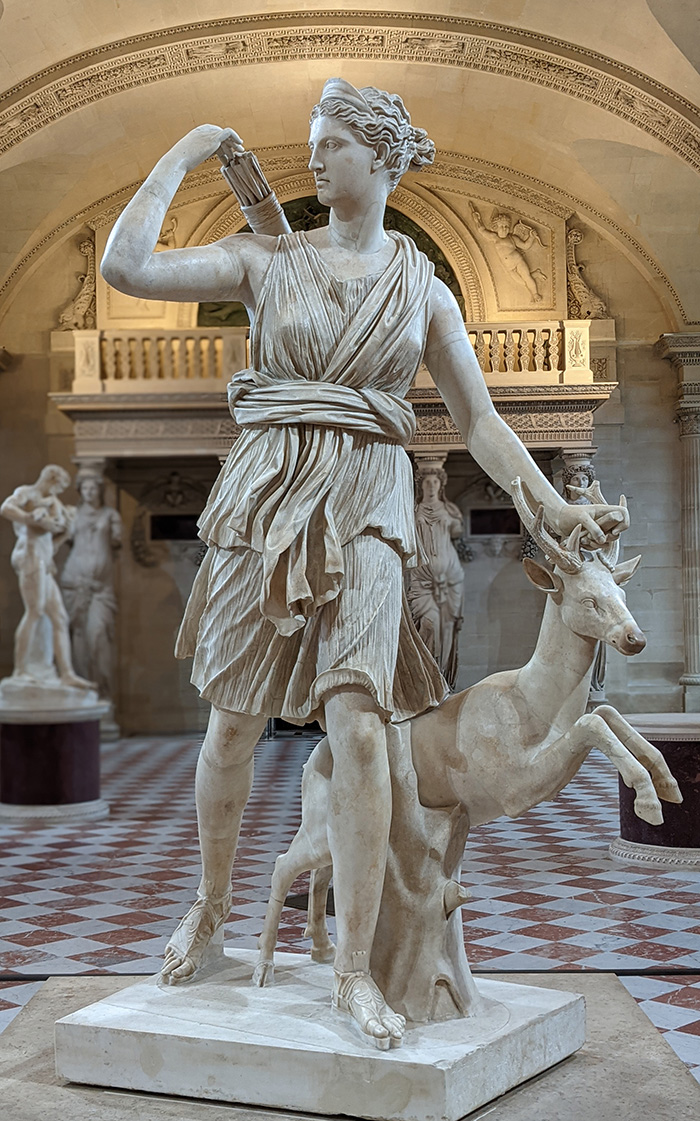
The Diana of Versailles, a Roman copy of a Greek sculpture by Leochares, Louvre Museum
The etymology of Artemis is disputed. Plato indicated its meaning in the Cratylus dialogue, 406b-c.1 Socrates gives several explanations; ἀρτεμές (artemes), meaning safe, sound, unharmed or unadulterated, ἀρετῆς ἵστωρ (aretes istor), meaning knower of virtue or knower of origin, and ἀρότου μισήσασα (ploughing-hater), widely held to be a reference to the virgin maiden's hatred for intercourse, but also a subtle reference to her clashing with civilization. It is explained by Socrates that her names result from her balanced nature.2
Another etymology connects her to the word 'hunter, butcher, slaughterer' in Attic Greek, ἄρταμος, supported by a link to the Doric form of her name.2 Modern theorists have postulated a connection to the word arktos or bear, one of her animals.3 The Kallisto myth is linked to this ferocious animal, as are other stories of girls and bears.
Artemis appears to be a goddess of very ancient standing.3 Her name is likely represented in the Linear B corpus in two areas, both documents from the Mycenean site of Pylos. PY Un 219 calls her "a-ti-mi-te", while PY ES 650 calls her "a-te-mi-to".
Sources: Homer, The Iliad, trans. A. T. Murray, rev. William F. Wyatt, Cambridge, MA, Harvard University Press, 5.51 (1999); Zolotnikova, Olga Albert. Becoming Classical Artemis: A Glimpse at the Evolution of the Goddess as Traced in Ancient Arcadia (2017); Budin, Artemis, Gods and Heroes of the Ancient World (2015)3,4,5,6
II. Artemis in the Hellenic World
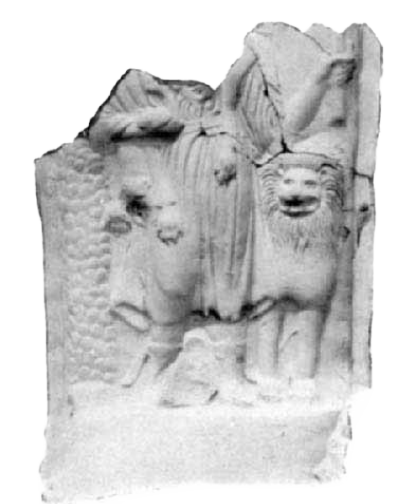
Figurine of Artemis with Lion and Palm Tree, 4th century BCE, Gela
The Homeric Artemis
δίδαξε γὰρ Ἄρτεμις αὐτὴ βάλλειν ἄγρια πάντα
Homer, Iliad 5.51
Artemis is represented as a huntress par excellence in her first Homeric reference, a master of the wilds who taught the hunter Scamandrius everything, teaching him how to strike down all wild creatures. Her sweeter, discerning nature is shown, however, when she and her mother Leto both heal the wounded Aeneas at Apollo's command.
She causes sudden death for Andromache's mother as a facet of mercy when Achilles abducts the matriarch, showing her power over the female sex. She then reappears in the story of Phoenix and Meleager, where she is shown as outraged that Oeneus failed to pay her due respect unlike all the other Gods, unleashing the Calydonian boar that ravages the land for generations to come. It is narrated that she continually sends disruptive winds to the Greeks because of Agamemnon because he in various later prologue works to the Iliad either carelessly is to cause the death of so many male youths, or slays an stag sacred to her, later boasting he is better than her at hunting.6,7
In time, Artemis becomes a fierce advocate of the Trojan side due to the disparagement of her by the Greeks. In the last segments, Artemis again reappears forcefully to rebuke her brother for edging away from conflict with Poseidon, and in the Theomachic conflict between the Gods, Artemis is bold enough to even challenge Hera to a duel. The supreme goddess grabs her by the wrists and beats her with her own bow, after which Artemis flees in distress to the lap of Zeus. In Book 24, despite this episode showing her to be only a girl relative to Hera, her deadly nature of primacy on the earth is still affirmed; Achilles indirectly references the slaughter of Niobe's daughters from Artemis' arrows for Niobe's hubris.6 In the Odyssey,7 she is referred to with more majesty, considered a supreme model for female beauty. Helen and Nausicaa are compared to her, while Penelope wishes for her help in escaping a marriage she finds detestable.
Even here, the nurturing and inordinately radiant and chthonic attributes of the goddess are present. Artemis is too green to command Olympus, but her dominion as πότνια θηρῶν (the mistress of beasts) on earth, as shown by Homer, is supreme. If humans act outrageously, she has powers from a side they cannot anticipate. The Moon may skulk behind clouds, but it is still there even in most tenebrous darkness. Rugged and powerful demigods like Achilles cannot see her designs. That is why Homer endlessly uses the word "ἰοχέαιρα", arrow-showering, as her syndetic adjective.6
Later depictions
The Homeric Hymn to Artemis presents Artemis in her fuller aspect as a guardian of the forest. Thh Homeric Hymn to Apollo provides her with her origin, which shows Leto wandering in labor while many places refuse to receive her on Hera's enraged orders to the world, before the mother escapes to Delos. Later sources add that Hera’s hostility also made her send the killer monster Python or an attack by the giant Tityos, and Callimachus gives a variant in which Ares watches the continents vigilantly to prevent cities from sheltering Leto. In the Delian tradition, Apollo is born on Delos near Mount Cynthus, while some sources distinguish Artemis’ birth at Ortygia in Sicily, or, as the Ephesians claimed, in an ancient grove near the vicinity of their city which happened to be named Ortygia, sacred to the Amazons. Tacitus adds the striking detail that Artemis, immediately after being born, helped Leto deliver Apollo.8,9,10,11,12,13
She is only referred to once in the Theogony. Alcman, a Spartan poet, gives his own rendition of her worship as Ortheia among the Spartans in poems dated to the 7th century BCE. Her early titulary shows her connection to being a master of all beasts; she is even called the suckler and nurturer of the youngest animals.14,15,16
The Classical Depictions
Endless myths proliferated about Artemis beginning from the start of the Classical period, some of which made their way into the dramas of playwrights like Euripides. Some, such as the myth of Hippolytus dramatised by Euripides, where he is thrown from his horses and trampled from ultimately disobeying Aphrodite's dictum to pursue marriage, prompting the touched goddess to turn his tumult into an eternal song for her maidens to chant forever, show Artemis as grieving the innocent and pure.17
For children, the best-known example is Atalanta. When the infant Atalanta is exposed by her father, a she-bear associated with Artemis nurses and preserves her life; tradition strongly crowns the bear as her protective agent.
On the other hand, a veritable array of dramatic works continue to show Artemis' capacity for vengeance and retribution, often prompted by disturbances of divine order or scurillous males attempting to seize her. The two giants Otos and Ephialtes, for example, as told by Callimachus, wish to seize Hera and Artemis, installing themselves as the rulers of Olympus. They nearly succeed in their plan until on their abode of Naxos, Artemis turns into a kicking doe and jumps between them, making the brothers gore each other to death in an attempt to seize her.
III. The Epithets of Artemis
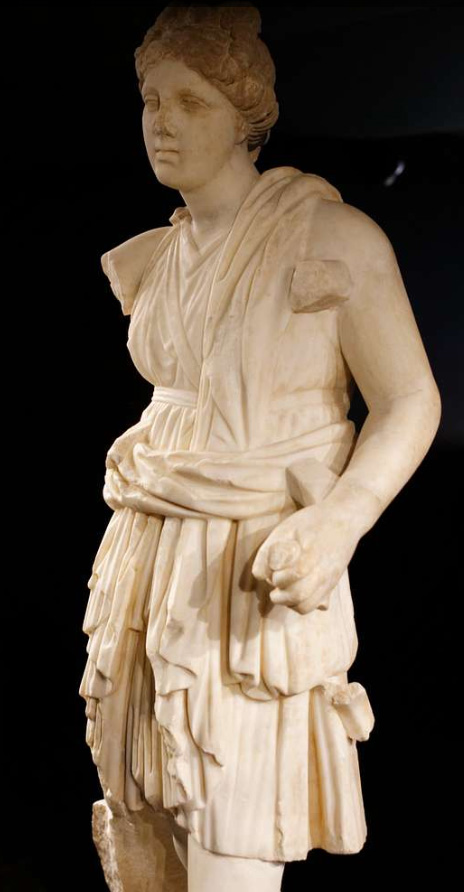
Artemis, Louvre Museum
Artemis has a wide array of epithets, some of which like Ortheia appear to predate even the appearance of the name Artemis itself in archaic Greek art.
| Epithet | Meaning | Domain |
|---|---|---|
| Artemis Soteira (Σώτειρα) | Artemis the Savior | Absolution, spiritual hygiene |
| Potnia Therion (πότνια θηρῶν) | Mistress of Beasts | Control over animals and man |
| Artemis Ortheia (Ὀρθεία) | Artemis the Upright | Marksmanship, consequence |
| Artemis Diktynna (Δίκτυννα) | Artemis of the Nets | Hunter cult of Cretan Artemis |
| Artemis Iocheaira (Ἰοχέαιρα) | Artemis Arrow-Showerer | Inescapability, accuracy and precision |
| Artemis Eileithyia (Εἰλείθυια) | Artemis the Bringer | Midwifery, ensuring motherhood |
| Artemis Brauronia (Βραυρωνία) | Artemis of Brauron | Purity, life transition |
| Artemis Agrotera (Ἀγροτέρα) | Artemis the Huntress | Hunting, fishing, rural matters |
| Artemis Philomeirax (Φιλομείραξ) | Artemis who Loves Girls | Childhood, innocents' protection |
| Artemis Kallistê (Καλλίστη) | Artemis the Beautiful | Beauty, total purity |
| Artemis Phôsphoros (Φωσφόρος) | Artemis the Lightbringer | Makes the concealed visible |
| Artemis Tauropolos (Ταυροπόλος) | Artemis at Tauris (Pulled by Bulls) | Reverence for the arcane |
| Artemis Elaphêbolos (Ἐλαφηβόλος) | Artemis the Deer-shooter | Fate, mastery over swiftness |
| Artemis Keladeinos (Κελαδεινή) | Artemis of Strong Voice | Gravity, inviolability |
| Artemis Parthenos (Παρθένος) | Artemis the Virgin | Independence, youthfulness |
| Artemis Prostatêria (Προστατηρία) | Artemis the Guardian | Protection of nature, children |
| Artemis Delphinia (Δελφινία) | Artemis of Delphi | Twin of Apollo |
Sources: Budin, Artemis, (Soteira, Diktynna, Agrotera, Eileithyia, Parthenos, Elaphebolos) (2015); Harpocration, Lexicon of the Ten Orators, a236 (Brauronia); Pausanias. Description of Greece 3.17.1 (Ortheia), 6.23.8 (Philomeirax); IG_2².788, attalus.org (Kalliste)5,18,19,20
IV. The Temples and Sacred Sites of Artemis
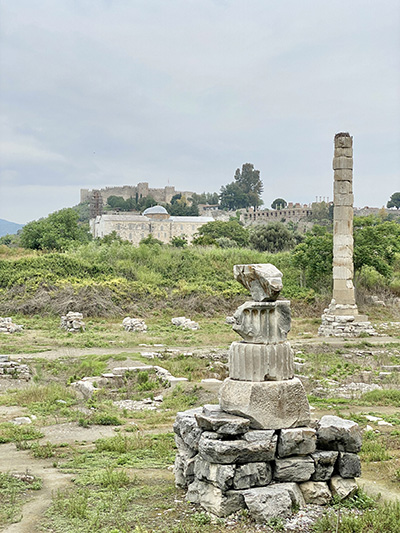
Ruins of Ephesian temple
Brauron
Brauron was one of the ancient cities of Attica. It held special significance in Greek memory through myths connecting it either with her priestess Iphigeneia, who was said to have brought the xoanon of Artemis from the Tauri and established the cult there, or with the Athenian story of the sacred bear.
The sanctuary complex included a temple and sanctuary area, a sacred spring, and multiple dining rooms, while inscriptions also mention a gymnasium and a palaestra not yet excavated. Girls before majority served Artemis there as arktoi, ‘little bears,’ in a ritual capacity. Peisistratos is associated with founding the Brauronian sanctuary on the Acropolis at Athens, linking the Brauron cult more closely with the city. Finds from Brauron include statues of children and other offerings connected with women, childbirth, and children.21,22,23,24,25,26,27,28
Delos
Delos as Artemis' fabled occasional birthplace in the Aegean held her most sacred and supposedly arcane cult in being Artemis Soteira, divine savior, adjacent to that of her brother, Apollo, and the Pythion. Two sanctuaries existed there, and Herodotus too spoke of a Temple to Artemis, although the rest of the classical corpus is rather vague, probably as Apollo's precedence as the deity of Delos overshadowed his sibling.5,24,29
One indication of her eternal sanctity is found in the literature surrounding the assault on Greece: the world-conquering Darius' commander Datis, for all his might, refused to violate the island in his invasion of the Aegean even when his troops violated many other sanctuaries. Even the Shah of Shahs feared the divine twins' brutal capacity to destroy the powerful through faint glimmers. Unlike the classical tomes, the Delian inscriptions are major primary evidence for her precedence, since the epigraphic corpus from Delos includes records connected with sanctuaries, dedications, systematic inventories, a high level of clerical activity connected to the Virgin. Modern scholars try to use these inscriptions together with Herodotus and Callimachus to gauge the fortunes of the Artemision's existence on the island.24,30
The Temple of Artemis-Diana at Ephesus
The temenos at Ephesus is very ancient. The goddess was supposedly worshiped by the ancient Amazons there. At a certain point, a systematic cult developed along Greek lines from which her archaic temple arose. This oldest and first temple of Artemis was wrecked by a flood in the seventh century BCE. In response, the well-heeled Lydian king Croesus commissioned the famous second Temple of Artemis in Ephesus, which was constructed by a group of the most famed Greek artisans he could find. The sacred site, rising from the mists as an apex of splendor, was handed down to posterity as a Wonder of the World in Antipater of Sidon's famous account, hailed as the most beautiful sight on earth and a centerpiece of the city, a masterwork of skilful piety.31
The second temple burned in 356BCE due to Herostratus' lunacy (it is relayed in myth that Artemis herself was too busy delivering Alexander the Great, born at the same time, to care for the temple). A few decades later, the tyrant Lysimachus either forced the Ephesians to move due to disease or military strategy, or had the city deliberately flooded. The new locale of Ephesus in the next four centuries would come to foster the most intricate priesthood and ritualized system of worship for eight centuries, despite the third Temple remaining at the site of the old city, miles outside the new city's walls. Increasing grandeur within the new Ephesus, including a civic cult rivalling Rome itself, made Ephesus the core of eastern Roman religious life by the late second century AD. The people of the urbes proclaimed themselves the ancient inheritors of Artemis and a custodian of particular traditions relating to her Greco-Anatolian past; the variation of the virgin goddess had long spread across the Mediterranean.31
Other Major Sites
The cult of Artemis was gargantuan in popularity and very well-attested in writing, rivaled by very few in scope by the time of the Roman Empire. Eighty five sanctuaries to her alone existed in mainland Greece. Artemis is a popular subject of depiction in the earliest Greek objects; every part of Greece had some distinct variation of venerating her.32,33
Even in the sixth century BCE, Greek colonies in modern day Marseille (in France) established an artemesion of enduring importance up to the Christian period, increasingly modeled on the Ephesian Artemis. With Alexander's conquets, her worship in Bactria at the edge of India survived for centuries. Following on from the Ephesian model, she had major sites in the sprawling cities of Gerasa (modern day Jordan), Dura-Europos (Syria) and Seleucia in Pieria (Turkey). The prominence of Diana's cult brought by the marching Romans established her presence to the north with distinct qualities, but never entirely overrode Artemis' own popularity as a distinctly Greek goddess throughout the entire Mediterranean, North Africa and the Middle East.34,35,36
V. The Deliverer
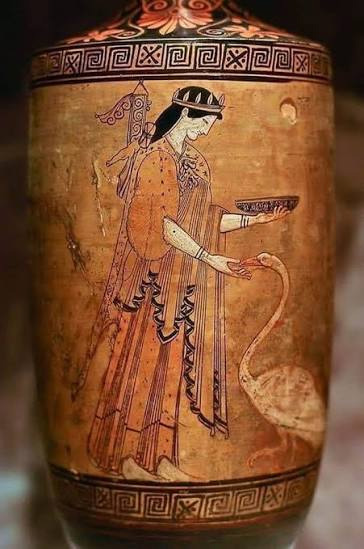
Artemis nourishing heron on lekynthos, 5th century BCE
Despite her perpetual status as a virgin,or maybe because of this as Socrates states, or relating back to the myth of her delivering her brother, Artemis is considered the midwife of women She was increasingly amalgamated with the pregnancy goddess Eileithyia across Greece, other than in locales like Crete, where their cults remained distinctly separate.
Greek women often prayed to Artemis for a successful delivery, because her consent to create life was vital. Forever untouched by labor and birthing pains, it was assumed she also had the power to dictate the conditions of stillborns or difficult deliveries. Some of her indirect antagonism with Aphrodite in myth results from her powers to control intercourse and generation. She also represented prospective brides and after a bride (nymph) was married, Artemis had to be appeased in a specific ritual before the newly wedded dared embark on conjugal sexual acts. Her divine attendants being the nymphoi are presumably related to this. 3
Like Apollo, the huntress is often portrayed as a child with an advanced mind in myth and in significant amounts of visual portrayal, such as one myth where she states her desire to be without marriage to Zeus at only three years old.3 Similarly too to Apollo, children's fates in themselves were often tied to her worship. Many of her worshipers were young girls, but boys also played an important part in her cult and her guardianship over little ones was not necessarily segregated by sex. Artemis protected both young children and children on the cusp of puberty, so liminality was the core function of her divine attributes with children. Again, however, her powers were often represented as relentless; for mocking Leto in only producing twins, she took Niobe's children with her arrows. She could also doggedly avenge outrages committed against children, such as her revenge on the Messenian violators.
Wetnurse symbolism is curiously tied to Artemis also, despite the apparently paradoxical depictions of her as a child. The Ephesian Artemis with her litany of breast-like shapes is often associated with this connection to nursing; Artemis in her Greek context is said to symbolically nourish the smallest babies of animals, in the archaic cult of Arcadia, she was strongly connected to the survival of plant life, her cult sites often contained statues of children, mothers and wetnurses to a higher level than what Brauron exhibited.3
VI. The Lunar Artemis
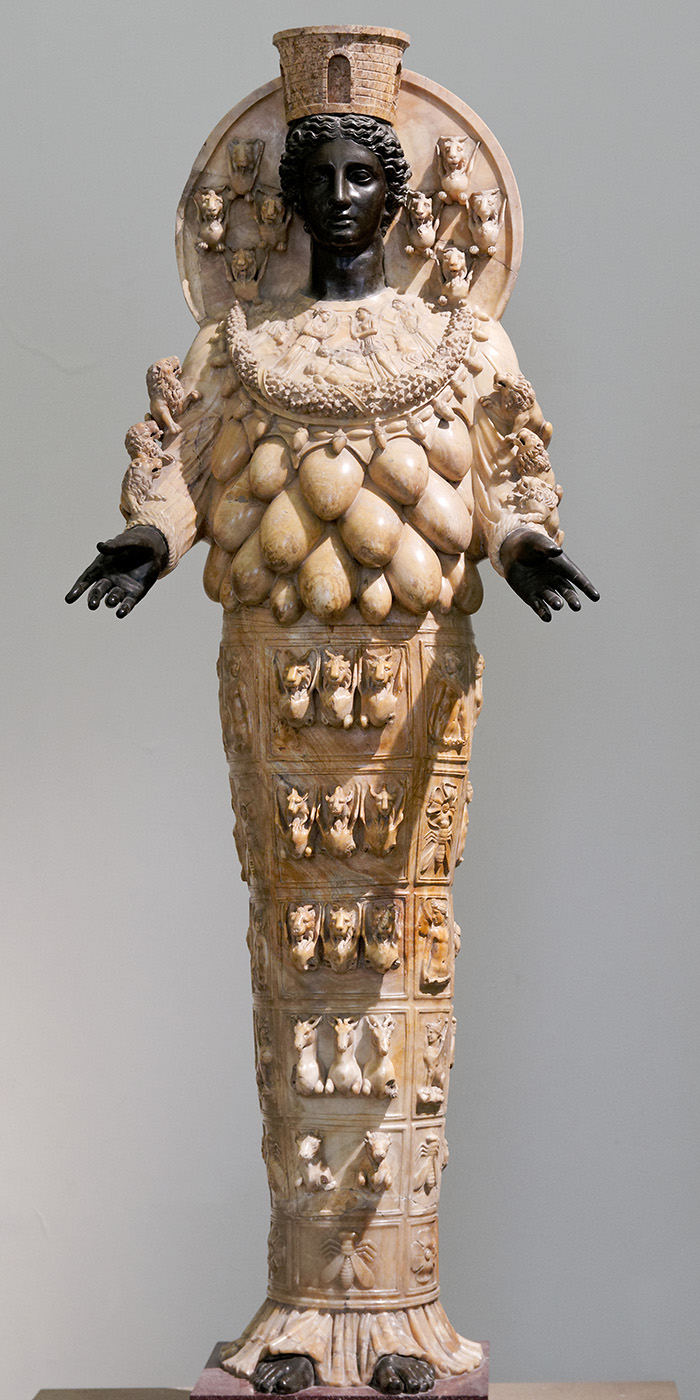
Farnese Artemis (Black Artemis), the National Archaeological Museum, Naples, 2nd century BCE
Artemis has a symbolic relationship to the Moon itself. Supervising darkness in all the shadowy boughs, she reigns with a keen eye, particularly in her proximity to Hecate and Persephone. Most importantly, she is equated with the lunar goddess Selene, a process which begins in a scholia to the Iliad comparing her attributes to the Moon and Hera to the air around the earth.3
Of all the twelve Olympian Gods, it was claimed that Artemis was the closest divinity in essence to all daimons in a liminal manner, good or bad, and could summon them at will, paralleling her steward Hecate summoning the dead. The myth of Iphigeneia also has lunar undertones. Artemis, outraged at her father, demands her death. In most variations of the story, at the final moment, the young noble girl is taken from the plinth and exchanged with a deer, where she either becomes the priestess of the savage Tauri people before returning an artefact of the virgin goddess to Greece, or ascends to heaven. Iphigeneia, undergoing apotheosis, becomes the goddess Hecate, the eternal lunar assistant of Artemis.3
VII. Potnia Theron
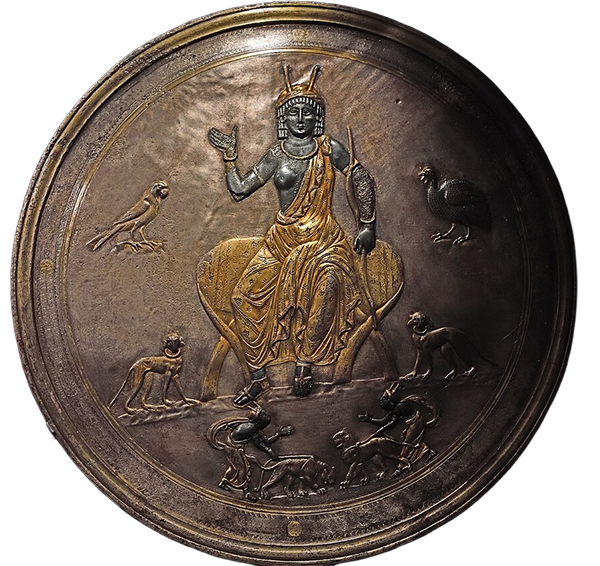
Archaic Anatolian depiction of Potnia Theron/Artemis, Silver Patera/Disc found at Lampsacus (Turkey), 6th century BCE
Homer introduced Artemis as both the hunter of animals and the guardian of all things wild. In this, she is clearly related to the convention of a master of animals dating back to the 13th century BCE, from both Greece itself where the symbolism passes down directly into her worship, as well as possible Minoan antecedents. Although Artemis is a Greek goddess, this imagery is comparable to both a parallel Asian representation of the animal-mistress, related to the symbolism of Anat, and the characterization of Bastet, the Egyptian cat goddess; in one myth, when Typhon threatens Olympus, Artemis transforms into a cat and leaves for Egypt.37,38,39,40
Classical conventions evolve the concept. She is always given a golden bow, while her brother Apollo often has one of silver. Artemis' token animals all kinds of representation, said directly in texts to be her chosen sacred animals, are the stag and the doe; stags are constantly part of her preserve of protection. The Hind, a strangely horned doe, was famously captured by Heracles. Four drive her divine chariot. Callimachus stated was also gifted a group of heavenly hunting hounds, and her indirect association with terrifying she-bears is a persistent theme in mythology. Another animal that is associated with her is an unidentified long necked bird that sometimes appears on her votive pottery.41
Artemis is associated with the hunt in numerous mythological settings. Her destruction of Orion, Aktaion and others shows her power over hunters, even their hounds. After the hunt, smaller animals or first-fruits of the hunt were dedicated to her. She was also associated with fishermen and their catch, especially through Artemis Britomartis of Crete and the language of nets. Inscriptions from seabearers show them thanking her.
There is some evidence she was associated with the ritual dedication or sacrificial treatment of animals and food taken from the wilds. In other contexts, Artemis was invoked in caring for animals, particularly animals of suckling age. In essence many of her functions relate to having to survive, but the proper prodecure involved in dealing with such basic contexts where endings are a core theme.41,42,43,44,45,46,47
VIII. Artemis as an Urban Entity
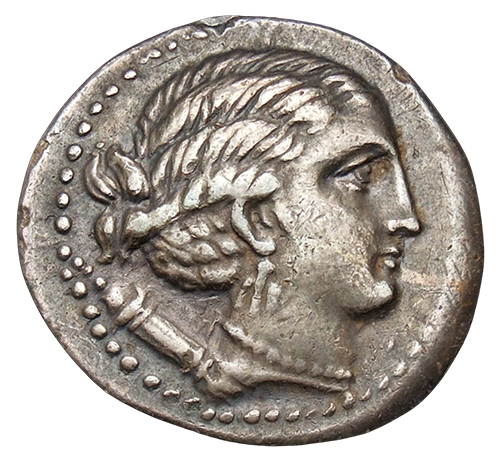
Coin depicting Artemis with knotted hair, pearl necklace and earring, and quiver behind, ca. 360–340 BC, Thrace
One of the problems of characterizing Artemis as a rural goddess, however, is that much of her cult belonged to an urban context. Callimachus calls her "Artemis... of many cities." Although many of her centers of worship were strongly located in nature and isolated from civilization, paralleling the case of the old site of Ephesus to the new metropolis, historians have estimated roughly 60 percent of her religious sites were actually in urban areas. Given the grandeur of Rome, Dura-Europos and other focal points of her worship, that is a point worth considering. The sheer breadth and variety of her festivals in urban settings of Greece were legendary too. About 35–40 separately attested Artemis festivals or recurring local rites were in operation in mainland Greece alone.
τὸ δὲ τέταρτον, οὐ πολὺ δὴν ἦν
ἔβαλες πόλιν ἀδίκων ἀνδρῶν,
οἳ πρὸς ἀλλήλους καὶ πρὸς ξείνους
πολλὰ κακὰ ῥέζουσιν, ἀτάσθαλοι,
οἷσιν ἐπιφράσσεις χαλεπὸν χόλον.
τοῖσι μὲν ἐν βουσὶ νόσος βόσκεται,
ἐν δὲ ἀρούραις κρύος·
γέροντες δὲ τέμνονται τρίχας ἐπὶ παισὶν,
αἱ δὲ γυναῖκες ἢ ὠδῖσιν ἁλίσκονται
ἢ θνήσκουσιν· εἰ δὲ φύγωσι,
τίκτουσιν ὧν οὐδεὶς ὀρθὸν ἔχει πόδα.
οἷσι δ᾽ ἂν ἵλαος ἐπιβλέψῃς καὶ μειδήσῃς,
τοῖσι μὲν ἄρουρα φέρει στάχυν ἄφθονον,
ἄφθονα δ᾽ αὔξεται τετράποδα,
ἄφθονος δὲ γένος αὐξάνει·
οὐδὲ θάνατον ἴσασιν,
εἰ μὴ γηραιὸν ἄγοιεν ἐπὶ τύμβον.
But the fourth time, not long was it before you shot at the city of unjust men, those who toward one another and toward strangers wrought many wicked deeds, reckless men, on whom you will lay your grievous wrath.
On their cattle plague feeds; on their fields frost feeds; and the old men cut their hair in mourning over their sons. Their wives are either seized in childbirth or die; or, if they escape, they bear children of whom none stands upright on his feet.
But on whomsoever you look smiling and gracious, for them the field bears abundant grain, the four-footed stock grows abundantly, and their prosperity increases abundantly. Nor do they go to the tomb except when they carry there the aged.
Callimachus, Hymn to Artemis 122–135; trans. the author, from the Greek text of Mair (Loeb Classical Library 129)
The ancient texts make it clear that Artemis herself enters the city to either assist women during labor or to commend good men, opposed to the barbaric. This leads to a sort of paradox, an open question: does she convey that human civilization is the true wilderness?
IX. The Ephesian State
Ephesus did not just pride itself on being the center of a great temple. The early priesthood were youths held to her service, the Curetes, named after the dancing attendants of Artemis who played loud instruments to distract Hera from foiling Leto's labor. In time, the Curetes transfered and became part of the urban cult of the city, attending more to Hestia's shrine at the Prytaneion. The priesthood began to transform in character as the emperor Augustus made it the capital city of the area.
Under Roman rule, the clergy developed a highly complex system of temple management, and it is recorded by posterity that they held their own intricate mysteries dedicated to the goddess. The priesthood often came from powerful backgrounds; a majority were Roman citizens who had to serve both the empire's interest and the regional Greek locale. Most dramatically, it has been shown that most of the clergy of Artemis were comprised of the city's ruling Boule, making an element of her cult socio-political in scope.31
The highly distinctive symbolism of the Ephesian form of Artemis grew in this place, where statues of this type were reproduced during the first and second centuries. Ephesian Artemis certainly has Anatolian features: the rigid cult-image form, animals, and city-protective character make her look unlike the classical huntress Artemis of mainland Greek vase-painting. Yet that does not mean she is “really Cybele” under another name. Stephanie Budin explicitly notes Roller’s argument that the goddess of Ephesus cannot be identified with Anatolian Meter or Kybele, and Lynn LiDonnici made a broader point that worshippers encountered her as Artemis Ephesia in specific civic and ritual settings, not as an abstract survival of a single prehistoric Mother Goddess Her link to Artemis is ancient and public: the Ephesian sanctuary was the Artemision, her name in Greek cult was Artemis, her image travelled as Artemis Ephesia, and ancient testimony makes Ephesos a city guarded by “the great Artemis.”3,48,49,50
The form of the goddess reflected the prestige of Ephesus itself, but also perhaps its need for penance. Marvels like the Library of Celsus were built in the city. Despite its distance to the temple proper miles away, the cult of Artemis oversaw the most grandiose phase of the city because during Roman times. Ephesus was known for its opulence, civilized nature in the wilds and profound beauty, a mirror image of the goddess. Her cult doggedly survived well into Christian era,31 necessitating a desperate array of Christians needing to obliterate her presence over ten times. In many regards, if Zeus was placed at Pergamon, Ephesus was Artemis' equivalent.
X. The Philosophical Artemis
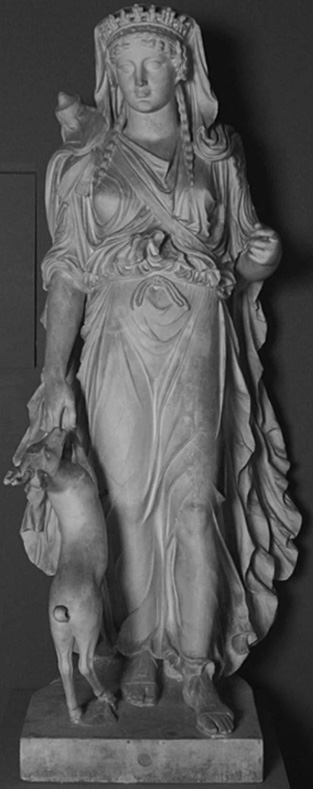
Artemis Braschi
Artemis was commended as a pure force by Socrates in Plato's Cratylus, and that is in spite of the mythoplastes creating rather dark episodes surrounding her mythological persona. This reference was not lost on the generations of philosophers interpreting Plato's works on a deeper level. The Neoplatonist Proclus, in his commentary on the Cratylus, also takes Plato’s etymology seriously and expands it philosophically rather than treating it as mere wordplay.51 Summarizing Socrates' line, he says Artemis is named for her “sound” nature, her guardianship of virtue, and her rejection of procreative intercourse. Then he interprets what Socrates says as three theological properties of the goddess: immaculateness, ordering, perfective power, and transcendence of generation.
Hence she is involved in triads: the triad of the Kore with Persephone and Athena where she represents the font pure life untamed and the triad of Demeter and Hera where Artemis gives ordered and ensouled life to the natural world, the force guarding boundary and transition. Proclus takes virginity to mean not merely sexual abstinence but freedom from mixture, contamination, immersion in generation, including the endless distractions of it, the divine faculty of control that prevails among what can corrupt it. She also represents the stability of keeping one's gaze toward divinity intact, with no excuses, no haste, explaining much of the brutal mythological corpus her acts are tied to.
As far as order is concerned, Artemis is the cause of biological life from the firmament itself. She may be of the wilds, but she is fundamentally above. The virginity is an allegory for standing apart. She is a girl because she represents the possibility of what something can truly be by keeping itself in natural order. The praise of Socrates is because, above all, Artemis is a highly philosophical symbol amenable to the philosophical life. Here is also a deeper allegory; Artemis represents the perpetually uncorrupted, virgin part of the soul that exists from incarnation to incarnation, not just the natural untouched potential of the body.52
XI. The War Against Artemis
The first Ephesian Christian confrontation with Artemis is not presented as a smashed statue, rather it is a a direct attack on the goddess’ civic place. In Acts 19, the preaching of Paul is understood by the silversmith Demetrius as a threat to the makers of miniature shrines of Artemis. Demetrius is concerned that Paul is attacking the manufacture of idols and that this endangers both the trade and “the temple of the great goddess.” The crowd’s cry, “Great is Artemis of the Ephesians,” shows that the Christian challenge was already articulated as a way to attack the popularity of the goddess which became a particularly vicious narrative.53,54
A more aggressive attack appears in the apocryphal Acts of John, where John enters the Ephesian temple of Artemis and challenges the goddess’ power directly. This text is a masterclass of Sahiburaic barbarism. The narrative has John pray against the cult-site. The altar of Artemis splits apart, dedications in the temple fall, more than seven divine images collapse, and half the temple itself falls down, killing the priest. The Ephesian crowd then completes the violence by tearing down what remains of the idol-temple.This sets the stage for later types of attacks and assaults that began to pile up during the fifth century in particular in a repeated endless fashion. Christians attempt to destroy the worship of Artemis, gain some sort of victory by smashing objects, and then another narrative comes along a decade later. The Christians also formulated the myth of the Sleepers of the Cave of Ephesus.31,55
The patience of the divine persisted. Late antique memory attached a final "victory" to John Chrysostom. Later sources credit him with the despoiling of the Ephesian temple: Cyril of Alexandria calls Chrysostom the destroyer of demons and overthrower of the temple of Diana. Proclus of Constantinople gives the most chilling note, simply claiming that the "delusion of Midas... was expunged", conflating ancient artistry and skill with the vain error of the ancient king. The Artemision had already suffered earlier destruction and decline, and the exact state of the building in the early fifth century is debated. In the Orthodox tradition, Chrysostom is celebrated as the bishop-saint who completed the destruction of Diana’s sanctuary. The Ephesian Artemis continued to be castigated as a hated symbol by Christians.56,57
Ephesus continued to be a prosperous city for two centuries, but it went down with the fortunes of eastern Rome. It was destroyed in large part during the destructive Sasanian War of 615CE, and sacked to a large extent by the Arab caliph, Muawiya, four decades later. In the 9th century, it was renamed Hagios Theologos and prospered somewhat before being destroyed again by the Seljuks. By the Ottoman period, it was vacant.
The city is gone, but the grandeur of Ephesus resurfaced with the efforts of classicists and archeologists to instruct us. Ultimately, the adherents of the pure goddess still exist at the Temple of Zeus.
XII. The Cult of Artemis at Crete
Artemis’ Cretan cult is distinctive in its wildness, showing the local Cretan landscape of mountains and sea-edge danger. The central figure is Britomartis, whom Callimachus calls a Gortynian nymph dear to Artemis, a deer-slayer pursued by Minos across Crete until she leapt into the sea and was saved in fishermen’s nets; from this, he says, the Cydonians called her Diktynna, “Lady of the Nets.” Diodorus also says Britomartis or Diktynna lived in the company of Artemis, invented the hunting nets, and received sacrifices and temples from the Cretans, while also noting that some people identified Diktynna and Artemis as one and the same.58,59
The Britomartis-Diktynna element was another form popular across Greece. Pausanias says Britomartis was loved by Artemis, made divine by her, and worshipped as Diktynna in Crete, while the Aeginetans worshipped the same figure as Aphaia. Strabo fixes the cult geographically in western Crete, speaking of the Diktynnaion in the territory of Kydonia and connecting Diktynna with the western Cretan landscape rather than with a generalized literary Olympus. Britomartis as “sweet maiden,” Diktynna as the net-goddess, and Artemis as the wider Greek divine frame. Being distinctive from the myths of her origin in Attica and Ephesus, the myth shows the potential link of Artemis to the ancient Minoan civilization, as the form of Diktynna appears to overlap with ancient Cretan themes.60,61,62
Sources and Bibliography
- Plato, Cratylus, In Plato in Twelve Volumes, vol. 12, translated by Harold N. Fowler. Cambridge, MA: Harvard University Press; London: William Heinemann, 1921. 406b-c.
- van der Toorn, Karel, Bob Becking, and Pieter W. van der Horst, eds. Dictionary of Deities and Demons in the Bible. 2nd extensively rev. ed. Leiden: Brill; Grand Rapids, MI: Eerdmans, 1999. S.v. “Artemis.”
- Zolotnikova, Olga Albert. “Becoming Classical Artemis: A Glimpse at the Evolution of the Goddess as Traced in Ancient Arcadia.” Journal of Arts and Humanities 6, no. 5 (2017).
- The Oxford Classical Dictionary. 4th ed. Edited by Simon Hornblower, Antony Spawforth, and Esther Eidinow. Oxford: Oxford University Press, 2012. S.v. “Artemis.”
- Budin, Stephanie Lynn. Artemis. Gods and Heroes of the Ancient World. Edited by Susan Deacy. Routledge, 2016.
- Homer. The Iliad. Translated by A. T. Murray and William F. Wyatt. Cambridge, MA: Harvard University Press, 1999. Section cited: 5.51.
- Homer. The Odyssey. Translated by A. T. Murray. Revised by George E. Dimock. Loeb Classical Library 104–105. Cambridge, MA: Harvard University Press, 1995. Sections cited: 6.102–109 (Nausicaa); 4.122 (Helen); 20.61–90 (Penelope).
- Homeric Hymn 27 (to Artemis). In Hesiod, the Homeric Hymns, and Homerica, translated by Hugh G. Evelyn-White. Loeb Classical Library 57. Cambridge, MA: Harvard University Press, 1914.
- Homeric Hymn 3 (to Apollo), Delian section (lines 1–178). In Hesiod, the Homeric Hymns, and Homerica, translated by Hugh G. Evelyn-White. Loeb Classical Library 57. Cambridge, MA: Harvard University Press, 1914.
- Callimachus. Hymn 4 (to Delos). In Callimachus: Hymns and Epigrams; Lycophron; Aratus, translated by A. W. Mair and G. R. Mair. Loeb Classical Library 129. Cambridge, MA: Harvard University Press, 1921.
- Hyginus. Fabulae 53. Translated by Mary Grant. University of Kansas Publications in Humanistic Studies, 1960.
- Apollodorus. Bibliotheca 1.21, 1.22. Translated by Sir James George Frazer. 2 vols. Loeb Classical Library 121–122. London: William Heinemann; New York: G. P. Putnam’s Sons, 1921.
- Tacitus. The Annals 3.61. Translated by John Jackson. Loeb Classical Library 249. Cambridge, MA: Harvard University Press, 1931.
- Hesiod. Theogony. Translated by Hugh G. Evelyn-White. Loeb Classical Library. Cambridge, MA: Harvard University Press, 1914.
- Alcman. Fragments. In Greek Lyric, vol. 2, Anacreon, Anacreontea, Choral Lyric from Olympus to Alcman, edited and translated by David A. Campbell. Loeb Classical Library 143. Cambridge, MA: Harvard University Press, 1988. Section cited: fr. 19 Campbell, from the scholion on Iliad 21.485, on Artemis “clad in the skins of the beasts of the field.”
- Aeschylus. Oresteia: Agamemnon; Libation-Bearers; Eumenides. Edited and translated by Alan H. Sommerstein. Loeb Classical Library 146. Cambridge, MA: Harvard University Press, 2008. Section cited: Agamemnon 140–43, where Artemis is described as delighting in the suckling young of wild animals.
- Euripides. Children of Heracles; Hippolytus; Andromache; Hecuba. Edited and translated by David Kovacs. Loeb Classical Library 484. Cambridge, MA: Harvard University Press, 1995. Sections cited: Hippolytus 73–87, Hippolytus’ address and garland-offering to Artemis; 1283–1441, Artemis’ appearance to Hippolytus and Theseus.
- Harpocration. Lexicon of the Ten Orators, a236 (Brauronia). Translated by W. H. S. Jones. Loeb Classical Library, 1918.
- Pausanias. Description of Greece 3.17.1 (Ortheia), 6.23.8 (Philomeirax) Translated by W. H. S. Jones. Loeb Classical Library, 1918.
- IG II² 788. Sylloge Inscriptionum Graecarum 486. Attalus.org. Section cited: “Athens Honours the Priest Antidoros,” on Kalliste.
- Perlman, Paula. “Acting the She-Bear for Artemis.” Arethusa 22, no. 2 (1989): 111–33.
- Athens Attica. “Archaeological Site of Brauron.”
- Pausanias. Description of Greece 1.33.1. Translated by W. H. S. Jones. Loeb Classical Library. Cambridge, MA: Harvard University Press, 1918.
- Herodotus. Histories 6.138, 4.34, 6.96–98. Edited by C. Hude. Oxford Classical Texts. 3rd ed. Oxford: Oxford University Press, 1927. Translated by A. D. Godley. Loeb Classical Library. Cambridge, MA: Harvard University Press, 1920.
- GTP. “Archaeological Sites: Vravrona (Settlement), Attica, East.”
- Encyclopædia Britannica. “Ancient Greece / Greek Tragedy.”
- Acropolis Museum. “The Sanctuary of Artemis Brauronia (Brauronion).”
- University of Warwick. “The Sanctuary of Artemis at Brauron.”
- Trümper, Monica. “Archaeology of Delos.” In The Oxford Encyclopedia of Ancient Greece and Rome. Oxford: Oxford University Press, 2010.
- Steinhauer, J. “Religious Practice and the Delian Neighbourhoods.” 2020.
- Rogers, Guy Maclean. The Mysteries of Artemis of Ephesos: Cult, Polis and Change in the Graeco-Roman World. New Haven and London: Yale University Press, 2012. Section cited: chapter 1, “Continuity in Change.”
- Encyclopaedia Britannica. “Artemis.” Last modified April 1, 2026. Sections cited: Artemis’ worship in Crete or mainland Greece, local cults, and local variations.
- Léger, Ruth M. Artemis and Her Cult. PhD diss., University of Birmingham, 2015. Sections cited: catalogue/survey of Artemis sanctuaries and cult places in mainland Greece.
- Raja, Rubina. “The Sanctuary of Artemis in Gerasa.” In Studies in the History and Archaeology of Jordan 10, edited by Fawzi Zayadine, 381–88. Amman: Department of Antiquities of Jordan, 2009. Sections cited: the sanctuary of Artemis at Gerasa/Jerash. See also Dolci, Jacopo. “The Artemision and the Late Antique Evolving Cityscape of Gerasa.” Levant 57, no. 3 (2025): 1–23. Section cited: the Artemision at Gerasa as a defining urban landmark.
- Rostovtzeff, M. I., A. R. Bellinger, C. Hopkins, and C. B. Welles. The Excavations at Dura-Europos: Preliminary Report of Fifth Season of Work, October 1931–March 1932. New Haven: Yale University Press, 1934. Sections cited: Temple of Artemis Azzanathkona at Dura-Europos. See also Andrade, Nathanael J. Syrian Identity in the Greco-Roman World. Cambridge: Cambridge University Press, 2013. Section cited: chapter 7, “Dura-Europos,” on the temple of Artemis and its inscriptions.
- Blömer, Michael, Olympia Bobou, Eleanor Q. Neil, and Rubina Raja. “From ‘Secondary’ City to Primary Focus: A Historiographical Approach to the Urbanity of Seleucia in Pieria.” Journal of Urban Archaeology 12 (2025): 229–44. Sections cited: Seleucia in Pieria and archival/urban evidence including the Temple of Artemis.
- Nosch, Marie-Louise. “Approaches to Artemis in Bronze Age Greece.” In From Artemis to Diana: The Goddess of Man and Beast, edited by Tobias Fischer-Hansen and Birte Poulsen, 21–40. Acta Hyperborea 12. Copenhagen: Museum Tusculanum Press, 2009. Sections cited: Linear B Potnia, Mycenaean female divinities, and Bronze Age background to later Artemis traditions.
- Fischer-Hansen, Tobias, and Birte Poulsen, eds. From Artemis to Diana: The Goddess of Man and Beast. Acta Hyperborea 12. Copenhagen: Museum Tusculanum Press, 2009. Sections cited: Artemis as goddess of man and beast; Greek Artemis and animal imagery; archaic and cultic development of the Mistress-of-Animals pattern.
- Cornelius, Izak. “Anat and Qudshu as the ‘Mistress of Animals’: Aspects of the Iconography of the Canaanite Goddesses.” Studi Epigrafici e Linguistici sul Vicino Oriente Antico 10 (1993): 21–45. Sections cited: Canaanite and Syro-Palestinian animal-mistress iconography involving Anat and Qudshu.
- Antoninus Liberalis. The Metamorphoses of Antoninus Liberalis: A Translation with Commentary. Translated by Francis Celoria. London: Routledge, 1992. Section cited: 28, on the gods fleeing Typhon and Artemis becoming a cat, with Artemis identified as Bubastis in Egyptian terms. See also Herodotus. The Persian Wars. Vol. 1, Books 1–2. Translated by A. D. Godley. Loeb Classical Library 117. Cambridge, MA: Harvard University Press, 1920. Sections cited: 2.59, 2.137, and related passages identifying Bubastis with Artemis.
- Callimachus. Hymns and Epigrams. In Callimachus: Hymns and Epigrams; Lycophron: Alexandra; Aratus: Phaenomena. Translated by A. W. Mair and G. R. Mair. Loeb Classical Library 129. Cambridge, MA: Harvard University Press, 1921. Sections cited: Hymn to Artemis 1–110, on Artemis’ bow, arrows, hunting dogs, mountains, nymph attendants, deer, and hunting identity.
- Apollodorus. The Library. Vol. 1. Translated by James George Frazer. Loeb Classical Library 121. Cambridge, MA: Harvard University Press, 1921. Sections cited: 3.4.4, on Aktaion/Actaeon, Artemis, transformation, and destruction by hounds; 1.4.3–5, on Orion traditions and Artemis.
- Xenophon. Scripta Minora. Translated by E. C. Marchant. Loeb Classical Library 183. Cambridge, MA: Harvard University Press, 1925. Section cited: Cynegeticus 6.13.
- Tracy, Stephen V. “Dedication to Artemis Diktynna by Timothea for Her Children.” In Attic Inscriptions Online. Translated and edited by Stephen Lambert. Section cited: inscription iii.249.
- Euripides. Iphigenia among the Taurians; Bacchae; Iphigenia at Aulis; Rhesus. Edited and translated by David Kovacs. Loeb Classical Library 495. Cambridge, MA: Harvard University Press, 2002.
- Georgoudi, Stella. “Venison for Artemis? The Problem of Deer Sacrifice.” In Animal Sacrifice in the Ancient Greek World, edited by Sarah Hitch and Ian Rutherford, 50–66. Cambridge: Cambridge University Press, 2017.
- Aeschylus. Agamemnon. In Oresteia: Agamemnon; Libation-Bearers; Eumenides. Edited and translated by Alan H. Sommerstein. Loeb Classical Library 146. Cambridge, MA: Harvard University Press, 2008.
- LiDonnici, Lynn R. “The Images of Artemis Ephesia and Greco-Roman Worship: A Reconsideration.” Harvard Theological Review 85, no. 4 (1992): 389–415.
- Fleischer, Robert. Artemis von Ephesos und verwandte Kultstatuen aus Anatolien und Syrien. Leiden: Brill, 1973.
- Bammer, Anton. “A Peripteros of the Geometric Period in the Artemision of Ephesus.” Anatolian Studies 40 (1990): 137–60. See discussion of finds from the Artemision, including amber pendants associated with the cult-image tradition.
- Proclus. Commentary on Plato’s Cratylus. Section cited: commentary on Artemis and Plato’s etymology of Artemis in Cratylus 406b–c.
- Proclus. Platonic Theology. Edited and translated by H. D. Saffrey and L. G. Westerink. 6 vols. Paris: Les Belles Lettres, 1968–1997. Books V–VI. For the Kore triad of Artemis, Persephone and Athena.
- The Acts of the Apostles, 19:23–41. In The New Oxford Annotated Bible: New Revised Standard Version with the Apocrypha. 5th ed. Edited by Michael D. Coogan, Marc Z. Brettler, Carol A. Newsom, and Pheme Perkins. Oxford: Oxford University Press, 2018.
- Strelan, Rick. Paul, Artemis, and the Jews in Ephesus. Beihefte zur Zeitschrift für die neutestamentliche Wissenschaft 80. Berlin: Walter de Gruyter, 1996.
- Acts of John, 37–45. In New Testament Apocrypha. Volume Two: Writings Relating to the Apostles; Apocalypses and Related Subjects. Edited by Wilhelm Schneemelcher. Translated by R. McL. Wilson. Rev. ed. Louisville: Westminster John Knox Press, 1992.
- Foss, Clive. Ephesus after Antiquity: A Late Antique, Byzantine, and Turkish City. Cambridge: Cambridge University Press, 1979.
- Trombley, Frank R. Hellenic Religion and Christianization c. 370–529. 2 vols. Religions in the Graeco-Roman World 115.
- Callimachus. Hymn to Artemis, 3.189–205. In Callimachus: Hymns and Epigrams; Lycophron; Aratus. Translated by A. W. Mair and G. R. Mair. Loeb Classical Library 129. Cambridge, MA: Harvard University Press, 1921. Section cited: Artemis’ love for Britomartis, Minos’ pursuit, the leap into the sea, the fishermen’s nets, and the Cydonian name Diktynna.
- Diodorus Siculus. Library of History, 5.76.3–4. Translated by C. H. Oldfather. Loeb Classical Library 340. Cambridge, MA: Harvard University Press, 1939. Section cited: Britomartis/Diktynna as daughter of Zeus and Karme, inventor of hunting nets, companion of Artemis, recipient of Cretan sacrifices and temples, and sometimes identified with Artemis.
- Pausanias. Description of Greece, 2.30.3. Translated by W. H. S. Jones. Loeb Classical Library 188. Cambridge, MA: Harvard University Press, 1918. Section cited: Britomartis as dear to Artemis, made a goddess by Artemis, called Diktynna by Cretans and Aphaia by Aeginetans.
- Strabo. Geography, 10.4.12. Translated by Horace Leonard Jones. Loeb Classical Library 211. Cambridge, MA: Harvard University Press, 1928. Section cited: the Diktynnaion and the western Cretan geography of Diktynna near Kydonia.
- “Cretan Cults and Myths.” In The Oxford Classical Dictionary. Oxford: Oxford University Press, online ed. Section cited: Diktynna as a Cretan goddess/epithet associated with mountain cult and possibly older Cretan religious forms.