





| Language / Culture | Name of Libera | Attestation |
|---|---|---|
| Latin | Libera | Cicero, In Verrem 2.4.107 (70 BCE) |
| Latin | Proserpina | Ennius, Epicharmus, quoted by Varro (early 2nd century BCE) |
26 min read
LIBERA
author: High Priest Zevios Metathronos
co-author: Novice Priest Karnonnos
I. Names
Libera is the feminine of the masculine given name Liber. Therefore, these two names have divided one word between them. This is supported by the view of Latin scholar Michiel de Vaan. He claims that Latin līber comes from Proto-Italic *louðero-, and ultimately from Proto-Indo-European *h₁leudʰ-ero-, which means "one belonging to the people." Therefore, the root of Latin Līber is also the source of Greek ἐλεύθερος (eleutheros) or "free". In addition, French linguists Ernout and Meillet claim that the divine names Liber and Libera were created when the adjective was elevated to become a cult name. The "Free One" had a mate named the "Free One".1,2
The term Libera has been a part of cult tradition for some time but does not appear until much later in historical documents. Dionysius of Halicarnassus relates that in 496 BCE, the Aventine offering included Ceres, Liber, and Libera. However, Dionysius wrote this approximately 500 years after it occurred so we do not know if this was actually made as a religious practice at that time. Although no other references exist prior to Cicero's prosecution of Verres in 70 BCE, there is no mention of Libera as a member of the Aventine triad in either Plautus or Ennius.3,4
Cicero mentions Libera again in his survey of Roman theology around 45 BCE. There he distinguishes between the Liber who was consecrated with Ceres and Libera by their Roman ancestors and the Liber who was born from Semele. Thus, Libera appears in Latin literature for the second time during one family generation, first in connection with the festival at Henna and then on the Aventine. In each case she is specifically identified as non-Greek. The testimony concerning her non-Greek identity is provided by the same person who recorded her identity as Greek.5
Proserpina represents a separate concept with its own background. Cicero explicitly states that Proserpina is a Greek name and that she is Persephone to the Greeks. According to him, those educated in Greek considered Proserpina to represent the seed of the crops that are placed beneath the earth and searched out by her mother. The Latinized version of Persephone is often understood to have come into Rome via Etruscan Φersipnai, and further modified to resemble a well-known Latin verb.2,5,6
Varro explains Proserpina as coming from proserpere, "to creep forth", based on the idea that she moves extensively both to the right and to the left like something crawling. Also, in this passage, Varro mentions that the Ennian poet Epicharmus referred to the moon under the name Proserpina.7,8
This line from Ennius provides Proserpina's earliest known datable reference in Latin. It occurs at least a full lifetime prior to Libera can be documented anywhere. The Latin playwright Plautus utilizes the verb literally referring to an animal moving ahead; essentially the raw material utilized by Varro for creating his etymology. Prior to having a Latinized form, there exists documentation of the imported name Proserpina.7,8,9
Two other names existed in Latin that made something veiled in Greece more explicit: Virgil calls her Iuno Inferna and Ovid calls her Iuno Averna.10,11
Sources: Cicero, In Verrem and De natura deorum; Varro, On the Latin Language, quoting the Epicharmus of Ennius; Virgil, Aeneid; Ovid, Metamorphoses; Dionysius of Halicarnassus, Roman Antiquities; de Vaan and Ernout and Meillet for the etymologies; de Grummond for the Etruscan forms1,2,3,4,5,6,7,8,10,11
II. What We Know About Libera
The honest account of the records about Libera is that there is little to go off of. She holds a cella in the Aventine Temple, is the third figure in a rigidly structured liturgical formula, receives the offerings of the plebeian aediles, and she appears to have done almost everything else in the surviving records that we know of. In fact, as noted by Georg Wissowa, she has no myth, no specific festival or rituals specifically honoring her, and no independent iconography (which would be uncommon for a deified being of the first rank in Roman religion, but perhaps represents the prevalence of Eleusis)12
VVarro provides the only real doctrine associated with Libera. He explained how Libera's power was related to male procreation and that Liber's powers were related to female procreation. Thus together they controlled reproduction from both sides, possibly contributing to a taboo. This explanation is consistent, Italic. That would explain why Libera had no mythology7,13
Historians have speculated about her based on this cursory evidence. Henri Le Bonniec suggested that Libera was originally a concept given form; that is, a female counterpart of a functional god and not a woman with a personal history. Barbette Spaeth made the same point using Libera's iconography. There are many examples of Roman Art that identify Libera solely because of her association with Ceres and Liber.14,15
One Roman aetiology gives her a distinct characteristic, as Ovid relates how Bacchus placed the crown of the abandoned Ariadne among the stars and named her "Libera", and Hyginus states the same identity in his collection of the myths. That would make the identity of Libera rather unique, as she was understood openly to be Ariadne, not necessarily just a rendering of Persephone.16,17
Alfred Bruhl and T. P. Wiseman divide over what this poverty means. Bruhl read Libera as a genuine Italic power whose thin record reflects the loss of early evidence, while Wiseman treats the Aventine group as Greek in conception from the first, so that Libera was always a Latin mask for Kore. The dispute cannot be settled from the sources now standing, and the prudent statement is that a functional goddess of increase was available to be read as a daughter the moment Rome wanted one.18,19
III. Epithets
Under her own name she carries none at all, since Roman cult addresses her absolutely, as the third term of the Aventine formula and nothing further. Poverty of titles is the strongest single argument for her original character as a function rather than a person.12,14
Everything that looks like an epithet arrives with Proserpina. Virgil calls her the Juno of the world below when Aeneas is sent to break the golden bough. Then Ovid gives a similar appellation as the Juno of Avernus, each poet reaching for the vocabulary of queenship rather than as a cult title, so her sources are essentially poetic in teir nature..10,11
The Greek names persist untranslated in Roman poetry and in Roman magic. Horace addresses Proserpina in the odes on death, and the private defixiones of Latin-speaking Italy invoke her by name in the accusative of surrender, which is the one register in which ordinary Romans wrote to her directly. Curses are the most candid prayers of the ancient world.20,21
| Epithet | Meaning | Domain |
|---|---|---|
| Libera (absolute) | The Free One, feminine of Liber | Aventine triad, plebeian cult, generation |
| Libera Ariadna | Ariadne renamed at her deification | Augustan aetiology, consort of Liber |
| Proserpina | Latin form of Περσεφόνη, drawn toward proserpere | Underworld, the buried seed |
| Proserpina Iuno Inferna | Proserpina the Juno below | Sovereignty of the dead |
| Proserpina Iuno Averna | Proserpina the Juno of Avernus | The lake of descent, katabasis |
| Proserpina Regina (Περσεφόνη) | Proserpina the Queen | Curse tablets, private appeal |
Sources and first attestations: Libera, Cicero, In Verrem 2.4.107 (70 BCE); Libera as the deified Ariadne, Ovid, Fasti 3.512, with Hyginus; Proserpina, Ennius, Epicharmus, quoted by Varro (early 2nd century BCE); Iuno Inferna, Virgil, Aeneid 6.138; Iuno Averna, Ovid, Metamorphoses 14.114; the queenly address in the Latin curse tablets collected by Gager; Wissowa and Le Bonniec for the analysis of the absence.4,7,8,10,11,12,14,16,17,20,21
IV. Temples and Sacred Sites
The Aventine Cella
Libera possessed one building in Rome paralleling the cult of Demeter, Hades and Persephone in Greece. The temple of Ceres, Liber and Libera at the foot of the Aventine, vowed in 496 BCE during famine and dedicated in 493 BCE by the consul Spurius Cassius, gave her a cella of her own within a structure named for the grain goddess. Lawrence Richardson and Filippo Coarelli both reported that the precise site has never been recovered.3,22,23
Eric Orlin has shown how completely such vows belonged to the magistrate since the Aventine temple carried the plebeian character of its founders for the rest of the Republic's duration. The building burned in 31 BCE, was restored by Augustus and was dedicated by Tiberius in 17 CE.24,25
The Tarentum in the Campus Martius
The second Roman location was related to Proserpina, not Libera. It was located underground. At the Tarentum (a place in the Campus Martius) there was a subterranean altar of Dis Pater and Proserpina. This was uncovered for the Tarentine games, but after this time it was again placed underground. Also, Valerius Maximus preserves the family history of the Valerii, who said they discovered the altar. The ritual descriptions and calculation of the length of a saeculum, can be read in Zosimos and Censorinus.26,27,28
TIt is clear from these texts that what developed from this would become the most important expiation of all ceremonies that the Roman State could perform. John Scheid has described how the Secular Games were constructed during the reign of Augustus with the gods of the new era. The Chthonic couple of the old Ludi Tarentini were quietly removed from their position. Proserpina had an altar in Rome that the Romans did not want to reveal which also indicates that perhaps her secretive nature was very deliberate.29
Enna
In fact, the Roman Senate gave to Proserpina her own sanctuary outside of Italy, one the Greeks already identified. Cicero writes about the sanctuary of Ceres at Enna in central Sicily, the lake, and the woods where Proserpina was abducted, and also writes about the official delegations that the Senate would send to Enna when a "prodigy" occurred. He states that according to Roman belief, the entire island of Sicily was sacred to Ceres and Libera. The Roman state recognized a Sicilian mountain from Greek lore as her site of disappearance.4
The Absence
No temple in the city was ever dedicated to Libera alone. Barbette Spaeth notes that even her cult personnel are the personnel of Ceres, since the aediles and the Greek priestesses were appointed for the mother. The daughter was housed, funded and served entirely through her mother's establishment.15,22
| Sites of Libera and Proserpina | Place | Description | Importance | Date Recorded |
|---|---|---|---|---|
| Temple of Ceres, Liber and Libera | Rome, foot of the Aventine | Three cellae, araeostyle plan, Greek terracottas | Sole cult home of Libera; plebeian archive | Dedicated 493 BCE; reported by Dionysius of Halicarnassus |
| Altar of Dis Pater and Proserpina | Rome, the Tarentum in the Campus Martius | Subterranean altar, uncovered only for the games | Ludi Tarentini, ancestor of the Secular Games | Valerius Maximus 2.4.5; Zosimus 2.1–4 |
| Sanctuary of Ceres at Henna | Sicily, under Roman administration | Grove, lake and shrine of the abduction | Senatorial legations; the whole island held consecrated | Cicero, In Verrem 2.4.106–115 (70 BCE) |
| Sacrum anniversarium Cereris | Rome, Greek rite of Ceres and Proserpina | Women's fast, mourning and search | Suspended after Cannae for want of matrons free from mourning | Livy 22.56.4 (216 BCE) |
| No independent shrine | Rome and Latium | No temple, altar or festival under the name Libera alone | The central negative datum of the cult | Absent from the surviving fasti, Degrassi Inscr. Ital. 13.2 |
Sources: Dionysius of Halicarnassus for the vow and dedication; Richardson and Coarelli for the topography; Valerius Maximus, Zosimus and Censorinus for the Tarentum; Cicero, In Verrem, for Henna; Livy for the suspension of the Greek rite after Cannae; Degrassi, Inscriptiones Italiae 13.2, for the calendars in which her name does not appear.3,4,22,23,26,27,28,30,31
V. Proserpina and Ceres in Roman Religion: Mother and Daughter
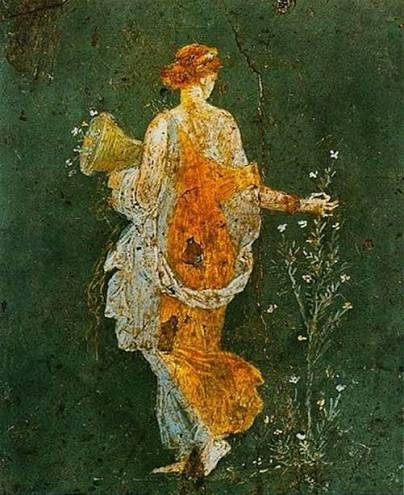
Flora, perhaps Prosperine, collecting flowwrs from Villa Arianna in Stabiae, Naples Museum
The mother Ceres came first and then it seems she brought the daughter with her. Ceres was worshipped at the Aventine temple, the Cerealia of the nineteenth of April and the whole apparatus of the plebeian aedileship, and every Roman honor paid to Proserpina was emblematic of being her mother's daughter in that sense.15
Beside the old Roman worship stood a second and deliberately foreign rite. The sacrum anniversarium Cereris, conducted by women in the Greek manner, reproduced the search of Ceres for the daughter with fasting, mourning dress and abstinence, and Henri Le Bonniec demonstrated that its introduction belongs to the pressure of the Punic wars as the grief of such a pivotal war seemed to inaugurate the rites of the goddess of death.14,15
Livy records the moment the machinery hhad failed. After Cannae in 216 BCE the annual rite of Ceres was omitted, since it could not be performed by matrons in mourning and there was no household in Rome untouched by the casualty lists. A ritual of grief was cancelled by an excess of the real thing.30
Also, Cicero wrote about an administrative detail that proves the rite was Greek in essence. It appears priestesses were fetched from Velia and Naples, then given Roman citizenship so that they might perform the sacrifices on behalf of the Roman people. The arrangement was still remembered as an exception a century and a half later.32,33
The literary form of the cult seems to correspond to what Ovid wrote and it is unmistakably about the pair. The Fasti has the abduction, the wandering of the mother by torchlight, the refusal of the earth to bear fruit and the division of the year, and the Metamorphoses tell the same story at greater length with the pomegranate seed and the judgement of Jupiter.11,16
Mary Beard, John North and Simon Price place the whole complex among the deliberate Hellenizations of the middle Republic, in which the Senate adopted Greek forms precisely because they were legible as foreign. The Greek rite did not compete with the Aventine cult; it was added above it as Rome preferred a religiious accumulation to reform.34
VI. The Aventine Triad and Proserpina
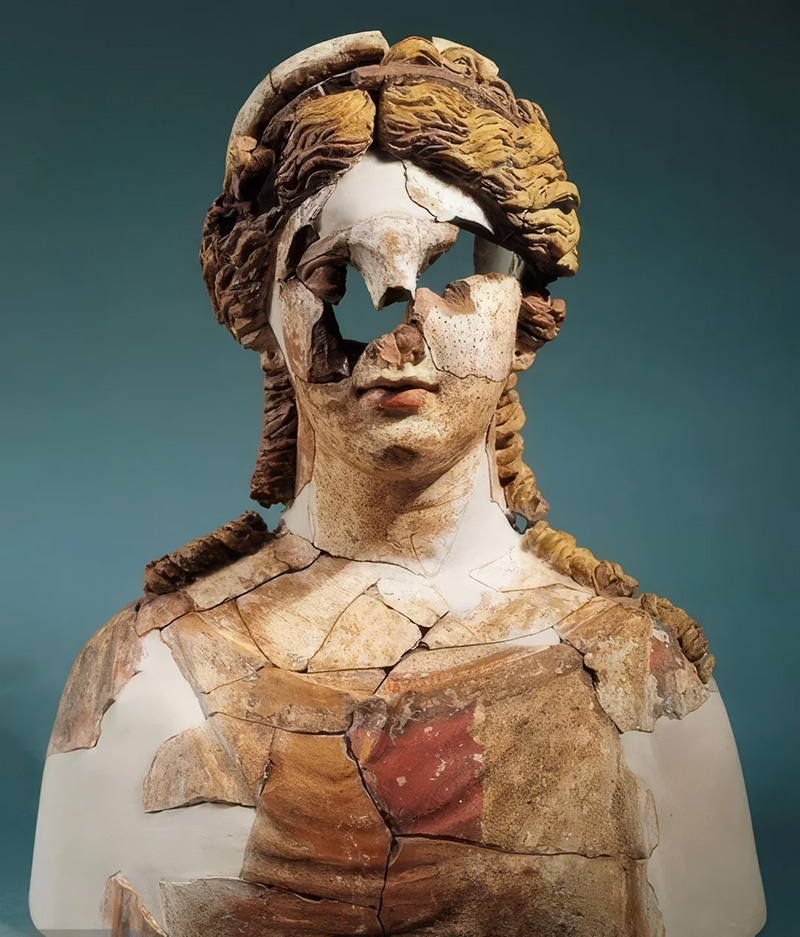
The triad was Greek in its prescription and Roman in its formula. Dionysius reports that the Sibylline books answered the famine of 496 BCE by demanding a temple for the group answering to Demeter, Dionysus and Kore, and Henri Le Bonniec demonstrated that Ceres, Liber and Libera renders that trinity into Latin cult language. Kore was in the building from the day it was vowed.3,14
Roman practice nonetheless kept the names apart with some care. Cicero distinguishes the Liber consecrated with Ceres and Libera from the son of Semele, which implies that the priestly language of his own day still refused the simple equation, and no republican formula substitutes Proserpina for Libera in the Aventine list. The cult conserved a distinction the poets had already abandoned.5,12
Barbette Spaeth thinks of the triad as the plebeian answer to the Capitol, matching Jupiter, Juno and Minerva above with Ceres, Liber and Libera below. The parallel places Libera in the position Minerva holds on the hill opposite. It is possible, however, that the triad also had a deeply occult meaning in its 'answer'.15,34
The triad also had underworld-like connotations as Ceres and Proserpina shared the buried seeds, Liber had the vine, and the same building contained the two Roman powers of the descent, the power that goes down in order to come up.14,15
VII. How Libera Became Identified with Proserpina
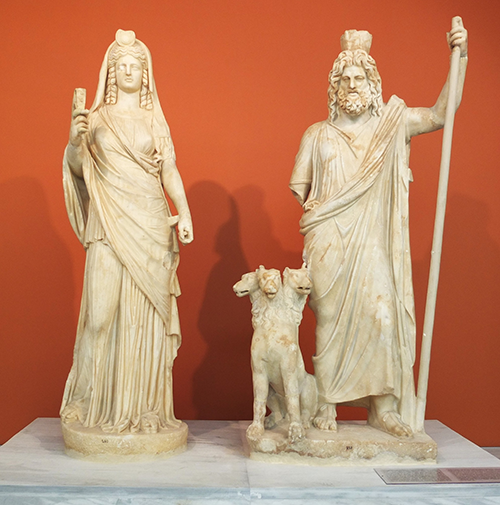
Serapis-Pluto and Isis-Proserpine with Cerberus, 190s CE
The process of establishing an identity for Proserpina was a slow and gradual process that occurred throughout history. Once the Aventine group translated the Greek trinity into Latin, it would take another 300 years for the Greek name to replace the Latin name of Kore (from 493 BC). Before her identity was established she held a position in society.3,14
The cities of Etruria under the Rasenna civilization probably played the role of the "middle zone" in this transformation. Nancy Thomson De Grummond has shown evidence of Φersipnai (the name of the goddess) appearing on Etruscan mirrors and in paintings on Etruscan tomb walls during the 4th and 3rd centuries BC. The Latin version of the name Proserpina also shows signs of being transmitted through a secondary language instead of directly borrowed from the Greeks. In other words, the Etruscans provided a middle ground in which the daughter could travel to Rome..2,6
It is likely the Punic Wars that finished the transmission to Rome itself as during the time of the Tarentine games (third century BCE), a Roman altar was dedicated to both Proserpina and Dis Pater. By this point in time, the ritual practice of the Greeks had been incorporated into the Roman calendar of festivals celebrating women. When Cicero stood before a Roman court and used the term Libera to refer to the abducted wife, we know that at least some people were referring to a single goddess with two names..4,14,26
After the various uses of the terms Libera and Proserpina became customary, the educated elite began to rationalize the meanings behind these names. Varro derived his name for the goddess from proserpere so as to make her a symbol of germination. Cicero's Stoic interpretation placed Libera as the seed itself, though hidden and searched for. And according to Servius, the obvious connection between Libera and Proserpina was simply a matter of interpretation when reading Virgil. After the custom developed among educated elites, allegorical interpretations followed and legitimized the use of these names5,7,35
The most developed description of what ultimately transpired can be found in Augustine's polemical writings against the gods. In consecutive chapters, Augustine describes both the Varronian concept of Libera as relating to masculine and feminine seeds and the Proserpina as relating to crops growing together. While Augustine ridiculed the contradictions inherent in this polysemous view, he clearly acknowledged that both views described a single goddess. As such, he realized that even those who oversaw the rituals of Rome could not reconcile the contradiction.13
Historians today argue about whether or not a distinct pre-Italic Libera was lost in translation. Le Bonniec and Spaeth believe that there was an actual Italic goddess named Libera who was replaced by Persephone/Proserpina while T.P. Wiseman disputes their argument stating that there may have never been enough substance to lose. Regardless, historians do acknowledge that after the first century AD, most references to Libera are found within scholarly literature and that Romans addressing a deity referred to Proserpina.14,15,19
VIII. Claudian's Proserpina
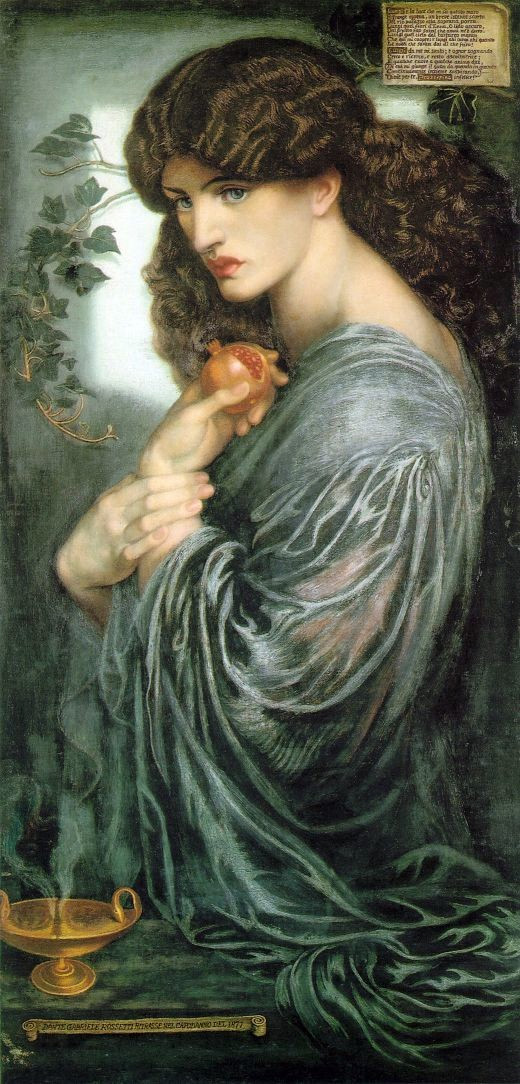
Proserpine, Dante Gabriel Rossetti (1874)
Claudian, a poet from Alexandria, wrote the final major pagan poem (in Latin) about the goddess during the reign of a Christian emperor. He arrived in Italy in 394 CE, began working as an imperial panegyrist under Honorius and then developed into a client of the powerbroker and general Stilicho. His poem "De Raptu Proserpinae" was written in 3 books with two preface poems. It was incomplete upon his death. Alan Cameron placed the writing of the poem approximately 395-97 CE, seeing it as the product of a young man developing his reputation.36,37
The design of the poem is dissimiliar to Ovid as Book I begins in Hades, with Dis Pater complaining because he wants a wife, and if he does not get a wife, he will go to war with the heavens. As a result of this threat, Jupiter agrees to let his brother marry Proserpina as a form of strategy. The actual kidnapping occurs later in Book II, and the return of Ceres to an empty house is described in Book III. In her commentary on Claudian, Claire Gruzelier illustrates how intentionally Claudian delayed showing the scene that the readers came to see.37,38
Claudian's most well known passage in the poem describes the weaving of a garment. While left alone in Sicily, Proserpina weaves a robe for her mother, with depictions of the four elements and the throne of the gods on it. When she is interrupted by her kidnapper, she leaves her loom uncompleted; therefore, the fabric and poem are destined to have the same fate. Classicists used this scene as the focal point of his analysis of the ornate style of late antique poetry, in which ornaments convey ideas.37,39
Ceres searches with torches lit at the crater of Etna. Claudian gives her the felling of the sacred cypress grove for the pine, the kindling at the volcano and the pursuit across a scorched island, and the whole third book is a study in a mother's rage rather than a girl's fear. The Roman goddess of the harvest is here at her most implacably Greek.37,38
Whether the poem is pagan in conviction has been argued since antiquity. Augustine believed that Claudian was a stranger to Christianity altogether, and Orosius agreed, while Cameron has argued that the poet was a professional versifier for whom the gods were a stylistic choice.13,36,37
The afterlife of the poem was immense. De raptu Proserpineae was used as a textbook throughout the medieval west and provided the source material for Chaucer and other mythographers and even influenced John Milton's depiction of the field of Enna in book IV of Paradise Lost. This unfinished epic produced Europe's literary Proserpine.38,40
Sources and Bibliography
- Michiel de Vaan. Etymological Dictionary of Latin and the Other Italic Languages. Leiden Indo-European Etymological Dictionary Series 7. Leiden: Brill, 2008. S.vv. līber, Līber. For the derivation of the adjective and the divine name from Proto-Italic *louðero- and PIE *h₁leudʰ-ero-, on which the feminine Libera depends.
- Alfred Ernout and Antoine Meillet. Dictionnaire étymologique de la langue latine: Histoire des mots. 4th ed., revised by Jacques André. Paris: Klincksieck, 2001. S.vv. līber, Lībera, Proserpina. For the treatment of Liber and Libera as a cult name formed from the adjective, and for Proserpina as an adaptation of Persephone showing the marks of transmission through Etruscan rather than direct borrowing.
- Dionysius of Halicarnassus. Roman Antiquities. Translated by Earnest Cary. 7 vols. Loeb Classical Library. Cambridge, MA: Harvard University Press, 1937–1950. See 6.17.2–4 and 6.94.3. For the famine of 496 BCE, the Sibylline prescription of a temple to the group answering to Demeter, Dionysus and Kore, the vow of Aulus Postumius and the dedication by Spurius Cassius in 493 BCE.
- Cicero. The Verrine Orations, Volume II: Against Verres, Part 2, Books 3–5. Translated by L. H. G. Greenwood. Loeb Classical Library 293. Cambridge, MA: Harvard University Press, 1935. See 2.4.106–115, with 2.4.107. For the earliest securely dated Latin occurrence of the name Libera, the declaration that the whole of Sicily is consecrated to Ceres and Libera, the description of the grove, lake and shrine at Henna, and the senatorial legations sent there.
- Cicero. On the Nature of the Gods. Academics. Translated by H. Rackham. Loeb Classical Library 268. Cambridge, MA: Harvard University Press, 1933. See De natura deorum 2.62 and 2.66. For the separation of the Liber consecrated with Ceres and Libera from the Liber born of Semele, and for the statement that Proserpina is a Greek name, that she is the goddess the Greeks call Persephone, and that she was taken to be the seed of the crops hidden and sought by her mother.
- Nancy Thomson de Grummond. Etruscan Myth, Sacred History, and Legend. Philadelphia: University of Pennsylvania Museum of Archaeology and Anthropology, 2006. For Φersipnai and Φersipnei on Etruscan mirrors and in the painted tombs of the fourth and third centuries BCE, cited as the intermediate stage between the Greek name and the Latin one.
- Varro. On the Latin Language. Edited and translated by Roland G. Kent. Loeb Classical Library 333. Cambridge, MA: Harvard University Press, 1938. See 5.68 and 6.14. For the derivation of Proserpina from proserpere, the report that the Epicharmus of Ennius used the name of the Moon, the Plautine parallel for the verb, and the doctrine of Liber and Libera as the powers of male and female seed.
- Ennius. Fragmentary Republican Latin, Volume II: Ennius, Dramatic Fragments, Minor Works. Edited and translated by Sander M. Goldberg and Gesine Manuwald. Loeb Classical Library 537. Cambridge, MA: Harvard University Press, 2018. For the Epicharmus fragment preserved by Varro, which gives Proserpina her earliest datable appearance in Latin in the first half of the second century BCE.
- Plautus. Casina. The Casket Comedy. Curculio. Epidicus. The Two Menaechmuses. Edited and translated by Wolfgang de Melo. Loeb Classical Library 61. Cambridge, MA: Harvard University Press, 2011. For the literal use of proserpere of a creeping beast, quoted by Varro as the parallel behind his etymology of the divine name.
- Virgil. Eclogues, Georgics, Aeneid: Books 1–6. Translated by H. Rushton Fairclough. Revised by G. P. Goold. Loeb Classical Library 63. Cambridge, MA: Harvard University Press, 1999. See Aeneid 6.138 and 6.142. For the golden bough sacred to the Juno of the world below, the first attestation of that title for Proserpina.
- Ovid. Metamorphoses, Volume I: Books 1–8, and Volume II: Books 9–15. Translated by Frank Justus Miller. Revised by G. P. Goold. Loeb Classical Library 42 and 43. Cambridge, MA: Harvard University Press, 1916. See 5.341–571 and 14.114. For the fullest Ovidian narrative of the abduction, the pomegranate seed and the judgement of Jupiter, and for the title Juno of Avernus.
- Georg Wissowa. Religion und Kultus der Römer. 2nd ed. Handbuch der Altertumswissenschaft V.4. Munich: C. H. Beck, 1912. For the observation that Libera has no myth, no festival of her own and no independent iconography, and for the persistence of the Latin formula in priestly language after the poets had abandoned it.
- Augustine. The City of God against the Pagans, Volume II: Books 4–7. Translated by William M. Green. Loeb Classical Library 412. Cambridge, MA: Harvard University Press, 1963. See 4.11, 6.9, 7.16 and 7.21. For the Varronian doctrine of Liber and Libera as the powers of male and female seed, for the treatment of Libera and Proserpina as one goddess under two explanations, and for the charge that Claudian was a stranger to the name of Christ.
- Henri Le Bonniec. Le culte de Cérès à Rome des origines à la fin de la République. Études et Commentaires 27. Paris: Klincksieck, 1958. The standard treatment. For the demonstration that Ceres, Liber, Libera renders the Greek trinity into Latin cult language, for Libera as a functional abstraction rather than a person, for the Punic-war context of the Greek rite, and for the argument that an Italic Libera was overwritten by Proserpina.
- Barbette Stanley Spaeth. The Roman Goddess Ceres. Austin: University of Texas Press, 1996. For the identification of Libera in Roman art only by her position beside Ceres and Liber, the asymmetry by which every honour paid to the daughter passed through the mother's establishment, the triad as the plebeian answer to the Capitol, and the cult personnel appointed for Ceres alone.
- Ovid. Fasti. Translated by James G. Frazer. Revised by G. P. Goold. Loeb Classical Library 253. Cambridge, MA: Harvard University Press, 1931. See 3.459–516, with 3.512, and 4.393–620. For Bacchus conferring the name Libera on the deified Ariadne, and for the abduction, the torchlit wandering of Ceres and the division of the year.
- Hyginus. Fabulae. Edited by Peter K. Marshall. 2nd ed. Bibliotheca Teubneriana. Munich: K. G. Saur, 2002. See Fabulae 224. For the catalogue entry identifying Ariadne, daughter of Minos, with Libera among those made immortal from mortals.
- Alfred Bruhl. Liber Pater: Origine et expansion du culte dionysiaque à Rome et dans le monde romain. Bibliothèque des Écoles françaises d'Athènes et de Rome 175. Paris: de Boccard, 1953. For the reading of Libera as a genuine Italic power whose thin record reflects the loss of early evidence rather than the absence of a cult.
- T. P. Wiseman. "Liber: Myth, Drama and Ideology in Republican Rome." In The Roman Middle Republic: Politics, Religion and Historiography c. 400–133 BC, edited by Christer Bruun, 265–99. Acta Instituti Romani Finlandiae 23. Rome: Institutum Romanum Finlandiae, 2000. For the position that the Aventine group was Greek in conception from the first, so that Libera was always a Latin mask for Kore.
- Horace. Odes and Epodes. Edited and translated by Niall Rudd. Loeb Classical Library 33. Cambridge, MA: Harvard University Press, 2004. See Odes 1.28.20 and 2.13.21. For the invocation of Proserpina in the odes on death and the Latin poetic register of her name.
- John G. Gager, ed. Curse Tablets and Binding Spells from the Ancient World. New York: Oxford University Press, 1992. For the Latin defixiones that hand a victim over to Proserpina by name, cited as the register in which ordinary Romans addressed her directly.
- L. Richardson Jr. A New Topographical Dictionary of Ancient Rome. Baltimore: Johns Hopkins University Press, 1992. For the unrecovered site of the temple of Ceres, Liber and Libera above the Circus valley, and for the absence of any building in the city dedicated to Libera alone.
- Filippo Coarelli. Rome and Environs: An Archaeological Guide. Translated by James J. Clauss and Daniel P. Harmon. Berkeley: University of California Press, 2007. For the Aventine and Circus Maximus quarter and the state of the question on the temple's location.
- Eric M. Orlin. Temples, Religion, and Politics in the Roman Republic. Mnemosyne Supplements 164. Leiden: Brill, 1997. For the mechanics of the temple vow and the way a vowed building carried the political character of the magistrate who made the vow.
- Tacitus. Histories: Books 4–5. Annals: Books 1–3. Translated by Clifford H. Moore and John Jackson. Loeb Classical Library 249. Cambridge, MA: Harvard University Press, 1931. See Annals 2.49. For the dedication by Tiberius in 17 CE of the Aventine temple burned in 31 BCE and restored by Augustus.
- Valerius Maximus. Memorable Doings and Sayings, Volume I: Books 1–5. Edited and translated by D. R. Shackleton Bailey. Loeb Classical Library 492. Cambridge, MA: Harvard University Press, 2000. See 2.4.5. For the buried altar of Dis Pater and Proserpina at the Tarentum and the legend of the Valerii by which it was discovered.
- Zosimus. New History. Translated by Ronald T. Ridley. Byzantina Australiensia 2. Canberra: Australian Association for Byzantine Studies, 1982. See 2.1–4. For the transmitted prescriptions of the Tarentine and Secular rites and the nocturnal sacrifices to the chthonic pair.
- Censorinus. The Birthday Book. Translated by Holt N. Parker. Chicago: University of Chicago Press, 2007. See chapter 17. For the reckoning of the saeculum and the sequence of celebrations of the games at the Tarentum.
- John Scheid. An Introduction to Roman Religion. Translated by Janet Lloyd. Bloomington: Indiana University Press, 2003. For the Augustan reconstruction of the Secular Games around the deities of the new age and the displacement of the older chthonic pair.
- Livy. History of Rome, Volume V: Books 21–22. Translated by B. O. Foster. Loeb Classical Library 233. Cambridge, MA: Harvard University Press, 1929. See 22.56.4. For the omission of the annual rite of Ceres after Cannae in 216 BCE, since it could not be performed by matrons in mourning and no household in Rome was untouched.
- Attilio Degrassi, ed. Inscriptiones Italiae. Vol. 13, fasc. 2, Fasti anni Numani et Iuliani. Rome: Libreria dello Stato, 1963. For the surviving Roman calendars, cited here for the negative datum that no festival stands under the name of Libera.
- Cicero. Pro Caelio. De Provinciis Consularibus. Pro Balbo. Translated by R. Gardner. Loeb Classical Library 447. Cambridge, MA: Harvard University Press, 1958. See Pro Balbo 55. For the priestesses fetched from Velia and Naples and given Roman citizenship so that they might perform the rites of Ceres on behalf of the Roman people.
- Celia E. Schultz. Women's Religious Activity in the Roman Republic. Chapel Hill: University of North Carolina Press, 2006. For the religious agency of Roman women and the place of the Greek rite of Ceres within it.
- Mary Beard, John North, and Simon Price. Religions of Rome, Volume 1: A History. Cambridge: Cambridge University Press, 1998. For the deliberate Hellenisations of the middle Republic, in which Greek forms were adopted because they were legible as foreign, and for the accumulative rather than reforming character of Roman religious change.
- Servii Grammatici qui feruntur in Vergilii carmina commentarii. Edited by Georg Thilo and Hermann Hagen. 3 vols. Leipzig: Teubner, 1881–1902. On Georgics 1.7 and Aeneid 4.58. For the late antique gloss stating the equation of Libera and Proserpina as settled fact.
- Alan Cameron. Claudian: Poetry and Propaganda at the Court of Honorius. Oxford: Clarendon Press, 1970. For the dating of the poem to the years around 395 to 397 CE, the poet's arrival in Italy in 394 CE and his relation to Stilicho, and for the argument that Claudian was a professional versifier rather than a committed pagan controversialist.
- Claudian. De raptu Proserpinae. In Claudian, Volume II, translated by Maurice Platnauer, Loeb Classical Library 136. Cambridge, MA: Harvard University Press, 1922. See the two prefaces and 1.32–116, 1.246–275, 2.204–306, 3.332–448. For the complaint and threat of Dis Pater, the concession of Jupiter, the robe woven for Ceres with the four elements and the seat of the Gods, the abduction in the second book, and the torches kindled at Etna in the third.
- Claire Gruzelier. Claudian: De Raptu Proserpinae. Oxford: Clarendon Press, 1993. For the commentary on the poem's structure, the deliberate withholding of the abduction until the second book, the rage of Ceres in the third, and the medieval transmission of the text as a school author.
- Michael Roberts. The Jeweled Style: Poetry and Poetics in Late Antiquity. Ithaca, NY: Cornell University Press, 1989. For the account of late antique verse in which descriptive ornament carries the argument, with the weaving scene of Proserpina treated as a central example.
- John Milton. Paradise Lost. Edited by Barbara K. Lewalski. Oxford: Blackwell, 2007. See 4.268–272. For the field of Enna measured against Eden, cited as the furthest reach of the Claudianic transmission of the abduction.