




| Language or Tradition | Form | Earliest Secure Attestation |
|---|---|---|
| Etruscan (fuller) | Phersipnai, Phersipnei | Painted tomb captions, fourth century BCE |
| Etruscan (worn) | Ferspnai | Later inscriptions |
| Greek (source) | Persephone; western form Phersephone | The word from which the Etruscan is borrowed |
| Latin | Proserpina | The Roman equivalent |
7 min read
PERSIPNEI
author: High Priest Zevios Metathronos
co-author: Novice Priest Karnonnos
Hieratic Information about Persipnei
| Divine Symbols | |
|---|---|
|
I. The Name
The Etruscan's translation of her title were called phersipnai & phersipnei, eventually shortened into ferspnai. Her Greek name was Persephone, a process similar to Aplu (Apollo) and Ercle (Hercules).
The single fact that may merit our attention is which dialect of the Greek language that the name originated from. The name Persephone was represented by many different dialects of Greek and besides the most well known representation of the name, there existed a group of names beginning with "p" followed by "h": Phersephone, Phersephassa, Pherrephatta. Therefore, since the Etruscan term Phers-ipnai maintains the first letter "P", it indicates that the Etruscans obtained their knowledge of this particular Greek dialect from those western Greeks residing in the southern colonies, which the Etruscans both traded and fought against, rather than the Ionic-Attic Persephone, used as an example in the classroom. The historian Carlo De Simone placed the name within the category of loaned terms that are certain to be Greek, and thus, has been read in the same manner by the standard grammatical texts.2,3
Persipnai came later to the Etruscan pantheon. Both the name and character appear during the fourth century BCE., when Etruscan art became interested in the Greek underworld and began to darken as Etruria lost territory to Rome. Prior to this century, she does not appear in art. 4
Sources: Rix's corpus for the Etruscan spellings;1 de Simone and the Bonfantes for the Greek loan and the western form behind it;2,3 de Grummond for the fourth-century arrival.4
II. The Enthroned Consort
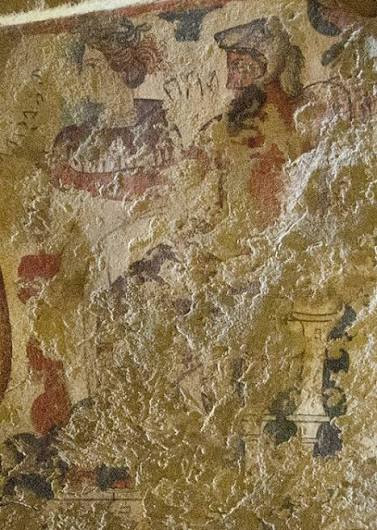
Persipnei and Aita, Etruscan tomb
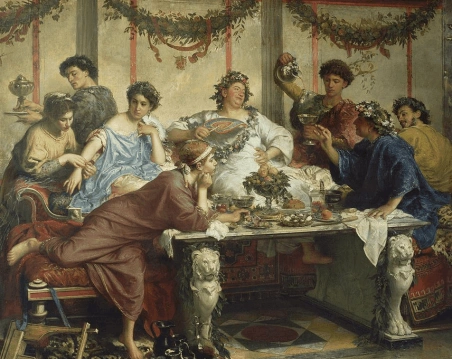
Persipnai is not one of the many gods found throughout the Etruscan world. She can be seen in only two painted tombs; sitting with Aita in both tombs; in the Golini Tomb near Orvieto and in the Tomb of Orcus II at Tarquinia (around 325 B.C.E.) and she is depicted as sitting alongside Aita in a banquet scene. In addition, the painters added her name and those of others in the scene to ensure identification. The scene depicts a banquet. There is a table with food on it. There are also servants attending to guests. Aita and Persipnai sit at the end of the table and preside over the meal much as Etruscan lords and ladies would preside over their feasts in the tombs of the living.
Aita wears a wolf's scalp (or pelt) over his head, similar to a hat. This was not borrowed from Greece. De Grummond states that this comes from Calu, the Etruscan wolf of the underworld. Calu is referenced by ancient texts but he had no face or image for himself. Therefore, when the Greeks introduced Hades into Etruscan mythology, he was covered in the Etruscan "death" wolf's skin. Persipnai holds a scepter next to her husband and has serpents in her hair..4,5
| Scene or Object | Place and Date | What It Shows | Bearing on the Goddess |
|---|---|---|---|
| Golini Tomb I | Near Orvieto, fourth century BCE | Aita and Phersipnai enthroned at the underworld banquet, named in paint | Her securest attestation; named and seated |
| Tomb of Orcus II | Tarquinia, c. 325 BCE | The couple in the hall of the dead; she has snakes in her hair, he a wolf cap | Her defining image; the serpent-crowned queen |
| Painted vase from Vulci | Fourth century BCE | The abduction of Phersipnai, the Greek rape scene transplanted | The one "narrative," and it is borrowed |
| Alabaster ash urns | Volterra, second century BCE | Underworld couples on funerary containers | Late, funerary, and formulaic |
Sources: de Grummond for the tomb couple and the wolf cap;4 Steingräber for the paintings of the Golini and Orcus tombs;5 Jannot for Aita and Phersipnai in the underworld.6
III. A Queen With Native Neighbors
In addition to her new kingdom in the afterlife, the Etruscan queen stepped into an occupied space. The Etruscans had developed some of the most densely populated regions of the underworld in the ancient world, and those areas were inhabited by beings the Etruscans themselves created. She would have been accompanied throughout her journey through the underworld by Vanth, a winged female figure carrying both a torch (to light the way) and a scroll; Vanth acted as both a guide and a witness for the deceased. At the entrance to the underworld stood Charun, an Etruscan being made up of blue flesh and wielding a mallet or hammer. He was far more menacing than the gentle Greek ferryman (Charon), whom his name derived. On top of which, the beast Tuchulcha waited inside the Tomb of Orcus. And roaming beneath all this existed Calu the wolf.
These are the figures involved in Etruscan death, and they are native, old, and everywhere. Ingrid Krauskopf's study of the pre-Hellenistic death-powers shows an underworld already fully manned before the Greek names arrived. Into that household the Etruscans imported a king and a queen from Greek myth and sat them on thrones. The demons act. The royal couple preside, Persipnai functioning as she does in the Iliad.7
IV. The Face
The Greek Persephone has two faces, the grim wife below and the young maid Kore which will return to her mother every spring. However, there is no depiction of the return in the Etruscan art. She appears as a queen ruling over death.. But the aspect of return is not shown in Etruscan art; she is a reigning queen over death.
The serpents in her hair belong to the visual syllabus of the Furies she commands in Roman myth, and they put her closer to the fully Etruscan deity Vanth than to Kore alone.4,7,8,9
Sources and Bibliography
- Rix, Helmut, ed. Etruskische Texte. Editio minor. 2 vols. ScriptOralia 23–24. Tübingen: Gunter Narr, 1991. Cited for the attested Etruscan spellings of the goddess's name, phersipnai, phersipnei, and the reduced ferspnai.
- de Simone, Carlo. Die griechischen Entlehnungen im Etruskischen. 2 vols. Wiesbaden: Otto Harrassowitz, 1968–1970. Cited for the treatment of the name as a secure Greek loanword and for the western Greek form, beginning in ph, that underlies the Etruscan.
- Bonfante, Giuliano, and Larissa Bonfante. The Etruscan Language: An Introduction. 2nd ed. Manchester: Manchester University Press, 2002. Cited for the identification of Phersipnai with Greek Persephone and for the phonetic shape of the borrowed name.
- de Grummond, Nancy Thomson. Etruscan Myth, Sacred History, and Legend. Philadelphia: University of Pennsylvania Museum of Archaeology and Anthropology, 2006. Cited pages: 229–231, for Aita and Phersipnai enthroned in the tomb paintings, for the fourth-century date of the pair, for Aita's wolf cap and its derivation from the native underworld wolf Calu, for the serpents in Phersipnai's hair, and for the abduction scene as a transplanted Greek subject.
- Steingräber, Stephan. Abundance of Life: Etruscan Wall Painting. Translated by Russell Stockman. Los Angeles: J. Paul Getty Museum, 2006. Cited for the underworld banquet frescoes of the Golini Tomb near Orvieto and the Tomb of Orcus II at Tarquinia, including the painted captions naming the divine couple.
- Jannot, Jean-René. Religion in Ancient Etruria. Translated by Jane K. Whitehead. Madison: University of Wisconsin Press, 2005. Cited pages: 66–67 and 153–154, for Aita and Phersipnai in the Etruscan underworld and for the Etruscan reception of the Greek realm of the dead.
- Krauskopf, Ingrid. Todesdämonen und Totengötter im vorhellenistischen Etrurien: Kontinuität und Wandel. Firenze: Leo S. Olschki, 1987. Cited for the native Etruscan death-powers, Vanth, Charun, Tuchulcha, and Calu, and for the fully developed underworld that preceded the Greek names of Aita and Phersipnai.
- van der Meer, L. Bouke. The Bronze Liver of Piacenza: Analysis of a Polytheistic Structure. Amsterdam: J. C. Gieben, 1987. Cited for the catalogue of the forty deity-names inscribed on the Liver of Piacenza, among which Phersipnai does not appear, nor do Aita and Aritimi.
- Pallottino, Massimo. The Etruscans. Revised and enlarged ed. Translated by J. Cremona. Edited by David Ridgway. Bloomington: Indiana University Press, 1975. Cited for the warning against reading Etruscan gods directly off their borrowed Greek iconography, since the Etruscans adopted the images more freely than the beliefs behind them.