




| Language / Culture | Name of Persephone | Attestation |
|---|---|---|
| Classical Greek | Περσεφονεία (Persephoneia) | Homer, Hesiod, inscriptions (8th century BCE onwards) |
| Classical Greek | Περσεφόνη (Persephone) | Hesiod (8th century BCE onwards) |
| Classical Greek | Κόρη (Kore) | Homeric Hymn to Demeter (7th-6th century BCE) |
46 min read
PERSEPHONE
author: High Priest Zevios Metathronos
co-author: Novice Priest Karnonnos
Hieratic Information about Persephone
| Divine Names | |
|---|---|
| |
| These hieratic names carry strong spiritual resonance and are recommended for summoning and invocation practices. | |
| Divine Symbols | |
| |
| Divine Numbers and Attributes | |
| Sacred Numbers | 40, 50, 60 |
| Runes | Thurisaz, Tiwaz, Sowilo (in order of importance) |
| Zodiac Sign of Power | Aries |
| Sacred Animals | The Great Eagle, the Bull, the Hawk, the Serpent |
| Element | Fire, Aether |
| Divine Forces | |
| |
| Important Titles | |
| |
I. Names
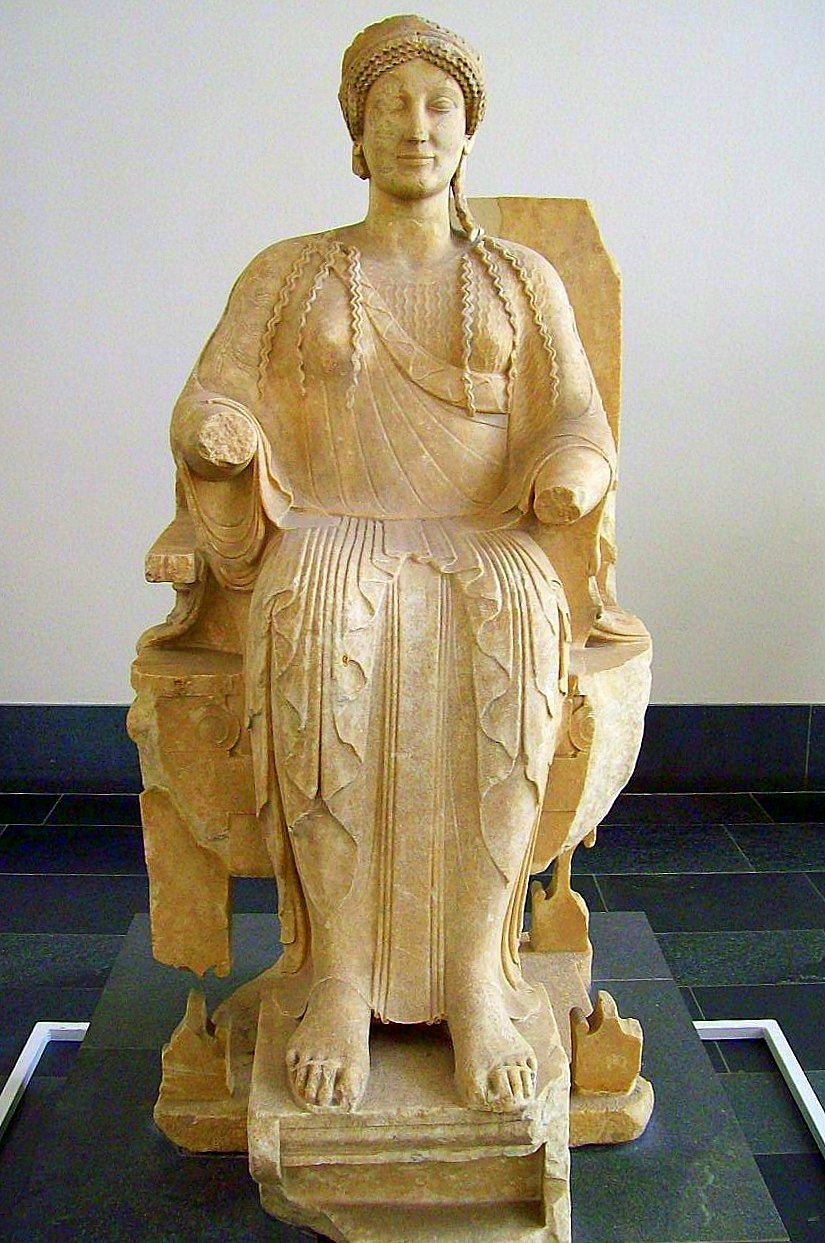
Persephone, Pergamon Museum, Berlin
Persephone had many names. The general taboo placed upon her core names mentioned in the Cratylus and the Description of Greece suggests the word Persephone was considered sacred and it signified her reign in Hades, similar to the weight placed upon uttering her husband's name. It was typical to call her Kore (Κόρη, girl or daughter), particularly prior to her abduction. Pausanias plainly states that the real name of Kore was Persephone, using Homer and Pamphos as his justification. Socrates claims her correct name is Pherepapha (Φερέπαφα) or "something of that sort". 1,2,3,4
Homer calls her Persephoneia (Περσεφονεία) in the Odyssey, while Pherrophatta (Φερρϖφάττα, early Attic pottery), Periphona (Πηριφόνα, from Locri) Persephassa (Περσεφάσσα, poetic and tragic form) and Persephatta (Περσεφάττα, Attic) were also known as variations in wider Greek culture. Hesiod's Theogony and the Homeric Hymn use the form Persephone, though Hesiod only uses the accusative case, and both alternate the from Περσεφόνη with Περσεφονεία.5,6,7,8,9,10
ἔρχεο, Περσεφόνη, παρὰ μητέρα κυανόπεπλον.
She bore white-armed Persephone, whom Aidoneus carried off from her mother…
Περσεφονείηι...10
Socrates claimed the fear of uttering her name came from ignorance, and Pherepapha is the name he uses to refer to her in his etymological discussion in the Cratylus, in uttering this the etymology is explained as her being the goddess who touches whatever is put into lively motion (from Φερε- from τὰ φερόμενα "things in motion", -παφα from ἐπαφή, "touch, contact").3
Philologically the name appears oppositional to modern concepts. Rudolf Wachter connects it to a formulation of the Rig Veda and Avesta (parsa-) connected to a sheath of grain, because Wachter showed that fifth-century Attic vases give Φερ(ρ)όφαττα, with -o-, which must be older than the -e- of later Attic Φερρέφαττα and of epic Περσεφόνεια. The second element 'phatta' is connected to *gʷʰen-, meaning to beat or kill. "Thresher of grain" is a possible modern etymology.12,13
Perhaps the taboo also resulted from the name's violent alternate classical etymology. "Περσεφόνη· παρὰ τὸ φέρω καὶ τὸ φόνος came from pherō and phonos, being as it were Persephone, before whom are carried those who die by violence", so says the Etymologicum Magnum 665.49–51 Gaisford. Some similarly connected it with φέρειν φόνον, "she who brings death." In Plutarch's Isis and Osiris, he says she is the pneuma that is borne through the crops (φερόμενον) and slain (φονευόμενον). Porphyry says it is Pherrephatta from φέρβειν τὴν φάτταν, "she who feeds the ring-dove."14,15,16
It is possible Persephone's name existed in the Linear B corpus in the form pe-re*. John Chadwick connected it with Preswa-, a goddess either connected to Persephone or Perse (daughter of Oceanus).17
Sources: Homer, Odyssey; Hesiod, Theogony; Homeric Hymn to Demeter2,10,11
II. Persephone in Myth
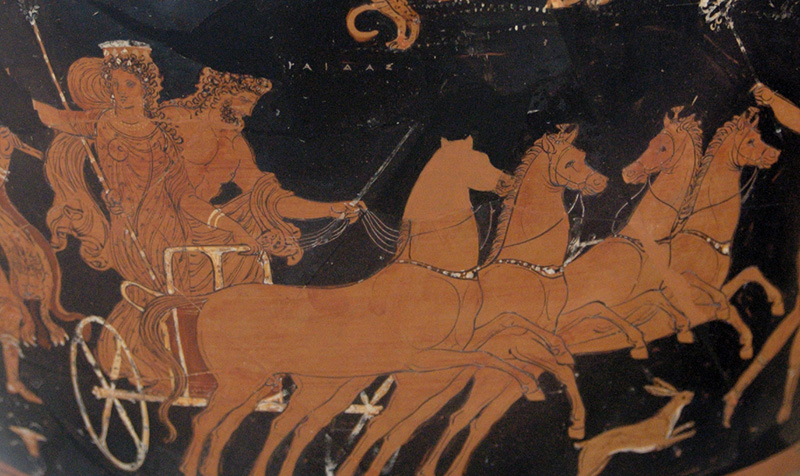
Abduction of Persephone, vase
The Eleventh Book of the Odyssey
Persephone primarily appears in the Odyssey as the mysterious and powerful queen of Hades in allusions by both the author when Odysseus descends into Hades and by the initial admissions of Circe that nonetheless reveal a lot about her.2
Odysseus wishes to see Tiresias in Hades to know of his fate. Circe claims Persephone made an exception for him to him alone, dead as he is, she granted a mind, that Tiresias alone should have understanding of life and death. Circe, telling Odysseus that the road home runs the wrong way, gives him the destination to the prophet as a pair of names, the house of Hades and dread Persephone, εἰς Ἀΐδαο δόμους καὶ ἐπαινῆς Περσεφονείης (10.491).2
Past Ocean, where the ship is to be beached, there is a level shore and the groves of Persephone: tall poplars, and willows that shed their fruit, the ἰτέαι ὠλεσίκαρποι or trees that drop what they bear before it can ripen. Her fruit cannot be eaten, a foreshadowing of her spectral realm.2
Down in the dark, as Odysseus enters Hades, the epic begins doing something stranger. Anticleia, his beloved mother comes. Three times Odysseus reaches for her and three times she goes through his arms like a shadow, like a dream. His first thought is that he is being played with. "Is this a phantom that august Persephone has sent me, so that I may grieve the more?" (11.213–14).2
His mother's answer is among the coldest things: her spectral form is the way of mortals when they die (11.217–18) because the sinews no longer hold the flesh and bone, and Persephone does not deceive. She acquits the goddess and in acquitting her of causing grief she takes from her son the work shows the existential side. Odysseus further interviews Tyro, Antiope, Alcmene, Epicaste, Chloris, Leda, Ariadne, Eriphyle and other women, brought forth by an unseen Persephone.2
He sees the shades of Achilles, Patroclus, Ajax and Antilochus, leading him to debate the first. Odysseus then lingers in the last part of the eleventh book, hoping to see great men like Theseus and Peirithous who entered the deathly house themselves. Before he can see them, the myriad tribes of the dead come thronging up with an unearthly cry, and pale fear takes him that august Persephone will send up out of Hades the head of the Gorgon itself. In his terror leading to those presumptions, he runs back to his ship.2
Homeric Hymn
The main role of Persephone and her progression is outlined in the Homeric Hymn to Demeter, which presents her as the daughter of Zeus and Demeter. Kore, as she is always named, goes to pick flowers with the daughters of Oceanus and Tethys (the Oceanids), alongside Artemis and Athena. Kore is taken by the absolute radiance of the flowers, including the lilies, narcissus, iris, crocus and rosebuds. As soon as she gathers them, the grim god of death swiftly takes her in his golden chariot, leading her to scream out, something only heard by the sun god Helios and the chthonic goddess Hecate.11
Helios states later in the Hymn to a distressed and unhappy Demeter that her daughter has become the queen of the underworld, Persephone, through the will of her father Zeus. Her mother is thrown into catastrophic despair, not even abating with the commencement of her mysteries at Eleusis. The entire world starves as a result of her anger. Zeus notices this, sending Hermes to bring Persephone out of the underworld:11
Go, Persephone, to your mother, the one with the dark robe.
Have a kindly disposition and thûmos in your breast.
Do not be too upset, excessively so.
I will not be an unseemly husband to you, in the company of the immortals.
I am the brother of Zeus the Father. If you are here,
you will be queen of everything that lives and moves about,
and you will have the greatest tîmai in the company of the immortals.
Those who violate dikê– will get punishment for all days to come
, those who do not supplicate your menos with sacrifice,
performing the rituals in a reverent way, executing perfectly the offerings that are due.
, trans. Nagy11
Overjoyed at this, Persephone braces to leave. But before she does so, Hades gives her the seed of the pomegranate to eat, ensuring she would come back. After Hermes brings Persephone to the palace of Demeter, her mother bundles down the hill like a maenad, grasping her in her arms in joy, and the entire land is rejuvenated, verdant with greenery, flowers and all plant life. Spring is ushered in again.11
Zeus ordains that Persephone spend a third of the year below in the misty realms of Hades near her groom and two-thirds above ground near the presence of her mother. Realizing the necessity to help humanity after the disaster, both goddesses reveal the processes of farming, tilling and agriculture to the local kings, particularly the king of Eleusis, Triptolemus. They also teach the entire corpus of the Mysteries to him and the leader of men, Eumolpus, Diokles, the master of horses, and the leader of the commoners, Keleos, who become their first priests.11
It is said in the end that Demeter and Persephone, having concluded the mystery rites and finished the instructions assigned to them for humanity, eventually come to sit next to the throne of Zeus on Olympus forever.11
Hesiodic Context
The Theogony lists Persephone in two areas: the 'dread' queen by Hades side whom is guarded by Cerberus, and then as the gift of Zeus to Hades in being abducted. The details are low; nonetheless they show the duality of the goddess. Her presence in the other Hesiodic materials is little attested.10
A scholion to Pindar's Isthmian Ode first elaborates the myth of the first Persephone, the one who creates Dionysus as Zagreus and leads to the latter sitting at the side of Demeter, calling this the "mystic word" (ὁ μυστικὸς λόγος) separable from the popular mythology.19
Orphic Hymns
The Orphic Hymns contain some subtext about Persephone, as she is the one female deity within the broader Orphic materials who is equally as important as Orpheus and Dionysus, though her own hymn is characteristically vague.20
They speak of her as the recipient of sacrifice, beloved of mortals, horned like Dionysus and the mother of meadow-blown spring, the bride of Hades. It is said Persephone nourishes all mortals like her mother, but most importantly kills them too, an indication of her active role. The hymn exhorts her to give a 'blessed old age' to the elderly one sailing to her realm.20
The Hymn to Persephone also mentions that she is the daughter of Zeus and Demeter, following on from the Homeric Hymn's genealogy. As with Pindar, however, she is also paradoxically considered the mother of 'many-shaped' Eubouleus, the first Dionysus. In the next hymn, the Orphic Hymn to Dionysus, Eubouleus is described as the offspring of her 'unspeakable union' with Zeus, a fact not mentioned in her own hymn. The ambiguity of placing the two genealogies next to each other in successive hymns is perhaps deliberate.19, 20
What the hymns make clear is that Persephone is by no means a marginal mythological figure or just an abducted girl. Her control over life and death is without limit, just as the spring appears from the haze of winter.20
III. The Epithets of the Great Daughter
| Epithet | Meaning | Domain |
|---|---|---|
| Persephone Despoina (Δέσποινα) | Persephone the Mistress | Mystery cult, sovereign authority |
| Persephone Chthonia (Χθονία) | Persephone of the Underworld | Earth, underworld |
| Persephone Soteira (Σώτειρα) | Persephone the Savior | Mystery salvation, Eleusis |
| Persephone Hagne (Ἁγνή) | Persephone the Pure One | Sacred purity, initiatory rite |
| Persephone Potnia (Πότνια) | Persephone the Mistress | Divine authority, chthonic |
| Persephone Anassa (Ἄνασσα) | Persephone the Queen | Queen of the Underworld |
| Persephone Megala Thea (Μεγάλη Θεά) | Persephone the Great Goddess | Solemn mystery worship |
| Persephone Karpophoros (Καρποφόρος) | Persephone the Bearer of Fruit | Crops, fertility, vegetation |
| Persephone Pasikrateia (Πασικράτεια) | Persephone the All-Powerful | Supreme chthonic sovereignty |
| Persephone Praxidike (Πραξιδίκη) | Persephone the Exacter of Justice | Retribution, fate |
| Persephone Epaine (Ἐπαινή) | Persephone the Dread One | Terrifying majesty |
| Persephone Agaue (Ἀγαυή) | Persephone the Illustrious | Renown, royal dignity |
| Persephone Brimo (Βριμώ) | Persephone the Terrible One | Fierce underworld |
| Persephone Melitodes (Μελιτώδης) | Persephone the Honey-Sweet | Spring and bee, pollination |
| Persephone Pantokrateira (Παντοκράτειρα) | Persephone the Ruler of All | Dominion over life and death |
| Persephone Biosdotis (Βιοδῶτις) | Persephone the Giver of Life | Generation, growth, spring |
| Persephone Phaesphoros (Φαεσφόρος) | Persephone the Light-Bringer | Return from below |
| Persephone Semne (Σεμνή) | Persephone the August or Revered One | Sacred dignity, mystery reverence |
| Persephone Monogeneia (Μουνογένεια) | Persephone the Sole Child | Unique daughterhood, divine lineage |
| Persephone Keroessa (Κερόεσσα) | Persephone the Horned One | Lunar imagery, Dionysus |
Sources: Pausanias, Description of Greece; Homer, Iliad and Odyssey; the Homeric Hymn to Demeter; the Orphic Hymn to Persephone; Theocritus, Idylls, with the ancient scholia; Farnell, The Cults of the Greek States; Liddell, Scott, Jones, and McKenzie, A Greek-English Lexicon.2, 4, 11, 18, 19, 20, 21, 22, 23
IV. The Temples and Sacred Sites of Persephone
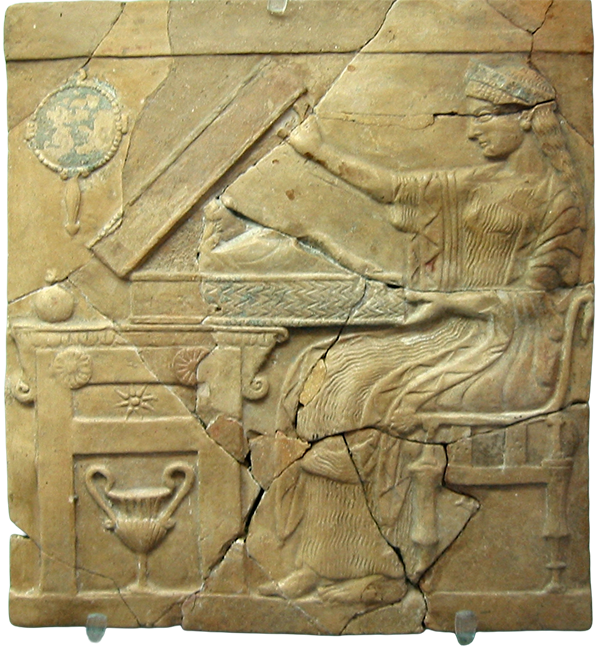
Persephone opening a cista containing the infant Adonis, on a pinax from Epizephyrian Locris
In the myths, Persephone appeared from the earth to spread the cult of Eleusis after her great reunion with her mother. Both appear in art to commonly instruct Triptolemus, often depicted as a boy, to spread the rites to all men, and mother and daughter are considered the progenitors of the Mysteries to humanity.11, 24, 25
Therefore the majority of Persephone's cult sites, usually under the name of Kore, were also dedicated to Demeter as distinctively shared temple complexes. Other sites were dedicated to Hades and his bride whose characteristics pointed towards her mature form. In Triphylia, all three were worshipped at one site. However, there were some sites that were dedicated to Persephone's worship alone, often giving her a highly important role.4, 26, 27
Eleusis
The mysterious architecture of Eleusis was developed around a parallel to her shadowy realm. It produced secrecy through a sequence of controlled boundaries, restricted sightlines, enclosed assembly spaces, the use of darkness and selective illumination, and an inner repository of sacred objects. It was difficult to access and equally difficult to fathom for outsiders.28, 29, 30
From at least the Archaic period, the sanctuary was surrounded by very high walls as impregnable as a typical Greek fortress. Michael Scott estimates that the circuit extended for approximately 580 meters. Euripides mentions that women could only vaguely see the roof of the Teleisterion. Access was mitigated by two real and three symbolic gates: the Lesser Propylaia, the Greater Propylaia and the enclosed forecourt.28, 29, 31, 32
The Telesterion was designed very differently to a conventional elongated Greek temple with a cult image visible through a frontal doorway. In its Classical form it was an enormous, nearly square, roofed hall approximately 51–54 metres across. Eight rising tiers of stone seating were arranged against all four sides, partly cut directly into the western rock. The roof of the Classical Telesterion was supported by forty-two columns, arranged in six rows of seven. These columns were structurally necessary for spanning the enormous roofed space, but they also broke up sightlines across the hall, creating more mystery.28, 29, 32
Within the Telesterion, more access points existed. At the heart of the Telesterion was the structure conventionally identified as the Anaktoron, the “royal chamber.” The reconstructive notion of the Anaktoron is that it was a smaller building contained within the larger hall, serving as the repository of the most sacred Eleusinian objects, probably designed to show them at the height of the ritual.28, 29, 33
Epizephyrian Locris
The town of Epizehryian Locris in the modern southern Italian province of Calabria treated Persephone as a patron deity. The votive plaques from the area show that the abduction by Hades served as a model for marriage, that brides brought their peplos to be blessed by Persephone, and that children of the town were dedicated to her.34, 35, 36
It appears in this locale that Persephone absorbed many of the traditional attributes of Hera. The Locrian pinakes found from the area often depict the goddess in bright colors, painted as series of objects. These constitute some of the most important artistic artifacts of all the Greek colonies.34, 36, 37
Paolo Orsi, a famous archeologist, excavated the site from 1908 to 1911, finding the famous Persephoneion there. Her sanctuary was located at the ravine of the Mannella hill in Locris. The cult of Persephone in this area according to archeological finds probably dates from the 7th century BCE and it was highly regionally influential, informing how the Greeks in their southern Italian colonies beheld the goddess.34, 35, 38
Alexandria
Epiphanius the Christian author mentioned that a mysterious and very large temple called the Koreion existed in the great Hellenistic metropolis of Alexandria. There the deity present was treated as the great mother of Aion. A group of Roman-period Alexandrian gaming counters depicts a temple identified as an Eleusinion. Elisabeth Alföldi-Rosenbaum and some subsequent scholars argued that these images placed the Koreion in the Alexandrian suburb called Eleusis.39, 40, 41
According to him, torchbearers descended into an underground sacred chamber, they brought up a naked wooden image seated on a litter, the image bore five gold-inlaid marks: one on the forehead, one on each hand and one on each knee, the image was carried seven times around the “innermost” or “most central” sanctuary, the procession was accompanied by flutes, tambourines and hymns, and after the celebration, the image was returned to its underground chamber.39, 42
Arcadia
The cult of Demeter and Persephone as the Great Goddesses at Megalopolis in Arcadia was distinctive. An inscription found at Lykosoura, IG V 2, 517, honors a Megalopolitan named Saon. He was a priest (hierophant) of the Great Goddesses and a descendant of the men who had first introduced their telete in Arcadia. The statue of Kore in the shared temple was draped in wood, while the statue of Demeter was sculpted from stone.4, 43, 44, 45
There was a separate sanctuary to Kore with its own importance to the Arcadians, one housing the cult of Kore Soteira, the savior. Here, she possessed her own stone statue and a pedestal covered with ribbons. Male access was restricted to one entry annually; the area was considered an exclusively feminine zone. Additionally, statues of Callignotus, Mentas, Sosigenes and Polus existed in the temple, the first men to spread the rites to the region through the Arcadian variation of the myth.4, 45, 46
V. The Children of Persephone
Dionysus
Diodorus explains about the traditions of the earlier Dionysus (usually known as Zagreus, Iacchus or Sabazios), born to Zeus and Persephone, whose birth and honors were celebrated secretly at night. This is supported by Hyginus who essentially describes the same thing, adding the detail that Semele mirrors Persephone in numerous ways.47, 48
Melinoë
Melinoë is the daughter of Persephone. An Orphic Hymn was addressed to her directly, the seventy-first. It is said she was born near the Corcytus river. The young girl was known to drive mortals mad with divine rage, walking the boundary between Hades and the earth.20, 49
She is represented on a bronze magic tablet associated with magic, with the name DIONE, PHOEBE and other divine epithets. Some assume that Melinoë is an epithet of Hecate; she appears on adjacent triangular imagery with her mother.49, 50
Makaria
Makaria is only mentioned in the Byzantine Suda, being absent from any surviving classical text. She is the sole child of Hades, the others being products of the unions of Persephone with Zeus. There appears to be a deliberate conflation with Makaria, the daughter of Heracles, as Zenobius hints at. The surviving phrase associated with her appeared have a euphemistic meaning hinting "to go to hell" in a popular context but probably meant "to go into blessedness" in its holier form.51, 52
VI. The Mystery
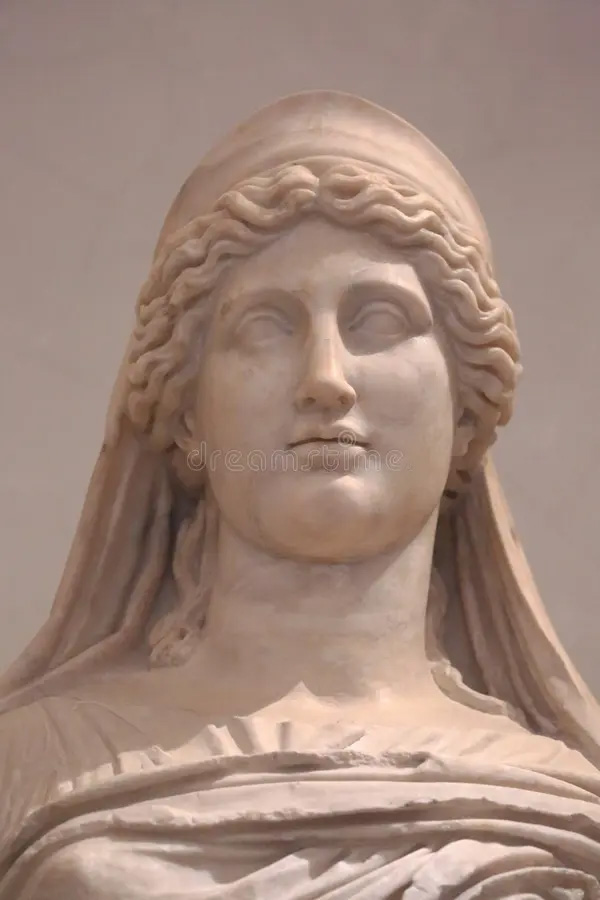
Persephone, Hermitage Museum, St. Petersburg
Like her mother, Persephone presided over the great mystery of ascent. It was outlined above that Eleusis had the highest grade of security possible in Ancient Greece. The procession was always with the τώ θεώ, the Two Goddesses, in view.28, 29
The sacred objects of the mysteries, called the ἱερά (hiera), had a deep relation to the return and ascent of Persephone from the underworld. One of the vessels, the kernos, was often filled with first fruit, showing the return of the vegetation to life. The plemochoai, the first libation, also seemed to be poured in her honor. Myrtle wreaths (bakchoi) were insignia pointing towards the return of the procession.25, 28, 53
Statues of Demeter and Kore often are depicted with supplicants around them, such as the depiction of the worshippers in graven image at Arcadia.4, 45
VII. Persephone's Role in Hades
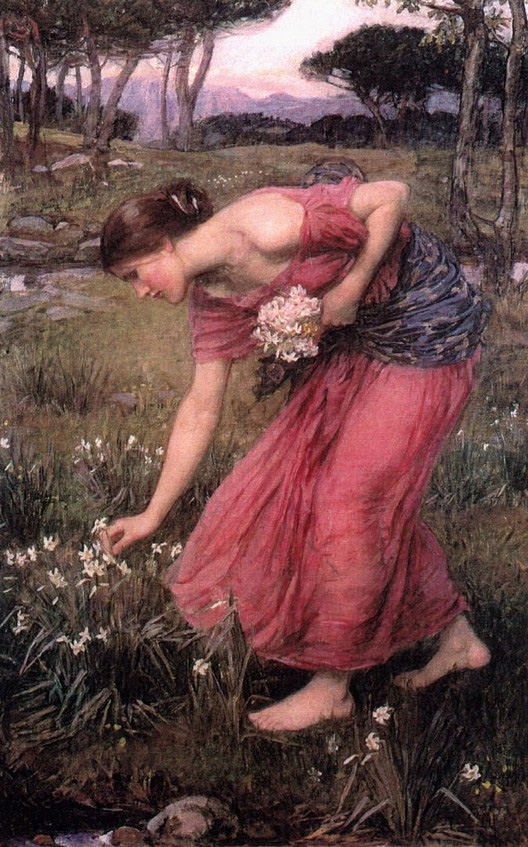
John William Waterhouse, Persephone (1912)
Persephone's presence in Hades is reflective of her respect to heroes in instances, while in others any attempt to steal her powers has savage and gruesome consequences. Like her Mesopotamian counterpart Ereshkigal, her powers in the abyss are not secondary ones.2, 54
The nekyia of the Odyssey shows this the most. Spectral successions of shades are brought forth by the invisible hand of Persephone. She conducts through such a sleight the self-realization of Odysseus, even though he eventually leaves in terror. Her role in the realm is scarcely as a captured damsel, it is a prerogative she takes up in regal solemnity.2
In the Roman accounts of the Orphic katabasis, it is Persephone rather than Hades who sets the condition to Orpheus that in order to come to the surface Eurydice cannot look back, which she does and ends up violating the rule set.55, 56
The best-attested katabasis of a living hero is with Heracles. Apollodorus has the shades scatter at his approach, except Meleager and the Gorgon Medusa. H rolls away the stone pinning Ascalaphus, and, wanting blood for the souls, slaughters one of Hades' cattle. The herdsman Menoetes challenges him to a wrestling match; Herakles seizes him about the middle and breaks his ribs, and releases him only at Persephone's request. The petition for Cerberus is then made to Plouton, who grants it on condition that the dog be mastered without weapons.57
Wrath
Along with her husband, Persephone was the subterranean mistress of the Erinyes, the furious deities tasked with avenging murder, rape or other atrocities. In the Dionysiaca, she has the Furies under her command.56
The hero Peirithous, having sworn with Theseus that each would win a daughter of Zeus, chose to abduct Persephone, and the two descend to take her from her husband. Hades receives them with a show of hospitality and invites them to sit; they are fixed to the Chair of Lethe by the Erinyes with coils of serpents growing about them, and remain until Heracles pulls Theseus free, the earth quaking when he attempts the same for Peirithous who violated the oath of xenia, incurring the wrath of Persephone.57, 58
Mercy
The 'dread' queen had a merciful side. She enabled the return of Alcestis, for example, who chose to die to avoid her husband and children perishing. It makes that return an act of the queen's clemency, perhaps a response to a conjugal virtue that mirrors her own condition. Plato's Symposium, comparing her favorably with Orpheus, says the powers below were so struck by the deed of Alcestis that they released her soul from Hades. Virtues leading to the divine do not have to be grandiose as an Achilles or a Perseus.59, 60
VIII. The Chthonic Persephone in Funerary Culture
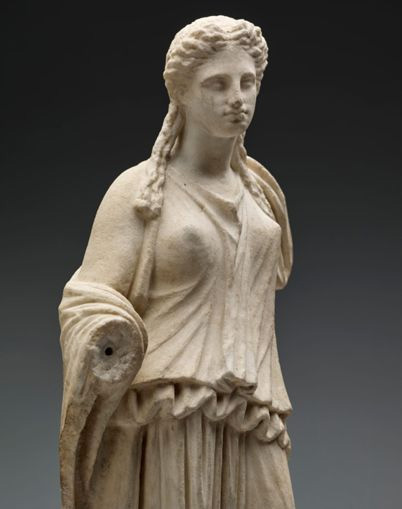
Statuette of Persephone
Funerary items from Greece and the wider Hellenistic world represent deceased brides and mothers with the typical items of Persephone and Hera. One funerary relief from Kerch, dating approximately to the first or second century CE, represents a deceased noblewoman Artipous named seated and holding a pomegranate, while a smaller attendant carries a box and possibly an alabastron.61
Anothere Classical example is the grave stele of Choirine, from Eleusis, approximately 375–350 BCE. Choirine holds an unusually large temple key. The key identifies her as a priestess and custodian of a sanctuary. The monument came from Eleusis so she has sometimes been interpreted as a priestess of Demeter or Kore by historians.61, 62
A much stronger form of divine assimilation appears in the Archaic Lakonian hero reliefs, perhaps indicating that divine-facing couples were given the imagery in a stronger form. The so-called Sabouroff grave stele from Chrysapha, near Sparta, represents a deceased man and woman enthroned together. They possess a snake and a pomegranate while being sat on a divine throne.63, 64
These items are synchronistic with the depiction in the Odyssey of Persephone calling forth the shades of various virtuous young women to speak with Odysseus, as well as his own mother. There is also a possible tie to Persephone and the so-called Kore statues of deceased young girls, though the etymological association is vague. One play on words from the so-called Phrasikelia Inscription shows a particularly distinctive tying together of theme:2, 65
σε͂μα Φρασικλείας·
Marker of Phrasikleia.
κόρε κεκλέσομαι αἰεί,
I shall be called 'kore' forever.
ἀντὶ γάμο παρὰ θεο͂ν
τοῦτο λαχο͂σ’ ὄνομα.
having received this name
from the Gods instead of marriage.66, 67
IX. The Orphic Persephone
A curious aspect of Persephone's cult extended deeper into death with the Orphic kinds of mourning materials where her nature was less linearly expressed as a goddess of death and more as a goddess of life within death.20
Two bodies of evidence stand behind almost everything we can say about her Orphic role which weave distinct threads. The Orphic Hymns address her in the accents of a living congregation; while the gold leaves are the private property of the dead. Together they place Persephone at the center of Orphic devotion as the mother of Zagreus. The study of the divine cast that populates the leaves by Jan Bremmer and other archeologists shows how consistently Persephone holds that ground.68, 69
The leaves themselves were made on fragile materials as beaten foil, sometimes as thin as a fingernail, which were folded small and set in the grave beside the body, inscribed with hexameters meant to be carried out of life and used; basically they are less prayers than provisions for the afterlife. Persephone's name recurs across them, sometimes beside Demeter, sometimes beside Euklês, a name that may be a courtesy-title for Plouton.69, 70
What the initiate hopes to reach is named without ornament. The pasture and shade of her grove and spring, a landscape rather than a throne room and a new spring time. Persephone offers shelter to the initiated dead rather than extreme judgement. The dead speaker says she has slipped beneath the kolpos of the Chthonian Queen, the overfold of the goddess's robe where it blouses above the belt. The Queen of the Dead whose character is filled with 'dread' elsewhere is is known as a mother.36, 69
X. Persephone in Philosophy
Neoplatonists took Persephone's role stemming from the Cratylus discussion very seriously. She may be one of the most important goddesses in this sense with a multiplicity of both heavenly and earth-bound roles, many descending from her mother, Demeter. What Socrates described as putting into lively motion was considered to be an allusion to what she does.3, 71
Kore
The Kore (Virgin) is treated as a triad which also includes Artemis and Athena, explaining why they are there in the Homeric Hymn in the flower picking meadow. Persephone in is in the middle zone in that triad reaches outward, touching the limit of generation. At the middle she is joined with Hades and his rewards beneath the earth. Persephone extends life into precisely the region (like Hades) governed by separation, change, embodiment and mortality, so as Socrates says, she touches the motion of beings.11, 71, 72
She communicates soul-having life (the life of the psyche or soul) into the lowest parts of the cosmos. Yet the same goddess also perfects the circuit of life by separating souls from bodies and turning them back toward their divine causes, while her husband perfects the most general aspects of separation.71, 72
The reception she gives in abyssal Hades and her ushering in of the spring for all new life above the surface become a coherent whole of two seeming halves. She is 'abducted' into Hades because her life-giving presence is necessary in that realm to make new life for souls.71, 72
The Artemis in this procession represents what is heavenly, incorruptible and above any process of generation. Her power flows into Persephone. Persephone takes that stable, undivided life and expresses it as power - the dynamis. When the soul is reassembled to achieve a greater perfection, the power flows into the next member of the triad, Athena.72
Persephone gives a being the power to live, move, generate and possess psychic activity. Athena gives the life able to have intellectual definition, order and self-dignity, the capacity to return to the first cause.72
Life-Bearing
The other Triad that Proclus assigns to Persephone is the life bearing one of Demeter, Hera and Persephone. Here she is called the daughter. She receives the particulars of soul ranks created from Hera and Zeus, becoming the source through which soul pours into all living beings. Persephone conducts life into procession, living wholes, and ultimately individual existence.72, 73
Like in the Kore Triad, her power to create souls flows down to the lowest level and again it unites with the power of Hades. Something of Persephone is shared with her son Zagreus-Dionysus who creates the individual confines for a life.47, 72, 73
XI. Persephone's Festivals
| Persephone Ritual Days | Place | Description | Importance | Date Recorded |
|---|---|---|---|---|
| Greater Mysteries | Eleusis to Athens | Eleusinian Mysteries | Inner rites, procession of objects | Homeric Hymn (7th century BCE) |
| Lesser Mysteries | Agrai and Athens | Prelude to Mystery | Preliminary initiation | Plutarch (1st century CE) |
| Thesmophoria | Across Greece | Demeter and Kore | Women-only festival, sacrifices | Pausanias (2nd century CE) |
| Eleusinia | Eleusis | Athletic | Games and footraces | Pindar (6th century BCE) |
| Stenia | Athens | Preparation for Thesmophoria | Women only-festival, insults, rising | Aristophanes (5th century BCE) |
| Proerosia | Across Greece | Agricultural Festival | Pre-ploughing sacrifice | I Eleusis 175 (330 BCE) |
| Soteria (Koreia) | Cyzicus | Annual-quadriennial festival | Competitive gathering | IG XI.4 1298 |
| Koragia | Mantinea | Solemn Rite | Koragoi rite | IG V² 265 (64-61 BCE) |
Sources: Pausanias, Description of Greece, for the Thesmophoria; the Homeric Hymn to Demeter, for the Greater Mysteries; Plutarch, for the Lesser Mysteries; Pindar, for the Eleusinia; I Eleusis 175, for the Proerosia; Aristophanes, for the Stenia; IG V² 265 inscription for the Koragia and IG XI.4 1298 inscription for the Soteria.4, 9, 11, 26, 43, 74, 75, 76, 77
XII. The Organization of Kore
Outside Eleusis, the priesthood of Kore or Persephone did not belong to a single Panhellenic hierarchy. Title, sex of clergy and responsibilities were determined by the individual city and sanctuary.5
At Hellenistic Knidos, a short inscription identified a woman whose name ends in -leia as ἱέρεια Κούραι, “priestess of Kore,” using the local Doric form of the goddess’s title. At early-imperial Cyzicus, by contrast, Claudius Eumenes, also called Moschos, served as a male priest of Kore Soteira for a second term or year and as interpreter (exēgētēs) of the goddess’s Great Mysteries. The same inscription has him among the city’s generals.78, 79, 80
Persephone's cult was particularly active and much of the most integral acts to buttress her went beyond the priesthood. Evidence comes from the Koragia at Mantinea, recorded in an honorific decree of 61-60 BCE for the wealthy benefactress Nikippa. The Koragoi were outside of simply being priests of Kore who are referred to as a separate group. They were a synodos, an organization who were attached to Kore’s public cult.5, 43
The great benefactor Nikippa financed the festival and liturgy. She put money toward sacrifices and inspection of omens. Nikippa also supported the procession, even providing a new peplos for the goddess, arranged and embellished the secret mysteries, paid for repairs to the temple and performed the customary rites connected with its opening on the thirtieth day. In a particularly cryptic remark, she also received the goddess, it is claimed.43
What this example shows is very simple. The piety given to the goddess was reinforced by large amounts of effort and money from the lowest rungs to the highest wealthy in society. Persephone was regarded as one of the most integral of goddesses.43, 80
XIII. The Symbolism of Persephone
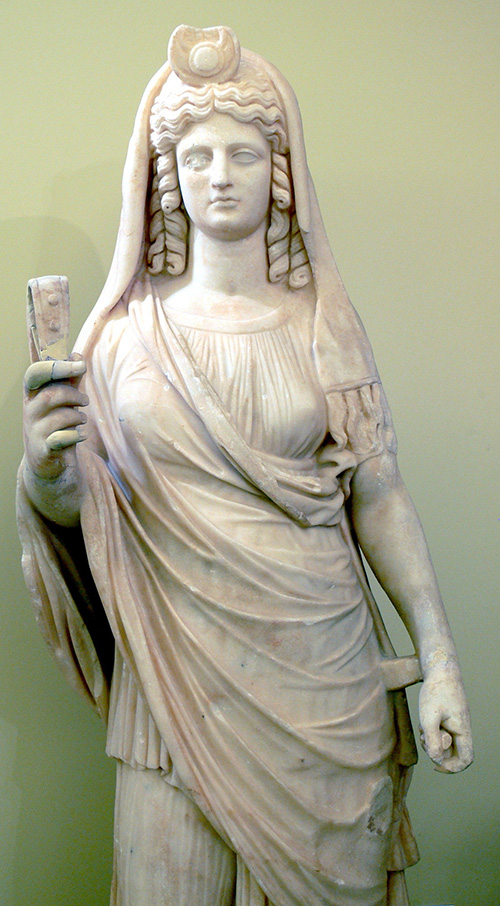
Isis-Persephone, Heraklion Museum of Crete
Diadem and Statuary
Persephone is represented as a younger woman, occasionally as an adolescent girl as Kore. Her guise as Persephone usually shows her in the garb of a woman clad with a diadem or veil, a representation of a Greek queen. She often sits in front of Hades enthroned in wall-reliefs and other depictions; sometimes she is at his side carrying a torch. It should be stated, however, that many statues of Persephone are conjectural in their assignment.4, 81, 82
The image of the cult with that in mind usually gives the mature Persephone a controlled, frontal and impassive expression of oval face. Her mouth area is often small and eyes are large with a uncovered forehead. The Kore statues on the other hand, especially archaic ones, may show semblances of fear or widened eyes. These busts could evoke Persephone rising from below, the anodos, but they could also represent the mortal nymphe, the young bride passing from maidenhood into marriage. Sometimes Persephone is shown as golden-haired like her mother, and she often has long braided or curled hair strands falling onto her neck and body like vines.81, 83
Magna Graecia had their own conventions. From the fifth through third centuries BCE, Sicily produced terracotta busts (protomes) associated with Demeter and Kore. These often show only the head, neck and upper chest emerging from an abbreviated body. The form has been interpreted as Persephone’s emergence from the earth, although its young female face could equally represent a bride approaching the transition embodied by the goddess. A typical head wears a polos; its centrally parted wavy hair is drawn back, its earlobes are pierced for real metal earrings, and its full chin, small mouth and sober expression follow classical ideals.84
Like Aphrodite and Demeter, Persephone is frequently conflated with the great goddess of Egypt, Isis, particularly in Roman-era imperial statuary where the head throne and sistrum are items she wields. Here she shares the role of Isis in allowing life to penetrate to the lowest depths, sharing too in her function of being the husband of the god of death, as well as a mastery over funerary practices.85, 86
Pomegranate
As with Hera, Persephone is associated with the pomegranate. The Homeric Hymns above give the reason as Hades gives its seeds to her to go from above to below. Clutching the fruit in her hand is a typical convention in art, especially in the pinakes of Locris, and it is assumed the fruit played a large role in the Eleusinian Mysteries as a symbol.11, 25, 35
Sheath of Grain and Asphodel
The sheath is a shared symbol with her mother. Again it shows a dualistic symbolism: what has been cut still gives way to new life as its seeds are shorn along with it.81
The asphodel was particularly associated with Persephone. This is a visual symbol that blooms in late spring and which harkens to the Asphodel Meadows where many people end up, a realm outside of Hades but full of shades that the queen presumably has power over. Even from the earliest Hesiodic contexts, the flower aligns with death and rebirth.2, 10
Symbolically the flower had certain connotations in an Orphic context. It represented the endurance of the initiate in the afterworld. A Bacchic gold leaf describes the blessed destination of the purified soul as the “sacred meadows and groves of Persephone.”36, 69
Torch
The torch is a general symbol that Persephone wields, particularly on vases and Greek pottery as a whole. She shares this imagery with her mother, Hecate and to some extent Artemis on a wider level. Like Hecate, Persephone is shown in the conventions after Praxiteles as wielding dual torches in statuary.81, 87
Sources and Bibliography
- Richardson, Nicholas J. “Demeter.” In Oxford Classical Dictionary. Oxford: Oxford University Press, 2016. For the framing of Kore as Demeter’s daughter and the shared cult identity that governs the naming section.
- Homer. Odyssey, Volume I: Books 1–12. Translated by A. T. Murray. Revised by George E. Dimock. 2nd ed. Loeb Classical Library 104. Cambridge, MA: Harvard University Press, 1995. See 10.491, 10.494, 10.509, 10.534, and 11.213–14, 11.217–18, 11.225–327, 11.633–35. For the form Persephoneia, the groves of Persephone, the phantom sent to Odysseus, and the parade of heroines and the Gorgon terror in the nekyia.
- Plato. Cratylus. Parmenides. Greater Hippias. Lesser Hippias. Translated by Harold North Fowler. Loeb Classical Library 167. Cambridge, MA: Harvard University Press, 1926. See Cratylus 404c–d. For Pherepapha, the charge that fear of the name comes from ignorance, and the derivation from things in motion and contact that the Neoplatonic section later builds on.
- Pausanias. Description of Greece. Translated by W. H. S. Jones and H. A. Ormerod. 4 vols. Loeb Classical Library. Cambridge, MA: Harvard University Press, 1918–1935. See especially 1.2.4; 2.4.7; 4.1.5–9; 4.33.4–5; 8.9.2; 8.31.1–8; 8.37.1–10. For the statement that Kore’s real name is Persephone, the Acrocorinth and Arcadian sites, the Megalopolitan Great Goddesses with their stone Demeter and wood-draped Saviour, the sanctuary of Kore entered by men once a year, and the four founders of the Arcadian rite.
- Jiménez San Cristóbal, Ana Isabel. “Persephone/Kore.” In Oxford Classical Dictionary. Published March 7, 2016. Updated July 30, 2020. For the survey of regional name-forms, and for the Koragia at Mantinea and the absence of any single Panhellenic priesthood behind Section XII.
- Wachter, Rudolf. “Persephone, the Threshing Maiden.” Die Sprache 47, no. 2 (2007–2008): 163–181. For the fifth-century Attic vase spellings with -o-, their priority over later Attic and epic forms, and the full statement of the *perso- plus *gʷʰen- etymology.
- Del Monaco, Lavinio, ed. Locri. Iscrizioni greche d’Italia 5. Rome: Edizioni Quasar, 2013. See no. 74. For the Locrian form Periphona.
- Aeschylus. Oresteia: Agamemnon, Libation-Bearers, Eumenides. Edited and translated by Alan H. Sommerstein. Loeb Classical Library 146. Cambridge, MA: Harvard University Press, 2009. See Libation-Bearers 490. For the tragic form Persephassa.
- Aristophanes. Birds. Lysistrata. Women at the Thesmophoria. Edited and translated by Jeffrey Henderson. Loeb Classical Library 179. Cambridge, MA: Harvard University Press, 2000. See Women at the Thesmophoria 287. For the Attic form Phersephatta, and for the Stenia in the festival table.
- Hesiod. Theogony. Works and Days. Testimonia. Edited and translated by Glenn W. Most. Loeb Classical Library 57. Cambridge, MA: Harvard University Press, 2018. See Theogony 768, 774, 913, and Works and Days 167–73. For the two Theogonic appearances of the dread queen and the gift to Hades, the alternation of Persephōnē and Persephoneia, and the earliest associations of the blessed dead with meadow and flower.
- Homeric Hymn to Demeter, translated by Gregory Nagy, Center for Hellenic Studies. For the Loeb edition see Homeric Hymn to Demeter, in The Homeric Hymns and Homerica, translated by Hugh G. Evelyn-White, Loeb Classical Library 57 (Cambridge, MA: Harvard University Press, 1914), 359–360. For the abduction, the speech of Hades quoted in Section II, the pomegranate seed, the division of the year, the instruction of Triptolemus, Eumolpus, Diokles and Keleos, and the enthronement beside Zeus.
- Beekes, Robert. Etymological Dictionary of Greek. 2 vols. Leiden: Brill, 2010. S.v. Περσεφόνη. For the lexical treatment of the second element and its connection to the root meaning to beat or to kill. Substituted for a duplicate entry that repeated the Wachter article already listed above.
- Wachter, Rudolf. Review of Lexikon des frühgriechischen Epos, fascs. 19–20. Kratylos 51 (2006): 136–144. For the first appearance in print of the threshing etymology, with Persephone treated at 139–44.
- Etymologicum Magnum. Edited by Thomas Gaisford. Oxford: Oxford University Press, 1848. See 665.49–51. For the classical derivation from pherō and phonos and the gloss about those carried off by violent death.
- Plutarch. Moralia. Vol. 5, Isis and Osiris. Translated by Frank Cole Babbitt. Loeb Classical Library. Cambridge, MA: Harvard University Press, 1936. For the allegorical reading of Persephone as the breath borne through the crops and slain with them.
- Porphyry. On Abstinence from Killing Animals. Translated by Gillian Clark. London: Duckworth, 2000. For the derivation of Pherrephatta from feeding the ring-dove.
- Ventris, Michael, and John Chadwick. Documents in Mycenaean Greek: Three Hundred Selected Tablets from Knossos, Pylos, and Mycenae, with Commentary and Vocabulary. 2nd ed. Cambridge: Cambridge University Press, 1973. See 411, 463, and 484. For the pe-re* problem and the proposed Preswa-.
- Homer. The Iliad. Translated by A. T. Murray. Revised by William F. Wyatt. 2 vols. Loeb Classical Library. Cambridge, MA: Harvard University Press, 1999. See 9.457, 9.569. For the epic epithet epainē and the invocation of Persephone alongside the Erinyes.
- Drachmann, Anders Bjørn, ed. Scholia Vetera in Pindari Carmina. Vol. 3, Scholia in Nemeonicas et Isthmionicas; Epimetrum; Indices. Leipzig: B. G. Teubner, 1927. Scholion to Pindar, Isthmian 7.3. For the mystic word about the first Persephone and the birth of Dionysus as Zagreus.
- Orphic Hymns. Hymn 29, “To Persephone”; Hymn 30, “To Dionysos”; Hymn 71, “To Melinoë.” Translated by Apostolos N. Athanassakis and Benjamin M. Wolkow. Baltimore: Johns Hopkins University Press, 2013. For her horned aspect, her nourishing and killing of mortals, the blessed old age, the Eubouleus genealogies set side by side, and the parentage of Melinoë.
- Theocritus. Idylls 15.14, 94, with the ancient scholia ad loc. In The Greek Bucolic Poets, translated by J. M. Edmonds. Loeb Classical Library 28. Cambridge, MA: Harvard University Press, 1912. See also Porphyry, On the Cave of the Nymphs 18. For the cult titles used in Hellenistic devotional address.
- Farnell, Lewis Richard. The Cults of the Greek States. 5 vols. Oxford: Clarendon Press, 1896–1909. See especially vol. 3, the sections on Demeter and Kore-Persephone. For the older synthetic collection of the epithets gathered in the table.
- Liddell, Henry George, Robert Scott, Henry Stuart Jones, and Roderick McKenzie. A Greek-English Lexicon. 9th ed., with revised supplement. Oxford: Clarendon Press, 1996. Entries under Περσεφόνη and the individual epithets. For the lexical glosses behind the meanings given in the epithet table.
- Foley, Helene P., ed. The Homeric Hymn to Demeter: Translation, Commentary, and Interpretive Essays. Princeton, NJ: Princeton University Press, 1994. Cited for the commentary and interpretive essays rather than the text itself, which is listed above. For the reading of the Hymn as a charter narrative in which mother and daughter jointly found the rites.
- Clinton, Kevin. Myth and Cult: The Iconography of the Eleusinian Mysteries. Skrifter utgivna av Svenska Institutet i Athen 8°, 11. Stockholm: Svenska Institutet i Athen, 1992. For the visual convention in which Demeter and Kore flank a youthful Triptolemus, and for the identification of the kernos, the kiste and the other hiera discussed in Section VI and the pomegranate in Section XIII.
- Strabo. Geography. Translated by Horace Leonard Jones. 8 vols. Loeb Classical Library. Cambridge, MA: Harvard University Press, 1917–1932. See 2.3.4 and 8.3.14. For the Triphylian precinct of Hades beside the grove of Demeter and the temples of Demeter and Kore held there in high honour, and for the name Koreia given to the Cyzicene festival.
- Bookidis, Nancy, and Ronald S. Stroud. The Sanctuary of Demeter and Kore: Topography and Architecture. Corinth 18.3. Princeton, NJ: American School of Classical Studies at Athens, 1997. For the excavated form of a shared Demeter and Kore complex, cited as the type case for the claim that most of her sites were jointly dedicated.
- Mylonas, George E. Eleusis and the Eleusinian Mysteries. Princeton, NJ: Princeton University Press, 1961. For the excavation-based account of the sanctuary: the Propylaia, the successive Telesteria, the roughly square Periclean hall of about 51 metres, the eight tiers of seating, the forty-two columns of the Koroibos design, and the Anaktoron within.
- Scott, Michael. “Walls and the Ancient Greek Ritual Experience: The Sanctuary of Demeter and Kore at Eleusis.” In Cognitive Approaches to Ancient Religious Experience, edited by Esther Eidinow, Armin W. Geertz, and John North, 193–217. Cambridge: Cambridge University Press, 2022. For the high fortress-like temenos wall standing from at least the sixth century, the estimate of its circuit, and the argument that the walls, the darkness and the column screen deliberately broke sightlines and produced the secrecy the article describes. This is the source named in the body text.
- Clinton, Kevin. “The Sanctuary of Demeter and Kore at Eleusis.” In Greek Sanctuaries: New Approaches, edited by Nanno Marinatos and Robin Hägg, 110–124. London: Routledge, 1993. For the internal landscape of the sanctuary, the sequence of controlled boundaries, and the administration of access.
- Euripides. Suppliant Women. Edited and translated by David Kovacs. Loeb Classical Library 9. Cambridge, MA: Harvard University Press, 1998. See 1–103. For the women seated at the altars outside the wall who can see only the roof of the Telesterion above them.
- Lippolis, Enzo. Mysteria: Archeologia e culto del santuario di Demetra a Eleusi. Milan: Bruno Mondadori, 2006. For the building phases of the sanctuary and the dating of the Lesser and Greater Propylaia, which are Roman rather than Archaic.
- Clinton, Kevin. “Stages of Initiation in the Eleusinian and Samothracian Mysteries.” In Greek Mysteries: The Archaeology and Ritual of Ancient Greek Secret Cults, edited by Michael B. Cosmopoulos, 50–78. London: Routledge, 2003. For the debate over whether the Anaktoron is a structure within the Telesterion or the hall itself, and for the display of the hiera at the climax of the rite.
- Sourvinou-Inwood, Christiane. “Persephone and Aphrodite at Locri: A Model for Personality Definitions in Greek Religion.” Journal of Hellenic Studies 98 (1978): 101–121. For the reading of the abduction as a marriage model at Locri, for the peplos and child dedications on the pinakes, and for the argument that Persephone there occupies the functional space Hera holds elsewhere.
- Redfield, James M. The Locrian Maidens: Love and Death in Greek Italy. Princeton, NJ: Princeton University Press, 2003. For the Locrian ritual system linking maidenhood, marriage and death, and for the goddess as civic patron of the colony. Also cited in Section XIII for the pinakes showing the fruit in her hand.
- Eisenfeld, Hanne. “Life, Death, and a Lokrian Goddess: Revisiting the Nature of Persephone in the Gold Leaves of Magna Graecia.” Kernos 29 (2016): 41–72. For a corrective to the strong absorption reading at Locri, and, in Sections IX and XIII, for Persephone as a goddess of life within death in the gold leaves and for the meadow imagery.
- Torelli, Mario. “I culti.” In Storia della Calabria: La Calabria antica, edited by Salvatore Settis, 589–612. Bari: Gangemi, 1988. For the standing of the Locrian pinakes among the artistic products of the western colonies.
- Prückner, Helmut. Die lokrischen Tonreliefs: Beitrag zur Kultgeschichte von Lokroi Epizephyrioi. Mainz: Philipp von Zabern, 1968. For the corpus of pinakes recovered from the Mannella deposit, their polychromy and their typology, and for the chronology running back to the late seventh or early sixth century.
- Epiphanius of Salamis. The Panarion of Epiphanius of Salamis, Books II and III. Translated by Frank Williams. 2nd ed. Nag Hammadi and Manichaean Studies 79. Leiden: Brill, 2013. See 51.22. For the Koreion described as an immense temple, the descent by torchlight, the naked wooden image on its litter with five gilt seals, the sevenfold circuit with flutes, tambourines and hymns, and the saying that Kore gave birth to Aion.
- Alföldi-Rosenbaum, Elisabeth. “Alexandriaca: Studies on Roman Game Counters III.” Chiron 6 (1976): 205–239. For the Alexandrian gaming counters inscribed Eleusinion and the argument placing the building in the suburb of that name. This is the study named in the body text.
- Fraser, P. M. Ptolemaic Alexandria. 3 vols. Oxford: Clarendon Press, 1972. For the topography of Alexandria and its suburb Eleusis, and for the standing of the Koreion in the city’s cults.
- Bowersock, G. W. Hellenism in Late Antiquity. Ann Arbor: University of Michigan Press, 1990. For the interpretation of the Aion rite reported by Epiphanius and its date of 6 January.
- Inscriptiones Graecae. Vol. 5, part 2, Inscriptiones Arcadiae. Edited by Friedrich Hiller von Gaertringen. Berlin: Georg Reimer, 1913. See nos. 265 and 517. For the Mantinean decree honouring Nikippa, the synodos of the Koragoi and the Koragia in Sections XI and XII, and for the Lykosouran honours for Saon of Megalopolis in Section IV.
- Kantirea, Maria. “Re-shaping the Sacred Landscape through Benefaction: The Sanctuary of Lykosoura in the Peloponnese.” In Hellenistic Sanctuaries: Between Greece and Rome, edited by Milena Melfi and Olympia Bobou. Oxford: Oxford University Press, 2016. For the Roman-period standing of the Lykosouran sanctuary and the Megalopolitan families who held office and paid for it, which is the setting of the Saon inscription.
- Jost, Madeleine. Sanctuaires et cultes d’Arcadie. Études péloponnésiennes 9. Paris: Vrin, 1985. For the standard treatment of the Arcadian cults, the distinction between the Megalopolitan Great Goddesses and Despoina at Lykosoura, and the cult images and their materials.
- Cole, Susan Guettel. Landscape, Gender, and Ritual Space: The Ancient Greek Experience. Berkeley: University of California Press, 2004. For the gendered regulation of sacred space, cited for the sanctuary of Kore that women might enter at any time and men only once a year.
- Diodorus Siculus. Library of History. Translated by C. H. Oldfather. Loeb Classical Library. Cambridge, MA: Harvard University Press, 1933–. See 3.62.6–8; 4.4.1–2; 5.4.2–6; 5.75.4. For the earlier Dionysus born to Zeus and Persephone whose birth and honours were celebrated secretly at night, and, in Section X, for the dividing of the god that the Neoplatonic reading presupposes.
- Hyginus. Fabulae 155, 167. In Apollodorus’ Library and Hyginus’ Fabulae: Two Handbooks of Greek Mythology, translated by R. Scott Smith and Stephen M. Trzaskoma. Indianapolis: Hackett, 2007. For the Latin mythographic version of the Zagreus birth and the parallels drawn between Semele and Persephone.
- Morand, Anne-France. Études sur les Hymnes orphiques. Religions in the Graeco-Roman World 143. Leiden: Brill, 2001. For the placing of Melinoë within the hymnic collection, the sense of her name, and her overlap with Hecate.
- Wünsch, Richard. Antikes Zaubergerät aus Pergamon. Jahrbuch des Kaiserlich Deutschen Archäologischen Instituts, Ergänzungsheft 6. Berlin: Georg Reimer, 1905. For the editio princeps of the triangular bronze divinatory tablet from Pergamon, its three crowned figures labelled Dione, Phoebe and Nyche, and the occurrence of Melinoë’s name upon it.
- Suidae Lexicon. Edited by Ada Adler. 5 vols. Leipzig: B. G. Teubner, 1928–1938. See μ 51 and β 74–75. For Makaria as a daughter of Hades, for the proverb about going into blessedness and its euphemistic sense, and for the entry that runs the two Makarias together.
- Zenobius. Epitome 2.61. In Corpus Paroemiographorum Graecorum, vol. 1, edited by Ernst Ludwig von Leutsch and Friedrich Wilhelm Schneidewin. Göttingen: Vandenhoeck und Ruprecht, 1839. For the proverb applied to those who give themselves into danger through courage, which is the strand the Suda merges with the daughter of Hades.
- Burkert, Walter. Ancient Mystery Cults. Cambridge, MA: Harvard University Press, 1987. For the sacred objects carried in the Eleusinian procession, the kernos and its first fruits, the plemochoai and the bacchoi, and the relation of the whole sequence to the return of the goddess.
- Burkert, Walter. The Orientalizing Revolution: Near Eastern Influence on Greek Culture in the Early Archaic Age. Translated by Margaret E. Pinder and Walter Burkert. Cambridge, MA: Harvard University Press, 1992. For the comparative frame behind the comparison of Persephone’s underworld sovereignty with that of Ereshkigal.
- Virgil. Georgics 4.453–527. In Eclogues. Georgics. Aeneid: Books 1–6, translated by H. Rushton Fairclough, revised by G. P. Goold. Loeb Classical Library 63. Cambridge, MA: Harvard University Press, 1999. For the statement at 4.487 that Proserpina herself had laid down the condition Orpheus breaks, which is the basis of the claim that the Roman accounts assign the terms to her rather than to her husband.
- Nonnus of Panopolis. Dionysiaca. Translated by W. H. D. Rouse. Loeb Classical Library 344. Cambridge, MA: Harvard University Press, 1940. Cited sections: 44.198-230, with the general Dionysiaca source-note folded here.
- Apollodorus. The Library. Translated by James George Frazer. 2 vols. Loeb Classical Library 121–122. Cambridge, MA: Harvard University Press, 1921. See 2.5.12 and Epitome 1.24. For the scattering of the shades, Ascalaphus beneath the stone, the wrestling with Menoetes broken off at Persephone’s request, the terms set for Cerberus, and the fixing of Theseus and Peirithous below.
- Virgil. Aeneid 6.601–618. In Eclogues. Georgics. Aeneid: Books 1–6, translated by H. Rushton Fairclough, revised by G. P. Goold. Loeb Classical Library 63. Cambridge, MA: Harvard University Press, 1999. For the punishment of Theseus and Peirithous as an exemplum of violated hospitality in the underworld.
- Plato. Symposium 179b–d. In Lysis. Symposium. Gorgias, translated by W. R. M. Lamb. Loeb Classical Library 166. Cambridge, MA: Harvard University Press, 1925. For the speech of Phaedrus in which the powers below, struck by Alcestis, send her soul back, and for the unfavourable comparison with Orpheus.
- Euripides. Alcestis. In Cyclops. Alcestis. Medea, edited and translated by David Kovacs. Loeb Classical Library 12. Cambridge, MA: Harvard University Press, 1994. For the substitution of Alcestis for her husband and her return, which is the act the article reads as the queen’s clemency.
- Margariti, Katia. “Lament and Death instead of Marriage: The Iconography of Deceased Maidens on Attic Grave Reliefs of the Classical Period.” Hesperia 87, no. 1 (2018): 91–176. For the funerary convention in which the unmarried dead are given the attributes of the bride, and for the seated woman with attendant, box and alabastron as a standing type.
- Connelly, Joan Breton. Portrait of a Priestess: Women and Ritual in Ancient Greece. Princeton, NJ: Princeton University Press, 2007. For the oversized temple key as the identifying attribute of a priestess on Greek funerary monuments, which is the basis for reading the Choirine stele as that of a sanctuary custodian.
- Salapata, Gina. Heroic Offerings: The Terracotta Plaques from the Spartan Sanctuary of Agamemnon and Kassandra. Ann Arbor: University of Michigan Press, 2014. For the Laconian enthroned-couple type, its attributes of throne, snake and offering vessel, and the long dispute over whether these are heroised dead or the underworld pair themselves.
- Antikensammlung, Staatliche Museen zu Berlin. Relief with heroes and worshippers, from Chrysapha, Laconia. Inv. no. Sk 731, ca. 540 BCE, formerly Sabouroff Collection. For the specific monument named in the article, the oldest of the Laconian hero reliefs.
- Mackin Roberts, Ellie. “Girls Playing Persephone (in Marriage and Death).” Mnemosyne 71, no. 2 (2018): 209–228. For the argument that Greek girls were figured as Persephone at both marriage and death, which underwrites the link drawn between the goddess and the kore monuments.
- Svenbro, Jesper. Phrasikleia: An Anthropology of Reading in Ancient Greece. Translated by Janet Lloyd. Ithaca, NY: Cornell University Press, 1993. For the reading of the Phrasikleia epigram and the play by which the dead girl receives the name kore from the gods in place of marriage.
- Hansen, Peter Allan, ed. Carmina Epigraphica Graeca saeculorum VIII–V a.Chr.n. Texte und Kommentare 12. Berlin: De Gruyter, 1983. No. 24 (= IG I³ 1261). For the text of the Phrasikleia inscription quoted in the article.
- Bremmer, Jan N. Initiation into the Mysteries of the Ancient World. Münchner Vorlesungen zu Antiken Welten 1. Berlin: De Gruyter, 2014. For the divine cast of the gold leaves and the consistency with which Persephone occupies its centre, which is the scholarship the article names.
- Graf, Fritz, and Sarah Iles Johnston. Ritual Texts for the Afterlife: Orpheus and the Bacchic Gold Tablets. 2nd ed. London: Routledge, 2013. For the physical form of the beaten-foil leaves and their hexameters, for Persephone beside Demeter and Euklēs, for the meadows and groves of the blessed, and for the Thurii text in which the speaker has sunk beneath the kolpos of the Chthonian Queen.
- Edmonds, Radcliffe G., III, ed. The “Orphic” Gold Tablets and Greek Religion: Further Along the Path. Cambridge: Cambridge University Press, 2011. For the range of scholarly readings of the leaves, including the identification of Euklēs as a courtesy title for Plouton.
- Proclus. On Plato’s Cratylus. Translated by Brian Duvick. London: Duckworth, 2007. For the Neoplatonic development of the Cratylus etymology, for Kore as the middle term reaching to the limit of generation, and for her joining with Hades in the sublunary region.
- Proclus. Platonic Theology. Edited and translated by H. D. Saffrey and L. G. Westerink. 6 vols. Paris: Les Belles Lettres, 1968–1997. Books V–VI. For the Kore triad of Artemis, Persephone and Athena, for the life-bearing triad of Demeter, Hera and Persephone, and for the doctrine that she communicates ensouled life into the lowest parts of the cosmos while also separating souls from bodies.
- Chlup, Radek. Proclus: An Introduction. Cambridge: Cambridge University Press, 2012. For an accessible account of the Proclan triadic scheme and the procession, remaining and reversion pattern that the article’s two triads presuppose.
- Plutarch. Lives. Vol. 9, Demetrius 26. Translated by Bernadotte Perrin. Loeb Classical Library 101. Cambridge, MA: Harvard University Press, 1920. For the Lesser Mysteries at Agrai and their relation to the Greater, as given in the festival table.
- Pindar. Olympian Odes, Pythian Odes. Edited and translated by William H. Race. Loeb Classical Library 56. Cambridge, MA: Harvard University Press, 1997. See Olympian 9.99. For the Eleusinian games, which are the earliest notice of the athletic Eleusinia in the table.
- Clinton, Kevin. Eleusis: The Inscriptions on Stone; Documents of the Sanctuary of the Two Goddesses and Public Documents of the Deme. 2 vols. Athens: Archaeological Society at Athens, 2005–2008. See I Eleusis 175. For the epigraphic record of the Proerosia dated 330 BCE in the table.
- Habicht, Christian. “The City of Kyzikos, Client of Oracles.” In Studies in Greek Epigraphy and History in Honor of Stephen V. Tracy, edited by Gary Reger, Francis X. Ryan, and Timothy F. Winters, 311–322. Bordeaux: Ausonius Éditions, 2010. For IG XI.4 1298 and the foundation of the Cyzicene Soteria in honour of Kore, the festival also called Koreia.
- Blümel, Wolfgang, ed. Die Inschriften von Knidos. Vol. 1. Inschriften griechischer Städte aus Kleinasien 41. Bonn: Rudolf Habelt, 1992. For the Hellenistic Knidian text naming a woman as hiereia Kourai, in the local Doric form of the title.
- Schwertheim, Elmar, ed. Die Inschriften von Kyzikos und Umgebung. 2 vols. Inschriften griechischer Städte aus Kleinasien 18 and 26. Bonn: Rudolf Habelt, 1980–1983. For the Cyzicene record of a male priest of Kore Soteira who also served as exēgētēs of the goddess’s Great Mysteries and appears among the city’s generals.
- Jim, Theodora Suk Fong. Saviour Gods and Soteria in Ancient Greece. Oxford: Oxford University Press, 2022. For Kore Soteira as the principal deity of Cyzicus, the standing of her Great Mysteries there, and the wider point that the shape of her cult was set locally rather than by any common hierarchy.
- Lexicon Iconographicum Mythologiae Classicae (LIMC). Vol. 8. Zurich: Artemis, 1997. S.v. “Persephone,” by Günter Güntner. For the catalogue of her images: the diadem and veil, the enthronement beside Hades, the torch, the grain ear and the sheaf, and the cautionary point that many assignments are conjectural.
- British Museum. Marble statuette of Persephone. Ca. 350–300 BCE. Museum no. 1859,1226.43. For a dated example of the standing type described in the article.
- Stewart, Andrew. “Hellenistic Free-Standing Sculpture from the Athenian Agora, Part 2: Demeter, Kore, and the Polykles Family.” Hesperia 81, no. 4 (2012): 655–689. For the facial canon of the mature cult image, the oval face, small mouth, large eyes and uncovered brow, and for the problems of attribution in the Kore statues.
- Hinz, Valentina. Der Kult von Demeter und Kore auf Sizilien und in der Magna Graecia. Palilia 4. Wiesbaden: Reichert, 1998. For the Sicilian terracotta protomes of the fifth to third centuries, their truncated form, the polos and the pierced earlobes, and the debate over whether they show the goddess rising or the bride.
- Newby, Zahra. Greek Myths in Roman Art and Culture: Imagery, Values and Identity in Italy, 50 BC–AD 250. Cambridge: Cambridge University Press, 2016. For the reworking of Greek divine imagery under the empire, cited for the imperial-period conflation of Persephone with Isis.
- Walters, Elizabeth J. Attic Grave Reliefs That Represent Women in the Dress of Isis. Hesperia Supplement 22. Princeton, NJ: American School of Classical Studies at Athens, 1988. For the Isiac attributes, including the sistrum and the headdress, as markers of assimilation in funerary and cult sculpture.
- Musée du Louvre. “Demeter and Kore.” In Praxiteles. Exhibition microsite. For the Praxitelean torch-bearing type and its later repetitions, cited for the dual-torch convention shared with Hecate.