




| Language | Name | Earliest Secure Named Object |
|---|---|---|
| Etruscan | neθunus | Carnelian scarab, reportedly from Vulci, fourth century BCE |
9 min read
Nethuns
author: High Priest Zevios Metathronos
co-authors: Karnonnos
Hieratic Information about Nethuns
| Divine Symbols | |
|---|---|
|
I. The Name
The etymology of Nethuns is disputed. Helmut Rix classified Etruscan Neθuns among the theonyms borrowed from the neighbouring Italic languages and derived it from an Umbrian form *Nehtuns, "Neptune." This proposal gives a plausible direction of transmission, although it does not recover a transparent meaning for the name within Etruscan itself.1
The earliest surviving object generally treated as a securely named image of the God is a carnelian scarab reportedly found at Vulci and now in the Cabinet des Médailles of the Bibliothèque nationale de France, Luynes 251. The inscription reads neθunus from right to left. Laura Ambrosini dates the gem broadly to the fourth century BCE and records it as ET Vc G.3, CIE III.3, 11180, and LIMC Poseidon/Nethuns 1.2,3
The broad dating prevents an exact sequence within the fourth century BCE, especially beside the Tuscania mirror usually placed around 350 BCE. Nonetheless, the Vulci scarab remains the standard earliest candidate because the divine figure and the written name occur together.2,3
Source: Paris, Bibliothèque nationale de France, Cabinet des Médailles, Luynes 251; ET Vc G.3; CIE III.3, 11180; LIMC Poseidon/Nethuns 1.2,3
II. Greek Myth in Etruscan Art
Amymone and the Spring of Lerna
A bronze mirror in the Vatican Museums, inv. 5539, presents a closely recognizable Etruscan treatment of a familiar Poseidon myth. Nethuns embraces Amymone beside water issuing from a stone lion-mask; he carries the trident, while a fish and hippocamp appear below and a satyr watches from behind. The mirror was made in Etruria during the second half of the fourth century BCE.6,7
Pseudo-Apollodorus relates that Amymone encounters a satyr while searching for water in the dry Argolid. Poseidon drives the satyr away, lies with her, and reveals the springs of Lerna. The Latin mythographer Hyginus later gives Neptune the same role and adds that the God strikes the earth with his trident, whereupon the Lernaean spring and Amymonian river flow forth.4,5
The Vatican mirror therefore employs a Greek narrative already suited to Nethuns through its union of divine rescue, subterranean water and the trident. The published catalog identifies the figures from their attributes and narrative setting. The story travelled more securely than its words.3,6,7
Hercle Among the Gods
A late-sixth-century BCE black-figure hydria by the Micali Painter, Florence, Museo Archeologico Nazionale 4139, shows the apotheosis of Hercle and an assembly of Gods. One long-bearded male holds a trident and is conventionally identified as Poseidon/Nethuns. The figure is uninscribed, so the name remains an iconographic attribution rather than an epigraphic fact.3,8
Ollie Croker and Thomas Mannack stress that trident-like implements are not invariably exclusive to Nethuns in Etruscan art. On the Florence hydria, however, the mature beard and the divine assembly strengthen the identification. Here the Etruscan God enters a Greek mythological company while retaining the instrument by which he is known.8
III. In the Rite of Nethuns
Nethuns also appears outside narrative art. His abbreviated name, neθ, occupies more than one compartment of the bronze Liver of Piacenza, a model of a sheep's liver used to articulate the divine regions consulted by an Etruscan haruspex. L. Bouke van der Meer dates the object to about 100 BCE and treats the abbreviated forms as references to Nethuns.9
The Liber Linteus, the Etruscan ritual book preserved as the wrappings of an Egyptian mummy, gives the genitive neθunśl, "of Nethuns." Van der Meer counted several appearances of the God in the surviving calendar and interpreted one sequence as prescribing wine in connection with his image or cult-object. The syntax and much of the ritual vocabulary remain debated, so the proposed actions belong to the editor's reconstruction.10
These texts establish Nethuns within formal divination and calendrical ritual. A complete theology and continuous account of his cult do not survive. His name nevertheless belongs inside the disciplined operations of Etruscan religion. The divine name entered the rite.9,10
IV. Objects and Places of Found Objects
The surviving evidence is dispersed across gems, mirrors, painted pottery, ritual equipment and coinage. Reported provenance must be distinguished from controlled archaeological context: several celebrated objects reached modern collections through the antiquities market, and their original tomb or sanctuary setting is unrecorded.
| Object | Date | Ancient Provenance | Present Collection | Status of Identification |
|---|---|---|---|---|
| Carnelian scarab, Luynes 251 | Fourth century BCE | Reportedly from Vulci | Bibliothèque nationale de France, Paris | Securely named neθunus |
| Black-figure hydria, inv. 4139 | c. 510–500 BCE | Vulci provenance reported in the scholarly catalogs | Museo Archeologico Nazionale, Florence | Probable Poseidon/Nethuns; uninscribed |
| Amymone mirror, inv. 5539 | Second half of the fourth century BCE | Made in Etruria; ancient findspot unrecorded in the modern catalog | Vatican Museums | Identified from the Amymone scene and trident |
| Tuscania mirror, MEG 12645 | c. 350 BCE | Tuscania | Vatican Museums, Museo Gregoriano Etrusco | Securely named Nethuns with Usil and Thesan |
| Bronze Liver of Piacenza | Late second or early first century BCE | Found near Gossolengo in 1877 | Musei Civici di Palazzo Farnese, Piacenza | The abbreviated neθ is read as Nethuns |
| Vetulonian sextans, HN Italy 203 | c. 300–250 BCE | Minted at Vetulonia | British Museum, 1907,0501.96 | Male head often identified as Nethuns; no divine name appears |
Sources: Ambrosini for the Vulci scarab;2 Krauskopf and Croker and Mannack for the Florence hydria;3,8 the INHA catalog and Bloch for the Amymone mirror;6,7 van der Meer, de Grummond and Simon for the Tuscania mirror;9,11,12 van der Meer and the City of Piacenza for the Piacenza Liver;9,15 and the British Museum, Krauskopf and Historia Numorum: Italy for the Vetulonian coin.3,13,14
Vetulonia
The Vetulonian bronze coin places a marine image within civic circulation. Its obverse bears a male head wearing a ketos headdress; the reverse displays a trident between two dolphins. The British Museum describes the imagery without naming the head, while numismatic scholarship commonly identifies him as Nethuns through the combined marine attributes.3,13,14
The identification is probable rather than inscribed. The mint and imagery are secure. Claims that the coin proves a formal office as patron of Vetulonia or protector of its harbour exceed the surviving legend. The coin permits a civic association; no lost Etruscan title can be recovered from it.3,13,14
V. The Spring and the Dawn
Water from the Rock
On the named Vulci scarab, the youthful Nethuns stands nude beneath a chlamys and strikes a rock with his trident. Water springs from the stone. Ambrosini records the proposed identification with the creation of the Lernaean spring for Amymone, while also noting an alternative connection with Peneus; both readings remain speculative.2
The action itself is secure, it gives the trident an exact function: it opens the earth and releases concealed water. Krauskopf's catalog has the gem within the Poseidon and Nethuns corpus, yet the scene cannot prove that Nethuns began solely as a well god before acquiring the sea. It documents mastery over freshwater in one fourth-century image.2,3
Nethuns, Usil and Thesan
The bronze mirror from Tuscania, now Vatican MEG 12645, names Nethuns beside Usil, the Sun God, and Thesan, the Goddess of Dawn. Nethuns sits with a double-ended trident; Usil bears a radiant nimbus and bow, while Thesan stands close beside him. A winged anguiped being holding dolphins fills the lower register.9,11,12
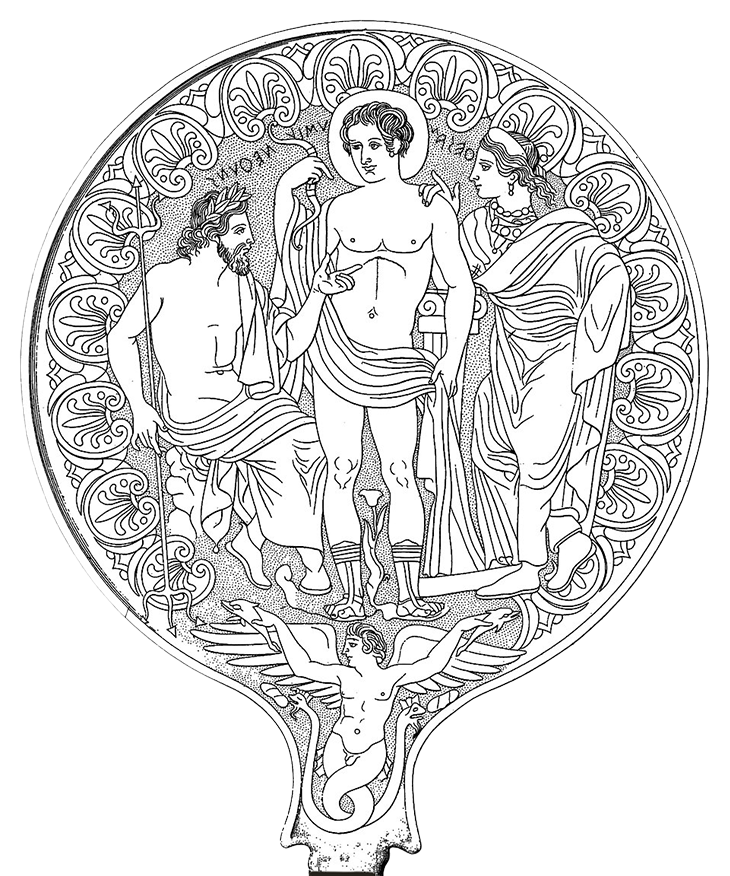
Bronze Mirror.
Erika Simon proposed that the scene represents daybreak, with Thesan and Usil rising from the sea and taking leave of seated Nethuns. Van der Meer likewise treated the sunrise reading as possible and recorded an older interpretation of the three Gods as a cosmic triad. No surviving Etruscan text explains the mirror, so these readings remain scholarly interpretation.9,12
The named grouping is nevertheless exceptional within the surviving corpus. Nethuns presides beside Dawn and the Sun in a composition without a close Classical Greek parallel identified by Simon. The names are secure; the narrative remains disputed. The mirror preserves an Etruscan theology without preserving its explanation.11,12
Sources and Bibliography
- Rix, Helmut. “Etruscan.” In The Ancient Languages of Europe, edited by Roger D. Woodard, 141–64. Cambridge: Cambridge University Press, 2008. Cited page: 163, classifying Neθuns as an Etruscan borrowing from Umbrian *Nehtuns.
- Ambrosini, Laura. Le gemme etrusche con iscrizioni. Mediterranea, Supplemento 6. Pisa and Rome: Fabrizio Serra Editore, 2011. Cited catalog entry: no. 33, Paris, Cabinet des Médailles, Luynes 251; see also the discussion of the spring-producing Nethuns.
- Krauskopf, Ingrid. “Poseidon/Nethuns.” In Lexicon Iconographicum Mythologiae Classicae, vol. 7, pt. 1, 479–83; vol. 7, pt. 2, pls. 378–79. Zürich and Munich: Artemis Verlag, 1994. Cited objects include Poseidon/Nethuns 1 and 8.
- Apollodorus. The Library. Translated by James G. Frazer. 2 vols. Loeb Classical Library 121–122. Cambridge, MA: Harvard University Press, 1921. Cited section: 2.1.4, on Amymone, the satyr and the springs of Lerna.
- Hyginus. Fabulae. Edited by Peter K. Marshall. 2nd ed. Bibliotheca Teubneriana. Munich and Leipzig: K. G. Saur, 2002. Cited fable: 169, “Amymone,” on Neptune striking the earth and producing the Lernaean spring.
- Institut national d’histoire de l’art. “Miroir: Neptune.” AGORHA: Digital Muret. Vatican Museums, inv. 5539. Accessed July 17, 2026. Cited for the object’s date, Etruscan production, dimensions and iconography.
- Bloch, Raymond. “Quelques remarques sur Poséidon, Neptunus et Nethuns.” Comptes rendus des séances de l’Académie des Inscriptions et Belles-Lettres 125, no. 2 (1981): 341–52. https://doi.org/10.3406/crai.1981.13844. Cited page: 349, fig. 2, for the Amymone mirror.
- Croker, Ollie, and Thomas Mannack. “An Etruscan Black-Figure Hydria: The Judgment of Paris in Archaic Etruria.” Etruscan and Italic Studies 25, nos. 1–2 (2022): 148–72. https://doi.org/10.1515/etst-2021-0016. Cited for Florence, Museo Archeologico Nazionale 4139 and the caution required when identifying trident-like attributes.
- van der Meer, L. Bouke. The Bronze Liver of Piacenza: Analysis of a Polytheistic Structure. Dutch Monographs on Ancient History and Archaeology 2. Amsterdam: J. C. Gieben, 1987. Cited especially for Nethuns on the liver and the Tuscania mirror, Vatican MEG 12645.
- van der Meer, L. Bouke. Liber Linteus Zagrabiensis: The Linen Book of Zagreb: A Comment on the Longest Etruscan Text. Monographs on Antiquity 4. Leuven: Peeters, 2007. Cited for the forms of Nethuns’s name and the proposed ritual prescriptions in the surviving text.
- de Grummond, Nancy Thomson. Etruscan Myth, Sacred History, and Legend. Philadelphia: University of Pennsylvania Museum of Archaeology and Anthropology, 2006. Cited for the Tuscania mirror and its named divine figures.
- Simon, Erika. “Gods in Harmony: The Etruscan Pantheon.” In The Religion of the Etruscans, edited by Nancy Thomson de Grummond and Erika Simon, 45–65. Austin: University of Texas Press, 2006. Cited especially for the interpretation of the Tuscania mirror as a possible scene of daybreak.
- British Museum. “Coin, Museum Number 1907,0501.96.” Collection Online. Accessed July 17, 2026. Cited for the Vetulonian sextans, c. 300–250 BCE, with a ketos-headdress head and a trident between dolphins.
- Rutter, N. K., ed. Historia Numorum: Italy. London: British Museum Press, 2001. Cited type: no. 203, Vetulonia.
- City of Piacenza. “Etruscan Liver.” Visit Piacenza. Accessed July 17, 2026. Cited for the object’s discovery near Gossolengo in 1877 and its preservation in the municipal collection at Palazzo Farnese.