





| Language / Culture | Name of Varuna | Attestation |
|---|---|---|
| Hurrian-Mitanni | Aruna / Uruwana (a-ru-na, ú-ru-wa-na) | Šattiwaza treaties (c. 1380 BCE) |
| Vedic Sanskrit | Varuṇa (वरुण) | Rigveda (c. 1500–1200 BCE) |
| Sindhi (Daryā Panth) | Jhūlelāl / Uderolāl | Jhulelal legend (10th–11th c. CE); shrine 1684 CE |
| Balinese | Dewa Baruna / Bhatara Segara | Tanah Lot tradition (assoc. 15th c. CE) |
| Japanese | Suiten (水天) | Twelve Devas; Suitengū shrines (early 19th c. CE) |
22 min read
Varuna
author: High Priest Zevios Metathronos
co-authors: Lucius Invictus
I. The Name of Varuna
The origin of Varuna's name, from the old Indo-Aryan derivation of a Sanskrit root cluster (√vṛ / var-), is usually glossed as "cover, surround, bind, restrain," with theonymic interpretations like "the encloser [of the world]," "the binder [of law]," or "he who encompasses [the upper waters/heavens]." In addition, a useful nuance from scholars is that Varuna's name stands in significant relation to vrata- "commandment," which corresponds to his Vedic profile as a cosmic sovereign with binding ordinances over existence.1
Vrata is treated as the most meaningful Vedic association; Varuna, more than any other Vedic deity, represents the authority of the King, and is therefore God of commandments, judicial authority, and absolute decrees, both earthly and heavenly.2 And although rejected today because of etymological clarity, yet useful to address for comparative analysis, Varuna was often identified with the Greek Ouranos/Uranus from the PIE *wer- "bind/cover." Now, Ouranos is more often derived from *wers- "to moisten/drip." In any case, their mythic comparison is suggestive.3
Moreover, some scholars have offered interpretive refinements of a semantic rather than a strictly reconstructive kind, such as Varuṇa as "night sky / enclosing heaven" (with reference to broad mythic domains of Varuna and Vedic cosmology) and an Indo-Iranian comparison with Avestan vara- "enclosure" and Iranian sovereign theology (cf. Ronzitti's note on the *wer- series and Boyce on Mithra/Ahura patterns).
Overall, the strongest etymology belongs to internal Sanskrit and Indo-Iranian, which becomes obvious given the language of the Vedas and the Proto-Indo-European heritage of Vedic and Indo-Iranian culture, especially the philological relationship between them.4
The earliest securely datable attestation of Varuna's name comes not from India but from northern Mesopotamia. In the treaty concluded between Šuppiluliuma I of Ḫatti and Šattiwaza of Mitanni in the second half of the fourteenth century BCE (c. 1380 BCE), a line of Indo-Aryan deities is invoked as divine witnesses: Mitra, Varuna, Indra, and the Nāsatyas (the Aśvins). Varuna's name is written in cuneiform as a-ru-na and ú-ru-wa-na, at times carrying a Hurrian suffix. These theonyms belong to a branch of Indo-Aryans settled among the Hurrian-speaking Mitanni, and because the hymns of the Rigveda were transmitted orally and committed to writing only much later, the Mitanni treaties furnish the oldest fixed date for the god.5, 6
Within India proper, Varuna's earliest and fullest religious portrait belongs to the Rigveda, whose hymns were composed orally around 1500–1200 BCE. There he already appears as a cosmic sovereign, a kingly Āditya and guardian of ṛta, as detailed in the following section. The two records together frame his antiquity: the Mitanni treaty fixes the earliest date at which the name is documented, while the Rigveda preserves the earliest developed theology.
Sources: Ronzitti on the *wer- series; the Jamison and Brereton translation of the Ṛgveda; Dumézil, Mitra-Varuna; the Temple of Zeus "Battle of the Gods, Part C" essay; Thieme, "The 'Aryan' Gods of the Mitanni Treaties," and Mayrhofer, Die Indo-Arier im Alten Vorderasien, on the Mitanni theonyms; Ray, "Varuṇa, Jhūlelāl and the Hindu Sindhis," on the Sindhi Jhūlelāl; the Tanah Lot temple tradition on the Balinese Baruna; and Salman with the Nara National Museum e-Museum record on the Japanese Suiten (each treated further in the Temples section below).1, 2, 3, 4, 5, 6, 7, 8, 9, 10
II. Varuna throughout the Vedas
Rig Veda
Varuna appears as a cosmic sovereign in the oldest Veda. He is a kingly Āditya who is the guardian of ṛta (cosmic order) and vrata (divine commandment). He observes truth and falsehood, binding those who sin against ṛta with his pāśa (fetters/shackles), and is a lord whose judicial authority is at once heavenly and earthly. Reflected in hymns 1.24–25, 2.28, 5.85, and 7.86–89, he governs the cosmos and dispenses punishment and alleviation for the transgressors of ṛta. Although already associated with the celestial waters, rivers, rain, and the sea, the early hymns emphasize his role as sovereign guardian of cosmic order more than they do an exclusively aquatic domain.
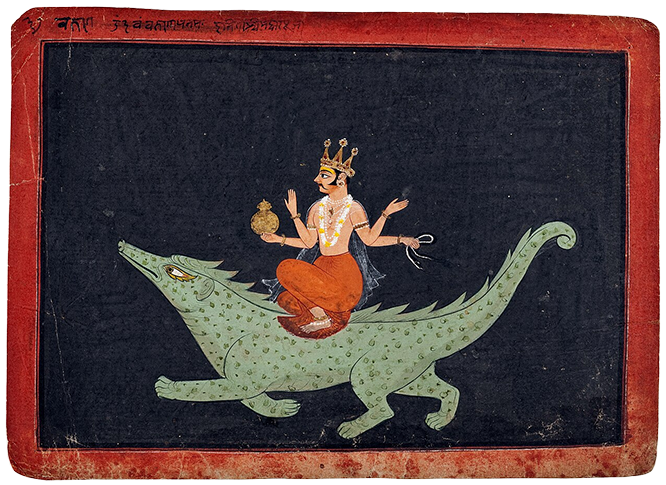
Varuna on his steed, Makara (the crocodile), the Felix and Helen Juda Foundation.
In tandem with his cosmic governance, Varuna consistently appears throughout the hymns as the liberator from wrongdoing. RV 2.28 praises him as the mighty Āditya whose command makes rivers flow, who can loosen "sin as from a bond that binds [a man or woman]," and whose fixed statutes (vrata) stand "as on a mountain." Likewise, RV 5.85 casts him as an "Imperial Ruler" who through his power (māyā) establishes the earth, heaven, rain, and even Surya and Soma in their respective domains. All of this is evident in RV 1.25, where he is praised for his ordinance and mercy.11
The most confessional tone in supplication to Varuna is found in RV 7.86–89, the Vasiṣṭha hymns. The poet, Vasiṣṭha, wonders how to reunite with Varuna, as he recalls a former companionship as voyagers together upon the ocean. He confesses to unintentional sin and begs for freedom and release from the fetters of Varuna:
What, Varuṇa, hath been my chief transgression… Tell me, Unconquerable Lord, and quickly sinless will I approach thee with mine homage.
Free us from sins committed by our fathers, from those wherein we have ourselves offended.
O King, loose, like a thief who feeds the cattle, as from the cord a calf, set free Vasiṣṭha.
Not our own will betrayed us, but seduction, thoughtlessness, Varuṇa, wine, dice, or anger.
Ṛgveda 7.86 (trans. Griffith)
In these hymns Varuna is the transcendent judge, who issues rulings against even the unaware offenders of ṛta while at the same time being the salvation of those who seek absolution. Thus, he is the arbiter of cosmic order that, when offended by a mortal, afflicts him or her with his bindings. The only option for forgiveness is purification and reorientation (toward ṛta) sanctioned by the god. (cf. 2)
Yajurveda
Across the Yajurveda material, Varuna retains his sovereign function while becoming increasingly ritualized. His fetter becomes a standard liturgical motif in release-expiation formulas; his anger appears alongside sin, oath, and disease, especially dropsy.12, 13 Exemplified by King Hariścandra (AB 7.13–18), Varuna provided him with a son under very specific conditions he swore to; the vow was left unfulfilled and the god seized the king with dropsy, a chronic swelling of water in the belly. The disease represents Varuna's binding power (his proverbial noose); the king must reconcile with Varuna to restore harmony with ṛta through ritual release of his internal bondage.14
Yajurvedic texts repeatedly reuse RV 1.24.15 as a release-mantra. In Vājasaneyī Saṃhitā 12.12 (White Yajurveda), the plea is almost unchanged:
Varuna, from the upmost bond release us, let down the lowest and remove the midmost.
So in thy holy law may we made sinless belong to Aditi, O thou Âditya.
Vājasaneyī Saṃhitā 12.12 (trans. Griffith)
Similarly, Black Yajurveda recensions do the same, and the Maitrāyaṇī Saṃhitā explicitly embeds the Sanskrit line in ritual sequence. (cf. 12)
Throughout the Yajurveda, he is paired with other deities in a variety of settings, especially concerning Soma and consecratory situations, as with Mitra-Varuṇa and Indra-Varuṇa (VS 7.9–10). Likewise, Varuṇa is paired with Viṣṇu in rites involving purificatory waters (VS 8.59). And in VS 21.1–4, as illustrated previously, Varuna's displeasure at sin must be settled; his favor is mediated through appealing to Agni and Aditi. These examples articulate the Rig Vedic Varuna so that one can adapt one's relationship with his divine commandments. He cooperates in broader devotional hierarchies more than in the early Veda (though still referred to as a "god of gods"), closely aligned with Brāhmaṇic concern for ritual correctness and karmic expiation.15, 16, 17 (and cf. 12, Books 7, 8, 21)
Atharvaveda
The Atharvaveda applies Varuna's bondage-and-release motif to earthly and religious needs: AV 1.10 and 7.83 specifically deal with the original curse of dropsy, one being a charm against it and the other repeating RV 1.24–25, the release mantra. However, AV 5.11 reads as a dialogue between Atharvan (a Vedic ṛṣi) and Varuna, in which Varuna retains his early sovereign theology as self-dependent, law-establishing, and respected by gods and men alike. At the same time, he is featured in a whole manner of prayers and rites, ranging from health and longevity, protection, and kingship to heavenly and earthly success, exorcism, poison control, and even romantic and domestic rituals, such as in AV 14.2.49:
To Sūryā and the Deities, to Mitra and to Varuna… Let him flash gloom away from us…
All witcheries that hang about this garment, all royal Varuna's entangling nooses.
Atharvaveda 14.2.49 (trans. Griffith)
"All royal Varuna's entangling nooses" are transferred away from the bride, demonstrating the recurring diffusion of the pāśa (bindings, fetters).18
Sāmaveda
The Sāmaveda is the musical recitation of the Rig Veda. In the case of Varuna, it elaborates the existing language of law, kingship, and Soma-sacrifice as it pertains to him. For example, "Drink Soma, ye who strengthen Law!" in Hymn 1.5, "Mitra-Varuna," preserves his function and pairs him with Mitra; similarly, Hymn 2.7, "Mitra-Varuna," provides the clearest continuation of the sacred role as guardian of ṛta:
Those who by Law uphold the Law, Lords of the shining light of Law,
Mitra I call, and Varuna.
Sāmaveda 2.7 (trans. Griffith)
Varuna appears throughout the Sāmaveda in similar fashion to the Rig Veda, retaining his high theological status. The difference lies in the purpose of the Sāmaveda: ritual articulation through diverse and precise chanting, especially concerning Soma sacrifices.19, 20
The Common Thread

Varuna on his steed, Makara (the crocodile), the Felix and Helen Juda Foundation.
A key Sanskrit line, preserved across the Vedas, the recensions, and the later descended traditions, capturing the continuity of Varuna's guardianship of ṛta and his merciful power, is RV 1.24–25:
उदुत्तमं वरुण पाशमस्मदवाधमं वि मध्यमं श्रथाय ।
अथा वयमादित्य व्रते तवानागसो अदितये स्याम ॥
ud uttamaṃ varuṇa pāśam asmad avādhamaṃ vi madhyamaṃ śrathāya /
athā vayam āditya vrate tavānāgaso aditaye syāma
"Loosen above the uppermost fetter from us, o Varuṇa; below, the lowest; away, the middle. Then, under your commandment, o Āditya, may we be guiltless for Aditi."
Ṛgveda 1.24.15
In the Rig Veda it is a plea within a poetic and theological drama, and in the Yajurveda and Atharvaveda that drama becomes a liturgical instrument for the release of microcosmic obstruction, caused by incongruence with ṛta, the divine order that Varuna oversees. (cf. 2)
Brāhmaṇas and Āraṇyakas (Prose Texts on the Vedas)
The Brāhmaṇa literature preserves the Rig Vedic Varuna but articulates his majesty according to cosmic abstractions, especially when paired with Mitra. For example, the Śatapatha Brāhmaṇa 4.1.4.1 defines Mitra and Varuna as intelligence and will, with Mitra as conception, priesthood, and the thought before action, while Varuna is execution, nobility, and the force that brings intention into completion. By the Brāhmaṇa period (c. 1000–700 BCE) Mitra-Varuna constituted a dual sovereignty, and it shows that the theology was being further philosophized. (cf. 15)
Moreover, in the Śatapatha and the Aitareya Brāhmaṇa, Varuna's binding-and-release formula is illustrated in detail through the Varuṇapraghāsāḥ (SB 5.2.4.2) and the story of Śunaḥśepa (AB 7.13–18). These examples make explicit what the RV hymns imply: that Varuna can bind through transgressions of his vrata while offering release through correct speech and conduct, dependent upon ritual propriety. (cf. 16, 19)
The early Upaniṣadic materials turn Varuna's original cosmic-juridical role inward, with the śānti-mantra tradition associating Varuna with apāna (downward and outward movement) and night, alongside Mitra (day/prāṇa). In addition, the mantric invocation of Mitra and Varuna serves to restore cosmic grace when one is out of order with ṛta, harking back to the consistent binding-release motif.
The Bhr̥guvallī of the Taittirīya Upaniṣad shows Varuna as a father and teacher, who instructs his son in the apprehension of Brahman. At this point in the late Vedic period (c. 1000–500 BCE), Varuna was a teacher who guides the aspirant toward realization of Brahman.21
Classical Hindu Reframing
In epics like the Mahābhārata, Varuna's older sovereignty survives in more specialized forms, increasingly marine and directional. Mahābhārata 2.9 describes Varuṇa's radiant white assembly and states that the Ādityas attend the "lord of the waters." Also, in 1.227, Varuna provides Arjuna with the divine Gāṇḍīva and equipment, showing that he remains a benefactor among the gods.22
Similarly, the Rāmāyaṇa treats the ocean as Varuṇa's realm:
They looked upon the boundless main
The awful seat of Varun's reign,
And heard his waters roar and rave
Terrific with each crested wave.
Rāmāyaṇa 4.53 (trans. Griffith)
Look, love, the unconquered sea behold,
King Varun's home ordained of old,
Whose boundless waters roar and swell
Rich with their store of pearl and shell.
Rāmāyaṇa 6.125 (trans. Griffith)
Although these two epics evolved out of the late Vedic period, they remain today the two foundational epics in Hinduism. Thus, Varuna is still recognized as a powerful and important god, while specified as a deity of the ocean and the west.23
The Smṛti literature preserves a juridical memory of Varuna. Manu 8.106 prescribes the same release-from-fetters verse, inherited from the Rig Veda, as an expiation related to false testimony. Here, Varuna no longer organizes the whole theological world, but his old connection with transgression and release remains. (cf. 13)
III. Epithets
Varuna's titles gather around a small number of enduring functions: kingship and law, cosmic creation, all-seeing surveillance, wisdom, judicial power, the cosmic waters, and the sovereignty he shares with Mitra. The following are grouped accordingly.
| Epithet | Meaning | Domain |
|---|---|---|
| Asura | Mighty lord; numinous sovereign | Sovereignty, command, cosmic and moral order |
| Rājā / Rājan | King | Kingship, law, judgment, punishment, mercy |
| Svarāj | Self-ruling; absolute sovereign | Supreme authority; RV 4.42.1–2: "the gods follow the will of Varuṇa" |
| Dharmapati | Lord of Dharma | Foundation of all normative order: cosmic, social, and moral |
| Dhṛta-vrata | Of Upheld / Steadfast Commandments | Oath, vow, law, cosmic regularity, moral order |
| Rājan Aditeḥ Vrata | King Within the Commandments of Aditi | To be "within Varuṇa" is to be in conformity with the binding order of cosmic offenselessness |
| Kavítama | Most sage; the one who best knows and best articulates what he knows | Supreme intelligence, cosmic measurement, māyā |
| Sahasrākṣa | Of a thousand eyes | Omniscient surveillance, totalizing cosmic awareness |
| Spāśavat | Possessor of Spies | Surveillance distributed throughout the cosmos, agents |
| Cakṣus / Goptā Sūrya | The Eye / He Who Sees Through the Sun | Sun, sky, movement, moral surveillance |
| Sarvajña | Knower of All Things | Possession of Reality |
| Kavi | Sage; seer; poet | Insight, providence, cosmic knowledge |
| Medhira | Wise; intelligent | Discernment, hearing prayer, judicial intelligence |
| Pracetas | Wise Asura; Far-knowing Lord | Omniscience, moral surveillance, hidden knowledge |
| Pāśin | Wielder of the Fetter (Pāśa) | Violations of ṛta |
| Dharmasākṣin | Witness of Dharma / Observer of Moral Conduct | Dharma, right way of living |
| Apāṃpati | Lord of Waters | Water, ocean, rivers, aquatic sovereignty |
| Dikpāla | Guardian of a Direction | West, guardianship, later iconography |
| Ṛtasya Gopā | Guardian of ṛta | Cosmic order, moral order, truth, law |
| Vipaścit | Discerning; far-seeing | Intelligence, judgment, oversight of vows |
| Bhūripāśa | Having many nooses/fetters | Oaths, sin, punishment |
| Divas Patī | Lords of earth and heaven | Sky, rain, celestial kingship |
Sources: the GRETIL/Aufrecht text of the Ṛgveda for the Rigvedic epithets; the Jamison and Brereton translation of the Ṛgveda; Wisdom Library on Apāṃpati; and the Bhaviṣya Purāṇa on Varuna as Dikpāla of the west.24, 2, 25, 26
IV. Temples
Major stand-alone temples to Varuna appear to be uncommon in antiquity. Unlike Śiva, Viṣṇu, Durgā, or Sūrya, for whom temples are documented, there is weak evidence for structural cult-sites for Varuna. However, there are clear survivals in water-centered regional traditions and transformed cults that may reproduce Varuna in another form; and it remains possible to refer to Vedic and Hindu texts to infer temple and cult sites.27
Vedic References
The Rig Veda records no fixed temple sites. The Varuṇapraghāsa and related rites in later Vedic literature suggest only temporary ritual arrangements.
Somewhere between the fifth and seventh centuries CE, the Vishnudharmottara tradition (Part III, Chapter 52) preserves an instruction for creating an image of Varuna. Although no specific structures are attested, it does show that a canonical installable Varuṇa mūrti existed, moving the evidence from pure liturgy toward imagery and the possibility of temple-installation.28
Medieval and Early Modern: The Shrine at Odero Lal
Among the Sindhi Hindus, a cult narrative reaches back to the tenth and eleventh centuries through the Jhulelal/Uderolal legend. According to folklore, a Muslim leader issued an ultimatum to the local Hindus: convert to Islam or face execution. The Sindhi fasted and prayed for forty days on the banks of the Sindhu (Indus) River. In answer to their prayer, Varuna manifested as an avatar, to be born as Uderolāl (later named Jhūlelāl). He then convinced the Muslim ruler, Mirkshāh, to abandon his persecution. Afterward, reverence for Uderolāl evolved into the Daryā Panth (River Cult).
The Odero Lal Shrine (Odero Lal, Pakistan) was built in 1684 CE to commemorate this mythological memory, and it remains active today, with festivals like the Cheti Chand.7
Medieval and Early Modern: Pura Luhur Tanah Lot
Located in Beraban village, Kediri District, Tabanan Regency, Bali, Indonesia, is a sea temple dedicated to Dewa Baruna, or Bhatara Segara, the sea power. Official tradition connects the temple's origins to Dang Hyang Nirartha (Dwijendra), a Hindu priest, and his arrival in the fifteenth century. At the time, the King of Bali was Dalem Waturenggong, who allowed the priest to extend his teaching of Hinduism throughout the island. When he reached Beraban village, the local people were adherents of monotheism, but he managed to turn them toward Hinduism. However, he was chased away by Bendesa Sakti Beraban and his followers who refused to convert. The legend says that Dang Hyang Nirartha protected himself by becoming a small floating island where the temple is located, now called "Tanah Lot."
Tanah Lot is one of the clearest examples of a living Varuṇa-derived temple tradition.8
Modern and Contemporary: Suitengū in Tokyo
Suiten (水天), a "Water Deva," is theologically identified with the god Varuna in the Japanese museum resources on the Twelve Devas. The Suitengū are Shinto shrines dedicated to several kami, including Varuna. Beginning in the early nineteenth century, these shrines are especially associated with prayers for conception, safe childbirth, child protection, and water-related disasters.9, 10
Although Varuna is one of the most theologically significant gods in the Vedic heritage, that prominence did not afford him structural temples, at least none that can be verified. Instead, the best evidence points to his much later evolution into a deity of water, like Jhūlelāl, Baruna, and Suiten.
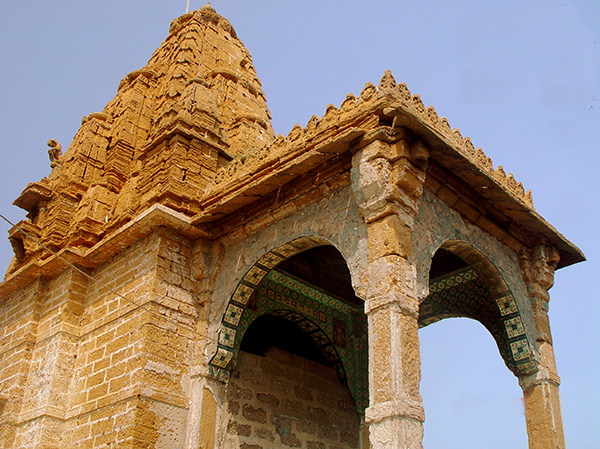
Shri Varun Dev Mandir, Pakistan.
V. Symbolism and Iconography
Varuna, in his earliest form, symbolizes universal sovereignty and supreme propriety of ṛta. It is he "who through his greatness stayed ever, spacious heaven and earth asunder; who urged the high and mighty sky to motion, the Star of old, and spread the earth before him" (RV 7.86.1). His original kingship was the architectural management of existence.
His ordinance extended morally as well, as in RV 1.24.15 and in later supplications within the Vedas, the epics, and the supporting literature. Since Varuna is the guardian of ṛta, his rulership is law-bearing, as he measures justice itself and dispenses punishment and reward for the sinful or the righteous. And no one can escape his knowing, for his spies are everywhere (1.25.13) and he is omniscient.29
Although originally mentioned in the Rig Veda, later Vedic and Hindu literature mentions Varuna's noose (pāśa) more frequently, as in AV 2.10 or Sabhāparvan 2.9. His noose becomes a symbol for divine restraint, used to bind the wicked. As previously mentioned, this symbology becomes ritualized so the aspirant can attain freedom from his own discord with ṛta. His later aquatic dominion reflects a specification of purity, life, and the enveloping nature of the celestial waters.30, 31
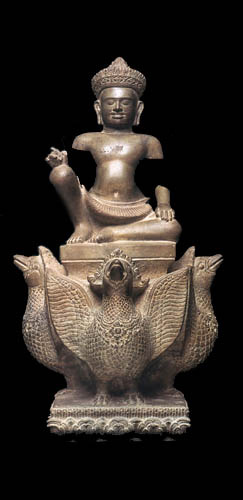
Khmer Empire depiction of Varuna, 10th century CE, National Museum of Cambodia.
Iconographically, Varuna's image shifts depending on the timeline. For example, in the Śatapatha Brāhmaṇa (5.2.5.17), Varuna is said to be adorned with black cloth, likely symbolizing night, hidden law, and dread.32 Alternatively, in the Viṣṇudharmottara Purāṇa, the idol of Varuṇa should be adorned with white cloths, suiting the notions of purity, protection, and regality. This may perhaps show his dual nature regarding the judgment of an individual's conduct.33 In addition to black or white attire, in Rig Veda 1.25.13 he is "wearing golden mail, hath clad him in a shining robe."
By the time of the epics, Varuṇa unmistakably became a watery sovereign and guardian of the west. Sabhāparvan 2.9 describes Varuṇa's Sabhā as unmatched in beauty, with pure white walls and arches, built by Viśvakarma (the celestial architect) within the waters. The palace was decked with celestial trees made of gems and jewels, yielding excellent fruits and flowers. An assortment of plants and flowers grew there, and hundreds of birds always sang sweet melodies: "owned by Varuna, that delightful assembly house of pure white." Moreover, it was inhabited by many immortal beings who were of good conduct and of excellent vows, all revering Varuna, the deity bearing the noose as his weapon. (cf. 31)
Purāṇic and Āgamic sources elucidate the iconography that earlier texts only imply: the Viṣṇudharmottara Purāṇa states that Varuna should wear white cloth, have four arms, ride on a chariot with seven swans, and carry a lotus, noose, conch, and jewel-box; a crocodile emblem appears on the banner, and Gaurī is placed on his lap with Gaṅgā and Yamunā at his sides. Other sources say he should have only two arms, and that his vehicle should be the crocodile. (cf. 33
Referring to his primary weapon, the noose, the Metropolitan Museum of Art holds a sculpture of "Varuna Holding a Noose and Riding a Swan," from India, sixth to eighth century. This is significant because it proves that the swan-vehicle described in some textual traditions was not purely literary, quite apart from the stable noose attested since the earliest Veda. For further medieval-to-modern iconographic development, refer to the Bhubaneswar survey describing the Rajarani Temple Varuṇa, the British Museum's c. 1814 Tanjore-style Varuṇa on a makara, and the British Museum's c. 1850 Company-school four-armed Varuṇa.34, 35, 36
VI. Philosophy
Varuna's cosmic role may shift in its specifics from his early depiction in the Rig Veda to his common position in the epics, but philosophically it is an articulation rather than a discontinuation. He is the wisdom of reality, which proves itself to be lawful and intelligent. Presented as omniscient and universal (RV 1.25) and as the ethical overseer of ṛta, to which all beings must submit so they can be "within Varuna" (1.24 and 7.86), he watches all action, in cooperation with Mitra, through the eye of the sun (7.60).
In the late Vedic to post-Vedic period, Varuna is lord of the waters, of the boundary, and of the western direction. The Rig Veda already prepares for this in 7.49.3:
Those amid whom goes Varuṇa the Sovran, he who discriminates men's truth and falsehood
Distilling meath, the bright, the purifying, here let those Waters, Goddesses, protect me.
Ṛgveda 7.49.3 (trans. Griffith)
And in 1.25:
He knows the path of birds that fly through heaven, and, Sovran of the sea,
He knows the ships that are thereon.
Ṛgveda 1.25 (trans. Griffith)
Therefore, the later periods simply emphasize rather than replace his domain. Bṛhadāraṇyaka Upaniṣad 3.9.22 asks: "Which is thy deity in the Western quarter?" The answer: "Varuna," who abides "in the water." In the Rāmāyaṇa, the ocean is simply "Varuṇa's abode." Thus, the center of influence shifts from cosmic to liminal rulership. Water is the crossing, depth, seed, purification, and the western boundary where light declines.37
The continuity is apparent because Varuna still manages the primeval waters of the universe, the hidden laws that cannot be transgressed without penance, and the substance of all unmanifest potential. As the water, oceans, seas, and rivers, Varuna's omniscient surveillance encompasses the liminal space where boundaries are tested, oaths are sworn, and hidden truths are revealed. It is contained depth together with that which surrounds, measures, and judges.38
In that sense, Varuna still embodies the wisdom of law and the maker of the virtuous. One is within Varuna when one is in concordance with ṛta, the order of the cosmos. On the other hand, Varuna binds with his noose and afflicts one's internal waters; the water swells (dropsy) and disturbs the soul, the only release being righteous penance with Varuna.
Sources and Bibliography
- Ronzitti, Rosa. "L'età dell'oro sotto Vṛtra e la formula indoeuropea 'terra inarata.'" Atti del Sodalizio Glottologico Milanese IX, n.s. 2014 [2016]: 205–217. https://riviste.unimi.it/index.php/asgm/article/viewFile/8165/7800.
- The Rigveda: The Earliest Religious Poetry of India. Translated by Stephanie W. Jamison and Joel P. Brereton. 3 vols. New York: Oxford University Press, 2014.
- Dumézil, Georges. Mitra-Varuna: An Essay on Two Indo-European Representations of Sovereignty. Critical ed. Edited and with a new introduction by Stuart Elden. Translated by Derek Coltman. Afterword by Veena Das. Chicago: HAU Books, 2024. https://haubooks.org/mitra-varuna/.
- High Priest Zevios Metathronos. "The Battle of the Gods, Part C: Bhārata." Temple of Zeus. n.d. https://templeofzeus.org/advancedphilosophy/Titanomachy_Part3_Hindu.php.
- Thieme, Paul. "The 'Aryan' Gods of the Mitanni Treaties." Journal of the American Oriental Society 80, no. 4 (1960): 301–317.
- Mayrhofer, Manfred. Die Indo-Arier im Alten Vorderasien. Wiesbaden: Otto Harrassowitz, 1966.
- Ray, Anita C. "Varuṇa, Jhūlelāl and the Hindu Sindhis." South Asia: Journal of South Asian Studies 35, no. 2 (2012): 219–38.
- "History & Natural Environment." Tanah Lot. Daya Tarik Wisata Tanah Lot. Accessed July 8, 2026. https://www.tanahlot.id/page/sejarah--lingkungan-alami.
- Salman, Mac. "Suitengu: Keeping Children Safe, Pre and Post-Birth." Tokyo Authority, June 23, 2020. Accessed July 8, 2026. https://tokyoauthority.com/shrines-and-temples/suitengu-childbirth-shrine-nihonbashi-tokyo/.
- "Suiten (Skt. Varuṇa)." e-Museum: National Treasures & Important Cultural Properties of National Institutes for Cultural Heritage, Japan. Nara National Museum. Accessed July 8, 2026. https://emuseum.nich.go.jp/detail?content_base_id=100031&content_part_id=11&langId=en.
- The Rig Veda. "Book 2, Hymn XXVIII: Varuṇa." Translated by Ralph T. H. Griffith. 1896. Sacred Texts Archive. https://sacred-texts.com/hin/rigveda/rv02028.htm.
- The Texts of the White Yajurveda. "Book the Twelfth." Translated by Ralph T. H. Griffith. 1899. Sacred Texts Archive. https://sacred-texts.com/hin/wyv/wyvbk12.htm.
- The Laws of Manu. "Chapter VIII." Translated by George Bühler. Vol. 25 of Sacred Books of the East. 1886. Sacred Texts Archive. https://sacred-texts.com/hin/manu/manu08.htm.
- Aitareya Brahmanam of the Rigveda. Edited and translated by Martin Haug. Allahabad: Sudhindra Nath Vasu at the Panini Office, 1922. Internet Archive. https://archive.org/details/in.ernet.dli.2015.104262.
- The Satapatha Brahmana, Part II. "Fourth Brâhmaṇa." Translated by Julius Eggeling. Vol. 26 of Sacred Books of the East. 1885. Sacred Texts Archive. https://sacred-texts.com/hin/sbr/sbe26/sbe2643.htm.
- The Satapatha Brahmana, Part III. "Fourth Brâhmaṇa." Translated by Julius Eggeling. Vol. 41 of Sacred Books of the East. 1894. Sacred Texts Archive. https://sacred-texts.com/hin/sbr/sbe41/sbe4111.htm.
- The Mahabharata, Book 1: Adi Parva. "Section CCXXVII." Translated by Kisari Mohan Ganguli. 1883. Sacred Texts Archive. https://sacred-texts.com/hin/m01/m01228.htm.
- Hymns of the Atharva-Veda: Together with Extracts from the Ritual Books and the Commentaries. Translated by Maurice Bloomfield. Vol. 42 of Sacred Books of the East. 1897. Sacred Texts Archive. https://sacred-texts.com/hin/av.htm.
- Hymns of the Samaveda. Translated with a popular commentary by Ralph T. H. Griffith. 1895. Sacred Texts Archive. https://sacred-texts.com/hin/sv.htm.
- "Samaveda." Vedic Heritage Portal. Indira Gandhi National Centre for the Arts, Ministry of Culture, Government of India. https://vedicheritage.gov.in/samhitas/samaveda-samhitas/.
- Taittiriya Upanishad. Chennai: Vedanta Students, 2019. https://vedantastudents.com/wp-content/uploads/2019/08/07.-Taittiriya-Upanishad.pdf.
- The Mahabharata. Translated by Kisari Mohan Ganguli. 1883–1896. Internet Sacred Text Archive. https://sacred-texts.com/hin/m01/index.htm.
- The Rámáyan of Válmíki. Translated by Ralph T. H. Griffith. 1870–1874. Internet Sacred Text Archive. https://sacred-texts.com/hin/rama/index.htm.
- Ṛgveda-Saṃhitā. Edited by Theodor Aufrecht. Bonn, 1877. XML/HTML transformation by Barend A. van Nooten and Gary B. Holland. Göttingen Register of Electronic Texts in Indian Languages (GRETIL), SUB Göttingen. Version dated October 3, 2019. https://gretil.sub.uni-goettingen.de/gretil/corpustei/transformations/html/sa_Rgveda-edAufrecht.htm.
- "Apampati, Apāṃpati." Wisdom Library. Last modified June 14, 2024. https://www.wisdomlib.org/definition/apampati.
- Bhavishya Purana [Sanskrit]. "Verse 4.141.44." Wisdom Library. Last modified February 3, 2024. https://www.wisdomlib.org/hinduism/book/bhavishya-purana-sanskrit/d/doc1278995.html.
- von Stietencron, Heinrich. "Orthodox Attitudes towards Temple Service and Image Worship in Ancient India." Central Asiatic Journal 21, no. 2 (1977): 126–38. http://www.jstor.org/stable/41927181.
- Kramrisch, Stella. The Vishnudharmottara (Part III): A Treatise on Indian Painting and Image-Making. 2nd rev. and enl. ed. Calcutta: Calcutta University Press, 1928. https://archive.org/details/vishnudharmottar031493mbp.
- Rig Veda. Translated by Ralph T. H. Griffith. 1896. Internet Sacred Text Archive. https://sacred-texts.com/hin/rigveda/rv02028.htm.
- The Hymns of the Atharvaveda. "Book 2, Hymn X: Absolution and Benediction." Translated by Ralph T. H. Griffith. 1895–1896. Internet Sacred Text Archive. https://sacred-texts.com/hin/av/av02010.htm.
- The Mahabharata, Book 2: Sabha Parva. "Section IX." Translated by Kisari Mohan Ganguli. 1883. Sacred Texts Archive. https://sacred-texts.com/hin/m02/m02009.htm.
- The Satapatha Brahmana, Part III. "Fifth Brâhmaṇa." Translated by Julius Eggeling. Vol. 41 of Sacred Books of the East. 1894. Sacred Texts Archive. https://sacred-texts.com/hin/sbr/sbe41/sbe4112.htm.
- Sarma, Bhagyashree. "8(b): The Image of Various Gods." In Vishnudharmottara Purana (Art and Architecture). Wisdom Library, 2021. Last updated April 6, 2023. https://www.wisdomlib.org/hinduism/essay/vishnudharmottara-purana-art-and-architecture/d/doc1143510.html.
- Mitra, Debala. Bhubaneswar. 2nd ed. New Delhi: Director General of Archaeology in India, 1961. Internet Archive. https://archive.org/details/in.ernet.dli.2015.66826.
- "Painting." The British Museum. Museum number 1994,1110,0.12. https://www.britishmuseum.org/collection/object/A_1994-1110-0-12.
- "Painting; Album." The British Museum. Museum number 1993,0806,0.74. https://www.britishmuseum.org/collection/object/A_1993-0806-0-74.
- The Brihadaranyaka Upanishad. Translated by Max Müller. Hinduwebsite.com. https://www.hinduwebsite.com/sacredscripts/hinduism/upanishads/brihad.asp.
- Sreenivasarao S. "Varuna and His Decline." Scribd. Uploaded by Nestor David Morales. https://www.scribd.com/document/217342127/Varuna-and-His-Decline.