




| Language | Name of Poseidon | Attestation |
|---|---|---|
| Mycenaean Greek | po-se-da (𐀡𐀮𐀅) | Knossos V 52 + 52 bis + 8285 (after 1435BCE) |
| Homeric Greek | Ποσειδάων (Poseidaon) | Homer (8th century BCE onward) |
| Classical Greek | Ποσειδῶν (Poseidon) | Hesiod (7th century BCE onward) |
28 min read
Poseidon
author: High Priest Zevios Metathronos
co-authors: Karnonnos
Hieratic Information about Poseidon
| Divine Names | |
|---|---|
| Poseidon (Ποσειδῶν) | the ancient Hellenic name |
| These hieratic names carry strong spiritual resonance and are recommended for summoning and invocation practices. | |
| Divine Symbols | |
| |
| Divine Numbers and Attributes | |
| Sacred Numbers | 40, 50, 60 |
| Runes | Thurisaz, Tiwaz, Sowilo (in order of importance) |
| Zodiac Sign of Power | Aries |
| Sacred Animals | The Great Eagle, the Bull, the Hawk, the Serpent |
| Element | Fire, Aether |
| Divine Forces | |
| |
| Important Titles | |
| |
| Names Across Civilizations | |
| Greek | Poseidon (Ποσειδῶν) |
| Etruscan | Nethluns |
| Roman | Neptune (Neptūnus) |
| Vedic | Varuna |
I. The Name of Poseidon, Lord of Becoming
The origin of Poseidon's name is uncertain. Modern etymologies tie his name to πόσις (lord or husband), perhaps with the Doric form δᾶ (earth), meaning "husband of the earth". Others link his name to Proto-Indo-European *dah₂- "water" or *dʰenh₂- "to run, flow". This formulation of 'dan' seems to correlate with water across Europe, and may be related to the Danaides.1, 2
Plato’s first explanation through Socrates dialogue derives Poseidon from ποσί or ποσίν, “feet,” plus δεσμός, “bond" or "fetter.” The idea is that the name-giver, encountering the sea, found that it checked his walking; the sea became a “bond for the feet", hence Poseidon as a kind of ποσί-δεσμος, a “foot-fetter.” Socrates' second suggestion is that the name originally meant πολλὰ εἰδώς, “knowing many things.” The third explanation is that Poseidon is ὁ σείων, the shaker, connecting him with earthquakes. The Stoic Cornutus gave a different explanation, connecting his name to πόσις, meaning a drink, rather than a lord. He also connects it to Physiidion, a word that shows nature itself sweating.3, 4
The archaic nature of the etymology shows that Poseidon, alongside Zeus, is likely the oldest of the Greek gods. There is a relatively large corpus attesting to his ancient presence in Mycenean Greek records and Linear B objects. The ancient inscription from Knossos in the Room of the Chariot Tablets from Knossos in Crete records his name as "po-se-da[-o-ne]". The PY Es 653 from Pylos records his full name as "po-se-da-o" and PY Fr 1224.b uses the dative form "po-se-da-o-ne".5
Homer uses the form Ποσειδάων (Poseidaon), while Hesiod uses the form known to us, Ποσειδῶν (Poseidon). There are endless different variations of Poseidon's name by region. Many early Greek objects use the form Ποτειδάν (Poteidan), Ποτεδάνι (Potedani) or σειτον (Seiton), such as a Corinthian object called the Penteskouphia pinakes. One early Attic material label is on the François Vase (Florence 4209, c. 570–560 BCE) where the CAVI interpreted the divine procession at the wedding of Peleus and Thetis, Poseidon’s label given as [Πο]σειτον.6, 7, 8, 9, 10, 11
Sources: Aurora, Procedia: Social and Behavioral Sciences; Iliad Murray, Wyatt; Hesiod. Theogony. Evelyn-White.5, 9, 11
II. Poseidon as the God of the Seas
The Iliad
Poseidon is one of the Twelve Olympians and takes the side of Hera and the Greeks in the Iliad. He takes the side of the latter because the ruler of Troy, Laodemon, had refused to pay his wages when he built the great wall around the city, which enraged him to the extent he sent a sea monster to ravage it. His role is not entirely rooted in an obsessive love for the Achaeans as he is also affronted by the Greeks building their own wall of ships without proper hecatombs to the gods. It is hinted in Book 12 through a prophetic vision that he achieves this destruction.9
His greatest intervention occurs in Book 13, where he observes the Achaeans being crushed by Hector's might. This causes Poseidon to go to his palace in Aegae and drift down to pilot the seas, disguising himself as the seer Calchas on land. A single smack of his staff restores the morale of the Greeks defending the ships. He speaks to Idomeneus in the voice of Thoas and urges him back into the battle. Poseidon leaps among the foremost fighters: he tells the Argives not to yield the ships to Hector, arranges an exchange of better shields to better men, and then leads them personally. It is through his intervention that Ajax is able to assail Hector with a stone.
When ordered by Zeus through Iris to leave the battlefield, Poseidon boasts of his lineage and points out that Zeus and he are brothers. The great sea god angrily explains that he and Hades are also the sons of Cronus and Rhea, and he reveals that the universe was divided by lot, with Poseidon receiving the gray seas, Hades the darkness, and Zeus the skies, with earth and Olympus being intermediary and common zones.
The cosmic nature of Poseidon is shown in the next books. Poseidon, embittered that Apollo sided with Laodemon despite also being cheated by the king, challenges him to a duel, which Apollo concedes. When the gods enter battle, Zeus thunders from above, while Poseidon shakes the vast earth from below. Ida, Troy, and the Achaean ships tremble. Even Hades, down in the underworld, leaps from his throne in fear that Poseidon will split the earth open and expose the realm of the dead to gods and mortals. His fairness is shown when he saves the Trojan hero Aeneas from death, honoring the instruction of Zeus.
The Odyssey
In the Odyssey, Poseidon takes on an antagonistic role to Odysseus in his travels. The sea god became angry because the over-boldened Odysseus had blinded his son Polyphemus, the strongest of the Cyclopes, born from Poseidon and the sea-nymph Thoosa. Polyphemus begs in a prayer to the gods that Odysseus either must perish or be cast out from his house, doomed to lose all his followers.10
Despite Poseidon's anger at the hero throughout the text being his exclusively among the gods, his actions are still shown as divinely sanctioned. The second request of Polyphemus is fulfilled. Even Athena disguised as Mentes is still obliged to pay proper respects to the sea god, so great is his stature.
Poseidon himself boasts of his lineage and points out that Zeus and he are brothers, particularly when ordered by the former through Iris to leave the battlefield. The great sea god explains that he and Hades are also the sons of Cronus and Rhea, and he reveals that the universe was divided by lot, with Poseidon receiving the gray seas, Hades the darkness, and Zeus the skies, with earth and Olympus being intermediary and common zones.
The cosmic nature of Poseidon is shown in the next books. Poseidon, embittered that Apollo sided with Laodemon despite also being cheated by the king, challenges him to a duel, which Apollo concedes. When the gods enter battle, Zeus thunders from above, while Poseidon shakes the vast earth from below. Ida, Troy, and the Achaean ships tremble. Even Hades, down in the underworld, leaps from his throne in fear that Poseidon will split the earth open and expose the realm of the dead to gods and mortals. His fairness is shown when he saves the Trojan hero Aeneas from death, honoring the instruction of his brother Zeus.
Hesiodic and Orphic Context
Hesiod makes Poseidon one of the sons of Kronos, the fourth child. Pindar fully elaborates that the consort of Poseidon is Amphitrite, the goddess of the seas.
The Orphic Hymn, the seventeenth, is rather similar to that of the Homeric Hymn in the way it is structured. Yet it implicates Poseidon in having the 'third domain', that of the abyssal sea.13, 14
III. Epithets of the Sea God
| Epithet | Meaning | Domain |
|---|---|---|
| Poseidon Hippios (Ἵππιος) | Poseidon of Horses | Horses, cavalry |
| Poseidon Asphalios (Ἀσφάλιος) | Poseidon the Securer | Safety at sea, anti-earthquake power |
| Poseidon Pelagaios (Πελαγαῖος)14 | Poseidon of the Open Sea | Sea, deep waters |
| Poseidon Helikonios (Ἑλικώνιος) | Poseidon of Helikon | Ionian federal cult, Panionion |
| Poseidon Isthmios (Ἴσθμιος) | Poseidon of the Isthmus | Isthmian sanctuary |
| Poseidon Basileus (Βασιλεύς) | Poseidon the King | Divine kingship, sovereignty |
| Poseidon Erechtheus (Ἐρεχθεύς) | Poseidon Erechtheus | Athena-Poseidon mystery |
| Poseidon Sōtēr Nēōn (Σωτὴρ Νηῶν) | Poseidon the Savior of Ships | Rescue at sea, naval power |
| Poseidon Gaieochos (Γαιήοχος)) | Poseidon Holder of the Earth | Earth, foundations |
| Poseidon Enosichthōn (Ἐνοσίχθων) | Poseidon Earth-Shaker | Earthquakes, subterranean force |
| Poseidon Phytalmios (Φυτάλμιος) | Poseidon the Nurturer | Vegetation, fertility |
| Poseidon Prosklystios (Προσκλύστιος) | Poseidon the Flooder | Floods, sea-surges |
| Poseidon Genesios (Γενέσιος) | Poseidon of Birth | Generation, ancestry and genetics |
| Poseidon Domatites (Δωματίτης) | Poseidon of the House | Domestic protection, household cult |
| Poseidon Epoptes (Ἐπόπτης) | Poseidon the Overseer | Divine watching, cyclops |
| Poseidon Krenouchos (Κρηνοῦχος) | Poseidon Keeper of Springs | Springs and fountains, Pegasus |
| Poseidon Anax ( Ἄναξ) | Poseidon the King | Mycenean title |
Sources: Pausanias. Description of Greece; Jones and Ormerod, Herodotus. Histories; Godley; Hesiod and Homer. Homeric Hymns. Homeric Apocrypha. Lives of Homer; West; Homer. Iliad Murray, Wyatt; Homer. Odyssey Murray, Dimock; Plutarch. Moralia. Babbitt et al; Hesychius Alexandrinus. Hesychius Alexandrinus: Lexicon Schmidt; Ventris and Chadwick. Documents in Mycenaean Greek14, 15, 16, 17, 18, 19
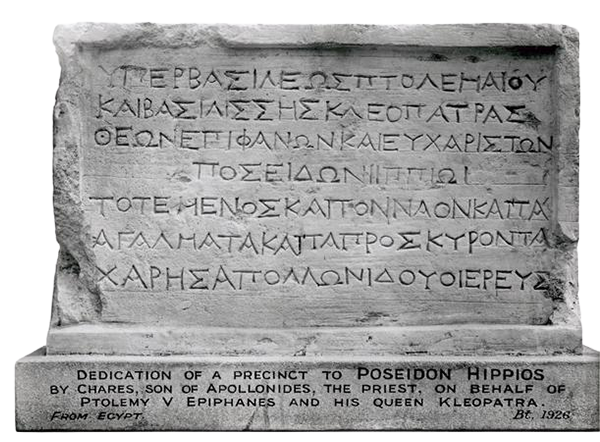
Egyptian dedication to Poseidon Hippios by Ptolemy V Epiphanes (193-180BCE) British Museum
IV. The Temples of Poseidon
Temples to Poseidon are very ancient and numerous; they were known in Antiquity as being architectural marvels often using the most advanced techniques in their construction. Being situated next to the great expanse of the coast was an obvious feature that sacred architects explored with vivific enthusiasm. Just as Athena's temples were situated at the center of the polis and those of Dionysus were tied to the great theaters of Greece, in an urban setting some of Poseidon's temples were situated near hippodromes, the great horse racing stadia that the Greeks took much pride in. 14, 20
Isthmia
The Isthmia near Corinth was the most important site dedicated to the king of the seas. Being situated between the furthestmost parts of Aegea and Pylos in the great strait linking the two parts of southern Greece, it hosted the Isthmian Games every two years, one of the great Panhellenic circuits of festivals. Isthmia was important in a cultural sense to Achaean and Ionian identity, and the archaic temple dated back to the eighth century BCE.
Pausanias says the Corinthians told a myth in which Poseidon and Helios disputed the territory; Briareos judged the case and awarded the Isthmus to Poseidon. The site was famous for its feasts, festivals and sacrifices. The archeologists investigating the site found a long altar to Poseidon which is distinctive in character. The temple also received highly beautiful votive dedications and cult images that led to its fame in the classical period. Pausanias describes seeing bronze Tritons on the temple, images of Poseidon, Amphitrite, and Thalassa, and a later lavish dedication by Herodes Atticus showing the divine couple, horses, Tritons, and Palaimon on a dolphin.9, 14, 20, 21
Aegea and Pylos
Aegea, a mythical locality often situated on the island of Euboea at the eastern edge of Greece, was often considered to be Poseidon's abode. Here, he dwelled in a glittering palace beneath the seas. This estate is where Poseidon summons all of his forces in the Homeric account.
His tie to ancient Pylos is more concrete. This city was located on the westernmost edge of the trident shaped Peloponnese on the opposite side of Greece to Aegea. Archeologists estimate Pylos to be one of the oldest sites of Ancient Greek civilization, and the earliest evidence for one of Poseidon's temples was retrieved in Linear B script from the site. The evidence of ancient texts led them to believe Poseidon was the chief god of the primeval Pylian kingdom. By the time of Pausanias, however, Pylos had long been dedicated to the cult of Nestor and was generally dedicated to Athena.22, 23, 24
Athens and Sounion
Athens honored Poseidon as its secondary god due to the myth of his contending with Athena elaborated below. Several shrines and statues existed to his presence, including a bronze statue that stood in the Agora, and Poseidon's link to the Erectheion.
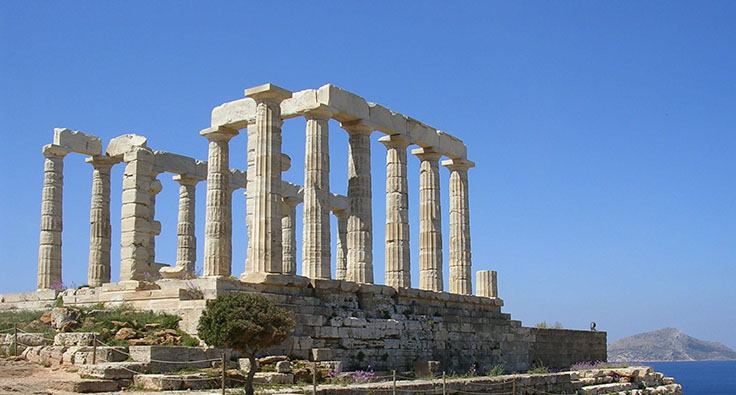
The Temple of Poseidon at Sounion.
Sounion was the fort of Athens that celebrated both Poseidon and the civic goddess. The temple at Sounion, primeval in its base character, was probably built around 700BC. The second great marble temple was built by Pericles during his ascendancy in Athens. It was fortified with a propylaos, peribolos and two stoas, which were quite an advanced investment for the time. Each side of the temple was composed of twenty-three intermediate blocks. It had a certain military purpose in doubling as a site to see the sea lanes from Piraeus and other areas.25, 26
Tinos
Another sacred complex, the island of Tinos in the Aegean southeast of Euboea, was recorded by Strabo for its great opulence and feasting halls during Roman times. Tinos was a large temple complex by description and probably tied to Poseidon as a result of a myth where he freed the island from an influx of snakes. The island has a rich architectural record.27, 28, 29
Other Locales
Many towns and cities in Asia Minor worshipped Poseidon, but his cult at Panionion near Mount Mycale in Ionia was the most important. It served as the center of the Ionian League whose exploits against the Persian Empire had a deeply maritime character. The wealthy Greek city state of Paestum in Southern Italy was another important center which was originally named after him and displayed Poseidon on its coinage, but its great temple often mistakenly attributed to Poseidon is actually one of Hera's great temples with a large emphasis on the maritime god.15, 30, 31, 32, 33
V. King of the Seas
Poseidon in his central role is still known as the god of the seas to humanity. This was a very important aspect of his identity to the Greeks, too. A large amount of his shrines were adjacent to capes of precarious seafaring,21 while his abodes at Aegea and Pylos were at the opposite ends of the sea in mainland Greece. The epithet so commonly applied to him, dark-haired, also loosely translates as sea colored. His horses were often depicted as sea-horses or hippocamps.
He was called upon by ancient sailors, fishermen, dockworkers and others for safe voyage and help when taming the great expanse of the waters, often side-by-side with Aphrodite. Those who fished in particular called upon the great god to provide abundance. The Greeks associated Poseidon with an important phase of civilization after the invasion of the land and a phase prior to knowing how to cultivate the land and its fruits properly. Their general aptitude in navigating the waves was considered to be a gift from the marine god. Maritime unions and guilds were often named after Poseidon too, as in the I.Délos 1774 inscription from the island:34
τὸ κοινὸν Βηρυτίων Ποσειδωνιαστῶν ἐμπόρων καὶ ναυκλήρων καὶ ἐγδοχέων τὸν οἶκον καὶ τὴν στοὰν καὶ τὰ χρηστήρια θεοῖς πατρίοις ἀνέθηκεν. The association of the Berytian Poseidoniasts, merchants, shippers, and warehousemen, dedicated the house, the stoa, and the oracular installations to the ancestral gods. I.Délos 1774, lines 1–2.
Poseidon was used as the emblem of several cities named Poseidonia, including Paestum in its most ancestral form. Demetrios I Poliorketes of Macedonia used Poseidon as a naval symbol in combination with Nike to commemorate victories at Salamis over the Ptolemies. The Ptolemaic Dynasty of Egypt also used the trident of Poseidon as a symbol of their imperial power in combination with the diadem of Helios and the aegis of Zeus.35, 36, 37
VI. Earth-Shaker
Poseidon also has extensive powers over the earth, being able to split it asunder with his terrifying earthquakes in myth. Some Greeks believed the power of earthquakes came from rock erosion by water, hiding in the earth in caverns and causing enough wear to produce earthquakes. Thales believed this, though Aristotle believed they were caused by trapped air.38, 39
This was also taken in an abstract way to show his powers over the material world rather than the interplay with water with earth itself. Poseidon has powers over the earthly realm; its shaking powers are evocative of his life giving powers.
VII. The Contests of Poseidon and Athena
Poseidon often engages in dispute with Athena in myth. In the Odyssey, Athena nonetheless cannot surmount Poseidon and recognizes his superiority in commanding the powers of nature. Cornutus the Stoic interpreted the rivalry between the gods as showing Poseidon's ambiguous nature; the sea can both help and harm humans, while the cultivated land of civilization is less ambiguous.
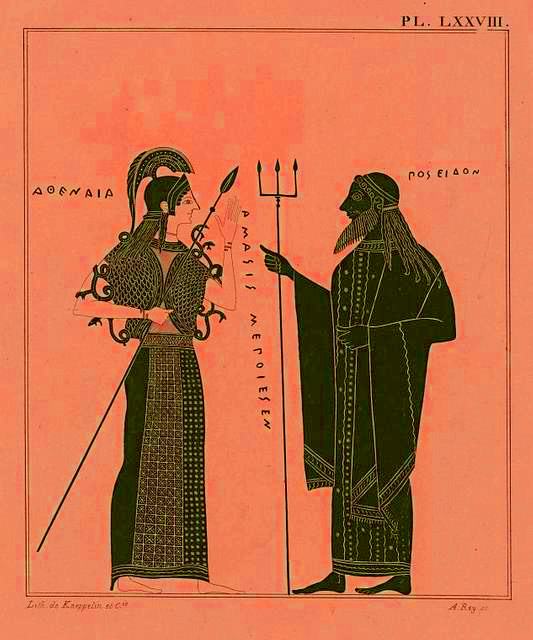
Poseidon and Athena, drawing of an amphora in the Cabinet des Médailles in Paris.
She often represents civic-mindedness, while Poseidon represents the raw powers of nature and their various kinds of uses. Nowhere is this more obvious than in Athens' story of how it was founded. Apollodorus gives the fuller narrative. Poseidon arrives first, strikes the Acropolis with his trident, and produces a sea called Erechtheis (sometimes instead a spring, or a horse); Athena then plants the olive. The twelve gods judge the land to Athena because Cecrops witnesses her planting of the olive, and Poseidon, angry at losing, floods the Thriasian plain and lays Attica under the sea. He later kills Athena's foundling Erechtheus after the latter kills his own Eumolpus.40
The myth of Erechtheus was, however, ambiguously odd. Inside the Erechtheion, there was an altar of Poseidon, but the Athenians, “in obedience to an oracle,” sacrificed on it too to Erechtheus. In the same sanctuary, Pausanias describes the sea-water cistern and the trident-mark in the rock, the two tokens of Poseidon’s contest with Athena. Euripides’ lost tragedy Erechtheus seems to have made this fusion even clearer. Surviving evidence indicates that after Poseidon’s destructive anger, Athena intervenes and orders the settlement: Erechtheus is to receive honors in connection with Poseidon, and the opposing divine powers are reconciled in worship. The later Atlantis myth also played into their rivalry in a mysterious guise.9, 14, 41, 42, 43
VIII. Poseidon as Challenger of Heroes
The great god of the seas is often a challenger to the heroes of Greek myth beyond Odysseus. The great monsters fought are often products of Poseidon's influence, such as the dire Medusa produced on her violation. Athena often serves as a patron too against these beasts, such as the Gorgons as a whole and the sea monster sent to terrify Andromeda in the case of Perseus, the Cretan bull sent by Poseidon to ravage Marathon which stifles both Theseus and Heracles,40, 44 the sea monster ravaging Troy, and the Pegasus born from Medusa's head who turns out to be an aid to Valefor.
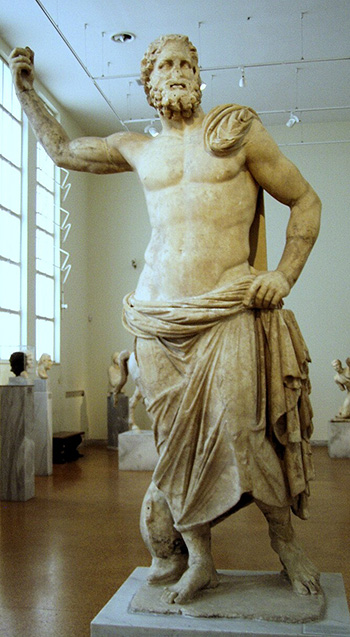
Poseidon of Melos in the National Archaeological Museum of Athens.
These are all emblematic of a deeper role of Poseidon, one that the Homeric Hymns calls γαιήοχε (holder of the earth), analogous to the sea propping it up.
IX. The Horse: the Animal of the Mind
Poseidon was associated with horses, his characteristic animal. The Homeric Hymns also call him the (tamer of horses). Some Roman variations of the Attic myth credit him with inventing the horse rather than providing sea water or the spring to the Athenians in the contest.45 In Arcadia, Pausanias reported the very ancient myth in which Demeter turns into a mare, Poseidon becomes a stallion, and she bore the divine horse Arion. Pausanias says this was why Poseidon was first called Hippios, and his general association with Pegasus was well-established, too.
Horses were emblematic of Poseidon's violent stamping power and his speed. They are deeply emotional and reactive herd animals with nonetheless highly distinct individual personalities. The mastery of the horse in this context is a parallel for human ingenuity just as much as taming the seas aloof to reason with sturdy ships is. Tellingly, Poseidon was the patron deity of the Athenian cavalry, the hippeis of Athens who had to use mental strategy on a mental constant basis to win battles.46, 47 However, beyond the horse being a type of microcosm of his symbolism, there was a deeper allegory involving the mind:
In their pantheons, both Neptune and Poseidon were also associated with horses. Horses symbolize what can be out of control and is to be tamed. Even the strongest man can be killed by a wild horse, and people have been trampled to death by horses. Horses were gifted to humans from the Gods* to be tamed for our use, and in return, we are to take care of our horses and treat them well. Horses were the animal that allowed civilization to expand. Neptune/Poseidon’s message: Control your wild horses (urges, impulses). Tame your storm (mind, emotions). Clean your waters (soul). Calm your wild ocean (your unconscious). High Priestess Lydia Coventina, Poseidon
X. Philosophical Poseidon
Even in the Homeric account, Poseidon follows general procedure. He is deeply affronted at unfairness and disrespect toward the divine from mortals. His anger in mythology is well-grounded. This theme is also iterated quite commonly in Greek myth from a plethora of ocean, sea and river deities where any hero's attempt to bend water for their own purpose is often met with anger.
The triad of Zeus, Hades and Poseidon as elaborated by the marine deity in the Iliad was also discussed in the Platonic dialogues. In the Gorgias, Poseidon is conspicuously absent from the triad when discussing the judgement of souls, as he rules over souls in their earthly activity. In the Cratylus, from which we derive our etymology above, Socrates treats Poseidon as knowledgeable in many things, but says name is evocative of being enchained and preventing walking freely. Poseidon becomes a symbol of increase and decline, power and dehabilitation, flux.3, 48
δύναμις δ᾽ ὁ Ποσειδῶν... [dynamic] power is Poseidon... Proclus, On Plato's Cratylus
Neoplatonists like Proclus interpreted the Triad in a highly symbolic sense. Olympidorus, like the Temple of Zeus, asserted that each prong of the triad must be understood as a symbolic power belonging to a higher unity.49 Each triadic power represents a proper allotment of divine functions. Proclus interpreted Plato's dialogue as Poseidon receiving souls from the heavenly father Zeus, setting them into generation, motion and flux. Hades, the intellective power, releases them from this zone.50 The sea, which the ancients already knew to be the source of all biologic life, represents that generation. The horse takes on a deeper symbolic meaning as a symbol of motion, as does the trident in its triple imagery.
Because Poseidon ruled over the visible world and all sense perception, he presides over the world of idols. This is one of the reasons Athena with her intellective powers contends with him and cooperates with his design in equal measure. Poseidon is the limit.
XI. The Festivals of the Dark-Haired Lord
There were a variety of festivals to Poseidon. Most important of all were the Isthmian Games:
| Poseidon Ritual Days | Place | Description | Importance | Date Recorded |
|---|---|---|---|---|
| Isthmian Games | Isthmia | Panhellenic Games | Athletic, equestrian contests | Plutarch (105-155CE) |
| Panionia | Ionia | Ionian Assembly | Sacrifice to Poseidon Helikonios | Herodotus (5th century BCE) |
| Poseidonia | Tinos | Holy Festival | Banqueting, street celebration | Strabo (1st century AD) |
| Poseidonia (Thiasoi) | Aegina | Holy Festival | 16 day festival, sacrifice to Aphrodite | Plutarch (95 CE-120 CE) |
| Posideia | Delos | Holy Festival | Ritual and festival celebration | Delos Inscription (n/a, archeological) |
Sources: Plutarch. Theseus. 25.4–5 (Isthmian Games). In Plutarch’s Lives, translated by Bernadotte Perrin. Loeb Classical Library 46. Cambridge, MA: Harvard University Press, 191444 Herodotus. Histories. 1.148 (Panionia). Translated by G. C. Macaulay. London: Macmillan, 189015 Strabo. Geography. 10.5.11 (Poseidionia of Tinos). Translated by Horace Leonard Jones. Loeb Classical Library 211. Cambridge, MA: Harvard University Press, 1928;22Plutarch. Moralia: The Greek Questions. 44, 301E–F (Poseidonia of Aegina). Translated by Frank Cole Babbitt. Loeb Classical Library 305. Cambridge, MA: Harvard University Press, 1936; see also Athenaeus. The Deipnosophists; or, Banquet of the Learned. 13.590F–591A. Translated by C. D. Yonge. London: Henry G. Bohn, 1854;17, 51 Carbon, Jan-Mathieu, Saskia Peels, and Vinciane Pirenne-Delforge, eds. “CGRN 199: Example of the Accounts of the Posideia and Ilithyaia on Delos.” A Collection of Greek Ritual Norms, 201752
XII. The Trident
Poseidon is often portrayed in classical statuary as a bearded, mature man of sturdy build with a mantle. He has a variety of symbols . Often the wreath he wears was made of celery leaves, evoking the watery and bitter plant with its pungent outer trappings. Quite commonly, he is portrayed with gray-blue or black hair evoking the darkest sea. One of the most common conventions is to portray Poseidon with his wife representing the seas, Amphitrite.53, 54
The most important Poseidonic symbol is the three-pronged wand called the Trident, which functions as a shorthand for his identity and even the sea altogether. The ancients ascribed various allegories to this tool.10, 12, 55 The ocean itself represented much?
Oceans symbolize the psyche, unconscious mind, emotions, boundlessness, and escape. The planet Neptune rules the psyche and unconscious mind, and it also rules insanity, mental illness, confusion, indecision, formlessness, and escapism (as well as spirituality, the occult, inspiration, art, music, dance, and anything to do with the ocean). High Priestess Lydia Coventina, Poseidon
As the High Priestess explains above, Poseidon is also represented by the exocosmic planet Neptune, discovered in the 1700s and given his Roman equivalent's name, which in modern Greek was named after him and also has the trident as a shorthand. Marsilio Ficino also assigned Pisces as the god Neptune's sign.56 Much of the nature of Pisces is grounded in Poseidon's symbolism.
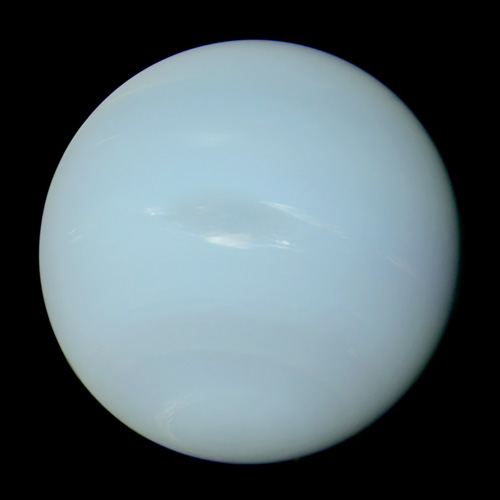
The planet Neptune.
XIII. Poseidon and Atlantis
The most evocative myth-beyond-myth of Poseidon is his status in Platonic dialogues as the patron deity of Atlantis. In the beginning, Socrates insists that Poseidon gave the mythical empire its laws, which they prospered under when the ten kings followed them to the letter. Atlantis, however, started to go awry in some fashion, becoming a monstrous polity and oppressing the four corners of the earth.
Corrupt and venal, the empire is ultimately submerged through cataclysmic earthquakes and floods. Though Zeus gives the order, the end of Atlantis is unmistakably tied to its source.57
XIV. The Arcane King
Perhaps one of the most abyssal aspects of Poseidon is his high status in the most ancient part of recorded history in Greece, occupying a blurred role with Zeus and Hades. Many of Poseidon's earliest myths from Arcadia, Boeotian and other old Greek regions show his antiquity as a deity, often representing him simply as a horse.
At Pylos, Poseidon was celebrated as a Lord of the Underworld. There seems to have been an association of Poseidon with Mycenean kingship.24, 23, 58
Bibliography:
- Vlad Borrelli, Licia. “Posidone.” In Enciclopedia dell’Arte Antica. Rome: Istituto della Enciclopedia Italiana, 1965. Sections cited: modern proposed etymologies of Poseidon, including πόσις-δᾶ.
- Komita, Nobuo. “The Indo-European Attribute of Poseidon as the Water God.” Research Reports of Kanagawa Institute of Technology A 14 (1990). Sections cited: Indo-European water-etymology proposals for Poseidon.
- Plato. Cratylus. In Plato: Cratylus, Parmenides, Greater Hippias, Lesser Hippias, translated by Harold North Fowler. Loeb Classical Library 167. Cambridge, MA: Harvard University Press, 1926. Sections cited: 396a–397b; 400d–401a.
- Cornutus, Lucius Annaeus. Theologiae Graecae Compendium. Edited by Carl Lang. Leipzig: Teubner, 1881. Sections cited: discussion of Poseidon’s name and φύσις/πόσις explanation.
- Aurora, Federico. “DĀMOS: Database of Mycenaean at Oslo. Annotating a Fragmentarily Attested Language.” Procedia: Social and Behavioral Sciences 198 (2015): 21–31. Sections cited: DĀMOS corpus and Linear B entries PY Es 653 and PY Fr 1224.
- Palmieri, Maria Grazia. Penteskouphia: Immagini e parole dipinte sui pinakes corinzi dedicati a Poseidon. Tripodes 15. Athens: Scuola Archeologica Italiana di Atene, 2014. Sections cited: Penteskouphia Poseidon forms.
- Musée du Louvre. “Pinax, MNB 2856 / L 187.” Collections du Louvre. Sections cited: Penteskouphia pinax, 575–550 BCE.
- Immerwahr, Henry R. Corpus of Attic Vase Inscriptions. Entry for Florence 4209, the François Vase. Sections cited: François Vase, c. 570–560 BCE, and Poseidon label [Πο]σειτον.
- Homer. Iliad. Translated by Richmond Lattimore. Chicago: University of Chicago Press, 1951. Sections cited: Poseidon in the Trojan War, Iliad 2.546–551; 12; 13.20–35; 15.184–217; 20.144; and related Homeric titles.
- Homer. Odyssey. Translated by A. T. Murray. Revised by George E. Dimock. Loeb Classical Library 104–105. Cambridge, MA: Harvard University Press, 1995. Sections cited: 3.6; 5.282; 9.528, 9.536; 11.241; 13.125.
- Hesiod. Theogony. Translated by Hugh G. Evelyn-White. Loeb Classical Library 57. Cambridge, MA: Harvard University Press, 1914. Sections cited: genealogy of Poseidon and children of Kronos.
- Pindar. Olympian Odes. Pythian Odes. Translated by William H. Race. Loeb Classical Library 56. Cambridge, MA: Harvard University Press, 1997; Pindar. Nemean Odes. Isthmian Odes. Fragments. Translated by William H. Race. Loeb Classical Library 485. Cambridge, MA: Harvard University Press, 1997. Sections cited: Olympian 6.100–105; Isthmian 2.13–16.
- Orpheus. “Hymn 17: To Poseidon.” In The Orphic Hymns, translated by Apostolos N. Athanassakis and Benjamin M. Wolkow. Baltimore: Johns Hopkins University Press, 2013. Sections cited: Hymn 17.1–10.
- Pausanias. Description of Greece. Translated by W. H. S. Jones and H. A. Ormerod. Loeb Classical Library 93, 188, 272, 297, 355. Cambridge, MA: Harvard University Press, 1918–1935. Sections cited: 1.24.3–5; 1.26.5–6; 1.30.4; 2.1.6–9; 2.9.6; 2.22.4; 2.30.6; 2.32.8; 2.38.4; 3.11.9; 3.14.7; 4.36.1–2; 7.21.7–8; 8.30.1.
- Herodotus. Histories. Translated by A. D. Godley. Loeb Classical Library 117–120. Cambridge, MA: Harvard University Press, 1920–1925. Sections cited: 1.148, Panionion and Poseidon Helikonios.
- Hesiod and Homer. Homeric Hymns. Homeric Apocrypha. Lives of Homer. Edited and translated by M. L. West. Loeb Classical Library 496. Cambridge, MA: Harvard University Press, 2003. Sections cited: Homeric Hymn 22.1–7.
- Plutarch. Moralia. Translated by Frank Cole Babbitt et al. Loeb Classical Library. Cambridge, MA: Harvard University Press, 1927–2004. Sections cited: Table Talk 8.8.4 (= Moralia 730D), Poseidon Phytalmios; Greek Questions 44, 301E–F, Poseidonia of Aegina.
- Hesychius Alexandrinus. Hesychius Alexandrinus: Lexicon. Edited by Mauricius Schmidt. Jena: Hermann Dufft, 1858–1868. Section cited: s.v. “Κρηνοῦχος.”
- Ventris, Michael, and John Chadwick. Documents in Mycenaean Greek. 2nd ed. Cambridge: Cambridge University Press, 1973. Sections cited: Mycenaean attestations of Poseidon and the earth-shaker title.
- Hayes, John W., and Kathleen Warner Slane. Isthmia XI: Late Classical, Hellenistic, and Roman Pottery. Isthmia: Excavations by the University of Chicago 11. Princeton, NJ: American School of Classical Studies at Athens, 2022. Sections cited: Isthmia sanctuary context.
- Paga, Jessica, and Margaret M. Miles. “The Archaic Temple of Poseidon at Sounion.” Hesperia 85, no. 4 (2016): 657–710. Sections cited: Sounion’s Archaic temple, architecture, 6 × 13 plan, naval significance, and coastal sanctuary pattern.
- Strabo. Geography. Translated by Horace Leonard Jones. Loeb Classical Library 49, 50, 182, 196, 211, 223, 241, 267. Cambridge, MA: Harvard University Press, 1917–1932. Sections cited: 9.2.13; 10.5.11.
- Palaima, Thomas G. “Sacrificial Feasting in the Linear B Documents.” Hesperia 73, no. 2 (2004): 217–246. Sections cited: Linear B evidence from Pylos, Un 718, Poseidon, and Pylian cult.
- Palaima, Thomas G. “The Last Days of the Pylos Polity.” In Politeia: Society and State in the Aegean Bronze Age, edited by Robert Laffineur and Wolf-Dietrich Niemeier, 623–633. Aegaeum 12. Liège: Université de Liège, 1995. Sections cited: Poseidon’s position in the Mycenaean Pylian kingdom and Mycenaean kingship context.
- Hellenic Ministry of Culture and ODAP. Sounion. Athens: Organization for the Management and Development of Cultural Resources, n.d. Sections cited: Sounion’s geography, Poseidon and Athena sanctuaries, Geometric cult activity, Classical temple, fortification, and strategic function.
- Thucydides. History of the Peloponnesian War. Translated by Richard Crawley. London: J. M. Dent, 1910. Section cited: 8.4.1, Sounion’s fortification.
- Hellenic Ministry of Culture. “Archaeological Site of Holy Poseidon and Amphitrite, Tinos.” All of Greece One Culture. Sections cited: sanctuary at Kionia, Poseidon and Amphitrite, foundation date, and healing function.
- Håland, Evy Johanne. “Saints and Snakes: Death, Fertility and Healing in Modern and Ancient Greece and Italy.” Performance and Spirituality 2, no. 1 (Spring 2011): 111–151. Sections cited: Tinos/Ophioussa snake tradition.
- McGilchrist, Nigel. “Poseidon/Amphitrite Sanctuary (Tinos).” In McGilchrist’s Greek Islands. 2010. Reproduced in ToposText, web version 4.0. Sections cited: Poseidon/Amphitrite sanctuary at Tinos.
- Foss, C., and G. Reger. “Panionion: A Pleiades Place Resource.” Pleiades: A Gazetteer of Past Places. Sections cited: Panionion.
- Harvard Art Museums. “Stater of Poseidonia, Lucania, 1.1965.396.” Harvard Art Museums Collections Online. Sections cited: Poseidonia’s coinage showing Poseidon.
- University of Notre Dame. “Paestum: Overall View of Sanctuary of Hera.” Marble: Museum and Archaeology Research in the Built Environment and Landscape. Sections cited: Poseidonia/Paestum and the correction that the so-called Temple of Neptune belongs to Hera’s sanctuary.
- van Rookhuijzen, Jan Zacharias. “The Erechtheion on the Acropolis of Athens.” Kernos 34 (2021). Sections cited: Erechtheion, Poseidon-Erechtheus, and Acropolis cult.
- Roussel, Pierre, and Marcel Launey, eds. Inscriptions de Délos. Vol. 4, Décrets postérieurs à 166 av. J.-C. (nos. 1497–1524); Dédicaces postérieures à 166 av. J.-C. (nos. 1525–2219). Paris: Librairie ancienne Honoré Champion, 1937. Section cited: no. 1774, lines 1–2.
- Parchi Archeologici di Paestum e Velia. “The Story of Paestum.” Accessed June 22, 2026. Sections cited: Poseidonia/Paestum.
- Metropolitan Museum of Art. “Silver Tetradrachm of Demetrios Poliorketes.” The Met Collection. Object no. 05.44.399. Sections cited: Poseidon and Nike on Demetrios’ coinage.
- Lorber, Catharine C. “Theos Aigiochos: The Aegis in Ptolemaic Portraits of Divine Rulers.” In More than Men, Less than Gods: Studies in Royal Cult and Imperial Worship, edited by Panagiotis P. Iossif, Andrzej S. Chankowski, and Catharine C. Lorber, 293–356. Studia Hellenistica 51. Leuven: Peeters, 2011. Sections cited: Ptolemaic royal imagery, trident, aegis, and diadem.
- Seneca. Naturales Quaestiones. Translated by John Clarke. London: Macmillan, 1910. Section cited: 6.7.
- Aristotle. Meteorology. Translated by E. W. Webster. In The Works of Aristotle, edited by W. D. Ross. Oxford: Clarendon Press, 1931. Section cited: 2.8, 366a.
- Apollodorus. The Library. Translated by James George Frazer. 2 vols. Loeb Classical Library 121–122. Cambridge, MA: Harvard University Press, 1921. Sections cited: 2.5.7; 3.14.1; 3.14.6–7; 3.15.1; 3.15.4–5.
- Clairmont, Christoph W. “Euripides’ Erechtheus and the Erechtheion.” Greek, Roman and Byzantine Studies 12, no. 4 (1971): 485–494. Sections cited: Erechtheus and Erechtheion.
- Euripides. Fragments: Aegeus–Meleager. Edited and translated by Christopher Collard and Martin Cropp. Loeb Classical Library 504. Cambridge, MA: Harvard University Press, 2008. Sections cited: Erechtheus fragments.
- Meyer, M. “To Cheat or Not to Cheat: Poseidon’s Eris with Athena in the West Pediment of the Parthenon.” Electra 6 (2018): 51–77. Sections cited: Poseidon’s eris with Athena in Parthenon iconography.
- Plutarch. Lives. Translated by Bernadotte Perrin. Loeb Classical Library. Cambridge, MA: Harvard University Press, 1914–1926. Sections cited: Theseus 14.1–2; 25.4–5.
- Patay-Horváth, András. “The Contest between Athena and Poseidon: Myth, History and Art.” Historika 5 (2015): 353–362. Sections cited: 353–354; Servius on Vergil, Georgics 1.12.
- Vivliodetis, Evangelos. “Hippios Kolonos: Cultic Rituals in the Sacred Place of Poseidon.” National Archaeological Museum, Athens. Sections cited: Poseidon Hippios and Athenian cavalry/cult.
- Xenophon. The Cavalry General / Hipparchicus. Translated by H. G. Dakyns. Project Gutenberg edition. Sections cited: 1.1–9; 3.10–13; 4.1–7; 5.1–6.
- Plato. Gorgias. Translated by W. R. M. Lamb. In Plato in Twelve Volumes, vol. 3. Cambridge, MA: Harvard University Press; London: William Heinemann, 1925. Sections cited: 522e–527e.
- Olympiodorus. Commentary on Plato’s Gorgias. Translated by Robin Jackson, Kimon Lycos, and Harold Tarrant. Leiden: Brill, 1998. Sections cited: commentary on the triadic divine powers.
- Proclus. On Plato’s Cratylus. Translated by Brian Duvick. London: Duckworth, 2007. Sections cited: In Cratylum 150–152.
- Athenaeus. The Deipnosophists; or, Banquet of the Learned. Translated by C. D. Yonge. London: Henry G. Bohn, 1854. Sections cited: 13.590F–591A.
- Carbon, Jan-Mathieu, Saskia Peels, and Vinciane Pirenne-Delforge, eds. “CGRN 199: Example of the Accounts of the Posideia and Ilithyaia on Delos.” A Collection of Greek Ritual Norms, 2017. Sections cited: Posideia and Ilithyaia accounts on Delos.
- Rodríguez López, María Isabel. “Iconography of Poseidon in Greek Coinage.” In Greek Art in Motion: Studies in Honour of Sir John Boardman on the Occasion of His 90th Birthday, edited by Rui Morais, Delfim Leão, Diana Rodríguez Pérez, and Daniela Ferreira, 264–275. Oxford: Archaeopress Archaeology, 2019. Sections cited: Poseidon iconography in coinage.
- Acropolis Museum. “Parthenon. West Pediment. Poseidon.” Acropolis Museum Official Website. Sections cited: Poseidon in the Parthenon west pediment.
- Norris, Michael. Greek Art: From Prehistoric to Classical: A Resource for Educators. New York: Metropolitan Museum of Art, 2000. Section cited: 180, no. 49.
- Ficino, Marsilio. Platonic Theology. Vol. 1, Books I–IV. Edited and translated by Michael J. B. Allen, with John Warden; Latin text edited by James Hankins with William Bowen. The I Tatti Renaissance Library. Cambridge, MA: Harvard University Press, 2001. Section cited: Book 4, chapter 1.
- Plato. Critias. Translated by R. G. Bury. In Plato in Twelve Volumes, vol. 9. Cambridge, MA: Harvard University Press; London: William Heinemann, 1929. Sections cited: 108e–114c; 112b–113e.
- Balériaux, Julie. “Mythical and Ritual Landscapes of Poseidon Hippios in Arcadia.” Kernos 32 (2019): 83–99. Sections cited: Poseidon Hippios in Arcadia.