




| Language | Name of Athena | Attestation |
|---|---|---|
| Mycenaean Greek | a-ta-na(-pot-ni-ja)(𐀀𐀲𐀙 (𐀡𐀴𐀛𐀊)) | Linear B Texts (1300-1200 BCE) |
| Homeric Greek | Ἀθήνη (Athéne) | Homer (8th century BCE onward) |
| Classical Greek | Ἀθηνᾶ (Athena) | IG I³ 527. Acropolis (500BCE) |
| Ancient Attic Greek | Ἀθηλᾶ (Athela) | Athenagoras (ancient) |
35 min read
ATHENA
author: High Priest Zevios Metathronos
co-author: Novice Priest Karnonnos
Hieratic Information about Athena
| Divine Names | |
|---|---|
| Athena (Ἀθηνᾶ) | the ancient Hellenic name, from Proto-Indo-European *Dyēus ("Sky Father")1 |
| Athene (Ἀθήνη) | Homeric form |
| |
| These hieratic names carry strong spiritual resonance and are recommended for summoning and invocation practices. | |
| Divine Symbols | |
| |
| Divine Numbers and Attributes | |
| Sacred Numbers | 40, 50, 60 |
| Runes | Thurisaz, Tiwaz, Sowilo (in order of importance) |
| Zodiac Sign of Power | Aries |
| Sacred Animals | The Great Eagle, the Bull, the Hawk, the Serpent |
| Element | Fire, Aether |
| Divine Forces | |
| |
| Important Titles | |
| |
| Names Across Civilizations | |
| Greek | Athena (Ἀθηνᾶ) |
| Roman | Minerva (Minerva) |
| Etruscan | Mnerva |
I. The Name of Athena, Wisdom Incarnate
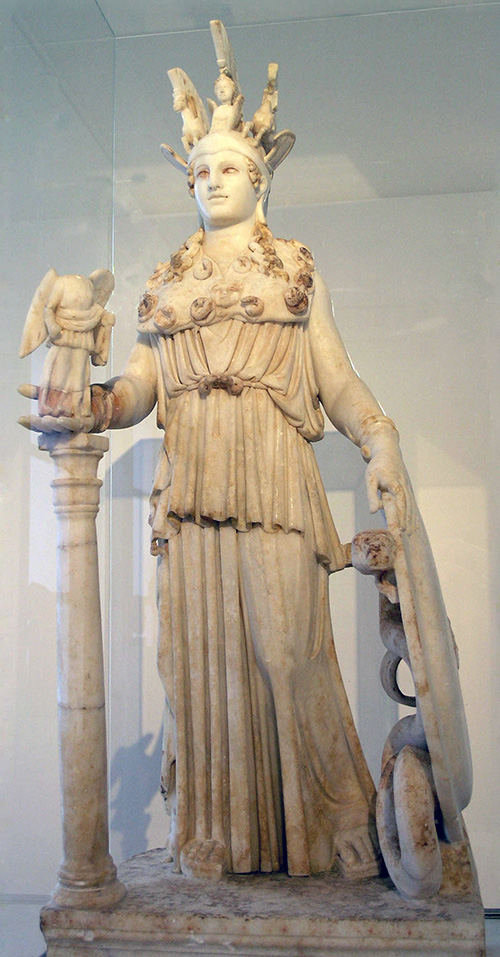
The Varvakeion Athena, the most faithful copy of the Athena Parthenos, National Archaeological Museum, Athens, based on original of Phidias of 438 BCE
Beyond Athena's perennial connection to her great city, it is unclear whether her name came first as a theonym or whether her general name came from Athens. Much like with other gods, Plato's Cratylus dialogue around lines 407b–407c discusses her name. To illustrate her tie to wisdom, Socrates links θεοῦ νόησιν (divine mind), ἁ θεονόα (a theonoa) or the mind of God, θεῖα νοούσης (theia noousis), she who knows divine things; Ἠθονόην (ithonoin), ethical mind, a description of her moral intelligence and refinement.1,2
A vase of Mycenaean wares found in the ancient Minoan city of Knossos on Crete appears to refer to Athena as "a-ta-na-po-ti-ni-ja" and the visual evidence for her presence in Mycenae is strong, however, this could mean Mistress from the Place of Athana. Homer uses the Ionic variation Ἀθήνη (Athini) and the more sacred Ἀθηναίη (Athenaii). The most cursory evidence for the -α ending after the fall of Mycenae is IG I³ 590 = DAA 33, the inscription of the Chairion Altar from Athens dated to around 600BCE, containing the dative form Ἀθεναίαι (Athenaiai), but the IG I³ 527 inscription contains the first -a ending. The Christian apologist Athenagoras in the 2nd century AD claimed the mystical form Ἀθηλᾶ (Athila) was in use in Attica since ancient times, and this name is attested as appearing on a magic sphere also.3,4,5,6,7,8
Sources: Burkert, Greek Religion, (1985); Plato, Cratylus; García Ramón, "Mycenaean Onomastics", (2011); Liddell & Scott, A Greek-English Lexicon, (1940); Inscriptiones Graecae, IG I³ 527; Di Bella, "L’officina di Endoios e Philergos", (2023);1,2,3,4,5,7
II. Athena
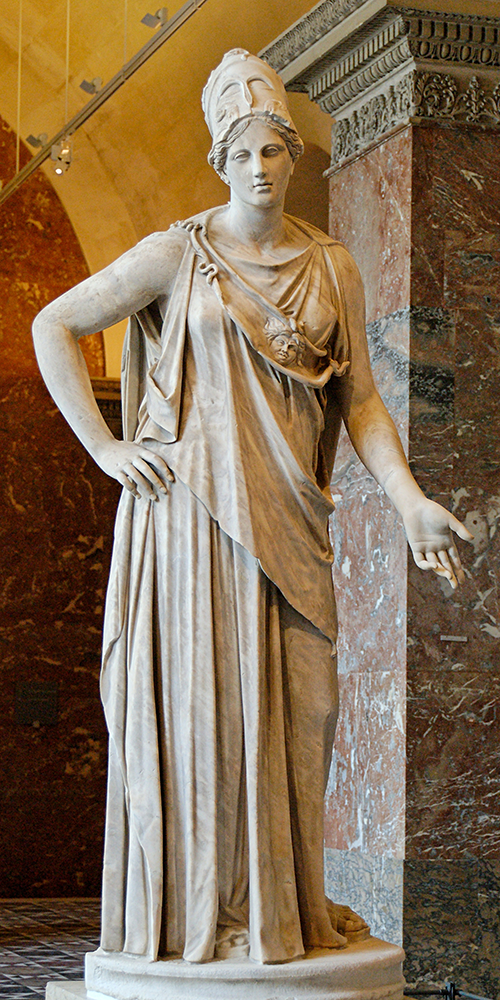
Mattei Athena, Roman copy of 1st century BCE-CE after 4th century BCE original (Piraeus Athena) attributed to Cephisodotos or Euphranor. Louvre
The Iliad
In the Iliad, Athena takes the side of the Achaeans in the Trojan War. She cooperates ceaselessly with Hera to help them win their war against Troy, and often aids Achilles directly, but not without stern confrontation, as her first move is to seize him by his hair for wanting to strike Agamemnon. Zeus instructs her to make the Trojans fail their oath, and this she does faithfully.9
One warrior beloved to her heart, Diomedes, becomes her representative of sorts. She tells him he may only strike Aphrodite and Ares, the foremost advocates of the Trojans acting out of order, but in human error he still defies her instructions not to attack their great protector, Apollo. This disaster entices Ares onto the battlefield by the sun god's command, causing intense levels of fighting. Sensing the chaos unfolding, she guides the warrior to undo his mistake and to stab Ares in his flank, which causes him to fall with a terrifying groan.
Athena then aids the unarmed Achilles in his lowest moment at Book 14, feeding him with nectar and ambrosia. During the pivotal one-on-one fight between him and the Trojan champion Hector, Athena tricks Hector into standing his ground by appearing as his brother Deiphobus, ultimately leading to his death. Her bond with Odysseus, king of Ithaca, is also affirmed in the Iliad itself when she helps him win the footrace, leading later to the events of the Odyssey.
She again takes Hera's side in the conflict between the gods, using her powers to throw a shield at an escaping Ares and Aphrodite. Her motivations for siding with the Achaeans is shown as the Golden Apple episode is explained; given a choice by the three goddesses, the Trojan prince Alexandros (later known as Paris) choses the gift of Aphrodite, the most beautiful woman, Helen of Troy, instead of the glory of winning battles that Athena promises, which she finds to be an offense.
The Odyssey
She also has a rather direct role in the Odyssey, set ten years after the end of the war, as the divine guide and tutor of Odysseus. The latter has been cast out of his palace by one hundred and eight violent and boorish suitors vying for his wife, Penelope. At the beginning, pitying Odysseus' situation, she shapeshifts as Mentes and Mentor to tell Odysseus' son Telemachus to seek information about his father.10
Odysseus continues to have problems, particularly drawing the wrath of Athena's rival, Poseidon. Pleading to Zeus to save Odysseus, she saves him from the nymph Calypso, and then helps him be rescued by the beautiful princess of Phaecaea, Nausicaa, as he swims precariously to her city state's shore from the tumultuous and dangerous seas. Odysseus returns to his homeland after many travails as the Phaeacians take the hero to Ithaca, where Athena is able to create a magical disguise for him as a beggar. After he kills the hated suitors in his wily disguise, the goddess ultimately prevents any further bloodshed by placating the suitors' relatives.
Although this is not detailed in the Iliad itself, background information about Troy is conveyed. Athena lent more of her tactical wisdom to Odysseus, guiding the Greeks to build the massive wooden horse. However, she is said to have turned against the Achaeans due to Cassandra being violated in her temple by Ajax, leading her to persuade Poseidon to destroy the Greek fleet. The Homeric Hymns, the eleventh and twenty eighth, celebrate her as the savior of the city whose fearsome shaking spear can make Olympus itself shake. The hymn also references the myth of Athena springing from the head of Zeus.11
Hesiodic and Pindaric Context
In the Theogony, this primary birth myth of Athena is elaborated upon. Zeus feared of a successor who could defeat him as he defeated his father Cronus, as he had lain with the nymph Metis, who was the wisest and most useful among deities and men. He remembered that Gaia and Uranus had prophesized his overthrow would come. Zeus then tricked and swallowed the pregnant Metis, who had nonetheless already conceived. Athena eventually came out of Zeus' head after he had acquired six more wives, settling on Hera. Later expositions claim that Athena resided in Zeus' mind inbetween being swallowed and born.12,13
Often, Hephaestus is treated in mythological geneology as being the exclusive child of Hera. Athena is always from Zeus. Pindar added the detail that Hephaestus uses his axe to cut open Zeus' head, upon which Athena came out armed and powerful, fully-grown, shouting in a manner that caught all of the gods attention, including the sun god Helios. The two form a kind of antagonistic relationship in myth afterwards.
III. The Names and Epithets of Athena
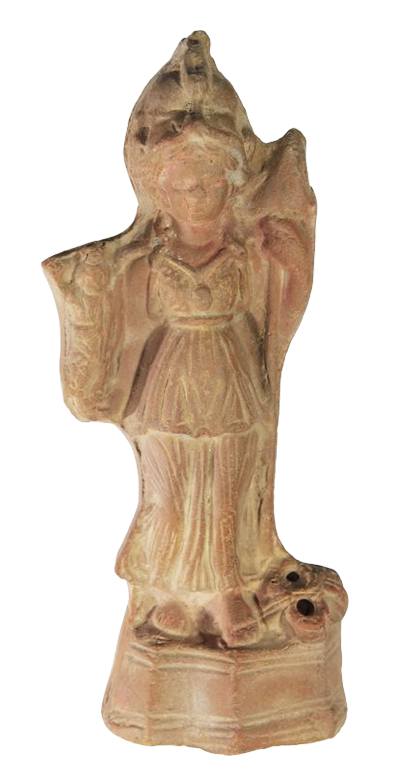
Athena-Isis-Neith holding statue of Serapis, the Israel Museum
| Epithet | Meaning | Domain |
|---|---|---|
| Athena Polias (Πολιάς) | Athena of the City | The Polis |
| Athena Parthenos (Παρθένος) | Athena the Virgin | Virginity, sacred sovereignty |
| Athena Nike (Νίκη) | Athena Victory | Victory in war |
| Athena Ergane (Ἐργάνη) | Athena the Craftswoman | Crafts, protection of workers |
| Athena Areia (Ἀρεία) | Athena the Warlike | War, martial valor |
| Athena Alea (Ἀλέα) | Athena Alea | Arcadian sanctuary, sovereignty |
| Athena Pronaia (Πρόναια) | Athena Before the Temple | Threshold guardianship, sacred approach |
| Athena Hippia (Ἱππία) | Athena of Horses | Horsemanship, noble training |
| Athena Chalinitis (Χαλινῖτις) | Athena of the Bridle | Restraint, disciplined force |
| Athena Hygieia (Ὑγίεια) | Athena of Health | Health, spiritual hygiene |
| Athena Zosteria (Ζωστηρία) | Athena the Girded | Preparation, martial arming |
| Athena Itonia (Ἀθηνᾶ Ἰτωνία) | Athena Itonia | Goddess of Thessaly, Hades |
| Athena Skiras (Σκιράς) | Athena Skiras | Attic festival, sacred procession |
Sources: Pausanias, Description of Greece; Attic Inscriptions Online, AIO 314; Harpocration, Lexicon of the Ten Orators;14,15,16
IV. The Temples of Athena
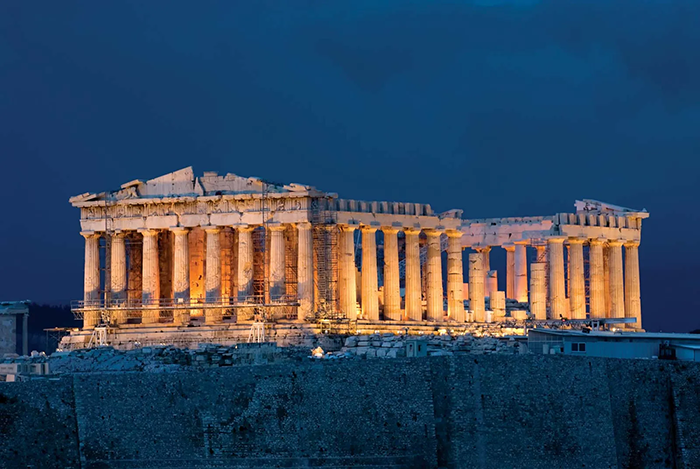
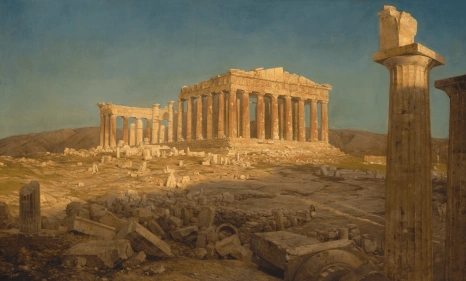
The Parthenon of Athens, her inheritance to humanity, constructed in the mid 5th century BCE
Much like Hera, Athena is thought to be a Myceanean palace goddess. Visual representations of her kind of iconography in art are very old as one particular Mycenean figure is shown carrying a griffin while wearing a boar's husk helmet that recur throughout her subsequent symbolism. A Minoan goddess depicted as part of processions may be related to her also. The evolution of her cult is tied to not only the acropolis in Athens, but to the historical development of acropoleis across Greece and Asia Minor.
From an early point, Athena was the guardian of royal welfare. Standing beside all rulers to use wisdom, Athena was scarcely only the urban protector of republican Athens, but was said to be the regal and civic goddess of many different polities. In particular, Athena was very important to the ancient polity of Corinth where her symbolism was deeply integrated with that of Pegasus.17,18,19,20
Athens, Sounion and the Parthenon
Athens itself was named for Athena, given to be a product of the mythological contest between her and Poseidon. Poseidon granted the Attic plain gushing salt water, but Athena granted it olive manufacture, which either the gods themselves or the denizens of Attica narrowly felt was superior due to its resilience and ability to contribute to civilization beyond a level of mere sustenance. Plutarch said that Athens' choice of the olive was historically reflective of the people moving away from the mechanics of survival through fishing. Consequently, the city state thereafter bore the name of the goddess, and it was the city of her patronage. Several arcane cults existed to Athena that were already ancient by the time of the classical authors, including the one of Pallas.13,21,22,23,24,25,26
The archaic worship of Athena in the area had some aspects related to her function as law-giver. Certain sacred presincts dedicated to Athena also showed evidence of her association with passed heroes in the realm of the dead, such as the precinct of her old temple, later located in the Erechtheum on the northern side of the high Acropolis hovering above the city. Here, the statue of Athena Polia was rather rustic, being made out of olive wood as a xoanon, and the cult of the very ancient temple was notoriously simple and tied to vegetation itself in comparison to the grand structures of Athena Parthenos. Nonetheless, the shrine and everything in it was considered one of the holiest of Athens, and the bucolic image of Athena Polia bestowed Athens with its protection. During the Plynteria when the temple was left without the sacred image due to it being carried to the sea, Athenian workers refused to do anything.27,28
This disobedience had its own reasons. Athena was said to protect workers rather than simply representing them. The markets of Athens and the quality of all of its artisans was in relation strongly to Athena's status in being the Ergane, the divine craftswoman. She was famous for being a goddess of the polis in terms of quality of what it produced in handicraft and wool-work, her cult often intersecting with that of Hephaestus strongly in this respect, with the two deities often sharing particular shrines. Pausanias, for instance, witnessed that a statue of her was beside the Temple of Hephaestus. Athena was also important to the class and caste system of the city, representing many of the non-industrial artisans like weavers in contrast to the god of the fiery forge, though her cult also represented the lines of labor between the sexes in a more abstract sense.14,29,30
The worship of Athena Polias on her old site at the north of the acropolis before the Persian Wars provoked the Athenians to build a grander complex than the rustic area of the Erechthean sanctuary. During the outset of that titanic conflict, a large temple was already under construction to accomodate the large amount of pilgrims, but the invasion caused widespread damage and delayed its erection entirely. Decades later, classical era architects and artisans under the patronage of Pericles constructed the most famous temple dedicated to Athena Parthenos, the Parthenon, the one that still stands today as an emblem of Greek civilization and human wisdom. Plutarch claimed that during its construction, after a craftsman was injured, Athena appeared to Pericles in a dream and prescribed a cure, leading to the dedication of the cult of Athena Hygieia on the Acropolis too.31,32,33,34
Homer refers to Sounion as the "holy cape" of Athens. It was another greatly important locality to Athena where her temple, mentioned as important by Pausanias, was founded around 600BCE. In 412 BC, during the Peloponnesian War, the Athenians fortified Sounion so that their grain-ships could round it safely. Here the Athenians defended themselves from the Persians and observed in great clarity the sea lanes of their great thalassocratic empire. It was also adjacent to the great silver mines of of Laurion.
Lindos
Rhodes was associated with the origin myth of Athena springing forth from the head of Zeus, as gold was said to rain down on that island when she was born, filling the houses and streets with plentitude. The sanctuary of Athena Lindia was erected there at the apex of the capital acropolis of Lindos. Legend stated it was founded by Danaus and the Danaïdes, the human ancestors of the Greeks. According to conventional archeological understanding, one holy complex was built during the 6th century BCE by one of the ancient rulers of the island, however, a disastrous fire necessitated that a new one be built in the mid fourth century BCE (though the the Lindos Chronicle itself claimed the destruction of the original temple occurred earlier in 392-391 BCE), which was Doric in style and had modest dimensions of 7.75 by 21.65 meters.
The sanctuary attracted both Hellenic and foreign dedications from elites, and the Lindian Chronicle is important to historians for understanding Aegean religion recording a litany of ancient offerings and epiphanies in a network that recorded the site's rather high reputation in the eastern Mediterranean. Alexander the Great and his armies even participated in sacrifices at Lindos to ensure victory. The gold myth meant that a statue of Ploutos also accompanied Athena at the temple.35,36,37,38,39
Pergamon
Pergamon, a grand city in Asia Minor, also took Athena as its formal patron deity, with the wisdom goddess deployed as a steward of her father's grandiose worship in the city. The city had a strong reputation for knowledge, craft-work and being a center of learning with a library second only to Alexandria. Portraits of Athena on coinage began to circulate as the locally powerful Pergamene kingdom grew to prominence, while a great temple to her was established by the third century BCE.
The king Eumenes bestowed to us sacred architectural elements that strengthened Athena's ties to Zeus through visual symbolism like the eagle, the olive, the oak and other symbolism. In the area, her worship also had great overtones of pertaining to the cosmos and fate as a whole. This area is where the title Nikephoros is sourced in the earliest and widest amount of contexts, again showing Athena's tie to her father. One of the most famous celebrations of Athena, the famous Nikephoria festival, was inaugurated by the rulers of Pergamon some time in the second century BCE.40,41
Arcadia
At Tegea, there stood a site to Athena of ancient importance. The famous architect Skopas designed the classical era temple, which had the characteristics of a pilgrimage site of ancient Arcadian culture and functioned as an asylum which kept the vulnerable safe. The rites to Athena in Arcadia were obscure and ancient, not comprehensible to many Greeks of the time.14
V. Wisdom, the Patroness of Heroes
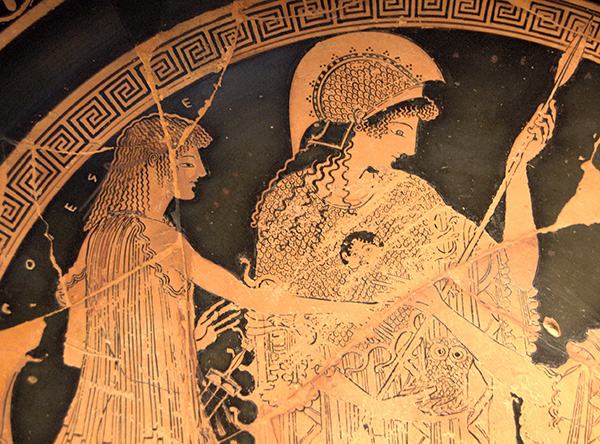
Athena and Theseus, vase, Attic red-figure cup, 500–490 BCE, Department of Greek and Roman Antiquities
Athena often bestows her guidance onto the heroes of Greek myth. Long before her aid to Achilles and Odysseus, that is exemplified first in the Perseus episode. Perseus is often refered to being as the ancestral, prototypal hero of Greece to whom she gives the blessing of weaponry needed to defeat the monstrous Gorgon created by Poseidon's acts. She lent the hero her shield with a polished finish, one that could reflect the face of Medusa without Perseus freezing to stone by meeting her direct gaze. Athena also lent him the kibisis, a bag in which he could put the Gorgon's defeated head, and the goddess gives Perseus a major clue: she informs him he must subjugate the Graeae hags in order to obtain information about the Gorgon's whereabouts.13,42,43
What this episode of the Gorgon shows is that even in the most typical mythological episodes, Athena never does the work of the hero for them. She gives her sagacious advice and brilliant weaponry to confront the most terrifying and chaotic forces to spur them to act. In the end, Perseus brought the foul and dire head to Athena, who placed it as a symbol on her aegis, showing the cooperation needed between the divine and human level. Communion with the holy is never a one-way system: true wisdom is facilitation between the faculties of the human and the divine.
VI. Embodiment of Justice
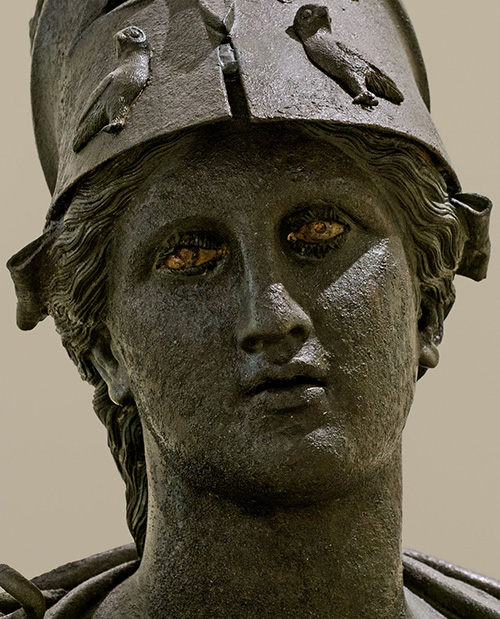
Athena is one of the deities whose visual presence is everywhere. Even after demonization by Christians, she appeared in medieval manuscripts and medals of her were produced from the 1470s. Perhaps most notably, the wisdom goddess is one of the most common subjects of statuary in the ancient world, also becoming a civic symbol from the 1540s onwards through Jacopo Sansovino's statue of Minerva in Venice. She is represented as a young woman clad in armor. As the archetypal city goddess and guarantor of the laws, she is quite closely related to many other types of divine concept often shown in statues, such as Lady Justice, Nike or Victoria, Nemesis, Harmony and many others. She also clearly serves as the base archetype for the national symbols of Lady Liberty and Marianne, among others.44,45,46
Pliny the Elder noted that the famous statue of Athena made by Pheidias was hailed widely in his time for its beautiful form and proportion transcending all banal sensuality and popular vulgarity. The ideal Athena was proportionate and rational, pristine and relative, showing the verve of the mind. The eyes of the Athena statues often were suggestive of her epithet, glaukopis, which can be translated as owl-eyed, gray gaze or of bright quality, a sharp element characteristic of an acute, judging mind. Although Athena is often shown as a stern goddess in most of her statuary, copies of the most famous Parthenos statue by Pheidias actually show her smiling in an enigmatic fashion.
VII. The Serpent and the Aegis
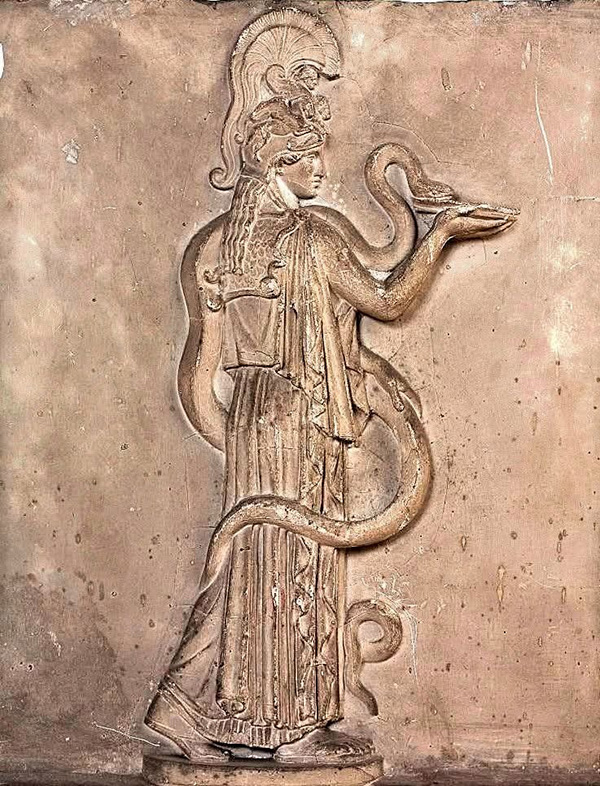
Roman relief, Minerva with serpent, c. 100 CE, Thorvaldsens Museum
The silent, precise and unseen nature of the serpent made it natural to be one of Athena's defining symbols. The earliest kings and ancestors of Athens were imagined to be earth-born and often serpent-like. Cecrops, the first king of Attica, is described as a being whose body was partly human and partly serpent. Herodotus says the Athenians believed a great serpent lived in Athena’s temple on the Acropolis which at all times did possessively guard the citadel. They fed it monthly with a honey-cake in reverence. When the cake was left uneaten before the Persian invasion, the priestess interpreted this as a sign that Athena herself had abandoned the Acropolis, encouraging the Athenians to evacuate.13,32
The fact the serpent almost glides above the earth while not seeming to walk on it with limbs is another clue to why it represents Athena. Boustrophedon, a style of writing that shows a mirrored-style from line to line and is found strongly in the acropolis of Athens in inscriptions and conventions, has a link to the way snakes weave and wax sideways when moving. The logical nature of this sacred writing has ties to her too.47
Her aegis is today one of her most recognizable symbols. It conferred authority from Zeus onto his daughter, a daughter who was fully of his essence alone; the Iliad makes it clear Zeus Aigiokhos bestowed it to her, and it is even impervious to his bolts of lightning. The shield was taken to represent the defense of Athens and its thassalocratic empire, but the symbolism transcended such worldly concerns in other ways to represent her watch over the sacred.
The aegis also integrated the nature of the serpent into it. The edges of the great shield moved with serpents, and thus it represents dangerous forces being put under control. Serpent scales and the hides of the Gorgon were said to reside in Athena's shield or breastplate, their stupeifying powers neutralized to serve wiser ends than the effusion of chaos and terror. Athena also is shown wearing an antique helmet, although sometimes she was represented wearing a leather cap named the kataityx kyne in coinage.48
IX. Just War
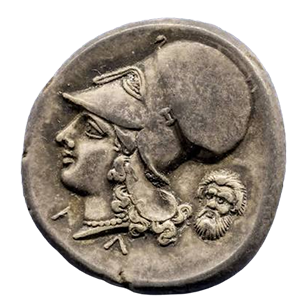
Head of Athena, silver stater of Corinth, 386-307 BCE
From her earliest representation in the Iliad and Odyssey, Athena is often shown as the champion of a heroic cause, instructing the few she regards as sapient and courageous enough to handle her advice. She also intervenes to prevent excesses. Her striking down of Ares through the medium of Diomedes curtails the most wanton bloodshed that Homer describes as littering strewn corpses on the field. It was a convention of the ancients that she represented both the just cause in war and its higher elements of strategy, military elegance and, perhaps most importantly, the right conditions for indivisible peace brought about by higher-mindedness.49
Athena's chosen advocate in the Iliad itself is the wise warrior Diomedes, often overshadowed by Achilles and Odysseus, whose excellence and fair understanding of both fate and war is affirmed constantly. Diomedes generally obeys the wisdom goddess in her recommendations, but his attack on Apollo contrary to her instructions brings the enraged Ares to the battlefield, forcing him to rectify this grave mistake. In post-Homeric myths, Diomedes is the only human in the epic to be deified explicitly by Athena herself.35
Her Corinthian helmet, representing the ancient helmet of the most competent Greek army in the years long before the Classical era and the unique precision required to form a phalanx, shows the nobility necessary to gauge just war. Furthermore, since Athena represented all Greek states in a sense and not just Athens, her symbolism had a deeper layer of conveying the intellective element of a common humanity, one that rises above conflict.
Athena is, on the deeper levels, a guardian of the civic walls of proper religion. This is a city which is without any physical border, which speaks no particular tongue and which envelops the cosmos, the polis holiest to her. Part of the mystery of the acropolis is in what it means (ἄκρον - highest, πόλις - state). Her defense of the apex of spiritual achievement is limitless. Even as entire civilizations fell, some philosophers attributed the direct intervention and supervision of Athena to their continued succcess and safety. One point is clear: she protects the high-minded.50
X. The Goddess of Philosophy
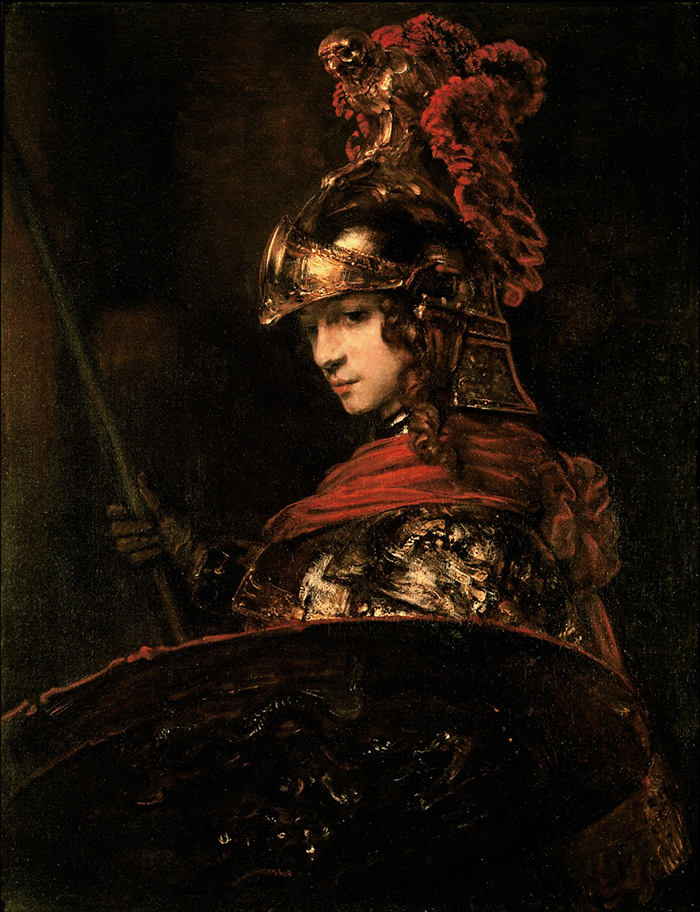
Pallas Athena, Rembrandt (1657)
Athena helps heroes, because heroes are precisely the souls who need to act inside the material world without being swallowed by it. They fight monsters, tyrants, passions, and impossible labors; allegorically they are fighting the disorderly, irrational, material side of reality. Athena gives them strategic intellect, an ennobling purity, self-command, the key to total victory using the powers of reason. She has been feted as the goddess of philosophy since the advent of written literature.
This is the reason Socrates cites her as an example of excellence. In the Timaeus, she is simply named 'the Goddess', nothing else. The Second Alcibiades claims Athena clears the sight of Diomedes so he can distinguish between the divine and mortal, which Socrates uses as an allegory for why Alcibiades must remove the mist from his soul, lest he choose corruption in public life.51
Neoplatonists looked deeper into the allegory. In Proclus' system, Athena belongs to the Kore triad alongside Persephone and Artemis. Her job is to turn life towards Nous, the Father and Intellect; she represents the intellective principle that cannot be tainted by matter without rejecting the baser parts of its essence. The philosopher was so fond of her that he wrote a hymn to her essence52,53:
Great goddess, hear! and on my dark'ned mind
Pour thy pure light in measure unconfined;
That sacred light, O all-protecting queen,
Which beams eternal from thy face serene:
My soul, while wand'ring on the earth, inspire
With thy own blessed and impulsive fire;
And from thy fables, mystic and divine,
Give all her powers with holy light to shine.
Give love, give wisdom, and a power to love,
Incessant tending to the realms above;
Such as, unconscious of base earth's control, Gently attracts the vice-subduing soul;
From night's dark region aids her to retire,
And once more gain the palace of her sire:
And if on me some just misfortune press,
Remove th' affliction, and thy suppliant bless.
Proclus, Hymn to Athena (trans. Taylor)
Proclus makes the physical Acropolis itself a symbol of Athena's metaphysical position: in his hymn to the goddess he calls the Acropolis “a symbol … of the summit of your great series.” His interpretation is quite deliberate, the Acropolis is the highest point of Athens just as Athena occupies the highest position within her own relative divine series. Proclus elsewhere understands Athena's warfare allegorically as the victory of intellect and reason over material and irrational disorder; when intellect governs the soul, he says, the goods of Athena and the Olympians prevail.53,54
Marinus claimed later that Athena Poliouchos was believed to protect and save the great philosopher's birthplace and to have appeared to Proclus as a youth to summon him to philosophy; after Athena's statue was removed from the Parthenon, Proclus dreamed that the “Athenian Lady” wished henceforth to dwell in his own house.50
Later, Sallustius gave Athena the attribute of being a cosmic guardian. Once the world is made, she ensures it remains in good order, and that is exactly why among the goddesses she is the one armed with weaponry and gives out arms to those she gives help to. Her aetheric nature hovers above the world of matter.55
XI. The Festivals of Athena
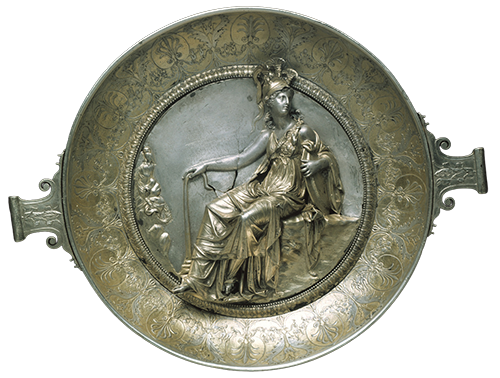
Roman emblem-bowl with a sitting Athena, 1st century CE, Altes Museum Berlin Misc. 3779, 1
The festivals of the wisdom goddess were quite famous and general in scope due to her patronage of both the ruler and the city state:
| Athena Ritual Days | Place | Description | Importance | Date Recorded |
|---|---|---|---|---|
| Great Panathenaia | Athens | Great Panathenaia | Contests, procession, peplos | Herodotus (5th century BCE) |
| Nikephoria | Pergamon | Athena Nikephoros | Royal festival of victory | Syll.*³ 629–630 (182 BCE) |
| Plynteria | Athens | Athena Polias Rite | Veiling and cleansing ancient image | Xenophon (4th century BCE) |
| Synoikia | Attica | Civic Festival | Theseus as unifier under Athena | Thucydides (5th century BCE) |
| Chalkeia | Athens | Worker Festival | Loom warp and worker celebration | Hypereides (4th century BCE) |
| Pamboiotia | Boeotia | Athena Itonia Festival | Contests | Polybius (2nd century BCE) |
Sources: Herodotus, Histories; Dittenberger, Sylloge Inscriptionum Graecarum, (1915); Welles, Royal Correspondence in the Hellenistic Period, (1934); Xenophon, Hellenica; Plutarch, Lives (Alcibiades); Thucydides, History of the Peloponnesian War; Harpocration, Lexicon; [Plutarch], Moralia; Polybius, Histories;16,28,32,56,57,58,59,60,61
XI. Athena as Judge
As she taught humanity how to use wisdom correctly, Athena is cited as a judge in certain literary episodes. The Eumenides of Aeschlyus shows her in this role quite vividly. where Athena founds a court for homicide on the Areopagus hill of Athens after the nobleman Orestes is interrogated over the omitted matricide of his mother, Clymenestra (herself perhaps punished for the murder of Agamemnon at her hands), and hounded by the Erinyes. This setting is also where Ares is said to have been bound by the gods, and it was used by Athenians to conduct important trials.62,63,64
Athena turns a confused mess into something amenable to the civic order. She summons citizen-jurors and oversees the legal procedure in clinical detail, voting herself for Orestes' acquittal and the presiding jury come to a tie, leading to the system she established acquitting him. After this, Orestes founds an altar to Athena Areia and the furious Erinyes become the Eumenides, supportive deities of counsel. The Semnai Theai (Eumenides-Erinyes) were associated with the Areopagus and the Athenian state.14,62
In Euripides' plays, Athena is represented as a goddess whose commitment to maintenance of the divine order is shown in her direct actions. In the Creusa, the mother and son Creusa and Ion have only narrowly avoided killing one another when Ion begins to doubt Creusa’s assertion that Apollo is his father. Athena then appears deus ex machina, explicitly saying that Apollo has sent her because he does not wish to appear personall.. She confirms that Apollo fathered Ion by Creusa, explains the concealment of Ion’s parentage, and declares that his arrangements actually saved mother and son from killing one another through mysterious mechansims.65
Athena then commands Creusa to take Ion to Athens and seat him upon the ancient royal throne because, as a descendant of Erechtheus, he possesses a legitimate claim to the land. She prophesies that his four sons will become eponyms of the old Ionian tribes and that their descendants will spread through the Cyclades and Asia, becoming the Ionians. Again, she averts any sacrilege, she creates elements of legitimacy and she attempts to convert all strains of chaos into an enforceable civic order that replicates civilization, such as when she appears in the Ion These representations of Athena deal with the abstract concept of truth in civilization, enforcing her philosophical role as appearing to guard order.65
XIII. The Urban Coronation
The name of Athena has a link to truth and the concept was taken rather literally, particularly in forming the civic identity of the Athenian people in their various government and legal systems. Her presence in Greek life on the lower levels, such as in various marble fragments, inscribed decree reliefs and stelai found across the Hellenistic world, show her crowning the honorand of a great work or winner of a contest in a way that was visible and permanent to the Greeks and Romans. This was part of the symbolic language of truth.2,66
Such images translated the written judgement of the Council and People into a permanent sacred image: the deserving individual was not merely named in stone but visibly received the approval of Athena herself. Some of her temples also showed the labors of Theseus or Heracles in their art work, such as the parallel metopes of the Hephaeisteion. At the archaic Temple of Athena at Assos, the sculptured architectural decoration included Heracles wrestling Triton and Heracles routing the centaurs at Mount Pholoe. In the Parthenon itself, the great chryselephantine Athena Parthenos carried a shield decorated externally with the Amazonomachy Thesaurus fought. Even in far away Etruria, her Etruscan counterpart Mnerva's shrine had a roof scene of Apollo confronting Heracles over the Cernynian Hind.14,67,68,69,70
XIV. The Ambiguity of the Owl
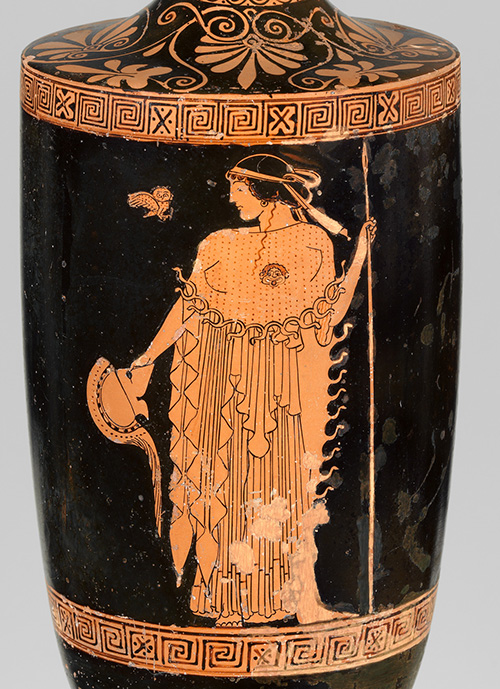
Athena mystified by little owl, terracotta lekythos (oil flask), ca. 490–480 BCE, attributed to Brygos Painter.
Perhaps Athena's most famous symbol is the little owl. The image of the bird was so ubiquitous in Athens that it was stamped on their currency, to the point Athenian coins were called glaukes (owls). These animals also now carry her name. Some of the earliest Greek vases also show her association with it. The simplest reason is that the quick-thinking animal was the patron of her city.1,24,42,71,72
The birds also occupied the Acropolis itself from time immemorial. Athena's general Homeric naming formula merges the bird into her identity. The second element is ōps (eye, face); the first, glauk-, is disputed, resting either on glaux, the owl, or on glaukos, a colour term for a pale, gleaming brightness with sea and metal within its color range, or perhaps both.73,74,75,76
Surviving references to why Athena is associated with these animals comes from Roman explanations, rather than Greek ones. Cornutus' handbook of Greek theology explains the flashing and rapidly moving eyes of snakes and owls are difficult to meet. Meeting their intimidating gaze is like the attainment of wisdom. Ovid explains through the lamenting crow of Athena, her original favored bird for its intelligence, that she was supplanted by the owl, an animal that Nyctimene of Lesbos, violated by her own father, was transformed into out of pity by Athena. As a result of shame, the animal only appears at night.49,77,78,79,80,81
Dio Chrysostom claimed the sculptor Pheidias associated Athena with the owl for civic reasons, prompting Aesop to compose a fable where he made the owl look wise. This is clearly a lie or exaggeration, however, as Aesop existed nearly a century before Pheidias' lifetime. The story of Aesop is perhaps a symbol of the owl's relationship to the goddess's wisdom, as the fable shows the wise owl advises the other birds to not allow the acorn to grow, to pluck up the flax, and to be wary of archers who would soon make arrows faster than birds by using their feathers. It is said the owl was mocked by the other birds and then, when it was known she was right, she only lamented forever.82,83
G.W.F Hegel and others contributed to the idea that the owl symbolized wisdom or intelligence in Minerva taking flight, an idea that has now crystallized in the public consciousness. This idea is perhaps somewhat simplistic, because the theme Athena is tied to in the heroic epics is wisdom as a matter of difficulty. The owl is not an exceptionally intelligent animal by bare nature, as Aristotle mockingly showed; it is an intimidating one with a sense of propriety which must use its senses to survive.84
Sources and Bibliography
- Burkert, Walter. Greek Religion: Archaic and Classical. Translated by John Raffan. Cambridge, MA: Harvard University Press, 1985.
- Plato. Cratylus. In Cratylus, Parmenides, Greater Hippias, Lesser Hippias, translated by Harold North Fowler. Loeb Classical Library 167. Cambridge, MA: Harvard University Press, 1926.
- García Ramón, José Luis. “Mycenaean Onomastics.” In A Companion to Linear B: Mycenaean Greek Texts and Their World, vol. 2, edited by Yves Duhoux and Anna Morpurgo Davies, 213–51. Louvain-la-Neuve: Peeters, 2011.
- Liddell, Henry George, and Robert Scott. A Greek-English Lexicon. Revised and augmented by Henry Stuart Jones and Roderick McKenzie. 9th ed. Oxford: Clarendon Press, 1940.
- Inscriptiones Graecae. Vol. 1, 3rd ed. (IG I³), edited by David Lewis and Lilian Jeffery. Berlin: Walter de Gruyter, 1981–98. IG I³ 527. Consulted via PHI Greek Inscriptions, Packard Humanities Institute.
- Umholtz, Gretchen. “Architraval Arrogance? Dedicatory Inscriptions in Greek Architecture of the Classical Period.” Hesperia 71, no. 3 (2002): 261–93.
- Di Bella, Fabiano Fiorello. “L’officina di Endoios e Philergos.” Thiasos 12 (2023): 235–63.
- Delatte, Armand L. “Études sur la magie grecque: I. Sphère magique du Musée d’Athènes.” Bulletin de Correspondance Hellénique 37 (1913): 247–78.
- Homer. The Iliad. Translated by A. T. Murray. Revised by William F. Wyatt. 2 vols. Loeb Classical Library 170–71. Cambridge, MA: Harvard University Press, 1999.
- Homer. The Odyssey. Translated by A. T. Murray. Revised by George E. Dimock. 2 vols. Loeb Classical Library 104–5. Cambridge, MA: Harvard University Press, 1995.
- Homeric Hymns. In Hesiod, the Homeric Hymns and Homerica, translated by Hugh G. Evelyn-White. Loeb Classical Library 57. Cambridge, MA: Harvard University Press, 1914.
- Hesiod. Theogony. In Hesiod, the Homeric Hymns and Homerica, translated by Hugh G. Evelyn-White. Loeb Classical Library 57. Cambridge, MA: Harvard University Press, 1914.
- Apollodorus. The Library. Translated by Sir James George Frazer. 2 vols. Loeb Classical Library 121–22. Cambridge, MA: Harvard University Press, 1921.
- Pausanias. Description of Greece. Translated by W. H. S. Jones, H. A. Ormerod, and R. E. Wycherley. 5 vols. Loeb Classical Library. Cambridge, MA: Harvard University Press, 1918–35.
- Lambert, Stephen, Josine Blok, and Robin Osborne, trans. “Decree about Priestess and Temple of Athena Nike (AIO 314).” In Attic Inscriptions Online, edited by Stephen D. Lambert. Accessed August 17, 2026. https://www.atticinscriptions.com/inscription/BlokAthenaNike/1.
- Harpocration, Valerius. Lexicon in decem oratores Atticos. Edited by Wilhelm Dindorf. 2 vols. Oxford: Oxford University Press, 1853.
- O’Brien, Susan. “The Sword Is a Ploughshare? Interpreting the Armed Woman in Late Bronze Age Aegean Art.” Annual of the British School at Athens 119 (2024): 1–34.
- Boloti, Tina. “do-ra pe-re: The Ritual Processions of the Aegean 2nd Millennium B.C. Re-visited.” In Gesture, Stance, and Movement: Communicating Bodies in the Aegean Bronze Age, edited by Ute Günkel-Maschek et al., 307–13. Heidelberg: Propylaeum, 2024.
- Tüner Önen, Nihal, and Fatih Yılmaz. “A New Athena Polias Votive Inscription from the Phaselis’ Acropolis.” Adalya 18 (2015): 121–36.
- Guthrie, W. K. C. “Early Greek Religion in the Light of the Decipherment of Linear B.” Bulletin of the Institute of Classical Studies 6, no. 1 (1959): 35–46.
- Fitzwilliam Museum. “Athena or Minerva.” Cambridge: Fitzwilliam Museum, University of Cambridge. Accessed August 17, 2026.
- Augustine. The City of God. Translated by Marcus Dods. 2 vols. Edinburgh: T. & T. Clark, 1871.
- Patay-Horváth, András. “The Contest between Athena and Poseidon: Myth, History and Art.” Historika 5 (2015): 353–62.
- Plutarch. “Themistocles.” In Lives, Volume II: Themistocles and Camillus. Aristides and Cato Major. Cimon and Lucullus, translated by Bernadotte Perrin. Loeb Classical Library 47. Cambridge, MA: Harvard University Press, 1914.
- Encyclopaedia Britannica. S.v. “Palladium.” Accessed August 17, 2026.
- Valdés Guía, Miriam. “Pallas and a Female Pyrrhic Dance for Athena in Attica.” Mnemosyne 74, no. 6 (2021): 913–34.
- Papachatzis, Nicolaos. “The Cult of Erechtheus and Athena on the Acropolis of Athens.” Kernos 2 (1989): 175–85.
- Xenophon. Hellenica. Translated by Carleton L. Brownson. 2 vols. Loeb Classical Library 88–89. Cambridge, MA: Harvard University Press, 1918–21.
- Lewis, David M., John Boardman, J. K. Davies, and M. Ostwald, eds. The Cambridge Ancient History. Vol. 5, The Fifth Century B.C. 2nd ed. Cambridge: Cambridge University Press, 1992.
- Smith, William, ed. A Dictionary of Greek and Roman Antiquities. London: John Murray, 1875. S.v. “Chalceia.”
- Acropolis Museum. “The Erechtheion.” Athens: Acropolis Museum. Accessed August 17, 2026.
- Herodotus. Histories. Translated by A. D. Godley. 4 vols. Loeb Classical Library 117–20. Cambridge, MA: Harvard University Press, 1920–25.
- Encyclopaedia Britannica. S.v. “Parthenon.” Last modified March 25, 2026. Accessed August 17, 2026.
- Plutarch. “Pericles.” In Lives, Volume III: Pericles and Fabius Maximus. Nicias and Crassus, translated by Bernadotte Perrin. Loeb Classical Library 65. Cambridge, MA: Harvard University Press, 1916.
- Pindar. Olympian Odes. Pythian Odes. Edited and translated by William H. Race. Loeb Classical Library 56. Cambridge, MA: Harvard University Press, 1997; and Nemean Odes. Isthmian Odes. Fragments. Loeb Classical Library 485. Cambridge, MA: Harvard University Press, 1997.
- Strabo. Geography. Translated by Horace Leonard Jones. 8 vols. Loeb Classical Library. Cambridge, MA: Harvard University Press, 1917–32.
- Higbie, Carolyn. The Lindian Chronicle and the Greek Creation of Their Past. Oxford: Oxford University Press, 2003.
- Warwick Department of Classics. “Sanctuary of Athena Lindia, Rhodes.” Greek Religion Database, April 30, 2015. Accessed August 17, 2026.
- Callaghan, Gregory J. “Lindian Chronicle Connections: Contrasting Rhodian Networks Real and Imagined.” Journal of Historical Network Research 7 (2022): 155–80.
- Agelidis, Soi. “Vom Palladion zur Nikephoros.” Istanbuler Mitteilungen 64 (2014): 75–135.
- Mark, Joshua J. “Library of Pergamon.” World History Encyclopedia, September 14, 2022. Accessed August 17, 2026.
- Deacy, Susan. Athena. Gods and Heroes of the Ancient World. London: Routledge, 2008.
- Encyclopaedia Britannica. S.v. “Perseus.” Last modified June 10, 2026. Accessed August 17, 2026.
- Ch’ien, Letha. “Jacopo Sansovino, Loggetta, Piazza San Marco, Venice.” Smarthistory. Accessed August 17, 2026.
- Ovide moralisé. Attributed to Chrétien Legouais. Rouen, Bibliothèque municipale, MS O.4 (1044). Parchment manuscript, 432 fols. France, ca. 1325.
- Bihl, Laurent. “Typology and Iconographic Polysemy of Marianne between the Nineteenth and Twenty-First Centuries.” In National Symbols, Fractured Identities: Contesting the National Narrative, edited by Michael E. Geisler, 173–95. New York: Palgrave Macmillan, 2005.
- Jeffery, L. H. “The Boustrophedon Sacral Inscriptions from the Agora.” Hesperia 17, no. 2 (1948): 86–111.
- Liddell, Henry George, and Robert Scott. An Intermediate Greek-English Lexicon. Oxford: Clarendon Press, 1889.
- Cornutus, Lucius Annaeus. Greek Theology, Fragments, and Testimonia. Edited and translated by George Boys-Stones. Writings from the Greco-Roman World 42. Atlanta: SBL Press, 2018.
- Marinus. Proclus, or On Happiness. Translated by Mark Edwards. Liverpool: Liverpool University Press, 2000.
- Plato. Timaeus. In Plato, vol. 9, translated by R. G. Bury. Loeb Classical Library 234. Cambridge, MA: Harvard University Press, 1929.
- Proclus. Commentary on Plato’s Timaeus. Translated by Harold Tarrant et al. 6 vols. Cambridge: Cambridge University Press, 2007–17.
- Proclus. “Hymn to Athena, or Minerva.” Translated by Thomas Taylor. In The Hymns of Orpheus, 211–14. London: Printed for the Author, 1792.
- van den Berg, R. M. Proclus’ Hymns: Essays, Translations, Commentary. Philosophia Antiqua 90. Leiden: Brill, 2001.
- Sallustius. Concerning the Gods and the Universe. Edited and translated by Arthur Darby Nock. Cambridge: Cambridge University Press, 1926.
- Dittenberger, Wilhelm, ed. Sylloge Inscriptionum Graecarum. 3rd ed. Vol. 2. Leipzig: S. Hirzel, 1915.
- Plutarch. “Alcibiades.” In Lives, Volume IV: Alcibiades and Coriolanus; Lysander and Sulla, translated by Bernadotte Perrin. Loeb Classical Library 80. Cambridge, MA: Harvard University Press, 1916.
- [Plutarch]. Moralia, Volume X. Translated by Harold North Fowler. Loeb Classical Library 321. Cambridge, MA: Harvard University Press, 1936.
- Polybius. The Histories. Translated by W. R. Paton. 6 vols. Loeb Classical Library. Cambridge, MA: Harvard University Press, 1922–27.
- Thucydides. History of the Peloponnesian War, Volume I: Books 1–2. Translated by Charles Forster Smith. Loeb Classical Library 108. Cambridge, MA: Harvard University Press, 1919.
- Welles, C. Bradford. Royal Correspondence in the Hellenistic Period: A Study in Greek Epigraphy. New Haven, CT: Yale University Press, 1934.
- Aeschylus. Oresteia: Agamemnon, Libation-Bearers, Eumenides. Edited and translated by Alan H. Sommerstein. Loeb Classical Library 146. Cambridge, MA: Harvard University Press, 2009.
- Aristotle. The Athenian Constitution. In Aristotle, Volume XX: The Athenian Constitution; The Eudemian Ethics; On Virtues and Vices, translated by H. Rackham. Loeb Classical Library 285. Cambridge, MA: Harvard University Press, 1935.
- Demosthenes. Orations, Volume III: Orations 21–26. Translated by J. H. Vince. Loeb Classical Library 299. Cambridge, MA: Harvard University Press, 1935.
- Euripides. Trojan Women; Iphigenia among the Taurians; Ion. Edited and translated by David Kovacs. Loeb Classical Library 10. Cambridge, MA: Harvard University Press, 1999.
- Lawton, Carol L. Attic Document Reliefs: Art and Politics in Ancient Athens. Oxford: Clarendon Press, 1995.
- Museo Nazionale Etrusco di Villa Giulia. “Apollo of Veii.” Rome: Museo Nazionale Etrusco di Villa Giulia. Accessed August 17, 2026.
- Palagia, Olga. “Archaism and the Quest for Immortality in Attic Sculpture during the Peloponnesian War.” In Art in Athens during the Peloponnesian War, edited by Olga Palagia, 24–51. Cambridge: Cambridge University Press, 2009.
- Stewart, Andrew. “Cultural and Technological Evolution on the Metopes of the Hephaisteion.” In From Hippias to Kallias: Greek Art in Athens and Beyond, 527–449 BC, edited by Olga Palagia and Elisavet P. Sioumpara. Athens: Acropolis Museum, 2019.
- Wescoat, Bonna Daix. The Temple of Athena at Assos. Oxford Monographs on Classical Archaeology. Oxford: Oxford University Press, 2012.
- Kraay, Colin M. Archaic and Classical Greek Coins. London: Methuen, 1976.
- Diodorus Siculus. Library of History, Volume X: Books 19.66–20. Translated by Russel M. Geer. Loeb Classical Library 390. Cambridge, MA: Harvard University Press, 1954.
- Thompson, D’Arcy Wentworth. A Glossary of Greek Birds. 2nd ed. Oxford: Clarendon Press, 1936.
- Deacy, Susan, and Alexandra Villing. “What Was the Colour of Athena’s Aegis?” Journal of Hellenic Studies 129 (2009): 111–29.
- Nilsson, Martin P. The Minoan-Mycenaean Religion and Its Survival in Greek Religion. 2nd rev. ed. Lund: C. W. K. Gleerup, 1950.
- Arnott, W. Geoffrey. Birds in the Ancient World from A to Z. London: Routledge, 2007.
- Ovid. Metamorphoses, Volume I: Books 1–8. Translated by Frank Justus Miller. Revised by G. P. Goold. Loeb Classical Library 42. Cambridge, MA: Harvard University Press, 1977.
- Hyginus. The Myths of Hyginus. Translated and edited by Mary Grant. University of Kansas Publications in Humanistic Studies 34. Lawrence: University of Kansas Press, 1960.
- Pliny the Elder. Natural History, Volume III: Books 8–11. Translated by H. Rackham. Loeb Classical Library 353. Cambridge, MA: Harvard University Press, 1940.
- Ovid. Fasti. Translated by James G. Frazer. Revised by G. P. Goold. Loeb Classical Library 253. Cambridge, MA: Harvard University Press, 1989.
- Virgil. Aeneid: Books 1–6. In Eclogues; Georgics; Aeneid: Books 1–6, translated by H. Rushton Fairclough, revised by G. P. Goold. Loeb Classical Library 63. Cambridge, MA: Harvard University Press, 1999.
- Aesop. Aesop’s Fables. Translated by Laura Gibbs. Oxford World’s Classics. Oxford: Oxford University Press, 2002.
- Aristophanes. Birds. In Birds; Lysistrata; Women at the Thesmophoria, edited and translated by Jeffrey Henderson. Loeb Classical Library 179. Cambridge, MA: Harvard University Press, 2000.
- Detienne, Marcel, and Jean-Pierre Vernant. Cunning Intelligence in Greek Culture and Society. Translated by Janet Lloyd. Chicago: University of Chicago Press, 1991.