




| Language or Culture | Name | Note |
|---|---|---|
| Etruscan | 𐌿𐌽𐌼 (Menrva) | Votives from Portonaccio (sixth century BCE) |
| Latin, Faliscan | Menerva | Objects from late fourth century BCE |
17 min read
MENRVA
author: High Priest Zevios Metathronos
co-author: Novice Priest Karnonnos
I. The Name
The Etruscan goddess Menrva was the goddess of war and intelligence of the Etruscan people. She was accepted by the Romans as their Minerva in the time to come after the advent of Etruscan civilization. However, unlike Athena, Menrva is associated with the thunderstorm and has a connection to the elements. Her name is Italic and probably predates Greek influence on her cult.
The name of Menrva has been recorded in various ways throughout the inscriptions. These include menrva, menerva and menrfa. While there is debate about whether the Etruscan form of Menrva was taken from an early Latin Menerwā, or if it originated with the Etruscan peoples themselves, there is consensus that Menrva is seen in written transcription before any surviving Italic form. Therefore, while it is unclear whether Menrva ultimately comes from Etruria or elsewhere, it is evident that Menrva first appears in written form in Etrusca.1
The First Attestation
The goddess appears in written history during the sixth century BCE, primarily at one site. This site is the Portonaccio, a suburban sanctuary located outside of the walls of the major city of Veii. The Portonaccio is well-known for yielding the earliest and greatest number of archaic votive inscriptions known from all of Etruria, including some 80 fragments, in large part incomplete, found in the zone surrounding the altar where Menrva was the presiding deity.
Most of these inscriptions were created using the archaic Veian alphabet and exhibit enough similarities to suggest that there existed a school of scribes directly affiliated with the Portonaccio. Many of the inscribed items were ceramics; however, many were large bucchero wine jugs produced locally and containing wine, which formed part of the offerings. There is almost always present on these early votives, the name of the person making the dedication, whereas the name of the goddess is rarely included; therefore, the Portonaccio provides our initial understanding of Menrva through those individuals who made offerings at her sanctuary.2
In terms of dating the first use of her name, one item may serve to represent all of the Portonaccio votives. One such example is a bucchero chalice, which is now missing its bowl-shaped top and contains only the cylindrical base with an inscription reading: mini muluvanice avile vipiienas - "Aulus Vibenna gave me" - and datable to either the second quarter or mid-sixth century BCE. The donor of this item was an Etruscan nobleman from Vulci. His gift of this vessel to a sanctuary away from his own city represents a measure of how widely Menrva's temple at Veii had attracted members of Etruria's nobility by the sixth century BCE. This item is one of the earliest certainly dated votives from Menrva's Veian temple and establishes her cult at Veii firmly in the Archaic period.2
The name of Menrva herself appears on securely dated artifacts slightly later in the same century at another sacred area. Located along the coast near Santa Marinella, Punta della Vipera yielded three fragmentary vessels bearing her name: the earliest of which is a piece of bucchero dating to approximately the end of the sixth century BCE, and the last item can be dated to approximately the third century BCE.. As such, these are among the earliest examples bearing Menrva's name and not simply recording names of individuals who offered sacrifices to her.3
Sources: the Bonfantes for the name, its forms, and the men- root; Colonna for the Portonaccio votive deposit, the archaic inscriptions around the altar of Menerva, and the chalice of Aulus Vibenna; Comella for the vases inscribed to Menrva at Punta della Vipera.1,2,3
II. The Goddess and Her Domains
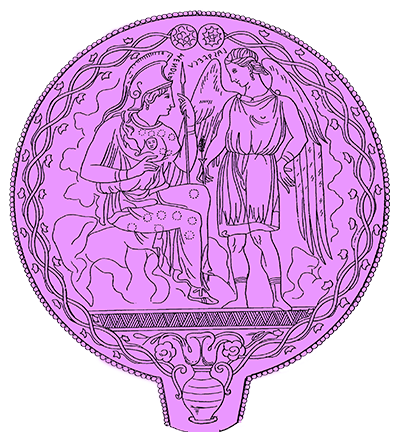
Etruscan bronze mirror with Menrva and Lasa Vecu, Museo Nazionale Etrusco di Villa Giulia, Rome, 300–275 BCE
Menrva retains Athena's familiar characteristics. She was more emphatically a patroness of both weavers and artisans whose weights for looms have appeared in offerings to her since at least pre-historic times when such loom-weights were used by Villanovans. Up until this point she shares identical portfolio with Athena..4
One unique aspect appears to be that Menrva is a goddess of the weather and lightning and one of the deities of the Etruscan "sky doctrine" (the study of the heavenly realm), and therefore capable of throwing a thunderbolt. The Romans preserved the Etruscan belief that there were fewer than ten gods besides Tinia who were capable of throwing the bolt, and Menrva was one of these.
As a goddess of healing and of the protection of birth, Menrva was also a kourotrophos or nurse to the young in a way that seems to be more pronounced than in what we know of Greece, where her role in nurturing seems to be transitional. People suffering from illness and women in childbirth possibly brought model representations of the affected parts of the body to the goddess for relief. This maternal-healing aspect, so different from the virgin Athena, has been present in her since the beginning. Alongside Tinia and Uni, she was part of the Etruscan triumvirate of deities known collectively as "the Three Great Gods," which eventually became the Roman Jupiter, Juno, and Minerva of the Capitol.5,6
In some cases on the mirrors she appears beside Hercle. Together with him, they can be seen as caretakers of Epiur, the winged child. Above all else, however, she is a protector. She is a god who protects and stands behind the hero during his time of trial, and this protective function is just as common in most depictions of her in Etruscan art as it is elsewhere.4
III. Her Attributes
The table gathers Menrva's domains and attributes with the basis of each.
| Attribute or Role | Sense | Basis in the Evidence |
|---|---|---|
| Helmet, spear, aegis | The armed war-goddess, in the manner of Athena | Her standard iconography on mirrors, statues, and terracottas |
| Goddess of wisdom and craft | Patron of weaving and the skilled arts | The loom-weights and craft-tools among her votives |
| Goddess of the thunderbolt | A hurler of lightning, a power of the weather | The Etruscan lightning-doctrine reported by the Roman writers; her thunderbolt in art |
| Healer and nurse of the young | A kourotrophic and healing goddess, protector of birth | The anatomical votives at her sanctuaries |
| Protector of the city and the hero | Guardian of Veii and defender of Hercle and Pherse | The extramural sanctuary at Veii; the mirror-scenes of protection |
| Member of the great triad | Worshipped with Tinia and Uni as the chief gods | The triad that passed into Rome as the Capitoline three |
Sources: de Grummond for the iconography, the guardian role, and the family; Simon for the triad; Pliny for the lightning-doctrine; Comella for the healing and craft votives.3,4,5,6
IV. The Sanctuary at Portonaccio and the Temples of Menrva
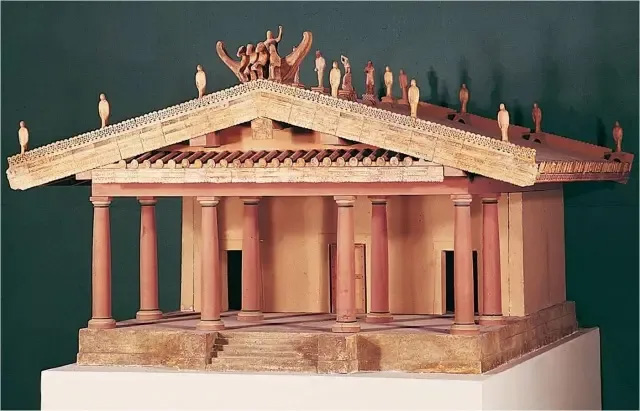
Model of Temple of Menrva, Veii, master sculptor Vulca. c. 510-500 BCE. Original temple of wood, mudbrick, or tufa (volcanic rock)
Menrva is one of the few Etruscan gods whose temple is attested and visible, and the sanctuary that was hers is among the most important religious sites of all Etruria. To understand it is to understand two things at once: the peculiar form of the Etruscan temple, and the reasons a great sanctuary outside the walls of Veii belonged to this goddess above the others.
The Etruscan Temple
The Etruscan temple is a building of a different temperament from the Greek temple and is directly related to the Roman development. Their proportions and design are described by Vitruvius (the Roman architect) in his De Architectura. He describes the general layout of how these existed. In addition, archeological evidence from many surviving Etruscan temples confirm Vitruvius's descriptions faithfully. Notably, to start with, the temple would sit atop a raised foundation of stone or tufa that elevates it above grade and adds prominence to it.
Unlike the Greek temple that rests on a stepped platform, a Tuscan temple is approximately square in footprint, slightly longer than it is wide, in a ratio given by Vitruvius as roughly 5:6. Unlike the long, rectangular footprint of the Greek temple, the temple is very solidly frontal. One would approach it using a single flight of stairs at the front. There is no secondary staircase or passageway to access either side. Once inside, one enters into a deep porch where the exterior of the temple is surrounded by columns. These columns belong to the Etruscan order. They have plain, unfluted shafts and sit atop bases. Their capitals resemble those of the Greek Doric order but are closer to each other. Because these columns were likely made of wood and carried a wooden architrave (lintel), they were spaced farther apart than Greek columns.7
Behind the porch is the cella, and commonly (such as at Veii) the cella is divided into three parallel rooms, a triple cella designed to house more than one god. All of the construction above the raised foundation of stone or tufa was constructed of lightweight materials such as timbers and mud bricks. This is why there is relatively little remaining of it compared to Greek temples which were constructed from durable stone.
The roof of a Tuscan temple was generally flat and covered in terracotta tiles. The edges of the roof extended far beyond the walls of the cella and hung down to protect the fragile walls from water damage. Although they were less permanent than their stone counterparts, Etruscan temples made up for this lack of durability through the use of vibrant and beautiful terracotta decorations. These types of elaborate decorations adorned the eaves of the roof and extended downward over the entire facade of the temple creating an ornate display. Some temples also included decorative tiles called antefixes in the shapes of gorgons, maenads and so on, while others featured revetment plaques, and some even displayed life-sized statues of their gods positioned along the ridge line of their rooftops, a feature of Menrva's temple. 7,8
The Sanctuary at Portonaccio
The temple at Portonaccio, Veii is most typical type of temple and the best studied. It stands outside the city walls on a terrace, on an almost square podium of tufa blocks measuring close to eighteen and a half meters on a side, with a stepped entrance at the front, a deep columned porch, a side entrance, and a three-part cella. It is approached by a flight of steps leading to a wide entrance hall at the front. Behind this is a narrow corridor flanked by columns and a side door. Inside there are two interior rooms, the first being a small chamber to the right of the entrance which is connected to the main room, while there is a large altar in front of the temple and nearby a very large rectangular stone fountain used for ritual purposes. The whole complex was designed like most Etruscan sanctuaries, to be used both inside and outside. When the temple was demolished, much of its sculpture and artifacts were collected together and placed in a votive deposit, where they remain today. In 1916, archaeologists found one major piece in fragments when they excavated these.2,8
That major artifact was part of the roof decoration of the temple at Portonaccio. Along the ridge of the Portonaccio temple was a row of over life-size painted terracotta figures. These were created by the workshop of Vulca of Veii, the only Etruscan artist known by name to have existed. They depicted a myth of Hercules: the contest of Aplu and Hercle over the golden horned hind. Depicted atop the roof was Aplu advancing towards Hercle, Hercle standing facing Aplu, Letun holding the infant Aplu, and Turms watching. Only one figure remains facially intact today, the advancing Apollo of Veii in the Villa Giulia, and it is regarded as the finest surviving example of Etruscan art. Menrva was also depicted in these decorations since a terracotta image of the goddess formed part of the acroterial figures on top of her temple.8
Why the Temple Is Hers
The uncertainty regarding the dedication of the Portonaccio temple was important. As soon as the large terracottas emerged from the earth, along with Apulu, the excavators assumed that the sanctuary was consecrated to Apollo. However, after they had collected the votive deposit and especially the inscriptions surrounding the altar, the names of the early archaic dedications indicated that Menerva was the chief deity of the sanctuary, while the god located on top of it is just another part of it.2
There is an excellent explanation why Menrva would have control over this sanctuary outside of the walls of Veii. Menrva was probably situated protecting the city much like the Athena Polias protected Athens and other states. There is also her shrine at the gate of Veii. From there, she oversees all travel going into and coming out of the city. Travelers could stop at her sanctuary and receive rest or asylum, following on from the example of Tegea and others. The sanctuary functioned as a place for travelers to seek guidance and make decisions by means of an oracle. Hypothetically, it was also a venue for rituals related to the transition of youth into adulthood (rites of passage). Thus, the Goddess of Wisdomwas present both when traveling strangers entered Veii, and when the youth of Veii became adults. 9
The Other Sanctuaries of Menrva
Portonaccio was the largest and most prominent of her temples, however, it was not alone. At Punta della Vipera on the coast, near Santa Marinella and along what used to be the border between Caere and Tarquinia (a border that did not exist during my time), was a rural sanctuary built between approximately 540 BCE-520 BCE. That sanctuary was also consecrated to Menrva. The votive deposit is relatively small in comparison to Portonaccio, but it still provides a wealth of information regarding her divine characteristics.
The evidence of Menrva provided through pottery that bear her name. An oracular disc-shaped lead lot (one of the earliest known) that demonstrates the cult associated with her as being oracular, while anatomical votives of body parts that represent her ability to protect and heal new life, and loom weights found there demonstrate her support for artisans. An extremely long (and unclear) inscription on a lead sheet that is buried in a well at the base of the sanctuary dated circa 500 BCE may preserve the text of an example of an oracular lot. 3,10
Menrva’s cult existed beyond these two locations. Within Veii itself, she had a second temple at Campetti inside the city. Later arcaeological finds confirmed this. The aspects of her character demonstrated at Punta della Vipera occur again at other temples devoted to her throughout Latium and Rome. These include Lavinium and Minerva Medica (the latter which the Romans referred to as such), and it was as a member of a triad (Tinia, Uni, Menrva) that would arrive in Rome for her to assume her position with Jupiter and Juno on Capitol Hill as the Etruscan goddess of intellect. 5,10
V. The Birth from the Head of Tinia
The mythology surrounding the origin of Menrva is depicted on many Etruscan engraved mirrors. In these depictions, she springs from the top of the head of the sky god Tinia, armed. At her side stands the blacksmith Sethlans, holding the axe which had been used to create the opening in Tinia's skull. This subject is covered at length on this website’s webpage dedicated to Sethlans, as seen from his perspective. From Menrva’s perspective, however, it is noteworthy that the Etruscan artists both toned down and anthropomorphized the depiction of this event.4
Whereas the birth of Athena depicts a scene of divine power which is witnessed by inactive bystanders or the concern of Hera, the Etruscan myths depict the birth process being actively facilitated by three female birth deities named Thanr, Thalna, and Ethausva, who are assisting the laboring Tinia and reaching upward to assist in the delivery of Menrva. She enters into the world confidently but non-threateningly, assisted in her birth by nurse-midwives.4
VI. Menrva on the Mirror
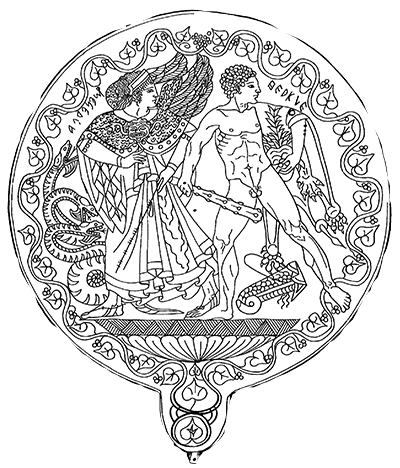
Etruscan mirror with winged Menrva and Hercle, 450-425BCE, British Museum
Menrva is the protector of Hercle, raising him to be a god and accompanying him during his twelve labors. Additionally, she protects Pherse (the Etruscan version of Perseus), helping him fight against Medusa. One mirror from Praeneste depicts her attending Pherse while he confers with the Graeae hags, while another mirror depicts her alongside Perseus and Turms looking calmly upon the severed head of Medusa in a pool beneath their feet. Her presence is felt within the Etruscan Judgment of Paris, where the judge is called Elcsntre (Paris), standing along-side Turan and Uni while judging the prince-shepherd. Additionally, Menrva exists in the realm of prophecy favored by the mirrors and is often found amongst prophets and soothsayers.4
Her unique, alien quality that has no Greek counterpart is perhaps best shown by two specific scenes. In one reflection, Menrva submerges a small child called Maris in a large container, which is an act of immersion apparently concerned with providing or restoring life, an image of the goddess as a patroness of birth. In a painted terracotta relief from a temple pediment at Pyrgi (circa 470-460 BCE), the goddess appears at the tragic point during the story of the Seven Against Thebes where the hero Tydeus eats the cranium of his dead foe. At this point the protector shows her other side; she is the grantor of immortality and may deny its gift. The scene is arguably one of the greatest works of Etruscan religious art.4
Sources and Bibliography
- Bonfante, Giuliano, and Larissa Bonfante. The Etruscan Language: An Introduction. Rev. ed. Manchester: Manchester University Press, 2002. Cited for the forms of the name (menrva, menerva, menrfa), its native Italic character and derivation from the Indo-European root men- ("mind"), the debated relation of the Etruscan and Latin forms, and the fact that the Etruscan transcriptions are attested earlier than any surviving Italic form.
- Colonna, Giovanni. "Il santuario di Portonaccio a Veio." Monumenti Antichi, Serie Miscellanea. Rome: Accademia Nazionale dei Lincei. Cited for the Portonaccio sanctuary and its votive deposit, the archaic votive inscriptions concentrated around the altar of Menerva, the bucchero chalice dedicated by Aulus Vibenna (mini muluvanice avile vipiienas) of the mid-sixth century BCE, the identification of Menerva rather than Apollo as the presiding deity, and the plan and altar of the temple. Volume and year to be verified by the author.
- Comella, Annamaria. Il santuario di Punta della Vipera (Santa Marinella, Comune di Civitavecchia). I: I materiali votivi. Corpus delle Stipi Votive in Italia XIII; Archaeologica 131. Rome: Giorgio Bretschneider, 2001. Cited for the sanctuary of Menrva at Punta della Vipera: the three fragmentary vases inscribed to Menrva (from late-sixth-century bucchero to a third-century amphora), the disc-shaped lead lot and the oracular character of the cult, the anatomical votives attesting healing and kourotrophic powers, and the loom-weights attesting patronage of craft in a tradition of Villanovan roots.
- de Grummond, Nancy Thomson. Etruscan Myth, Sacred History, and Legend. Philadelphia: University of Pennsylvania Museum of Archaeology and Anthropology, 2006. Cited for Menrva's iconography and domains, her role as protector of Hercle and of Pherse (Perseus), her pairing with Hercle and the foster-child Epiur, the birth from the head of Tinia with the midwife-goddesses Thanr, Thalna, and Ethausva, the immersion of Maris, the Judgement of Paris (Elcsntre), and the Pyrgi pediment of the Seven against Thebes with Menrva and Tydeus.
- Simon, Erika. "Gods in Harmony: The Etruscan Pantheon." In The Religion of the Etruscans, edited by Nancy Thomson de Grummond and Erika Simon, 45–65. Austin: University of Texas Press, 2006. Cited for Menrva's place in the supreme triad of Tinia, Uni, and Menrva, the passage of that triad into Rome as the Capitoline Jupiter, Juno, and Minerva, and her standing among the great gods of the pantheon.
- Pliny the Elder. Natural History. Translated by H. Rackham. Loeb Classical Library 330. Cambridge, MA: Harvard University Press, 1938. Cited: 2.138–139, for the Etruscan doctrine of the gods empowered to hurl the thunderbolt, the framework within which Menrva is counted among the lightning-throwing deities, a power the Greeks did not grant Athena.
- Vitruvius. On Architecture. Translated by Frank Granger. 2 vols. Loeb Classical Library 251, 280. Cambridge, MA: Harvard University Press, 1931–34. Cited: 4.7.1–5, for the canon of the Tuscan temple, its nearly square plan in the proportion of five to six, its high podium and single frontal stair, its deep porch and widely spaced Tuscan columns with smooth shafts and bases, and its cella divided for more than one god.
- Carlucci, Claudia. "Veio, Portonaccio." In Etruschi: Le antiche metropoli del Lazio, edited by Mario Torelli and Anna Maria Moretti Sgubini. Verona: Mondadori Electa, 2008. Cited for the Portonaccio temple of about 510 BCE, its terracotta roof decoration, the over-life-size acroterial group of the workshop of Vulca enacting the contest of Aplu and Hercle over the hind (with Letun and Turms), the striding Apollo of Veii recovered from the votive deposit in 1916, and the figure of Menrva among the roof statues.
- Edlund-Berry, Ingrid E. M. The Gods and the Place: Location and Function of Sanctuaries in the Countryside of Etruria and Magna Graecia (700–400 B.C.). Skrifter utgivna av Svenska Institutet i Rom, 4°, 43. Stockholm: Svenska Institutet i Rom, 1987. Cited for the interpretation of the extramural sanctuary of Menerva at Portonaccio as a shrine of the city-protecting goddess, controlling the traffic in and out of Veii, offering rest and refreshment to travelers, and serving as a place of oracle and of the rites of passage of the young.
- Stoddart, Simon K. F. Historical Dictionary of the Etruscans. Historical Dictionaries of Ancient Civilizations and Historical Eras. Lanham, MD: Scarecrow Press, 2009. Cited for the sanctuary of Menrva at Punta della Vipera as a rural shrine on the boundary of Caere and Tarquinia built between about 540 and 520 BCE, its long archaic inscription and its anatomical votives indicating a healing cult, and for the wider distribution of Menrva's cult and the sanctuaries of the goddess.