





| Language | Name of Minerva | Attestation |
|---|---|---|
| Latin | Minerva (archaic Menerva) | Portonaccio dedication, Veii: CIL I² 2909 (late 4th–early 3rd c. BCE) |
| Etruscan | Menrva (Menerva) | Attested from the 6th century BCE |
| Faliscan | menerua (Minervai) | Diespater stamnos CIL I² 454 (c. 380–360 BCE); CIL I² 364–365 |
| Paelignian | minerua | Italic dialect forms (rhotacism -sw- > -rw-) |
| Oscan | menere | Italic dialect forms |
| Proto-Italic | *menezwo- | Comparative reconstruction |
| Proto-Indo-European | *menes-weh₂ (from *ménos) | Comparative reconstruction |
38 min read
MINERVA
author: High Priest Zevios Metathronos
co-author: Novice Priest Karnonnos
I. Etymology
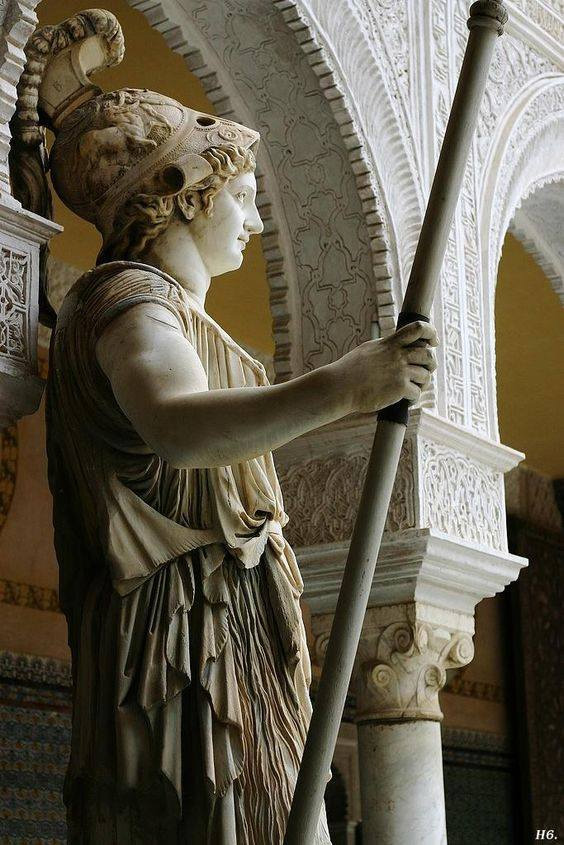
Roman marble statue of Pallas Athena, 2nd century CE, Casa de Pilatos, Seville
The name "Minerva" has long been the subject of scholarly debate, with competing theories tracing its origins to Proto-Italic, Proto-Indo-European (PIE), and Etruscan sources. The most widely cited etymology derives Minerva from Proto-Italic *menezwo-, itself possibly from Proto-Indo-European *ménos, meaning "thought" or "mind".1
Several scholars have advanced the PIE derivative *menes-weh₂ ("provided with a mind, intelligent") as a transitional form, connecting Minerva to a broader semantic field of intellect and mental prowess, supported by cognates such as Vedic mánas-, Avestan manah-, and Greek μένος, all relating to mind or spirit.
Another hypothesis connects the term with a possible PIE term *méh₁nos- ("moon"). Alternatively, the name of the goddess may not derive from Indo-European, instead borrowing from Etruscan, itself considered a distinctly Paleo-European language.2
Italic & Etruscan Contexts
The name Minerva appears in various Italic languages, including Faliscan (menerua), Paelignian (minerua), and Oscan (menere), with some scholars suggesting that the rhotacism (the change of -sw- to -rw-) in these forms may indicate borrowing from Latin or another Italic dialect.3
The Etruscan form of the name, Menrva (or Menerva), is attested from the 6th century BCE and may itself be a borrowing from Old Latin *Menerwā, or vice versa.4
The earliest surviving Latin-language example of the theonym Minerva appears to be the dedication from the Portonaccio sanctuary at Veii, probably after Rome conquered it from the Etruscans: CIL I² 2909 = ILLRP 237. It was scratched onto a small miniature jug (olpetta) and reads L. Tolonio(s) ded(et) Menerva, dated between the end of the fourth and the first half of the third century BCE.5,6
The earliest example in the related language Faliscan is a red-figure stamnos of the Diespater Painter, CIL I² 454, conventionally dated to around 380–360 BCE. The Faliscan form is further attested in the community dedication CIL I² 364, [D]iovei, Iunonei, Minervai / Falesce quei in Sardinia sunt, and in CIL I² 365, both illustrating the cult of the Capitoline deities among the Faliscans.7,8,9
Sources: Corpus Inscriptionum Latinarum I² 364; Corpus Inscriptionum Latinarum I² 365; de Vaan, Etymological Dictionary of Latin and the Other Italic Languages, (2008); Matasović, A Reader in Comparative Indo-European Religion, (2018); Dhar, Minerva: Roman Goddess of Wisdom and Justice, (2022); Ambrosini, Il paesaggio religioso di Veio, (2013); Nonnis, Le iscrizioni vascolari latine, (2010); Bakkum, The Latin Dialect of the Ager Faliscus, (2009); Harari, The Imagery of the Etrusco-Faliscan Pantheon, (2013).1,2,3,4,5,6,7,8,9
II. Mythology
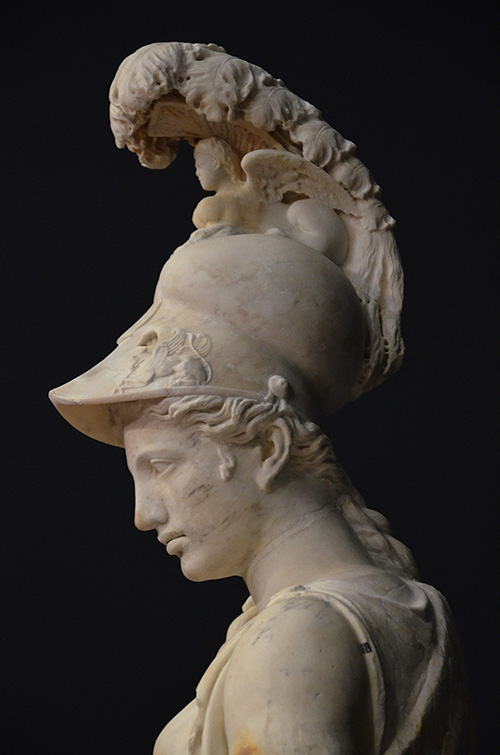
Statue of Athena wearing a Corinthian helmet, the aegis and Gorgoneion (detail), 180-190CE (torso restored from Renaissance and Baroque era), Liebieghaus
Minerva was revered in Roman religion as the goddess of wisdom, justice, law, victory, and the patroness of the arts, commerce, skilled crafts, and strategic thought. Although she also presided over warfare, her sphere emphasized planning, tactics, and disciplined military leadership rather than the raw force and aggression typically associated with Mars and especially the Greek Ares. From approximately the second century BCE onward, the Romans identified Minerva with Athena, her Greek counterpart. She was also one of the three principal deities of the Capitoline Triad, alongside Jupiter and Juno.
Italic & Etruscan Traditions
Minerva's earliest roots are found in the Italic and Etruscan worlds, where she appears as a "transfunctional" goddess (that is, a goddess who transcends the boundaries of any single sphere of functions), one whose domains span warfare, priesthood, and agricultural activity.10
The Etruscan Menrva, daughter of Tinia and Uni (considered cognate with Zeus/Jupiter and Hera/Juno through interpretatio Graeca), was a major deity in the Etruscan triad and was associated with wisdom, war, the arts, and medicine. Etruscan iconography often depicts Menrva as an armed goddess, sometimes with a Gorgoneion (a shield bearing the likeness of the Gorgon Medusa), and occasionally as a lightning thrower, a trait unique to the Etruscan tradition.4
Archaeological evidence from Lavinium, a key Latin sanctuary, reveals Minerva's cult as early as the 4th century BCE. Terracotta statuettes from the site depict both unmarried and married women, as well as swaddled infants and anatomical votives (such as breasts and wombs), suggesting Minerva's role as a guardian of young women and a protector during transitions to marriage and motherhood. Loom weights found at Lavinium reinforce her association with weaving and crafts, while the presence of male votives (such as boys offering toys) indicates that her protective functions extended to both genders.11
Though it can be noted that the Greek Athena typically lacks any associations with regards to childbirth and procreation (often staunchly regarded as a virgin goddess), it should be clarified that none of the iconography at Lavinium explicitly portrayed childbirth itself, with Minerva's cult evoking her status as one who protects women during transitional times.
Interpretatio Graeca and Syncretism with Athena
From the second century BCE, the Romans increasingly identified Minerva with the Greek Athena. This syncretism led to the adoption of Greek myths, iconography, and cult practices into Minerva's Roman persona. However, Minerva retained distinctively Roman features, particularly a greater emphasis on practical wisdom, crafts, and the patronage of professional guilds. It should be stated that Athena was unquestionably one of the principal Greek deities of craftsmanship (τέχνη, technē), especially weaving, carpentry, pottery, metalworking, and architecture. However, she did not become the central patron of professional craft in the same way Minerva did in Roman society.
The classical Greek polis generally did not organize crafts through legally recognized guilds comparable to the Roman collegia. Craftsmen generally worked independently, as part of family workshops, as slaves or foreign resident workers (metics) or otherwise various informal associations.
Occupational associations of craftsmen become much more visible only during the Hellenistic period, centuries after Classical Athens. Even then, they lacked many of the civic and legal functions later characteristic of Roman collegia.12
Roman Minerva inherited Athena's craft functions but developed them further within Roman civic life. Most notably, she became patroness of the Quinquatrus, a festival celebrated not only by craftsmen but also teachers, physicians, poets, actors, and scribes. Numerous professional collegia regarded Minerva as their patron, and her temple on the Aventine became an important meeting place for craft and literary guilds.
In Rome, the state increasingly recognized professional corporations, and these corporations required a divine patron. Minerva naturally became their principal protector because of her inherited association with craftsmanship and skilled knowledge. Further, Minerva's role as a goddess of healing (Minerva Medica) further distinguished her from her Greek counterpart.11
Roman Myths
Many of Minerva's myths are adaptations of Greek stories about Athena, but they were reinterpreted within a Roman context to reflect local values and concerns.
In general, the Romans adopted Athena's mythology more completely than they did that of many other Greek gods. Unlike Mars, who retained many uniquely Roman traditions despite later identification with Ares, Minerva's mythological corpus is overwhelmingly Greek in origin. Most stories about Minerva in Roman literature are Roman retellings of Greek myths rather than independent Roman legends. That said, there are some notable differences in emphasis, characterization, and occasional reinterpretation.
Birth
Jupiter swallows the pregnant Metis (often translated as Prudentia or left as Metis), and Minerva later springs fully armed from his head after Vulcan splits it open with an axe. However, Roman authors tend to emphasize this as demonstrating Minerva's embodiment of ratio (reason), consilium (wise counsel), and disciplined intelligence, qualities particularly admired in Roman political thought.
Ovid (Fasti 3.809–848) retells the myth in a thoroughly Roman poetic context, connecting it to the Quinquatrus festival.13
Arachne
Ovid's Metamorphoses recounts the story of Arachne, a mortal weaver who challenges Minerva's skill. After a contest in which Arachne's tapestry is flawless but impious, Minerva transforms her into a spider, establishing the origin of weaving and the consequences of hubris.
Ovid's version in the Metamorphoses is now the definitive telling. This is one case where the Roman version became the standard version. Earlier Greek references merely mention Arachne or allude to the story, whereas Ovid expands on it greatly.
Arachne was a mortal celebrated for her extraordinary mastery of weaving and embroidery. Her finished creations were admired for their beauty, but even the act of weaving itself was said to be so remarkable that nymphs would leave their natural surroundings simply to watch her at work. Proud of her talent, Arachne declared that her skill surpassed even that of Minerva, adding that she would willingly accept whatever punishment awaited her if she proved to be inferior.
Offended by this boast, Minerva disguised herself as an elderly woman and approached Arachne, urging her to withdraw her challenge and seek the goddess's forgiveness. Arachne refused, prompting Minerva to cast aside her disguise and accept the contest.
The two began weaving rival tapestries. Arachne's work depicted the failings and misdeeds of the gods, while Minerva created a scene illustrating her own contest with Neptune, surrounded by images of the gods expressing contempt for mortals who dared to challenge divine authority. Minerva's tapestry served as both a demonstration of her skill and a final warning for Arachne to abandon her defiance.
Rather than admire her opponent's craftsmanship, Minerva was enraged by the subject matter of Arachne's weaving and tore the tapestry apart. She then touched Arachne's forehead, overwhelming the young woman with shame and despair until she took her own life by hanging herself. Moved by pity, Minerva restored Arachne to life, but transformed her into a spider as a lasting punishment. From that moment onward, Arachne and her descendants would spend eternity suspended from their webs, weaving without end as a perpetual reminder of the consequences of challenging the gods.14
Here, Arachne becomes more of a sympathetic character, with the tapestry contest described in elaborate detail, the subject matter of both tapestries becoming an artistic commentary on divine justice. Minerva's anger becomes psychologically complex, with the earliest versions of the myth being more unclear or simply unattested as to why the earlier Athena held any particular contempt for the spider.15
Medusa
In the later Roman version of the myth, as part of Ovid's Metamorphoses, Medusa was originally a beautiful maiden (something typically missing from earlier Greek versions, with Medusa being the one mortal among three monstrous sisters), but when Neptune mated with her in the temple of Minerva, the goddess then punished Medusa by turning her hair into horrifying snakes whose gaze turned onlookers to stone, later to be slain by Perseus.
Medusa's spilt blood gave birth to Pegasus, whom Minerva immediately tamed and gifted to Bellerophon, with Perseus delivering the severed head to Minerva, who placed its image on her aegis. This Roman version of the story, similarly to Arachne, depicts Medusa in a more sympathetic sense than earlier Greek versions of the myth, though the differences are not otherwise as substantial as the Arachne story.14,16
Aglauros
Ovid's version of the Aglauros (Aglaurus) story appears in Metamorphoses Book 2. Mercury (Hermes) spots the beautiful Herse, one of the daughters of Cecrops (king of Athens), during a procession of Athenian maidens carrying offerings to Minerva (Athena)'s temple on the Acropolis. Smitten, he approaches their home without disguise.
Aglauros, Herse's elder sister (who had previously violated Minerva's trust by opening the forbidden basket containing the infant Erichthonius), greets him first. Mercury asks her to help him woo Herse, promising she would become an aunt to his children. Motivated by greed, Aglauros demands a large sum of gold as payment and sends him away.
Minerva, already resentful of Aglauros for her earlier disobedience, notices this and enlists the personified goddess Envy (Invidia). Envy lives in a dark, dismal cave. Minerva instructs her to infect Aglauros with jealousy. Envy fills Aglauros's heart with poison and thorns, breathing venom into her and planting vivid images of Herse's impending happiness with the god.
Consumed by envy, Aglauros wastes away, blocks the door to Herse's chamber when Mercury returns, and refuses to move despite his pleas. Mercury, angered by her obstinacy, touches her with his caduceus and turns her into a stone statue, blackened and immobile, and now a lasting monument to her vice. Mercury then proceeds with Herse.14
In earlier Greek traditions, Aglauros (often one of the three Cecropides: Aglauros/Aglaurus, Herse, and Pandrosus) is primarily linked to the Erichthonius myth, where Athena entrusts the sisters with a sealed basket containing the infant Erichthonius (born from Hephaestus and Gaia/Earth, often serpentine or guarded by a snake). They are forbidden to open it. Aglauros and Herse (or variants) disobey out of curiosity. Seeing the child/serpent drives them mad; they leap to their deaths from the Acropolis (or into the sea). Pandrosus usually obeys and is spared/rewarded. A crow (Corone) sometimes reports the disobedience to Athena, who fell into a rage, dropping Mount Lycabettus.17
Ovid shifts the focus away from the basket story, Aglauros no longer a tragic character but rather a cautionary tale of vice that is punished by the goddess.
III. Epithets
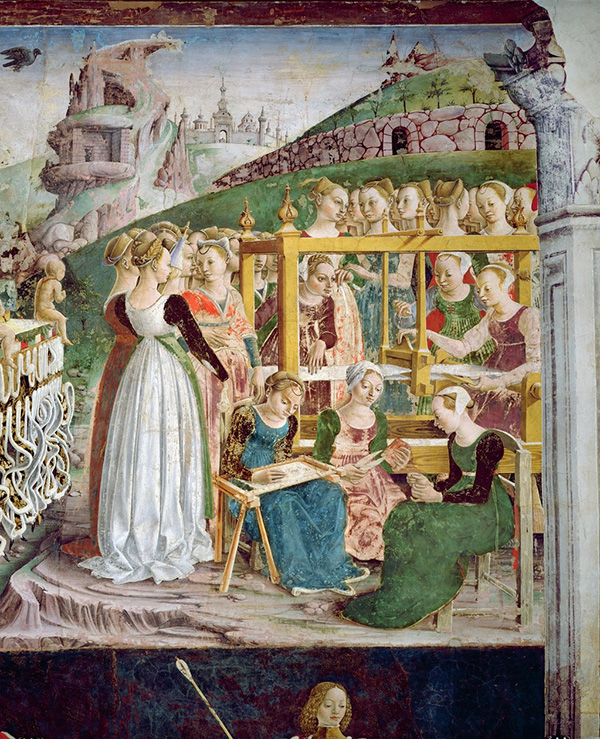
Triumph of Minerva: March, from the Room of the Months, detail of the weavers, c.1467-70. Francesco del Cossa
Extending back to classical times and even in medieval culture, weaving quietly was considered a sign of female wisdom from Minerva
Extending back to classical times and even in medieval culture, weaving quietly was considered a sign of female wisdom from Minerva
Minerva accumulated fewer formal, uniquely Roman cult epithets than many other divinities. Roman religion generally favored titles describing a deity's function or place of worship, whereas Greek religion (especially that of Athena) developed a much broader system of local epithets. Consequently, many titles used for Minerva are adaptations of Greek titles, though a few do remain uniquely Roman.
| Epithet | Meaning | Domain |
|---|---|---|
| Minerva Medica | "of Medicine" | Healing, medicine, anatomical votives |
| Minerva Achaea | "Achaean" | Martial tradition; the arms of Diomedes at Lucera |
| Minerva Capta | "Captured" | Cult sculpture transferred from Falerii, 241 BCE |
| Minerva Polias | "of the City" | Protectress of the city (from Athena Polias) |
| Minerva Ergane | "Worker" | Crafts and artisans, especially weaving |
| Minerva Custos | "Guardian" | Protectress of cities, emperors, and individuals |
| Minerva Augusta | "of the Emperor" | The imperial household and emperor |
| Minerva Victrix | "Victorious" | Military victory and strategy (tied to Victoria) |
| Minerva Pacifera | "Bringer of Peace" | Wise peace after victory (poetic) |
| Minerva Armifera | "Weapon-bearing" | The spear (or lance) and the aegis |
| Minerva Virgo | "the Virgin" | Her status as a virgin goddess |
| Minerva Sulis | Celtic syncretism | Romano-British healing cult at Bath |
Sources: Ovid, Fasti; Aristotle, On Marvellous Things Heard; Virgil, Aeneid; Claudian, Panegyricus de Sexto Consulatu Honorii Augusti; Corpus Inscriptionum Latinarum VIII 7045; Corpus Inscriptionum Latinarum III 14370; Graf, Athena and Minerva: Two Faces of One Goddess?, (2001); Belayche, Religious Actors in Daily Life, (2007); Thein, Minerva Capta, Delubra / Minervium; Reynolds and Volk, Gifts, Curses, Cult and Society at Bath, (1990).11,13,18,19,20,21,22,23,24,25
Two further epithets carry a heavier weight of Greek myth. Minerva Tritonia (or Tritonis), inherited directly from the Greek Athena Tritogeneia, is of debated origin: potential sources include Lake Tritonis in ancient Libya or the river Triton in Greece, where local cults claimed she was raised or born, or a derivation from roots meaning "third-born" (tritos and geneia), referencing her unique divine lineage or emergence from Zeus's head. Some have suggested tritô itself may mean "head-born" outright, but the evidence is scant.26
Minerva Pallas, borrowed directly from Greek usage, is the most common poetic substitute for Minerva and Athena alike. It potentially means either "to brandish [a weapon]" or "young woman". One myth posits that Pallas was a daughter of Triton (which may connect to the epithet above), accidentally slain during a friendly sparring match; grieving her friend, Athena took the epithet in remembrance. Another describes Pallas as a Giant slain by Athena during the Titanomachy.27,28,29
IV. Worship
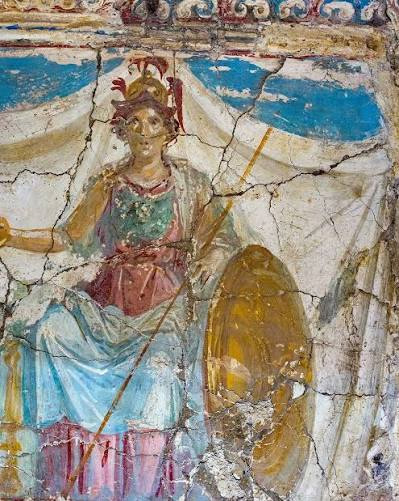
Lararium with wall painting; goddess Minerva sitting on throne, and Agathodaemon snake at altar with offerings (food) and the crow. Pompeii. Note the gaze
Major Temples and Sanctuaries
Temple of Minerva (Aventine): The Temple of Minerva stood on the summit of Rome's Aventine Hill beside the Temple of Diana. Although the structure no longer survives, its general layout is known from the Forma Urbis Romae, which depicts it as a peripteral hexastyle temple positioned on a different alignment from the neighboring Temple of Diana.
Neither the exact date of the temple's construction nor the identity of its founder is known, though it is certain that the sanctuary was already standing by the third century BCE. It became the principal religious center for Rome's craft guilds, and by the close of the third century BCE it had developed a particularly close association with the city's guilds of writers and actors.
In 123 BCE, Gaius Gracchus and his followers unsuccessfully attempted to take refuge within the temple while fleeing Rome. During the reign of Augustus, the sanctuary underwent restoration, and it continued to stand into the fourth century CE, when it is recorded in the Forma Urbis Romae. If the temple remained active during that period, it would likely have been closed as part of the suppression of pagan worship carried out in the later Roman Empire.30
The Temple of Minerva Medica: The Temple of Minerva Medica (possibly an aedes and not a templum), situated on the Esquiline Hill, was renowned for its association with healing and medicine. Archaeological finds from the site include numerous anatomical votive offerings, attesting to the temple's role as a center for health-related cults. The temple's precise architectural form remains uncertain, but its significance as a locus of healing is well established. Its site has been identified through the discovery of the aforementioned votive deposits unearthed along Via Carlo Botta (formerly Via Curva), in the area between Via Buonarroti and Via Machiavelli. Although these finds have helped establish the temple's location, no architectural remains of the structure itself have survived.31
The Capitoline Temple (Temple of Jupiter Optimus Maximus): Minerva's most prestigious cultic presence was as a member of the Capitoline Triad, worshipped in the grand temple on the Capitoline Hill alongside Jupiter and Juno. Traditionally believed to have been dedicated in 509 BCE, the first structure was the earliest major temple constructed in Archaic Rome and ranked among the city's most significant religious monuments. At the time of its completion, it was the largest temple in the Italian peninsula, standing as a testament to Rome's prosperity and resources during the closing years of the Etruscan era. Each deity of the Triad had a separate cella, with Juno Regina on the left, Minerva on the right, and Jupiter Optimus Maximus in the middle.32,33
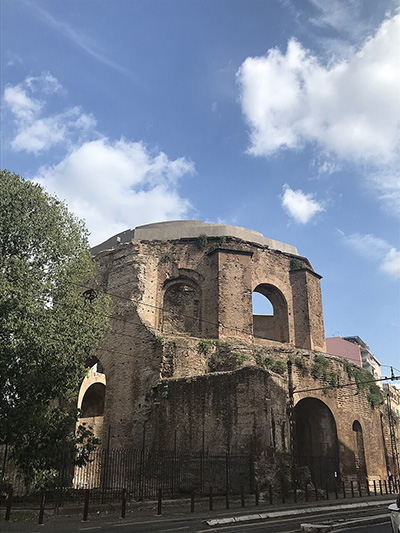
Temple of Minerva Medica, Rome
Other Notable Sanctuaries
Lavinium: The previously mentioned sanctuary at Lavinium yielded terracotta statues and votive offerings dating to the 4th century BCE, in accordance with Minerva's role in transitions to adulthood and childbirth.11
Lucera in Apulia: Site of the cult of Minerva Achaea, where relics of Diomedes were preserved.18
Roman Britain: Shrines to Minerva have been found at Bath (where she was syncretized with Sulis), Carrawburgh, and Chester.34
V. Symbols
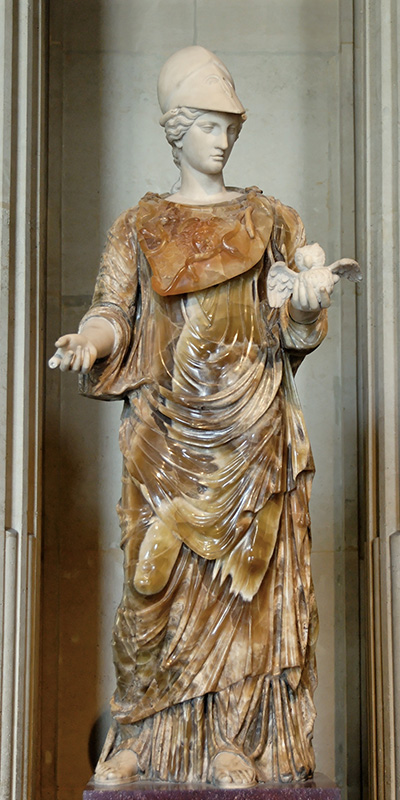
Minerva with owl, golden onyxmarble, 2nd century CE and 18th century restorations (body is of Hera Borghese type), Louvre
Owl
The owl is Minerva's most enduring and recognizable symbol, representing wisdom, insight, and the ability to perceive what is hidden or obscure, given its ability to see in the dark. As stated on the Athena page, however, this simple modern relationship to wisdom is not as simple as it appears.
The specific species associated with Minerva is the little owl (Athene noctua), a bird common in the Mediterranean and closely linked to both Athena and Minerva. In Roman art, much as in Greek art, the owl appears perched on Minerva's shoulder, helmet, or at her feet, serving as a constant companion.
Minerva's owl is featured in Book 2 of Ovid's Metamorphoses, roughly lines 547–595, during the story of Coronis and Apollo, as the crow explains why she lost her favored status with Minerva and was replaced by an owl.
Cornix (the crow) was once a companion and favorite of Minerva. She recounts how Minerva entrusted the infant Erichthonius (born from Vulcan/Hephaestus without a mother) to the three daughters of Cecrops (Aglauros, Herse, and Pandrosos) in a sealed basket, warning them not to look inside. The sisters disobeyed. Aglauros opened it and saw the child with a serpent (or dragons). The crow reported this betrayal to Minerva.
Minerva however, was not especially thrilled by this, seeing this not as an act of loyalty so much as gossiping about matters which should have remained private. Minerva stripped her of protection and downgraded her status, replacing her with the owl as her bird. The crow laments: Minerva "took away her long protection, and degraded me beneath the boding Owl."
The crow then explains that Minerva's owl is actually Nyctimene (daughter of Epopeus, king of Lesbos). Nyctimene committed a grave crime and was transformed by Minerva into the bird of night. She now serves Minerva but hides in shame from daylight, shunned by other birds: "Minerva changed her to the bird of night, and ever since has claimed her as her own instead of me."
Nyctimene the owl, however, as noted by Ovid, remains conscious of her crime, shrouding herself in the darkness of night and avoiding contact with humans altogether. Despite Nyctimene's transgressions in life, the quiet, nocturnal owl better matched Minerva's domain of deep thought, watchfulness and self-introspection.14
Within Roman folklore, owls were considered harbingers of death if they hooted while perched upon one's roof, and placing one of its feathers near someone while they slept could prompt them to speak and reveal their secrets.35
Olive Tree
In the founding of Athens legend (as written by Apollodorus, Herodotus, Pausanias and later Roman adaptations), Athena and Poseidon competed to become its patron deity. King Cecrops (or sometimes the gods) judged which gift would be more beneficial to the people.
Poseidon struck the rock of the Acropolis with his trident, producing a saltwater spring (or sometimes a horse in variant tellings). This symbolized naval power and the sea but was salty and largely useless for drinking or daily life.
Athena thrust her spear into the ground (or planted a branch), causing an olive tree to spring up. It provided food (olives), oil for cooking, lighting, anointing, and trade, wood for tools and construction, and shade. It was hardy and highly practical.
Athena won the contest (often by a narrow margin or with Cecrops's testimony), and the city was named Athens in her honor. The olive tree became the emblem of Athenian prosperity and identity. A sacred olive tree (or its descendant) was said to stand on the Acropolis near the Erechtheion, and legends claimed it miraculously regrew after being burned by Persians in 480 BCE.36
The olive's usefulness was a long-term benefit, rather than immediate spectacle. Olive cultivation requires patience and care, and olive trees may live thousands of years in some instances.
Ovid features this prominently in Book 6, during the weaving contest between Minerva and the mortal Arachne. Minerva weaves a tapestry depicting the contest for Athens: she shows herself striking the earth with her spear to produce the olive tree (with pale shoots and berries), while the gods marvel. She frames her work with olive leaves as symbols of peace.14
Spear & Armor
Unlike Mars, whose weapons tend to emphasize martial force and aggressive valor, Minerva's arms represent the controlled, rational application of power. Roman authors generally portray Minerva as armed because she is perpetually prepared, not because she delights in war. Throughout the Metamorphoses, Minerva almost never wins by physical strength.
The aegis carries several layers of symbolism. The aegis originally belonged to Jupiter before becoming closely associated with Minerva, which itself imbues the shield with a divine legitimacy. At the center sits Medusa's head (the gorgoneion). For Greeks and Romans alike this functioned as an apotropaic symbol, that is, one intended to ward off evil. In this sense, it can represent the triumph of order over chaos.
The spear is perhaps Minerva's defining weapon. Unlike swords, which imply close combat, the spear historically functioned as the principal weapon of organized infantry. Therefore, the weapon symbolizes formation, planning and tactics. It should be noted that in most Roman art, Minerva holds the spear upright, and not in an attacking pose, simply maintaining it with vigilance.
VI. Capitoline Triad
The Capitoline Triad, Jupiter, Juno, and Minerva, was the central grouping of deities in Roman state religion, worshipped in the grand temple on the Capitoline Hill. This triad effectively replaced an earlier Archaic Triad (Jupiter, Mars, Quirinus) and may have been modeled on the Etruscan trio of Tinia, Uni, and Menrva.37
The Capitoline Triad embodied the core values and functions of the Roman state: Jupiter represented sovereignty, law, and the protection of the state; Juno the protection of women, marriage, and the continuity of the Roman people; and Minerva wisdom, strategy, crafts, and the practical application of knowledge in governance and society.
Every major state ceremony, including the inauguration of consuls, triumphal processions, and the marking of the new year, involved rituals at the Capitoline Temple. The triad's composition, that is, one male and two female deities, was unusual in Indo-European religion.
The Triad was collectively worshipped in temples known as Capitolia. These sanctuaries were commonly erected on hills or other elevated locations throughout Italy and the Roman provinces, particularly during the reigns of the Augustan and Julio-Claudian emperors. Most Capitolia were designed with three separate cellae, one for each member of the Capitoline Triad. The earliest known Capitolium constructed outside Italy stood at Emporion.
According to Ovid, the god Terminus also retained a place within the sanctuary because his earlier shrine occupied the site before the temple's construction, and, as the deity of boundary stones, he refused to relinquish his position.13
While the term Capitolium could refer to any temple dedicated to the Capitoline Triad, it most often denoted the great temple on Rome's Capitoline Hill, formally known as the Aedes Iovis Optimi Maximi Capitolini ("Temple of Jupiter Best and Greatest on the Capitoline").
Tradition attributes its construction to Lucius Tarquinius Superbus, the final king of Rome before the establishment of the Republic. Although the sanctuary was shared by Jupiter, Juno, and Minerva, each deity possessed an individual cella: Juno Regina occupied the left chamber, Minerva the right, and Jupiter Optimus Maximus the central and most prominent shrine. Architecturally, the temple stood upon a raised podium and featured a tetrastyle pronaos, or entrance porch, supported by four columns.38
A second sanctuary dedicated to Jupiter, Juno Regina, and Minerva was the Capitolium Vetus, situated on Rome's Quirinal Hill. Ancient tradition regarded this shrine as older than the celebrated Temple of Jupiter Optimus Maximus on the Capitoline Hill, and it remained a recognizable landmark as late as the end of the first century CE, when it was mentioned by the Roman poet Marcus Valerius Martialis.39
VII. Roman Education & Pedagogical Significance
Minerva embodied applied intelligence: the disciplined use of knowledge for practical ends, whether in warfare, craftsmanship, healing, or teaching. She governed intellectual disciplines such as philosophy, rhetoric, poetry, music, and drama, alongside manual arts like weaving and metalworking. Roman sources portray her as magistra artium, mistress or teacher of the arts, linking her directly to the transmission of skills and knowledge.40
Schoolteachers and their pupils fell under her protection, and her influence extended to the structure of Roman learning, which emphasized grammar, literature, rhetoric, and moral formation through skilled oratory and civic virtue. This aligned with broader Roman educational goals: not abstract contemplation alone, but sapientia, practical wisdom that enabled effective action in public and private life.
Her patronage reflected the Roman view of education as a form of techne (skilled craft), akin to other professions under her aegis. Teachers were seen as practitioners of an art requiring intelligence, memory, and methodical instruction, all qualities Minerva obviously personified.
On the first day of the Quinquatria students and teachers honored the goddess with prayers and offerings. Schools often closed or held special observances. Students presented teachers with gifts or payments known as the minervale munus or minerval, a tribute acknowledging Minerva's patronage of education. This was not always the full annual fee but a symbolic or supplementary honorarium dedicated to the goddess. Sources like Varro, Juvenal, Tertullian, and Jerome reference it, sometimes framing it as a devotional act or practical payment.41
Ovid's Fasti (3.809ff.) explicitly connects the festival to education: he urges boys and tender girls to pray to Pallas (Minerva), promising that those who please her will become learned (doctus erit). He also addresses schoolmasters directly, noting that Minerva "attracts new pupils."
Minerva's influence extended beyond festivals. Her Aventine temple was a hub for writers, actors, and craftsmen, reinforcing connections between education, the arts, and professional guilds. As a member of the Capitoline Triad with Jupiter and Juno, she symbolized wisdom as essential to Roman governance and civic life, as education trained future orators, lawyers, and leaders who applied ratio (reason) in service of the state.42
The enduring association of Minerva with education is evident in the iconography of academic institutions, both ancient and modern. In Roman academic architecture, Minerva often occupies the apex of pediments or is featured in reliefs and statues, symbolizing the primacy of reason, strategic governance, and the victory of the mind over chaos, with this tradition even continuing to this day.
VIII. Priesthoods and Cult Administration
Unlike several major Roman deities, Minerva did not have her own dedicated flamen (a high-ranking state priest assigned to a single god). There was no Flamen Minervalis equivalent to the Flamen Dialis (Jupiter), Flamen Martialis (Mars), or Flamen Quirinalis (Quirinus). However, this does not mean Minerva lacked priestly service. Her cult was maintained through several different religious institutions.
The day-to-day oversight of Minerva's public cult fell under the supervision of the College of Pontiffs, who were responsible for the administration of most Roman state religion. They oversaw sacrifices, temple maintenance, festivals, and religious law affecting her worship. Large temples (especially those aforementioned) dedicated to Minerva almost certainly had their own local priests (sacerdotes) attached to them, though surviving information is scarce.
This being said, Minerva's cult certainly existed, though primarily through the collegia of Rome. The collegia opificum, or guilds of craftsmen, were traditionally attributed to the reign of Numa Pompilius. According to Ovid in the Fasti, these associations included weavers, fullers, dyers, shoemakers, physicians, teachers, painters, and practitioners of numerous other trades. Ovid further states that these guilds were originally linked to the worship of Minerva, who presided over craftsmanship and skilled labor. Plutarch provides a somewhat different list, mentioning guilds of flute players, who were connected with the cult of Jupiter on the Capitoline, as well as organizations of smiths, goldsmiths, and tanners.13
Although these professional associations were not established solely as religious institutions, they were, like many early Roman civic organizations, closely tied to religious worship. In most cases, their principal patron deity was indeed Minerva. Nearly all of the collegia maintained both their religious center and administrative headquarters at her temple on the Aventine Hill. During the Second Punic War, when a guild of poets was created, it too adopted the Temple of Minerva as its official meeting place.
In 495 BCE, following the introduction of Minerva's cult to Rome, a collegium mercatorum (guild of merchants) was established to oversee its observances. This association celebrated its principal festival each year on the dies natalis, the anniversary commemorating the dedication of Minerva's temple.43
IX. Minerva's Imperial Identity
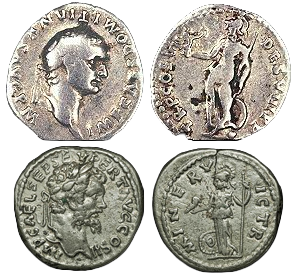
Septimius Severus silver denarius 194 CE from Emesa
Domitian silver of Minerva with Victoria 81 CE from Rome
Domitian silver of Minerva with Victoria 81 CE from Rome
Because Minerva stood so close to the Roman conception of the state, she became a natural instrument of imperial self-representation. From the early Principate she appeared on imperial coinage as a guarantor of victory and of wisdom in government; Nero, for instance, placed her, helmeted, holding owl and spear, on the reverses of his congiarium issues, associating the goddess with the emperor's public generosity.44
No emperor identified with Minerva more completely than Domitian, who regarded her as his personal protectress. She dominated the reverses of his coinage in four principal types: advancing with a spear; standing upon the capital of a rostral column, accompanied by her owl; standing with spear and thunderbolt beside a shield; and standing quietly with a spear. So insistent was this imagery that Minerva became inseparable from the memory of his reign.44,45
Domitian expressed the same devotion across every medium of empire. In 82 CE he raised the Legio I Minervia, a legion placed under the goddess's protection and bearing her image as its emblem; he gave her a prominent place in the Forum Transitorium (the Forum of Nerva); and he honored her festival lavishly. Philostratus even records that the emperor believed himself to be her son, while Suetonius notes the depth of his attachment to her cult.45,46,47
This imperial use of Minerva was calculated rather than eccentric. By binding himself to the goddess of disciplined wisdom, victory, and the arts, and, through the Palladium, to the very welfare and permanence of the state, an emperor could present his authority as sanctioned by the divine intelligence believed to guide Rome itself.45
X. Stoical Interpretations of Minerva
The Stoics, who understood the traditional gods as names for aspects of the single rational principle (logos) that pervades and orders the cosmos, interpreted Minerva, through her Greek counterpart Athena, as divine intelligence itself. In the summary of Stoic theology preserved by Diogenes Laertius, the god is called Athena in reference to the extension of the ruling faculty (hēgemonikon) into the aether, the finest and highest region of the universe.48
Cornutus, in his first-century handbook of Greek theology, allegorizes Athena as the phronēsis, the practical intelligence, of Zeus. Her birth fully armed from his head signifies that intelligence resides in the highest and most commanding part of the cosmos, while her martial character expresses the ordering, governing power of reason rather than mere force.49
The same reading passed into Latin thought. In Cicero's On the Nature of the Gods, the Stoic spokesman Balbus explains Minerva as the power that presides over reason and the arts, one of the divine names under which the single providential nature is worshipped. For the Stoics, then, Minerva was not an independent personality set beside the supreme god but the aspect of divine reason expressed in wisdom, skilled craft, and disciplined intelligence.50
XI. Festivals of Minerva and Quinquatria
The Quinquatria
The Quinquatria (also Quinquatrus or Quinquatria) was the primary festival honoring Minerva, celebrated from March 19 to 23. Its name derives from quinqu- ("five"), referring to its occurrence on the fifth day after the Ides of March (March 19), though the full observance expanded to five days. Ancient sources like Varro and Festus describe the core event as a single day, while Ovid (Fasti) portrays the extended version, likely an augmentation (possibly from Caesar's time) to include popular entertainments.51
March 19 (main day): The principal festival day, often called the dies natalis (birthday) of Minerva, commemorating her birth fully armed from Jupiter's head. It was a solemn day with offerings (flowers, cakes, salt) with no animal sacrifice or bloodshed. Artisans, craftsmen, students, teachers, poets, doctors, and other professionals honored her as patroness. Schools might be suspended, and students offered gifts or fees (minerval) to teachers. Women consulted diviners.
Following days (esp. 20–22): Featured gladiatorial contests, theatrical performances, poetic and oratorical competitions, and public festivities. These additions catered to popular demand. It should be stated that both Varro and Festus state that the Quinquatrus was celebrated for only one day, though Ovid states it was celebrated for five, hence the name.
March 23: Often incorporated the Tubilustrium, the purification of sacred trumpets (tubae) used in rituals and war. This may have originally been separate but merged into the extended festival.13
The festival had military aspects (purification of arms, trumpets, and equipment, linked to the Salii priests of Mars in some calendars), in a reflection of Minerva's strategic warfare role, but it evolved strongly toward crafts and learning. It was initially possibly tied more to Mars before Minerva's prominence grew.52
Emperor Domitian (r. 81–96 CE), who claimed Minerva as his personal protectress, greatly enhanced the festival. He instituted a collegium to oversee it and celebrated it annually at his Alban villa with beast hunts, plays, and contests. This tied into imperial ideology and his building projects, such as elements in the Forum Transitorium (Forum of Nerva) dedicated to her.47
A lesser observance, the Quinquatrus minores or minusculae, occurred in June (around the Ides, June 13–15), primarily involving flute players (tibicines) processing to Minerva's temple. It should be said that the connection between this and the Quinquatrus in March is not entirely clear.
XII. Minerva and the Palladium
Among the sacred objects most closely bound to Minerva's Roman identity was the Palladium, a small and archaic wooden image of the armed goddess said to have fallen from heaven in answer to the prayer of Ilus, the founder of Troy. So long as the image remained within the walls, tradition held, the city could not be taken.53
During the Trojan War the Greeks learned of its power, and Diomedes and Odysseus stole it from the citadel of Troy. Roman tradition, however, maintained that the image thus carried off had been only a copy: the true Palladium had been rescued by Aeneas, who bore it westward to Italy together with his household gods.19,53
At Rome the Palladium was kept in the Temple of Vesta in the Forum, tended by the Vestal Virgins, and numbered among the pignora imperii, the sacred pledges upon which the continuance of Roman rule (imperium) was believed to depend. Its protective role was taken with the utmost seriousness: when the temple caught fire in 241 BCE, the pontifex maximus Lucius Caecilius Metellus was said to have been blinded while rescuing the image from the flames.13,54
Through the Palladium, Minerva became not merely a goddess of wisdom and craft but the ancestral guardian of Rome itself. Her Trojan image bound the city's destiny to Aeneas and to the divine protection that had once shielded Troy, and it furnished later emperors, Domitian above all, with a potent symbol of Minerva's care for the permanence of the state.53
XIII. The Adoption of Minerva as Renaissance–Enlightenment Symbol
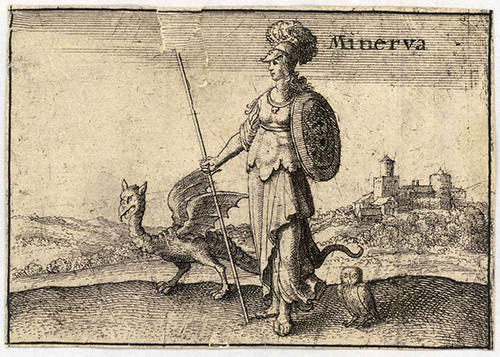
Minerva with griffin and owl, woodcut
Minerva's identification with wisdom, the arts, and disciplined reason ensured her survival long after the end of Roman religion. In late antiquity and the Middle Ages she was preserved above all through the allegorical tradition of Martianus Capella, whose De nuptiis Philologiae et Mercurii made her a mistress of the liberal arts and a personification of learning itself, transmitted to generations of medieval readers.40
Renaissance humanists and artists revived her as the emblem of wisdom and virtue triumphant over ignorance and vice, a theme depicted in works such as Botticelli's Pallas and the Centaur and Mantegna's Minerva Expelling the Vices from the Garden of Virtue. As the personification of reason and the arts, she became a favored device upon the seals, medals, and frontispieces of academies, printing houses, and learned societies across Europe.
The Enlightenment made her the very emblem of reason. Her owl in particular became a metaphor for philosophy, a sense crystallized in Hegel's famous remark that "the owl of Minerva spreads its wings only with the falling of the dusk" a figure for a wisdom that arrives through reflection rather than anticipation. To this day Minerva presides over the seals of universities and states as guardian of knowledge, the clearest survival of the ancient ideal that wisdom must serve virtue.55
XIV. The Many Minervas of Britannia
While Minerva was associated in mainland Europe and the other parts of the empire with craftsmen, various artifacts from Roman Britain in particular are taken by historians to be dedications to her from the scribes of that island; an example is the completion of a vow inscribed on rocks from Roman Britain, another from a military clerk (librarius) called Titus Tertinius. These examples are indicative of a kind of cult of scribes, particularly in military contexts, perhaps relating to an identity of Minerva locally or among the soldiers posted to the remotest parts of the empire.56
The clearest expression of Minerva's British character is the sanctuary at Aquae Sulis (Bath), where she was fused with the local goddess Sulis into the composite Sulis Minerva, presiding over the town's hot springs. The pairing joined Minerva's wisdom and civic authority to Sulis's power over the healing and uncanny waters, producing a divinity of both learning and cleansing.25,34
From the sacred spring have come more than a hundred inscribed sheets of lead and pewter, the so-called curse tablets (defixiones), addressed to Sulis Minerva, most of them written by ordinary people seeking the return of stolen property and the punishment of unknown thieves. Composed in provincial Latin between the second and fourth centuries CE and often folded before being cast into the water, they show the goddess invoked less as a strategist of war than as a dispenser of justice and a guardian of the wronged.57,58
Taken together, the scribal dedications, the syncretism with Sulis, and the appeals for justice at the spring suggest a distinctively British Minerva: a goddess of the written word, of oaths and redress, and of cleansing waters, honored at the edge of the empire by soldiers, clerks, and townspeople alike.34
Sources and Bibliography
- de Vaan, Michiel. Etymological Dictionary of Latin and the Other Italic Languages. Leiden Indo-European Etymological Dictionary Series 7. Leiden: Brill, 2008.
- Matasović, Ranko. A Reader in Comparative Indo-European Religion. Zagreb: University of Zagreb, 2018.
- Bakkum, Gabriël C. L. M. The Latin Dialect of the Ager Faliscus: 150 Years of Scholarship. 2 vols. Amsterdam: Amsterdam University Press, 2009. See esp. 32, 203–5, 393–95, 494–95, 631–52.
- Dhar, Rittika. “Minerva: Roman Goddess of Wisdom and Justice.” History Cooperative, 2022.
- Ambrosini, Laura. “Il paesaggio religioso di Veio tra Etruschi e Romani: il contributo dell’epigrafia.” See esp. CIL I² 2909 = EDR 073773, the dedication L. Tolonio(s) ded(et) Menerva (late 4th–first half 3rd c. BCE).
- Nonnis, David. “Le iscrizioni vascolari latine da Populonia e da contesti sacri dell’Etruria tra media e tarda Repubblica.” In Materiali per Populonia 9, 133–47. Pisa: Edizioni ETS, 2010. See esp. 135–36.
- Harari, Maurizio. “The Imagery of the Etrusco-Faliscan Pantheon.” In The Etruscan World, edited by Jean MacIntosh Turfa. London: Routledge, 2013. See the Faliscan red-figure stamnos of the Diespater Painter (c. 380–360 BCE).
- Corpus Inscriptionum Latinarum I² 365 = XI 3081 = Inscriptiones Latinae Liberae Rei Publicae 238 = Corpus Inscriptionum Etruscarum 8340. See also Bakkum, The Latin Dialect of the Ager Faliscus, no. 214.
- Corpus Inscriptionum Latinarum I² 364. See Maria Cristina Biella and David Nonnis, “Hi Fescenninas acies Aequosque Faliscos. Falerii: da città idioglossa a comunità romana,” esp. 248–49, for the inscription [D]iovei, Iunonei, Minervai / Falesce quei in Sardinia sunt.
- Mallory, J. P., and D. Q. Adams, eds. Encyclopedia of Indo-European Culture. London: Fitzroy Dearborn, 1997.
- Graf, Fritz. “Athena and Minerva: Two Faces of One Goddess?” In Athena in the Classical World, edited by Susan Deacy and Alexandra Villing, 127–39. Leiden: Brill, 2001.
- Maillot, Stéphanie, and Julien Zurbach, eds. Personal Statuses and Labour in the Hellenistic Mediterranean. Clermont-Ferrand: Presses Universitaires Blaise-Pascal, 2025.
- Ovid. Fasti. Translated by James G. Frazer. Revised by G. P. Goold. Loeb Classical Library 253. Cambridge, MA: Harvard University Press, 1989.
- Ovid. Metamorphoses. Translated by Frank Justus Miller. Revised by G. P. Goold. 2 vols. Loeb Classical Library 42–43. Cambridge, MA: Harvard University Press, 1916.
- Oakley, John H., ed. Athenian Potters and Painters, Volume III. Oxford: Oxbow Books, 2014.
- Karoglou, Kiki. “Dangerous Beauty: Medusa in Classical Art.” The Metropolitan Museum of Art Bulletin 75, no. 3 (2018).
- Pausanias. Description of Greece. Translated by W. H. S. Jones, H. A. Ormerod, and R. E. Wycherley. 5 vols. Loeb Classical Library. Cambridge, MA: Harvard University Press, 1918–35.
- Aristotle [attrib.]. On Marvellous Things Heard. Translated by W. S. Hett. In Aristotle, Minor Works. Loeb Classical Library 307. Cambridge, MA: Harvard University Press, 1936. See 108.
- Virgil. Aeneid. Translated by H. Rushton Fairclough. Revised by G. P. Goold. 2 vols. Loeb Classical Library 63–64. Cambridge, MA: Harvard University Press, 1999–2000. See 2.162–79, 2.615.
- Claudian. Panegyric on the Sixth Consulship of Honorius (Panegyricus de Sexto Consulatu Honorii Augusti). In Claudian, vol. 2, translated by Maurice Platnauer. Loeb Classical Library 136. Cambridge, MA: Harvard University Press, 1922.
- Corpus Inscriptionum Latinarum VIII 7045.
- Corpus Inscriptionum Latinarum III 14370.
- Belayche, Nicole. “Religious Actors in Daily Life: Practices and Related Beliefs.” In A Companion to Roman Religion, edited by Jörg Rüpke, 275–91. Malden, MA: Blackwell, 2007.
- Thein, Alexander G. “Minerva Capta, Delubra / Minervium.” Digital Augustan Rome.
- Reynolds, Joyce, and Terence Volk. “Gifts, Curses, Cult and Society at Bath.” Britannia 21 (1990): 379–91.
- Hesiod. Theogony. In Hesiod, the Homeric Hymns and Homerica, translated by Hugh G. Evelyn-White. Loeb Classical Library 57. Cambridge, MA: Harvard University Press, 1914.
- Plato. Cratylus. In Cratylus, Parmenides, Greater Hippias, Lesser Hippias, translated by Harold North Fowler. Loeb Classical Library 167. Cambridge, MA: Harvard University Press, 1926. See 407b.
- Graves, Robert. The Greek Myths. 2 vols. Harmondsworth: Penguin, 1960.
- Kerényi, Karl. The Gods of the Greeks. London: Thames & Hudson, 1951.
- Coarelli, Filippo. Guida archeologica di Roma. Verona: Arnoldo Mondadori Editore, 1984.
- Thein, Alexander G. “Minerva Medica.” Digital Augustan Rome.
- Cicero, Marcus Tullius. On Old Age. On Friendship. On Divination. Translated by W. A. Falconer. Loeb Classical Library 154. Cambridge, MA: Harvard University Press, 1923.
- Norwich, John Julius, ed. The World Atlas of Architecture. New York: Portland House, 1988.
- Henig, Martin. Religion in Roman Britain. London: B. T. Batsford, 1984.
- Eason, Cassandra. Fabulous Creatures, Mythical Monsters, and Animal Power Symbols: A Handbook. Westport, CT: Greenwood Press, 2008.
- Herodotus. Histories. Translated by A. D. Godley. 4 vols. Loeb Classical Library 117–20. Cambridge, MA: Harvard University Press, 1920–25. See 8.55.
- Ryberg, Inez Scott. “Was the Capitoline Triad Etruscan or Italic?” American Journal of Philology 52, no. 2 (1931): 145–56.
- Fishwick, Duncan. “Seneca and the Temple of Divus Claudius.” Britannia 22 (1991): 137–41.
- Richardson, L., Jr. A New Topographical Dictionary of Ancient Rome. Baltimore: Johns Hopkins University Press, 1992.
- Hodapp, William F. “The Martianus Tradition: Minerva as Mistress of the Liberal Arts.” In The Figure of Minerva in Medieval Literature. Cambridge: Boydell & Brewer, 2019.
- Editors of Roman Mythology. “Minerva: Goddess of Wisdom, Strategy, and the Arts.” Roman Mythology, 2025.
- Cartwright, Mark. “Minerva.” World History Encyclopedia, 2014.
- Livy. History of Rome, Volume I: Books 1–2. Translated by B. O. Foster. Loeb Classical Library 114. Cambridge, MA: Harvard University Press, 1919. See 2.27.
- Mattingly, Harold. Coins of the Roman Empire in the British Museum. Vol. 2, Vespasian to Domitian. London: British Museum, 1930.
- Jones, Brian W. The Emperor Domitian. London: Routledge, 1992.
- Philostratus. Life of Apollonius of Tyana. Edited and translated by Christopher P. Jones. 2 vols. Loeb Classical Library 16–17. Cambridge, MA: Harvard University Press, 2005. See 7.24.
- Suetonius. Domitian. In Lives of the Caesars, Volume II, translated by J. C. Rolfe. Loeb Classical Library 38. Cambridge, MA: Harvard University Press, 1914. See 4, 15.
- Diogenes Laertius. Lives of Eminent Philosophers, Volume II: Books 6–10. Translated by R. D. Hicks. Loeb Classical Library 185. Cambridge, MA: Harvard University Press, 1925. See 7.147.
- Cornutus, Lucius Annaeus. Greek Theology, Fragments, and Testimonia. Edited and translated by George Boys-Stones. Writings from the Greco-Roman World 42. Atlanta: SBL Press, 2018. See 20.
- Cicero, Marcus Tullius. On the Nature of the Gods; Academics. Translated by H. Rackham. Loeb Classical Library 268. Cambridge, MA: Harvard University Press, 1933. See De Natura Deorum 2.62, 3.53.
- Varro, Marcus Terentius. On the Latin Language. Translated by Roland G. Kent. 2 vols. Loeb Classical Library 333–334. Cambridge, MA: Harvard University Press, 1938. See 6.14.
- Smith, William, ed. A Dictionary of Greek and Roman Antiquities. London: John Murray, 1842. S.v. “Quinquatrus.”
- Dionysius of Halicarnassus. Roman Antiquities, Volume I: Books 1–2. Translated by Earnest Cary. Loeb Classical Library 319. Cambridge, MA: Harvard University Press, 1937. See 1.68–69.
- Pliny the Elder. Natural History, Volume II: Books 3–7. Translated by H. Rackham. Loeb Classical Library 352. Cambridge, MA: Harvard University Press, 1942. See 7.141.
- Hegel, Georg Wilhelm Friedrich. Elements of the Philosophy of Right. Edited by Allen W. Wood. Translated by H. B. Nisbet. Cambridge: Cambridge University Press, 1991. See the Preface (first published 1820).
- Collingwood, R. G., and R. P. Wright. The Roman Inscriptions of Britain, Volume I: Inscriptions on Stone. Oxford: Clarendon Press, 1965.
- Tomlin, R. S. O. “The Curse Tablets.” In The Temple of Sulis Minerva at Bath, Volume 2: The Finds from the Sacred Spring, edited by Barry Cunliffe, 59–277. Oxford: Oxford University Committee for Archaeology, 1988.
- Tomlin, R. S. O. “Voices from the Sacred Spring.” In Bath History, vol. 4, edited by Trevor Fawcett, 7–24. Bath: Millstream Books, 1992.