




| Language / Culture | Name of Neith | Attestation |
|---|---|---|
| Old Egyptian | N.t / Nj.t (𓈖𓏏𓋌𓁐) | Neithhotep (ca. 3100 BCE) |
| Koine Greek | Νηΐθ (Nēïth) | Plato, Timaeus 21e (ca. 360 BCE) |
| Latin | Neith | Roman-period learned usage |
27 min read
NEITH
author: High Priest Zevios Metathronos
co-author: Novice Priest Karnonnos
Hieratic Information about Neith
| Divine Names | |
|---|---|
| Neith (Νηΐθ) | the Koine Greek form, borrowed through the Demotic name. |
| N.t / Nj.t | the ancient Egyptian theonym, written with the crossed-arrows emblem. |
| These archaic names carry the weight of the oldest cult in the Nile Valley and are held fit for invocation of the Primeval One. | |
| Divine Symbols | |
| |
| Divine Numbers and Attributes | |
| Sacred Number | 7 (her seven creative utterances at Esna) |
| Sacred Crown | the Red Crown of Lower Egypt |
| Sacred Animals | the Nile perch (Lates), the Great Cow, the crocodile |
| Elements | the Primeval Waters (Nun) and the Lamp-Flame |
| Cardinal Quarter | the North; the East side of the coffin |
| Divine Forces | |
| |
| Important Titles | |
| |
| Names Across Civilizations | |
| Egyptian | N.t / Nj.t (𓈖𓏏𓋌𓁐) |
| Koine Greek | Νηΐθ (Nēïth) |
I. The Name of Neith
Etymology
The exact meaning of Neith's ancient Egyptian name, typically translated as either N(j)t, or Nj.t, is unclear primarily due to the fact that the goddess and her name appear at the onset of recorded Egyptian history. Although both have traditionally been translated as "Terrifying One" with reference to a word of fear (nrw), or "She Who Is/that Which Is", respectively, this latter translation reflects her later characterization as an auto-genetic creator. Neither derivation has ever been considered to be definitively established. In addition, given the great antiquity of the theonym, recovery of the lexical origin of the term is complicated by this circumstance.1,2,3
Neith's distinctive double arrow/ bow sign served as a way to write her name simply because she used it as an emblem; the item illustrated does not indicate that the name had some relation to "bow", "arrow", or "weaver". The sign belonged to Neith before her name could be written by means of it, and therefore they should not be conflated into a spurious etymological relationship.2,4
Her name appears in written form early in the First Dynasty, approximately 3100 BCE. This occurs in the theophoric royal name Neith-hotep (Nt-ḥtp, "Neith is pleased"), which is represented as well through many of the ceramic vessel seals from Naqada and Abydos dated to the Early Dynastic Period.
Additionally, we do possess a securely identified clay sealing from the "Royal Tomb" at Naqada, dated to the reign of Pharaoh Hor-Aha. We do not interpret this example as merely a later representation from a king list. Rather, we believe that this is an actual name appearing upon contemporary archaeological materials. As such, most modern scholars would place Neithhotep near the dawn of Dynasty I and conclude that the element Neith is actually a reference to the goddess herself.5,6
Iconography representing possible earlier representations of Neith may extend even further back in time. Stan Hendrickx recognized three types of Protodynastic cult signs associated with Neith: a bilobed object, two crossing arrows, and two bows connected together. These suggest that a cult sign for Neith may exist prior to the Late Naqada Period. However, identifying an iconographic symbol retroactively as Neith's is not equivalent to having evidence of a written theonym. More recently, Victoria Almansa-Villatoro has performed a new palaeographic review of the crossed-arrows sign from the Early Dynastic Period. She argues that this crossed-arrows sign should actually be read Ḥms.t (Hemsit); whereas Neith's archaic writing consists of the two tied bows and is confirmed by examples from during the reign of King Djet. Therefore, the bound-bows writing represents the safer basis for the divine name independent of a human theophore.4,7
First Attestation in Greek, Coptic, and Meroitic
In Greek the goddess reaches us in two quite different ways. In the documentary papyri and inscriptions of Graeco-Roman Egypt she is almost never transliterated; she is simply rendered by the name of Athena, and Herodotus, writing about Sais around 440 BCE, calls her Athena and does not give her Egyptian name at all. The transliterated form Νηΐθ (Nēïth), a borrowing of the Demotic ny.t, is a learned rather than a documentary usage, and its earliest secure appearance is in Plato's Timaeus (21e, c. 360 BCE), where the priests of Sais tell Solon that their foundress, "in the Egyptian tongue Neith," is the Athena of the Greeks.8,9,10
In Coptic there is no securely attested cult-name of the goddess: her worship had ended before the Christian period, and the "Coptic" forms sometimes printed in older handbooks derive from early-modern reconstruction rather than from any Coptic text. What survives in Coptic is her sacred geography, the name of her Delta city Sais (ⲥⲁⲓ, Sai, from Egyptian Zau) and of her southern seat Esna (Sahidic ⲥⲛⲏ, Snē, from Ta-senet). In Meroitic she is not attested at all: unlike Isis, whose cult flooded into Nubia, Neith remained a goddess of Egypt proper and left no Meroitic form of her name.3,9,10
Sources: Almansa-Villatoro, Renaming the Queens, 2019; Leitz, Lexikon der ägyptischen Götter und Götterbezeichnungen, 2002; Herodotus, Histories, 1920; Plato, Timaeus, 1929; El-Sayed, La déesse Neith de Saïs, 1982; Metropolitan Museum of Art, Jar Sealing of Neithhotep.4,10,9,8,3,5
II. Neith in the Egyptian World
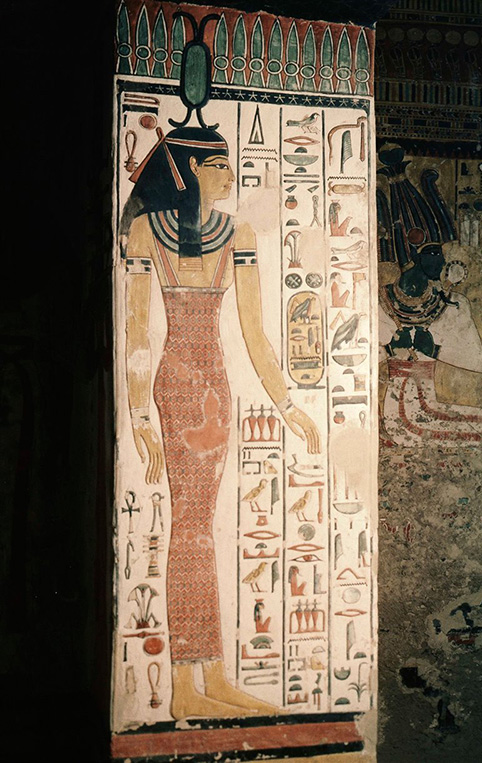
Neith, depicted within the Tomb of Nefertari New Kingdom, 19th Dynasty, reign of Ramesses II, c. 1279-1213 BCE, Tomb of Nefertari (QV66),
The Old Kingdom
The Old Kingdom marks the pinnacle of Neith’s status at the inception of Egyptian civilization. This stature is best measured through the naming of royal Wives of the First Dynasty, particularly those named with the theonym of Neith such as Neithhotep, “Neith is pleased” and Meret-Neith, “the Beloved of Neith,” who was honored with a tomb at Abydos on the scale reserved for Pharaohs. As noted by Susan Tower Hollis, the relationship between Neith and the royal women of the early dynasty is unique and unlike that of any other deity.11,12
Two changes occur in these centuries that ultimately shape her future. Neith is one of the two deities alongside Hathor that possesses female priests in large number, making her cult open up a primary source of priestly offices to women. Also, at the end of the Fifth Dynasty, the Pyramid Texts were inscribed, which introduced Neith into the sphere of funereal worship as one of four protector goddesses (Isis, Nephthys, Neith and Serqet), placed there to protect the deceased Pharaoh. The hunting tools used by Neith for game are here transformed into protective tools.13,14,15,16
The Pyramid Texts also establish her definitive connection with Lower Egypt and the red crown, which is even used as a symbol of terror in the inscriptions to drive away enemies of the deceased. The texts also name her as the mother of Sobek, a crocodile god worshipped in the Fayyum delta. Her connection to the royal Neiths seems to be emphatic.
The Middle Kingdom
The Middle Kingdom is a quiet age for Neith, and the change is one of contraction and consolidation. Her Early Dynastic prominence fades: the female priesthood that had been her distinction thins as priestly office passes into the hands of men, and her Delta cult leaves only faint traces. What grows in its place is the tomb. In the Coffin Texts she keeps her guardian's part, and the scheme of the four protecting goddesses now hardens into custom, each goddess joined to one of the Four Sons of Horus, Neith paired with Duamutef, keeper of the stomach, a pairing fixed on the coffins and canopic chests of the age.16,17,18,19,20
One earlier theme emerges stronger As Sobek's influence expanded throughout Egypt during the Middle Kingdom, his mother Neith gained corresponding prestige down to the point where Egyptian kings bearing his name (Sobekhotep and Sobekneferu), who ruled Egypt during the 12th Dynasty, arose. However, while her parentage of the crocodile god is ancient, the theological framework necessary to fully describe Neith as Sobek's self-made creator would take many centuries to develop at Esna. 21,16
The New Kingdom
During the New Kingdom, Neith's role in funeral rites reached an artistic zenith that she had never before achieved. The four-goddess scheme that had originated in reference to the coffins was elevated to refer to shrines made of gold. During the reign of Tutankhamun, on his canopic chest, the four goddesses stood with their arms stretched out in protection. Throughout the 18th through to the 20th Dynasties, they wrapped their arms around the corners of the royal sarcophagi. The only occasion when a deviation occurred in this pattern was during the reign of Akhenaten when he replaced them with the solar disk of the Aten.22,20
The greater novelty is that Neith is given a voice during the titanic dispute of Horus and Set. In the Ramesside-era Contendings of Horus and Seth,, the deadlocked Ennead writes for judgment to "Neith the Great, the God's Mother," the most ancient of the goddesses. She as an esteemed power rules decisively for Horus, threatening that the sky will fall if she is denied. Neith is clearly shown as one of the elder deities whose wisdom is exemplary.23,24,25
The Late Period
The Late Period brings the largest transformation in Neith's history. With her city of Zaw (Sais) producing the Pharaohs of the 26th Dynasty who conquered all of Egypt and established their capital there, Neith was promoted from a respected patroness of the Delta region to one of Egypt's foremost deities. According to Herodotus' descriptions, her magnificent temple included a massive monolithic shrine, a sacred lake, and nightly rituals along with tombs for her Saite kings that lay inside her temple courtyard.9,26
There were also additional developments during this era. Her creation mythology begins to receive greater attention and focus. Specifically, she begins to emerge as the self-created mother of Ra in her role as a central figure in her cult. It is also during this time that she was first encountered by Greek visitors who came to Egypt at the invitation of the Pharaoh Amasis and settled at the colony of Naukratis near Sais and began calling her their Athena.
The eventual invasion by Persia targeted her household: Udjahorresnet, a priest and physician, records on his stela how he guided Cambyses to cleanse and revive the temple of Neith at Sais. Unfortunately, very little remains today from this vast complex as its mounds have been leveled off and parts have been excavated for quarrying over time.8,16,27,28
The Ptolemaic and Roman Period
During the final centuries of ancient Egyptian worship, Neith would receive her most comprehensive description of her divine nature etched onto walls of the great temple at Esna. At Esna, she would be portrayed as a single androgynous creative force represented by both her male manifestation as Khnum and her female manifestation as Neith. Moreover, she would be credited with creating a cosmogony in which she created everything in raising the primeval mound, generating sunlight and speaking gods into existence solely because she is self-created and existed prior to water itself.25,29
At the same time the goddess passed into the thought of her foreign rulers. Plutarch and Proclus report the veiled statue of Sais and its famous inscription, and in the daily documents of Graeco-Roman Egypt she lived on as Athena and was folded into the universal Isis. Yet the change beneath the grandeur was decline: the great temple of Sais was already crumbling, and when the temples finally closed, the goddess of the first dynasties passed with the old religion she had outlasted so long.28,30,31
During this time, some of her worship appeared to cross into the Mediterranean, where her statues and statuettes show increasing syncretization with Athena and Isis.
III. The Epithets of Neith
| Epithet | Meaning | Domain |
|---|---|---|
| N.t nb.t Zꜣw | Neith, Lady of Sais | Civic cult |
| mwt-nṯr | Mother of the God | Mother of the Sun |
| N.t wr.t | Neith the Great | Supreme divine rank |
| nṯr.t ꜥꜣ.t | The Great Goddess | Pantheonic pre-eminence |
| N.t nb.t tꜣ-sn.t | Neith, Lady of Ta-senet (Esna) | Her Upper Egyptian temple-city, Latopolis |
| nb.t pḏ.t ḥqꜣ.t šsr.w | Mistress of the Bow, Ruler of Arrows | War, boundaries |
| it-it.w mwt-mwt.w | Father of Fathers, Mother of Mothers | Wisdom as demiurge |
| mwt Rꜥ | Mother of Ra | Solar generation |
| pꜣwty.t | The Primeval One | Ancient nature |
| N.t-Mḥ.t-wr.t | Neith–Mehet-Weret (the Great Flood) | Bovine cult, primeval waters |
| nb.t tꜣ-mḥw | Lady of Lower Egypt | The Red Crown, the North |
| wp.t wꜣ.wt | Opener of the Ways | Guide in war and death |
| N.t-ih.t wr.t | Neith–Ihet-Weret (the Great Cow) | Generator of Ra |
Sources: El-Sayed, La déesse Neith de Saïs, 1982; Sauneron, Esna V, 1962; Leitz, Lexikon der ägyptischen Götter und Götterbezeichnungen, 2002; Wilkinson, The Complete Gods and Goddesses of Ancient Egypt, 2003; Lesko, The Great Goddesses of Egypt, 1999; Herodotus, Histories; Plato, Timaeus; Plutarch, On Isis and Osiris.2,3,8,9,10,16,30
IV. The Temples and Sacred Sites of Neith
Zaw, the Great Temple of Neith
Zaw (known in Greek as Sais, modern Sa el-Hagar, in the Western Nile delta, was Neith's unchallenged city, and it ultimately became one of the large state temples of Egypt. Penelope Wilson demonstrated through her reconstruction of the textual evidence that there were at least two large sanctuary zone present during the Middle Kingdom period, the Southern Neith (Rs-Nt) and the Northern Neith (Mh-Nt) alongside other features such as an Osiris sanctuary, a sacred lake and ceremonial grounds. During the reign of the Saites, the temple had become a royal sanctuary in every respect, with each Pharaoh being interred within its walls. Hermann Ranke appropriately termed it the Great State Sanctuary of Neith. 3,33
The influence of this temple extended beyond its sacred monumentality, because the environment was of an economic importance, something Plato attests to as well. The Naukratis and Thonis decrees of Nectanebo I allocated one-tenth of the customs revenues to Neith of Sais; therefore, the tithe from the Greek emporium went into her treasury. Additionally, Herodotus described the massive portico, gigantic statues, and the monolithic shrine built by Amasis for Neith at Sais. Even though the Persians conquered Egypt, the temple was significant enough that Udjahorresnet used it to demonstrate whether or not Cambyses was legitimate.9,27,34
Memphis, the Temple of Neith (Ḥwt-Nt)
Memphis had one Temple of Neith, the Egyptian Ḥwt-Nt, distinct from the great temple of Ptah, though its archeological site has not been securely located. The textual case is strong: the New Kingdom official Meryneith had the title "First God's Servant in the Temple of Neith," and the vizier Paser was a keeper of secrets in the same temple, evidence of a temple organization.35,36
Its influence was strongest during the earlier periods of worship for Neith. At these times, Neith experienced her unique status as one of the primary goddesses of both the Early Dynastic Period and the Old Kingdom. Generally speaking, most treatments identify Sais and Memphis as Neith's two major centers. However, unlike Sais, which was a city dominated by the cult of Neith, Ptah continued to be the patron god of the city of Memphis throughout Egyptian history. Thus, Memphis remains a secondary center throughout Egyptian history. During the Ptolemaic and Roman periods Esna replaced Memphis as a major center of her worship, particularly as the importance of the city declined.3,2
Esna, the Temple of Khnum and Neith
Built and decorated over the Ptolemaic and Roman periods, the Esna Temple presents the most complete surviving temple theology of Neith in combination with Khnum. It is one of six large surviving Greco-Roman temples. As Hallof noted, to refer to Esna solely as the "Temple of Khnum", does injustice to Neith since the temple's prime creator was conceived as an androgynous primordial deity, manifesting itself in two aspects: the male form of Khnum and the female form of Neith. An IFAO publication lists Khnum and Neith as co-prime deities of the temple.37,38,39
On its walls survives the celebrated Esna Cosmogony of Neith. Furthermore, its festival calendar contains many references to ceremonies performed at Sais in honor of Neith prior to her migration northward. These include a ceremony commemorating the arrival of the craft goddess at her new temple by lightening lamps for her while the people keep vigil through the entire night. Thus, despite being less influential in historical terms than Sais, Esna represents the paradoxical aspect of Neith's legacy: it is the wealthiest source for understanding her theological development, due to the fact that Sais lost virtually all of its monumental temple.29,40
V. The Opener of the Ways
Among the earliest of the titles of Neith is "Opener of the Way" (wp.t wꜣ.wt) a term she has in common with the wolf god Wepwawet whose banner preceded the Pharaohs from the early Dynasties. In its initial application, the name refers to the military action of opening the path to success for the ruler in both battle and hunt, by clearing his route to victory, as her arrows precede him. It is a part of an ancient warrior characteristic which is also reflected in her emblem and title, "Mistress of the Bow".2,3
The name had a second interpretation as she is involved in funerary rites from the times of the Pyramid Texts alongside Isis and Nephthys. As Opener of the Ways, Neith comes to the fore as a psychopomp of the dead, and as such serves as a guide clearing the paths of danger through the perilous journey to the afterlife, much as she served as a path opener to victory in battle. The two aspects are but one motion viewed at two times: the goddess who clears the way for the living Pharaoh before his enemies, does likewise for the dead before the dangers of the beyond.2,16
VI. Weaving and Textiles
Along with the bow, Neith claimed ownership of the loom. Her symbol would eventually be interpreted as a weaving shuttle as well as crossed arrows. She was honored as a patroness of weaving and of the craftsmanship associated with textiles, something strongly associating her with Athena. This must be distinguished from her etymological origins, since her symbol was hers prior to being a weaving shuttle, and therefore it speaks to how the Egyptians came to understand her, rather than what her name originally meant.2,4
The weaving aspect had a funerary connotation that elevated it above evoking simple craftsmanship. Through her expertise in textile production, Neith was connected with the linen wrappings used in mummification practices. While she protected the deceased, she also provided the clothing for them. The bandages that wrapped their bodies were thought of as being produced by the goddess. By the time of Egypt's most fully realized Late Theology, domestic arts were transformed into cosmic ones. At Esna, Neith is depicted as producing and creating the world itself on her loom, similar to the spindle of Athena and the Moirai. The thread that forms and defines her weaving is equated with the thread of Creation.2,16,29
VII. The Mystery Goddess
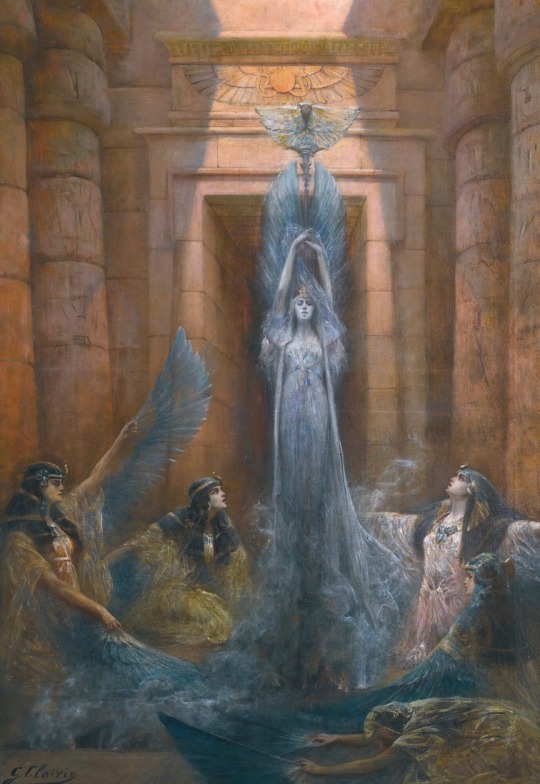
Neith is the goddess of hidden wisdom in Egyptian religion more than any other deity. Neith's character as a deity who is self-begotten and was before all other gods is reflected by her name meaning "She Who Is", alongside her self-begetting theological representation at Esna. This role made her the very type of the unknown first cause and the goddess who is and shall be. It was this role as the deity of mystery that both the Greeks and Romans used to evoke when they wrote about her.1,29
I am all that has been and is and shall be, and no mortal has ever lifted my veil.
Inscription of the goddess at Sais, reported by Plutarch, De Iside et Osiride 930
Plutarch set this inscription on the seated statue of the goddess of Sais, whom he took for Athena and Isis together, and the Neoplatonist Proclus, quoting it again, added a line naming the sun as the fruit she had brought forth, binding the veiled goddess to the creation her own temple produced.16,30
VIII. War Attributes
Neith has been the embodiment of warfare since the Predynastic period and, accordingly, her symbol, two crossed arrows over a shield, have represented both the goddess, the city and the nome. She has been a protector and a hunter. As such her, emblems represent both her attributes and her symbols. The images of Neith show her armed with a bow and an arrow, wearing the Red Crown of the north which is a crown associated with military conquests.2,3
Her weapons served the king before they served the dead. In the earliest evidence Neith fights for the ruler, opening his way in battle and guarding him against his enemies, and it is only later that the same arrows are turned inward to the protection of the tomb, guarding the sleeper as they had once felled the game and the foe. The martial character never leaves her: even as she becomes the primeval mother and the veiled creator, she remains the arrow-goddess whose sign is a weapon.2,16
IX. Neith and Athena's Syncretism
The association between the Greek Athena, and the Roman Minerva, with the Egyptian Neith is well-documented from both Plato (c. 380 BCE) and Plutarch (c. 100 CE). However, this association did not exist merely as a literary device for philosophers. There are many examples in the everyday written documents of Graeco-Roman Egypt, where scribes used the name "Athena" when referring to Neith. In fact, Neith's temple is referred to as Athena's Temple, and the Priests of Neith were known as the Priests of Athena. A further example of how the Greeks used a single Greek term to refer to two different entities can be seen with the term "Thoeris," which refers to the hippopotamus godess Thoeris. Therefore, since the context of each document will determine whether the reference is to either the hippopotamus goddess or Athena, in the case of Sais we know that the reference to Athena is to Neith.2,31
Furthermore, an additional example of syncretism in terms of representation of Neith can be seen in depictions of her. Jan Quaegebeur points out a relief showing Neith depicted as Athena holding her son. He also notes that her depiction with her crocodile children, specifically the suckling twins, and her son Sobek, represented as a double entity, show that these representations were interpreted in syncretic Egyptian-Greek art as representing the Dioskouri, Polydeukes and Kastor. Neith's influence extended throughout Hellenistic Egypt through another of her sons Tutu, who was known as Tithoes by the Greeks. This sphinx-like god, associated with demonic spirits and considered a powerful protector during this time period, appeared numerous times on both stele and amulets, and was included in personal names found throughout Egypt. Neith is often depicted next to Tutu while displaying the wheel of destiny.31,41
Lastly, evidence exists that Neith's role was present in the Hellenistic magical texts. The creation account within the so-called Book of Moses, part of the collection of Greek Magical Papyri, traces back to the Esna theology of Neith through seven spoken words of creation. One such magical text indicates that the goddess speaking the gods into existence is actually one of the major creation accounts in the magical text. Additionally, depictions of Athena on magical gemstones include an armed Athena striking a snake with a double axe. Scholars associate this depiction with Egyptian material concerning Neith and Tutu.29,42,43
Neith was also syncretized, particularly during the Ramesside period, with the Phoenician goddess Anat, both in her warlike aspect and her use of the loom. The two goddesses share a similar appearance.
X. The Four Funerary Goddesses
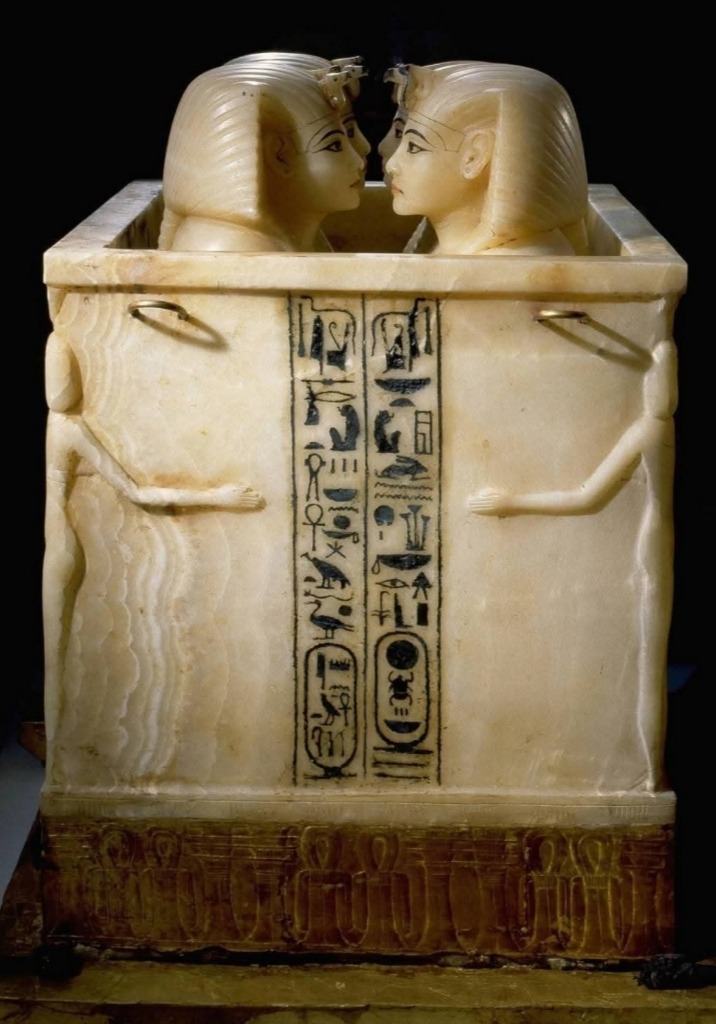
The goddess is one of four protector goddesses protect both the dead and the containers for the deceased person's organs (the Canopic Jars). The first time they appear together protecting the passed Pharaoh is in the Pyramid Texts, and it is at this point that Neith takes on a funerary role, using her bows and arrows not for hunting but for defending tombs.14,15
In the Middle Kingdom period these goddesses became a standard group consisting of each of the four goddesses paired with one of the Four Sons of Horus. Neith was associated with Duamutef, the son who protected the stomach. This association appears consistently on coffins and canopic boxes. By the New Kingdom Period this group had achieved its visual peak through the depiction of the four goddesses encircling the throne and coffin of Tutankhamun. It also continued into the Ptolemaic and Roman periods, so her function as a protector of tombs is the longest trait Neith possesses continually.18,19,20,22
XI. The Festival of Lamps and Other Festivals
Neith's most famous festival was a festival of light. Herodotus counted the nocturnal Feast of Lamps at Sais among the great festivals of Egypt, when the people lit saucers of oil to burn through the whole night and Egyptians far from the city kindled their own, so that the whole land lay under a single blaze of lamplight in her honour. The rite outlived the Delta capital and was kept at Esna as well, where the festival calendar records the lighting of lamps as the goddess arrives at her temple and the city keeps vigil.9,40
| Neith Ritual Days | Place | Description | Events | Date Recorded |
|---|---|---|---|---|
| The Feast of Lamps (Lychnokaia) | Sais, and throughout Egypt | Nocturnal festival of lamps for Neith | Lamps of oil and salt burned through the night across the land | Herodotus (5th century BCE) |
| The Illumination of Lamps at Esna | Esna (Latopolis) | The Saite lamp-rite renewed in the south | Lamps lit as the goddess arrives; the city keeps vigil through the night | Esna festival calendar (Sauneron; Abdelwahed, 2015) |
| The Arrival of Neith | Esna and Sais | The return of the goddess bearing the sun | Torches recall Neith swimming north as a cow, carrying Ra to Sais | Esna cosmogony (Roman period; Sauneron, 1962) |
Sources: Herodotus, Histories, 2.62; Abdelwahed, The Illumination of Lamps (Lychnokaia) for Neith, 2015; Sauneron, Les fêtes religieuses d'Esna, 1962; Pinch, Egyptian Mythology, 2004.9,25,29,40
XII. Neith and Khnum
At Esna, Neith is paired with the ram god Khnum. However this relationship is different than any other she participates in. Although the Temple of Esna describes the two as companions, it actually fuses them as male and female counterparts becoming a unified being. The supreme creative force is seen as a single androgynous primeval power. It manifests itself as both male Khnum and female Neith. Thus, the two are described as co-principals of the temple.38,39
Khnum creates life using his potter’s wheel, while Neith creates the world by speaking and weaving it into existence. She is the mother of Ra who existed prior to all other deities. With the pottery craft (Khnum) and weaving craft (Neith), representing the male and female aspects of the same creative force, Esna frames a cosmology in which Neith exists at the very beginning. As such, Esna represents the fullness of her divinity in a cosmological sense.25,29
XIII. Neith and her Symbolism
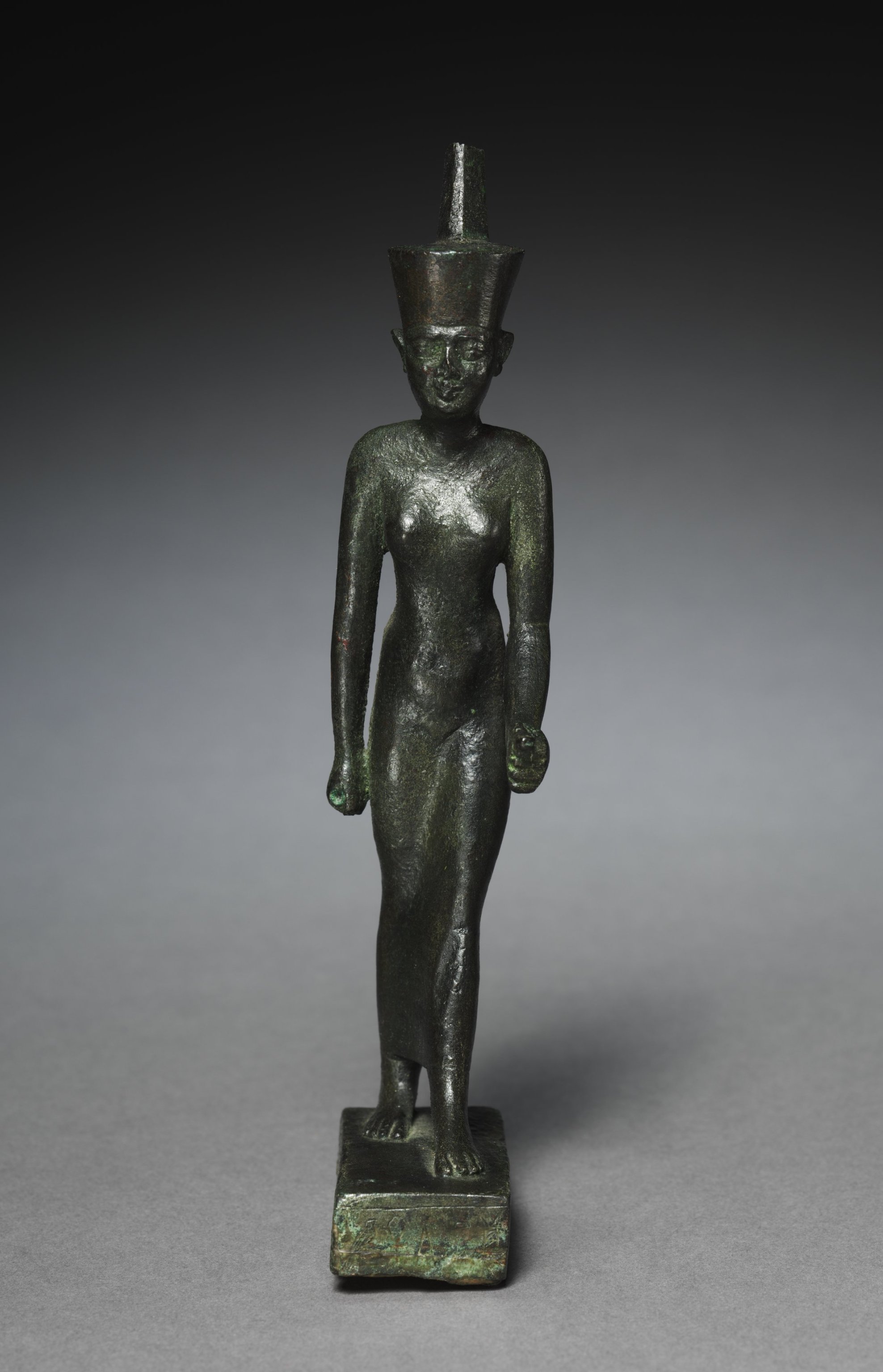
Statuette of the goddess Neith, Ptolemaic Period, ca. 305-30BCE
The icon on top of Neith is one of her oldest symbols: two arrows (with the points facing toward each other) on either side of an oval form. This symbol is used by Neith as well as for her city of Sais and for the nome where she resides. The different versions of this early symbol have been interpreted as two bound bows or as a bilobate object. At some point in time this symbol can be seen as representing both a bow and arrow or as a shuttle for weaving. Regardless of how the symbol is interpreted, it defines her role as both goddess of the bow and goddess of the loom.2,4,7
In addition to her weapons, Neith also has the physical attributes of her dual identity. When she holds the bow and arrows, she represents herself as both a huntress and a warrior. She also often holds the was scepter (a symbol of power) and the Ankh (a symbol of eternal life). On her head, usually wears the Red Crown of Lower Egypt, a crown that represents the Delta region that was under her control. Some of her symbols are related to the act of weaving and include the shuttle and the linen wrapped around a mummy body associated with her name. The click beetle is listed as one of the archaic symbols associated with Neith also.2,3
Neith's symbolic animal forms were developed by the theologians who created her mythology and come together in Esna. It is there that she emerges from the primeval water and becomes the large cow Mehet-Weret ("The Great Flood") and the heavenly milk cow Ihet who bears the sun, Ra, and then takes the form of the Lates fish from the Nile. These animals have special significance because their eyes emit the initial light when they ignite, providing illumination during the darkness. As the mother of Sobek, Neith's household includes the fierce crocodile god.16,29
Sources and Bibliography
- Pinch, Geraldine. The Penguin Book of Myths and Legends of Ancient Egypt. London: Penguin Books, 2011.
- Wilkinson, Richard H. The Complete Gods and Goddesses of Ancient Egypt. London: Thames & Hudson, 2003.
- El-Sayed, Ramadan. La déesse Neith de Saïs. 2 vols. Bibliothèque d'étude 86. Cairo: Institut français d'archéologie orientale, 1982.
- Almansa-Villatoro, Victoria. "Renaming the Queens: A New Reading for the Early Dynastic Crossed Arrows Sign and a Religious Approach to the Early Dynastic Onomastics." Studien zur Altägyptischen Kultur 48 (2019): 35–51.
- Metropolitan Museum of Art. "Jar Sealing Impressed with Name of Queen Neithhotep." Accession no. 20.2.54. Dynasty 1, reign of Aha. From Naqada, "The Royal Tomb."
- Roth, Silke. Die Königsmütter des Alten Ägypten von der Frühzeit bis zum Ende der 12. Dynastie. Ägypten und Altes Testament 46. Wiesbaden: Harrassowitz, 2001.
- Hendrickx, Stan. "Two Protodynastic Objects in Brussels and the Origin of the Bilobate Cult-Sign of Neith." Journal of Egyptian Archaeology 82 (1996): 23–42.
- Plato. Timaeus, Critias, Cleitophon, Menexenus, Epistles. Translated by R. G. Bury. Loeb Classical Library 234. Cambridge, MA: Harvard University Press, 1929.
- Herodotus. The Persian Wars, Volume I: Books 1–2. Translated by A. D. Godley. Loeb Classical Library 117. Cambridge, MA: Harvard University Press, 1920.
- Leitz, Christian, ed. Lexikon der ägyptischen Götter und Götterbezeichnungen. 8 vols. Orientalia Lovaniensia Analecta 110–116, 129. Leuven: Peeters, 2002–2003.
- Hollis, Susan Tower. Five Egyptian Goddesses: Their Possible Beginnings, Actions, and Relationships in the Third Millennium BCE. London: Bloomsbury Academic, 2019.
- Wilkinson, Toby A. H. Early Dynastic Egypt. London: Routledge, 1999.
- Robins, Gay. Women in Ancient Egypt. Cambridge, MA: Harvard University Press, 1993.
- Allen, James P. The Ancient Egyptian Pyramid Texts. Writings from the Ancient World 23. Atlanta: Society of Biblical Literature, 2005.
- Faulkner, R. O. The Ancient Egyptian Pyramid Texts. Oxford: Clarendon Press, 1969.
- Lesko, Barbara S. The Great Goddesses of Egypt. Norman: University of Oklahoma Press, 1999.
- Faulkner, R. O. The Ancient Egyptian Coffin Texts. 3 vols. Warminster: Aris & Phillips, 1973–1978.
- Assmann, Jan. Death and Salvation in Ancient Egypt. Translated by David Lorton. Ithaca, NY: Cornell University Press, 2005.
- Willems, Harco. Chests of Life: A Study of the Typology and Conceptual Development of Middle Kingdom Standard Class Coffins. Mededelingen en Verhandelingen van het Vooraziatisch-Egyptisch Genootschap "Ex Oriente Lux" 25. Leiden: Ex Oriente Lux, 1988.
- Dodson, Aidan. The Canopic Equipment of the Kings of Egypt. London: Kegan Paul International, 1994.
- Zecchi, Marco. Sobek of Shedet: The Crocodile God in the Fayyum in the Dynastic Period. Todi: Tau Editrice, 2010.
- Reeves, Nicholas. The Complete Tutankhamun: The King, the Tomb, the Royal Treasure. London: Thames & Hudson, 1990.
- Faulkner, R. O., trans. The Ancient Egyptian Book of the Dead. Edited by Carol Andrews. London: British Museum Publications, 1985.
- Lichtheim, Miriam. Ancient Egyptian Literature, Volume II: The New Kingdom. Berkeley: University of California Press, 1976.
- Pinch, Geraldine. Egyptian Mythology: A Guide to the Gods, Goddesses, and Traditions of Ancient Egypt. Oxford: Oxford University Press, 2004.
- Lloyd, Alan B. Herodotus, Book II: Commentary. 3 vols. Études préliminaires aux religions orientales dans l'Empire romain 43. Leiden: Brill, 1975–1988.
- Lloyd, Alan B. "The Inscription of Udjahorresnet: A Collaborator's Testament." Journal of Egyptian Archaeology 68 (1982): 166–180.
- Wilson, Penelope. The Survey of Sais (Sa el-Hagar), 1997–2002. Egypt Exploration Society Excavation Memoir 77. London: Egypt Exploration Society, 2006.
- Sauneron, Serge. Les fêtes religieuses d'Esna aux derniers siècles du paganisme. Esna V. Cairo: Institut français d'archéologie orientale, 1962.
- Griffiths, J. Gwyn. Plutarch's De Iside et Osiride. Cardiff: University of Wales Press, 1970.
- Quaegebeur, Jan, Willy Clarysse, and Bertrand Van Maele. "Athêna, Nêith and Thoêris in Greek Documents." Zeitschrift für Papyrologie und Epigraphik 60 (1985): 217–232.
- Wilson, Penelope. "Gateway to the Underworld: The Cult Areas at Sais." British Museum Studies in Ancient Egypt and Sudan 24 (2019): 341–364.
- Ranke, Hermann. "A Late Saitic Statue from the Temple of Neith at Sais." University Museum Bulletin 11, no. 3 (1946).
- Villing, Alexandra, Marianne Bergeron, Giorgos Bourogiannis, Alan Johnston, François Leclère, Aurélia Masson, and Ross Thomas. Naukratis: Greeks in Egypt. London: British Museum, 2013–2020.
- Raven, Maarten J., and René van Walsem. The Tomb of Meryneith at Saqqara. PALMA Egyptology 10. Turnhout: Brepols, 2014.
- Staring, Nico. "Nb.w nw Ptḥ, 'Mayor of Beyond the Walls of Ptah,' and the Early 19th Dynasty Temple Building Programme at Memphis." Zeitschrift für Ägyptische Sprache und Altertumskunde 142, no. 2 (2015).
- University of Tübingen, Institute for Ancient Near Eastern Studies. "The Temple of Esna." Research project. Accessed August 19, 2026.
- Hallof, Jochen. "Esna." In UCLA Encyclopedia of Egyptology, edited by Willeke Wendrich. Los Angeles: University of California, 2011.
- Sauneron, Serge. Le temple d'Esna. Vols. 2–4 and 6. Cairo: Institut français d'archéologie orientale, 1963–1975; vol. 7, with Jochen Hallof, 2009.
- Abdelwahed, Youssri. "The Illumination of Lamps (Lychnokaia) for Neith in Sais/Esna in Greco-Roman Egypt." Abgadiyat 10 (2015): 32–41.
- Kaper, Olaf E. The Egyptian God Tutu: A Study of the Sphinx-God and Master of Demons with a Corpus of Monuments. Orientalia Lovaniensia Analecta 119. Leuven: Peeters, 2003.
- Betz, Hans Dieter, ed. The Greek Magical Papyri in Translation, Including the Demotic Spells. 2nd ed. Chicago: University of Chicago Press, 1992.
- Nagy, Árpád M. "One God May Hide Another: Magical Gems in a Cross-Cultural Context." In Magical Gems in Their Context, edited by Kata Endreffy, Árpád M. Nagy, and Jeffrey Spier, 47–58. Rome: L'Erma di Bretschneider, 2019.