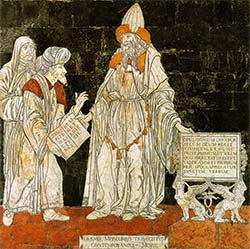
The welcome to the Temple of Zeus and Zevism: the Ancient faith behind all Ancient religions, the Gods falsely branded demonic, the practices for opening the chakras, freedom of belief, and Dedication as the first step.
Magick & Theurgy: the powers of the mind and soul, built on power meditation. The Magick Section holds the Chthonic Powers and the Theurgy Section the Heavenly Powers, each from Beginning to Advanced with Divination and Information; General Information, Knowing the Powers, serves both.
These hieratic names carry strong spiritual resonance and are recommended for summoning and invocation practices.
Divine Symbols
The Cadeuceus
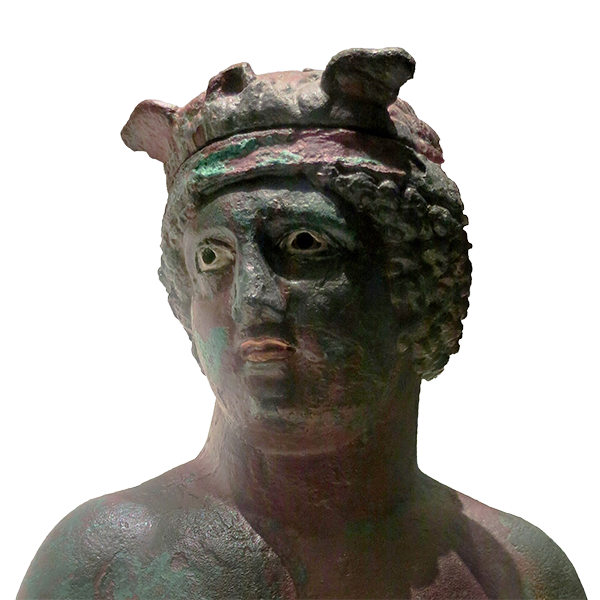
Petasos
Hermai
The Tortoise
Sandals
Logos (the Word)
The Stone Heap
Mercury
Divine Numbers and Attributes
Sacred Numbers
40, 50, 60
Runes
Thurisaz, Tiwaz, Sowilo (in order of importance)
Zodiac Sign of Power
Aries
Sacred Animals
The Great Eagle, the Bull, the Hawk, the Serpent
Element
Fire, Aether
Divine Forces
The Word (Logos)
Connection
Interpretation and Message
Living Form
Images and Signals
Forces of Nature
Deduction
Important Titles
the Great, the Great, the Great
Cyllene
Tricky
of the Roads
Guide of Souls
Herald
Lord of the Dead
I. Names
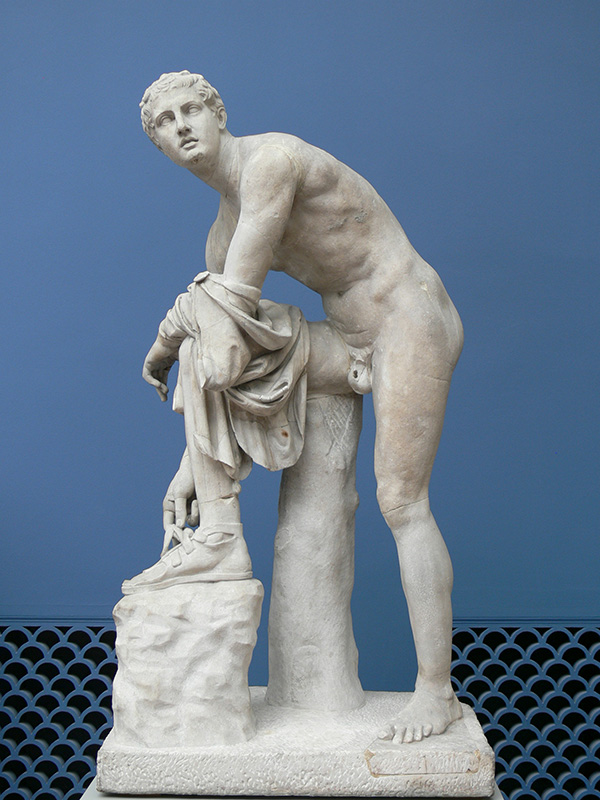
Hermes Fastening His Sandals, Ny Carlsberg Glyptotek Museum, copy of Lysippus
The name that bore a thousand faces was naturally subject to inquiry in antique times. The etymological Cratylus dialogue of Socrates in Plato's account makes the discussion of his name revolve around his link to ἑρμηνεύς (interpreter). He also states he believes the original name is Εἰρέμης (Eiremis) from the verbs εἴρειν (eirein "to speak") + μήσασθαι (mesasthai "to plot for oneself"), ἐμήσατο (emisato, "I contrived").1, 2
Other etymologies existed. One convention was, naturally, Ἑρμῆς from ἐρῶ (I speak). The Orphic Hymns alluded to the name appearing from ἑρμηνεὺς πάντων or the interpreter of all. Philo connected his name with being the ἑρμηνεύς, the prophet of divine beings.3, 4, 5
For modern scholars, one of the most obvious groupings is with the word for the stone-heap used as an ancient boundary marker, the ἕρμα. Xanthos of Lydia elaborates a myth of Hermes and the stone heap in the FGrHist 675 F 29, a story after the Argus episode, but the earliest surviving explicit etymological association between Ἑρμῆς and ἕρμα is in Orion’s fifth-century CE lexicon. Despite the lateness, such an attestation is deeply important, as Orion was the teacher of Proclus. 6, 7
The name Hermes is very ancient. As Arlene Allan explains, his name is found on three separate tablets from Pylos, Thebes and the ancient city of Knossos on Crete, the oldest of which is the Linear B tablet KN D 411. In the Iliad, he is called by the Epic or Ionic form Ἑρμείας, but the Odyssey uses the general form Ἑρμῆς.8, 9, 11, 10
Language / Culture
Name of Hermes
Attestation
Mycenaean Greek
e-ma-a2-o (𐀁𐀔𐁀)
Linear B tablets, Pylos, Thebes and Knossos (c. 1400 BCE)
Classical Greek
Ἑρμῆς (Hermes)
Homer, Hesiod, inscriptions (8th century BCE onwards)
Sources: Homer, Odyssey and Iliad, for the epic and classical name-forms; Arlene Allan, Hermes, and the Linear B tablet KN D 411, for the Mycenaean attestation.8,9,10,11
II. Hermes in Origin
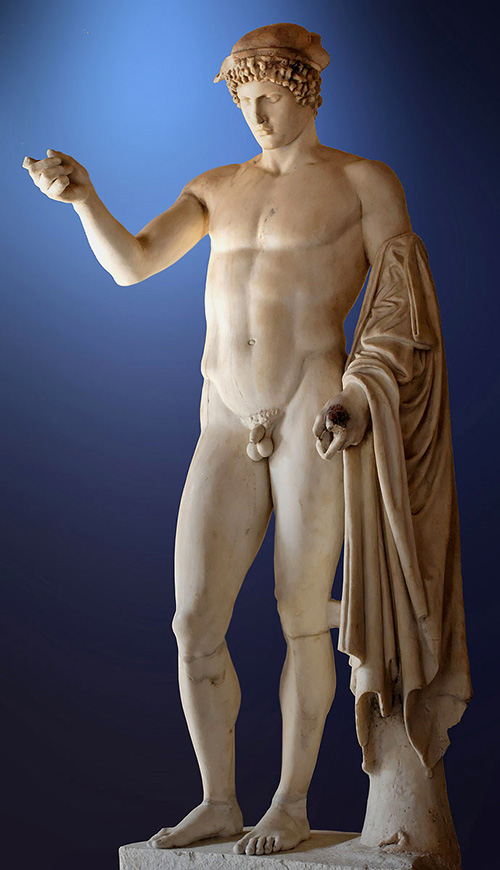
Hermes Logios, Roman copy of 5th century Greek original, National Roman Museum of the Altemps Palace
The Iliad
Hermes plays an liminal role in the Iliad. For the most part, he enigmatically stays out of conflict, acting as a guide for the characters. The scepter of Agamemnon is where he is introduced: it is said Hephaestus made it, who gave it to Zeus, who gave it to Hermes. From Pelops line the wand passed down to Agamemnon.
He rescues Ares from the jar the giants trap him in. The great runner Eudorus is described as his son in Book 16, hinting that his progeny share his talents. Hermes takes the pro-Greek side in the Battle of the Gods, but he courteously refuses to fight Leto, even inviting her to boast she overcame him. It is hinted the real reason he will not fight is to not anger Zeus.
In Book 24, he escorts the grieving Priam from Ilos to the camp of Achilles, using the two objects at his disposal: a wand which can lull any being to sleep and his golden sandals, and shoes that let him traverse heaven and earth. Hermes disguises himself as a youthful squire of Achilles to convince Priam to plead for Hector's dead body.
Pulling over the drapery of night, he tells the aged king to leave after waking him. He yokes horses and mules on a carriage, reaching the ford of the Xanthos. He returns to Olympus triumphant as dawn spreads over the land.10
The Odyssey
The role of Hermes is far more prominent in the Odyssey. In the beginning, the Gods command Hermes as Argeiophontes to send a warning to the vain Aegisthus who promptly ignores it, and this insolence leads to his own macabre downfall via Orestes, perpetuated through his own defilement.
While Athena is sent to Ithaca, Hermes is sent to tell Calypso that Odysseus must return home to confront the suitors occupying his house. Again he takes up his sandals and his wand to deftly stride toward Ogygia. There he is greeted with great hospitality by the nymph which turns to acrimony as she protests that Odysseus is torn away from her. Nonetheless, Hermes convinces Calypso.
By the tenth book, the god takes the same youthful disguise as the escort to Priam in order to free Odysseus from Circe's terror, which he does by giving him specific instructions, demonstrating his knowledge of magic and botany in elucidating a proper use of the moly plant, a dualistic herb black in root and white in flower, to protect himself. Book 15 and 19 contain some further references to the function of Hermes as the god who bestows charis (favor) upon mortal beings.
At the opening of the final book, Hermes of Cyllene summons the souls of the slain suitors. He holds his golden wand, and with it he rouses and leads the ghosts, who follow gibbering like bats squeaking in the recess of a cave when one falls from the cluster. He guides them down past the streams of Ocean, the White Rock, the gates of the Sun, and the land of dreams, to the asphodel meadow where the dead dwell. Homer gives us a lesson: The Iliad ends with Hermes guiding the living, the Odyssey with Hermes guiding the dead.11
Homeric Hymn
The craftiness of Hermes is highlighted in his unusual Homeric Hymn, the fourth, which elaborates at length his industriousness the day of his birth. Hermes is the form of an infant born to his mother, Maia. He cannot be contained by the confines of infancy. First, he takes the lucky find (hermaion), the tortoise. He kills it and scoops out the fat to make a lyre. Hermes desires to steal the cattle of Apollo. He turns them single-handedly by persuading the shepherd and he sacrifices them, but instead of giving in to his immense hunger, he piles their fat high in a byre. Most notably, he invents fire in the first place by creating heat from the laurel of Apollo, and then throws his own sandals into the river to cover his tracks. Ingenuity is the lesson.
Apollo, initially angry about the theft of his sacred cows, seeks out Hermes, who pretends to be an incapable infant in swaddled clothes. He persistently lies to Apollo, who, as the arbiter of cosmic truth, is nonetheless unconvinced, but is charmed by his deft art. The two become closely united as the best of friends. Eventually, the solar god decides to put Hermes to use for humanity and makes him swear to never lie to the divine, granting him a golden wand that he forever carries in heavenly service to the Olympian order, a rememberance of his oath. 12
The eighteenth Homeric Hymn is also dedicated to him, showing his origin from Maia.
Hesiodic and Orphic Context
"The herald of the deathless Gods" is what Hermes is called by Hesiod in his Theogony, and it is this role that Hermes plays in subsequent mythologies, connected to his epithets of kēryx and angelos, the messenger.13
The Orphic context also says much about Hermes as a mystery conductor, describing him as the 'fearsome tongue', exhorting him to grant grace in both speech and memorization.8, 14
III. The Epithets of the Thousand-Faced God
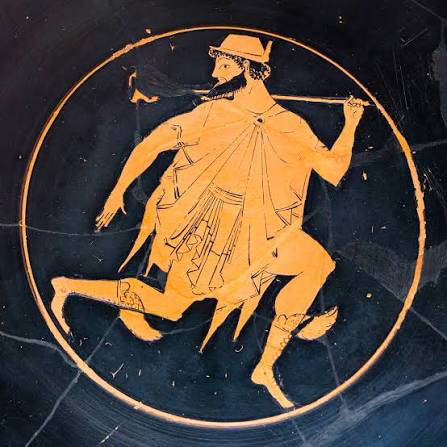
Hermes on kylix, Ambrosios Painter, c. 510BCE, Staatliche Antikensammlungen
It cannot come as a shock to know that the amount of epithets tied to Hermes was colossal in scope and depth. If the god had a thousand functions, he certainly had many names. The fourth Homeric Hymn lists forty of these by itself. These are the most important:
Epithet
Meaning
Domain
Hermes Propylaios (Ἑρμῆς Προπύλαιος)
Hermes before the Gate
Holy threshold cult, liminality
Hermes Agoraios (Ἑρμῆς Ἀγοραῖος)
Hermes of the Agora
Market-place, public exchange
Hermes Logios (Λόγιος)
Eloquent Hermes
Language, mind and logic
Hermes Enagōnios (Ἐναγώνιος)
Hermes of the Contests
Athletics, stadion, gymnasium
Hermes Cyllenios (Κυλλήνιος)
Hermes of Cyllene
Birthplace, famous site
Hermes Chthonios (Χθόνιος)
Hermes of the Earth
Graves, offerings to the dead
Hermes Psychopompos (Ψυχοπομπός)>
Guide of Souls
Escort of the dead
Hermes Nekyōn Anaktōr (νεκύων ἀνάκτωρ)>
Lord of the Dead
Chthonic sovereignty, Hermanubis
Hermes Kriophoros (Κριοφόρος)
Hermes the Ram-Bearer
Plague averting, resurrection
Hermes Promachos (Πρόμαχος)
Hermes the Champion
Tanagra, boxing
Hermes Epimēlios (Ἐπιμήλιος)
Hermes, Keeper of Flocks
Shepherds, sheep, herds
Hermes Dolios (Δόλιος)
Wily Hermes
Cunning, trickeryn
Hermes Aipytos (Αἴπυτος)
Hermes Aepytus
Tegea and Arcadia, Thoth
Hermes Enodios (Ἐνόδιος)
Hermes of the Road
Roads, journeys
Hermes Pylaios (Πύλαιος)
Hermes of the Gates
Gateways, entrances
Hermes Dromios (Δρόμιος)
Running Hermes
Speed, gymnasia
Hermes Hēgemonios (Ἡγεμόνιος)
Hermes the Guide
Guidance, processions
Hermes Kērux (Κῆρυξ)
Hermes the Herald
Heralds, diplomacy
Hermes Argeiphontēs (Ἀργειφόντης)
Slayer of Argos
Astral forces
Hermes Chrysorrhapis (Χρυσόρραπις)
Golden-wanded Hermes
Herald Staff
Hermes Polytropos (Πολύτροπος)
Much-turning Hermes
Trickster intelligence
Hermes Oneiropompos (Ὀνειροπομπός)
Sender of dreams
Dreams and oracles, sleep
Hermes Nyktophylax (Νυκτοφύλαξ)
Night-watcher Hermes
Night travel, secrecy
Hermes Kleptēs (Κλέπτης)
Hermes the Thief
Theft, stealth
Sources: Homer. Odyssey; Homer. Iliad; The Homeric Hymns and Homerica; Pausanias. Description of Greece; The Orphic Hymns. ed. Athanassakis and Wolkow; Aeschylus. Libation Bearers; Farnell. The Cults of the Greek States; Inscriptiones Graecae, IG10, 11, 12, 14, 15, 16, 17, 18
IV. The Temples of Hermes
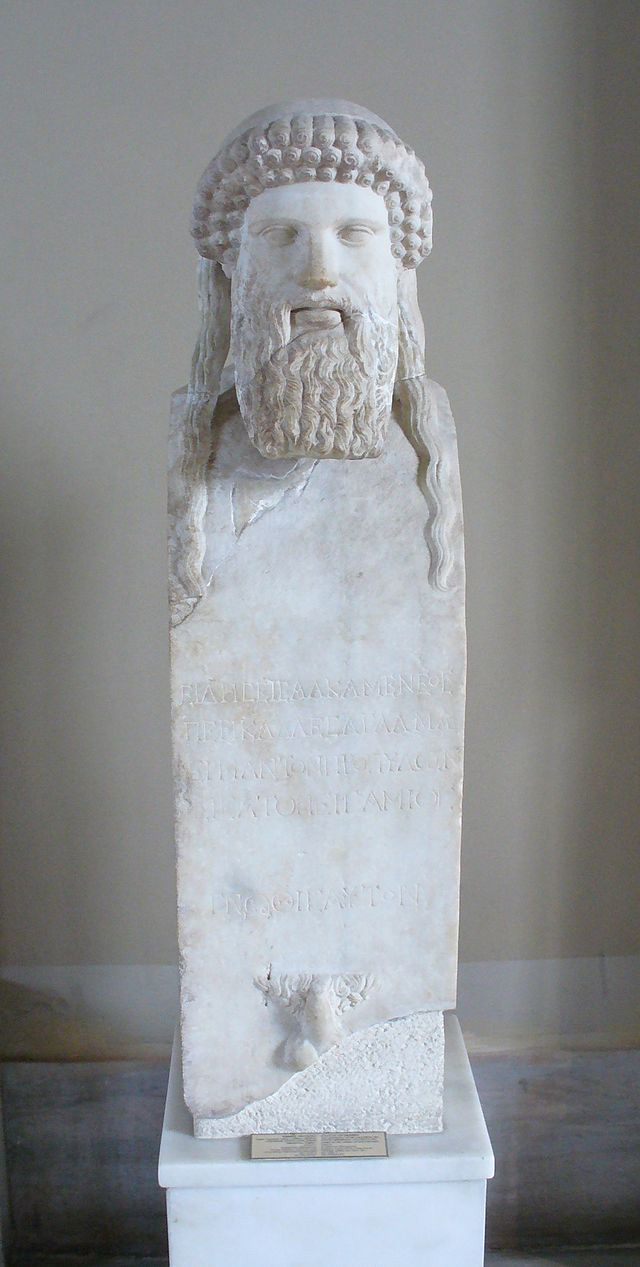
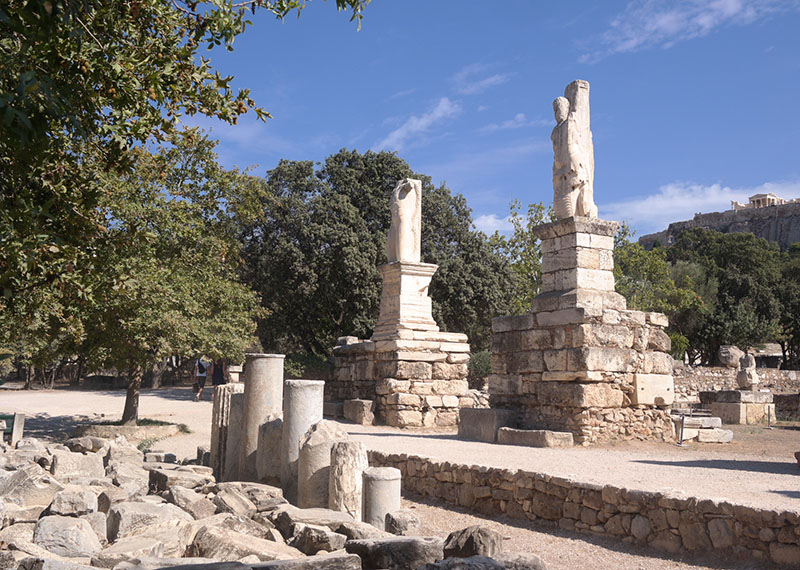
Herm with Hermes in archaic form
Remains of Athenian Agora
In contrast to the sheer abundance of naming conventions for Hermes, many of the sacred architectural elements tied to him in Greece were modest. The Hermetic principle and a presence in grandiose monumental structures was not a concept that the Greeks felt was compatible, principally because Hermes was a rural and liminal god, but also because the great temple to Hermes in Egypt was important. There is also a misconception among historians that Hermes arose as an Attic god around Athens.8, 17
Beyond this, Hermes' most presence was in the gymnasia of Greece, a function he shared with the great Heracles and Theseus.17, 19
Pheneus and Cyllene
Hermes was the chief god of Pheneus, a town in Arcadia located inbetween Mount Cyllene and the Aronaian chain. The rites of the god there were particularly ancient. Bucking the general pattern of Greek worship, there was a temple dedicated to him with a stone statue and a nearby spring where the infant god was bathed. This temple was also where the games of the Hermaia were held.
One of the great importances of the town was its dualistic nature. In addition to being situated between the mountain ranges, two streams that are disunited form into a single river in the nearby valley. The town was barely occupied in Pausanias' time, but the temple to Hermes was still important and attracted venerable worshippers.
Lycaon apparently built a sanctuary to Hermes on the peak of Mount Cyllene, according to Hyginus. As per the Description of Greece by Pausanias, it was dilapidated at that time. Part of the fame of the god in Arcadia was due to his fathering the great nature god, Pan, and the mortal Euandros.15,17,19
Athens
Athens was extremely important to Hermes for its proliferation of the hermai statues, and the presence of Hermes in the Athenian agora. Every door and corridor of an enclosed place or a crossroad was said to bear a herm. The existence of the god in daily life was more diffuse in dissemination than having a great temple.
The scandal when the hermai were mutilated was enough to cause extreme outrage in Athens, and the consequences were severe. It is arguable that this hubris was the one preliminary sign of the downfall of Athenian civilization.20,21
Tanagra
The dual cult of Hermes Kriophoros and Hermes Promachos was a fixture in the town of Tanagra in Boeotia. Pausanias saw the worship and rites connected to Hermes as particularly exceptional and beautiful in their display of piety, a display designed to avert plagues and disasters. The sanctuaries also housed a statue to Hermes made by Calamis.
His statue of the ram-bearer was so deeply revered and famous in antiquity that its likeness was frequently stamped onto Roman coins issued by Tanagra, becoming an honored model for the image of the Kriophoros used throughout the Roman Empire.15, 17,19
Kato Symi
Kato Symi on the island of Crete had a shared temple of Aphrodite and Hermes Kedrites. Archeologists discerned there were about 2,700 years of continuous use of this site, making it almost antediluvian and leading historians to call it the Cretan Delphi.22
Other sites
A dual cult of Zeus and Hermes existed in western Asia Minor in Lycaonia and Phrygia. The couple from the latter province in Ovid's Metamorphoses, Bauchis and Philemon, welcome the two gods into their home. Pausanias also claims that Themisonion in Phrygia believed that Apollo, Hermes and Hercules had saved them in divine grace from an invasion of maruading Gauls by revealing a hidden cave in a dream; the cave was consecrated to all three gods as a site of worship after the inhabitants used it to hide successfully without bloodshed.15,23
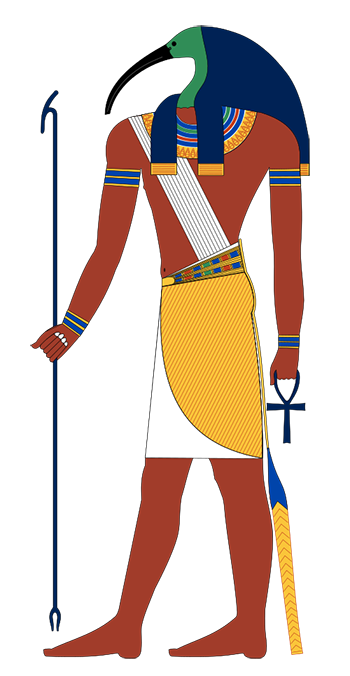
Most importantly of all, the temple of Thoth in Hermopolis Magna became a place of shared worship for both Hermes and Thoth, and it was in this locality of Egypt that the sacred Trismegistus formula originated. 8
V. The Merchant and the Thief
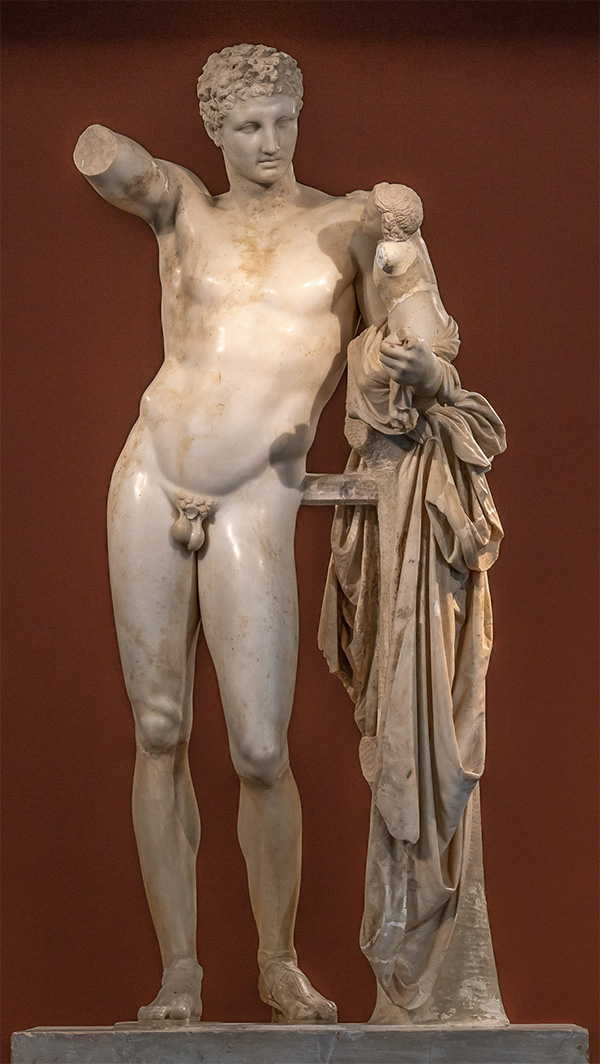
Hermes and the Infant Dionysus, Praxiteles, 4th century BCE
Μοσχίων Μοσχίωνος
ἀγορανομήσας
Ἑρμεῖ Ἀγοραίωι.
Moschion, son of Moschion
after serving as market superintendent
dedicated this to Hermies Agoraios.
Alabanda 8
The motif of turning stealing to various uses was elaborated in the Homeric Hymn to a large extent. Yet Hermes represented both polarities of selling and taking, manufacturing and requisitioning, bartering and sale, giving and taking. He was the god of the marketplace, the great social hub of every standing Greek city, and it is clear that any sale can only occur through communication.12,24
One inscription of the marketplace gives Hermes the rulership of balances and weights. The example betrays something important in the indication of mathematics and physics as sciences originating from these basic elements of barter, the most practical use of either in their primeval state. A marketplace also has the most names a place can hold; an object must be named to be bought.17,24
Nonetheless, the thief and trickster aspect of Hermes has made many question why a god would be involved in these kinds of activities. Alcaeus of Mytilene in his own hymn to Hermes has the infant swipe even the bows and arrows of Apollo. An ekphrasis of a painting of the swaddled infant already driving cattle into a cleft in the earth and stealing Apollo's weapons is elaborated by Philostratus who remarks that "the thefts of the god are delightful," and has the baby rob the whole pantheon.12, 25
To an extent, it showed the depth of cunning. The sign-reading of the god even in the Homeric Hymn allows him to recognize the Apollonian cows by their tracks, leading them to the hiding place. One symbol leads to comprehension of something not apparent.
The theft of Hermes belies deeper allegories about living and passing. Hermes also 'robs' what belongs to the gods when divine boundaries are transgressed; in this case the function is even more paradoxical as it involves thieving from the thief.
VI. The Tongue
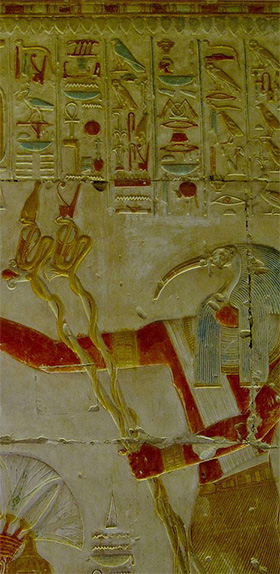
1st–2nd-century incense-burner, Hermes-Thoth with Ma'at feather, Louvre
The essence of Hermes as a persuasive through speech dates to the Homeric materials. There are other literary instances where this occurs; the continuity of Hermes as persuader par excellence is a divine attribute. In the Judgement of Paris by Lucian, Hermes uses various rhetorical tricks to convince the frightened Paris to accept the command of Zeus to judge the golden apple or beauty contest incident between Hera, Aphrodite and Athena. Likewise, the angry grumbling about Zeus from Ares is put to a stop by him in the Dialogues of the Gods, showing that he can even tame the most martial god with words.
This is connected to his original function: Diodorus Siculus in his collection of accounts from myth claims Hermes taught humans how to articulate their thoughts into speech. Hermes was, however, also thought of as being an interpreter of foreign tongues, the head of all exchanges in word between foreigners. The word ἑρμηνεύς means interpreter. The liminal nature of one speaker learning the tongue of the other mirrored divine function.1, 26
Perhaps most of all, Hermes was associated with charis, the bestowal of favor upon men. A variety of his epithets attest to the concept of charis being tied to both speech and goodwill among others. The concept was also deemed important in how the god granted certain talents to people out of his benevolent mind.8, 10
There is a certain degree of playfulness in Hermes' mildly subversive actions
and words; perhaps this is why he becomes one of the most frequently seen gods in
Athenian comedy and satyr play.
Arlene Allan, Hermes 8
The tie of Hermes to wit is deeply underlined in his Homeric Hymn, where his observations prove both a source of charm and laughter. It is also shown in numerous plays that Hermes tends to deal with the world as it is, rather than an idealistic form. The acceptance of things as-is, this is an attribute of his divine character.8
VII. The Secret
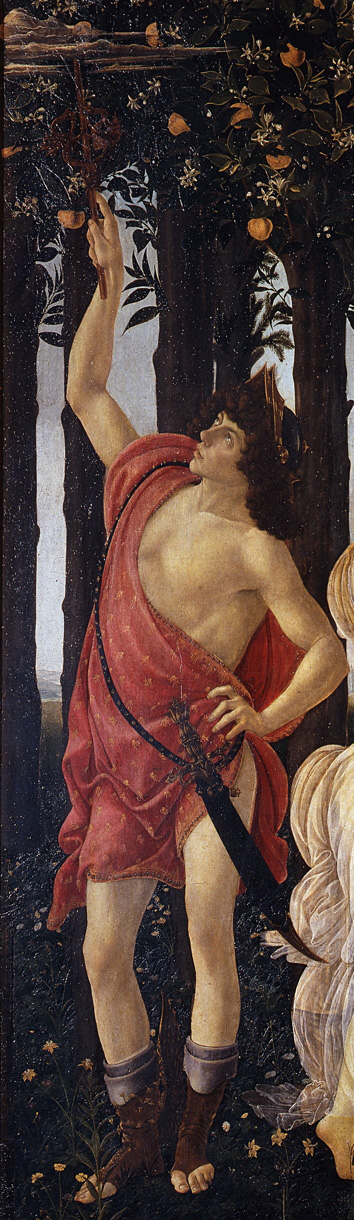
Hermes scene in Primavera, Sandro Botticelli (1482)
Invisibility is a major divine power of Hermes, tied often to the ambiguous nature of what is discussed above. As a deity of boundaries and threshholds like doors, he represents what is unseen and alarming. The realm of Hermes goes beyond words and into what is unknown.
The roots of the invisibility are in some of the ambiguities Hermes presents to us in myth. The act of concealing himself as a harmless infant in a cradle before Apollo is one. The utterance to Aegisthus which alludes to future consequences and is disastrously poorly understood in arrogance is another.
So ultimately Hermes also held the secret in his grasp. His presence communicated hidden truths in things, what lies beneath things, what the external appearance of anything conceals. Officially, the roots of his stealthy presence are in his seizure of the Cap of Hades.
Hermes as Kadmilos was connected to this at Samothrace. The Great Gods (Megaloi Theoi) of the Samothracian Mysteries included a figure the Greeks identified with Hermes: Kadmilos (Kasmilos), an ithyphallic god whose attributes were the ram's head and the caduceus, alongside Axieros (the Great Mother), Axiokersa (Persephone), and Axiokersos (Hades).19, 27
Another sacred element of secrecy was present at the mysteries at Eleusis. One of the two priestly families who conducted the mysteries claimed to be descended from Keryx, the son of the god. The descent of Persephone was enacted with appropriately Mercurial symbolism too.8
VIII. Psychopomp
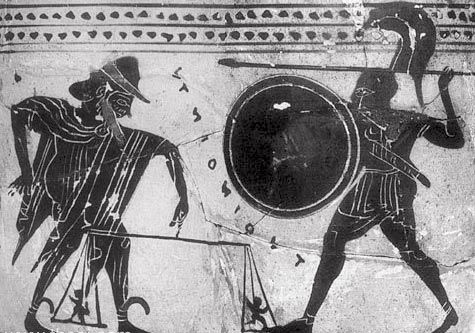
Hermes using scales with Memnon, lekythos, British Museum
Hermes is synonymous with the term psychopomp, namely being a guide to the dead. This aspect begins with the end of the Odyssey in attestation and becomes significantly more complex in reach, ideal and meaning from that point onwards. An endless assortment of artefacts, attestations and affirmations from ancient Greece show that the Cyllenian role grows into the full power over the denizens of the that shadowy realm. One prominent playwright starts his entire play with:
Ἑρμῆ χθόνιε, πατρῷ' ἐποπτεύων κράτη...
Hermes of the Underworld, you who watch over my father's powers…
Aeschylus, Libation Bearers
The most major role of Hermes in this literary context lies in his escort of Kore to the underworld, a journey beginning with his role in the Homeric Hymn to Demeter. Ajax prior to death calls upon the god to escort him in death (πομπαῖον Ἑρμῆν χθόνιον), as Sophocles has it. Interestingly, in the Persians of Aeschylus, Hermes is tasked with drawing the soul of king Darius up into the light: for this, he is psychogogos, the soul-raiser. One of his lost plays, Psychagogoi, alos revolved around this in relation to the Odyssean nekyia.12, 28
The epithet 'Khthonie' in itself has a certain ambiguity, meaning both of the earth and of the underworld. This was also the focus of the third day of the Anthesteria, otherwise dedicated to Dionysus. On this date, only Hermes Khthonios was worshipped and given tribute by the faithful with a cooked seed mash (panspermia), the age-old offering to the dead, as the historian Theopompos notes.29, 30
Funerary oil flasks named lekythoi were placed on Athenian tombs and graves with images of Hermes Psychopompos. The mass-production of these flasks seemed to intensify morbidly during the Peloponnesian War when casualities in Athens and other states reached a large enough level to eventually become notable fixtures in archeological recovery.31, 32
Another example is the representation of Hermes and the winged deceased (eidola). Vase-painting frequently depicts Hermes among small winged souls. Most strikingly, these show scenes of tiny souls fluttering from a large storage jar (a pithos), associated by scholars with the Anthesteria and the release of the dead.31, 33
Another funerary monument was the hermai.
IX. The Hermai
Hermai are statues with heads affixed to a great stone which represented a certain kind of function related to chthonic powers. The curious monuments were known to be a fixture of Athenian life, essentially visible everywhere. They were typically fixed as four sided quadrilateral stones and often given phalli, and in general the hermai were placed at liminal boundary zones.20, 21
Busts of Hermes on these artefacts are always represented as bearded, long-haired and mature. Plato stated that Hipparchus made the herms replete with sayings.
Herodotus reports that the ithyphallic herm came from ancient Pelasgian initiatory rites connected with the divine mysteries of Samothrace.
The great historian (2.51) does not hide the secret's existence in his writings. The ithyphallic images of Hermes, the herms, carry a sacred story (hieros logos) that is disclosed only in the Samothracian rites of the Kabeiroi. "Whoever has been initiated," he writes, "understands what I mean", the gesture of the initiate who knows a secret he will not spell out. Here the physical form of the herm is an encoded mystery, and Herodotus, himself a priestly initiate, treats it as such.34, 35
On a more basic level, the eponymous dialogue of Plato says Hipparchus set up the hermai along roads in the city and countryside specifically to educate. The unique hermai carried maxims so that passers-by would presumably “acquire a taste for his wisdom”. Examples of these phrases included:
στεῖχε δίκαια φρονῶν.
Walk with just intent.
μὴ φίλον ἐξαπάτα.
Do not deceive a friend. , quoted in Plato, Hipparchus, 228d-229b.
Certain early descriptions say that the first images of Hermes depict him as a wooden post held in place by stones. Modern classicists debate the extent to which the Hermai evolved from the primeval depictions elaborated thus, as the first herm from Samothrace is described as carved, and the etymology of Hermes is connected to these fixtures.8
Many gods were represented and the hermai need not just be Hermes. They could be of other gods, but the majority of extant hermai show a dualistic aspect, such as the Hermaphroditus, Hermathena, Hermares and other combinations found from antiquity.8, 20
X. Hermes in Philosophy
Plato's discussion of Hermes outlined a number of things. In the Timaeus, he connects Hermes to the 'planet sacred to him', the eponymous planet to the Greeks but the one we know as Mercury. He also describes Theuth in the Phaedrus and Philebus, the Egyptian god who was for Socrates the bestower of divine sounds into written letters. But it was the discussion of the Cratylus that most fascinated subsequent philosophers.1, 36
Prior to his comments on the discussion above, Proclus makes a sharp distinction between a true philosopher using rhetorical means to arrive at truth and a sophist doing so to exhibit their speech as a tool to impress. This is one of the mysteries of Hermes, namely that two verbal methods using the same embellishments to the ear can be used for entirely distinct, perhaps oppositional, purposes.
Unlike many of the other gods, the comments of Proclus on the etymological discussion of Hermes' name does not survive. But Proclus intuits from the joke of Socrates about his discourse partner, Hermogenes, that ἕρμαιον (profit or windfall) is connected to his name, that there is a chain of command in what Hermes rules over.
In chapter 28, he ranks the “Hermaic gifts” from highest to lowest: first purely intellectual goods (indivisible truth), then goods perfecting discursive thought (knowledge in a sequence, reading signs properly), then purification from irrationality and moderation of imagination (guarding against fantasy), then the establishment of logoi within nature (the signs of nature and limits in which natural things exist), and only last external advantages and profits like the ἕρμαιον (knowledge of material gain). This ladder he gives also mirrors the process of true communication with the divine.37, 38
Other aspects of his discussion relate to Hermes. The god is the connector who attaches the ends of everything to the beginnings of another. The logos travels downward in the chain above through that mechanism. At the same time, Hermes then bestows the medium of discovery, he gives discursive thought, and he finally leads those suitable to the discovery of the Good itself. The lower knavish destination can lead to the divine, the loop goes from one arc to another, which is what the fourth Homeric Hymn shows. For Proclus:
ὁ δὲ πειθοῦς δημιουργὸς οὐκ ἄλλος ἢ ὁ Ἑρμῆς
The demiurge of persuasion is none other than Hermes.
Proclus assigns Hermes the function of being the head of all messengers. The end at the episode of the Iliad is the most illustrative case of this principle. It shows how intellect travels down to the characters at the bitterest moment to save them from ruin as Hermes gives Priam the right formula to end the war, and the terrorized Priam and ever-vengeful Achilles reconcile by the divine vehicle.
The art of philosophical discourse is Hermetic. Olympiodorus says Socrates is to the craven Alcibiades what Hermes is to Odysseus in giving him moly to use against Circe. The herb of ivory and ebony is a symbol of the rational antidote against being transformed into a beast by the crowd and their whims. The warning Hermes gives to Aegisthus in the Odyssey is another example, one of how words can precede and succeed calamity; men at the height of their virility can become slavish beasts. Zeus allows Hermes to hold the scales. The thief can take away what has been given.10, 39
Although his functions indeed deal with guiding souls to their next destination as Cyllene does in the Odyssey, Hermes is properly psychopompic in matters beyond being assigned the role of a deity of death. The divine signature is transition between gods and humans, intellect and speech, word and reading, travel and destination, hidden meaning and interpretation, call and response, sleep and waking, black and white, life and death, above and below.
XI. Hermes the Swift-Footed
The role of Hermes was connected with vehicles, an association that today is still considered Mercurial. Even in the Iliad, he uses various methods to transport himself and other people from place to place. In the hymn of Demeter, Hermes takes the reins and whip and drives Persephone out of Hades back toward Demeter. This is also why Hermes was associated with roads, the post and other aspects connected to his messenger role.11, 12
Of all the great active associations, his tie to contests and the gymnasia were the most prominent, visible and comprehensible fixtures in Greek life. One of Hermes' most important epithets was 'of the contests' (Ἐναγώνιος), and Pausanias says that near the starting point for the Olympic chariot race stood an altar of the swift-footed god for all to see. As Arlene Allan says8, the roots ran deep:
That the god was so intimately associated
with athletics, especially running (given his own phenomenal speed), is attested
in the naming of long-distance runners, Hermerodromoi, after the god.
The association with sport did not end there. The author of the Description of Greece also recorded a gymnasium in Athens named after Hermes, and claimed that in the gymnasium of Ptolemy, there were notable hermai. In his retaliatory speech five centuries earlier, Aeschines claims the lawgiver regulated the festivals of the Muses in schools and the festivals of Hermes in wrestling-schools, and also the mentions “contests of Hermes” connected with boys and gymnasia. The IG II³ 4, 389 inscription of 36-7BCE by Athenian ephebes and personal trainers claims that Hermes is one of the gods of the gymnasium40, 41:
Martial arts and wrestling were a particularly dexterous sport where the association of Hermes was prevalent. Related to the rite of Tanagra, it was said Hermes boxed Ares for the hand of the maiden who gave her name to the town:
περὶ τεοῦς Ἑρμᾶς πὸτ Ἄρεα πουκτεύει.
For your sake Hermes boxes against Ares.
Corinna, fr. 666
Hermes also had numerous festivals dedicated to him often tied to athletics, most of which were simply called Hermaia but often differed quite strongly in their character beyond the name:
Hermes Ritual Days
Place
Description
Importance
Date Recorded
Phenean Hermaia
Pheneus
Core Festival
Hermean games, temple worship
Pausanias (2nd century CE)
Athenian Hermaia
Athens
Athletic Festival
Oak ritual, bridal image
Aeschines (345-6 BCE)
Kriophoros
Tanagra
Plague Rite
Youth with ram, plague aversion
Pausanias (2nd century CE)
Cretan Hermaia
Cydonia
Social Inversion
Masters waiting on slaves
Athenaeus (2nd century CE)
Delian Hermaia
Delos
Athletic festival
Oak ritual, bridal image
Inscriptions (137-132 BCE)
Macedonian Hermaia
Beroia
Athletic Festival
Discipline, athletics, body prize
Inscription (2nd century BCE)
Sources: Pausanias, Description of Greece, for the Phenean and Tanagran (Kriophoros) Hermaia; Aeschines, Against Timarchus, for the Athenian Hermaia; Athenaeus, Deipnosophistae 14.639b, for the Cretan Hermaia at Cydonia; Gauthier and Hatzopoulos, La loi gymnasiarchique de Béroia, for the Macedonian Hermaia; Poliakoff, Combat Sports in the Ancient World, for the athletic and combative character of the festivals; Campbell, Greek Lyric IV, for Corinna fr. 666 on Hermes boxing Ares; and Bagnall and Derow, The Hellenistic Period, for the Delian Hermaia15,40,42,43,44,45,46
XII. Megiste, Megiste, Megiste
The origins of Hermes Trismegistus are legendary even in classical accounts. The earliest known triple-great Thoth, a unique innovation in Egyptian religion, is a hieroglyphic inscription at Edfu, from the reign of Ptolemy V Epiphanes, 204–181 BCE: Ḏḥwty ꜥꜣ ꜥꜣ wr nb Ḫmnw, “Thoth the great, great, great, lord of Hermopolis.”47, 48
The archive of Hor of Sebennytos at Saqqara. One Demotic ostracon, dated to June 1, 172 BCE, calls the ibis “the soul of Thoth, the three times great,” while another Greek ostracon gives the equivalent expression μεγίστου καὶ μεγίστου θεοῦ μεγάλου Ἑρμοῦ, “of Hermes, the great god, greatest and greatest.” Thrasyllus in the first century CE refers to ὁ λεγόμενος Τρισμέγιστος Ἑρμῆς. The identities of the deity as 'thrice-great' in both languages appear at the same time.47, 49
It is from this point that the general mystic tradition of Hermeticism develops. The visual evidence is early as Hermes is portrayed with a feather of Ma'at. The earliest astrological corpus like the Salmeschoiniaka and Liber Hermetis of the third century BCE even precedes the mention of the Thrice Great. The former, highlighted by Iamblichus, showed the division of the zodiac into 36 specific 10-degree segments called decans, often used to govern special topics, areas of life, and planetary strengths.50, 51
The most important of these was the Emerald Tablet, transcribed much later as an Arabic text named the Book of the Secret of Creation and the Craft of Nature by the late eighth century. It outlines philosophical ideas through visual codes and deals with the alchemical nature of the soul. Contrary to academic belief, the emergence of the Hermetic literature at the same time Thoth is given the epithet is a strong indication that Greece's norms influenced those of Egypt, not just the other way round.47, 52
XIII. The Many Symbols and Faces of Hermes
Animal Symbols
The humble and slow tortoise was Hermes' sacred animal above others, symbolic of his fashioning of the lyre. Paradoxically, the quickened hare was another animal symbol which was turned into a constellation in myth, and the inheritance Aesop gives us in their age-old race is part of the Hermetic inheritance of symbolic dualism.12, 53
Agalma
In regular statuary, Hermes is represented most often as a young man. His facial features often show an airy influence. Of the gods, Hermes is the deity most likely to be given dynamic poses. The so-called Hermes Logios statues tend to portray his arm held upwards, as if he is giving a speech, but scholars are divided on whether these are psychopompic statues or represent an aspect of oratorical nature.17, 27, 53
Youth represents potentiality rather than completion. It reflects Hermes as a continuous transition-state, the youthful man that has set upon a journey, being the journey. The body is usually lean, fast, “unfinished” in the sculptural sense, in stark contrast to the muscular figures of the other gods, suggesting mobility and flexibility over permanence or prominence. Another aspect of this is that Hermes is often portrayed nude, but also marginally clothed.
Certain statues like the 'Hermes Fastening his Sandal' type emphasize the feet and hands, unusually showing a god in the middle of dynamic preparation. The face is also turned toward Zeus above as if in a state of shock. Wings are present on the sandals, the helmet, often the head. On the sandals (called the Talaria), they represent movement that is not bound by physical friction.27, 53
On the helmet and sandals, this points to a given role. These are tools, not part of Hermes’ being.
This does not necessarily point to Hermes having borrowed power. It is just yet another element of Hermes that is not “set in stone” and yet is set in stone by virtue of being a statue. A helmet can be taken off, sandals can be taken off, pointing further to the fact that nothing is certain, but on a statue they also cannot be removed. The paradox is the divine message.
Another attribute Hermes has the petasos, the round hat of the traveller or farmer. This is evocative of his rural and rustic origins but points also towards his speed. The need for farmers not to be burned by the sun preceeds all work.8 The perfectly round shape recalls one of his divine symbols, the circle.
Cadeuceus
The cadeuceus (κηρύκειον) perhaps represents the most famous short hand for the god alongside the Mercury glyph. Symbolically, the two weaving serpents represent the hermetic principle perfectly. The exchange of the lyre for the wand recalls the close association of Hermes with the philosophical Apollo who gifted it, his divine tutor. In myth, Hermes invariably uses the wand to lull others to sleep, such as the giant Argus.12, 53
Expounding on this, Olympidorus in his interpretation of Plato's Alcibiades dialogue states that the cadeuceus itself is symbolic of philosophical dialectic. Dialectic weaves in and out as the snakes in the points of reasoned argument. Socrates is more truly Hermaic than the orator Demosthenes, because Socrates does not merely speak beautifully; he uses speech to convert the soul, to turn it upward as a psychegoge.53, 54
Psychostasia
Of all the psychopompic iconography, the psychostasia of Hermes is the most revealing one. Here, the connection of Hermes to Thoth, Anubis and Ma'at is made obvious, as Hermes himself holds the balance of the scales to weigh the souls of heroes like Achilles and Memnon. The character of this weighing is often different to that of the Egyptian context. Instead of a feather, two heroes are put in miniature on each cup of the scale. The iconography is very ancient, such as the London B639 vase of the British Museum. Another funerary monument was the hermai.55, 56, 57, 58
Mercury
The planet Mercury (Ἑρμῆς in Greek) was not always known by that name. The Greeks originally connected it with the dusk phase of Mercury only, while the morning appearance was called Apollon (Ἀπόλλων), and it was often called Stilbon (Στίλβων). The discovery that the planet was the same during the day and night led to it being called Ἑρμῆς. There is a mystery even in this misconception correlating to Mercury's proximity to the Sun and its inherent duality, and Mercury's orbit was impossible to calculate in classical times.59, 60, 61
Sources and Bibliography
Plato. Cratylus. In Plato in Twelve Volumes, vol. 12, translated by Harold N. Fowler. Cambridge, MA: Harvard University Press; London: William Heinemann, 1921. 407e–408a. For Socrates’s etymologies of Hermes from ἑρμηνεύς and Eἰρέμης.
Beekes, Robert S. P., with Lucien van Beek. Etymological Dictionary of Greek. 2 vols. Leiden Indo-European Etymological Dictionary Series 10. Leiden: Brill, 2010. S.vv. “Ἑρμῆς,” “εἴρω/ἐρῶ,” “μήδομαι.” For the modern etymology of the name.
Etymologicum Magnum. 376.20, s.v. the Hermes-derivation, quoted in Ludwig Radermacher, “A. Initia Artis.” For the derivation παρὰ τὸ ἐρῶ, “from erō, ‘I say.’”
Orphic Fragment 297 Kern = 413 Bernabé, quoted in Ioannes Diaconus Galenus, commentary on Hesiod, Theogony 943. For Hermes as ἑρμηνεὺς τῶν πάντων in the Orphic material.
Philo. On the Embassy to Gaius. Translated by F. H. Colson. Loeb Classical Library 379. Cambridge, MA: Harvard University Press; London: William Heinemann, 1962. For Philo’s linking of the name with the ἑρμηνεύς, the prophet of divine beings.
Orion of Thebes. Etymologicum, s.v. Ἑρμῆς. Edited by Friedrich Wilhelm Sturz. Leipzig: Weigel, 1820; reprint, Hildesheim: Olms, 1973. For the earliest explicit link of Ἑρμῆς with ἕρμα, the stone-heap.
Dizionario Etimologico della Mitologia Greca (DEMGO). “Ἑρμῆς.” University of Trieste. For the survey of etymological proposals (Mycenaean e-ma-a₂, Nilsson, Wilamowitz, Chantraine).
Allan, Arlene. Hermes. Gods and Heroes of the Ancient World. London: Routledge, 2018. For the antiquity and attestation of the name, Hermes in comedy, the concept of charis, and the herms.
LiBER: Linear B Electronic Resources. “KN D 411.” Consiglio Nazionale delle Ricerche. For the Knossos tablet transcribing e-ma-a₂-o.
Homer. The Iliad. Translated by A. T. Murray, revised by William F. Wyatt. Cambridge, MA: Harvard University Press, 1999. For Hermes in the Iliad, the escort of Priam, and his association with vehicles.
Homer. The Odyssey. Translated by A. T. Murray, revised by George E. Dimock. Cambridge, MA: Harvard University Press, 1995. For the role of Hermes in the Odyssey, the moly episode, charis, and the classical name-form.
The Homeric Hymns and Homerica. Translated by Hugh G. Evelyn-White. Loeb Classical Library 57. Cambridge, MA: Harvard University Press, 1914. For the Homeric Hymn to Hermes (the birth-day inventions, the theft of the cattle, and the epithets) and the Homeric Hymn to Demeter (Hermes’ escort of Kore).
Hesiod. Theogony. Translated by Hugh G. Evelyn-White. Loeb Classical Library 57. Cambridge, MA: Harvard University Press, 1914. For Hermes as “herald of the deathless gods.”
The Orphic Hymns. Edited and translated by Apostolos N. Athanassakis and Benjamin M. Wolkow. Baltimore: Johns Hopkins University Press, 2013. Hymns 28 and 57. For Hermes as messenger, lord of the dead, and chthonic way-leader.
Pausanias. Description of Greece. Translated by W. H. S. Jones and H. A. Ormerod. 5 vols. Loeb Classical Library 93, 188, 272, 297, 355. Cambridge, MA: Harvard University Press, 1918–1935. For the epithets and cult sites of Hermes across Greece, Pheneus, Cyllene, Tanagra, Themisonion, and the Athenian gymnasia.
Aeschylus. Libation Bearers. In Aeschylus: Oresteia, edited and translated by Alan H. Sommerstein. Loeb Classical Library 146. Cambridge, MA: Harvard University Press, 2008. Lines 1–5. For the invocation of Hermes Chthonios that opens the play.
Farnell, Lewis Richard. The Cults of the Greek States. Vol. 5. Oxford: Clarendon Press, 1909. For the cultic prominence, Arcadian depth, and the pastoral, agonistic, and commercial forms of Hermes.
Inscriptiones Graecae, IG II² 4, 16; and Attic Inscriptions Online. For the dedication to Hermes Propylaios at the Athenian Acropolis approach.
Larson, Jennifer. Ancient Greek Cults: A Guide. New York: Routledge, 2007. For Hermes in the gymnasia, the Arcadian cults, and the Samothracian Great Gods.
Osborne, Robin. “The Erection and Mutilation of the Hermai.” Proceedings of the Cambridge Philological Society 31 (1985): 47–73. For the herms as an Athenian fixture and the mutilation scandal of 415 BCE.
Parker, Robert. Polytheism and Society at Athens. Oxford: Oxford University Press, 2005. For the place of the herms and of Hermes in Athenian civic religion.
Lebessi, Angeliki, and Polymnia Muhly. “The Sanctuary of Hermes and Aphrodite at Syme, Crete.” National Geographic Research 3, no. 1 (1987): 102–113. For the long-lived shared sanctuary of Hermes Kedrites and Aphrodite at Kato Symi.
Ovid. Metamorphoses. Translated by Frank Justus Miller, revised by G. P. Goold. 2 vols. Loeb Classical Library 42–43. Cambridge, MA: Harvard University Press, 1977–1984. 8.611–724. For Baucis and Philemon receiving Zeus and Hermes in Phrygia.
Cousin, Georges, and Charles Diehl. “Inscriptions d’Alabanda.” Bulletin de correspondance hellénique 10 (1886): 308, no. 3. For the dedication to Hermes Agoraios by a market superintendent at Alabanda.
Philostratus the Elder. Imagines. Translated by Arthur Fairbanks. Loeb Classical Library 256. Cambridge, MA: Harvard University Press, 1931. For the ekphrasis of the infant Hermes’ thefts (“the thefts of the god are delightful”).
Diodorus Siculus. Library of History. Translated by C. H. Oldfather. Loeb Classical Library. Cambridge, MA: Harvard University Press, 1933–. 1.16. For Hermes–Thoth as the god who gave humans articulate speech.
Burkert, Walter. Greek Religion. Translated by John Raffan. Cambridge, MA: Harvard University Press, 1985. For the Samothracian Kabeiroi and Kadmilos and the interpretation of Hermes’ cult and image.
Aeschylus. Persians. In Aeschylus, Volume I, translated by Herbert Weir Smyth. Loeb Classical Library 145. Cambridge, MA: Harvard University Press, 1926. For Hermes as psychagogos raising the ghost of Darius; the lost Psychagogoi (Sommerstein, Aeschylus: Fragments, LCL 505) treated the same theme.
Dasen, Véronique. “Playing at the Festival: Aiora, a Swing Ritual.” In Play and Games in Classical Antiquity, edited by Véronique Dasen and Marco Vespa, 61–77. Liège: Presses Universitaires de Liège, 2021. For the Anthesteria and its third day (Chytroi), when Hermes Chthonios received the panspermia.
Mili, Maria, and Jenny WAllansten. “Dedications from the Dead? The Strange Case of Hermes Chthonios.” In Greek Epigraphy and Religion, edited by Nikolaos Papazarkadas and Stephen V. Tracy, 203–230. Leiden: Brill, 2020. For the cult and offerings of Hermes Chthonios.
Oakley, John H. Picturing Death in Classical Athens: The Evidence of the White Lekythoi. Cambridge: Cambridge University Press, 2004. For Hermes Psychopompos on Athenian funerary lekythoi and their intensified production in wartime.
Brendle, Rossana. “The Message Is in the Medium: White-Ground Lekythoi and Stone Grave Markers in Classical Athens.” In A Companion to Ancient Greek and Roman Art, 121–138. Cambridge: Cambridge University Press, 2020. For the funerary use and context of the white-ground lekythoi.
Boardman, John. Athenian Red Figure Vases: The Classical Period. London: Thames and Hudson, 1989. For vase-paintings of Hermes among the winged souls (eidola) released from the pithos.
Herodotus. Histories 2.51. Edited by C. Hude, Oxford Classical Texts, 3rd ed., 1927; translated by A. D. Godley, Loeb Classical Library, 1920. For the ithyphallic herms, their Pelasgian and Samothracian origin, and the initiate’s reticence.
Plato. Hipparchus 228d–229b. In Plato: Charmides, Alcibiades I and II, Hipparchus, The Lovers, Theages, Minos, Epinomis, translated by W. R. M. Lamb. Loeb Classical Library 201. Cambridge, MA: Harvard University Press; London: William Heinemann, 1927. For Hipparchus setting up inscribed herms bearing maxims along the roads of Attica.
Plato. Timaeus. Translated by R. G. Bury. Loeb Classical Library 234. Cambridge, MA: Harvard University Press, 1929. 38d. For the planet “sacred to Hermes” (Mercury).
Proclus. On Plato’s Cratylus. Translated by Brian Duvick. London: Duckworth, 2007. Greek text: Procli Diadochi in Platonis Cratylum Commentaria, edited by Giorgio Pasquali (Leipzig: Teubner, 1908). Ch. 28. For the ranking of the “Hermaic gifts” from intellectual truth down to the ἕρμαιον.
van den Berg, Robbert Maarten. Proclus’ Commentary on the Cratylus in Context: Ancient Theories of Language and Naming. Leiden: Brill, 2008. For the interpretation of Proclus on Hermes, names, and persuasion.
Olympiodorus. Commentary on Plato’s Phaedo. In The Greek Commentaries on Plato’s Phaedo, vol. 1, edited and translated by L. G. Westerink. Amsterdam: North-Holland, 1976. For the analogy of Socrates and Alcibiades to Hermes and Odysseus (the moly).
Aeschines. Against Timarchus. In The Speeches of Aeschines, translated by Charles Darwin Adams. Loeb Classical Library 106. Cambridge, MA: Harvard University Press, 1919. For the regulation of the festivals of Hermes and the Muses in the schools and wrestling-grounds.
Inscriptiones Graecae. “IG II/III³ 4, 389.” Inscriptiones Graecae: Digitale Edition. Berlin-Brandenburgische Akademie der Wissenschaften. For the ephebic dedication (36/7 AD) naming Hermes among the gods of the gymnasium (see also Lambert, de Lisle, and Kamphorst, “AIUK 11 no. 4,” Attic Inscriptions Online).
Athenaeus. The Learned Banqueters (Deipnosophistae) 14.639b. For the Cretan Hermaia at Cydonia, at which masters waited upon their slaves.
Gauthier, Philippe, and Miltiades B. Hatzopoulos. La loi gymnasiarchique de Béroia. Meletemata 16. Athens: Centre de Recherches de l’Antiquité Grecque et Romaine, 1993. For the Macedonian Hermaia and the gymnasiarchic regulation of the festival at Beroia.
Poliakoff, Michael B. Combat Sports in the Ancient World: Competition, Violence, and Culture. New Haven: Yale University Press, 1987. For the athletic and combative character of the Hermaia and Hermes’ patronage of wrestling.
Campbell, David A., ed. and trans. Greek Lyric IV: Bacchylides, Corinna, and Others. Loeb Classical Library 461. Cambridge, MA: Harvard University Press, 1992. For Corinna fr. 666, in which Hermes boxes Ares for Tanagra (Greek text also in D. L. Page, Poetae Melici Graeci, Oxford: Clarendon Press, 1962).
Bagnall, Roger S., and Peter Derow, eds. The Hellenistic Period: Historical Sources in Translation. 2nd ed. Malden, MA: Blackwell, 2004. For the Hellenistic inscriptional evidence of the Delian Hermaia.
Bull, Christian H. The Tradition of Hermes Trismegistus: The Egyptian Priestly Figure as a Teacher of Hellenized Wisdom. Religions in the Graeco-Roman World 186. Leiden: Brill, 2018. For the origin of the “thrice-great” title in Egyptian and Greek sources and the Edfu and Hor evidence.
Fowden, Garth. The Egyptian Hermes: A Historical Approach to the Late Pagan Mind. Cambridge: Cambridge University Press, 1986. For the emergence of Hermes–Thoth and the Hermetic tradition in Greco-Roman Egypt.
Ray, J. D. The Archive of Ḥor. Texts from Excavations 2. London: Egypt Exploration Society, 1976. For the Saqqara ostraca of Hor of Sebennytos, including the “thrice-great” epithet (172 BCE).
Roccati, Alessandro. “Σαλμεσχοινιακά.” In Greco-Roman Cities at the Crossroads of Cultures, 207–212. Oxford: Archaeopress, 2019. For the early Egyptian astrological corpus the Salmeschoiniaka.
Iamblichus. De mysteriis. Edited and translated by Emma C. Clarke, John M. Dillon, and Jackson P. Hershbell. Atlanta: Society of Biblical Literature, 2003. For the Hermetic and decanal astrology highlighted by Iamblichus (see also Kyle Fraser, “Hermetism and Hieratic Tradition in the De mysteriis,” Greek, Roman, and Byzantine Studies 65 [2025]: 386–409; and Briant Bohleke, “In Terms of Fate,” Studien zur Altägyptischen Kultur 23 [1996]: 11–46).
van Bladel, Kevin. The Arabic Hermes: From Pagan Sage to Prophet of Science. Oxford: Oxford University Press, 2009. For the later Arabic transmission of the Emerald Tablet in the Book of the Secret of Creation (Sirr al-khalīqa).
Kerényi, Karl. Hermes: Guide of Souls. Translated by Murray Stein. Dallas: Spring Publications, 1976. For the symbolism of Hermes’ animals, his youthful iconography, the winged sandals, and the caduceus.
Olympiodorus. Commentary on the First Alcibiades of Plato. Edited by L. G. Westerink. Amsterdam: North-Holland, 1956. For the caduceus as an image of dialectic and for Socrates as more truly Hermaic than Demosthenes.
Morrison, James V. “Kerostasia, the Dictates of Fate, and the Will of Zeus in the Iliad.” Arethusa 30, no. 2 (1997): 276–296.
Leone, Massimo. “Weight Problems: An Enquiry into Scales and Justice.” Insights 8, no. 8 (2015): 1–31.
Martin, Bridget. “Cold Comfort: Winged Psychai on Fifth-Century BC Greek Funerary Lekythoi.” Bulletin of the Institute of Classical Studies 59, no. 1 (2016): 1–17.
British Museum. “Lekythos.” Museum no. 1873,0820.300; Catalogue of Vases in the British Museum, B639. British Museum Collection Online.
Pseudo-Aristotle. De Mundo 392a. In Cosmic Order and Divine Power: Pseudo-Aristotle, On the Cosmos, edited and translated by Johan C. Thom. Tübingen: Mohr Siebeck, 2014.
Pliny the Elder. Natural History. Book 2. Translated by John Bostock and H. T. Riley. London: Taylor and Francis, 1855.
Hyginus. Astronomica 2.42.5. Translated by Mary Grant. Lawrence: University of Kansas Press, 1960.