The welcome to the Temple of Zeus and Zevism: the Ancient faith behind all Ancient religions, the Gods falsely branded demonic, the practices for opening the chakras, freedom of belief, and Dedication as the first step.
Magick & Theurgy: the powers of the mind and soul, built on power meditation. The Magick Section holds the Chthonic Powers and the Theurgy Section the Heavenly Powers, each from Beginning to Advanced with Divination and Information; General Information, Knowing the Powers, serves both.
author: High Priest Zevios Metathronos co-author: Karnonnos
Hieratic Information about Thoth
Divine Names
Thoth (𓅝𓏏𓏭)
These hieratic names carry strong spiritual resonance and are recommended for summoning and invocation practices.
Divine Symbols
The Moon
The Ibis or Pelican
Tree of Life
The Scales of Justice
Stylus and Tablet
Logos (the Word)
The Ankh
The Scepter
Divine Numbers and Attributes
Sacred Numbers
40, 50, 60
Runes
Thurisaz, Tiwaz, Sowilo (in order of importance)
Zodiac Sign of Power
Aries
Sacred Animals
The Great Eagle, the Bull, the Hawk, the Serpent
Element
Fire, Aether
Divine Forces
Writing and Learning
Memory
Justice
Equilibrium
Time and Seasons
Astronomy
Fate
Important Titles
the Great, the Great, the Great
Lord of Divine Words
Lord of Ma'at
Master of Secrets
Reckoner of Years
Scribe of the Gods
Part I. Names
Thoth’s Egyptian name is conventionally transliterated Ḏḥwty, often vocalized in modern writing as Djehuty, Jehuty, Tehuti, or Tahuti. The age of the name is part of the difficulty: modern Egyptology does not really explain its etymology, although older interpretations connected it with the ibis, one of the god’s principal sacred animals.1
The hieroglyphic writing of the name may be represented by the ibis-sign and phonetic complements, commonly rendered as 𓅝𓏏𓏭 or as forms built around the signs for ḏḥwty. In Egyptian usage, the same divine name could be written in fuller or shorter spellings depending on period, orthography, and the surrounding inscriptional context.2
The theonym first appears at the Old Kingdom Fourth Dynasty tomb inscriptions of Meresankh III at Giza, G 7530–7540. There is earlier Pre and Early Dynastic ibis iconography and First Dynasty evidence for the dedication of an ibis deity image, but this is not a secure written occurrence of the name Ḏḥwtj.3, 4
The later Greek name Thōth / Θώθ is the form by which the god became most widely known outside Egypt, whilst Plato gives the related Greek form Θεὺθ in the Phaedrus, where Theuth is the Egyptian inventor of writing, number, calculation, geometry, astronomy, draughts, dice, and letters. Coptic preserves related forms such as Ⲑⲱⲟⲩⲧ and Ⲑⲟⲟⲩⲧ, showing the long afterlife of the Egyptian divine name in the last phase of the Egyptian language.5, 6
Language
Name of Thoth
Attestation
Egyptian
Ḏḥwty / Djehuty (𓅝𓏏𓏭)
Fourth Dynasty Tomb of Meresankh III (c. 2500–2480 BCE)
Greek
Θώθ, Θεὺθ
Plato (370BCE)
Coptic
Ⲑⲱⲟⲩⲧ, Ⲑⲟⲟⲩⲧ
Coptic continuation of the Egyptian divine name
Hermetic Greek
Ἑρμῆς Τρισμέγιστος
Syncretic Greek-Egyptian
Sources: Stadler, “Thoth,” on the antiquity and uncertain etymology of the name; Erman and Grapow, Wörterbuch der ägyptischen Sprache, for the Egyptian lexical form ḏḥwty; Crum, A Coptic Dictionary, for Coptic forms of Thoth’s name; Plato, Phaedrus 274c–275b, for Greek Θεὺθ as Egyptian inventor of writing and calculation1, 2, 6.
II. Moon God
Thoth, known in Egyptian as Djehuty, is the Word incarnate; he was greatly esteemed by the Egyptians as the God of the Moon, of wisdom, magic, knowledge, writing, science, mathematics, medicine and art. Everything intelligible was held to be under the domain of the ibis-headed god of wisdom, and even all inventions were attributed to him through his careful inspiration and distillation, for Thoth was worshiped by the Egyptians as the wisest of all, the closest in proximity to divine wisdom par excellence.
He is a particularly ancient god whose visual presence is possibly attested even in Predynastic visual sources such as slate palettes. Revered lovingly by the Egyptian people, this ibis-headed god was considered particularly helpful to humanity. He was held to be the son of the sun, Re, though certain myths like the Contending of Horus and Set assert that Thoth sprang from the head of Set, or stole a shining disc embodying Horus from the head of Set and placed it upon his own.7, 8, 9, 10
The functions of Thoth in the Pyramid Texts are essentially endless. He appears in recorded history as a great mediator. The wing of Thoth provides a transport for the Pharaoh. Thoth travels beside the sun. He seizes or delivers the enemies of Osiris and the deceased Pharaoh. He reverses the condition created by death, he establishes celestial boundaries, he is placed next to Osiris and Set as ambivalent protectors of both. Already the Hermetic principle is made obvious in the most ancient of the texts.11, 12, 13
By the Coffin Texts of the Middle Kingdom, Thoth retained his Pyramid Text roles as mediator, restorer, avenger and celestial guide. But he also appears much more clearly as judge, vindicator, master of ritual knowledge, possessor of books and archives, lunar deity, and divine scribe in an explicit sense. Coffin Text 1096 is where he becomes Iah, while CT 1103 describes a being whom Thoth will judge in the morning; CT 1117 speaks of passing through every tribunal in which Thoth is present, hinting at the Weighing.14, 15, 16, 17, 18, 19
It appears Thoth, though he was always highly present in Egyptian religious art, started to gain an extremely major presence physically around the New Kingdom, when th Weighing of the Heart scenes become ubiquitous and the growth of Khemenu became a fact. The Late Period began the tradition of animal galleries and zoos dedicated to his complexes, something the Ptolemies and Romans maintained and stimuated. Esoteric discourses and books credited to Thoth began to appear after Alexander's conquests.20, 21, 22
Worship of Thoth was open to all classes of society, which the case of a worker who made a stela from Deir el-Medina indicates. The stela shows the man in adoration and contains lines expressing his desire to acquire benefits from Thoth23 The prevalence of requests and offerings made to Thoth in tombs show his chthonic identity tied to death as well as life intertwined with the psychopomp role of Hermes, but they also indicate the amount that private citizens called upon the God and trusted him implicitly. A typical type of plea to Thoth is inscribed in this way:
Come to me, Thoth, O noble ibis… Come to me and give me counsel to make me skillful in your calling. He who masters it is found fit to hold office … Fate and Fortune are to be found with you...
Papyrus Anastasi V24
III. The Epithets of Thoth
Epithet
Meaning
Domain
Ḏḥwty nb Ḫmnw
Thoth, Lord of Hermopolis
Primary cult, Hermopolis
Ḏḥwty nb mdw-nṯr
Thoth, Lord of Divine Words
Hieroglyphs, sacred language
sš nṯrw
Scribe of the Gods
Writing, judgement
wp rḥwy
He who Judges the Two Rivals
Horus and Seth, duality
nb mꜣꜥt
Lord of Maʿat
Truth, Justice Weighing
ḥry-sštꜣ
Master of Secrets
Hidden knowledge, Ritual
ḥsb rnpwt
Reckoner of Years
Time and Fate, lunar order
Ḏḥwty ꜥꜣ ꜥꜣ ꜥꜣ
Thoth the Great, Great, Great
Hermes Trismegistus
Sources: Fowden, The Egyptian Hermes; Leitz, Lexikon der ägyptischen Götter und Götterbezeichnungen; Brugsch, Thesaurus Inscriptionum Aegyptiacarum22, 25, 26
IV. The Temple of Thoth
Khemenu
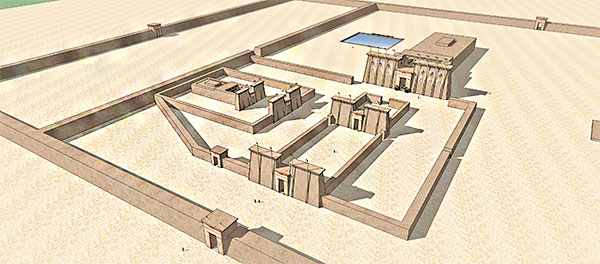
The Great Temple of Thoth was dedicated to him in Hermopolis or Khemenu, one of the holiest sites of the great civilization altogether, situated rather deliberately in Middle Egypt. Two major holy complexes existed there: one dedicated to Thoth, and the other to Set. Khemenu, the name of which means ‘the eight’, also related to Eshmun of Phoenicia in a mysterious manner. The town was known to be second only to Thebes in its majestic grandeur, and according to one of the Oxyrhynchus Papyri, even high-rise buildings of seven stories existed there.27, 28
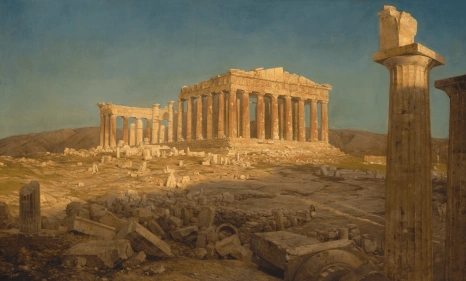
The Great Temple of Thoth was architecturally complex. The surviving structure of the temple is its portico, made up of two parallel rows of columns, six in each row. The spacing between the central pair of columns is wider than between the others: the largest intercolumnation measures 17 feet, while the remaining columns stand 13 feet apart. Each column, including its capital, rises to about 40 feet in height. The greatest circumference, approximately 28 and a half feet, is found about five feet above the ground, as the shafts taper both downwards toward the base and upwards toward the capital. The bases are carved to resemble the lower leaves of the lotus; above these comes a series of concentric rings, like the hoops of a barrel, and higher up the shafts are treated as bundles of reeds bound together with horizontal bands. The columns were painted in alternating bands of yellow, red, and blue, the primary colors, known famously by 1820s traveelers before their destruction.29
Hermopolitan Temple
A notable peculiarity of the Hermopolitan portico, found elsewhere only in the temple of Gournou, the internal construction of the columns. Instead of being built from large horizontal drums or blocks stacked one above another, they are made of irregularly shaped pieces so skilfully fitted together that the joints are difficult to detect. The New Kingdom added to Hermopolis’s prominence as Pharaoh Amenhotep III, for instance, commissioned two colossal 30-ton baboon statues to stand at the temple of Thoth. Ptolemaic rulers greatly improved the complex, and the Greek rulers were said by ancient writers to have given the Temple a new sort of majesty, partially leading to Hermopolis’ continuing prosperity well into Roman times. It appears much of the temple actually survived the tumult of the Christian period, relatively uniquely, being known to the British and French travelers above in a delapidated state even in the 1820s. Unfortunately, however, the valuable limestone of the building was progressively used in a quarry by Muslims, and very little remains as a consequence.30, 31, 32, 33
Thebes
Before Hermopolis became important, the oldest temple of Thebes (to Horus) was located on what is now called Thoth’s Hill due to the prevalence of baboon fragments, meaning that the foundation of religion in the great city dedicated to Amon had its share. The Temple of Khnum at Esna was another locality important to Thoth, as a less share in the temple itself was dedicated to him by Ramesses II during the New Kingdom. It is said here is where his three-named identity was conceived.In the Late Period and Ptolemaic era, new temples to Thoth were constructed, including sites in Nubia, for example the Temple of Dakka in Lower Nubia, originally built in the 3rd century BCE under Nubian king Arqamani and Ptolemy IV, and later expanded by the Romans. The 15th Lower Egyptian Nome was also represented with the head of an Ibis and is theorized to be one of his original cult sites.32, 33, 34
V. Priesthood of the Ibis
His priesthood was one of the most elevated holy brotherhoods of Egypt, and notoriously difficult to gain access to in terms of being chosen as an initiate. High priests of Thoth at Hermopolis such Petosiris or Djehutyirdis could be very powerful local figures; their families sometimes formed hereditary priestly dynasties with both a religious and civic authority. Powerful priests of Thoth consisted of those strongly indebted to the scribal arts. They were selected as highly educated men who could write, become literate in antique texts, keep accounts, understand languages, and copy sacred texts in a prolific manner. The temple scribal corps played a great part in the preservation of ancient texts through editing and revising religious compositions in particular. It was also their job to create intricate works in meticulous artistic as well as clinical detail; the faultless appearance of such sacred texts was paramount.35, 36
Scribe of Thoth bowing to A'ani
They were engaged in much of the planning of timing and monthly cycles, coordinating events with the rest of Egypt in order to keep systems running. Occasionally, they were known to directly intervene in chaos in the realm, documented in incidents where a wab priest of Thoth from Hermopolis was said to have used secret rites to completely destroy the enemies of the realm. The Papyrus of Ani shows how Thoth was viewed by his priests:
I am thy writing palette, O Thoth, and I have brought unto thee thine ink-jar. I am not of those who work iniquity in their secret places; let not evil happen unto me
Papyrus of Ani37
An exemplary priest is Djehuty-Min of the Late Dynasty whose gilded limestone statue reveals a particularly royal type of visual symbolism with the heqa scepter, showing the extreme reverence in which priests of Thoth could be viewed throughout the Egyptian context. The priest’s hands are held to his Middle Chakra. Another priest of Thoth, Djehutyirdis, was given a prominent and luxurious shabti and given agricultural regalia to assist him in the afterlife.38, 39
VI. The Ibis, the Scribe, the Ankh
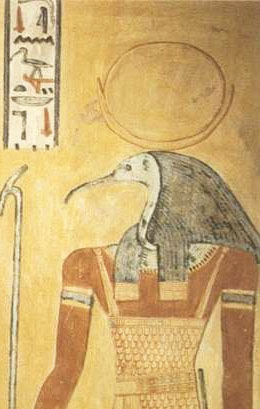
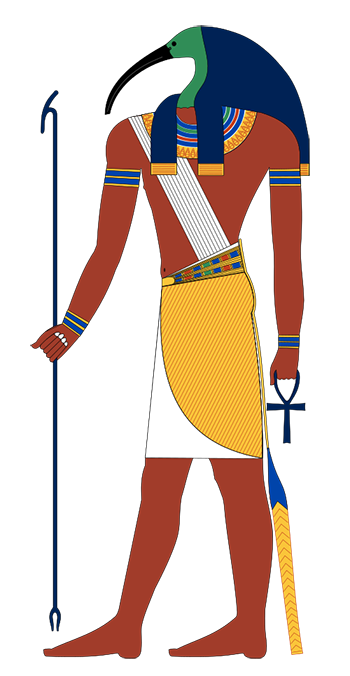
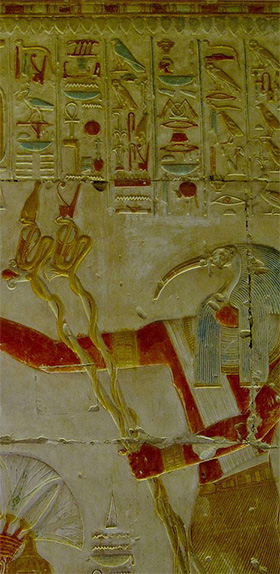
Thoth is represented typically as a man with the mask of an ibis and a solar or lunar disk, often holding a stylus with an accompanying tablet, indicating his position as the divine vizier who records all things past and to come. Symbolism like this is persistent and enduring in all visual representations of this god. The green shape of the head of the Ibis is closely related to that of the human neck, the throat and the jawline from the side, while the beak represents the extension of the product made by those parts of the body into reality. Naturally, Thoth also rules over the electromagnetic vibration produced by sound along with using the mind to manifest a desired result; this part of the myth is also alluded to in the ancient texts. The ibis call sounds like the ‘A’ sound, a letter persistently associated with Hermes Trismegistus.
One of the major aspects of Thoth’s symbolism also relates to the brain, with which the theta letter in Greek intersects.
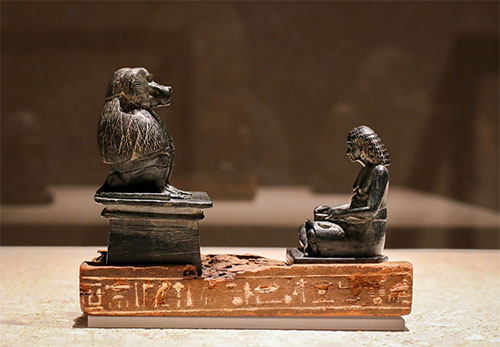
As with the other Gods, he could be shown simply as an ibis, as a pelican or as a variety of birds. On occasion, Thoth was also represented as a baboon in the form of A’ani33, the aspect of his that deals with equilibrium. Observers in ancient times explained amongst themselves that the baboon is the only animal that heralds the dawn day by day and tends to chatter excitedly as the sun rises, possessing an excellent sense of almost gymnastic balance in movement. The society of baboons is complex, therefore the animal was considered to be watchful, mercurial and calculating in its general nature. A’ani was also represented in the shape of a brain and a heart.
Frequently Thoth is pictured with the dual staff of serpents representing Upper and Lower Egypt, something of an Egyptian equivalent to the Caduceus of Hermes. He was also commonly represented with the Ankh in an extremely prevalent manner, mainly as Thoth is the most intermediary and intelligible deity to assist humanity in the quest for all that is divine, and through him, all eternal life is possible.
Texts which date back to at least the Kingdom tell of the god Thoth assigning fixed lifespans humans and gods alike….
The Complete Gods and Goddesses of Ancient Egypt, Richard. H. Wilkinson7
Thoth could be associated with other Gods in a variety of complex manners, because he was adaptable to the other Gods. For instance, his representation as a crocodile rider on the back of Sobek tended to denote a need for victory over evil forces and the powers of disease. His presence in the Judgement of Ma’at reflected his careful notation of the defendant’s soul. It was his beautiful wording that calmed the enraged Hathor in the form of Sekhmet to discontinue her rampage. In several stories, he appears as the vizier of Amon or Osiris, giving out thoughtful counsel to the others.40, 41
VII. Thoth the Healer
Knowledge and magical power rendered the divine Thoth patron of all physicians, according to the Hearst Papyrus and numerous other Egyptian texts which certainly hail him as the great font of the medicinal arts. Certain deities like Sekhmet were considered to assist the great Ibis in his work to heal humanity of its ailments. Imhotep was listed in several texts as being the intermediary of Thoth sent by him to advance the art of practical medicine. Tellingly, Asclepius himself is listed a disciple of the great Hermes Trismegistus in the Corpus Hermeticum.42, 43, 44
VIII. The Moon God
Thoth functions as an intermediary proximate to humanity who communicates divine wisdom in a comprehensible way, so he was symbolized as the divine force of the Moon in Egyptian cosmology as a nearby satellite that reflects the divine light in its luminous luster and happens to be visible even during night itself. The Moon is changeable too; its colors never appear to be as stable as the Sun, and, of course, the shadows cast on the Moon forever change its shape. Just as the satellite orbits the earth in close proximity and its gravitational pull, from his intermediary nature flowed all kinds of human endeavors, from agriculture to writing to the arts, all of which elevate us collectively above the other members of the animal kingdom.
Playing into Thoth’s primordial role as the Lord of Time discussed above, the Moon itself was pivotal to Egyptian society, because the lunar month predicted the phases of nature and further determined every single activity that was organized within the civilized polities of the Nile; Egypt regimented itself around the monthly orbit. Thoth was believed to have rendered these lunar cycles intelligible to the masses. Plutarch claimed Thoth himself is the originator of the 365 day calendar.45
As the master of the word, indicated by his spontaneous birth from the lips of Re in the hieratic texts, Thoth helps humanity in the spread of language, expression and communication. Above all, he rules the most golden arts of philosophical inquiry and dialectic, which enables humanity to question enough about material reality to come back to the divine source itself. In the sailing of the Solar barque, he stood on one side of the boat and Ma’at on another side.46
Thoth is associated with his wife Seshat. Their association is consistent in Egyptian iconography, and both are held to make etchings on the Tree of Life. In themselves, the God and Goddess represent the dualistic principle of male and female forces.
His belt consists of the mysterious ever-self-devouring ouroboros, similar to the idea that Thoth as the God of the Moon was devoured each lunar phase. The number of the card is also related to Thoth’s famous title in Egypt as the indivisible “One”.47
IX. The Weighing of the Heart
The great God of the Moon played an important role in the ever-increasingly important Weighing of the Heart, a role that he shared with Ma’at. He was considered to rule over the heart (ib) in itself. Thoth meticulously documented whether the heart was lighter, equal to, or heavier than the feather, thereby ensuring that the judgement was fair and accurate. His involvement underscored the importance of wisdom, record-keeping, and truth in the afterlife judgement process, but harkens into deeper allegories, touched upon by the Myth of Er elaborated by Plato.48, 49
Just as often as he is represented as a notary, Thoth also appears in these scenes as A’ani perched atop the scales, representing the equilibrium of the process as a whole. His proclamations show his status as the final judge, the representative of true and pure Mind:50
Thoth:
Hear ye in very truth this statement; I have judged the heart of this Osiris [i.e., Ani], his soul standing as witness for him. His deeds are true upon the great balance; no evil has been found in him ... Great Ennead's proclamation to Thoth:
This utterance of yours is true. The Osiris, king's scribe Ani, justified, is without evil. We have nothing to accuse him of...
X. The God of Magic
Due to his prominence in ruling over magic, Thoth is invoked as a deity of magical means endlessly in Egypt. The Magician Djedi, a story involving Thoth from the Middle Kingdom, indicates that the followers of Thoth even in the times of Khufu were privy to secrets that were unknowable to others.51 Egyptians clearly engaged with this activity prolifically; the historical record now attests to diverse retrieved artefacts related to pursuit of the so-called “Hermetic arts”, therefore typical examples of Thoth’s influence are shown in the endless magical stones dedicated to him that were used in workings in Antiquity, which started in the New Kingdom and appeared to reach a fever pitch in the Hellenistic and Roman periods.
Amulets dedicated to Thoth appear prolifically from the New Kingdom onwards, often faience ibises or baboons 52Often his stones were made of jasper and hematite moulded into a heart or oval shape. The most common type was blood red, but the prevalence of jasper in numerous hues connected it to Thoth rather directly. The color of each stone tended to be tied to its desired function: green signified the desire for rebirth, while red was used in matters of the generative principle of medicine, such as requesting fertility or a safe pregnancy.
Thoth in his anthropomorphic ibis-headed form appears on amulets closely related in terms of content to the Egyptian tradition. These amulets are connected with rebirth while additionally performing an apotropaic function. Baboon representations emphasise the strong relationship of Thoth with the sun and astrology. Ibis images appear on gems of a medical nature, relating also to the creation of the world. The depiction of the bird often appearing along with the attribute of Hermes, the caduceus, is a reference to the idea of rebirth. The gems are a testament to the syncretism of the Egyptian and Greek god. Most amulets containing the image of Thoth refer to grand ideas, the creation of the world, rebirth and, above all, to solar eschatology yet rarely appear in reference to osirian eschatology. The proximity of the moon and sun god is emphasised, not only in the iconography, but also in the inscriptions. Here we have a reference to cyclicality: night and day, death and rebirth.
The Wisdom of Thoth: Magical Texts in Ancient Mediterranean Civilisations, Archaeopress40
Many of the amulets and stones contain references to Abraxas who was continually placed beside Thoth for invocation, as well as the mysterious triad of the IAO.
XI. Hermes Trismegistus and the European Inheritance
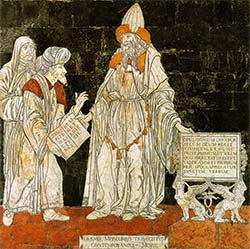
Just as Osiris took the form of Serapis in Hellenistic Egypt, Thoth took the form of Hermes Trismegistus, an identity combining the elements of Hermes and Thoth into a mystical hero, alchemist, bestower of knowledge and prophet, which continued to influence magicians from ancient times well into the modern era, for it is from this identity of Thoth which the mysterious traditions of Hermeticism emanated. Cryptically, it was also said Hermes was the second emanation of the God, while Thoth was the first.53
Hermetica from the said traditions cover a broad spectrum of treatises dealing with theurgy, astrology, medicine and pharmacology, alchemy, and regular magic, the oldest of which were written in Greek and likely date to second or third century BCE. Despite their character as documents written in Greek, much of this literature bears an extreme Egyptian influence, leading modern scholars to recognize that they likely originated among the priestly class during Ptolemaic times. Supporting this is that some of the discovered Nag Hammadi writings contain excerpts from these texts. Iamblichus claimed that Thoth had written many works predating anyone else in scope and accuracy. The Christian writer Clement of Alexandria claimed that the Egyptian priesthood had forty-two divine texts containing divine writing and explaining their outlook, although this may be a literalization of a process this individual did not understand.47, 54
Other Hermetica continued to be composed regularly after the advent of Christianity and even the advent of Islam from all kinds of sources, some corrupted and others of divine interpretation. Some in Arabic and Persian purport to be part of the tradition of the Thrice-Great, such as Hirmis al-thalāth bi-l-ḥikma and Rasāʾil Ikhwān al-Ṣafā’, and ultimately Thoth became identified with Idris (Enoch), a tradition already prevalent in Judaism with Hermes. Many of these collocations are discussed in the book The Arabic Hermes: From Pagan Sage to Prophet of Science by Kevin van Bladel. As Augustine viewed Hermes Trismegistus as a man worshiping demons, the standard medieval viewpoint was to see Thoth (opposed to ‘Mercury’ straightforwardly seen as a demon) as a sort of pagan parallel to Solomon. On the other hand, this iteration of Thoth was also given a spurious kind of reputation in Muslim lands, as the original Arabic manuscript of the Picatrix (Ghāyat al-Ḥakīm) claims the planetary deities are recipients of sacrifice as worshiped by the Harrian Sabaeans.55, 56, 57
Until the thirteenth century, medieval European intellectuals dismissed as rural superstitions not only the use of formulae and rituals rooted in Christianity but not accepted by the Church, but also the practices of inferior magic or sorcery (maleficium). However, the Latin translations of texts about magic and astrology that reached the West, made above all in the Iberian Peninsula during the twelfth and thirteenth centuries, together with the other branches of knowledge in the Greco-Arab tradition, caused a revival of superior magic, transmitted in writing. Indeed, its power of attraction and its prestige were far greater than those of sorcery thanks to a more complex worldview and techniques, linked to astrology, and to the authority conferred upon it by ancient, often mythical, origins, which were based on numerous works attributed to Solomon or Hermes.
Medieval necromancy, the art of controlling demons, Sebastià Giralt 58
In the year 1453, while en route to Macedonia via Constantinople, the Italian monk Leonardo da Pistoia discovered fourteen original books, once apparently owned by Michael Psellus, of an 11th-century work written in Greek from Hermes Trismegistus which was entitled the "Hermetica". From this work, the Corpus Hermeticum, a major work of the genre, was translated by Marsilio Ficino and Lodovico Lazzarelli under the name Pimander. 59
XII. Teachers; Time
Thoth was the patron of teachers, for which he was called Teacher of Teachers. All learning was tied to him. It is also worth noting that the entire concept of literacy and record-keeping was imbued with Thoth’s spirit in Egypt. The scribes called their hieroglyphic signs “mdw-nṯr”, in English “words of God”. For instance, if Egyptian scribes were to write contracts or letters, they seemingly would invoke deities in formal adverbial phrases (“as Thoth lives, I shall do X”). To read and write was to touch the divine. As early as the Pyramid Texts, Thoth is also verbally associated with mathematics, as he is referred to using verbs that denote measuring and counting.> He was also associated with music and the lyre 45,48,60
The first month of Djehuty or Thoth on the calendar was enshrined as a testament to his highness in Egyptian culture. The eighteenth day of that month in particular, known as the Day of the Moon, honored Thoth in conjunction with the Wag festival, being held after it, with a joint focus on death and rebirth. Likewise, at the Opening of the Year (Wp-rnpt), Thoth is prevalent in temple scenes as Lord of Time, recording the Pharaoh’s regnant years and prompting the renewed order of the world. He was often depicted marking years on palm branches, “writing time” into existence. A specifically named Festival of Thoth is also documented in the Ptolemaic temple calendars, especially the ones at the Temple of Thoth in Edfu, but a far earlier festival in Memphis is also attested in the Middle Kingdom years.7,61,62
But, as we have seen, Thoth is Iooḥ, the moon. He is, therefore, the chief time-measurer. Many of his epithets express this position. He is lord of time (Brugsch, Thes. IV, 759): lord of old age (Philae, Phot. 1011): reckoner of years (Edfu R. I. 297, 27): reckoner of time (Brugsch, Thes. IV, p. 757; Mar., Dend. II, 43): (2) the Reckoner (Edfu R. I. 259): ruler of years (Brugsch, Thes. IV, 759): determiner of time (Edfu R. I. 27. 291): the scribe of time (Edfu R. I. 522): the divider of time (Edfu R. II. 27, 31; Mar., Dend. II, 73 c): he that increaseth time, and multiplieth years (Edfu R. I. 77).
Thoth the Hermes of Egypt: A Study of Some Aspects of Theological Thought in Ancient Egypt, Patrick Boylan63
Bibliography
Stadler, Martin A. “Thoth.” In UCLA Encyclopedia of Egyptology, edited by Willeke Wendrich and Jacco Dieleman. Los Angeles: Department of Near Eastern Languages and Cultures, University of California, Los Angeles, 2012.
Erman, Adolf, and Hermann Grapow, eds. Wörterbuch der ägyptischen Sprache. Vol. 5. Berlin: Akademie-Verlag, 1926–1961, s.v. “ḏḥwty.”
Grunert, Stefan, with contributions by AV Wortschatz der ägyptischen Sprache. “Sentence ID IBUBd7fD6SW4GUk3i240YhG15n4.” In Thesaurus Linguae Aegyptiae, Corpus Edition 20, Web app version 2.5.1. Edited by Tonio Sebastian Richter and Daniel A. Werning. Berlin-Brandenburg Academy of Sciences and Humanities; Saxon Academy of Sciences and Humanities in Leipzig. Accessed July 5, 2026.
Harvard University, Giza Project. “G 7530–7540.” Digital Giza. Accessed July 5, 2026.
Crum, W. E. A Coptic Dictionary. Oxford: Clarendon Press, 1939, s.vv. “Ⲑⲱⲟⲩⲧ,” “Ⲑⲟⲟⲩⲧ.”
Plato. Phaedrus. In Plato: Euthyphro; Apology; Crito; Phaedo; Phaedrus. Translated by Harold North Fowler. Loeb Classical Library 36. Cambridge, MA: Harvard University Press, 1914. Phaedrus 274c–275b.
Wilkinson, Richard H. The Complete Gods and Goddesses of Ancient Egypt. London: Thames & Hudson, 2003, s.v. “Thoth.”
Patch, Diana Craig, ed. Dawn of Egyptian Art. New York: Metropolitan Museum of Art, 2011. See discussion of Predynastic ceremonial palettes and animal standards.
Lichtheim, Miriam, trans. “The Contendings of Horus and Seth.” In Ancient Egyptian Literature. Vol. 2, The New Kingdom. Berkeley: University of California Press, 1976, 214–223.
te Velde, Herman. Seth, God of Confusion: A Study of His Role in Egyptian Mythology and Religion. Translated by G. E. van Baaren-Pape. Probleme der Ägyptologie 6. Leiden: Brill, 1977.
Allen, James P. The Ancient Egyptian Pyramid Texts. Edited by Peter Der Manuelian. Writings from the Ancient World 23. Atlanta: Society of Biblical Literature, 2005.
Sethe, Kurt. Die altägyptischen Pyramidentexte nach den Papierabdrücken und Photographien des Berliner Museums. 4 vols. Leipzig: J. C. Hinrichs, 1908–1922.
Čermák, Michal. “Thoth in the Pyramid Texts.” Master’s thesis, Charles University in Prague, 2015.
de Buck, Adriaan. The Egyptian Coffin Texts. 7 vols. Oriental Institute Publications 34, 49, 64, 67, 73, 81, and 87. Chicago: University of Chicago Press, 1935–1961.
Faulkner, Raymond O. The Ancient Egyptian Coffin Texts. Vol. 1, Spells 1–354. Warminster: Aris & Phillips, 1973.
Faulkner, Raymond O. The Ancient Egyptian Coffin Texts. Vol. 2, Spells 355–787. Warminster: Aris & Phillips, 1977.
Faulkner, Raymond O. The Ancient Egyptian Coffin Texts. Vol. 3, Spells 788–1185 and Indexes. Warminster: Aris & Phillips, 1978.
Priskin, Gyula. The Ancient Egyptian Book of the Moon: Coffin Texts Spells 154–160. Archaeopress Egyptology 22. Oxford: Archaeopress, 2019.
Lesko, Leonard H. Index of the Spells on Egyptian Middle Kingdom Coffins and Related Documents. Berkeley: B. C. Scribe Publications, 1979.
Metropolitan Museum of Art. “Haremhab as a Scribe of the King.” New Kingdom, Dynasty 18, ca. 1336–1323 BCE. Accession no. 23.10.1. New York: Metropolitan Museum of Art.
Dodson, Aidan. “Rituals Related to Animal Cults.” In UCLA Encyclopedia of Egyptology, edited by Jacco Dieleman and Willeke Wendrich. Los Angeles: University of California, Los Angeles, 2009.
Fowden, Garth. The Egyptian Hermes: A Historical Approach to the Late Pagan Mind. Princeton: Princeton University Press, 1993.
El-Behariy, Hanaa Mokhtar Abd El-Nabi. “A Ramesside Stela of R3-Mc from Deir El-Madina in the Egyptian Museum of Cairo.” Bulletin of the Center of Papyrological Studies 42, no. 1 (2025): 227–242.
Gardiner, Alan H. Late-Egyptian Miscellanies. Bibliotheca Aegyptiaca 7. Brussels: Édition de la Fondation Égyptologique Reine Élisabeth, 1937. See Papyrus Anastasi V.
Leitz, Christian, ed. Lexikon der ägyptischen Götter und Götterbezeichnungen. Vol. 7. Orientalia Lovaniensia Analecta 116. Leuven: Peeters, 2002, s.v. “Ḏḥwty.”
Brugsch, Heinrich. Thesaurus Inscriptionum Aegyptiacarum: Altägyptische Inschriften. Vol. 4. Leipzig: J. C. Hinrichs, 1883, 757–759.
Shaw, Ian, and Paul Nicholson. The Dictionary of Ancient Egypt. London: British Museum Press, 1995, s.v. “Hermopolis.”
Grenfell, Bernard P., and Arthur S. Hunt, eds. The Oxyrhynchus Papyri. Vol. 27. London: Egypt Exploration Society, 1962. See P.Oxy. XXVII 2471.
Description de l’Égypte. Antiquités, descriptions. Paris: Imprimerie Impériale, 1809–1822. See Hermopolis / Achmounein plates and descriptions.
Hamilton, William. Ægyptiaca; or, Some Account of the Ancient and Modern State of Egypt, as Obtained in the Years 1801, 1802. London: T. Payne, 1809.
Smith, William, ed. “Hermopolis Magna.” In Dictionary of Greek and Roman Geography. Vol. 1. London: John Murray, 1854.
The Hunt Museum. “Thoth: Baboon and Ibis God of the Moon.” Limerick: The Hunt Museum, n.d.
Budge, E. A. Wallis. The Gods of the Egyptians; or, Studies in Egyptian Mythology. Vol. 1. London: Methuen & Co., 1904.
Arnold, Dieter. The Encyclopaedia of Ancient Egyptian Architecture. Edited by Nigel Strudwick and Helen M. Strudwick. Translated by Sabine H. Gardiner and Helen M. Strudwick. London: I. B. Tauris, 2003.
“Egyptian Art and Architecture: Greco-Roman Egypt.” Encyclopaedia Britannica. Chicago: Encyclopaedia Britannica, n.d.
Fielding, Hannah. Ancient Egyptian Scribes. London: Bloomsbury Academic, 2023.
Budge, E. A. Wallis, trans. The Book of the Dead: The Papyrus of Ani in the British Museum. 2nd ed. London: British Museum, 1895. See plate and translation for Ani’s address to Thoth.
Rijksmuseum van Oudheden. “Statue of Djehuti-Min, Priest of Thoth.” Leiden: National Museum of Antiquities, n.d.
Metropolitan Museum of Art. “Shabti of the High Priest of Thoth Djehutyirdis, Born of Nepthysiti.” Accession no. 26.7.919. New York: Metropolitan Museum of Art, n.d.
Bąkowska-Czerner, Grażyna, Alessandro Roccati, and Agata Świerzowska, eds. The Wisdom of Thoth: Magical Texts in Ancient Mediterranean Civilisations. Oxford: Archaeopress, 2016.
van der Toorn, Karel, Bob Becking, and Pieter W. van der Horst, eds. Dictionary of Deities and Demons in the Bible. 2nd extensively rev. ed. Leiden: Brill, 1999, s.v. “Thoth.”
Reisner, George A. The Hearst Medical Papyrus. Leipzig: J. C. Hinrichs, 1905.
Manchester Museum. “The Cult of Imhotep, Part One.” Egypt at the Manchester Museum. Manchester: University of Manchester, May 31, 2020.
Copenhaver, Brian P., trans. Hermetica: The Greek Corpus Hermeticum and the Latin Asclepius in a New English Translation, with Notes and Introduction. Cambridge: Cambridge University Press, 1992.
Plutarch. “Isis and Osiris.” In Moralia, Volume V: Isis and Osiris; The E at Delphi; The Oracles at Delphi No Longer Given in Verse; The Obsolescence of Oracles. Translated by Frank Cole Babbitt. Loeb Classical Library 306. Cambridge, MA: Harvard University Press, 1936. See the calendar myth and Thoth’s calculation of the five additional days.
Lichtheim, Miriam, trans. “The Memphite Theology.” In Ancient Egyptian Literature. Vol. 1, The Old and Middle Kingdoms. Berkeley: University of California Press, 1973, 51–57. See the Shabaka Stone inscription.
Iamblichus. De Mysteriis. Edited and translated by Emma C. Clarke, John M. Dillon, and Jackson P. Hershbell. Writings from the Greco-Roman World 4. Atlanta: Society of Biblical Literature, 2003.
Faulkner, R. O., trans. The Ancient Egyptian Pyramid Texts. Oxford: Clarendon Press, 1969. See Utterance 217.
Plato. Republic. Translated by Paul Shorey. 2 vols. Loeb Classical Library 237 and 276. Cambridge, MA: Harvard University Press, 1930–1935. See 10.614b–621d.
British Museum. “The Papyrus of Ani.” Museum no. EA10470. London: British Museum, n.d.
Lichtheim, Miriam, trans. “King Cheops and the Magicians.” In Ancient Egyptian Literature. Vol. 1, The Old and Middle Kingdoms. Berkeley: University of California Press, 1973, 215–222.
Museum of Fine Arts, Houston. “Thoth, God of Writing and Knowledge, as a Baboon.” Houston: Museum of Fine Arts, Houston, n.d.
Manetho. Aegyptiaca. In Manetho. Translated by W. G. Waddell. Loeb Classical Library 350. Cambridge, MA: Harvard University Press, 1940.
Clement of Alexandria. Stromateis, Books One to Three. Translated by John Ferguson. Fathers of the Church 85. Washington, DC: Catholic University of America Press, 1991. See 6.4 for the Egyptian priestly books.
van Bladel, Kevin, eds. The Arabic Hermes: From Pagan Sage to Prophet of Science. Warburg Institute Colloquia 16. London: Warburg Institute, 2019.
Augustine. The City of God against the Pagans. Edited and translated by R. W. Dyson. Cambridge Texts in the History of Political Thought. Cambridge: Cambridge University Press, 1998. See 8.23–26 on Hermes Trismegistus.
Hamvas, Endre Ádám. “Traces of Necromantic Divinatory Practices in the Picatrix.” Religions 15, no. 4 (2024): 512.
Giralt, Sebastià. “Medieval Necromancy, the Art of Controlling Demons.” Publicacions de la Universitat Autònoma de Barcelona, n.d.
van Woerkom, Maurits. Marsilio Ficino and His Translation of Corpus Hermeticum VI. Final thesis supervised by A. W. van Duijn, 2021.
Wilson, John A. “The Oath in Ancient Egypt.” Journal of Near Eastern Studies 7, no. 3 (1948): 129–156.
University College London. “Festivals in the Ancient Egyptian Calendar.” Digital Egypt for Universities. London: University College London, n.d.
Jauhiainen, Heidi. “Do Not Celebrate Your Feast without Your Neighbours”: A Study of References to Feasts and Festivals in Non-Literary Documents from Ramesside Period Deir el-Medina. Publications of the Institute for Asian and African Studies 10. Helsinki: Yliopistopaino, 2009.
Boylan, Patrick. Thoth, the Hermes of Egypt: A Study of Some Aspects of Theological Thought in Ancient Egypt. London: Oxford University Press, 1922.