The welcome to the Temple of Zeus and Zevism: the Ancient faith behind all Ancient religions, the Gods falsely branded demonic, the practices for opening the chakras, freedom of belief, and Dedication as the first step.
Magick & Theurgy: the powers of the mind and soul, built on power meditation. The Magick Section holds the Chthonic Powers and the Theurgy Section the Heavenly Powers, each from Beginning to Advanced with Divination and Information; General Information, Knowing the Powers, serves both.
author: High Priest Zevios Metathronos co-author: Karnonnos
Hieratic Information about Nabu
Divine Names
Nabu (𒀭𒀝)
the standard Akkadian name
Nabium
the older Old Babylonian form of the name
Tutu (𒀭𒌇)
a name occasionally identified with him at Borsippa
The name is written most often with the two signs dAK, and also spelled out syllabically as dna-bi-um in the Old Babylonian period. The logogram dPA carries the name in later scholarly texts, shared with Ninurta.
Divine Symbols
The Stylus on the Tablet
The Single Wedge
The Writing-Board
The Horned Cap of Divinity
Divine Forces
Writing and the Scribal Art
Wisdom and the Rational Arts
The Fixing of Destinies in Writing
Vegetation and Abundance
Important Titles
Firstborn Son of Marduk
Scribe of Esagila
Holder of the Tablet-Stylus
Lord of Ezida
Names Across Civilizations
Eblaite
Nabu, among the earliest attestations
Akkadian
Nabu (𒀭𒀝)
Hebrew
Nebo (נְבוֹ)
Aramaic
Nabu (ܢܵܒܼܘܼ), nbw
Greek
identified with Apollo and Hermes
Mandaic
Nbu (ࡍࡁࡅ), the planet Mercury
I. The Name
The name Nabu is written most economically with the two cuneiform signs dAK, and in the Old Babylonian period it is spelled out in full as dna-bi-um. The Akkadian nabû means "the announcer" or "the called one," from the Semitic root n-b-ʾ, "to name, to proclaim, to summon." The same root stands behind the Hebrew nabi, the Aramaic nebiyya, and the Arabic nabiyy, all meaning "prophet." The name marks its bearer as the authorized speaker.1,2
The earliest secure attestation of the name takes the god out of Babylonia altogether. Nabu appears among the deities of Ebla in northern Syria in the twenty-fourth century BCE. It seems as if his origin was in Syria. He entered Mesopotamia proper only later, carried in by the Amorites at the beginning of the second millennium BCE, probably at the same time and along the same road as Marduk. The two remained linked for the next two thousand years.3,4
His relation to Nisaba, the older Sumerian goddess of writing, is complicated. Nabu seemingly took over many of her functions, a certain change that did likely follow the political passage from Sumerian to Babylonian dominance. Early sources make him her husband and assistant rather than her replacement, the male scribe who helps the goddess keep the library of the gods, analogous perhaps to Thoth and Seshat. 4,5
The life of the name is long. It survives in the Hebrew Nebo of the prophets, in the Aramaic nbw carried by expatriate communities into Egypt and Anatolia, and in the theophoric names of kings whose reigns close the history of Babylon, Nabopolassar, Nebuchadnezzar, Nabonidus. The god outlasted the empire that raised him. Nabu was still worshipped into the second century CE, when the cuneiform that was his gift to men had become a lost art. His name persists even now in the Mandaic Nbu, the planet Mercury.1,6
Language / Script
Name of Nabu
Attestation
Eblaite
Nabu
Ebla texts (c. 2300 BCE)
Old Babylonian
dna-bi-um (Nabium)
Code of Hammurabi; god-lists (early 2nd millennium BCE)
Standard Akkadian
dAK (Nabû)
First-millennium royal inscriptions
Hebrew
נְבוֹ (Nebo)
Isaiah 46:1; Masoretic Text
Aramaic
ܢܵܒܼܘܼ (nbw)
Elephantine and later Aramaic documents
Mandaic
ࡍࡁࡅ (Nbu)
Mandaean cosmological texts, the planet Mercury
Sources: Pomponio, "Nabû A. Philologisch," Reallexikon der Assyriologie 9 (1998–2001); Pomponio, Nabû: Il culto e la figura di un dio del Pantheon babilonese ed assiro (1978); Millard, "Nabû," in Dictionary of Deities and Demons in the Bible (1999).1,3,4
II. Aspects of Mythology
Nabu has few myths. No long epic of his deeds survives in the manner of Nergal's Erra or Inanna's Descent; his sanctuary at Borsippa yielded quantities of ornately written tablets left as offerings, yet no literary composition extolling his exploits has been recovered.4,7
What he had instead of myths was an office: the keeping of the Tablet of Destinies and the writing of fates. Where the Enuma Elish makes the tablet the token of cosmic rule and the Hymn to Nungal makes it the register of human conduct, in Nabu the same object becomes the ledger of individual lives, recording how long each person will live and what fortune awaits. The bureaucratic clay of Mesopotamian administration, on which grain and contracts and letters were kept, supplied the model by which the gods were imagined to govern the universe.8
His fullest appearance in living cult is the Akitu of the New Year. Nabu travelled by boat from Borsippa to Babylon to attend upon his father Marduk, taking up residence in his chapel Ezida within Marduk's great temple Esagila. In one strand of the festival theology he is the royal prince who comes to his father's aid, and father and son together determined the destinies for the year.9
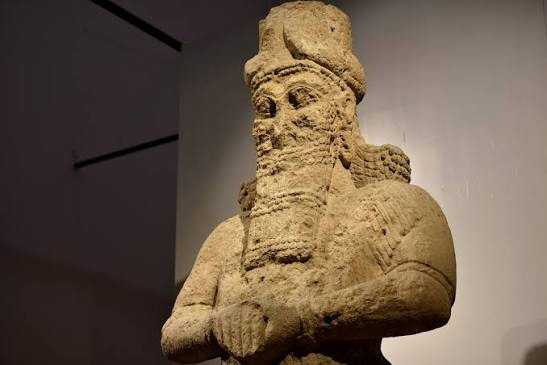
Statue of Nabu from the temple at Nimrud, dedicated for the life of Adad-nirari III, c. 800 BCE
In poems the marriage of Nabu and Tashmetu is the nearest thing to a myth involving Nabu. A love dialogue from the library of Ashurbanipal at Nineveh has the two deities lovingly speaking in their own voices, rejoicing in one another, and the composition is thought to accompany a ritual in which the cult statues of god and goddess were brought together in a ceremonial marriage. Later temple sources name a chamber called the "House of the Bed," a purification room where Nabu and Tashmetu were united.10,11
Where Nabu appears in the older cosmic literature, it seems as if this comes from a divine sort of inheritance. Marduk took the kingship of the gods from Enlil. The role of the great god's most important son, once held by Ninurta as son of Enlil, passed to Nabu. Ninurta and Nabu seemingly occupied a similar space attenuated by their functions as scribes.2,12
III. Epithets of Nabu
Epithet
Meaning
Domain
Mār Marduk
Son of Marduk
The defining title; firstborn of Esagila
Ṭupšar Esagila
Scribe of Esagila
Keeper of the records of the gods
Bēl Ezida
Lord of Ezida
Master of his temple at Borsippa
Nāš ṭuppi šīmāti
Bearer of the Tablet of Destinies
The writing and keeping of fates
Apkal ilāni
Sage of the Gods
Wisdom and the rational arts
Ēpiš kittim
Doer of Right
Justice and true judgement
Nabû mušallim
Nabu Who Keeps Safe
Protector invoked in personal names
Nabium (older form)
The Announcer
The archaic Old Babylonian name
Source: Grayson, Assyrian Rulers of the Early First Millennium BC II (858–745 BC).13
IV. Temples of Nabu
Ezida at Borsippa
Nabu's house was the E-zida at Borsippa, the "true house" or "legitimate house," a few miles south of Babylon. Borsippa was his city. Andrew George recorded the temple among the great sanctuaries of the land, its ziggurat bearing the ceremonial name E-ur-imin-anki, "house of the seven guides of heaven and earth." In his own city Nabu was supreme, second to no god, and the priests who tended his statue there were held in the high honour that a society devoted to the written word reserved for the god who gave it. Nebuchadnezzar II rebuilt both temple and ziggurat, and it was this tower, rising alone from the plain, that later tradition mistook for the Tower of Babel.7,14
Ezida at Kalhu and the Assyrian Houses
Around 800 BCE the Assyrian king Adad-nirari III built a temple of Nabu at Kalhu, modern Nimrud, bearing the same ceremonial name as the house at Borsippa, and several of his successors repaired it. The Kalhu Ezida was a working centre of Assyrian scholarship, its chambers holding tablet-stores tended by the scholars of the court, and the omen-series copied by men like Nabu-zuqup-kenu and his descendants have been recovered from it. Ashurbanipal refurbished and re-roofed the temple, and it continued to function nearly to the fall of the empire.13,15
Other Assyrian houses of Nabu followed the spread of the god through the empire. Shalmaneser I is credited with the first sanctuary of Nabu at Ashur around 1300 BCE, and further temples rose at Nineveh, at Kalhu, and at Khorsabad. From the reign of Sargon II onward, as the empire reached its height, Nabu stood among the great gods of Assyria and was invoked constantly in the royal inscriptions, his cult carried on the back of Assyrian arms as far as those arms reached.7,13
The disproportion between the two ends of his history is striking. In early second-millennium Babylonia Nabu had no temple of his own and did not appear at all in the Old Babylonian royal inscriptions; he was a scribe in another god's house. By the first millennium he owned Ezida at Borsippa, a second Ezida at Kalhu, and sanctuaries across two empires.7,16
V. Nabu and Kings
No god was closer to the Mesopotamian crown in its last centuries than Nabu in his ascendancy. The kings of the Neo-Babylonian dynasty had theophoric names attesting to his rise in the pantheon. Nabopolassar the founder, Nebuchadnezzar the great builder, Nabonidus the last. To bear the name of the god who inscribed destinies was clearly of high importance. Nabonidus went even further, topping his royal sceptre with Nabu's single wedge.1,6
At the Akitu the statue of Nabu came from Borsippa to Babylon. There the king's legitimacy was renewed before the son as much as the father, for it was Nabu who was thought to speak the king's name before Marduk in the divine assembly where destinies were fixed. A building inscription of Nebuchadnezzar II, appended to his work on the ziggurat of Ezida, closes with a prayer that puts the whole theology in the king's own words.9,17
"On your unchangeable tablet, which establishes the boundaries of heaven and earth, proclaim length of days for me, inscribe long life."
Nebuchadnezzar II, building inscription for E-zida
The Assyrian kings made Nabu a royal patron. The dedications from the Kalhu Ezida are addressed to the god for the life of the king. It appears the twin statues set at the gate of the temple also carried inscriptions binding the god to Adad-nirari III. Where Marduk was the god of the Babylonian state, Nabu was increasingly the god of the literate bureaucracy.13,15
The desire to enforce a rigidly bureaucratic order had its dark sides. An inscription from Ezida threatened that whoever erased the king's name and set his own in its place, or stole the tablet from the temple, would have his name erased by Nabu from the Tablet of Life and be deprived of light.14,18
In the royal inscriptions of the Neo-Babylonian kings Nabu is sometimes given precedence over Marduk. In the popular devotion of the last centuries of Babylon it was Nabu, the son who knows all and sees all, who stood as one of the highest deities. The very last royal inscription from Babylonia concerns him: a report by Antiochus I Soter, the Seleucid king, on his restoration of Esagila and Ezida, found in the temple at Borsippa. The line of kings who served Nabu closes with a Greek writing in Akkadian for the god of the scribes.4,7
VI. Nabu and the Scribes
Nabu was the god of the men who could write. In a world where writing was the rare and guarded craft of a trained few, that made him the god of a powerful guild. The scribe who sat with the wet clay and the reed stylus practised the art that Nabu had invented and over which he presided. Tools of the trade, the tablet and the stylus, were the god's symbols before they were the scribe's instruments.1,7
The devotion of the scribes to their patron is written into the archaeology of his temples. Excavators working at Ezida found tablets of unusual calligraphic skill, deposited as ex-voto offerings. A scribe honored Nabu with a beautifully made tablet; the craft itself was the offering.6,7
The custom of ending a composition with a phrase of praise to the patron of writing was old, taken over from the Sumerian hymns that had praised Nisaba in the same place. In the first millennium, it was Nabu who received the closing benediction. The scholars of the Assyrian court, the men who copied the omen-series and the rituals and the astronomical compendia, worked under his name and signed it at the foot of their labor.5,15
Those scholars were among the most important men in the state. Evidence is evocative of the fact the chief scribe and the chief exorcist of the Assyrian court, men whose letters to the king survive in quantity, were servants of Nabu whose skills were predictably trained to a high level. The tablet-stores of the Kalhu Ezida, tended by named scholars across generations, do show the god of writing at the center of an actual working apparatus of knowledge.15,16
The reach of the scribal god extended past the borders of the empires that raised him, carried by the men who wrote. Names compounded with Nabu are the most common Semitic theophoric names among the Aramaic-speaking communities of Egypt, and the god was worshipped at Elephantine beside Yahweh and Anat and the rest. The patron of the Babylonian stylus became a familiar name in the account-books of a Jewish garrison on the Nile.6,19
VII. Nabu and Wisdom
Wisdom in the Mesopotamian sense was a mastery of a vast inherited body of learning so naturally Nabu was its lord. The rational arts, the ordered disciplines of the scholar, were his province: the omen-series by which the future was read, then he astronomy by which the heavens were tracked., then the mathematics and the medicine in which the scribes were trained, while each realm represents a sort of knowledge.4,8
The link between writing and destiny gives his wisdom its particular character. Nabu did not merely know. Like Thoth he inscribed, what he inscribed was said to come to pass as divinatory wisdom. His wisdom is administrative rather than contemplative, the wisdom of a record-keeper, and the Tablet of Destinies in his possession made his records binding.8,20
The Greeks matched Nabu to Apollo as a giver of prophecy and to Hermes as the god of wisdom and the divine messenger; the Romans set him beside Mercury; the reflex that paired the Egyptian Thoth with Hermes reached also for Nabu.2,6
VIII. The Son of Marduk
The making of Nabu into Marduk's son is the central event of his theology, and it happened in step with Marduk's own rise. When Marduk climbed from city-god of Babylon to king of the gods, taking Enlil's place and titles, the pantheon reorganised around him, and the vacant role of the great god's heir was filled by Nabu. He was not born Marduk's son in the oldest sources; he became so, by the same political theology that made Marduk supreme, and from the Kassite period onward the sonship was fixed.2,4
The stages of the ascent can be traced. Samsu-ditana, last king of the First Dynasty of Babylon in the late seventeenth century BCE, introduced a statue of Nabu into Esagila, Marduk's temple, giving the god a foothold in his father's house. Nabu began as Marduk's minister and scribe, the servant who kept the master's records, and only across the second millennium did the servant become the son. The chapel Ezida within Esagila, where Nabu lodged at the New Year beside Marduk, gave that sonship visible form.4,21
By the first millennium the two were joined as the heads of the pantheon, Bel and his son, co-rulers whose names ran together through the royal inscriptions. Marduk kept the theoretical precedence as his father, yet in the devotion of the people it was the intercessor, the mediator god who was looked for first. Nabu's mother in this theology is Sarpanitu, Marduk's consort, called also Erua, and his own consort Tashmetu completes the divine family between Babylon and Borsippa.4,10
The relationship gave the state a working image of succession. Where in Egypt the dying god is restored to power, in Mesopotami the royal prince Nabu is an avenger and support, coming at the New Year to free his father from the ritual confinement of the festival and to stand beside him in triumph. In the Babylonian pattern the son stands beside the father. The arrangement modelled the passage of the crown.9,12
Nabu was also shown riding the mushhussu, the horned serpent-dragon, the creature that had belonged to Marduk.2,22
IX. Nabu and the Planet Mercury
The planet Mercury was the star of Nabu. In the astronomical tradition of the MUL.APIN compendium the planet had been assigned to Ninurta, of whom it was said that Mercury, whose name is Ninurta, travels the same path the moon travels. When the role of the great god's son passed from Ninurta to Nabu, the planet passed with it.2,23
A planet closest to the sun, quick and elusive in its motion, hard to catch low on the horizon, made a fitting star for the god of the swift stylus and the messenger's errand, and the same quality that later drew the Greeks to equate Nabu with Hermes and the Romans with Mercury was already legible in the Babylonian sky. The planet's moon-like path, noted in the compendia, tied Nabu also to a faint association with the moon-god Sin and the oracular knowledge that clung to the night sky.2,24
Ninurta was never wholly displaced, and the planet could carry more than one divine name in the scholarly texts. Nabu was equated Mercury as part of the same scheme that made him Marduk's son and heir to Ninurta.2,23
X. Nabu in the Bible
Nabu enters the Hebrew scriptures under the name Nebo. The prophet of the exile, writing as Babylon's power broke, pictures the city's gods hauled away on the backs of beasts, unable to save even themselves: "Bel bows down, Nebo stoops" (Isaiah 46:1). The insult is aimed: the verse names the father and the son, Marduk and Nabu, the two heads of the Babylonian pantheon, and topples them together.25
The scene is a polemic against the whole theology traced above. The gods who inscribe destinies and rule the New Year are shown as dead weight. The Hebrews of the Bible cast them images that must be carried and cannot carry, a burden to the weary cattle that bear them into captivity. The sarcasm turns precisely on Nabu's true cult, the annual procession in which his statue was carried in triumph; in vituperative inversion the prophet takes the great processional image and makes of it a helpless load.25,26
Mount Nebo, from which Moses looked upon the promised land, carries the same consonants, and the god's name stands inside the biblical Nebuchadnezzar. Whether the mountain was named for the god has never been settled. The Nebo of Isaiah, at least, is beyond doubt the Nabu of Babylon, caught in scripture at the instant of his fall.25,27
XI. Festivals of Nabu
The great occasion of Nabu's year was the Akitu, the New Year festival of Babylon. On the appointed day his statue was brought out of Ezida at Borsippa and carried by boat downstream to Babylon, there to enter his chapel within his father's temple and to stand beside Marduk through the days of the rite. The visit of the son to the father was among the fixed hinges of the Babylonian year.6,9
On the sixth day of the celebrations he arrived with other gods and dignitaries; on the following days he was held to free his father from the ritual confinement that the Akitu enacted, and father and son proceeded together to the determination of destinies, the fixing of the fates for the year to come.9,17
The marriage rite of Nabu and Tashmetu marked another point in the sacred calendar. The love dialog from Ashurbanipal's library has a ceremony in which the statues of the god and his consort were brought together. Certain later sources place their union in the chamber called the House of the Bed. There the register of the festival is desire and blessing. Two deities entering their house of Ezida in peace and joy so that their love might spread from them across the land.10,11
Beyond the great set-pieces the god was served in the daily maintenance of his houses, the offerings and the care of the statue at Borsippa and at Kalhu that were the ordinary substance of his cult.4,7
The single wedge of Nabu on a kudurru, the emblem later set atop the sceptre of Nabonidus
Sources and Bibliography
Pomponio, Francesco. "Nabû A. Philologisch." In Reallexikon der Assyriologie und Vorderasiatischen Archäologie, vol. 9, 16–24. Berlin: De Gruyter, 1998–2001.
Leick, Gwendolyn. A Dictionary of Ancient Near Eastern Mythology. London and New York: Routledge, 1998, s.v. "Nabu," 123–24.
Millard, Alan R. "Nabû." In Dictionary of Deities and Demons in the Bible, edited by Karel van der Toorn, Bob Becking, and Pieter W. van der Horst, 2nd ed., 607–10. Leiden: Brill; Grand Rapids, MI: Eerdmans, 1999.
Pomponio, Francesco. Nabû: Il culto e la figura di un dio del Pantheon babilonese ed assiro. Studi Semitici 51. Rome: Istituto di Studi del Vicino Oriente, 1978.
Michalowski, Piotr. "Nisaba." In Reallexikon der Assyriologie und Vorderasiatischen Archäologie, vol. 9, 575–79. Berlin: De Gruyter, 1998–2001.
Bertman, Stephen. Handbook to Life in Ancient Mesopotamia. Oxford: Oxford University Press, 2003, 122.
George, Andrew R. House Most High: The Temples of Ancient Mesopotamia. Mesopotamian Civilizations 5. Winona Lake, IN: Eisenbrauns, 1993, 159–60 (E-zida) and 100 (the ziggurat E-ur-imin-anki).
Lambert, W. G. "The Qualifications of Babylonian Diviners." In Festschrift für Rykle Borger, edited by Stefan M. Maul, 141–58. Cuneiform Monographs 10. Groningen: STYX, 1998. See also Rochberg, The Heavenly Writing (2004), on the Tablet of Destinies.
Bidmead, Julye. The Akitu Festival: Religious Continuity and Royal Legitimation in Mesopotamia. Gorgias Dissertations, Near Eastern Studies 2. Piscataway, NJ: Gorgias Press, 2002.
Foster, Benjamin R. Before the Muses: An Anthology of Akkadian Literature. 3rd ed. Bethesda, MD: CDL Press, 2005, 944–46 (the love lyric of Nabu and Tashmetu).
Nissinen, Martti. "Akkadian Love Poetry and the Song of Songs." Zeitschrift für die alttestamentliche Wissenschaft 127, no. 2 (2015): 211–34. See also Black and Green, Gods, Demons and Symbols (1992), 157, on the ceremonial marriage.
Pomponio, Francesco. "Nabû A. Philologisch." In Reallexikon der Assyriologie und Vorderasiatischen Archäologie, vol. 9, 20–22. Berlin: De Gruyter, 1998–2001 (succession to Ninurta; Mercury and Sin).
Grayson, A. Kirk. Assyrian Rulers of the Early First Millennium BC II (858–745 BC). Royal Inscriptions of Mesopotamia, Assyrian Periods 3. Toronto: University of Toronto Press, 1996 (the Nabu statue dedication of Adad-nirari III from Kalhu).
Langdon, Stephen. Die neubabylonischen Königsinschriften. Vorderasiatische Bibliothek 4. Leipzig: Hinrichs, 1912, 98–101 (Nebuchadnezzar II, E-zida inscription no. 11).
Oates, Joan, and David Oates. Nimrud: An Assyrian Imperial City Revealed. London: British School of Archaeology in Iraq, 2001, 111–14 (the Ezida at Kalhu and its tablet-collections).
Robson, Eleanor. "The Production and Dissemination of Scholarly Knowledge." In The Oxford Handbook of Cuneiform Culture, edited by Karen Radner and Eleanor Robson, 557–76. Oxford: Oxford University Press, 2011.
Lenzi, Alan. Reading Akkadian Prayers and Hymns: An Introduction. Ancient Near East Monographs 3. Atlanta: Society of Biblical Literature, 2011, 475–81 (the royal prayer to Nabu of Nebuchadnezzar II).
Radner, Karen. "The Relation between Format and Content of Neo-Assyrian Texts." In Nineveh, 612 BC: The Glory and Fall of the Assyrian Empire, edited by R. Mattila, 63–77. Helsinki: Helsinki University Press, 1995 (curse formulae protecting temple tablets).
Porten, Bezalel. Archives from Elephantine: The Life of an Ancient Jewish Military Colony. Berkeley: University of California Press, 1968, 166 (Nabu at Elephantine).
Rochberg, Francesca. The Heavenly Writing: Divination, Horoscopy, and Astronomy in Mesopotamian Culture. Cambridge: Cambridge University Press, 2004.
Sommerfeld, Walter. Der Aufstieg Marduks: Die Stellung Marduks in der babylonischen Religion des zweiten Jahrtausends v. Chr. Alter Orient und Altes Testament 213. Kevelaer: Butzon & Bercker; Neukirchen-Vluyn: Neukirchener Verlag, 1982 (Samsu-ditana and the introduction of Nabu into Esagila).
Black, Jeremy, and Anthony Green. Gods, Demons and Symbols of Ancient Mesopotamia: An Illustrated Dictionary. London: British Museum Press, 1992, s.v. "Nabu" and "snake-dragon (mushhussu)," 133–34, 166.
Hunger, Hermann, and David Pingree. MUL.APIN: An Astronomical Compendium in Cuneiform. Archiv für Orientforschung, Beiheft 24. Horn, Austria: Ferdinand Berger, 1989.
Koch-Westenholz, Ulla. Mesopotamian Astrology: An Introduction to Babylonian and Assyrian Celestial Divination. CNI Publications 19. Copenhagen: Museum Tusculanum Press, 1995, 127.
The Holy Bible: New Revised Standard Version, Updated Edition. Washington, DC: National Council of Churches, 2021. Isaiah 46:1–2.
Blenkinsopp, Joseph. Isaiah 40–55: A New Translation with Introduction and Commentary. Anchor Bible 19A. New York: Doubleday, 2002, 270–74 (the polemic of Isaiah 46 against Bel and Nabu).
Millard, Alan R. "Nabû." In Dictionary of Deities and Demons in the Bible, edited by Karel van der Toorn, Bob Becking, and Pieter W. van der Horst, 2nd ed., 607–10. Leiden: Brill; Grand Rapids, MI: Eerdmans, 1999 (on Nebo, Mount Nebo, and theophoric names).