




| Language | Name | Earliest Secure Attestation |
|---|---|---|
| Etruscan | Turms | Engraved bronze mirrors (sixth century BCE) |
15 min read
Turms
author: High Priest Zevios Metathronos
co-author: Karnonnos
Hieratic Information about Turms
| Divine Symbols | |
|---|---|
|
I. The Name
Three explanations of the name Turms are in circulation. Bernard Combet-Farnoux saw it as a native Etruscan formation, grouping it with Fufluns, opposed to the openly borrowed Hercle and Apulu. Alternatively, Ambros Josef Pfiffig linked it instead to the name of Turan and to the Etruscan root tur, "give," which would make the god a giver and his consort-in-name a giving. James Clackson has argued against both.1,2,3
The suffix that would have to produce turm- from tur- has no parallel anywhere in Etruscan. He proposed instead that Etruscan speakers heard the Greek name of Hermes in the form in which Greek dedications most often gave it, preceded by the definite article and contracted with it. Archaic graffiti supply the shape: torméō on a kylix from Olbia, t[o]rma at Pantikapaion, tormai in a sacred law from Arcadia. A Greek long o in a first syllable is regularly taken into Etruscan as u, as in qutun from kōthōn and truile from Trōilos. The final s then follows the pattern of other Etruscan masculine divine names in -ns and -ms: Fufluns, Culsans, Neθuns, Selvans, Śeθlans.3
If Clackson is right, the god carries a Greek name wearing a Greek article, mistaken for part of the word and kept for two centuries because it happened to resemble the Etruscan verb for giving.
The written forms vary more than most. The nominative appears thirteen times as turms, once as turmś, once as turmus, and once, on a late mirror, reduced to turm. A longer turamś stands beside the god on a mirror of 460 to 450 BCE attributed to Vulci. A genitive turmsal, otherwise unattested, opens the inscription on a bronze weight from Caere. The earliest images of the god belong to the end of the sixth century BCE, where Maurizio Harari's catalogue identifies him by hat, cloak, winged sandals and caduceus.3,4,5
Sources: Combet-Farnoux for the native-Etruscan reading;1 Pfiffig for the derivation from tur;2 Clackson for the Greek loan and for the tally of written forms;3 Meiser's edition of the Etruskische Texte for the individual inscriptions;4 Harari for the earliest images.5
II. Greek Myth in Etruscan Art
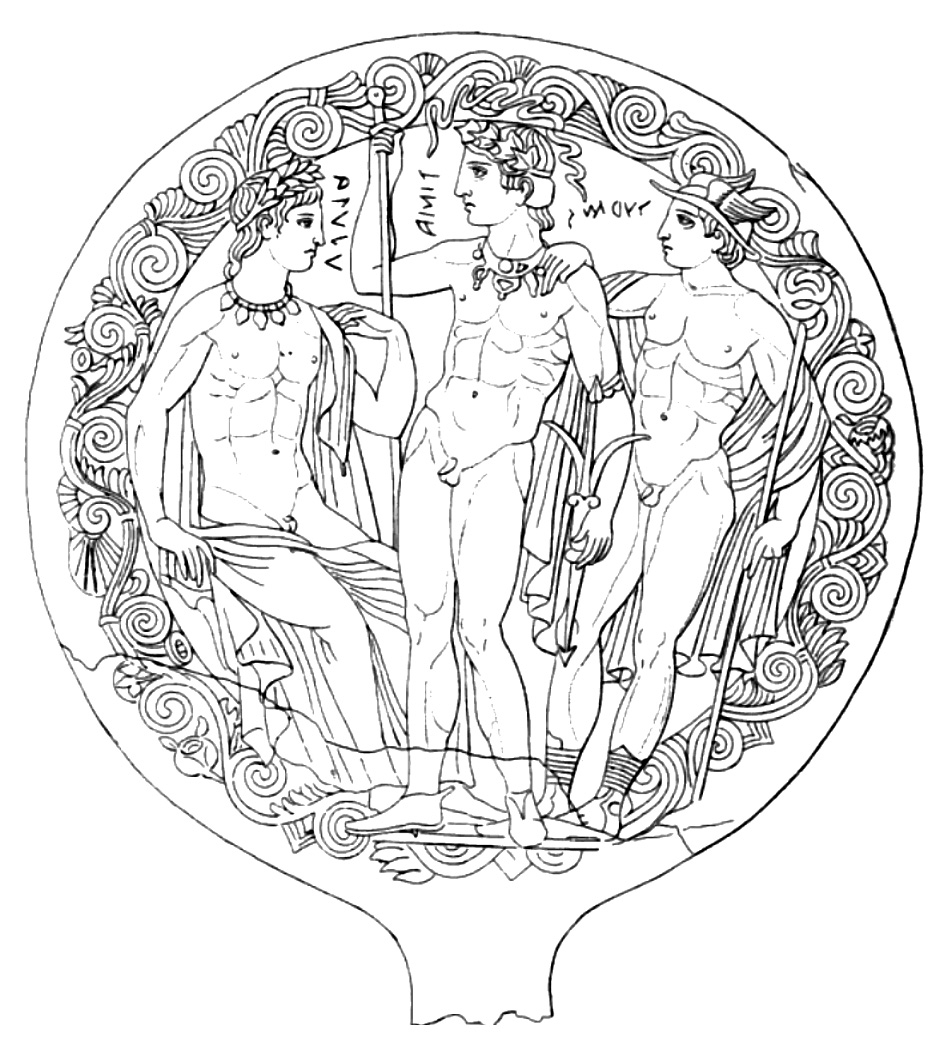
The Judgement of Elcsntre
Turms has the same function in the Etruscan version of the contest of the three goddesses as he does in the Greek version. He carries the prince to be judged; he is near the scene of judgment. The prince is Elcsntre (Paris or Alexandros), and the competitors are Menrva, Turan and Uni. Nancy de Grummond lists Turms as standing at the side of the group on her catalog of the Judgement mirrors. He is gesturing. He is holding the caduceus. He is performing the duties of a herald, but not as a participant.6,7
This is where almost all of his representations show him. He escorts; he announces; he leads... Combet-Farnoux based his understanding of the god on this concept; he describes Turms as serving, with "ministerium," the other gods, particularly Tinia, his master.1
Turms Aitaś and the Summoning of the Dead
A fourth-century bronze mirror in the Vatican Museums names four figures. Uθuze is Odysseus. Terasias is Tiresias, and the word hinθial beside him marks him as a shade rather than a man. The god who has brought him up is labelled Turms Aitaś, Turms of Aita, Turms belonging to the lord of the dead.1
The scene follows the eleventh book of the Odyssey (Nekyia), where Odysseus digs his trench at the edge of the world and the dead come up to the blood, and the seer of Thebes comes among them to tell him the road home.8 Homer sends no god to fetch Tiresias. The Etruscan engraver for whatever reason has one.
Turms Aitaś is the same god described by whose errand he is on, which is exactly how the mirrors treat him elsewhere.1
III. In the Rite of Turms
Here the record thins to almost nothing. L. Bouke van der Meer's analysis of the bronze liver from near Gossolengo works through the names inscribed on its regions one by one, twenty-eight entries covering Tin, Neθ, Uni, Mae, Tecvm, Lvsa, Caθa, Fufluns, Selva, Leθam, Tluscv, Cel, Cvl, Alp, Vetis, Cilens, Θufltha, Tul, Lasa, Tvath, Maris, Lar, Hercle, Velch, Satre, Metlvmth, Tiv and Usil. Turms is not among them.9
Clackson wrote that all but one come from engraved mirrors.3 Mirrors are toilet articles and grave goods. They record what an Etruscan family wished to look at.
Where the god becomes part of the mechanism of religion; that part is the mechanism of death, possibly as psychopomp. Fernando Gilotta has studied a late 5th century BCE red figure column krater (or vase) that was likely found in a burial ground at Bettolle and now housed at Chiusi. This vase depicts a bearded man who appears as if he is getting ready to leave and is being helped by Turms Aitaš. Gilotta noted that the vases created by this workshop had their interior surfaces left unglazed which indicates that these vessels were intended for holding ash remains rather than wine. Combet-Farnoux also records the god again on sarcophagi, in one case besie Charun and Cerberus.1,10
A god heavily present at Etruscan funerals and absent from Etruscan divination. The pattern holds across the whole surviving corpus.
IV. Objects
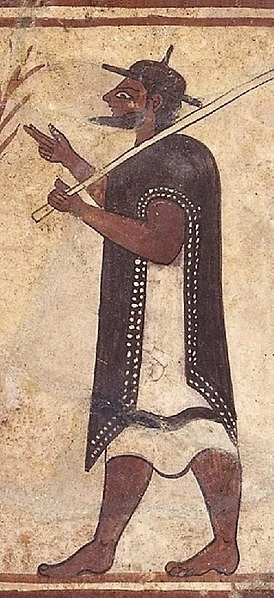
There are, in the strict sense, none. Turms is among the most frequently pictured figures in Etruscan art and among the least worshipped from what we know, and the scholarship does say that in the plainest terms imaginable: Pfiffig, Mauro Cristofani, Erika Simon and Daniele Maras all conclude that he was not the subject of a cult.2,3,11
Caere
A bronze weight dated approximately 350 B.C.E., published by Cristofani as an "aequipondium etruscum", contains ten lines of Etruscan. The opening lines contain the genitive forms of Raθ (the god) and Turms (the god), along with names of a "meθlum" and a "zilaχ-magistracy". This is likely the only known text dedicated to Turms; this is the only reference in the literature to the genitive form of the name Turms.3,12,13
The weight has been read several times since. Giulio Facchetti and Koen Wylin produced preliminary notes on it, Adriano Maggiani discussed it in the Veio-Cerveteri-Vulci catalogue, Mario Torelli approached it from the institutional side, and Valentina Belfiore has published a lexical re-reading.14,15,16,17
The Candelabrum at Florence
A fifth-century bronze candelabrum in the Museo Archeologico Nazionale at Florence has long been read with a word given as lursnal or lursl. Maras now reads turmsal.3,13 If the new reading holds, this becomes the earliest Etruscan dedication to the god by roughly a century, and the only one from outside Caere.
Cortona
Combet-Farnoux took one dedication to indicate that a temple of Turms had stood at Cortona.1 The inference is his rather than the stone's. It has not been taken up by the later literature on Etruscan cult inscriptions, and it should be held loosely.
Three candidates, one of them contested in its reading, one of them contested in its function, and one of them an inference. Against several hundred images. No sanctuary anywhere in Etruria has yet produced a votive deposit that belongs to him, unless the substance of the mirrors are misunderstood.
V. Objects and Places of Found Objects
The material divides sharply by medium. Mirrors carry the name and almost nothing else; the two objects that might carry a cult carry no image. Findspots are recorded for the funerary material and lost for much of the rest, since mirrors reached collections through the antiquities trade in large numbers and without their tombs.
| Object | Date | Ancient Provenance | Present Collection | Status of Identification |
|---|---|---|---|---|
| Bronze weight, aequipondium etruscum | c. 350 BCE | Caere | Not specified in the sources cited here | Securely named turmsal; function disputed |
| Bronze mirror with Uθuze, Turms Aitaś and the shade of Terasias | Fourth century BCE | Not recorded in the sources cited here | Vatican Museums | Securely named Turms Aitaś |
| Bronze mirror with the form turamś | c. 460–450 BCE | Findspot uncertain; attributed to Vulci | Not specified in the sources cited here | Securely named; longer form of the name |
| Red-figured column krater | Late fifth century BCE | Probably a necropolis at Bettolle | Chiusi | Securely named Turms Aitaś |
| Bronze candelabrum | Fifth century BCE | Faliscan territory | Museo Archeologico Nazionale, Florence | Reading turmsal proposed; provisional |
Sources: Cristofani and Belfiore for the weight from Caere;12,17 Combet-Farnoux for the Vatican mirror;1 Clackson and Meiser for the mirror with turamś and for the candelabrum;3,4 Gilotta for the krater;10 Maras for the re-reading of the candelabrum inscription.13
The Weight from Caere
The aequipondium is the counterweight of a steelyard balance, the sliding mass that sets the reading. An inscription of ten lines on such an object is extraordinary, and the length is what has drawn the successive re-readings.12,14,17
Raθ, whose genitive stands first, is a god of Caere known from that city's sanctuaries. Turms follows him. Beyond that the text runs into vocabulary that is either unattested elsewhere or attested too thinly to translate, and the published renderings diverge from one another well before the end of the first line.12,15,16,17
The issue here is whether the weight was given as a "gift" to Turmus, or if it was merely documented as being guaranteed by him. The Etruscans will not allow their position on this matter to be defined. This leaves us with nothing but procedure.
VI. Turms, Mercurius and the Aventine
Camillus
Certain Roman accounts have some information. Macrobius reported in his works that the Etruscans had another name for the god. Citing Statius Tullianus citing Callimachus, he writes that the Tusci called Mercury Camillus, a word meaning an attendant of the gods, and adds that this is why Virgil's Metabus gave his daughter the name Camilla, an attendant of Diana.18
As Combet-Farnoux showed so well he was able to use Macrobius' Camillus alongside the Cadmilos of the Samothracian mysteries (whom a scholiast on Callimachus describes as the Hermes of Tyrrhenia), and treat them as being names for the same figure. According to Combet- Farnoux the servant role is an even earlier form of the god than the commerce, that existed in both Etruria and Latium at least prior to each having temples for him1
All things considered the line of transmission needs to be evaluated fairly. A Latin compiler from the 5th century quotes a glossographer from the 4th century who quoted an Alexandrian scholar from the 3rd century about a language none of those men knew. No Etruscan texts give the god the name Camillus.
The Temple by the Circus
The Roman cult was placed by the Annals into the early years of the Republic. According to Livy, the Temple of Mercury was dedicated around 495 B.C.E. He stated that there was a dispute between Consul Appius Claudius and Consul Publius Servilius as to which one would be allowed to dedicate the temple. Therefore, the senate decided to let the people decide and they chose a Centurion. The Centurion arrived along with a ship carrying grain (the annual shipment) and he brought a merchant association with him. The same episode can be found preserved in Valerius Maximus.20 The location of the Temple of Mercury has been noted as being located at the base of the Aventine Hill, north of the Circus Maximus. It also faced the Circus.19,20,21
Ovid describes what the merchants did there. On the Ides of May they went to the spring near the Porta Capena, drew the water, wet a laurel branch in it and sprinkled their goods and their own heads, asking the god to wash off the profits of their lying.22
In conclsuion, the Etruscans depicted Turms more often than they depiced almost any deity, which would suggest some level of popularity for Turms, but the evidence of a physical presence in a holy context at present is on the scanter side.
Sources and Bibliography
- Combet-Farnoux, Bernard. “Turms étrusque et la fonction de «minister» de l’Hermès italique.” In Mercure romain: Le culte public de Mercure et la fonction mercantile à Rome de la République archaïque à l’époque augustéenne, 171–217. Bibliothèque des Écoles françaises d’Athènes et de Rome 238. Rome: École française de Rome, 1980. Cited pages: 171 and 183–84 for the name as native Etruscan; 177–80 for the psychopomp scenes, the sarcophagi and the mirror with Turms Aitaś; 189 for the ministerium; 173 for the inferred temple at Cortona; 185–87, 208, 214 and 216–17 for Camillus and Cadmilos.
- Pfiffig, Ambros Josef. Religio Etrusca. Graz: Akademische Druck- und Verlagsanstalt, 1975. Cited pages: 239–41, for the derivation of Turms from the root tur alongside Turan and for the absence of a cult.
- Clackson, James. “Etruscan Turms and Turan.” Studi Etruschi 80 (2017): 157–65. Cited for the derivation from Greek Ἑρμῆς with the definite article incorporated by crasis, the Greek comparanda from Olbia, Pantikapaion and Arcadia, the treatment of Greek long o as Etruscan u, the tally of written forms of the name, the observation that all but one instance come from mirrors, and Maras’s re-reading of the Florence candelabrum.
- Meiser, Gerhard, Valentina Belfiore, and Sindy Kluge, eds. Etruskische Texte: Editio minor. 2nd ed. Founded by Helmut Rix. Hamburg: Baar, 2014. Cited inscriptions: Vs S.11, Vs S.12 and Vs S.26 for variant forms of the name; Ve S.4 (CIE 11177) for turamś; Cr 4.22 for the weight from Caere; Fa 4.2 for the candelabrum.
- Harari, Maurizio. “Turms.” In Lexicon Iconographicum Mythologiae Classicae, vol. 8, pt. 1, 98–111. Zürich and Düsseldorf: Artemis Verlag, 1997. Cited for the earliest representations at the end of the sixth century BCE and for the attributes by which the god is recognised.
- de Grummond, Nancy Thomson. Etruscan Myth, Sacred History, and Legend. Philadelphia: University of Pennsylvania Museum of Archaeology and Anthropology, 2006. Cited for Turms in the Judgement scenes and for his role as guide and herald on the mirrors.
- de Grummond, Nancy Thomson. Corpus Speculorum Etruscorum: Great Britain 3. Rome: L’Erma di Bretschneider, 2007. Cited page: 15, on the mirrors of the Judgement of Elcsntre and the arrangement of the figures.
- Homer. The Odyssey, Volume I: Books 1–12. Translated by A. T. Murray. Revised by George E. Dimock. Loeb Classical Library 104. Cambridge, MA: Harvard University Press, 1919. Cited book: 11, on the summoning of the dead and the prophecy of Tiresias.
- van der Meer, L. Bouke. The Bronze Liver of Piacenza: Analysis of a Polytheistic Structure. Dutch Monographs on Ancient History and Archaeology 2. Amsterdam: J. C. Gieben, 1987. Cited for the catalogue of the twenty-eight divine names inscribed on the liver, among which Turms does not appear.
- Gilotta, Fernando. “A Journey to Hades with Turms Aitas.” In Material Aspects of Etruscan Religion: Proceedings of the International Colloquium, Leiden, May 29 and 30, 2008, edited by L. Bouke van der Meer, 105–15. BABesch Supplement 16. Leuven: Peeters, 2010. Cited for the late fifth-century column krater from Bettolle, now at Chiusi, and for the use of vases from that workshop as cinerary urns.
- Simon, Erika. “Gods in Harmony: The Etruscan Pantheon.” In The Religion of the Etruscans, edited by Nancy Thomson de Grummond and Erika Simon, 45–65. Austin: University of Texas Press, 2006. Cited page: 60, on the absence of a cult of Turms.
- Cristofani, Mauro. “Aequipondium etruscum.” In Due testi dell’Italia preromana: 1. Per regna Maricae; 2. Aequipondium Etruscum, 39–54. Quaderni di Archeologia Etrusco-Italica 25. Rome: Consiglio Nazionale delle Ricerche, 1996. Cited for the publication of the inscribed bronze weight from Caere and the reading raθs turmsal.
- Maras, Daniele F. Il dono votivo: Gli dei e il sacro nelle iscrizioni etrusche di culto. Biblioteca di Studi Etruschi 46. Pisa and Rome: Fabrizio Serra Editore, 2009. Cited pages: 277–79 for the weight from Caere; 317 for the candelabrum inscription re-read as turmsal.
- Facchetti, Giulio M., and Koen Wylin. “Note preliminari sull’aequipondium di Cere.” Annali dell’Istituto Universitario Orientale di Napoli 23 (2001) [2005]: 143–62. Cited for an early attempt at the syntax of the inscription.
- Moretti Sgubini, Anna Maria, ed. Veio, Cerveteri, Vulci: Città d’Etruria a confronto. Exhibition catalogue. Rome: L’Erma di Bretschneider, 2001. Cited page: 153, the entry by Adriano Maggiani on the weight from Caere.
- Torelli, Mario. “Riflessioni antiquarie e istituzionali sull’aequipondium di Caere.” In EQO DUENOSIO: Studi offerti a Luciano Agostiniani, edited by Alessandro Calderini and Riccardo Massarelli, 865–96. Collana Ariodante: Linguistica ed epigrafia dell’Italia antica 1. Perugia: Università degli Studi di Perugia, 2022. Cited for the institutional reading of the object.
- Belfiore, Valentina. “Aequipondium etruscum: Elementi per una rilettura. Riflessioni lessicali.” Studi Etruschi 87 (2024): 319–37. Cited for the most recent lexical re-reading of the inscription.
- Macrobius. Saturnalia, Volume II: Books 3–5. Edited and translated by Robert A. Kaster. Loeb Classical Library 511. Cambridge, MA: Harvard University Press, 2011. Cited section: 3.8.6, on Statius Tullianus, Callimachus, and the Etruscan name Camillus for Mercury as praeminister deorum.
- Livy. History of Rome, Volume I: Books 1–2. Translated by B. O. Foster. Loeb Classical Library 114. Cambridge, MA: Harvard University Press, 1919. Cited sections: 2.21.7, on the dedication of the temple of Mercury in 495 BCE; 2.27.5–6, on the dispute between the consuls and the assignment of the dedication to a centurion together with the grain supply and the guild of merchants.
- Valerius Maximus. Memorable Doings and Sayings, Volume II: Books 6–9. Edited and translated by D. R. Shackleton Bailey. Loeb Classical Library 493. Cambridge, MA: Harvard University Press, 2000. Cited section: 9.3.6, on the same dedication.
- Platner, Samuel Ball, and Thomas Ashby. A Topographical Dictionary of Ancient Rome. London: Oxford University Press, 1929. Cited entry: “Mercurius, Aedes,” for the dedication of 495 BCE and the position of the temple on the Aventine slope above the Circus Maximus.
- Ovid. Fasti. Translated by James G. Frazer. Revised by G. P. Goold. Loeb Classical Library 253. Cambridge, MA: Harvard University Press, 1931. Cited section: 5.669–92, on the Ides of May, the spring near the Porta Capena, and the merchant’s prayer over his sprinkled goods.