





| Language | Name of Juno | Attestation |
|---|---|---|
| Old Latin | Iuno | CIL I² 361 inscription (3rd century BCE) |
32 min read
Juno
author: High Priest Zevios Metathronos
author: Karnonnos
I. Name of the Divine Queen
The oldest literary, inscriptive and object-derived evidence of Juno's name comes from the late 3rd to early 2nd century BCE. These include Livy's attestation of Livius Andronicus’ hymn to Juno Regina from 207BCE, the CIL I² 361 = ILLRP 161 inscription from the 3rd century BCE and CIL I² 360 = ILLRP 163 inscription from Norba from 230-181BCE. Plautus' early Aulularia from around 190BCE also mentions her as a character calls out for her help directly.1, 2, 3, 4
She is likely descended from the Etruscan goddess Uni in part, whose name is attested far further back in the Pyrgi golden tablets of that civilization from 510BCE. However, Juno's name is presumed to have a link with Proto-Indo-European *iuuen (h₂iu-h₁en) which has links to the idea of time and fertility. Her name is connected to a form of Jupiter known in some inscriptions as Iuuntus, and to the epithet Ioviste, a superlative of the same root meaning the youngest.5,6,7
In Latin, her name had a correlation with the concept of iuvenis, an idea of full vitality. Varro connected her name with the idea of aid, iuvare, and the verb iuvenescere, to rejuvenate. Plutarch took the word Juno to refer in part to the Moon and month cycle.8, 9
Sources: Di Fazio, Analysis Archaeologica: An International Journal of Western Mediterranean Archaeology 1 (2015)2
II. Juno in the Roman World
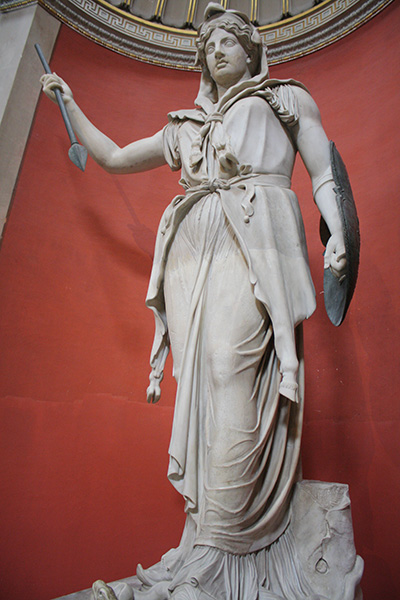
The Early Roman Juno
Juno is presented as being part of Latin life as early as 753BCE, around the time of the first King of Rome, Romulus, in Dionysius of Halicarnassus' account of Roman history. After the union of the Sabines with the Roman people, the co-ruling king Titus Tatius dedicated ritual tables in every curia to Juno Quiritis.10
The shared account of Livy and Dionysius on the next iteration of Juno's worship, that is Juno Regina of Veii, comes during Camillus’ capture of the Etruscan city of Veii in 396 BCE. Livy has Camillus pray to “Queen Juno” to come to Rome, then describes her statue being ritually transferred to the Aventine. This context is indicative of her link to her Etruscan counterpart in a manner more linear than the majority of Roman gods in inheritance.10, 11
The rite Camillus used is called evocatio, aka the summoning of an enemy community's tutelary deity to Rome under the promise of a richer cult. In Livy's account, the dictator asks the goddess whether it pleases her to follow the victors, surprisingly, the young men detailed to lift the statue report that she nodded.11, 12
Robert Palmer treated the Roman Juno as a composite assembled out of the sovereign goddesses of conquered neighbors, and read her original character as political rather than domestic. Her Aventine temple was dedicated in 392 BCE outside the sacred boundary of the city, on the hill that later became the quarter of the plebs, so that the goddess brought from Veii was housed among the people and not at the political centre.11, 13
Latium Absorbed
The settlement of the Latin War in 338 BCE brought a second foreign Juno into the Roman state. Livy records that the temple and grove of Juno Sospita at Lanuvium were made common to the Lanuvines and to the Roman people, and that Roman magistrates were thereafter obliged to sacrifice there. The cult stayed where it was, and Rome acquired a share in it.14
During the Hannibalic war Juno received a large share of the expiatory ritual of Rome. Livy's prodigy lists for 218 and 217 BCE are full of portents referred to her at Lanuvium and on the Aventine, expiated by gifts collected from the matrons of the city. In 207 BCE, after a lightning strike on her Aventine temple, the decemvirs ordered a procession of twenty-seven maidens through the city singing the hymn composed by Livius Andronicus.3, 15 Mary Beard, John North and Simon Price treat that procession as a turning point, the moment at which a public rite of expiation also became an instrument of civic morale in a war Rome expected to lose.16
The Queen Under the Principate
Augustus in his rearticulation of Roman religion restored the Capitoline cult and gave Juno Regina a conspicuous place in the Secular Games of 17 BCE, where one hundred and ten matrons held sellisternia in her honor. John Scheid has emphasised that the Augustan settlement kept the republican forms of such rites while transferring their patronage to a single house.17
The temple on the Capitol stood through the fires of 83 BCE, 69 CE and 80 CE and through three rebuildings, therefore Juno was still receiving public sacrifice there in the fourth century CE, long after both the monarchy and the Republic had ended. Her Capitoline cult lasted until the state withdrew from paying.16, 17
III. The Epithets of the Queen
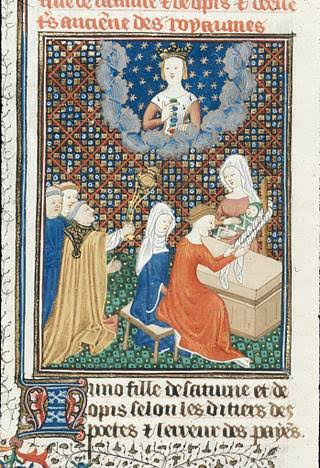
Georg Wissowa treated the proliferation of cult epithets as the ordinary Roman method of dividing a divine power into its separate operations, each with its own altar, its own day and its own qualified priest. On this account a Roman reached Juno through a title before reaching her through the name, and the epithet did the working part of the cult. Georges Dumézil read the Lanuvian formula Iuno Seispes Mater Regina as a single trifunctional utterance, with Seispes carrying the warlike second function, Mater the third function of fecundity and Regina the first function of sovereignty. Geneviève Dury-Moyaers and Marcel Renard later surveyed the whole state of the question. There is a dispute on the meaning of 'Regina'.18, 19, 20, 21
A further stratum of names survives only in the grammarians and in hostile Christian catalogues. Festus preserves Sororia, Iuga and Fluonia; Servius supplies the Sabine etymology of Curitis; Martianus Capella lists Iterduca, Domiduca, Unxia and Cinxia in his account of a wedding; Augustine assembles the marriage deities from Varro so as to ridicule them. Much of this material would have been lost without the polemic that carried it.22, 23, 24, 25
Valerius Maximus describes the shrine of Juno Viriplaca on the Palatine, where a husband and wife at odds went to speak in turn and returned home reconciled. The title records an institution rather than a divine power, and it gave Juno jurisdiction over the one quarrel Rome could not afford to lose.26
| Epithet | Meaning | Domain |
|---|---|---|
| Juno Regina | Queen | Sovereignty, the Capitoline and Aventine state cult |
| Juno Lucina | She who Brings Light | Childbirth, the Matronalia |
| Juno Moneta | She who Warns | Warning, the citadel, the republican mint |
| Juno Sospita | The Savior | Armed protection, Lanuvium, prodigy |
| Juno Curitis | Of the Spear | The curiae, the citizen body in arms |
| Juno Caprotina | Of the Wild Fig | Fertility, Nones |
| Juno Sororia | Of the Sister | Puberty, the Sororium Tigillum |
| Juno Iuga | Of the Yoke | The marriage bond |
| Juno Pronuba | She who leads the bride | The wedding rite, matron of honor |
| Juno Cinxia | Of the Bridal Gridle | Marriage |
| Juno Domiduca | Who Leads the Bride Home | The bridal procession |
| Juno Unxia | Of Anointed Doorpost | The threshold of the marital house |
| Juno Fluvionia | Who Stays the Flow | Gestation, obstetric protection |
| Juno Covella | Of the hollow moon, invoked at the Kalends | The lunar month, the Kalends |
| Juno Populona | Of the people in arms | The people under arms |
| Juno Viriplaca | Appeaser of Husbands | Marital reconciliation, the Palatine shrine |
| Juno Martialis | Of Mars | Imperial war cult |
| Juno Conservatrix | Preserver, giver of victory | Imperial coinage, dynastic protection |
Order follows religious weight in the Roman state calendar and in public cult, not frequency of literary mention. Sources: Varro, De lingua Latina 5.69, 6.18, 6.27; Dionysius of Halicarnassus, Roman Antiquities 2.50.3; Livy, History of Rome 5.21–22, 7.28.4–6, 8.14.2; Wissowa, Religion und Kultus der Römer (1912); Dury-Moyaers and Renard, “Aperçu critique de travaux relatifs au culte de Junon” (1981); Festus–Paulus, De verborum significatu; Servius, In Vergilii carmina commentarii on Aeneid 1.8, 4.166; Martianus Capella, De nuptiis Philologiae et Mercurii 2.149; Augustine, De civitate Dei 6.9; Valerius Maximus, Memorable Doings and Sayings 2.1.6; Mattingly and Sydenham, The Roman Imperial Coinage.8, 10, 11, 14, 18, 20, 22, 23, 24, 25, 26, 27
IV. The Temples of Juno
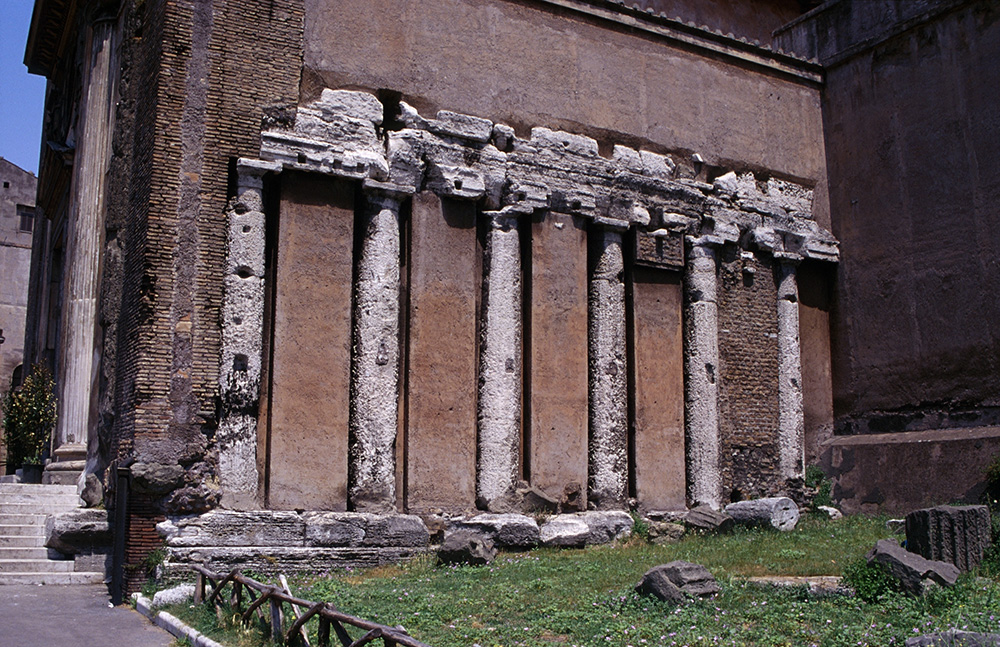
The Capitoline Cella
In the temple of Jupiter Optimus Maximus on the Capitol, Juno held the left cella of three. It ranked with Minerva's on the right and stood subordinate to the central hall of the God of Thunder, so that the largest house she had at Rome was never wholly her own. Lawrence Richardson and Filippo Coarelli both stress the tripartite plan as the defining fact of the building, since it made her a permanent resident of the state sanctuary rather than a visitor to it.28, 29
The scale is disputed in detail and very large on any reckoning. John North Hopkins gives the archaic podium as roughly 53 by 62 metres on the surviving foundations, which makes it the largest temple in Italy for most of the Republic, and on those figures Juno's cella alone exceeded the footprint of most Roman temples.29, 30
The Aventine
The temple of Juno Regina on the Aventine came second to the Capitoline cella in dignity and first in emotional charge. Camillus vowed it at Veii in 396 BCE and it was dedicated in 392 BCE. Eric Orlin has shown how such vows worked as instruments of aristocratic competition, since the man who made the vow secured the credit and often the dedication as well. The Aventine temple was the destination of the great matronal processions of the Hannibalic war and remained the principal address for Roman women acting as a body.11, 31
The Cispius
The temple of Juno Lucina stood in a grove on the Cispian spur of the Esquiline. The grove was older than the building: Pliny records that the lotus tree in the precinct was reckoned as old as the city itself, while the temple is dated to 375 BCE. The Matronalia of the first of March were celebrated here, and Roman women brought the offerings of childbirth to the same precinct.28, 32
The Arx
The temple of Juno Moneta stood on the Arx, the northern summit of the Capitoline hill. Lucius Furius Camillus vowed it during the war against the Aurunci and it was dedicated in 344 BCE. Livy places it on the site of the house of Marcus Manlius Capitolinus, razed after his condemnation, so that the goddess took possession of the ground of a Roman traitor.11, 28
The Forum Holitorium
The Lanuvian goddess received her own temple at Rome in the vegetable market by the Tiber. Gaius Cornelius Cethegus vowed it in 197 BCE during the campaign against the Insubrian Gauls, and it was dedicated in 194 BCE. Its remains are generally identified with one of the three republican temples embedded in the church of San Nicola in Carcere, although which podium belongs to which cult is disputed; Coarelli sets out the difficulty and leaves it open.29, 33
The Campus Martius and the Porticoes
A temple of Juno Curitis stood in the southern Campus Martius. Richardson places it among the crowded republican foundations near the Circus Flaminius, without claiming a secure identification with any excavated podium. Nearby, Quintus Caecilius Metellus Macedonicus built a temple of Juno Regina in 146 BCE, which Augustus later enclosed within the Porticus Octaviae. Imperial building in this quarter largely consisted of wrapping older cult sites of Juno in newer marble.28, 29
Lanuvium
Outside the city the chief sanctuary of the Roman state was the temple of Juno Sospita on the acropolis of Lanuvium, shared with Rome after 338 BCE and served by an annual sacrifice performed by Roman magistrates. Its grove held the serpent to which the Lanuvines brought their maidens. No other Latin sanctuary was annexed so completely while keeping so much of its local character.14, 29
Under the Empire, the pattern was reproduced across the provinces, since every colony with a Capitolium built Juno a cella of her own. The Capitoline model was deliberately transportable and carried the Roman hierarchy of the three deities into Africa, Gaul and Britain, with Juno in the left-hand chamber in each case.16, 17
V. Juno, Ruler of Women
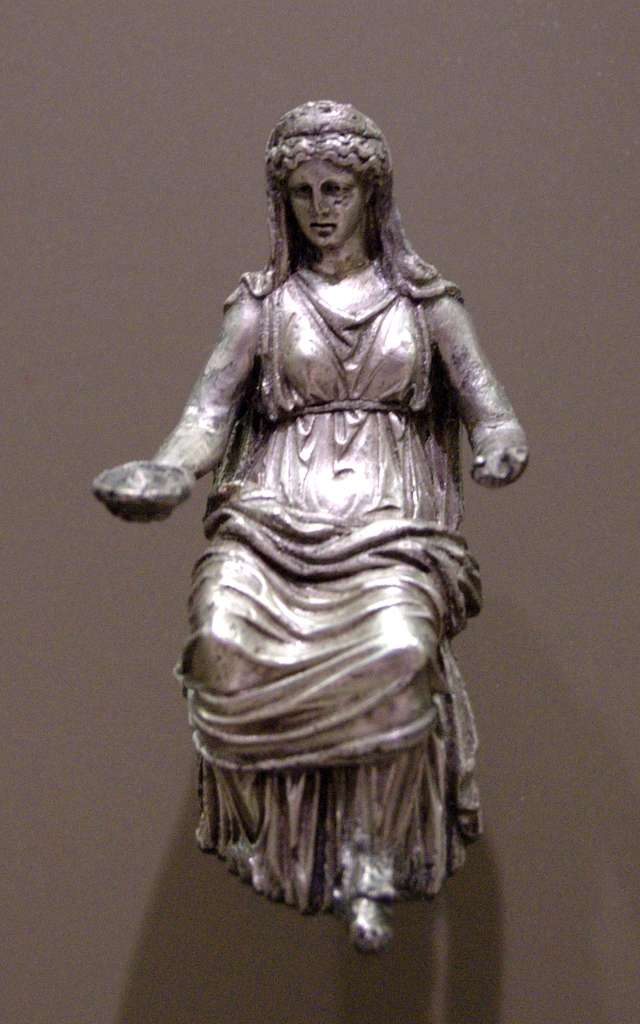
The Iuno of Every Woman
Roman religion gave each man a genius probably related to Iove and each woman a iuno, a tutelary power born with her and bound to her for life. Censorinus states the doctrine plainly in his birthday treatise, pairing the two guardians as exact counterparts. A Roman woman therefore both prayed to the Queen of the Gods and carried a power of the same name within herself.34
That personal iuno received her own worship. The poems of Sulpicia in the Tibullan corpus address the Natalis Iuno of a woman's birthday with incense and prayer, in the same terms a man would use for his genius.35
The public calendar carried the same association every month. Varro and Macrobius recorded that the Kalends belonged to Juno, and that the pontifex minor on the Arx called out the number of days to the Nones with an invocation of Juno Covella, a title referring to the hollow moon. The Roman month opened with a cry addressed to her.8, 36
The Girl
Juno Sororia governed the first of these thresholds. Festus and Paulus attached her to the sororium tigillum, the beam under which the surviving Horatius passed after killing his sister, and the antiquarian tradition connects the epithet to the swelling of a girl's body at puberty.22
The Bride
At marriage the goddess divided into a series of functions. Virgil calls her pronuba, the goddess who stands as matron of honor. Martianus Capella lists Iterduca who walks the road, Domiduca who brings the bride to the door, Unxia who attends the anointing of the doorposts and Cinxia who governs the girdle. Augustine repeats the catalog so as to mock a religion that appointed a deity to every gesture. The sequence he mocks is an ordered account of a single afternoon.24, 25, 37
The Mother
Childbirth belonged to Juno Lucina, whose name Varro derived from lux, the light into which the infant is drawn. On the Kalends of March the matrons of Rome kept the Matronalia in her grove on the Cispius. Ovid describes them praying with hair unbound and every knot and belt loosened, so that nothing tied should bind the birth, a piece of sympathetic magic carried on inside a state cult.8, 38
The obstetric titles are specific to particular physiological processes. Festus preserves Fluonia, invoked to hold back the menstrual flow so that the child might be nourished, and the antiquarians also knew titles concerned with the knitting of infant bones.22
The Matron
Celia Schultz has shown that the matronae of Rome functioned as a religious corporation with its own cults, its own funds and its own occasions of public visibility, and that Juno was their chief patron. Nicole Boëls-Janssen traced the same institution back into archaic Latium, where the univira, the woman married only once, held ritual privileges denied to others. A woman's access to these cults was graded by her own history.39, 40
Taken together the epithets cover an entire life. A Roman woman met the same goddess at her birthday, at puberty, at her wedding, in childbirth, in widowhood, under a different name on each occasion.34, 39
VI. Juno Curitis
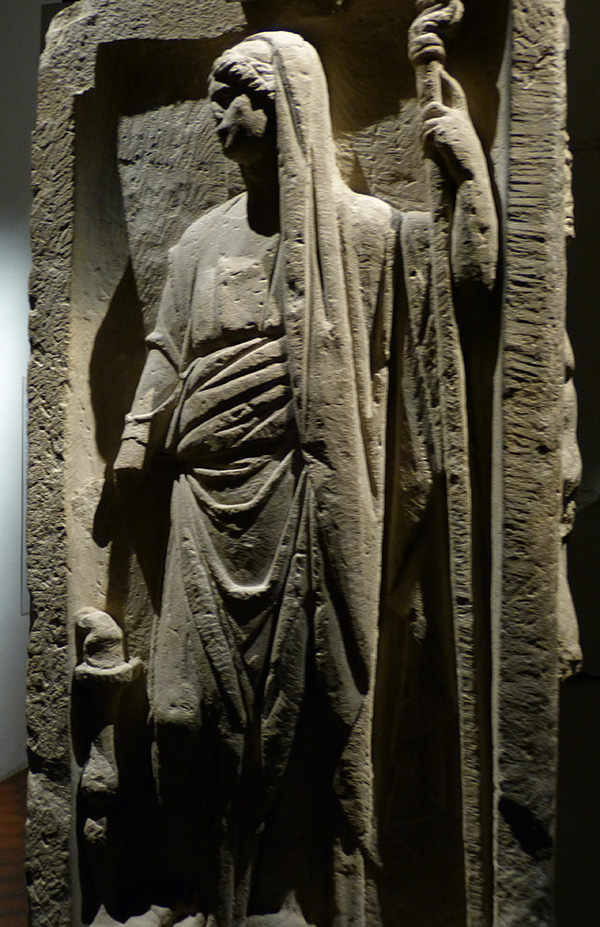
The oldest institutional form of Juno at Rome is the goddess of the curiae. Dionysius reports that Titus Tatius set tables for Juno Quiritis in each of the thirty curiae, the archaic voting and military divisions of the Roman people, so that her worship was distributed through the constitution before it was made in any temple.10
The ancient etymology is war-based and unlike any surviving concept of Hera other than the epithets given in the Byzantine tomes. Servius derives Curitis from curis, which he reports as the Sabine word for a spear, and Festus preserves the same equation in the entries linking Quirites and Quirinus to that root. On this derivation the goddess of the curiae carried the weapon of the assembly she governed.22, 23
Ovid supplies the only close description of the rite as he saw it outside Rome. At Falerii, he watched the annual festival of Juno: the road strewn and hung, white-robed youths and maidens moving in procession, the sacred objects carried on the heads of chosen girls, and a she-goat given to the goddess. The Faliscans told him their cult was of Argive origin, a claim of Greek descent that many Italian communities made to their visitors.41
Modern reconstructions differ in emphasis as it is debated exactly what state function she served. They see Curitis as the spear-bearing goddess of the armed community, while others see the curial Juno as the religious expression of the curia itself, a corporation of men with wives, children and property to defend. Both readings agree on the substance and make her the goddess of the citizen body considered as an armed household.21, 42
Her temple at Rome stood in the southern Campus Martius. However, no excavated podium can be assigned to it with confidence. The cult outlived its own archaeology and its own political occasion: the curiae kept their tables long after they had lost their power.28
VII. Juno Sospita
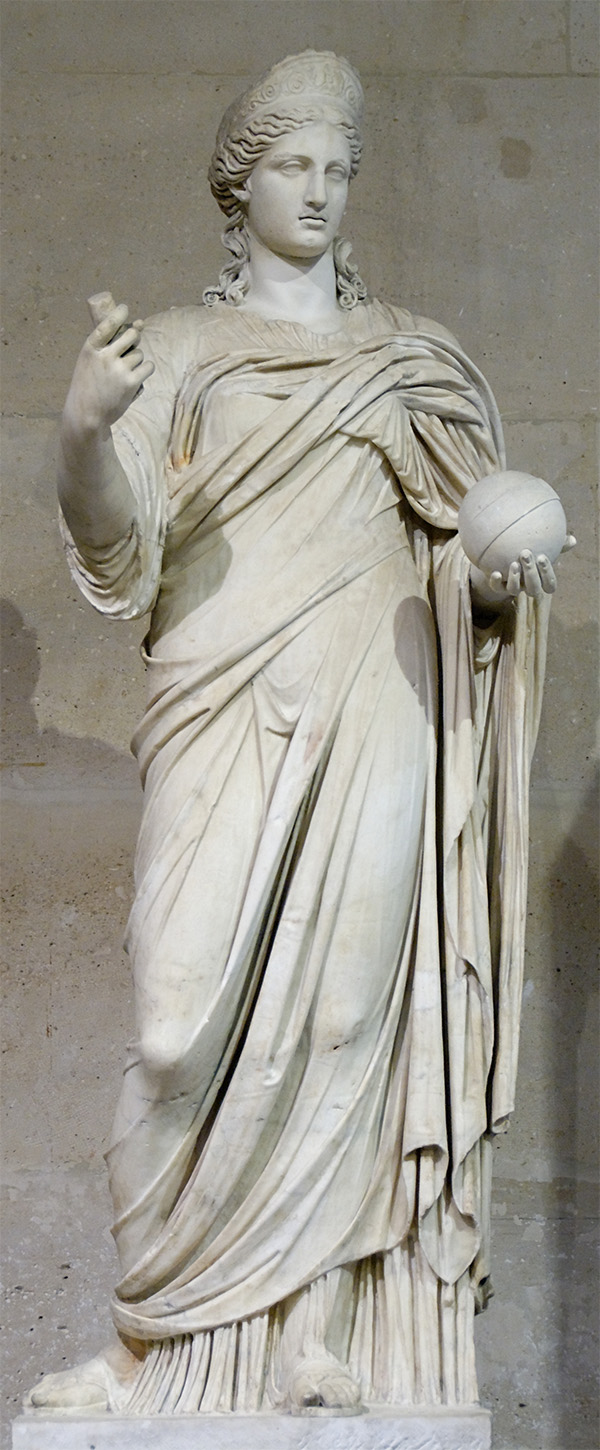
The Savioress of Lanuvium entered Roman state religion by a treaty. After the Latin War the temple and grove at Lanuvium were declared common to the Lanuvines and the Roman people, and Roman magistrates were bound to sacrifice there each year. The same document that annexed the town gave her cult a place in Roman public religion.14
Her image was unmistakable and deliberately archaic. Cicero describes her with a goatskin drawn over her head, a spear, a small shield and shoes with turned-up toes, and remarks that no Roman would confuse this figure with the Juno of the Argives.43
The grove at Lanuvium held a serpent, and the serpent gave oracles. Propertius describes maidens carrying barley cakes down into the cave with their eyes covered, and Aelian gives the same rite with the outcome attached: if the snake accepted the food, the girl was chaste and the year would be fruitful.44, 45
Rome watched her shrine for warnings throughout the second cataclysmic war with Carthage. Livy's prodigy lists report ravens in her temple, weapons moving of themselves and blood on her statue, each expiated by decree of the Senate. The sanctuary was in effect a reporting station for the Senate which continued after the Punic Wars.15
The best documented of these episodes falls in 90 BCE. Cicero records the dream of Caecilia Metella, in which Juno Sospita fled her own polluted temple and returned only after the building had been cleansed; the Senate ordered the consul to see to the restoration. Celia Schultz has read the incident as a measure of Roman anxiety during the Social War, when the state of a cult shared with the Latins stood as an index of whether the alliance itself would hold.46, 47
Her Lanuvine priesthood remained a working political office into the last generation of the Republic. Cicero states that Milo was travelling to Lanuvium as dictator of the town to appoint a flamen of Juno Sospita on the day he met Clodius on the Appian Way.48
Roman moneyers used her image without restraint. Michael Crawford catalogues the goatskin-crowned head of Sospita on the denarii of Lucius Thorius Balbus, who added the legend I S M R, of Lucius Procilius, and of Lucius Roscius Fabatus, whose reverse shows a girl feeding the serpent of the grove. Jane DeRose Evans reads these types as claims of Lanuvine descent, a cheap way for a family that could show the goddess to show its own antiquity.49, 50
VIII. Juno Moneta
Lucius Furius Camillus vowed the temple on the Arx during the campaign against the Aurunci, and it was dedicated in 344 BCE on ground taken from a condemned patrician. Livy states that the house of Marcus Manlius Capitolinus had stood on the spot, and that after his execution the people forbade any patrician to live on the Capitol or the Arx.11
Her title is a participle. Moneta comes from monere, to warn, and the Romans preserved the incident that earned it: a voice out of her grove announced a coming earthquake and demanded the sacrifice of a pregnant sow, and the sacrifice was made. Ovid fixes her dedication day to the Kalends of June, a month associated with the matrons.38, 46
Her sacred geese belong to the same complex of vigilance, though they are older than the temple. Livy reports that in the Gallic siege of 390 BCE the geese sacred to Juno, kept on the Capitol and spared through the famine on that account, roused Marcus Manlius in time to throw the attackers off the cliff. The sanctuary on the Arx was not dedicated for another forty-six years, so the birds belonged to the goddess rather than to this precinct.11
The consequence for the history of money is well known and thinly attested. Livy's phrase aedes atque officina Monetae, the temple and workshop of Moneta, together with an entry in the Suda, are the only two ancient statements that place the republican mint at her temple. Andrew Meadows and Jonathan Williams grant that the evidence is meagre and argue that it is sufficient anyway, since no rival location has any claim at all.11, 51, 52 From the workshop the name passed to its product: Isidore of Seville records the derivation of moneta, the coin, from the goddess in whose precinct coin was struck, and through Latin the word reached almost every European language.53
IX. The Capitoline Triad and Her Role Within It
The temple on the Capitol was begun under the Tarquinian kings of Rome and was dedicated in the first year of the Republic by Marcus Horatius Pulvillus. Livy tells the story of the exauguration of the older shrines on the hill. Every deity consented to move except Terminus and Iuventas, whose refusal was read as an omen of permanence. Juno entered the greatest sanctuary of Rome by this formal legal procedure.54
The plan itself is Etruscan in its basic shape. Vitruvius describes the Tuscan temple with its three parallel cellae and its deep front porch, and Servius reports the rule of the Etruscan discipline that a properly founded city should possess temples of Jupiter, Juno and Minerva. Rome took the central structure of its state religion from the people it conquered.23, 55
The dimensions have been argued over since antiquity. Dionysius gives the platform as roughly two hundred by one hundred and eighty-five Roman feet, while John North Hopkins and Gabriele Cifani, working from the surviving cappellaccio foundations, arrive at figures near 53 by 62 metres. The disagreement concerns metrology, not the order of magnitude.10, 30, 56
Within that building Juno Regina occupied the cella on Jupiter's left, and the ritual hierarchy was visible at every banquet. Valerius Maximus records that at the epulum Iovis the God of Thunder reclined on a couch while Juno and Minerva were seated on chairs, a distinction of posture that stated a distinction of rank without a word being spoken. Every Roman triumph ended at the door of this temple.26
The building burned in 83 BCE, again in the fighting of 69 CE and once more in 80 CE, and each rebuilding gave a Roman ruler the occasion to attach his name to the cult. Tacitus describes the destruction of 69 CE as the gravest disgrace to befall the Roman state, since the temple fell by Roman hands. None of the three fires dislodged Juno from the hill.57
The most complete surviving image of the group comes from outside Rome. The triad found in 1992 in the Parco dell'Inviolata near Guidonia Montecelio, cut from Luna marble in the later second century CE and recovered by the Carabinieri in 1994, shows the three deities seated on a single throne: Jupiter at the centre with sceptre and thunderbolt, Juno at his side with sceptre and patera, Minerva helmeted at the other, each crowned by a small winged Victory and each with the sacred animal at the feet. Juno's peacock stands on the same step of the same throne as the eagle and the owl.58
X. Juno Accompanying Roman Rulers
The practice began under the Republic, among competing families rather than monarchs. The academic record showed Lucius Thorius Balbus, Lucius Procilius and Lucius Roscius Fabatus placing the goatskin head of Sospita on their denarii within a few decades of one another, and Jane DeRose Evans reads the sequence as competitive advertisement of Lanuvine ancestry, that is, as an argument about who deserved to hold office.49, 50
Restoration served the same purpose at a larger scale. After the fire of 83 BCE the rebuilding of the Capitoline temple fell to Quintus Lutatius Catulus, whose name stood on the architrave until the Flavians replaced it. Every subsequent reconstruction carried the same advertisement in that the man who repaired the roof of Juno Regina had also claimed the guardianship of Rome.28, 57
Augustus, as with the consort of Juno and other deities like Hestia, ensured he did pay righteous honor to the goddess. The inscribed acts of the Secular Games of 17 BCE, preserved in the great Capitoline inscription and edited by Giovanni Battista Pighi, record one hundred and ten matrons holding sellisternia for Juno Regina, while Horace's commissioned hymn asked the Gods to prosper the Roman race. Juno was given a place in the new order without the loss of a single rite.59, 60
Under the Principate, her image was transferred to the women of the imperial house. The reverses IVNO REGINA, IVNO LVCINA and IVNONI CONSERVATRICI run through the coinage of Sabina, Faustina, Lucilla, Crispina and their successors. The empress was shown as the counterpart of the goddess without ever being called a goddess in her lifetime, so that the equation was suggested and never stated.27, 61
The Severan house pressed the identification hardest. Clare Rowan has analysed the divine typology of Julia Domna, on whose coinage Juno appears as the guarantor of dynastic continuity at the moment when that continuity was least secure.62
Barbara Levick had shown the same instrument working on behalf of Faustina the Elder and Faustina the Younger, where Juno Lucina types accompany imperial births and Juno Regina types accompany consecration. Under Trebonianus Gallus and Volusianus the coinage went further still and produced Iuno Martialis, a warlike Juno housed in a round temple, struck for an emperor who needed a war goddess and had one to hand. The coinage in each case adapted an existing deity to a new purpose.27, 63
XI. Representations of Juno in the Renaissance and Beyond
Juno outlived the end of her own cult inside books. Jean Seznec demonstrated that the Gods of antiquity passed through the Middle Ages as allegories, planetary powers and moral emblems. They returned to the Renaissance with their attributes intact despite their altars being empty. She reached the sixteenth century as an iconographic type, identified by the peacock, the diadem and a reputation for jealousy.64
The key text in transmission through the Middle Ages was Ovid, particularly L'Ovide Moralisé. The Metamorphoses gave painters the persecution of Io, the blinding and death of hundred-eyed Argus whose eyes were set in the peacock's tail, the burning of Semele and the transformation of Callisto. Every one of these episodes shows the goddess in her aspect of jealous vengeance, and almost none of the material that made her famous has any connection with Roman cult.65
Venice produced Jacopo Tintoretto's Origin of the Milky Way, painted about 1575 for the physician Tommaso Rangone and now in the National Gallery in London, shows the infant Hercules set to the breast of the sleeping goddess; the milk that spurts upward forms the galaxy and the milk that falls makes lilies. The canvas was cut down by roughly a third around 1727, so that the earth and its flowers are gone and only the heavens remain.66
In Rome, Annibale Carracci painted the Loves of the Gods in the gallery of the Palazzo Farnese between 1597 and 1600, and Charles Dempsey has shown how the programme reads the divine amours as a philosophical argument about the power of love over the universe. Juno appears there as a wife on a couch, an antique statue restored to warmth.67
Rubens took the cruel half of the story. His Juno and Argus in the Wallraf-Richartz-Museum at Cologne, painted about 1610, shows the goddess gathering the eyes from the severed head of her murdered watchman to set them in the tail of her bird.68
French taste made her a stage figure. The tragédie en musique Isis, with a libretto by Philippe Quinault and music by Jean-Baptiste Lully, first performed in 1677, gave Junon the leading dramatic role as the implacable persecutor of Io, and the opera was read at court as a portrait of jealousy in high places.69
The rococo restored her authority in a lighter key. Juno Asking Aeolus to Release the Winds, painted by François Boucher in 1769 as one of six great canvases for Jean-François Bergeret de Frouville and now in the Kimbell Art Museum, measures 278.2 by 203.2 centimetres. The subject comes from the first book of the Aeneid, with the goddess offering the nymph Deiopea in exchange for a storm, and Boucher gave the destruction of a fleet the colouring of a boudoir.70
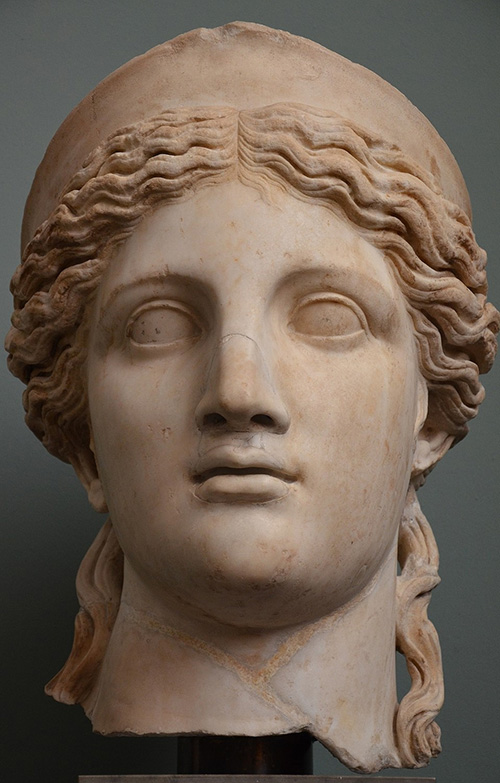
Sculpture showed her dignity. The colossal head known as the Juno Ludovisi, now in the Palazzo Altemps, was among the most admired antiquities in Europe from the seventeenth century onward, as Francis Haskell and Nicholas Penny record. Goethe kept a cast of it in his house at Weimar, and Schiller made it the central example of the fifteenth letter of the treatise on aesthetic education, where the repose of the divine countenance stands for freedom itself. Schiller's account of beauty thus took its central example from a Roman image of Juno.71, 72
Modern scholars have argued that the head is an idealised portrait of Antonia Minor in the guise of the goddess and not a cult image of Juno. The truth however is that statues like this were used to portray the noble woman in the ideal of the ultimate.64,71,73
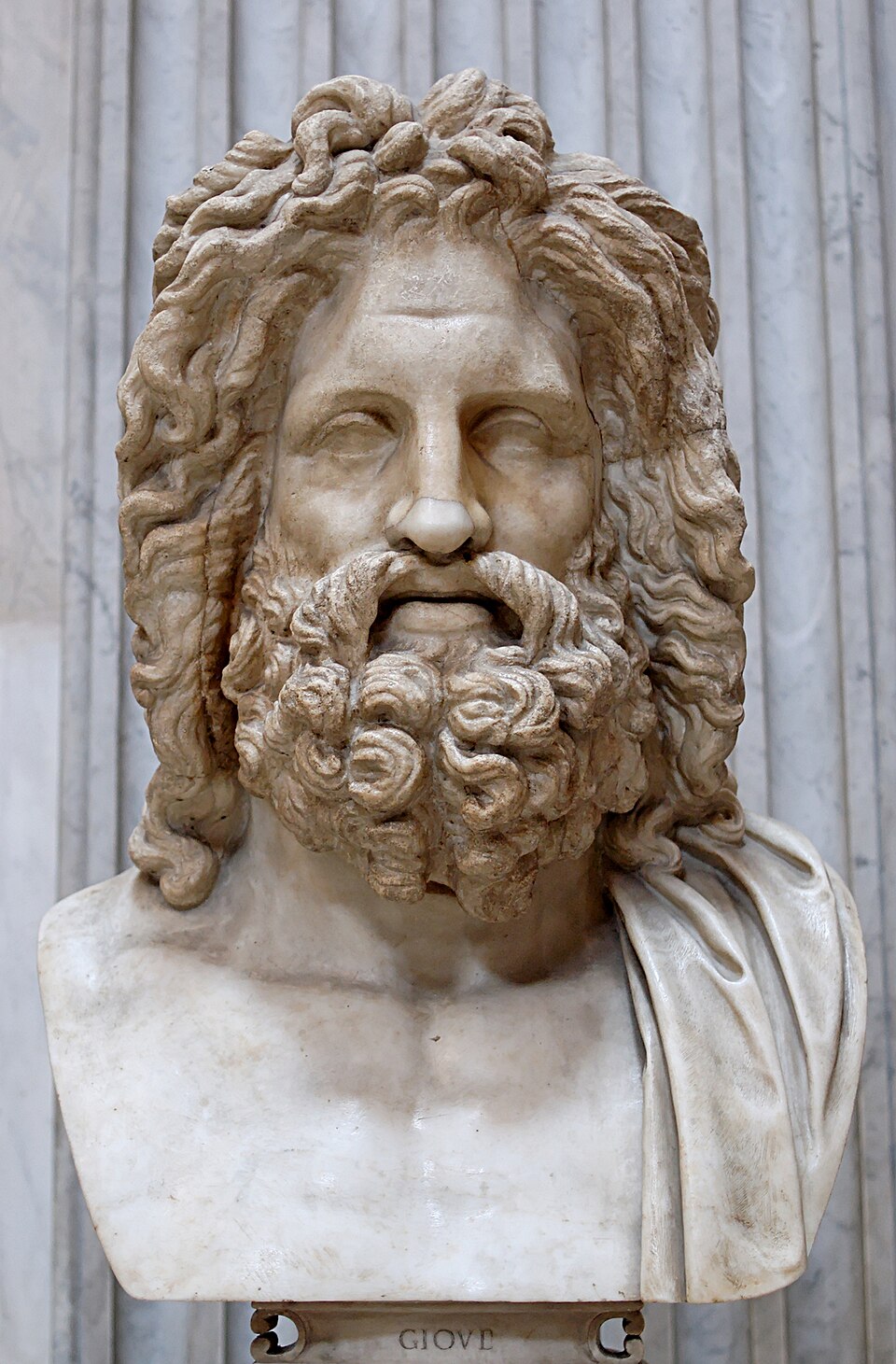
Here at the Temple of Zeus the Queen of Rome is addressed once more on her own terms.
Sources and Bibliography
- James N. Adams, The Regional Diversification of Latin, 200 BC–AD 600 (Cambridge: Cambridge University Press, 2007), 76, §10.6; Attilio Degrassi, ed., Inscriptiones Latinae Liberae Rei Publicae, 2 vols. (Florence: La Nuova Italia, 1957–1963), no. 161.
- Clara Di Fazio, “Il tempio di piazza della Liberazione e il culto di Giunone a Praeneste: aspetti, funzioni e significati,” Analysis Archaeologica: An International Journal of Western Mediterranean Archaeology 1 (2015): 117–38.
- Livy, History of Rome, 27.37.7–15, in History of Rome, Volume IX: Books 26–27, trans. J. C. Yardley, Loeb Classical Library 367 (Cambridge, MA: Harvard University Press, 2020)
- Plautus, Aulularia, lines 555–557 and 691–692, in Plautus, Volume I: Amphitryon; The Comedy of Asses; The Pot of Gold; The Two Bacchises; The Captives, ed. and trans. Wolfgang de Melo, Loeb Classical Library 60 (Cambridge, MA: Harvard University Press, 2011).
- Erika Simon, “Uni,” in Thesaurus Cultus et Rituum Antiquorum 3, ed. J. Paul Getty Museum (Los Angeles: J. Paul Getty Museum, 2005), 166–69.
- De Vaan, Michiel. Etymological Dictionary of Latin and the Other Italic Languages. Leiden Indo-European Etymological Dictionary Series 7. Leiden: Brill, 2008. Proof: entry iuvenis; derivatives include Iūnō; Proto-Italic *juwen-, “young”; PIE *h₂iu-h₁en-, “who possesses vital force”; explanation of Iūnō as an extension of *iun-, “young.”
- Watkins, Calvert. “Latin iouiste et le vocabulaire religieux indo-européen.” In Mélanges linguistiques offerts à Émile Benveniste, edited by F. Bader et al., 527–534. Paris: Peeters, 1975. Proof: comparative discussion of Latin Iouiste/Ioviste and Indo-European religious vocabulary; cognacy with Vedic yáviṣṭha noted in later linguistic discussion. Use cautiously for the Jupiter/youth-complex claim, not as direct proof that “Iuuntus” is securely attested without citing the inscription.
- Varro. On the Latin Language. Edited and translated by Roland G. Kent. Loeb Classical Library 333. Cambridge, MA: Harvard University Press, 1938. Proof: De lingua Latina 5.67, Juno from iuvare because she “helps” with Jupiter; 5.69, Juno Lucina from iuvare and lux.
- Plutarch. Moralia, Volume IV: Roman Questions. Translated by Frank Cole Babbitt. Loeb Classical Library 305. Cambridge, MA: Harvard University Press, 1936. Proof: Roman Questions 77; Juno’s name explained as “young” or “junior” and connected with the moon/months.
- Dionysius of Halicarnassus, Roman Antiquities, 2.50.3, trans. Earnest Cary, 7 vols., Loeb Classical Library (Cambridge, MA: Harvard University Press, 1937–1950).
- Livy, History of Rome, 5.21.1–7, 5.22.3–7, 5.31.3, 5.47.4, 6.20.13, 7.28.4–6, in History of Rome, Volume III: Books 5–7, trans. B. O. Foster, Loeb Classical Library 172 (Cambridge, MA: Harvard University Press, 1924).
- Gabriella Gustafsson, Evocatio deorum: Historical and Mythical Interpretations of Ritualised Conquests in the Expansion of Ancient Rome, Acta Universitatis Upsaliensis, Historia Religionum 16 (Uppsala: Uppsala University, 2000), 42–77.
- Robert E. A. Palmer, Roman Religion and Roman Empire: Five Essays (Philadelphia: University of Pennsylvania Press, 1974), 3–56.
- Livy, History of Rome, 8.14.2, in History of Rome, Volume IV: Books 8–10, trans. B. O. Foster, Loeb Classical Library 191 (Cambridge, MA: Harvard University Press, 1926).
- Livy, History of Rome, 21.62.1–11, 22.1.14–20, in History of Rome, Volume V: Books 21–22, trans. B. O. Foster, Loeb Classical Library 233 (Cambridge, MA: Harvard University Press, 1929).
- Mary Beard, John North, and Simon Price, Religions of Rome, Volume 1: A History (Cambridge: Cambridge University Press, 1998), 80–98.
- John Scheid, An Introduction to Roman Religion, trans. Janet Lloyd (Bloomington: Indiana University Press, 2003), 129–46.
- Georg Wissowa, Religion und Kultus der Römer, 2nd ed., Handbuch der Altertumswissenschaft V.4 (Munich: C. H. Beck, 1912), 181–91.
- Georges Dumézil, “Juno S.M.R.,” Eranos 52 (1954): 105–19.
- Geneviève Dury-Moyaers and Marcel Renard, “Aperçu critique de travaux relatifs au culte de Junon,” in Aufstieg und Niedergang der römischen Welt II.17.1, ed. Wolfgang Haase (Berlin: Walter de Gruyter, 1981), 142–202.
- Georges Dumézil, Archaic Roman Religion, trans. Philip Krapp, 2 vols. (Chicago: University of Chicago Press, 1970), 1:291–303.
- Sexti Pompei Festi De verborum significatu quae supersunt cum Pauli epitome, ed. Wallace M. Lindsay (Leipzig: Teubner, 1913), s.vv. sororium tigillum, Iugarius vicus, Fluoniam, Populonia.
- Servii Grammatici qui feruntur in Vergilii carmina commentarii, ed. Georg Thilo and Hermann Hagen, 3 vols. (Leipzig: Teubner, 1881–1902), on Aeneid 1.8, 1.422, 4.166.
- Martianus Capella, De nuptiis Philologiae et Mercurii, ed. James Willis (Leipzig: Teubner, 1983), 2.149.
- Augustine, The City of God against the Pagans, Volume II: Books 4–7, 6.9, 7.3, trans. William M. Green, Loeb Classical Library 412 (Cambridge, MA: Harvard University Press, 1963).
- Valerius Maximus, Memorable Doings and Sayings, Volume I: Books 1–5, 1.8.3, 2.1.2, 2.1.6, ed. and trans. D. R. Shackleton Bailey, Loeb Classical Library 492 (Cambridge, MA: Harvard University Press, 2000).
- Harold Mattingly and Edward A. Sydenham, The Roman Imperial Coinage (London: Spink, 1923–1994), vols. 3–4.
- L. Richardson Jr., A New Topographical Dictionary of Ancient Rome (Baltimore: Johns Hopkins University Press, 1992), 214–17, 221–24.
- Filippo Coarelli, Rome and Environs: An Archaeological Guide, trans. James J. Clauss and Daniel P. Harmon (Berkeley: University of California Press, 2007), 31–37, 273–75, 320–24.
- John North Hopkins, The Genesis of Roman Architecture (New Haven: Yale University Press, 2016), 118–35.
- Eric M. Orlin, Temples, Religion, and Politics in the Roman Republic, Mnemosyne Supplements 164 (Leiden: Brill, 1997), 45–76.
- Pliny, Natural History, Volume IV: Books 12–16, 16.235, trans. H. Rackham, Loeb Classical Library 370 (Cambridge, MA: Harvard University Press, 1945).
- Livy, History of Rome, 32.30.10, 34.53.3, in History of Rome, Volume IX: Books 31–34, trans. Evan T. Sage, Loeb Classical Library 295 (Cambridge, MA: Harvard University Press, 1935).
- Censorinus, The Birthday Book, 3.2, trans. Holt N. Parker (Chicago: University of Chicago Press, 2007).
- Tibullus, Elegies 3.12 (4.6), in Catullus, Tibullus, Pervigilium Veneris, trans. F. W. Cornish, J. P. Postgate, and J. W. Mackail, rev. G. P. Goold, Loeb Classical Library 6 (Cambridge, MA: Harvard University Press, 1913).
- Macrobius, Saturnalia, Volume I: Books 1–2, 1.15.10–21, ed. and trans. Robert A. Kaster, Loeb Classical Library 510 (Cambridge, MA: Harvard University Press, 2011).
- Virgil, Aeneid, 4.166, in Eclogues, Georgics, Aeneid: Books 1–6, trans. H. Rushton Fairclough, rev. G. P. Goold, Loeb Classical Library 63 (Cambridge, MA: Harvard University Press, 1999).
- Ovid, Fasti, 2.435–452, 3.229–258, 6.183–190, trans. James G. Frazer, rev. G. P. Goold, Loeb Classical Library 253 (Cambridge, MA: Harvard University Press, 1931).
- Celia E. Schultz, Women's Religious Activity in the Roman Republic (Chapel Hill: University of North Carolina Press, 2006), 47–81.
- Nicole Boëls-Janssen, La vie religieuse des matrones dans la Rome archaïque, Collection de l'École française de Rome 176 (Rome: École française de Rome, 1993), 227–83.
- Ovid, Amores, 3.13, in Heroides. Amores, trans. Grant Showerman, rev. G. P. Goold, Loeb Classical Library 41 (Cambridge, MA: Harvard University Press, 1914).
- Robert E. A. Palmer, The Archaic Community of the Romans (Cambridge: Cambridge University Press, 1970), 154–70.
- Cicero, De natura deorum, 1.82, in On the Nature of the Gods. Academics, trans. H. Rackham, Loeb Classical Library 268 (Cambridge, MA: Harvard University Press, 1933).
- Propertius, Elegies, 4.8.3–14, ed. and trans. G. P. Goold, Loeb Classical Library 18 (Cambridge, MA: Harvard University Press, 1990).
- Aelian, On the Characteristics of Animals, Volume II: Books 6–11, 11.16, trans. A. F. Scholfield, Loeb Classical Library 448 (Cambridge, MA: Harvard University Press, 1959).
- Cicero, De divinatione, 1.4, 1.99, 1.101, in On Old Age. On Friendship. On Divination, trans. W. A. Falconer, Loeb Classical Library 154 (Cambridge, MA: Harvard University Press, 1923).
- Celia E. Schultz, “Juno Sospita and Roman Insecurity in the Social War,” in Religion in Republican Italy, ed. Celia E. Schultz and Paul B. Harvey Jr., Yale Classical Studies 33 (Cambridge: Cambridge University Press, 2006), 207–27.
- Cicero, Pro Milone, 27, 45, in Pro Milone. In Pisonem. Pro Scauro. Pro Fonteio. Pro Rabirio Postumo. Pro Marcello. Pro Ligario. Pro Rege Deiotaro, trans. N. H. Watts, Loeb Classical Library 252 (Cambridge, MA: Harvard University Press, 1931).
- Michael H. Crawford, Roman Republican Coinage, 2 vols. (Cambridge: Cambridge University Press, 1974), 1:316, 1:397, 1:449.
- Jane DeRose Evans, The Art of Persuasion: Political Propaganda from Aeneas to Brutus (Ann Arbor: University of Michigan Press, 1992), 87–107.
- Suidae Lexicon, ed. Ada Adler, 5 vols. (Leipzig: Teubner, 1928–1938), s.v. Μονήτα.
- Andrew Meadows and Jonathan Williams, “Moneta and the Monuments: Coinage and Politics in Republican Rome,” Journal of Roman Studies 91 (2001): 27–49.
- Isidore of Seville, The Etymologies of Isidore of Seville, 16.18.8, trans. Stephen A. Barney, W. J. Lewis, J. A. Beach, and Oliver Berghof (Cambridge: Cambridge University Press, 2006).
- Livy, History of Rome, 1.55.1–56.3, 2.8.6–8, in History of Rome, Volume I: Books 1–2, trans. B. O. Foster, Loeb Classical Library 114 (Cambridge, MA: Harvard University Press, 1919).
- Vitruvius, On Architecture, Volume I: Books 1–5, 3.3.5, 4.7.1–5, trans. Frank Granger, Loeb Classical Library 251 (Cambridge, MA: Harvard University Press, 1931).
- Gabriele Cifani, Architettura romana arcaica: Edilizia e società tra Monarchia e Repubblica (Rome: L'Erma di Bretschneider, 2008), 80–108.
- Tacitus, Histories, 3.72, in Histories: Books 1–3, trans. Clifford H. Moore, Loeb Classical Library 111 (Cambridge, MA: Harvard University Press, 1925).
- Soprintendenza Archeologia, Belle Arti e Paesaggio per l'Area Metropolitana di Roma e la Provincia di Rieti, “Montecelio, Museo Civico Archeologico ‘Rodolfo Lanciani’,” accessed July 22, 2026, http://www.sabap-rm-met.beniculturali.it/it/238/news/1939/montecelio-museo-civico-archeologico-rodolfo-lanciani.
- Giovanni Battista Pighi, De ludis saecularibus populi Romani Quiritium libri sex (Milan: Vita e Pensiero, 1941), 107–75; the acts are CIL VI 32323.
- Horace, Carmen Saeculare, in Odes and Epodes, ed. and trans. Niall Rudd, Loeb Classical Library 33 (Cambridge, MA: Harvard University Press, 2004).
- Susan E. Wood, Imperial Women: A Study in Public Images, 40 BC–AD 68, Mnemosyne Supplements 194 (Leiden: Brill, 1999), 27–74.
- Clare Rowan, Under Divine Auspices: Divine Ideology and the Visualisation of Imperial Power in the Severan Period (Cambridge: Cambridge University Press, 2012), 43–86.
- Barbara Levick, Faustina I and II: Imperial Women of the Golden Age (Oxford: Oxford University Press, 2014), 68–92.
- Jean Seznec, The Survival of the Pagan Gods: The Mythological Tradition and Its Place in Renaissance Humanism and Art, trans. Barbara F. Sessions, Bollingen Series 38 (New York: Pantheon Books, 1953), 84–121.
- Ovid, Metamorphoses, Volume I: Books 1–8, 1.588–750, 2.466–507, 3.253–315, trans. Frank Justus Miller, rev. G. P. Goold, Loeb Classical Library 42 (Cambridge, MA: Harvard University Press, 1916).
- National Gallery, London, “Jacopo Tintoretto, The Origin of the Milky Way,” NG1313, accessed July 22, 2026, https://www.nationalgallery.org.uk/paintings/jacopo-tintoretto-the-origin-of-the-milky-way.
- Charles Dempsey, Annibale Carracci: The Farnese Gallery, Rome (New York: George Braziller, 1995), 9–48.
- Wallraf-Richartz-Museum, Cologne, Peter Paul Rubens, Juno and Argus, c. 1610, oil on canvas, 249 × 296 cm, inv. WRM 1040.
- Philippe Quinault, Isis, tragédie en musique, music by Jean-Baptiste Lully (Paris: Christophe Ballard, 1677).
- Kimbell Art Museum, Fort Worth, “François Boucher, Juno Asking Aeolus to Release the Winds,” 1769, oil on canvas, 278.2 × 203.2 cm, acc. no. AP 1972.08, accessed July 22, 2026, https://www.kimbellart.org/collection-object/juno-asking-aeolus-release-winds.
- Francis Haskell and Nicholas Penny, Taste and the Antique: The Lure of Classical Sculpture, 1500–1900 (New Haven: Yale University Press, 1981), 184–87.
- Friedrich Schiller, On the Aesthetic Education of Man in a Series of Letters, letter 15, ed. and trans. Elizabeth M. Wilkinson and L. A. Willoughby (Oxford: Clarendon Press, 1967).
- Renate Tölle-Kastenbein, “Juno Ludovisi: Hera oder Antonia Minor?,” Mitteilungen des Deutschen Archäologischen Instituts, Athenische Abteilung 89 (1974): 241–53.