




| Language | Name | Earliest Secure Attestation |
|---|---|---|
| Etruscan | Uni | Gold tablets from Pyrgi, c. 510 BCE |
| Phoenician | Uni-Astarte | Phoenician gold tablet from Pyrgi, KAI 277, c. 510 BCE |
17 min read
Uni
author: High Priest Zevios Metathronos
author: Karnonnos
Hieratic Information about Uni
| Divine Symbols | |
|---|---|
|
I. The Name
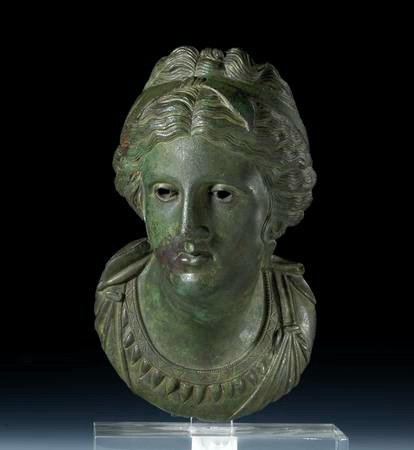
The etymology of Uni is known in direction, if not necessarily in sense. James Clackson and Geoffrey Horrocks placed the name among a small group of Etruscan theonyms taken over from the neighboring Italic languages, together with Menerva and Nethuns, and derive it from Latin or Sabellian Iuno. The transfer runs into Etruscan, which unsettles the older assumption that Rome received the name of its queen of the gods from Etruria along with so much else of its public religion.1
The Etruscan forms are uni in the nominative and unial in the genitive. The earliest securely dated objects to carry the name are the three gold tablets from the sanctuary at Pyrgi, the seaward sanctuary of Caere, placed at about 510 BCE and recovered in 1964. Two are inscribed in Etruscan and the third in Phoenician. Jacques Heurgon read in the longer Etruscan leaf the compound unial astres, "of Uni-Astarte," while the Phoenician leaf, catalogued as KAI 277, opens with a dedication to the Lady, to Astarte.2,3,4
An earlier attestation may exist. A sandstone stele recovered in 2015 from the foundations of the Late Archaic temple at Poggio Colla, near Vicchio in the Mugello, carries one of the longest Etruscan sacred texts known on stone. Adriano Maggiani dated its letter forms to between 525 and 510 BCE and identified, in a preliminary reading, the names of Tinia, the sovereign sky god, and of Uni. He published the reading as provisional and it remains so.5,6
Sources: Heurgon for the Etruscan texts and the reading unial astres;2 Schmitz for the Phoenician dedication;3 the Villa Giulia record for the find and the date;4 Clackson and Horrocks for the Latin form.1
II. Greek Myth in Etruscan Art
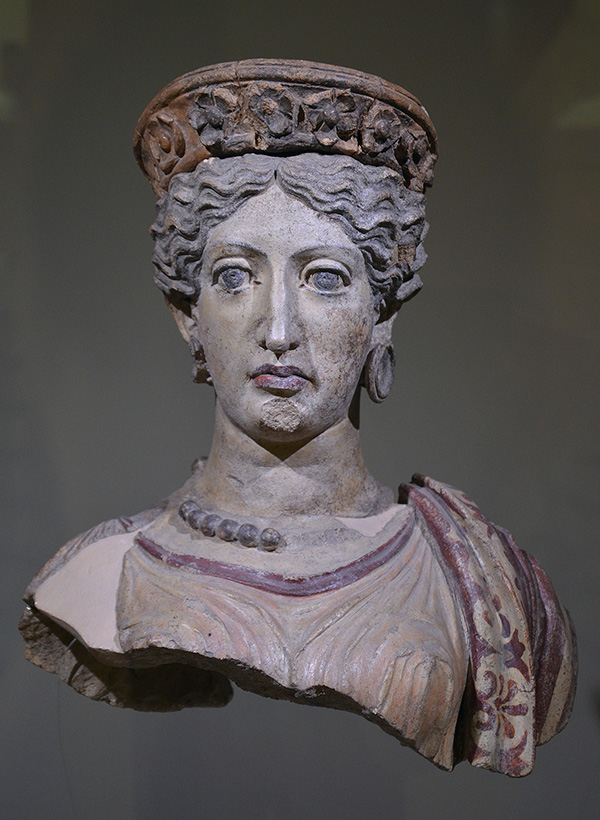
The Adoption of Hercle
A bronze mirror from Volterra, engraved around 300 BCE, shows Uni seated and giving her breast to Hercle, the Etruscan Herakles, who is here no infant but a grown and bearded man. Tinia stands by and points to a tablet. The tablet is inscribed eca sren tva iχnac hercle unial clan θrasce. Larissa Bonfante reads the line as a caption written for the viewer, declaring that Hercle became the son of Uni.7
Eva Fiesel examined the same tablet in 1936 and treated it as legend rather than as speech assigned to a figure. The mirror explains itself in the same way very few Etruscan objects tend to do.8
Greek myth supplied the antecedent concept as Diodorus Siculus reported that Hera suckled the infant Herakles after Athena contrived to lay him at her breast, and that she flung the child away on learning who he was, with the spurt of milk creating the Milky Way. The Etruscan version keeps the milk but it seems like it discarded the deception. Experts in Etruscan culture like Nancy de Grummond treats the adoption of a grown hero by a willing goddess as an Etruscan development and reads the act as admission to the company of the gods. Nonetheless, it is possible this is a development of a strand from Greek vases.9,10
The Judgement of Elcsntre
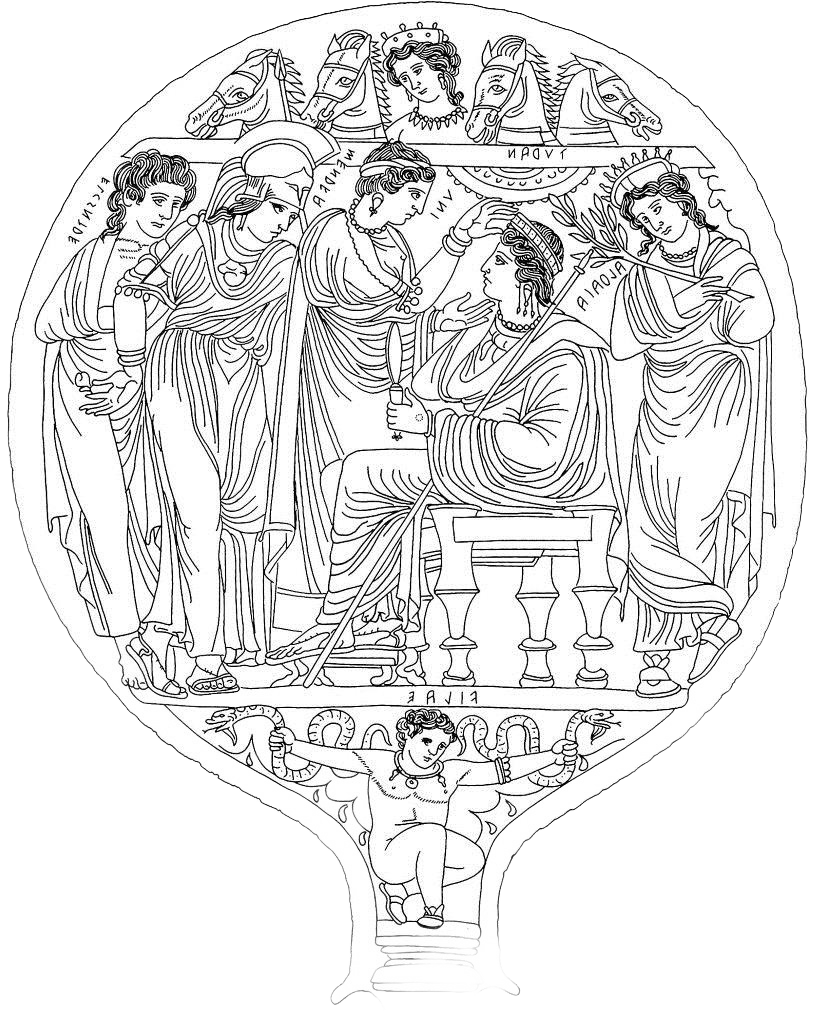
Uni also entered the Etruscan retelling of the contest of the three goddesses. On mirrors the shepherd prince appears as Elcsntre, led by Turms, the Etruscan Hermes, and the competitors are Menrva (Athena), Turan (Aphrodite) and Uni. Hyginus preserved the Latin form of the story, in which Paris awards the prize to Venus after the three are submitted to his judgement.11
The Etruscan images depart from the Greek precisely at Uni. De Grummond observes that she appears on some mirrors unclothed and on others fully dressed and holding a branch of pomegranate bearing three fruits. Neither corresponds to the fully clothed sovereignty (other than some variations of Herakles suckling on her breast) that Hera offers in the Greek accounts. What Uni is shown as on these mirrors is stated in no surviving text. The pomegranate is preserved.10,12
III. In the Rite of Uni
The name of Uni belongs to the technical apparatus of Etruscan divination. The bronze model of a sheep's liver found near Gossolengo carries the inscription uni mae in one compartment of its outer rim. L. Bouke van der Meer read those compartments as the houses of the Gods within the celestial templum and placed Uni among them.13
Natalie Stevens assigned Uni to region four of that scheme and tied the assignment to the ground. Temples of Uni are commonly found facing southwest and temples of Tinia facing south, where Greek temples look east almost without exception. Stevens proposed a heaven that rotated with the seasons, which would account for sanctuaries sitting two regions away from the position a fixed reading demands.14
The Pyrgi tablets carry evidence of the other kind, the prescriptive. The shorter Etruscan leaf sets out observances to be repeated year by year, and the longer text binds the dedication to a named month and to the third year of the dedicator's rule. Heurgon read its closing formula as a wish that the offerings of the sanctuary should endure as long as the stars.2
Divination and calendar hold the name securely. Whatever her priests said over her image is gone.2,13
IV. Sites of Worship
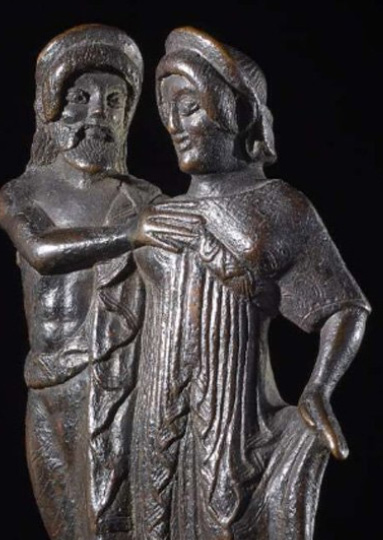
Four places name Uni in writing found in or beneath a sanctuary of hers. These are the secure cases and they deserve separation from the many sites where a cult of women or of childbirth has been assigned to her by inference alone. The four span two centuries and reach from the Tyrrhenian coast to the Apennine foothills.
Pyrgi
The suburban sanctuary of Pyrgi lay on the coast below Caere and reached its greatest extent around 510 BCE. Temple B, the earlier of its two monumental buildings, was raised by Thefarie Velianas and dedicated to Uni under her Phoenician equivalent. Its plan was Greek, a single cella with columns on every side. Beside it stood the small precinct C and a long block of twenty rooms whose occupants Roman writers later remembered with contempt.4,15
The votive record agrees with the epigraphic one. Jean MacIntosh Turfa counted several hundred dedications from the sanctuary along with animal bone from sacrifice, and noted vessels given by a member of the Spurina family recording vows to Uni beside Tinia and Thesan, the goddess of dawn, all three named on the vessels themselves.16
Pyrgi documents Uni as the deity of a state sanctuary at the seaward edge of a great city, honoured in a foreign name for the benefit of foreign traders and in her own name for the benefit of her own.
Kainua
Marzabotto, the Etruscan city in the Apennine foothills whose ancient name Kainua survives in the locative kainuathi written on pottery from the site, holds the clearest architectural evidence for the pairing of Uni with Tinia. Excavations directed by Elisabetta Govi in 2014 and 2015 uncovered a Tuscanic temple in Regio I, dated to the closing decades of the sixth century BCE, standing a short distance from the later peripteral temple of Tinia and divided from it by a single narrow street. Inscribed pottery from each building identifies the deity who owned it.17,18
A fragment of inscription recovered from among the stones of the temple's foundation wall records its consecration by the spura, the civic body of Kainua. Govi reads the north-eastern quarter of the city as a deliberate transcription of the seats of the Gods onto the ground, with the sites of Uni and Tinia adjacent, as the discipline required. Her temple came first and the city grew northward around it.17
Gravisca
At Gravisca, the port of Tarquinia, Uni held a room of her own inside a sanctuary shared with Greek and Etruscan gods from the sixth century BCE onward. Denise Demetriou has set out its contents. The room assigned to Uni yielded 145 votive uteri and 22 swaddled infants; the neighbouring room of Turan yielded 74 uteri and two infants. Each room held two votive breasts.19
The two goddesses received the same kinds of gift in sharply different proportions. Childbirth belonged to Uni at Gravisca in a way it did not belong to Turan.19
Poggio Colla
The hilltop sanctuary at Poggio Colla commanded the junction of the Mugello basin with the valley of the Sieve. In the final season of excavation, Gregory Warden recovered the inscribed stele from the temple foundations in a context he describes as secure and as belonging to the phase that preceded stone architecture on the hill. Weaving equipment, gold ornament and dedications made by women accumulate across the site, and the focus of the cult was a fissure in the ground given ritual treatment after the temple was destroyed.6
If Maggiani's reading holds, Poggio Colla gives Uni a sanctuary far to the north of the great coastal cities, and gives it to her early.5
Vulci and the Limits of Attribution
The sanctuary at Fontanile di Legnisina near Vulci appears in some accounts as a temple of Uni, and Stevens uses it to test her reconstruction of the Etruscan heaven.14 Laura Ricciardi's report on the monumental altar and the votive deposit has described in it a mass of votive uteri, and the inscribed example among them names Vei, a goddess absent from the Liver of Piacenza and from the ancient authors and recovered only through excavation in the 1980s.20,21
The confusion is instructive. A sanctuary of childbirth in southern Etruria is not by that fact a sanctuary of Uni.
V. Objects and Places of Found Objects
| Object | Date | Ancient Provenance | Present Collection | Status of Identification |
|---|---|---|---|---|
| Three gold tablets | c. 510 BCE | Sanctuary at Pyrgi, doorframe of Temple B | Museo Nazionale Etrusco di Villa Giulia, Rome | Securely named unial astres |
| Vicchio stele | c. 525–510 BCE | Poggio Colla, foundations of the Late Archaic temple | Under conservation in Florence | Preliminary reading of the name; provisional |
| Bronze mirror with Hercle at the breast | c. 300 BCE | Volterra | Not specified in the sources cited here | Securely named unial |
| Bronze Liver of Piacenza | Late second or early first century BCE | Found near Gossolengo in 1877 | Musei Civici di Palazzo Farnese, Piacenza | One compartment inscribed uni mae |
| Inscribed pottery from the Tuscanic temple | Late sixth to fifth century BCE | Marzabotto, Regio I | Museo Nazionale Etrusco "Pompeo Aria", Marzabotto | Identifies the deity of the building |
| Anatomical votives from the room of Uni | Sixth century BCE onward | Gravisca, southern sanctuary | Not specified in the sources cited here | Assigned to Uni by the epigraphy of the sanctuary |
Sources: Heurgon and the Villa Giulia record for the gold tablets;2,4 Maggiani and Warden for the Vicchio stele;5,6 Bonfante and Fiesel for the Volterra mirror;7,8 van der Meer and the City of Piacenza for the bronze liver;13,22 Govi and her collaborators for Marzabotto;17,18 Demetriou for Gravisca.19
The Gold Tablets
The three leaves were thin enough to be nailed to woodwork and were taken down and buried rather than melted. The Villa Giulia record notes that they had been fixed to the doorframe of Temple B before their deposition. They were found together in the sanctuary in 1964.4
Their value to Etruscology lies in the pairing of languages. The Phoenician text is not a translation of the Etruscan in any strict sense. Philip Schmitz has shown that its dialect and formulae belong to the western Phoenician world rather than to the homeland. Heurgon treated the dedication as a political document as much as a religious one, a ruler of Caere advertising a goddess whom Punic merchants would recognise at sight.2,3
VI. Uni, Juno and the Aventine
The Direction of the Name
Latin Iuno and Etruscan uni are the same word, and the linguistic evidence sends it westward into Etruria rather than eastward into Latium.1 This clears up less than it appears to. A borrowed name may travel without its cult, and a cult may travel without its name.
The Statue from Veii
Livy reported that in 396 BCE, on the eve of the fall of Veii, the dictator Marcus Furius Camillus prayed to the Juno who then dwelt in that city and promised her a temple in Rome worthy of her greatness. When the city fell, young soldiers were sent to lift her image. One of them asked the goddess whether she wished to go to Rome; the rest cried that she had nodded, and a later version of the story had her answer aloud. Livy himself recorded only that the statue proved light and easy to move, as though it followed of its own will. It was carried to the Aventine and Camillus dedicated there the temple he had vowed.23
Plutarch was descriptive of the same episode with the ritual placed in the hands of Camillus rather than of the soldiers, and Dionysius of Halicarnassus and Valerius Maximus preserve further versions of the removal of the wooden image. Platner and Ashby collect the topographical evidence as they stated the temple was vowed in 396 and dedicated in 392, it housed the statue brought from Veii, it received expiatory offerings on several later occasions, and then the emperor Augustus restored it.24,25,26,27
Roman writers call her Iuno Regina and Roman scholarship has long identified her with Uni. No Etruscan inscription from Veii names the goddess. The identification rests on the Roman account together with the general equivalence of the two names. This is the ordinary condition of Etruscan religion because the evidence that survives is Roman.23
The Triad
Vitruvius prescribed that ground be set aside for Jupiter, Juno and Minerva on the highest point of a town, from which the greatest part of the walls may be seen. Inez Scott Ryberg asked whether that grouping was Etruscan or Italic in origin and found the question harder to answer than the confident textbooks allowed. The Etruscan ground offers a pair rather than a group of three. At Kainua the temples of Uni and Tinia stand adjacent in the sacred quarter. Menrva however is not among them.17,28,29
Sources and Bibliography
- Clackson, James, and Geoffrey Horrocks. The Blackwell History of the Latin Language. Malden, MA: Blackwell, 2007. Cited section: 2.1, “Latin and the Languages of Italy,” for Iuno, Minerua and Neptunus borrowed into Etruscan as Uni, Menerva and Neθuns.
- Heurgon, Jacques. “The Inscriptions of Pyrgi.” Journal of Roman Studies 56, nos. 1–2 (1966): 1–15. https://doi.org/10.2307/300130. Cited for the Etruscan texts of the gold tablets, the reading unial astres, the annual observances and the political reading of the dedication.
- Schmitz, Philip C. “The Phoenician Text from the Etruscan Sanctuary at Pyrgi.” Journal of the American Oriental Society 115, no. 4 (1995): 559–75. https://doi.org/10.2307/604727. Cited for the dedication to Astarte (KAI 277) and for the western Phoenician character of its dialect and formulae.
- Museo Nazionale Etrusco di Villa Giulia. “Lamine d’oro da Pyrgi.” Accessed July 25, 2026. Cited for the discovery of the three tablets in the sanctuary at Pyrgi in 1964, their attachment to the doorframe of Temple B, and the date of about 510 BCE.
- Maggiani, Adriano. “The Vicchio Stele: The Inscription.” Etruscan Studies 19, no. 2 (2016): 220–24. https://doi.org/10.1515/etst-2016-0018. Cited for the preliminary reading naming Tinia and Uni and for the dating of the letter forms to 525–510 BCE.
- Warden, P. Gregory. “The Vicchio Stele and Its Context.” Etruscan Studies 19, no. 2 (2016): 208–19. https://doi.org/10.1515/etst-2016-0017. Cited for the stele’s recovery from the temple foundations at Poggio Colla, the security of its context, and its standing as the earliest surviving non-funerary Etruscan sacred text.
- Bonfante, Larissa. “Etruscan Inscriptions and Etruscan Religion.” In The Religion of the Etruscans, edited by Nancy Thomson de Grummond and Erika Simon, 9–26. Austin: University of Texas Press, 2006. Cited for the inscription on the Volterra mirror and its reading as a caption to the image.
- Fiesel, Eva. “The Hercules Legend on the Etruscan Mirror from Volterra.” American Journal of Philology 57, no. 2 (1936): 130–36. https://doi.org/10.2307/290470. Cited for the early analysis of the inscribed tablet held before Hercle.
- Diodorus Siculus. Library of History, Volume II: Books 2.35–4.58. Translated by C. H. Oldfather. Loeb Classical Library 303. Cambridge, MA: Harvard University Press, 1935. Cited section: 4.9.6, on Hera suckling the infant Herakles at Athena’s contrivance.
- de Grummond, Nancy Thomson. Etruscan Myth, Sacred History, and Legend. Philadelphia: University of Pennsylvania Museum of Archaeology and Anthropology, 2006. Cited pages: 78–84, on Uni’s attributes, the adoption of the adult Hercle as an Etruscan development, and the pomegranate branch in the Judgement scenes.
- Hyginus. Fabulae. Edited by Peter K. Marshall. 2nd ed. Bibliotheca Teubneriana. Munich and Leipzig: K. G. Saur, 2002. Cited fable: 92, “Paris,” on the judgement of the three goddesses.
- de Grummond, Nancy Thomson. Corpus Speculorum Etruscorum: Great Britain 3. Rome: L’Erma di Bretschneider, 2007. Cited page: 15, on the mirrors of the Judgement of Elcsntre and the depiction of Uni unclothed.
- van der Meer, L. Bouke. The Bronze Liver of Piacenza: Analysis of a Polytheistic Structure. Dutch Monographs on Ancient History and Archaeology 2. Amsterdam: J. C. Gieben, 1987. Cited for the inscription uni mae and for the reading of the sixteen regions as the houses of the Gods.
- Stevens, Natalie L. C. “A New Reconstruction of the Etruscan Heaven.” American Journal of Archaeology 113, no. 2 (2009): 153–64. https://doi.org/10.3764/aja.113.2.153. Cited pages: 153, 162, for Uni’s placement in region four, the south-western orientation of her temples, and the proposal of a rotating Etruscan heaven.
- Colonna, Giovanni. “Sacred Architecture and the Religion of the Etruscans.” In The Religion of the Etruscans, edited by Nancy Thomson de Grummond and Erika Simon, 132–68. Austin: University of Texas Press, 2006. Cited for the plan of the Pyrgi sanctuary and the relation between its two temples.
- Turfa, Jean MacIntosh. “Votive Offerings in Etruscan Religion.” In The Religion of the Etruscans, edited by Nancy Thomson de Grummond and Erika Simon, 90–115. Austin: University of Texas Press, 2006. Cited for the votive material and sacrificial bone at Pyrgi and for the Spurina vessels naming Uni with Tinia and Thesan.
- Govi, Elisabetta. “Kainua-Marzabotto: The Archaeological Framework.” Archeologia e Calcolatori 28, no. 2 (2017): 87–97. Cited pages: 89, 91–92, for the Tuscanic temple of Uni in Regio I, its date, the foundation inscription naming the spura of Kainua, and the reading of the sacred quarter as a transcription of the celestial templum.
- Garagnani, Simone, Andrea Gaucci, and Elisabetta Govi. “ArchaeoBIM: dallo scavo al Building Information Modeling di una struttura sepolta. Il caso del tempio tuscanico di Uni a Marzabotto.” Archeologia e Calcolatori 27 (2016): 251–70. Cited for the excavation of 2014–2015 and the reconstruction of the temple.
- Demetriou, Denise. Negotiating Identity in the Ancient Mediterranean: The Archaic and Classical Greek Multiethnic Emporia. Cambridge: Cambridge University Press, 2012. Cited for the sanctuary at Gravisca and the distribution of anatomical votives between the rooms of Uni and Turan.
- Ricciardi, Laura. “Canino (Viterbo): Il santuario etrusco di Fontanile di Legnisina a Vulci. Relazione delle campagne di scavo 1985 e 1986: L’altare monumentale e il deposito votivo.” Notizie degli Scavi di Antichità, 8th ser., 42–43 (1988–89): 137–209. Cited for the monumental altar, the votive deposit and the typology of the votive uteri.
- Museo Nazionale Etrusco di Villa Giulia. “Agosto e la dea Vei.” ETRU a casa: Aiser. Accessed July 25, 2026. Cited for the cult of Vei at Fontanile di Legnisina and for the inscribed votive uterus naming her.
- City of Piacenza. “Etruscan Liver.” Visit Piacenza. Accessed July 25, 2026. Cited for the discovery of the bronze liver near Gossolengo in 1877 and its preservation in the municipal collection at Palazzo Farnese.
- Livy. History of Rome, Volume III: Books 5–7. Translated by B. O. Foster. Loeb Classical Library 172. Cambridge, MA: Harvard University Press, 1924. Cited sections: 5.21.3, on the vow of Camillus; 5.22.3–8, on the removal of the image to the Aventine; 5.31.3, on the dedication of the temple.
- Plutarch. Lives, Volume II: Themistocles and Camillus; Aristides and Cato Major; Cimon and Lucullus. Translated by Bernadotte Perrin. Loeb Classical Library 47. Cambridge, MA: Harvard University Press, 1914. Cited section: Camillus 6, on the transfer of the goddess from Veii.
- Dionysius of Halicarnassus. Roman Antiquities, Volume VII: Books 11–20. Translated by Earnest Cary. Loeb Classical Library 388. Cambridge, MA: Harvard University Press, 1950. Cited section: 13.3, on the wooden image brought from Veii.
- Valerius Maximus. Memorable Doings and Sayings, Volume I: Books 1–5. Edited and translated by D. R. Shackleton Bailey. Loeb Classical Library 492. Cambridge, MA: Harvard University Press, 2000. Cited section: 1.8.3, on the removal of the statue.
- Platner, Samuel Ball, and Thomas Ashby. A Topographical Dictionary of Ancient Rome. London: Oxford University Press, 1929. Cited entry: “Iuno Regina, templum,” for the vow of 396 BCE, the dedication of 392 BCE, the statue from Veii, the later expiatory offerings and the Augustan restoration.
- Vitruvius. On Architecture, Volume I: Books 1–5. Translated by Frank Granger. Loeb Classical Library 251. Cambridge, MA: Harvard University Press, 1931. Cited section: 1.7.1, on ground assigned to Jupiter, Juno and Minerva at the highest point of a town.
- Ryberg, Inez Scott. “Was the Capitoline Triad Etruscan or Italic?” American Journal of Philology 52, no. 2 (1931): 145–56. https://doi.org/10.2307/290109. Cited for the difficulty of assigning the triad to an Etruscan rather than an Italic origin.