




17 min read
Kali: The Abrahamic Inversion
author: High Priest Zevios Metathronos
author: Karnonnos
Lilith is the inversion of the Feminine Divine: of Kali first, and of Hera, whose order and marriage the tale turned upside down. Never invoke a Goddess by the name of Her slander; approach Kali by Her legitimate and eternal name.
In the Temple's reading, the Goddess behind the name Lilith is Kali: the Mother of Mothers, Queen of All Unmanifested Domains, Shakti incarnate, as Her Power Ritual names Her, known in Mesopotamia as Lilitu. What the rabbinic tradition made of Her is the inversion of the Feminine Divine. Hera, Queen of the Olympians and upholder of Order and Marriage, suffered the same inversion, and the record below follows how the Goddess of Marriage was turned into the being that tears marriage asunder.
The Lilith of Isaiah
The name of Lilith enters Jewish literature at Isaiah 34:14, inside the oracle of Edom's ruin. The word occurs exactly once in the whole Hebrew Bible, set in a catalogue of the creatures that will settle the land after judgment has emptied it, between the desert scavengers and the goat-shaped se'irim.1
Wildcats meet with hyenas, and the goat-demon calls to his fellow; there too the lilit reposes and finds herself a resting place.
Isaiah 34:14
The dominant scholarly derivation runs through Akkadian lilītu, the female member of a triad of night-spirits (lilû, lilītu, ardat lilî) attested across Mesopotamian incantation literature as killers of infants. By attaching the name of these to a 'goat-demon' there is already a tie to Azazel and so on. Desolation of Edom is complete because even she can rest there undisturbed. The folk etymology later attached the name to laylah, night, though the Akkadian word-family is older than that.2
The ancient translators found the term confusing. The Septuagint gives onokentauros, an ass-centaur, for want of anything better. Jerome chose lamia, the child-devouring demoness of Greco-Roman legend, and through that single word she acquired her first Western identity. The Great Isaiah Scroll from Qumran complicates the verse further by reading a plural, liliyyot, a whole class of such beings rather than one named figure.3,4,5,6
The Dead Sea Scrolls
The first attestation nobody disputes is 4Q510, the Songs of the Maskil, a sectarian apotropaic liturgy from Qumran dated on the writing to the late first century BCE. The parallel copy 4Q511 also has the same list. The instructor proclaims the splendor of God to terrify the evil spirits, and he lists them: the spirits of the ravaging angels, the bastard spirits (ruḥot mamzerim), demons (shedim), Lilith, howlers, and desert-haunters.7
Two things tend to anchor this text as the turning point for historians. The category is settled by function rather than guessed from poetry, while the liturgy has no gloss, which means the community already perceived her as frightening. Unlike the later Jewish magic of bowls and amulets, which commands demons through divine names, the Maskil's only weapon is praise itself. The demons flee because they are reminded of the glory of God.8
Babylonian Talmud
Increasingly discussions about Lilith become bizarre and paranoid. The rabbis of Babylonia speak of Lilith as of something familiar. In tractate Niddah, the shape of Lilith is a fixed type against which an abnormal birth can be measured and a woman's ritual status decided:9
אמר רב יהודה אמר שמואל המפלת דמות לילית אמה טמאה לדה ולד הוא אלא שיש לו כנפים;
Rav Yehudah said in the name of Shmuel: one who miscarries the likeness of Lilith, its mother is impure by reason of birth, for it is a child, save that it has wings.
Niddah 24b
Among the penalties laid upon Eve, she grows her hair long like Lilith. A man must not sleep alone in a house, for whoever sleeps alone in a house is seized by Lilith. And in the tales of Rabbah bar bar Hana, the demon Hormin is called a son of Lilith. She is a dangerous kind, winged, long-haired, a peril to sleepers and to the womb. Lilith becomes a sort of category for every paranoia about the feminine. 10,11,12
The Aramaic incantation bowls of Sasanian Babylonia, buried mouth-down under house thresholds between roughly the fifth and seventh centuries, show what this strange direction looked like. The liliths swarm through their spells, drawn on several bowls as bound figures with loosed hair, and a favorite formula expels them from the household by a writ of divorce, served on the demoness as on an unwanted wife.13,14,15
The Alphabet of Ben Sira
Everything the later ages write about Lilith grows from one Geonic text consolidating parts of the above beliefs. The Alphabet of Ben Sira is an anonymous work of the eighth to tenth centuries, composed somewhere in the Islamic East, a frame-tale in which the child prodigy Ben Sira answers the questions of Nebuchadnezzar. The purpose of the book is disputed.16,17
The Lilith story is the fifth of Ben Sira's answers. It exists to explain an amulet. The king's young son falls ill; Ben Sira writes a healing amulet bearing three angel names, Senoy, Sansenoy, and Semangelof. The king asks who these are, and the tale follows. God formed a woman from the earth as he had formed Adam and called her Lilith. The two quarrelled at once over who would lie beneath in the act, and when Adam claimed the upper place she answered that they were equal, both having been made from the same earth.
Neither yielded and then Lilith pronounced the Ineffable Name and flew from the garden. At Adam's complaint God sent the three angels after her, decreeing that a hundred of her children would die each day if she refused to return. They overtook her in the sea where the Egyptians would one day drown, and she refused. She disclosed that she had been created to harm newborns, boys in their first eight days and girls in their first twenty, and she swore that wherever she saw the names or forms of the three angels on an amulet she would leave that child alone.16
The synthesis is complete. The child-killing demoness and her amulet come from the incantation tradition of the bowls. The vacant post of a first wife comes from the midrash on the two creation accounts of Genesis, where a "first Eve" was formed and set aside before the woman of the rib. The classical midrash never names that rejected woman Lilith, but the alphabet does so. The oath and the names passed straight into practice. The three-named amulets against her guarded Jewish childbeds for the next thousand years. In Ashkenazi territories, the corners of the birthing room carried the formula "Adam and Eve, out Lilith."18,19,20
The Kabbalistic Lilith
The demoness becomes a metaphysical principle in Castile around 1265, in the Treatise on the Left Emanation of Isaac ben Jacob ha-Kohen. There, for the first time in a Jewish work, the demon Samael and demoness Lilith are husband and wife, the ruling pair of the emanation on the left. They were born together from beneath the Throne of Glory as a single androgynous, double-faced being, the dark twin of the androgyne Adam and Eve. There are als now two Liliths. The Elder wed to Samael and the Younger wed to Asmodeus king of demons; it names the Blind Dragon as the go-between who brings about the union of Samael and Lilith; it reports that God castrated Samael so that their offspring should not overrun creation.21,22
The Zohar took over this scheme a generation later and gave it the form that became common Jewish inheritance. Lilith is queen of the Sitra Ahra, the Other Side, the shadow cast by the Shekhinah; she attaches herself to the diminished moon and draws her force from its waning; during the hundred and thirty years in which Adam held apart from Eve after the fall, she and Naamah came to him and bore from his spilled seed the plagues of mankind. Around her, the tradition arranged a court of four mothers of demons, Lilith, Naamah, Igrat, and Mahalath, each with her own host, with Lilith foremost. The amuletic material was meanwhile codified in the stream that descends into Sefer Raziel ha-Malakh, whose incantation names her the First Eve, come to harm the mother and the newborn, and whose angel-iconography is printed on childbirth amulets to this day.23,24,25
Naphtali Bacharach's Emeq ha-Melekh of 1648 elaborates the two Liliths and the demonic hierarchy in full, and Patai has drawn from Zoharic and later material the striking teaching that during the exile, with the Shekhinah gone down with Israel, Lilith rises to the vacant place of the Bride.20,26
The distortions above are clearly blurred concepts of the Neoplatonic role of Hera. The generation of new classes of psychic life by the 'unholy' side began to be seen as evil itself in an exclusionary belief system.
The Rabbinical Dispute
Whether any of the above described a real being divided the Hebrew authorities for six centuries. Rashi is with the plain sense of the Talmud and even supplies a taxonomy: among the mazzikin, the shedim have human form and eat and drink like men, the ruhin are wholly bodiless, and the lilin have human form and wings.
At the other end, Maimonides denied the whole order, ruling that such matters are falsehood and deceit and that those who credit them are foold. On his account the Talmudic Lilith cannot be read literally at all. Nachmanides answered him that demons are real, bodied in fine fire and air and therefore unseen, and he counts their denial as running against the reeived teaching of the sages. The kabbalists fearful of divine retribution and mixing in increasingly strange ideas went onto Nachmanides' side of the line, and by the early modern period that side held the mainstream. Menasseh ben Israel's Nishmat Hayyim, printed at Amsterdam in 1652, argues the reality of spirits and demons at book length against the deniers.27,28,29,30
The last great quarrel of the period was fought not over her existence but over the amulet raised against her. In 1751 Jacob Emden examined protective amulets that Jonathan Eybeschütz, newly chief rabbi of Altona, Hamburg, and Wandsbek, had issued at Metz and Altona, and read in their ciphers a hidden invocation of the false messiah Shabbetai Tzvi. Eybeschütz defended them as ordinary kabbalistic protection. The affair split the communities as it even reached the courts of Hamburg and Denmark.31
At the other end, Maimonides denied the whole order, ruling that such matters are falsehood and deceit and that those who credit them are foold. On his account the Talmudic Lilith cannot be read literally at all. Nachmanides answered him that demons are real, bodied in fine fire and air and therefore unseen, and he counts their denial as running against the reeived teaching of the sages. The kabbalists fearful of divine retribution and mixing in increasingly strange ideas went onto Nachmanides' side of the line, and by the early modern period that side held the mainstream. Menasseh ben Israel's Nishmat Hayyim, printed at Amsterdam in 1652, argues the reality of spirits and demons at book length against the deniers.27,28,29,30
The Western Lilith
Outside Jewish letters, her trail is older than Isaiah and longer than the Kabbalah. A limestone plaque from Arslan Tash in upper Syria, of the seventh century BCE, carries a Northwest Semitic incantation against night-flying strangler-spirits which some editors have read as invoking her name; the reading is contested and the authenticity of the plaques has been challenged more than once, so the piece is a possible Phoenician cousin rather than an ancestor. On the Greek side her closest kin is the child-stealing Gello of Byzantine legend, whose binding by three holy pursuers is the same story-type the Alphabet of Ben Sira tells of the three angels, but it is assumed thet the Byzantine variant grew out of the Jewish.19,32
Into Christian Europe she came twice, first through Jerome's lamia in the Latin Bible, and then through the learned demonological compendia of the seventeenth century. Johann Praetorius' Blockes-Berges Verrichtung of 1668, the great gathering of Blocksberg witch-lore, carried the legend of Adam's first wife into German letters. It was from this Blocksberg material that Goethe furnished the Walpurgis Night of Faust, where she receives her most famous Western lines:4,33,34
Adams erste Frau.
Nimm dich in acht vor ihren schönen Haaren,
Vor diesem Schmuck, mit dem sie einzig prangt.
Wenn sie damit den jungen Mann erlangt,
So läßt sie ihn so bald nicht wieder fahren.
Goethe, Faust I, Walpurgisnacht
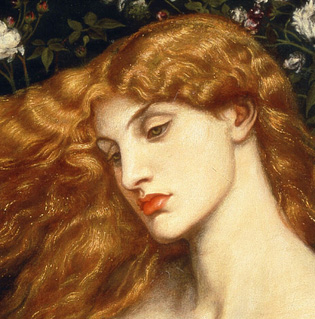
The idea was: Beware of her beautiful hair, the one adornment in which she glories. when she snares a young man with it, she does not soon let him go. It is interesting that the weapon Goethe gives her is the hair, the very trait the Talmud fixed on her a millennium earlier in Eruvin. The Pre-Raphaelites received her from Goethe. Rossetti painted her combing that hair before a mirror in Lady Lilith, begun in 1866 and repainted in 1872, and in the ballad Eden Bower he made her a serpent-bride of the garden, plotting the fall of the couple that replaced her. The seductress of the Romantics is the immediate parent of the modern figure, the Lilith of the twentieth century's less-than-optimal feminist valuations and left hand path sites, which reversed the valuation of the Ben Sira tale while keeping every one of its narrative bones.35,36
How the Goddess of Matrimony Became the Mother of Demons
Three ideas in the Bavli lead to the later sexual reputation. First, the danger to the solitary man: R. Hanina rules that one may not sleep alone in a house, and whoever sleeps alone "is seized by Lilith" (b. Shabbat 151b). Second, and more important for the harlotry motif, the demon-breeding tradition. During the hundred and thirty years Adam was separated from Eve, he begot spirits and demons (b. Eruvin 18b), a passage later read through the lens of nocturnal emission, with Lilith and her kind as the females who harvest a man's seed and bear demon children from it. Third, her physical type is fixed as winged (b. Niddah 24b, the passage you were just working on) and wild-haired, growing her hair "like Lilith" among the curses of Eve (b. Eruvin 100b). Motherhood of demons is explicit at b. Bava Batra 73a, where a demon is named as the son of Lilith.
Things become increasingly more depraved. The Zohar then makes her the "harlot" outright, paralleling the identification of Aphrodite with Babylon the Great and the Mother of Harlots in the Christian eschatology, identifying the Queen of Olympus with the "strange woman" and adulteress of Proverbs, then casting her as the counter-Shekhinah, the seductive underside of the sitra archa who ensnares holy men through nocturnal emission and through defective or solitary sexual states.
Though the Zohar in its code here still implies beneath the lurid context that those who have spiritual knowledge outside of circle are to be detested, the great goddess who forces heroes into existence and presides over the marriage rite was fully recontextualized in a moronic and sexually perverse direction eventually, one fuelled by hatred of women and paranoia of others. Although the portrayals of Lilith in the 18th and 19th century often had some dignity, by the 20th this old rabbinical tradition bled into misconceptions in Western 'Satanic' circles of Lilith being the reigning spirit of total sexual chaos and the consort of Satan himself.
Bibliography:
- Isaiah 34:14. Masoretic Text, in Biblia Hebraica Stuttgartensia. Edited by Karl Elliger and Wilhelm Rudolph. Stuttgart: Deutsche Bibelgesellschaft, 1977. Cited for the sole biblical occurrence of the word lilit.
- Hutter, Manfred. “Lilith.” In Dictionary of Deities and Demons in the Bible, 2nd extensively rev. ed., edited by Karel van der Toorn, Bob Becking, and Pieter W. van der Horst, 520–21. Leiden: Brill; Grand Rapids, MI: Eerdmans, 1999. Cited for the derivation from Akkadian lilītu and the Mesopotamian night-spirit triad.
- Septuaginta. Edited by Alfred Rahlfs. Stuttgart: Deutsche Bibelgesellschaft, 1935. Isaiah 34:14. Cited for the rendering onokentauros.
- Biblia Sacra iuxta Vulgatam Versionem. Edited by Robert Weber. Stuttgart: Deutsche Bibelgesellschaft, 1969. Isaiah 34:14. Cited for Jerome's rendering lamia.
- Ulrich, Eugene, and Peter W. Flint. Qumran Cave 1.II: The Isaiah Scrolls. Discoveries in the Judaean Desert 32. Oxford: Clarendon Press, 2010. Cited for the plural liliyyot of the Great Isaiah Scroll at 34:14.
- Blair, Judit M. De-Demonising the Old Testament: An Investigation of Azazel, Lilith, Deber, Qeteb and Reshef in the Hebrew Bible. Forschungen zum Alten Testament 2. Reihe 37. Tübingen: Mohr Siebeck, 2009. Cited for the reading of the Isaiah list as unclean animals.
- Baillet, Maurice. Qumrân grotte 4.III (4Q482–4Q520). Discoveries in the Judaean Desert 7. Oxford: Clarendon Press, 1982. 215–62. Cited for the editio princeps of 4Q510–511 and the demon-list of 4Q510 1 5.
- Nitzan, Bilhah. Qumran Prayer and Religious Poetry. Translated by Jonathan Chipman. Studies on the Texts of the Desert of Judah 12. Leiden: Brill, 1994. 243. Cited for praise as the apotropaic weapon of the Maskil.
- Babylonian Talmud, Niddah 24b. In The Babylonian Talmud, edited by Isidore Epstein. London: Soncino Press, 1935–52. Cited for the halakhic ruling on a miscarriage in the likeness of Lilith.
- Babylonian Talmud, Eruvin 100b. Cited for Eve's hair grown long like Lilith's.
- Babylonian Talmud, Shabbat 151b. Cited for the prohibition of sleeping alone in a house.
- Babylonian Talmud, Bava Batra 73a. Cited for Hormin the son of Lilith.
- Montgomery, James A. Aramaic Incantation Texts from Nippur. Philadelphia: University Museum, 1913. Cited for the liliths of the incantation bowls and the divorce-writ formula.
- Naveh, Joseph, and Shaul Shaked. Amulets and Magic Bowls: Aramaic Incantations of Late Antiquity. Jerusalem: Magnes Press, 1985. Cited for the bowl corpus and its imagery.
- Lesses, Rebecca. “Exe(o)rcising Power: Women as Sorceresses, Exorcists, and Demonesses in Babylonian Jewish Society of Late Antiquity.” Journal of the American Academy of Religion 69, no. 2 (2001): 343–75. Cited for the social setting of the bowls.
- “The Alphabet of Ben Sira.” Translated by Norman Bronznick. In Rabbinic Fantasies: Imaginative Narratives from Classical Hebrew Literature, edited by David Stern and Mark Jay Mirsky, 167–202. Philadelphia: Jewish Publication Society, 1990. Cited for the fifth response and the full first-wife narrative.
- Yassif, Eli. Sippurei Ben Sira bi-Yemei ha-Beinayim [The Tales of Ben Sira in the Middle Ages]. Jerusalem: Magnes Press, 1984. Cited for the date, provenance, and satirical character of the work.
- Genesis Rabbah 18:4 and 22:7. In Midrash Bereshit Rabba, edited by J. Theodor and Ch. Albeck. Berlin, 1912–36; reprint, Jerusalem: Wahrmann, 1965. Cited for the midrashic first Eve.
- Scholem, Gershom. Kabbalah. Jerusalem: Keter, 1974. S.v. “Lilith.” Cited for the Gello story-type parallel, the four mothers of demons, and the later kabbalistic elaborations.
- Patai, Raphael. The Hebrew Goddess. 3rd enlarged ed. Detroit: Wayne State University Press, 1990. 221–54. Cited for the amulet customs, the Zoharic material, and the exile-consort synthesis.
- Isaac ben Jacob ha-Kohen. Maʾamar ʾal ha-Atsilut ha-Semalit [Treatise on the Left Emanation]. Edited by Gershom Scholem in “Qabbalot R. Yaʾaqov ve-R. Yitshaq benei R. Yaʾaqov ha-Kohen,” Maddaʾei ha-Yahadut 2 (1927): 244–64. English translation by Ronald C. Kiener in The Early Kabbalah, edited by Joseph Dan, 165–82. New York: Paulist Press, 1986. Cited for Samael and Lilith as the ruling pair of the left emanation.
- Dan, Joseph. “Samael, Lilith, and the Concept of Evil in Early Kabbalah.” AJS Review 5 (1980): 17–40. Cited for the two Liliths, the Blind Dragon, and the castration of Samael.
- Zohar 1:19b, 1:23a–b, and 3:76b (Mantua pagination). Cited for the diminished moon, the corruption of the Watchers, and the hundred and thirty years of Adam.
- Tishby, Isaiah. The Wisdom of the Zohar. Translated by David Goldstein. 3 vols. Oxford: Oxford University Press for the Littman Library, 1989. 2:451–63. Cited for Lilith in the Zoharic system and as counterpart of the Shekhinah.
- Sefer Raziel ha-Malakh. Amsterdam, 1701. Cited for the incantation naming Lilith the First Eve and the amulet iconography.
- Bacharach, Naphtali. ʾEmeq ha-Melekh. Amsterdam, 1648. Cited for the full Lurianic elaboration of the two Liliths and the demonic hierarchy.
- Trachtenberg, Joshua. Jewish Magic and Superstition: A Study in Folk Religion. New York: Behrman's Jewish Book House, 1939. 37–38, 169–71. Cited for Rashi's classification of the demon-kinds and the childbed formula.
- Maimonides, Moses. Mishneh Torah, Hilkhot Avodat Kokhavim 11:16. Cited for the denial of the reality of demons and divination.
- Nachmanides (Moses ben Nahman). Commentary on the Torah, ad Leviticus 17:7. Cited for the affirmation of demons as beings of fine fire and air.
- Menasseh ben Israel. Nishmat Hayyim. Amsterdam, 1652. Cited for the defence of the reality of spirits and demons.
- Kohler, Kaufmann, et al. “Eybeschütz, Jonathan.” The Jewish Encyclopedia. New York: Funk and Wagnalls, 1901–1906. Cited for the amulet controversy of 1751–1753 and its course through the courts.
- Cross, Frank Moore, Jr., and Richard J. Saley. “Phoenician Incantations on a Plaque of the Seventh Century B.C. from Arslan Tash in Upper Syria.” Bulletin of the American Schools of Oriental Research 197 (1970): 42–49. Cited for the disputed Northwest Semitic parallel.
- Praetorius, Johann. Blockes-Berges Verrichtung. Leipzig, 1668. Cited for the transmission of the Lilith legend into German witch-lore.
- Goethe, Johann Wolfgang von. Faust. Der Tragödie erster Teil. Tübingen: Cotta, 1808. Walpurgisnacht. Cited for the Lilith exchange between Faust and Mephistopheles.
- Rossetti, Dante Gabriel. Lady Lilith. Oil on canvas, 1866–1868, repainted 1872. Delaware Art Museum, Wilmington.
- Rossetti, Dante Gabriel. “Eden Bower.” In Poems, 31–41. Leipzig: Bernhard Tauchnitz, 1873.