




76 min read
Hubris and Izfet: The Breach in the Measure
author: High Priest Zevios Metathronos
The Greeks called it ὕβρις, the overstepping of the measure. Egypt named the force that pours through the breach isfet, the undoing of Ma'at. The Vedic seers called the breach anṛta, the untrue, and its root atimāna, the arrogance that the Śatapatha Brāhmaṇa calls the mouth of ruin. Zevism holds these names to describe 1 event seen from 2 sides: hubris is the act, and Izfet is the dissolution the act lets in. This teaching sets out what hubris is in the order of the cosmos as well as in the conduct of men; the seasons in which it is triggered; what it does, blinding before it destroys, so that its first penalty is an ignorance that walks past the gifts of the Gods and loses the great opportunities of a life; how Nemesis restores the measure; and how the death of Socrates in 399 BCE, and the bubonic plague that fell on Justinian's empire 12 years after it closed the schools of Athens, show the law at work in a city and in a civilization.
Hubris and Izfet in Plain Words
The teaching has 5 parts, and each answers a plain question.
What hubris is. Hubris is the overstepping of a measure that the order of the cosmos has set. The Greeks used the word for the violence of a man who shames another for the pleasure of standing above him, for the insolence of a king who scourges the sea, and for the arrogance that refuses the help of the Gods; at root the 3 are 1 act. Every being in the Kosmos has a measure, μέτρον, and a portion, μοῖρα: the Sun its road, the river its banks, the body its strength, the soul its present rank on the way to the Gods. Hubris is the will that takes more than its portion and sets itself up as the judge of what it may take. Plato names the true judge in 1 line: God is the measure of all things for us, far more than any man.1
What Izfet is. Izfet is the primordial tendency of existence toward dissolution: entropy in matter, decay in the body, ignorance in the mind, injustice in the city, and in the spirit the severing of the bond between humanity and the Gods.2 Without throne or will of its own, it is the condition the cosmos falls back into wherever Ma'at, the order held by Zeus as Sovereign of the Cosmos, is left unsustained.3
How they relate. Izfet is the pressure, and hubris is the breach. A dam holds a river in its measure while the river presses against every stone of it, and nothing is lost until a stone is pulled out. Hubris is the pulling of the stone. Izfet, which was pressing all along, then pours through the breach into a soul, a house, a city or an age. The Greeks watched the breach and named it ὕβρις; the Egyptians watched the flood and named it isfet; Zevism names both, because the act and the dissolution are 2 sides of 1 event. That is why hubris is a cosmological event as well as a moral fault: a part of the ordered whole stepping out of its place, with consequences that follow the laws of the whole.
When it triggers. Hubris rarely begins in poverty and weakness. The Ancients found its seeds in prosperity without understanding, in power without account, in youth and beauty without discipline, in knowledge without humility, in success without gratitude to the Gods, and in contempt for counsel and for the sacred. Solon put the law in a single couplet: surfeit breeds hubris when great prosperity attends men whose mind is not sound.4
What it does. First it blinds. The Greeks called the blindness ἄτη, and they knew it as punishment and disaster at once: the mind is taken first, so that the man of hubris no longer sees his error, the teacher who could correct it, or the opportunity standing open before him.5 Then comes Nemesis, the restoration of the measure, which the man of hubris suffers as ruin and the cosmos receives as repair.6 Between the blindness and the ruin lies the whole tragedy of the hubristic life: the great opportunities that were offered and never seen.
Greece, Egypt and India each name the moments of the event in their own tongue:
| Aspect | In Plain English | Hellenic | Ancient Egyptian | Vedic and Sanskrit |
|---|---|---|---|---|
| The order | Each thing in its measure. | κόσμος, δίκη, μέτρον; "God is the measure of all things."1 | Ma'at, the right order set at creation; the king appointed "for the generation of ma'at, for the destruction of isfet."7 | Ṛta, the true course of Sun, seasons and rite; the circuit in which Gods and men nourish one another.8 |
| The breach | Taking more than one's portion. | ὕβρις, and πλεονεξία, the will to have more, whose advocate "neglects geometry."9 | Hearts that "disobey what I have said."10 | Atimāna, arrogance; offering "into their own mouths."11 |
| The blindness | Not seeing the error, the teacher or the gift. | ἄτη, who "walks on the heads of men."12 | The fool who "sees knowledge in ignorance."13 | Ajñāna and moha, ignorance and delusion.14 |
| The restoration | The measure returns. | νέμεσις; the Erinyes, "ministers of Justice," who would find out even the Sun.15 | The Eye of Ra sent against the plotters; "Order will return to its seat, while Chaos is driven away."16, 17 | The fall "to the lowest state" of those who never reached the God.14 |
| The virtue | Keeping the measure. | σωφροσύνη, and μηδὲν ἄγαν, nothing in excess.18 | Hearing: "Don't be proud of your knowledge."13 | The offering made to the Gods and to one another.11, 8 |
The Words: Ὕβρις, Ἄτη, Νέμεσις and Izfet
4 words carry the doctrine, and each holds a piece of the cosmology inside it.
Ὕβρις. In the courts of Athens, ὕβρις was a crime with its own public action, the γραφὴ ὕβρεως, brought against the man who assaulted or humiliated another.19 Aristotle gives the definition the courts assumed: hubris is "doing and saying things at which the sufferer is shamed, for no gain beyond the act itself, but for the pleasure of it," and the pleasure lies in this, that those who commit it "think that by ill-treating others they show their own superiority the more."20
The definition looks social, yet its heart is a claim about rank: the man of hubris acts in order to stand higher than he stands. That is why the same word covers the king who dishonours a priest, the mortal who boasts against a God and the river that bursts its banks, and why modern scholarship has found at its core both the assault on another's honour and the "thinking big" that drives it.21
Its etymology is uncertain.22 Plato calls it "many-named, for it has many limbs and many parts," and says each form takes its name from the appetite that rules in it, as gluttony from food and drunkenness from wine.23
Ἄτη. The word names 2 things the Greeks refused to separate: the blindness that seizes the mind, and the ruin that follows from it. Homer makes Atē a Goddess, the eldest daughter of Zeus, who blinds all and walks with soft feet on the heads of men. E. R. Dodds defined her as "a state of mind, a temporary clouding or bewildering of the normal consciousness," in fact "a partial and temporary insanity."24 The doctrine turns on that double meaning. The blindness is the ruin in its first form, and the later ruin is the blindness worked out in events.
Homer, Iliad 19.91 to 94 12
πρέσβα Διὸς θυγάτηρ Ἄτη, ἣ πάντας ἀᾶται, οὐλομένη· τῇ μέν θ᾽ ἁπαλοὶ πόδες· οὐ γὰρ ἐπ᾽ οὔδει πίλναται, ἀλλ᾽ ἄρα ἥ γε κατ᾽ ἀνδρῶν κράατα βαίνει βλάπτουσ᾽ ἀνθρώπους·
"Eldest daughter of Zeus is Atē, who blinds all, the ruinous one. Soft are her feet, for she never touches the ground, but walks on the heads of men, bringing them to harm."
Νέμεσις. The word comes from νέμω, to distribute, to allot, to give each thing its portion. Nemesis is the distribution restored: the portion that hubris seized, given back to the order it was taken from. The Greeks felt νέμεσις as the just indignation that rises at what is undeserved, and they worshipped Nemesis at Rhamnous as the Goddess most implacable to men of hubris.25, 26 When Herodotus explains the fall of Croesus, the richest king of his age, he uses her name, and he places the crime in a thought:
Herodotus, Histories 1.34.1 6
μετὰ δὲ Σόλωνα οἰχόμενον ἔλαβε ἐκ θεοῦ νέμεσις μεγάλη Κροῖσον, ὡς εἰκάσαι, ὅτι ἐνόμισε ἑωυτὸν εἶναι ἀνθρώπων ἁπάντων ὀλβιώτατον.
"After Solon had gone, a great nemesis from God took Croesus, as one may guess, because he thought himself the most blessed of all men."
Izfet. The Egyptian jzft, which the Temple writes Izfet, is the opposite of Ma'at: the lie against truth, the wrong against right, chaos against order.2 The office of the king was defined against it. A text that Egyptologists call The King as Sun Priest says that Re set the king on the earth of the living "to speak justice to the people, to satisfy the gods, for the generation of ma'at, for the destruction of isfet."7 Izfet is what the created world becomes wherever the order is left undone, and it creates nothing of its own.
Beside the 4 stand the words for what hubris breaks and what keeps it whole: μέτρον, the measure; μοῖρα, the portion; κόρος, the surfeit that feeds hubris; and σωφροσύνη, sound-mindedness, the virtue that keeps the measure and that the sages condensed into the 2 sayings written up at Delphi, γνῶθι σαυτόν, know yourself, and μηδὲν ἄγαν, nothing in excess.18 To know oneself, in the Delphic sense, begins with knowing the distance still to be climbed, and so the measure of the present step.
India gives the same doctrine in its own vocabulary. The Gītā lists the endowment of the Asuras in a single verse, and it sets ignorance in the same line as arrogance and conceit:
Bhagavad Gītā 16.4 14
dambho darpo 'bhimānaś ca krodhaḥ pāruṣyam eva ca, ajñānaṃ cābhijātasya pārtha sampadam āsurīm.
"Hypocrisy, arrogance and conceit, anger and harshness, and ignorance belong, O son of Pṛthā, to the one born to the endowment of the Asuras."
Ὕβρις μὲν ἡ πρᾶξις, Ἰσφὲτ δὲ ἡ διάλυσις· ἡ μὲν τὴν θύραν ἀνοίγει, ἡ δὲ εἰσέρχεται.
Hubris is the act and Izfet the dissolution: the one opens the door, and the other walks in.
The Cosmos as Measure
The Greek word for the world is a word for order. Κόσμος means the array of an army, the adornment of a woman, the right arrangement of a city, and the philosophers gave the name to the whole because the whole is ordered. Socrates states the reason in the Gorgias, against Callicles, the advocate of the strong man's right to take more:
Plato, Gorgias 507e to 508a 9
φασὶ δ᾽ οἱ σοφοί, ὦ Καλλίκλεις, καὶ οὐρανὸν καὶ γῆν καὶ θεοὺς καὶ ἀνθρώπους τὴν κοινωνίαν συνέχειν καὶ φιλίαν καὶ κοσμιότητα καὶ σωφροσύνην καὶ δικαιότητα, καὶ τὸ ὅλον τοῦτο διὰ ταῦτα κόσμον καλοῦσιν, ὦ ἑταῖρε, οὐκ ἀκοσμίαν οὐδὲ ἀκολασίαν.
"The wise say, Callicles, that heaven and earth, Gods and men are held together by communion and friendship, by orderliness, sound-mindedness and justice; and for this reason, my friend, they call this whole a kosmos, and not disorder or licence."
Socrates then names the error of Callicles in the language of mathematics: "geometric equality has great power among Gods and men, and you think one ought to practise πλεονεξία, the having of more; for you neglect geometry."9 Πλεονεξία is hubris in its economic form, and Socrates diagnoses it as an ignorance of proportion. The law that keeps the planets in their ratios keeps a soul in its place, and the man who reaches for more than his share has failed to learn the geometry of the cosmos he lives in.
The oldest Greek philosophers had already written the law into the stars. Anaximander, in the first sentence of Greek philosophical prose that survives, says that things perish into that from which they came "according to necessity; for they pay penalty and retribution to one another for their injustice according to the ordering of time."27 Whatever takes too much is made to give it back, and the cosmos keeps the account. Heraclitus calls the kosmos "an ever-living fire, kindled in measures and quenched in measures," and he applies the measure to the greatest fire in the sky:
Heraclitus, fragment B94 15
ἥλιος γὰρ οὐχ ὑπερβήσεται μέτρα· εἰ δὲ μή, Ἐρινύες μιν Δίκης ἐπίκουροι ἐξευρήσουσιν.
"The Sun will not overstep his measures; if he does, the Erinyes, ministers of Justice, will find him out."
Heraclitus used the language of fire for the soul as well: "hubris must be quenched more than a blazing fire."15 The verb σβεννύναι, to quench, is the verb of the cosmic fire's ἀποσβεννύμενον μέτρα, "quenched in measures." For Heraclitus the kosmos is fire within its measure and hubris is fire beyond it, and the difference between them is the difference between a hearth and a conflagration.
Plato makes Zeus the keeper of the measure. In the Laws the Athenian addresses the founders of a new city with an ancient saying, which the old commentators knew as Orphic: Zeus is the beginning, Zeus the middle, and from Zeus all things are made.28
Plato, Laws 715e to 716a 1
ὁ μὲν δὴ θεός, ὥσπερ καὶ ὁ παλαιὸς λόγος, ἀρχήν τε καὶ τελευτὴν καὶ μέσα τῶν ὄντων ἁπάντων ἔχων, εὐθείᾳ περαίνει κατὰ φύσιν περιπορευόμενος· τῷ δὲ ἀεὶ συνέπεται δίκη τῶν ἀπολειπομένων τοῦ θείου νόμου τιμωρός.
"The God, as the ancient saying has it, holding the beginning and the end and the middle of all things that are, goes straight to his end, moving round according to nature; and with him always follows Justice, the avenger of those who fall short of the divine law."
Zeus holds the measure because Zeus holds the whole. A few lines later Plato draws the conclusion: "God would be for us the measure of all things in the highest degree, far more than, as they say, any man."1 The sentence answers Protagoras, who had made man the measure of all things.29 Hubris is the doctrine of Protagoras turned into conduct: the self made the measure, and the portion fixed by appetite instead of by the order of the whole.
The Temple's teaching on the Ten Antithetical Powers gives the same law its working form. Each Power has its right form under Ma'at and 2 failures under Izfet, 1 by an excess of limit, the mold, and 1 by the loss of limit, the flood.30 Hubris is the flood. Plato's Philebus says that the Goddess, seeing "wanton excess and all the wickedness of all things," with no limit in their pleasures and surfeits, "established law and order, which have limit."31 The teaching on Light and Darkness gives the rule in a sentence, "Ὕβρις is light that has broken its measure," and the teaching on Necessity and Freedom gives its political case, freedom without necessity breeding "the ὕβρις of Xerxes."32, 33
Phaethon: The Myth Read as Astronomy
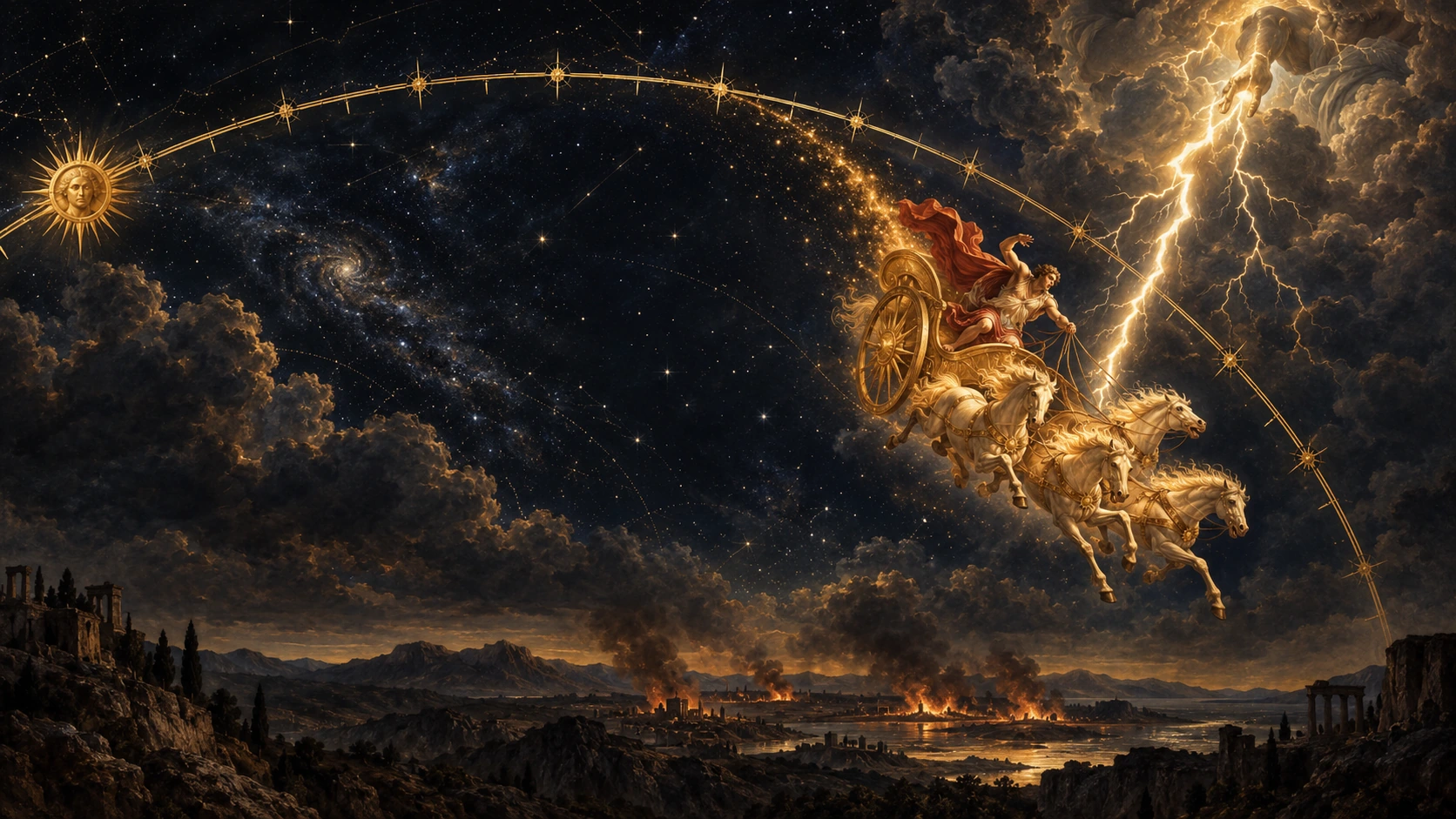
The Greeks told the story of hubris in the sky before they told it on earth. Phaethon, son of Helios, held his father to an oath, asked to drive the chariot of the Sun for a day, could not keep the horses on the road, and set the earth on fire until the thunderbolt of Zeus struck him down into the river Eridanus.34 In the Timaeus an Egyptian priest of Saïs tells Solon what truth the story holds, and reads it as astronomy:
Plato, Timaeus 22c to d 35
ὥς ποτε Φαέθων Ἡλίου παῖς τὸ τοῦ πατρὸς ἅρμα ζεύξας διὰ τὸ μὴ δυνατὸς εἶναι κατὰ τὴν τοῦ πατρὸς ὁδὸν ἐλαύνειν τά τ᾽ ἐπὶ γῆς συνέκαυσεν καὶ αὐτὸς κεραυνωθεὶς διεφθάρη, τοῦτο μύθου μὲν σχῆμα ἔχον λέγεται, τὸ δὲ ἀληθές ἐστι τῶν περὶ γῆν κατ᾽ οὐρανὸν ἰόντων παράλλαξις καὶ διὰ μακρῶν χρόνων γιγνομένη τῶν ἐπὶ γῆς πυρὶ πολλῷ φθορά.
"That Phaethon, son of Helios, once yoked his father's chariot and, because he was not able to drive it along his father's road, burned up what was on the earth and was himself destroyed by a thunderbolt: this is told in the shape of a myth, but the truth of it is a deviation of the bodies that move in the heavens around the earth, and a destruction, recurring over long periods of time, of what is on the earth by much fire."
Here the Ancients give the cosmological reading of hubris themselves, and the 4 elements of the myth are the 4 elements of the doctrine. The road, ὁδός, is the measure: the course the father's order has set. The deviation, παράλλαξις, is the hubris: the son takes the reins of a power he has not grown into, and the power leaves its road. The conflagration is Izfet: fire that gave life within its measure destroys life outside it. The thunderbolt is the restoration. Zeus strikes to save the earth, and the Sun returns to its road. The Temple's teaching on Light and Darkness sets Phaethon among the faces of light under Izfet, beside the Eye of Ra unbound.32
Phaethon's wish was a high one. Helios had sworn to grant him anything, and the son asked for the highest thing his father had. His fault lay in taking the reins before he could hold them: the claim without the climb. That distinction returns at the end of this teaching, because it is the line that divides hubris from Theosis.
Ma'at and Izfet: The Hearts That Disobeyed
Egypt states the origin of isfet in the creator's own words. In a spell of the Coffin Texts the Lord of All recites the 4 good deeds he did within the portal of lightland: he made the 4 winds, that every man might breathe in his time; he made the great flood, that the humble might have their share of it like the great; and then:
Coffin Texts, spell 1130 10
"I made every man like his fellow; and I did not command that they do wrong. It is their hearts that disobey what I have said. This is one of the deeds."
The word translated "wrong" is jzft, isfet.10 The creator made the order equal and true, and the breach came from hearts that disobeyed the word. Isfet entered the world through the door the Greeks called hubris: a will stepping out of the measure it was given.
The Book of the Heavenly Cow tells what followed. When Ra had grown old, mankind plotted rebellion against him. He sent out his Eye, Hathor in her raging form, to destroy them; then he relented, and saved the remnant by having 7,000 jars of beer dyed red with ochre and poured out over the fields, which the Goddess drank as blood until she no longer knew the men she hunted.16 The book goes on to tell how Ra, weary of men, withdrew from the earth and rose to the sky on the back of Nut, transformed into a cow, and how the order of the heavens was set around him.16
The myth is a cosmogony of distance. The present arrangement of the world, with the Gods in heaven and men below, begins with an act of hubris against the source of light, and the separation of heaven and earth is the scar of the first breach. In Zevist terms, distance from Zeus and from Ma'at is the entropic fall back toward chaos, and the Magnum Opus is the closing of that distance.36
Ṛta and Anṛta: The Closed Circuit
India set the law in the language of offering. Ṛta is the true order: the course of the Sun, the turning of the seasons, the rite that keeps them turning. Its negation, anṛta, is the untrue. The Śatapatha Brāhmaṇa tells why the Asuras lost their contest with the Gods, and the story is a cosmology of hubris in 3 sentences:
Śatapatha Brāhmaṇa 5.1.1.1 11
devāś ca vā asurāś ca ubhaye prājāpatyāḥ paspṛdhire. tato 'surā atimānenaiva kasmin nu vayaṃ juhuyāmeti sveṣv evāsyeṣu juhvataś ceruḥ. te 'timānenaiva parābabhūvuḥ. tasmān nātimanyeta, parābhavasya haitan mukhaṃ yad atimānaḥ.
"Once upon a time the gods and the Asuras, both of them sprung from Pragâpati, strove together. And the Asuras, even through arrogance, thinking, 'Unto whom, forsooth, should we make offering?' went on offering into their own mouths. They came to naught, even through arrogance: wherefore let no one be arrogant, for verily arrogance is the cause of ruin."
The Gods, the text continues, "went on making offerings unto one another," and that is the whole difference between them.11 Offering is the circulation of the cosmos. The Gītā states the circuit: nourish the Gods with the offering and let the Gods nourish you, and "nourishing one another, you will attain the highest good"; whoever enjoys the gifts of the Gods without offering to them in return "is a thief"; and whoever does not turn the wheel so set in motion "lives in vain."8 The Asuras broke the circuit and held the flow in themselves, and a held flow stagnates and dies. Their arrogance was a closed circuit, and a closed circuit is Izfet. The literal sense of the last clause is apt: arrogance is the mukha, the mouth or doorway, of ruin.
The 3 civilizations agree on the shape of the cosmos. The order is a measure held from the center: by Zeus, by the creator's word, by the circuit of offering. Hubris is a part that steps out of its measure, keeps the flow for itself or claims the center. Izfet is what pours in when it does.
Μέτρον Ζεύς· ὁ δ᾽ ἑαυτὸν μέτρον ποιούμενος ἔρημος θεοῦ λείπεται.
Zeus is the measure. Whoever makes himself the measure is left desolate of God.
What Hubris Is
With the cosmos in view, hubris can be defined with precision. It has 5 marks, and a full case carries all of them.
It oversteps a measure. Every being stands somewhere in the order: a body has its strength, a mind its present knowledge, an office its authority, a soul its rank on the road to the Gods. The measure is real even where no law has written it down. Hubris acts as if the line were absent, and the Sun of Heraclitus is its standard case: the greatest fire in the sky is bound by measures, and the Erinyes would find even him out.15
It makes the self the measure. Plato's man of hubris burns "as if he needed neither ruler nor guide, but were fit to lead others."1 He consults no measure outside himself, because he has made himself the measure. In the Greek view this is the root form of the vice, and every other form grows from it.
It dishonours. Aristotle's definition makes hubris an act of shaming, done for the pleasure of standing above.20 The Greek word for the deed it does is ἀτιμάζειν, to deprive of honour. Agamemnon "dishonoured" Chryses, the priest of Apollo, and he "did not honour the best of the Achaeans."37 Hubris always lowers something, a man, a priest, a God, the earth itself, in order to rise above it.
It refuses the hand of the Gods. The messenger in Sophocles' Ajax reports the words that won the hero the anger of Athena. When his father told him to seek victory with the help of the Gods, he answered:
Sophocles, Ajax 767 to 769 and 774 to 777 38
πάτερ, θεοῖς μὲν κἂν ὁ μηδὲν ὢν ὁμοῦ κράτος κατακτήσαιτ᾽· ἐγὼ δὲ καὶ δίχα κείνων πέποιθα τοῦτ᾽ ἐπισπάσειν κλέος. … ἄνασσα, τοῖς ἄλλοισιν Ἀργείων πέλας ἵστω, καθ᾽ ἡμᾶς δ᾽ οὔποτ᾽ ἐκρήξει μάχη. τοιοῖσδέ τοι λόγοισιν ἀστεργῆ θεᾶς ἐκτήσατ᾽ ὀργήν, οὐ κατ᾽ ἄνθρωπον φρονῶν.
"'Father, with the Gods even a man who is nothing might win the mastery; but I am confident that I will draw this glory to myself even without them.' ... [When Athena urged him on against the enemy, he answered:] 'Queen, stand beside the other Argives; where I stand, the line will never break.' With such words he won the unrelenting anger of the Goddess, not thinking as befits a man."
The seer Calchas gives the law in the same speech: the bodies that grow "excessive and useless" fall by heavy misfortunes sent from the Gods, whoever is born with a human nature and then does not think as befits a man.38 Ajax was the greatest warrior at Troy after Achilles. His strength was real; his refusal of the divine hand was the hubris.
It claims without climbing. Aristotle's account of greatness of soul gives the measure of a claim. The great-souled man "is thought to be the one who claims great things for himself and is worthy of them," while "the one who claims great things and is unworthy is vain," χαῦνος, and the one who claims less than his worth is small of soul.39 Hubris lives in the gap between the claim and the worth. What decides is the claim running ahead of the climb, whatever the size of the claim. Phaethon asked for the Sun, and the Gods would one day give Heracles his seat on Olympus. The difference between them was 12 labours.
The Greeks recognized 3 objects of hubris: men, whom it shames; the Gods, whom it defies; and nature, which it violates. Xerxes committed all 3 in 1 campaign. He had a canal cut through the peninsula of Athos and bridged the Hellespont, and when a storm broke the bridge he had the strait given 300 lashes and a pair of fetters thrown into it, while his men pronounced over it words that Herodotus calls "barbarous and presumptuous": "Bitter water, your master lays this penalty on you, because you wronged him."40 In Zevism the 3 objects are 1, because men, Gods and nature are held in 1 Kosmos, and an act that tears it at 1 point strains it at every point.9
Ἡ ἀρετὴ ἀναβαίνει κατὰ μέτρον, ἡ δὲ ὕβρις ἁρπάζει ἄνευ μέτρου.
Arete climbs by measure; hubris seizes without it.
When Hubris Triggers
Hubris is a seed that waits for its season, and the Ancients recorded the seasons in which it germinates. They are, almost without exception, the seasons in which a life seems most favoured.
Prosperity without understanding. Solon, who refused a tyranny that was his for the taking, wrote the classic law of the subject, and Aristotle preserved it in his account of the Athenian constitution:
Solon, fragment 6, quoted by Aristotle, Constitution of the Athenians 12.2 4
τίκτει γὰρ κόρος ὕβριν, ὅταν πολὺς ὄλβος ἕπηται ἀνθρώποισιν, ὅσοις μὴ νόος ἄρτιος ᾖ.
"For surfeit breeds hubris, when great prosperity attends men whose mind is not sound."
The collection of Theognis repeats the couplet with a sharper subject: surfeit breeds hubris "when prosperity attends a bad man," a man whose mind is not sound.4 The 2 versions together give the full law. Prosperity is energy. Within a sound mind, νόος ἄρτιος, the energy is held in measure and becomes power for good; within a mind unfitted to hold it, the same energy floods. The gift is innocent. The vessel decides.
Power without account. When the Persian nobles debated the best constitution, Otanes argued against monarchy from the nature of power itself: "hubris is engendered in the monarch by the good things he has, while envy is planted in man from the beginning."41 Sophocles reversed the direction in a single line of the Oedipus Tyrannus: "hubris breeds the tyrant."42 Power feeds hubris, and hubris hungers for power; the circle turns faster with every revolution, and the man inside it rarely notices the speed.
Youth, beauty and honours without discipline. Plato's list in the Laws runs: the man "lifted up by boastfulness, or elated by wealth or honours, or by beauty of body together with youth and folly," whose soul "burns with hubris."1 None of these goods is evil. Each is a measure of force that has arrived before the measure of mind that should govern it.
Knowledge without humility. The Instruction of Ptahhotep, among the oldest books of wisdom that survive, opens its first maxim with this danger:
The Instruction of Ptahhotep, maxim 1 13
"Don't be proud of your knowledge, consult the ignorant and the wise; the limits of art are not reached, no artist's skills are perfect."
Apollo's oracle declared that no one was wiser than Socrates, and Socrates found the meaning only after questioning the men reputed wise: the God called that man wisest who, like Socrates, knows that his wisdom is worth nothing in truth.43 Knowledge is the most dangerous field of hubris, because the knower trusts his knowledge to protect him. Plato called the condition a double ignorance, and Proclus made the name a doctrine: not knowing, and not knowing that one does not know.44
Success without gratitude. Ajax won his battles, and he credited the victories to himself alone. The Śatapatha's Asuras asked "Unto whom should we make offering?" because they could see no one above them to thank.38, 11 Success is the moment in which the hand of the Gods is easiest to forget, and the forgetting is the first step out of the measure.
Contempt for the sacred and its servants. The Iliad opens with it. Agamemnon drove off Chryses, priest of Apollo, who had come to ransom his daughter, and the God answered with plague.37 Aeschylus' Darius foretells the disaster awaiting his son's army in Greece as "the recompense of hubris and godless thoughts," for they had not scrupled to plunder the images of the Gods and burn their temples.45
Contempt for counsel. Croesus dismissed Solon, "thinking him very ignorant."6 Xerxes answered his uncle Artabanus, who warned him against the war, with anger and the threat of disgrace.40 In both men the hubris had already done its first work: the counsel that could have saved them looked to them like ignorance and insult.
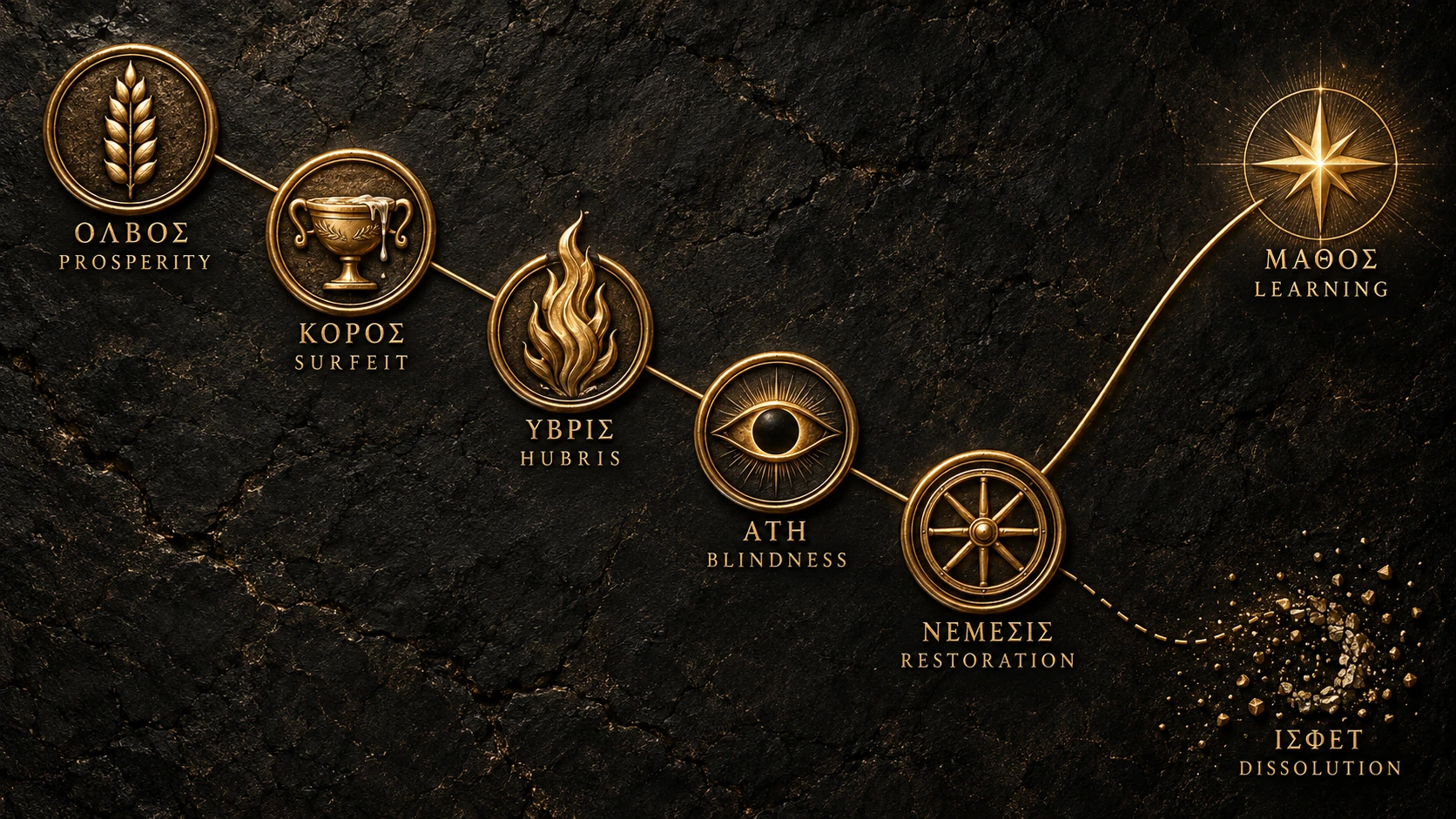
These are the conditions of the seed. The growth of the plant follows a sequence that the Greek poets traced from the first good fortune to the last ruin, and that branches at its end into 2 ways out:
| Stage | Greek | What Happens | Witness |
|---|---|---|---|
| Prosperity | ὄλβος | Gifts arrive: wealth, power, beauty, knowledge, success. They are goods, and the test begins with them. | Solon to Croesus: count no man blessed before his end.6 |
| Surfeit | κόρος | The gifts outgrow the mind that should hold them, and appetite outgrows its measure. | "Surfeit breeds hubris."4 |
| Hubris | ὕβρις | The breach: the measure overstepped in thought, then in word, then in deed. | Xerxes scourges the Hellespont.40 |
| Blindness | ἄτη | The mind is taken: evil seems good, counsel seems insult, the gift seems worthless. | "Evil seems good to him whose mind a God leads to atē."46 |
| Restoration | νέμεσις | The measure returns, and the man of hubris suffers its return as ruin. | "A great nemesis from God took Croesus."6 |
| Learning | μάθος | The one who suffers and understands is brought back into the measure. | Zeus "who laid down as law that learning comes through suffering."47 |
| Dissolution | Izfet | The one who refuses even the lesson falls apart, and takes his house and city with him. | "Himself, his house and his city he brought to utter ruin."1 |
Ὕβρις πῦρ ἐστιν ἐκτὸς μέτρου· σβέννυ αὐτήν, μὴ τὸν οἶκον καταφλέξῃ.
Hubris is fire outside its measure. Quench it before it burns the house down.
What Hubris Does
The effects of hubris come in an order, and the order is the heart of what the Ancients knew about them. The blindness comes first. The ruin of the house, the defeat of the army and the fall of the city come after, and they are the blindness carried out into the world.
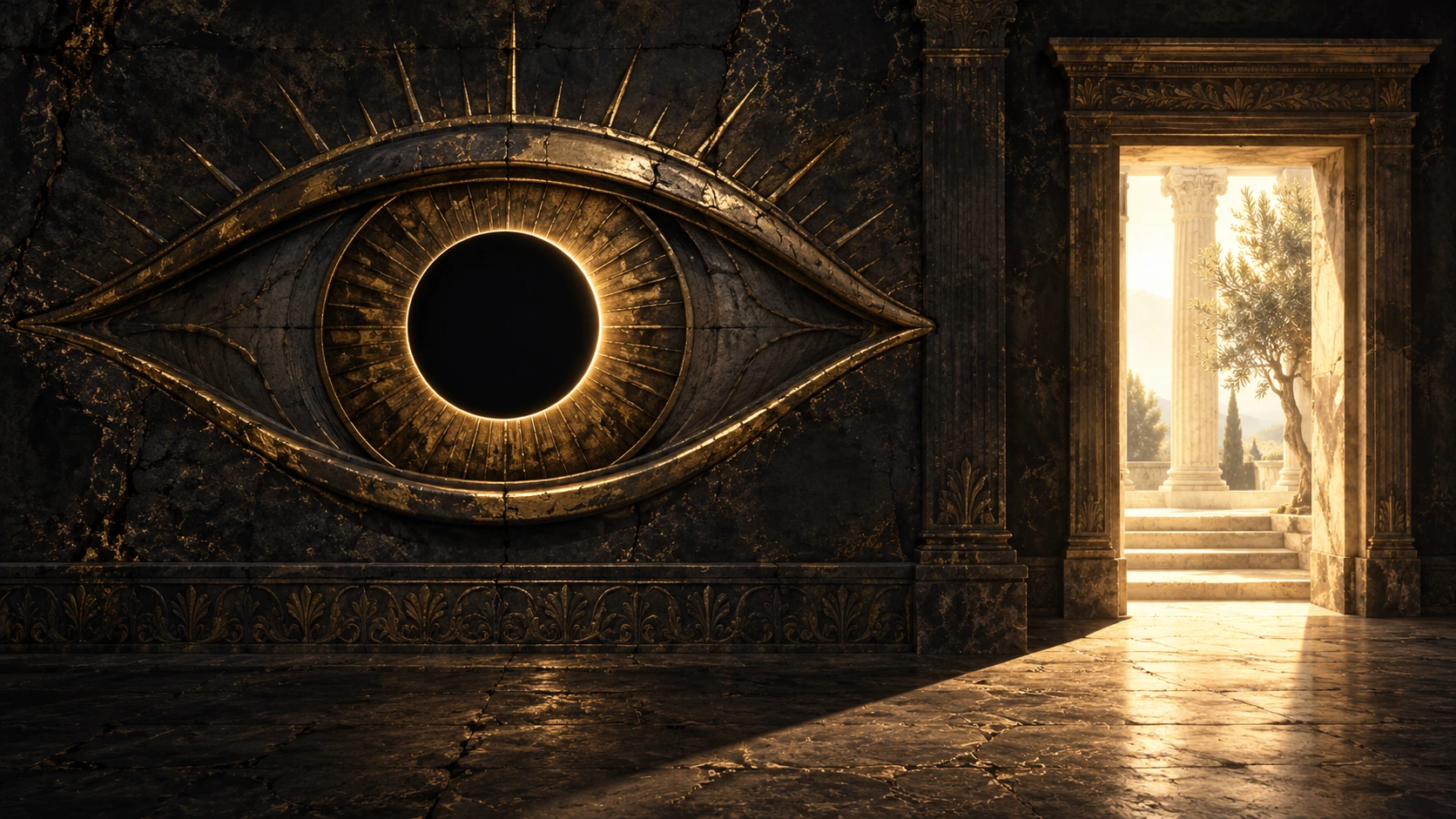
The First Penalty: Ἄτη, the Blindness
Before the ruin, the mind of the man of hubris is darkened, and it is darkened where he most needs to see. An Athenian orator of the 4th century BCE quoted "some of the ancient poets," who had left the lines to later generations like oracles:
Lycurgus, Against Leocrates 92 5
ὅταν γὰρ ὀργὴ δαιμόνων βλάπτῃ τινά, τοῦτ᾽ αὐτὸ πρῶτον, ἐξαφαιρεῖται φρενῶν τὸν νοῦν τὸν ἐσθλόν, εἰς δὲ τὴν χείρω τρέπει γνώμην, ἵν᾽ εἰδῇ μηδὲν ὧν ἁμαρτάνει.
"When the anger of the daimones harms a man, this is the very first thing: it takes the noble understanding out of his mind and turns him to the worse judgment, so that he knows nothing of the errors he commits."
The Chorus of Sophocles' Antigone sings the same thought as a "famous saying," and adds the detail that makes the blindness so hard to escape: the man in its grip sees his ruin as his good.
Sophocles, Antigone 620 to 625 46
σοφίᾳ γὰρ ἔκ του κλεινὸν ἔπος πέφανται. τὸ κακὸν δοκεῖν ποτ᾽ ἐσθλὸν τῷδ᾽ ἔμμεν ὅτῳ φρένας θεὸς ἄγει πρὸς ἄταν· πράσσει δ᾽ ὀλίγιστον χρόνον ἐκτὸς ἄτας.
"With wisdom someone uttered the famous saying: evil seems good, sooner or later, to the man whose mind a God is leading toward atē; and he fares for the briefest time outside atē."
Aeschylus gives the condition its medical name. When the ghost of Darius hears what his son attempted at the Hellespont, he asks: "A mortal, he thought, with no good counsel, to master all the Gods and Poseidon. How was this not a disease of the mind, νόσος φρενῶν, that held my son?"45
The poets speak of the anger of the daimones and of a God leading the mind astray. The philosophers explain the mechanism, and the mechanism is cosmological. Plato's sentence in the Laws gives it whole:
Plato, Laws 716a to b 1
ὁ δέ τις ἐξαρθεὶς ὑπὸ μεγαλαυχίας, ἢ χρήμασιν ἐπαιρόμενος ἢ τιμαῖς, ἢ καὶ σώματος εὐμορφίᾳ ἅμα νεότητι καὶ ἀνοίᾳ φλέγεται τὴν ψυχὴν μεθ᾽ ὕβρεως, ὡς οὔτε ἄρχοντος οὔτε τινὸς ἡγεμόνος δεόμενος, ἀλλὰ καὶ ἄλλοις ἱκανὸς ὢν ἡγεῖσθαι, καταλείπεται ἔρημος θεοῦ, καταλειφθεὶς δὲ καὶ ἔτι ἄλλους τοιούτους προσλαβὼν σκιρτᾷ ταράττων πάντα ἅμα, καὶ πολλοῖς τισιν ἔδοξεν εἶναί τις, μετὰ δὲ χρόνον οὐ πολὺν ὑποσχὼν τιμωρίαν οὐ μεμπτὴν τῇ δίκῃ ἑαυτόν τε καὶ οἶκον καὶ πόλιν ἄρδην ἀνάστατον ἐποίησεν.
"But the man who is lifted up by boastfulness, or elated by wealth or honours, or by beauty of body together with youth and folly, burns in his soul with hubris, as if he needed neither ruler nor guide but were fit to lead others: he is left desolate of God. And being left so, he gathers others like himself and leaps about, throwing everything into confusion at once, and to many he seems to be someone; but before long he pays a penalty that Justice cannot fault, and brings himself, his house and his city to utter ruin."
The key words are καταλείπεται ἔρημος θεοῦ, "he is left desolate of God." The soul sees by a light it does not make. Plato's Republic calls the Good the Sun of the intelligible world, the source at once of the being of things and of the power to know them.48 A soul inside the order stands in that light; a soul that steps out of the order steps out of the light. The darkness that follows is what remains when a lamp is carried out of the Sun. That is why the poets say the Gods take the mind first: the taking is the withdrawal of the soul from the light it has refused. In the Temple's terms, distance from Zeus and from Ma'at is the entropic fall, and its first symptom in a mind is darkness.2
The Theaetetus carries the thought to its end. Socrates tells Theodorus that the unjust "are ignorant of the penalty of injustice, which they should least of all be ignorant of," because the penalty they cannot escape is a different one from the beatings and deaths they fear:
Plato, Theaetetus 176e to 177a 49
παραδειγμάτων, ὦ φίλε, ἐν τῷ ὄντι ἑστώτων, τοῦ μὲν θείου εὐδαιμονεστάτου, τοῦ δὲ ἀθέου ἀθλιωτάτου, οὐχ ὁρῶντες ὅτι οὕτως ἔχει, ὑπὸ ἠλιθιότητός τε καὶ τῆς ἐσχάτης ἀνοίας λανθάνουσι τῷ μὲν ὁμοιούμενοι διὰ τὰς ἀδίκους πράξεις, τῷ δὲ ἀνομοιούμενοι. οὗ δὴ τίνουσι δίκην ζῶντες τὸν εἰκότα βίον ᾧ ὁμοιοῦνται.
"2 patterns, my friend, stand in reality: the divine, most blessed, and the godless, most wretched. Not seeing that this is so, through foolishness and the utmost folly they fail to notice that by their unjust deeds they are being made like the godless pattern and unlike the divine. And they pay the penalty for it by living the life that answers to the pattern they resemble."
This passage stands a few lines after the sentence that defines the Magnum Opus, ὁμοίωσις θεῷ κατὰ τὸ δυνατόν, likeness to God as far as is possible.36 Hubris is the same motion run in reverse: ἀνομοίωσις, the soul made unlike God. Its penalty is the life it produces, and its cruellest feature is that the sufferer cannot see it, because blindness cannot see itself. Plato and Proclus called this condition double ignorance, and the Temple calls it the first prison of the soul.44
The ignorance is the punishment itself, in its first and longest form. It falls on the most intelligent as readily as on the dull, because it attacks judgment and leaves cleverness intact: Croesus remained shrewd, Xerxes remained a capable organizer of armies, Ajax remained a superb fighter. What they lost was the power to see where they stood, and with it every chance that depended on seeing.
The Lost Opportunities
Blindness costs most at the moment of opportunity, and the opportunities of a life tend to arrive in the shapes hubris is least able to recognize: a teacher who contradicts, a counsel that restrains, an oracle that asks for a second question, a gift that must be received with gratitude. The Instruction of Ptahhotep describes the inversion: "The fool who does not hear, he can do nothing at all; he sees knowledge in ignorance, usefulness in harmfulness."13 The categories turn over. The gift appears as a threat, and the threat as a gift.
Croesus. The story Herodotus tells is the classic case, and every step of it is a lost opportunity. Solon the Athenian, the wisest man of his age, came to Sardis as a guest. Croesus showed him his treasuries and asked who was the most blessed of men, expecting his own name. Solon named an Athenian who had died well, and warned the king to count no man blessed before he saw his end. Croesus sent him away, "thinking him very ignorant."6 The man of hubris judged the wise man ignorant: the very inversion the blindness produces. The first opportunity was lost.
Then came the oracle. Croesus asked Delphi whether to march against Persia and was told that if he did, he would destroy a great empire. He did not ask which empire. When his own kingdom had fallen, the Pythia gave the verdict on that blindness: "not grasping what was said, and not asking again, let him declare himself the cause."6 The second opportunity was lost.
Bound on the pyre that Cyrus had built for him, Croesus remembered the saying of Solon, that no one living is blessed, and after a long silence groaned and called the name "Solon" 3 times.6 The understanding came, and it came on the pyre. Herodotus adds that Apollo, whose shrine Croesus had honoured with great gifts, sent a sudden storm to put out the fire, and that the king lived to become the counsellor of Cyrus.6 Learning restored him; nothing restored the kingdom his blindness had thrown away.
Agamemnon. The Iliad turns on a lost opportunity. Agamemnon had the best warrior of the Greeks in his army and dishonoured him over a captive woman. Achilles withdrew and prayed that the Greeks be driven back to their ships, so that Agamemnon "may know his atē, that he did not honour the best of the Achaeans."37 Many of the Achaeans died before the king understood what he had thrown away, and when he did, he named the Goddess Atē as the power that had taken his mind.12
Ajax. When Athena's anger fell on Ajax, it fell as an ignorance so complete that the hero mistook cattle for men. Athena cast false visions on his eyes, and he slaughtered the army's herds believing he was killing the Greek commanders who had given the arms of Achilles to Odysseus.38 The punishment was the blindness itself, and it took from him in a single night the honour of a lifetime. When the madness lifted, he chose death over the shame of having been seen in it.
The greatest opportunity. The Gītā follows the Asuric soul past a single life. Deluded "by ignorance" and "surrounded by the net of delusion," such souls are cast into Asuric wombs, deluded "in every birth," and "not reaching me," says the God, "they go to the lowest state."14 Beyond the chances of a career, a marriage or a kingdom, hubris loses the opportunity for which a human life is given at all: the Work of becoming like the Gods. The Temple's teaching on Theosis calls each life spent on the Work a life that has reached its highest worth.36 A life spent in hubris is spent walking past the door.
Ὁ ὑβριστὴς τὴν τῶν θεῶν δόσιν παρ᾽ αὑτῷ ἑστῶσαν οὐχ ὁρᾷ.
The man of hubris does not see the gift of the Gods standing at his side.
Nemesis: The Restoration of the Measure
After the blindness comes the restoration. The Greek picture of it is organic: hubris is a plant that grows by its own nature until it yields its own harvest.
Aeschylus, Persians 820 to 822 45
ὡς οὐχ ὑπέρφευ θνητὸν ὄντα χρὴ φρονεῖν. ὕβρις γὰρ ἐξανθοῦσ᾽ ἐκάρπωσεν στάχυν ἄτης, ὅθεν πάγκλαυτον ἐξαμᾷ θέρος.
"A mortal must not think thoughts beyond his measure. For hubris, once in flower, bears its fruit, an ear of atē, from which it reaps a harvest all of tears."
A few lines later Darius names the power that presides over the harvest: "Zeus is the chastiser of thoughts too boastful, a heavy auditor."45 The word for auditor, εὔθυνος, is the title of the Athenian official who examined the accounts of a magistrate at the end of his term. Zeus audits the accounts of the cosmos. Anaximander's things that "pay penalty and retribution to one another according to the ordering of time" and the Erinyes who would find out even the Sun describe the same audit at the scale of nature.27, 15
Nemesis is restorative justice. Her name is the restoration of the portion, and her worship at Rhamnous kept a witness to it in stone: the Persians who landed at Marathon brought with them a block of Parian marble to carve a trophy of the victory they were sure of, and after their defeat, as Pausanias tells it, Phidias carved the marble into the image of Nemesis (Pliny and modern scholars give the statue to his pupil Agoracritus).26 The material hubris had brought to celebrate itself became the statue of the Goddess who corrected it. The Temple's teaching on Nemesis adds what the Ancients knew and the moderns forget: her penalty is often present already, simply beyond the awareness of the mind that suffers it, and it can take the form of decay and unawareness lasting decades or lifetimes, which is why she carries a wheel.25
Aeschylus also states where the restoration leads, in the Hymn to Zeus, in the first choral song of the Agamemnon:
Aeschylus, Agamemnon 176 to 178, from the Hymn to Zeus 47
τὸν φρονεῖν βροτοὺς ὁδώσαντα, τὸν πάθει μάθος θέντα κυρίως ἔχειν.
"Him who set mortals on the road to understanding, who laid it down as law that learning comes through suffering."
The restoration is a lesson. Zevism holds that Izfet is woven into creation so that beings may grow by overcoming it, and that Zeus is the supreme teacher of that overcoming.50 Nemesis is his teaching applied to the soul that has stepped out of the measure: the ruin is the last lesson offered to a mind that refused the earlier ones.
Izfet Spreads: House, City and Age
Hubris never stays inside the man who commits it. The breach is his, and the flood finds everyone below it. Hesiod, among the first Greek poets to state the law, set out its reach:
Hesiod, Works and Days 238 to 243 51
οἷς δ᾽ ὕβρις τε μέμηλε κακὴ καὶ σχέτλια ἔργα, τοῖς δὲ δίκην Κρονίδης τεκμαίρεται εὐρύοπα Ζεύς. πολλάκι καὶ ξύμπασα πόλις κακοῦ ἀνδρὸς ἀπηύρα, ὅς κεν ἀλιτραίνῃ καὶ ἀτάσθαλα μηχανάαται. τοῖσιν δ᾽ οὐρανόθεν μέγ᾽ ἐπήγαγε πῆμα Κρονίων λιμὸν ὁμοῦ καὶ λοιμόν· ἀποφθινύθουσι δὲ λαοί.
"But for those who care for wicked hubris and cruel deeds, wide-seeing Zeus, son of Kronos, ordains a penalty. Often a whole city suffers for a single bad man who sins and devises reckless deeds. On them the son of Kronos brings down from heaven a great disaster, famine and plague together, and the people waste away."
Famine and plague together, λιμὸν ὁμοῦ καὶ λοιμόν: the 2 words differ by a single letter, and Hesiod sets them side by side as the twin faces of a disordered city. The same law opens the Iliad. Agamemnon dishonoured the priest of Apollo, and the God sent a plague through the army: "he roused an evil sickness through the host, and the people perished, because the son of Atreus had dishonoured Chryses, his priest."37 The same law opens the Oedipus Tyrannus, where Thebes lies under a plague whose cause is a crime hidden in the house of its king.42
The Temple's teaching on Izfet explains why the flood finds the innocent: Izfet works at every level of existence at once, physical, biological, psychological, social and spiritual, and a breach at 1 level opens the others.2 The teaching on Light and Darkness puts it in a sentence: "The lie, the injustice, the chosen ignorance and the slow drift from the right are 1 fall at different speeds."32 Hubris at the level of the spirit and Izfet at the level of the body are the same fall seen at 2 speeds.
The 2 Exits: Learning or Dissolution
The ladder of the fall ends in 2 ways out, and Hesiod named both in the lines he addressed to his brother:
Hesiod, Works and Days 213 to 218 51
ὦ Πέρση, σὺ δ᾽ ἄκουε δίκης, μηδ᾽ ὕβριν ὄφελλε· ὕβρις γάρ τε κακὴ δειλῷ βροτῷ· οὐδὲ μὲν ἐσθλὸς ῥηιδίως φερέμεν δύναται, βαρύθει δέ θ᾽ ὑπ᾽ αὐτῆς ἐγκύρσας ἄτῃσιν· ὁδὸς δ᾽ ἑτέρηφι παρελθεῖν κρείσσων ἐς τὰ δίκαια· Δίκη δ᾽ ὑπὲρ Ὕβριος ἴσχει ἐς τέλος ἐξελθοῦσα· παθὼν δέ τε νήπιος ἔγνω.
"Perses, listen to Justice and do not feed hubris. Hubris is evil for a lowly mortal, and even the noble cannot bear it easily, but is weighed down by it when he meets with ruin. The better road is the other way, toward what is just. Justice prevails over Hubris when she comes to the end, and the fool learns it by suffering."
Even in Hesiod hubris leads to ἄτη: the man of hubris is weighed down "when he meets with ruin," ἐγκύρσας ἄτῃσιν. And the last half-line holds the first exit. The νήπιος, the fool, the man without understanding, learns by suffering what he refused to learn by listening. That is the exit of μάθος, learning. Croesus took it on the pyre, and Agamemnon took it before the assembled army when he confessed his atē and made amends to Achilles.6, 12 The exit is real, and it is the mercy built into the law. Nemesis restores the measure, and whoever accepts the restoration is restored with it.
The second exit is dissolution. The man who refuses even the lesson of suffering has nothing left to teach him, and Izfet completes its work: he brings "himself, his house and his city to utter ruin," ἄρδην ἀνάστατον, uprooted from the ground.1 Ajax, waking from his madness, refused to live and learn. Xerxes went home in rags, and the Persian queen and elders of Aeschylus' play mourn an army that no longer exists.45
The ghost of Darius adds the law of momentum that decides which exit a man reaches: "when a man hastens of himself, the God too joins in," ἀλλ᾽ ὅταν σπεύδῃ τις αὐτός, χὠ θεὸς συνάπτεται.45 The cosmos amplifies the direction a will has chosen. A man running toward the breach finds the slope steepening under him. The same law, as the end of this teaching shows, works in the other direction too.
Hubris in History
The law is older than tragedy and wider than myth. Wherever the record is full enough, the same sequence can be read in the lives of men and of states: the gift, the surfeit, the breach, the blindness that turns away the very help that could have saved, and the restoration that follows.
| Who | The Hubris | The Blindness | The Lost Opportunity | The Nemesis |
|---|---|---|---|---|
| Agamemnon, in the Iliad | Drives off Apollo's priest; seizes the prize of Achilles. | Takes the plague's warning as an insult to his rank. | Achilles, the best of the Achaeans, and a swift end to the war. | Plague in the army; the Trojans at the ships.37 |
| Croesus of Lydia, as Herodotus tells it | Thinks himself the most blessed of all men. | Judges Solon ignorant; never asks which empire the oracle meant. | Solon's counsel; the oracle's warning. | His son's death, his kingdom's fall, the pyre.6 |
| Xerxes, 480 BCE | Scourges the Hellespont; thinks to master Poseidon and all the Gods. | "A disease of the mind," in his father's words. | His uncle's counsel to stay in Asia. | Salamis; the army lost; the king home in rags.40, 45 |
| Ajax, in Sophocles | Refuses Athena's hand in battle. | A madness sent on his eyes: cattle for kings. | The honour of a lifetime and the regard of the army. | Shame, and death by his own sword.38 |
| Athens, 399 BCE | Condemns, in the name of the city's Gods, the man than whom Apollo declared no one wiser. | Double ignorance: to think it knew what it did not know. | "The gift of the God," the gadfly sent to wake the city. | "You would go on sleeping for the rest of your lives."43, 52 |
| The empire of Justinian, 529 to 542 CE | Forbids the teaching of philosophy; shuts the last temples of the Gods in Egypt. | Calls the wisdom of the Hellenes a sickness. | The schools that had taught the world for 9 centuries. | Famine and plague together; the emperor himself struck.53, 54 |
| Latin Christendom, 1347 to 1351 | The age the Temple calls the Ignorance Era: the Gods' learning forbidden, the Divine claimed as the property of 1 institution. | Seeks scapegoats, and burns the Jews of Strasbourg. | To learn from the catastrophe instead of adding to it. | Death of a third or more of Europe, and the cracking of an order.55, 56 |
The last 3 rows hold the 2 historical cases this teaching examines in full: the death of Socrates, and the bubonic plague in its 2 pandemics. Both show the law at the scale of a community, and both show its 2 halves, the blindness that costs the opportunity and the restoration that repairs the measure.
The Death of Socrates, 399 BCE
Athens in 399 BCE was a city that had already lived through its own tragedy of hubris. At the height of its empire, in 416 BCE, its envoys told the magistrates of the small island of Melos the creed by which Athens then lived:
Thucydides, History 5.105.2 57
ἡγούμεθα γὰρ τό τε θεῖον δόξῃ τὸ ἀνθρώπειόν τε σαφῶς διὰ παντὸς ὑπὸ φύσεως ἀναγκαίας, οὗ ἂν κρατῇ, ἄρχειν·
"For of the divine we believe, and of the human we know clearly, that by a necessity of nature it always rules wherever it has the power."
Melos refused to submit. The Athenians killed its men and enslaved its women and children.57 The next year Athens launched the great expedition against Sicily, and in 413 BCE it ended at Syracuse in the destruction of the whole force: "of many, few came home."57 In 404 BCE Athens surrendered to Sparta, saw its walls pulled down and suffered the terror of the Thirty. The ladder of the fall had run its full course once, from the surfeit of empire to the ruin of the city. A city that learns would have been taught by it. Athens looked instead for someone to blame.
In 399 BCE 3 citizens brought a public indictment against Socrates. Diogenes Laertius, citing Favorinus, preserves its wording as it was kept in the city's archive:
Diogenes Laertius, Lives of the Philosophers 2.40 52
Σωκράτης ἀδικεῖ, οὓς μὲν ἡ πόλις νομίζει θεοὺς οὐ νομίζων, ἕτερα δὲ καινὰ δαιμόνια εἰσηγούμενος· ἀδικεῖ δὲ καὶ τοὺς νέους διαφθείρων. τίμημα θάνατος.
"Socrates does wrong in not recognizing the Gods the city recognizes and introducing other new divine beings; he does wrong also in corrupting the young. Penalty: death."
The irony of the charge is the substance of the case. Apollo at Delphi had answered Chaerephon that no one was wiser than Socrates, and Socrates had spent his life testing the oracle, until he understood that the God called that man wisest who knew that his own wisdom was worth nothing in truth.43 The servant of the God was accused of impiety, and he was accused in the name of the Gods. Some 500 citizens sat in judgment over a gift the God had sent them, and they judged it as men judge who are certain of what they do not know. Socrates had defined that condition for them in his defence: "how is this not the most reprehensible ignorance, to think one knows what one does not know?"43 The verdict was the double ignorance of a city, pronounced as law.
The Apology contains this doctrine in Socrates' own voice, delivered to the men about to condemn him. He told them that the harm would fall on the doers: "if you kill me, being such a man as I say, you will not harm me more than yourselves."43 He told them what they were throwing away: they should beware of erring "about the gift of the God to you by condemning me." And he named the penalty:
Plato, Apology 30e and 31a 43
ἐὰν γάρ με ἀποκτείνητε, οὐ ῥᾳδίως ἄλλον τοιοῦτον εὑρήσετε … εἶτα τὸν λοιπὸν βίον καθεύδοντες διατελοῖτε ἄν, εἰ μή τινα ἄλλον ὁ θεὸς ὑμῖν ἐπιπέμψειεν κηδόμενος ὑμῶν.
"For if you kill me, you will not easily find another like me ... and then you would go on sleeping for the rest of your lives, unless the God, in his care for you, should send you someone else."
The penalty Socrates foresaw for Athens was sleep: the loss of the voice that woke the city, and ignorance prolonged for life. Here, spoken in 399 BCE, is the ignorance that is itself a punishment, and the lost opportunity in its plainest form. The God had sent Athens a teacher. Athens killed him, and went back to sleep. After the sentence Socrates added a prophecy: "punishment will come upon you immediately after my death, far harder, by Zeus, than the one you have given me," and the punishment would be more examiners, younger and harsher, whom they would find harder to bear.43
The sequel, as later Greeks told it, is the second half of the law. Diogenes Laertius, writing some 6 centuries afterward, reports:
Diogenes Laertius, Lives of the Philosophers 2.43 52
Ἀθηναῖοι δ᾽ εὐθὺς μετέγνωσαν, ὥστε κλεῖσαι καὶ παλαίστρας καὶ γυμνάσια. καὶ τοὺς μὲν 〈ἄλλους〉 ἐφυγάδευσαν, Μελήτου δὲ θάνατον κατέγνωσαν· Σωκράτην δὲ χαλκῇ εἰκόνι ἐτίμησαν, ἣν ἔθεσαν ἐν τῷ πομπείῳ, Λυσίππου ταύτην ἐργασαμένου.
"The Athenians at once repented, so that they closed the training grounds and the gymnasia. The other accusers they banished, and Meletus they condemned to death; and they honoured Socrates with a bronze statue, which they set up in the Pompeion, the work of Lysippus."
Modern historians doubt parts of this report, since it is late and the earlier witnesses are silent about it. Its survival shows how the Greeks themselves read the event: as blindness followed by repentance, and repentance arriving after the opportunity had closed. The statue came, and the man was gone.
Nemesis restored the measure around the city that had broken it. Plato had been present at the trial, and after the death of his teacher he left Athens.43, 52 He returned to found the Academy, where the teaching Athens had silenced was given back to the world, and Plato's school, through its later refoundations, taught at Athens for 9 centuries.58 The God did send others, as Socrates had said. Athens bore its own penalty, and the order of the cosmos was repaired around it. The Temple remembers Socrates among the divine men, and his death as the archetype of a community that kills the gift it was sent.59
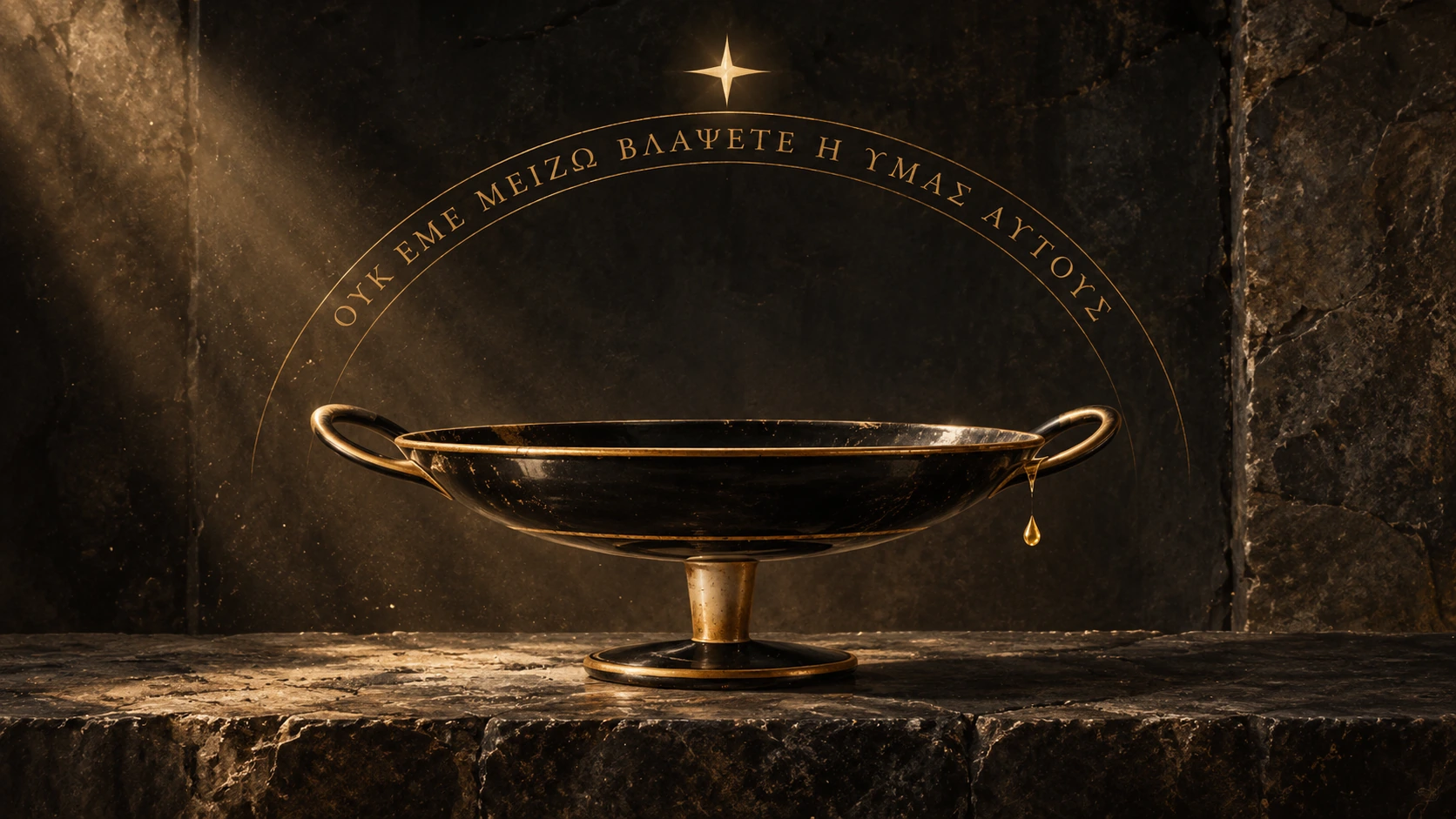
Ἡ πόλις ἡ τὸν σοφὸν ἀποκτείνασα ἑαυτὴν ἐτύφλωσεν.
The city that killed its wise man blinded itself.
The Bubonic Plague: From the Closed Schools to the Black Death
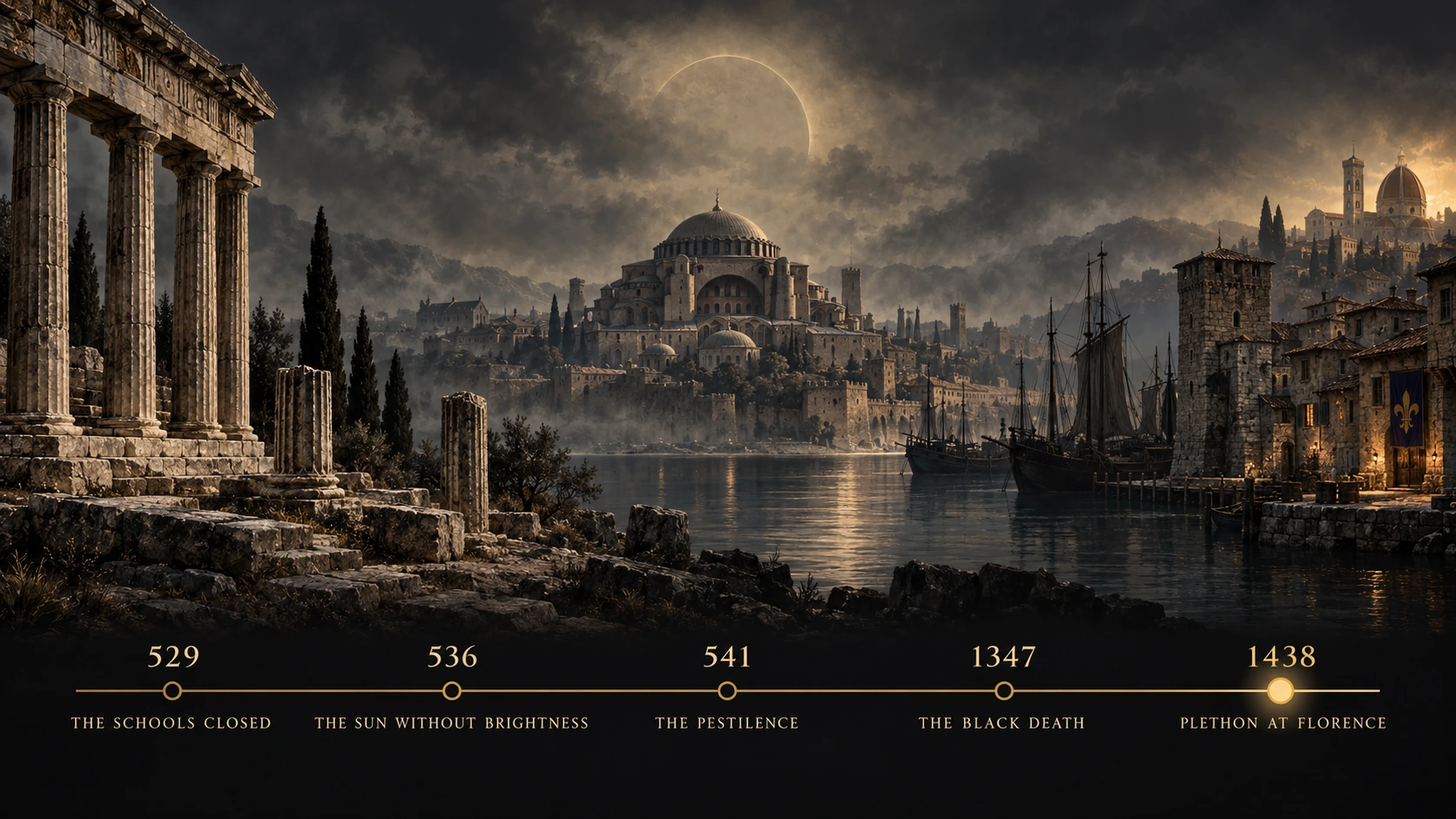
The Platonic school that Plato founded after the death of Socrates taught at Athens, in changing forms, for 9 centuries, and its end opens the second case. In 529 CE, the chronicler John Malalas records, the emperor Justinian sent a decree to Athens ordering that no one should teach philosophy there.53 A law of the same years, preserved in Justinian's Code, forbids "the teaching of every form of learning by those infected with the madness of unholy Hellenism."60 The Greek word rendered "infected" is νοσούντων, "those who are sick."
The last scholarch of the Academy, Damascius, left with 6 colleagues for the court of the Persian king.58 In the following years, Procopius reports, Justinian ordered the sanctuaries at Philae, the island of Isis, where the last temples of the Gods were still served in Egypt, to be taken down; Narses the Persarmenian, who commanded the troops there, closed them, "put the priests under guard and sent the statues to Byzantium."61
Then the sky changed. Procopius, the historian of Justinian's wars, records the 10th year of the reign, 536 CE:
Procopius, History of the Wars 4.14.5 54
καὶ τέρας ἐν τῷδε τῷ ἔτει ξυνηνέχθη γενέσθαι δεινότατον. ὁ γὰρ ἥλιος ἀκτίνων χωρὶς τὴν αἴγλην, ὥσπερ ἡ σελήνη, ἐς τοῦτον δὴ τὸν ἐνιαυτὸν ἅπαντα ἠφίει, ἐκλείποντί τε ἐπὶ πλεῖστον ἐῴκει, τὴν ἀμαρυγὴν τὴν αὑτοῦ οὐ καθαρὰν οὐδὲ ᾗπερ εἰώθει ποιούμενος.
"And in this year a most dread portent took place. For the Sun gave forth its light without brightness, like the moon, during this whole year, and it seemed exceedingly like the Sun in eclipse, for the beams it shed were not clear nor such as it is accustomed to shed."
Procopius adds that "from the time when this thing happened men were free neither from war nor pestilence nor any other thing leading to death."54 Modern science has confirmed his Sun. Ice cores and tree rings show that great volcanic eruptions in 536 and 540 CE veiled the Sun and cooled the northern hemisphere for decades, opening the period that climatologists now call the Late Antique Little Ice Age, with failing harvests in the years that followed.62
In 541 CE the plague came. It began among the Egyptians of Pelusium and spread along the coasts in both directions; in the spring of 542 it reached Constantinople.54 Procopius, who was in the city, opens his account with the scale of it: "during these years there was a pestilence, by which the whole human race came near to being annihilated," and he confesses that no explanation of it can be given in words or conceived in thought, "except indeed to refer it to God."54
The deaths at Constantinople rose to 5,000 a day, and then to 10,000 and more. The emperor himself fell ill, καὶ αὐτῷ γὰρ ξυνέπεσε βουβῶνα ἐπῆρθαι, "for he too had a swelling of the groin": the bubo that gives the bubonic plague its name.54 In his Secret History Procopius adds that the plague "carried off about one-half of the surviving population."54 Ancient DNA taken from the graves of its victims has identified the agent as Yersinia pestis, and the pandemic returned in waves for 2 centuries, until about 750 CE.63
The Zevist reading of these years stands on Hesiod's line. The famine came with the veiled Sun and the plague came with the bubo: λιμὸν ὁμοῦ καὶ λοιμόν, famine and plague together.51 The law that Hesiod wrote for a city suffering for a single man's hubris was fulfilled at the scale of an empire, and the emperor who had declared the Hellenes sick was struck with the sickness in his own body.
The Zevist claims no thunderbolt in the bacillus. Yersinia pestis lives in rodents and their fleas, and it most likely rode the grain ships out of Egypt into the harbours of the empire. The law is wider than the bacillus. Izfet works at every level of existence at once, and a civilization that breaks the measure at the highest level, closing its schools, shutting its temples and declaring the wisdom of its ancestors a disease, stands open to Izfet at every lower level.2 Without claiming that a decree caused a pandemic, the reading observes that the Ancients' law foretold the shape of what came, and the shape came: first the light dimmed, then the bread failed, then the pestilence entered, and the man at the head of the breach was struck in the body.
The bacillus returned 8 centuries later, in the pandemic later ages named the Black Death. Its genome, recovered from the dead of London, matches the same species, and its source has been traced to Central Asia in the late 1330s.55 Between 1347 and 1351 it killed between a third and, on the highest modern estimate, 60% of the population of Europe.55 It fell on the age the Temple calls the Ignorance Era, when the Gods of the Ancients were forbidden and the Divine was claimed as the property of 1 institution.64
The response of the age shows atē compounding itself. The medical faculty of Paris, asked for the cause, blamed a conjunction of 3 planets in Aquarius on 20 March 1345.65 Crowds blamed the Jews, and on 14 February 1349 some 2,000 Jews of Strasbourg were burned on a wooden platform in their own cemetery; Pope Clement VI had already condemned the accusation in 2 bulls of 1348, and he condemned the wandering flagellants in October 1349.56 A blind order meeting the consequence of its blindness reached for a scapegoat, and the scapegoat is hubris once more: the community appoints itself judge, pours its own disorder onto another, and climbs the ladder of the fall a second time.
Nemesis also completed its second half. The order that had closed the schools cracked under the plague. Giovanni Boccaccio, who saw the plague at Florence in 1348 and described it at the opening of the Decameron, went on to compose the Genealogy of the Pagan Gods, finished in a first version in 1360 and revised until his death in 1375.66
In 1438 and 1439 Georgios Gemistos Plethon came to Italy with the Byzantine delegation to the Council of Ferrara and Florence, and at Florence he lectured on Plato to the humanists of the city; Marsilio Ficino translated the whole of Plato into Latin, completing the work in 1468 and 1469 and printing it in 1484.67 Historians have long argued that the plague transformed the West, breaking the old order of labour, land and authority.68 The teaching Justinian silenced in Athens was heard again in Florence. The God, as Socrates said, sent others.
Λιμὸς καὶ λοιμὸς ὁμοῦ ἔρχονται ὅπου τὸ μέτρον ἐξελαύνεται.
Famine and plague come together where the measure is driven out.
Hubris and Theosis
From far away, hubris and Theosis look alike: both aim high, and both reach for what belongs to the Gods. Up close they are opposites, and the difference is the practical core of the teaching. The Temple's teaching on the Magnum Opus answered the charge that seeking the Godhead is hubris.36 The doctrine of the measure supplies the positive test, and it has 4 parts.
The measure of the step. Theosis is ὁμοίωσις θεῷ κατὰ τὸ δυνατόν, likeness to God "as far as is possible," and the phrase carries the measure inside it: the whole height, reached step by step, each step taken at the measure of the one before.36 Hubris seizes the summit in a day. Phaethon took the reins of the Sun at once and set the earth on fire; Heracles served 12 years, laboured, was purified and initiated, and was given his seat among the Gods at the end of a pyre.36, 69, 34 Both reached for the sky. One climbed and one grabbed.
The hand of the Gods. The Work is done with the Gods. The Greeks told how Heracles, setting out, received his arms from them: a sword from Hermes, a bow from Apollo, a breastplate from Hephaestus and a robe from Athena.69 Ajax told Athena to stand elsewhere. The one who accepts the divine hand is lifted by it; the one who refuses it has chosen to stand alone in a cosmos that is held together by communion and friendship, and Socrates told Callicles what such a man becomes: a man incapable of communion is incapable of friendship, and he is dear neither to men nor to God.9
The circuit. The Gods of the Śatapatha "went on making offerings unto one another," and the Asuras offered into their own mouths.11 The Work gives. Its 4th and weightiest hand is pious works, the worship of Zeus and the Gods carried into deeds for others.36 Hubris keeps. It closes the circuit on itself, and a closed circuit is the shape of Izfet.
The claim and the worth. Aristotle's great-souled man claims great things and is worthy of them; his vain counterfeit claims great things and is unworthy; his small-souled opposite claims less than he is worth.39 Hubris is the vain claim, the claim that has outrun the climb. The small soul is the other failure of the same measure, the mold where hubris is the flood. Zevism refuses both. The child of the Gods claims the inheritance of a child of the Gods, and earns it.70
The doctrine of the measure also exposes an inversion that has done great harm. The systems the Temple calls Yehuboric brand every aspiration to the divine as "pride," forbid Theosis to all but 1, and teach the child of the Gods to think of itself as a slave.71 They call that teaching humility. Measured against the Ancients' law it fails twice. It drives the believer into the small soul, the mold face of Izfet, the andrapod who claims nothing and climbs nothing.72 And the institution that preaches it commits the hubris it condemns, by appointing itself the measure of every soul's distance from God and claiming to speak with God's authority over that distance.73 Humility in the Ancients' sense is knowledge of the present step, and it walks together with the will to take the next one.
The law of momentum that Darius stated works in both directions: "when a man hastens of himself, the God too joins in."45 On the road of hubris the God's joining is atē, the slope steepening toward the fall. On the road of the Work the God's joining is the help the Theosis teaching describes as the Gods leading the initiate: the arms given before the first labour and the cloud sent at the last.36 The cosmos amplifies the direction a will chooses. Hubris chooses the breach, and the cosmos widens it; Theosis chooses the climb, and the cosmos lifts.
Ὁ τὸ μέτρον φυλάσσων τῷ Διὶ ὁμοιοῦται, ὁ δ᾽ ὑπερβαίνων ἀνομοιοῦται.
Whoever keeps the measure is made like Zeus; whoever oversteps it is made unlike him.
Objections and Replies
Objection I: "Hubris is a moral fault of persons. Calling it cosmological is a figure of speech."
The Ancients put the measure into the cosmos as well as into the soul. Hesiod and Solon wrote the law for cities, and Anaximander, Heraclitus and the priest of Saïs carried it to the elements, the Sun and the paths of the heavenly bodies.51, 4, 27, 15, 35 Socrates told Callicles that heaven, earth, Gods and men form 1 kosmos held together by the same order, so that a man who takes more than his share breaks a geometry that runs through everything.9 On this view the soul is a part of the cosmos and its acts are events in the cosmos, with consequences that follow the cosmos' laws.
The doctrine also holds where it can be tested. A body that ignores its limits breaks; a market position with no stop is liquidated; an empire that extends past its means is overrun; the Temple's teaching on Necessity and Freedom sets these cases out side by side.33 Each is the same event at a different scale: a part stepping past its measure and the order of the whole restoring it.
Objection II: "The Gods are jealous of human greatness, as Herodotus says. Hubris is only success that the Gods resent."
Herodotus' Solon calls the divine "jealous and troublesome," and Artabanus tells Xerxes that "the God loves to cut down everything that stands too high" and "allows no one but himself to think great thoughts."6, 40 The philosophers corrected the poets on exactly this point. Plato says that "envy stands outside the divine chorus," and that the maker of the cosmos was good, "and in the good no envy ever arises about anything."23, 35 Aristotle answers the poets directly: "the divine cannot be jealous; but, as the saying goes, bards tell many lies."74
The Gods command greatness, and Heracles is their proof. The poets saw envy where the law of the measure was at work, acting on the claim that has outrun its worth as weight acts on a beam loaded past its strength. Herodotus himself, telling the fall of Croesus, puts the cause in the measure: the nemesis came "because he thought himself the most blessed of all men," a judgment beyond his knowledge of his own end.6
Objection III: "The men of hubris often prosper to the end. Where is the penalty?"
Plato answers that the penalty is hidden from the one who pays it. The unjust, Socrates says in the Theaetetus, are ignorant of the penalty of injustice, the one thing they should least be ignorant of, and they pay it "by living the life that answers to the pattern they resemble."49 The Chorus of the Antigone says the man led toward atē "fares for the briefest time outside atē."46 The Temple's teaching on Nemesis states the same truth: her punishment is often present already and simply beyond the awareness of the mind that suffers it, in states of decay and unawareness that can last for decades.25
A man can keep his palace and lose his sight, and the second loss is the greater one, because it takes every opportunity that sight would have shown him. The prosperity of the man of hubris is a picture seen from outside. From inside, it is a life lived in the dark of the cave, mistaking shadows for what is real.48
Objection IV: "To read a plague as the consequence of hubris blames its victims."
The law blames the breach, and the breach has authors. Hesiod states it plainly: often "a whole city suffers for a single bad man."51 Izfet sorts the guilty from the innocent no more than a flood sorts the houses it fills, and that is why hubris is a crime against the whole and why Heraclitus says it must be quenched more than a blazing fire.15 The dead of Constantinople in 542 and of Europe in 1348 were the victims of hubris, and the Zevist reading lays the weight on those who broke the measure: the legislators who closed the schools and shut the temples, and the blind crowds and authorities who answered catastrophe with scapegoats. The Temple's grief is for the victims. Its reading is for the living, who can still keep the measure and so close the breach before the next flood.
Conclusion: Keep the Measure
Hubris and Izfet are 1 event seen from 2 sides. The cosmos is a measure held from the center by Zeus, and every being in it has its portion and its road. Izfet presses against the measure always, as the river presses against the dam. Hubris is the stone pulled out: the will that oversteps its measure, makes itself the measure, dishonours what stands above and beside it, refuses the hand of the Gods and claims what it has not climbed to. Through that breach Izfet pours into a soul, a house, a city and an age.
Hubris triggers in the seasons of favour: prosperity without understanding, power without account, youth and honours without discipline, knowledge without humility, success without gratitude, contempt for counsel and for the sacred. Its first penalty is blindness. The mind is taken first, the man of hubris is left desolate of God, and in the dark he sees knowledge as ignorance and the gift as an insult, so that the great opportunities of his life pass before his eyes unseen: Solon's counsel, the oracle's question, the best of the Achaeans, the gadfly of Athens, the schools of Plato. That ignorance is the punishment itself, the life that answers to the pattern it resembles. Then Nemesis restores the measure, and the man of hubris either learns through suffering or dissolves with everything he has drawn into the breach.
Athens killed the gift the God had sent and went back to sleep. Justinian's empire called the wisdom of its ancestors a sickness, and saw the Sun dim, the harvests fail and the plague enter the emperor's own body. In both cases the order of the cosmos repaired itself around the breach: Plato carried the teaching into the Academy, and the Gods' learning, driven out of Athens, returned through the door the Black Death broke open in Florence.
The remedy is the oldest virtue of the Greeks, and Athena taught it to Odysseus after showing him the hero she had blinded:
Sophocles, Ajax 127 to 133 38
τοιαῦτα τοίνυν εἰσορῶν ὑπέρκοπον μηδέν ποτ᾽ εἴπῃς αὐτὸς εἰς θεοὺς ἔπος, μηδ᾽ ὄγκον ἄρῃ μηδέν᾽, εἴ τινος πλέον ἢ χειρὶ βρίθεις ἢ μακροῦ πλούτου βάθει. ὡς ἡμέρα κλίνει τε κἀνάγει πάλιν ἅπαντα τἀνθρώπεια· τοὺς δὲ σώφρονας θεοὶ φιλοῦσι καὶ στυγοῦσι τοὺς κακούς.
"Seeing such things, then, never yourself speak an arrogant word against the Gods, and take on no swelling pride if you outweigh another in strength of hand or in depth of great wealth. For a single day lays low and raises up again all human things; and the Gods love the sound-minded and hate the base."
Keep the measure, and climb. The measure is Zeus, and the climb is toward him; the one who keeps the first and makes the second is made like the Gods, and the one who breaks the first to seize the second is made unlike them. Hubris is the short road, and it ends in the fall. The Work is the whole road, and it ends among the Gods.
Ὁ ὑπὲρ τὸ μέτρον ἁρπάζων πίπτει· ὁ δὲ κατὰ τὸ μέτρον ἀναβαίνων ἀφικνεῖται.
Whoever seizes beyond the measure falls; whoever climbs by the measure arrives.
High Priest Zevios Metathronos
Temple of Zeus Foundation
Sources & References
- Plato, Laws 4, 715e to 716d. 715e to 716a: the God "holding the beginning and the end and the middle of all things that are," with Justice always following him, "the avenger of those who fall short of the divine law" (τῷ δὲ ἀεὶ συνέπεται δίκη τῶν ἀπολειπομένων τοῦ θείου νόμου τιμωρός). 716a to b: the man who "burns in his soul with hubris" καταλείπεται ἔρημος θεοῦ, "is left desolate of God," and in a short time brings "himself, his house and his city to utter ruin" (ἑαυτόν τε καὶ οἶκον καὶ πόλιν ἄρδην ἀνάστατον ἐποίησεν). 716c: ὁ δὴ θεὸς ἡμῖν πάντων χρημάτων μέτρον ἂν εἴη μάλιστα, καὶ πολὺ μᾶλλον ἤ πού τις, ὥς φασιν, ἄνθρωπος. Ed. J. Burnet, Oxford Classical Texts, 1907; Greek checked against the Perseus text.
- Temple of Zeus, Liturgical Terms: Izfet: Izfet as the primordial force of disorder and entropy, the default state of unattended existence; Izfet in the human being as ignorance; Izfet working "simultaneously at every level of existence: physical (decay), biological (death), psychological (ignorance), social (injustice), and spiritual"; Dikē violated, "famine comes, plague comes," as the natural consequence of the disruption of the order.
- Temple of Zeus, Satya, Ma'at and Arete: The Cosmos Around the Throne of Zeus, and Liturgical Terms: Ma'at: Zeus the Sovereign, Satya the Truth, Ma'at the Order, Arete the Vehicle.
- Solon, fragment 6.3 to 4 West, quoted by Aristotle, Constitution of the Athenians 12.2: τίκτει γὰρ κόρος ὕβριν, ὅταν πολὺς ὄλβος ἕπηται ἀνθρώποισιν, ὅσοις μὴ νόος ἄρτιος ᾖ. The same couplet in the collection of Theognis 153 to 154: τίκτει τοι κόρος ὕβριν, ὅταν κακῷ ὄλβος ἕπηται ἀνθρώπῳ καὶ ὅτῳ μὴ νόος ἄρτιος ᾖ. Solon's refusal of the tyranny: fragments 32 to 33 West; Plutarch, Solon 14. M. L. West, Iambi et Elegi Graeci II, 2nd ed., Oxford, 1992.
- Lycurgus, Against Leocrates 92, quoting "some of the ancient poets": ὅταν γὰρ ὀργὴ δαιμόνων βλάπτῃ τινά, τοῦτ᾽ αὐτὸ πρῶτον, ἐξαφαιρεῖται φρενῶν τὸν νοῦν τὸν ἐσθλόν, εἰς δὲ τὴν χείρω τρέπει γνώμην, ἵν᾽ εἰδῇ μηδὲν ὧν ἁμαρτάνει. The same thought stands behind the later Latin proverb on those whom the God would destroy. Greek text, Perseus Digital Library; English, J. O. Burtt, Minor Attic Orators II, Loeb, 1954.
- Herodotus, Histories 1.30 to 1.91, the story of Croesus. 1.32.1: Solon on the divine, πᾶν ἐὸν φθονερόν τε καὶ ταραχῶδες, and on counting no man blessed before his end. 1.33: Croesus sends Solon away, κάρτα δόξας ἀμαθέα εἶναι, "thinking him very ignorant." 1.34.1: μετὰ δὲ Σόλωνα οἰχόμενον ἔλαβε ἐκ θεοῦ νέμεσις μεγάλη Κροῖσον, ὡς εἰκάσαι, ὅτι ἐνόμισε ἑωυτὸν εἶναι ἀνθρώπων ἁπάντων ὀλβιώτατον. 1.53.3: the oracle on the great empire. 1.86.3: on the pyre Croesus "groaned and called 3 times on Solon" (ἐς τρὶς ὀνομάσαι Σόλων). 1.87 to 90: Apollo's storm and Croesus as counsellor of Cyrus. 1.91.4: οὐ συλλαβὼν δὲ τὸ ῥηθὲν οὐδ᾽ ἐπανειρόμενος ἑωυτὸν αἴτιον ἀποφαινέτω. Greek ed. A. D. Godley, Loeb, 1920 (Perseus); English, Godley.
- J. Assmann, The Mind of Egypt: History and Meaning in the Time of the Pharaohs, trans. A. Jenkins, New York, 2002, quoting the text known as The King as Sun Priest: "Re has set up the king on the earth of the living for ever and ever, to speak justice to the people, to satisfy the gods, for the generation of ma'at, for the destruction of isfet." The text is edited in J. Assmann, Der König als Sonnenpriester, Glückstadt, 1970; see also his Ma'at: Gerechtigkeit und Unsterblichkeit im Alten Ägypten, Munich, 1990.
- Bhagavad Gītā 3.11: devān bhāvayatānena te devā bhāvayantu vaḥ, parasparaṃ bhāvayantaḥ śreyaḥ param avāpsyatha, "with this nourish the Gods, and let the Gods nourish you; nourishing one another, you will attain the highest good." 3.12: whoever enjoys their gifts without offering to them in return stena eva saḥ, "is a thief." 3.16: evaṃ pravartitaṃ cakraṃ nānuvartayatīha yaḥ … moghaṃ pārtha sa jīvati, "whoever here does not turn the wheel thus set in motion … lives in vain." Sanskrit from GRETIL (Bhagavadgītā with 4 commentaries); English, the Temple.
- Plato, Gorgias 507e to 508a: the wise say that heaven and earth, Gods and men are held together by communion, friendship, orderliness, sound-mindedness and justice, "and for this reason they call this whole a kosmos"; ἡ ἰσότης ἡ γεωμετρικὴ καὶ ἐν θεοῖς καὶ ἐν ἀνθρώποις μέγα δύναται, σὺ δὲ πλεονεξίαν οἴει δεῖν ἀσκεῖν· γεωμετρίας γὰρ ἀμελεῖς. 507e: the man incapable of communion is dear neither to men nor to God. Ed. J. Burnet, Oxford Classical Texts, 1903.
- Coffin Texts, spell 1130, in A. de Buck, The Egyptian Coffin Texts VII, Chicago, 1961, 461 to 471. English, M. Lichtheim, Ancient Egyptian Literature I, Berkeley, 1973, "A Spell from the Coffin Texts": "I made every man like his fellow; and I did not command that they do wrong. It is their hearts that disobey what I have said." The Egyptian word for the wrong is jzft, isfet; on the passage see J. Assmann, The Mind of Egypt (above).
- Śatapatha Brāhmaṇa 5.1.1.1 to 2. Sanskrit from GRETIL; the key clause: tasmān nātimanyeta, parābhavasya haitan mukhaṃ yad atimānaḥ. English, J. Eggeling, The Satapatha-Brâhmana III, Sacred Books of the East 41, Oxford, 1894, p. 1, whose spelling Pragâpati (for Prajāpati) is kept in the quotation. 5.1.1.2: "But the gods went on making offerings unto one another."
- Homer, Iliad 19.86 to 94: Agamemnon's apology, ἐγὼ δ᾽ οὐκ αἴτιός εἰμι, ἀλλὰ Ζεὺς καὶ Μοῖρα καὶ ἠεροφοῖτις Ἐρινύς, and the portrait of Atē, eldest daughter of Zeus, who walks on the heads of men. 19.78 to 144: the reconciliation and the amends. Ed. D. B. Monro and T. W. Allen, Oxford Classical Texts, 3rd ed., 1920.
- The Instruction of Ptahhotep, trans. M. Lichtheim, Ancient Egyptian Literature I, Berkeley, 1973, 61 to 80. Maxim 1: "Don't be proud of your knowledge, consult the ignorant and the wise; the limits of art are not reached, no artist's skills are perfect." Maxim 5: "Great is justice, lasting in effect … crime never lands its wares; in the end it is justice that lasts." Epilogue: "The fool who does not hear, he can do nothing at all; he sees knowledge in ignorance, usefulness in harmfulness."
- Bhagavad Gītā 16.4: dambho darpo 'bhimānaś ca krodhaḥ pāruṣyam eva ca, ajñānaṃ cābhijātasya pārtha sampadam āsurīm; the vulgate reading 'bhimānaś is kept in the quotation, and the GRETIL text reads 'timānaś (atimāna, "arrogance"). 16.14 to 15: "I am lord, I am the enjoyer, I am perfected, mighty, happy … who else is like me?" ity ajñāna-vimohitāḥ, "thus deluded by ignorance." 16.16: moha-jāla-samāvṛtāḥ … patanti narake 'śucau, "surrounded by the net of delusion … they fall into a foul hell." 16.19 to 20: cast into Asuric wombs, "deluded in every birth," mām aprāpyaiva kaunteya tato yānty adhamāṃ gatim, "not reaching me, O son of Kuntī, they go to the lowest state." Sanskrit from GRETIL; compare K. T. Telang, Sacred Books of the East 8, Oxford, 1882, 114 to 117.
- Heraclitus, fragments in H. Diels and W. Kranz, Die Fragmente der Vorsokratiker, 6th ed., Berlin, 1951. B94 (Plutarch, On Exile 604a): ἥλιος γὰρ οὐχ ὑπερβήσεται μέτρα· εἰ δὲ μή, Ἐρινύες μιν Δίκης ἐπίκουροι ἐξευρήσουσιν. B30 (Clement, Stromateis 5.104): κόσμον τόνδε, τὸν αὐτὸν ἁπάντων, οὔτε τις θεῶν οὔτε ἀνθρώπων ἐποίησεν, ἀλλ᾽ ἦν ἀεὶ καὶ ἔστιν καὶ ἔσται πῦρ ἀείζωον, ἁπτόμενον μέτρα καὶ ἀποσβεννύμενον μέτρα. B43 (Diogenes Laertius 9.2): ὕβριν χρὴ σβεννύναι μᾶλλον ἢ πυρκαϊήν.
- The Book of the Heavenly Cow. English of its first part, M. Lichtheim, Ancient Egyptian Literature II, Berkeley, 1976, "The Destruction of Mankind": Re sets out to destroy the human race "because mankind was plotting rebellion against him" when he had grown old; Hathor as his Eye; the red ochre ground into the beer-mash "and it became like human blood," 7,000 jars poured out on the fields. The whole book, with Ra's withdrawal to the sky on the back of Nut as the cow: E. Hornung, Der ägyptische Mythos von der Himmelskuh: Eine Ätiologie des Unvollkommenen, Orbis Biblicus et Orientalis 46, Freiburg and Göttingen, 1982.
- The Prophecy of Neferti, trans. M. Lichtheim, Ancient Egyptian Literature I, Berkeley, 1973: "Then Order will return to its seat, while Chaos is driven away." Lichtheim's "Order" and "Chaos" render mꜣꜥt and jzft.
- Plato, Protagoras 343a to b: the Seven Sages dedicated at Delphi the sayings γνῶθι σαυτόν and μηδὲν ἄγαν; Charmides 164d to 165a: "know yourself" read as "be sound-minded." Ed. J. Burnet, Oxford Classical Texts, 1903.
- N. R. E. Fisher, Hybris: A Study in the Values of Honour and Shame in Ancient Greece, Warminster, 1992: the Athenian law of hubris and the public action, the γραφὴ ὕβρεως (compare Demosthenes 21.47, Against Meidias).
- Aristotle, Rhetoric 2.2.5 to 6, 1378b23 to 27: ἔστι γὰρ ὕβρις τὸ πράττειν καὶ λέγειν ἐφ᾽ οἷς αἰσχύνη ἔστι τῷ πάσχοντι, μὴ ἵνα τι γίγνηται αὑτῷ ἄλλο ἢ ὅ τι ἐγένετο, ἀλλ᾽ ὅπως ἡσθῇ … αἴτιον δὲ τῆς ἡδονῆς τοῖς ὑβρίζουσιν, ὅτι οἴονται κακῶς δρῶντες αὐτοὶ ὑπερέχειν μᾶλλον. Ed. W. D. Ross, Oxford Classical Texts, 1959.
- D. L. Cairns, "Hybris, Dishonour, and Thinking Big," Journal of Hellenic Studies 116 (1996), 1 to 32.
- R. Beekes, Etymological Dictionary of Greek, Leiden, 2010, s.v. ὕβρις; P. Chantraine, Dictionnaire étymologique de la langue grecque, s.v. ὕβρις.
- Plato, Phaedrus 238a: ὕβρις δὲ δὴ πολυώνυμον (πολυμελὲς γὰρ καὶ πολυμερές), each form named after the appetite that rules in it; 247a: φθόνος γὰρ ἔξω θείου χοροῦ ἵσταται, "envy stands outside the divine chorus." Ed. J. Burnet, Oxford Classical Texts, 1901 (the edition sets the parenthesis between dashes).
- E. R. Dodds, The Greeks and the Irrational, Sather Classical Lectures 25, Berkeley, 1951, chapter 1, "Agamemnon's Apology": atē is "a state of mind, a temporary clouding or bewildering of the normal consciousness … a partial and temporary insanity."
- Temple of Zeus, Nemesis: Nemesis and the checking of hubris; restorative justice and cosmic order; her punishment "often blatantly in the present and simply beyond the awareness of a limited human mind experiencing it," and "states of decay and unawareness lasting decades or lifetimes," the reason she carries a wheel; Rhamnous and the Persian marble.
- Pausanias, Description of Greece 1.33.2 to 3: Nemesis of Rhamnous, the Goddess most implacable to men of hubris; the Persians who landed at Marathon brought Parian marble "to make a trophy, as if their work were already done" (λίθον Πάριον ὃν ὡς ἐπ᾽ ἐξειργασμένοις ἦγον ἐς τροπαίου ποίησιν), and Phidias made of it the statue of the Goddess. Pliny, Natural History 36.17, gives the statue to Agoracritus, the pupil of Phidias.
- Anaximander, fragment B1 Diels and Kranz, from Simplicius, Commentary on Aristotle's Physics 24.13 to 21 (ed. H. Diels, Berlin, 1882): ἐξ ὧν δὲ ἡ γένεσίς ἐστι τοῖς οὖσι, καὶ τὴν φθορὰν εἰς ταῦτα γίνεσθαι κατὰ τὸ χρεών· διδόναι γὰρ αὐτὰ δίκην καὶ τίσιν ἀλλήλοις τῆς ἀδικίας κατὰ τὴν τοῦ χρόνου τάξιν. See the Temple's page on Anaximander.
- The "ancient saying" of Laws 715e is identified as Orphic by the ancient scholion on the passage (O. Kern, Orphicorum Fragmenta, Berlin, 1922, fr. 21); the fuller hymn, Ζεὺς κεφαλή, Ζεὺς μέσσα, Διὸς δ᾽ ἐκ πάντα τέτυκται, is quoted in Pseudo-Aristotle, On the Cosmos 7, 401a (Kern fr. 21a), and its line on Zeus as head and middle already stands in the Derveni Papyrus, column XVII.
- Plato, Theaetetus 152a, quoting Protagoras: πάντων χρημάτων μέτρον ἄνθρωπον εἶναι, "man is the measure of all things."
- Temple of Zeus, Limit and Unlimited, Power II of the Ten Antithetical Powers: the right form under Ma'at and the 2 faces of Izfet, Limit alone (the mold) and the Unlimited alone (the flood), whose form in the soul is ὕβρις, "appetite without end."
- Plato, Philebus 26b: ὕβριν γάρ που καὶ σύμπασαν πάντων πονηρίαν αὕτη κατιδοῦσα ἡ θεός … νόμον καὶ τάξιν πέρας ἔχοντ᾽ ἔθετο, as set out on the Temple's page Limit and Unlimited.
- Temple of Zeus, Light and Darkness: The Cosmic Forces Under Ma'at and Izfet: "Ὕβρις is light that has broken its measure"; Phaethon and the Eye of Ra unbound as fire without measure; "The lie, the injustice, the chosen ignorance and the slow drift from the right are 1 fall at different speeds."
- Temple of Zeus, Necessity and Freedom, Power VII: under Izfet, necessity alone breeds the fatalism of the andrapod and freedom alone breeds "the ὕβρις of Xerxes"; the table of domains (cosmos, sea, body, market, soul, religion).
- The myth of Phaethon: Euripides, Phaethon (fragments, ed. J. Diggle, Cambridge, 1970); Ovid, Metamorphoses 1.750 to 2.400, with the oath of Helios (2.44 to 48), the burning of the earth, the thunderbolt and the fall into the Eridanus.
- Plato, Timaeus 22c to d, the priest of Saïs on Phaethon (Greek in the quotation above); 29e: ἀγαθὸς ἦν, ἀγαθῷ δὲ οὐδεὶς περὶ οὐδενὸς οὐδέποτε ἐγγίγνεται φθόνος. Ed. J. Burnet, Oxford Classical Texts, 1902.
- Temple of Zeus, Theosis: The Magnum Opus: ὁμοίωσις θεῷ κατὰ τὸ δυνατόν (Plato, Theaetetus 176b); the road of Heracles; the 4 hands of the Work, Meditation, Theurgy, Education and pious works; the Gods leading the initiate; Objection III, "To seek to become a God is hubris."
- Homer, Iliad 1.9 to 12: Apollo νοῦσον ἀνὰ στρατὸν ὄρσε κακήν, ὀλέκοντο δὲ λαοί, οὕνεκα τὸν Χρύσην ἠτίμασεν ἀρητῆρα Ἀτρεΐδης. 1.202 to 203 and 1.214: Achilles to Athena, ἦ ἵνα ὕβριν ἴδῃ Ἀγαμέμνονος Ἀτρεΐδαο; and her answer, ὕβριος εἵνεκα τῆσδε. 1.411 to 412: γνῷ δὲ καὶ Ἀτρεΐδης εὐρὺ κρείων Ἀγαμέμνων ἣν ἄτην ὅ τ᾽ ἄριστον Ἀχαιῶν οὐδὲν ἔτισεν. Ed. Monro and Allen, Oxford Classical Texts.
- Sophocles, Ajax 51 to 65: Athena casts false visions on the eyes of Ajax, and he slaughters the army's cattle as if they were the Greek commanders; 127 to 133: Athena to Odysseus on the sound-minded; 758 to 761: the seer's law on bodies "excessive and useless" (τὰ γὰρ περισσὰ κἀνόνητα σώματα) and the man who does not think as befits a man; 767 to 769 and 774 to 777: the refusal of the Gods' help. Greek text, Perseus Digital Library.
- Aristotle, Nicomachean Ethics 4.3, 1123b1 to 9: δοκεῖ δὴ μεγαλόψυχος εἶναι ὁ μεγάλων αὑτὸν ἀξιῶν ἄξιος ὤν … ὁ δὲ μεγάλων ἑαυτὸν ἀξιῶν ἀνάξιος ὢν χαῦνος; the man who claims less than his worth is μικρόψυχος. Ed. I. Bywater, Oxford Classical Texts, 1894.
- Herodotus, Histories 7.10 to 11: the counsel of Artabanus, φιλέει γὰρ ὁ θεὸς τὰ ὑπερέχοντα πάντα κολούειν … οὐ γὰρ ἐᾷ φρονέειν μέγα ὁ θεὸς ἄλλον ἢ ἑωυτόν (7.10ε), and the anger of Xerxes; 7.22 to 24: the canal through Athos; 7.35: the scourging of the Hellespont and the words βάρβαρά τε καὶ ἀτάσθαλα, ὦ πικρὸν ὕδωρ, δεσπότης τοι δίκην ἐπιτιθεῖ τήνδε, ὅτι μιν ἠδίκησας. Ed. Godley, Loeb, 1922.
- Herodotus, Histories 3.80.3, Otanes in the debate on constitutions: ἐγγίνεται μὲν γάρ οἱ ὕβρις ὑπὸ τῶν παρεόντων ἀγαθῶν, φθόνος δὲ ἀρχῆθεν ἐμφύεται ἀνθρώπῳ.
- Sophocles, Oedipus Tyrannus 873: ὕβρις φυτεύει τύραννον (some editors print Blaydes' emendation ὕβριν φυτεύει τυραννίς); 22 to 30: the plague on Thebes. Greek text, Perseus Digital Library.
- Plato, Apology of Socrates. 21a: the oracle to Chaerephon. 23a to b: the God calls that man wisest who, like Socrates, knows that his wisdom is worth nothing in truth. 29b: καίτοι πῶς οὐκ ἀμαθία ἐστὶν αὕτη ἡ ἐπονείδιστος, ἡ τοῦ οἴεσθαι εἰδέναι ἃ οὐκ οἶδεν; 30c: ἐάν με ἀποκτείνητε τοιοῦτον ὄντα οἷον ἐγὼ λέγω, οὐκ ἐμὲ μείζω βλάψετε ἢ ὑμᾶς αὐτούς. 30d to e: μή τι ἐξαμάρτητε περὶ τὴν τοῦ θεοῦ δόσιν ὑμῖν ἐμοῦ καταψηφισάμενοι. 30e to 31a: the gadfly and the sleep. 34a and 38b: Plato present at the trial. 39c to d: τιμωρίαν ὑμῖν ἥξειν εὐθὺς μετὰ τὸν ἐμὸν θάνατον πολὺ χαλεπωτέραν νὴ Δία ἢ οἵαν ἐμὲ ἀπεκτόνατε. Ed. J. Burnet, Oxford, 1924.
- Temple of Zeus, Διπλῆ Ἄγνοια, Double Ignorance: The Gateway to Zevism: Proclus on double ignorance, not knowing and not knowing that one does not know, as the first prison of the soul. Plato, Laws 9, 863c: the ignorance that is "double" when a man also thinks himself wise; compare Sophist 229c.
- Aeschylus, Persians. 742: ἀλλ᾽ ὅταν σπεύδῃ τις αὐτός, χὠ θεὸς συνάπτεται. 749 to 751: θνητὸς ὢν θεῶν τε πάντων ᾤετ᾽, οὐκ εὐβουλίᾳ, καὶ Ποσειδῶνος κρατήσειν. πῶς τάδ᾽ οὐ νόσος φρενῶν εἶχε παῖδ᾽ ἐμόν; 807 to 812: ὕβρεως ἄποινα κἀθέων φρονημάτων, the images of the Gods plundered and the temples burned. 820 to 822: the harvest of atē. 827 to 828: Ζεύς τοι κολαστὴς τῶν ὑπερκόμπων ἄγαν φρονημάτων ἔπεστιν, εὔθυνος βαρύς. 908 to 1077: the return of Xerxes in torn robes. Greek text, Perseus Digital Library.
- Sophocles, Antigone 620 to 625: σοφίᾳ γὰρ ἔκ του κλεινὸν ἔπος πέφανται. τὸ κακὸν δοκεῖν ποτ᾽ ἐσθλὸν τῷδ᾽ ἔμμεν ὅτῳ φρένας θεὸς ἄγει πρὸς ἄταν· πράσσει δ᾽ ὀλίγιστον χρόνον ἐκτὸς ἄτας. Greek text, Perseus Digital Library.
- Aeschylus, Agamemnon 160 to 183, the Hymn to Zeus; 176 to 178: τὸν φρονεῖν βροτοὺς ὁδώσαντα, τὸν πάθει μάθος θέντα κυρίως ἔχειν. Greek text, Perseus Digital Library.
- Plato, Republic 6 to 7, 507b to 517a: the Sun as offspring and image of the Good, the cause both of sight and of the generation, growth and nourishment of what is seen; 509b: the Good gives the objects of knowledge their being; 514a to 517a: the Cave. Ed. J. Burnet, Oxford Classical Texts, 1902.
- Plato, Theaetetus 176c to 177a: ἀγνοοῦσι γὰρ ζημίαν ἀδικίας, ὃ δεῖ ἥκιστα ἀγνοεῖν; the 2 patterns, the divine and the godless; τῷ μὲν ὁμοιούμενοι διὰ τὰς ἀδίκους πράξεις, τῷ δὲ ἀνομοιούμενοι. οὗ δὴ τίνουσι δίκην ζῶντες τὸν εἰκότα βίον ᾧ ὁμοιοῦνται. Ed. J. Burnet, Oxford Classical Texts, 1900.
- Temple of Zeus, Why Evil Exists and the Epicurean Paradox: Izfet woven into creation "so that beings may evolve through the work of overcoming it, and Zeus is the supreme teacher of that overcoming."
- Hesiod, Works and Days 213 to 218 (ὦ Πέρση, σὺ δ᾽ ἄκουε δίκης, μηδ᾽ ὕβριν ὄφελλε … Δίκη δ᾽ ὑπὲρ Ὕβριος ἴσχει ἐς τέλος ἐξελθοῦσα· παθὼν δέ τε νήπιος ἔγνω) and 238 to 247 (πολλάκι καὶ ξύμπασα πόλις κακοῦ ἀνδρὸς ἀπηύρα … λιμὸν ὁμοῦ καὶ λοιμόν). Greek ed. H. G. Evelyn-White, Loeb, 1914 (Perseus); critical text, M. L. West, Hesiod: Works and Days, Oxford, 1978.
- Diogenes Laertius, Lives of the Eminent Philosophers. 2.40: the indictment, which Favorinus says was still kept in the Metroön. 2.43: Ἀθηναῖοι δ᾽ εὐθὺς μετέγνωσαν … Λυσίππου ταύτην ἐργασαμένου (the edition supplies 〈ἄλλους〉). 3.6: after the death of Socrates, Plato went to Megara to Euclides. Ed. R. D. Hicks, Loeb, 1925 (Perseus).
- John Malalas, Chronographia 18.47 (ed. J. Thurn, Berlin and New York, 2000): in the consulship of Decius, 529 CE, the emperor sent a decree to Athens forbidding the teaching of philosophy. E. Watts, "Justinian, Malalas, and the End of Athenian Philosophical Teaching in A.D. 529," Journal of Roman Studies 94 (2004), 168 to 182; A. Cameron (1969, above).
- Procopius, History of the Wars 2.22 to 23 and 4.14.5 to 6, and Secret History 18.44. 2.22.1: Ὑπὸ δὲ τοὺς χρόνους τούτους λοιμὸς γέγονεν, ἐξ οὗ δὴ ἅπαντα ὀλίγου ἐδέησε τὰ ἀνθρώπεια ἐξίτηλα εἶναι. 2.22.2: no explanation "except indeed to refer it to God." 2.22.6 to 9: from Pelusium to Byzantium "in the middle of the spring" of the 2nd year. 2.23.1 to 2: 5,000 and then 10,000 deaths and more each day. 2.23.20: ἡνίκα βασιλεῖ νοσῆσαι ξυνέβη (καὶ αὐτῷ γὰρ ξυνέπεσε βουβῶνα ἐπῆρθαι). 4.14.5 to 6: the Sun without brightness for the whole year, in the 10th year of Justinian. Secret History 18.44: τὴν ἡμίσειαν μάλιστα τῶν περιγινομένων ἀνθρώπων ἀπήνεγκε μοῖραν. Greek ed. J. Haury (Teubner) and M. Krascheninnikov (1899) as given in the Perseus texts; English, H. B. Dewing, Loeb, 1914 to 1935.
- K. I. Bos et al., "A draft genome of Yersinia pestis from victims of the Black Death," Nature 478 (2011), 506 to 510; M. A. Spyrou et al., "The source of the Black Death in fourteenth-century central Eurasia," Nature 606 (2022), 718 to 724; O. J. Benedictow, The Black Death 1346 to 1353: The Complete History, Woodbridge, 2004, for the estimate of up to 60% mortality in Europe (other estimates run lower).
- Jacob Twinger of Königshofen, Chronicle, on Strasbourg, 14 February 1349: "they burnt the Jews on a wooden platform in their cemetery. There were about two thousand people of them," trans. J. R. Marcus, The Jew in the Medieval World, Cincinnati, 1938, 43 to 48. Pope Clement VI condemned the accusation in bulls of July 1348 and 26 September 1348 (Quamvis perfidiam), and condemned the flagellants on 20 October 1349.
- Thucydides, History of the Peloponnesian War 5.84 to 116, the Melian dialogue; 5.105.2: ἡγούμεθα γὰρ τό τε θεῖον δόξῃ τὸ ἀνθρώπειόν τε σαφῶς διὰ παντὸς ὑπὸ φύσεως ἀναγκαίας, οὗ ἂν κρατῇ, ἄρχειν; 5.116.4: the men of Melos killed, the women and children enslaved; 7.87.6: of the Sicilian expedition "few out of many returned home." Ed. H. S. Jones, rev. J. E. Powell, Oxford Classical Texts, 1942.
- On the Platonic school at Athens and its end: Agathias, Histories 2.30 to 31, the 7 philosophers, Damascius and Simplicius among them, at the court of Khosrow; A. Cameron, "The Last Days of the Academy at Athens," Proceedings of the Cambridge Philological Society 15 (1969), 7 to 29; the Temple's pages The Greatest Followers of Zeus in the Ancient Times and Damascius.
- Temple of Zeus, Socrates, and The Four Great Philosophers: Divine Men Among Mortals.
- Codex Justinianus 1.11.10.2 (ed. P. Krüger), Greek: πᾶν δὲ μάθημα παρὰ τῶν νοσούντων τὴν τῶν ἀνοσίων Ἑλλήνων μανίαν διδάσκεσθαι κωλύομεν. English, S. Corcoran, "From Unholy Madness to Right-mindedness: Or How to Legislate for Religious Conformity from Decius to Justinian," in A. Papaconstantinou, N. McLynn and D. L. Schwartz (eds.), Conversion in Late Antiquity: Christianity, Islam, and Beyond, Farnham, 2015 (reissued London, 2016), 67 to 94: "We forbid the teaching of every form of learning by those infected with the madness of unholy Hellenism."
- Procopius, History of the Wars 1.19.36 to 37: "the Emperor Justinian decided to tear them down"; Narses, "a Persarmenian by birth," commanding the troops there, "tore down the sanctuaries at the emperor's order, and put the priests under guard and sent the statues to Byzantium." Trans. H. B. Dewing, Loeb, 1914. The temple of Isis itself still stands: it was closed, and later converted into a church; J. Dijkstra, Philae and the End of Ancient Egyptian Religion, Leuven, 2008.
- M. Sigl et al., "Timing and climate forcing of volcanic eruptions for the past 2,500 years," Nature 523 (2015), 543 to 549; U. Büntgen et al., "Cooling and societal change during the Late Antique Little Ice Age from 536 to around 660 AD," Nature Geoscience 9 (2016), 231 to 236; K. Harper, The Fate of Rome: Climate, Disease, and the End of an Empire, Princeton, 2017.
- D. M. Wagner et al., "Yersinia pestis and the Plague of Justinian 541 to 543 AD: a genomic analysis," Lancet Infectious Diseases 14 (2014), 319 to 326; M. Keller et al., "Ancient Yersinia pestis genomes from across Western Europe reveal early diversification during the First Pandemic (541 to 750)," Proceedings of the National Academy of Sciences 116 (2019), 12363 to 12372; L. K. Little (ed.), Plague and the End of Antiquity: The Pandemic of 541 to 750, Cambridge, 2007.
- Temple of Zeus, Ignorance Era, and Liturgical Terms: Eilotil.
- The Report of the Paris Medical Faculty, October 1348: "In 1345, at one hour after noon on 20 March, there was a major conjunction of three planets in Aquarius." Trans. R. Horrox, The Black Death, Manchester Medieval Sources, Manchester, 1994.
- Giovanni Boccaccio, Decameron, introduction to the 1st day (the plague at Florence in 1348); Genealogia deorum gentilium, 1st version completed 1360, revised until 1375. See the Temple's page Boccaccio.
- Temple of Zeus, Georgios Gemistos Plethon and Marsilio Ficino: Plethon at the Council of Ferrara and Florence, 1438 to 1439; Ficino's Latin Plato, completed in 1468 to 1469 and printed at Florence in 1484.
- D. Herlihy, The Black Death and the Transformation of the West, ed. S. K. Cohn Jr., Cambridge, Massachusetts, 1997.
- Apollodorus, Library 2.4.11: Heracles receives a sword from Hermes, a bow and arrows from Apollo, a golden breastplate from Hephaestus and a robe from Athena. 2.4.12: the 12 years of service; 2.5.12: purified and initiated at Eleusis; 2.7.7: the pyre on Oeta, the cloud and the apotheosis. Ed. J. G. Frazer, Loeb, 1921.
- Temple of Zeus, Liturgical Terms: Theoteknia: humanity as the children of the Gods.
- Temple of Zeus, Liturgical Terms: Eilotil: the conversion of the bond of child and parent into the bond of slave and master, and the ban on Theosis.
- Temple of Zeus, Andrapoda Ethics and Θεοφόροι καὶ Ἀνδράποδα: There Is No "They".
- Temple of Zeus, Liturgical Terms: Sahiburah, on the Greek Hybris as the claiming of divine authority for profane action, and Liturgical Terms: Yehuborim, "On the Hybris of the Yehuborim."
- Aristotle, Metaphysics 1.2, 983a2 to 4: ἀλλ᾽ οὔτε τὸ θεῖον φθονερὸν ἐνδέχεται εἶναι, ἀλλὰ κατὰ τὴν παροιμίαν πολλὰ ψεύδονται ἀοιδοί. Ed. W. D. Ross, Oxford, 1924.