





| Language / Culture | Name of Mercury | Attestation |
|---|---|---|
| Old Latin | Mirqurios | Archaic dedications (c. 500 BCE) |
23 min read
Mercury
author: High Priest Zevios Metathronos
co-author: Karnonnos
I. Names
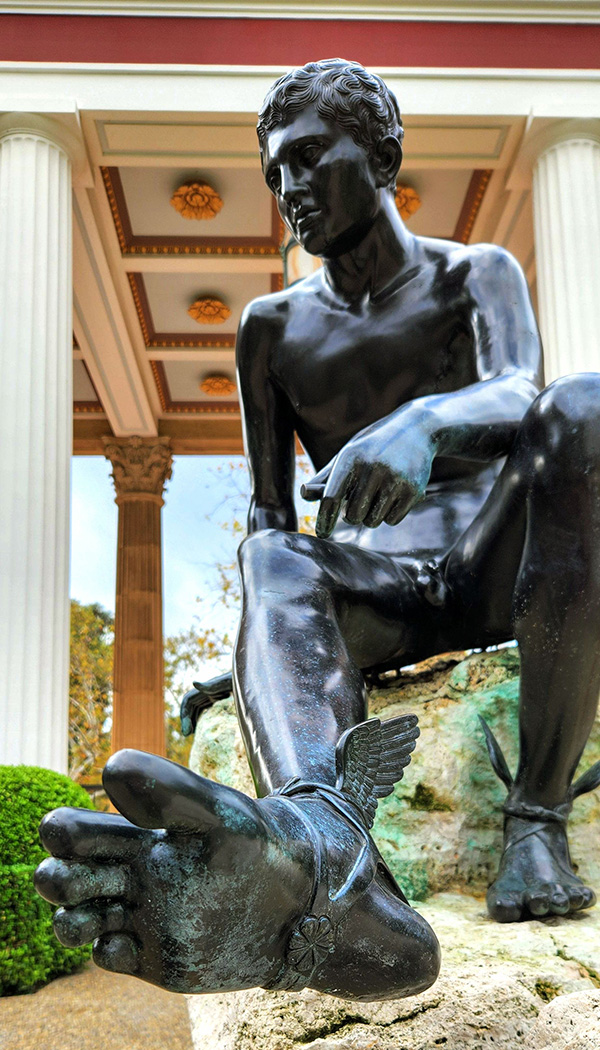
Mercury with Winged Sandals, Getty Villa copy from Heraculaneum, Naples
The name of Mercury is a Roman name for a Roman idea. Latin Mercurius is built on the noun merx, "merchandise," with the same root that gives mercari, "to trade," and mercari, so that unlike most of the great Roman gods his name declares his office in plain Latin. Michiel de Vaan derives merx and its family from a Proto-Italic *merk-, of uncertain further connection, and treats the divine name as a native formation rather than a loan.1,2
The earliest documented instances of the name of Mercury are ancient and votive. The inscription Mircurios, cut into the base of a bronze figurine circa 500 B.C.E., is commonly accepted as the earliest documented use of the name. The inscription may fit within the time frame when Livy reported that Mercurius came to Rome.3,4
Plautus, a playwright writing between approximately 205 and 184 B.C.E., identified Mercury as the speaker of the prologue in his play Amphitruo. Mercury identifies himself therein as the servant and messenger of Jupiter, while simultaneously identifying himself as a herald. In this instance, Mercury presents himself in a manner consistent with later depictions of him.5
Roman etymology always recognized the commercial significance stemming from merx as Festus, a Roman grammarian using sources from antiquity, linked Mercurius to both merx and to the merces (wages) paid for transactions. Similarly, Paulus preserved this etymology in his epitome. However, the god upon whom this name was applied remained predominantly Greek. Latin Mercurius assumed the duties and mythos of Ἑρμῆς (Hermes). .2,6,7
Sources: de Vaan, Etymological Dictionary of Latin (2008); Ernout and Meillet, Dictionnaire étymologique de la langue latine; Wachter, Altlateinische Inschriften (1987); Radke, Die Götter Altitaliens.1,2,3,4
II. Roman History
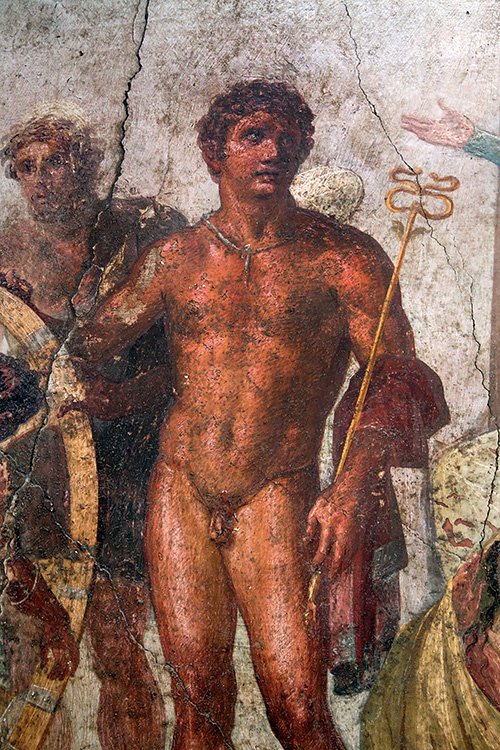
Antique fresco of Mercurius from Pompeii
The Temple of 495 BCE
Mercury introduced himself into Roman public worship through the grain trade and the plebeians. Livy wrote that a temple to Mercury was consecrated on the Ides of May in 495 B.C.E., during the same tumultuous years that saw the first secession of the plebs, and that the temple was consecrated by dispute to a senior centurion named Marcus Laetorius instead of either Consul, an affront the patricians felt deeply. However, the extremely primitive character of worship of Mercury and the early appearance in Latin raise doubt as to whether Mercurius developed symbolic associations distinctively in a Roman manner.8
The same act founded a merchant guild as on the day of the dedication the collegium mercatorum was established. The god's festival on the Ides of May became the feast of the traders.8,9
The Greek Shape of the Cult
The Roman merchant class trading with Greek city-states in southern Italy likely brought Hermes with them. It appears that Mercury is one of the clearest examples of Romans assigning a foreign aspect to a native function. Likely, an Italic notion of exchange clothed in the imagery of Greeks arose. Cicero's view of large-scale wholesale commerce as nearly respectable indicates how profoundly ingrained this type of commerce was in Roman thought. 7,10,11
Nonetheless, the extremely archaic nature of the cult and early attestation in Latin makes it questionable whether Mercurius evolved symbolically in a distinctly Roman way.
The Later Republic and the Empire
Worship increased. Ovid describes the rituals of traders at the spring adjacent to the Porta Capena at which a trader sprinkled himself and goods with water drawn in the name of Mercury. The trader prayed for the profitable washing away of past false statements regarding prior trades. This passage illustrates that worship of Mercury was fully integrated into daily life by the time of Ovid. Cicero himself records that a well-known statue of Mercury located at Tyndaris in Sicily was a focus of communal devotion for which Verres' theft represented a complete sacrilege. Under the Empire, Mercury emerged as one of the most universally venerated gods throughout Western provinces and served as a deity associated with the entirety of imperial commerce.7,9,12
III. Epithets
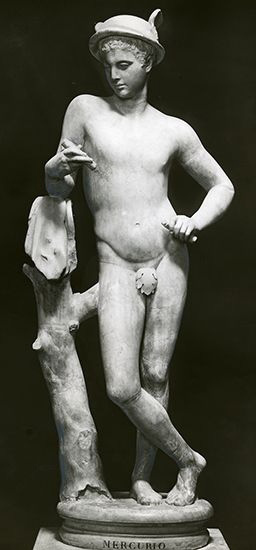
Mercury, with winged hat and staff, marble statue, Uffizi
| Epithet | Meaning | Domain |
|---|---|---|
| Mercurius Augustus | August Mercury | Imperial cult |
| Mercurius Felix | Mercury the Bringer of Increase | Good fortune, favor |
| Mercurius Negotiator | Mercury the Trader | Wholesale commerce |
| Mercurius Mercator | Mercury the Merchant | Speech, persuasion |
| Mercurius Nundinator | Mercury of the Market Day | The nundinae |
| Mercurius Viator | Mercury the Wayfarer | Roads, travel and liminality |
| Mercurius Nuntius | Mercury the Messenger | Communication |
| Mercurius Conservator | Mercury the Preserver | Deliverance, imperial protection |
| Mercurius Dominus | Mercury the Lord | Personal devotion |
Sources: Combet-Farnoux, Mercure romain (1980); Wissowa, Religion und Kultus der Römer (1912); Ovid, Fasti 5.663–692; the imperial and provincial dedications collected in CIL.7,9,13,14
IV. Temples and Sacred Sites of Mercury
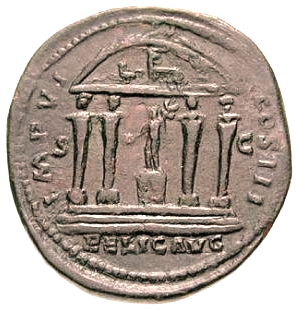
Sestertius of Marcus Aurelius from 172-173 CE representing Mercury's temple at the Aventine
Circus Maximus
The largest temple dedicated to Mercury in Rome stood atop a hillside above the Circus Maximus near the Porta Capena, it was consecrated on the Ides of May in 495 B.C.E.. This temple was also the house of worship for the Collegium Mercatorum (merchant's guild), which was founded on the same day as the temple's consecration. For as long as worship continued to exist, the date of worship was that of the Festival of Merchants. Although Lawrence Richardson suggests that the location of this temple has yet to be excavated, literary references indicate it was situated near there.8,15
Porta Capena
Nearby to the temple existed the aqua Mercurii at Porta Capena, which was considered a holy spring where merchants would annually purify themselves with water from which they had drawn, as described by Ovid. While sprinkling his goods and head with water, he recited prayers asking for forgiveness for lying about bargains.9
Provincial Temples
In contrast to Rome, Mercury had monumental temples erected throughout its provinces by various communities. Pliny writes that a colossal statue of Mercury built by sculptor Zenodorus for the Arverni in Gaul required over 10 years and was constructed at an enormous cost, serving as testament to Mercury's stature amongst a people who regarded him as their chief deity. 16,17
Hilltops and Boundaries
The god's name settled on high places across the western empire, from the Puy de Dôme in Gaul to the Mercury temples of Roman Germany and Britain. These sanctuaries mark the roads and summits where travellers gave thanks.17,18
V. The Widespread Popularity of Mercury
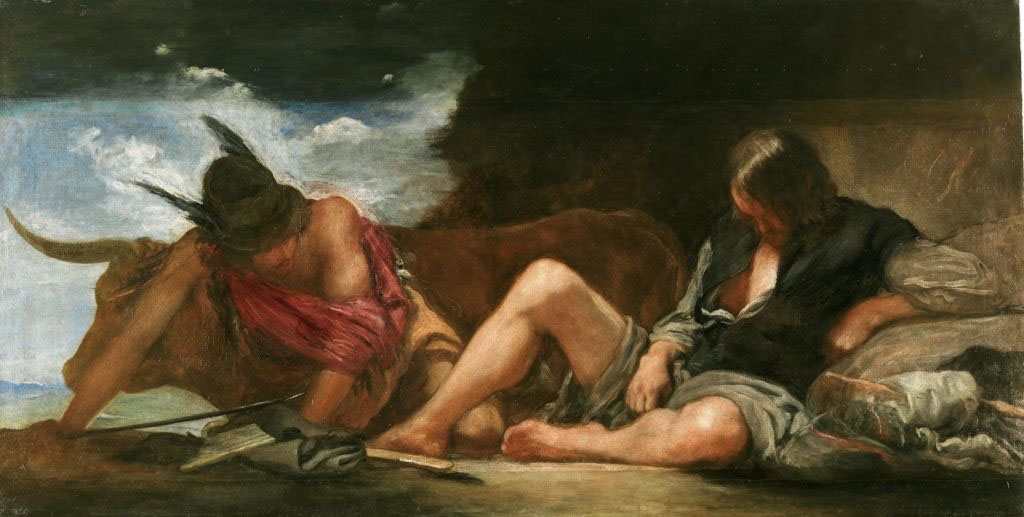
Mercury and Argus, Diego Velázquez (1659), Museo Nacional del Prado
No deity within the Roman Pantheon left behind more physical remains in western provinces as did Mercurius. More dedications to Mercury can be found than to nearly any other deity except perhaps members of the Capitol Triad; ranging from massive civic altars to inexpensive bronze statues.14,18
A merchant/traveler/slave/soldier could make vows to Mercury without having access to a temple days due to his multifaceted nature representing many domains relevant to diverse subjects; Horace opened his satire thanking Mercury for moderate prosperity, an internal documentation for his cult.7,19
Because Mercury ruled over what was mundane, the material record is correspondingly humble in form and enormous in its scope. Bronze statuettes of the god with purse and caduceus fill the museums of Europe, made for household shrines and market stalls rather than for temples, and they carry the same iconography from Italy to the Rhine.18
Dionysius of Halicarnassus indicated similarly about Italy, that few if any locations existed that failed to honor gods of commerce. This reality held for entire western provinces under Imperial rule.7,20
VI. How Mercury Represented Roman Communications and Commerce
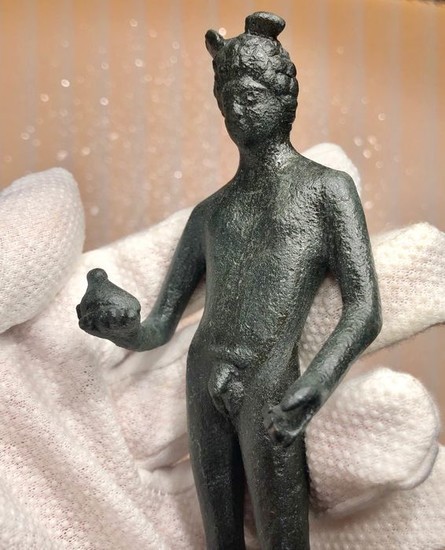
Statuette of Mercury holding bag or purse, Austria
Mercury is the only Olympian deity whose Latin name refers to economics. His symbols include a purse (moneybag) and herald's staff. Both objects are involved in exchanging goods and communicating messages essential for facilitating exchanges..7,21
The purse is a peculiar type of Roman signature as the Greek Hermes rarely held one. Roman Mercury holds it constantly, on statuettes, reliefs, gems, coins and other artifacts, and the marsupium in his fist announces that this is the god of the paid transaction. That is one reason why in some early classical accounts, Hermes was confused for being a god of wealth alone.7
As the nuntius of the gods he carries the word of Jupiter, the office the Greek Hymn to Hermes had given the god Rome adopted, and the Roman state read its own communications, its couriers, its treaties and its market announcements under elements of Hermetic symbolism that persist to this day, as the cadeuceus is still used as a symbol of delivery and quick transportation.5,21,22
The nine days of Roman commerce, the nundinae, were also the days on which news was proclaimed and business transacted in public, and Mercury was said to have a central role in this.7,9
VII. The Identifications of Mercury in Gaul and Germania
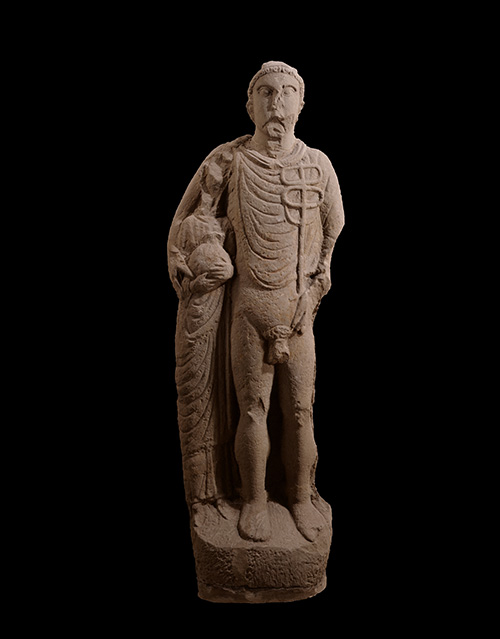
Mercury and Rosmerta, Germanic type, Landesmuseum Württemberg
Caesar gave the identification its classic statement. In the account of Gaulish religion he writes that the god the Gauls worship most is Mercury, that they hold him the inventor of all arts, the guide of roads and journeys and the greatest power over money and trade, and Roman writers followed him in reading the chief Gaulish god under that name; the scholia on Lucan gloss the Gaulish Teutates as Mercury, transmitting the same equation in a later hand. The interpretatio Romana made a Celtic sovereign into a Roman merchant.23,24
The dedications are the native god visible under the Latin one. Gaulish Mercury carried bynames such as Mercurius Visucius, Mercurius Cissonius and Mercurius Gebrinius, each preserving a local deity. Ton Derks has argued that the pairing let a provincial worshipper address his own god and the god of the empire in a single vow.17,18
Gaulish mythology also assigned a local consort to imported deity as reliefs depicted Mercury paired with Rosmerta ("The Great Provider") - a goddess with no Roman spouse whose name signified she embodied abundance; therefore, a local consort for the deity was provided which did not exist elsewhere in Roman pantheon.18
Germania had unique attributes of Mercury worship too as Tacitus reported that the Germans reckoned Mercury the chief of their gods and offered him sacrifice on fixed days, an identification of the Roman Mercury with a Germanic sovereign of the dead and of the wind that later surfaces in the weekday name Wednesday. In the end, the god of the Roman market stood in for the highest god of peoples Rome sought to control as one of their greatest boundary zones, an unintentional and ironic facet.17,25
VIII. God of Abundance
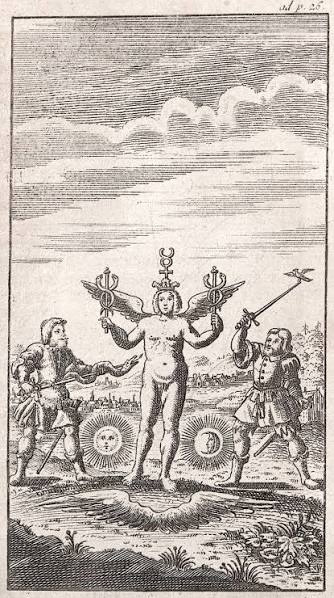
Alchemical image of ventricular Mercury surrounded by lancers from Valentinian convention besides Sol and Luna
The purse that marks the Roman Mercury is, of course, a symbol of increase. The god of profit is by the same token a god of plenty, and the marsupium heavy with coin is an image of abundance secured rather than merely of exchange conducted, and Servius glosses the god's very name and staff as tokens of gain.7,26
The Gaulish evidence shows the the abundance the conquered peoples attached to their patron. The consort Rosmerta carries a cornucopia and a patera. It seems that the pairing of the merchant god with a provider goddess states that trade and fertility of goods are the same.17,18
Roman devotion named the quality directly in that the epithet Mercurius Felix and the frequent association of the god with Fortuna and with Bonus Eventus, the power of the good outcome, place him among the deities a Roman invoked for a prosperous result, and the imperial coinage pairs his purse with the legends of felicity.7,14,27
The abundance is a working abundance in that where Ceres had given the grain and Liber the vine, Mercury meanwhile gave the gain that comes from moving them, the profit of the merchant from the yield of the field.7,21
IX. God of Doorways and Transitions
Mercury is a god of thresholds because he was a god of passage. He conducts the living across borders and the dead across the last one, and the herald's staff is a passport as much as a badge of office, opening the way through gates that would otherwise stay shut.7,21
The psychopomp is the most pointed form that resonated in Roman culture quite heavily. As the guide of souls, Mercury leads the dead down to the underworld, the one journey from which the traveller does not return. In poetry, Horace addresses him as the god who herds the pale flocks with his golden wand, and Virgil arms the same god with the wand that calls the pale souls up from Orcus and lays sleep on waking eyes.7,28,29
Here we see Janus placed next to mercury. While both are gods of doorways/doorways to the threshold, there are differences. Janus is the doorway, a static threshold that is present at each end and is part of no journey. On the other hand, mercury is the one that crosses the doorway/threshold. Thus, Janus is a stationary entity whereas mercury is a moving participle. Augistine catalogued the roman gods from varron. He stated that Janus was associated with beginnings and thresholds, while mercury was associated with communication and exchange.9,21,30
In contrast to Janus' static role as guardian of the threshold, mercury's role is dynamic as he is constantly in motion. As a result, Mercury can facilitate travel, commerce, and social interactions. These themes reflect the significance of communication and movement in Roman society.7,21
X. Mercury and Maia the Good Goddess
His mother gave the god his birthday and his month. Roman tradition made Mercury the son of Maia, and the temple of 495 BCE was dedicated in her month of May, so that the god of the Ides was tied from the beginning to the goddess whose name the month bears.9,31
Roman antiquarians disputed which Maia they meant. A debate over whether the Maia honoured at the Kalends of May was the mother of Mercury, the Greek nymph of the Pleiades, or an old Italic earth power called Maia identified with Bona Dea, the Good Goddess, and Fauna, and he records that the pontiffs sacrificed to a Maia who was reckoned a goddess of growth existed in Roman intellectual life. Aulus Gellius preserved the old priestly formula in which Maia Volcani is invoked, evidence that a cult Maia from Italy itself was beside the mythical mother. The function of origin from two goddesses is probably distinctly Roman.31,32
Maia was connected by the Romans with the comparative maius, "greater," and with the power of making things grow, which suits the mother of a god of gain.31,33
The pairing binds Mercury to the oldest Italic soil under the Greek surface. Whatever the myths made him, his mother was a Roman power of growth worshipped at the turn of spring, and the god of the imported caduceus was given a native parent.7,31
XI. Mercury as Astrological Planet in Roman Thought
The swift inner planet, never far from the Sun and quickest of the wanderers to complete its course, was called Stella Mercurii because its speed matched the god of the road and the message. Cicero had the identification in his account of the heavens as a settled Roman idea, while Pliny gives the planet the same name and the same swiftness in his own survey of the sky.34,35,36
The astrologers, seeing a common thread of meaning, gave the god's offices to the star, as the confusion prevailing in Greek thought about the nature of the planet had been resolved. Manilius assigned to the planet of Mercury the domains of speech, calculation, trade and the quick intelligence, and the later handbook of Firmicus Maternus made it the ruler of scribes, orators, merchants and messengers, so that the planet governs in the sky the same business the god governed on the ground.37,38
The link was tied to both the day and the metal. The planetary week gave Mercury his day, the dies Mercurii that survives in the Romance languages. Cassius Dio records the Roman adoption of the seven-day planetary cycle and its Egyptian rationale. The alchemical tradition attached the god's name to quicksilver, the mobile metal, so that his quality of swift motion printed itself on the calendar and the laboratory too.7,31,39
XII. Festivals
| Festival | Date | Observance |
|---|---|---|
| Mercuralia | Ides of May (15 May) | Feast of the merchants; purification |
| Dedication of the Temple | Ides of May (15 May), 495 BCE | Anniversary of the temple by the Circus Maximus and of the collegium mercatorum |
| Festival of Maia | Kalends of May (1 May) | Sacrifice to the god's mother at the opening of his month |
Sources: Ovid, Fasti 5.663–692; Macrobius, Saturnalia 1.12; Combet-Farnoux, Mercure romain (1980); Scullard, Festivals and Ceremonies of the Roman Republic (1981).7,9,31,40
The Mercuralia fell on the Ides of May and belonged to the merchants. Ovid gives the scene in detail, the trader drawing water from the god's spring at the Porta Capena, sprinkling his head and his wares, and praying for the profitable washing away of past deceits and for the forgiveness of the perjuries to come.9
The day was also the birthday of the cult. It marked the dedication of the temple of 495 BCE and the founding of the merchant guild on the same date, so that the festival celebrated the god, his house and his corporation together.8,9
The god's month opened with his mother. The Kalends of May carried the sacrifice to Maia. The Ides carried the feast of her son, so that May framed the god between the goddess who bore him and the market that employed him.7,31
Sources and Bibliography
- Michiel de Vaan. Etymological Dictionary of Latin and the Other Italic Languages. Leiden Indo-European Etymological Dictionary Series 7. Leiden: Brill, 2008. S.vv. merx, mercor, Mercurius. For the derivation of the divine name from merx, "merchandise," and the noun family of trade, and for the Proto-Italic reconstruction.
- Alfred Ernout and Antoine Meillet. Dictionnaire étymologique de la langue latine: Histoire des mots. 4th ed., revised by Jacques André. Paris: Klincksieck, 2001. S.vv. merx, Mercurius. For the treatment of Mercurius as a native Latin formation on merx, distinct in origin from Greek Hermes whose functions it later assumed.
- Rudolf Wachter. Altlateinische Inschriften: Sprachliche und epigraphische Untersuchungen zu den Dokumenten bis etwa 150 v. Chr. Bern: Peter Lang, 1987. For the archaic votive forms of the name, including the early spellings with the unsettled vowel that precede classical Mercurius.
- Gerhard Radke. Die Götter Altitaliens. 2nd ed. Fontes et Commentationes 3. Münster: Aschendorff, 1979. S.v. Mercurius. For the collection of the early Italic dedications and the discussion of the god's name among the deities of ancient Italy.
- Plautus. Amphitryon. The Comedy of Asses. The Pot of Gold. The Two Bacchises. The Captives. Edited and translated by Wolfgang de Melo. Loeb Classical Library 60. Cambridge, MA: Harvard University Press, 2011. See the prologue of the Amphitruo. For the earliest securely dated literary use of the name, spoken by the god as the herald and servant of Jupiter.
- Sextus Pompeius Festus. De verborum significatu quae supersunt cum Pauli epitome. Edited by Wallace M. Lindsay. Leipzig: Teubner, 1913. S.v. Mercurius. For the antiquarian derivation of the name from merx and merces, the Roman etymology that read the god as the power of trade.
- Bernard Combet-Farnoux. Mercure romain: Le culte public de Mercure et la fonction mercantile à Rome de la République archaïque à l'époque augustéenne. Bibliothèque des Écoles françaises d'Athènes et de Rome 238. Rome: École française de Rome, 1980. The standard monograph. For the public cult, the mercantile function, the purse as the Roman signature of the god, the accessibility that produced his ubiquity, and the god of passage and its offices.
- Livy. History of Rome, Volume I: Books 1–2. Translated by B. O. Foster. Loeb Classical Library 114. Cambridge, MA: Harvard University Press, 1919. See 2.21.7 and 2.27.5–6. For the dedication of the temple of Mercury on the Ides of May 495 BCE, the award of the dedication to the centurion Marcus Laetorius over the consuls, and the founding of the merchant guild.
- Ovid. Fasti. Translated by James G. Frazer. Revised by G. P. Goold. Loeb Classical Library 253. Cambridge, MA: Harvard University Press, 1931. See 5.663–692. For the Mercuralia of the Ides of May, the merchant's purification at the aqua Mercurii near the Porta Capena, and the prayer for the profitable washing away of past and future perjuries.
- John Scheid. An Introduction to Roman Religion. Translated by Janet Lloyd. Bloomington: Indiana University Press, 2003. For the account of Mercury as a Roman function given a Greek face, an Italic idea of exchange in the iconography of the Greek herald.
- Cicero. On Duties. Translated by Walter Miller. Loeb Classical Library 30. Cambridge, MA: Harvard University Press, 1913. See De officiis 1.150–151. For the Roman ranking of large-scale wholesale commerce as almost respectable, evidence of the mercantile grain in Roman thought.
- Cicero. The Verrine Orations, Volume II: Against Verres, Part 2, Books 3–5. Translated by L. H. G. Greenwood. Loeb Classical Library 293. Cambridge, MA: Harvard University Press, 1935. See 2.4.84–85. For the famous statue of Mercury at Tyndaris treated as an object of civic devotion whose removal by Verres was a sacrilege.
- Georg Wissowa. Religion und Kultus der Römer. 2nd ed. Handbuch der Altertumswissenschaft V.4. Munich: C. H. Beck, 1912. For the survey of the Roman cult of Mercury, its epithets, and its place among the deities of trade.
- Theodor Mommsen et al., eds. Corpus Inscriptionum Latinarum. Berlin: Berlin-Brandenburg Academy of Sciences, 1853–. For the imperial and provincial dedications carrying the titles Mercurius Augustus, Felix and Conservator, and the association of the god with Fortuna and Bonus Eventus.
- L. Richardson Jr. A New Topographical Dictionary of Ancient Rome. Baltimore: Johns Hopkins University Press, 1992. S.v. Mercurius, aedes. For the temple by the Circus Maximus and the Porta Capena and the note that its exact site has not been recovered.
- Pliny. Natural History, Volume IX: Books 33–35. Translated by H. Rackham. Loeb Classical Library 394. Cambridge, MA: Harvard University Press, 1952. See 34.45. For the colossal statue of Mercury made by Zenodorus for the Arverni over ten years at great cost.
- Ton Derks. Gods, Temples and Ritual Practices: The Transformation of Religious Ideas and Values in Roman Gaul. Amsterdam Archaeological Studies 2. Amsterdam: Amsterdam University Press, 1998. For the Gaulish cult of Mercury, the native bynames borne under the Latin name, the pairing with Rosmerta, and the hilltop sanctuaries of the western provinces.
- Miranda J. Green. Dictionary of Celtic Myth and Legend. London: Thames and Hudson, 1992. S.vv. Mercury, Rosmerta. For the ubiquity of the god in the western provinces, the humble bronze statuettes, and the Gaulish consort Rosmerta with her cornucopia and patera.
- Horace. Satires. Epistles. The Art of Poetry. Translated by H. Rushton Fairclough. Loeb Classical Library 194. Cambridge, MA: Harvard University Press, 1926. See Satires 2.6.1–15. For the poet thanking Mercury for a modest competence, the private register of the cult.
- Dionysius of Halicarnassus. Roman Antiquities. Translated by Earnest Cary. 7 vols. Loeb Classical Library. Cambridge, MA: Harvard University Press, 1937–1950. See 1.39–40. For the observation that scarcely a place in Italy could be found where the gods were not honoured, cited for the reach of trade-and-travel cult.
- Georges Dumézil. Archaic Roman Religion. Translated by Philip Krapp. 2 vols. Chicago: University of Chicago Press, 1970. For the reading of trade and communication as a single function in the god, the moving of goods and words along the same roads, and for the contrast of motion with the fixed threshold of Janus.
- The Homeric Hymns. Translated by Martin L. West. Loeb Classical Library 496. Cambridge, MA: Harvard University Press, 2003. Hymn to Hermes (4). For the Greek charter of the messenger and herald whose office the Roman Mercury assumed.
- Julius Caesar. The Gallic War. Translated by H. J. Edwards. Loeb Classical Library 72. Cambridge, MA: Harvard University Press, 1917. See 6.17. For the statement that the god the Gauls worship most is Mercury, held the inventor of all arts, the guide of roads and journeys, and the greatest power over money and trade.
- Lucan. The Civil War (Pharsalia). Translated by J. D. Duff. Loeb Classical Library 220. Cambridge, MA: Harvard University Press, 1928. See 1.444–446, with the Bern scholia. For the Gaulish Teutates glossed as Mercury in the later commentary tradition.
- Tacitus. Agricola. Germania. Dialogue on Oratory. Translated by M. Hutton and W. Peterson. Revised by R. M. Ogilvie, E. H. Warmington and Michael Winterbottom. Loeb Classical Library 35. Cambridge, MA: Harvard University Press, 1914. See Germania 9. For the report that the Germans reckon Mercury the chief of their gods and offer him human sacrifice on fixed days.
- Servii Grammatici qui feruntur in Vergilii carmina commentarii. Edited by Georg Thilo and Hermann Hagen. 3 vols. Leipzig: Teubner, 1881–1902. On Aeneid 4.577. For the gloss reading the god's name and staff as tokens of gain and exchange.
- Harold Mattingly and Edward A. Sydenham. The Roman Imperial Coinage. London: Spink, 1923–1994. For the imperial reverse types pairing Mercury's purse and caduceus with legends of felicity and good outcome.
- Horace. Odes and Epodes. Edited and translated by Niall Rudd. Loeb Classical Library 33. Cambridge, MA: Harvard University Press, 2004. See Odes 1.10 and 1.24.15–18. For the hymn to Mercury as messenger and inventor and for the god who herds the insubstantial dead with his golden wand.
- Virgil. Aeneid: Books 1–6. Translated by H. Rushton Fairclough. Revised by G. P. Goold. Loeb Classical Library 63. Cambridge, MA: Harvard University Press, 1999. See 4.238–258. For Mercury taking up the wand with which he calls the pale souls up from Orcus, sends others down, and lays sleep on waking eyes.
- Augustine. The City of God against the Pagans, Volume II: Books 4–7. Translated by William M. Green. Loeb Classical Library 412. Cambridge, MA: Harvard University Press, 1963. See 7.14. For the catalogue drawn from Varro that keeps Janus over beginnings and thresholds and Mercury over speech and exchange as distinct powers.
- Macrobius. Saturnalia, Volume I: Books 1–2. Edited and translated by Robert A. Kaster. Loeb Classical Library 510. Cambridge, MA: Harvard University Press, 2011. See 1.12.16–22. For the learned dispute over the identity of Maia, her connection with Bona Dea, Fauna and the earth, the derivation from maius, and the sacrifices of the month of May.
- Aulus Gellius. Attic Nights, Volume II: Books 6–13. Translated by John C. Rolfe. Loeb Classical Library 200. Cambridge, MA: Harvard University Press, 1927. See 13.23. For the old priestly prayer formulas that pair goddesses with gods, including the cult Maia, evidence of a Maia behind the mythical mother.
- Varro. On the Latin Language. Edited and translated by Roland G. Kent. Loeb Classical Library 333. Cambridge, MA: Harvard University Press, 1938. See 5.68–74. For the antiquarian etymologies of the divine names and the connection of Maia with growth and increase.
- Cicero. On the Nature of the Gods. Academics. Translated by H. Rackham. Loeb Classical Library 268. Cambridge, MA: Harvard University Press, 1933. See De natura deorum 2.53. For the identification of the planet as the Star of Mercury and the account of its swift course, and for the Roman distinction of the god from the star named after him.
- Cicero. On the Republic. On the Laws. Translated by Clinton W. Keyes. Loeb Classical Library 213. Cambridge, MA: Harvard University Press, 1928. See De re publica 6.17 (the Dream of Scipio). For the ordering of the planetary spheres in which the star of Mercury holds its place beneath the Sun.
- Pliny. Natural History, Volume I: Books 1–2. Translated by H. Rackham. Loeb Classical Library 330. Cambridge, MA: Harvard University Press, 1938. See 2.36–40. For the star of Mercury, its nearness to the Sun and the swiftness of its course.
- Manilius. Astronomica. Translated by G. P. Goold. Loeb Classical Library 469. Cambridge, MA: Harvard University Press, 1977. For the assignment to the planet of Mercury of the domains of speech, calculation, trade and quick intelligence.
- Firmicus Maternus. Matheseos libri VIII. Edited by W. Kroll and F. Skutsch. 2 vols. Leipzig: Teubner, 1897–1913. For the later astrological handbook that makes the planet of Mercury the ruler of scribes, orators, merchants and messengers.
- Cassius Dio. Roman History, Volume III: Books 36–40. Translated by Earnest Cary. Loeb Classical Library 53. Cambridge, MA: Harvard University Press, 1914. See 37.18–19. For the Roman adoption of the seven-day planetary week and the rationale offered for the order of the days.
- H. H. Scullard. Festivals and Ceremonies of the Roman Republic. London: Thames and Hudson, 1981. For the reconstruction of the festival year and the placing of the Mercuralia and the rites of Maia in the month of May.