






| Language | Name | Earliest Secure Attestation |
|---|---|---|
| Amorite (Mari) | Ḫanat | Old Babylonian archives of Mari (eighteenth century BCE) |
| Egyptian | ꜥntjt | Scarab-seals (seventeenth century BCE) |
| Ugaritic | ʿnt | Alphabetic tablets (Late Bronze Age) |
| Phoenician | ʿnt | Inscribed horse-binder, Cyprus (600BCE) |
| Akkadian (Suhum) | an-at | Inscriptions of Ninurta-kudurri-usur (700 BCE) |
| Greek | Αναθ | KAI 42 (350-300BCE) |
30 min read
ANAT
author: High Priest Zevios Metathronos
co-author: Novice Priest Karnonnos
Hieratic Information about Anat
| Divine Symbols | |
|---|---|
|
I. The Name
The goddess is named in Ugaritic and Phoenician as ʿnt; as an-at in the Akkadian of the middle Euphrates region; as ꜥntjt in Egyptian; and as ʿānāt in Hebrew, and Ἀναθ (Anath) in Greek. No possible etymology for the name has ever been demonstrated. One proposal for the etymology of the name that is widely accepted is based upon the assumption that Anat is derived from the Arabic word ʿanwat meaning force or violence, which corresponds to what Anat is depicted as being in the actual texts describing her. Older attempts at derivation have largely been abandoned due to their construction upon a characterization of Anat that the available evidence does not confirm. For example, Deem has suggested a hypothetical root *ʾnh ("to love") based on a characterization of Anat that the evidence does not demonstrate.1
There is a possibility that a "younger" goddess, Anat, may have been preceded by an older goddess. Wilfred Lambert has suggested that she be identified as Ḫanat. She is known to have been worshipped in the land of Suhum (the middle Euphrates) and is also very well documented in the Old Babylonian Archives at Mari. The goddess received sheep from the offerings of the king's daughters during the time of King Zimri-Lim, and she received oil from the women of the palace.2,3
Her cult city bore her name and was indicated with the divine determinative. Historians are divided on whether it preceded her or not..Those who are researching Anat in the first millennium identify her as a goddess of Suhum (Anat) and state that her name (Ḫa-na-at in earlier texts) can appear as an-at in local inscriptions.2,4
The First Attestation in Egyptian
The first recorded use of the term outside Mesopotamia was in Egypt, however, was not in religious text. In addition to these two leaders (Anat-her, 'Aper-'Anati) who had the term in their name as part of a scarab seal were referred to as "heqa-khasut", or "rulers of foreign lands" which were used by early kings of the Hyksos Fifteenth dynasty. According to Kim Ryholt 'Aper-'Anati is dated to approximately the 17th century BCE. Anat-her was documented solely through his scarabs.5
Richard Wilkinson cites the name Anat-her as evidence that the Hyksos worshiped the goddess.6 Christiane Zivie-Coche is more careful. She observes that the Hyksos attestations amount to a single theophoric name, and that as of 2011 there was no material evidence for Anat in a religious context in Egypt before the reign of Ramesses II. Reshep and Haurun, deities of the same origin, appear in Egyptian records as far back as Amenhotep II.7
A name on a seal is not a cult. What the scarabs establish is that the goddess was known by name in the Nile Delta some four centuries before anyone in Egypt is known to have made her an offering.
The First Attestation in Phoenician
Four inscribed votive objects dedicated to Anat have been recovered from Idalion on Cyprus. Two of them are datable: a horse-binder of the seventh century BCE and a spearhead of the fifth or early fourth.1 The horse-binder is the earliest attestation of the theonym in Phoenician, and both objects are military, which is taken to indicate that her warlike character carried over into Phoenician religion.1
The famous Phoenician text is later and comes from the same island. The bilingual altar inscription from Larnakas tis Lapithou, cut into the rock on the southern slope of the Kyrenia range and dated to the late fourth century BCE, opens in Phoenician l-ʿnt ʿz ḥym, "to Anat, Strength of the Living," and renders her in the Greek as Athena Soteira Nike. When Melchior de Vogüé published it in 1867 he noted that the first line gave, with certainty, the Semitic spelling of the goddess's name, which had not until then been met with in the inscriptions.8,9
The claim is often repeated that this is the first attestation of Anat in a Canaanite inscription. It was the first known in 1867. The Idalion horse-binder is three centuries older.
Sources: Day for the etymology and the Idalion objects;1,1 Schwemer and Feliu for Ḫanat and the Mari evidence;2,3 Frame for the Suhum inscriptions;4 Ryholt for the Hyksos scarabs;5 Zivie-Coche for the Egyptian sequence;7 de Vogüé and Donner and Röllig for KAI 42.8,9
II. In the Ba'al Cycle
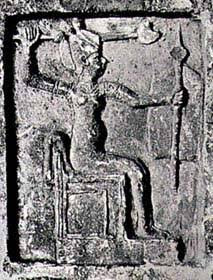
Anat with arm raised, enthroned
What follows is the story as the six tablets tell it, in the order they tell it.10,11
The Messengers of Yam and the Battle
The first section of this text is called "the messengers of Yam". In this part of the text, Yam, Ba'al’s opponent for control over the gods, sends his representatives to an assembly with an ultimatum. Ba’al immediately attempts to attack them. However, both envoys are protected by the goddesses Anat and Athtart, who hold his arms, protecting the envoys from harm.
This leads to the second section of the text which is called “the Battle in the Valley.” in this section of the text, Anat begins a battle in a valley located between two cities. She attacks those living along the coast to the west as well as those who live toward the rising sun to the east. Her victims fall around her like fallen fruit; her enemies fly through the air above her like swarms of locusts. She fiercely binds her victims' heads to her back and girdles their hands around her waist. As she walks through the battlefield, she wades knee deep in the blood of slain soldiers and neck-high in their gore. She forces the captured soldiers before her using a staff and uses her bow string to force any remaining soldiers to follow her.
After that, she returns to her house but is not content. She places chairs for soldiers, tables for warriors and foot stools for heroes. She then proceeds to fight the furniture. She continues to fight until her liver becomes swollen with laughter and her heart full of happiness. Following that, she cleanses her hands in the blood of soldiers and cleanses her fingers in their gore. Anat washes herself in the dew from heaven and oils herself with earth's oil. Finally, she picks up her lyre.
The Messengers of Ba'al
B'al sends Gapnu and Ugar to Anat, carrying a message of peace and calling on her. When she sees them approaching, she believes that a new enemy has arisen against Ba'al and recounts all that she had previously destroyed: Yam (the beloved of El), Nahar (the great god), the dragon Tunnanu, the twisting serpent (the seven-headed one), Arsh (the beloved of El), Atik (the calf of El), Dhabibu (the daughter of El), and the flame, Ishatu. Ba'al protests that he lacks a house like the other gods.
She goes to the source of rivers where El sits but does not bend. Anat tells him that if he shall not give her permission, she will cause his gray hair to flow with blood and his gray beard hair to flow with gore. El responds from inside his seven chambers that he knows her and that she is bold, and among goddesses not a single one bolder than her. He tells her to ask whatever she would like to ask. She asks for the house of Ba'al and does not receive it, enraging her.
The Embassy to Athirat and Death of Ba'al
Ba'al and Anat travel together to Athirat at the shore with gifts of silver and gold made in the forge of Kothar-wa-Khasis. Athirat panics as she thinks they have come to kill her children. Seeing the luxurious gifts, however, changes her mood. Anat requests that Athirat take the petition to El, being likelier to convince him. Athirat gets on a donkey and rides to the source of rivers. El grants what athirat has requested. The news reaches ba'al, and the house is constructed upon Saphon using cedar, silver and gold with an open window.
The hero Ba'al descends into the throat of Mot, the god of death. El leaves his throne and sits on the ground, tears his skin open, cuts his cheeks, and mournfully cries that Ba’al is dead and all people have perished. Anat looks everywhere upon every mountain and every hill. She finds the dead body together with Shapash the sun god, lifts it on to her shoulders and then carries it up to Saphon. Anat weeps for and buries him while killing seventy of each type of beast for funeral rites and announces his death to El. El places Athtar the luminous upon the throne; but his feet do not reach foot-stool.
Anat and Mot
A day passes and days, and Anat comes to Mot like the heart of a cow for her calf. She seizes him by the hem of his garment and demands her brother. In a rage, she splits Mot open with a blade, then she winnows him with a sieve and finally she burns him in fire and grinds him with a millstone, where his remains are scattered and the birds eat them like seeds.
El dreams that the heavens are drizzling oil and wadis run with honey. Through this, he knows Ba’al is alive again. He tells Anat to summon Shapash who searches furrows of fields for him. Ba’al returns and takes the throne. After seven years, Mot comes back again and complains about Anat's brutal treatment of him.
III. Epithets
| Epithet | Meaning | Domain |
|---|---|---|
| btlt ʿnt | Maiden Anat | Raw power |
| ybmt lʾimm | Sister-in-law of the peoples (?) | Popular devotion |
| bʿlt mlk | Mistress of kingship | Royal cult |
| bʿlt drkt | Mistress of dominion | Royal cult |
| bʿlt šmm rmm | Mistress of the High Heavens | Heavenly Firmament |
| bʿlt kpṯ | Mistress of the kpṯ, probably a headdress | Headdress, crown |
| gṯr | The Powerful | Supreme power |
| nʿmt | Most Beautiful | Artemis, Beauty |
| ʿz ḥym | Strength of the Living | Life-fulfilling |
| nbt pt | Mistress of Heaven | Holy Firmament |
| ntjt nbt pt | Mistress of all the Gods | Heavenly nature |
| sꜣt Ptḥ | Daughter of Ptah | Divine Parentage |
| Mother of Ramesses | As written | Egyptian; Ramesses II called himself her beloved and called her his mother, while assigning her warlike rather than motherly traits |
Sources: Rahmouni for the Ugaritic epithets; Pardee for KTU 1.108 and the kpṯ; Selz on the heavens title; Donner and Röllig for KAI 42; Cornelius and Tazawa for the Egyptian titles and the Beth-Shan stele.9,12,13,14,15,16
IV. Sites of Worship
Ugarit
Anat was one of the primary goddess of Ugarit and she received offerings on an ongoing basis. In the standard list of gods she is between Athirat and Shapash. In some lists she receives rams under the tittle "offering to the gods of Mount Saphon", bulls and rams elsewhere.13
She also has appearances in the Hurrian offering lists at the city. In one listing she receives a ram after Ashtabi and Simige, and in the other she receives a ram after Nupatik. She is mentioned as part of a Hurrian anointing ritual which includes only Hurrian gods for all others. Schwemer explained this presence as being part of fact that she did not have a direct equivalent among the Hurrians.4,13,17, 18
Suhum
The city (modern day Anah) on the mid-Euphrates river which was dedicated to Ishtar as a cult center is where she was worshipped. The temple bore the ceremonial Sumerian name E-shuziana ("House, True Hand of Heaven") and was patroned by King Hammurabi of Babylon per an inscription from much later. Ninurta-kudurri-usur, son of the governor of Suhu, renovated this temple and produced a written account referring to her as "the Best Lady, highest of all the Gods, greatest of the Igigu (heroes), who has no equal for courage with other Goddesses." In the same written account he also stated that at one time or another, the Assyrians removed the decorations from her image and then hid it. He recovered it.4,19
Tanis and Beisan
Three possible temples of Anat have been identified in Egypt. One at Tanis within the temple complex of Mut is definite, and one ambiguous figure shows Anat or Astarte at Temple of Hibis in the Kharga Oasis. The Egyptians also built her a temple at Beisan, ancient Beth-Shan, under Ramesses III.1,6,15
At Tanis, Jean Yoyotte’s understanding of the archeological evidence described it precisely as the so-called “Enclosure of Anta,” containing both a temple of Mut and the house of Anat the Phoenician. It was s shared complex suggesting a dualistic relationship of the two goddesses.20,21
Other than the ruins of several remaining parts of its wall enclosures, remains of the bases of its large granite columns and some pieces of those large granite column bases exist at the site. Additionally, a limestone double well used for ceremonial water purification rites by priests is found to be still standing. An uncompleted sacred basin was also located on the site. As well as these artifacts, a reused statue depicting Ramesses II alongside Sekhmet, the lioness goddess, has survived at the site.21,22,23,24
The enclosure was located southwest of the Amun precinct and was arranged on a north–south axis. Its first substantial construction appears to belong to the Twenty-first Dynasty, although it was repeatedly reconstructed and enlarged through the Late and Ptolemaic periods. The attestation of Hibis is far less certain.23
Beisan in northern Palestine is less ambiguous; it was part of two temples built side-by-side to contain or be close to the site of an earlier temple complex from the Egyptian Period. There were also reused royal monuments in front of it, which included stelae of Seti I and Ramesses II as well as a reused statue of Ramesses III that had been located within the central courtyard area.25,26,27
The most important object was a limestone stela dedicated by an Egyptian named Hesi-Nakht. It portrays a slender goddess wearing an Egyptian double-plumed crown. She carries an ankh in her right hand and a was-sceptre in her left, while Hesi-Nakht stands before her with his hands raised in worship. The inscription calls her 'Antit, queen of heaven, mistress of the gods'. It is still debated, however, whether this Antit refers to Anat or Astarte.
Elsewhere in the Levant
The remaining presence of Anat is sparse and faint. Although there are many references to her at Emar (the city where she received worship) the number of references indicate that it was less than the number of references to her at Ugarit. Theophoric names such as Anat-ummi are currently being recognized as part of the local collection. Names with the element ha-nuta in a lawsuit from Hazor date back to sometime between the 18th century B.C.E. through the 16th century B.C.E. that were originally believed to invoke her. There is only one other reference to a theophoric name, Anati, that can be found from Byblos. In addition, a ship's captain from an unknown location in Syria during the time of Ramesses II is referred to as "bn 'nt.1,19
Cyprus
The most compelling evidence of Phoenicians is to be seen on the island of Cyprus. There are the four votive offerings from Idalion and an inscribed stone altar carved into the side of a mountain at Larnakas tis Lapithou. Max Ohnefalsch-Richter (in the nineteenth century) examined the area where Larnakas tis Lapithou was located, but could find no sign of a cult using images and no parts of any image, only narrow wall remains which he believed formed a peribolos around the altar; therefore, it appeared that the natural mountain rock represented the symbol of the goddess.1,28
V. Objects and Documents
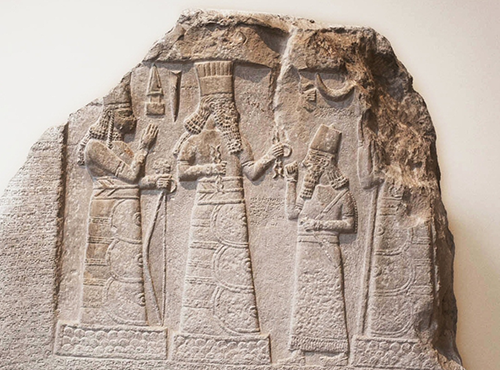
Anat to the far right, The stele of Shamash-resh-uṣur, Semitic form
The Corpus is divided both geographically (regionally) and according to material (medium). Ugaritic tablets and a list of rituals are found at Ugarit while votive weapons and one altar are found at Cyprus. In addition to these two sites, monumental stone statues and reliefs were found in Egypt and Egyptian-controlled areas of Palestine. Reliability for identifying her through visual means is low as several regional goddesses have similar iconography.15
| Object | Date | Ancient Provenance | Present Collection | Status of Identification |
|---|---|---|---|---|
| Scarab-seals of Anat-her and ʿAper-ʿAnati | Seventeenth century BCE | Egypt; one possibly from Bubastis | Petrie Museum of Egyptian Archaeology (ʿAper-ʿAnati) | Name element secure; royal names, not cult objects |
| Baal Cycle tablets, KTU 1.1–1.6 | Late Bronze Age | Ugarit, Ras Shamra | Not specified in the sources cited here | Named throughout; copied by the scribe Ilimalku |
| Inscribed horse-binder | Seventh century BCE | Idalion, Cyprus | Not specified in the sources cited here | Securely named; earliest Phoenician attestation |
| Inscribed spearhead | Fifth or early fourth century BCE | Idalion, Cyprus | Not specified in the sources cited here | Securely named |
| Bilingual altar inscription, KAI 42 | Late fourth century BCE | Larnakas tis Lapithou, Cyprus; cut into living rock | In situ; also CIS I 95 | Securely named ʿnt, rendered Athena in the Greek |
| Stele of Antit | Reign of Ramesses III | Temple at Beth-Shan | Not specified in the sources cited here | Securely named; the only Levantine image of Anat identified by an accompanying inscription |
| Statue group of Anat and Ramesses II | Reign of Ramesses II | Temple at Tanis | Not specified in the sources cited here | Both figures identified by inscription |
| Stele of Šamaš-reš-uṣur | c. 760 BCE | Found at Babylon; governor of Suhu | Not specified in the sources cited here | Anat proposed as one of three deities depicted; inscription and image both damaged |
Sources: Ryholt for the scarabs; Smith and Pitard and Wyatt for the Baal Cycle tablets; Day for the Cypriot votives; de Vogüé and Donner and Röllig for the altar; Cornelius for the Beth-Shan stele and the Tanis statue; Frame and Asher-Greve and Westenholz for the stele of Šamaš-reš-uṣur.1,4,5,10,11,15,29
Scholars and Error
One object fits into this collection by virtue of its omission. For years, the KTU 1.96 tablet was used to support the claim that Anat was a cannibal. That interpretation had influenced generations of writers describing her savagery. In 1996, Theodore Lewis indicated that the reading depended upon an old photograph of the tablet, washed-out and epigraphically useless. An examination of the tablet in Damascus revealed that it did not mention Anat (the 'n' in ʿnn is not a typo for ʿnt).30,31
Gregorio del Olmo Lete proposes the text is an incantation against the evil eye. The correction is now generally accepted, and the goddess who ate her enemies has quietly left the corpus.15,30
VI. Tanit and Anat?
Carthage has a goddess who has been identified as Anat numerous times, but the evidence is far from conclusive. Tanit (𐤕𐤍𐤕), consort of Ba’al Hamman (pn b’ll “Face of Ba’l” and rb’t “Lady”), was the primary goddess of Carthage from approximately the 5th Century B.C.E., and her icon can be found on over 10,000 stone stele located at the tophet of Carthage and at other sites such as Sousse and Motya. Her cult spread across the western Mediterranean from Malta to Gades. William Foxwell Albright supported the position that her name represented Anat. Flemming Hvidberg-Hansen, in his book about this deity, likewise hypothesized that Tanit was a descendant of Anat.31,32
Historians debate any connection. Steve Wiggins advised caution about this claim as it seems to have originated in earlier literature. So it therefore be viewed with a critical eye, and one cannot assume that Tanit refers to any of the most prominent deities of the second millennium. As for methodology, Richard Clifford makes the same point concerning methodological limitations of data: although there are many Phoenician texts related to worship, few of these texts relate to mythology; none of these myths are longer than a single sentence; we cannot establish the degree of continuity of religion between the time of the Phoenicians and the time of Ugaritic religion. In addition, there is another problem. Onomastically speaking, the root tn, "to ring" or "to resound", (the root from which the name Tinnit derives), does not occur in any Punic context within theophoric personal names.33,34,35
AThe Phoenician and Punic evidence for Anat is centered on Cyprus. The very few theophoric names invoking Anat, as well as the overall sparseness of other Anat-related evidence indicate that her cult in the West was reduced significantly from where it had been during the 2nd millennium B.C.E. Izak Cornelius claims that she was removed from many local pantheons. However, Peggy Day disagrees with this assertion.1,15,36
VII. Anat in Egypt
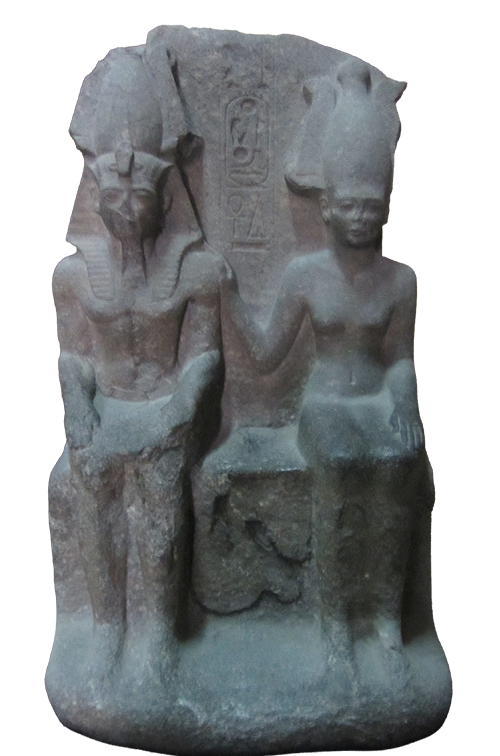
Anat and Ramesses III
Anat received the greatest share of worship in Egypt, a curiosity that is lacking with the majority of other gods from Phoenicia. Both Anat and Astarte received high recognition in the country of their adoption.
The conventional account of the arrival of Anat in Egypt is that she arrived in Egypt by the hands of the Hyksos during the Second Intermediate period (approximately a hundred years). While the Hyksos' presence in Egypt does result in the appearance of a theophoric name, it was the Eighteenth Dynasty's reconquest of the former Hyksos area and increased travel/traffic on the Mediterranean coast and to other parts of the Near East which brought northern deities to Egyptian religious practices in greater number. Worship of this goddess was not limited to those who had been displaced due to captivity, as some scholars have suggested. In fact, textual sources demonstrate that both Pharaohs and priests of Ptah, as well as common Egyptians, participated in worshiping the foreign deity.1,6,7
The apex of the recognition of Anat was at the highest point of the New Kingdom. Amidst his conquests in the Levant, the great Pharaoh Ramesses II called himself the beloved of Anat and rendered her his mother. The inscriptions give her warlike traits befitting the Pharaoh's nature. Ramesses II named a daughter, Bintanath, after the goddess, while also naming a war dog and a sword for her. The goddess was given an additional honor when his successor, Ramesses III, gave the name to her of the one who helped protect him during battle. The goddess and the Pharaoh are shown together in a statue that came from his temple at Tanis..6,15
A festival of Anat at Gaza is known from a thirteenth-century BCE ostracon, a copy of a letter from a scribe named Ipuy to a garrison commander named Bak-en-amun describing conditions in the territory under his charge; the details of the festival itself are lost. A situla said to come from Gaza and naming Anat may not be authentic. Egyptian names invoking her follow native patterns exactly. Anat-em-heb, "Anat in her festival," is built like the names formed on Amun or Horus.1,6,15,37
Anat kept her place in the Egyptian pantheon through the first millennium BCE and into the period of Roman rule. She is even among the deities depicted at Dendera in the Roman period, and she appears on a stele in Greco-Roman style beside Khonsu and Mut.7,15
VIII. How the Egyptians Read Her
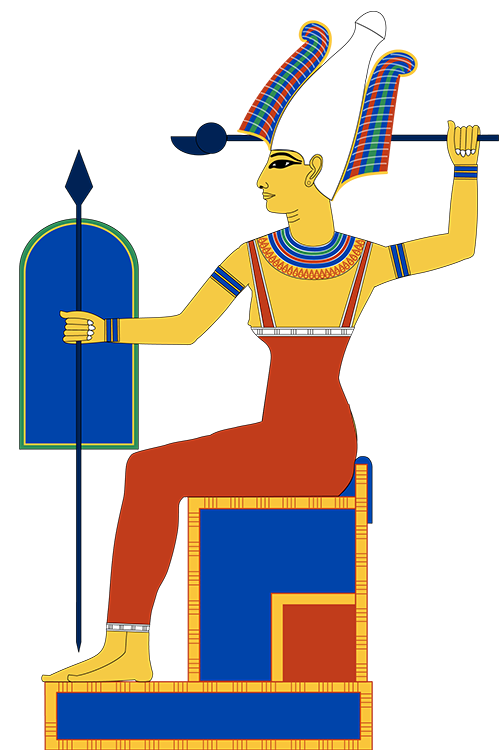
Anat in Egyptian form, wielding spear, enthroned
Dress and Attribute
Anat wore the Atef (crown of Upper Egypt) and carried a spear and shield, a fenestrated battle axe;,or possibly a "was" sceptre although this sceptre is generally better known as being associated with Astarte. The Beth-Shan Stele shows her wearing a crowned headpiece very similar to the white crown and carrying a sceptre and the ankh in each hand. On the Tanis material she is shown sitting on a throne and holds a spear, axe and shield.
Egyptians usually depicted foreign gods by local standards; and what symbols were given them were based on the god's characteristics rather than where he came from. Anat holding the ankh is the work of an Egyptian sculptor who gave a war goddess the symbol of eternal life.7,15
Filiation
The Egyptians solved the problem of a foreign goddess's parentage by assigning her a native father. She and Ashtart could both be called daughters of Ra or of Ptah, though the two are not always explicitly called sisters. The Memphite inscriptions call her daughter of Ptah. A goddess who is consistently the daughter of El in the Ugaritic texts becomes, in Egypt, the daughter of whichever great god presided over the city that housed her.7
The Wives of Seth
The New Kingdom composition The Contendings of Horus and Seth for many years was interpreted as conferring Anat and Astarte upon Set as brides, since the Egyptians associated Set with Ba'al. However, Egyptian scholars have challenged this interpretation since at least the 1970s; similarly, Ugaritic scholars have also challenged it., Neal Walls argued in 1992 that the reading is based on an incorrect assumption. Furthermore, as reported by Mark Smith in 2014, none of these challenges have produced conclusive evidence to settle the matter.19
The passage carries importance beyond just this passage, as it is one of the very limited passages in which an Egyptian source seems to discuss Anat with regard to a Ba'al figure. Therefore it has been utilized within the discussion regarding if Anat and Ba'al are consorts at Ugarit.19
The Winchester Stele
The Winchester College Stele depicts a single female form and names Qetesh, Anat, and Astarte in a single line of inscription. This piece was used to assert that Qetesh would be an important Syro-Palestinian goddess, along with the other two; therefore a triad of large goddesses is inferred using this piece.15,33
Reconstruction of the system of goddesses has taken place from multiple angles. The theory that Anat, Astarte, and Athirat were the three major goddesses of Ugarit has been disputed in light of the prominence of Shapash, nor do any groups at Ugarit associate Anat and Ashtart with Athirat. Zivie-Coche disputed the notion that Qetesh was an aspect of Anat or a Syrian deity at all; she believes that she evolved in Egypt as a deity based upon a Semitic stem. Day states prior to the Hellenistic era there is no additional evidence to indicate Anat merged with any other goddess within Egyptian tradition. The hieroglyphics indicate at the time of publication in 1955 that they were written by someone who had difficulty writing in the style of hieroglyphic script; thus, it was also possible that these hieroglyphics were created fraudulently. The provenance of the artifact is unknown; the object itself has since gone missing.1,7,15,33
What Egypt Made of Her
Egypt gave to Anat temples, statues, festivals, her own name to many people as their queen's name, a pharaoh that said she was his mother, and went on and on with its offerings to her for centuries through to the Roman period. Her adoptive land is also where we find the most complete set of records of worship for her.
Sources and Bibliography
- Day, Peggy L. "Anat." In Dictionary of Deities and Demons in the Bible, 2nd rev. ed., edited by Karel van der Toorn, Bob Becking, and Pieter W. van der Horst, 36–43. Leiden: Brill, 1999. Cited especially page 39. Cited for the etymology from Arabic ʿanwat and the rejection of older derivations, the four inscribed votives from Idalion including the seventh-century horse-binder and the fifth- or early fourth-century spearhead and the retention of her warlike character in Phoenician religion, the Hazor and Byblos names, the temple at Beisan, the Gaza festival and situla, and the assessment of the Winchester stele.
- Schwemer, Daniel. Die Wettergottgestalten Mesopotamiens und Nordsyriens im Zeitalter der Keilschriftkulturen: Materialien und Studien nach den schriftlichen Quellen. Wiesbaden: Harrassowitz, 2001. Cited page: 625, on Ḫanat in the Mari texts, the city of Suhum, and the writing of the name as an-at in first-millennium local inscriptions; 547, on Anat in the Hurrian lists from Ugarit.
- Feliu, Lluís. The God Dagan in Bronze Age Syria. Translated by Wilfred G. E. Watson. Culture and History of the Ancient Near East 19. Leiden: Brill, 2003. Cited pages: 115, on Durand's objection to the Ḫanat identification; 79 and 89, on the offering list of Zimri-Lim and the oil offerings by the palace women.
- Frame, Grant. Rulers of Babylonia: From the Second Dynasty of Isin to the End of Assyrian Domination (1157–612 BC). Royal Inscriptions of Mesopotamia, Babylonian Periods 2. Toronto: University of Toronto Press, 1995. Cited pages: 275 and 279, on Šamaš-reš-uṣur and his stele; 317–18, for the inscription of Ninurta-kudurri-usur praising Anat and reporting the recovery of her statue from the Assyrians.
- Ryholt, Kim. The Political Situation in Egypt during the Second Intermediate Period, c. 1800–1550 B.C. Carsten Niebuhr Institute Publications 20. Copenhagen: Museum Tusculanum Press, 1997. Cited for the placement of ʿAper-ʿAnati among the early Hyksos rulers, the title heqa-khasut on the scarab-seals, and the absence of Anat-her from the Turin canon.
- Wilkinson, Richard H. The Complete Gods and Goddesses of Ancient Egypt. London: Thames and Hudson, 2003. Cited page: 137, on the name Anat-her as evidence of Hyksos worship, the title "mistress of heaven," the temple at Tanis within the complex of Mut, the naming of Bintanath and the war hound, the theophoric name Anat-em-heb, and Ramesses III's appeal to her protection.
- Zivie-Coche, Christiane. "Foreign Deities in Egypt." In UCLA Encyclopedia of Egyptology, edited by Jacco Dieleman and Willeke Wendrich. Los Angeles, 2011. Cited pages: 2–6, for the argument that the Hyksos evidence amounts to one theophoric name, that no material evidence places Anat in an Egyptian religious context before Ramesses II, that her worshipers were not limited to captives, that imported deities were depicted according to Egyptian norms, that Anat and Ashtart could be called daughters of Ra or Ptah, and that Qetesh developed in Egypt.
- de Vogüé, Melchior. "Inscriptions phéniciennes de l'île de Cypre." Journal Asiatique, 6th ser., 10 (1867): 85–150. Cited page: 121ff., for the first publication of the bilingual altar from Larnakas tis Lapithou, the description of the site, and the remark that the first line gives the Semitic spelling of the goddess's name, not previously met with in the inscriptions.
- Donner, Herbert, and Wolfgang Röllig. Kanaanäische und aramäische Inschriften. 5th ed. Wiesbaden: Harrassowitz, 2002. Cited: KAI 42, the bilingual altar inscription from Larnakas tis Lapithou, with the Phoenician dedication l-ʿnt ʿz ḥym.
- Smith, Mark S., and Wayne T. Pitard. The Ugaritic Baal Cycle. Vol. 2, Introduction with Text, Translation and Commentary of KTU/CAT 1.3–1.4. Vetus Testamentum Supplements 114. Leiden: Brill, 2009. Cited for the text and translation of the tablets covering Anat's battle in the valley, the embassy of Gapnu and Ugar, her confrontation with El, and the embassy to Athirat.
- Wyatt, Nicolas. Religious Texts from Ugarit. 2nd ed. Biblical Seminar 53. Sheffield: Sheffield Academic Press, 2002. Cited for the translation of the Baal Cycle as a whole, including the tablets covering the death of Ba'al, the burial on Saphon, the destruction of Mot, and Mot's complaint after his return; also for the Epic of Aqhat.
- Rahmouni, Aicha. Divine Epithets in the Ugaritic Alphabetic Texts. Translated by J. N. Ford. Handbook of Oriental Studies 93. Leiden: Brill, 2008. Cited pages: 61 and 138–41 for btlt; 188–89 for ybmt lʾimm; 108–17 for the sequence of bʿlt epithets in KTU 1.108; 260–62 for gṯr; 249–51 for nʿmt and for the relation to Ba'al; 208 for the absence of an Anat-Ashtart-Athirat grouping.
- Pardee, Dennis. Ritual and Cult at Ugarit. Writings from the Ancient World 10. Atlanta: Society of Biblical Literature, 2002. Cited pages: 15 for her place in the god-list; 28–31 and 47–48 for the offerings, including those to Anat of Saphon; 90–95 for the Hurrian lists; 205 for the kpṯ and the atef; 274 for Inbubu and her characterization.
- Selz, Gebhard J. "Five Divine Ladies: Thoughts on Inana(k), Ištar, In(n)in(a), Annunītum and ʿAnat, and the Origin of the Title 'Queen of Heaven.'" NIN: Journal of Gender Studies in Antiquity 1 (2000): 29–62. Cited pages: 35–36, for the acceptance of the Ḫanat identification and the observation that Anat was never regarded as an astral deity despite the epithet naming the high heavens.
- Cornelius, Izak. The Many Faces of the Goddess: The Iconography of the Syro-Palestinian Goddesses Anat, Astarte, Qedeshet, and Asherah c. 1500–1000 BCE. 2nd ed. Orbis Biblicus et Orientalis 204. Fribourg: Academic Press; Göttingen: Vandenhoeck und Ruprecht, 2008. Cited pages: 6 for the caution against identifying goddesses in art without accompanying inscriptions and for the argument that Anat disappeared from many local pantheons in the first millennium; 10 and 92 for her character and the Egyptian temples; 22 for the Gaza situla; 28–30 and 73–76 for the atef, the weapons, and the Tanis statue; 35 and 85 for Ramesses II's devotion and the Dendera and Greco-Roman material; 95–96 for the Winchester stele and the suggestion of forgery.
- Tazawa, Keiko. Syro-Palestinian Deities in New Kingdom Egypt: The Hermeneutics of Their Existence. BAR International Series 1965. Oxford: Archaeopress, 2009. Cited for the compilation of the Egyptian textual and iconographic evidence for Anat and for the distribution of the material across Beth-Shan, Memphis, and the Delta sites.
- van Soldt, Wilfred H. "Divinities in Personal Names at Ugarit, Ras Shamra." In Études ougaritiques IV, edited by Valérie Matoïan and Michel Al-Maqdissi, 95–107. Ras Shamra-Ougarit 24. Leuven: Peeters, 2016. Cited pages: 99 and 105, for the seventeen individuals bearing names invoking Anat, including a king of Siyannu, and for the remark that she appears in theophoric names less often than her prominence in the myths would suggest.
- George, A. R. House Most High: The Temples of Ancient Mesopotamia. Mesopotamian Civilizations 5. Winona Lake, IN: Eisenbrauns, 1993. Cited page: 147, for the temple E-šuzianna at the city of Anat, Hammurabi's patronage of it, and its later renovation.
- Smith, Mark S. "ʿAthtart in Late Bronze Age Syrian Texts." In Transformation of a Goddess: Ishtar, Astarte, Aphrodite, edited by David T. Sugimoto, 33–85. Orbis Biblicus et Orientalis 263. Fribourg: Academic Press; Göttingen: Vandenhoeck und Ruprecht, 2014. Cited pages: 34 and 45 for Anat at Emar and the name Anat-ummī; 40–41 and 49–51 for the pairing with Ashtart; 55–58 for the gender inversion and the hunting texts; 59–60 and 64 for the questioning of the reading of The Contendings of Horus and Seth since the 1970s, Neal Walls’s 1992 objection, the unsettled state of the dispute, and the bearing of the Egyptian evidence on the Anat-Baʿal question.
- Yoyotte, Jean. Religion de l’Égypte ancienne. École pratique des hautes études, Section des sciences religieuses. Annuaire 75 (1966): 101–11. Cited pages: House of Anat and Mut.
- Montet, Pierre. Les fouilles de Tanis en 1935. Comptes rendus des séances de l’Académie des Inscriptions et Belles-Lettres 79, no. 3 (1935): 314–22.
- Leclère, François, and Frédéric Payraudeau. Tanis Re-discovered: A Major City in the History of Ancient Egypt in the First Millennium BC. Paris: Mission française des fouilles de Tanis and École pratique des hautes études, 2023. Cited pages: Reconstruction of the site repeated.
- Winlock, Herbert E. The Temple of Hibis in El Khārgeh Oasis. Part I, The Excavations. Publications of the Metropolitan Museum of Art Egyptian Expedition 13. New York: Metropolitan Museum of Art, 1941.
- Cornelius, Izak. Anat and Qudshu as the ‘Mistress of Animals: Aspects of the Iconography of the Canaanite Goddesses Studi Epigrafici e Linguistici sul Vicino Oriente Antico 10 (1993): 21–45
- Rowe, Alan. The Four Canaanite Temples of Beth-Shan. Part 1, The Temples and Cult Objects. Publications of the Palestine Section of the University Museum, University of Pennsylvania 2. Philadelphia: University of Pennsylvania Press, 1940. Cited for: Interpretation of the Beth-Shan site, doubt over Anat/Astarte identification.
- James, Frances W. The Iron Age at Beth Shan: A Study of Levels VI–IV. University Museum Monograph 28. Philadelphia: University Museum, University of Pennsylvania, 1966.
- Mullins, Robert A. The Late Bronze and Iron Age Temples at Beth-Shean. In Temple Building and Temple Cult: Architecture and Cultic Paraphernalia of Temples in the Levant (2nd–1st Mill. B.C.E.), edited by Jens Kamlah, in cooperation with Henrike Michelau, 127–157. Abhandlungen des Deutschen Palästina-Vereins 41. Wiesbaden: Harrassowitz, 2012.
- Ohnefalsch-Richter, Max Hermann. Kypros, the Bible and Homer: Oriental Civilization, Art and Religion in Ancient Times. London: Asher and Company, 1893. Cited page: 223, for the examination of the Larnakas site, the absence of any trace of a cult with images, the remains taken for a peribolos, and the reading of the rock itself as the goddess's symbol.
- Asher-Greve, Julia M., and Joan Goodnick Westenholz. Goddesses in Context: On Divine Powers, Roles, Relationships and Gender in Mesopotamian Textual and Visual Sources. Orbis Biblicus et Orientalis 259. Fribourg: Academic Press; Göttingen: Vandenhoeck und Ruprecht, 2013. Cited pages: 282–83, for the city of Anat as her Mesopotamian cult center, the reading of the stele of Šamaš-reš-uṣur, and the Babylonian artistic conventions of the figures on it.
- Lewis, Theodore J. "The Disappearance of the Goddess Anat: The 1995 West Semitic Research Project on Ugaritic Epigraphy." Biblical Archaeologist 59, no. 2 (1996): 115–21. Cited pages: 117–19, for the collation of KTU 1.96, the assessment of the photograph on which the older reading rested, the removal of Anat from the text, and del Olmo Lete's proposal that it is an incantation against the evil eye.
- Albright, William Foxwell. Yahweh and the Gods of Canaan: A Historical Analysis of Two Contrasting Faiths. Jordan Lectures 1965. London: Athlone Press, 1968. Cited for the derivation of the Carthaginian Tinnit from Anat.
- Hvidberg-Hansen, Flemming O. La déesse TNT: Une étude sur la religion canaanéo-punique. 2 vols. Copenhagen: Gad, 1982. Cited as the standard monograph on Tinnit and for the entertainment of her descent from Anat.
- Wiggins, Steve A. A Reassessment of Asherah: With Further Considerations of the Goddess. 2nd ed. Gorgias Ugaritic Studies 2. Piscataway, NJ: Gorgias Press, 2007. Cited page: 233, for the caution against equating Tinnit with Anat or with any particular second-millennium goddess; 229–30, for Anat's vestigial presence in Israel and the criticism of the Winchester triad.
- Clifford, Richard J. "Phoenician Religion." Bulletin of the American Schools of Oriental Research 279 (1990): 55–64. Cited pages: 55–56 and 62, on the scarcity and laconic character of the Phoenician sources, the impossibility of establishing continuity with Ugaritic religion, the limits of Philo of Byblos as a witness, and the treatment of the Tinnit-Anat equation in older literature.
- Ahlström, Gösta W. Review of La déesse TNT: Une étude sur la religion canaanéo-punique, by F. O. Hvidberg-Hansen. Journal of Near Eastern Studies 45, no. 4 (1986): 311–14. Cited page: 314, for the observation that the element tnt does not appear in theophoric names in Punic contexts.
- van der Toorn, Karel. "Anat-Yahu, Some Other Deities, and the Jews of Elephantine." Numen 39, no. 1 (1992): 80–101. Cited pages: 82–84, for the argument that the scarcity of theophoric names and other evidence indicates a decline in Anat's western worship, and for the questioning of a Phoenician origin for the name Anat-Bayt'el.
- Higginbotham, Carolyn R. Egyptianization and Elite Emulation in Ramesside Palestine: Governance and Accommodation on the Imperial Periphery. Culture and History of the Ancient Near East 2. Leiden: Brill, 2000. Cited page: 53, for the ostracon recording the letter from the scribe Ipuy to the garrison commander Bak-en-amun and the reference to the festival of Anat at Gaza.