





| Language | Form | Earliest Secure Attestation |
|---|---|---|
| Latin (Długosz) | Dzewana | Annales, c. 1455–1480 |
| Polish | Dziewanna | Chroniclers of the sixteenth century, copying Długosz |
| Czech | Devana | Gloss in the Mater Verborum; a nineteenth-century forgery (see III) |
| Sorbian | Dživica | Recorded by Kolberg in Lusatia, nineteenth century |
| Proto-Slavic (the plant) | *divizna, *divina "mullein" | Reconstruction; living in every branch as a plant-name |
14 min read
DEVANA
author: High Priest Zevios Metathronos
co-author: Novice Priest Karnonnos
Hieratic Information about Devana
| Divine Symbols | |
|---|---|
|
I. The Name
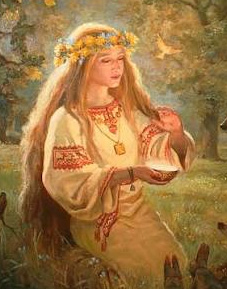
The Polish word dziewanna can be found describing one object (a tall yellow wildflower) as well as a goddess of hunting and the woods, the Polish Diana. A single fifteen century writer was the first person to write about her for history. Since then every historian has copied his account. However, the flower has a much longer recorded history than the goddess. This makes it difficult to separate fact from fiction when writing about this subject.
There is a very ancient slavic name for the mullein. This name has been reconstructed based on historical data. Aleksander Anikin uses Proto-slavic *divizna as well as its variant *divina. He also references it being connected to Polish Dziwizna, Dziewanna, the Czech-Slovak Divizna, the Ukrainian Dyvyna and Lithuanian versions of the name for this plant. The connection he makes to the root of these names comes from an archaic sense of lightening and shining. In addition, he mentions that Lithuanian versions of the names are related to the Lithuanian word for 'nine'."1
Aleksander Gieysztor relates this to dziewa (or dziewka), "young girl" or "young woman", and dziewica, "unmarried virgin", fitting perfectly for a hunter as she was married in the Roman version and bore no children. This seems like a reasonable explanation why Długosz thought of Diana. Other scholars were searching for a deeper history. Andrzej Szyjewski connects her name with Proto-Slavic *divъ, a spirit or demon, the feminine *diva being the source for Polish words such as dziwożona and South Slavic words such as samodiva, and traces the connection of *diva and *deywós to the Indo-European sky god *Dyēus. He also states that the demonizing character of the word comes from Iranian influence.6 Leszek Kolankiewicz traces the same origins of the name and adds that the suffix -anna has been used in many names of gods/goddesses, possibly because it is related to the word lord.
Sources: Anikin for the plant reconstruction and the Baltic parallels; Gieysztor for the derivation from dziewa; Szyjewski and Kolankiewicz for the *divъ and *Dyēus proposals; Niedzielski for the -anna ending; Kolberg for the Sorbian Dživica.1,2,3,4,5,6
II. The One Source and Its Copyists
Jan Długosz is where it all started. He was writing his Annales, at the end of the 15th Century, around five hundred years after Poland’s baptism. In doing so, he noted the pantheon of the Poles. The Romans had named their gods as follows. For Jupiter he said Jessa, for Mars he said Łada, for Venus he said Dzydzilela, for Pluto he said Nyja; but the two which concerned him most, he wrote of them as a couple. As goddess of the forest that had her sway over the land of the Lechs, the Poles called Diana by the name Dzewana and because they cultivated the grain of the harvest they desperately needed, they called Ceres (the goddess of agriculture) by the name Marzanna. They both are written as being especially loved.2,7
He has another thought about her as well. As for the images of Dziewanna and Marzanna that had been worshipped as idols by pagans when Mieszko became Christianized and commanded their destruction; according to Długosz they were carried out on a long pole and drowned. And the practice was revived, at least up until his time, in villages throughout Poland on the fourth Sunday in Lent.3,7
The Chain of Copyists
After Długosz, the goddess appears in other works. Maciej Miechowita was took the account of the Annales for his Chronica Polonorum, he had different ideas about the other gods than Długosz did, but no difference regarding Diana. He borrowed from them both. Maciej Stryjkowski used all three to give a simple description of her: "Diana, goddess of the hunt; the Sarmatians called her Zievonia (or Dziewanna) in their language." The only person that also placed her next to Marzanna in his Kronika Polska was Marcin Bielski.8,9,10,11,12
On White Sunday, the villagers would dress a sheaf of hemp (straw) like a man and parade this figure around the village, then strip off its clothing at the first pond where they would throw it into the water. While doing all this they sang their sad song "Death by the Fence" and quickly returned to their homes. The relation of this to Długosz's story is uncertain.11,12
| Witness | Date | What It Says | Dependence |
|---|---|---|---|
| Długosz, Annales | c. 1455–1480 | Dzewana as Diana, paired with Marzanna as Ceres; the drowning of the idols | The source |
| Miechowita, Chronica Polonorum | 1521 | Repeats the pantheon | On Długosz |
| Kromer, De origine et rebus gestis Polonorum | 1555 | Repeats the custom and the names | On Długosz and Miechowita |
| Stryjkowski, Kronika | 1582 | Zievonia or Dziewanna as Diana of the hunt | On his predecessors |
| Bielski, Kronika Polska | 1597 | Eyewitness drowning custom | Rite from life; theonyms from Długosz |
Sources: Długosz for the pantheon and the drowning passage, as edited and quoted by Gieysztor; the later chroniclers surveyed by Kolankiewicz; Stryjkowski and Bielski as carried in Gloger's Encyklopedia staropolska.2,7,11,12
III. The Czech "Devana"
There seems to be another reference that may predate that of the above by two centuries. The Mater Verborum is an authentic Latin glossary dated at the Bohemian site circa 1240, which contains a Czech gloss written into the margin next to the entry for Diana as follows: "Devana, daughter of Letnica and Perun". If Devana was a 13th century Czech goddess who is the same as the Polish case and she had both parents listed, this is suggestive that her cult is very old.
While the Manuscript itself is believed to be original, Václav Hanka, the curator of the National Museum in Prague who had created many well-known forgeries (including the "Queen’s Court" and "Green Mountain" manuscripts) used his position at the museum to add nearly one thousand new Old Czech glosses to the true medieval additions; these included several with mythological references. Scholars were able to detect the addition. The forgery can be identified by the fact that they have been written-over erased areas; their ink, as well as letters and form, also do not match those on the pages where they appear. The case against the forgeries was resolved within the same wave of scholarly research that uncovered all of Hanka’s forgeries.13,14
This leaves Długosz alone, which is the honest starting position for anyone who wants to talk about Devana.
IV. The Rite Without the Name
Although the ritual of throwing Marzanna into the river is the central event of the narrative and does not require the goddess as an element, every spring season, particularly in Poland, as well as the Silesian and Bohemian regions, local communities would create a straw or cloth figure (the effigy), carry it into the woods while singing, and throw it into the water; after that they would go to the forest, chop down a small tree, decorate it with ribbons and eggshells, and bring back Summer, May or the Bride.15
The ritual is referenced prior to when Długosz described it. Statutes for the churches in Poland from the early 1420s prohibited clergy members from allowing their parishioners to carry an image they called "Death" and drown it in puddles on Sundays, indicating that the activity had become popular enough to be regulated by statute before the Annales gave a divine name to the practice. On the other hand, its taboo nature suggests a reason it was forbidden.3
James Frazer recorded the Silesian version and stated the wording that has kept Dziewanna as an entry in most English language folkloric guides to date. He reported that in many areas, the youth would either burn or drown the straw death; they would take to the woods a well-dressed figure referred by the name of Summer, May, or the Bride, "in the Polish districts it is called Dziewanna, the goddess of spring."16
The Two-Faced Year
Because Dziewanna and Marzanna keep turning up together, the green one against the drowned one, some have read them as one goddess with two faces, life and death sharing a body the way Persephone shares her year between the fields and the dark. Szyjewski entertains the pairing and reaches for Hel, the Norse figure half fair and half corpse, as the type. Kolankiewicz grounds it in the vegetation itself, an old rhythm of the year onto which the two names were later pinned.3,4
V. Demolition and Rescue
Aleksander Brückner tried to dismantle the report of Poland’s entire pantheon in approximately 1900, so pointedly that Polish academia has been reacting for more than a hundred years. Brückner claimed that Długosz created his own set of deities from what he thought were remnants of old-folkloric materials, phrases and refrains from wedding and beer-drinking songs that nobody could understand any longer , paired with Latin names to give them a semblance of ancientness. The "Łada" from a wedding-song, became a god of war; a string of syllables from a refrain, a goddess of matrimony. Therefore, on Brückner's reading, the Polish Olympian gods are merely an academic’s file cabinet rather than an actual religion. What gave his argument extra weight was that it was Brückner who identified the “Mater Verborum” glosses as Hanka’s fabrications.15,16,17,18
The position of Dziewanna is different from Bruckner's position with regard to the song-refrain gods. In this sense, Dziewanna is a more difficult case and at the same time a simpler case. More difficult, inasmuch as she is not a mangled fragment of a refrain but rather a simple living Polish word that means "maiden" and "plant," so that there exists a base of Polish underneath the Latin. Simpler, however, because that is all there is to say about her.
Some scholars revised thsi view. After the overly critical disposition had subsided, Gieysztor, Szyjewski, and the Russian academics, Vyacheslav Ivanov, and Vladimir Toporov, were prepared to grant that at least some of the data (figures) of Długosz could have rested on factual ground. As for Devana, their case against her is circumstantial and based upon the surrounding items; as opposed to the item itself. The etymology extends deep into the past and is shared with Baltic languages.
A spring rite has been demonstrated to exist and is ancient. Her name remains present within the Sorbian region to the south, in which Oskar Kolberg documented a Dživica, a beautiful woman of the forest and the hunt that carries a bow and retains greyhounds, and is said to hunt during full moon light, derived from dživi or "wild".6 There remain in topographic names numerous hills and settlements called Děvín etc., along with an assortment of folklore remnants containing female forest spirits, devony and boginki, young women of the forests and waters that attend to wild animals, emerge under the full moon and shoot arrows from a bow, close enough to hunting to potentially represent her worn down descendants.2,3,5,19
Marek Derwich and Marek Cetwiński introduced one additional, albeit loosely connected but intriguing theme; on Łysa Góra (the 'Polish Olympus'), a local folklore tale about a proud lady existed. One where she rules over a castle atop the hill, declaring herself to be Diana until she was struck by lightning by god. This has also been interpreted as being a recollection of Devana. 20
Sources and Bibliography
- Gieysztor, Aleksander. Mitologia Słowian. 3rd ed. Warsaw: Wydawnictwa Uniwersytetu Warszawskiego, 2006. Cited pages: 195 and 197, for the text of Długosz's passage on Dzewana and Marzanna and for the drowning of the idols; 196–97, for the derivation of the name from dziewa, "maiden," and for the cautious acceptance of at least part of the "pantheon of Długosz."
- Anikin, Aleksandr E. "дивена." In Русский этимологический словарь [Russian Etymological Dictionary], vol. 13, 357. Moscow: Nestor-Istorija, 2019. Cited for the reconstruction of Proto-Slavic *divizna and *divina, "mullein," for the Balto-Slavic parallels including the Lithuanian plant-names, for the root of shining or brightening, and for the noted proximity to Lithuanian devynì, "nine."
- Szyjewski, Andrzej. Religia Słowian. Kraków: Wydawnictwo WAM, 2003. Cited pages: 171, for the derivation of the name from Proto-Slavic *divъ and the Iranian demonization of *Dyēus; 132, for the drowning custom and the church statutes condemning it before Długosz; 135 and 135–36, for Frazer's Silesian Dziewanna and for the reading of Dziewanna and Marzanna as a single two-faced goddess of life and death; 164 and 170–75, for the devony and the boginki as forest spirits with bow and moon.
- Kolankiewicz, Leszek. Dziady. Teatr święta zmarłych. Gdańsk: słowo/obraz terytoria, 1999. Cited pages: 461–62, for the connection of the name to *Dyēus and for the -anna suffix; 425, for the survey of the later Polish chroniclers; 461, for the Devín toponymy; 460, for the mullein in Marian iconography and its overlap with the plant-name marzanna; 463, for the double-goddess reading.
- Niedzielski, Grzegorz. Królowie z gwiazd. Mitologia plemion prapolskich. Sandomierz: Armoryka, 2011. Cited page: 165, for the -anna ending and for the devony as a demonized Devana; 166–69, for the boginki-nymphs and their lunar associations.
- Kolberg, Oskar. "Przekłady fragmentów Pjesnicěk J. E. Smolerja." In Lud. Jego zwyczaje, sposób życia, mowa, podania, przysłowia, obrzędy, gusła, zabawy, pieśni, muzyka i tańce, vol. 59, pt. 1, Łużyce, 126. Wrocław: Krajowa Agencja Wydawnicza, 1985. Cited for the Sorbian Dživica, goddess of forests and hunting, with her bow, her greyhounds, her hunting by moonlight, and the gloss dživi "wild," dživina "wild meat."
- Długosz, Jan. Annales seu cronicae incliti Regni Poloniae, Liber primus. Composed c. 1455–1480. Cited for the equation of Diana with Dzewana and Ceres with Marzanna within the Roman-modeled Polish pantheon, and for the claim that the images of the two goddesses were drowned at the baptism of Mieszko, the custom continuing on the fourth Sunday in Lent. Text as edited and translated in Gieysztor 2006, 195–97.
- Maciej z Miechowa (Miechowita). Chronica Polonorum. Kraków: Hieronim Wietor, 1521. Cited for the repetition of Długosz's pantheon and for the author's dissent on Łada, whom he read as the Greek Leda rather than Mars.
- Kromer, Marcin. De origine et rebus gestis Polonorum libri XXX. Basel: Johannes Oporinus, 1555. Cited for the repetition of the drowning custom and the divine names dependent on Długosz and Miechowita.
- Stryjkowski, Maciej. Kronika Polska, Litewska, Żmódzka i wszystkiej Rusi. Königsberg: Georg Osterberger, 1582. Cited for the statement that the Sarmatians called Diana of the hunt Zievonia or Dziewanna.
- Bielski, Marcin. Kronika Polska. Completed by Joachim Bielski. Kraków: Jakub Siebeneicher, 1597. Cited for the eyewitness account of the White Sunday drowning of the straw figure, the mournful song, and the application of the names Marzana and Ziewanna as Ceres and Diana.
- Gloger, Zygmunt. Encyklopedia staropolska ilustrowana. Vol. 4, 507. Warsaw: P. Laskauer i W. Babicki, 1903. Cited as the carrier for the passages of Stryjkowski and Bielski and for the litany of Polish god-names in the later chronicles.
- Cooper, David L. The Czech Manuscripts: Forgery, Translation, and National Myth. Ithaca, NY: Northern Illinois University Press, 2024. Cited for Václav Hanka's addition of roughly nine hundred and fifty Old Czech glosses to the genuine medieval glosses of the Mater Verborum, and for the sequence of nineteenth-century forgeries to which the mythological glosses belong.
- Brodský, Pavel. "Rukopis Mater verborum jako problém paleografický, kodikologický i uměleckohistorický." Historia Slavorum Occidentis 2, no. 1 (2012): 1–2. Cited for the paleographic and codicological assessment of the manuscript and its interpolated glosses.
- Brückner, Aleksander. Mitologia słowiańska. Edited by Stanisław Urbańczyk. Warsaw: Państwowe Wydawnictwo Naukowe, 1985. Cited page: 117, for the exposure of the Mater Verborum gloss as a forgery; and generally for the argument that Długosz's pantheon was constructed from misunderstood folk refrains and exclamations fitted to Roman names.
- Frazer, James George. The Golden Bough: A Study in Magic and Religion. Abridged ed. London: Macmillan, 1922. Cited: chapter 28, "The Killing of the Tree-Spirit," section 4, "Bringing in Summer," for the Silesian custom of carrying out Death and bringing back the dressed figure of Summer, called in the Polish districts Dziewanna, the goddess of spring.
- Urbańczyk, Stanisław. Dawni Słowianie: wiara i kult. Wrocław: Zakład Narodowy im. Ossolińskich, 1991. Cited for the continuation of the critical assessment of the "pantheon of Długosz."
- Łowmiański, Henryk. Religia Słowian i jej upadek (w. VI–XII). Warsaw: Państwowe Wydawnictwo Naukowe, 1979. Cited for the skeptical treatment of the Polish god-names transmitted through Długosz.
- Ivanov, Vyacheslav V., and Vladimir N. Toporov. Исследования в области славянских древностей [Studies in the Field of Slavic Antiquities]. Moscow: Nauka, 1974. Cited for the structural approach to Slavic mythology that made a partial rehabilitation of Długosz's figures possible.
- Derwich, Marek, and Marek Cetwiński. Herby, legendy, dawne mity, 135. Wrocław: Krajowa Agencja Wydawnicza, 1987. Cited for the interpretation of the Łysa Góra legend of the "Proud Lady" who declared herself Diana as a memory of Devana. See further Marek Derwich, "Od Gigantów po Aleksandra Macedońskiego," in Staropolski ogląd świata (Wrocław, 2004), 57–63.