





| Language | Name | Earliest Secure Attestation |
|---|---|---|
| Thracian | Unknown | None; known only through Greek transmission |
| Greek | Βένδις | IG 383 (429/8 BCE) |
| Latin | Bendis; the adjectival form in Livy is contested | Livy (188 BCE) |
20 min read
BENDIS
author: High Priest Zevios Metathronos
co-author: Novice Priest Karnonnos
Hieratic Information about Bendis
| Divine Symbols | |
|---|---|
|
I. The Name
It is claimed Βένδις is Thracian. The Greeks who wrote this down did not know any etymology about it and neither do we, though the leading proposal from Wilhelm Tomaschek connected the name to the Proto-Indo-European root *bhendh-, "to bind," and the connection is attested in the standard lexicon of Thracian remains assembled by Dimiter Detschew, an elaboration that has existed for a century or so.1,2
The root "Bind" has many possible meanings depending upon how you interpret the name. She could be the Binder (a master over the untamed) - using bindings as a way of capturing the untamed. Alternatively, she could have been known as the Catcher (since capture and bind are very similar in their intent), so the name would simply describe a huntress or, she could have stood in relation to an old Thracian word for "bow", much like we see in Old English bindan, yielding bendan (to pull a string tight), therefore, the name translates to archer. There is nothing from ancient Thrace that will help us decide between these options as the Thracian language remains in about five to six short inscriptions and some scattered glosses, and none of the ancient writers explained the word.
What the Greeks did with the name is far more well-documented than the name itself seeing as one comedian, Cratinus, named her δílogchos (dilogchos), Two-Spears, in his play Thracian Women, while Hesykhios, saving the word, proposed three alternatives for his own interpretation: she was double-appointee (one office above, one below); she bore two spears; she possessed two light sources, her own and the Sun's.2,3
Sources: Tomaschek and Detschew for the etymology and its variants;1,2 Hesychius, xxx3; IG I³ 383; Livy 1,2,3,4,5
II. The Goddess in Athenian Eyes
On the Vases
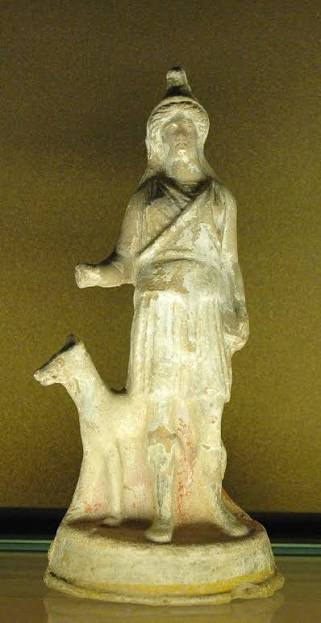
Although Bendis was depicted by Athenian artists before she appeared in Athenian literature, she is seen as a distinct figure, wearing foreign attire. She is shown to be recognizable due to her Thracian clothing; she is often drawn wearing a Thracian mantle fastened by a pin, a style of dress that does not appear on other goddesses, a fox fur hat (the alopekis) and high boots. Unlike Athena, who is never depicted wearing anything but her helmet or crown, and unlike Artemis, who can be depicted either bare foot or wearing sandals, Bendis's attire marked her out in Greek art as a non-Greek deity. A number of vases show her to have been associated with the worship of the gods. For example, on a red-figured vase at Verona she is accompanied by dancing satyrs and maenads, giving her a Dionysian flair.6,7,8
In the Comic Poets
It is evident Cratinus put her in his play Thracian Women, which is believed to date to the 430s BCE, while Aristophanes mentioned her in his Lemnian Women and called her "the great goddess." According to Photius and Hesychius, this is what Aristophanes said: "[She] whom we call the Great Goddess." This is the exact quote cited in Strabo from the Augustan period; Strabo wrote that "the Athenians accepted so many foreign customs" that the comic poets sometimes mocked their acceptance of such customs; Strabo specifically noted the Thracian customs.9,10
Nonetheless, the appearance of Bendis in a way that seems recognizable to an audience with little context seems to show she encompassed a large degree of familiarity among Greek viewers.
At the Opening of the Republic
The most famous Athenian account of her is a scene-setting paragraph in a philosophical dialogue. Socrates says he went down to the Piraeus with Glaucon to pray to the goddess and to see how they would conduct the festival, this being its first performance. He judged the procession of the locals fine and the one conducted by the Thracians no less impressive. Polemarchus then tells him of a torch race on horseback to come that evening, and of an all-night rite, one called the pannychis, after.11
The first paragraph of this section establishes the context of the cult of Bendis. It notes that the Thracian goddess received "two processions" (one Greek and one not) at the harbor of a city at war, and in the end historians know a lot about the Bendideia from Plato.
III. Bendis as Artemis
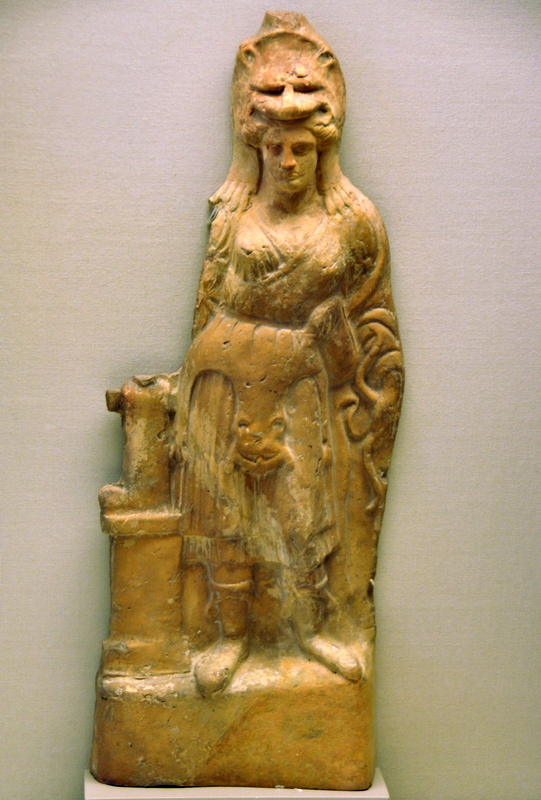
As noted above, Robert Parker writes that Bendis is a "huntress deity similar to Artemis" and to support this argument, Parker cites evidence from several ancient writers who describe Bendis using language that is similar to the descriptions of Artemis. As he points out, this similarity allowed the Athenians to welcome Bendis as a goddess without feeling as if they were welcoming a completely new and therefore possibly unacceptable deity. It is also probable that Bendis was seen as an aspect.12
Artemis Basileia in Thrace
In addition to the information provided by Parker, there are additional references in ancient literature that provide evidence that Bendis was seen as equivalent to Artemis. The first reference comes from Herodotus, who described the worship of Artemis Basileia among the Thracians. Herodotus explained that when women in Thrace sacrificed to Artemis Basileia, they would use wheat-straw as part of their ritual. Scholars believe that Herodotus is referring to Bendis.13,14
Two Temples on One Hill
When the Athenians accepted Bendis as a goddess, they did not necessarily identify her fully with Artemis. Instead, they placed a separate shrine for Bendis near the shrine for Artemis located on the same hill. A significant passage that illustrates this is found in Xenophon's Hellenika. In this work, Xenophon describes events surrounding the Peloponnesian War. Specifically, he mentions that during the fighting in 404 BCE, Athenian warriors were stationed in the marketplace of Hippodamus. These fighters were positioned along a road leading to both the Temple of Artemis of Mounychia and the Shrine of Bendis as separate confines. This fact suggests that even though the Athenians saw a connection between Bendis and Artemis, they still viewed them as separate deities.15
The Reach of the Equation
Although the identification of Bendis with Artemis appears to be fairly complete, there is another aspect of Greek mythology that may shed light on why Bendis was identified with so many different deities and is most revealing. In particular, Proclus refers to Bendis being worshipped as Persephone and Athena, likely fitting into his Triad below the Kore or virgin. However, according to him, she was usually associated with Artemis.
Additionally, Strabo associates the cult practices of Bendis in Thrace with those of Cotyttia (a fertility goddess), Rhea (the mother of Zeus), and Dionysus (the god of wine). Both of these lines of association run towards Cybele (the Mother Goddess) and the mysteries rather than towards hunting. Finally, Selene (the moon) and Hecate (a witch-like goddess) appear in later handbooks based upon the use of moonlight and torches.
Images of Bendis demonstrate this struggle between assimilation and difference as, for example, on a votive relief from the Piraeus (dated approximately 400-375 BCE), Bendis wears a short tunic such as the one worn by Artemis, wears an animal hide such as Artemis' own, and bears a spear; however, she retains her Eastern-style brooch, mantle and boots. The image demonstrates an attempt by Athenian artisans to create a hybridized image of Bendis; one that blends elements from both cultures.7
IV. Sites of Worship
Her sanctuaries seem to be conetrated in one port (Piraeus) and then quickly thinned out. The pattern shown here is the opposite of what we expect from a Thracian goddess, and the areas are listed in chronological order based on the evidence.
The Bendideion on Mounychia
The main place where the cult operated was the temple dedicated to Bendis on top of the Mounychia Hill in the Piraeus, known as the Bendideion. In 404 BCE Xenophon treated it as if every Athenian would know where it was. The location cannot be determined because today's town completely fills the area. However, three fragments of a decree from the fifth century which regulated the cult were discovered on the hill and it is believed that the decree was displayed in the Bendideion.15,16
That decree, IG I^3 136, most likely dated 413/2 BCE, represents the charter of the public cult of Bendis. It establishes provisions for the cult statue, for sacrifices, for the all night ritual, for a religious levy, for the priest and his assistants, and for fifty drachma paid each time. It refers to advice from outside authorities at least once an oracle. The cult was already established when the decree was created. The Treasurers of the Other Gods had included Bendis in their list in 429/8 BCE. Probably before the treasury was created around 434/3 BCE,14,16
In 333 BCE, receipts from the sale of sacrificial hides at the Bendideia totaled 457 drachmas, implying that somewhere on the order of seventy-six cattle were dispatched during the single festival.16,19
The Sanctuary in the City
A second sanctuary was established within Athens. The Decree of the Oregones passed in the year of Archon Polystratus (240/39 BCE), stated that "the Athenian people have granted to the Thracians, uniquely among all foreign peoples, the right to buy property and establish a shrine," and to lead a procession from the hearth of the Prytaneum.20
The Decree is an agreement between two sets of worshippers. Those recently organized in Athens led a procession from the Prtyaneum down to Piraeus along with those already located there and the Managers in Piraeus were to meet them at the Nymphaion with sponges, basins, water, and wreaths. They seemingly provided them with the same food they provide for themselves, while the priests/priestesses were to include those from the city orgeones in their prayers they offered.20
As noted in its introductory statements, the rights being claimed are unique and recognized by its authors. There is no indication that any other foreign group at Athens had a State Cult Shrine nor did any other group lead a procession from the hearth of the City. The notice given to Bendis by Plato himself was probably for distinct reasons.20
Salamis
There is evidence of worshipers of Bendis on Salamis through a collection of Hellenistic Decrees of the Thiasotai published by Michael Osborne. The distinction implied by these documents suggests that Salamis had two shrines of Bendis, however modest. These organizations issuing these decrees consisted of individuals who were not Athenian Citizens.21,22
Laurion
There is only one inscription which indicates that Bendis' cult extended into the silver mining district of Southern Attica. That is a single hexameter poem inscribed over an existing poem (largely effaced). The first poem records a torch-racing victory by an individual named Daos. The name could originate from Bithynia or Mysia and was commonly used as a name for slaves. The name was never used as that of an Athenian citizen. The race that Daos competed in may well be the same torch racing contest on horseback that Socrates watched.23
In short, this inscription can serve as an example of both the geographical and socio-economic extent of Bendis' cult. On one side is a slave or freedman working in a mine in Southern Attica, participating in a festival, composing a hexameter poem in honor of a Thracian Goddess using Attic Greek.
The Northern Aegean
Beyond Attica, there are some real but sparse remains. Petra Janouchova identifies six mentions of Bendis on Thasos near Thrace and also reconstructs possible dedication to Bendis from Samothrace which her editor identified as indicative of a temple to her there. Bendis is mentioned throughout Euboea, Macedonian cities including Ainos and Maroneia, Byzantium, and Northern Asia Minor as well as many others in nearly all cases on monuments dated Hellenistic or later.24
Nikomedes I of Bithynia minted Tetradrachm coins approximately between 280 and 250 BCE with reversals showing a seated woman who is generally accepted by numismatists to represent Bendis through association, similarity and the certain cults of kings.
Thrace
Her native home is blank. Janouchova simply states: "there is no attestation for Bendis' cult itself anywhere in Thrace" and "all remaining remains (in Thrace) are onomastical: e.g., persons bearing divine names".14
V. Objects, Documents, and Their Place of Foinding
Almost everything material comes from Attic soil. Two of the principal documents were found on the hill where they were set up, which is uncommon, and the vases and reliefs were made in Athenian workshops for an Athenian market.
| Object | Date | Ancient Provenance | Present Collection | Status of Identification |
|---|---|---|---|---|
| Accounts of the treasurers of the Other Gods, IG I³ 383 | 429/8 BCE | Athens | Not specified in the sources cited here | Names Bendis; earliest dated attestation |
| Decree on the cult of Bendis, IG I³ 136 | 413/2 BCE (probable) | Piraeus, Mounychia; three non-joining fragments | Piraeus Museum 1595 (frag. b); frags. a and c lost | Names Bendis; regulates an existing cult |
| Votive relief with Bendis and worshipers | c. 400–375 BCE | Piraeus | Not specified in the sources cited here | Identified by dress and attributes |
| Relief with eight youths led to Bendis by two elders | Fourth century BCE | Attica | British Museum 2155 | Torch held by one elder; read as a torch-race dedication |
| Decree of the orgeones of Bendis, IG II² 1283 | 240/39 BCE | Piraeus, western part of the port of Zea | Piraeus Museum 1619 | Names Bendis; records the Dodona oracle and the grant of land |
| Dedication to Bendis by Daos, IG II³ 4, 591 | Fourth century BCE | Mining region of southern Attica | Not specified in the sources cited here | Names Bendis; single hexameter over an erased text |
Sources: the treasurers' accounts and the fifth-century decree as edited in Attic Inscriptions Online;4,16 the Piraeus relief and the vases;7 the British Museum relief;23 the decree of the orgeones;20 the dedication of Daos.23
The Regulation of the Orgeones
A second document can be viewed independently as well. The plaque provides a picture of the religious organization in action rather than as a legal entity. A marble plaque dating to either the year 330 BC or 320 BC (the orgeones) which is housed in the Epigraphical Museum in Athens lists the costs of sacrifices made by individual citizens to the priestess, so the evidence of this shows a highly functioning cult rather than something primitive.25
VI. The Goddess Who Went the Wrong Way
The Political Reading
There are many different ways to describe how Bendis came to be worshipped in Athens. Most descriptions portray the process diplomatically. In the mid-400’s BC Athens was seeking out alliances with the King of Thracia, Sitalkes, due to his control of timber, silver mines, and grain routes. Additionally, Sitalkes’ kingdom was also home to numerous cavalry units. As stated by Thucydides: "proxeny for Nymphodorus of Abdera" (who had married Sitalkes’ sister), an alliance brokered through him; and “citizenship” given to Sitalkes’ son Sadokos. On this interpretation of events, a cult honoring a Thracian goddess located at the port of Athens was simply another aspect of the agreement. It was primarily intended to serve the needs of the Thracian residents living at the Port of Athens12,14,26
Peter Liddel has challenged the standard explanation of how Bendis arrived in Athens. He questions whether there is sufficient reason to assume that the cult was formally recognized by the government of Athens during the period immediately prior to the time when it is first attested. He maintains that none of the frequently cited explanations of why Athens formally recognized Bendis are supported by credible evidence. Liddel reviews exactly the same evidence everyone else uses: the Kallias decree(s); the accounts of the treasurers, the fragments of Cratinus, and the representations of Bendis on vases.6
The debate between Liddel and other scholars concerning the timing and rationale behind Athens formal recognition of Bendis has significant implications regarding our understanding of the primary source materials. A religion whose introduction into a very well-documented city could not be fixed within a span of twenty years nor otherwise adequately explained would not likely be as thoroughly understood as it is presented in most handbooks.
Templum Mendidium: Possible Thracian Evidence
The single reference in classical literature to a sanctuary dedicated to Bendis in Thrace is problematic. In describing Gnaeus Manlius Vulso’s march from the Thracian Chersonese toward the river Hebrus in 188 BCE, Livy identifies a temple located less than a day’s journey from the land controlled by Aenos. All surviving manuscripts give the words Templum Mendidium. One 16th century editor changed it to Bendidium and it has remained so ever since.5
Dilyana Boteva-Boyanova supports changing templum Mendidium to Bendidium, citing that both readings are functionally equivalent and that they represent reasonable conjectures based upon variant readings within the manuscript tradition, but Jordan Iliev does not support changing templum Mendidium to Bendidium and believes instead that we should follow the manuscripts and conclude that this temple was part of an Ionic colony named Mende that was allegedly located at or near the lower reaches of the Hebrus River close to Aenos.27,28
Foreign in Both Directions
Bendis retained her headgear (cap), her cloak (mantle), her boots and her name in a city that possessed every resource available to absorb her and did so for others. Dionysus became an Olympian; Bendis continued to be the goddess of the Thracians and was worshiped in a sanctuary of her own next to an Artemis that was not hers; by organizations comprised of metics and slaves and freedmen; at a festival that Athens subsidized and at which Athenian comic poets jeered.
Herodotus called her Artemis the Queen before Athens had heard of the Bendideia. Athens called her Bendis for two hundred years after. The identification persisted yet it never eclipsed the identity of Bendis herself, leaving probably only Proclus' explanation as the coherent one.
Sources and Bibliography
- Tomaschek, Wilhelm. Die alten Thraker: Eine ethnologische Untersuchung. 2 vols. Sitzungsberichte der Kaiserlichen Akademie der Wissenschaften, Philosophisch-Historische Classe 128 and 130. Vienna: F. Tempsky, 1893–94. Cited for the derivation of Bendis from Proto-Indo-European *bhendh-, "to bind."
- Detschew, Dimiter. Die thrakischen Sprachreste. 2nd ed. Schriften der Balkankommission, Linguistische Abteilung 14. Vienna: Österreichische Akademie der Wissenschaften, 1976. Cited for the entry on Βένδις and the range of proposed meanings, including "Binder," "Catcher," and "Archer."
- Hesychius of Alexandria. Lexicon. Edited by Kurt Latte, Peter Allan Hansen, and Ian C. Cunningham. 4 vols. Sammlung griechischer und lateinischer Grammatiker 11. Berlin: De Gruyter, 1953–2009. Cited entries: δίλογχον, for Cratinus's epithet of Bendis and the three explanations offered; Βένδις; and the entry preserving Aristophanes's phrase from the Lemnian Women.
- Inscriptiones Graecae I³ 383. Accounts of the treasurers of the Other Gods, 429/8 BCE. Cited lines: 142–43, for the earliest dated mention of Bendis, there linked with Adrasteia. See also IG I³ 369, lines 67–68 (423/2 BCE), where the two appear separately.
- Livy. History of Rome, Volume XI: Books 38–39. Translated by Evan T. Sage. Loeb Classical Library 313. Cambridge, MA: Harvard University Press, 1936. Cited section: 38.41.1, on the temple passed by Gnaeus Manlius Vulso within a day's march of the territory of Ainos.
- Liddel, Peter. "The Goddess Bendis in Fifth Century Athenian Culture." Vestnik Drevnei Istorii [Journal of Ancient History] 83, no. 2 (2023). Cited for the re-examination of the Kallias decrees, the treasurers' accounts, the fragments of Cratinus, and the early vases, and for the argument against the received account of the cult's adoption.
- Simon, Erika. "Bendis." In Lexicon Iconographicum Mythologiae Classicae, vol. 3, pt. 1, 95–97; vol. 3, pt. 2, pls. 84–86. Zürich and Munich: Artemis Verlag, 1986. Cited for the vases of the 430s and 420s, including the vessel linking Bendis with Themis, for the Piraeus votive relief of c. 400–375 BCE, and for the goddess's dress and attributes.
- Bäbler, Balbina. Fleissige Thrakerinnen und wehrhafte Skythen: Nichtgriechen im klassischen Athen und ihre archäologische Hinterlassenschaft. Beiträge zur Altertumskunde 108. Stuttgart and Leipzig: B. G. Teubner, 1998. Cited for the archaeological record of non-Greeks at Athens and for the Thracian elements of Bendis's iconography.
- Kassel, Rudolf, and Colin Austin, eds. Poetae Comici Graeci. 8 vols. Berlin: De Gruyter, 1983–2001. Cited fragments: Cratinus, Thracian Women, fr. 85; Aristophanes, Lemnian Women, fr. 384.
- Strabo. Geography, Volume V: Books 10–12. Translated by Horace Leonard Jones. Loeb Classical Library 211. Cambridge, MA: Harvard University Press, 1928. Cited section: 10.3.18, on Athenian hospitality to foreign rites and the mockery of the comic poets.
- Plato. Republic, Volume I: Books 1–5. Edited and translated by Christopher Emlyn-Jones and William Preddy. Loeb Classical Library 237. Cambridge, MA: Harvard University Press, 2013. Cited sections: 327a and 328a, on the descent to the Piraeus, the two processions, the torch race on horseback, and the all-night rite.
- Parker, Robert. Athenian Religion: A History. Oxford: Clarendon Press, 1996. Cited pages: 170–75, on Bendis as a huntress deity resembling Artemis and on the incorporation of her cult into Athenian religion; 26–27, on the hearth of the city hall.
- Herodotus. The Persian Wars, Volume II: Books 3–4. Translated by A. D. Godley. Loeb Classical Library 118. Cambridge, MA: Harvard University Press, 1921. Cited section: 4.33, on the Hyperborean offerings and on Thracian and Paeonian women sacrificing to Artemis the Queen with wheat straw.
- Janouchová, Petra. "The Cult of Bendis in Athens and Thrace." Graeco-Latina Brunensia 18, no. 1 (2013): 95–106. Cited for the survey of the Athenian and Thracian evidence, for the attestations on Thasos and the possible dedication from Samothrace, for the distribution of the name in the northern Aegean and Asia Minor, and for the conclusion that no physical evidence of the cult survives in Thrace itself.
- Xenophon. Hellenica, Volume I: Books 1–4. Translated by Carleton L. Brownson. Loeb Classical Library 88. Cambridge, MA: Harvard University Press, 1918. Cited section: 2.4.11, on the road leading to the temple of Artemis of Mounychia and the sanctuary of Bendis.
- Lambert, Stephen, and Robert Parker, trans. "IG I³ 136: Decree about the Cult of Bendis." Attic Inscriptions Online, AIO 1246. Updated July 21, 2024. Cited for the text and notes: the date of 413/2 BCE, the three fragments from Mounychia, the provisions for statue, sacrifices, all-night rite, cult tax and personnel, the appeals to oracular advice, the proximity of the Bendideion to the sanctuary of Artemis Mounychia, and the calculation from the hide sales of 333 BCE.
- Proclus. Théologie platonicienne. Edited and translated by H. D. Saffrey and L. G. Westerink. 6 vols. Collection des Universités de France. Paris: Les Belles Lettres, 1968–97. Cited for the identification of Bendis with Persephone and, more commonly, with Artemis.
- Strabo. Geography, Volume V: Books 10–12. Translated by Horace Leonard Jones. Loeb Classical Library 211. Cambridge, MA: Harvard University Press, 1928. Cited section: 10.3.16, grouping the Cotytian and Bendideian rites of Thrace with those of Rhea and Dionysus.
- Inscriptiones Graecae II² 1496. Records of the sale of sacrificial hides. Cited lines: 86–87, for the 457 drachmas realized from the Bendideia of 333 BCE.
- Lambert, Stephen, and Robert Parker, trans. "IG II² 1283: Decree of the Orgeones of Bendis (240/39 BC)." Attic Inscriptions Online, AIO 1248. Updated June 28, 2025. Cited for the text and notes: the grant of land to the Thracians alone, the oracle from Dodona, the procession from the city hall, the reception at the Nymphaion, the shared meal, the addition of the city orgeones to the prayers, and the findspot at the western part of the port of Zea.
- Osborne, Michael J. "Five Hellenistic Decrees of the Salaminian thiasotai of Bendis." Horos 17–21 (2004–9): 657–72. Cited for the Salaminian decrees and their dating.
- Arnaoutoglou, Ilias. "Cult Associations and Politics: Worshipping Bendis in Classical and Hellenistic Athens." In Private Associations and the Public Sphere: Proceedings of a Symposium Held at the Royal Danish Academy of Sciences and Letters, 9–11 September 2010, edited by Vincent Gabrielsen and Christian A. Thomsen, 25–56. Copenhagen: Royal Danish Academy of Sciences and Letters, 2015. Cited for the associations of Bendis, the implication of two cult places on Salamis, and the relation between private association and civic festival.
- Lambert, Stephen, trans. "IG II³ 4, 591: Dedication to Bendis by Daos." Attic Inscriptions Online. Cited for the single hexameter cut over an erased earlier version, the servile associations of the name Daos, the identification of the torch race, and the fourth-century relief in the British Museum showing eight youths led to Bendis.
- Sear, David R. Greek Coins and Their Values. Vol. 2, Asia and North Africa. London: Seaby, 1979. Cited for the tetradrachms of Nikomedes I of Bithynia, c. 280–250 BCE, whose reverse type is identified as Bendis.
- Sokolowski, Franciszek. Lois sacrées des cités grecques. École française d'Athènes, Travaux et Mémoires 18. Paris: E. de Boccard, 1969. Cited: LSCG 45, the regulation of the orgeones of Bendis, for the sacrificial tariff, the exemption of members, and the division of perquisites between priestess and priest; LSCG 46, for IG II² 1283.
- Thucydides. History of the Peloponnesian War, Volume I: Books 1–2. Translated by Charles Forster Smith. Loeb Classical Library 108. Cambridge, MA: Harvard University Press, 1919. Cited section: 2.29, on Nymphodorus of Abdera, the alliance with Sitalkes, and the citizenship granted to Sadokos.
- Boteva-Boyanova, Dilyana. "The Sanctuary of Bendis in Thrace and the Manuscripts of Livius." Cited for the defense of the reading templum Bendidium at Livy 38.41.1 as a reasoned conjecture drawn from the manuscript variants rather than an error.
- Iliev, Jordan. "Gn. Manlius Vulso's March through Thrace in 188 B.C. according to Livy's Manuscript Tradition." Aristonothos: Rivista di Studi sul Mediterraneo Antico 15 (2019). Cited for the defense of the manuscript reading templum Mendidium and its association with the settlement of Mende near the lower Hebrus.