





| Language / Culture | Name of Diana | Attestation |
|---|---|---|
| Old Latin | Dianai | Bronze dedications from Nemi (3rd to 1st centuries BCE) |
27 min read
DIANA
author: High Priest Zevios Metathronos
co-author: Novice Priest Karnonnos
I. Name
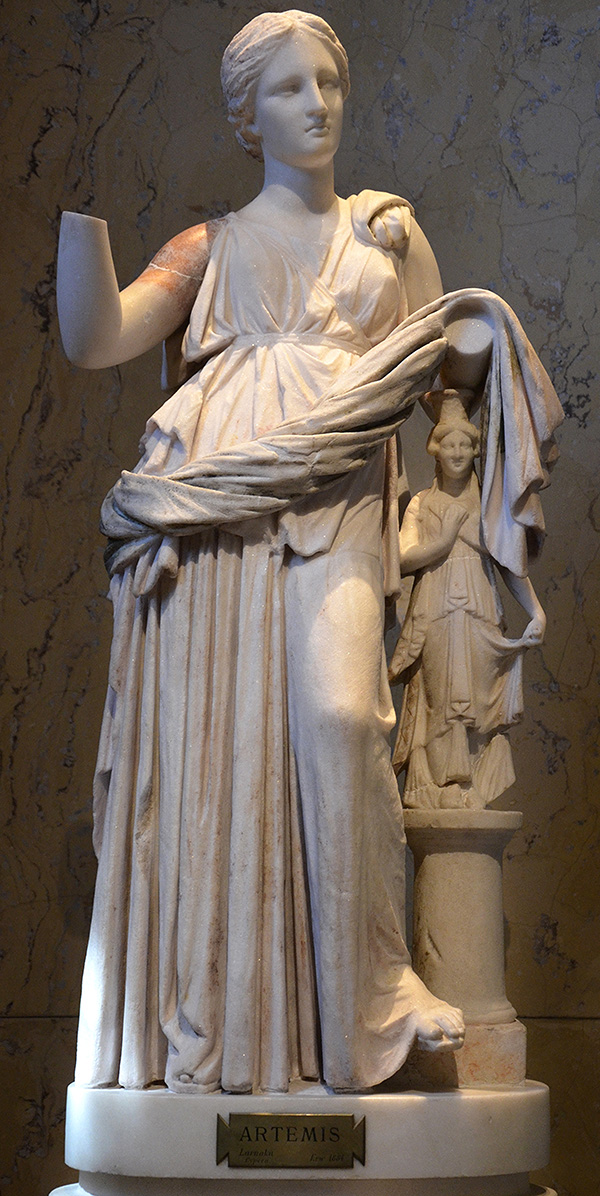
Larnaca Artemis from Cyprus, 2nd century BCE
The name Diana is derived from the Latin name for the Roman goddess and is formed using the same Italic stem that can be seen in the names dius and dies. These are Latin terms that mean 'the bright sky' and 'daylight', which have at their base the Proto-Indo-European root *dyew-, "shining", also the source of the word deus and of the Roman god Jupiter. As such, Diana is the shining one, the female aspect of the bright sky. In addition, Michiel de Vaan considers Diana to be a native creation in the above named family rather than an importation.1
It is curious that Diana was connected to the Moon while epitomizing the day itself. To explain that, the Stoic speaker from Cicero derives Diana from dies ("day") because she turns nighttime into daytime; he also gives her the additional title of Omnivaga (wide-roaming) to describe how the moon goes through its monthly cycle. Varro wrote down an older version of this name as Diviana and states that Diana was associated with the moon which creates a "kind of" day during the night. Possibly her Roman name reflected her tie to her twin, Apollo, or represents the night's 'termination' of day.2,3
There are very few references to this form of the name from antiquity. There is no ancient stone inscription which can be dated to this period. In his Origines, Cato had transcribed the dedication of the sacred grove of Aricia (the lucum Dianium in nemore Aricino) made by Egerius Baebius of Tusculum as dictator Latinus on behalf of some eight other Latin peoples. With that archaic formula from the sixth century BCE, it contained an adjective for the goddess Diana named Dianius.4
The earliest bronze examples of this type of cutting were found in Diana’s temple at Nemi; they are votive bronzes inscribed in an archaic dative form as “Dianai”, and include the plaque donated by Publilia Turpilia for her son Gnaeus. This plaque has an inscription written to emulate ancient forms of dedicatory language. Alongside these is another example of this tradition of inscription which survives through Macrobius’ account of the views of Nigidius Figulus, that Apollo was Janus and Diana was Iana, both having their names reduced to a single bright root, the same as the god of doors.5,6,7
Sources: de Vaan, Etymological Dictionary of Latin (2008); Varro, De lingua Latina 5.68; Cato, Origines fr. 58 Peter; the Nemi dedications in Remains of Old Latin IV.1,2,4,5
II. Roman History
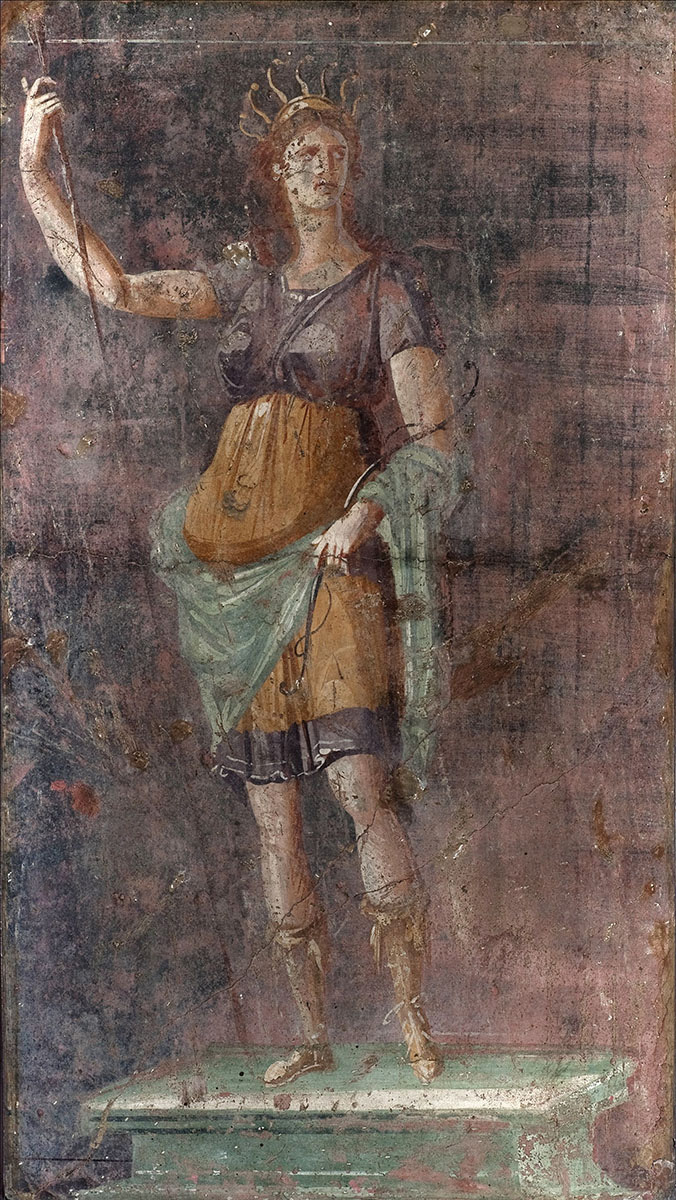
Diana, fresco from Pompeii
The Aventine Foundation
Diana entered Roman public religion as an instrument of statecraft. According to Livy, when the Romans used public religious practice as a means of foreign policy, Diana was part of that. He states that when Servius Tullius attempted to persuade the Latins to build a temple of Diana on the Aventine Hill with Rome as its base (as did the Greeks), this was to show that Rome had finally established itself superior to all other contending powers.
In the same book, he tells the story of the 'Sabine heifer' which is described as being "wonderfully" large. The people from the city who were responsible for sacrificing it would be granted power by the gods. When the Sabines took the heifer to the altar of Diana located at the top of the Aventine hill, the high priest of Rome asked them to bathe in the Tiber before they could sacrifice the animal. However, the high priest then proceeded to make the sacrifices. For many years, the horns of the heifer were kept in the temple as proof that Rome had outsmarted its opponents.8
Dionysius of Halicarnassus provided the subsequent evidence to back up these claims. According to him, all the cities paid their portion from public coffers, the festivals and meetings of the confederation were held at this new temple, and the covenant for the founding of the League, which was inscribed upon a bronze pillar listing the names of all the member-cities, had remained intact until his time.9
The Remarks of the Antiquarians
Although the tradition remained alive through the goddess long after the kings, it continued to be applied. The earlier name and lunar interpretation were maintained by Varro while Nigidius (as reported by Macrobius) made a theological link with Janus as Iana. In addition, Macrobius elsewhere also transmitted the physiologic theory, derived from Greek banquet question material, which stated the moisture and heat of the moon would mature bodily development and ease childbirth, and thus was the theoretical basis for the invocations of Diana by women in childbirth.2,7,10
Diana Throughout Latium
The Aventine Temple came after her presence was already adjacent to Roman contexts. In his list for the Arician grove, Cato lists a number of towns (Tusculum, Aricia, Lanuvium, Laurentum, Cora, Tibur, Pometia, and Ardea) as being involved communiter in a map of the old city-state of Latium. Horace did speak of the goddess of the hill on the Aventine and the wooded mountain of the Aequian border in his Hymn to the Secular games, thus putting her hill and hers alone, against the others. Festus records another way that some remember this. Manius Egerius is said to have consecrated the grove to Diana and Strabo wrote about the sanctuary at Aricia as he found it, filled with people, money and odd priests. Before Rome began to organize all of these, the cult sites for Diana were spread around the Alban Hills. Thus when Rome built a temple to Diana, it was more like an addition to what appareetly already existed.4,11,12,13
III. Epithets
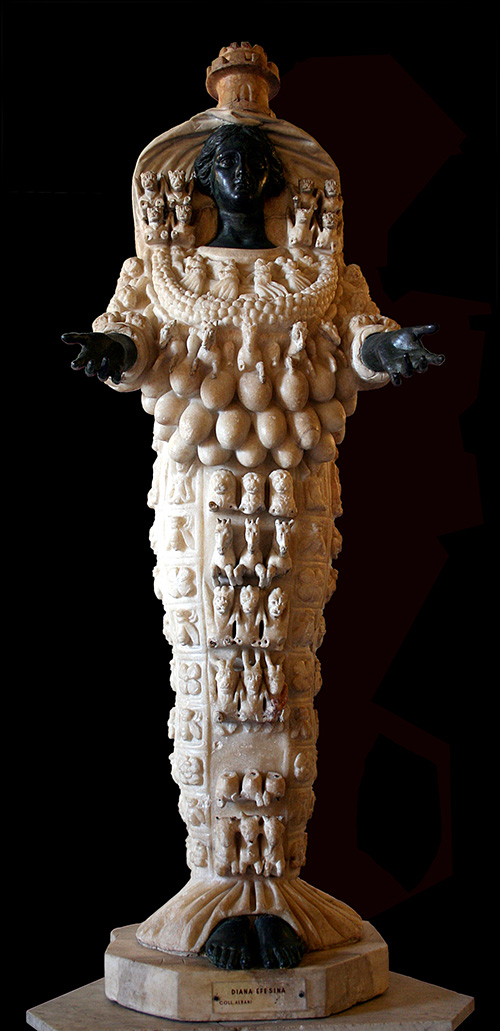
Artemis-Diana of Ephesus
| Epithet | Meaning | Domain |
|---|---|---|
| Diana Nemorensis | Diana of the Grove | The sanctuary at Nemi |
| Diana Aventina | Diana of the Aventine | The federal temple at Rome |
| Diana Tifatina | Diana of Mount Tifata | The great Campanian sanctuary above Capua |
| Diana Lucina | Diana the Light-Bringer of Birth | Childbirth |
| Diana Lucifera | Diana the Bearer of Light | The Moon, torchlight |
| Diana Trivia | Diana of the Three Ways | Crossroads, the triple goddess |
| Diana Triformis | Diana of Three Forms | Kore triad, Hecate |
| Diana Omnivaga | Diana the Wide Wanderer | The moon's circuit |
| Diana Augusta | August Diana | Imperial cult |
Sources: Cicero, De natura deorum 2.68–69; Horace, Odes 3.22 and Carmen Saeculare; Catullus 34; the dedications collected in CIL, including the Tifatina inscriptions.3,11,14,15
IV. Temples
Aricia (Nemi)
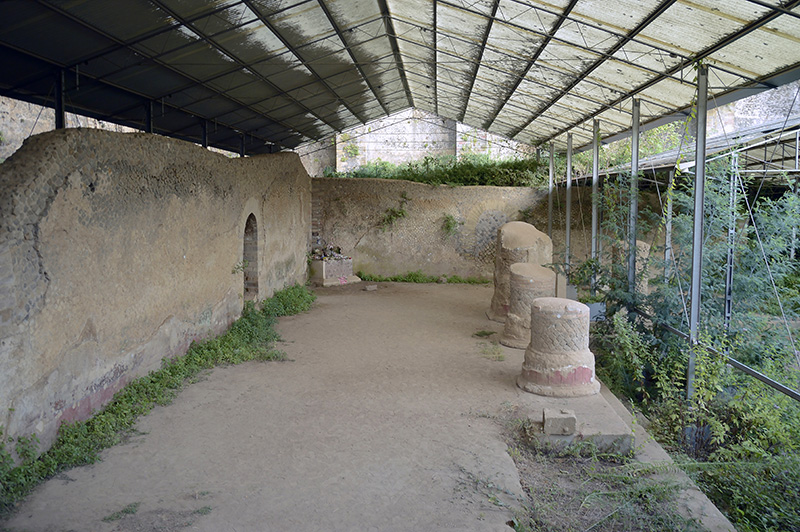
Ruins of Nemi, altar room
Lake Nemi is eleven miles from Rome via the Via Appia to the south, The history of the temple itself is shrouded in an ancient Latin mystery as it belonged to the city state of Aricia; ultimately, it became the famous sanctuary to Diana by far, rivalling the fame of her other holy sites in Greece and Anatolia. Excavations have already shown that the site was active in the most archaic periods of history. Livy references in his Annals that a dedication in the Arician woods was made by the dictator Latinus.
At the end of the Latin revolt in 338BCE, Aricia was absorbed into the Roman state along with sixteen other Latin cities. The Aricians in the decades after founded an opulent new temple with a new gilded golden roof and other facets unacceptable to their Roman conquerors, so the temple has been viewed as asserting a Latin identity. The area around the temple developed into a highly complex commercial district welcoming endless pilgrims, as the invectives against Augustus' ancestors from the area attest.
Thanks to pivotal excavations such as the one of 1885, archeologists such as Mette Moltesen have examined groups of statues tied to both Diana and Apollo at the site, often rendering complex examples of Greek myth. One headless seated statue may have represented her regal aspect. Statuettes of Diana in Greek-style as the huntress Artemis are the most popular early items.16,17
The emperor Augustus renovated the site. Other emperors appeared to use it as a place of purification. During the first centuries CE, the context of the site being used as a place of healing and incubatio becomes obvious with references to many doctors working there, particularly ones directed toward healing 'deformity'. The grammarian Festus seemingly alludes to the contradiction of Nemi in a proverb "Multi Mani Ariciae", because one aspect of this proverb praised the Manii gens (led by Manius) for dedicating at such an illustrious site, but others like Sinnius Capito interpreted the phrase with 'Mani' (Manius was a common name, mani meaning ugly mask) to describe the plebeian crowd needing healing there. 18,19
Capua
Mount Tifata in Capua formed another important focus of the worship of Diana Tifatina, a very notable nexus of her worship in the province of Campania. It owned extensive lands, receiving endless funding and contributions from Roman military campaigns. This form of Diana received empire-wide worship by the military because of the victories over Hannibal at Capua in 212BCE and Sulla's victory over Norbanus in 83BCE, leading to the latter establishing it as a territorial zone with rights.20,21,22,23
Inscriptions from Tifata show the importance of Diana as huntress, while a famous mosaic of a sacred choir was also recovered from the site. Pausanias while digressing from his description of Olympia claims he also saw the temple in Italy and claimed to have witnessed the skull of a giant elephant there.23,24
The Aventine Temple
The temple of Servius Tullius on the Aventine remained the chief house of Diana at Rome for the whole life of the city. Its founding charter had a legal afterlife of its own, for the regulations of the altar, the lex arae Dianae in Aventino, became the standard formula of Roman sacred law; the charter of the altar of the imperial cult at Narbo in Gaul closes by ordering that its rules be the same as those of the altar of Diana on the Aventine. Under Augustus the temple was rebuilt by Lucius Cornificius, one of the works Suetonius lists among the monuments the princeps encouraged other leading men to raise, and it carried the name Diana Cornificiana thereafter.8,9,15,25
Circus Flaminius
A second temple stood in the southern Campus Martius. Marcus Aemilius Lepidus vowed temples to Juno Regina and to Diana in his Ligurian campaign, and Livy records his dedication of both in 179 BCE near the Circus Flaminius, with games marking the occasion.26
The Shrines
Dedications for a Diana Planciana were made to a member of the gens Plancia. The dedication for this Diana Planciana can be found on the Quirinal. Although the site is believed to be located near there, the location has been identified with less exactness than other sites. This dedication is recorded in the topographic records as being among the smallest of the many shrines dedicated to the goddess Diana within Rome.27
Plutarch also reported that there were two unusual rituals associated with worship of Diana in Rome. All temples of Diana were adorned with deer antlers (except for those at the Aventine) in honor of an ancient Sabine cow, and there existed a single temple of Diana that men did not enter, which was said to be located in the Vicus Patricius.27,28
V. Diana and Apollo
The Romans paired the twins together strongly. Catullus' poem called Diana the greater daughter of Latona (Leto), born by the Delian olive tree, mistress of the mountains and of the green woods. The origin of Leto's children were among Rome's very early Greek borrowings. The combination also became a matter of ritual for both poetry and actuality. During Rome's earliest supplication (the banquet of the gods), Apollo and Latona were seated on one couch and Hercules and Diana on another.14,29
Between his mother and his sister, the temple of Apollo, located on the Palatine Hill, featured Apollo between his mother and sister Diana in this sanctuary where the emperor Augustus commemorated Actium. At the Secular Games of 17 BCE they had an entire hymn as Horace's chorus of young boys and girls sang to Apollo and Diana as a group, to the goddess of the Aventine and Algidus hills, who attended the prayers of the Fifteen and the saeculum was dedicated to the twins.11,30
VI. Dianas of the Frontiers
On the northern frontiers the name Diana did the same work the name Mercury did for the male gods of Gaul: it gave a Latin face to native powers of forest and height. In the Ardennes the goddess Arduinna, the numen of the wooded heights whose one secure altar reads deae Ardbinnae, was worshipped under the Roman name; when her cult meets us last, in Gregory of Tours's account of the stylite Vulfilaicus pulling down the great statue on the hill near the Ardennes, the goddess the country people served is called simply Diana.15,31
In the Black Forest the equation is epigraphically explicit. Tacitus knew Abnoba as the mountain from whose slope the Danube rises, and the altars of the region, at Badenweiler among the healing springs and at Mühlenbach on the road, invoke Diana Abnoba by the double name, the Roman huntress and the forest goddess fused in a single dative.15,32 Miranda Green reads these frontier Dianas as the standard grammar of interpretatio in the west, the local mistress of beasts and wild country addressed through the imperial vocabulary, and the soldiers and officers of the frontier provinces left Diana more dedications than almost any goddess of the wild.33
VII. Diana as Goddess of the Roman Countryside
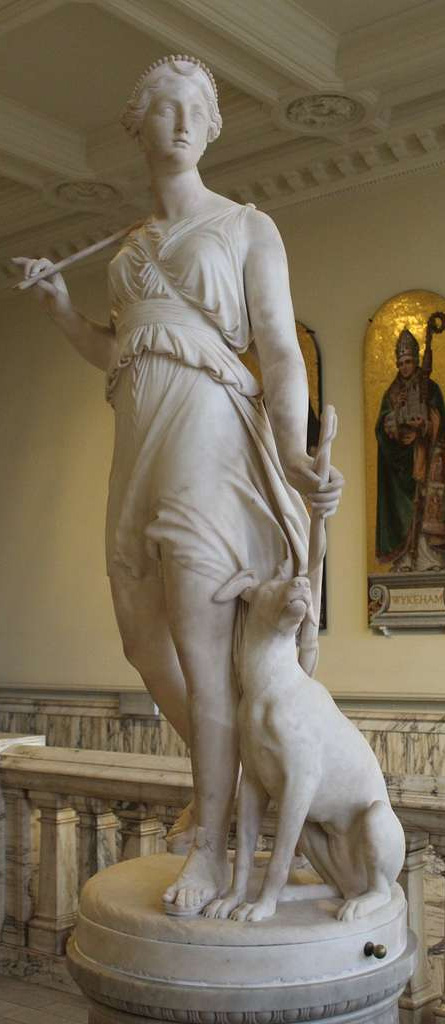
Giovanni Maria Benzoni, Diana Hunting (1859)
The wilderness lay on one side of the city and the countryside was the other. Just as her Greek counterpart, the Roman Diana was held to control the countryside and urbs from either end. Horace's ode to his Sabine farm operated as a delineation of a mini-cult: she protects mountains and groves and listens to girls in labor, and he dedicates to her the pine tree leaning over his villa; he will sacrifice the blood of a young boar to her once a year. In eight lines the wild huntress and protector of the household land are one goddess.
The hunting poets began their work under her patronage. As an example, Grattius starts his Cynegeticon off with Diana (the giver of the arts of the hunt) before naming a single dog. The large rural sanctuary at Aricia demonstrates what the countryside expected from her. Healing was one of the foremost aspects. The shrine on the lake became a vacation spot for those who were sick or hoped to be cured. Pilgrims filled the terraced areas of the shrine and its deposits contained many votive offerings from the citizens of the surrounding countryside. C. M. C. Green in her study indicates how the healing aspect of Diana's cult was tied to nature.6,11,34
VIII. The Plebeian Emphasis
The Aventine was located beyond the pomerium, which defined the city, and it was the home of the plebeians, who were a people of merchants, foreigners and the poor. The Temple of Diana served both as an archive for the plebeians and a place of refuge. Dionysius states that the law which secured the Aventine to the plebeians was written in bronze and placed in the temple of Diana, so the charter of the hill remained housed within her dwelling.6,9,27
The relationship between masters and slaves was so well-known as to become a common reference point. The Ides of August (the birthday) of the Temple of Diana at Aventine Hill is the day when both male and female slaves would celebrate their "holiday" or time off from work. The ancient writer Plutarch in Roman Questions rhetorically asked why this day was celebrated by both male and female slaves.13,25,28,35
IX. Household Worship
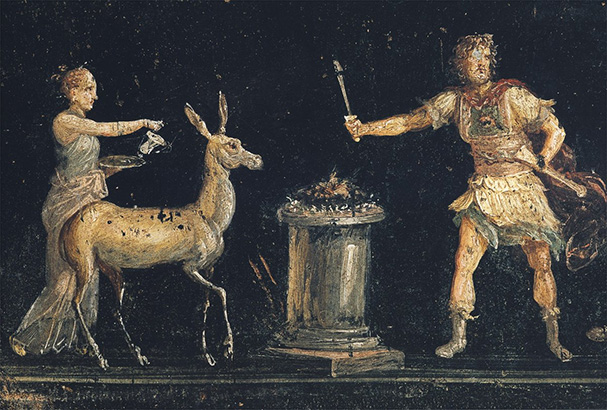
Diana sacrifice scene, House of the Vettii (60-79CE)
The cult of the family was most evident in what families contributed. Household documents, the Nemi bronzes, include a statue dedicated by Publilia Turpilia to Diana for her son, as well as a bronze left to the goddess by the nurse, Paperia. They are the offerings of a mother and a nurse of the nursery, rather than those of public officials.5,6,11
In addition to carrying the household cult into the field during the course of the year (at least annually), women also took it outside the home. According to Propertius, Cynthia runs with lit torches to take light to Trivia's grove, and there she discharges a private vow through the use of torchlight as she makes her way down the road to Nemi. Plutarch further notes that the domestic aspect of the festival included washing the hair of the women on the day of the goddess's Ides. This festival had become so routine for these women that they washed their hair as part of the rituals involved with it.28,30
X. Diana-Selene; Roman Interpretations Cosmologically
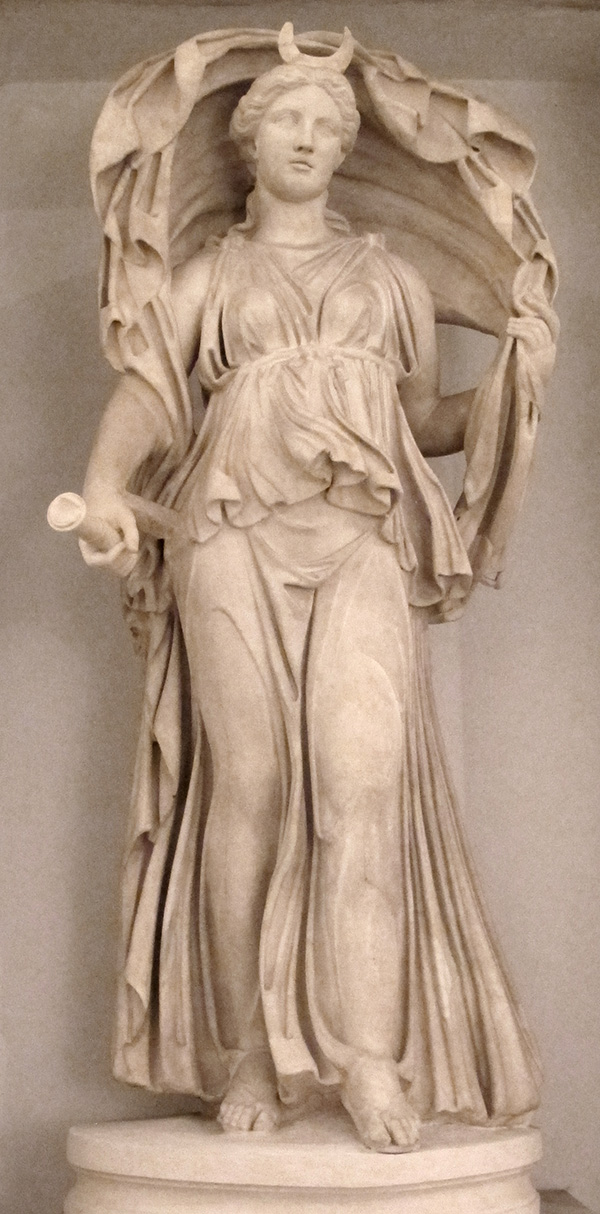
Diana-Selene, an Early Imperial copy of an original from the early 4th century B.C., Capitoline Museums
The Roman cursory philosophical interpretation of Diana through reading is lunar and has three parts as briiefly stated, Varro and Cicero derived the origin of Diana from the root of light (day) and placed her in the sky as the moon that creates day out of night; thus, they described her as the wide roamer of the month.2,3,10
In his hymn, Catullus describes her by the titles Trivia and Luna at once and Horace prayed to the Diva Triformis. Other poets established the canon for the triple form. Servius did so when he identified Diana as the Virgin with Three Faces as being Hecate in Virgil's three folded state. Therefore Diana was Luna in Heaven, Diana on Earth, and Proserpina in Hades. Macrobius completed this description physically in regard to the physical aspect of the Moon's moist Influence over the growth of bodies and time of birth.11,14,36
The Roman inheritance of Diana from her Latin origins appears to have placed more emphasis on her identity as a lunar deity. Some scholars have observed that the Greek form of Artemis becomes more closely identified with Selene, the moon goddess, after most of the Hellenistic world was annexed to Rome. On the other hand, the relationship of Artemis to both Selene and the Titaness named Phoebe is established in Greek myth earlier than this.
XI. Festivals of Diana
| Festival | Date | Observance |
|---|---|---|
| Nemoralia at Aricia | Ides of August (13 August) | Torch-lit procession |
| Dies Natalis of the Aventine temple | Ides of August (13 August) | Diana, Servius Tullius |
| Servorum Dies | Ides of August (13 August) | Holiday of slaves, women washed hair in the goddess's honor |
Sources: Plutarch, Roman Questions 100; Statius, Silvae 3.1; Martial 12.67; Ovid, Fasti 3.263–272.28,37,38,39
XII. The Inversion; Medieval Diana as Witch and Demon
The first time Diana appeared after the cessation of worship in the metropole of Roman cities was when Gregory of Tours in the sixth century said the peasants of the Ardennes continued to worship Arduinna (Diana) until missionaries destroyed the statue.
The Canon Episcopi, which included Diana as part of a key document of medieval beliefs regarding witchcraft. Around 906 AD, Bishop Regino of Prüm wrote and distributed his Canon Episcopi in a guide book for Bishops, which condemned certain wicked women, who had been deceived by demonic deceptions, believed they rode out during the dead of night on beasts with Diana, goddess of paganism, along with countless numbers of women, traveling vast distances, while answering to Diana as their mistress.
The Canon itself says that the ride is a deceptive fantasy, but it fixed Diana as the Mistress of the so-called Night-Flight for the remainder of the Middle Ages. The inclusion of the Canon Episcopi into Gratians Decretum in the Twelfth Century added the authority of canon law to this image. It is a strange curiosity that Artemis appeared to weather five centuries of libel to attract new worshippers.31,40
Burchard of Worms took up this text in his Penitential, and added Herodias to Diana as the lady of the ride. Confessors were instructed to ask questions about these beliefs for over three hundred years. Enough vitality remained in this tradition so that it reached the courts. At the end of the Fourteenth Century in Milan, two women, Sibillia and Pierina, were prosecuted for belonging to a group known as the Society of Diana or a gathering of the Lady referred to as Oriente. This was one of the last times the Company of Diana would appear before disappearing altogether. It is a point identified by Carlo Ginzburg as the intersection between the old beliefs regarding the Company of Diana and the new stereotype of the Witches Sabbath. By the time the Great Persecution occurred, Diana had turned from the goddess of the Aventine to become a demon of night. The demonologists referenced the Canon Episcopi.41,42
XIII. Diana in Renaissance and Baroque Art
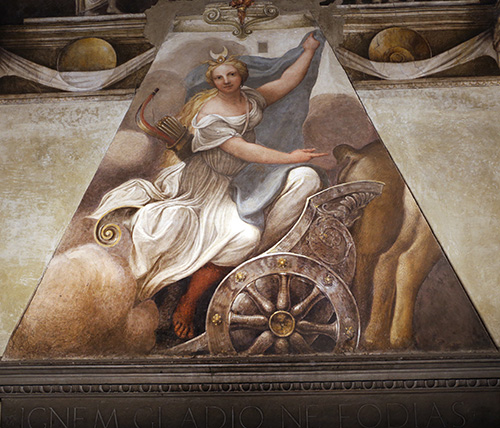
Correggio, Diana (1517)
In the Renaissance, the cultured denizens of Italy recovered the divine huntress as a positive symbol, evolving from display in cassone from the 1390s onwards to a positive portrayal with Correggio's work Diana (1517).43,44
The painters took her from ancient poetry, the bow, the quiver, the dogs, the little tunic and most of all the crescent moon she wore as a diadem to indicate that she was Diana, an indicator common to the entire tradition. In the mid-16th-century French court, she became a political language around Diane de Poitiers, the school of Fontainebleau created the slender naked huntress of the Louvre and a complete artistic expression of Diana at the Château d'Anet for the queen's mistress and the goddess who lent each other their names45,46
Diana was always a source of material for the Baroque painters. They adapted stories from Ovid into the major themes of female nudity and divine anger following on from the moralistic cassone. Titian’s “poesie” (paintings) for King Philip II of Spain became the model for the rest of Europe when he created Diana and Actaeon and Diana and Callisto. In those two works Titian showed the fatal consequences of the bathing. Domenichino later added many figures to the Borghese Gallery’s painting of Diana on a hunt with an archery competition among the nymphs. Rembrandt then brought together Actaeon and Callisto in one forest pool. Rubens went back to Callisto’s shame. And finally, Vermeer started his career by creating Diana and Her Companions but unlike all of the others he depicted the goddess in a way that emphasized her quiet, calm, and peaceful state.45,46
XIV. Diana as Goddess of Women in Roman Times
For Roman women Diana was above all the goddess who brought children into the light. Catullus's hymn addresses her as Juno Lucina to women in labor; Cicero explains the invocation by the moon's government of the months of gestation; and the Carmen Saeculare prays to her under the names Lucina and Genitalis to bring births to term and raise up the generations of Rome. The philosophical tradition Macrobius transmits gave the same belief its physics, the moist lunar warmth that opens the womb.3,10,11,14
Deposits from Nemi clearly contained many offerings made by women, including terracotta representations of mothers and children and anatomical images relating to childbirth. They also include objects donated for safe birth, healthy development of offspring, and for successful pregnancy. In addition to these artifacts the inscriptions preserved at the sanctuary record that a mother named Publilia Turpilia made an offering on behalf of her son, and a nurse named Paperia made an offering while she was still in the nursery. These torches represent part of this devotion. Ovid writes about the women who went to the sanctuary, crowned, bearing burning brands and it seems their vows were fulfilled. Cynthia ran the same route under her light.5,6,28,30,39
Sources and Bibliography
- Michiel de Vaan. Etymological Dictionary of Latin and the Other Italic Languages. Leiden Indo-European Etymological Dictionary Series 7. Leiden: Brill, 2008. S.vv. deus, dies, dius. For the derivation of Diana from the Italic family of the bright sky and daylight and the Proto-Indo-European root *dyew-, "to shine."
- Varro. On the Latin Language. Edited and translated by Roland G. Kent. Loeb Classical Library 333. Cambridge, MA: Harvard University Press, 1938. See 5.68. For the older form Diviana and the lunar reading of the goddess who makes a kind of day in the night.
- Cicero. On the Nature of the Gods. Academics. Translated by H. Rackham. Loeb Classical Library 268. Cambridge, MA: Harvard University Press, 1933. See De natura deorum 2.68–69. For the derivation of Diana from dies, the title Omnivaga, and the moon's government of the months of gestation invoked in childbirth.
- Cato. Origines, fragment 58 Peter, preserved in Priscian, Institutiones grammaticae 4 and 7 (ed. Hertz). In Hermann Peter, Historicorum Romanorum Reliquiae, vol. 1. 2nd ed. Leipzig: Teubner, 1914. For the archaic dedication of the lucus Dianius at Aricia by Egerius Baebius of Tusculum, dictator Latinus, on behalf of eight Latin peoples, the oldest recorded text carrying the goddess's name.
- E. H. Warmington. Remains of Old Latin, Volume IV: Archaic Inscriptions. Loeb Classical Library 359. Cambridge, MA: Harvard University Press, 1940. See no. 70 (CIL I² 42). For the Nemi bronze of Publilia Turpilia with the old dative Dianai and for the early votive dossier of the sanctuary.
- C. M. C. Green. Roman Religion and the Cult of Diana at Aricia. Cambridge: Cambridge University Press, 2007. The standard monograph. For the history of the Arician sanctuary, its healing function and votive deposits, the goddess of the Latin countryside, and the social range of her worshippers.
- Macrobius. Saturnalia, Volume I: Books 1–2. Edited and translated by Robert A. Kaster. Loeb Classical Library 510. Cambridge, MA: Harvard University Press, 2011. See 1.9.8. For the doctrine of Nigidius Figulus that Apollo is Janus and Diana is Iana.
- Livy. History of Rome, Volume I: Books 1–2. Translated by B. O. Foster. Loeb Classical Library 114. Cambridge, MA: Harvard University Press, 1919. See 1.45. For the foundation of the common temple of Diana on the Aventine by Servius Tullius as an admission of Roman primacy, and for the prodigy of the Sabine heifer and her horns.
- Dionysius of Halicarnassus. Roman Antiquities. Translated by Earnest Cary. 7 vols. Loeb Classical Library. Cambridge, MA: Harvard University Press, 1937–1950. See 4.26 and 10.32. For the federal funding, festival, and bronze pillar of the Aventine foundation still extant in the author's day, and for the law of the Aventine deposited in the temple of Diana.
- Macrobius. Saturnalia, Volume III: Books 6–7. Edited and translated by Robert A. Kaster. Loeb Classical Library 512. Cambridge, MA: Harvard University Press, 2011. See 7.16. For the physiological lore of the moon's moist influence over the growth of bodies and the timing of births.
- Horace. Odes and Epodes. Edited and translated by Niall Rudd. Loeb Classical Library 33. Cambridge, MA: Harvard University Press, 2004. See Odes 3.22 and Carmen Saeculare. For the guardian of mountains and groves receiving the pine above the poet's villa, for the diva triformis, and for the goddess of the Aventine and Algidus invoked as Lucina and Genitalis at the Secular Games.
- Sextus Pompeius Festus. De verborum significatu quae supersunt cum Pauli epitome. Edited by Wallace M. Lindsay. Leipzig: Teubner, 1913. P. 145. For the notice that Manius Egerius consecrated the Nemus to Diana.
- Strabo. Geography, Volume II: Books 3–5. Translated by Horace Leonard Jones. Loeb Classical Library 50. Cambridge, MA: Harvard University Press, 1923. See 5.3.12. For the description of the Arician sanctuary and the runaway slave who holds its priesthood sword in hand.
- Catullus. In Catullus. Tibullus. Pervigilium Veneris. Translated by F. W. Cornish, J. P. Postgate, and J. W. Mackail. Revised by G. P. Goold. Loeb Classical Library 6. Cambridge, MA: Harvard University Press, 1913. See poem 34. For the hymn to the child of Latona, mistress of mountains and woods, called Lucina by women in labor and Trivia and Luna by ancient custom.
- Theodor Mommsen et al., eds. Corpus Inscriptionum Latinarum. Berlin: Berlin-Brandenburg Academy of Sciences, 1853–. For the Tifatina dedications of Campania (X 3828), the Narbonne altar law referring its rules to the altar of Diana on the Aventine (XII 4333), the Ardennes altar of Arduinna (XIII 7848), and the Diana Abnoba altars of the Black Forest (XIII 6283 and the Badenweiler stone).
- Fischer-Hansen, Tobias, and Birte Poulsen, eds. From Artemis to Diana: The Goddess of Man and Beast. Acta Hyperborea 12. Copenhagen: Museum Tusculanum Press, 2009.
- Francesca Diosono and Francesca Romana Plebani, “Le terrecotte architettoniche e la coroplastica,” in Il Santuario di Diana a Nemi: Le terrazze e il ninfeo: Scavi 1989–2009, ed. Paolo Braconi, Filippo Coarelli, Francesca Diosono, and Giuseppina Ghini (Rome: L’Erma di Bretschneider, 2014), 167–68.
- Maureen Carroll, “Temple Gardens and Sacred Groves,” in Gardens of the Roman Empire, ed. Wilhelmina F. Jashemski, Kathryn L. Gleason, Kim J. Hartswick, and Amina-Aïcha Malek (Cambridge: Cambridge University Press, 2018), 152–64.
- Festus, Sextus Pompeius. De verborum significatu quae supersunt cum Pauli epitome. Edited by Wallace M. Lindsay. Leipzig: B. G. Teubner, 1913, 129 Lindsay.
- de Franciscis, Alfonso. "Templum Dianae Tifatinae." Archivio Storico di Terra di Lavoro 1 (1956): 301–58.
- de Franciscis, Alfonso. "Note sui 'Praedia Dianae Tifatinae'." Rendiconti dell'Accademia di Archeologia, Lettere e Belle Arti di Napoli 41 (1966): 241–46.
- Frederiksen, Martin. "Republican Capua: A Social and Economic Study." Papers of the British School at Rome 27 (1959): 80–130.
- Pobjoy, Mark. "A New Reading of the Mosaic Inscription in the Temple of Diana Tifatina." Papers of the British School at Rome 65 (1997): 59–88.
- Pausanias. Description of Greece (5.12.1 – 5.12.3), Translated by W. H. S. Jones. Loeb Classical Library, 1918.
- Suetonius. Lives of the Caesars, Volume I. Translated by J. C. Rolfe. Loeb Classical Library 31. Cambridge, MA: Harvard University Press, 1914. See Augustus 29.5 and Caligula 35. For the rebuilding of the Aventine temple by Lucius Cornificius, and for Caligula's procuring of a stronger rival against the long-reigning rex nemorensis.
- Livy. History of Rome, Volume XI: Books 38–40. Translated by Evan T. Sage. Loeb Classical Library 313. Cambridge, MA: Harvard University Press, 1936. See 40.52. For the dedication by Marcus Aemilius Lepidus of the temples of Juno Regina and Diana near the Circus Flaminius in 179 BCE.
- L. Richardson Jr. A New Topographical Dictionary of Ancient Rome. Baltimore: Johns Hopkins University Press, 1992. S.vv. Diana, aedes; Diana Planciana; Diana, Vicus Patricius. For the topography of the Aventine temple outside the pomerium, the shrine of Diana Planciana, and the shrine in the Vicus Patricius.
- Plutarch. Moralia, Volume IV. Translated by Frank Cole Babbitt. Loeb Classical Library 305. Cambridge, MA: Harvard University Press, 1936. See Roman Questions 3–4 and 100. For the harts' horns in all temples of Diana except the Aventine's ox-horns, the shrine that men did not enter, and the slaves' holiday and women's hair-washing of the Ides of August.
- Livy. History of Rome, Volume III: Books 5–7. Translated by B. O. Foster. Loeb Classical Library 172. Cambridge, MA: Harvard University Press, 1924. See 5.13. For the first lectisternium of 399 BCE, with Hercules and Diana feasted on one couch.
- Propertius. Elegies. Edited and translated by G. P. Goold. Loeb Classical Library 18. Cambridge, MA: Harvard University Press, 1990. See 2.31 and 2.32. For Apollo on the Palatine between his mother and his sister, and for Cynthia running with kindled torches to carry lights to the grove of Trivia.
- Gregory of Tours. The History of the Franks. Translated by Lewis Thorpe. Harmondsworth: Penguin, 1974. See 8.15. For the stylite Vulfilaicus and the destruction of the statue of Diana worshipped in the Ardennes.
- Tacitus. Agricola. Germania. Dialogue on Oratory. Translated by M. Hutton and W. Peterson. Revised by R. M. Ogilvie, E. H. Warmington and Michael Winterbottom. Loeb Classical Library 35. Cambridge, MA: Harvard University Press, 1914. See Germania 1. For Mount Abnoba as the source of the Danube.
- Miranda J. Green. The Gods of the Celts. Gloucester: Alan Sutton, 1986. For the interpretatio of native goddesses of forest and height as Diana in the western provinces.
- Grattius. In Minor Latin Poets, Volume I. Translated by J. Wight Duff and Arnold M. Duff. Loeb Classical Library 284. Cambridge, MA: Harvard University Press, 1934. Cynegeticon 1–23. For the hunting poem's opening invocation of Diana as giver of the arts of the chase.
- Ovid. The Art of Love and Other Poems. Translated by J. H. Mozley. Revised by G. P. Goold. Loeb Classical Library 232. Cambridge, MA: Harvard University Press, 1929. See Ars amatoria 1.259–260. For the suburban grove of Diana and the kingship there won by the sword.
- Servii Grammatici qui feruntur in Vergilii carmina commentarii. Edited by Georg Thilo and Hermann Hagen. 3 vols. Leipzig: Teubner, 1881–1902. On Aeneid 4.511. For the schoolroom doctrine of the three faces of the virgin: Luna in heaven, Diana on earth, Proserpina below.
- Statius. Silvae. Edited and translated by D. R. Shackleton Bailey. Loeb Classical Library 206. Cambridge, MA: Harvard University Press, 2003. See 3.1.52–60. For the Ides of August as Trivia's day and the torch-lit season at Aricia.
- Martial. Epigrams, Volume III. Edited and translated by D. R. Shackleton Bailey. Loeb Classical Library 480. Cambridge, MA: Harvard University Press, 1993. See 12.67. For the return of Diana's day on the Ides of August.
- Ovid. Fasti. Translated by James G. Frazer. Revised by G. P. Goold. Loeb Classical Library 253. Cambridge, MA: Harvard University Press, 1931. See 3.263–272. For the grove of Aricia, the rex nemorensis, and the women coming crowned from the City with burning torches, their vows answered.
- Alan Charles Kors and Edward Peters, eds. Witchcraft in Europe, 400–1700: A Documentary History. 2nd ed. Philadelphia: University of Pennsylvania Press, 2001. For the text and transmission of the Canon Episcopi circulated by Regino of Prüm, the women believed to ride by night with Diana, goddess of the pagans, and the canon's passage into Gratian's Decretum.
- Burchard of Worms. Decretum, Book 19 (Corrector sive medicus). In Patrologia Latina 140, edited by J.-P. Migne. Paris, 1853. For the penitential interrogations on the night rides and the addition of Herodias beside Diana as mistress of the company.
- Carlo Ginzburg. Ecstasies: Deciphering the Witches' Sabbath. Translated by Raymond Rosenthal. New York: Pantheon, 1991. For the Milanese trials of Sibillia and Pierina and the society of Diana, called Oriente, at the joint between the old belief and the stereotype of the sabbath.
- Baskins, Cristelle L. Cassone Painting, Humanism, and Gender in Early Modern Italy. Cambridge: Cambridge University Press, 1998.
- Panofsky, Erwin. The Iconography of Correggio's Camera di San Paolo. London: Warburg Institute, University of London, 1961.
- Malcolm Bull. The Mirror of the Gods: Classical Mythology in Renaissance Art. London: Allen Lane, 2005. For the Renaissance and Baroque career of Diana, the Fontainebleau huntress and the court of Diane de Poitiers, and the Ovidian subjects of Titian, Domenichino, Rembrandt, Rubens, and Vermeer.
- James Hall. Dictionary of Subjects and Symbols in Art. Rev. ed. New York: Harper and Row, 1979. S.v. Diana. For the attributes of the painted Diana: bow and quiver, hounds, the short tunic, and the crescent diadem, and for the iconography of the Actaeon and Callisto subjects.