





| Language | Form | Earliest Secure Attestation |
|---|---|---|
| Etruscan (fuller) | Aritimi | Dedicatory inscriptions, sixth century BCE |
| Etruscan (syncopated) | Artumes, Artume; also Artames | Inscribed mirrors and votives, fifth–fourth century BCE |
| Etruscan place-name | Aritim (Arretium, Arezzo) | Homophone; entangled with the goddess in tradition |
10 min read
ARTUMES
author: High Priest Zevios Metathronos
co-author: Novice Priest Karnonnos
Hieratic Information about Artumes
| Divine Symbols | |
|---|---|
|
I. The Name
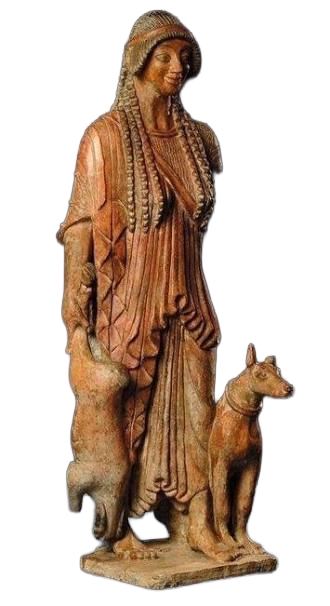
Terracotta figurine of Artume and hound
The goddess appears in Etruscan bronzes and ceramics, most commonly depicted in two forms; as the longer Aritimi (also spelled Artimes), and as the shorter form Artumes (or Artume) or sometimes referred to as Artames. There seems to be no debate regarding the origin of this name.
The term is simply derived from the Greek, Artemis, adopted by the Etruscans along with many other elements of the Greek pantheon, such as Aplu from Apollo, Hercle from Heracles, and Aita from Hades. De Simone placed Aritimi in his list of those words of Etruscan provenance that are undoubtedly Greek, while the usual grammatical treatises view both long and short forms of Artume as the same word but with different stress patterns, specifically that the unstressed middle vowel has been lost, and that the -e- has shifted to -u- prior to the "m" in accordance with Etruscan rules.1,2,3
Erika Simon claims that Artume is the same as Artemis; that the religion surrounding her has been around since the Neolithic period, an assertion that covers thousands of years and about 2-4 different peoples with no pause for documentation. Marjatta Nielsen and Annette Rathje, who wrote the only study dedicated solely to her, chose to be much more careful. In their title they called her the "borrowed goddess," but spent most of the rest of the paper arguing that borrowed does not come close enough to describe how thoroughly she was influenced by others. The name itself is Greek. She was constructed (by the Etruscans) using Phoenician architectural designs and Greek mythology.4,5
Confusingly, however, the Etruscans called the town at modern Arezzo Aritim, Latin Arretium. The name is close enough to Aritimi that the two probably got tangled, and a later tradition even made the goddess the founder of the city.6
Sources: Rix's corpus for the attested spellings; de Simone and the Bonfantes for the Greek loan and the syncope; Simon and Nielsen and Rathje for the borrowing and its limits; Pittau for Aritim and Arezzo.1,2,3,4,5,6
II. The Goddess of the Mirror-Back
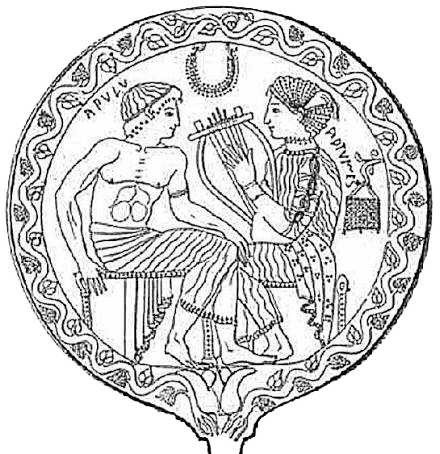
Etruscan mirror of Apulu and Artume
Where to find Artumes is in the workshops; she is among the frequent divine figures of Etruscan images drawn from Greek myth and her fellow deities are recognizable by the huntress's bow and often by wings, which Etruscan artists added to gods the Greeks left wingless.7
The Potnia Theron as a Mistress of Animals and holds the beasts of the wild is an explicit theme of the Etruscan variation of Artemis. A bronze belt buckle located in the Vatican clearly illustrates this and shows the goddess holding either wolves or dogs and their cubs; the protector and the predator in one. The name from the Greek stories remained attached to it. On Etruscan urns are depictions of the death of Actaeon, who is torn apart by his own hunting dogs for having seen the goddess naked.
Also depicted on urns are scenes depicting the sacrifice of Iphigenia, and there is often an image of Artemis (the goddess) standing in the back, holding a deer in order to substitute herself into the act of being sacrificed. Nielsen and Rathje interpreted this scene as evidence that the Etruscans perceived Artemis as a savior, a deity who intervenes in rituals at the very end. 5,8
The Twin of Aplu
Artumes' most powerful relationship was with her brother. In Greek mythology, Apollo and Artemis are siblings (twins). In Etruria, there is abundant evidence of the sibling pair, Aplu and Artumes throughout the iconography of Etruria as well as in the limited number of artifacts (statues) that have named her. According to De Grummond, she is part of an extended family. She is the daughter of Tinia and Letun standing alongside Aplu. There is one single artifact which clearly shows how this cult was tied together. The votive bronze is approximately dated from 375-350 B.C.E. This is a bronze statuette of Aplu who is nude except for his necklace, armlets and boots. Alongside his leg is an inscription which names neither Apollo nor Artemis. Instead it states that he was gifted to Aritimi. This was given by a female named Fasti, wife of Rufri, on behalf of her son. The term used to connect the gift to the goddess spulare is without definition or agreement of meaning. Her name appears, in other words, on a statue of her brother.5,7
III. The Thin Cult
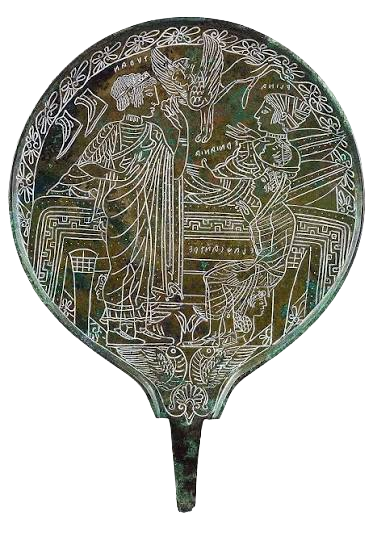
Bronze Etruscan mirror of Apulu and Artume
For a goddess this visible, the record of worship is remarkably light. The dedications that name her are few and mostly modest, the earliest reaching back to the sixth century BCE, and no great sanctuary can be given to her with much confidence. Many of her artefacts are found at the sites of Aplu.5
The most precise example of this would be the Liver of Piacenza, a model of a sheep’s liver made of bronze dating back to approximately 150-100 BCE. The surface of the liver is sectioned off into various areas and etched with the names of the gods (the gods' dwelling places) on the Etruscan sky and thus is an Etruscan "map" of the cosmic heavens read by the haruspex. The forty named locations on this model include Aritimi but do not include her brother Aplu. In other words, whatever form or identity she may have taken on with the Etruscan people, she did not become a permanent part of their cosmological view as did the earlier Italic/Etruscan deities.8,9,10
| Object | Date | What It Shows | Bearing on the Cult |
|---|---|---|---|
| Dedicatory inscriptions naming Aritimi | From the sixth century BCE | The goddess's name in votive formulae | Worship attested, but sparse and scattered |
| Votive statuette of Aplu with the Aritimi inscription | c. 375–350 BCE | A dedication to the goddess cut on a statue of her brother | The Aplu–Artumes cult bond in one object |
| Bronze belt buckle, Mistress of Animals | Etruscan | The goddess holding wolf or dog cubs | The old potnia theron role, older than the Greek name |
| Engraved bronze mirrors | Fifth–fourth century BCE | Artumes at divine births and assemblies, often winged | Prominence in image, not proof of cult |
| Liver of Piacenza | Late second century BCE | Forty deity-names mapping the divine order | Names her absence; she is not on it |
Sources: Nielsen and Rathje for the dedications and the Aplu statuette;5 de Grummond for the mirrors and the Vatican belt buckle;7 van der Meer's catalogue of the Liver names, and Jannot on the Liver as a reading of the divine order.8,9
IV. The Moon and the Shade
iN some locations Artumes became something local and then lost her identity. Nielsen and Rathje note the area around Latium which is the land of the moon for Artumes and provides ritual similarities to the Diana of the Wood (Nemi). On Etruscan and Roman soil the Moon is important to her in a way that only becomes exceedingly obvious in Greece later. Both cultures shared rituals with the Latin Diana.
She also begins to move closer to death. Etruscan religion has always been a funerary-based religion and its gods are generally found in association with graves rather than Greek gods. The huntress of the outer fringes of the earth is close to the underworld's powers. Scholars have often debated when looking at monuments if it is the female figure with the scroll and wild setting that represents Artumes or Vanth, the winged spirit who unlocks the gates of the underworld using her light and her key. It appears that there is no division between the goddess of hunting and the goddess of passage from this aspect that the Etruscans perceived.5,7
Sources and Bibliography
- Rix, Helmut, ed. Etruskische Texte. Editio minor. 2 vols. ScriptOralia 23–24. Tübingen: Gunter Narr, 1991. Cited for the attested Etruscan spellings of the goddess's name, Aritimi, Artumes, Artume, and Artames, on inscribed mirrors and votive objects.
- de Simone, Carlo. Die griechischen Entlehnungen im Etruskischen. 2 vols. Wiesbaden: Otto Harrassowitz, 1968–1970. Cited for the treatment of Aritimi as a secure Greek loanword into Etruscan, alongside the other borrowed theonyms.
- Bonfante, Giuliano, and Larissa Bonfante. The Etruscan Language: An Introduction. 2nd ed. Manchester: Manchester University Press, 2002. Cited for the identification of the name with Greek Artemis and for the syncope that reduces Aritimi to Artume.
- Simon, Erika. "Gods in Harmony: The Etruscan Pantheon." In The Religion of the Etruscans, edited by Nancy Thomson de Grummond and Erika Simon, 45–65. Austin: University of Texas Press, 2006. Cited page: 57, for the derivation of Artume directly from Greek Artemis and for the claim of a cult reaching back to the Neolithic.
- Nielsen, Marjatta, and Annette Rathje. "Artumes in Etruria, the Borrowed Goddess." In From Artemis to Diana: The Goddess of Man and Beast, edited by Tobias Fischer-Hansen and Birte Poulsen, 261–301. Acta Hyperborea 12. Copenhagen: Museum Tusculanum Press, 2009. Cited for the survey of the Etruscan evidence, for the argument that Artumes was more than a calque of Artemis and was shaped by Phoenician models and Greek myth and remade to Etruscan use, for the votive statuette of Aplu bearing the Aritimi inscription and the unexplained word spulare, for the sacrifice of Iphigenia and the death of Actaeon on Etruscan urns, for the sparse dedications reaching back to the sixth century BCE, and for the development near Latium into a Moon goddess with rites resembling those of Diana Nemorensis.
- Pittau, Massimo. Toponimi italiani di origine etrusca. Sassari: Magnum Edizioni, 2006. Cited for the Etruscan place-name Aritim (Latin Arretium, modern Arezzo) and for its entanglement in tradition with the name of the goddess.
- de Grummond, Nancy Thomson. Etruscan Myth, Sacred History, and Legend. Philadelphia: University of Pennsylvania Museum of Archaeology and Anthropology, 2006. Cited pages: 99–103 and 130–32, for Artumes on the engraved bronze mirrors, her wings, and her place among the divine births and assemblies, and for the reconstruction of her family as daughter of Tinia and Letun and sister of Aplu; 101 (catalogue no. V.31), for the Vatican belt buckle showing the Mistress of Animals with wolf or dog cubs; and for the difficulty of distinguishing Artumes from the underworld spirit Vanth on certain monuments.
- van der Meer, L. Bouke. The Bronze Liver of Piacenza: Analysis of a Polytheistic Structure. Amsterdam: J. C. Gieben, 1987. Cited for the catalogue of the forty deity-names inscribed on the Liver of Piacenza, among which the names of Aritimi and Aplu do not appear.
- Jannot, Jean-René. Religion in Ancient Etruria. Translated by Jane K. Whitehead. Madison: University of Wisconsin Press, 2005. Cited for the Liver of Piacenza as a working reading of the Etruscan divine order and for the structure of the Etruscan pantheon.
- Pallottino, Massimo. The Etruscans. Revised and enlarged ed. Translated by J. Cremona. Edited by David Ridgway. Bloomington: Indiana University Press, 1975. Cited for the warning against reading Etruscan gods directly off their borrowed Greek iconography, since the Etruscans adopted the images more freely than the beliefs behind them.