




| Language / Culture | Name | Attestation |
|---|---|---|
| Gaulish (Continental Celtic) | Gobannos, Cobannus (ΓΟΒΑΝΟ) | Berne zinc tablet (Gallo-Roman) |
| Gaulish (personal name) | Gobannitio | Caesar, Gallic War 7.4 (52 BCE) |
| Old Irish | Goibniu (Gaibhne) | St Gall thorn charm (9th century CE) |
| Middle Welsh | Gofannon fab Don | Culhwch ac Olwen (c. 1100 CE) |
| Common noun (the root) | OIr. gobae, W gof, Gaul. gobedbi | Proto-Celtic *goban- |
17 min read
GOBANNUS
author: High Priest Zevios Metathronos
co-author: Novice Priest Karnonnos
Hieratic Information about Gobannus
| Names Across Civilizations | |
|---|---|
| Gaulish | Gobannos, Cobannus (ΓΟΒΑΝΟ) |
| Irish | Goibniu (Gaibhne) |
| Welsh | Gofannon fab Don |
| Cornish / Breton | Gof (the Smith) |
| Proto-Celtic | *goban- |
I. The Names of the Smith
The Smith is certainly one of the few gods in the Celtic speaking world whom we can follow through all three branches of surviving traditions. The Gaulish Gobannos, the Irish Goibniu, and the Welsh Gofannon are no coincidental similarities. All three have descended from a single Proto-Celtic word for the Smith *goban- and all three carry the same role within their countries. That role is the craftsman of the gods, master of fire and iron, maker of weapons whereby the divine host shall prevail.1, 2
A common theonym clearly lies behind *goban-, from which comes Old Irish gobae (genitive gobann), and also Middle Welsh, Cornish and Breton gof and the Gaulish gobedbi (dative plural 'with the smiths'). The comparison extends further into Lithuanian gabija ('sacred hearth-fire', also a goddess) and gabus ('gifted, clever'), although there remains uncertainty about the deeper indo-europeanness of the stem and whether it goes back past celtic and its closest relatives. Thurneysen interpreted the Old Irish n-stem as a geminate gobann-; Matasovic interprets a single n- as a smaller dispute that still divides linguists to this day..1, 2, 3
The divine proper name appears first during the roman period on votive metals from Gaul and its borderlands, but the smith element appears earlier than this in the record. Caesar mentions a Gobannitio, the paternal uncle of Vercingetorix, among the Arverni in the year of the great revolt, therefore before any surviving stone or tablet attests to a god. The theonym itself occurs in two forms: the Gaulish Gobannos, written in Greek letters on the Berne tablet and the Latinized Cobannus of the Gallo-Roman dedications. In Ireland, the name appears in a healing charm; in Wales, in the prose of medieval storytellers.2,4,6
Sources: 1. Matasovic, Etymological Dictionary of Proto-Celtic, s.v. *goban-, 164. 2. Delamarre, Dictionnaire de la langue gauloise, s.vv. gobannos, gobedbi, 181–82. 3. Blazek, "Celtic 'Smith' and His Colleagues," 35–53. 4. Caesar, Gallic War 7.4. 5. Stokes and Strachan, Thesaurus Palaeohibernicus II, 248 (the St Gall charm). 6. Bromwich and Evans, Culhwch and Olwen, on the date of the tale.
II. The Gobannus Tablet
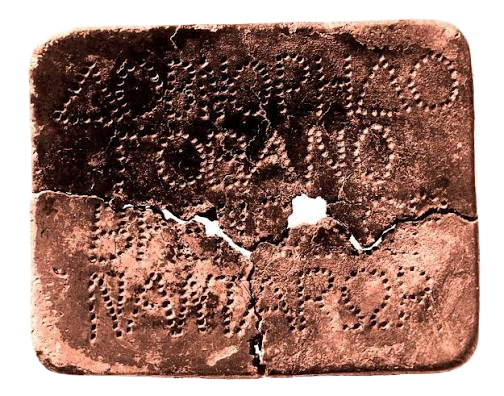
The object alone that gives the god his own Gaulish name is a dimunitive sheet of metal found in 1984 in the Thormenboden woods above Bern in Switzerland. It was lifted out of the ground by a workman, and only studied later after his death, so that its exact area of retrival is lost. What was recorded places it in a Gallo-Roman layer, alongside Roman roof-tile at a shallow depth. The sheet carries four gaulish words each on their own line in Greek letters formed from rows of punched dots.7
ΔΟΒΝΟΡΗΔΟ ΓΟΒΑΝΟ ΒΡΕΝΟΔΩΡ ΝΑΝΤΑΡΩΡ
Dobnoredo Gobano Brenodor Nantaror
"To Gobannos the world-traveller, at Brennoduron in the valley of the Aare."
Berne zinc tablet
Gobano is a dative "to Gobannos", the god named by the word for smith. Dobnoredo is interpreted as his epithet from dubno- ("world") and second element for journey, giving such sense as "world-traveller" or "world-courser", a suitable title for the patron of trade whose goods moved far. . Brenoduron is a place-name, the fort of Brennos, the Gaulish name of Berne itself, formed like Salodurum which became Solothurn and Vitudurum which became Winterthur. Nantaror holds the element nanto-, a valley with a stream, and is known as the valley of the Aare.
The tablet raised suspicion because it was made mostly out of pure zinc, a material rarely used alone in antiquity. The study of metals provided an answer, because the composition is consistent with a product of the Roman period as any zinc gathered as pale condensation on walls of a smelting furnace could be scraped off and collected. A metal born of the furnace is an apt gift for the god of the furnace. The style of language and use of Greek alphabet indicate a time when Gaulish still lived using the lingua franca of the Greek alphabet and weight of Latin had not yet been total. The Bern tablet is now generally accepted as genuine Gallo-Roman votive even though precise date and fine points of wording continue to be discussed.2,7
III. The Places of His Presence
Gobannos' chief fame, beyond Bern, comes from his Latin designation, Cobannus, which appears on several Gallic dedicatory inscriptions from the centre of Gaul, specifically in the ancient Roman province of Lugudunensis. In addition to this inscription, discovered in the 1970s at Fontenay-pres-Vezelay in Burgundy, there are additional examples of similar dedicatory inscriptions from the same geographic location and time period collected within the epigraphic corpora. Moreover, the major hoard examined in the subsequent sections includes dedicatory inscriptions. On present evidence, Gobannos’ worship appears to be an aspect of the heartland of Gaul, to have been practiced by elites and to have been civic in its nature.8
His name is also recorded on maps. The Roman fort at Abergavenny, located in south east Wales, was named Gobannium, "Smith", and it was established near significant areas of iron ore extraction. Evidence for his divine nature from Celtic personal names extends even further; Caesar records Gobannitio, while numerous inscriptions record Gobannicnos. Furthermore, he can be identified in Old Irish Gobban, and as St. Gobain, who provided his name to St.Gobain in the Aisne, and as Govan in Scotland. Thus, from Ireland and Wales, through Gaul to the mountainous regions of Italy, the smith-root has occurred repeatedly.2, 9
Most Gaulish gods are local, tied to one spring or one people. The smith is one of the small company, with Lugus and Brigantia, whose name and office are shared across the Celtic world, so that the Gaulish Gobannos, the Irish Goibniu, and the Welsh Gofannon may be seen as three faces of a single inherited godn.10
IV. The Statues and the Bronze Cauldron
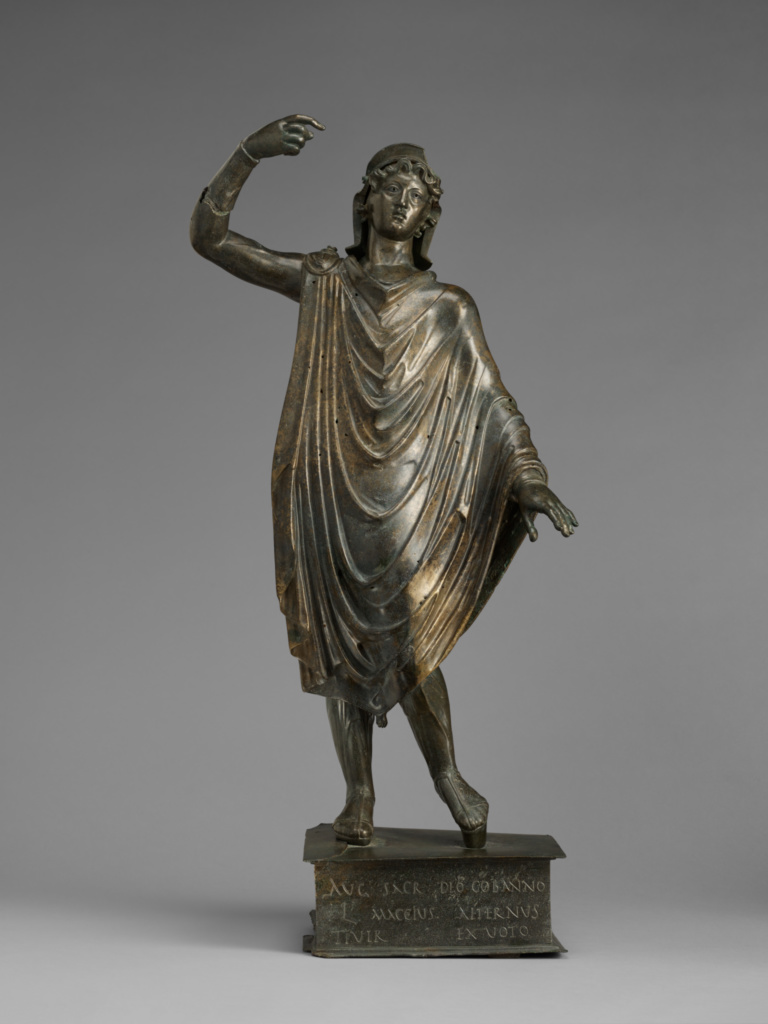
“Sacred to the venerable god Cobannus, Lucius Maccius Aeternus, duumvir, [dedicated this] in accordance with a vow.”
The greatest source of information regarding Gobannos’ cult practices is the hoard of Gallo-Roman bronze objects that arrived at the J. Paul Getty Museum in California during unclear circumstances in the late 1980s. At tehir center is a large bronze figurine of Gobannos-Mars created sometime between approximately 125-175 CE. The figurine depicts Cobannos dressed in attire representative of the northern provinces of northwest Gaul (long sleeved tunic, leggings and a cape pinned at the shoulder). Accompanying the figurine were a pair of marble portrait busts, a bronze offering box, and a bronze cauldron that bore the inscription Deus Cobannos. The cauldron was therefore dedicated to him on a large vessel produced out of the very material he masterfully produces.8,11
The base of the statuette has a dedication: Aug(usto) sacr(um) deo Cobanno, erected by Lucius Maccius Aeternus, a duumvir, in fulfillment of a vow. That the duumvir was a municipal magistratus and that the association of the god with Augustus placed the local smith into the imperial cult means that Pollini interprets Cobannos as a local deity elevated to the status of an officially recognized deity of the Roman town. The selection of Mars as the model for the smith is not unusual for Gaul where votive offerings to both Mars and Vulcan were common in Gaul and where forging arms do place a god directly involved in being prepared for battle-readiness.8
V. The Mythology of the Irish Goibniu
In Ireland, Goibniu was the smith of the Tuatha De Danann, and one of the three gods of craft, the tri de dana, together with Luchta the wright, who works in wood, and Credne the brazier, who works the fittings in bronze and gold. His parentage is told in more than one way, his father named now as Esarg, now as Tuirbe the axe-thrower, and Brigid, the goddess of the flame, set as his mother in some reckonings..12, 13
Goibniu’s greatest moment is during the Second Battle of Mag Tuired when the Tuatha De Danaan battled the Fomorians. When Lugh had assembled his people, and asked if anyone wanted to join the battle, Goibniu agreed to provide all the Tuatha warriors with a new spear or sword whenever theirs broke in combat. Additionally, the smith promised that none of the weapons he would make would miss their mark. All three craftsmen worked at incredible speeds, no mortal forge could keep up with them: Goibniu shaped the blade in three strikes; Luchta shaped the shaft with one strike; Credne put the rivets in place with a cast. Therefore, Lugh received his spear from this forge that reached Balor’s eye.13, 12
When the Fomorians discovered how dangerous this was, they decided to attack the source of the problem. They sent Ruadhan, Bres’ son and Brig’s son (therefore related to Goibniu) to spy on Goibniu and ultimately kill him. Ruadhan took a newly forged spear and stabbed Goibniu with it, but the smith pulled the spear out of his body and threw it right back at Ruadhan, killing him with the very spear meant to take Goibniu’s life. Ruadhan’s mother Brig went to mourn for him, and according to legend, that was the first time anyone in Ireland cried. The fact that Goibniu was able to heal himself after being mortally injured using water from the healing well of Dian Cecht is another interesting aspect of this story. According to legend, this well gave back the bodies of all those killed during battles between the Tuatha and the Fomorians.13
Goibniu is also associated with feasting. The "Fled Goibnenn" (Feast of Goibniu), is a feast that Goibniu hosts for all members of the Tuatha De, and is known for producing ale that gives eternal youth, makes sickless, and makes deathless. As a god whose fire can transform metal ore into useful tools and objects, it follows logically that this same fire can produce alcohol that has similar transformative properties.12, 14
The Attestation Outside of Myth
The earliest evidence of Goibniu’s identity as a god comes from an early reference to a spell using the name. This can be found in an ancient Old Irish charm in the St Gall manuscript dated in the 9th century. Goibniu is used in a call against a thorn stuck in a person’s skin. The author uses Goibniu’s own sharp craftsmanship against the sharp object that caused the wound. The fact that this reference exists before any known account makes it difficult to discern how much earlier the references would have existed. 5
"Nothing is higher than heaven, nothing is deeper than the sea.
A thorn most sharp is Goibniu's science;
let Goibniu's goad go out before Goibniu's goad."
The St Gall thorn charm
There is an alternative understanding of Goibniu as an ancient god. T.F. O'Rahilly believed that Goibnu was fundamentally a god of lightning and that his fatal spear was nothing more than a representation of lightning bolts, while Balor was simply another manifestation of sunlight energy. While this idea may seem compelling and has certainly garnered support from some scholars, it represents part of an old school of thought regarding solar mythology that is currently viewed skeptically and primarily exists because of systems rather than through direct references to the sources.15
VI. Irish Folklore: the Grey Cow and the Free Smith
Under the surface of the tales the smith kept a long life in the mouths of the people. In the myths outside of the cycles, his chief treasure is a cow. The Glas Gaibhnenn, the grey cow of the smith, is a bovine white with green markings whose milk never fails, so that to own her is to have plenty. Her keeper is Goibniu, or in some tellings a smith called Gaibhlin. The strange fable of the cow is told across Ireland and in Scottish Gaelic alike.16
Like many stories from Northwestern Europe, she plays an important role in Lugh's birth legends. In particular, the smith brothers share ownership of Glas Gaibhnenn, Goibhuin's gray cow. However, Balor, who knows that his own grandchild (Lugh) will slay him, removes Glas Gaibhnenn to Tory Island as part of a plot to get rid of Lugh before he grows strong enough to defeat him. To prevent Balor from removing her from the mainland permanently Cian goes to Balor's island stronghold in search of her. During his journey he meets Birog (a female druid), who transports him into Balor's fortress where he conceives Eithne (Balor's daughter), giving birth to Lugh seveal months later. Several villages along Ireland's coastline still bear names referencing Cian (including Dun Caneily/Duncaneely).16, 17
Later myths describe him not as a smith but as a builder. He is known as the Goban Saor, the free wright (mason), who erects churches and round towers while outsmarting kings and their masons at each step. Popular legend describes the Goban Saor as an old smith-god who has been reduced to a folk-hero. Philologists note that the term "Gobban Saer" comes from a different Old Irish word, gop, a snout or beak, therefore, they suggest that Gobban Saor's connection to Goibniu is based on theme and function, rather than direct lineage. Regardless of whether the connection is through theme or direct lineage, the divine craftsman survived long after the deities he served.12
VII. The Mythology of the Welsh Gofannon
In Wales the smith was Gofannon, a member of the Children of Don, a family of divine beings in Welsh mythology. Gofannon shares kinship with several other major characters in Welsh mythology including magician Gwydion, farmer Amaethon, Gilfaethwy and Arianrhod. As for actual appearance in Welsh literature and storytelling, Gofannon appears very infrequently. Each time he does appear however, his presence contributes something significant to the story line. Medieval storytellers considered Gofannon to be a smith in the vein of Goibniu, i.e., a powerful smith capable of wielding magical tools. Like Goibniu, he too represents a dangerous type of smithing ability. As with Goibniu, these abilities make Gofannon a unique addition to Celtic mythology.12,18
Dylan ail Don
The fourth branch of the Mabinogion tells of Gofannon’s involvement with one very brief negative reference. When Arianrhod is tested for virginity by Math using his wand and she gives birth to a male infant, which is immediately baptized and named Dylan, Dylan immediately goes directly to the ocean where he assumes the characteristics of fish and swam as well as any fish. No waves were ever formed under him, hence the title Dylan Ail Don (Dylan Second Wave) or Dylan of the Wave.
Gofannon then attacks him with the blow of death. There is no stated reason for this act nor is there a scene depicting a confrontation; it simply states that Gofannon killed Dylan and continues with the narrative. This attack is included within the Three Unfortunate Blows of the Isle of Britain, a triad which is now lost. Possibly ,this has a connection to the Tatenen and Vishvakarma myths about creation.18, 19
Amaethon and the Plough
His next occurrence is in Culhwch ac Olwen, which is considered to be the oldest Arthurian tale. In order for Culhwch to secure Olwen he must complete the impossible tasks given to him by Olwen’s father Ysbaddaden. Two of those are completed by the sons of Don. First, the wild lands need to be tilled; no person can till them except for Amaethon son of Don.
Amaethon’s name translates to divine farmer. Next, the iron needs to be placed; no person will go to the top of the hill where it should be placed except for Gofannon who will only complete the task if it is for a rightful king. The medieval plow was primarily constructed of wood, and before any area could be worked in fields, it would have needed to have metal added to its cutting edge (the share and coulter). The task specifically refers to the craftsmanship skills of a smith. Amaethon turns over the soil and Gofannon sharpens the iron blades and together they allow the land to produce crops.6,18,20
Sources and Bibliography
- Matasovic, Ranko. Etymological Dictionary of Proto-Celtic. Leiden Indo-European Etymological Dictionary Series 9. Leiden: Brill, 2009. S.v. *goban-, 164. For the reconstruction of the Proto-Celtic stem, the cognate set, and the disputed geminate.
- Delamarre, Xavier. Dictionnaire de la langue gauloise: Une approche linguistique du vieux-celtique continental. 2nd ed. Paris: Editions Errance, 2003. S.vv. gobannos, gobedbi, 181–82. For the Gaulish theonym, the reading of the Berne tablet, and the onomastic and toponymic reflexes.
- Blazek, Vaclav. "Celtic 'Smith' and His Colleagues." In Evidence and Counter-Evidence: Essays in Honour of Frederik Kortlandt, vol. 1, edited by Alexander Lubotsky, Jos Schaeken, and Jeroen Wiedenhof, 35–53. Amsterdam: Rodopi, 2008. For the comparative Indo-European material behind the smith-word.
- Caesar, Gaius Julius. The Gallic War. Translated by H. J. Edwards. Loeb Classical Library 72. Cambridge, MA: Harvard University Press, 1917. 7.4. For Gobannitio, the uncle of Vercingetorix, and the smith-root in a datable text of 52 BCE.
- Stokes, Whitley, and John Strachan, eds. Thesaurus Palaeohibernicus: A Collection of Old-Irish Glosses, Scholia, Prose, and Verse. Vol. 2. Cambridge: Cambridge University Press, 1903. 248. For the St Gall thorn charm, the earliest datable attestation of Goibniu.
- Bromwich, Rachel, and D. Simon Evans, eds. Culhwch and Olwen: An Edition and Study of the Oldest Arthurian Tale. Cardiff: University of Wales Press, 1992. For the date of the tale, the anoethau, and the tasks laid on Amaethon and Gofannon.
- Rehren, Thilo. "A Roman Zinc Tablet from Bern, Switzerland: Reconstruction of the Manufacture." In Archaeometry '94: The Proceedings of the 29th International Symposium on Archaeometry, edited by S. Demirci, A. M. Ozer, and G. D. Summers, 35–45. Ankara: Tubitak, 1996. For the find, the composition, and the manufacture of the Berne tablet. [Pagination to verify.]
- Pollini, John. Gallo-Roman Bronzes and the Process of Romanization: The Cobannus Hoard. Monumenta Graeca et Romana 9. Leiden: Brill, 2002. For the Cobannus hoard, the corpus of Deo Cobanno dedications, the Mars-Cobannus statuette (AE 1994, no. 1915), the inscribed cauldron, and the imperial-cult reading.
- Rivet, A. L. F., and Colin Smith. The Place-Names of Roman Britain. London: B. T. Batsford, 1979. S.v. Gobannium. For the fort at Abergavenny and the smith-name in the landscape.
- Koch, John T., ed. Celtic Culture: A Historical Encyclopedia. Santa Barbara: ABC-CLIO, 2006. S.vv. Gobannos, Goibniu, Gofannon. For the god as one of the few pan-Celtic deities, beside Lugus and Brigantia.
- The J. Paul Getty Museum. "Statuette of Mars-Cobannus." Gallo-Roman, A.D. 125–175. Object 96.AB.54. Los Angeles: J. Paul Getty Museum. For the description and dedication of the statuette.
- MacKillop, James. A Dictionary of Celtic Mythology. Oxford: Oxford University Press, 1998. S.vv. Goibniu, Gofannon, Glas Ghaibhleann, Goban Saor. For the three gods of craft, the Feast of Goibniu, the folklore of the cow, and the Goban Saor.
- Gray, Elizabeth A., ed. and trans. Cath Maige Tuired: The Second Battle of Mag Tuired. Irish Texts Society 52. Dublin: Irish Texts Society, 1982. For the crafts of the Tuatha De, the making of the weapons, the death of Ruadan, and the healing well.
- Dobbs, Margaret E., ed. and trans. "Altram Tige Da Medar" [The Fosterage of the House of the Two Milk-Vessels]. Zeitschrift fur celtische Philologie 18 (1930): 189–230. For the Feast of Goibniu and the ale that keeps the Tuatha De from age and death.
- O'Rahilly, Thomas F. Early Irish History and Mythology. Dublin: Dublin Institute for Advanced Studies, 1946. For the thunder-and-solar interpretation of Goibniu and its identification with Balor, here noted with caution.
- Gregory, Lady Augusta. Gods and Fighting Men. London: John Murray, 1904. "The Coming of Lugh." For the three smith-brothers, the Glas Gaibhnenn, and Balor's theft of the cow.
- Larminie, William. West Irish Folk-Tales and Romances. London: Elliot Stock, 1893. For the Donegal folktale of Balor, the cow, and the birth of Lugh.
- Davies, Sioned, trans. The Mabinogion. Oxford World's Classics. Oxford: Oxford University Press, 2007. For the Fourth Branch on Dylan ail Don and for the tasks of Culhwch ac Olwen.
- Bromwich, Rachel, ed. and trans. Trioedd Ynys Prydein: The Triads of the Island of Britain. 4th ed. Cardiff: University of Wales Press, 2014. For the Three Unfortunate Blows and the killing of Dylan.
- Payne, Ffransis G. Yr Aradr Gymreig [The Welsh Plough]. Caerdydd: Gwasg Prifysgol Cymru, 1975. For the medieval plough and the setting of the iron share and coulter that is Gofannon's task.