




| Language | Name of Vulcan | Attestation |
|---|---|---|
| Latin | Volcanus (archaic), Vulcanus | Naevius (c. 240–200 BCE) |
| Minoan Cretan | Velchanos | Proposed origin (disputed) |
| Proto-Indo-European | *wl̥kānos | Comparative reconstruction |
24 min read
VULCAN
author: High Priest Zevios Metathronos
co-author: Novice Priest Karnonnos
I. Etymology
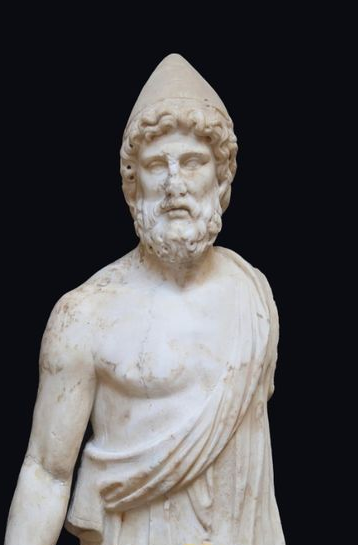
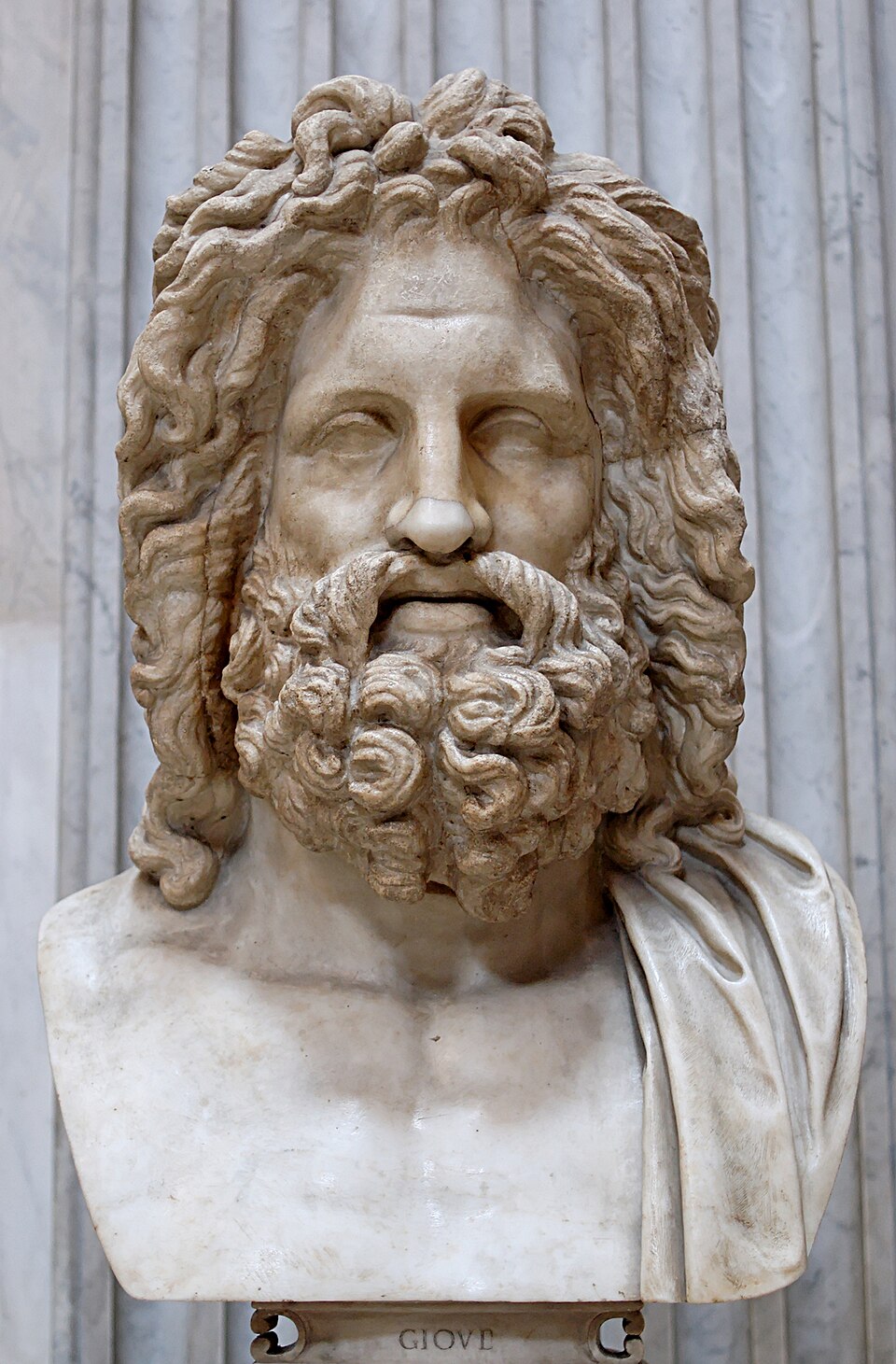
The oldest surviving statue of Vulcan, Ostiense Archeological Museum
The origin of the name Vulcanus (or Volcanus) remains unclear and has been the subject of scholarly debate. Roman tradition itself connected the name to Latin words associated with lightning and flames, such as fulgur, fulgere, and fulmen, viewing lightning as a form of divine fire. This interpretation links the god's name to concepts of brilliance or luster, which are obviously related to the brightness of fire or the shine in metal. This in turn may also share a connection with Sanskrit words ulkā (उल्का) ("flame, meteor, firebrand") and/or várcas- ("brilliance, glare").1
Some scholars have proposed non-Latin origins. One theory traces the name back to the Cretan god Velchanos, a deity associated with nature and the underworld in Minoan Crete. However, this identification has been disputed as speculative by other scholars. Another theory suggests a possible Indo-European connection, comparing it to the Ossetic legendary smith figure Kurd-Alä-Wärgon in the Nart sagas of Ossetian myth, and hypothesizing a Proto-Indo-European smith god wl̥kānos.2,3
Linguistically, the name is also directly related to the Latin vulcanus, meaning "fire" or "volcano," which most notably influenced the modern English word "volcano" via the island of Vulcano (named after the god and believed to be his forge).
The earliest surviving Latin attestation of the Roman theonym Vulcan that can be assigned with reasonable confidence to a Latin author is in Gnaeus Naevius, in the late third century BCE. The form is the older Latin Volcanus, appearing in the genitive Volcani. The fragment is preserved only because the later grammarian Festus quoted it, probably dating to c. 240–200 BCE.4,5,6,7
Sources: Naevius, Bellum Punicum; Festus, De verborum significatu; Varro, On the Latin Language; Cook, Zeus: A Study in Ancient Religion, (1925); West, Indo-European Poetry and Myth, (2007); Maltby and Slater, Fragmentary Republican Latin, (2022); Warmington, Remains of Old Latin, (1936).1,2,3,4,5,6,7
II. Culture & Mythology
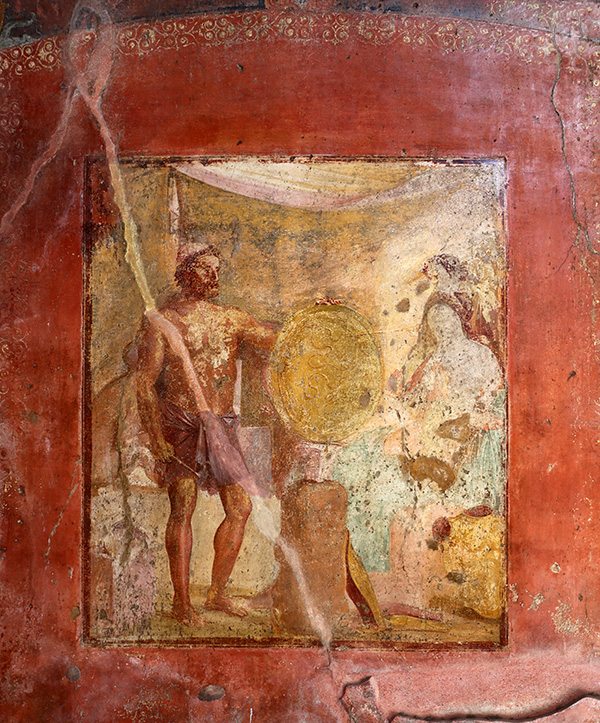
Vulcan presenting the shield, mural from Pompeii
Vulcan (Latin: Vulcanus, sometimes archaically Volcanus) is the god of fire, including the fire of volcanoes, deserts, metalworking, and the forge, in ancient Roman religion and myth. He is often depicted with a blacksmith's hammer and anvil. His Greek counterpart is Hephaestus. In Etruscan religion, he is identified with Sethlans. Vulcan belongs to the most ancient stratum of Roman deities. Roman tradition linked his worship to the early kings, particularly the Sabine co-king Titus Tatius.
Vulcan occupies a unique position in Roman religion as the embodiment of fire's dual nature, both as a creative force essential to civilization and as a destructive power capable of devastating cities. He is one of the oldest Roman deities, with his cult attested from the earliest periods of the city's history. Varro, citing the Annales Maximi, records that King Titus Tatius, the Sabine co-ruler with Romulus, dedicated altars to Vulcan and other deities, situating Vulcan among the foundational Gods of Rome.8
Unlike many other Roman Gods, Vulcan's worship was characterized by a sense of ambivalence and caution. Fire was indispensable for cooking, metalworking, and daily life, but it was also a constant threat in the densely built urban environment of Rome. As a result, Vulcan was both honored and propitiated, with rituals designed to avert his destructive aspect while harnessing his creative power, an aspect of his cult emphasized more than the Greek Hephaestus.9
Roman myths about Vulcan's origins closely parallel those of his Greek counterpart, Hephaestus, but with distinct Roman inflections. Vulcan is usually described as the son of Jupiter (Zeus) and Juno (Hera), though some accounts suggest he was born solely of Juno, who sought to produce a child without Jupiter in response to his infidelities.
In both traditions, Vulcan is born deformed, often depicted as lame or physically imperfect, and is cast out of heaven by his mother (or, in some versions, by Jupiter). This motif of rejection and exile underscores the god's outsider status and his subsequent mastery of the forge, where he becomes indispensable to the divine order.10
Much as with the Greek Hephaestus, Vulcan was the patron of all trades involving fire, including blacksmiths, bakers, cooks, and potters. His cult was especially important to artisans and workers whose livelihoods depended on the controlled use of fire.
III. Epithets & Titles
| Epithet | Meaning | Domain |
|---|---|---|
| Ignipotens | "Mighty in Fire" | Mastery over fire in all its forms |
| Mulciber | "The Softener" / "The Smelter" | Softening and shaping metal through fire |
| Quietus | "The Peaceful" / "The Calmer" | Calming or restraining destructive fire |
| Volcanalis | Of the flamen Volcanalis | Priestly cult title |
| Maia Volcani | "Might of Vulcan" / consort-aspect | Ritual pairing with the Goddess Maia |
Sources: Macrobius, Saturnalia; Lewis and Short, A Latin Dictionary, (1879).11,12
Ignipotens ("Mighty in Fire"), used by Virgil in the Aeneid, emphasizes Vulcan's mastery over fire in all its forms.11
Mulciber ("The Softener" or "The Smelter"), also applied to Hephaestus, refers to Vulcan's ability to soften and shape metal through fire. Macrobius explains that as fire, Vulcan "softens [mulcere] and masters all things". This particular name is notable due to its usage in Milton's Paradise Lost and thus the later Daemonic portrayals of the god as the architect of Hell's Pandaemonium.11
Quietus ("The Peaceful" or "The Calmer"), found in inscriptions such as CIL VI 0802, may refer to Vulcan's role in calming or restraining destructive fire.11
Volcanalis is associated with the flamen Volcanalis, the priest dedicated to Vulcan's cult.12
Maia Volcani: in ritual contexts, Vulcan is sometimes paired with the goddess Maia, as in the phrase "Maia of Vulcan," which may mean "might of Vulcan" or refer to a consort or aspect of the god.12
IV. Temples & Priesthood
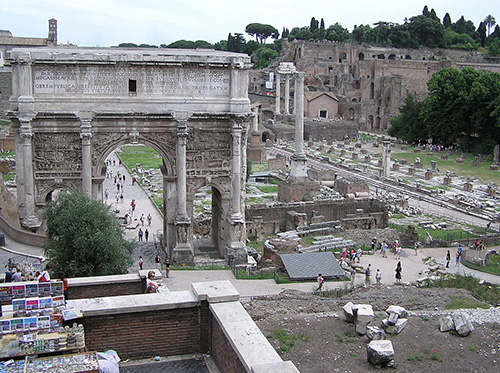
Probable site of Temple of Vulcan, Rome
The oldest and most significant sanctuary of Vulcan in Rome was the Vulcanal (or Volcanale), an open-air altar and sacred precinct located at the foot of the Capitoline Hill in the area that would later become the Roman Forum. Tradition holds that the Vulcanal was established either by Romulus or by Titus Tatius in the 8th century BCE, making it one of the city's most ancient religious sites. The shrine was situated outside the original city boundaries, reflecting the belief that Vulcan's destructive power should be kept at a distance from inhabited areas.13
The Vulcanal was not a temple in the conventional sense but an open precinct containing an altar, a sacred lotus tree, and other monuments, such as a bronze quadriga (four-horse chariot) dedicated by Romulus and a statue of the king himself. The site served as a place of worship, a venue for public assemblies, and, according to some traditions, the location of Romulus's death at the hands of the Senate.14
By the late Republic, Vulcan also had a temple on the Campus Martius, near the Circus Flaminius. This temple, in existence by 214 BCE, was the site of rituals and games during the Vulcanalia and other festivals. Additionally, after the Great Fire of Rome in 64 CE, Emperor Domitian established a new altar to Vulcan on the Quirinal Hill.15,16
V. Symbols
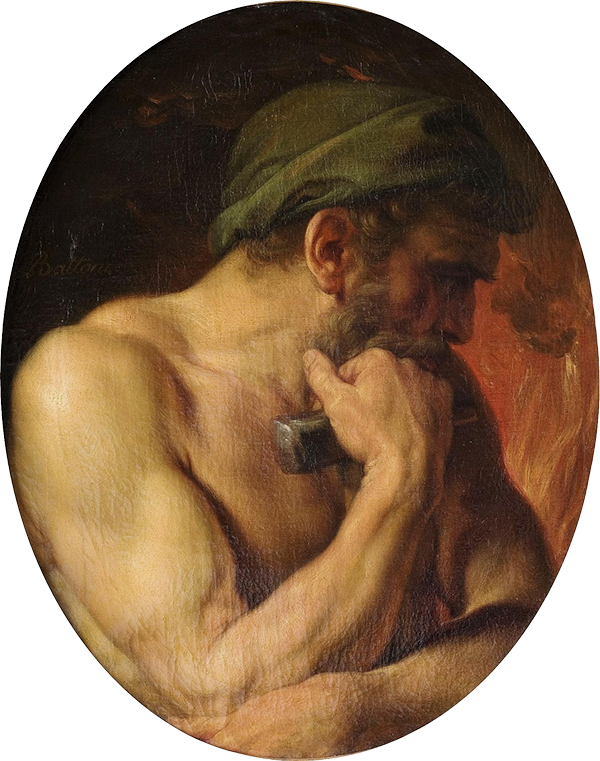
Vulcan, Pompeo Batoni, 18th century
The primary and most distinctive symbol of Vulcan is the blacksmith's hammer, often shown in his hand as he works at the forge. This tool directly signified his mastery of metalworking and his role as the divine patron of smiths and artisans. Complementary to the hammer were the anvil, upon which metals were shaped, and tongs used to handle hot materials.
Beyond literally representing metalworking, each of these implements also represents deeper occult symbology. The hammer represents the transformative force, that which actively shapes the metal with direction and conscious effort. The anvil is the foundation of the productive craft, where the base substances are turned into precious objects. In this sense, it can represents the unconscious mind. It provides the solid, often unyielding foundation or resistance that the conscious mind must push against. The tongs, are representative of the finer elements; the control over fire and dangerous matter, and the more hidden aspects of artisan work. The raw metal is held safely in the fire and made malleable, to then be worked on by the conscious and unconscious forces.
Fire itself, as mentioned, served as a fundamental symbol, embodying both the dangerous, untamed aspect of Vulcan (linked to volcanoes, lightning, and conflagrations) and its controlled, productive form in the forge. His forges were mythically located beneath volcanoes such as Mount Etna or the island of Vulcano in the Aeolian Islands, where eruptions were interpreted as signs of his activity. In some representations, he appears with a limp, an attribute inherited from his Greek counterpart Hephaestus, though this was less emphasized in purely Roman contexts.10
VI. Cult of Vulcan
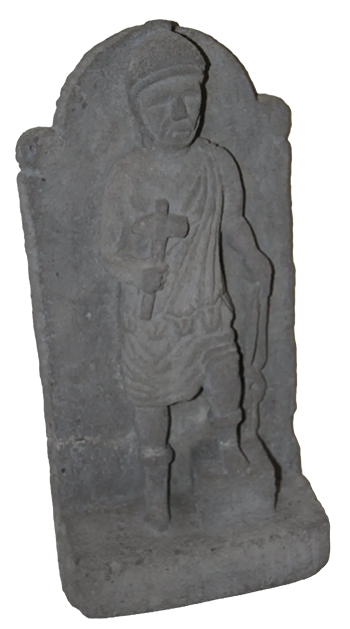
Relief of Vulcan, 1st-2nd century CE, Butzbach Museum.
Outside Rome, the cult of Vulcan was prominent in cities such as Ostia, where the pontifex Vulcani et aedium sacrarum served as the chief priest, overseeing all sacred buildings and religious activities related to Vulcan. Vulcan's cult was served by a dedicated priest, the flamen Volcanalis, one of the flamines minores (minor flamines) in the Roman priestly hierarchy. The flamen Volcanalis was responsible for officiating at the Vulcanalia and other rituals, including rituals to the Goddess Maia on the Kalends of May.17
VII. Mythology and Meaning
Beyond the adaptation of the Greek myths, Vulcan held a number of unique Roman mythic characteristics often underlined by his cult festivals.
In one of his primary aspects, Vulcan was honored during the Volcanalia in order to ward off the destructive threat of fire to stored grain, a celebration which often involved the lighting of bonfires, candles, and the drying of fabrics in the sun. His cult site was deliberately placed beyond the original boundaries of the city, a precaution intended to limit the danger his fiery nature might pose within Rome itself. At the same time, this destructive power could be turned outward against enemies, which may also explain the positioning of his sanctuary. This dual function is reflected in rituals where the weapons of defeated foes, and even those of victorious generals in acts of devotion, were dedicated to him.18,19
Through comparative analysis, one scholar associated this aspect of Vulcan with the concept of a "defensive fire" in the system of three Vedic sacrificial fires. In that framework, three distinct fires structure ritual activity: the domestic hearth, which anchors the sacred space on Earth; the sacrificial fire, which carries offerings to the divine; and a protective fire, typically positioned at the southern boundary to guard against harmful forces. When applied to Rome, envisioned as an enlarged sacred enclosure, these correspond to the hearth in the temple of Vesta, the sacrificial flames of temples and altars, and the protective fire maintained in Vulcan's sanctuary.15
Another dimension of Vulcan's identity concerns his association with male generative power. In Roman myth, he is credited as the father of several notable figures, including Caeculus, Cacus, and the king Servius Tullius. Some traditions even suggest that he may have been the unknown divine force responsible for impregnating Goddesses such as Fortuna Primigenia and Feronia, potentially, and rather bizzarely positioning him as a progenitor of Jupiter, though this interpretation obviously conflicts with other theological traditions, and must be considered only through a strictly symbolic occult lens.20,21
In these myths, Vulcan's generative capacity is closely tied to the fire of the domestic hearth. For example, Caeculus is said to have been conceived when a spark from the hearth fell upon his mother. Similarly, the mother of Servius Tullius, Ocresia, was impregnated by a mysterious phallic form that emerged from sacrificial ashes, an event linked to the household rites overseen by Tanaquil. Pliny the Elder recounts a similar version, attributing the act instead to a household spirit. In each case, the divine nature of the child is signaled by fire imagery, such as flames surrounding the head without causing harm.22,23,24
Building on these traditions, one archaeologist has suggested that figures like Cacus and his sister Caca may represent offspring of Vulcan and a local divine or virginal figure, embodying both metallurgical fire and the domestic hearth, extensions of Vulcan and Vesta respectively.
These narratives likely originate in the early period of Latium before urban development. Their symbolism points to a broader pattern: at the divine level, Vulcan unites with a primal feminine force to produce a supreme deity like Jupiter; at the human level, he engenders rulers through unions with mortal or semi-divine women.25
Evidence of a ritual association between Vulcan and Vesta appears as early as the lectisternium of 217 BCE. Additional support for this connection includes the close proximity of their sanctuaries and the account of Dionysius of Halicarnassus, who states that both cults were introduced to Rome by Titus Tatius in fulfillment of a vow made during wartime, a claim later affirmed by Varro.26
In addition to the Vulcanalia, Vulcan was honored during the Tubilustria (May 23), a ceremony for the purification of trumpets, and in the Ludi Vulcanalici, games held in his honor on rare occasions, such as in 20 BCE to commemorate Augustus's diplomatic triumphs. After the Great Fire of Rome in 64 CE, special rites and new altars were dedicated to Vulcan in an effort to placate his anger and prevent further catastrophe.9
VIII. Danger and Fire
The clearest indication of this idea is shown in the epigraphic name "Volcanus Quietus Augustus," which appears during the reign of Augustus. In 3/2 B.C., the magistrates of the Vicus Armilustri created a joint inscription dedicating cult to "Vulcan Quietus Augustus and Statae Matri Augusta" "to Vulcan Quietus Augustus and Stata Mater Augusta." Quietus, as the term suggests, implies that Vulcan was being worshipped in a quieted, pacified, non-raging form. The other goddess in the dedication clearly indicates that the intent is even clearer. As we will see below, Stata Mater is specifically linked to putting out urban fires, and the neighborhood cult of the two deities would have been part of a Roman community where the threat of urban fires has always existed. Therefore, from the point of view of his followers, Vulcan's optimal state was not the highest possible state of burning, but rather when flames were quieted and controlled.27,28
This epigraph is more solid proof that there was an explicit Vulcan of fire aversion than are later depictions of him simply working at a forge. The response to the great fire in Rome in 64 CE demonstrates that this was not simply an archaizing reading of some ancient festival. Tacitus describes Nero's fire-fighting efforts as separate from the religious responses that followed. He first describes wider streets, fire-proof construction, better access to water, and better equipment for fighting fires. Then he writes that after those practical steps, resort was had to the Sibylline Books and that supplicatum Vulcano, a supplication was offered to Vulcan, along with rituals for Ceres, Proserpina, and Juno. Therefore, Vulcan represents the divine aspect of preventing fires in Rome, just as building codes and having enough water represent the human aspects of preventing fires. Roman thought does not present the use of propitiatory religion and practical fire safety as mutually exclusive options; they can be used to fight the same danger.29
Under the Flavians, the memory of the fire caused by Nero continued to find expression through Vulcan's cult. The monumental altars known as Arae Incendii Neroniani were built under Domitian, based on vows made after the fire in 64 AD; their inscriptions specified rituals for the Volcanalia. Virginia Closs's new assessment of these monuments connects them with both memories of disasters and claims by Flavian emperors to have restored and protected Rome. Therefore, Vulcan could operate on behalf of the entire city as a divine way to limit dangers that had destroyed Rome again and again. Thus it is more accurate to say that Vulcan served as an averter of fire that is destructive due to propitiation than simply as a "god who prevents fires". While the Romans could worship Stata Mater as the actual force that stopped a spreading fire, Vulcan represents the powerful forces of flame that needed to be calmed down.30
IX. Occupations
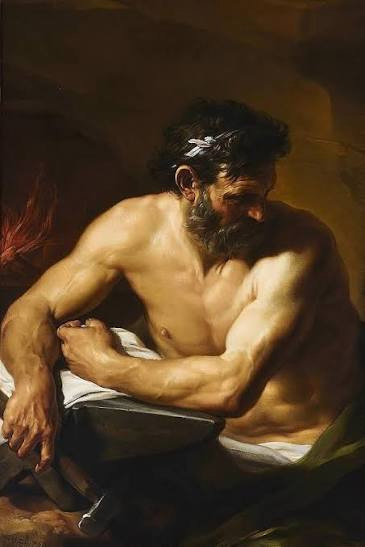
Vulcan, Pompeo Batoni (1750)
In specifically Roman evidence, Vulcan developed a recognizable relationship with working-class individuals (who worked with fire) but his relationship was broader than the contemporary notion of him simply as the "patron god of blacksmiths." Latin literature identifies Vulcan especially with working fire of kitchens, ovens, furnaces and workshops. Plautus made a joke about this association in the Aulularia where the unfortunate cook Congrio is referred to as a "son of angry Vulcan" because whatever he touched caught fire; the Loeb Commentary on Plautus' Aulularia, points out the obvious connection of cooks with Vulcan due to their constant use of fire.31
Centuries later Apuleius gave a beautiful literary expression to this idea at the divine marriage ceremony of Cupid and Psyche: While Liber served wine, Vulcan cooked the banquet, Vulcanus cenam coquebat. A late Latin poem attributed to Vespa takes this association one step further by showing the Iudicium coci et pistoris iudice Vulcano, the "judgment of the cook and baker before judge Vulcan". Therefore, Vulcan could symbolize not only metallurgy but all of those occupations which utilized controlled fire in transforming raw materials into something useful: cooks, bakers, furnace workers and, obviously, metalworkers.32,33
The strongest evidence for Vulcan as a deity of craftsmen collectively is from Roman occupational associations, the collegia fabrum. The word faber itself was far more inclusive than "blacksmith": Depending upon its context, it could include builders, carpenters, metalworkers and many other skilled craftsmen. In Roman Dacia, the connection to Vulcan became epigraphically clear. The officials of the municipal collegium fabrum at Potaissa in 197 CE dedicated to Volcanus Augustus for the well-being of Septimius Severus and Caracalla. Similarly, at Sarmizegetusa, another inscription to Vulcan was found within the monumental aedes fabrum, the official headquarters of the college of craftsmen. This is important evidence since they are actual Roman inscriptions written by real professional associations rather than conclusions drawn from Greek mythology. As such, they show that at least some Roman fabri regarded Vulcan as a deity particularly fitting to their own collective identity as professionals.34
However, the fabri were not just private artisans. Roman craftsmen could serve a very civic purpose, and this is what explains why Vulcan can sit at the confluence of craftsmanship, civic duty and fire-protection. When a devastating fire broke out at Nicomedia, Pliny the Younger suggested to Trajan that a collegium fabrorum of 150 craftsmen should be formed to fight fires. He offered Trajan a guarantee that ne quis nisi faber recipiatur"only a faber will be accepted".35
Trajan refused to accept Pliny's suggestion because he was afraid that an organized association would become a political faction (hetaeria), but importantly replied that Pliny's suggestion had been attempted by other cities. Furthermore recent research on the westward collegia fabrum has emphasized that these highly formalized unions of artisans were useful to local municipalities as reservoirs of skilled labor for building projects and as groups which could be mobilized during fires and other civic disasters. Hence, a faber could be simultaneously a craftsman, builder, guild member and in certain situations a type of municipal firefighter.35,36
Therefore, the association of the fabri with Vulcan is doubly relevant for Romans. On one hand, the same men who employed fire professionally could also be called upon to suppress uncontrolled fires. On the other hand, the dedication of the Potaissan collegium fabrum to Volcanus Augustus may have contained double reference: Vulcan represented craftsmen who employed controlled fire and material transformations; yet he represented equally the powerful civic fire-deity whose powers craftsmen might literally be required to contain.34
This is especially important since the fabri at Potaissa made their dedication pro salute of the emperors, thus imparting a strong public character to their action rather than merely expressing the private piety of a few smiths. At Sarmizegetusa, the aedes fabrum itself stood prominently in the colonial forum demonstrating how completely these organizations of manual laborers could be enmeshed in municipal government.34
At Rome itself, Vulcan was similarly related to low-ranking administrative officials responsible for maintaining the daily activities of each city quarter. In 3/2 BCE officials from the Vicus Armilustri established a dedication which reads:
Volcano Quieto Augusto
et Statae Matri Augustae
sacrum …
CIL VI 802 = ILS 3306
"To Vulcan Quietus Augustus and Stata Mater Augusta sacred." These officials were not senators nor great state priests but officials from an individual Roman quarter. The fact that they paired Vulcan Quietus with Stata Mater is especially interesting. Stata Mater was very concerned with prevention of urban fires whereas Vulcan appeared here as Quietus; the force of fire had been reduced to peaceable or pacified status. Therefore, Vulcan's cult extended into the organizational framework of individual quarters of Rome: local ward-officials involved in maintaining and protecting an urban district in terms of physical upkeep and religious safety honored him as a protector against destructive fire.27,28
X. Vulcan as Stoic Power
A new way of understanding Vulcan/Hephaestus was developed by the Stoics. They used the idea of the god as a representation of the rational divine force through fire to create both physical and allegoric representations of Vulcan/Hephaestus. According to Minucius Felix, Zeno saw the traditional mythology as a description of natural forces:
interpretando Iunonem aera, Iovem caelum, Neptunum mare, ignem esse Vulcanum
"interpreting Juno as air, Jupiter as heaven, Neptune as the sea, and Vulcan as fire."
Minucius Felix, Octavius
Minucius added right away that Chrysippus had essentially the same view as Zeno on the physiological, physical or natural philosophy, interpretations of Hesiod, Homer and Orpheus. This is significant because it states that Vulcan controls fire, but in the context of Stoic interpretation, Vulcan IS fire, or more accurately, "Vulcan," is one of the traditional religious names for a specific demonstration of divine nature.37,38
This concept follows a larger body of Stoic theology preserved by Diogenes Laertius. In his account of Stoicism, Diogenes describes God as a singular rational and provident entity pervading the cosmos. However, he attributes different divine names to the same divine principle based upon different extensions of divine power or region. Therefore, the same divine principle is called Hera for air, Poseidon for water, Demeter for earth, and Hephaestus for its creative/artificing fire into the "technic fire." Diogenes then provides even simpler wording: Hephaestus = Fire / Zeus = Ether. So, Vulcan/Hephaestus was not an entirely independent supernatural personality in addition to the supreme cosmic Deity. Instead, he was another aspect or name of the one Divine Nature, viewed specifically in terms of its fiery and productive activities.39
It should be noted that the Stoics did not equate Vulcan with all kinds of fire. As far as Stoic Physics is concerned, fire occupies a very high rank. Divine Nature itself may be described as a rational or "creative fire" (tecnic fire) proceeding systematically towards creation. Cicero reports this definition as the Stoic definition of Nature and indicates that the divine being is diffused in each part of Nature under various traditional names. While Vulcan represents a certain development of that fiery divine activity, it does not equate directly to the overall Stoic god. On the highest level of cosmology there belongs the universal rational fire, providence, Zeus, Nature, and Logos; at a lower level, Vulcan/Hephaestus refers to divine fire when considered in one of its differentiated operational contexts.40,41
Cornutus made this point explicitly in the first century CE. Cornutus states that bright clean fire and ether correspond to Zeus; however,
Hephaestus is the fire mixed with air which we use.
Cornutus, Greek Theology
Hephaestus is therefore associated with craftsmanship. Most craftsmen need fire to make their products. Cornutus explains that his parentage from Zeus and Hera can be physiologically allegorized as well since Zeus is represented by fiery ether and Hera by air. Cornutus also offers explanations for Hephaestus' traditional lameness and falling from heaven. His lameness is caused by the irregular motion of flames passing over their fuels; his fall from heaven is due to humans finding earthly fire via lightning. Similarly Cornutus uses naturalistic explanation for Hephaestus' control of metalwork. When Hephaestus catches Ares in a net; it is easy to understand how iron and bronze were defeated by the power of fire. Virtually all aspects of this mythical figure could be translated into a lesson about how flame behaves physically and technologically.42
Sources and Bibliography
- Varro, Marcus Terentius. On the Latin Language. Translated by Roland G. Kent. 2 vols. Loeb Classical Library 333–334. Cambridge, MA: Harvard University Press, 1938. See 5.10, 45–47.
- Cook, Arthur Bernard. Zeus: A Study in Ancient Religion. Vol. 2. Cambridge: Cambridge University Press, 1925.
- West, M. L. Indo-European Poetry and Myth. Oxford: Oxford University Press, 2007.
- Biggs, Thomas. "Roman and Carthaginian Journeys: Punic Pietas in Naevius' Bellum Punicum and Plautus' Poenulus." In The Epic Journey in Greek and Roman Literature, edited by Thomas Biggs and Jessica Blum. Cambridge: Cambridge University Press, 2019.
- Festus, Sextus Pompeius. Sexti Pompei Festi De verborum significatu quae supersunt cum Pauli epitome. Edited by Wallace M. Lindsay. Leipzig: B. G. Teubner, 1913.
- Maltby, Robert, and Niall W. Slater, eds. and trans. Fragmentary Republican Latin, Volume VI: Livius Andronicus, Naevius, Caecilius. Loeb Classical Library 314. Cambridge, MA: Harvard University Press, 2022.
- Warmington, E. H., ed. and trans. Remains of Old Latin, Volume II: Livius Andronicus, Naevius, Pacuvius, Accius. Loeb Classical Library 314. Cambridge, MA: Harvard University Press, 1936. See Naevius fr. 50, pp. 68–69.
- Platner, Samuel Ball, and Thomas Ashby. A Topographical Dictionary of Ancient Rome. London: Oxford University Press, 1929. S.v. "Volcanal."
- Fowler, W. Warde. The Roman Festivals of the Period of the Republic: An Introduction to the Study of the Religion of the Romans. London: Macmillan, 1899.
- "Vulcan." Mythopedia. Accessed March 24, 2021.
- Lewis, Charlton T., and Charles Short. A Latin Dictionary. Oxford: Clarendon Press, 1879.
- Macrobius. Saturnalia. Edited and translated by Robert A. Kaster. 3 vols. Loeb Classical Library 510–512. Cambridge, MA: Harvard University Press, 2011. See 1.12.18.
- Grant, Michael. The Roman Forum. London: Weidenfeld & Nicolson, 1970.
- Hülsen, Christian. The Roman Forum: Its History and Its Monuments. Rome: Ermanno Loescher & Co., 1906.
- Dumézil, Georges. La religion romaine archaïque. Paris: Payot, 1974.
- Inscriptiones Latinae Selectae 4914. Translated in Robert K. Sherk, The Roman Empire: Augustus to Hadrian. Cambridge: Cambridge University Press, 1988.
- Pavolini, Carlo. La vita quotidiana a Ostia. Rome-Bari: Laterza, 1986.
- Plutarch. Moralia, Volume IV: Roman Questions. Translated by Frank Cole Babbitt. Loeb Classical Library 305. Cambridge, MA: Harvard University Press, 1936. See Roman Questions 47. With Vitruvius. On Architecture. Translated by Frank Granger. 2 vols. Loeb Classical Library 251, 280. Cambridge, MA: Harvard University Press, 1931–34. See 1.7.1.
- Livy. History of Rome (Ab Urbe Condita). Translated by B. O. Foster et al. 14 vols. Loeb Classical Library. Cambridge, MA: Harvard University Press, 1919–59. See 8.10.
- Scholia Veronensia ad Aeneidem 7.681. In Appendix Serviana, edited by Hermann Hagen. Leipzig: B. G. Teubner, 1902.
- Champeaux, Jacqueline. Fortuna: Le culte de la Fortune à Rome. Vol. 1, Fortuna dans la religion romaine archaïque. Rome: École française de Rome, 1982.
- Virgil. Aeneid. Translated by H. Rushton Fairclough. Revised by G. P. Goold. 2 vols. Loeb Classical Library 63–64. Cambridge, MA: Harvard University Press, 1999–2000. See 7.680.
- Ovid. Fasti. Translated by James G. Frazer. Revised by G. P. Goold. Loeb Classical Library 253. Cambridge, MA: Harvard University Press, 1989. See 6.627.
- Pliny the Elder. Natural History. Translated by H. Rackham et al. 10 vols. Loeb Classical Library. Cambridge, MA: Harvard University Press, 1938–62. See 36.204.
- Carandini, Andrea. La nascita di Roma: Dèi, Lari, eroi e uomini all'alba di una civiltà. Turin: Einaudi, 1997.
- Dionysius of Halicarnassus. Roman Antiquities. Translated by Earnest Cary. 7 vols. Loeb Classical Library. Cambridge, MA: Harvard University Press, 1937–50. See 2.50.3.
- Lott, John Bert. The Neighborhoods of Augustan Rome. Cambridge: Cambridge University Press, 2004. See esp. 91–94, 137–39, 166–68, 192.
- Corpus Inscriptionum Latinarum VI 802 = Inscriptiones Latinae Selectae 3306. Rome, 3/2 BCE.
- Tacitus. Annals. Translated by John Jackson. 4 vols. Loeb Classical Library. Cambridge, MA: Harvard University Press, 1931–37. See 15.43–44, esp. 15.44.1.
- Closs, Virginia. "Neronianis Temporibus: The So-Called Arae Incendii Neroniani and the Fire of A.D. 64 in Rome's Monumental Landscape." Journal of Roman Studies 106 (2016): 102–23.
- Plautus. Aulularia. In Plautus, vol. 1, edited and translated by Wolfgang de Melo. Loeb Classical Library 60. Cambridge, MA: Harvard University Press, 2011. See 359.
- Apuleius. Metamorphoses (The Golden Ass). Vol. 1. Translated by J. Arthur Hanson. Loeb Classical Library 44. Cambridge, MA: Harvard University Press, 1989. See 6.24.2.
- Vespa. Iudicium coci et pistoris iudice Vulcano. In Poetae Latini Minores, vol. 4, edited by Emil Baehrens, 326–30. Leipzig: B. G. Teubner, 1882. (= Anthologia Latina 199 Riese.)
- Byros, Graziela Marieta. "Reconstructing Identities in Roman Dacia: Evidence from Religion." PhD diss., Yale University, 2011. See esp. 98–101.
- Pliny the Younger. Letters. Vol. 2. Translated by Betty Radice. Loeb Classical Library 59. Cambridge, MA: Harvard University Press, 1969. See Epistulae 10.33–34.
- Verboven, Koenraad. "Who Created and Populated the Collegia Fabrum and Why?" In Greece and Rome: Social Life, Politics and Culture, edited by Alister Filippini, Marco Maiuro, and Davide Morelli, vol. 3, 343–81. Rome: L'Erma di Bretschneider, 2024.
- Minucius Felix. Octavius. Translated by Gerald H. Rendall. In Tertullian: Apology, De Spectaculis; Minucius Felix: Octavius. Loeb Classical Library 250. Cambridge, MA: Harvard University Press, 1931.
- Arnim, Hans von, ed. Stoicorum Veterum Fragmenta. Vol. 1. Leipzig: B. G. Teubner, 1905. See fr. 169.
- Diogenes Laertius. Lives of Eminent Philosophers. Vol. 2. Translated by R. D. Hicks. Loeb Classical Library 185. Cambridge, MA: Harvard University Press, 1925. See 7.147–48.
- Cicero, Marcus Tullius. On the Nature of the Gods; Academics. Translated by H. Rackham. Loeb Classical Library 268. Cambridge, MA: Harvard University Press, 1933. See De Natura Deorum 2.57, 2.63–70, 3.63.
- Long, A. A., and D. N. Sedley. The Hellenistic Philosophers. 2 vols. Cambridge: Cambridge University Press, 1987.
- Cornutus, Lucius Annaeus. Greek Theology, Fragments, and Testimonia. Edited and translated by George Boys-Stones. Writings from the Greco-Roman World 42. Atlanta: SBL Press, 2018. See 19 (§§33–35).