




| Language | Name of Hephaestus | Attestation |
|---|---|---|
| Mycenaean Greek | pai-to?(𐀞𐀂𐀵) | Minoan place name in Linear B |
| Classical Greek | Ἥφαιστος (Hephaistos) | Homer (8th century BCE onward) |
36 min read
HEPHAESTUS
author: High Priest Zevios Metathronos
co-author: Novice Priest Karnonnos
Hieratic Information about Hephaestus
| Divine Names | |
|---|---|
| Hephaestus (Ἥφαιστος) | the Greek name of Antiquity |
| These hieratic names carry strong spiritual resonance and are recommended for summoning and invocation practices. | |
| Divine Symbols | |
| |
| Divine Numbers and Attributes | |
| Sacred Numbers | 40, 50, 60 |
| Runes | Thurisaz, Tiwaz, Sowilo (in order of importance) |
| Zodiac Sign of Power | Aries |
| Sacred Animals | The Great Eagle, the Bull, the Hawk, the Serpent |
| Element | Fire, Aether |
| Divine Forces | |
| |
| Important Titles | |
| |
| Names Across Civilizations | |
| Greek | Ἥφαιστος (Hefaistos) |
| Roman | Vulcan |
| Egyptian | Ptah |
| Phoenician | Kothar-wa-Khasis |
| Chinese | Zhurong |
| Vedic | Tvastr |
| Vedic | Vishvakarma |
| Celtic | Gobannus |
| Finnish | Ilmarinen |
| Germanic | Wayland |
I. The Name of Hephaestus, the Fashioner of All
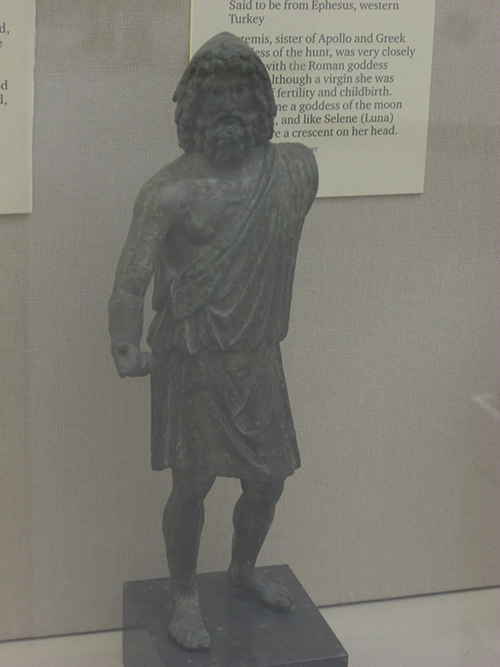
Greek statue of Hephaestus, British Museum
In Cratylus 407b, Socrates gives an etymology for Ἥφαιστος by connecting the name with φάος, φαέος (“light”), τοῦ φαέος ἵστωρ,1 The point is that Hephaestus is like “the knower of light” or “the one who knows light.” Many historians treat the following passage as exhibiting humor by Socrates, not really comprehending what the philosopher is attempting to say;
Ἑρμογένης: Τί δὲ Ἥφαιστος;
Σωκράτης: Ἀλλὰ τὸν τοῦ φαέος ἵστορα λέγεις;
Ἑρμογένης: Ἔοικα.
Σωκράτης: Φαῖστός ἐστιν, τὸ δὲ ἦ ἐπεισῆλθεν.
Hermogenes: And what about Hephaistos?
Socrates: You mean “the knower of light”?
Hermogenes: Apparently.
Socrates: It is really Phaistos; the eta (Ἥ) has slipped in.
This connection to Ptah (he-Ptah) is hinted at here, yet paradoxically any Greek form could be ancient. In the administrative tablet of Knossos named KN L 588, the word a-pa-i-ti-jo exists, indicative of a personal name relating to the god. One placename in Crete is given as 𐀞𐀂𐀵 (pa-i-to), perhaps related to the Egyptian god.2
Sources: Duhoux and Morpurgo Davies, A Companion to Linear B: Mycenaean Greek Texts and Their World, (2011); Cunliffe, A Lexicon of the Homeric Dialect (2012)2,3
II. The Fire-Worker
Hephaestus, as one of the Twelve Olympians and one of the most important of all the gods, took a heavenly placement in Ancient Greece as the god of smiths, artisans, metallurgists, fires, volcanoes and sculptors. He served as the primary craftsman and weapon-maker of Olympus and was involved in several important mythological episodes, such as his marriage to Aphrodite, his casting out of the heavens and his return there when subdued by Dionysus to render his services eternally as the heavenly artisan, and his fashioning of numerous sacred items that were continually used by gods and mythological heroes alike. Hephaestus's identity as divine blacksmith shaped his domestic cult, one closely associated with that of Athena. As patron of fire and craftsmanship, he was especially venerated by metalworkers and artisans, in contrastive nature to the domestic fire cult of Hestia and the humble crafts that were viewed to be in Athena's domain.4,5
Hephaistos means "He of the Volcano" (Literally in Ancient Greek) and is credited with being one of the creators to Mankind. The statement that he is "Beelzebul's Second in Command", is because when Zeus created mankind, his Son, Hephaistus helped shape mankind further through what we know as Genetic Engineering. Who is known as Mulciber in the "Goetia", is actually Hephaistos, Zeus's son. Hephaistos is a god of advanced architecture and divine technology.
6
The Homeric Hephaestus
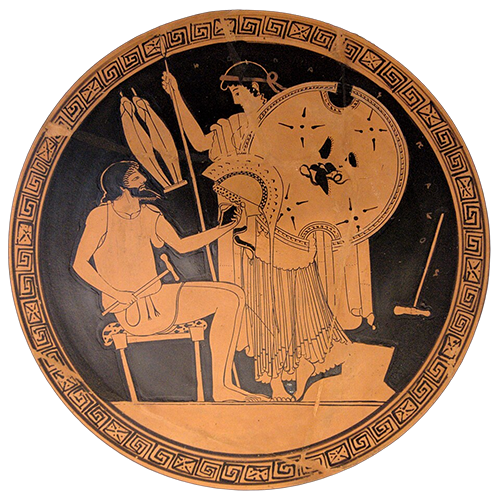
Kylix showing handing of Achilles armor to Thetis, Foundry Cup, 490–480 BCE, Antikensammlung Berlin
According to Homer, he is the son of Zeus and Hera. In the Iliad, he intervenes on the side of the Greeks, though the Trojans also give him tribute. After Thetis secures Zeus's promise to honor Achilles, Hera confronts her husband, and the divine banquet threatens to sour. Hephaestus intervenes to calm his mother, urging her to yield rather than let the immortals come to blows over mortals. To lighten the mood he recalls his own history: when he once tried to take Hera's side, Zeus seized him by the foot and flung him from the threshold of heaven.
With Patroclus dead and Achilles' old armor stripped by Hector, Thetis comes to Hephaestus' bronze-founded house on Olympus to ask for a new set (Il. 18.369–427). Homer lingers on the workshop: the smith is finishing twenty tripods on golden wheels that roll of themselves to the gatherings of the gods and back (Il. 18.372–379), and he is attended by golden handmaidens fashioned in the likeness of living girls, with mind, voice, and strength in them (Il. 18.417–420). His wife here is Charis, one of the Graces (Il. 18.382). He receives Thetis warmly because of an old debt. The narrative now states Hera cast him out of heaven, ashamed of his lameness, it was Thetis and Eurynome who caught him and sheltered him for nine years in a cave beside the stream of Oceanus.7
The primary narrative of Hephaestus in the Iliad is the next scene. He sets to work, and the description of the shield he makes is the poem's great ekphrasis that shows his cosmological role. On it he wrought the earth, sky, sea, the tireless sun, the full moon, and the constellations; two cities, one at peace with a wedding-procession and a lawsuit argued in the marketplace, the other under siege and ambush; scenes of plowing, of a king's estate at harvest, of a vineyard and a herd of cattle attacked by lions; a pasture, a dancing-floor like the one Daedalus made at Knossos, and around the whole rim the great stream of Ocean. After the shield he forges a corselet brighter than firelight, a heavy helmet with a golden crest, and greaves of pliant tin.
In the assembly and marshalling of the gods for the theomachy, Hephaestus is paired against the river the gods call Xanthos and men Scamander. Hephaestus looses a supernatural fire that shows his fearsome powers. First he burns the dead and the plain, then the elms, willows, and tamarisks along the banks, and finally turns the flame on the water itself until it boils and the fish and eels writhe in the shallow
Later Myths
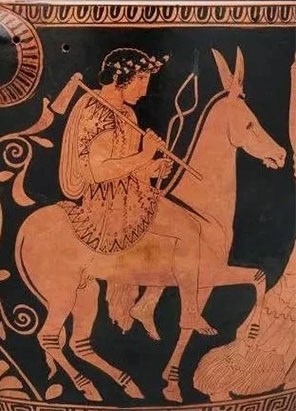
Hephaestus riding donkey, Athenian red-figure skyphos 5th BCE, Toledo Museum of Art
Other variations such as Hesiod's Theogony make him the son of Hera alone, as Hera resented Zeus siring Athena with Metis. Hephaestus was known to be as wily as a fox; the myths iterate the secondary narrative of the Iliad where it is stated that he cast out of the heavens by his mother for his lameness or for other reasons. Resentful of this, he built her a golden throne which either fixed her in place or trapped her in bronze chains, which none of the other gods could remove. Alternatively, in some cases, Hera is only affixed to the chair for him to take Aphrodite's hand and for respect. In other forms, like the initial contention, it is Zeus who casts him out.8,9,14
From that point, Hephaestus invariably falls onto the volcanic island of Lemnos from an extreme height,7 which sometimes renders him disabled, and after falling to earth he learns the arts of fire from the Sintian inhabitants of the volcanic island and constructs a forge. The area of the Lemnians which the craftsman God fell onto was considered to be an area with miraculous healing powers by the Greeks. To order to free Hera, even Ares failed to bring back the smith god.
Only Dionysus as the bridge between the divine and material was able to travel to the realm of mortals by tricking Hephaestus with alcohol, upon which he was captured and taken back to Olympus with a procession of partying revelers on a donkey. He subsequently became the smith of the gods whose talents were put to use. The palace of Hephaestus was present on Mount Olympus, containing his primary heavenly workshop, a workshop which shone brilliantly like the stars and was eternal. It contained his anvil and up to twenty bellows operating at his command.
Another element of his mythology concerns his tumultuous marriage to Aphrodite, characterized by the illicit affair of her and Ares. A general theme of being compared with Athena is present in Hephaestian imagery; he was commonly worshiped with her in temples as a typical dyad, while Hephaestus' mythological representation as her antagonistic male counterpart, and his desire to assail her out of lust (prompted by Poseidon, her enemy) is often written of.
The seminal fluid he spills out of lust for her either impregnates the earth, Gaia, or causes Erichthonios to emerge from the thigh due to Athena wiping the fluid off with a tuft of wool, and afterwards Athena adopts him. Otherwise, Hephaestus in the oldest account is married to Charis, a personification of grace, or is said in many contexts to be betrothed to Aglaea, the personification of brilliant light, both Charities who serve under Aphrodite as her attendants. Hephaestus was associated with alternate archaic myths revolving around him being a fiery, animalistic demon coming up out of the earth, splitting it in two. All of these myths are strongly allegorical..7,14,15,16
III. Epithets and Names
| Epithet | Meaning | Domain |
|---|---|---|
| Hephaestus Klytotekhnês (Κλυτοτέχνης) | Hephaestus the Renowned Craftsman | Smithcraft, forged artefacts |
| Hephaestus Amphiguêeis (Ἀμφιγυήεις) | Hephaestus the Lame | Fixed body, paradoxical skill |
| Hephaestus Klytomêtis (Κλυτόμητις) | Hephaestus of Famous Skill | Inventiveness, technical intelligence |
| Hephaestus Phôsphoros (Φωσφόρος) | Hephaestus the Light-Bringer | Fire, Lord of Light |
| Hephaestus Karterocheir (Καρτερόχειρ) | Hephaestus the Strong-Handed | Manual force, extreme power |
| Hephaestus Aiônios (Αἰώνιος) | Hephaestus the Eternal | Fire, demiurge, cosmic permanence |
| Hephaestus Teknodiaitos (Τεχνοδίαιτος) | Hephaestus in Craft | Artifice, manufacture |
| Hephaestus Ergastêr (Ἐργαστήρ) | Hephaestus the Worker | Labor, all workers |
Sources: Homer, Iliad 1.571 (Klytotekhnês) and 1.607 (Amphiguêeis); Homeric Hymn to Hephaestus 20.1 (Klytomêtis); Orphic Hymn to Hephaestus 66.2–4 (Phôsphoros, Karterocheir, Aiônios, Tekhnodiaitos, Ergastêr).7,37,44
IV. Temples, Festivals, Locales
Athens
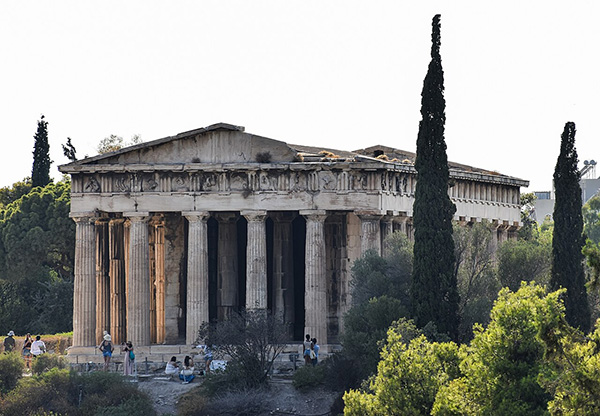
Temple of Hephaestus, often mislabelled as the Theseion, Athens
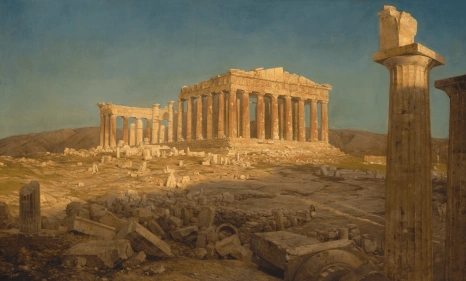
Numerous places in Greek life were dedicated to Hephaestus. The main Athenian center of Hephaestus' role in formal state worship lay in the Temple of Hephaestus, the Hephaisteion (mistakenly called the Theseion due to the reliefs of Theseus there), a peripteral Doric temple that still stands overlooking the ancient Athenian agora. This temple was uniquely dedicated jointly to both Hephaestus and Athena Ergane (Athena the Worker). Pausanias noted that famous bronze statues of both the deities stood in this temple, ones which were sculpted by Alkamenes, a well-honed student of the famous artist Phidias.9,17
Although the primary style is Doric, Ionic elements also exist, making the temple quite unique. The architect of the temple is unknown and in the absence of firm evidence, scholars simply refer to an anonymous designer known as the Hephaisteion Master. The building is constructed mainly from marble quarried on nearby Mount Penteli. Only the lowest step of the krepis (platform) uses a different material. The architectural sculpture of the temple employs both Pentelic and Parian marble.18,19
The ground plan measures roughly 13.71 m from north to south and 31.78 m from east to west. Around the exterior runs a Doric peristyle, with six columns on each of the short east and west sides and thirteen along the north and south flanks (counting the corner columns twice). Inside, the structure comprises a pronaos at the front, a central cella that housed the cult images, and an opisthodomos at the rear. A distinctive mid–5th-century BC design feature is the alignment of the pronaos antae with the third columns along the flanks of the peristyle, meaning the porches in the temple were very deep. Within the cella there is also an inner Doric colonnade: five columns on both the north and south sides and three across the end, again with the corner columns counted twice.20,21
Archeologically, the Hephaisteion is one of the best-preserved Greek temples. Its architecture is predominantly Doric, with some Ionic elements in the interior friezes. The temple also contained many scenes of Theseus, the local hero deity of the Athenians, and an array of represented metopes from the Labors of Hercules. Offerings excavated by archeologists in this environ included terracotta molds dedicated to Hephaestus and Athena, along with general industrial tools of the era. That was because the temple itself was located in the Kolonos Agoraios, an industrial district of Athens. Ancient authors also mentioned a chalkeion or bronze-smith's shop adjacent to the temple.7,9,22,23,24
Lemnos
The volcanic island of Lemnos in the northern Aegean was the preeminent cult center of Hephaestus outside Attica. Just as in the mythology, the island was spoken of as being the favored dwelling area of the God himself. At the reins of his whims, Lemnos' central polis was named Hephaestia. The importance of Hephaestus to the island's locale was clearly a high one.
The island's association with divine and ritual fire underscores Hephaestus's role as giver of useful fire to mankind. Another Lemnian cult was that of the Kabeiroi, mysterious chthonic deities often identified as sons of Hephaestus. Lemnos and the neighboring island of Samothrace were famous for their Kabeirian Mysteries. On Lemnos, the Sanctuary of the Kabeiroi at Chloe dated back to the 7th century BCE and had a venerable antiquity. Even King Philip V of Macedon bequeathed letters requesting his initiation into these mysteries.25,26
Lycia
He was also worshipped in Lycia in Asia Minor (modern day Turkey) and occupied a sacred temple of some note in that locality. Some scholars believe Hephaestus was originally a deity from Asia Minor. He gave his name to the Hephaesti Montes in Lycia, which Pliny describes as flaring when touched with a torch, with even river stones and underwater sand said to glow.27
Mount Etna
Mount Etna on the eastern side of Sicily was another important cult center. The residual activity of the stratovolcano was held to be a marvel by the denizens of the ancient world, and they took it for granted that Hephaestus was active in his forge as a result. There were numerous cult sites around the area dedicated to him. At the famous Sicilian Hephaestia, priests ensured the flames never slept in a similar way to the tending of Hestia's flame:
At Aitna in Sicily, honor is paid to a temple of Hephaestus, with a precinct, sacred trees, and a fire that never goes out… and sacred watchdogs guard the shrine, fawning on the righteous but attacking the impure.
On Animals 11.3, Aelian, trans. Scholfield28
V. Imagery of the Crafting God
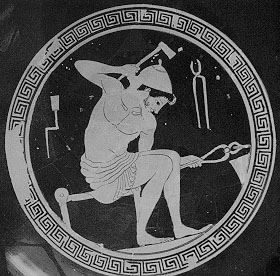
Tondo, Athenian red-figure kylix, Foundry Painter, dating to approximately 490–480 BCE, Antikensammlung Berlin
Images of Hephaestus, Sethlans and Vulcan usually depicted him in his regalia as a craftsman in a short tunic or chiton, a round close-fit cap often triangular in shape (pilos), and he was often rendered holding a hammer or pair of tongs. Sometimes he was even represented as dwarf-like in the same manner as the Pataikos. Hephaestus was conventionally depicted as lame, club-footed or disabled. The lameness is an allegory for his powers' fixed nature in the material realm and involvement in the affairs of the mortals, as opposed to, for example, Hermes, who can fly back and forth between realms easily.7,12,30
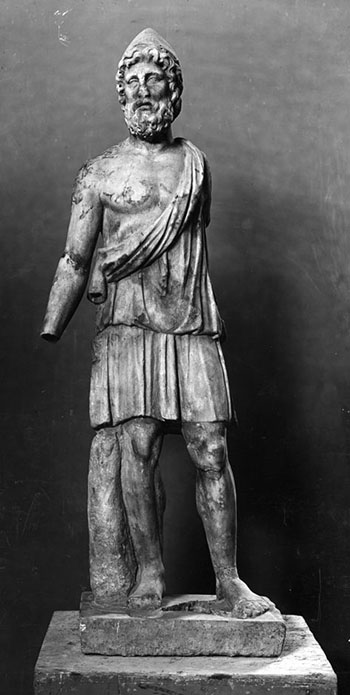
The oldest surviving large statue of Hephaestus, Ostiense Archeological Museum
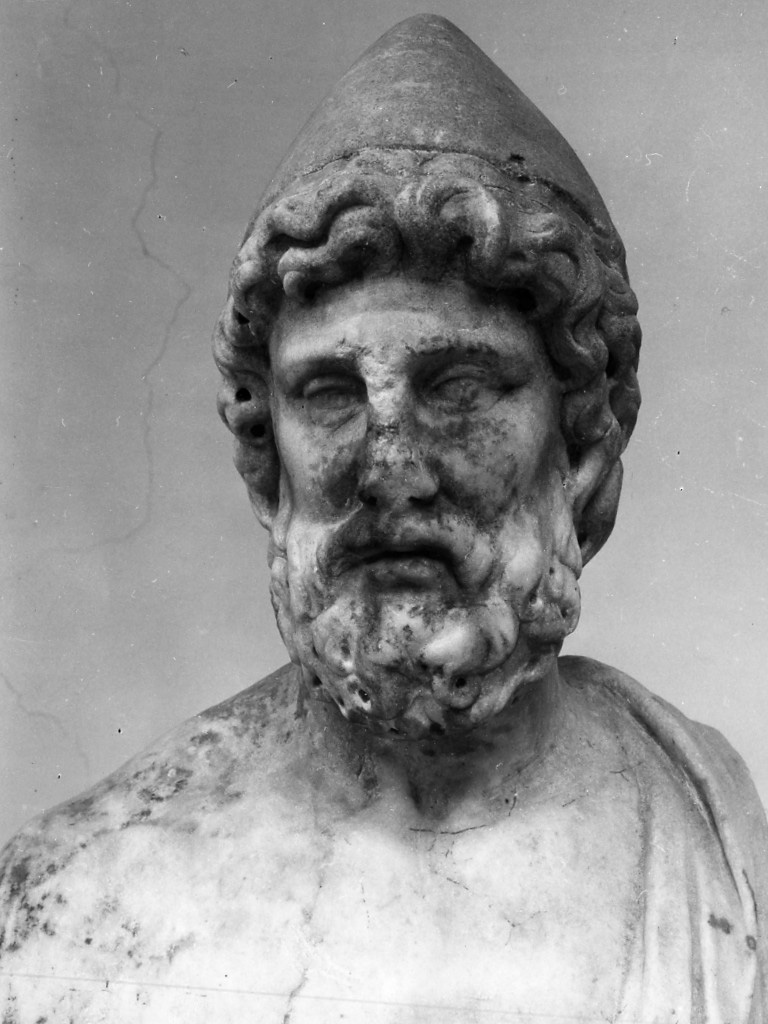
The oldest surviving large statue of Hephaestus, head view Ostiense Archeological Museum
Occasionally, in the mythology, Hephaistos faced acrimony for his lameness, and in some plays, it was the butt of jokes by ancient writers who could not comprehend why a god would suffer that kind of affliction. Others noted with adroit perception that without him, the Olympians would have no weaponry or armor whatsoever, a curious irony from one who found it difficult to fight. This ambiguity about his apparent lack of ability in itself contains certain occult messages, and by particular observers his problem was likened to being an allegorical spark that roars into a full fire.31,32
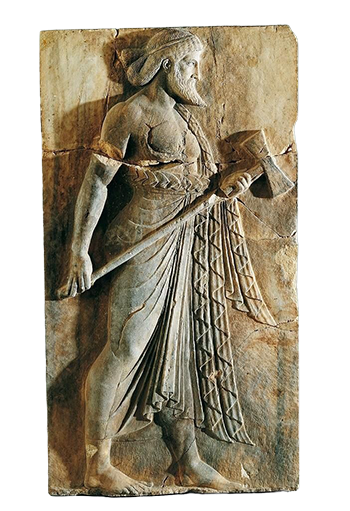
Relief of Hephaestus from Heraculaneum's Chapel of the Four Gods, National Archaeological Museum of Naples
Some artists such as Alkamenes brought an appropriate level of dignity and beauty to his portrayals, in line with Socrates' conception that Hephaestus must be portrayed with somber respect, and the mastery of this sculptor's portrayal in particular was commented on by Romans long after the unveiling of the statues.33,34
... at Athens there is a much-praised statue of Vulcan made by Alcamenes, a standing figure, draped, which displays a slight lameness, though not enough to be unsightly.
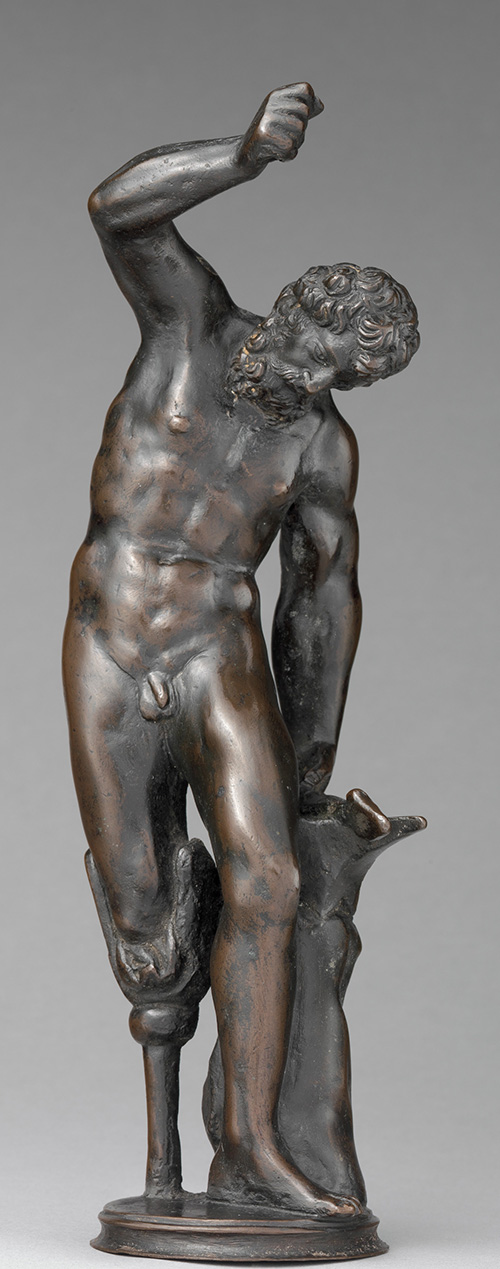
Bronze sculpture of Vulcan from Venice, 16th century, the Met
VI. Divine Tools
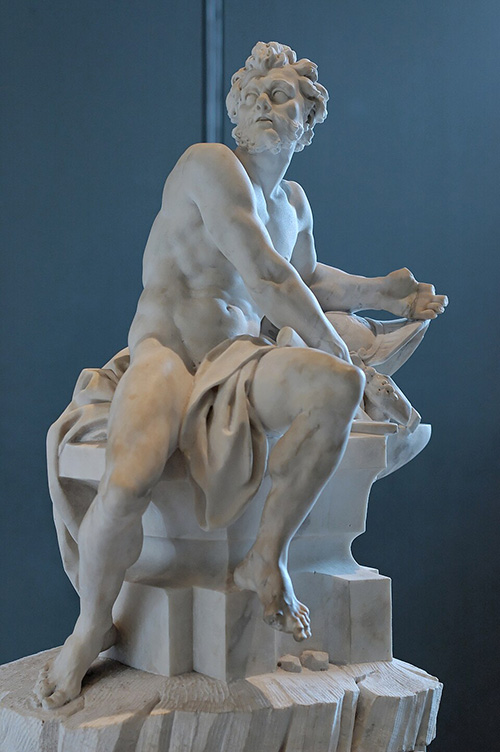
Hephaestus at the Forge, Guillaume Coustou the Younger (1742), Louvre
A major symbol of Hephaestus is the double-headed axe. This is a reference to his closeness to Athena in making coherent beginnings, and he actually uses the axe to free Athena from the head of Zeus.14 In terms of ritual implements, another symbol of his is the torch. The torch races (Lampadedromiai) in Athens had teams pass a lit torch in relay and a new fire was also brought ceremonially to Lemnos. That also represented the ability of Hephaestus to mediate between the powers of the Sun and the mental realm, allowing light to show the way forward and give 'form' to things that were lurking in darkness, and the lit torch was a key ritual object in his worship, representative of the god's element of fire. There is evidence the torches were used as trophy objects after the ritualized games.36,54,58
Of all his symbols, the hammer and anvil was the most important, representing his rigid and continual work associated with clinking, thumping sounds, but also the laborious nature of the Magnum Opus that is allegorically rendered in their guise. The spark of the hammer hitting the anvil is much like the violence of the serpent as it rises, and clanging of the smithy echoes the vibratory basis of reality and enacting magic. The implication of sound places Hephaestus next to Apollo.
The fire and hearth of the smith god also was symbolic of any initiate's fiery purification, leaving them cleansed of past errors. Symbolic too are practices like glassblowing and pottery where base materials are made into refined commercial objects, an association indicative of the increasing value of the occult acolyte as they practice continual refinement.
The dependable anvil is one of his symbols. It possessed certain occult meanings of its own. The beating 'anvil' of the heart and the hot system of blood circulation was equated with Hephaestus. As the king of the body, the sun of the heart dispensed the operative fire that shaped matter from the divine light. From this fire comes the ability to form images and engage in creativity, an important precursor for individuality. Above all, at the root, such symbols represented the fiery essence of creation.
VII. Work and Spiritual Allegory
All forms of technological wonder were attributed to Hephaestus by ancient authors, who even attribute the beginnings of robotics to him. Above the veil of stars, Hephaestus was said to have created the first human woman, Pandora. Lucian said in his Hermotimus:
Poseidon made a bull, Athene planned a
house, Hephaestus constructed a man.10
Divine weaponry and armor was one of his specialties in mythology. The divine architect is often consulted or referred to in mythological stories for his ability to manufacture these items. He carefully made the Aegis of Zeus, armor of Achilles, the spear of Hercules, the Trident of Poseidon, the Harpe of the first hero Perseus, and many more.7,8,11,14
Automata of Hephaestus were plentfiful, rivalling the amount of mythological monsters that the sea goddess Ceto produced. These included Talos, the bronze man of Crete who guarded the island, the flaming Colchian bulls of bronze, the golden and silver dogs of Alcinous who guarded his palace and even robotic tripods on wheels to serve the gods, among other novel and strange inventions. On a more negative note, he created the Necklace and Robe of Harmonia was of his design which cursed whomever it was gifted or betrothed to, and was covered in images of ill-fortune, primarily due to his rage at Aphrodite.13
Some aspects of his inventive nature belie deeper symbls. The specific facets of the upgraded nature of humanity and the mystery of the genetic engineering involved in this are implicated in his works. Humanity is a group theoretically limitless in potential to pursue the Great Work, yet his industrious symbols also represent specific caveats of the process. His tekhne is allegorical of meditation: an example are changes to DNA that occur with active meditation like use of the Kirtan Kriya and the great mantra reversing indications of extreme stress and aging in carers of vulnerable people.35
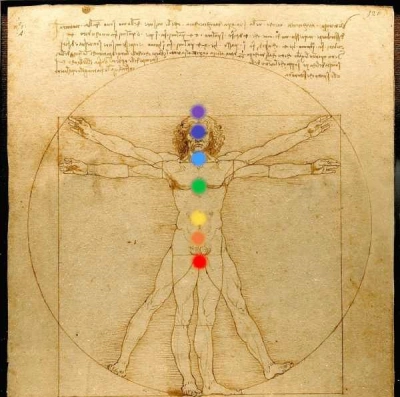
To laboriously hammer away in the font of heaven is a facet of symbolism showing that crafting a functioning soul is not a small matter and involves much work and deliberation. The metallic symbolism of the Chakras is also a notable theme of Hephaestus, although during Antiquity, this was rather veiled.
Ovid described Vulcan as the primary force in nature who shapes it inside out having total control over the material domain, a sentiment echoed by Greek writers describing the divine attributes of Hephaestus. At times, he could be equated and yet contrasted with Pan, as an unsightly being who nonetheless brought order and rhythm to the most base and wild nature. His link to Pan is affirmed in the Dionysian procession of the return, a theme that is a common representation of Hephaestus on Greek and Etruscan vases.37,38
VIII. Volcanic Identity
An example of how his imagery could be used was the way he was reflected on coinage and other artefacts, primarily due to their relative rarity compared with other gods (20 Hephaestus coin types have been found compared to 7,503 for Athena) making vague contexts impossible. The context that emerges from the artefacts dedicated to him is unmistakable. The area of Lipara, a volcanic zone, likely produced the first coins attributed with his imagery from around 440 to 420BCE.
The volcanic island produced other elements. Mytistraton far into the interior of Sicily was a unique case, as it was besieged by the Carthaginians in the First Punic War, and besieged by the Romans. Near to the great volcano of Mount Etna, coins of Hephaestus were issued, being overstruck on Syracusan coinage. At the aforementioned Hephaistia on Lemnos, a rare bronze coin dated around 100 CE bore the god’s head on one side and a torch on the other. The modest attributes of his coinage offer some insight into the preciousness of the volcanic island settings in the divine cult.39,40,41,42,43
IX. Fashioner of Humanity, He-Patah
Herodotus spoke of the temple of Hephaestus at Memphis. He spoke to its priests openly. Subsequently, he makes it clear that Hephaestus is the Greek rendering of the Egyptian god, Ptah. Evidence is provided for that claim, for example, dedications in the temple of Hephaestus and elsewhere the propylon of that same temple. Strabo likewise referred to the temple there, continuing the same Greek identification. Diogenes relayed the Egyptian claim that the craftsman god, peering into eternity, was the son of the Nile and that philosophy itself began with him. All of these amount to one conclusion.25,45,46,47
Yet it was scarcely just a conception shared by the Greeks. The Egyptian high priest Manetho says that the first god, the first being in Egypt was Hephaestus, famed as the discoverer of fire. In the source tradition, the corresponding Egyptian sequence begins with Ptah, then Ra. The creator god is one and the same. The artisan of flame has two expressions, one divine body.48
X. Philosophical Demiurge
The primary discussion of the philosophical role begins in Plato's catalog of devotions in Athenian society. In the Laws, he notes that all artisans are religiously dedicated to Hephaestus, as he says "the class of craftsmen… is dedicated to Hephaestus and Athena."49
For the the Neoplatonists, this was barely to be read at face value as a statement these people belonging to a particular kind of caste governed by a god. There are many unseen ramifications to the statement. The great philosophers elaborated that properly-made sacred images and statues (agalma) were "works of Hephaestus" and consequently were focal points of divine presence.50
The sculptors who were tasked with encoding sacred images were perceived as eking out complex, rather ornate symbolism that transmitted divine imagery on multiple levels to different types of people, a kind of simile for the demiurgic powers of Hephaestus in forging the rational world with its allotment of distinct classes of things. Plotinus likens the ordered cosmos to a great living statue, even imagining it as produced by Hephaestus’ craftsmanship, with stars shining upon its body. Proclus likewise developed the Hephaestean symbolism of material formation, treating being generated as constituted through the logoi of Hephaestus and the receptivity of earth.50,51,52
In later Neoplatonic interpretation, Hephaestus is part of the building triad with Zeus and Poseidon. What distinguishes him from the similar triad of Hades is his involvement in creating the exact form of man and other beings. can therefore represent the artisan who gives material form through fiery, operative, demiurgic power, while Athena represents the intellectual, rational, and ordering principle from the higher mind with which his craft is paired and yet oppositional to. The reason Hephaestus cannot co-exist with Hera is because the earthly quality of mixture and construction is incompatible with the highest nature of the firmament.52
All processes that impress form onto matter are held to be under the control of the demiurgic craftsman. Along with being an engineer of mankind to begin with, he is heavily implicated in reincarnation as the figure who forms souls into a material body and allows them to live again in a distinct form, which is an aspect of his 'techne' and his use of fire as the creative principle, analogous to both smithing and glass blowing human-shaped figures. Porphyry links Hephaestus to Ptah directly on an occult level.53
XI. The Hephaestia
| Hephaestus Ritual Days | Place | Description | Importance | Date Recorded |
|---|---|---|---|---|
| Athenian Hephaistia | Athens | Core Festival | Procession, ox sacrifices, meat distribution, bull-lifting, torch race, competitions | Decree (421/0 BCE); Aristotle (329/8 BCE) |
| Lemnian Hephaistia | Hephaistia, Lemnos | Core Island Festival | Nine-day extinction of fire, purification, sacred flame from Delos, relighting homes and forges | Philostratus (3rd century CE; annual rite) |
| Chalkeia | Athens | Craftsmen's Festival | Bronze-workers' observance, worship of Hephaestus and Athena, setting the warp for Athena's peplos | Suda (10th century CE; preserving older material) |
| Lampadedromia | Athens | Torch Festival Contest | Torch relay with the flame kept alight, commemorating Hephaestus' mastery and teaching of fire | Istros, preserved in the Suda (Hellenistic source) |
| Hephaestus-Aphrodite Feast | Lemnos | Cultic Celebration | Dances, communal banquets, burnt offerings, songs and sacrifices to Hephaestus and Aphrodite | Apollonius Rhodius (3rd century BCE) |
Sources: IG I 82 / AIO 1304;Aristotle, Athenian Constitution 54.7; Philostratus, Heroicus; Burkert, Jason, Hypsipyle, and New Fire at Lemnos (1970); the Suda, s.v. Chalkeia (χ 35) & the Suda, s.v. Lampados; Apollonius Rhodius, Argonautica54,55,56,58,59
The Athenian Hephaistia included the first torch races (Lampadedromia), a solemn procession dedicated to Hephaestus and a sacrificial rite.54,58
The Suda of the Late Roman Empire mentions that musical contests for boys and men were part of the Hephaestia, alongside the torch-race, the classical references also show that the festival involved bull-lifting as a sport (perhaps a subtle link to the Apis); this kind of feat became associated with Hephaestus in later accounts too. By Aristotle's time, the Athenian festival was held every four years. Fire was the emphasis of the festival. The implied character of the celebration was supposedly to relax and to ease class divisions through a civic celebration of labor and skill. It may have also served as a patriotic festival for Athenian statehood, as it tended to be celebrated during times of recent peace being declared.54,55,58
The most grandiose form of the holiday, as can be expected, occurred in Lemnos. The Lemnian ritual involved extinguishing all fires for nine days, submerging the entire island into darkness, then kindling a new sacred flame from the Temple of Apollo in Delos to rejuvenate every hearth. This practice, that was recorded in later summaries, was an emblematic periodic purification and renewal rite from the God of the Sun.
XII. The High Regard for Hephaestus
Aristophanes refers to a figure of the god placed beside a hearth-fire, showing that an image of Hephaestus could preside over a working fire in an ordinary setting.29 Smithing, cooking and other fire-dependent activities could have severe consequences in ancient times, since it was understood that these human activities were impositions on nature by humanity and came with risks, a mindset quite removed from the post-industrial mentalities of our age.
The use of theophoric personal names was not rare either. The name Hephaestion was given to children, with the most famous being Hephaestion, the close companion of Alexander the Great, who was a Macedonian noble planning many of the technical facets of Alexander's illustrious campaign. The popularity of such a name in Macedonia and earlier in Athens, as some 4th-century Athenians bore the name Hephaestion or Hephaestios, suggests a reverence for Hephaestus among elite families, possibly hoping for the God's favor in their craft or prosperity.
Sources and Bibliography
- Plato. Cratylus. Translated by Harold North Fowler. In Plato, vol. 4, Cratylus, Parmenides, Greater Hippias, Lesser Hippias. Loeb Classical Library 36. Cambridge, MA: Harvard University Press, 1926. Passage cited: 407c. Cited for: Socrates' wordplay on Ἥφαιστος as τοῦ φαέος ἵστωρ, “the knower of light.”
- Duhoux, Yves, and Anna Morpurgo Davies, eds. A Companion to Linear B: Mycenaean Greek Texts and Their World. Vol. 2. Bibliothèque des Cahiers de l'Institut de Linguistique de Louvain 127. Louvain-la-Neuve and Walpole, MA: Peeters, 2011. Cited for: the Linear B forms a-pa-i-ti-jo and pa-i-to, and the linguistic caution required when relating them to Hephaestus.
- Cunliffe, Richard John. A Lexicon of the Homeric Dialect: Expanded Edition. Edited by James H. Dee. Norman: University of Oklahoma Press, 2012. Cited for: the Homeric form and usage of the name Ἥφαιστος; this source is not evidence for the modern meditation claim elsewhere in the article.
- Burkert, Walter. Greek Religion: Archaic and Classical. Translated by John Raffan. Cambridge, MA: Harvard University Press, 1985. See especially chap. 3, sec. 2.11, “Hephaistos.” Cited for: Hephaestus' cult as god of fire, metalworking, artisans, and the crafts, and for his close Athenian association with Athena.
- Hermary, Antoine, and Anne Jacquemin. “Hephaistos.” In Lexicon Iconographicum Mythologiae Classicae, vol. 4, pt. 1, 627–654. Zürich and Munich: Artemis Verlag, 1988. Cited for: the ancient god's principal functions, cult associations, attributes, and visual types. This replaces the unrelated early-Christianity volume formerly attached to the passage.
- High Priest, Metathronos, Zevios. “Hephaistus.”
- Homer. Iliad. Edited and translated by A. T. Murray. Revised by William F. Wyatt. 2 vols. Loeb Classical Library 170–171. Cambridge, MA: Harvard University Press, 1999. Passages cited include 1.571–600, 18.369–617, and 20.1–74. Cited for: Hephaestus' fall from Olympus, rescue by Thetis and Eurynome, workshop and automata, Charis, the arms of Achilles, Homeric epithets, and the combat with Scamander.
- Hesiod. Theogony. In Hesiod, the Homeric Hymns, and Homerica, translated by Hugh G. Evelyn-White. Loeb Classical Library 57. Cambridge, MA: Harvard University Press, 1914. Passages cited include 927–929 and 570–584. Cited for: Hephaestus as Hera's fatherless son and for his role in fashioning Pandora and her adornment.
- Pausanias. Description of Greece. Translated by W. H. S. Jones and H. A. Ormerod. 5 vols. Loeb Classical Library 93, 188, 272, 297, and 298. Cambridge, MA: Harvard University Press, 1918–1935. Passages cited include 1.14.6, 1.20.3, and 5.19.8. Cited for: the Hephaisteion and its bronze cult images of Hephaestus and Athena, the Athenian representation of Hephaestus' return, and Hephaestean armor in visual art.
- Lucian of Samosata. “Hermotimus, or the Rival Philosophies.” In The Works of Lucian of Samosata, translated by H. W. Fowler and F. G. Fowler. 4 vols. Oxford: Clarendon Press, 1905. Section cited: 20. Cited for: the comparison “Poseidon made a bull, Athena planned a house, Hephaestus constructed a man.”
- Hyginus. The Myths of Hyginus. Edited and translated by Mary Grant. University of Kansas Publications in Humanistic Studies 34. Lawrence: University of Kansas Press, 1960. Fable cited: 106. Cited for: the post-Homeric catalogue of divine armor associated with Hephaestus, especially the arms of Achilles.
- Sneed, Debby. “Beautiful Hephaistos: A Re-Presentation of a Kalos-Inscription.” Greece & Rome 73, no. 1 (2026): 106–122. https://doi.org/10.1017/S0017383525100569. Cited for: the visual presentation of Hephaestus' body, beauty, disability, and social characterization in Greek vase-painting. It is no longer cited for unrelated lists of weapons or myths.
- Atsma, Aaron J. “Hephaestus Works.” Theoi Greek Mythology https://www.theoi.com/Olympios/HephaistosWorks2.html. Cited for: a convenient modern compilation of ancient passages concerning Hephaestus' artifacts, automata, and the gifts connected with Harmonia. It is a secondary online anthology, not an independent ancient witness.
- Pseudo-Apollodorus. The Library. Translated by Sir James George Frazer. 2 vols. Loeb Classical Library 121–122. Cambridge, MA: Harvard University Press, 1921. Passages cited: 1.3.5–6 and 3.14.6. Cited for: traditions about Hephaestus' birth and fall, the axe used at Athena's birth, and the encounter of Hephaestus, Athena, and Erichthonius.
- Proclus. On Plato's Cratylus. Translated by Brian Duvick. Ancient Commentators on Aristotle. London: Duckworth, 2007. Cited for: the late Neoplatonic theological interpretation of divine names and the relation of Hephaestean craftsmanship to intelligible and cosmic causation.
- Nilsson, Martin P. Greek Folk Religion. Foreword by Arthur Darby Nock. New York: Harper Torchbooks, 1961. Cited for: broad cultic and popular-religious traditions surrounding Greek divine fire and craftsmanship. The source does not by itself establish the article's later occult interpretations.
- Encyclopaedia Britannica. “Theseum.” Last modified January 30, 2026. https://www.britannica.com/topic/Theseum. Cited for: the former identification of the Hephaisteion as the Theseion and for a concise description of the standing temple in the Athenian Agora.
- Morgan, Charles H. “The Sculptures of the Hephaisteion III: The Pediments, Akroteria and Cult Images.” Hesperia 32, no. 2 (1963): 91–108. Cited for: the pedimental sculpture, roof sculpture, and cult-image program of the Hephaisteion, including discussion of the materials used.
- Stewart, Andrew. “Classical Sculpture from the Athenian Agora, Part 1: The Pediments and Akroteria of the Hephaisteion.” Hesperia 87, no. 4 (2018): 681–741. https://doi.org/10.2972/hesperia.87.4.0681. Cited for: modern reassessment of the Hephaisteion's pediments and akroteria, their chronology, materials, and reconstruction.
- Travlos, John. Pictorial Dictionary of Ancient Athens. London: Thames and Hudson, 1971. See 261–273. Cited for: the Hephaisteion's plan, dimensions, column count, porches, cella, and relationship to the topography of the Agora. This replaces the unrelated Sounion publication formerly listed.
- Hill, Bert Hodge. “The Interior Colonnade of the Hephaisteion.” Hesperia Supplement 8 (1949): 190–208, 457. https://doi.org/10.2307/1353893. Cited for: the reconstruction, number, and disposition of the inner Doric columns in the temple's cella.
- Dinsmoor, William Bell. “The Internal Colonnade of the Hephaisteion.” Hesperia 37, no. 2 (1968): 159–177. https://doi.org/10.2307/147688. Cited for: architectural evidence concerning the internal colonnade and the building history of the Hephaisteion.
- Velentza, Katerina. “The Ionic Friezes of the Hephaisteion in the Athenian Agora.” Berkeley Undergraduate Journal of Classics 4, no. 1 (2015). Cited for: the subject matter, placement, and Ionic character of the Hephaisteion's sculptured friezes.
- Stevens, Gorham Phillips. “Some Remarks upon the Interior of the Hephaisteion.” Hesperia 19, no. 3 (1950): 143–164. https://doi.org/10.2307/146773. Cited for: the cella, interior arrangement, installations, and architectural interpretation of the temple.
- Herodotus. The Persian Wars. Vol. 1, Books 1–2. Translated by A. D. Godley. Loeb Classical Library 117. Cambridge, MA: Harvard University Press, 1920. Passages cited include 2.51, 2.99–142, 2.101, 2.112, 2.121, 2.136, 2.141, 2.153, and 2.176. Cited for: the Kabeiroi and Samothracian mysteries, the Memphite priests, and the temple, courts, propylaea, dedications, and monuments of the Egyptian “Hephaestus,” that is, Ptah.
- Mari, Manuela, and Enrica Culasso Gastaldi. “A Letter from Philip V to the Athenians of Hephaestia (Lemnos).” Axon 3, no. 2 (2019). https://doi.org/10.30687/Axon/2532-6848/2019/06/012. Cited for: the inscription from the Kabeirion of Lemnos, Philip V's relations with Hephaestia, and the debated request connected with initiation into the mysteries.
- Pliny the Elder. Natural History. Vol. 1, Books 1–2. Translated by H. Rackham. Loeb Classical Library 330. Cambridge, MA: Harvard University Press, 1938. Passage cited: 2.236. Cited for: the “Mountains of Hephaestus” in Lycia and the reported natural flames kindled by contact with a torch.
- Aelian. On the Characteristics of Animals. Translated by A. F. Scholfield. 3 vols. Loeb Classical Library 446, 448, and 449. Cambridge, MA: Harvard University Press, 1958–1959. Passage cited: 11.3. Cited for: the sanctuary, sacred trees, undying fire, and guardian dogs of Hephaestus at Etna. The work is On Animals, not Various Histories.
- Aristophanes. Birds. Edited and translated by Jeffrey Henderson. In Aristophanes, vol. 3, Birds, Lysistrata, Women at the Thesmophoria. Loeb Classical Library 179. Cambridge, MA: Harvard University Press, 2000. Lines cited: 436–438. Cited for: the comic reference to a figure of Hephaestus stationed beside a hearth-fire.
- Kerényi, Karl. The Gods of the Greeks. Translated by Norman Cameron. London: Thames and Hudson, 1951. Cited for: a synthetic account of Hephaestus' mythic character, physical difference, workshop attributes, and traditional iconography.
- Aeschylus. Prometheus Bound. In Aeschylus, vol. 2, translated by Herbert Weir Smyth. Loeb Classical Library 146. Cambridge, MA: Harvard University Press, 1926. Cited for: Hephaestus' reluctant physical labor in binding Prometheus and the dramatic contrast between his craft, obedience, and sympathy. It does not attest the article's modern occult interpretation.
- Pindar. Olympian Odes; Pythian Odes. Edited and translated by William H. Race. Loeb Classical Library 56. Cambridge, MA: Harvard University Press, 1997. Passage cited: Pythian 3. Cited for: poetic Hephaestean fire imagery. It is not evidence for the modern claim that lameness signifies an occult spark.
- Plato. Republic. Translated by Paul Shorey. 2 vols. Loeb Classical Library 237 and 276. Cambridge, MA: Harvard University Press, 1930–1935. Passage cited: 388e–389a. Cited for: Socrates' rejection of the Homeric scene in which the gods laugh uncontrollably at Hephaestus, relevant to the dignity appropriate to representations of divinity.
- Cicero. On the Nature of the Gods; Academics. Translated by H. Rackham. Loeb Classical Library 268. Cambridge, MA: Harvard University Press, 1933. Passage cited: On the Nature of the Gods 1.83. Cited for: the praised standing statue of Vulcan by Alcamenes at Athens, whose slight lameness was represented without ugliness.
- Black, David S., Steve W. Cole, Michael R. Irwin, Elizabeth Breen, John St. Cyr, Naja Aziz, et al. “Yogic Meditation Reverses NF-κB and IRF-Related Transcriptome Dynamics in Leukocytes of Family Dementia Caregivers.” Psychoneuroendocrinology 38, no. 3 (2013): 348–355. https://doi.org/10.1016/j.psyneuen.2012.06.011. Cited for: short-term gene-expression changes observed after Kirtan Kriya meditation in a small study of family dementia caregivers. The study does not demonstrate genetic engineering or a general reversal of human aging.
- Andocides. On the Mysteries. In Antiphon and Andocides, translated by Michael Gagarin and Douglas M. MacDowell. The Oratory of Classical Greece 1. Austin: University of Texas Press, 1998. Passage cited: 1.132. Cited for: Athenian torch-race equipment and the deposition or dedication of torches connected with civic contests.
- The Orphic Hymns. Translated by Apostolos N. Athanassakis and Benjamin M. Wolkow. Baltimore: Johns Hopkins University Press, 2013. Hymns cited: 11, “To Pan,” and 66, “To Hephaestus,” especially lines 2–4. Cited for: Pan as cosmic totality and for the Hephaestean titles Phôsphoros, Karterocheir, Aiônios, Tekhnodiaitos, and Ergastêr.
- Hedreen, Guy. “The Return of Hephaistos, Dionysiac Processional Ritual and the Creation of a Visual Narrative.” Journal of Hellenic Studies 124 (2004): 38–64. https://doi.org/10.2307/3246149. Cited for: archaic and classical vase-paintings of Dionysus leading Hephaestus back to Olympus, including the mule or donkey, satyrs, revelers, and Dionysiac processional structure.
- de Callataÿ, François. “Greek Coin Types in Context: A Short State of the Art.” Pharos: Journal of the Netherlands Institute at Athens 22, no. 1 (2016): 115–141. Cited for: the comparative frequency table of divine figures on Greek coin types, including 7,503 types for Athena and 20 for Hephaestus, and for methodological cautions about interpreting civic coin imagery.
- Hoover, Oliver D. Handbook of Coins of Sicily, Including Lipara: Civic, Royal, Siculo-Punic, and Romano-Sicilian Issues, Sixth to First Centuries BC. Handbook of Greek Coinage Series 2. Lancaster, PA: Classical Numismatic Group, 2012. Cited for: Lipara's bronze Hephaestus and pilos types of approximately 440–420 BCE and later seated-Hephaestus issues.
- Calciati, Romolo. Corpus Nummorum Siculorum: La monetazione di bronzo. Vol. 1. Milan: Edizioni G. M. Calciati, 1983. Cited for: the bronze coinage and Hephaestus types of Lipara and Mytistraton or Myttistraton.
- Head, Barclay V. Catalogue of the Greek Coins of Thrace. London: British Museum, 1877. Cited for: the civic bronze issues of Hephaistia on Lemnos, including torch, tongs, and related local types.
- Diodorus Siculus. Library of History. Vol. 11, Fragments of Books 21–32. Translated by Francis R. Walton. Loeb Classical Library 409. Cambridge, MA: Harvard University Press, 1957. Cited for: the fragmentary historical evidence for the First Punic War and the repeated sieges of Mytistraton; the numismatic interpretation itself is supplied by entries 39–42.
- “Homeric Hymn to Hephaestus” 20. In Homeric Hymns, Homeric Apocrypha, Lives of Homer, edited and translated by Martin L. West. Loeb Classical Library 496. Cambridge, MA: Harvard University Press, 2003. Passage cited: 20.1. Cited for: the address κλυτόμητις (Klytomêtis), “famed for skill.”
- Koźlak, Magdalena. “Hēphaistos vs. Ptah.” In New Perspectives on Myth, edited by Wim M. J. van Binsbergen and Eric Venbrux, 259–282. Haarlem: Shikanda, 2010. Cited for: the interpretive and historical problems in the Greek identification of the Memphite Ptah as Hephaestus.
- Strabo. Geography. Vol. 5, Books 10–12, and vol. 8, Book 17 and General Index. Translated by Horace Leonard Jones. Loeb Classical Library 211 and 267. Cambridge, MA: Harvard University Press, 1928 and 1932. Passages cited: 10.3.21 and 17.1. Cited for: the traditions concerning the Kabeiroi and Hephaestus at Memphis and for Strabo's descriptions of Memphis and the temple identified with Ptah.
- >Diogenes Laertius. Lives of Eminent Philosophers. Vol. 1, Books 1–5. Translated by R. D. Hicks. Loeb Classical Library 184. Cambridge, MA: Harvard University Press, 1925. Passage cited: 1.1–2. Cited for: the reported Egyptian claim that philosophy began with priests and prophets under Hephaestus, described as a son of the Nile.
- Manetho. Manetho. Translated by W. G. Waddell. Loeb Classical Library 350. Cambridge, MA: Harvard University Press, 1940. Fragment cited: 1. Cited for: the transmitted Egyptian divine sequence beginning with Hephaestus and the attribution to him of the discovery of fire.
- Plato. Laws. Vol. 2, Books 7–12. Translated by R. G. Bury. Loeb Classical Library 192. Cambridge, MA: Harvard University Press, 1926. Passage cited: 920d–e. Cited for: the class of craftsmen as sacred to Hephaestus and Athena.
- Iamblichus. De Mysteriis. Translated by Emma C. Clarke, John M. Dillon, and Jackson P. Hershbell. Writings from the Greco-Roman World 4. Atlanta: Society of Biblical Literature, 2003. Passages cited: 1.11, 2.11, 3.24, and 5.23. Proclus. Commentary on Plato's Timaeus. Vol. 1, Book 1, Proclus on the Socratic State and Atlantis. Translated by Harold Tarrant. Cambridge: Cambridge University Press, 2007. Passage cited: In Timaeum 1.273.11ff. Cited for: divine symbols, ritual animation and purification of sacred images, and the presence of gods in properly constituted statues. Both constituent works are given in full because the existing pointer refers to the combined evidentiary note.
- Plotinus. Ennead III. Translated by A. H. Armstrong. Loeb Classical Library 442. Cambridge, MA: Harvard University Press, 1967. Passage cited: 3.2.15. Cited for: the image of the cosmos as a great, beautiful, living statue and the comparison with craftsmanship attributed to Hephaestus.
- Proclus. Commentary on Plato's Timaeus. Vol. 6, Book 5, Proclus on the Gods of Generation and the Creation of Humans. Translated by Harold Tarrant. Cambridge: Cambridge University Press, 2017. Commentary on Timaeus 42d–47e; see especially 109c–d. Cited for: bodies constituted through the logoi of Hephaestus and the receptivity of earth, and for the affinity of Hephaestus and Athena in wisdom and craftsmanship. Claims about a Zeus–Poseidon–Hephaestus “building triad” require further direct documentation beyond this volume.
- Porphyry. Fragment preserved in Joseph Bidez, Vie de Porphyre, le philosophe néo-platonicien: Avec les fragments des traités Περὶ ἀγαλμάτων et De regressu animae. Ghent: E. Van Goethem, 1913, appendix 1. See also M. J. Edwards, “Gnostic Eros and Orphic Themes,” Zeitschrift für Papyrologie und Epigraphik 88 (1991): 25–40, esp. 40 n. Cited for: the fragmentary attribution used to connect Porphyry's Hephaestus with Egyptian Ptah, together with Edwards's modern discussion of the identification.
- Lambert, Stephen D., and Feyo Schuddeboom, trans. “Decree concerning the Festival (of Hephaistos?) (AIO 1304; IG I3 82).” Attic Inscriptions Online. Updated March 29, 2024. Cited for: the fifth-century BCE reorganization of the Athenian Hephaistia, including officials, procession, sacrifice, distribution of meat, bull-lifting, torch race, and competitions. The identification of the damaged decree with the Hephaistia is conventional rather than absolutely certain.
- Aristotle. Athenian Constitution. Edited and translated by H. Rackham. Loeb Classical Library 285. Cambridge, MA: Harvard University Press, 1935. Passage cited: 54.7. Cited for: the addition or reorganization of the quadrennial Hephaistia in the archonship of Cephisophon, 329/8 BCE.
- Philostratus. Heroicus. In Heroicus, Gymnasticus, Discourses 1 and 2, edited and translated by Jeffrey Rusten and Jason König. Loeb Classical Library 521. Cambridge, MA: Harvard University Press, 2014. Passage cited: 53.5–7. Cited for: the annual Lemnian purification, nine days without fire, the sacred ship from Delos, and the distribution of new fire to homes and artisans' workshops.
- Burkert, Walter. “Jason, Hypsipyle, and New Fire at Lemnos: A Study in Myth and Ritual.” Classical Quarterly 20, no. 1 (1970): 1–16. Cited for: the ritual interpretation of the Lemnian new-fire ceremony, its Hephaestean and Kabeiric setting, and the argument for associating it particularly with Hephaistia rather than Myrina.
- Suda, s.v. “Chalkeia” (χ 35), translated by David Whitehead, Suda On Line, 2001, revised 2020; and Suda, s.v. “Lampados,” in Suidae Lexicon, edited by Ada Adler, vol. 3. Leipzig: B. G. Teubner, 1933. Cited for: the Chalkeia on the last day of Pyanepsion, the setting of the warp for Athena's peplos, musical contests and the torch race of the Hephaistia, and the fragment of Istros connecting the first Athenian torch race with sacrifice to Hephaestus.
- Apollonius Rhodius. Argonautica. Edited and translated by William H. Race. Loeb Classical Library 1. Cambridge, MA: Harvard University Press, 2008. Passage cited: 1.853–860. Cited for: the Lemnian dances, banquets, burnt offerings, songs, and sacrifices directed especially to Hephaestus and Aphrodite