




| Language or Culture | Name | Relation |
|---|---|---|
| Etruscan | sethlans; the related form Velchans | A native theonym, sharing no root with Hephaistos; first named in the fourth century BCE |
| Greek | Hephaistos | Matched to Sethlans by the shared craft of the forge, not by the name |
| Roman | Volcanus, Vulcan | Possibly derived, through Etruscan Velchans, from the Cretan Velchanos (Capdeville); disputed |
| Minoan Crete | Velchanos | A young fire-god proposed as the ultimate source of the Velchans and Vulcan names |
11 min read
SETHLANS
author: High Priest Zevios Metathronos
co-author: Novice Priest Karnonnos
Hieratic Information about Sethlans
| Divine Symbols | |
|---|---|
|
I. The Name
Sethlans is the Etruscan divinity who is both the divine blacksmith, the god of fire, and of metallurgy. While Apulu and Hercle traveled northward bearing Greek names, and while Turan and Fufluns were native Etruscan powers clothed in Greek garb, Sethlans was different from each of them.1
The name is spelled "sethlans". Although most representations of Sethlans exist in the fourth century B.C.E. onwards (primarily in conjunction with images of him), primarily as labels accompanying images on engraved bronze mirrors and coinage related to metalworking, the first images of Sethlans include the engraved mirrors depicting the birth of Menrva, created in the middle fourth century B.C.E. and later. In these depictions, Sethlans is shown standing at the edge of the scene, holding his axe. An example of such a mirror can be seen at Arezzo.
Another lineage of representation includes Velchans. It is essential to understand that Velchans is the element that ties the Etruscan smith to the Roman one. Roman Volcanus was a fire/forge deity, and although there existed differing views on the origins of the Roman deity's name by the ancient Romans (some believed it derived from Latin words associated with lightning, while others believed it derived from an earlier fire deity), Gerard Capdeville's comparative studies of the Roman name ultimately connected the Roman name to an Etruscan Velchans, further connecting Velchans to the Minoan Cretan god Velchanos, a young lord of fire and companion to the major goddess.
The relationship between the Roman Vulcan and Velchans or Sethlans is still being researched and does not appear certain. Some researchers have discounted the Cretan connection as fanciful; nevertheless, if true, it would provide evidence that Sethlans (under the title Velchans) could represent a potential source for the Roman worshipper of Vulcan at the Volcanalia.2,3,4
His likeliest place of prominence in cult, as the sections below set out, is among the metal cities of the coast and at Perugia inland.2,5
Sources: the Bonfantes for the native name and its independence from the Greek; Stoddart for the fourth-century appearance and the cult cities; Kennedy-Quigley for the earliest named appearances on the fourth-century mirrors, including the birth-of-Menrva mirror from Arezzo; Capdeville for the Velchans and Velchanos connection to Vulcan; de Grummond for the god's place in the pantheon.1,2,3,4,5
II. The Divine Smith
Sethlans was the master of the forge, the god who works fire into made things. His domain is metalworking and, through it, craftsmanship in general, the whole ordered discipline of turning raw material into tool and weapon and ornament. This was no small area among the Etruscans, who were the finest metalworkers of the early western Mediterranean, and whose wealth and fame rested on the iron and copper and bronze of their hills. The god of the forge was close to the cultural and economic center of what made the Etrurian cities what they were.5
His tools are his most important attributes of identification as he carries the smith's hammer, the tongs or pincers with which the worker grips the workable metal, often too wielding the double-headed axe in the Menrva scenes, and as with his Greek counterpart, he wears the conical pileus, the hat of the workman which designates the craftman par excellence. His lameness seems to be a less prominent attribute in Etruscan art other than the donkey scenes popular in it where this is implied.2,5
As a fire-god Sethlans has a share in the volcanic and the subterranean, the fire that burns under the earth as well as the fire of the forge. This aspect shows a continuity in how the Roman god Volcanus was represented.4,5
III. The Axe at the Birth of Menrva
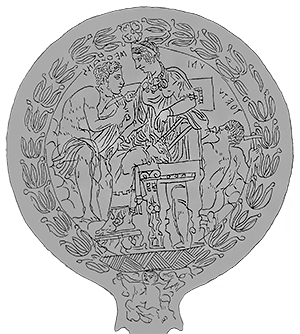
He is the god who splits open the head of Tinia to give birth to Menrva. This is the Etruscan account of the birth myth that the Greeks related of Zeus and Athena and Hephaistos. There are many similarities as well as contrasts.5
On a number of engraved mirrors, including the famous example now located at Arezzo, Tinia the powerful deity sits while the armed goddess Menrva emerges from his head and Sethlans stands beside him wielding his axe, the blacksmith who struck the head with his axe to free her. The similarity between the two myths is evident in both details and overall structure: just as Hephaestus strikes Zeus in the head with an axe, causing the fully-armed Athena to leap forth, so too is the Etruscan artist transforming the tone of the scene entirely.
While the Etruscan Menrva emerges calmly, the Greek Athena seems to burst forth stridently in most depictions. Likewise, while Zeus depicts absolute authority in the classical Greek version regardless of what is occurring, Tinia in the Etruscan version appears weary in regards to the act, something more similar to archaic Greek depictions. Finally, while the Greek scene contains inactive bystanders or bewildered Olympians, those attending Menrva’s birth include active midwives (Thanr, Thalna and Ethausva) tending to Tinia’s wounded head and reaching to gently pull out the new goddess. In addition, while Sethlans departs quickly once he has delivered a fatal blow in the Greek version, in the Etruscan versions of this event he remains watching over it..5
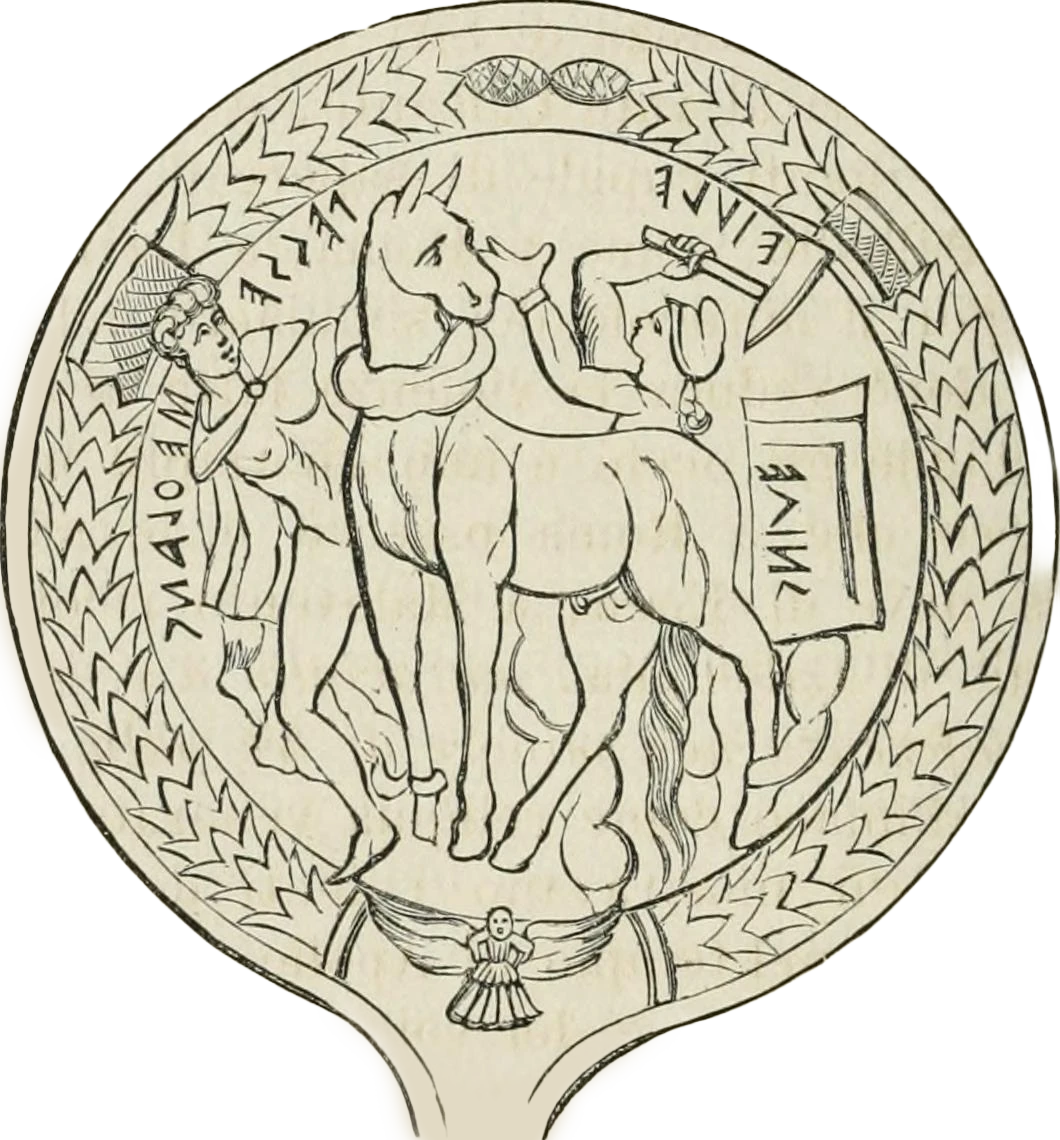
He is shown at his forge, at work on the metal, the god of the craft caught in the act of it or creating the Trojan horse with Etule, the Etruscan equivalent of the Greek craftsman Epeius. He appears in scenes alongside other gods, drawn into the wider mythological world of the mirrors, including company with Fufluns and others, a sign of how fully he belonged to the social life of the Etruscan pantheon rather than being apart as a solitary workman..5,7
IV. His Cult: Populonia, Perugia, and the Metal of Etruria
Much of what can be said about his cult is bound up with the metal economy of Etruria.2,5,8
The Coinage of Populonia
The clearest indication of his status and power is the depiction of him on Populonia’s coins. Populonia was the major metal-working city of Etruria. It was a seaport through which the iron produced on Elba island would be melted and sent abroad. As the smith-god, it was logical that he would be represented on the coins of a city built upon the riches of iron. Thus, the fact that Populonia stamped his likeness on its coins is the most direct evidence of the actual practice of Sethlans’ worship in association with a specific trade, the production of metal, which would later become an association in Rome too.2,5
Perugia and the Thunderbolt
In addition to being identified with Populonia, Sethlans also has a long history associated with Perugia. According to some traditions related to Sethlans, he played a significant part there. The Perugian connection relates to Sethlans as an Etruscan scholar of the celestial body. Some of these traditions indicate that he was one of those Etruscan gods responsible for casting lightning bolts. The Romans described the Etruscan theory of lightning and the casting of it. Nine gods were said to be capable according to this theory. Each god cast lightning bolts for a unique reason. This theory was passed along to the Romans by way of Pliny. Although Sethlans' participation in this theory fits well within a god of fire whose flames leap from heaven as well as burn in the fire of the forge, there is no absolute proof that Sethlans was involved in this aspect of the Etruscan lore.2,6
The Curious Omission
A bronze model of a sheep's liver used by ancient Etruscan priests as a chart to determine the movements of the stars and planets, is located at Piacenza, Italy. On this model of the sheep's liver are listed many gods that are believed to represent areas of the heavens. However, when reviewing this model, there is no mention of Sethlans. Scholars studying the "Liver" have noted that this lack of reference to Sethlans may seem like a strange oversight. The reasons for this absence include; as a god of fire, it could be assumed that Sethlans would be included in a list of gods representing the area of the heavens.
Additionally, although Sethlans represents fire and lightning, he is not alone in being left out. Other prominent gods such as Apulu, Menrva and Turan are also missing from this model. These scholars note that both the "Liver" and the creation of images of gods are two different representations of the gods and therefore should not necessarily be consistent with one another. Specifically, Sethlans can be seen as belonging to the category of gods that are illustrated in images, rather than being included in the more formal models of divination.9,10
Sources and Bibliography
- Bonfante, Giuliano, and Larissa Bonfante. The Etruscan Language: An Introduction. Rev. ed. Manchester: Manchester University Press, 2002. Cited for Sethlans as an indigenous Etruscan theonym sharing no root with the Greek Hephaistos, the two gods matched by their common craft rather than by any borrowing of the name.
- Stoddart, Simon K. F. Historical Dictionary of the Etruscans. Historical Dictionaries of Ancient Civilizations and Historical Eras. Lanham, MD: Scarecrow Press, 2009. Cited for Sethlans as the Etruscan equivalent of Hephaistos and Vulcan, his attributes of hammer, pincers, and double-headed axe with the workman's cap, his first appearance as a named figure in the fourth century BCE, his frequent appearance on the coinage of Populonia the metallurgical city, and his particular veneration at Perugia.
- Kennedy-Quigley, Shanna. "Visual Representations of the Birth of Athena/Menrva: A Comparative Study." Etruscan Studies 8 (2001): 65–78. Cited for the engraved bronze mirrors depicting the birth of Menrva, produced from the mid fourth century BCE onward and among the earliest objects to carry the named figure of Sethlans, who stands at the edge of the scene holding his axe, as on the mirror from Arezzo.
- Capdeville, Gerard. Volcanus: Recherches comparatistes sur les origines du culte de Vulcain. Bibliotheque des Ecoles francaises d'Athenes et de Rome 288. Rome: Ecole francaise de Rome, 1995. Cited for the derivation of the Roman Volcanus/Vulcan, through an Etruscan Velchans, from the Minoan Cretan fire-god Velchanos, a young master of fire and companion of the great goddess; the reconstruction is argued from the closeness of the names and has been disputed by other scholars.
- de Grummond, Nancy Thomson. Etruscan Myth, Sacred History, and Legend. Philadelphia: University of Pennsylvania Museum of Archaeology and Anthropology, 2006. Cited for Sethlans as the divine smith and god of the forge, his iconography as a sturdy bearded workman with hammer, tongs, and axe, the absence of the Greek lameness, his role with the axe at the birth of Menrva and the reworking of that scene from the Greek (the calmer Menrva, the vulnerable Tinia, the midwife-goddesses Thanr, Thalna, and Ethausva), his appearances at the forge and among other gods on the mirrors, and the mirrors as the primary surviving source of Etruscan myth.
- Pliny the Elder. Natural History. Translated by H. Rackham. Loeb Classical Library 330. Cambridge, MA: Harvard University Press, 1938. Cited: 2.138–139, for the Etruscan doctrine that nine gods are able to send thunderbolts, the framework within which Sethlans is counted in the tradition among the thunderbolt-hurling gods; the specific inclusion of Sethlans is to be confirmed by the author.
- Haynes, Sybille. Etruscan Civilization: A Cultural History. Los Angeles: J. Paul Getty Museum, 2005. Cited for the pre-eminence of the Etruscans as metalworkers of the early western Mediterranean, the iron economy of Populonia and Elba, and the engraved bronze mirrors as products of the metalworker's craft.
- Jannot, Jean-Rene. Religion in Ancient Etruria. Translated by Jane K. Whitehead. Madison: University of Wisconsin Press, 2005. Cited for the place of the smith-god in Etruscan cult and for the connection of Etruscan religion to the metalworking economy of Etruria.
- Krauskopf, Ingrid. "Gods and Demons in the Etruscan Pantheon." In The Etruscan World, edited by Jean MacIntosh Turfa, 513–38. Routledge Worlds. London and New York: Routledge, 2013. Cited for the absence of Sethlans from the Liver of Piacenza, together with the likewise-absent Apulu, Menrva, and Turan, all major gods of the pictorial tradition missing from the diviner's model.
- van der Meer, L. Bouke. The Bronze Liver of Piacenza: Analysis of a Polytheistic Structure. Amsterdam: J. C. Gieben, 1987. Cited for the structure of the Liver of Piacenza as a model of the divine regions of the sky with the gods' names inscribed in their compartments, and for the absence of Sethlans from among those names.