





| Language | Name of Ptah | Attestation |
|---|---|---|
| Old Egyptian | ptḥ (𓊪𓏏𓎛) | Tarkhan Grave Bowl 231 (3000 BCE) |
| Sahidic Coptic | ⲡⲧⲁϩ (Ptah) | Shenoute of Atripe (400–450 CE) |
| Greek | Φθᾶ | Rosetta Stone (196 BCE) |
28 min read
PTAH
author: High Priest Zevios Metathronos
co-author: Novice Priest Karnonnos
I. The Name
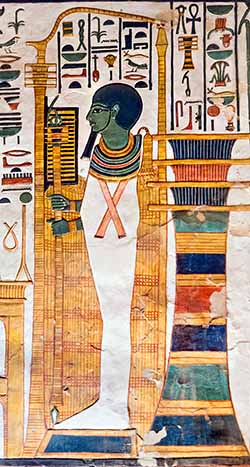
Ptah from the Tomb of Nefertari (QV66), 1255 BCE
The earliest secure written attestation of the god-name Ptah is on the Tarkhan Grave 231 bowl, a small stone vessel found by Sir Flinders Petrie at Tarkhan. The object is variously described as alabaster and travertine in older materials, but as calcite in the works of modern interpreters, who have evolved in their consensus about the object. It shows Ptah standing in a shrine with his name written above him. Petrie dated it from the associated material to about the reign of Den in the middle First Dynasty, and this is still generally agreed upon. Wilkinson likewise calls it “the first definite attestation of Ptah.”1, 2
The Egyptian root √ptḥ means “to make, form, create,” and his divine name is understood semantically to be like “the Fashioner” or “the Creator”. Ptah's name in hieroglyphs is made up of the reed mat, bread and twisted flax symbols, yet as with many Egyptian gods, there are endless ways of varying it.3
Greeks typically simply used the word Hephaistos to describe Ptah, which is a convention of Herodotus writing in the fifth century BCE. However, the famous Rosetta Stone records it as Φθᾶ (Ptha) when translating from Egyptian.4, 5
His name found his way into Sahidic Coptic as ⲡⲧⲁϩ (Ptah) where an attack on Hephaestus, Ptah and Apollo by the Christian abbot Shenoute of Atripe is attested.6, 7
Sources: Petrie, Wainwright, and Gardiner, Tarkhan I and Memphis V (1913); Wilkinson, Early Dynastic Egypt (1999); Thesaurus Linguae Aegyptiae, "Ptḥ (Lemma ID 62980)"; Herodotus, Histories; Dittenberger, Orientis Graeci Inscriptiones Selectae (1903); Crum, A Coptic Dictionary (1939); Amélineau, Œuvres de Schenoudi (1907).1, 2, 3, 4, 5, 6, 7
II. Ptah
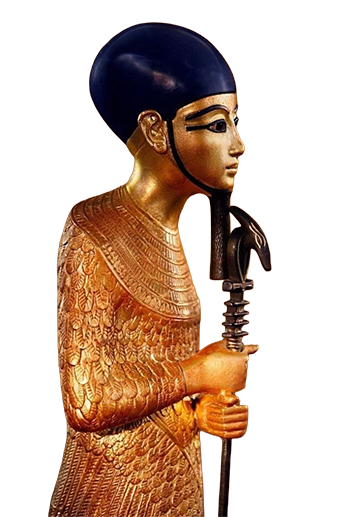
Wooden statuette of Ptah from Tomb of Tutankhamun (KV62), 1323BCE
Ptah is the self-created god of the Egyptians, the god of craftsmen, artisans, speech and the recipient of all prayers who renders humanity's pleas intelligible to the divine. He was one of the head deities of Memphis, the ancient capital of Egypt which bore his name and was his major cult center. Ptah was considered a divine intermediary between God and man in a more clear manner than his Hellenic counterpart. Egyptian texts contended that Ptah formed humanity and breathed life into it; like Khnum he is represented making men on a potter's wheel, and while Khnum fashioned the limbs of humanity, Ptah was said to fashion the torso. His productions were not limited to forming humanity, since it was said he forms the gods themselves in an endless process, being an architect of everything divine. Like the majority of prominent Egyptian deities, Ptah was considered an accompanying figure to the Pharaoh of Egypt, and his symbolism concerned the binding of the Egyptian state into a coherent form as the King of the Two Lands, celebrated as channeling all prayers of the people towards the divine ruler, in line with his name: The One who Hears. He was associated with Osiris and Sokar, and the Egyptians deemed him to be the husband of Sekhmet in forming the Memphite Triad, albeit secondarily he could be married to Bastet.8, 9
Silent, poised and attentive, the role of the smith god in mythology was abstract and scant in Egypt's arcane texts despite his ubiquity in representation. It was said Ptah brought Egypt and even the gods themselves into existence through the power of his mouth and his beautiful speech, a more marked aspect tied to the form of expression as compared with his Greek equivalent. The references to Ptah in the Pyramid Texts are ancient, but they only concern two (perhaps three) particular episodes; his only direct role is to provide food and water for the Pharaoh in the afterlife. The majority of his theology was elaborated not so much in myth or sacred writing but by artefacts like the Shabaka Stone, which describes Ptah as the creator of all beings, cities and other aspects, sharing an interesting parallel with the Orphic Hymn to Hephaestus:10
"He made the towns,
He established the nomes,
He placed the Gods in their shrines,
He settled their offerings,
He established their shrines,
He made their bodies according to their wishes.
Thus the Gods entered into their bodies,
Of every wood, every stone, every clay,
Every thing that grows upon him
In which they came to be.
Thus were gathered to him all the Gods and their Kas,
Content, united with the Lord of the Two Lands."
Shabaka Stone (trans. Miriam Lichtheim)11
"Strong, mighty Hephaistos, bearing splendid light, unwearied fire, with flaming torrents bright: strong-handed, deathless, and of art divine, pure element, a portion of the world is thine: all-taming artist, all-diffusive power, ’tis thine, supreme, all substance to devour: aither, sun, moon, and stars, light pure and clear, for these thy lucid parts [of fire] to men appear. To thee all dwellings, cities, tribes belong, diffused through mortal bodies, rich and strong. Hear, blessed power, to holy rites incline, and all propitious on the incense shine: suppress the rage of fire’s unwearied frame, and still preserve our nature’s vital flame."
Orphic Hymn to Hephaestus (trans. Thomas Taylor)12
III. The Epithets of Ptah
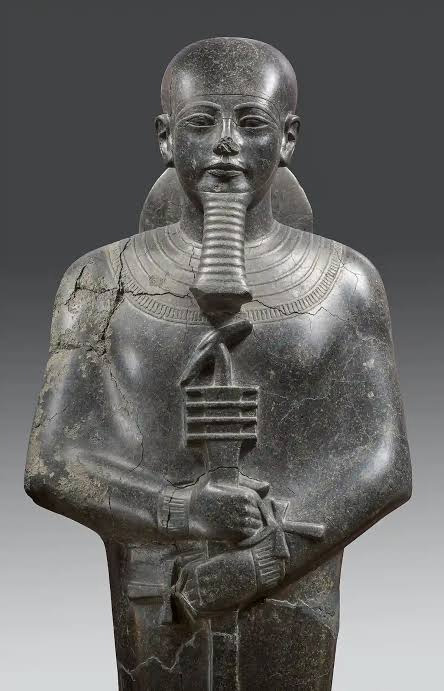
Grandiorite statue of Ptah, 1390–1353 BCE, Museo Egizio Turin
| Epithet | Meaning | Domain |
|---|---|---|
| Ptḥ rs.j-jnb=f | Ptah, South of His Wall | Lord of Memphis |
| Ptḥ nṯr ꜥꜣ | Ptah the Great | Great God |
| Ptḥ nb Mꜣꜥ.t | Ptah, Lord of Ma'at | Mediator of truth |
| Ptḥ nb nṯr.w | Ptah, Lord of the Gods | Divine primacy |
| Ptḥ nb ꜥnḫ-Tꜣ.wj | Ptah, Lord of the Two Lands | Lord of Egypt, occult aspects |
| Ptḥ nfr-ḥr | Ptah, Beautiful of Face | Public aspect, prayers |
| Ptḥ sḏm nḥ.t | Ptah who Hears Prayers | Intercessor of the Gods |
| Ptḥ mr ḥmw.w=f | Ptah who Loves Craft | Craftwork, industry |
Sources: Thesaurus Linguae Aegyptiae, "Ptḥ (Lemma ID 62980)"; Van Dijk, "Ptah" (2001); Staring, "Decoding Signs of Identity" (2018).3, 13, 14
IV. The God of Memphis
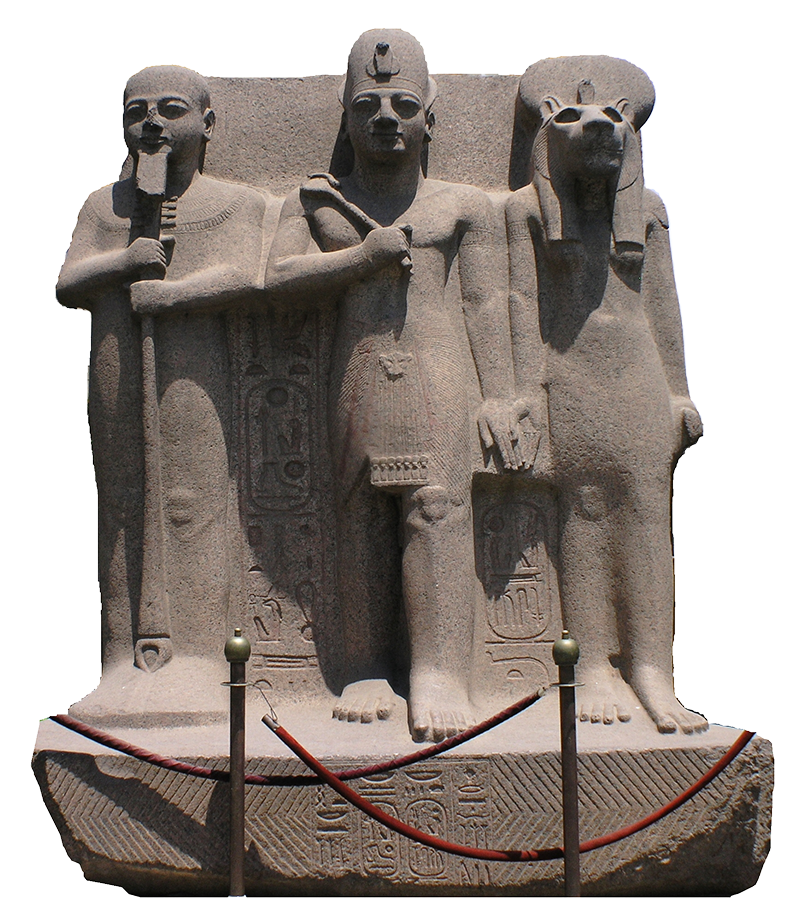
Memphite Ptah and Sekhmet flanking Ramesses II
Memphis, the City of Ptah
Ptah's worship correlated around a kind of public royal ideology and intercession with the divine, connected to his role as the primordial Tatenen. Early in Egyptian history his presence was attested to in the most ancient capital of Egypt, Memphis, and the sacred architecture was instated by Pharaohs in distinct waves. During the Old Kingdom, theophoric names referencing Ptah are common, and the most ancient name of the city 'the White Walls' is taken to be a reference to the predominance of his alabaster temple in being important to Memphis itself. The New Kingdom, particularly after Thutmose, elevated his worship to new heights, and the great Pharaoh Ramesses II built many sacred complexes in Ptah's name.11, 13, 15, 16, 17, 18, 19
Merneptah, another Pharaoh, moved the capital of Egypt back to the ancient city of Memphis when it had been located in Thebes or a succession of other cities for thousands of years. The Nubian rulers of Egypt from the Kushite kingdom took Ptah as their patron deity and the Shabaka Stone itself was commissioned on their part to emphasize this claim. The Ptolemaic Dynasty also fostered the cult of Ptah very strongly, as Ptolemy V even took a recondite theonym from the god of extreme antiquity from the Old Kingdom that had long fallen into disuse. Ptah's worship was, according to Egyptians, infamously disrespected by Cambyses, the Persian ruler, which supposedly led to his total downfall. In the Roman period, it appears his worship declined due to the lack of Egyptian independence in itself.4, 5, 11, 20
The Great Temple
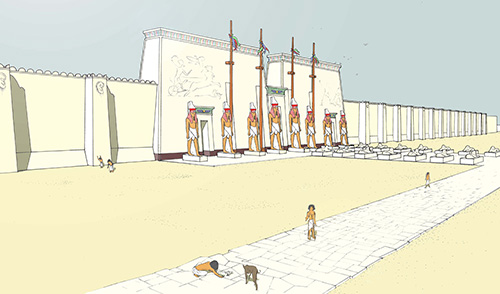
Great Memphis Temple of Ptah, reconstruction
The central cult site for Ptah was his colossal temple at Memphis or Hout ka-Ptah (House of the Ka of Ptah), claimed to have been founded by the ancient Pharaoh, Menes, although Manetho the Egyptian insisted it was founded by his son, Athothis. This temple is said to be the root of the word Aigyptos and therefore the root of Egypt in English. Its fame was so great that during the Late Period, Memphis was renamed after it altogether. The Great Temple was described by many classical authors like Herodotus as a grandiose glorious complex that encapsulated everything majestic about Egypt, but it fell into a state of advanced disrepair that makes deciphering its exact dimensions difficult. Historians have nonetheless found that statues of Ramesses II at the entrance indicate a majestic scope.4, 8, 19, 21, 22
A more minor temple adjacent to the great one was erected to Ptah by the son of Ramesses II, Merneptah, and more is known about this better-preserved precinct. Archeological excavations and textual clues were the key to understanding its layout. The minor temple (as excavated by Petrie and later Rudolf Anthes) follows the classic Egyptian temple pattern, since it consisted of an eastern pylon gateway, an enclosed open court or colonnade, a hypostyle hall, and both a dark inner sanctuary (naos) and shrine (naiskos). Inside the sanctuary of the Ramesside temple, a central pillar-hall led to a rear chapel and steps up to a niche platform held the cult statue of Ptah. The temple was ordinary compared to many grandiose Egyptian designs, either out of redundancy at the temple next to it, or perhaps to reflect the mechanical, clear simplicity of Ptah himself.19
Regardless of its lack of grandiosity, it has some unique features. According to Rudolf Anthes, the temple’s enclosure wall was “fortress-like” as a 36m square, one of the first of its kind showing the influence of pioneering design technology during the New Kingdom. This feature was imitated later on at Medinet Habu and other temples, meaning that the craftsman God's sacred complexes had been able to act as some kind of technological blueprint. The outer wall was itself used for worship, and its exterior face was carved with large pairs of Ptah’s ears painted with epithet inscriptions. The finds suggest that an ordinary person would stand outside this wall, facing the temple, to pray with hands raised toward the carved ears of the God. Inside the wall lay the temple complex: a pylon, a paved forecourt, then an eight-pillared hall and finally the dark sanctuary. Much of the precinct actually remains unexcavated, but classical accounts like those of Herodotus and Ptolemaic documents noted down the existence of an Apis court on the south and the holiest precinct with a cult statue of the self-created one.4, 19, 22
Another structure at the east nearby was the supposed combined temple of Ptah and Sekhmet built by Ramesses II, which has not been completely archeologically confirmed. The Pharaoh Psamtik II also built a temple complex to the Apis exclusively. In modern times, the fame of the polis of Ptah contributed to the name of the American city of Memphis and other localities.23, 24
The Theban Temple
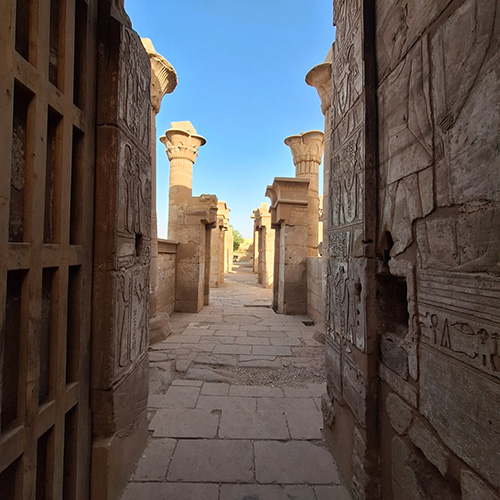
Temple of Ptah at Karnak
In Thebes, another sacred temple to Ptah and Sekhmet was erected, being built by Thutmose III and extensively renovated by the Ptolemaic dynasty, a temple which is well-preserved. The original Theban function was distinctive in meaning as the sacred dimension of Ptah's cult was added as an extension to the great complex of Amon Ra of Karnak. The central chamber was connected with the solar god, while side chapels served Hathor and Ptah himself. During processions the temple worked as a station in which Amon Ra and Osiris were received.25, 26
The temple is small in architectural terms, but quite strongly layered. The core was a sandstone building with a courtyard, a two-columned portico and a tripartite arrangement which was continually altered. The main western approach was later developed through a sequence of gateways, and the temple’s visible form was especially reshaped under the Kushite, Late Period, Ptolemaic, and Roman phases of Egyptian history, showing it had a certain level of activity. The main Ptolemaic transformation occurred under Ptolemy III Euergetes and Ptolemy IV Philopator, especially around the courtyard: the front court was reorganized and the pylons beside the Thutmose III-era Gate F were altered, the courtyard was covered, and a kiosk structure was erected in front of the western pylon. During the Roman period, it appears the worship of Ptah became more visible in Thebes.27, 28
Jean-Jacques Rifaud in his discovery of the area in 1818 found a group of standing Sekhmet statues in front of the temple, eleven of which are now in the Museum of Turin. At least sixteen standing Sekhmet statues have been recorded from the area, though their exact original arrangement is not definable. The presence of the lion goddess has led many to designate it a shared temple of Ptah and Sekhmet, although it may be connected to the myth of Hathor. Modern archeological work in the temple area found a favissa with Osiris objects arranged around a central statue of Ptah.28, 29, 30
Ptah-Meretseger Shrines
Another set of seven shrines in Thebes in part celebrated Ptah with Meretseger, the snake goddess. These shrines cut into rock seemed to function for groups of Thebes' artisans around the Valley of the Queens and Deir el-Medina. The chapels may have functioned as the core zone for Ptah in the aspect of Ptah of the Place of Beauty.31, 32
V. Festivals and Domestic Cult
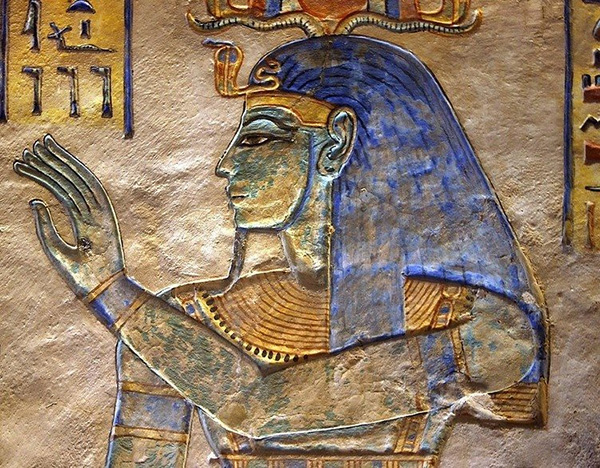
Ptah-Tatenen, New Kingdom tomb of Prince Amun-her-khepeshef (QV55), approx. 1189–1077 BCE
As a result of his royal role, Ptah acted as a patron deity for the Heb-Sed, the royal jubilee intended to rejuvenate regal matters of strength and legitimacy after 30 to 33 years of rule. In later pharaonic titulary such as in the Ptolemaic times, Pharaohs used Horus names that indicated the presence of “many Sed festivals … like Ptah-Tatenen” treating the creator god as the sole paradigmatic figure presiding over the general jubilee abundance. His role here directly bound the divine creative stability (djed) to the Pharaoh's physical ability to govern. There were also great and minor feasts to Ptah which occurred on distinct dates of the Egyptian calendar, as well as The Festival of the Sacred Boat where during major holidays, a statue of Ptah was paraded in a large sacred boat to visit different regions around Memphis, allowing the public to seek oracular guidance.15, 16, 17
His worship in a domestic context is still notable, however. For example, numerous stelae were made in a clear household context showing that there was an intimate dimension to belief in the primordial one:
"One stela was carved with a scene of a man named Seti-er-neheh and his family adoring Amun Re and statues of the god Ptah and King Ramesses II (Fig. 35). Behind the statues were the god’s ears, ready to receive the family’s requests. Some of these ear stelae have been excavated from houses, indicating that they were kept at home as private lines to the god that could be activated at any time."
Teeter, Religion and Ritual in Ancient Egypt18
VI. The Priesthood of Ptah
A staff of sem, lector, and wab priests maintained Ptah’s cult, under a First Priest. The First Priest of Ptah was dubbed “Great Chief of All Artisans”, reflecting Ptah’s craftsman aspect and nominally putting all creatives in the realm under his guidance, while later titles included "Prophet of Ptah." This high priest often held immense influence. Under Ramesses II he was second only to the vizier as shown in the example of Khaemwaset, and by the Ptolemaic era even intermarried with the royal family. Inscriptions from Old and Middle Kingdom tombs of artisans also mention his priests, suggesting his worship was residually endowed with a continuous laity. The Memphite priests ran the daily temple cult, and they oversaw the treatment of the famous Apis bull. Apis and his mother cow had stables and exercise courts adjacent to Ptah’s temple which reinforced the inextricable link between his form and the royal bull. By the time of the Pharaoh Thutmose, the priesthood often had royal connections, such as Amenhotep III's heir Prince Thutmose, who held the title of Overseer of the Priests of Upper and Lower Egypt.18, 33
The involvement of the Priests in building projects was very ancient indeed, and their relationship to these building projects is notable. The Debhen inscription, connected with the Pharaoh Menkaure and his pyramids at Giza, mentioned royal construction and the involvement of two high priests of Ptah. The Memphis priests also appeared at Saqqara in relation to the building works there, such as Imephor Impy Nikauptah.34, 35
The amount of information from Memphis itself indicates a significant amount of material on the artisanal nature of the office. In the Old Kingdom inscription of Sabu or Tjety, the official says the temple of Ptah-South-of-His-Wall was under his charge. Many centuries later, a colossal statue of Ramesses II bearing Khaemwaset’s titles once stood at the South Gate of the Temple of Ptah in Memphis in a way that linked the high priest to the monumental program of the temple. Later also, the records of priests from Memphis like Pasherienptah III and Pasherienamun II exist by the Ptolemaic and Roman period.36, 37
Apis Bull
Ptah's most important animal symbolism came in the living form of the Apis Bull. The Apis was considered to be the Ba of Ptah himself, while the bull's proactive power was said to represent all layers of manifestation of the great receiving God. Bulls were associated with Pharaohs from the time of Narmer, if not earlier; Ptah's powers were mediated through the divine monarchs, and the stelae of Apis Bulls would be reproduced in Pharaonic imagery perpetually. Sanctuaries and spaces for worship of the Apis are found in Ptah's holy complexes most commonly out of any associated deity. The sacred animal renewed the proximity of Ptah over and over again in a mysterious process.8, 38, 39
It was known as his herald and, in the first part of the elaborate ceremony related to its appearance, it would emerge from Memphis, and its observable acts would indicate particular omens. Not only this was the case; the behavior of children playing around the cow's precinct was also noted meticulously and held to be an omen of Ptah. In life, the bull was seen as an aspect of Ptah himself, but in death it passed over to Osiris. Windows would be erected in the temple through which he could be viewed and during certain festivals the bull would be led through the city, given gifts of flowers and gold.4
Arcane 'Running of the Apis' rituals were connected with Ptah's cult. The bull represented the potency of his power in the material realm through its forceful nature. The bull, with a yoke or other materials, can be harnessed to cultivate the land. Bovines are symbolic of being an adaptable animal that can empower an entire agricultural ecosystem, and the bull among the herd is the symbolic overseer of this, aligning with Ptah's purpose. The Serapeum of Saqqara was the sacred, long-running underground burial complex for Apis bulls, the divine incarnations of Ptah that featured, in its later years, massive granite sarcophagi and extensive galleries expanded by Persian and Ptolemaic rulers. It merged Egyptian, Persian, and Greek, or "Osor-Apis" (Serapis) traditions. The search for the bull could take up to three months or more. Even in Muslim Egyptian times, it is said women would climb on the back of a bull to promote fertility.4, 22, 40, 41, 42
VII. Occult Symbolism
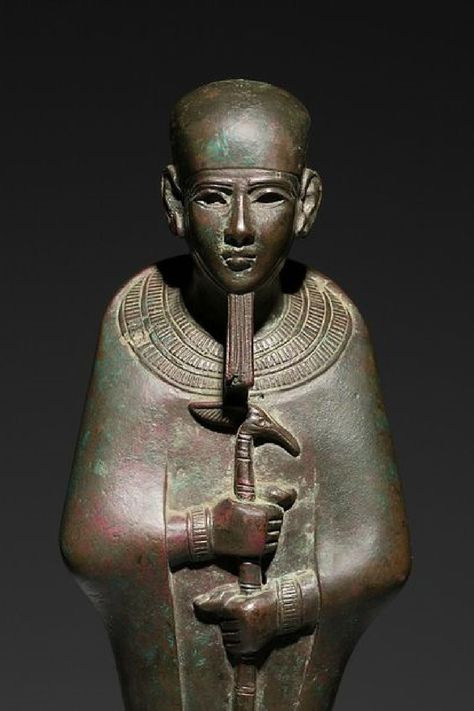
Bronze statue of Ptah, Third Intermediate Period
His name means the Opener or the Maker in Egyptian; hence his intense association with the Opening of the Mouth. In this type of language is an association with the volcano that opens violently and spews lava. Another word it is related to is sculpting, so his name relates to the act of creation and the art of the hands as a whole. The Neoplatonist authors associated Ptah with the erection of statues, considering that statues could house an occult essence recalling divinity to a soul of advancement. As the pre-existing creator in Nun, Ptah's name was also tied to mythology.42, 43
The Djed was one of his symbols borrowed from Sokar, but increasingly was wielded by Osiris. In most representations of Ptah from statuary and from wall coverings, he wields a specific combined scepter consisting of the Ankh, the Was and the Djed Pillar that is only ever rarely wielded by other deities. References to the staff indicate that Ptah wields the powers of Atum, Re, Thoth, Set and others. These are commonly taken to represent Ptah's creativity, power and stability, yet they speak to his power in uniting all of these symbolic powers and rendering them into an interpretation intelligible to the material world. He often clutches this scepter with his two fists stacked on top of each other near the Middle Granthi.8
Ptah is represented in Egyptian sacred conventions as a swaddled, mummified man. This is, like the lameness of Hephaestus, a code. Sometimes he is represented as being a dwarf or a child, with certain imagery related to Bes. At the shoulders, he wears a necklace with a back-facing tassel. He wears a blue-black cap and tends to be represented in white, representative of the pure state of an ascended soul. The tint of the cap is reminiscent of a scorched land adjacent to scalding lava. His body is represented as pure white, other than occasionally being shown with a cross shape in the very middle axis. Ptah, like Osiris and the primordial entity Nun, has blue-green skin indicating his ascended atmic state of soul, so in this his ability to convene between the divine world, the world of the living and the world of the dead is shown in how he looks to anyone. In addition to the Trinity of Memphis and the contrast of Ptah with Atum-Re in Heliopolis and Amon in Thebes, Ptah formed a particular trinity of meaning from ancient times with Sokar and Osiris.8
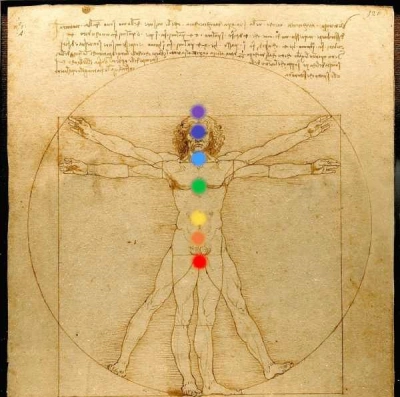
The great Ptah is strongly related to the Pineal Gland, a part of the soul that his blue cap represents. The Pineal Gland is tied to creativity and intelligence; its relative inactivity is represented in human beings lacking their own creative nature, as shown in studies of IQ that show a hard threshold for inventiveness and original thinking. He is also always represented with a distinctly shaped beard, and the shape of the beard represents the functions of the Throat Chakra and all accomplished through vibration, especially in its vertical correspondence with the Sixth Chakra and Pineal Gland.
The vibration of his name with a particular technique allows one to empower this all-important center of occult power strongly. In addition to intelligence and creativity, the true manifestation of magic on all levels is far more practicable through its empowerment, so many of the codes of Ptah in being able to remodel reality with his speech through the opening of his lips are related to this concept too. The liberation of the Chakras of the head and throat also make it so blessings are opened up to the initiate better for reception. The inward shape of his beard also shows the compacted power of the diaphragm. Royal in prerogative, the golden diadem of his cap with a Uraeus represents his association with the Pharaohs and Sekhmet, but also concerns the power of the Third Eye and the other Eyes of the forehead. He is given prominent eyes and eyebrows of a bluish tint.
VIII. Ptah the Hearing One
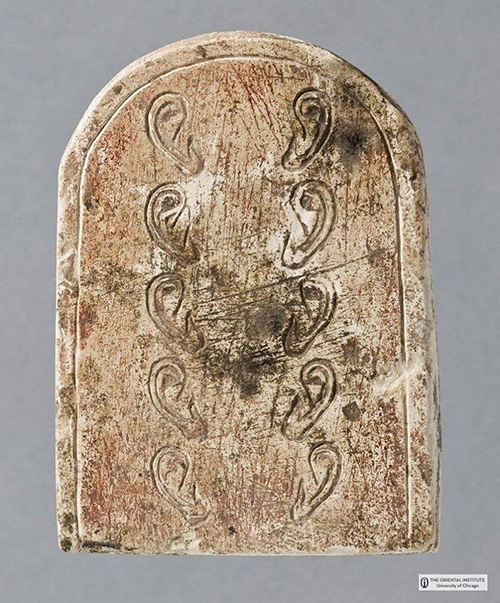
Ear stela for Ptah worship, Chicago University
Prominent ears are also one of his visual hallmarks; the ears also signify the concept of receptivity, as he was said to hear the endless prayers of humanity and give practical solutions to the problems posed. Egyptians with protruding ears were even said to be like Ptah. Occasionally, as stated above, the symbol of an ear could just be a visual shorthand for him altogether. He is Sekhmet or Bastet's husband, and that conjugal relation is also a coded reference to aspects of the Magnum Opus. What is indicated is his ability to process the insurmountable and extreme power of Bastet. In the case of Sekhmet, his talent for controlling the unpredictable and dangerous serpent was shown, and the general symbolism indicates the need for adulteration of the solar and flaming attributes of the feline deities through his craft producing the perfected divine child, Nefertem.19
IX. The Dwarven Form
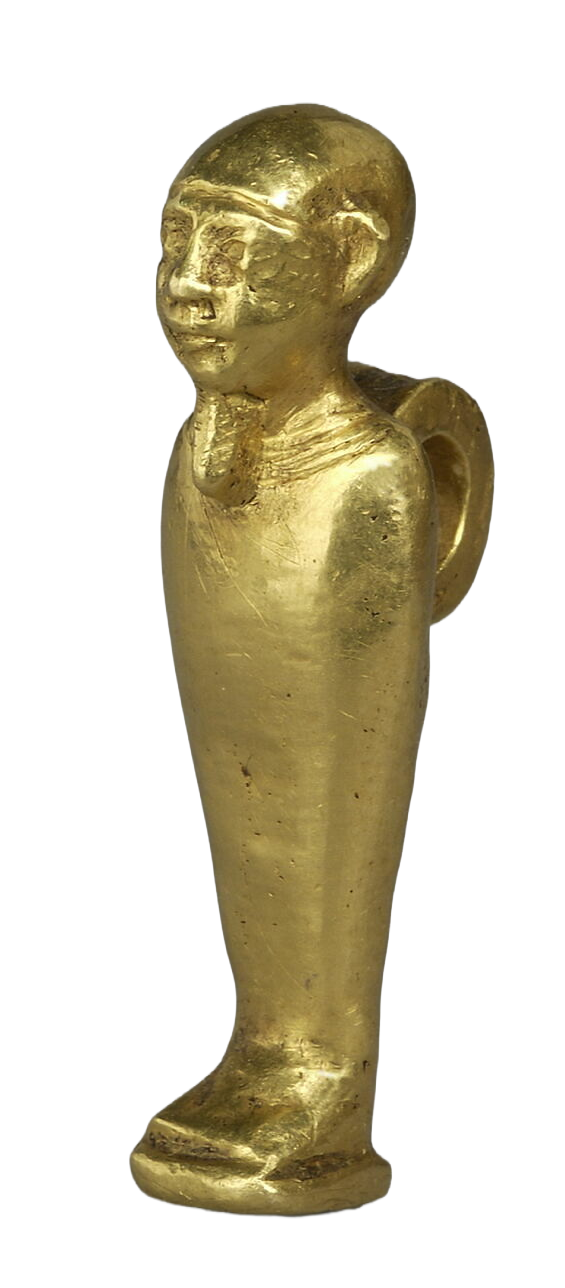
Late Period golden amulet of Ptah, Louvre
During the Third Intermediate to Hellenistic periods, a particularly unique type of Ptah imagery began to surface in diminutive form, often accompanied by Bes or other dwarf-like gods. Modern historians have named this the Pataikos based on old passages of Herodotus referring to the dwarf-like image of Ptah at Memphis he saw being like the Pataïci, Phoenician dwarf-like representations of deities on the prows of ships, though the connection to Egypt inferred by this is questionable. This imagery of Ptah is said to have a protective and domestic function. It seems like in this form he had a protective, domestic, and therapeutic function, especially relating to childbirth, protection of children, healing from dangerous animals such as snakes, scorpions, and crocodiles, and symbolism of the sun, but the exact purpose of the statues remains unknown beyond their stated purpose in helping labour in a magical context.4, 44, 45, 46, 47, 48
X. Greek Philosophy
Ptah, of all the Egyptian gods, perhaps shares the unique distinction of being discussed in Hellenistic-Roman philosophy outside of Plutarch's expositions on the subject. In Cicero's dialogue, he refers to an Egyptian form of Vulcan that is glossed as Phtha or Opas. Well versed in Egyptian religion, Iamblichus refers to Ptah as the perfective principle of the demiurgic intellect or Nous. In Plutarch's exposition on the Egyptian gods he warns against reducing the concept of Hephaestus to flame or fire, probably with the context of Ptah in mind.43, 49, 50
Sources and Bibliography
- Petrie, W. M. Flinders, G. A. Wainwright, and A. H. Gardiner. Tarkhan I and Memphis V. British School of Archaeology in Egypt and Egyptian Research Account 23. London: School of Archaeology in Egypt, University College, and Bernard Quaritch, 1913. Sections cited: Tarkhan Grave 231 bowl and early Ptah attestation.
- Wilkinson, Toby A. H. Early Dynastic Egypt. London: Routledge, 1999. Sections cited: Tarkhan bowl and first definite attestation of Ptah.
- Thesaurus Linguae Aegyptiae. “Ptḥ (Lemma ID 62980).” Edited by AV Wortschatz der ägyptischen Sprache, with contributions by Simon D. Schweitzer and Amnah El-Shiaty. In Thesaurus Linguae Aegyptiae, Corpus Edition 20, Web App Version 2.5.0, edited by Tonio Sebastian Richter and Daniel A. Werning et al. Berlin-Brandenburgische Akademie der Wissenschaften / Sächsische Akademie der Wissenschaften zu Leipzig. Sections cited: Ptḥ name, root “to make/form/create,” and Ptah epithets.
- Herodotus. Histories, 2.2–3, 2.99, 2.101, 2.108, 2.110, 2.112, 2.121, 2.136, 2.141–42, 2.147, 2.151, 2.153, 2.176; 3.37. Translated by A. D. Godley. Loeb Classical Library 117–120. Cambridge, MA: Harvard University Press, 1920–1925.
- Dittenberger, Wilhelm, ed. Orientis Graeci Inscriptiones Selectae. Vol. 1. Leipzig: S. Hirzel, 1903. No. 90, lines 4, 8–9, 37, 49. Greek text of the Memphis Decree/Rosetta Stone, 196 BCE, with Φθᾶ in ἠγαπημένος ὑπὸ τοῦ Φθᾶ.
- Crum, Walter Ewing. A Coptic Dictionary. Oxford: Clarendon Press, 1939. Reprint online at Remnqymi / Coptic Dictionary, s.v. ⲡⲱⲧϩ / ⲫⲱⲧϩ.
- Amélineau, Émile, ed. and trans. Œuvres de Schenoudi: Texte copte et traduction française. Vol. 1. Paris: Ernest Leroux, 1907. Sections cited: Shenoute’s references to Hephaestus/Ptah and Apollo.
- Wilkinson, Richard H. The Complete Gods and Goddesses of Ancient Egypt. London: Thames & Hudson, 2003. Sections cited: Ptah, Memphite theology, iconography, Apis, and Ptah-Sokar-Osiris.
- Kaper, Olaf E. The Kellis Mammisi: A Painted Chapel from the Final Centuries of the Ancient Egyptian Religion. Leiden: Nederlands Instituut voor het Nabije Oosten, 1997. Sections cited: Ptah’s creative/formative role and anthropogony.
- Mercer, Samuel A. B., trans. The Pyramid Texts. New York: Longmans, Green, 1952. Utterances 560 and 573.
- Lichtheim, Miriam. Ancient Egyptian Literature. Vol. 1, The Old and Middle Kingdoms. Berkeley: University of California Press, 1973. Sections cited: “The Memphite Theology,” Shabaka Stone, lines 56–64, including Ptah’s creation of towns, nomes, shrines, divine bodies, and the gathering of the Gods and their Kas.
- Taylor, Thomas, trans. The Mystical Hymns of Orpheus. London: Printed for the Author, 1787. Hymn 66, “To Vulcan” / “To Hephaestus.”
- Van Dijk, Jacobus. “Ptah.” In The Oxford Encyclopedia of Ancient Egypt, edited by Donald B. Redford, 3:74–76. Oxford: Oxford University Press, 2001. Sections cited: Ptah’s cult, epithets, theology, Memphis, and Tatenen.
- Staring, Nico. “Decoding Signs of Identity: Egyptian Workmen’s Marks in Archaeological, Historical, Comparative and Theoretical Perspective.” In Egyptian Workmen’s Marks in Archaeological, Historical, Comparative and Theoretical Perspective, edited by Ben J. J. Haring and Olaf E. Kaper, 77–110. Leiden: Nederlands Instituut voor het Nabije Oosten, 2018. Sections cited: Ptah-related identity marks and epithets.
- Sandman Holmberg, Maj. The God Ptah. Lund: C. W. K. Gleerup, 1946. Sections cited: Ptah, Tatenen, Memphis, royal ideology, and cult.
- Pharaoh.se. “Ptolemy IX.” Sections cited: Horus names and Ptah-Tatenen titulary.
- Jauhiainen, Heidi. “Do Not Celebrate Your Feast without Your Neighbours”: A Study of References to Feasts and Festivals in Non-Literary Documents from Ramesside Period Deir el-Medina. Publications of the Institute for Asian and African Studies 10. Helsinki: University of Helsinki, 2009. Sections cited: feasts and festivals to Ptah.
- Teeter, Emily. Religion and Ritual in Ancient Egypt. Cambridge: Cambridge University Press, 2011. Sections cited: domestic stelae, household worship, ear stelae, and Ptah’s priestly/artisanal contexts.
- Anthes, Rudolf. “Memphis (Mit Rahineh) in 1956.” Expedition / Penn Museum Bulletin. Philadelphia: University of Pennsylvania Museum, 1956. Sections cited: Memphis excavations, Ptah temple, Merneptah temple, ear stelae, and temple architecture.
- Petrie, W. M. Flinders. Memphis I. British School of Archaeology in Egypt and Egyptian Research Account 15. London: School of Archaeology in Egypt, University College, and Bernard Quaritch, 1909. Sections cited: Temple of Ptah of Merneptah, “Temple of Proteus,” and Merneptah’s Memphis precinct.
- Manetho. Aegyptiaca. In Manetho, translated by W. G. Waddell. Loeb Classical Library 350. Cambridge, MA: Harvard University Press, 1940. Sections cited: Menes/Athothis traditions and early Memphis temple foundation claims.
- Strabo. Geography, 17.1.31–32. Translated by Horace Leonard Jones. Loeb Classical Library 267. Cambridge, MA: Harvard University Press, 1932. Sections cited: Memphis, Apis, and related sacred precincts.
- Serapeum Stelae. Sections cited: Psamtik II / Apis material and Serapeum documentation. Full edition details not supplied in the uploaded file.
- University of Memphis, Institute of Egyptian Art & Archaeology. “Brief History of the IEAA.” Sections cited: modern Memphis and the ancient city-name tradition.
- Chevrier, Henri. Le temple de Ptah à Karnak. Cairo: Institut français d’archéologie orientale, 1949. Sections cited: Temple of Ptah at Karnak.
- Biston-Moulin, Sébastien, and Christophe Thiers. Le temple de Ptah à Karnak. Vol. 1, Relevé épigraphique (Ptah, nos 1–191); vol. 2, Relevé photographique. Travaux du Centre Franco-Égyptien d’Étude des Temples de Karnak, Bibliothèque générale 49. Cairo: Institut français d’archéologie orientale, 2016. Sections cited: epigraphy, architecture, and cultic layout of the Temple of Ptah at Karnak.
- Thiers, Christophe, and Pierre Zignani. “The Temple of Ptah at Karnak.” Egyptian Archaeology 38 (2011): 20–24. Sections cited: Karnak Ptah temple architecture and phases.
- Spallone, Roberta, Fabrizio Lamberti, Davide Calandra, Davide Mezzino, Johannes Auenmüller, and Martina Rinascimento. “Re-contextualizing the Standing Sekhmet Statues in the Temple of Ptah at Karnak through Digital Reconstruction and VR Experience.” Disegnarecon 16, no. 31 (2023): 1–9. Sections cited: Sekhmet statues in front of the Temple of Ptah at Karnak.
- Auenmüller, Johannes. “A ‘New’ Sekhmet Statue in Turin: Fragment Provv. 3864.” Rivista del Museo Egizio 9 (2025). Sections cited: Turin Sekhmet statues and Karnak Ptah temple context.
- Charloux, Guillaume, Christophe Thiers, Mohammad Abd Al-Aziz, Mona Ali Abady Mahmoud, Stéphanie Boulet, Camille Bourse, Kevin Guadagnini, Juliette Laroye, and Ahmed Mohammed Sayed ElNasseh. “The Afterlife of Egyptian Statues: A Cache of Religious Objects in the Temple of Ptah at Karnak.” Antiquity 91, no. 359 (2017). Sections cited: favissa/cache and Ptah statue at Karnak.
- Ghabriel, Ikram. “Ptah of the Place of Beauty.” The Journal of Egyptian Archaeology 109, nos. 1–2 (2023). Sections cited: Ptah of the Place of Beauty and Theban artisan cult.
- Ghabriel, Ikram. “The So-Called Oratory of Ptah and Mertseger Re-Examined.” In Deir el-Medina Through the Kaleidoscope: Proceedings of the International Workshop, Turin, 8th–10th October 2018, edited by Susanne Töpfer, Paolo Del Vesco, and Federico Poole, 760–782. Modena: Franco Cosimo Panini, 2022. Sections cited: Ptah-Meretseger shrines and Deir el-Medina/Theban artisan cult.
- Dodson, Aidan. “Crown Prince Djhutmose and the Royal Sons of the Eighteenth Dynasty.” The Journal of Egyptian Archaeology 76 (1990): 87–96. Sections cited: Prince Thutmose and priestly titles.
- Breasted, James Henry. Ancient Records of Egypt: Historical Documents from the Earliest Times to the Persian Conquest. Vol. 1, The First to the Seventeenth Dynasties. Chicago: University of Chicago Press, 1906. Sections cited: Debhen inscription and high priests of Ptah in construction contexts.
- Cervelló Autuori, Josep. “The High Priesthood of Memphis during the Old Kingdom and the First Intermediate Period: An Updating Study and Prosopography.” Trabajos de Egiptología 9 (2018): 7–63. Sections cited: Memphite high priesthood and construction/project contexts.
- Staring, Nico. “The Title ḥꜣ.ty-ʿ.w ḥꜣ ı͗nb.w n.w Ptḥ, ‘Mayor of Beyond the Walls of Ptah,’ and the Early 19th Dynasty Temple Building at Memphis.” Zeitschrift für ägyptische Sprache und Altertumskunde 142, no. 2 (2015): 167–190. Sections cited: early 19th Dynasty temple building at Memphis and Ptah’s precinct.
- Marković, Nenad. “Death in the Temple of Ptah: The Roman Conquest of Egypt and Conflict at Memphis.” Journal of Egyptian History 8, no. 1 (2015): 37–48. Sections cited: Ptolemaic and Roman priests of Memphis.
- Nicholson, Paul T. “Sacred Animals at Saqqara.” Heritage. Sections cited: Apis bulls and the Saqqara animal cults.
- Quibell, James E. Hierakonpolis, Part I. Egyptian Research Account 4. London: Bernard Quaritch, 1900; Quibell, James E., and F. W. Green. Hierakonpolis, Part II. Egyptian Research Account 5. London: Bernard Quaritch, 1902. Sections cited: Narmer Palette and early royal bull imagery.
- Dodson, Aidan. “Rituals Related to Animal Cults.” In Divine Creatures: Animal Mummies in Ancient Egypt, edited by Salima Ikram. Cairo: American University in Cairo Press, 2005. Sections cited: Apis and animal-cult rituals.
- Mariette, Auguste. Le Sérapéum de Memphis. Paris: Gide, 1857. Sections cited: Serapeum of Memphis/Saqqara and Apis bull burials.
- Loprieno, Antonio. Ancient Egyptian: A Linguistic Introduction. Cambridge: Cambridge University Press, 1995. Sections cited: ptḥ and related verbal/semantic forms.
- Iamblichus. On the Mysteries, 8.3. Translated by Emma C. Clarke, John M. Dillon, and Jackson P. Hershbell. Writings from the Greco-Roman World 4. Atlanta: Society of Biblical Literature, 2003. Sections cited: Ptah as perfective principle of demiurgic intellect.
- British Museum. “Amulet; Figure: Pataikos.” British Museum Collection Online, EA58314. Sections cited: Pataikos figure and protective/dwarf imagery.
- Bulté, Julien. “Pataikos.” In Iconography of Deities and Demons in the Ancient Near East, electronic pre-publication. Zurich: University of Zurich, 2008. Sections cited: Pataikos iconography and identification.
- Győry, Hedvig. “Some Aspects of Magic in Ancient Egyptian Medicine.” In Ancient Egyptian Demonology: Studies on the Boundaries between the Demonic and the Divine in Egyptian Magic, edited by Panagiotis Kousoulis, 151–166. Orientalia Lovaniensia Analecta 175. Leuven: Peeters, 2011. Sections cited: protective and therapeutic magic involving dangerous animals and childbirth/healing.
- Minas-Nerpel, Martina. “Ptah-Pataikos, Harpokrates, and Khepri.” In The Sensory World: Art, Religion, Experience, edited by Élodie P. V. de Bruijn and Annette Stähli, 146–149. Rome: Edizioni Quasar, 2013. Sections cited: Ptah-Pataikos, Harpokrates, and Khepri imagery.
- Metropolitan Museum of Art. “Pataikos Amulet.” The Met Collection, objects 2021.41.99 and 26.7.1032. Sections cited: Pataikos amulet descriptions and protective function.
- Cicero. On the Nature of the Gods, 3.55 / 3.22.55. In On the Nature of the Gods; Academics. Translated by H. Rackham. Loeb Classical Library 268. Cambridge, MA: Harvard University Press, 1933.
- Plutarch. Moralia. Vol. 5, Isis and Osiris. Translated by Frank Cole Babbitt. Loeb Classical Library 306. Cambridge, MA: Harvard University Press, 1936. Sections cited: Egyptian Hephaestus/Ptah and anti-reductive interpretation of fire.