





| Language / Culture | Name of Vishvakarma | Attestation |
|---|---|---|
| Vedic Sanskrit | Vishvakarma (विश्वकर्मा) | Rigveda 10.81–82 (c. 1500–1200 BCE) |
| Classical Sanskrit | Vishvakarma, Devashilpin (देवशिल्पिन्) | Nirukta, the epics, and the Puranas |
21 min read
VISHVAKARMA
author: High Priest Zevios Metathronos
co-author: Novice Priest Karnonnos
I. The Name of Vishvakarma
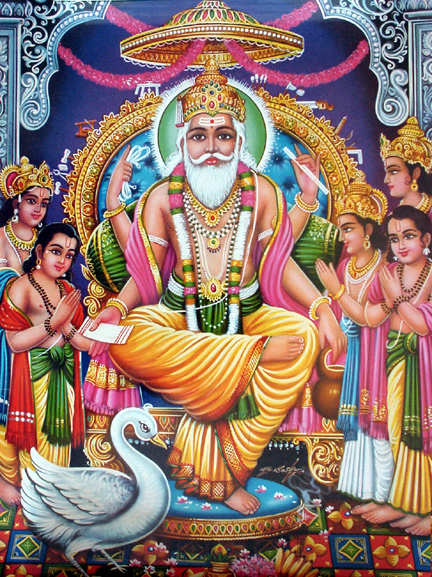
Modern northern/western Indian devotional image of Vishvakarma
Vishvakarma is a name that declares its meaning before any deed is told of him. It is a compound of two ancient words, vishva, meaning "all" or "whole," and karman, meaning "work," "act," or "deed," and read as a possessive it names the one whose work is all things, the all-accomplishing. The lexical tradition renders it without ornament as all-doer, all-creator, and all-maker, a claim about the reach of the god's activity, so that to pronounce the name is already to confess him the maker of everything that is made.1
The weight of the name rests on its second member. Karman descends from the verbal root kri, "to do, make, perform, accomplish," the root that would later give the doctrine of action its name, and beyond Sanskrit it reaches into the common Indo-Iranian past through the Avestan and Old Persian words for making. The first member, vishva, "all," keeps its clearest cousin in the Avestan vispa, "all," so that both halves of the title are old Aryan stock, the notion of everything joined to the notion of making in a single word.1,2,3
The name is first uttered in the Rigveda, the oldest of the Indo-Aryan texts, and within it in the tenth and latest book. The word sounds five times in that book, where it served first as an epithet for a supreme power and as an attribute of Indra and of the Sun before it settled into the proper name of a distinct deity, the all-seeing maker of the two hymns gathered to him, the eighty-first and the eighty-second.4,5
The tradition that received these hymns preserved a seer's name beside the god's. Vishvakarma Bhauvana, the son of Bhuvana, is named in the commentarial literature as the author of the two hymns, and Yaska treats him so in the Nirukta. The name thus stands at three removes at once from its first utterance: a word of praise meaning the accomplisher of all, the seer to whom the hymns of the all-maker are ascribed, and the creator-god whose unbounded activity the epithet had always described.1,6
Sources: Rigveda 10.81–82; Yaska, Nirukta 10.26; Monier-Williams, A Sanskrit-English Dictionary, (1899); Macdonell, Vedic Mythology, (1898); Mayrhofer, Etymologisches Woerterbuch des Altindoarischen, (1986–2001); Dowson, A Classical Dictionary of Hindu Mythology, (1879).1,2,4,5,6,7
II. Vishvakarma in the Vedas
The Rigveda can be said to be the home of the god. As such the two hymns contained in the tenth book provide us with our most complete picture of him. His writer sees him everywhere looking around with eyes and faces and hands and legs in every direction. He sits like a priest who makes an offering to the fire by giving over all created things to it and with his arms extended as wings he joins earth and sky. He is called Lord of Speech, quick-witted as thought, whose deeds are good. Here he is identified conventionally with Shiva's powers.5,8
These hymns represent a small group of hymns in the tenth book of the Rigveda in which the ideas of Vedic thought turn away from the many gods toward the one source behind them. Among other hymns is the hymn of the golden germ which arises upon the waters. There is also the hymn of the cosmic person out of which come the world systems, similar to the demurgic myths of other crafting gods, nd there is still another hymn which looks at the condition prior to existence and non-existence. Together, they indicate a tradition where Vishvakarma is the name assigned to that maker who has hands.9,10
In later Vedic writings the all-Maker becomes identified with Prajapati, Lord of Creatures, whose fundamental task is to generate all offspring. Consequently, until eventually only one functional description remains for both names, the function of universal builder flows between them. By virtue of this, in the Sama, Yajur and Atharva collections he appears to have little independent existence as a being, as his attributes in addition to Shiva in conventional belief were absorbed into those of Prajapati and in developed mythology into those of Brahma too.4,11
III. The Epithets of Vishvakarma
Vishvakarma is known under a series of titles that trace his passage from the Vedic demiurge to the artificer of the gods, some native to him and some borrowed from the powers with whom the tradition came to identify him.1,7
| Epithet | Meaning | Domain |
|---|---|---|
| Vishvakarma (विश्वकर्मा) | All-Maker, Maker of All | Universal creation and the totality of craft |
| Vachaspati (वाचस्पति) | Lord of Speech | Sacred utterance and inspired, creative speech |
| Tvashtr (त्वष्टृ) | The Fashioner | Forging of forms, metalcraft, the shaping of bodies |
| Prajapati (प्रजापति) | Lord of Creatures | Cosmic generation and progeny |
| Devashilpin (देवशिल्पिन्) | Craftsman of the Gods | Divine architecture and the mechanical arts |
| Bhauvana (भौवन) | Son of Bhuvana | Vedic seership and the authorship of the hymns |
| Prabhasaputra (प्रभासपुत्र) | Son of Prabhasa the Vasu | Descent among the Eight Vasus |
Sources: Monier-Williams, A Sanskrit-English Dictionary, (1899); Rigveda 10.81–82; Macdonell, Vedic Mythology, (1898); Keith, The Religion and Philosophy of the Veda and Upanishads, (1925); Dowson, A Classical Dictionary of Hindu Mythology, (1879); Yaska, Nirukta 10.26; Mani, Puranic Encyclopaedia, (1975).1,4,5,6,7,11,12
IV. The Temples of Vishvakarma
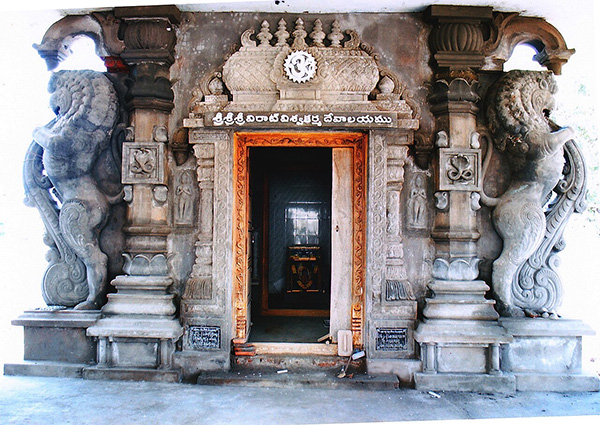
Vishvakarma Temple at Machilipatnam, Andhra Pradesh
Temples to Vishvakarma are a modern thing in their advent as no temple dedicated to Vishvakarma survives from antiquity. His oldest reverence appears to have been offered without a shrine, in the honoring of the tools of craft themselves. The great cult that now bears his name is a living tradition of artisans whose public temples are, for the most part, foundations of the last century or two, raised and kept by the craft and caste community that claims him as its forefather.13,14
One example is the Vishvakarma Temple in Guwahati, Assam, located within the Kamakhya Gate area of that city. Local legend maintains that this temple may be among the oldest places in the world dedicated to Vishvakarma.15
In the western region of India, the Panchmukhi Vishvakarma Temple at Dangiyawas, near Jodhpur, is the central place of devotion for the community of artisans. Artisans and laborers travel to participate in the festivals celebrated at this location. Similarly, the Vishvakarma Temple at Ratlam in Madhya Pradesh is one of the busiest such locations in that state.16
Farther north in India, the Bhagwan Vishvakarma Temple exists at Paharganj in Delhi. Tradition tied this location to the origin of Indraprastha, the city created according to mythology by Vishvakarma for the Pandavas. In southern India, the Angalamman Temple at Choolai in Chennai contains a shrine to Virat Vishvakarma. This temple is considered one of many sacred sites of the artisan communities in Chennai.17,18
Of ancient monuments, at Ellora, the tenth part of the site is a chaitya hall that is also the only Buddhist excavation. It is called Vishvakarma Cave because the craftsmanship of the site represented a form of craftsmanship that transformed rock into wooden images. However, it depicts a colossal seated Buddha in the position of teaching19,20
V. The Creation Narratives
The original and authentic cosmography of Vishvakarma is contained in the two songs and describes how he as all-seeing creator produces earth and heavens, unites both hemispheres, offers the first sacrifice to all creatures and poses the great question regarding the tree and wood that produced the universe. The second song tells about a first germ born on water. The germ came from where the gods had assembled. That germ became a gold embryo floating on the deep. From that gold embryo sprouts the later cosmic egg (Brahmanda). This type of mythology connects him to the other craftsman gods and Khnum quite strongly.5,9
In subsequent geographic descriptions contained in the Puranas, the ordered world is represented as being circular with Mount Meru (the Golden Mountain) as its axis, encircled by seven continents and seven oceans. When a mountain is placed in primordial waters to bring order out of chaos, that mountain is Mandara carried on the back of Vishnu as a tortoise; Vasuki as serpent forms a cord of churning21,22
A popular myth narrated today tells us that in early creation, the universe existed as an egg situated on a snake named Shesha, and every movement made by Shesha shook up that egg. To stabilize creation, Vishvakarma stabilized worlds with Mount Meru and received honor as "the first engineer." While this myth pertains to contemporary literature related to the celebration of Vishvakarma's day, it also relates to the role assigned to Shesha (supporter of earth) and to Vishnu (who rectifies the world's axis) in the Puranas' accounts.13,23
VI. Creator of Cities and Palaces
The Epic and Puranic tradition recorded Vishvakarma as being responsible for constructing many of the world's most notable architectural achievements throughout the four eras. During the first era, he constructs Svarga, the heavenly abode of Indra). In second era, he builds the golden Lanka with the aerial car Pushpaka which carries its lord through the air. In the Ramayana, his son Nala constructs the bridge from India to Lanka. Furthermore, he designs the residences of Yama and Indra and even the underwater home of Varuna. 13,24
In the age of the epics, his skilled hand builds Dvaraka, the sea-girt capital of Krishna drawn up from the ocean. Working beside Maya, the artificer of the anti-gods, the wondrous hall and city of Indraprastha is constructed by him for the Pandavas, so that the two craftsmen of gods and titans labor together.25,26
His creation does not stop at buildings and structures. In Book I of the Mahabharata, he creates Tilottama, almost the anti-Pandora, constructed atom-by-atom from all the beauties; she was sent by the gods to distract the demon-brothers Sundha and Upasundha. In addition, nearly all other celestial palaces, chariots, ornaments are said to have originated in his workshop. 12,27,28
VII. Fashioner of the Gods' Weapons
The arsenal of heaven is his workshop as with Hephaestus; it is there that he manufactures the Sudarshana Chakra of Vishnu and the Trisul of Shiva, and using the ribs of the sage Dadhici, who gave them voluntarily, he makes the Vajra with which Indra breaks the cosmic serpent Vritra.13,26
A very popular tale links his craftsmanship to the Sun, for when Surya's brightness proved too intense for his wife Sanjna to endure, Vishvakarma placed him on his lathe and trimmed down his excessive brilliance. The pieces he cut off created the Sudarshana Chakra of Vishnu and the arms of the other gods; thus, some of Surya's own brilliance was transformed into the means used by heaven to protect itself. 7,22
TThis particular function had originally belonged to Tvashtr, who as Vedic smith fashioned Indra's first Vajra, and it then came to belong to Vishvakarma 5,12
VIII. Vishvakarma and Tvashtr
The Vedic pantheon already included a craftsman god different from the demiurge and his name was Tvashtr. The hymns assigned Tvashtr the shaping of forms, the making of Indra's vajra, the making of the vessels of the gods, and the formation of the embryo in the womb. According to the Vedic calculation his work is separated from that of Vishvakarma, who stands closer to the creator.4,5
As the tradition developed both craftsmen were united and Vishvakarma took on the craftsman's function that had belonged to Tvashtr, as well as his family, so that he was given Tvashtr's many-formed Vishvarupa for a son (who also belonged to the older smith). It is this unification that transforms the cosmic maker of the hymns into the divine workman of the epics, the Devashilpin who works at the anvil of heaven.1,29
Some saw Tvashtr, Vishvakarma, and Prajapati as three aspects of one idea: the creative power which creates and produces brought together during the course of the tradition until the craftsman, the demiurge and the lord of creatures speak with one voice under the name of the all-maker.11,30
IX. The Imagery of Vishvakarma
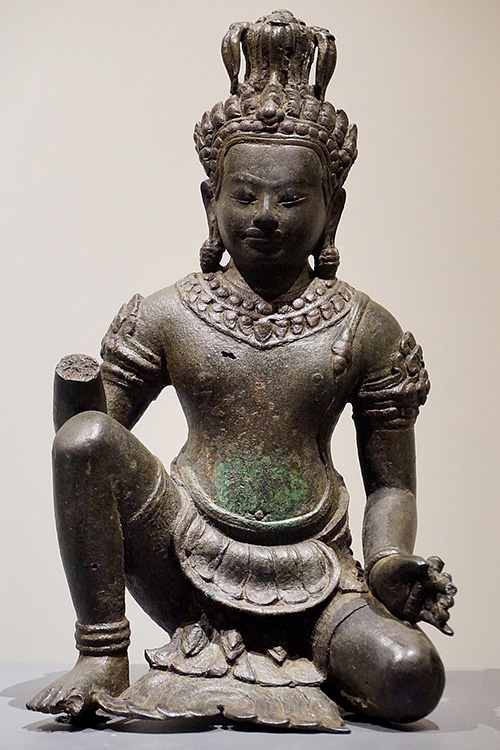
Thai representation of Vishvakarma from Lopuri, 13th century, Thailand National Museum
There is less visual record of the god from ancient through to medieval periods than we could have expected based on his cosmic dignity. The earliest reverence was most probably aniconic (i.e., worshiped in the form of instruments of craftsmanship) rather than in a body of his own and the major compilations of Hindu image-making that establish conventional representations for the main cultic deities and even for their personifications in weaponry do not provide a settled iconographic representation for the All-Maker, possibly because his ability to create many forms lends itself to many forms.13,31
Where his name appears on the medieval stone it represents primarily his work of creation and not a likeness of the god, as at the Vishvakarma Cave at Ellora. In the active temple, he is represented above all as the maker because it is he, bearing a lineage named after him, who performs the entire ritual craft of creating and sanctifying an image. Therefore, his sacred objects are primarily his tools such as his measuring rod and string, his hammer and chisel.19,32
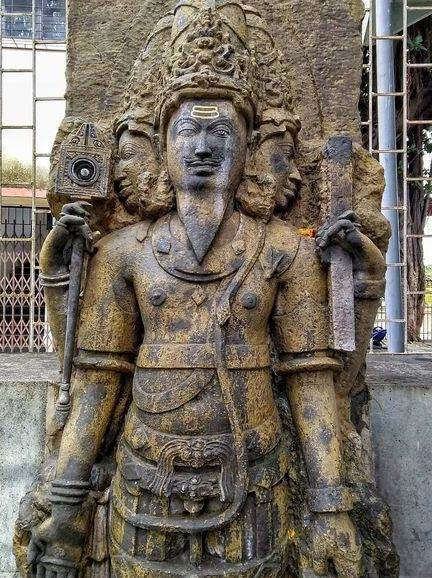
Visvhakarma statue, eleventh century CE, Chakrshwara Mahadev Mandir, Mumbai
Where he has a body at all, the features are taken from those of Brahma. He often has four arms and sometimes three, four or five faces and sits beside the hamsa (goose or swan) of the creator. He holds in his hands the water vessel and the book of the demiurge, inheriting Brahma's white beard as his facial features. What makes him distinct is his wielding of tools of creation rather than the typical weapons or rosaries, flowers and other objects of similar gods.13,33
Like most of the crafting gods other than Ptah, Vishvakarma's image is less stable than that of other gods. The style-guide tradition of Hindu art is itself his domain, for the science of building and image-making, the Sthapatya branch of knowledge, is revealed by him and presided over by his name.34,35
The craft itself has his authority built into it and in several of its texts, his name: the architectural chapters of the Matsya and Agni Puranas, the Manasara and the Mayamata of the southern Vastu schools, the Samarangana Sutradhara ascribed to the tradition of the divine architect, and the Aparajitaprccha of the western masons all prescribe the making of sacred images and buildings under his patronage..36,37,38,39,40,41
The settled regional images by which he is known today are a later crystallization of his imagery for each part of India: the white-bearded elder upon the swan in the west and northwest, the young man upon the elephant in the east, and the five-faced, ten-armed form beside the goddess Gayatri in the south, these established regional depictions occurred within devotional and communal iconographies that coalesced about his festival and conventions in time after the close of the medieval period.13,42
X. Worship and the Philosophy of Making
The god who gave orders to create the worlds is honored by those who give orders to create with their hands. A hereditary craft community whose lineage can be traced back to him by their own tongue (the Vishvakarma community, often given a lowly position in India) believe that he fathered five sons (Manu, Maya, Tvashtr, Shilpi, and Vishvajna), from whom the five artisan lines originate. The five artisan lines include the workers in wood, iron, bronze, gold, and stone, and look for the rituals and iconography for their worship to a Vishvakarma Purana of their own.14,42
In their theology, the craftsman is seen as the descendant of the divine creator. The guild that built many of the temples of medieval India saw its labor as a holy inheritance of the divine creator, Vishvakarma. This understanding of the craftsman as being descended from a divine source continued to shape the social status of the artisan communities throughout the medieval Indian peninsula. 43,44
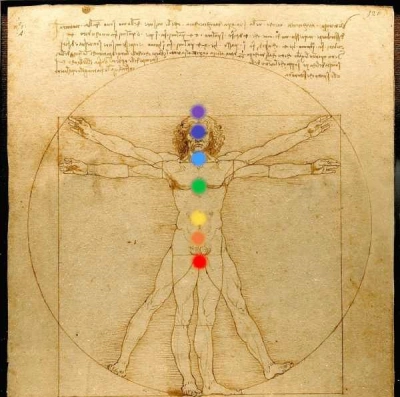
The science of building that he revealed, reckoned a fourth branch of sacred knowledge, is carried by the sthapati, the master-builder, who lays out the temple upon the diagram of the cosmic man and raises it as a model of the ordered universe, so that the consecrated building repeats in stone the primal act by which the worlds were set in order.45,46
Therefore, in terms of his relationship with his fellow humans, he occupies both positions of an ancestral figure and a deity. Therefore, his worship serves to sanctify labor itself and to elevate ordinary manual labor to participation in creating the universe.47,48
XI. The Festival of Vishvakarma
The greatest celebration of the god is Vishvakarma Puja, otherwise known as Vishvakarma Jayanti. It occurs on the day of Kanya Sankranti (which marks the sun moving into the astrological Sidereal sign of Virgo) and therefore falls on September. 17th. Of all of the principal Hindu celebrations, this festival is one of the few to follow the solar rather than lunar calendar.. On this day all the tools and machinery of every trade are cleaned, decorated and worshiped as manifestations of the god. They range from the small handheld tools of an artist to large factory equipment.13,49
In Nepal, it is celebrated as a total public holiday and in India, it is usually considered a partial holiday. The largest number of people celebrate the festival most enthusiastically in the east and manufacturing areas, including Bengal, Odisha, Jharkhand, Bihar, and Assam; and southwards in Karnataka, Andhra Pradesh, and Tamil Nadu. The communities hold these celebrations in their workplaces and office buildings just like they do in temples. Many communities have festive meals and kite-flying competitions during their celebration. Some communities replace the observance for his day with either celebrating in mid-winter or immediately after Diwali.50,51
Sources and Bibliography
- Monier-Williams, Monier. A Sanskrit-English Dictionary. Oxford: Clarendon Press, 1899. S.v. "vishvakarman." For the gloss all-doer, all-creator, and all-maker, and the identification of the god with Tvashtr and Prajapati.
- Mayrhofer, Manfred. Etymologisches Woerterbuch des Altindoarischen. 3 vols. Heidelberg: Carl Winter, 1986–2001. S.vv. "kar" and "vishva." For the root kri, "to make," behind karman, and the Indo-Iranian cognates of vishva, "all."
- Apte, Vaman Shivaram. The Practical Sanskrit-English Dictionary. Poona: Prasad Prakashan, 1957. S.vv. "vishvakarman" and "vachaspati." For the lexical range of the name and its titles.
- Macdonell, Arthur Anthony. Vedic Mythology. Grundriss der Indo-Arischen Philologie und Altertumskunde 3.1.A. Strassburg: Karl J. Trubner, 1898. For Vishvakarma and Tvashtr in the hymns, the five occurrences in the tenth book, and the shift from epithet to deity.
- Griffith, Ralph T. H., trans. The Hymns of the Rigveda. 2nd ed. Benares: E. J. Lazarus, 1896. For the two Vishvakarma hymns, Rigveda 10.81 and 10.82, and the cosmogonic hymns 10.90, 10.121, and 10.129.
- Yaska. The Nighantu and the Nirukta. Translated by Lakshman Sarup. Lahore: University of the Panjab, 1920–1927. Nirukta 10.26. For Vishvakarma Bhauvana, son of Bhuvana, as the seer of the two hymns.
- Dowson, John. A Classical Dictionary of Hindu Mythology and Religion, Geography, History, and Literature. London: Trubner, 1879. S.v. "Vishvakarma." For the artificer of the gods, his works, and the paring of the Sun's rays.
- Jamison, Stephanie W., and Joel P. Brereton, trans. The Rigveda: The Earliest Religious Poetry of India. 3 vols. New York: Oxford University Press, 2014. For the two hymns to the all-maker and his title as lord of speech.
- Doniger O'Flaherty, Wendy, trans. The Rig Veda: An Anthology. Harmondsworth: Penguin, 1981. For the Vishvakarma, Purusha, Hiranyagarbha, and Nasadiya hymns of creation.
- Griswold, Hervey De Witt. The Religion of the Rigveda. London: Oxford University Press, 1923. For the cosmogonic hymns of the tenth book and the all-maker as creative principle.
- Keith, Arthur Berriedale. The Religion and Philosophy of the Veda and Upanishads. 2 vols. Harvard Oriental Series 31–32. Cambridge, MA: Harvard University Press, 1925. For the identification of Vishvakarma with Prajapati in the Brahmanas.
- Mani, Vettam. Puranic Encyclopaedia. Delhi: Motilal Banarsidass, 1975. S.v. "Vishvakarma." For the Puranic genealogy, his descent from the Vasu Prabhasa, and the catalogue of his creations.
- Encyclopaedia Britannica. S.v. "Vishvakarma." https://www.britannica.com/topic/Vishvakarman. For the divine architect, his cities and weapons, the aniconic origin, the regional iconography, and the festival.
- Brouwer, Jan. The Makers of the World: Caste, Craft and Mind of South Indian Artisans. Delhi: Oxford University Press, 1995. For the Vishvabrahmin community, its descent from the god, and its five crafts.
- "Vishwakarma Puja 2023: Oldest Vishwakarma Temple in the World." NENow, September 9, 2023. https://www.nenow.in/national/vishwakarma-puja-2023-oldest-vishwakarma-temple-in-the-world.html. For the Guwahati temple in the Kamakhya Gate quarter and its mid-twentieth-century foundation.
- "Vishwakarma Puja 2024: Famous Vishwakarma Temples in India." LatestLY, September 16, 2024. https://www.latestly.com/lifestyle/travel/vishwakarma-puja-2024-famous-vishwakarma-temples-in-india-to-visit-and-worship-lord-vishwakarma-the-divine-architect-6269911.html. For the Panchmukhi temple at Dangiyawas near Jodhpur and the temple at Ratlam.
- "Bhagwan Vishwakarma Mandir, Paharganj, New Delhi." BhaktiBharat. https://www.bhaktibharat.com/en/mandir/vishwakarma-temple. For the Delhi temple on ground tied to the founding of Indraprastha.
- Krishnakumar, T. K. "Choolai Angalamman Temple, Chennai, India." Indian Columbus (heritage documentation), February 14, 2011. https://www.indiancolumbusheritage.com/2011/02/choolai-angalamman-temple-chennai-india.html. For the shrine to Virat Vishvakarma in the outer corridor of the Angalamman temple at Choolai.
- "A Riddle Called Ellora." Sahapedia. http://www.sahapedia.org/riddle-called-ellora. For the chaitya hall known as the Vishvakarma cave and its medieval name.
- Encyclopaedia Britannica. S.v. "Ellora Caves." https://www.britannica.com/place/Ellora-Caves. For the Vishvakarma cave and its colossal seated Buddha.
- Dimmitt, Cornelia, and J. A. B. van Buitenen, eds. and trans. Classical Hindu Mythology: A Reader in the Sanskrit Puranas. Philadelphia: Temple University Press, 1978. For the Puranic cosmogony and the churning of the ocean with Mount Mandara.
- Wilson, H. H., trans. The Vishnu Purana: A System of Hindu Mythology and Tradition. London: John Murray, 1840. For the cosmic geography and Mount Meru, and for Sanjna, daughter of Vishvakarma, wed to the Sun.
- "The Story of Lord Vishwakarma and Vishwakarma Puja." Samarthgurudhara. Accessed August 18, 2026. https://samarthgurudhara.org/. Cited as a modern devotional witness, not classical testimony, for the festival narrative of creation steadied by Mount Meru upon the serpent.
- Valmiki. The Ramayan of Valmiki. Translated by Ralph T. H. Griffith. London: Trubner, 1870–1874. For the golden Lanka, the aerial car Pushpaka, and Nala, son of Vishvakarma, who bridges the sea.
- The Bhagavata Purana. Translated by Ganesh Vasudeo Tagare. Ancient Indian Tradition and Mythology. Delhi: Motilal Banarsidass, 1976–1978. For the raising of Dvaraka from the sea for Krishna.
- Vyasa. The Mahabharata. Translated by Kisari Mohan Ganguli. Calcutta: Bharata Press, 1883–1896. For the vajra fashioned from the bones of Dadhichi and the works of the divine architect in the epic.
- van Buitenen, J. A. B., trans. The Mahabharata. Vols. 1–2. Chicago: University of Chicago Press, 1973–1975. For the fashioning of Tilottama in the Book of the Beginning and the hall of the Pandavas in the Book of the Assembly.
- Wilkins, W. J. Hindu Mythology, Vedic and Puranic. Calcutta: Thacker, Spink, 1882. For the catalogue of Vishvakarma's works and the survey of his epithets.
- Bhattacharji, Sukumari. The Indian Theogony: A Comparative Study of Indian Mythology from the Vedas to the Puranas. Cambridge: Cambridge University Press, 1970. For Tvashtr, Vishvakarma, and Prajapati as overlapping creator-artificers.
- Danielou, Alain. The Myths and Gods of India. Rochester, VT: Inner Traditions, 1991. First published as Hindu Polytheism, 1964. For Vishvakarma and Tvashtr among the aspects of the divine craftsman.
- Rao, T. A. Gopinatha. Elements of Hindu Iconography. 2 vols. Madras: Law Printing House, 1914–1916. For the canonical iconographic system and the absence of a fixed type for the all-maker.
- Branfoot, Crispin. "Making Space for the Sacred: Hindu Art and Material Religion." In Hinduism in India: The Early Period, edited by Greg Bailey, 179–207. New Delhi: Sage, 2015. For image-making as the ritual craft of the shilpin.
- "Vishwakarma." Hinduism Facts. Accessed August 18, 2026. https://www.hinduismfacts.org/. For the tool-bearing iconography and the emblems borrowed from Brahma.
- Varahamihira. Brihat Samhita. Translated by M. Ramakrishna Bhat. 2 vols. Delhi: Motilal Banarsidass, 1981. For the image-making chapter and the proportions of divine images.
- Vishnudharmottara Purana, Part III. Translated by Priyabala Shah. Gaekwad's Oriental Series 130 and 137. Baroda: Oriental Institute, 1958. For the image-making prescriptions of the third book.
- The Matsya Puranam. Translated by A Taluqdar of Oudh. Sacred Books of the Hindus 17. Allahabad: Panini Office, 1916–1917. For the chapters on architecture and image-making.
- The Agni Purana. Translated by N. Gangadharan. Ancient Indian Tradition and Mythology 27–30. Delhi: Motilal Banarsidass, 1984–1987. For the chapters on iconometry and building.
- Acharya, Prasanna Kumar. Architecture of Manasara. Manasara Series 4. London: Oxford University Press, 1934. For the Manasara Shilpa Shastra and the master-builder tradition.
- Dagens, Bruno, trans. Mayamata: An Indian Treatise on Housing Architecture and Iconography. New Delhi: Sitaram Bharatiya Institute of Scientific and Industrial Research, 1985. For the southern Vastu tradition of building and image.
- Bhoja. Samarangana Sutradhara. Edited by T. Ganapati Sastri. Gaekwad's Oriental Series 25 and 32. Baroda: Central Library, 1924–1925. For the treatise on architecture ascribed to the tradition of the divine architect and of Maya.
- Bhuvanadeva. Aparajitaprccha. Edited by Popatbhai Ambashankar Mankad. Gaekwad's Oriental Series 115. Baroda: Oriental Institute, 1950. For the medieval shilpa compendium of the western Indian masons.
- "Vishwakarma: The Divine Architect of the Universe." Hindutva Editorial. Accessed August 18, 2026. https://hindutva.online/vishwakarma-the-divine-architect-of-the-universe/. For the community iconographic norms, the regional forms, and the Vishvakarma Purana of the artisan tradition.
- Coomaraswamy, Ananda K. The Indian Craftsman. London: Probsthain, 1909. For the guild tradition and the craftsman as heir of the divine maker.
- Ramaswamy, Vijaya. "Vishwakarma Craftsmen in Early Medieval Peninsular India." Journal of the Economic and Social History of the Orient 47, no. 4 (2004): 548–582. For the standing and descent-claims of the medieval artisan communities.
- Michell, George. The Hindu Temple: An Introduction to Its Meaning and Forms. London: Elek, 1977. For the sthapati, the Vastu Purusha diagram, and the temple as a model of the cosmos.
- Kramrisch, Stella. The Hindu Temple. 2 vols. Calcutta: University of Calcutta, 1946. For the divine architect, the Vastu tradition, and the temple as the ordered universe rebuilt.
- Coomaraswamy, Ananda K. "Indian Architectural Terms." Journal of the American Oriental Society 48 (1928): 250–275. For the technical vocabulary of the sthapati tradition.
- Dalal, Roshen. Hinduism: An Alphabetical Guide. New Delhi: Penguin, 2010. S.v. "Vishvakarma." For the summary of his forms, functions, and worship.
- "When Is Vishwakarma Puja 2025: Date, Significance, and Rituals." Zee News, September 15, 2025. https://zeenews.india.com/culture/. For the Kanya Sankranti date, the worship of tools and machinery, and the Nepal public holiday.
- "Vishwakarma Puja 2025: Date, Rituals and Bank Holiday." Buddyloan, September 18, 2025. https://www.buddyloan.com/blog/vishwakarma-puja-holiday. For the regional spread of the observance and the solar-calendar date.
- "Vishwakarma Puja: Date, Rituals and Significance." Vedantu. Accessed August 18, 2026. https://www.vedantu.com/blog/vishwakarma-puja. For the regions of observance and the honoring of tools and machinery.