














| Language / Context | Name of Hathor | Attestation |
|---|---|---|
| Old Egyptian | 𓉡 / 𓉗𓅃 ḥwt-ḥr | First Dynasty (3000 BCE) |
| Greek | Ἁθώρ | Ptolemaic era |
| Old Coptic Egyptian | ϩⲁⲑⲱⲣ | 1st century BCE |
38 min read
HATHOR
author: High Priest Zevios Metathronos
co-author: Novice Priest Karnonnos
Hieratic Information about Hathor
| Divine Names | |
|---|---|
| Hathor (𓉡) | the Egyptian name of Antiquity |
| These hieratic names carry strong spiritual resonance and are recommended for summoning and invocation practices. | |
| Divine Symbols | |
| |
| Divine Numbers and Attributes | |
| Sacred Numbers | 40, 50, 60 |
| Runes | Thurisaz, Tiwaz, Sowilo (in order of importance) |
| Zodiac Sign of Power | Aries |
| Sacred Animals | The Great Eagle, the Bull, the Hawk, the Serpent |
| Element | Fire, Aether |
| Divine Forces | |
| |
| Important Titles | |
| |
| Names Across Civilizations | |
| Egyptian | Hathor (𓉡) |
I. The Name
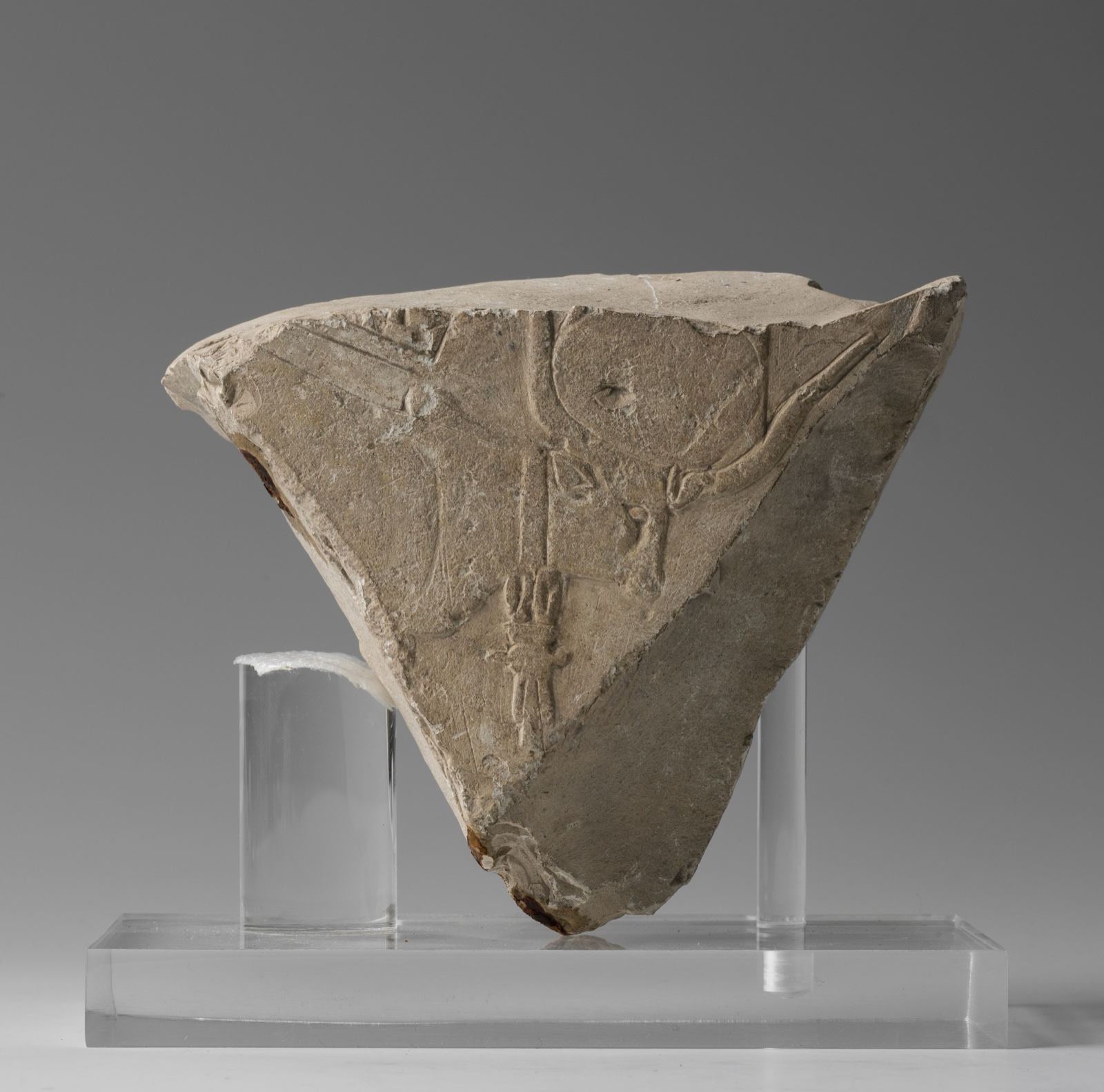
Fragment of a limestone stela with the Hathor cow. Above her is the hieroglyph used to write the goddess's name, Hat-Hor, 'the Temple (or House) of Horus': the plan of a temple with the Horus falcon inside, of which only the feet remain. Between 1539 and 1292 BC. Museo Egizio, Turin, S 12365.
Public domain (CC0), Museo Egizio · Source and licence
Public domain (CC0), Museo Egizio · Source and licence
The Egyptian form of Hathor is ḥwt-ḥr, usually written with the hieroglyphic compound 𓉡, or analytically as 𓉗𓅃. The name is formed from ḥwt, “house,” “mansion,” “estate,” or “enclosure,” and ḥr, “Horus,” so that ḥwt-ḥr means “House of Horus” or “Mansion of Horus.” The later English form Hathor comes through Greek and Coptic transmission, but the primary Egyptian name is ḥwt-ḥr. Her intricate tie to Horus is an allegory.1
The first element, ḥwt, is the architectural and institutional word meaning “house,” “temple,” “mansion,” “estate,” or enclosed divine dwelling. The second element, ḥr, is Horus. The name therefore does not mean “cow goddess” or “lady of love” on a literal level. Hathor is “the House of Horus,” a divine space or womb-like enclosure in which Horus is contained, protected, or manifested.2
Hathor's name is profoundly ancient, for the first attestation of Hathor’s name is from the First Dynasty, in the reign of the first Pharaoh Djer. An ivory tablet from Djer’s reign is reported as bearing the text “Hathor in the marshes,” and is published by Petrie among the royal tomb material. This is earlier than the more abundant Old Kingdom and later evidence for her cult, and it is therefore often treated as the earliest known occurrence of her name anywhere.3
Predynastic and Early Dynastic bovine goddess imagery can be difficult to assign securely to Hathor, Bat, Mehet-Weret, or another celestial cow figure unless the image is labelled. The Djer ivory tablet is therefore especially important because the goddess is identified by name, making it a stronger witness than unlabelled cow-headed or cow-eared iconography.4
Because of this, the safest short explanation is that Hathor’s primary Egyptian name is ḥwt-ḥr, written 𓉡 or 𓉗𓅃, and literally means “House of Horus” or “Mansion of Horus.” Her earliest commonly cited written occurrence is the First Dynasty Djer ivory tablet reading “Hathor in the marshes,” while the broader cult and iconography of Hathor become much more visible in the Old Kingdom and later Egyptian religious material. The much later Coptic form is ϩⲁⲑⲱⲣ (hathor) as Werner Vycichl's compendium of Coptic names shows, while the Greek, attested from many aspects of the Ptolemaic state, is Ἁθώρ, though Hathor was typically often called Aphrodite and Venus by Greek and Roman witnesses.5
Sources: Faulkner, A Concise Dictionary of Middle Egyptian (1962); Roberts, Hathor Rising (1995); Petrie, The Royal Tombs of the Earliest Dynasties (1901); Roeten, Loaves, Beds, Plants and Osiris (2018); Lesko, The Great Goddesses of Egypt (1999); Vycichl, Dictionnaire étymologique de la langue copte (1983).1, 2, 3, 4, 5, 6
II. Hathor in Egypt
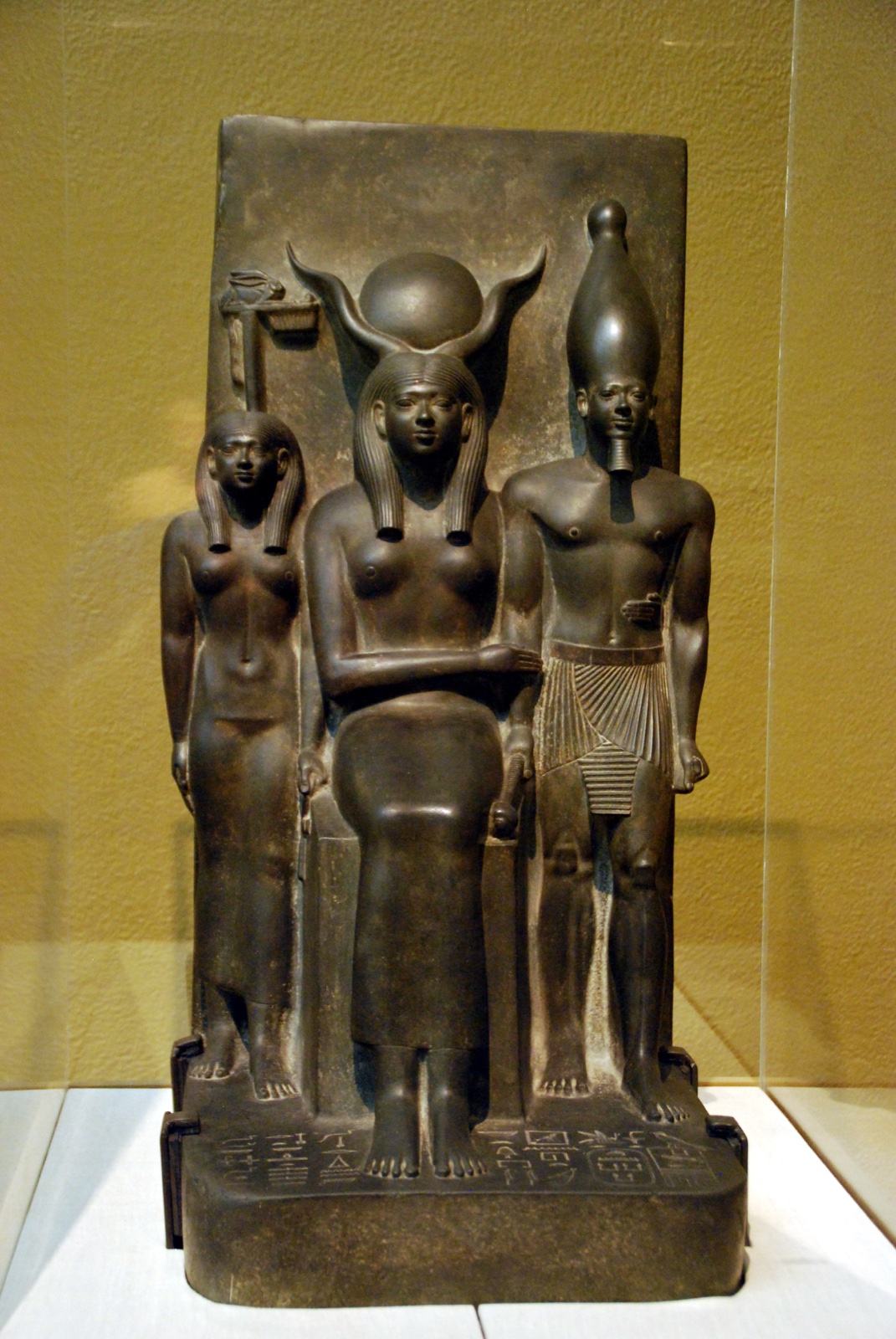
Triad of King Menkaura (Mycerinus) with the goddess Hathor and the goddess of the Hare nome. Greywacke, 4th Dynasty, c. 2548-2530 BC, from the Valley Temple of Menkaura at Giza. Museum of Fine Arts, Boston, 09.200.
Photo: Marcus Cyron, CC BY 3.0 · Source and licence
Photo: Marcus Cyron, CC BY 3.0 · Source and licence

The Egyptian goddess of the sky, Hathor, ruled over the sun, the stars, the human soul, love, music, dancing, eroticism, fertility, motherhood, fate, incense and proper conduct. Her worship in Egypt was so remarkably prolific and wide in scope that she was second only to Isis; Hathor was a goddess deeply cherished by her people, by whom she was deeply adored, sought after and respected to the degree that the temples of the cow goddess were placed among the Nile, the Sinai and deep into the adjacent territories of the empire for five millennia. She was not, however, just a goddess of the living world, being the feminine counterpart of Horus and Osiris as a figure on the boundary of life and death. Her symbolism was also deeply embedded in the mythological stories of Mut, Sekhmet, Bastet, Wadjet and other feminine divinities, whose adjacency to her is often represented in her mythological corpus and in their representation at her temples, yet a more mysterious aspect of Hathor concerned her endless identification with the Eye of Re in line with how these feminine elements are conveyed.7, 8, 9
"I am Praise; I am Appearance; I am Hathor-symbol-of-the-female-soul, who has two faces."
Pyramid Texts, Utterance 50610
As her primeval nature is a particularly powerful and attested facet of her identity, Hathor is cited in the ancient Pyramid Texts in numerous places stating that Horus is her son, while the Pharaoh Unas is questioned in relation to her protective, divine abilities as a result. Synchronistically with Wadjet, the Pharaoh is an eye that is said to reside on Hathor's brow. She is depicted from the 4th Dynasty of the Old Kingdom in art onwards, commonly flanking the Pharaoh in realistic statuary, but some of the bovine and front-facing imagery of the Protodynastic period is likened to her symbolism by archeologists and historians. The cult of Hathor slowly originated in Dendera at an ancient point and led to the proximate cult of the cow goddess Bat being synchronized with her own. At the vantage point looking onto the Old Kingdom, the maternal nature of Hathor as the great cow goddess is rather pointedly expressed, but her royal nature at the side of the Pharaoh is still a visual clue to her prominence in the monarchical cult even in the mists of arcane history.11, 12, 13, 14, 15
Evidence from subsequent periods shows an ever-expanding set of attributes. The Middle Kingdom Coffin texts flesh out the role of Hathor as a psychopomp and as the Eye of Ra more clearly, shown clearly by objects such as the ‘paddle dolls’ of the feminine deceased. In the 276th spell, she “takes shape as Hathor in the realm of the dead.” In Spell 331 named the “Becoming Hathor”, she calls herself “the primeval, the Lady of All” and states she came into being “before the sky was fashioned…” Spell 558 names her as the “Sistrum-player”, begging to be within her divine presence. The imagery of Hathor from this period, at least from what can be known, shows an enhanced entrenchment in multiple areas, as she became the royal patroness at Thebes, a festival goddess, and a presence in private funerary equipment where she began to displace Osiris as the unisex god of receiving the dead. Historians place an increasing emphasis on dancers and music, the accompanying menat and sistrum symbolism, the ties to beauty, and the frontal cow-eared Hathor emblem resulting from the Bat-Hathor convergence as symbols of an evolving cult of the great sky goddess. Furthermore, many of the temples of Egypt dedicated to Hathor with her characteristic columns began mass operation during the Middle Kingdom, yet those columns did not become common until the New Kingdom period.7, 16, 17, 18, 19, 20, 21
From the New Kingdom, the dimension of Hathor took on a more cemented role of being royalty’s greatest female protector and the official expression of her cult shifted strongly towards an elite. The Pharaoh Hatshepsut even patronized the creation of reliefs showing her suckling at the teat of the goddess, and numerous Great Royal Wives like Nefertari began to wear the horns with a solar disc affirming their own divine patronage of either Isis or Hathor. A slew of noblewomen in the New Kingdom associated with Hathor. Hathor columns in temples become far more numerous and her status as a funerary goddess of the western part of Thebes is increasingly apparent, particularly because of the nearby necropolis complex at Deir al-Bahari that Hatshepsut appears to have contributed to strongly maintaining as a tradition.21, 22, 23, 24, 25
The Heavenly Cow
From this point, however, her popular cult also left a corpus of evidence; distinctive mythologies about her have been recovered, the most important of which was the Myth of the Heavenly Cow first retrieved from the tomb of Tutankhamun and Seti I. In that foundational myth of Egypt, humanity rebels against the aged sun god Re; the primordial gods advise him to send his Eye, and that Eye descends “as Hathor.” She massacres humans in the desert, delights in the slaughter, and then turns into the wrathful goddess Sekhmet, who then goes on a further rampage of slaughter to the point humanity is endangered. Re stops her by having red-dyed beer spread out like blood so that she drinks it and becomes pacified. Hathor is the terrifying Eye of Re, the destroyer of rebels, and in being pacified becomes the goddess who can be turned back from wrath through intoxication and joy, but in the text itself only “through not perceiving mankind”. The text is preserved in other New Kingdom royal tombs, although parts of the tradition may be older. Hathor’s imagery also becomes attached to that of the lion and cat goddesses like Sekhmet from this point, whose own cults become increasingly important.26, 27
The Third Intermediate Period shows an increasing importance of great goddess narratives growing from the New Kingdom corpus, and this petitioning of the vengeful goddess to return perhaps has a link to the dire straits the Egyptians saw themselves in. In the Late Period and the recurrent collapse of imperial authority, Hathor’s material symbolism became more fixed in patterns of worship among isolated localities rather than the maintenance of a state cult, although she remained one of the most popular of the Egyptian goddesses. However, certain innovations of her status among believers are still apparent, at this point, like Ptah and Khnum, she started to become associated more with the increasingly prevalent mammissi complexes that became more common in Egyptian temples.28, 29
III. Epithets
| Epithet | Meaning | Domain |
|---|---|---|
| mwt nṯr(w) | Mother of the Gods | Horus, divine descent |
| Ḥwt-Ḥr wrt | Hathor the Great | Supreme divine rank |
| nbw.t, | The Golden One | Perfection |
| Ḥwt-Ḥr nb.t imnt.t | Hathor, Lady of the Western Mountain | Underworld symbolism |
| Ḥwt-Ḥr nb.t Iwn.t | Hathor, Lady of Iunet (Dendera) | Primary temple |
| Ḥwt-Ḥr ir.t Rꜥ | Hathor as the Eye of Ra | Solar power, wrath, protection, divine agency |
| Ḥwt-Ḥr ḥnw.t nṯr.w nb.w | Hathor, Mistress of all the Gods | Cosmic sovereignty, pantheonic prominence |
| Ḥwt-Ḥr nb.t pt (Nebet-Het) | Hathor, Lady of Heaven | Sky-goddess, higher soul |
| Ḥwt-Ḥr nb.t nḥ.t | Hathor, Mistress of the Sycamore Shrine | Funerary nourishment, love |
| Ḥwt-Ḥr nb(.t) išrw | Hathor, Lady of the Isheru-lake | Temple-lake cult |
| Ḥwt-Ḥr nb.t r ḏr | Hathor, Lady to the Utmost | Cosmic extent, starry power |
| Ḥwt-Ḥr nb.t tḥ | Hathor, Lady of Intoxication | Festival ecstasy, soul bliss |
Sources: British Museum, "balance, EA57369"; British Museum, "stela, EA25296"; Wood, "A Reconstruction of the Triads of King Mycerinus" (1974); Graves-Brown, The Theology of Hathor of Dendera (2022); Serova, The Central Hall in the Egyptian Temples of the Graeco-Roman Period (2025).30, 31, 32, 33, 34
IV. Dendera, the Home of Hathor
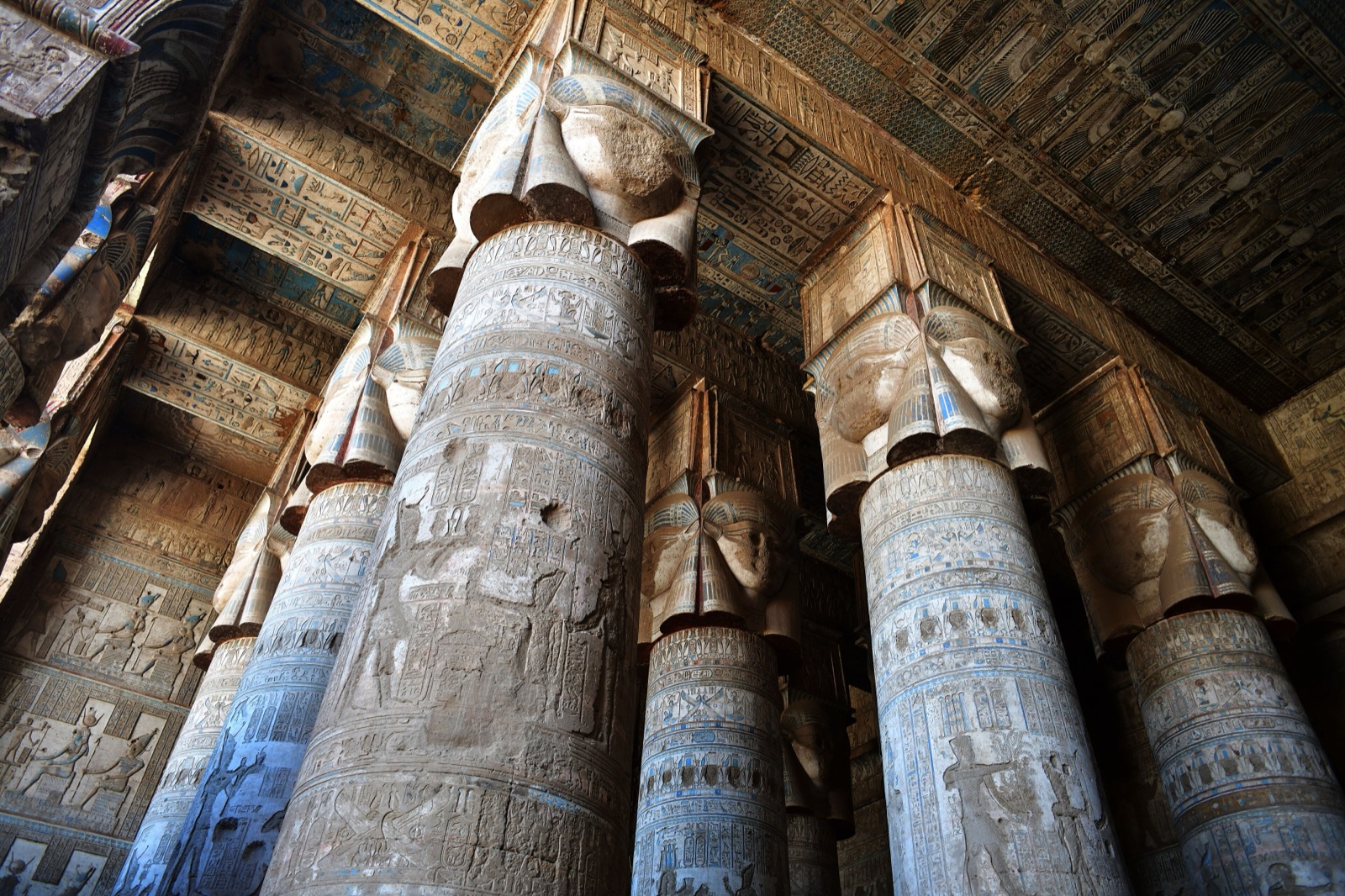
Hathor columns in the hypostyle hall of the temple at Dendera.
Photo: Panegyrics of Granovetter, CC BY-SA 2.0 · Source and licence
Photo: Panegyrics of Granovetter, CC BY-SA 2.0 · Source and licence

The astounding array of temples dedicated to her exceed those of any other Egyptian goddess, and this fact alone shows how broadly popular Hathor was in religious day-to-day life. The Ptolemaic period brought in a significant revival of Hathor’s cult on a statewide level associated with royalty; her cult as a national goddess began to reach the dimensions of the thousand years preceding that era. In particular, the opulent and sprawling Dendera Temple complex, which was built, rebuilt and paused progressively from the reign of Pepi I up until the time of Ignorance, was dedicated to Hathor, but in line with the revival of her worship, the Ptolemies commissioned the most dramatic expansions to this complex to revive its fortunes. A large amount of its contents represent the patronage of the female co-Pharaoh, Arsinoe II Philadelphos, who was deified in her relation to Isis and Hathor both in the temple and outside of it. The Dendera complex is one of the best-preserved temples of Egypt as a whole and possesses hundreds of scenes involving the goddess, being a particularly rich source of information for Egyptologists since the cracking of the linguistic codes of the Rosetta Stone.35, 36, 37, 38, 39, 40
The plan of the temple may be supposed to have included a colonnaded court in front of the present façade, and pylon towers at the entrance; but these were never built, probably for lack of funds. The building, which is of sandstone, measures about 300 ft. from front to back, and consists of two oblong rectangles; the foremost, placed transversely to the other, is the great hypostyle hall or pronaos, the broadest and loftiest part of the temple, measuring 135 ft. in width, and comprising about one-third of the whole structure; the façade has six columns with heads of Hathor, and the ceiling is supported by eighteen great columns. The second rectangle contains a small hypostyle hall with six columns, and the sanctuary, with their subsidiary chambers. The sanctuary is surrounded by a corridor into which the chambers open: on the west side is an apartment forming a court and kiosk for the celebration of the feast of the New Year, the principal festival of Dendera. On the roof of the temple, reached by two staircases, are a pavilion and several chambers dedicated to the worship of Osiris. Inside and out, the whole of the temple is covered with scenes and inscriptions in crowded characters, of ceremonial and religious import; the decoration is even carried into a remarkable series of hidden passages and chambers or crypts made in the solid walls for the reception of its most valuable treasures.
The architectural style is dignified and pleasing in design and proportions. The interior of the building has been completely cleared: from the outside, however, its imposing effect is quite lost, owing to the mounds of rubbish amongst which it is sunk. North-east of the entrance is a “Birth House” for the cult of the child Harsemteu, and behind the temple a small temple of Isis, dating from the reign of Augustus. The original foundation of the temple must date back to a remote time: the work of some of the early builders is in fact referred to in the inscriptions on the present structure. Petrie’s excavation of the cemetery behind the temple enclosures revealed burials dating from the fourth dynasty onwards, the most important being mastables of the period from the sixth to the eleventh dynasties; many of these exhibited a peculiar degradation of the contemporary style of sculpture.
Encyclopædia Britannica, "Dendera" (1911)41
The Dendera Zodiac was originally located on the ceiling of an Osiris chapel in the Temple of Hathor at Dendera, and it was covered in astronomical scenes, including the Dendera Zodiac which now in the Louvre, from a chapel on the roof. The reliefs of Dendera show celestial deities, star maps, and ritual representations of the sky goddess Nut, swallowing and rebirthing the sun. It constitutes our main knowledge of Egyptian astrology in general.42
The per-wer, the main sanctuary of the temple nested behind the Pronaos and the Hypostyle Hall, has the most important scenes to Hathor represented in abundance. She is represented as a solar goddess, and the Myth of the Wandering Goddess is also portrayed in scenes, the per-wer is the seat of her divine presence. The lower walls depict ritual processions and liturgical texts showing the Pharaohs before Hathor and other deities. The antechambers in front of the per-wer functioned as the zones of offering to the Gods, therefore the Divine Lady was represented in her role as receiving such offerings on the walls, while there also existed to the sides stairs presumably tied to carrying the cult image of Hathor up to the roof of the temple. Particular variations among the rooms at the wings of the sanctuary are distinctive; Room XI is dedicated to Hathor’s identification with the menat necklace and her divine child, Ihy, in Room X. The Wabet is one of the most starkly unique elements of the temple, as it was seemingly a purification room tied to the New Year celebrations. The underground crypts are also among the most famous Hathor spaces at Dendera; Barbara Ann Richter states that they were used for storing sacred vessels, divine iconography, jewelry, and ritual equipment, while the reliefs present explicitly show Hathor and Ihy. Outside of the Dendera temple proper, a ring of smaller chapels dedicated to Hathor dot the landscape around it.40, 43, 44, 45, 46, 47
The linguistic register of inscriptions in the temple is particularly interesting, because the architects and scribes chose to use a specific style of archaic Egyptian dating from the Middle and Old Kingdoms, 2,500 years prior to its construction, with some neologisms dating to the contemporary language, to depict the scenes involving the deities. Certain formulae of the temple’s scenes also dated back millennia and the divine function of the temple was a particularly stark reminder of Hathor’s genuine antiquity as a goddess; it is a remnant of Egyptian power for posterity. Barbara Ann Richter in her study of linguistic analysis of the language noted how the sacred references to Hathor and adoration texts addressed to the sky goddess at the temple are fully signposted with double-meanings, verbal repetition, wordplay and complex verbal patterns that are almost untranslatable into English or any other modern language, for example:40
“I make high your Ka to the height of heaven”
sk3=t k3=t r k3 n pt
The two occurrences of root k3 “be high”, first as the causative verb sk3 “make high” and then as the substantive, k3 “height”, create a polyptoton. These two forms of “be high” bracket the word, k3 “the soul” or “the embodiment of Hathor”, thus emphasizing the height to which the king praises her. The word, k3, sounds very similar to the root meaning “be high”, but it comes from a different root and has a different initial consonant. There is a rhythm to this expressing, emphasizing the element k3, three times. Additionally, the hieroglyph of a man raising his arms in adoration, on either side of the k3 of the goddess, creates the visual image that she is surrounded by praise.
Richter, The Theology of Hathor of Dendera40
Other sites
Another important cult complex of Hathor was in the ancient capital of Memphis with a more inconsistent record, because documents show her priests installed there at the necropolis from ancient times and a temple to the north of the wall of Memphis during the Old Kingdom. It is known from the archeological record that the original temple of Hathor may have contributed to a second temple to the south in the Middle Kingdom, and the New Kingdom temple of the Southern Sycamore is often attributed as being dedicated to her. Recent archaeological work indicates that this temple was built in the 18th Dynasty, then re-carved at least twice in the 18th and 19th Dynasties, while archeologists have noted a pylon, open forecourt, enclosed pronaos, and Hathor-head capitals being the significant architectural constituents. Deeper into the New Kingdom period, Ramesses’ own constructions occurred in her district of Memphis as additional elements.48, 49, 50
Theban elements of her cult came into being in an erratic fashion. The ancient Pharaoh Mentuhotep of the Middle Kingdom integrated the worship of the cow-goddess into his central temple, and a sarcophagus of a priestess of Hathor has been found beneath the complex. The Met’s relief of Mentuhotep II and Hathor comes from the main sanctuary of his temple during that period, built by the Pharaoh who “reunited Egypt after the era of disunity.” Hundreds of years later, as stated, Hatshepsut pursued a policy of building shrines to Hathor at Thebes alongside trinities of other Gods, and later at Thutmose III’s mortuary temple of Djeser-Akhet near the funerary necropolis of Luxor, Hathor possessed a shrine.1, 19
She was also associated with the Sinai peninsula that was not part of Egypt proper and the temple at Serabit al-Khadim there, which was cut from rock and contains constructed artificial caves dedicated to her worship, and even beyond the unique quality of this space the standards of this temple are unique, as archeologists have noted the temple layout is highly irregular. Hathor herself appears to have been hailed as the head deity of the mining expedition there, perhaps indicating her connection with precious stones and valuables. A Hathor shrine at Gebel Zeit was also found in the Sinai.19
A particular Egyptian complex was at Atfih, known as Busiris or Aphroditopolis, where inscriptions by her priests have been found. In his account of the disposal of sacred cattle, Herodotus says that in Atarbechis there was “a temple of Aphrodite of great sanctity.” Since Greek authors regularly use Aphrodite to represent Hathor in Egyptian contexts, this is commonly taken as a reference rather than to the Greek goddess as such.51, 52
V. Priesthood of the Sky
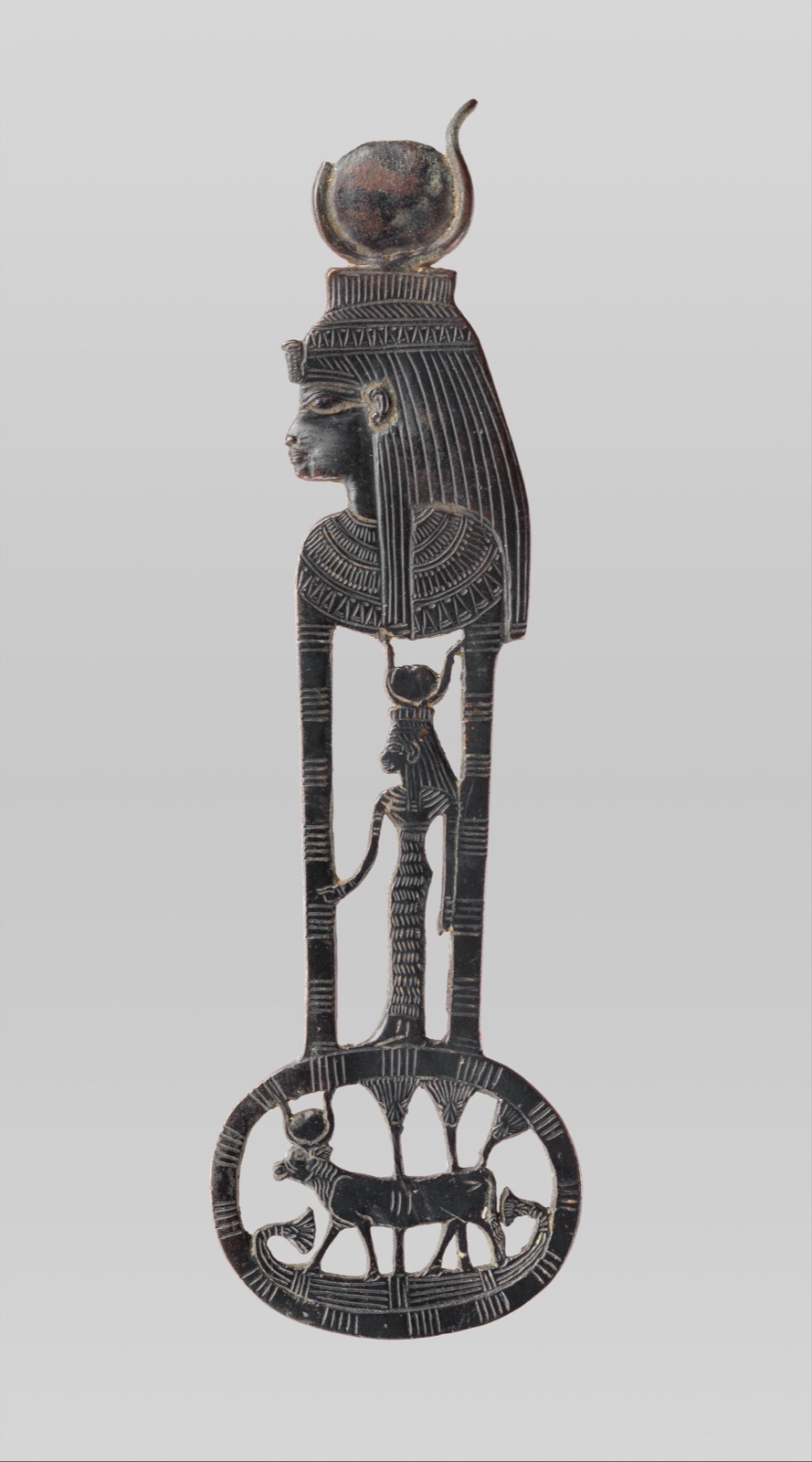
Menat counterpoise with figures of Hathor as a woman and a cow. Cupreous alloy, New Kingdom, Dynasty 18, reign of Amenhotep III, c. 1390-1352 BC. From Egypt. Metropolitan Museum of Art, New York, 51.157.2.
Public domain (CC0) · Source and licence
Public domain (CC0) · Source and licence

She was known to have both male and female priests, a distinction only shared with Isis herself. In the Old Kingdom, women of high rank could become the Priestess of Hathor, which conferred religious authority. Curiously, phallic-shaped objects were left by men in worship of Hathor also, which suggests there was a masculine dimension to her cult.53
The first known Priestess of Hathor was Neferhetepes, daughter of King Radjedef, though in the Old Kingdom, over 400 women seem to have held the title. In the Fourth Dynasty, royal women often took the title, but these were princesses, not wives or mothers of kings, and thus not mythically important to kingship. The fact that the title rh-t nswt “Royal Acquaintance” is often linked with the title ‘Priestess of Hathor’ suggests that Hathorian priestesses were part of the court circle. A few women who were priestesses also held what appears to be the higher title h- krt nswt ‘King’s Ornament’.
[...]
A Fifth Dynasty papyrus from Abusir shows that priestesses received the same payment as men, and were therefore not considered of lesser status.
Graves-Brown, Dancing for Hathor1
Hathor served as the feminine counterpart to Re and took on a distinct role as his wife. Increasingly, the Great Royal Wives of the Pharaohs vaunted her as their divine patroness, and some like Ashayet from the Middle Kingdom served as both the Pharaoh’s Wife and the Priestess of Hathor, to the point where the position of serving Hathor became intermingled with the royal cult. Nefertari, for example, benefitted from this association at the Temple of Abu Simbel by being shown as a handmaiden of Hathor. However, regnant female Pharaohs also had a distinct tendency to claim the imagery of Hathor as their own. When Hatshepsut declared herself Pharaoh, she aligned her reign with Hathor by refurbishing the sanctuary of the Goddess at Deir el-Bahari and depicted herself being nursed by her. Even in the late Ptolemaic period, Cleopatra VII embraced identifications with Hathor to present herself as a living goddess of fertility and wealth; her reliefs at Dendera itself bear that type of imagery.54, 55
In any event, the titles were often hereditary and sought out by all classes:
Hathoric titles held a certain prestige that was desirable, and probably they were indicative of a certain attitude of devotion, respect, or intelligence that was desirable. In the process of choosing a spouse such qualities may have been sought out. Further, the society of acquaintances of eligible males and females from which one would have chosen a spouse may have been influenced by a mother's participation in the Hathoric cult.
Galvin, "The Hereditary Status of the Titles of the Cult of Ḥathor"56
Votive objects to Hathor ask for a good presence in front of the Pharaoh suggestive of her linkage to the royal cult, in addition to pleading for a good life, love life and deftness in skill, while on cloth devotees would be represented, sometimes with their families, offering to the Holy Cow.57
VI. The Myth of the Heavenly Cow
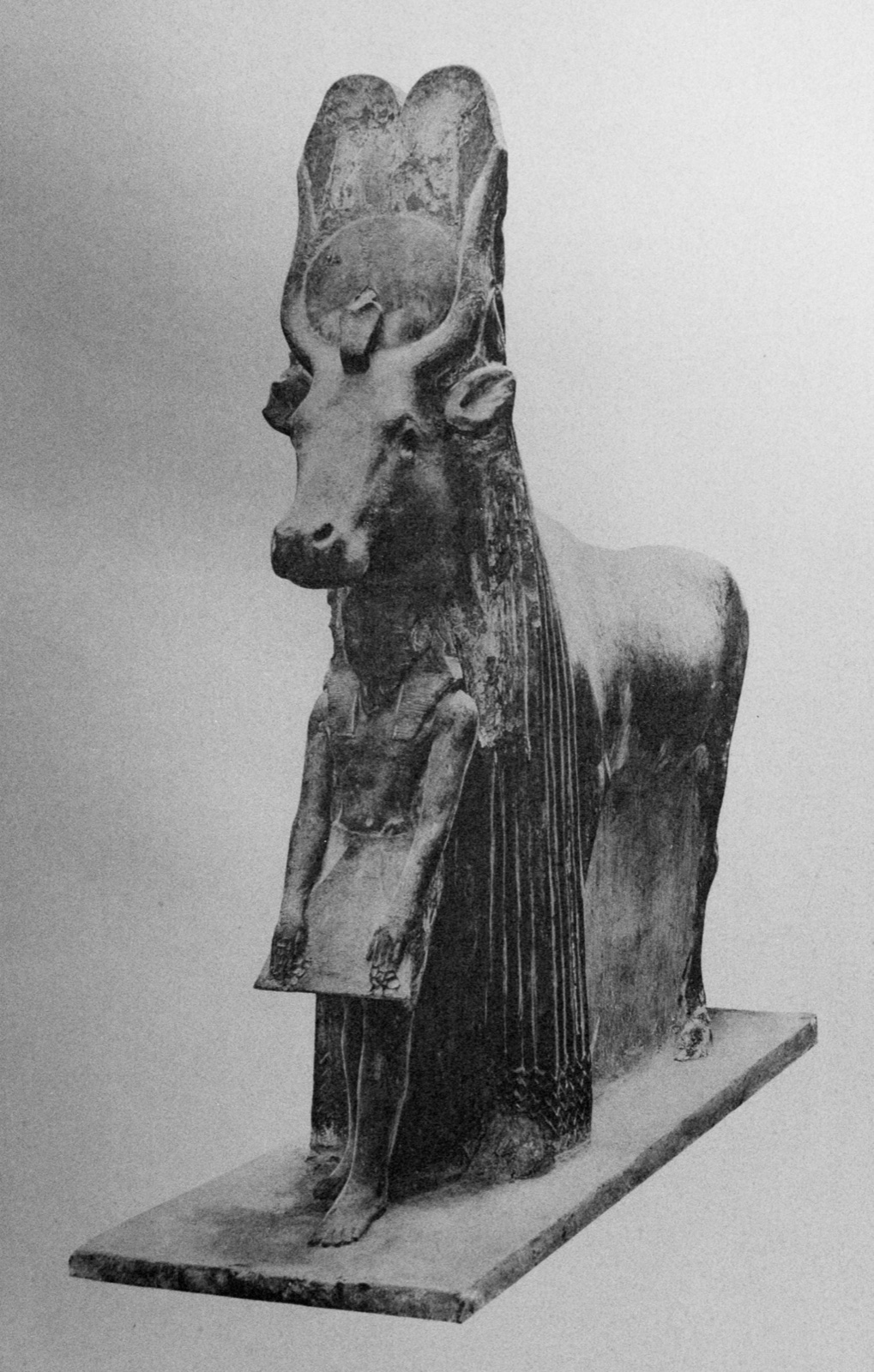
The divine Hathor cow with Amenhotep II in front, found in the chapel of Hathor at the temple of Thutmose III at Deir el-Bahari by Edouard Naville in 1906; now in the Egyptian Museum, Cairo, JE 38574-5. Photograph published by Naville in 1907.
Public domain · Source and licence
Public domain · Source and licence

The main mythology of Hathor with quite different tones to her worship in day-to-day life is recounted in the New Kingdom stories involving the ‘Seven Hathors’ of Fate, such as the Tale of the Two Brothers and the Tale of the Doomed Prince, an allegory of planetary forces where she warns individuals of their impending doom. Hathor’s representation as a starry Goddess was interlinked into ideas of fate. Accordingly, some findings from Deir el-Medina excavations suggest a link to the Seers of Hathor who were a cult of pious psychic women. Ancestor busts were linked to the goddess as well:58, 59, 60
It has been demonstrated that on private stelae and on votive cloths, women are shown directly before Hathor, without the male intermediary shown in tomb depictions.
Graves-Brown, Dancing for Hathor1
As said above, the main mythology involves her taking on the enraged Eye of Re to become Sekhmet. When transformed, in certain alternate stories, only the fruits of civilization such as beer or red ochre could pacify Sekhmet’s rampage and to return her consciousness to the friendlier form of Hathor. Benevolent and approachable as a deity after her pacification, the Egyptian people commonly celebrated her rites. The Egyptians named the month Hathor, which spanned from early November to early December, after her. Festivities were held celebrating her during this time period. Hathor was associated with letting go, and her celebrations tended to be quite vivid and raucous.61, 62
VII. Her Festivals
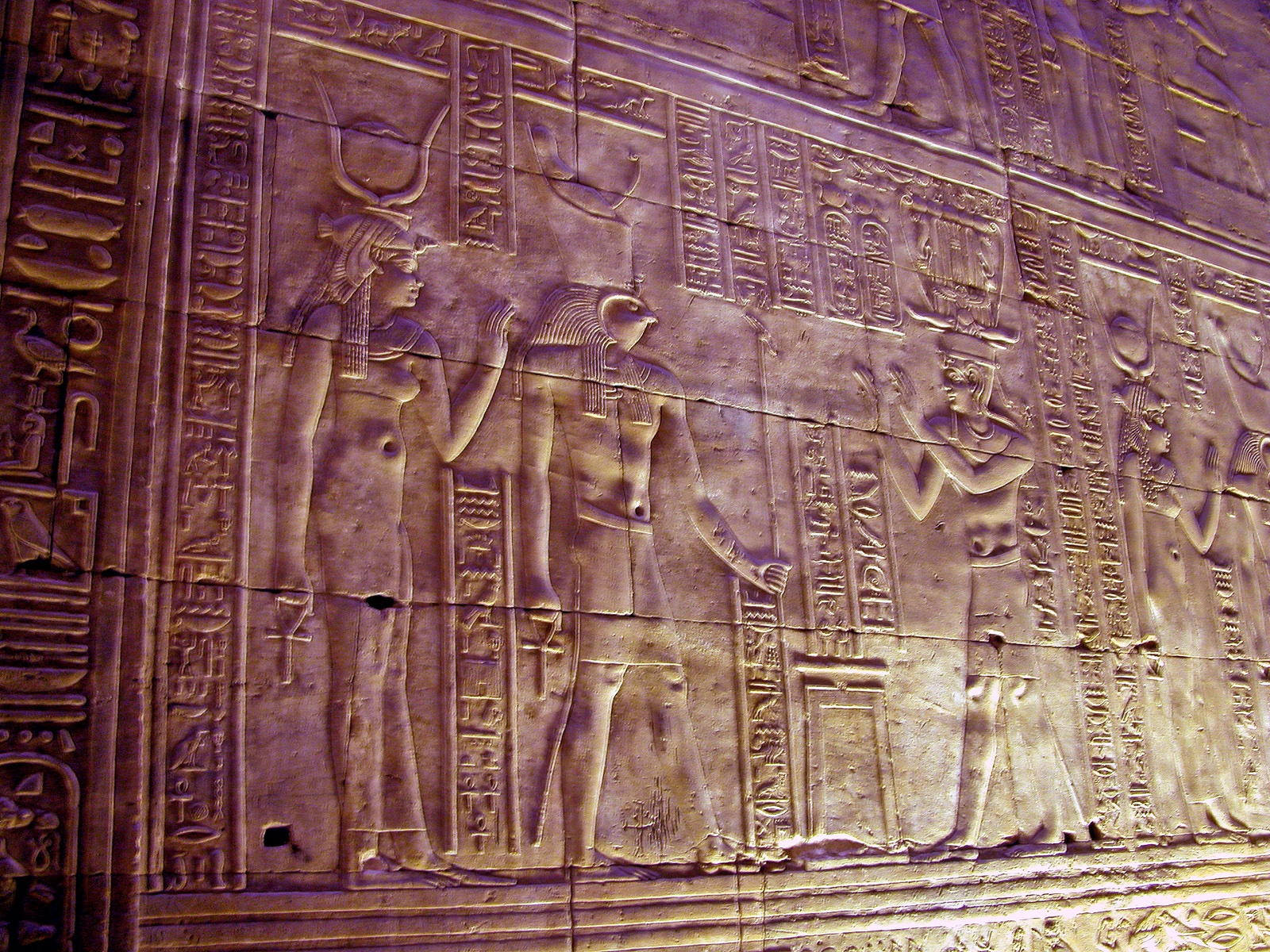
Relief depicting the Feast of the Beautiful Meeting, the reunion of Horus and Hathor. Temple of Horus, Edfu, Egypt.
Photo: Dennis G. Jarvis, CC BY-SA 2.0 · Source and licence
Photo: Dennis G. Jarvis, CC BY-SA 2.0 · Source and licence

Hathor became central to the Beautiful Festival of the Valley, one of the major religious festivals of the year. This festival, dating back to the Middle Kingdom, originally involved the Amun of Karnak traveling across the Nile to visit the west bank cemeteries. Families would picnic and honor their dead ancestors during the procession. Initially, Hathor was not directly involved, but in the New Kingdom, the mythic narrative was expanded, as Amun’s procession included an overnight stay at the Temple of Deir el-Bahari. The Valley festival took on her fertile, bounteous symbolism. Amun, representing the rejuvenated sun or life force, ensuring the rebirth of nature and the deceased from the western point. During the festival, Theban women played roles of Hathor’s priestesses, parts of the festivities included women dancing with menat necklaces and sistra in the procession. She was also celebrated in a parallel way during the Beautiful Reunion festival, which allegorically celebrated her marriage to Horus. Hathor’s statue was brought from Dendera with much ceremony to Edfu, the main hieratic complex of the Solar God in Egypt. People would flock from any town from Dendera to Edfu to witness the Goddess being carried, with endless celebrations and festivities occurring along the way. The Reunion was seen as a ritualized union which guaranteed cosmic renewal and, nine months later, it culminated in the Festival of Ihy, the son of both deities.40, 63, 64, 65
VIII. Beauty and Love
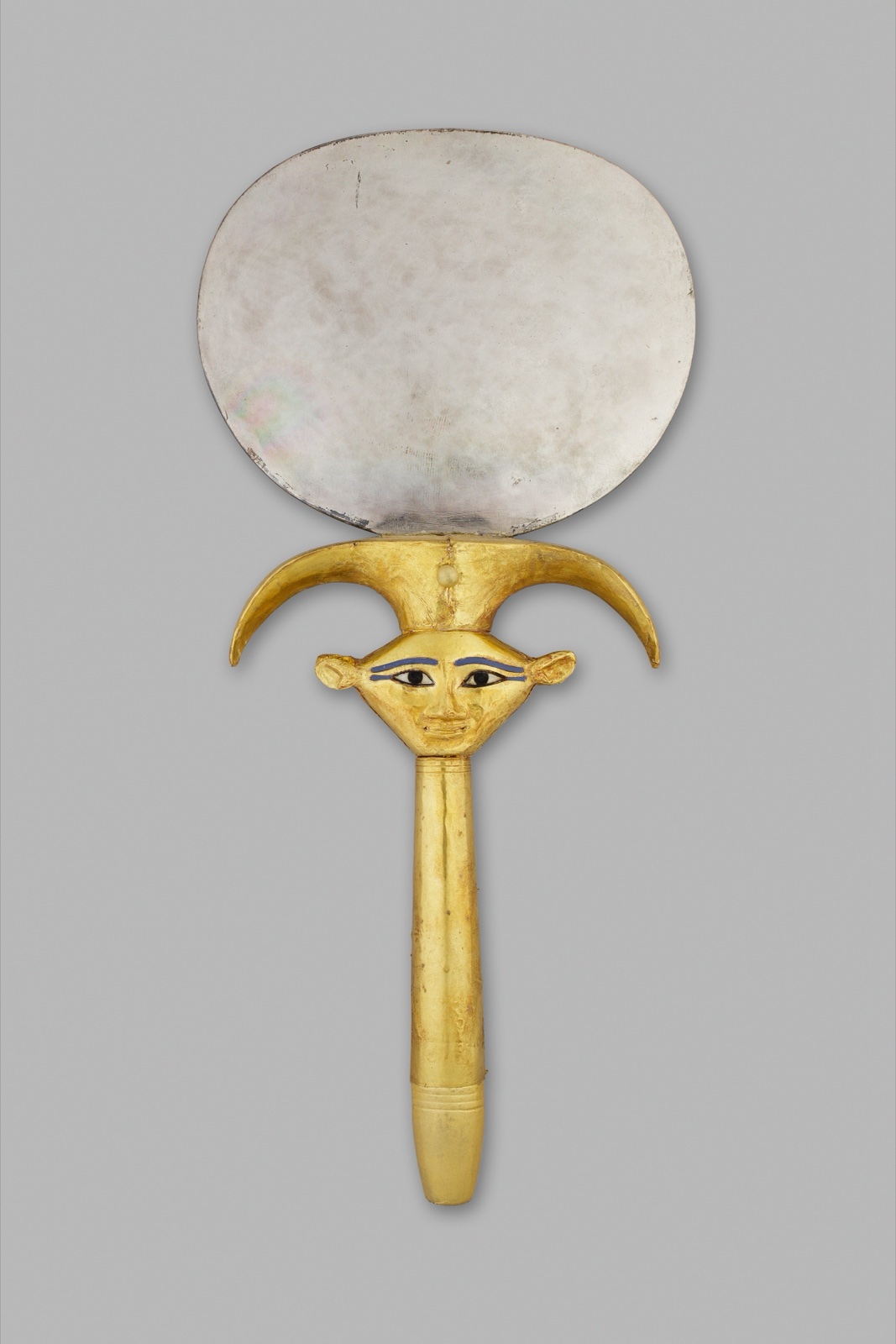
Mirror with a Hathor-emblem handle. Silver disk; handle of modern wood sheathed in gold, inlays restored. New Kingdom, Dynasty 18, reign of Thutmose III, c. 1479-1425 BC. From the Tomb of the 3 Foreign Wives of Thutmose III, Wadi Gabbanat el-Qurud, Thebes. Metropolitan Museum of Art, New York, 26.8.98.
Public domain (CC0) · Source and licence
Public domain (CC0) · Source and licence

Hathor was often represented on grinding palettes which were essential in Egyptian daily life, including the constantly present kohl worn by Egyptians to ward off eye infections, some commentators interpreted Hathor’s presence as the Eye of Ra as being tied to this protection. These palettes sometimes depicted Hathor’s face or her full-bodied form, symbolizing the pursuit of beauty and femininity. Egyptian mirrors from ancient periods sometimes featured Hathor’s face, alongside endless examples of jewelry, particularly in the form of amulets or pendants. The civilization treated beauty as an ornament of the divine, an inheritance of Hathor’s grace.66, 67
Let me worship the Golden One to honor her Majesty
and exalt the Lady of Heaven;
Let me give adoration to Hathor
and songs of joy to my heavenly Mistress!
I beg her to hear my petitions
that she send me my mistress now!
And she came herself to see me!
What a great thing that was when it happened!
I rejoiced, I was glad, I was exalted,
from the moment they said, “Oh, look at her!
“See, here she comes!” and the young men bowing
through their enormous passion for her.
Let me consecrate breath to my Goddess
that she give me my Love as a gift!
It is four days now I have prayed in her name;
let her be with me today!Papyrus Chester Beatty I, "Prayer to Hathor as Goddess of Love"68
In addition, the cow goddess’ attributes in the Egyptian mind were associated with music, celebration and eroticism, so the recorded New Kingdom love song has a young man pray to Hathor above for his love in that vein. Through celebration, intercession, dance, the Goddess was believed to intervene in affairs of the heart. She was commonly associated with dancing in every way, particularly the dances of young women and, complementary to that end, it was her symbolism that dealt with being bold in erotic directness. The synergy between Hathor and women is also evident in how deceased women could be depicted as the sky goddess, which is part of her increasing identification with the feminine deceased. In the funerary art of the New Kingdom and later, elite women sometimes appeared on stelae with her regalia, equating them with her protection in the afterlife. These kinds of funerary stelae from Egypt sometimes showed the lady of the house in the form of “Hathor of the West” greeting her relatives.1, 69, 70, 71
Hathor ushered the dead into an area where they had endless food and drink as sustenance and was regarded as a maternal figure of the Duat, often syncretized with ‘She of the West’, Imentet. Bes was also known as the companion of Hathor and was associated with her in terms of childbirth.72, 73
IX. The House of Horus, the Cow
Her name means the house or palace of Horus, also the House of the Soul, which indicates that she rules over the incubation of the personal sun and the soul inside, a process that must be harnessed to complete the Magnum Opus. The mother goddess is associated with the heifer as her animal symbol eternally, which is also the reason she is constantly represented with the horns of the cow with the disc of the sun and a serpentine uraeus.40, 74
This naturally related to fertility and motherhood, since bovine animals are known as some of the best mothers of the animal kingdom. There is some ambiguity, however, over Hathor’s maternal role as such, because despite her constantly attested parentage of Horus and Ihy, she was often cast more ambivalently in relation to the mother role in comparison to Isis. This may be suggestive of how calves are separated early from their mothers. Her bovine symbolism related to many aspects; cows are commonly known as gentle and pining animals capable of great emotional sensibility and subtlety. They cannot bear being separated from calves or, when in estrus, bulls, a tendency that provokes them to low and whine in despair.75
The civilization of the Nile put great emphasis on bovines for its sustained continuance. Cows are greatly nourished by the sun and correspondent solar effects on sunlit grass and other articles of food which cows consume, which in turn sustains humans through the end result of milk, meat and endless kinds of hides. The ‘house’ of Hathor and the interplay between the sun and the cow’s survival is allegorically represented by this animal in this way.76, 77
Egyptians viewed the udders of the goddess as sacred, producing a milk taken to be the galaxy of the Milky Way. The location of the earth is in an area distinctly separated from most forms of intelligible life; Hathor being a ‘house’ contains also some hidden meanings relating to this. Hathor was commonly represented as a sycamore tree all by itself; the pink fleshy fig with its milky residue connected to the udder was one of her symbols in worship. Sycamores were also conventionally referred to as meeting places for lovers in Egyptian songs like the Songs from the Grove and thought of as romantic symbols that alluded to fertility, but also, paradoxically, as symbols of death and transitional, liminal states. The sycamore is constantly associated with Hathor. Classical authors, like Lucretius, also associated the forlorn cow with lovers searching for their lost partners.1, 78, 79, 80, 81, 82
The milk of this Goddess, whether from the cow or the sycamore fruit, is also allegorical of the prima materia and the aether. The use of this element as a primer for magical workings and its conventional deployment as a start point of the Magnum Opus is like the nourishing milk of a wetnurse. Beyond being depicted in bovine form, she was commonly seen as both a lioness and a cobra in Egyptian depictions.
X. The Sistrum and Menat
A particularly vivid symbol of Hathor, shared with Isis, Sekhmet and Bastet, is the sistrum, which is always clad in the U-shape important to the Goddess. Often, sistra were adorned with floral handles depicting the papyrus or lotus flower. In daily use it was used by clergy to clear the temples and shrines of any malefic influences. The whirring sound of the serpent was evoked by the sistrum and its unique sibilating sound was considered analogous to Hathor’s calm, benefic presence.83, 84, 85
The menat necklace was also tied to her as an eternal symbol and is generally found in any area of Hathor’s imagery. The menat was held in one’s hand by its counterpoise, while priestesses used it as a rattling instrument. It was supposed to be used as a symbol to ward off evil like the sistra and was buried with the deceased.86, 87
Another subtle symbol of Hathor is the vulva, sometimes the uterus. The typical front-facing visage of Hathor depicted on the sistrum or the pillars and statues is allegorical of this shape, which is only otherwise noted to be of Bes in Egyptian style. The uterus secretes uterine milk, histiotroph, from its innumerable glands to provide nourishment to the ovum, embryo and fetus; the uterus also pushes the fertilized ovum to its proper place to begin conception. It is the sudden and violent contraction of the uterus that forces a woman into labor. Hathor’s direct nature as a goddess who descends with violence may be likened to this process.88
Myrrh, a hot and dry yet pure substance, was also associated with Hathor as a material of transformation in alchemy and for its use in embalming procedures. Like the sistrum, the burning of myrrh was considered purifying, and it was also commonly used as an ocular antiseptic. The cavity of organs in Egyptian burial was also filled with the purest myrrh, a cleansing mechanism but allegorical of the pleasant afterlife that Hathor promised to parishioners.52, 89, 90
Sources and Bibliography
- Faulkner, Raymond O. A Concise Dictionary of Middle Egyptian. Oxford: Griffith Institute, 1962, s.v. “ḥwt,” “Ḥr”; Erman, Adolf, and Hermann Grapow. Wörterbuch der aegyptischen Sprache. 5 vols. Leipzig: J. C. Hinrichs, 1926–1931, s.v. “ḥwt,” “Ḥr”;
- Roberts, Alison. Hathor Rising: The Power of the Goddess in Ancient Egypt. Totnes: Northgate Publishers, 1995.
- Petrie, W. M. Flinders. The Royal Tombs of the Earliest Dynasties. Part II. Egypt Exploration Fund Memoir 21. London: Egypt Exploration Fund, 1901
- Roeten, Leo. Loaves, Beds, Plants and Osiris: Considerations about the Emergence of the Cult of Osiris. Oxford: Archaeopress, 2018, 150;
- Lesko, Barbara S. The Great Goddesses of Egypt. Norman: University of Oklahoma Press, 1999, 81–97
- Vycichl, Werner. Dictionnaire étymologique de la langue copte. Louvain: Peeters, 1983, 317a–b
- Graves-Brown, Carolyn. Dancing for Hathor: Women in Ancient Egypt. London: Continuum, 2010.
- Riggs, Christina. “Osiris, Hathor, the Gendered Dead.” In The Beautiful Burial in Roman Egypt: Art, Identity, and Funerary Religion, 41–94. Oxford: Oxford University Press, 2005.
- Pinch, Geraldine. Votive Offerings to Hathor. Oxford: Griffith Institute, Ashmolean Museum, 1993.
- Pyramid Texts. In Allen, James P. The Ancient Egyptian Pyramid Texts. Edited by Peter Der Manuelian. Writings from the Ancient World 23. Atlanta: Society of Biblical Literature, 2005. Section cited: Utterance 506.
- Pyramid Texts. In Allen, James P. The Ancient Egyptian Pyramid Texts. Edited by Peter Der Manuelian. Writings from the Ancient World 23. Atlanta: Society of Biblical Literature, 2005. Section cited: Utterance 303.
- Pyramid Texts. In Allen, James P. The Ancient Egyptian Pyramid Texts. Edited by Peter Der Manuelian. Writings from the Ancient World 23. Atlanta: Society of Biblical Literature, 2005. Section cited: Utterance 282.
- Friedman, Florence Dunn. “Reading the Menkaure Triads, Part I.” In Palace and Temple: Architecture, Decoration, Ritual, edited by Rolf Gundlach and Kate Spence, 23–56. Wiesbaden: Harrassowitz Verlag, 2011.
- Jensen, Victoria. “Predynastic Precursors to the Festival of Drunkenness: Beer, Climate Change, Cow-Goddesses, and the Ideology of Kingship.” In Proceedings of the XI International Congress of Egyptologists, Florence, Italy, 23–30 August 2015, edited by Gloria Rosati and Maria Cristina Guidotti, 296–301. Oxford: Archaeopress, 2017.
- Fischer, Henry George. “The Cult and Nome of the Goddess Bat.” Journal of the American Research Center in Egypt 1 (1962): 7–18.
- Metropolitan Museum of Art. “Female Figurine.” The Met Collection. Middle Kingdom, ca. 2040–1640 BC. New York: Metropolitan Museum of Art. Section cited: female figurine associated with fertility/Hathoric imagery.
- Coffin Texts. In Faulkner, Raymond O. The Ancient Egyptian Coffin Texts. Vol. 1, Spells 1–354. Warminster: Aris & Phillips, 1973. Section cited: Spell 276.
- Coffin Texts. In Faulkner, Raymond O. The Ancient Egyptian Coffin Texts. Vol. 1, Spells 1–354. Warminster: Aris & Phillips, 1973. Section cited: Spell 331.
- Coffin Texts. In Faulkner, Raymond O. The Ancient Egyptian Coffin Texts. Vol. 2, Spells 355–787. Warminster: Aris & Phillips, 1977. Section cited: Spell 558.
- Horváth, Zoltán. “Hathor and Her Festivals at Lahun.” In The World of Middle Kingdom Egypt (2000–1550 BC), vol. 1, edited by Gianluca Miniaci and Wolfram Grajetzki, 125–44. Middle Kingdom Studies 1. London: Golden House Publications, 2015.
- Czellár, Katalin. “Anthropomorphic Supports in Ancient Egyptian Architecture.” Periodica Polytechnica Architecture 24, nos. 3–4 (1980): 133–56.
- Gillam, Robyn A. “Priestesses of Hathor: Their Function, Decline and Disappearance.” Journal of the American Research Center in Egypt 32 (1995): 211–37.
- Ivanova, Maria. Milk in Ancient Egyptian Religion. Master’s thesis, Uppsala University, 2009.
- Onstine, Suzanne Lynn. The Role of the Chantress (šmꜥyt) in Ancient Egypt. BAR International Series 1401. Oxford: Archaeopress, 2005.
- Institute of Egyptian Art and Archaeology, University of Memphis. “Thebes, Temple of Hatshepsut.” Egypt: A Color Tour of Egypt and Its Monuments. Memphis: University of Memphis
- Guilhou, Nadine. “Myth of the Heavenly Cow.” In UCLA Encyclopedia of Egyptology, edited by Jacco Dieleman and Willeke Wendrich. Los Angeles: Department of Near Eastern Languages and Cultures, UCLA, 2010.
- Jackson, Lesley. Sekhmet and Bastet: The Feline Powers of Egypt. London: Avalonia, 2018.
- Allen, James, and Marsha Hill. “Egypt in the Third Intermediate Period (ca. 1070–664 B.C.).” In Heilbrunn Timeline of Art History. New York: Metropolitan Museum of Art, 2004. https://www.metmuseum.org/essays/egypt-in-the-third-intermediate-period-1070-712-b-c.
- Institute for the Study of Ancient Cultures, West Asia & North Africa, University of Chicago. “Mammisi.” Tell Edfu Project. Chicago: University of Chicago.https://isac.uchicago.edu/research/projects/tell-edfu/mammisi.
- British Museum, “balance, EA57369,” Collection Online, https://www.britishmuseum.org/collection/object/Y_EA57369#
- British Museum, “stela, EA25296,” Collection Online, https://www.britishmuseum.org/collection/object/Y_EA25296#
- Wendy Wood, “A Reconstruction of the Triads of King Mycerinus,” Journal of Egyptian Archaeology 60 (1974): 82–93
- Carolyn J. Graves-Brown, The Theology of Hathor of Dendera: Aural and Visual Scribal Techniques in the Per-Wer Sanctuary (Atlanta: Lockwood Press, 2022), subject index and cited temple passages
- Dina Serova, The Central Hall in the Egyptian Temples of the Graeco-Roman Period: A Study of Their Decoration, Ritual and Use (PhD diss., Durham University, 2025), 70, 342
- Bondarenko, N. “The Religious Role of the Egyptian Queen as High Priestess: Cult of Hathor.” Bulletin of Taras Shevchenko National University of Kyiv: History, nos. 154–155 (2022): 5–9. https://doi.org/10.17721/1728-2640.2022.154-155.1.
- Minas-Nerpel, Martina. “The Creation of New ‘Cultural Codes’: The Ptolemaic Queens and Their Syncretic Processes with Isis, Hathor, and Aphrodite.” In Egypt and the Classical World: Cross-Cultural Encounters in Antiquity, edited by Jeffrey Spier and Sara E. Cole, 59–78. Los Angeles: J. Paul Getty Museum, 2022. https://www.getty.edu/publications/egypt-classical-world/04/.
- Marouard, Gregory. “Dendara at Its Origins: New Evidence for a Pre- and Early Dynastic Settlement Site in Upper Egypt.” Near Eastern Archaeology 80, no. 3 (2017): 166–75. https://doi.org/10.5615/neareastarch.80.3.0166.
- Sapienza Università di Roma. “Dendera.” PATHS: Tracking Papyrus and Parchment Paths. Rome: Sapienza Università di Roma
- Ashton, Sally-Ann. Ptolemaic Royal Sculpture from Egypt: The Interaction between Greek and Egyptian Traditions. BAR International Series 923. Oxford: Archaeopress, 2001.
- Richter, Barbara A. The Theology of Hathor of Dendera: Aural and Visual Scribal Techniques in the Per-Wer Sanctuary. Wilbour Studies in Egypt and Ancient Western Asia 4. Atlanta: Lockwood Press, 2016.
- Encyclopaedia Britannica. “Dendera.” In Encyclopaedia Britannica. 11th ed. Cambridge: Cambridge University Press, 1911.
- Musée du Louvre. “Dendera.” Louvre Collections. Paris: Musée du Louvre
- Corthals, Angélique. “The New Year Procession in the Staircase at Edfu and Dendara.” In L’Acqua nell’antico Egitto, edited by Alessia Amenta, Maria Novella Sordi, and Maria Michela Luiselli. Rome: L’Erma di Bretschneider, 2005.
- The Ancient Egypt. “Dendera Temple Complex, Part 5.” The Ancient Egypt: All About Egypt
- Wahby, A. “The Egyptian Egyptologists’ Publications of Dendera Chapel.” Full publication details not verified. Use only after checking author’s full name, journal/book title, year, and page range.
- Waitkus, Wolfgang. Die Texte in den unteren Krypten des Hathortempels von Dendera: Ihre Aussagen zur Funktion und Bedeutung dieser Räume. Münchner Ägyptologische Studien 47. Mainz: Philipp von Zabern, 1997.
- PATHS ERC. “Dendera.” Sacri Lapides Aegypti. Rome: Sapienza Università di Roma. Accessed April 27, 2026. https://paths-erc.eu/sacri-lapides-aegypti/dendera/.
- Bleeker, C. J. Hathor and Thoth: Two Key Figures of the Ancient Egyptian Religion. Studies in the History of Religions 26. Leiden: Brill, 1973.
- Staring, Nico. “The Title ḥꜣ.ty-ꜥ.w ḥꜣ ỉnb.w n.w Ptḥ, ‘Mayor of Beyond the Walls of Ptah,’ and Early 19th Dynasty Temple Building at Memphis.” Zeitschrift für ägyptische Sprache und Altertumskunde 142, no. 2 (2015): 169–90.
- Metropolitan Museum of Art. “Relief of Nebhepetre Mentuhotep II and the Goddess Hathor.” The Met Collection. Middle Kingdom, ca. 2010–2000 B.C. New York: Metropolitan Museum of Art. Accessed April 27, 2026.
- El-Tonssy, Muhammad A. “Some Unpublished Monuments from Atfih Necropolis.” Full publication details not verified. Use only after checking journal/book title, year, and page range.
- Herodotus. The Persian Wars. Vol. 1, Books 1–2. Translated by A. D. Godley. Loeb Classical Library 117. Cambridge, MA: Harvard University Press, 1920.
- Royal Ontario Museum. “Figure, Votive Phallus.” ROM Collections. Toronto: Royal Ontario Museum.
- Van Oppen de Ruiter, Branko Fredde. The Religious Identification of Ptolemaic Queens with Aphrodite, Demeter, Hathor and Isis. PhD diss., City University of New York, 2007.
- Ray, John. “Cleopatra in the Temples of Upper Egypt: The Evidence of Dendera and Armant.” In Cleopatra Reassessed, edited by Susan Walker and Sally-Ann Ashton, 9–12. British Museum Occasional Paper 103. London: British Museum Press, 2003.
- Galvin, Marianne. “The Hereditary Status of the Titles of the Cult of Ḥathor.” Journal of Egyptian Archaeology 70 (1984): 42–49.
- Winlock, H. E. “The Egyptian Expedition.” The Metropolitan Museum of Art Bulletin. New York: Metropolitan Museum of Art. Full volume, issue, year, and page range need checking against the exact expedition report used.
- “The Tale of the Doomed Prince.” In Miriam Lichtheim, Ancient Egyptian Literature. Vol. 2, The New Kingdom, 200–203. Berkeley: University of California Press, 1976.
- “The Tale of the Two Brothers.” In Miriam Lichtheim, Ancient Egyptian Literature. Vol. 2, The New Kingdom, 203–211. Berkeley: University of California Press, 1976.
- Richter, Barbara A. “The Priesthood of Hathor at Deir el-Medina: Devotion to the Goddess by Her Clergy and Their Families.” In Weseretkau “Mighty of Kas”: Papers in Memory of Cathleen A. Keller, edited by Deanna Kiser-Go and Carol A. Redmount, 235–70. Columbus, GA: Lockwood Press, 2023. https://doi.org/10.5913/2023853.15.
- Spalinger, Anthony. “Ancient Egyptian Calendars.” In Handbook of Archaeoastronomy and Ethnoastronomy, edited by Clive L. N. Ruggles, 1489–94. New York: Springer, 2015. https://doi.org/10.1007/978-1-4614-6141-8_149.
- Warkentin, Elizabeth Rose. Looking Beyond the Image: An Exploration of the Relationship between Political Power and the Cult Places of Hathor in New Kingdom Egypt. PhD diss., University of Memphis, 2018.
- Darnell, John C. “The Rituals of Love in Ancient Egypt: Festival Songs of the Eighteenth Dynasty and the Ramesside Love Poetry.” Die Welt des Orients 46, no. 1 (2016): 22–61.
- Teeter, Emily. Religion and Ritual in Ancient Egypt. Cambridge: Cambridge University Press, 2011.
- Siuda, Tamara L. The Ancient Egyptian Daybook. Lulu.com, 2016.
- Quick, Laura. “Through a Glass, Darkly: Reflections on the Translation and Interpretation of Exodus 38:8.” The Catholic Biblical Quarterly 81, no. 4 (2019): 595–612.
- Ellis, Caroline. “A Bronze Mirror with the Titles rḫt-nsw ḥm(t)-nṯr Ḥwt-ḥr.” Journal of Egyptian Archaeology 70 (1984): 139–40.
- “Prayer to Hathor as Goddess of Love.” In Alan H. Gardiner, Hieratic Papyri in the British Museum: Third Series, Chester Beatty Gift. Vol. 1, Text. London: British Museum, 1935. Section cited: Chester Beatty love poetry / prayer to Hathor.
- Fisher, Marci S. The Sons of Hathor: A Study of the Egyptian Dance Motif. PhD diss., University of Pennsylvania, 2001.
- McClymont, Alice. “Hathor in ‘Spheres of Belonging’: The Goddess in Non-Royal Tombs of New Kingdom Thebes.” Bulletin of the Australian Centre for Egyptology 23 (2012): 51–66.
- Bryan, Betsy M., and Peter F. Dorman, eds. Joyful in Thebes: Egyptological Studies in Honor of Betsy M. Bryan. Vol. 1, Material and Visual Culture of Ancient Egypt. Atlanta: Lockwood Press, 2015.
- Goebs, Katja, and John Baines. “Functions and Uses of Egyptian Myth.” Revue de l’histoire des religions 235, no. 4 (2018): 645–81. https://doi.org/10.4000/rhr.9334.
- Van Oppen de Ruiter, Branko F. “Lovely Ugly Bes! Animalistic Aspects in Ancient Egyptian Popular Religion.” Arts 9, no. 2 (2020): article 51. https://doi.org/10.3390/arts9020051.
- Hart, George. The Routledge Dictionary of Egyptian Gods and Goddesses. 2nd ed. London: Routledge, 2005.
- “The Effect of the Legend of Osiris on the Behaviour of King Ptolemy.” EKB Journals. Full author, journal title, year, volume, issue, and page range not verified.
- Wengrow, David. “Rethinking ‘Cattle Cults’ in Early Egypt: Towards a Prehistoric Perspective on the Narmer Palette.” Cambridge Archaeological Journal 11, no. 1 (2001): 91–104.
- Yusuf, Mustapha, et al. “Solar Radiation and Temperature as Predictor Variables for Dry Matter Intake in Beef Steer.” Full journal, year, volume, issue, and page range not verified. This appears to be an agricultural science article, not an Egyptological source.
- Azzazy, Mohammed Fathy, and Azza Ezzat. “The Sycamore in Ancient Egypt: Textual, Iconographic and Archaeopalynological Thoughts.” In Liber Amicorum–Speculum Siderum: Nūt Astrophoros: Papers Presented to Alicia Maravelia, edited by Nadine Guilhou, 209–20. Archaeopress Egyptology. Oxford: Archaeopress, 2016.
- “Songs from the Grove.” Museo Egizio, Turin, Papyrus Cat. 1966. For translation and discussion, cite through John C. Darnell, “The Rituals of Love in Ancient Egypt: Festival Songs of the Eighteenth Dynasty and the Ramesside Love Poetry,” Die Welt des Orients 46, no. 1 (2016): 22–61.
- Price, Campbell. “The Tree Goddess.” Egypt at the Manchester Museum, January 10, 2013.
- Scalf, Foy, ed. Book of the Dead: Becoming God in Ancient Egypt. Oriental Institute Museum Publications 39. Chicago: Oriental Institute of the University of Chicago, 2017.
- Lucretius. De Rerum Natura. Translated by W. H. D. Rouse. Revised by Martin Ferguson Smith. Loeb Classical Library 181. Cambridge, MA: Harvard University Press, 1992.
- Tatoń, Katarzyna. “Voiced or Silent? The Sound of the Sistrum in Ancient Egypt.” Analecta Archaeologica Ressoviensia 19 (2024): 7–19. https://doi.org/10.15584/anarres.2024.19.1.
- Metropolitan Museum of Art. “Spacer with Hathor Head.” The Met Collection. Third Intermediate Period, including Kushite, ca. 1070–664 B.C. New York: Metropolitan Museum of Art.
- National Archaeological Museum of Athens. “A Magical Rattle, unlike the Others!” National Archaeological Museum of Athens. Athens: Hellenic Ministry of Culture.
- Arroyo de la Fuente, Amparo. “The Goddess Meret: Iconography of a Personification of Music in Ancient Egypt.” Music in Art: International Journal for Music Iconography 47, nos. 1–2 (2022): 23–34.
- “Middle Kingdom Period.” EKB Journals. Full author, journal title, year, volume, issue, and page range not verified.
- Beretta, Valentina A. “The Anasyrma Fertility Ritual in Ancient Egypt: From Hathor to Hermaphroditus.” Birmingham Egyptology Journal 10 (2023). Full page range not verified.
- Smith, Grafton Elliot, and Warren R. Dawson. Egyptian Mummies. London: George Allen & Unwin, 1924.
- Abdel-Maksoud, Gomaa, and Abdelrahman Elamin. “A Review on the Materials Used during Mummification Processes in Ancient Egypt.” Mediterranean Archaeology and Archaeometry 11, no. 2 (2011): 129–50.