





51 min read
Ψυχῆς Ἰατρεῖον: The Healing of the Soul and Its Limits
author: High Priest Zevios Metathronos
Psychological Immaturity, Mental Illness & Physical Illness: The Context of Zevism
Over the sacred library of an Egyptian king, Diodorus reports, stood 2 words: Ψυχῆς ἰατρεῖον, "healing-place of the soul." The Temple of Zeus is such a place. Its worship, ethics, meditation and theurgy heal the soul and make it grow, and the Ancients called philosophy the medicine of the soul with good reason. The same Ancients knew where that medicine stops. Their God of healing cured with incantations, with drugs and with the knife; their physicians mocked the purifiers who treated disease of the brain with charms; their medicine of India counted 3 therapies and let none of them stand alone. This teaching sets out the healing the Temple gives and the limits it keeps: what the practice brings up from the depths and how to meet it; where spirituality resolves a trouble and where the psychologist or the psychiatrist must step in; how a wound left untreated walks into the sanctuary and turns the Gods into the faces of old injuries; how mental illness disguises itself as spiritual experience; why the Temple holds no stigma against any illness and honours those who have named and manage their own; how a Zevist may disclose a condition to the Temple in confidence; and why, beyond any doubt, a broken bone goes to the emergency department while the prayer goes with it.

Restored strength, clear sight and peace: a human being upheld in soul, mind and body.
If a Life Is in Danger Now
Call your local emergency number.
Find A Helpline (findahelpline.com) lists free, confidential crisis lines in more than 175 countries.
The Healing of the Soul in Plain Words
The teaching has 6 parts, and each answers a plain question.
What the Temple heals. The soul. Worship of Zeus and the Gods, ethics, meditation, theurgy, education and the company of a living community give a human being meaning, direction, discipline, courage, measure and a place in the order of the cosmos. These goods are real, and their effects reach the mind and the body. Research on religion and health finds that religious and spiritual involvement is, on the whole, associated with better mental health, more hope, more purpose and lower rates of depression and suicide.1 The Temple heals in this sense, and it does so without apology.
What the Temple does not do. It does not diagnose, prescribe, operate or treat disease. Its priests are priests. Nothing the Temple teaches stands in the place of medical, psychological or psychiatric care, and the Temple's own notice says so in its legal form.2 A Zevist who needs a physician goes to one, with the full blessing of the Temple.
The 3 hands. The medicine of ancient India named 3 kinds of therapy and expected the physician to use all of them: the therapy that rests on the Gods, the therapy that rests on reasoned use of diet and drugs, and the therapy that masters the mind.3 Zevism keeps the same division. The hand of the Temple tends the soul. The hand of the psychologist tends the habits and wounds of the mind. The hand of the physician, the psychiatrist among physicians, tends the body and the brain. In health the Temple's hand leads. In a wound or an illness another hand leads, and the Temple's hand stays on the shoulder.
The 3 conditions. This teaching treats 3 conditions that the soul's medicine cannot carry alone. Psychological immaturity is the set of developmental tasks left unfinished: trust, self-government, responsibility, the mastery of impulse, a settled identity. Mental illness is disease that involves the brain and the nervous system: depression, bipolar disorder, psychosis, addiction and the rest. Physical illness and injury is the ordinary harm of the body. Each has its keeper, and each, left untreated, enters the practice and bends it.
The rule. The body is healed by material means. The brain is part of the body. The soul is healed by the soul's medicine. And every hand works better when the others are working too. Plato's Socrates heard it from a Thracian physician: whoever wants to heal the head must not neglect the soul, and whoever wants to heal the soul must not forget the body it lives in.4
Without stigma. The Temple holds no stigma against any illness, of the mind or of the body, and excludes no one for carrying one. It commends those who have sought a diagnosis and manage their condition, and it recommends that a Zevist with a legitimate mental health condition disclose it to the clergy in strict confidence, while leaving that decision entirely to the person.
The 3 civilizations name the 3 hands in their own tongues:
| Hand | What It Tends | Hellenic | Ancient Egyptian | Vedic and Sanskrit | Today |
|---|---|---|---|---|---|
| The Temple | The soul: meaning, virtue, worship, the bond with the Gods | Prayer, rite, incubation in the sanctuary of Asclepius; philosophy as ψυχῆς ἰατρεία5, 6 | The priests of Sekhmet; spells spoken over the remedy7 | Daivavyapāśraya: mantra, offering, rite, fasting, vow3 | Worship, ethics, meditation, theurgy, community |
| The mind | Habits of thought, passions, wounds of upbringing | The fair words that bring σωφροσύνη; the school as a hospital4, 6 | Instruction and wisdom literature | Sattvāvajaya: restraining the mind from harmful objects3 | Psychology and psychotherapy |
| The body | Organs, brain, injury, infection | Drugs and the knife of Asclepius; Hippocratic medicine8, 9 | The swnw, the physician; the surgical cases of the Edwin Smith Papyrus10, 7 | Yuktivyapāśraya: the reasoned use of diet and drugs3 | Medicine and psychiatry |
Τὸ σῶμα φαρμάκοις θεραπεύεται, ἡ δὲ ψυχὴ λόγοις, ἀμφότερα δὲ σὺν θεοῖς.
The body is healed with medicines, the soul with words of reason, and both together with the Gods.

The Temple tends the soul, the psychologist the mind, and the physician the body. Each brings its own art to the care of the whole person.
Without Stigma: The Honour of the Named Illness
The Temple of Zeus holds no stigma against mental illness or against any other condition of health, and it discriminates against no one who carries one. A Zevist living with depression, anxiety, trauma, bipolar disorder, an attention disorder, an eating disorder, an addiction in recovery or any other condition stands in the Temple as every Zevist stands: a child of the Gods on the road toward them.11 The same holds for every illness of the body, from diabetes to cancer. No condition of health is a mark against a soul.
The Ancients stood on this ground. Plato wrote that no one is bad willingly, and that the disorders of the soul arise from a bad condition of the body and an uneducated upbringing.12 An illness is a condition to be treated, and blame has no place in it. The greatest of the heroes passed through madness himself: Heracles was struck by it, was purified, went to Delphi, took up his labours and was received on Olympus among the Gods.13, 14 The madness did not close his road to the Godhead. It became part of the road he walked.
The Temple commends every Zevist who has had the courage to seek a diagnosis and the discipline to manage a condition. To name an illness is an act of self-knowledge, and γνῶθι σαυτόν, know yourself, is the command written at Delphi.15 A person who knows the name of his trouble, its signs and its treatment, and who keeps the treatment, the sleep and the measure it requires day after day, practises σωφροσύνη, self-mastery, in its most concrete form. That awareness is pivotal. It is the beginning of managing the condition and of healing the self, and it gives the person a power over the trouble that the unnamed trouble never grants. Many people carry the same burdens unnamed, and the unnamed burden is the one that does the damage.
Within the Temple, a diagnosis is never grounds for exclusion, ridicule, suspicion or lowered standing. Those who carry one are included in worship, study and fellowship, and they are understood. The Temple asks of them what it asks of every Zevist, and it gives them what it gives every Zevist. What it promotes is the opposite of stigma: diagnosis, and the resolution of each trouble at its proper level, by the proper hand.
Ὁ τὴν νόσον αὑτοῦ γνοὺς καὶ θεραπεύων σωφροσύνην ἀσκεῖ.
Whoever has named his illness and tends it practises self-mastery.
The Word: Ψυχῆς Ἰατρεῖον
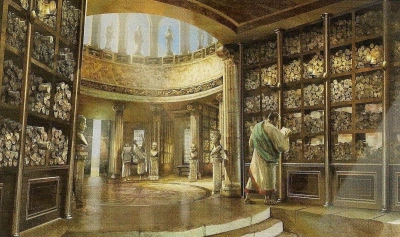
Diodorus of Sicily describes the tomb of the king the Greeks called Osymandyas at Thebes, and in it a sacred library:
Diodorus Siculus, Library of History 1.49.3 16
ἑξῆς δ᾽ ὑπάρχειν τὴν ἱερὰν βιβλιοθήκην, ἐφ᾽ ἧς ἐπιγεγράφθαι Ψυχῆς ἰατρεῖον.
"Next to this, they say, stands the sacred library, over which is written: Healing-place of the Soul."
An ἰατρεῖον is a physician's surgery, the room where wounds are dressed and bones are set. To call a library by that name is to make a claim and to mark a limit in the same 2 words. The claim: knowledge heals the soul. The limit: the library heals by knowledge, and only the soul. Nobody sets a broken leg with a scroll.
The philosophers took up the image and made it their own. Epictetus told his students that his school was a clinic in the full sense, painful as a clinic is painful:
Epictetus, Discourses 3.23.30 6
ἰατρεῖόν ἐστιν, ἄνδρες, τὸ τοῦ φιλοσόφου σχολεῖον· οὐ δεῖ ἡσθέντας ἐξελθεῖν, ἀλλ᾽ ἀλγήσαντας.
"The philosopher's school, men, is a clinic. You should leave it in pain, not in pleasure."
Cicero gave the same doctrine its Latin name: "there is, assuredly, a medicine of the soul, philosophy; and its help is not to be sought outside ourselves, as in the diseases of the body."5 The sentence draws the boundary as it states the claim. For the diseases of the body, help is sought outside: from the physician, the drug, the surgeon.
Modern psychology took the soul's medicine over directly. When Albert Ellis and Aaron Beck founded the cognitive therapies in the 20th century, both named the Stoics as their source, and both quoted the same sentence of Epictetus: "Men are disturbed not by things, but by the views which they take of them."17 The most widely practised psychotherapy of the modern world was built on a teaching of the ancient schools. The ground between the Temple and the psychologist is shared ground, and it can be stated with pride.
Plato's Timaeus adds the deeper principle, and it governs this whole teaching. The disease of the soul, Plato says, is folly, ἄνοια, and folly has 2 kinds, madness and ignorance. Then he names their causes:
Plato, Timaeus 86d to e 12
κακὸς μὲν γὰρ ἑκὼν οὐδείς, διὰ δὲ πονηρὰν ἕξιν τινὰ τοῦ σώματος καὶ ἀπαίδευτον τροφὴν ὁ κακὸς γίγνεται κακός.
"For no one is bad willingly; the bad man becomes bad through some bad condition of the body and an uneducated upbringing."
2 causes stand in 1 sentence. A bad condition of the body: illness, which the physician treats. An uneducated upbringing: immaturity, which education and psychology repair. Plato wrote both into the origin of the soul's disorders 24 centuries ago. The title of this teaching follows his sentence: psychological immaturity, mental illness and physical illness, each with its cause, each with its keeper.
Ὁ θεὸς τὴν ἰατρικὴν ἔδωκεν· ὁ μὴ χρώμενος αὐτῇ τὴν δόσιν ἀτιμάζει.
The God gave medicine. Whoever refuses to use it dishonours the gift.

Knowledge, reflection and the company of a teacher: the sacred library as a healing-place of the soul.
Catharsis: What the Practice Brings Up
Every serious practice turns attention inward, quiets the noise that usually covers the inner life, and loosens the defences a person has built over a lifetime. That is its purpose and its power. It is also why the practice brings things up. Memories return that had not been thought of in years. Grief that was never finished rises and asks to be finished. Anger at a parent, a teacher, a former partner appears with its original heat. Fear, shame and old images arrive in the body as tension, trembling, tears or heat. Meditation, prayer, ritual and theurgy all do this, and the more powerful the practice, the more it does it.
The Greeks had a name for the process: κάθαρσις, purification, the clearing out of what clogs the soul. Aristotle observed it in the worship of the Gods, where people overcome by sacred frenzy are restored by the sacred melodies:
Aristotle, Politics 8, 1342a 18
ἐκ τῶν δ᾽ ἱερῶν μελῶν ὁρῶμεν τούτους, ὅταν χρήσωνται τοῖς ἐξοργιάζουσι τὴν ψυχὴν μέλεσι, καθισταμένους ὥσπερ ἰατρείας τυχόντας καὶ καθάρσεως·
"We see these people, when they have used the melodies that rouse the soul to frenzy, being settled by the sacred melodies, as if they had received healing and purification."
He used the same word for what tragedy does to pity and fear, bringing them up and carrying them through to their purification.19 Plato called the testing of a soul by question and refutation "the greatest and most sovereign of purifications," because it clears out the false opinions that block learning.20 The Pythagoreans gave each evening its review: "Where have I gone wrong? What have I done? What duty have I left undone?"21 Each of these is a catharsis, and each brings something up in order to clear it.
The healthy course of catharsis has 4 steps. What surfaces is allowed to surface. It is felt, without flight and without drowning. It is understood: named, placed in its history, judged by reason. And it is integrated: the memory remains, its power to command the present is gone. Epictetus warned that this hurts: the student leaves the clinic "in pain, not in pleasure."6 Pain on that road is normal. It's the pain of a muscle working, and it passes.
The same word has been misused in the modern world, and the misuse must be cleared away. Venting anger by shouting, striking objects or rehearsing the offence misuses the word. In a controlled experiment, people who hit a punching bag while thinking about the person who had angered them became angrier and more aggressive than people who did nothing at all.22 Ancient catharsis clears a passion by bringing it under understanding and order. Venting feeds it. The Temple's doctrine on the passions is the ancient one: anger, hatred, envy and desire are forces to be acknowledged, understood, brought under reason and mastered, and none of them is to be denied.23
Catharsis also has a shadow, and modern research has measured it. A systematic review of meditation studies found adverse events in about 8.3% of participants; the most common were anxiety, depression and disturbances of thinking.24 A study of Western practitioners described 59 kinds of meditation-related experience across 7 domains, from the very pleasant to the very distressing, and among them the re-experiencing of traumatic memories.25 Clinicians who work at this border now teach a trauma-sensitive way of practising, because for a person carrying trauma, turning attention inward can pull the person back into the trauma instead of through it.26
These findings measure the power of the practice, and power needs measure. The Bhagavad Gītā set the measure in 2 verses that every Zevist should know by heart:
Bhagavad Gītā 6.16 to 17 27
nātyaśnatas tu yogo 'sti na caikāntam anaśnataḥ, na cātisvapnaśīlasya jāgrato naiva cārjuna. yuktāhāravihārasya yuktaceṣṭasya karmasu, yuktasvapnāvabodhasya yogo bhavati duḥkhahā.
"Yoga is not for the one who eats too much, nor for the one who does not eat at all; not for the one who sleeps too much, nor for the one who stays awake, Arjuna. For the one who is measured in food and recreation, measured in his efforts at work, measured in sleep and in waking, yoga becomes the destroyer of sorrow."
The measure is a medical fact as well as a spiritual counsel. Loss of sleep is one of the most reliable triggers of mania in people prone to bipolar disorder.28 Long fasts, nights without sleep and marathon sessions of intensive practice can tip a vulnerable mind over an edge it did not know was there. The Temple's practices are given in measure, and they are to be practised in measure.
Psychiatry itself has made room for this border. Since 1994 its diagnostic manual has carried a category called "Religious or Spiritual Problem": a distressing experience such as the loss or questioning of faith, or a problem connected with a spiritual path, which can be a focus of clinical attention without being a mental disorder.29 Researchers have described "spiritual emergency," a crisis that arises in the course of spiritual transformation.30 A spiritual difficulty is a difficulty. It becomes a medical matter when it crosses the line that the next section draws.
Catharsis
Κάθαρσις. The practice stills the surface, and what lay at the bottom rises. Most of it is meant to rise, be seen and be cleared. Some of it needs another hand.Ὃ ἐν τῇ σιγῇ ἀνέρχεται, ἄγγελός ἐστι θεραπείας δεόμενος.
What rises in the silence is a messenger asking to be tended.

The Line: Where Spirituality Resolves and Where the Clinician Must Step In
The Egyptian surgeons drew their line in writing. The Edwin Smith Papyrus, a manual of 48 cases of injury that works through the body from the head down, ends each diagnosis with a verdict in 1 of 3 forms: "an ailment which I will treat," "an ailment with which I will contend," or "an ailment not to be treated."10 A physician who knows the limit of his art is a good physician. A priest who knows the limit of his is a good priest.
The line between what the practice resolves and what needs a clinician is drawn by 6 tests. They apply to what the practice brings up and to every trouble a Zevist brings to it.
Duration. A wave of grief, anger or fear that rises in practice and settles within hours or days belongs to the practice. A state that holds for weeks, and does not lift with rest, measure and support, has become something else.
Intensity. Discomfort that can be felt and held belongs to the practice. A flood that overwhelms, that cannot be held even with help, belongs to a clinician.
Function. When sleep, work, study, eating and the ordinary care of oneself and others go on, the trouble is within reach of the soul's medicine. When they break down, the trouble has reached the body and the brain.
Safety. Any thought of ending one's life, any plan, any intention to harm oneself or another person, is past the line at once. It goes to emergency care the same day.
Contact with reality. Visions and voices have a place in the history of religion. When a person can no longer tell a dream, a vision or an inner image from the shared world; when voices command; when ordinary events seem to be secret messages about oneself; when sleep disappears and grandeur grows, the brain is ill, and the physician leads.
Direction. A trouble that is slowly improving under practice is in good hands. A trouble that is worsening week by week, despite practice, is in the wrong hands, or in too few.
The 6 tests give the following map:
| What Surfaces | Within the Practice | A Psychologist | A Psychiatrist or Emergency Care |
|---|---|---|---|
| Memories and grief | Old memories rise, are felt and settle; grief comes in waves and eases. | Memories return as intrusive flashbacks, nightmares, numbness; grief freezes for many months; a trauma keeps replaying. | Flashbacks with dissociation or loss of control; grief with thoughts of joining the dead. |
| Anger and resentment | Anger at old injuries appears, is understood and loses its grip. | Rage that does not subside; anger turned on oneself; hatred that organizes a life. | Violence, threats, or impulses to harm someone. |
| Fear and anxiety | Unease during practice that passes with grounding and rest. | Panic attacks, phobias, constant worry, fear of practising at all. | Panic with chest pain or fainting (the heart must be checked); terror that will not lift. |
| Mood | Low days after hard catharsis that pass. | Low mood most days for 2 weeks or more; loss of pleasure; withdrawal. | Hopelessness, no reason to live, inability to eat or sleep; or the opposite: days without sleep, racing thoughts, grand plans. |
| Unusual experiences | Light, warmth, energy, dream images, a sense of presence, held with calm and judgment. | Experiences that frighten and disturb, without loss of reality. | Commanding voices, fixed beliefs of persecution or chosen-ness, inability to tell inner from outer. |
| Guilt and scruples | Conscience that prompts amends and then rests. | Endless checking of whether a rite was done right; compulsive prayers; fear of having offended the Gods. | Guilt with thoughts of punishment or self-harm. |
| Thoughts of death | Reflection on mortality and the afterlife, as the philosophers practised it. | Frequent thoughts that life is not worth living. | Any wish to die, any plan: emergency care the same day. |
The warning signs that someone may be thinking of suicide are published by the health services, and every Zevist should know them: talk of wanting to die, of great guilt or shame, of being a burden to others; feeling empty, hopeless, trapped or without reason to live; extreme sadness, anxiety, agitation or rage; unbearable pain; making a plan; withdrawing from friends, saying goodbye, giving away important things; taking dangerous risks; extreme mood swings; eating or sleeping much more or much less; using drugs or alcohol more often. If these signs apply to you or to someone you know, get help as soon as possible, above all if the behaviour is new or has increased.31 The panel at the head and foot of this teaching is there for that moment.
Γνῶθι σαυτὸν καὶ τὸ μέτρον τῆς σῆς τέχνης.
Know yourself, and the measure of your own art.
Psychological Immaturity: The Untreated Wound Carried Into the Practice
A human being enters the Temple with a history. The child who learned trust or mistrust in the first years, the youth who was given or denied responsibility, the adult who finished or abandoned the tasks of growing up: all of them walk in together. The Temple's teaching on parenting sets out the foundations that each stage of childhood lays: the inner emotional foundation in the first years, the shaping of the will, the beginning and the testing of the intellect, the training of the adult.32 When a foundation was never laid, the adult carries the gap, and the gap does not stay outside the sanctuary.
Psychological immaturity is the name this teaching gives to those unfinished tasks, and the name carries no blame. Plato named its cause in the same spirit: the bad man becomes bad through "an uneducated upbringing," and no one is bad willingly.12 A Zevist who finds an unfinished task in himself has found work, and the work can be done at any age. The danger lies in leaving it undone, because an untreated pattern of the mind carries itself into the practice and bends the practice to its own shape.
The mechanism. Psychology has studied how this happens. The psychoanalyst Ana-María Rizzuto found that the image a person forms of the divine is built in part from the images of the parents and the other figures of early life.33 Research on attachment found 2 pathways: some people's bond with the divine corresponds to a secure bond they had with caring parents; others turn to the divine to compensate for a bond that failed them, and for some of them the divine becomes the secure base they never had.34 The finding cuts both ways. A soul can carry its parents' faults into its picture of the Gods, and a soul can also find in the Gods the repair of what its parents broke. Which way it goes depends largely on whether the wound is seen and tended.
The patterns below are the common ones. Each shows how a flaw of the mind enters the practice, and who tends it.
| The Pattern | In Daily Life | Carried Into the Practice | Who Tends It |
|---|---|---|---|
| Hatred or fear of a parent | Conflict with every authority; expecting to be controlled, punished or abandoned. | Zeus, the Father of Gods and men, seen through the face of a hard father; the Gods feared, resented or rejected. | The Temple and a psychologist together. |
| Dependency | Waiting for others to decide, provide, rescue. | The Gods treated as servants who must do the work; prayer instead of effort. | Ethics and practice; a psychologist when the pattern is deep. |
| Grandiosity | Inflated self-image; contempt for others; rage at criticism. | Claims of rank, powers or chosen-ness without the climb; hubris. | Ethics and the Temple's teaching; a clinician when it reaches delusion or mania. |
| Envy and resentment | Measuring oneself against others; bitterness at their success. | Resentment of other Zevists and of the favour the Gods show them. | Ethics and practice. |
| Victimhood | Every trouble caused by others; complaint instead of action. | The Gods blamed for one's lot; the practice used to rehearse grievance. | Ethics and practice; a psychologist when a real trauma lies beneath it. |
| Scruples and guilt | Fear of mistakes; endless checking. | Fear of having offended the Gods; rites repeated compulsively. | A psychologist; a psychiatrist when it becomes obsessive-compulsive disorder. |
| Suspicion | Others seen as hostile; slights everywhere. | Every misfortune read as a curse, an attack, the evil eye. | A psychologist; a psychiatrist when it hardens into paranoia. |
| Avoidance | Fleeing feelings, conflicts and tasks. | Practice used to rise above what should be faced; spiritual bypassing. | The Temple and a psychologist together. |
The 2 cases that matter most deserve a full account.
When hatred of the parents becomes hatred of the Gods. Zeus is the Father of Gods and men, and the Temple teaches that human beings are the children of the Gods.11 For a soul whose father was cruel, absent or contemptuous, that teaching is hard to hear. The word "father" carries the old injury, and the soul transfers it: Zeus becomes a severe judge waiting to punish, the Gods become distant authorities who do not care, and worship becomes either servile fear or open rebellion. Neither is worship. The soul is relating to its own childhood and calling it the Gods. The repair has 2 sides. On the Temple's side, the teaching itself corrects the image: Zeus is the Sovereign of an ordered cosmos, the giver of justice and the guardian of the guest, and the Gods lead those who seek them. On the psychologist's side, the old wound is named, felt and worked through, so that the parent's face can be taken off the God's. When both sides work, the research's second pathway opens: the Gods become the secure base the parents never were.
When dependency becomes waiting for the Gods. A soul that learned to wait for others to rescue it will wait for the Gods in the same way. It prays for the job without applying, for health without changing its habits, for wisdom without study. The research on religious coping distinguishes a style that defers everything to God and waits passively, a style that relies on the self alone, and a style in which the person and the divine work together; the deferring style goes with lower personal control, self-esteem and competence.35 The Greeks told the same truth as a fable. A waggoner's cart sank in a ditch, and he stood by it doing nothing and praying to Heracles. The God appeared and said:
Babrius, Fables 20 36
τῶν τροχῶν ἅπτου καὶ τοὺς βόας κέντριζε. τοῖς θεοῖς δ᾽ εὔχου, ὅταν τι ποιῇς καὐτός, ἢ μάτην εὔξῃ.
"Take hold of the wheels and goad the oxen. Pray to the Gods when you are doing something yourself, or you will pray in vain."
Aeschylus put the same law in a line: "when a man hastens of himself, the God too joins in."37 The Temple's teaching on Theosis gives the pious works the first weight among the 4 hands of the Work, because the Gods give nothing good to men without toil.13 Dependency carried into the practice turns this law upside down, and the practice stops working. The repair is ethical first: responsibility taken up in small things, then larger ones. Where the pattern is deep and old, a psychologist helps to find where it began.
The other patterns. Grandiosity carried into the practice becomes hubris, the claim without the climb, and the Temple's teaching on Hubris and Izfet sets out where it leads.38 Envy carried into the practice turns the community into a field of rivals.39 Victimhood carried into the practice becomes the andrapod's complaint against the Gods.40 Scruples carried into the practice turn worship into fear; research on religious coping finds that the belief in a punishing God, chronic spiritual discontent and the habit of reading misfortune as demonic attack go with more distress and poorer quality of life.41 When scrupulosity becomes compulsive, it is a recognized form of obsessive-compulsive disorder, and it is treated.42 Avoidance carried into the practice has its own modern name: spiritual bypassing, which the psychologist John Welwood described as the tendency "to use spiritual ideas and practices to sidestep or avoid facing unresolved emotional issues, psychological wounds, and unfinished developmental tasks."43
The principle. The Gods are approached by the whole person, and the whole person includes the wounds. A wound that is seen and tended stops bending the practice. A wound that is hidden behind the practice bends it more the harder one practises. Psychological maturity is the ground on which the higher work is built, and the Temple counts its repair as part of the Work.
Τὸ τραῦμα ὃ μὴ ἐθεράπευσας εἰς τὸ ἱερὸν συνεισέρχεταί σοι.
The wound you have not tended walks into the sanctuary with you.
Ὁ θεὸς τὴν χεῖρα δίδωσι τῷ τὸν ὦμον τῷ τροχῷ προσβάλλοντι.
The God gives his hand to the one who sets his shoulder to the wheel.

An old wound is met with understanding and care, so that it no longer shapes every encounter with the world or the Gods.
Mental Illness: Where the Physician Leads
Psychological immaturity is a gap in development, and much of it yields to education, ethics, practice and psychotherapy. Mental illness is disease. It involves the brain and the nervous system, it has causes in heredity, in the body and in what life has done to a person, and it is treated by medicine and by specialized therapy. The Temple's hand stays on the shoulder of the ill Zevist; the physician's hand leads.
The Ancients drew this line before anyone else. The Hippocratic treatise On the Sacred Disease opens with a declaration of principle about epilepsy, the disease of the brain that the people of its age called sacred:
Hippocrates, On the Sacred Disease 1 9
Περὶ μὲν τῆς ἱερῆς νούσου καλεομένης ὧδ᾽ ἔχει· οὐδέν τί μοι δοκέει τῶν ἄλλων θειοτέρη εἶναι νούσων οὐδὲ ἱερωτέρη, ἀλλὰ φύσιν μὲν ἔχει ἣν καὶ τὰ λοιπὰ νουσήματα, ὅθεν γίνεται.
"About the disease that is called sacred, the truth is this: it seems to me no more divine and no more sacred than the other diseases, but it has a nature, like the other diseases, from which it arises."
The author names the men who first called it sacred: "magicians, purifiers, begging priests and charlatans, who pretend to be very pious and to know something more."9 He ends with the rule that holds for every disease: "each has its own nature and power, and none is beyond resource or treatment."9 Greece was a deeply religious civilization, and its physicians said this in the name of the Gods' order, never against it. A disease has a nature, and the nature is what the physician treats.
Ancient India drew the same line inside its own medicine. The Caraka Saṃhitā counts 5 kinds of madness, unmāda: 4 arise from disorders of the body's humours, and 1, the exogenous kind, is ascribed to the Gods, the sages, the ancestors and the spirits.44 Even for that kind the physician's treatment joined the therapy of the Gods with drugs, and the text assigns its root to the patient's own error of judgment. Al-Razi, physician of Rayy and Baghdad, whom the Temple counts among its personalities, set up a ward for the mentally ill and treated their disorders as medical conditions rather than supernatural afflictions.45 The line runs straight from Hippocrates through Caraka and Al-Razi to the psychiatric clinic of today.
The illnesses below are the ones a Zevist and a priest must recognize. Each can disguise itself as a spiritual state, and that disguise is the danger.
Trauma and post-traumatic stress. Trauma is a wound inflicted on the mind by an event too great for it: violence, abuse, war, disaster, loss. Post-traumatic stress keeps the event alive in flashbacks, nightmares, numbness and constant alarm; the Temple's teaching on Memory and Forgetting describes it as a fear memory that refuses to fade and replays itself.46 It is treated, and treated well: the World Health Organization recommends trauma-focused cognitive therapy and EMDR.47 Meditation can bring traumatic memory to the surface without resolving it, which is why trauma calls for a trained therapist alongside the practice.26 One distinction must be stated without any ambiguity. The Temple's doctrine of the andrapod describes a cultural condition: the habit of complaint and grievance among those who live in the ruins and refuse to rebuild.40 A person suffering from trauma has been wounded. The wound is to be treated, and the person is owed care and respect. No reader of the Temple's teachings is to take the doctrine of the andrapod as a judgment on anyone who carries trauma, and no Zevist is to use it as one.
Depression. Major depression is more than sadness. It is low mood or loss of pleasure on most days for 2 weeks or more, with changes in sleep, appetite, energy and concentration, often with guilt and thoughts of death. In a religious person it can wear religious clothing: the "dark night," the sense that the Gods have withdrawn, the conviction of being unworthy of them. The Temple's word to the depressed Zevist is plain: the Gods are where they were; the brain is ill; see a physician, and keep praying while you do.
Bipolar disorder. In bipolar disorder, periods of depression alternate with periods of mania: little need for sleep, racing thoughts, great energy, inflated self-esteem, reckless action. Mania can look like spiritual awakening from the inside. The person feels chosen, full of power, in contact with the divine, gifted with a mission. Loss of sleep, through intensive practice or long vigils, can set it off.28 A Zevist who has not slept for days and feels that the Gods have chosen him for a great work needs a psychiatrist before anything else.
Psychosis. In psychosis the mind loses its hold on the shared world: hallucinations, voices, fixed false beliefs. Religious content is common: studies find religious themes in the delusions of roughly 20% to 60% of patients with delusions, depending on the place and the illness.48 For this reason no priest of the Temple ever interprets the voices or visions of a person in psychosis as revelation, and no Zevist encourages a person in that state to deepen the practice. Psychosis is treated, often with full recovery, and the Temple welcomes the recovered Zevist back to the full practice under medical advice.
Addiction. Dependence on alcohol, drugs or behaviours that has taken control of a life is a disease of the brain's systems of reward and will. It also has a spiritual dimension, and the practice helps the recovering Zevist rebuild self-mastery. The practice does not detoxify a body. Withdrawal from some substances is medically dangerous, and it is managed by physicians.
Eating disorders. Anorexia, bulimia and related disorders are among the most dangerous mental illnesses for the body. They can hide behind spiritual fasting and purity. A Zevist with a history of disordered eating does not fast for spiritual reasons without medical approval, and a priest who sees fasting turning into self-starvation speaks up.
Obsessive-compulsive disorder. When fear of impurity, of error in a rite or of having offended the Gods drives endless repetition and checking, it is the religious form of a known illness, called scrupulosity, and it responds to treatment.42 More ritual feeds it. The Temple's rites are given once, done well, and left in the hands of the Gods.
Suicidal thoughts. Any thought of ending one's life is an emergency. The Temple's teaching on this is one sentence long: call for help today, as the panel at the head and foot of this page says.
Spiritual readings of illness. The Temple teaches practices for the soul's protection, and they have their place. A spiritual reading of distress never replaces a diagnosis. When symptoms of illness appear, they go to a physician first; whatever rite accompanies the treatment is added to it, and never put in its place. The purifiers whom the Hippocratic author exposed covered their ignorance with piety. The Temple of Zeus does not follow them.
Νόσος ἐγκεφάλου νόσος σώματός ἐστιν· ἰατρὸν ζήτει καὶ τοὺς θεοὺς κάλει.
A disease of the brain is a disease of the body: seek the physician, and call on the Gods.

Clinical care begins with listening, recognition and treatment. The person remains worthy of respect throughout.
Physical Illness: The Body Is Healed by Material Means
The rule for the body is beyond any doubt. A broken limb, a wound, a burn, a heart attack, a stroke, an infection, a car accident: these go to the physician and the emergency department, at once. A Zevist prays as well, and the prayer goes with the patient into the ambulance. Nobody prays instead.
The Greeks wrote this into their religion. Socrates, the most pious of the philosophers, taught that the Gods have given men certain things to learn and others to ask of them:
Xenophon, Memorabilia 1.1.9 49
ἔφη δὲ δεῖν, ἃ μὲν μαθόντας ποιεῖν ἔδωκαν οἱ θεοί, μανθάνειν, ἃ δὲ μὴ δῆλα τοῖς ἀνθρώποις ἐστί, πειρᾶσθαι διὰ μαντικῆς παρὰ τῶν θεῶν πυνθάνεσθαι·
"He said that what the Gods have granted us to do by learning, we must learn; and what is not clear to men, we should try to find out from the Gods by divination."
Socrates gave examples: whether to hire a skilled driver or an unskilled one, a skilled helmsman or an unskilled one, and whatever can be known by counting, measuring or weighing. To ask the Gods about such things, he held, was impious.49 Medicine is the plainest case of what the Gods have given men to learn. To pray over a fracture and refuse the surgeon is to ask the Gods for what they have already given.
The Greeks' God of healing practised medicine. Pindar describes Asclepius at work: "some he tended with gentle incantations, some with soothing drinks, or he wrapped their limbs all round with remedies, and others he set upright by the knife."8 Incantation, drug, salve and surgery: the God used all 4, and he chose by the case. Plato's Socrates says Asclepius gave medicine to those who were healthy by nature and habit but carried a particular disease.50 Asclepius was the patron of physicians, and his great sanctuaries at Epidaurus, Kos and Pergamon stood beside the medical schools of the ancient world.51 Galen, the greatest physician of antiquity, served Asclepius and wrote a treatise to prove that the best physician is also a philosopher.52 The worship of the God of healing and the practice of medicine were 1 tradition.
Egypt kept the same unity. Homer says that in Egypt "every man is a physician, skilled beyond all men."53 The Egyptian swnw, the physician, worked beside the priests of Sekhmet and the magicians, and the Ebers Papyrus sets incantations beside hundreds of prescriptions.7 The Edwin Smith Papyrus, the oldest surgical treatise in the world, treats broken skulls, dislocated jaws and wounds of the neck by examination, diagnosis and splint, and resorts to a spell in only 1 of its 48 cases.10
The Temple's own doctrine on the body agrees. Physical health does not by itself change a soul's spiritual trajectory, and it is still an important condition of a good life: the fewer the troubles from the body, the better the soul is upheld, and the Temple's training aims at healthy individuals.54 A Zevist keeps the body by exercise, food, sleep and measure, and repairs it by medicine when it breaks.
Ὁ ἰατρὸς τὸ σῶμα σῴζει, ὁ λόγος τὴν ψυχήν, ὁ δὲ Ζεὺς τὸν ὅλον ἄνθρωπον.
The physician saves the body, reason the soul, and Zeus the whole human being.

The work of recovery joins treatment, patient effort and the support of those who accompany us.
How Spirituality Can Harm
Anything strong enough to heal is strong enough to harm when it is misused. The Temple names the misuses so that no Zevist falls into them.
Spiritual bypassing. Using practice to rise above what should be faced: grief not grieved, anger not understood, a conflict not resolved, a task of growing up not done. The practice becomes an escape, and the escape is mistaken for progress.43
Denial. "The Gods will heal me." "I'm beyond this." "A real initiate doesn't need a therapist." Each of these sentences keeps a sick person away from the help the Gods have placed within reach. Denial dressed as faith is still denial, and the Hippocratic author had a name for those who encourage it.9
Symptoms read as curses. Insomnia, voices, panic, exhaustion, sudden changes of mood or memory read as the evil eye, black magic or spiritual attack, and treated only by rite. The rite may have its place beside treatment. Read in place of a diagnosis, it delays the treatment that the symptoms need, sometimes past the point of easy recovery.
Stopping treatment on spiritual grounds. No Zevist stops a prescribed medicine because of a spiritual conviction, a practice or the advice of anyone without medical training. Some medicines, antidepressants among them, are dangerous to stop suddenly; the public health services instruct patients never to stop them without the prescriber and to reduce them gradually under a plan.55 A Zevist who wants to reduce or stop a medicine discusses it with the physician who prescribed it.
Intensive practice in a fragile state. Long fasts, nights without sleep, prolonged retreats, breath practices that alter consciousness strongly, and the more forceful energy practices such as the raising of Kundalini can push a vulnerable mind into crisis.28, 24 During an episode of mental illness, in the months after one, and whenever a clinician advises it, these practices are paused.
Isolation. A practice that draws a person away from family, friends, work and ordinary life, until the Temple or the practice is all that remains, is unhealthy whatever its content. The Zevist path runs through the world. Ties to family and friends are part of a healthy life, and their loss is a warning sign.31
Secrecy with the clinician. The Temple's guidance on legal rights advises members held in custody to keep their answers to official examiners simple, because unfamiliar religious experience can be misread in that setting.56 That advice belongs to custody alone. In a clinic of one's own choosing, the opposite holds. Tell your physician and your therapist what matters, including your practice, your experiences in it and what you are doing. Look for a clinician who respects religion; many do, and psychiatry's own manual recognizes religious and spiritual problems as distinct from mental disorder.29
Practice Alongside Treatment
A Zevist in treatment keeps the Temple. The worship of Zeus and the Gods continues; it is often the strength that carries a person through treatment. Prayer, study, ethics and the company of the community continue. The gentler meditations continue, with attention to what they bring up, and with the clinician informed. Physical exercise continues within medical advice.
The practices that pause are the intensive ones named above: fasting, vigils, prolonged retreats, strong breath work and the forceful energy practices. They pause during an episode of illness, in the time of recovery, and whenever the treating clinician advises. They resume when the physician agrees, in measure, and with the Gītā's rule kept: measured food, measured effort, measured sleep and waking.27
The Ancients practised in this way. The sick who came to the sanctuaries of Asclepius slept in the sacred hall and prayed for a healing dream, and the same sanctuaries stood beside physicians, baths, gymnasia and regimens of diet and exercise.51 The patient worshipped the God and followed the treatment, and saw no contradiction between them, because there was none.
Disclosure in Confidence
The Temple recommends 1 course to the Zevist who carries a legitimate mental health condition: private disclosure to the clergy, under strict confidentiality.
Why the Temple recommends it. Disclosure serves 2 ends. It protects the individual: a priest who knows of a condition can adapt the practice to it, advise when an intensive practice should wait, recognize the early signs of a crisis and know whom to call. And it allows the proper care of the community: rites, retreats, roles and responsibilities can be arranged so that no one is placed under a strain that the condition makes dangerous, and the community can support its member knowingly.
The decision belongs to the individual. Disclosure is a recommendation, never a requirement. No membership, rank, initiation or role in the Temple depends on it. Each Zevist decides whether to disclose, what to disclose, to whom and when, and may decline without explanation and without consequence.
The matter remains private at its core. What is disclosed is held by the priest who receives it. It is not discussed in the community, not shared with other members, and neither written down nor passed to anyone without the person's consent. The single exception is the one every healer has always kept: when a life is in immediate danger, the duty to that life comes first.
The healers of antiquity swore to this silence. The Hippocratic Oath binds the physician:
The Hippocratic Oath 57
ἃ δ᾽ ἂν ἐν θεραπείῃ ἢ ἴδω ἢ ἀκούσω, ἢ καὶ ἄνευ θεραπείης κατὰ βίον ἀνθρώπων, ἃ μὴ χρή ποτε ἐκλαλεῖσθαι ἔξω, σιγήσομαι, ἄρρητα ἡγεύμενος εἶναι τὰ τοιαῦτα.
"Whatever I see or hear in the course of treatment, or even outside treatment, in the life of men, which ought never to be spread abroad, I will keep silent, holding such things to be unspeakable."
The clergy of the Temple keep the same silence over what is entrusted to them.
Disclosure in confidence
What is entrusted in confidence is received with dignity, attention and care.The Duty of the Clergy
The priests of the Temple carry a particular responsibility, because a person in distress often comes to a priest before a physician. The duty of the clergy has 6 parts.
They do not diagnose. A priest does not tell anyone that a symptom is spiritual, or that it is not medical. The priest listens, and when a sign from the table of the line appears, the priest sends the person to a clinician.
They do not prescribe or withdraw treatment. No priest advises anyone to stop a medicine, to refuse a therapy or to replace treatment with rite.
They refer. Every priest knows the local emergency number, the crisis lines and the clinicians of the area, and gives them freely.
They keep confidence, and they know its limit. What is said to a priest stays with the priest, as the section on disclosure sets out. When a life is in danger, the duty to the life comes first, and the priest calls for help.
They accompany. A Zevist with a diagnosis, or in treatment, remains a full member of the Temple and is treated without stigma. The priest prays with and for the person, keeps the person in the community, and welcomes the person back to the full practice when the physician agrees.
They know their measure. The Egyptian surgeon wrote "an ailment not to be treated" when the case was beyond his art.10 A priest who meets a case beyond the art of the priesthood says so, and hands it to those whose art it is.
Objections and Replies
Objection I: "Psychiatry pathologizes spiritual experience. A Zevist should keep away from it."
The record contradicts the charge. Since 1994 the manual of American psychiatry has recognized religious and spiritual problems as a focus of care distinct from mental disorder, precisely so that spiritual experience would not be mistaken for illness.29 The most widely used psychotherapy of the modern world traces its principle to Epictetus.17 Where a clinician is hostile to religion, the remedy is a different clinician. To refuse medicine altogether because some physicians misunderstand religion is to refuse Asclepius because some men misunderstand the Gods.
Objection II: "Seeking therapy shows a lack of faith."
Socrates held that to ask the Gods about what they have given men to learn is impious.49 Heracles told the praying waggoner to put his hands to the wheels.36 The God of healing used drugs and the knife.8 Faith in the Gods includes faith in the arts the Gods have given, and medicine is foremost among them. A Zevist who goes to a physician acts on the Gods' gift, and the act is itself worship.
Objection III: "My suffering is spiritual, so only spiritual work can heal it."
Plato placed the soul's disorders in 2 causes: a bad condition of the body and an uneducated upbringing.12 Ancient India's medicine assigned 3 therapies to every illness and let none stand alone.3 A suffering that feels spiritual may have its seat in the body, the brain or an old wound, and it may have a spiritual dimension at the same time. The Temple's answer is to bring every hand that the trouble requires. The soul is served best when the body and the mind are served too.
Objection IV: "The practice is meant to purify. If it hurts, I should push through."
Epictetus said the student leaves the clinic in pain, and the pain of honest work is part of the path.6 The tests of the line separate that pain from harm. Pain that rises, is held and passes is the pain of growth. Pain that floods, lasts for weeks, breaks sleep and daily life, or brings thoughts of death is a signal to stop and call another hand. The Gītā gives the measure: yoga destroys sorrow for the one who is measured in food, effort, sleep and waking, and for no one else.27 Pushing through harm is the hubris of the practitioner who refuses the limits of his own art.38
Objection V: "If the Temple learns of my condition, I will be judged or held back."
The Temple holds no stigma against any illness, and a diagnosis is never grounds for exclusion or lowered standing. Disclosure is the person's own decision, it is held in strict confidence, and it is recommended for 1 reason: so that the person can be protected and the practice fitted to the person's needs. A Zevist who has named a condition and manages it has shown the self-knowledge that Delphi commands.15 The Temple counts that as strength.
Conclusion: The Whole Healing
The Temple of Zeus is a healing-place of the soul. Its worship, ethics, meditation, theurgy and community give meaning, strength and measure, and they heal what the soul's medicine can heal. The Temple claims that ground without apology, and it holds its limit without hesitation.
The Temple holds no stigma against any illness. It honours the Zevist who has named a condition and manages it, because that awareness is the beginning of healing the self. It recommends private disclosure to the clergy under strict confidentiality, for the protection of the person and the care of the community, and it leaves the decision with the person, whose health remains a private matter at its core.
The limit is old. Diodorus's library healed the soul by knowledge. Asclepius healed with incantation, drug and knife. The Hippocratic physician refused to call a disease of the brain sacred. Caraka counted 3 therapies and gave none of them the field alone. Plato traced the soul's disorders to the body and to upbringing, and Socrates counted medicine among the things the Gods give men to learn.
From that limit the rules follow. The practice brings up what lies in the depths, and most of it is meant to rise and be cleared; what crosses the line of duration, intensity, function, safety, reality or direction goes to the psychologist or the psychiatrist. A wound left untreated walks into the sanctuary and puts the face of an old injury on the Gods; it is tended until the Gods can be seen as they are. Mental illness is disease, and the physician leads while the Temple accompanies. The body is healed by material means, and the prayer goes with the patient to the emergency department.
Plato's Thracian physician taught that the whole must be healed for any part to be well.4 That is the Zevist doctrine of healing. The soul, the mind and the body are 1 human being, and each has its physician. The Temple keeps its own art, honours the arts of the others, and sends its people to them without hesitation, because the Gods who gave the soul its medicine gave the body its medicine too.
Plato, Charmides 157a 4
θεραπεύεσθαι δὲ τὴν ψυχὴν ἔφη, ὦ μακάριε, ἐπῳδαῖς τισιν, τὰς δ᾽ ἐπῳδὰς ταύτας τοὺς λόγους εἶναι τοὺς καλούς· ἐκ δὲ τῶν τοιούτων λόγων ἐν ταῖς ψυχαῖς σωφροσύνην ἐγγίγνεσθαι.
"The soul, he said, my friend, is treated with certain incantations, and these incantations are fair words; and from such words sound-mindedness arises in souls."
Ὁ ναὸς τὴν ψυχὴν ἰᾶται, ὁ ἰατρὸς τὸ σῶμα, οἱ δὲ θεοὶ ἀμφότερα.
The temple heals the soul, the physician the body, and the Gods both.


The soul, the mind and the body belong to one human life. Healing returns that life to its work, its company and its purpose.
If a Life Is in Danger Now
Call your local emergency number.
Find A Helpline (findahelpline.com) lists free, confidential crisis lines in more than 175 countries.
High Priest Zevios Metathronos
Temple of Zeus Foundation
Sources & References
- H. G. Koenig, "Religion, Spirituality, and Health: The Research and Clinical Implications," ISRN Psychiatry 2012, article 278730, a review of the research on religious and spiritual involvement and mental and physical health.
- Temple of Zeus, Legal Notice, 7.2: nothing on the website constitutes medical, psychological or other regulated professional advice, and nothing creates a physician-patient or therapist-client relationship; 7.3: the website is not an emergency service.
- Caraka Saṃhitā, Sūtrasthāna 11.54: trividham auṣadham iti daivavyapāśrayaṃ, yuktivyapāśrayaṃ, sattvāvajayaś ca. The therapy resting on the Gods is mantra, herbs and gems worn, auspicious acts, offerings, gifts, oblations into the fire, vows, expiations, fasting, blessings, prostration and pilgrimage; the rational therapy is the reasoned combination of diet and drugs; sattvāvajaya is the restraint of the mind from harmful objects. Sūtrasthāna 11.45: diseases are of 3 kinds, endogenous, exogenous and mental. Text as edited by Y. T. Acharya (Trikamji), consulted at carakasamhitaonline.com.
- Plato, Charmides 156e to 157a: everything, good and bad, flows to the body and the whole human being from the soul, so the soul must be treated "first and most"; the soul is treated with incantations, which are "fair words," and from them σωφροσύνη arises. Ed. J. Burnet, Oxford Classical Texts, 1903.
- Cicero, Tusculan Disputations 3.6: est profecto animi medicina, philosophia; cuius auxilium non ut in corporis morbis petendum est foris, omnibusque opibus viribus, ut nosmet ipsi nobis mederi possimus, elaborandum est. Ed. M. Pohlenz, Teubner, 1918.
- Epictetus, Discourses 3.23.30: ἰατρεῖόν ἐστιν, ἄνδρες, τὸ τοῦ φιλοσόφου σχολεῖον· οὐ δεῖ ἡσθέντας ἐξελθεῖν, ἀλλ᾽ ἀλγήσαντας. Ed. H. Schenkl, Teubner, 1916.
- J. F. Nunn, Ancient Egyptian Medicine, London, 1996: the physician (swnw), the wab-priests of Sekhmet and the magician (sau) as overlapping healers; the Ebers Papyrus (c. 1550 BCE), whose hundreds of remedies stand beside incantations, and whose section on the heart includes conditions of mood and mind. See also the Temple's page Sekhmet.
- Pindar, Pythian 3.47 to 53: Asclepius tended some "with gentle incantations" (μαλακαῖς ἐπαοιδαῖς), some with soothing drinks, wrapped the limbs of others with remedies (φάρμακα), "and others he set upright by the knife" (τοὺς δὲ τομαῖς ἔστασεν ὀρθούς). Ed. J. Sandys, Loeb, 1937.
- Hippocrates, On the Sacred Disease, ed. É. Littré, Œuvres complètes d'Hippocrate 6, Paris, 1849. Ch. 1: Περὶ μὲν τῆς ἱερῆς νούσου καλεομένης ὧδ᾽ ἔχει· οὐδέν τί μοι δοκέει τῶν ἄλλων θειοτέρη εἶναι νούσων οὐδὲ ἱερωτέρη, ἀλλὰ φύσιν μὲν ἔχει ἣν καὶ τὰ λοιπὰ νουσήματα, ὅθεν γίνεται; those who first called it sacred were μάγοι τε καὶ καθαρταὶ καὶ ἀγύρται καὶ ἀλαζόνες, "who pretend to be very pious and to know something more." Ch. 18 (ch. 21 in the Loeb of W. H. S. Jones): φύσιν δὲ ἔχει ἕκαστον καὶ δύναμιν ἐφ᾽ ἑωυτοῦ, καὶ οὐδὲν ἄπορόν ἐστιν οὐδὲ ἀμήχανον.
- J. H. Breasted, The Edwin Smith Surgical Papyrus, 2 vols., Oriental Institute Publications 3 and 4, Chicago, 1930: 48 cases, from the head downward; the 3 verdicts "an ailment which I will treat," "an ailment with which I will contend," "an ailment not to be treated" (Breasted: favourable, uncertain, unfavourable); resort to magic "in only one case out of the forty-eight cases preserved"; the verso, in a later section, carries incantations against pestilence and a recipe for rejuvenation.
- Temple of Zeus, Liturgical Terms: Theoteknia: humanity as the children of the Gods.
- Plato, Timaeus 86b: νόσον μὲν δὴ ψυχῆς ἄνοιαν συγχωρητέον, δύο δ᾽ ἀνοίας γένη, τὸ μὲν μανίαν, τὸ δὲ ἀμαθίαν; 86d to e: κακὸς μὲν γὰρ ἑκὼν οὐδείς, διὰ δὲ πονηρὰν ἕξιν τινὰ τοῦ σώματος καὶ ἀπαίδευτον τροφὴν ὁ κακὸς γίγνεται κακός. Ed. J. Burnet, Oxford Classical Texts, 1902.
- Temple of Zeus, Theosis: The Magnum Opus: the 4 hands of the Work, with the pious works first in weight, "because the Gods give nothing good or fair to men without toil" (Xenophon, Memorabilia 2.1.28).
- Apollodorus, Library 2.4.12: after the madness, Heracles is purified by Thespius, goes to Delphi, and is told by the Pythia to serve Eurystheus for 12 years and perform the labours, after which he will be immortal. Ed. J. G. Frazer, Loeb, 1921.
- Plato, Protagoras 343a to b: the Seven Sages dedicated at Delphi the sayings γνῶθι σαυτόν and μηδὲν ἄγαν; Charmides 164d to 165a: "know yourself" read as "be sound-minded"; Pausanias 10.24.1: the sayings written in the forecourt of the temple of Apollo at Delphi. Ed. J. Burnet, Oxford Classical Texts, 1903.
- Diodorus Siculus, Library of History 1.49.3, in the description of the tomb of Osymandyas at Thebes: ἑξῆς δ᾽ ὑπάρχειν τὴν ἱερὰν βιβλιοθήκην, ἐφ᾽ ἧς ἐπιγεγράφθαι Ψυχῆς ἰατρεῖον. Ed. I. Bekker, L. Dindorf and F. Vogel, Teubner, 1888.
- A. Ellis, Reason and Emotion in Psychotherapy, New York, 1962, p. 54: the principle "was originally discovered and stated by the ancient Stoic philosophers," best set forth by Epictetus: "Men are disturbed not by things, but by the views which they take of them" (Enchiridion 5). A. T. Beck, A. J. Rush, B. F. Shaw and G. Emery, Cognitive Therapy of Depression, New York, 1979, p. 8: "The philosophical origins of cognitive therapy can be traced back to the Stoic philosophers."
- Aristotle, Politics 8, 1342a: those seized by enthusiasm are settled by the sacred melodies ὥσπερ ἰατρείας τυχόντας καὶ καθάρσεως. Ed. W. D. Ross, Oxford Classical Texts, 1957.
- Aristotle, Poetics 6, 1449b27 to 28: tragedy δι᾽ ἐλέου καὶ φόβου περαίνουσα τὴν τῶν τοιούτων παθημάτων κάθαρσιν. Ed. R. Kassel, Oxford Classical Texts, 1965.
- Plato, Sophist 230d: τὸν ἔλεγχον λεκτέον ὡς ἄρα μεγίστη καὶ κυριωτάτη τῶν καθάρσεών ἐστι. Ed. J. Burnet, Oxford Classical Texts, 1900.
- Pythagorean Golden Verses 40 to 44, the evening review; line 42, πῇ παρέβην; τί δ᾽ ἔρεξα; τί μοι δέον οὐκ ἐτελέσθη;, is quoted by Diogenes Laertius 8.22. J. C. Thom, The Pythagorean Golden Verses, Leiden, 1995.
- B. J. Bushman, "Does Venting Anger Feed or Extinguish the Flame? Catharsis, Rumination, Distraction, Anger, and Aggressive Responding," Personality and Social Psychology Bulletin 28 (2002), 724 to 731: people who hit a punching bag while thinking about the person who had angered them felt angrier and were more aggressive than those in the distraction and control groups; "doing nothing at all was more effective than venting anger."
- Temple of Zeus, Black Magick and Mental Health: anger, hatred, envy and lust as forces the Gods gave, each "to be understood, brought under reason and mastered," none to be denied.
- M. Farias, E. Maraldi, K. C. Wallenkampf and G. Lucchetti, "Adverse events in meditation practices and meditation-based therapies: a systematic review," Acta Psychiatrica Scandinavica 142 (2020), 374 to 393: total prevalence of adverse events 8.3%; the most common were anxiety, depression and cognitive anomalies.
- J. R. Lindahl, N. E. Fisher, D. J. Cooper, R. K. Rosen and W. B. Britton, "The varieties of contemplative experience: A mixed-methods study of meditation-related challenges in Western Buddhists," PLOS ONE 12(5) (2017), e0176239: a taxonomy of 59 meditation-related experiences across 7 domains, ranging from very positive to very negative, including the re-experiencing of traumatic memories.
- D. A. Treleaven, Trauma-Sensitive Mindfulness: Practices for Safe and Transformative Healing, New York, 2018.
- Bhagavad Gītā 6.16 to 17: nātyaśnatas tu yogo 'sti na caikāntam anaśnataḥ, na cātisvapnaśīlasya jāgrato naiva cārjuna. yuktāhāravihārasya yuktaceṣṭasya karmasu, yuktasvapnāvabodhasya yogo bhavati duḥkhahā. Critical text, GRETIL (after the Bhandarkar Oriental Research Institute edition).
- T. A. Wehr, D. A. Sack and N. E. Rosenthal, "Sleep reduction as a final common pathway in the genesis of mania," American Journal of Psychiatry 144 (1987), 201 to 204.
- D. Lukoff, F. Lu and R. Turner, "Toward a more culturally sensitive DSM-IV: Psychoreligious and psychospiritual problems," Journal of Nervous and Mental Disease 180 (1992), 673 to 682. American Psychiatric Association, Diagnostic and Statistical Manual of Mental Disorders, 4th ed., 1994, and its successors: "Religious or Spiritual Problem," among the "Other Conditions That May Be a Focus of Clinical Attention" (ICD-10-CM Z65.8).
- S. Grof and C. Grof (eds.), Spiritual Emergency: When Personal Transformation Becomes a Crisis, Los Angeles, 1989.
- U.S. National Institute of Mental Health, Warning Signs of Suicide, rev. 2025: "If these warning signs apply to you or someone you know, get help as soon as possible, particularly if the behavior is new or has increased recently."
- Temple of Zeus, Zevist Parenting, and The Frameworks: The Science of the Growing Soul, on attachment and the foundations of each stage of childhood.
- A.-M. Rizzuto, The Birth of the Living God: A Psychoanalytic Study, Chicago, 1979: the representation of God formed in part from the representations of the parents and other primary figures of early life.
- L. A. Kirkpatrick and P. R. Shaver, "Attachment theory and religion: Childhood attachments, religious beliefs, and conversion," Journal for the Scientific Study of Religion 29 (1990), 315 to 334; P. Granqvist, M. Mikulincer and P. R. Shaver, "Religion as Attachment: Normative Processes and Individual Differences," Personality and Social Psychology Review 14 (2010), 49 to 59: the correspondence pathway, from secure attachment to sensitive caregivers, and the compensation pathway, from insecure attachment, which may lead to "earned security."
- K. I. Pargament, J. Kennell, W. Hathaway, N. Grevengoed, J. Newman and W. Jones, "Religion and the Problem-Solving Process: Three Styles of Coping," Journal for the Scientific Study of Religion 27 (1988), 90 to 104: the self-directing, deferring and collaborative styles; the deferring style was associated with lower personal control, self-esteem and tolerance of ambiguity.
- Babrius, Fables 20, lines 6 to 8: τῶν τροχῶν ἅπτου καὶ τοὺς βόας κέντριζε. τοῖς θεοῖς δ᾽ εὔχου, ὅταν τι ποιῇς καὐτός, ἢ μάτην εὔξῃ. Ed. O. Crusius, Teubner, 1897.
- Aeschylus, Persians 742: ἀλλ᾽ ὅταν σπεύδῃ τις αὐτός, χὠ θεὸς συνάπτεται.
- Temple of Zeus, Hubris and Izfet: The Breach in the Measure.
- Temple of Zeus, Envy, Greed, Hate, Anger, Lust, Gluttony.
- Temple of Zeus, Andrapoda Ethics and Θεοφόροι καὶ Ἀνδράποδα: There Is No "They".
- K. I. Pargament, B. W. Smith, H. G. Koenig and L. Perez, "Patterns of Positive and Negative Religious Coping with Major Life Stressors," Journal for the Scientific Study of Religion 37 (1998), 710 to 724: negative religious coping (spiritual discontent, punishing God reappraisals, demonic reappraisal) associated with more distress; see also K. I. Pargament, M. Feuille and D. Burdzy, "The Brief RCOPE," Religions 2 (2011), 51 to 76.
- J. S. Abramowitz and R. J. Jacoby, "Scrupulosity: A cognitive-behavioral analysis and implications for treatment," Journal of Obsessive-Compulsive and Related Disorders 3 (2014), 140 to 149.
- J. Welwood, "Principles of Inner Work: Psychological and Spiritual," Journal of Transpersonal Psychology 16 (1984), 63 to 73, where the term "spiritual bypassing" is introduced (p. 64); the definition quoted is from his interview with T. Fossella, "Human Nature, Buddha Nature," Tricycle, Spring 2011.
- Caraka Saṃhitā, Nidānasthāna 7 (Unmāda Nidāna) 7.3: iha khalu pañconmādā bhavanti, the 5 kinds of madness, from vāta, pitta, kapha, their combination, and the exogenous (āgantu); 7.10: the cause of the exogenous kind is the patient's own error of judgment (prajñāparādha); 7.12: the Gods, sages, ancestors and spirits named as its agents. Cikitsāsthāna 9 (Unmāda Cikitsā): the exogenous kind treated with mantra, offerings and the other therapies of the Gods together with drugs.
- Temple of Zeus, Al Razi: head of the hospitals of Rayy and Baghdad, credited with the first dedicated ward for the mentally ill, who "treated mental illnesses as medical conditions rather than supernatural afflictions."
- Temple of Zeus, Memory and Forgetting, Power VIII of the Ten Antithetical Powers: post-traumatic stress as "a fear memory that refuses to fade and replays itself."
- World Health Organization, Guidelines for the Management of Conditions Specifically Related to Stress, Geneva, 2013: individual or group cognitive behavioural therapy with a trauma focus, eye movement desensitization and reprocessing (EMDR), or stress management "should be considered" for adults with post-traumatic stress disorder.
- C. C. H. Cook, "Religious psychopathology: The prevalence of religious content of delusions and hallucinations in mental disorder," International Journal of Social Psychiatry 61 (2015), 404 to 425: reported prevalence of religious content in delusions ranges from 1.1% to 80%, with figures between 20% and 60% most typical.
- Xenophon, Memorabilia 1.1.6 to 9; 1.1.9: ἔφη δὲ δεῖν, ἃ μὲν μαθόντας ποιεῖν ἔδωκαν οἱ θεοί, μανθάνειν, ἃ δὲ μὴ δῆλα τοῖς ἀνθρώποις ἐστί, πειρᾶσθαι διὰ μαντικῆς παρὰ τῶν θεῶν πυνθάνεσθαι, with the examples of the skilled driver, the skilled helmsman, and what can be known by counting, measuring or weighing; to ask the Gods about such things he held ἀθέμιτα, impious. Ed. E. C. Marchant, Oxford Classical Texts, 1921.
- Plato, Republic 3, 405c to 408b: Asclepius showed the art of medicine to those healthy by nature and regimen who carried a particular disease (407c to d); Herodicus, who mixed gymnastics with medicine and wore out first himself (406a to b). Ed. J. Burnet, Oxford Classical Texts, 1902.
- Temple of Zeus, Asclepius: the sanctuaries of Epidaurus, Kos and Pergamon; incubation in the sacred dormitory; Galen's study at the Asclepieion of Pergamon. See also E. J. Edelstein and L. Edelstein, Asclepius: Collection and Interpretation of the Testimonies, Baltimore, 1945.
- Galen, That the Best Physician Is Also a Philosopher (ed. C. G. Kühn, Claudii Galeni Opera Omnia 1, Leipzig, 1821); on his service to Asclepius, On My Own Books 2 (Kühn 19).
- Homer, Odyssey 4.231 to 232: ἰητρὸς δὲ ἕκαστος ἐπιστάμενος περὶ πάντων ἀνθρώπων· ἦ γὰρ Παιήονός εἰσι γενέθλης. Ed. A. T. Murray, Loeb, 1919.
- Temple of Zeus, Physical Exercise: Beginner Level and Physical Exercise: Advanced Level: "Health doesn't change anyone's spiritual trajectory," yet "Health is still an important condition"; the aim is "healthy men and healthy women," never hyper-athletes.
- National Health Service (England), Antidepressants: Stopping or coming off antidepressants, reviewed 2025: "Do not stop taking an antidepressant suddenly or without talking to your doctor first," with a plan to reduce the dose gradually.
- Temple of Zeus, Know Your Rights, on conduct in custody.
- Hippocrates, The Oath (Ὅρκος), ed. É. Littré, Œuvres complètes d'Hippocrate 4, Paris, 1844; Greek and English, W. H. S. Jones, Hippocrates I, Loeb, 1923. The Greek quoted is Jones's text, letter for letter, as the Perseus Digital Library gives it.