The welcome to the Temple of Zeus and Zevism: the Ancient faith behind all Ancient religions, its Head God and His many names, the practices for opening the chakras, freedom of belief, the Gods restored to Their true Names, and Initiation as the first step.
Magick & Theurgy: the powers of the mind and soul, built on power meditation. The Magick Section holds the Chthonic Powers and the Theurgy Section the Heavenly Powers, each from Beginning to Advanced with Divination and Information; General Information, Knowing the Powers, serves both.
author: High Priest Zevios Metathronos
co-author: Novice Priest Karnonnos
I. The Name
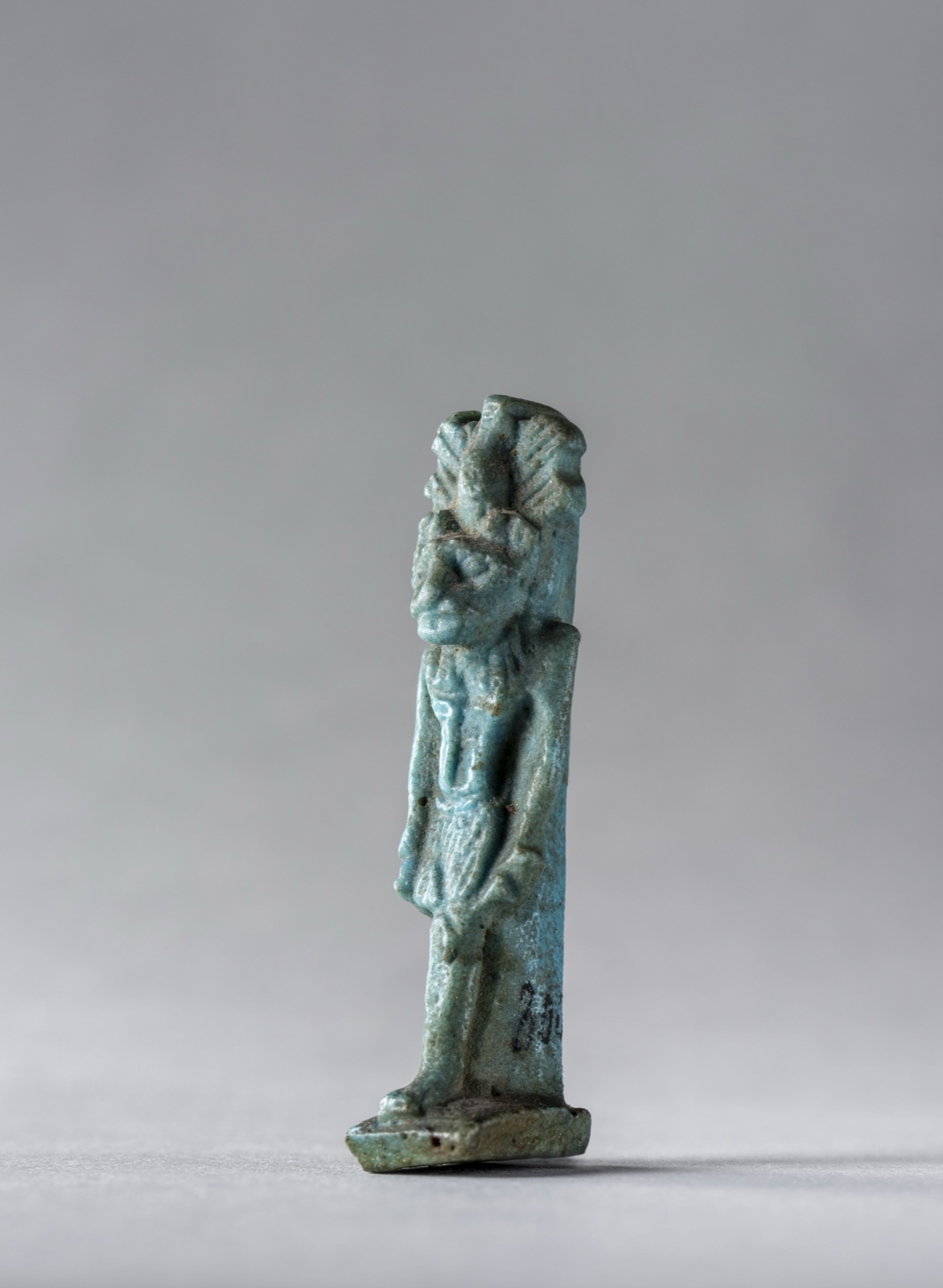
Amulet depicting the god Mahes, faience. Late Period, between 722 and 332 BC. Museo Egizio, Turin, C 306. Public domain (CC0), Museo Egizio · Source and licence
Maahes name as a theonym is first attested in the Middle Kingdom on the Statue of Snofru found in the sanctuary of Heqaib at Elephantine. The Egyptian name of the god is written Mꜣἰ-ḥsꜣ, sometimes shortened to Mꜣἰ-ḥs, and it is a compound of two ordinary words. Mꜣἰ is the
common noun for the male lion. Ḥsꜣ is the adjective for what is wild, savage or fierce. The name therefore means the fierce
lion as explained by Christian Leitz.1, 2, 3, 4
A second rendering, "he who is true beside her," is repeated in almost every popular account of the god and in a good many books that ought to
know better. It construes the signs as mꜣꜥ, "true," with ḥr, "beside," and a feminine suffix. No lexical entry supports it, and Egyptologists
do not use it.
The Greeks took the name over rather than translating it, and it appears in their documents as Μίυσις, Miysis, with the variants Μίος and
Μίης.6, 7 The Egyptian form itself survives in Demotic. On a stela now in Hildesheim, beneath a scene of a king before a lion, runs
the line pꜣ ḥtp-nṯr Mꜣἰ-ḥs pꜣ nṯr ꜥꜣ, "the god's domain of Miysis, the great god," a text edited by Sven Vleeming and entered by Leitz as the
twenty-ninth attestation of the name.4, 6, 7, 8
There is also a Greek translation, and it is the most revealing witness to how the name was heard. Paul Perdrizet proposed that the divine name
Ὀρνυμένης, Ornymenes, which appears in a Ptolemaic building inscription for a lion god, renders the Egyptian Mꜣἰ-ḥsꜣ; the Greek participle is
formed on ὄρνυμι, to rush upon or to rouse oneself to violence.The proposal was accepted by Jean Yoyotte and by Étienne Bernand,
and the inscription in question, OGIS II 732, records building work for the temple of Ornymenes under Ptolemy V.9, 10, 11, 12
The god also travelled under a compound name. On the Roman-period nome coinage of the Leontopolite nome he appears as Harmiysis, Ḥr-Mꜣἰ-ḥs, and
the die-cutters figure him as a youthful Ares, once only as a lion.13
Language
Name of Maahes
Attestation
Egyptian
Mꜣἰ-ḥsꜣ, Mꜣἰ-ḥs
Statue of Snofru (18th century BCE)
Demotic
Mꜣἰ-ḥs
Hildesheim stela 1897 (285 to 246 BCE)
Koine Greek
Μίυσις, Μίος, Μίης
Various Ptolemaic and Roman texts (320BCE-500CE)
Koine Greek
Ὀρνυμένης (Ornymenes), "the one who charges"
OGIS II 732 (210-180BCE)
Greek-Latin
Ḥr-Mꜣἰ-ḥs, Harmiysis
Nome Coin, Roman period
Sources: Erman and Grapow, Wörterbuch der aegyptischen Sprache, s.v. mꜣἰ and ḥsꜣ;2 Faulkner, A
Concise Dictionary of Middle Egyptian, s.v. mꜣἰ, ḥsꜣ;3 Leitz, Lexikon der ägyptischen Götter und
Götterbezeichnungen III, 211–212;4 Clarysse and Yan, Chronique d'Égypte 82 (2007), for the Greek and demotic
forms;7 Vleeming, Studia Demotica 5, no. 216, for the Hildesheim text;7 Geissen and Weber, ZPE 158
(2006), for Harmiysis on the nome coins.13
II. The Lion Before Maahes
The Pyramid Texts are full of lions referred to as Mꜣἰ but the idea of them containing a god named Maahes is nebulous. This is the central fact about his history that makes the imagery of the god rather ambiguous.14
The Old Kingdom lion powers have multiple attributes. Aker is the earth, figured as a double lion or as two lion foreparts set back to back, guarding the
gates through which the sun passes at the horizon. Ruty, the Two Lions, are a pair later identified with Shu and Tefnut. Sekhmet and Shesmetet
are lionesses, and Shesmetet carries the epithet Lady of Punt, which may point somewhere south.The king himself is repeatedly a
lion, and he is repeatedly the son of a lioness. Utterance 262 states this part without qualification.6
N. is great. N. has come forth from between the thighs of the Ennead. N. was conceived by Sekhmet, it is Šsmt.t who gave birth to N., as the
star with piercing glance and wide of stride, who brings provisions for his journey to Rē every day. Pyramid Texts, §§ 262a–263a (Utterance 248 in Mercer's numbering), trans. Mercer14
Sekhmet is said to have conceived the pharaoh twice in the corpus, at § 262 and again at § 2206. The office that Maahes will later
occupy, that of the lion son born of the lioness, is therefore filled in the Old Kingdom. Whether this relates to the royal symbolism of the lion god in later times is an open question.14,15
Maahes is not extracted from the general lion vocabulary of these texts by argument. Mꜣἰ, rw and ḥsꜣ are ordinary Egyptian words. Their
appearance in an Old Kingdom utterance no more attests a god called the Fierce Lion than the word for falcon attests Horus of Behdet. Every
attempt to place Maahes in the Pyramid Texts that has been offered in the popular literature depends on that confusion. The dossier for the personification of Maahes, like many other latecomer Egyptian gods and gathered in the Lexikon, begins in the New Kingdom.4
What can be said about his emergence is modest, and it is worth saying carefully. The name is at home in the New Kingdom, where mꜣἰ ḥsꜣ, the
fierce lion, is a stock expression of royal military rhetoric applied to the king in battle. The god becomes archaeologically
visible under the Libyan dynasties, when Osorkon III builds him a sanctuary at Bubastis, and he becomes loud in the Late, Ptolemaic and Roman
periods, when the Delta lion cult is documented by stelae, statuettes, coins, Greek inscriptions and the mummified bodies of the animals
themselves. The likeliest history of Maahes is that a royal epithet hardened into a divine name. Nonetheless, it is important to remember that Maahes appears during a time of war and expansion for Egypt.2,7,16,17
Maahes is sometimes said to be of Nubian origin, borrowed from the lion gods
of the south. The comparison usually invoked is Apedemak, the lion god of Meroe, but Apedemak is attested from the third century BCE and Maahes
from the New Kingdom, so the borrowing probably cannot have run in that direction. The foreign-origin hypothesis rests on no text. It rests
on the assumption that the Egyptians would not have thought of a lion by themselves.18
III. The Epithets of Maahes
The titles of Maahes are a difficult case, and the difficulty is worth setting out rather than concealing. A short list of English epithets,
Lord of the Massacre, Wielder of the Knife, the Scarlet Lord, Avenger of Wrongs, Protector of Sacred Places, circulates in every modern handbook
and website. The Egyptian originals behind them are seldom given, and in several cases cannot be traced. The table separates the titles that are
attested in edited texts from the titles that are merely repeated.
Epithet
Meaning
Attestation
Mꜣἰ-ḥs pꜣ nṯr ꜥꜣ
Miysis, the Great God
Demotic title
ꜥꜣ pḥty
Great of Strength
Solar power
mꜣj-ḥsꜣ nb ḫꜣyt
Lord of the Massacre
Behdet war title
sdšr.tj jr.wj
(of) the Reddened Two Eyes
Horus symbolism, war
pꜣ my ꜥnḫ
The Living Lion
Standing lion
Wsἰr pꜣ my
Osiris the Lion
Crouching lion
Ḥr-Mꜣἰ-ḥs
Harmiysis, Horus-Miysis
Horus name from Taremu
Ὀρνυμένης
Ornymenes, the One who Charges
Greek Ptolemaic title
sꜣ Bꜣstt
Son of Bastet
Bubastite Title
sꜣ Sḫmt
Son of Sekhmet
Memphite and Leontopolite title
nb Tꜣ-rmw
Lord of Taremu
Taremu Title
Sources: Leitz, Lexikon der ägyptischen Götter und Götterbezeichnungen III, 211–212;3 Clarysse and
Yan, Chronique d'Égypte 82 (2007), for the titles on the Leontopolite stelae;6 Vleeming, Studia Demotica 5, no.
216;7 Geissen and Weber, ZPE 158 (2006);12 Hart, The Routledge Dictionary of Egyptian Gods and
Goddesses, s.v. "Mihos," and Wilkinson, The Complete Gods and Goddesses of Ancient Egypt, for the handbook
titles.6,16
IV. The Temples
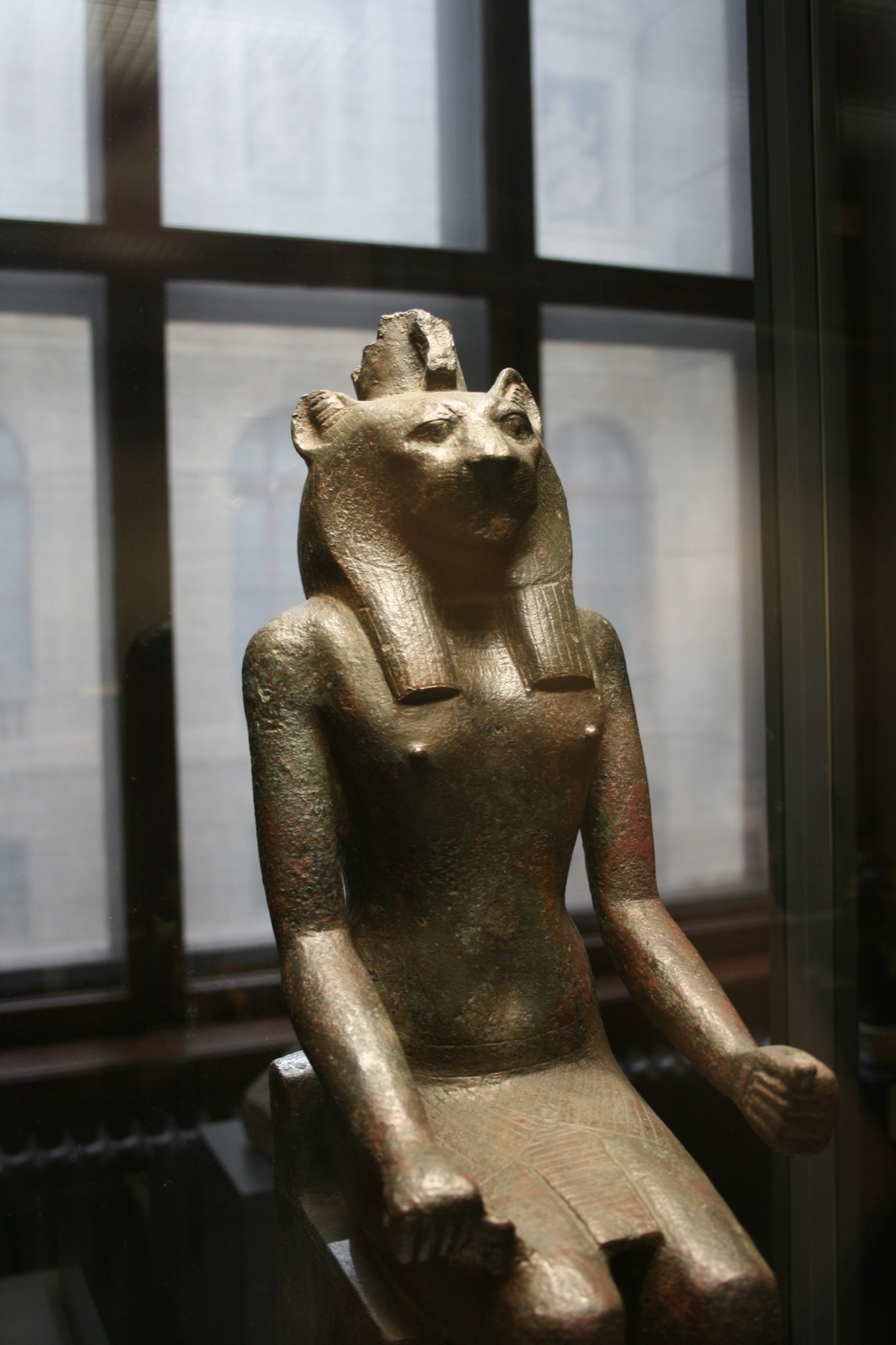
Enthroned god with the head of a lion, Mahes. Bronze, 660-520 BC. Kunsthistorisches Museum, Vienna. Public domain · Source and licence
Taremu, the City of Lions
The chief seat of the god was Tꜣ-rmw, Taremu, the land of fish, capital of the eleventh nome of Lower Egypt, which the Greeks called Leontopolis (Lion City)
and which lies today under the mound of Tell el-Muqdam in the central Delta. The city was a seat of royal power under the
Twenty-third Dynasty, and Piye names its ruler Iuput II among the princes he subdued. Carol Redmount and Renée Friedman excavated there in the
1990s but their reports describe a large and badly denuded settlement mound, scarce in evidence.19
What survives of it came out of the ground piecemeal. Bronze statuettes of lions were found in the ruins of the temple in 1884 and passed into
the Fouquet collection, published by Émile Chassinat and by Paul Perdrizet. More important is a corpus of limestone stelae which
began appearing in the Cairo antiquities shops in 1885, and which Willy Clarysse and Haying Yan catalogued in 2007, bringing the total to
nineteen. They share a single scene. A Pharaoh in the double crown offers the hieroglyph for "field" to a lion seated or standing on
a pedestal, with a sun disk and uraeus above the animal's head and a winged disk in the lunette.7,20,21
The inscriptions are emblematic of certain evidence since where the lion stands, the text above his back reads pꜣ my ꜥnḫ, "the living lion." Where he crouches, it reads
Wsἰr pꜣ my, "Osiris the lion." Beneath the scene on the stela in the Peking University Museum a single line of demotic reads pꜣ ꜥ.wy n tꜣ qs.t n
pꜣ my, "the house of the burial of the divine lion," and the stela in the Allard Pierson Museum in Amsterdam has the same statement in Greek:
οἰκία τῆς ταφῆς τῶν λεόντων ἱερά, "house of the tomb of the lions; sacred."7
Dimitri Meeks classified these objects as pseudo-donation stelae, since the king offers a field sign and no land actually changes
hands. Clarysse and Yan argue, against Yoyotte, that the phrase means what it says, and that the stelae stood at or inside the real
tombs of the sacred lions, in the way that the Buchis stelae stood in the bull cemetery at Armant. The Beijing stela bears the
cartouche of a Cleopatra, cut by a local sculptor who went on showing the offering pharaoh as a man because that is what the scene required.7,12,22
Bubastis
At Bubastis, the city of his mother, Maahes had a house of his own. It stood north of the great temple of Bastet, a rectangular structure with
red granite palm and papyrus-bundle columns, and it was identified as a sanctuary of Mihos by Labib Habachi, working over ground that Édouard
Naville had opened in the 1880s. The building is attributed to Osorkon III of the Twenty-third Dynasty and postdates the temple
of Bastet beside which it was set.17,23,24 Nothing now remains above the foundations.
Richard Wilkinson notes that the sanctuary functions in the manner of the later Ptolemaic birth houses, tying the birth of the divine son to the
birth of the Pharaoh who built it. The royal symbolism seems to have a running thread that links the cult of Maahes with the Mammissi and Horus.
Saqqara and the Burial of the Lions
The lion cult was not confined to the Delta. A late Ptolemaic papyrus, still unpublished, refers to the ταφὴ καὶ τροφὴ λεόντων, the burial and
the feeding of the lions, and is quoted by John Ray in his edition of the archive of Hor. Archeologists published lion mummies from
the animal cemetery at Saqqara in 1997. In 2001 the skeleton of an adult male lion was found in the tomb of Maïa at the Bubasteion at
Saqqara and published in Nature magazine by Cécile Callou, Anaïck Samzun and Alain Zivie; the animal had reached old age in captivity, and the wear on its
teeth shows that it had been fed by hand for a long time. It is the first hard zoological confirmation that Egyptians kept lions and
buried them.25,26,27
V. The Son of Sekhmet and Bastet
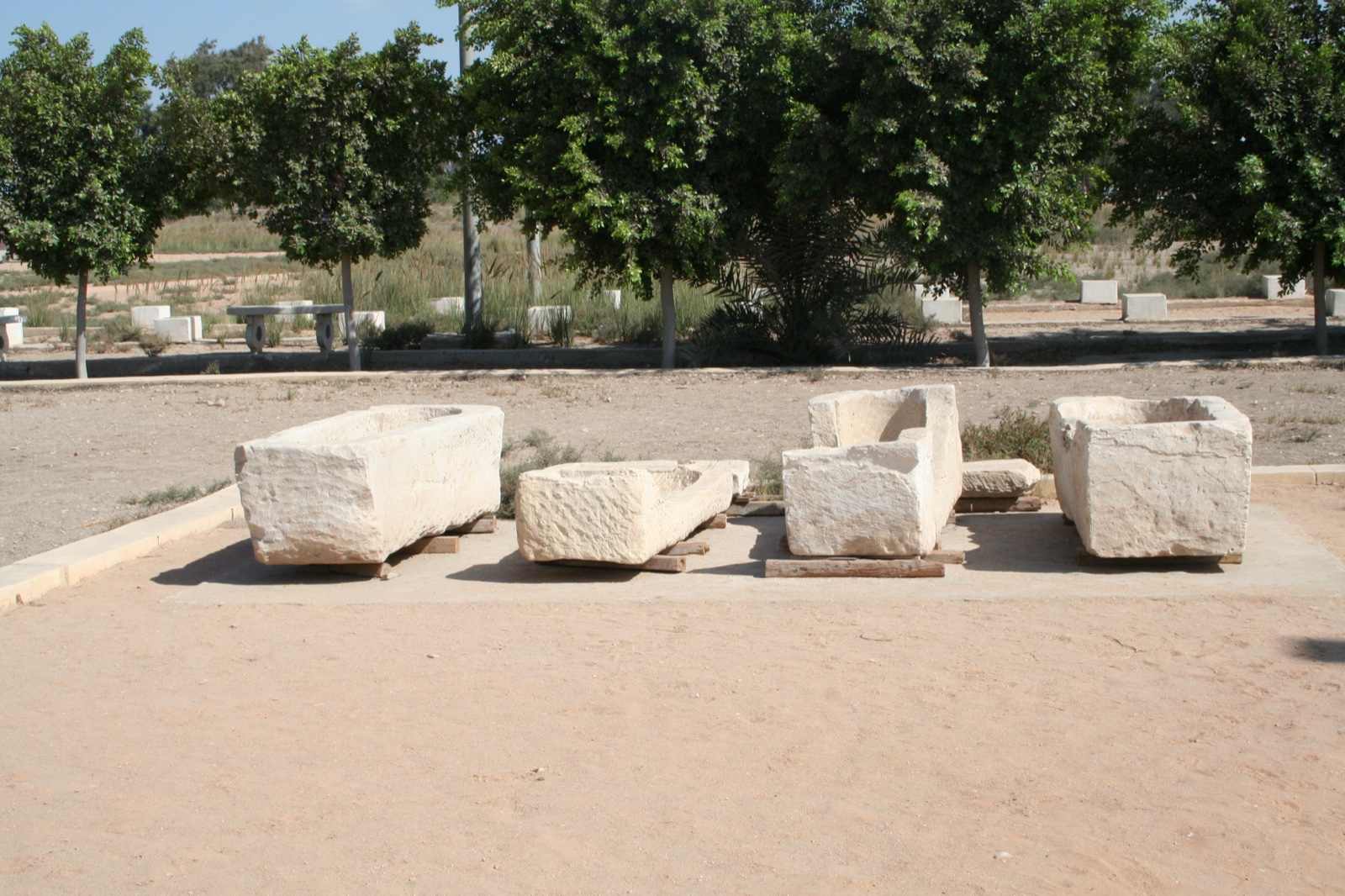
Bubastis (Tell Basta), Egypt. Photo: Einsamer Schütze, CC BY-SA 3.0 · Source and licence
Maahes is defined by his mother, and which mother depends on where the text was written. At Bubastis he is the son of Bastet, and his sanctuary
stands in her precinct. In the Memphite and southern material he is the son of Sekhmet, whose rage is the more famous of the
two and has a higher consistency with who Maahes is as a god. The distinction was less important to the Egyptians than it is to modern catalogues, because Bastet and Sekhmet are one power in two
tempers, both are lionesses in their primeval form.6,17,24
Ra is named as the father of Maahes in some accounts and Ptah in others, and the assignment to Ptah deserves a word of caution, since at Memphis
the son of Ptah and Sekhmet is Nefertem. Placing Maahes in that seat is a secondary equation, and it is repeated in the handbooks more
confidently than the evidence allows. The parentage of Maahes is the divine descent from the lioness.6,16
The theology of that descent is not sentimental. Sekhmet is the goddess who almost destroys mankind and has to be tricked into stopping, and the
Egyptians surrounded her with an apparatus of appeasement: the litanies of the seven arrows, the knife-bearing messengers who ride out at the turn
of the year, and the rites of the five epagomenal days when her emissaries are abroad and the year hangs in the balance. Philippe Germond assembled
this material in his study of Sekhmet and the protection of the world, and it is the necessary background to her son. The rage of the
lioness is real and it has to be aimed. Maahes is the aiming of it.28
His childhood is a matter of descent rather than of infancy, and here he differs from the other divine children of Egypt. Harpocrates is shown
naked, with a finger at his lip and the side-lock of youth, sitting on his mother's knee. Maahes is shown as a grown male lion, or as a man with a
lion's head, standing, dressed in a short kilt, wearing the atef crown or carrying a bouquet of lotuses, and frequently holding a
knife. No artist shows him at the breast. The word "prince," which the modern literature uses of him constantly, describes his rank
accurately and his age not at all.6,29
On one of the Copenhagen stelae the lion appears in company: Isis-Hathor, Bastet in the form of a lion-headed cobra, and Miysis wearing the atef
crown, a grouping identified by Yoyotte. The son stands beside the mother in the same frame, crowned, armed, and fully grown.7,12
VI. The Lord of the Massacre
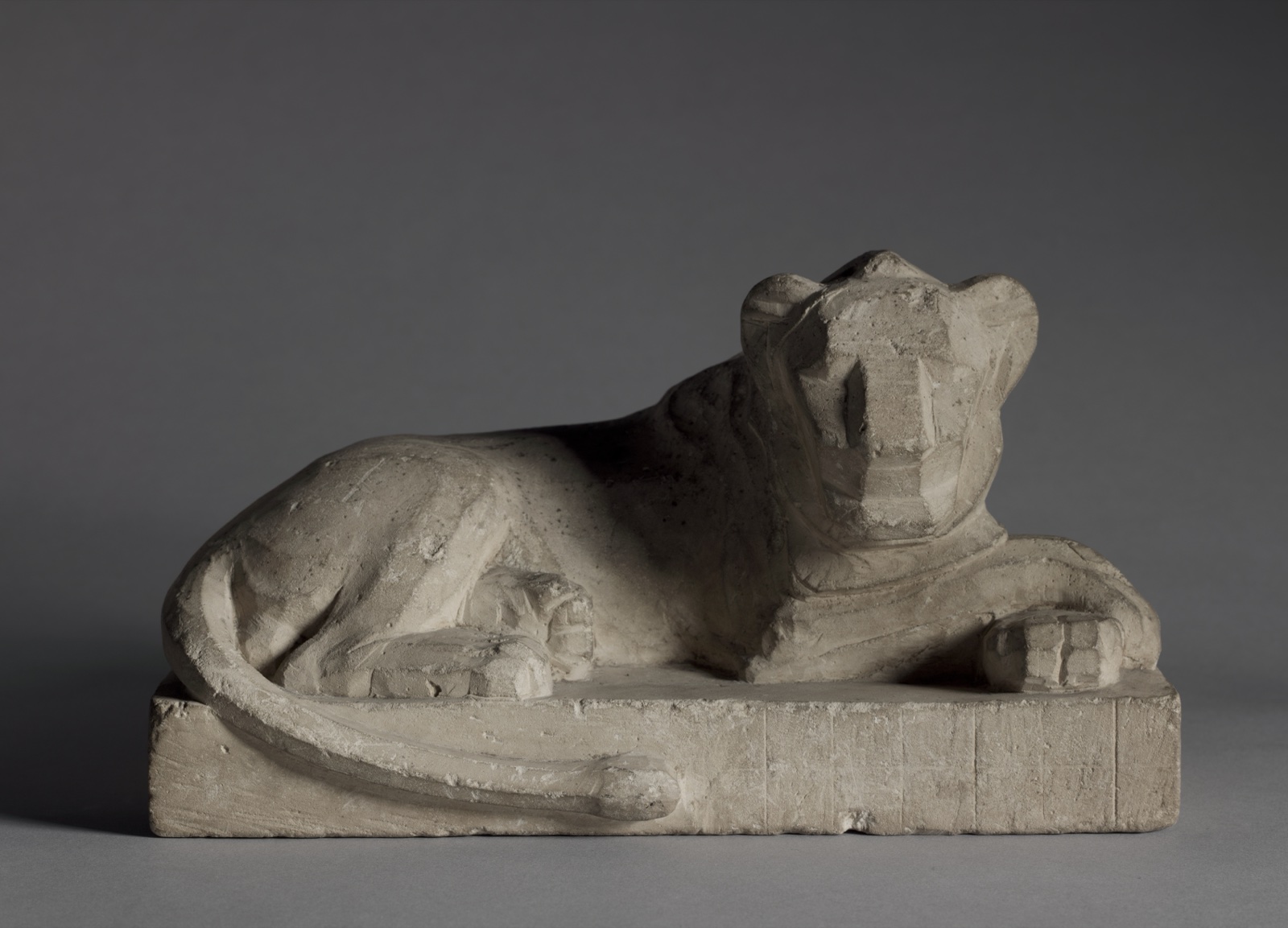
Statuette of a lion, limestone. Egypt, Late Period, Dynasty 30 or later (dated c. 380 BC on the file page). The museum notes that it probably represents the lion god Mahes, who had a great temple at Leontopolis ('Lion-City') in the Delta where lions were kept. Cleveland Museum of Art, 1920.2001. Public domain (CC0) · Source and licence
The most direct statement of what Maahes was for comes from the coinage. Under the Roman emperors the nomes of Egypt struck bronze issues showing
their local gods, and the Leontopolite nome put Harmiysis on its coins in the figure of a youthful Ares, once only as a lion.
The iconography shows the essence of the god. He carries a knife, and the lion-headed man with a blade is a figure of execution rather than of combat. He
does not fight duels in the myths, as Horus fights Seth or as Montu attends the Pharaoh in the heat of battle at Kadesh. He destroys what has been condemned, and in line with all of this, the Lord of the Massacre is an important title of Maahes attested at the Ptolemaic temple of Horus at Edfu.6,13,16
Behind this stands the older military language of the New Kingdom, in which the king in battle is a fierce lion, mꜣἰ ḥsꜣ, raging among his enemies.
The phrase belongs to the standard vocabulary of royal victory rhetoric, and the Kadesh inscriptions of Ramesses II use the leonine image with
great freedom showing a kind of parallelism with the divine presence of the fierce lion.2,29
His enemies are cosmic as well as political. The lion-headed powers stand in the retinue of Ra, and the knife is turned against Apep in the nightly
passage of the solar barque. Maahes is one of the weapons carried in it.
VII. Weather, and the Guarding of the Threshold
Maahes is described in the reference literature as a god of weather and storms, and the claim is made without a source in almost every place it
appears, showing how Egyptology sometimes devolves into Chinese whispers. The primary testimony is Plutarch, who reports that the Egyptians honour the lion and set gaping lions' heads at the doorways of their shrines, and
who explains the custom by the inundation, which begins when the sun enters Leo. He quotes Aratus for the astronomy.30,31
Of the stars the Egyptians think that the Dog-star is the star of Isis, because it is the bringer of water. They also hold the Lion in honour, and
they adorn the doorways of their shrines with gaping lions' heads, because the Nile overflows "When for the first time the Sun comes into
conjunction with Leo."
Plutarch, De Iside et Osiride 38 (366A), trans. Babbitt30
Plutarch has given a Greek explanation of a genuine Egyptian fact. The temples of Egypt discharge their rainwater through spouts cut in the form of
lions' heads, projecting from the roof line, and they are found at Dendera, at Edfu, at Philae and at Karnak.32 The storm that falls on
the roof of the god's house leaves it through the mouth of a lion. Whether or not any Egyptian priest connected that spout with Maahes by name, the
association of the lion with the violent water of the sky is built into the architecture, and it is not a modern invention.
The second strand is the destructive air itself. The messengers of Sekhmet ride out on the wind at the turn of the year and bring the plague with
them, and the whole apparatus of the epagomenal rites exists to turn them aside.Weather in Egypt is not rain in any quantity that
matters; it is the khamsin, the pestilential wind, the sky darkening out of season. The leonine powers govern exactly this, and Maahes belongs to
their family through his mother.28
The third strand is the lion at the gate. Couchant lions and sphinxes flank the entrances of Egyptian temples, and lion legs carry the beds, the
thrones and the chairs of the living. Protector of Sacred Places, the title the handbooks give him, is not attested in any Egyptian text I can
trace, and it is a fair summary of what the animal is doing on the threshold. The god of the doorway is the god who decides who may
pass, showing maybe a parallel to Nergal.6
The god was also invoked in magic. Mios and Miosis appear in the Greek magical text catalogued as SB I 5620 and edited by Reinhold Merkelbach,
which puts a lion god of this name into the working repertoire of Roman Egypt. What can honestly be said is this. The connection of the
lion with the storm, the inundation and the threshold is documented in the architecture, in the classical testimony and in the Sekhmet material. The
connection of Maahes by name with the weather rests, at present, on how the lion is a weather power. Whether Maahes
is more dubious.33
VIII. The Festivals
The festival evidence for Maahes is thin, foreign, and unexpectedly vivid. Almost none of it is Egyptian in language. What survives comes from Greek
visitors, from Greek dating formulae, and from the papers of a Ptolemaic estate manager who happened to pass through the town.
The one date we have is 9 Mecheir. The lion stela in the Ägyptisches Museum in Leipzig carries a badly cut Greek line beneath the offering scene
which appears to read "year 3, Mecheir 9." Clarysse and Yan set this beside the Zenon archive. In the twenty-eighth year of Ptolemy II
Philadelphus the dioiketes Apollonios and his agent Zenon were at Bubastis from the sixteenth to the twenty-sixth of March, were at Leonton polis at
the beginning of April, and moved on to Mendes on the eleventh; the letter P.Lond. VII 1938 was despatched to Zenon on 9 Mecheir. The
party appears to have timed its visit to the local festival. For a town as obscure as this one, the coincidence of the two dates is worth noticing.7,34
For the daily cult there is Aelian's account. His is really the locus classicus for the entire lion cult of Egypt because his account of the city of the lions is precise
about things in a way that is strongly evocative: the boneless meat, the singing during the meal, the exercise yards, and the calf provided so
that the animals could keep in practice.35,36
In Egypt they worship lions and there is a city called after them. They have temples and very many spaces in which to roam; the flesh of oxen is
supplied to them daily and it lies, stripped of bones and sinews, scattered here and there, and while the lions eat songs are sung in the Egyptian
language... And to preserve their health they have places to exercise and wrestling-grounds near by, and their adversary is a well-nourished calf. And
after practising his skill against the calf, the lion brings it down (this takes time, for he is lazy and unused to hunting), he eats his fill and
returns to his own stable.
Aelian, De natura animalium 12.7, trans. Scholfield35
Strabo, the earliest Greek writer to mention the nome, says only that the people there worship a lion, and that this is why the town has the name it
has. Diodorus, describing the consecration of animals in Egypt, gives the general practice into which the Leontopolite lions
fit. The stelae of the sacred lion stood at the house of the tomb of the lions, and the
animal, once dead, was Osiris the lion.7,37,38
Maahes Ritual Days
Place
Description
Events
Date Recorded
The Feast of 9 Mecheir
Leontopolis
Local festival
Dated stela; visit of the dioiketes Apollonios and Zenon
Leipzig stela and P.Lond. VII 1938 (3rd century BCE)
Feeding of the Sacred Lions
Leontopolis
Daily temple rite
Boned ox flesh; hymns sung in Egyptian during the meal
Aelian (2nd–3rd century CE)
Exercise of the Lions
Leontopolis
Temple discipline
Gymnasia and palaestrae; a calf given as an opponent
Aelian (2nd–3rd century CE)
Burial of the Sacred Lion
Leontopolis; Saqqara
Funerary rite
Stelae set at the "house of the tomb of the lions"; the beast becomes Osiris the Lion
Ptolemaic stelae; Saqqara lion mummies
The Ephebic Games
Leontopolis
Civic festival
Ephebe lists crowded with names built on "lion" and "strong"
Greek agonistic inscription, 220 CE
The Feast of Bastet
Bubastis
Great pilgrimage of his mother
River procession, music, wine; Herodotus does not name the lion god
Herodotus 2.59–60 (5th century BCE)
Sources: Clarysse and Yan, Chronique d'Égypte 82 (2007), for the Leipzig date and the Zenon itinerary;7
Pestman, A Guide to the Zenon Archive, for P.Lond. VII 1938;34 Aelian, De natura animalium 12.7, with Hopfner,
Fontes Historiae Religionis Aegyptiacae;35, 36 Strabo, Geography 17.1.40;36 Diodorus Siculus,
Library of History 1.83–84;38 Bingen, Chronique d'Égypte 76 (2001), for the ephebe list;39 Herodotus,
Histories 2.59–60, for the Bubastite pilgrimage.40
The lion names outlasted the temples Greek agonistic inscription from the city, listing its ephebes as late as 220 CE, is crowded with personal names
formed on λέων and on ἰσχυρός, the lion and the strong, and attention has been drawn in Egyptology to the density of them.39 Three centuries after
the last Ptolemy, in a city under Roman administration, the young men of Leontopolis were still being named after the animal in the temple.
Sources and Bibliography
Thesaurus Linguae Aegyptiae. “Statue de Snofru (Heqaib-Heiligtum, Nr. 69).” Berlin-Brandenburg Academy of Sciences and Humanities.
Erman, Adolf, and Hermann Grapow. Wörterbuch der aegyptischen Sprache. 5 vols. Leipzig: J. C. Hinrichs, 1926–1931, s.v. mꜣἰ
("lion") and ḥsꜣ ("wild, savage, fierce"); see also the expression mꜣἰ ḥsꜣ used of the king in battle.
Faulkner, Raymond O. A Concise Dictionary of Middle Egyptian. Oxford: Griffith Institute, 1962, s.v. mꜣἰ, ḥsꜣ.
Leitz, Christian, ed. Lexikon der ägyptischen Götter und Götterbezeichnungen. Vol. 3. Orientalia Lovaniensia Analecta 112. Leuven:
Peeters, 2002, 211–212, s.v. Mꜣἰ-ḥsꜣ. The dossier of attestations, with the Hildesheim stela as Beleg 29.
De Wit, Constant. Le rôle et le sens du lion dans l'Égypte ancienne. Leiden: E. J. Brill, 1951. The standard study of the lion in
Egyptian religion; see 276–280 for the Leontopolite stelae.
Wilkinson, Richard H. The Complete Gods and Goddesses of Ancient Egypt. London: Thames & Hudson, 2003. For Mahes and the wider
family of leonine deities, including Aker, Ruty, Shesmetet, Pakhet, Menhyt and Mestjet.
Clarysse, Willy, and Haying Yan. "Two Ptolemaic Stelae for the Sacred Lion of Leonton Polis (Tell Moqdam)." Chronique d'Égypte 82
(2007): 77–100. The corpus of nineteen lion stelae, with the demotic and Greek tomb inscriptions and the Leipzig date of 9 Mecheir.
Vleeming, Sven P. Some Coins of Artaxerxes and Other Short Texts in the Demotic Script Found on Various Objects and Gathered from Many
Publications. Studia Demotica 5. Leuven: Peeters, 2001, 218, no. 216. The demotic text of the Hildesheim stela.
Perdrizet, Paul. Comptes rendus de l'Académie des Inscriptions et Belles-Lettres, 1922, 322. The proposal that Greek Ornymenes renders
Egyptian Mꜣἰ-ḥs.
Dittenberger, Wilhelm, ed. Orientis Graeci Inscriptiones Selectae. Vol. 2. Leipzig: S. Hirzel, 1905, no. 732. Building inscription for
the temple of the lion god Ornymenes, reign of Ptolemy V.
Bernand, Étienne. "Le culte du lion en Basse Égypte d'après les documents grecs." Dialogues d'histoire ancienne 16 (1990): 63–94.
Yoyotte, Jean. Annuaire de l'École Pratique des Hautes Études, 5e section 96 (1987–1988): 158. On the divine figures of the lion stelae
and the interpretation of the "house of the lions."
Geissen, Angelo, and Manfred Weber. "Untersuchungen zu den ägyptischen Nomenprägungen VIII." Zeitschrift für Papyrologie und Epigraphik
158 (2006): 271–275. Harmiysis as a youthful Ares on the nome coinage of the Leontopolites.
Mercer, Samuel A. B. The Pyramid Texts in Translation and Commentary. 4 vols. New York: Longmans, Green, 1952. Utterance 248,
§§ 262a–263a, for the king conceived by Sekhmet and born of Shesmetet.
Allen, James P., trans. The Ancient Egyptian Pyramid Texts. 2nd ed. Writings from the Ancient World 23. Atlanta: SBL Press, 2015.
Hart, George. The Routledge Dictionary of Egyptian Gods and Goddesses. 2nd ed. London: Routledge, 2005, s.v. "Mihos."
Habachi, Labib. Tell Basta. Supplément aux Annales du Service des Antiquités de l'Égypte 22. Cairo: Institut français d'archéologie
orientale, 1957. The identification of the subsidiary temple of Mihos.
Zabkar, Louis V. Apedemak: Lion God of Meroe. A Study in Egyptian-Meroitic Syncretism. Warminster: Aris & Phillips, 1975.
Redmount, Carol A., and Renée F. Friedman. "Tales of a Delta Site: The 1995 Field Season at Tell el-Muqdam." Journal of the American
Research Center in Egypt 34 (1997): 57–83.
Chassinat, Émile. Les antiquités égyptiennes de la collection Fouquet. Paris, 1922. For the bronze lions from the temple ruins.
Perdrizet, Paul. "Antiquités de Léontopolis." Monuments et mémoires de la Fondation Eugène Piot 25 (1921–1922): 349–385.
Meeks, Dimitri. "Les donations aux temples dans l'Égypte du Ier millénaire avant J.-C." In State and Temple Economy in the Ancient Near
East, vol. 2, edited by Edward Lipiński, 605–687. Orientalia Lovaniensia Analecta 6. Leuven: Departement Oriëntalistiek, 1979. See
685–686 for the lion stelae as pseudo-donations.
Wilkinson, Richard H. The Complete Temples of Ancient Egypt. London: Thames & Hudson, 2000. For the Mihos sanctuary at Bubastis and
its relation to the birth houses.
Ray, John D. The Archive of Ḥor. Texts from Excavations 2. London: Egypt Exploration Society, 1976, 154. Citing the unpublished papyrus
on the burial and the feeding of the lions.
Charron, Pierre. "Des momies de lions à Saqqarah." Bulletin de la Société d'Égyptologie de Genève 21 (1997): 5–10.
Callou, Cécile, Anaïck Samzun, and Alain Zivie. "A Lion Found in the Egyptian Tomb of Maïa." Nature 427 (15 January 2004): 211–212.
Germond, Philippe. Sekhmet et la protection du monde. Aegyptiaca Helvetica 9. Geneva: Éditions de Belles-Lettres, 1981. On the messengers
and arrows of the lioness and the rites of the epagomenal days.
Lichtheim, Miriam. Ancient Egyptian Literature. Vol. 2, The New Kingdom. Berkeley: University of California Press, 1976. For the
Kadesh inscriptions of Ramesses II and the leonine language of royal victory.
Plutarch. Moralia, vol. 5, Isis and Osiris. Translated by Frank Cole Babbitt. Loeb Classical Library 306. Cambridge, MA: Harvard
University Press, 1936. See chapter 38 (366A) for the lions' heads at the doorways of shrines.
Aratus. Phaenomena 151. Translated by G. R. Mair. Loeb Classical Library 129. Cambridge, MA: Harvard University Press, 1921. Quoted by
Plutarch for the rising of the Nile when the sun enters Leo.
Arnold, Dieter. The Encyclopaedia of Ancient Egyptian Architecture. Edited by Nigel Strudwick and Helen Strudwick. London: I. B. Tauris,
2003, s.v. "water spout." For the lion-headed roof spouts of the Egyptian temple.
Merkelbach, Reinhold, and Maria Totti, eds. Abrasax: Ausgewählte Papyri religiösen und magischen Inhalts. Papyrologica Coloniensia 17.
Opladen: Westdeutscher Verlag, 1990–1996, vol. 4, 123–126. For the names Mios and Miosis in SB I 5620.
Pestman, Pieter W. A Guide to the Zenon Archive. Papyrologica Lugduno-Batava 21. Leiden: E. J. Brill, 1981, 224–225. For the itinerary of
Apollonios and Zenon in year 28 and the despatch of P.Lond. VII 1938 on 9 Mecheir.
Aelian. On the Characteristics of Animals 12.7. Translated by A. F. Scholfield. 3 vols. Loeb Classical Library. Cambridge, MA: Harvard
University Press, 1958–1959.
Hopfner, Theodor. Fontes Historiae Religionis Aegyptiacae. Vol. 3. Bonn: A. Marcus and E. Weber, 1922–1925, 427–428. The classical
testimonia on the lion cult, including Aelian 12.7.
Strabo. Geography 17.1.40. Translated by Horace Leonard Jones. Loeb Classical Library. Cambridge, MA: Harvard University Press, 1932.
Diodorus Siculus. Library of History 1.83–84. Translated by C. H. Oldfather. Loeb Classical Library 279. Cambridge, MA: Harvard University
Press, 1933. On the consecration and feeding of sacred animals in Egypt.
Bingen, Jean. Chronique d'Égypte 76 (2001): 225–226. Onomastic commentary on the ephebe list of Leontopolis, SEG 51.2159.
Herodotus. The Persian Wars 2.59–60. Translated by A. D. Godley. Loeb Classical Library. Cambridge, MA: Harvard University Press, 1920.
The festival and pilgrimage of Bastet at Bubastis.