The welcome to the Temple of Zeus and Zevism: the Ancient faith behind all Ancient religions, its Head God and His many names, the practices for opening the chakras, freedom of belief, the Gods restored to Their true Names, and Initiation as the first step.
Magick & Theurgy: the powers of the mind and soul, built on power meditation. The Magick Section holds the Chthonic Powers and the Theurgy Section the Heavenly Powers, each from Beginning to Advanced with Divination and Information; General Information, Knowing the Powers, serves both.
author: High Priest Zevios Metathronos
co-author: Novice Priest Karnonnos
Hieratic Information about Nergal
Divine Names
Nergal (𒀭𒄊𒀕𒃲)
the standard Akkadian name
Meslamtaea (𒀭𒈩𒇴𒋫𒌓𒁺𒀀)
"He Who Comes Forth from Meslam"
Erra (𒀭𒅕𒊏)
the Semitic scorching-god assimilated to him
The earliest spelling dKIŠ.UNU underlies the later dKIŠ.UNU.GAL, worn down by the second millennium BCE to the pronounced form Nerigal, then Nergal. The logograms dU.GUR and dIGI.DU carry the name in later periods.
Divine Symbols
The Lion-Headed Mace
The Scimitar and the Bow
The War Standard
The Flat Cap of the Underworld
Divine Forces
Inflicted Death
War and Pestilence
The Scorching Summer Sun
Kingship of the Underworld
Important Titles
Lord of the Great City
Enlil of the Underworld
King of Sunset
Lord of Peace (Lugal-silimma)
Names Across Civilizations
Sumerian
Meslamtaea (𒀭𒈩𒇴𒋫𒌓𒁺𒀀)
Akkadian
Nergal (𒀭𒄊𒀕𒃲)
Hebrew
Nergal (נֵרְגַל)
Aramaic
Nergal (ܢܸܪܓܲܠ), nrgl / nyrgl
Hatrene
Nrgl / Nrgwl, as Heracles-Nergal
Mandaic
Nirig (ࡍࡉࡓࡉࡂ), the planet Mars
I. The Name
The earliest attested writing of the god's name is the logogram dKIŠ.UNU, which by the Old Akkadian period had acquired its standard derivative dKIŠ.UNU.GAL. Frans Wiggermann parses the underlying phrase as "lord of the great city," a euphemism in which the great city is the underworld. The name was worn down over the second millennium BCE to the pronounced Nerigal and then to Nergal, the form the phonetic spellings preserve: dné-ri-ig-lá at Old Assyrian Tell Leilan, dné-ri-ig-la at Nuzi, nrgl in Aramaic, nēregal in the Masoretic Hebrew.1,2
The etymology is not completely known. Piotr Steinkeller argued against the conventional reading of the archaic writing, and Wilfred G. Lambert answered him twice over three years in the same journal, with Steinkeller replying in turn. The dispute concerns the sign-values of the oldest forms and whether the received analysis of dKIŠ.UNU.GAL as "lord of the great city" can survive scrutiny of the third-millennium orthography. The reading dNè-urugal, favored by some, is impossible on strictly phonological grounds, since KIŠ does not carry the value nè. What is secure is the meaning that the ancient scribes themselves attached to the name. In the end, what is debatable is the precise route.3,4,5
Alongside Nergal stands Meslamtaea, "he who has come out of Meslam," the alternative name used in the south of Lower Mesopotamia down to the Ur III period. Wiggermann proposes that the euphemism was a theological necessity rather than an ornament. In the south the rule of the dead already belonged to Ninazu and to Ereshkigal. Nergal occupied a secondary role founded in the geographical myth of the marriage. In the south he was therefore at first a war god who merely came forth from his temple, not a king who reigned below. Meslamtaea in time detached itself and became a separate deity, paired with Lugalirra as a set of divine twins, so that the logogram dMAŠ.TAB.BA, "the twins," could stand for Nergal himself.2,6
The Semitic name Erra, from a root cognate with the Akkadian verb erēru, "to scorch," originally belonged to a distinct god of the scorched earth. From the Old Babylonian period onward it could be applied to Nergal. In the Weidner and An = Anum lists the two are clearly equated. Weirdly, the borrowing ran against the usual current. Where Ishtar overtook Inanna and Ea overtook Enki, here the Sumerian Nergal prevailed and the Akkadian Erra became the antiquated form, so much so that late bilingual texts sometimes render the Akkadian column with Nergal and the Sumerian with Erra.7
Language / Script
Name of Nergal
Attestation
Sumerian (logographic)
dKIŠ.UNU (𒀭𒄊𒀕)
Fara and Abu Salabikh god-lists (c. 2600 BCE)
Old Akkadian
dKIŠ.UNU.GAL
Inscriptions of the Sargonic kings
Old Assyrian / Nuzi
dné-ri-ig-lá / dné-ri-ig-la
Tell Leilan and Nuzi tablets (2nd millennium BCE)
Hebrew
נֵרְגַל (Nergal)
2 Kings 17:30; Masoretic Text
Aramaic
ܢܸܪܓܲܠ (nrgl, nyrgl)
Hatrene inscriptions and incantation bowls
Mandaic
ࡍࡉࡓࡉࡂ (Nirig)
Mandaean cosmological texts, the planet Mars
Sources: Wiggermann, Reallexikon der Assyriologie 9 (1999); Steinkeller, "The Name of Nergal" (1987); Lambert, "The Name of Nergal Again" (1990); Steinkeller, "More on the Name of Nergal" (1990); Litke, A Reconstruction of the Assyro-Babylonian God-Lists (1998).1,2,3,4,5
II. Aspects of Mythology
Two great narratives do involve Nergal. In the first he is drawn down into the underworld and made its king by marriage; in the second he erupts out of it as the fury that unmakes the settled world. Between the lover who cannot leave Ereshkigal's side and the warrior who nearly burns creation to ash lies the whole span of the god's character.7,8
The Epic of Erra, compiled by a certain Kabti-ilāni-Marduk in a rare ancient statement of authorship, is the fuller of the two. Nergal, called Erra throughout, is roused from inertia by his own weapons, the Sebitti, who crave the slaughter of war. His sukkal Ishum, whom Andrew George reads as the god's conscience, pleads against the campaign and is dismissed. Through a trick Erra persuades Marduk to quit his temple, and in the god's absence the world tips into cosmic disorder.8
What follows is a catalogue of atrocity set upon nameless human beings. In no way does the poem soften that at alll. Erra means to destroy the remaining voices of moderation and the cosmic order entire. Ishum halts him only by waging a war of his own against the men of Mount Sharshar, and with that the fever breaks. The god, satisfied, orders Ishum to spread the tale of his rampage, and to make plain that only Ishum's calm spared the world.8
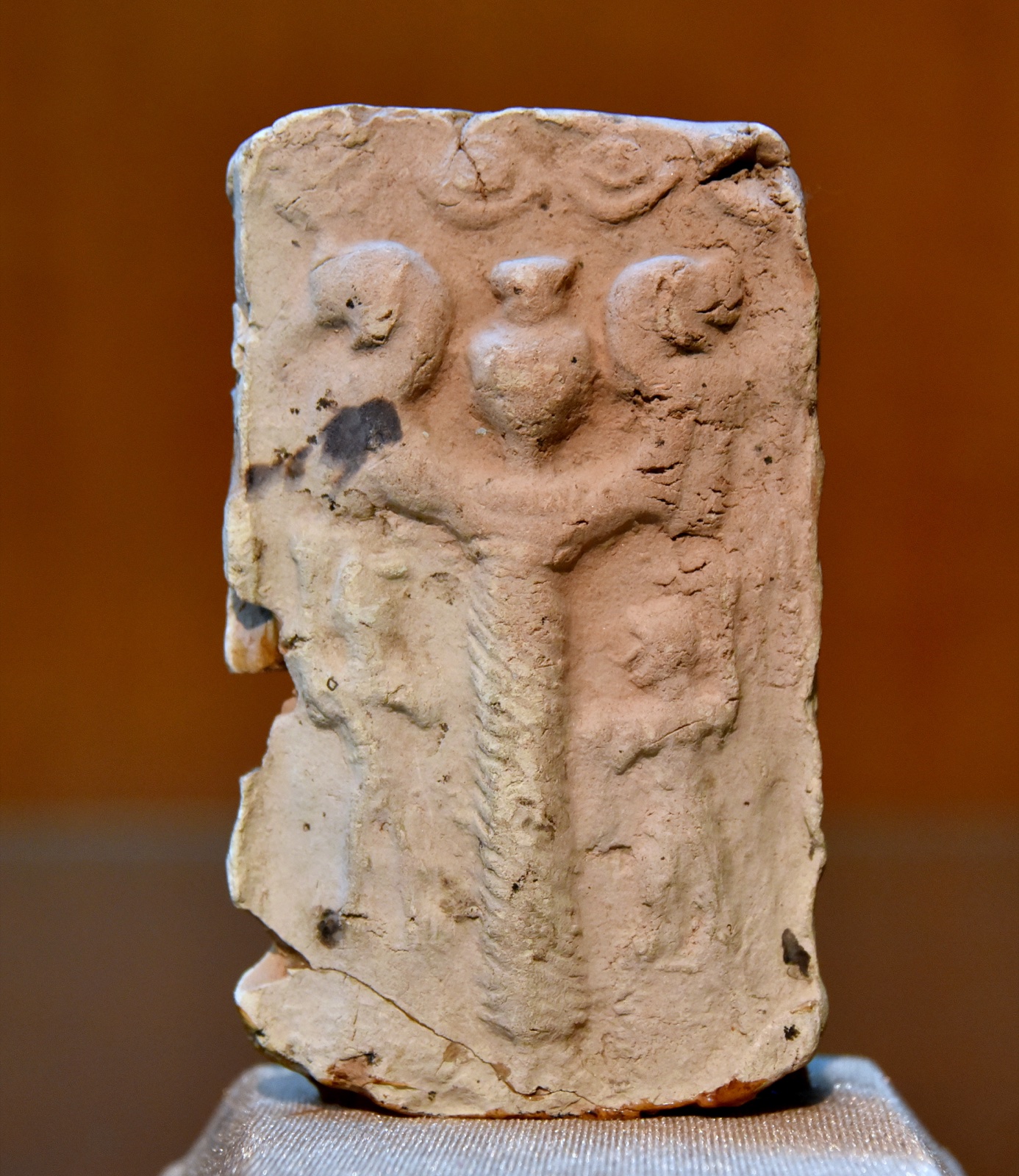
Nergal, Mesopotamian deity of the underworld, flanked by two small human figures. Old Babylonian fired clay plaque, 2003-1595 BCE, from the Scribal Quarter at Nippur, Iraq (2nd excavation season of the Oriental Institute, University of Chicago). Sulaymaniyah Museum, Iraqi Kurdistan. Photo: Osama Shukir Muhammed Amin, CC BY-SA 4.0 · Source and licence
Erica Reiner showed that excerpts were copied onto clay tablets and hung in houses as plague amulets, the words of the god of pestilence enlisted to turn pestilence aside. The reasoning is apotropaic to its core. Nergal took and inflicted in the Mesopotamian imagination.9,10
Nergal does move through lesser and worse preserved compositions besides that. One damaged Middle Assyrian text, kin to the Labbu myth, sets him against a monstrous serpent born in the sea, perhaps on behalf of Enlil or of Anu. In Enmesharra's Defeat, known from a single broken Seleucid or Parthian copy, he is the warden of the imprisoned Enmesharra and the Sebitti, and in its aftermath he shares lordship of the reordered universe with Marduk and Nabu.11,12,13
III. Epithets of Nergal
Epithet
Meaning
Domain
Lugal-gula / "lord of the great city"
Lord of the Great City
Kingship of the underworld; the defining name
Meslamtaea
He Who Comes Forth from Meslam
Meslam Temple
Enlil-banda
Junior Enlil
Fate-Fixer
Lugal-silimma
Lord of Peace
War leading to peace
Guanungia
Bull Whose Great Strength Cannot Be Repulsed
Martial vigor; attested already Early Dynastic
Sharrapu
The Burner
The scorching, plague-bearing aspect
Lugal-Apiak
Lord of Apiak
Apiak, west of Marad
Lugal-gishimmar
Lord of the Date Palm
Late vegetation titles
Lugal-asal
Lord of the Poplar
Late vegetation titles
The vegetation titles ask for a word of restraint. Dina Katz stresses that Lugal-gishimmar, Lugal-asal, Lugal-shinig, and the rest are applied to Nergal only in late sources, and it cannot be assumed that they reflect a green or agricultural aspect present in his character from the beginning. The safe statement is that a war-and-death god acquired, late and locally, a scatter of titles over trees and dates. To read them back into the third millennium as evidence of an original fertility Nergal is to build on sand.2,14
IV. Temples of Nergal
Kutha
Nergal's house was the E-meslam at Kutha, north of Babylon, the temple so central to him that his own name Meslamtaea is drawn from it. Andrew George renders the ceremonial name as "house, warrior of the netherworld," and records its secondary name E-ḫuskia, "fearsome house of the underworld." It is already attested under Shulgi of Ur, who ordered repairs there, and the long line of kings who rebuilt it runs through Apil-Sin, Hammurabi, Ashurbanipal, and Nebuchadnezzar II. It was still functioning in the Seleucid period, more than two thousand years after its first appearance.15,16
Apiak
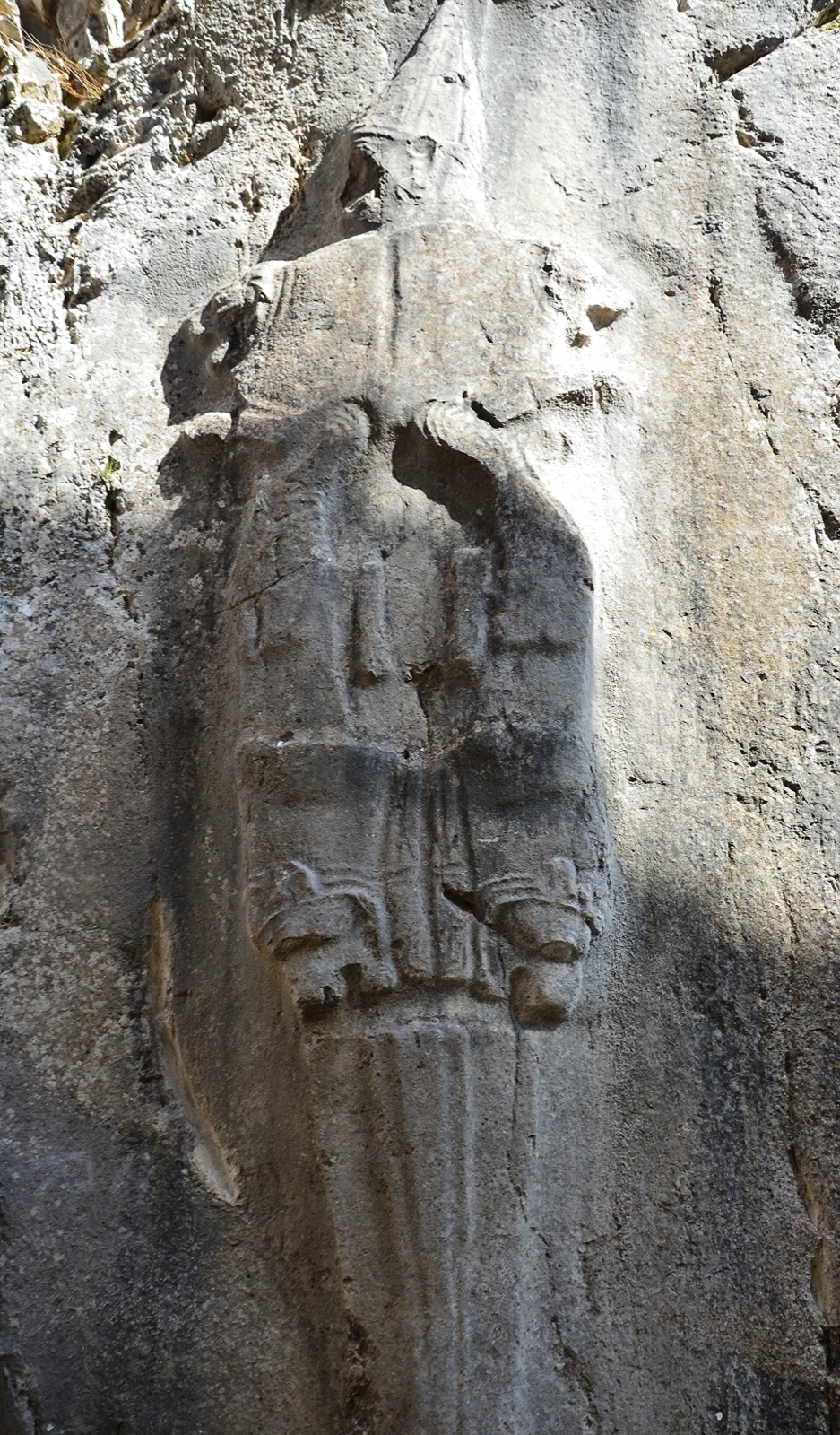
East wall of Chamber B at Yazılıkaya, the Hittite sanctuary of Hattusa, Turkey, with the relief of Nergal, the Sword God and God of the Underworld. Photo: Carole Raddato, CC BY-SA 2.0 · Source and licence
After Kutha the best-attested major cult center is Apiak, west of Marad, where the god was Lugal-Apiak already in Sargonic documents, though the site itself has not been located. In Assyria, where Nergal was absent in the Akkadian period and later rose to the first rank, Tarbisu was the important center of both the god and his wife Lasu. Sennacherib built his temple there, and it too bore the name E-meslam. A third E-meslam stood at Maskan-shapir, whose devotion to Nergal is thoroughly documented in the urban survey of Elizabeth Stone and Paul Zimansky.15,16,17
Lesser sanctuaries are a sign of his spread across the land. At Mê-Turan, excavators recovered a temple named E-shahulla, "house of the happy heart," identified by brick inscriptions and votives, its cheerful name a reference to the occasional association of Nergal with joy. A Babylon street called "the thoroughfare of Nergal of Joy" and the list-entry "Nergal of jubilation" belong to the same strange, warm undercurrent in the cult of a death god. Temples or offerings are further attested at Dilbat, Isin, Larsa, Nippur, Ur, Uruk, and Lagaba, where he was worshipped under the name Ishar-kidiSSu.16,18
When Tish-atal, endan of Urkesh, built a temple of Nergal and left behind the oldest text known in the Hurrian language, he was drawing the god north into a Hurrian zone that would keep him as one of its earliest and most durable foreign acquisitions there. Whether the "Nergal" of the earliest Urkesh inscriptions is the Mesopotamian god himself or a local Hurrian deity written with his name is a question Gernot Wilhelm leaves open, judging an identification with Kumarbi plausible but unproven.19
V. Nergal and Kings
The bond between Nergal and Mesopotamian rulers is old and deliberate. Naram-Sin of Akkad was particularly devoted to him, describing the god as his rābisu (caretaker) and himself as the god's rū'um (comrade). The language of a king who wished the terror of the underworld and the war-standard to be at his side was a convention and a pattern that outlasted the dynasty of Akkad by two millennia.7
The decisive shift came under the Third Dynasty of Ur. In the third millennium the deep south had little open worship of Nergal in the ultimate form, the one notable exception being Meslamtaea at Lagash in the days of Gudea. Under Shulgi this changed, and the theological texts of his reign present Nergal as one of the major gods and as king of the underworld outright. Enlil grants Nergal the power to fix fates, the goddess Baba installs him in the shrine Irikug, and the king Shulgi gives the god endless provisions in the end. The point is that the royal association with Nergal was far from marginal.17,20
In the Neo-Babylonian state pantheon Nergal ranked third, after Marduk and Nabu, and the three appear together across the royal inscriptions. Rocío Da Riva shows from a cylinder of Neriglissar that the upkeep of the E-meslam at Kutha counted as a royal duty on the same footing as the care of Marduk's E-sagil at Babylon and Nabu's E-zida at Borsippa. The hierarchy even reached into the naming of children, for in some families the third son received a name invoking Nergal, in accordance with the god's third place among the gods.21,22
Yet the honor was not matched pound for pound in offerings. The same texts that place Nergal third show that he and Lasu received fewer offerings at Kutha than Marduk or Nabu at their houses. Much like Hades, the prominence of Nergal may be reflective of his cosmogonical role, popular worship being a different story indeed.21
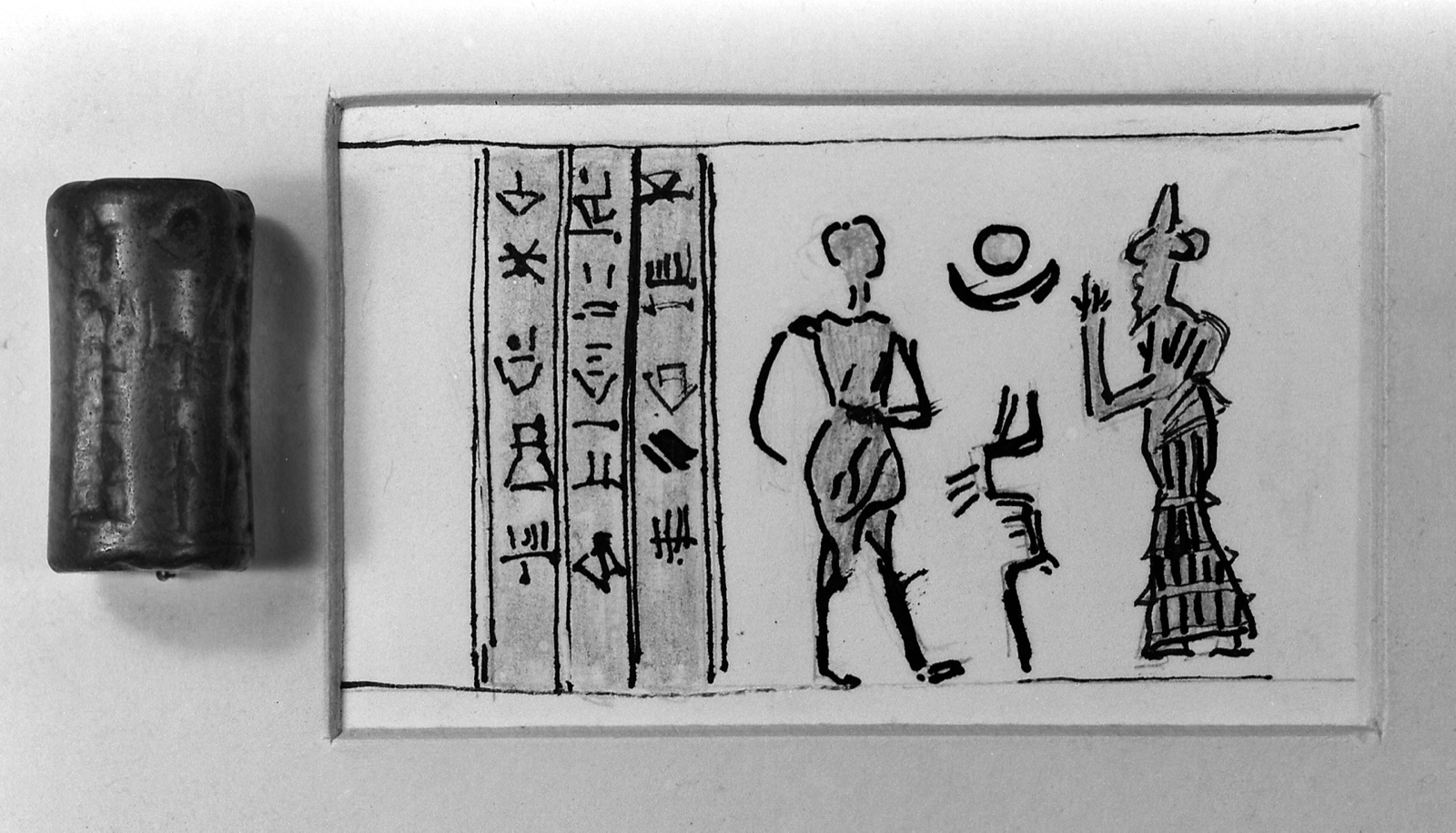
Cylinder seal and sketch of its impression depicting Nergal, god of plague and the netherworld; the crooked stick is his symbol. Wellcome Images, museum no. R 482/1937. Wellcome Collection, CC BY 4.0 · Source and licence
The Assyrian kings pressed the war-god harder than the Babylonians did. Esarhaddon styled Nergal the capturer of his enemies and the Enlil of the vast underworld, and Simonetta Ponchia has traced how Nergal's rituals were woven into Neo-Assyrian military practice and political theology. In the loyalty oaths edited by Simo Parpola and Kazuko Watanabe the god stands among the curses laid upon the oath-breaker. The king who marched under Nergal's standard marched under a threat as much as a blessing.23,24,25
VI. The Abyss of Nergal
The underworld of Nergal is called Kur, also called Irkalla and Ganzir. That is to say the land of no return whose gate the myths guard with fourteen keepers. His lordship there is attested in earlier texts. Already in the Early Dynastic Zame Hymns, the hymn to Kutha ties him to the underworld and to the Enki-Ninki deities, the ancestral gods of Enlil believed to dwell below. A hymn of Ishme-Dagan states that dominion over the land of the dead was bestowed on Nergal by his parents Enlil and Ninlil. One Old Babylonian adab song has him as "Enlil of the homeland and the underworld", paralleling the relation of Zeus Khthonios to Hades.2,26
The theology of that title is exactly made. As Enlil fixes the destinies of the living, so Nergal fixes the destinies of the dead; he was believed to decree fates below in the same manner Enlil decreed them above. This is why the epithet Enlil-banda, "junior Enlil," attaches to him, though the same title also belonged to Enki and cannot be pressed as Nergal's alone. The abyss is not chaos in this picture. It is the second Nippur, a governed ancient city with a lord who judges.2,26,27
A quieter strand of the evidence links Nergal with the going down of the sun, the setting place associated with death in many ancient cultures. Emil Kraeling and others in the early twentieth century made him a solar deity of midsummer and identified him with Shamash, the view is no longer held, it is untenable. The primary sources point to sunset. An Old Babylonian adab song sets him as judge at the hour the sun sets, another calls him "king of sunset," and the rituals that drive ghosts back below send them through the gates toward the setting sun. Nikita Artemov's guarded phrase, a "quasi-solar" character, fits the texts better than the discarded noonday sun.26,28
"I am the lord who walks in the night, who passes through the gate of sunset; the dead rise to greet me, the Anunnaki bow. I fix the fates in the great city below as my father Enlil fixes them above." , after an Old Babylonian adab to Nergal, paraphrased
VII. The Union of Ereshkigal and Nergal
The marriage of Nergal and Ereshkigal survives in two recensions of very different length. The shorter is a Middle Babylonian copy from Amarna in Egypt, seemingly written by a scribe whose first language was not Akkadian and sent west as a scribal school text. The longer, of perhaps seven hundred and fifty lines, comes from Sultantepe and from Uruk, in Neo-Assyrian and Neo-Babylonian copies. Oliver Gurney baked, joined, and published the Sultantepe tablets, identifying the text in the 1950s. When the original was composed is uncertain, with proposals ranging from Old to Middle Babylonian, and whether a Sumerian forerunner existed is unknown.29,30
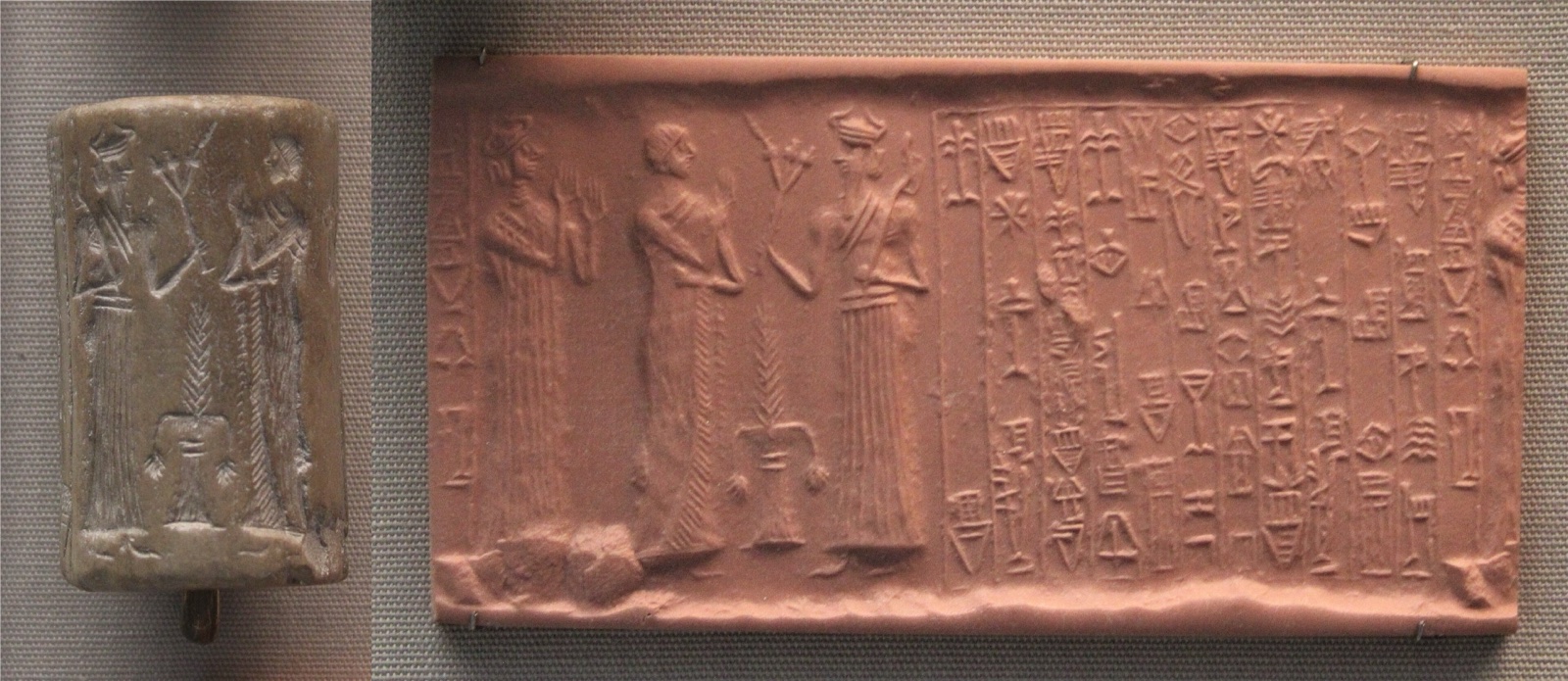
Calcite cylinder seal with modern impression, Third Dynasty of Ur: a worshipper prays before the god Meslamtaea, who carries the attributes of a warrior god, with a protective goddess behind him. The inscription names the owner as Kilula, the chair bearer, son of Ur-Bagara, servant of King Shulgi of Ur. British Museum 89131. Photo: Zunkir, CC BY-SA 4.0 · Source and licence
The story turns on an insult. At a feast, Nergal fails to rise for Ereshkigal's sukkal Namtar, who has come up as her proxy since the queen of the dead cannot leave her realm. She demands the offender be sent down to answer. Nergal descends, armed with Ea's advice on how to refuse the underworld's snares, the chair and the bread and the beer that would trap him. One counsel he ignores. He sleeps with Ereshkigal, and after six days slips away while she sleeps.30,31
Ereshkigal wakes to his absence and sends Namtar after him, threatening to raise the dead to devour the living unless he is returned. Nergal is handed back. Here the recensions part. The Amarna version, in which the queen had meant to kill him, ends with Nergal seizing her by the hair to kill her first, until she saves herself by offering marriage and a share of the throne. The Sultantepe and Uruk copies close in reconciliation, the two deities entering the bedchamber together, as Alhena Gadotti renders the final line.30,31
Beneath the plot lies a work of geographical reconciliation. Stephanie Dalley reads the myth as a device to fuse two views of the underworld, a northern one ruled by Nergal and a southern one ruled by Ereshkigal, into a single governed realm with a king and a queen. Gadotti places the idea of a shared kingship in older company, citing Gilgamesh, Enkidu and the Underworld, where the netherworld is given to Ereshkigal as a dowry. Older understandings of the tale as the "marginalization of goddesses" are superseded in current evidence. The union is ultimately a merger of jurisdictions: death is the handmaiden of war, war is the sword of death.30,31
VIII. Nergal as War God
Nergal's warfare is inseparable from death and disease, and Wiggermann's phrase gathers the three into one office: the god of "inflicted death." He was believed to march with the king on campaign. The weapons of Nergal are named without euphemism, the mace, the dagge and the bow. On the cylinder seals a mace with three lion-shaped heads and a scimitar with leonine decoration appear as his arms, and he wears the flat cap of the underworld gods, linking him to Hades too. The lion and the bull are his beasts.2,32,33
The paradox at the center of the war god is that his terror was held to secure peace. In this capacity, he bore the title Lugal-silimma, "Lord of Peace," not by irony but by deterrence, since a power fearsome enough deters the war it could wage. This logic is similar to that of the Egyptian god Maahes. The same logic governed his apotropaic role, in which he was invoked to guard houses against evil and his Erra epic was hung on the doorpost against the plague.2,9
In Assyria, as a conquering state, it appears the martial Nergal came into his own. War standards served as his symbol, and Assyrian armies carried such devotional objects on campaign. It represents him on the kudurru boundary stones. His identifications radiate outward along the lines of war and plague. The western Resheph, a god of war, plague, and death, was linked to him already at Ebla in the third millennium and again at Ugarit. The Elamite Simut shared both his warlike temper and his planet. Later in Hellenistic Hatra, Palmyra, and Tarsus it was Heracles who served as his Greek face, the club-bearing hero standing in for the mace-bearing god of the underworld.2,32,34
"The hero of the gods, who marches before them; the mace that shatters the mountain; the burner who goes at the king's right hand. Before him the rebel land is silent, and the enemy is bound." , after an Assyrian invocation of Nergal, paraphrased
IX. Nergal and the Planet Mars
The planet we call Mars was to the Mesopotamians the star of Nergal.. The MUL.APIN compendium, the great first-millennium astronomical text edited by Hermann Hunger and David Pingree, sets the correspondence down among its lists. The connection is there at the whole later tradition of celestial divination. The usual name of the planet was Salbatanu, of unclear meaning, and its red color and erratic motion made it the most malefic of the wandering stars, reckoned in the Babylonian omen literature more sinister even than Saturn.35,36
The names heaped on Mars in the star lists are basically like a portrait of the temper of Nergal. Ulla Koch-Westenholz gathered from the Great Star List such epithets as the enemy, the liar, the wicked, the strange, and the different, and Mars was counted among the stars of Amurru, the hostile west. The designation "unpredictable star" expresses the planet's habit of changing its place across the year, its retrograde loop that Babylonian observers recorded as early as the seventh century BCE. The red of it did the rest, red suggesting blood and fire, and so ill-boding omens gathered around the planet's risings and stations.36,37
Nergal was far from the only deity associated with Mars itself. Ninazu under the name "the Elam star," Nintinugga, and above all the Elamite Simut were also linked to the planet, so the star of Nergal was multi-faceted. Second, the disease the planet was thought to carry was specific: Mesopotamian belief tied Mars, like the god, to illness, and kidney disease in particular, possibly as it 'opposes' Venus. Nergal's red star was watched for what they portended to king and land.2,38,39
X. Nergal in the Bible
Nergal enters the Hebrew scriptures once by name, in the account of the peoples resettled in Samaria after the fall of the northern kingdom. "The men of Cuth made Nergal," the verse states, naming the god by his city, for Kutha was Cuth to the biblical writer and Nergal its god (2 Kings 17:30). The notice is brief and exact. The deportees carried the god of their home city with them into the emptied land of Israel, and the compiler of Kings set the fact down as evidence of the foreign cults planted there.40
The name surfaces again inside the theophoric name of a Babylonian officer. In the account of the fall of Jerusalem, among the princes of the king of Babylon who sat in the Middle Gate, is Nergal-sharezer, whose name renders the Akkadian Nergal-shar-uSur, "O Nergal, protect the king" (Jeremiah 39:3, 13). He is named again among those who had the prophet Jeremiah brought out of the court of the guard. Many scholars identify this Nergal-sharezer, the one titled Rab-mag, with Neriglissar, the son-in-law of Nebuchadnezzar who later took the Babylonian throne. The identification is probable rather than proven, and it should be offered as the likely reading it is.41,42
Later Jewish tradition tried to give the foreign god a face. The rabbinic sources associate Nergal with the image of a rooster, and the Victorian lexicographer E. Cobham Brewer, following that thread, glossed the name as "dunghill cock." Modern research sets the gloss aside. Nergal's name meant "lord of the great city," his beasts were the lion and the bull, and the chicken was unknown in Mesopotamia before the ninth century BCE and left no trace in the cuneiform record. The rooster belongs to the reception of Nergal, not to the god the tablets knew.1,43
XI. Festivals of Nergal
The rhythm of Nergal's worship was marked first in the days of the month. The fourteenth and the twenty-eighth were held sacred to him, and the number fourteen itself was his, the same fourteen that guards the gates of his underworld, though the number was shared in part with the herdsman-god Sakkan. A god of the underworld keeping the days of the waxing and the waning is fitting, the calendar itself descending and returning as he does.2,44
The upkeep of his cult at Kutha was, in the Neo-Babylonian ordering of things, a charge upon the king. The daily offerings for Nergal, for his wife Lasu, and for the gods of the E-meslam are provided for in the inscriptions of Nebuchadnezzar II, set beside the provision for Marduk and Nabu as a duty of the crown. Mark Cohen's study of the Mesopotamian cultic calendars places these observances within the first-millennium ritual year, in which the month Kislimu carried associations with the underworld and its lord. The festivals of Nergal were not, on the present evidence, the mourning-cycle that defined a dying god like Tammuz. They were the maintenance of a sovereign, the feeding of a king who reigns below.2,45,46
Ponchia's study of Nergal's rituals in Neo-Assyrian religious policy shows the other face of the festival calendar, the military one. The god's rites were tied to the practice of war and to the theology of a state that fought in his name, so that to honor Nergal on his days was also to renew the terms of a martial covenant. Here the domestic and the imperial meet. The same god fed at Kutha and hung on the doorpost against the plague was carried on the standard into the enemy's land.23
There is no securely reconstructed great annual procession of Nergal to set beside the lament-cycle of Tammuz or the akitu of Marduk.2,45
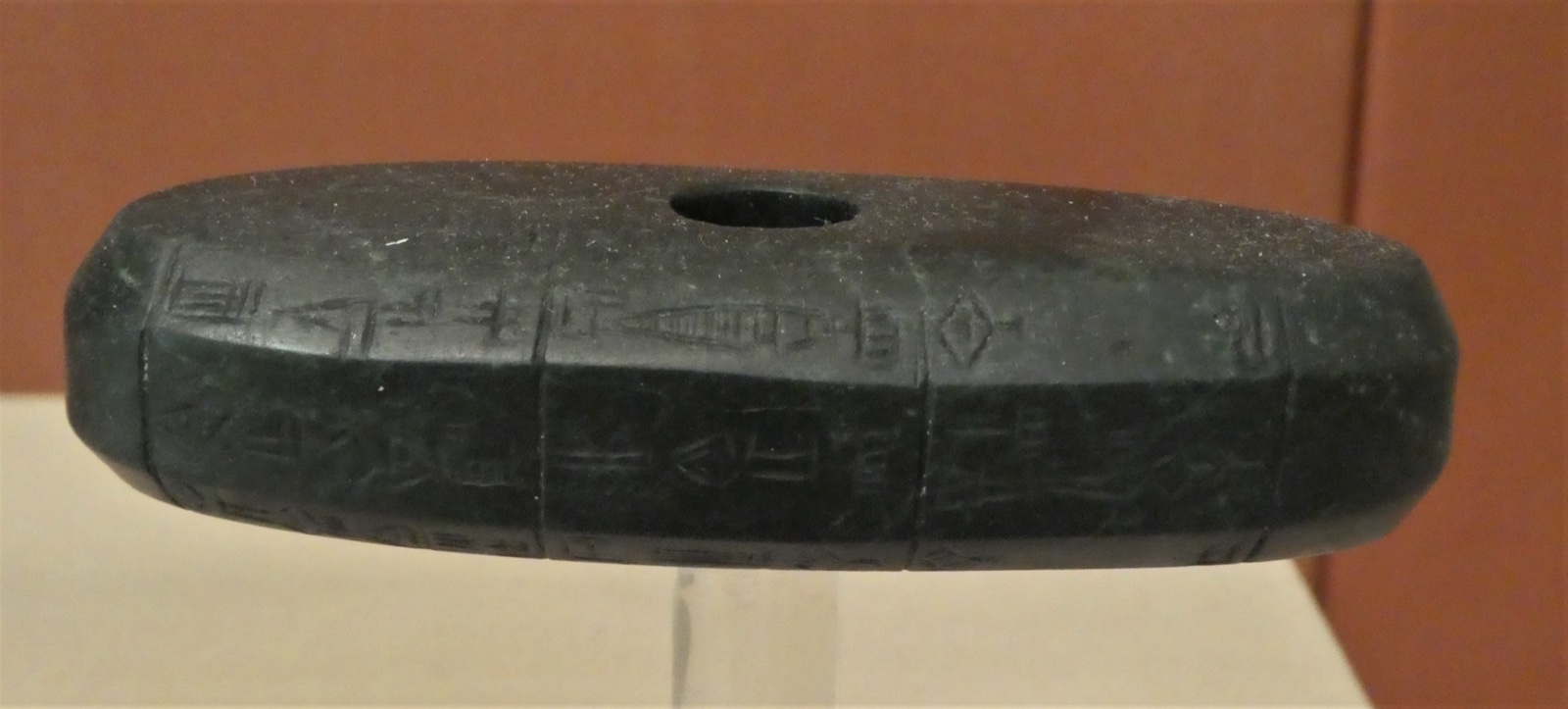
Green marble mace head with an inscription dedicating it to the god Nergal, offered by a man named Labashum on behalf of Shu-Turul, the last king of the Akkadian Empire (c. 2168-2154 BC). British Museum 114703. Photo: Zunkir, CC BY-SA 4.0 · Source and licence
Sources and Bibliography
Wiggermann, F. A. M. "Nergal A. Philologisch." In Reallexikon der Assyriologie und Vorderasiatischen Archäologie, vol. 9, 215–23. Berlin: De Gruyter, 1999.
Wiggermann, F. A. M. "Nergal A. Philologisch." In Reallexikon der Assyriologie und Vorderasiatischen Archäologie, vol. 9, 216–23. Berlin: De Gruyter, 1999.
Steinkeller, Piotr. "The Name of Nergal." Zeitschrift für Assyriologie und Vorderasiatische Archäologie 77 (1987): 161–68.
Lambert, W. G. "The Name of Nergal Again." Zeitschrift für Assyriologie und Vorderasiatische Archäologie 80 (1990): 40–52.
Steinkeller, Piotr. "More on the Name of Nergal and Related Matters." Zeitschrift für Assyriologie und Vorderasiatische Archäologie 80 (1990): 53–59.
Lambert, W. G. "Studies in Nergal." Bibliotheca Orientalis 30 (1973): 355–63.
Wiggermann, F. A. M. "Nergal A. Philologisch." In Reallexikon der Assyriologie und Vorderasiatischen Archäologie, vol. 9, 217. Berlin: De Gruyter, 1999.
Cagni, Luigi. The Poem of Erra. Sources from the Ancient Near East 1, fasc. 3. Malibu, CA: Undena Publications, 1977. See also George, Andrew R., in Foster, Before the Muses, and Weiershäuser, "Epic of Erra," Oxford Classical Dictionary, 2023.
Reiner, Erica. "Plague Amulets and House Blessings." Journal of Near Eastern Studies 19, no. 2 (1960): 148–55.
Foster, Benjamin R. Before the Muses: An Anthology of Akkadian Literature. 3rd ed. Bethesda, MD: CDL Press, 2005, 880–911.
Lambert, W. G. Babylonian Creation Myths. Winona Lake, IN: Eisenbrauns, 2013, 281–82, 384–85. (Enmesharra's Defeat and the Labbu-type serpent myth.)
George, Andrew R. "The Mayfly on the River: Individual and Collective Destiny in the Epic of Gilgamesh." Kaskal 9 (2012): 422–23. (The one-eyed igitelû.)
Luukko, Mikko, and Simonetta Ponchia. The Standard Babylonian Myth of Nergal and Ereškigal. State Archives of Assyria Cuneiform Texts 8. Helsinki: Neo-Assyrian Text Corpus Project, 2013.
Katz, Dina. The Image of the Netherworld in the Sumerian Sources. Bethesda, MD: CDL Press, 2003, 421.
George, Andrew R. House Most High: The Temples of Ancient Mesopotamia. Mesopotamian Civilizations 5. Winona Lake, IN: Eisenbrauns, 1993, 102, 126–27, 143–44.
George, Andrew R. Babylonian Topographical Texts. Orientalia Lovaniensia Analecta 40. Leuven: Peeters, 1992, 238, 362.
Wiggermann, F. A. M. "Nergal A. Philologisch." In Reallexikon der Assyriologie und Vorderasiatischen Archäologie, vol. 9, 221–22. Berlin: De Gruyter, 1999.
Stone, Elizabeth C., and Paul Zimansky. The Anatomy of a Mesopotamian City: Survey and Soundings at Mashkan-shapir. Winona Lake, IN: Eisenbrauns, 2004.
Wilhelm, Gernot, and Giorgio Buccellati on the Tish-atal and Atal-shen inscriptions of Urkesh; see Archi, Alfonso, "The West Hurrian Pantheon and Its Background," in Beyond Hatti, Atlanta: Lockwood Press, 2013, 7–8.
Peterson, Jeremiah. "An Adab Composition of Nergal/Meslamtaea at Lagaš and Ĝirsu for Šulgi." Journal of Cuneiform Studies 67 (2015): 45–63.
Da Riva, Rocío. "Dynastic Gods and Favourite Gods in the Neo-Babylonian Period." In Concepts of Kingship in Antiquity, 45–48. Padova and Winona Lake, IN: S.A.R.G.O.N. / Eisenbrauns, 2010.
Frame, Grant, and Jamie Novotny, eds. "Nebuchadnezzar II 011." In Royal Inscriptions of Babylonia Online: Babylon 7. Philadelphia and Munich, 2024.
Ponchia, Simonetta. "Nergal's Rituals in Neo-Assyrian Religious Policy." In Ana šulmāni: Ancient Near Eastern Studies in Honour of Simonetta Graziani, edited by Noemi Borrelli, 351–78. Series Minor 99. Naples: UniorPress, 2022.
Leichty, Erle. The Royal Inscriptions of Esarhaddon, King of Assyria (680–669 BC). Royal Inscriptions of the Neo-Assyrian Period 4. Winona Lake, IN: Eisenbrauns, 2011.
Parpola, Simo, and Kazuko Watanabe, eds. Neo-Assyrian Treaties and Loyalty Oaths. State Archives of Assyria 2. Helsinki: Helsinki University Press, 1988.
Zólyomi, Gábor, and Jeremiah Peterson on the Ishme-Dagan hymn and the "Enlil of the underworld" adab; see Peterson, JCS 67 (2015): 48, 56–57.
Wiggermann, F. A. M. "Nergal A. Philologisch." In Reallexikon der Assyriologie und Vorderasiatischen Archäologie, vol. 9, 219. Berlin: De Gruyter, 1999.
Artemov, Nikita. "The Elusive Beyond: Some Notes on the Netherworld Geography in Sumerian Tradition." In Altorientalische Studien zu Ehren von Pascal Attinger, 22–23. Fribourg and Göttingen: Academic Press / Vandenhoeck & Ruprecht, 2012.
Gurney, O. R. "The Sultantepe Tablets (Continued), VII: The Myth of Nergal and Ereshkigal." Anatolian Studies 10 (1960): 105–31.
Gadotti, Alhena. "Never Truly Hers: Ereškigal's Dowry and the Rulership of the Netherworld." Journal of Ancient Near Eastern Religions 20, no. 1 (2020): 1–16.
Dalley, Stephanie. Myths from Mesopotamia: Creation, the Flood, Gilgamesh, and Others. Rev. ed. Oxford: Oxford University Press, 2000, 163–81.
Black, Jeremy, and Anthony Green. Gods, Demons and Symbols of Ancient Mesopotamia: An Illustrated Dictionary. London: British Museum Press, 1992, s.v. "Nergal," "Erra," and "Weapons."
Wiggermann, F. A. M. "Nergal B. Archäologisch." In Reallexikon der Assyriologie und Vorderasiatischen Archäologie, vol. 9, 223–26. Berlin: De Gruyter, 1999.
Al-Salihi, Wathiq. "Hercules-Nergal at Hatra." Iraq 33, no. 2 (1971): 113–15; and "Hercules-Nergal at Hatra (II)." Iraq 35, no. 1 (1973): 65–69.
Hunger, Hermann, and David Pingree. MUL.APIN: An Astronomical Compendium in Cuneiform. Archiv für Orientforschung, Beiheft 24. Horn, Austria: Ferdinand Berger, 1989.
Reiner, Erica. Astral Magic in Babylonia. Transactions of the American Philosophical Society 85, pt. 4. Philadelphia: American Philosophical Society, 1995.
Koch-Westenholz, Ulla. Mesopotamian Astrology: An Introduction to Babylonian and Assyrian Celestial Divination. CNI Publications 19. Copenhagen: Museum Tusculanum Press, 1995.
Rochberg, Francesca. The Heavenly Writing: Divination, Horoscopy, and Astronomy in Mesopotamian Culture. Cambridge: Cambridge University Press, 2004.
Henkelman, Wouter, on Simut and the star Simut; see the discussion in Wiggermann 1999, 222–23, and Reiner 1995.
The Holy Bible: New Revised Standard Version, Updated Edition. Washington, DC: National Council of Churches, 2021. 2 Kings 17:30.
The Holy Bible: New Revised Standard Version, Updated Edition. Washington, DC: National Council of Churches, 2021. Jeremiah 39:3, 13.
Wiseman, D. J., and the Babylonian Chronicle on Neriglissar; see the standard commentaries on Jeremiah 39 and the identification with Neriglissar (559–556 BCE).
Klein, on the rabbinic rooster tradition, and Brewer, E. C., Dictionary of Phrase and Fable. London: Cassell, 1895, 268, corrected by Powell on the late arrival of the chicken in Mesopotamia.
Lambert, W. G. Babylonian Creation Myths. Winona Lake, IN: Eisenbrauns, 2013, 188 (the sacred fourteenth and twenty-eighth days).
Frame and Novotny, eds. "Nebuchadnezzar II 011," RINBE: Babylon 7, 2024 (daily offerings for Nergal, Lasu, and the gods of E-meslam).
Cohen, Mark E. The Cultic Calendars of the Ancient Near East. Bethesda, MD: CDL Press, 1993.