




14 min read
The Falcon of Horus
author: High Priest Zevios Metathronos
ἱέραξ (hiérax)
The bird of Horus, Re-Harakhty, Montu and Apollo, and the bearer of soma to Indra: the focused solar will.
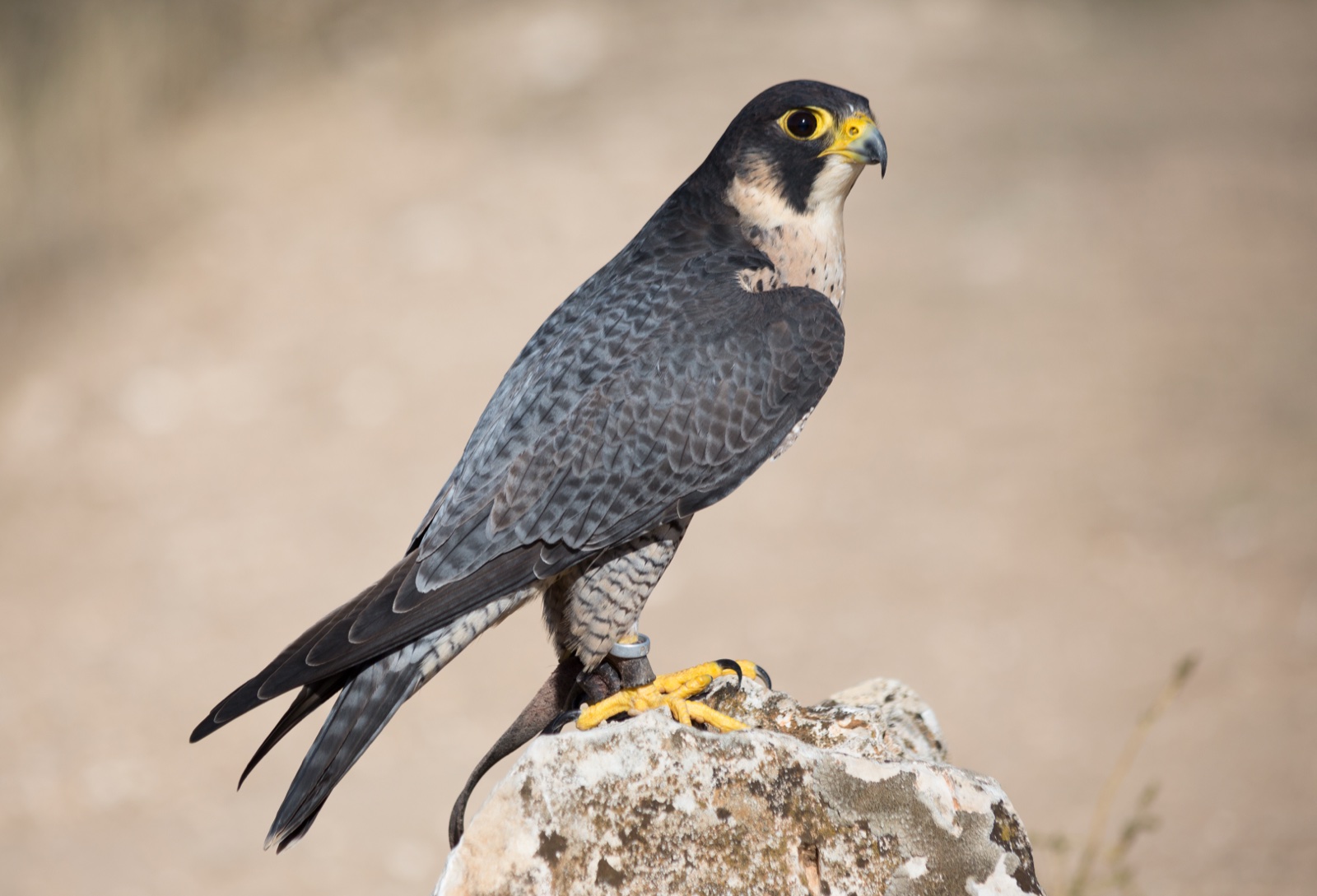
Carlos Delgado · CC BY-SA 4.0 · Wikimedia Commons

The peregrine falcon is often reported to be the fastest bird in the world[1], and Egypt gave its form to Horus and to its kings. The falcon is the soul's focused will under the Sun: the faculty that chooses one aim and descends on it.
| Realm | Birds of the Heavens |
|---|---|
| Greek | ἱέραξ (hiérax); Homeric κίρκος (kírkos) |
| Latin | accipiter |
| Other Names | Sanskrit śyena; Old Norse valr (in valshamr, falcon-shape) |
| Species | Falco peregrinus (peregrine falcon) and kin |
| Gods | Horus, Re-Harakhty, Montu, Apollo, Indra (Śyena), Freyja |
| Material Capacity | Stoops at 320 km/h and more; 2 foveae in each eye; found on every continent but Antarctica |
| Spiritual Capacity | The focused solar will; the kingship of the higher self; the bearer of soma |
| Element and Sphere | Air and Fire; the Sun; the stoop from the height |
The Living Animal
The peregrine falcon, Falco peregrinus, carries the falcon's name across the world: it is found on every continent except Antarctica and on many oceanic islands[2]. It hunts other birds in the open air, and its whole body is shaped for one act, the stoop: a dive from a great height onto prey in flight.
The peregrine is often reported to be the fastest bird in the world, and its speed in the stoop has been calculated at 238 mph[1]. Cornell's overview gives 320 km/h (200 mph) for a falcon dropping toward its prey from more than 1 km up; in travelling flight it averages 40 to 55 km/h, and in direct pursuit it reaches 112 km/h[2]. A 2014 study of the falcon's diving aerodynamics cites stoops of more than 320 km/h, and measured falcons in shorter dives from a dam at up to 22.5 metres per second[3]. It nests on cliffs from about 25 to 1,300 feet high, and also on towers, quarries, silos, bridges, churches and skyscrapers, laying its eggs in a bare scrape about 9 inches across[1].
Speed of that order demands a particular way of seeing. Each eye of a raptor has 2 foveae: a deep fovea, the sharper of the 2, whose line of sight points about 45 degrees to the side of the head, and a shallow fovea set about 15 degrees from its axis; hawks and falcons in Tucker's study shifted their heads between straight and sideways positions roughly every 2 seconds[4].
A falcon diving at about 70 metres per second would increase its drag by a factor of 2 or more if it turned its head to keep the deep fovea on the prey. Tucker's solution is a logarithmic spiral: the falcon keeps its head straight, holds the prey in one eye, and curves in; his model of an “ideal falcon” reaches the prey sooner on that longer path[4].
The species came close to the edge. Pesticide poisoning virtually eradicated the peregrine from eastern North America in the middle of the 20th century; it has since made a strong rebound and now lives regularly in many large cities and coastal areas, and a banded wild bird has lived at least 19 years and 9 months[2].
The Spiritual Capacity: The Solar Will
In Egypt the falcon is the form of Horus, a God whose right eye was the Sun and whose left eye was the Moon[5]. The Temple reads the falcon as the soul's focused will standing under the Sun: the faculty that chooses one aim, holds it in sight and descends on it without wavering. The teaching of the wedjat, the healed eye of Horus, is given on The Sacred Eye.
The falcon is also the bird of kingship. At Nekhen, the city the Greeks called Hierakonpolis, the reigning king was held to be a manifestation of Horus[5]. In Zevism this is the royal part of the soul: the higher self that governs the passions as a king governs a land. The Zevist who rules himself in Ma'at wears the falcon within.
Hellas knew the same bird as the messenger of the solar God. Homer calls the kirkos “the swift messenger of Apollo”[6], and Herodotus writes that Horus, son of Osiris, is the God the Greeks name Apollo[7]. The falcon is therefore the solar faculty of the soul. In the Temple's teaching it belongs to the solar chakra, the Grail, where the soul's Sun is kindled, and its 2 eyes of Sun and Moon are Light and Darkness bound together by Ma'at.
In the Ṛgveda the falcon, Śyena, brings the soma to the Gods; Britannica summarizes the Vedic image as an eagle carrying soma from heaven to earth[8]. Indra receives it, and in the Temple's teaching Indra is Zeus[9]. The falcon is thus the soul's power to rise to the highest centre and return bearing the nectar of the Gods: the crown and the Third Eye opened, and their light carried down into life.
In the North the falcon-shape is a garment. Freyja owns it, and Loki puts it on to fly to Jötunheimr and bring Iðunn back to the Gods[10]. The Temple reads it as the soul's subtle body, the aura, whose strength lets consciousness rise beyond its ordinary sphere and come home with what had been lost.
Where Matter and Spirit Meet
The peregrine's capacities can be measured, and each measure answers a power of the soul.
- The stoop and the descent of attention. The falcon drops from more than 1 km at up to 320 km/h[2]. Concentration works the same way: the mind gathers height in stillness and then falls on its object with its whole weight. The Zevist trains this in meditation, where scattered attention becomes a single line of force.
- The fixed eye on the curved path. The diving falcon keeps its head straight and one eye on the prey while its course bends in a spiral[4]. The soul's aim, Theosis, is held the same way: the gaze stays fixed while the road turns through years, reversals and changes of circumstance (Becoming as the Gods).
- The measured use of speed. The peregrine travels at 40 to 55 km/h, pursues at 112 km/h and keeps its full speed for the stoop[2]. This is Arete as right measure: power spent in proportion to the task, never wasted on display, released in full only when the moment demands it.
- The bare ledge. The peregrine builds no nest; it lays its eggs in a shallow scrape on a ledge, often on cliffs hundreds of feet high[1]. The soul that lives at height needs little: simplicity of possession leaves the whole strength free for flight, and the Zevist keeps the outer life plain so that the inner life can climb.
- The return after poison. Pesticides nearly erased the peregrine from eastern North America, yet it came back and now nests in great cities[2]. The solar faculty of the soul can be poisoned by disorder and still return when the poison is removed. Purification restores the falcon within.
The Gods and Their Many Names
The falcon gathers around the solar King and His champions. In Egypt it is Horus, Re-Harakhty, the falcon-headed form of the Sun God Re, and Montu, whom the Temple identifies with Ares and Mars; in Hellas it is the messenger of Apollo, and Herodotus states plainly that the Greeks called Horus Apollo[7]. In India the falcon serves Indra, whom the Temple holds to be Zeus[9], and in the North the falcon-shape belongs to Freyja.
| Civilization | God (and the Temple's identity) | The Bond with the Animal | Witness |
|---|---|---|---|
| Egypt | Horus | A falcon God whose eyes were the Sun and the Moon; at Nekhen the king was His manifestation. | Britannica, “Horus”[5] |
| Egypt | Horus of Behdet (Edfu) | “Horus of the Winged Disk, called the Behdetite”, lord of the temple at Idfu, which the Greeks called Apollinopolis. | Britannica, “Idfu”[11] |
| Egypt | Re-Harakhty (the Sun God Re) | The falcon-headed God crowned with the sun disk. | Metropolitan Museum 26.7.863[12] |
| Egypt | Montu (Ares, Mars) | A God of combat shown as a man with a falcon's head, worshipped at Thebes and Hermonthis. | Britannica, “Mont”[13] |
| Hellas | Apollo (whom Herodotus equates with the Egyptian Horus) | The kirkos, a hawk, is “the swift messenger of Apollo”. | Homer, Odyssey 15.525-526[6] |
| Vedic India | Indra (Zeus) | Śyena, the falcon swiftest of falcons, brings the oblation, the soma, by its own power. | Ṛgveda 4.26.4[14] |
| The North | Freyja | Owns the falcon-shape (valshamr) that Loki borrows to fly to Jötunheimr. | Skáldskaparmál[10] |
The thread is the Sun's sovereignty and its swift execution. The eagle stands beside the Head God Himself; the falcon stands beside the solar son who rules in His name and the warrior who fights for Him, and in India it serves the King of the Gods by fetching the drink of immortality. Egypt holds the oldest and fullest form of this witness, and the Greeks gave Idfu, the city of Horus, the name Apollinopolis[11].
The temple of Horus at Idfu was begun in 237 BC and completed in 57 BC on the site of an earlier temple of the 18th dynasty[11], and a statue of Horus still stands there. The winged disk of the Behdetite is taught on The Winged Sun.
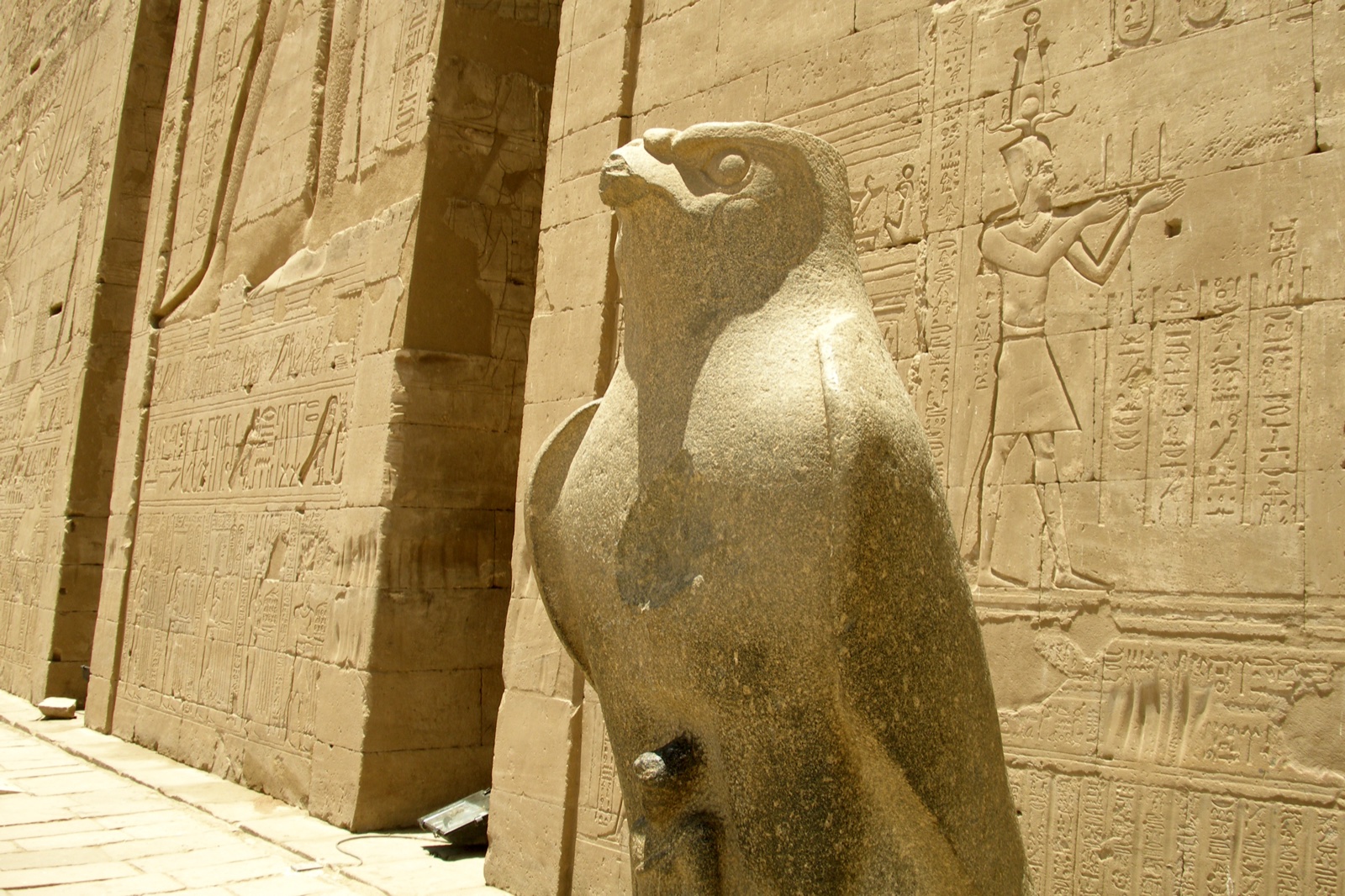
Vyacheslav Argenberg · CC BY 4.0 · Wikimedia Commons

Ancient Witnesses
Homer, Herodotus, the Ṛgveda and Snorri's Edda give the falcon in their own words. The Greek follows the Perseus editions, the Sanskrit the text of the Sacred Text Archive, and the Old Norse the edition of Guðni Jónsson. The translations are the Temple's own.
ὣς ἄρα οἱ εἰπόντι ἐπέπτατο δεξιὸς ὄρνις,
κίρκος, Ἀπόλλωνος ταχὺς ἄγγελος· ἐν δὲ πόδεσσιAs he spoke, a bird flew by on the right, a falcon, the swift messenger of Apollo, and in its feet...
Homer, The Odyssey, ed. A. T. Murray (London and New York, 1919) · Translation: Temple of Zeus. The falcon holds a dove in its talons and plucks it (15.527).
Herodotus, Histories 2.65.5, 2.67.1 [18]
ὃς δʼ ἂν ἶβιν ἢ ἴρηκα ἀποκτείνῃ, ἤν τε ἑκὼν ἤν τε ἀέκων, τεθνάναι ἀνάγκη.
τὰς δὲ μυγαλᾶς καὶ τοὺς ἴρηκας ἀπάγουσι ἐς Βουτοῦν πόλιν, τὰς δὲ ἴβις ἐς Ἑρμέω πόλιν.Whoever kills an ibis or a hawk, willingly or unwillingly, must die. ... Shrewmice and hawks they carry away to the city of Buto, and ibises to Hermopolis.
Herodotus, ed. A. D. Godley (Cambridge, MA, 1920) · Translation: Temple of Zeus. The 2 sentences are separated in the text by the account of sacred cats and dogs.
प्र सु ष विभ्यो मरुतो विर् अस्तु प्र श्येनः श्येनेभ्य आशुपत्वा । अचक्रया यत् स्वधया सुपर्णो हव्यम् भरन् मनवे देवजुष्टम् ॥
pra su ṣa vibhyo maruto vir astu pra śyenaḥ śyenebhya āśupatvā | acakrayā yat svadhayā suparṇo havyam bharan manave devajuṣṭam ||
Let this bird be foremost among birds, O Maruts, this swift-flying falcon foremost among falcons, since by its own power, without a chariot, the well-winged one brought to Manu the oblation dear to the Gods.
Ṛgveda-Saṃhitā, transliterated text, Internet Sacred Text Archive · Translation: Temple of Zeus. The oblation is the soma, brought by the falcon for Indra.
Snorri Sturluson, Skáldskaparmál (Bragaræður) [10]
En er hann varð hræddr, þá kvaðst hann mundu sækja eftir Iðunni í Jötunheima, ef Freyja vill ljá honum valshams, er hon á.
Ok er hann fær valshaminn, flýgr hann norðr í Jötunheima ok kemr einn dag til Þjaza jötuns.And when He grew afraid, He said that He would go after Iðunn into Jötunheimr if Freyja would lend Him the falcon-shape that She owns. And when He has the falcon-shape, He flies north into Jötunheimr and comes one day to the giant Þjazi.
Snorra-Edda, ed. Guðni Jónsson, text at Heimskringla.no · Translation: Temple of Zeus. Brodeur (1916) renders valshamr as “the hawk's plumage”.
Universal Significance: Kings, Falconers and Cities
Egypt made the falcon the first name of its kings. The full royal title contained 5 names, each introduced by a title, beginning with Horus[15], and the Metropolitan Museum notes of its Horus falcon inlays that the God, closely associated with kingship, appears prominently in the king's titularies[16]. Dynasty 30 pressed the bond further: a statue of 360 to 343 BC shows Horus as a great falcon protecting King Nectanebo II, and a cult honoured the king as “Nectanebo-the-Falcon”[17].
The living bird shared that holiness. Herodotus records that whoever killed an ibis or a hawk in Egypt, willingly or not, was put to death, and that dead hawks were carried to the city of Buto[18]. The Met keeps a hollow bronze falcon of the Late or Ptolemaic Period whose X-rays reveal animal bones, presumably those of a falcon, sealed inside as in a coffin[19].
Falconry carries the bond between human and falcon into the present. UNESCO inscribed “Falconry, a living human heritage” on its Representative List in 2021, with 24 countries taking part; it describes the art as the training and flying of falcons, and sometimes eagles, hawks, buzzards and other birds of prey, practised for over 4000 years[20].
The peregrine's own story has become a modern emblem of renewal. Driven from eastern North America by pesticides in the 20th century, it now lives regularly in large cities and along coasts[2], nesting on skyscrapers and bridges[1], and its dive remains a subject of aerodynamic research[3].
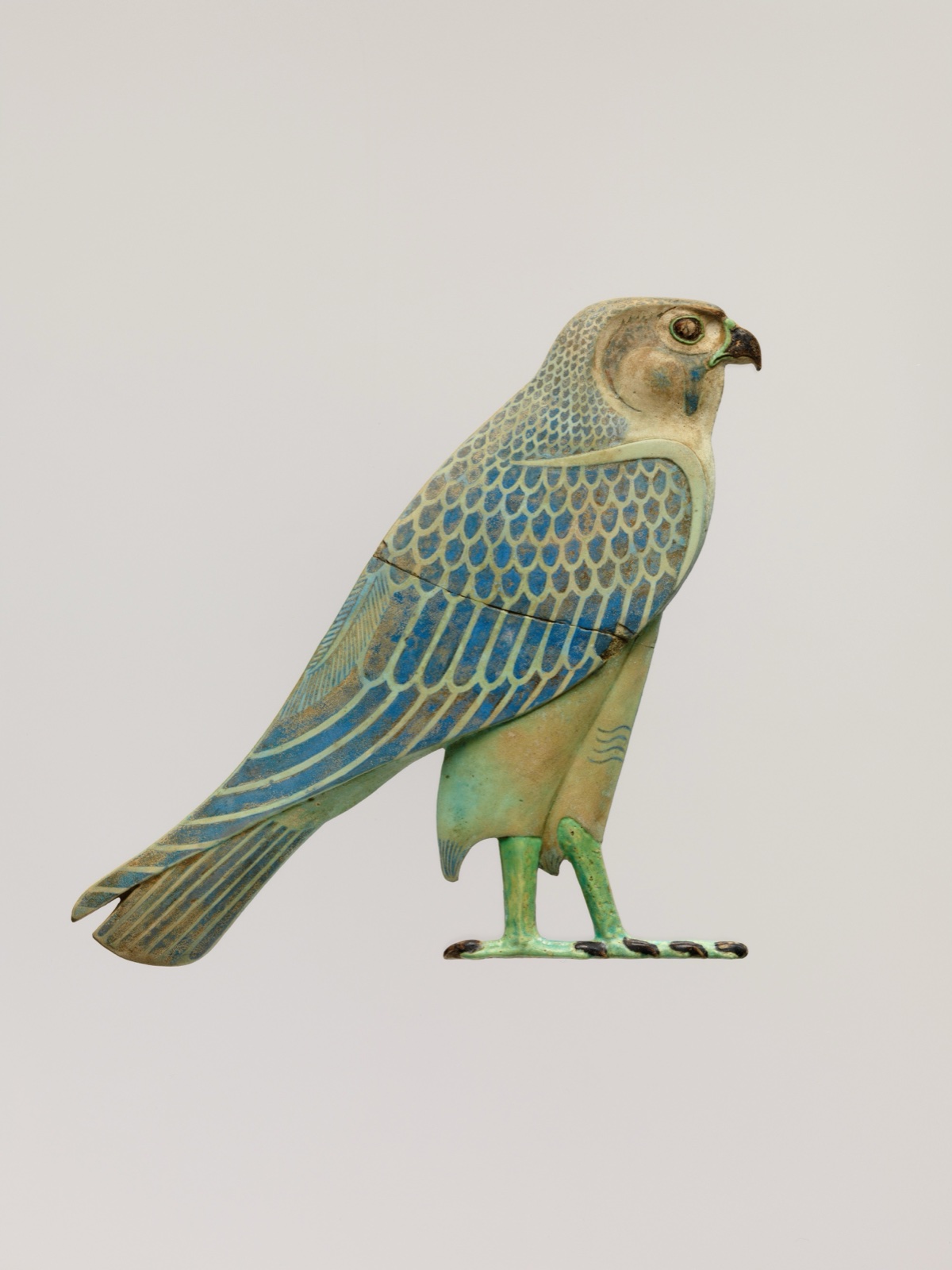
The Metropolitan Museum of Art · CC0 · Wikimedia Commons

In Zevist Contemplation
The Zevist works with the falcon to train concentration, sovereignty over the self and the balance of the 2 lights. The practices below belong to personal meditation and conduct.
- The stoop of attention. Sit upright, breathe slowly, and let the attention rise and widen like a falcon gaining height. Then choose one object, a word, a flame or the point between the brows, and let the whole attention fall on it and stay there.
- The 2 eyes of Horus. Breathe with awareness of the right side of the body as the solar current and the left as the lunar, then draw both into the centre of the head. The practice joins the Sun and the Moon of the falcon God in one gaze, as Ida and Pingala meet in Sushumna (Kundalini).
- The king on the throne. When anger or appetite rises, picture the falcon of Horus standing behind the head, as on the statue of Nectanebo II, and let the higher self give the order. Conduct governed this way is the royal Horus name made real in daily life.
- The falcon's return. After a lapse in discipline, return to practice at once, without self-reproach, as the peregrine returned to the cities that had lost it. Purification consists in removing what poisons the soul and resuming the flight.
The falcon's eye and the winged disk have their own pages: The Sacred Eye and The Winged Sun.
Continue exploring
Related Pages
- The Gods: Horus
- Symbol: The Sacred Eye
- Symbol: The Winged Sun
- The Gods: Apollo
- Sacred Animal: The Eagle of Zeus
- Sacred Animal: The Vulture of Nekhbet
- Previous: The Eagle of Zeus
- Next: The Vulture of Nekhbet
- All 32 Sacred Animals
- All symbols