




13 min read
The Vulture of Nekhbet
author: High Priest Zevios Metathronos
γύψ (gýps)
The bird of Nekhbet and Mut, of Romulus and Heracles: purifier, protecting Mother and guardian of order.
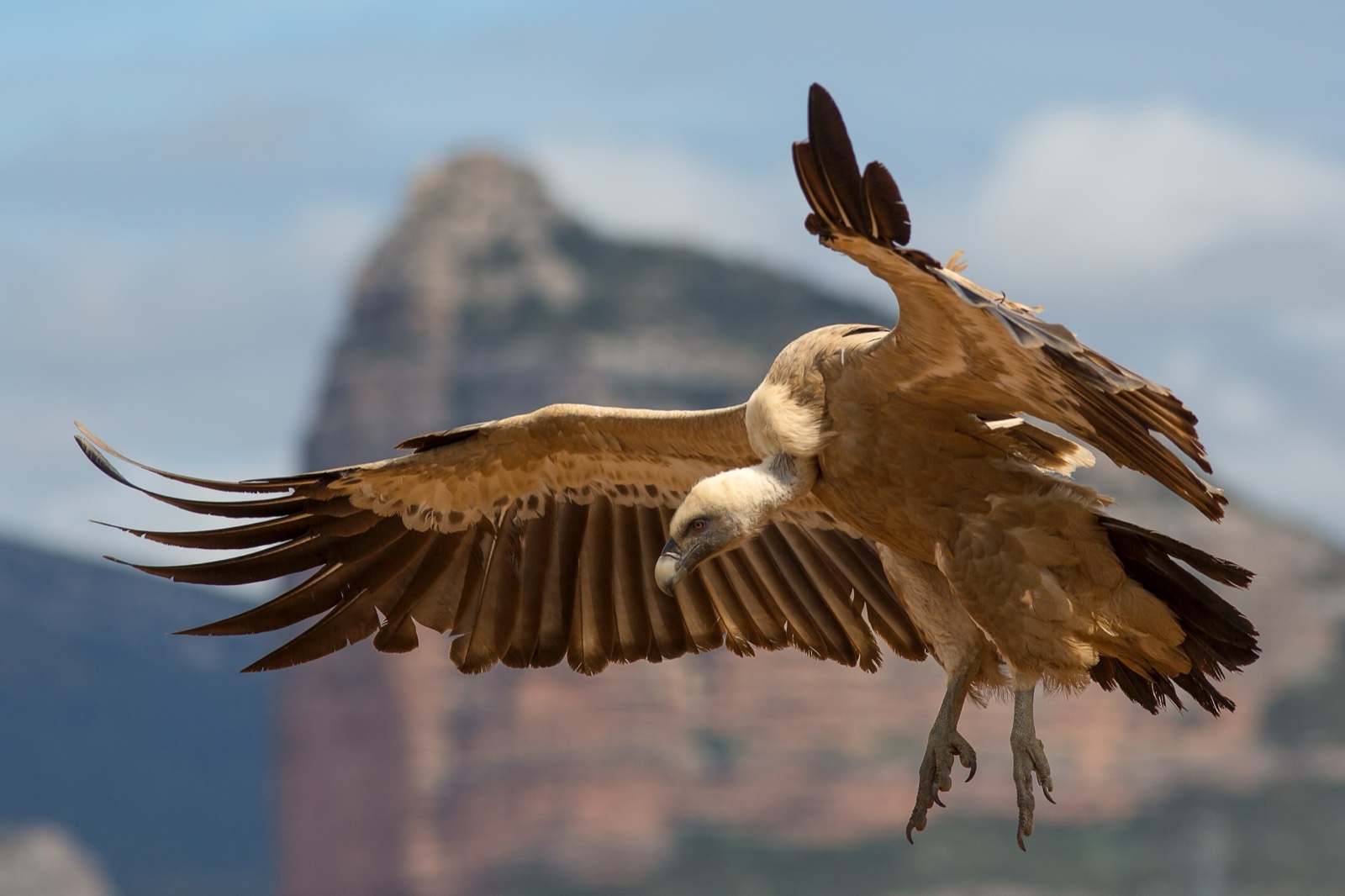
Pierre Dalous · CC BY-SA 3.0 · Wikimedia Commons

The vulture kills nothing and feeds on the dead, and for that reason Heracles welcomed it as the purest of omens[1]. It is the purifier of the world, the wing of the protecting Mother and a guardian of Ma'at against dissolution.
| Realm | Birds of the Heavens |
|---|---|
| Greek | γύψ (gýps) |
| Latin | vultur |
| Other Names | Griffon; lammergeier (bearded vulture) |
| Species | Gyps fulvus (griffon), Gypaetus barbatus (bearded vulture), Gyps rueppelli (Rüppell's vulture) |
| Gods | Nekhbet, Mut, Mars (augury), Heracles, Jatayu |
| Material Capacity | Flight to 11,300 m; acidic digestion that kills carrion bacteria; a flock clears a carcass in an hour |
| Spiritual Capacity | Purification; the protecting Mother; the turning of death into life |
| Element and Sphere | Air and Earth; the summit and the threshold of death |
The Living Animal
The griffon vulture, Gyps fulvus, is the great vulture of the Mediterranean: a wingspan of 2.4 to 2.8 metres, a weight of 6 to 11 kg, and the most social habits of Europe's 4 vultures, foraging in groups and breeding in colonies on steep cliffs that can hold hundreds of birds[2]. It feeds on the soft tissue of large herbivores, its long neck reaching deep into the carcass, and its build limits it to soaring and gliding, so that its day depends on the state of the air[2]. Pliny already knew that vultures nest on the highest crags[3].
The bearded vulture, Gypaetus barbatus, lives on what every other scavenger leaves: bone makes up 85 to 90 percent of its diet. When a bone is too large to swallow, it carries it up to 100 metres and drops it onto rock to break it; its wings span 2.5 to 2.85 metres[4].
Rüppell's vulture, Gyps rueppelli, holds an extraordinary height record. One individual reached 11,300 metres (37,100 feet), a flight that may have been a one-time anomaly and that became known when the bird was drawn into an aircraft engine; its distinctive hemoglobin uses oxygen more efficiently and helps it survive at altitude[5].
The vulture's senses and body are built for its office. Measured acuity in vultures reaches 89 to 135 cycles per degree, against 33 to 73 in humans[6], and Rüppell's vulture finds its food by sight, not smell; it is a strict carrion feeder whose very acidic stomach kills harmful bacteria[5]. In the New World vultures, a separate family[7], the acidic digestive tract acts as a strong filter on the microbes of the gut, and the birds show a remarkable tolerance to the bacterial toxins of decaying meat[8].
The work is vast. A flock can reduce an adult cow carcass to bare bones within an hour, each bird eats about 120 kg of meat a year, and in the early 1990s India's 100 to 160 million vultures consumed an estimated 20 million tonnes of carrion[9].
The Spiritual Capacity: Purifier and Mother
The vulture is the purifier of the world. Plutarch, following Herodorus of Pontus, writes that Heracles rejoiced when a vulture appeared at the outset of an action, because it is the most harmless of creatures: it feeds on the dead and neither kills nor injures anything that lives[1]. In Zevism the vulture reveals the power that receives what has died and returns it to the cycle of life. In the soul it is the faculty that consumes its own dead matter, the spent passion and the outworn habit, and turns it into strength; the Work of transformation that begins in the nigredo is taught on The Skull and the Work of Transformation.
The vulture is also the Mother who protects. Nekhbet, the vulture Goddess of Upper Egypt, was shown spreading Her wings over the pharaoh and was sometimes shown nursing him[10]; the name of Mut, the great Goddess of Thebes, means “mother”[11]. Plutarch reports the Egyptian fable that all vultures are female and conceive from the East Wind[12]. The Temple reads the vulture's wings as the protective power of the aura spread over the heart: the strength that shelters the young life of the soul while it grows.
The vulture keeps Ma'at in the body of the world. Where carcasses lie uncollected, disease follows; the vulture closes the door to Izfet, the dissolution that spreads through what is left to rot. The soul that has this faculty does not let its failures fester: it digests them and restores order.
The vulture also sees what is coming. Pliny cites Umbricius, the most skilled haruspex of his day, for the report that vultures fly 3 days in advance to the place where corpses will lie[3]. The Zevist reads this as the foresight of the soul that has risen high: the opened Third Eye perceives the end of a thing while it still seems alive, and prepares the renewal that follows.
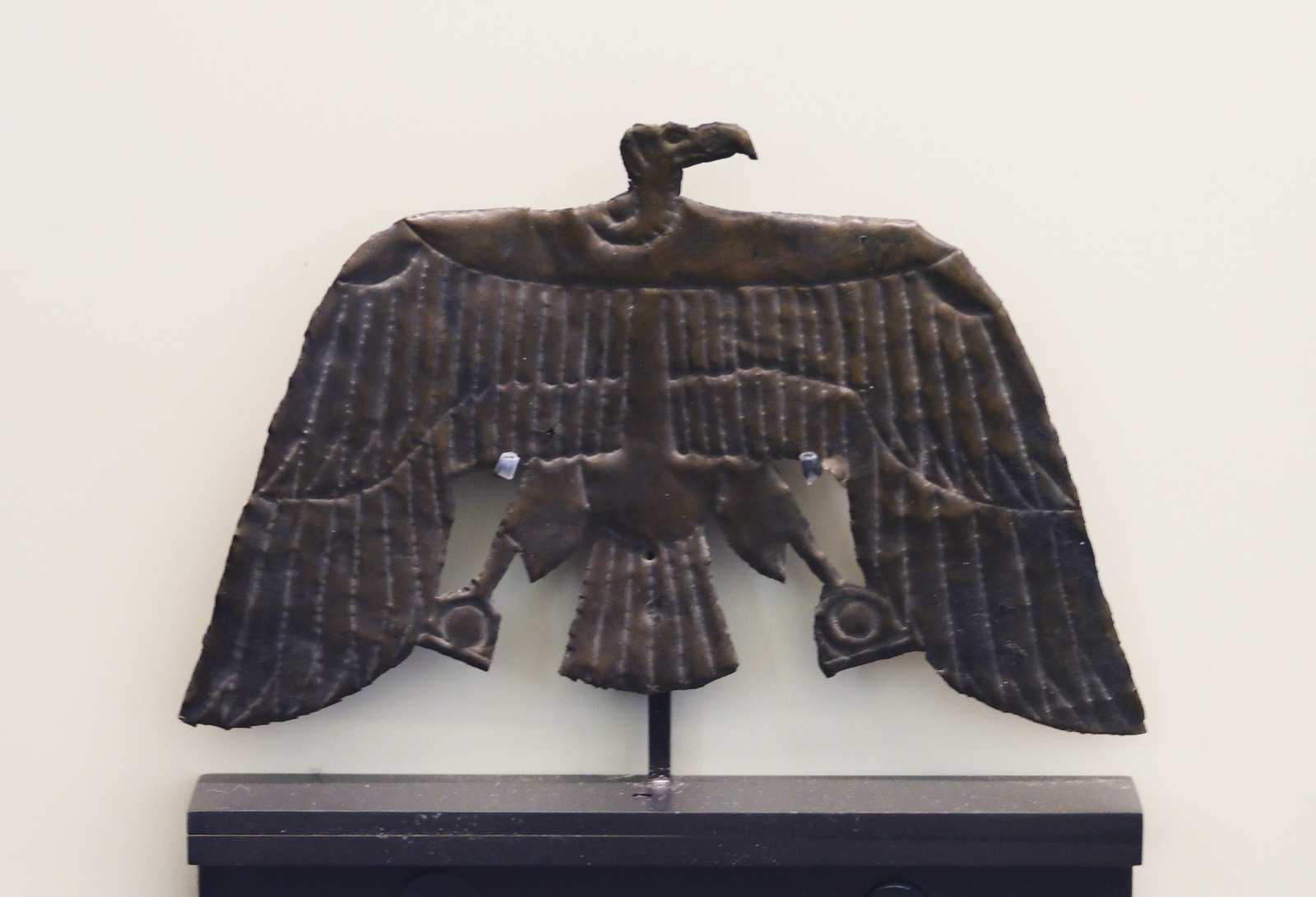
Shonagon · CC0 · Wikimedia Commons
_-_Mus%C3%A9e_du_Louvre_Antiquit%C3%A9s_%C3%A9gyptiennes_N_3643.jpg)
Where Matter and Spirit Meet
The vulture's body answers, point by point, to the purifying powers of the soul.
- The acid that cleanses. The vulture's stomach is acidic enough to kill the bacteria of carrion[5]. In the Temple's teaching this is the fire of the solar chakra, which burns what is corrupt in experience and keeps only what nourishes. The soul with a strong Sun can take in hard events without being poisoned by them.
- Breath at the summit. A Rüppell's vulture has flown at 11,300 metres, supported by blood that uses oxygen more efficiently[5]. Breath carries the soul to its heights in the same way. The Zevist trains slow, full breathing so that consciousness can rise toward the crown and remain steady where the air is thin.
- The marrow inside the bone. The bearded vulture lifts bones up to 100 metres and drops them to reach the marrow[4]. The hardest experiences of a life are bones of this kind. The soul raises them into the light of reflection, breaks them open and feeds on their essence.
- The hour's work of the flock. A flock clears a carcass to the bone within an hour[9]. Purification works best in common: a community bound by the same discipline clears in a short time what a single soul would carry for years.
The Gods and Their Many Names
The vulture belongs to the protecting Mother and to the guardians of order. In Egypt it is Nekhbet and Mut, and Mut stands beside Amun, whom the Temple holds to be Zeus[13], as Hera stands beside Zeus in Hellas. In Rome the vultures give the kingship to the son of Mars, Ares in the Temple's teaching; Heracles takes the vulture's sign as the pure omen; and in India the vulture Jatayu falls, mortally wounded, defending Sita.
| Civilization | God (and the Temple's identity) | The Bond with the Animal | Witness |
|---|---|---|---|
| Egypt | Nekhbet | The vulture Goddess of Upper Egypt, who spreads Her wings over the pharaoh and nurses him. | Britannica, “Nekhbet”[10] |
| Egypt | Nekhbet and Wadjet | The vulture of Upper Egypt and the cobra of Lower Egypt appear together on the king's diadem, signifying his reign over all Egypt. | Britannica, “Wadjet”[14] |
| Egypt | Mut, consort of Amun (Amun is Zeus) | Her name means “mother”; a bronze statuette shows Her with the double crown and a vulture's head on the forehead. | Britannica, “Mut”[11] |
| Rome | Mars (Ares), father of Romulus | 12 vultures appear to Romulus, son of Mars, against 6 to Remus, and decide the kingship of Rome. | Livy 1.4.2[15]; 1.7.1[16] |
| Hellas and Rome | Heracles | Rejoiced at the vulture's sign, because the bird harms nothing that lives. | Plutarch, Romulus 9.5-6[1]; Roman Questions 93[12] |
| India | Jatayu, son of Aruna | The mighty vulture, friend of Rama's father, guards Sita and fights Ravana until his wings are cut. | Rāmāyaṇa III.14[17]; III.51[18] |
The thread is guardianship. Nekhbet guards the king, Mut is the mother at the side of the Head God, the vultures of Romulus guard the founding of a city under Mars, and Jatayu spends his life's blood to guard the wife of Rama. Jatayu names his elder brother Sampati and descends from Aruna[17], the charioteer of the Sun God Surya and the elder brother of Garuda[19]: the vulture of the Rāmāyaṇa belongs to the family of Garuda and of the charioteer of the Sun (Surya).
Egypt holds the oldest form of the witness. Nekhbet's vulture already protected the kings of Upper Egypt, and Her main epithet tied Her to Hierakonpolis[10], the falcon city of Horus (The Falcon). Rome inherited the vulture as the bird of its foundation, and Plutarch preserved the Greek reason for it.
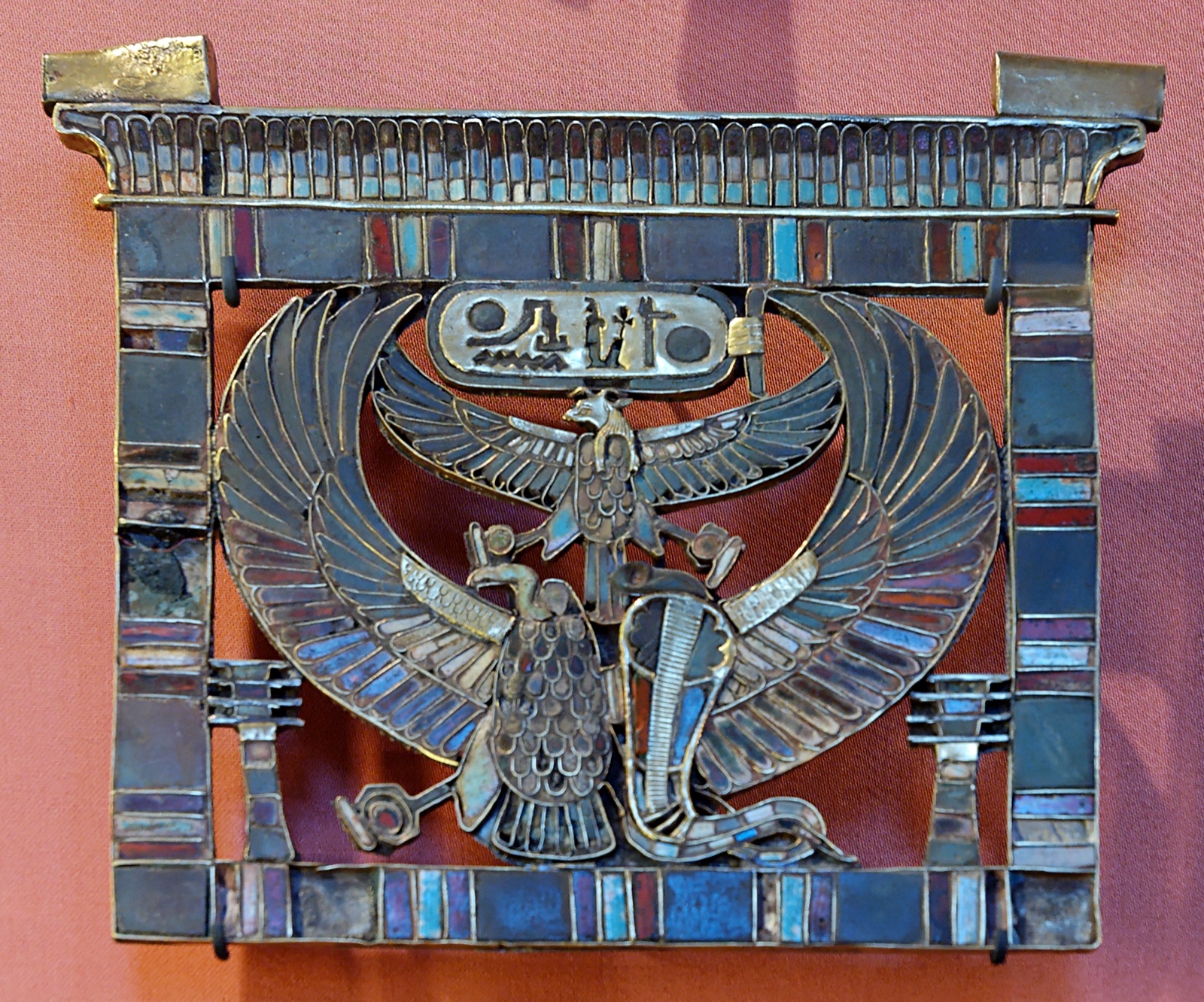
Unknown artist · Public domain · Wikimedia Commons

Ancient Witnesses
Livy, Plutarch and Pliny give the vulture in their own words. The texts follow the Perseus editions; the translations are the Temple's own.
Livy, Ab Urbe Condita 1.7.1 [16]
priori Remo augurium venisse fertur, sex vultures, iamque nuntiato augurio cum duplex numerus Romulo se ostendisset,
To Remus first, it is said, an augury came, 6 vultures; and the augury had just been announced when twice the number showed itself to Romulus,
Titi Livi Ab Urbe Condita, ed. W. Weissenborn and M. Müller (Leipzig, Teubner) · Translation: Temple of Zeus. Each brother was then hailed as king by his followers.
Ἡρόδωρος δʼ ὁ Ποντικὸς ἱστορεῖ καὶ τὸν Ἡρακλέα χαίρειν γυπὸς ἐπὶ πράξει φανέντος.
ἔστι μὲν γὰρ ἀβλαβέστατον ζῴων ἁπάντων, μηδὲν ὧν σπείρουσιν ἢ φυτεύουσιν ἢ νέμουσιν ἄνθρωποι σινόμενον, τρέφεται δʼ ἀπὸ νεκρῶν σωμάτων, ἀποκτίννυσι δʼ οὐδὲν οὐδὲ λυμαίνεται ψυχὴν ἔχον,Herodorus of Pontus relates that Heracles too rejoiced when a vulture appeared to him at the outset of an action. For it is the most harmless of all creatures: it injures nothing that men sow or plant or pasture, it feeds on dead bodies, and it neither kills nor maltreats anything that has life,
Plutarch's Lives, ed. B. Perrin (Cambridge, MA, 1914) · Translation: Temple of Zeus.
Pliny the Elder, Naturalis Historia 10.19 [3]
Vulturum praevalent nigri. nidos nemo attigit; ideo et fuere qui putarent illos ex adverso orbe advolare. falso: nidificant in excelsissimis rupibus; fetus quidem saepe cernuntur, fere bini.
Among vultures the black are the strongest. No one has ever reached their nests; for this reason some have even thought that they fly here from the other side of the world. That is false: they nest on the highest crags, and their young are often seen, usually 2.
C. Plini Secundi Naturalis Historiae, ed. K. Mayhoff (Leipzig, 1906) · Translation: Temple of Zeus.
Universal Significance: Augury, Crown and Crisis
Rome took its first king from the vulture. Livy tells that 6 vultures appeared first to Remus and then twice that number to Romulus[16], and Plutarch asks why the Romans make most use of vultures in augury: because 12 appeared to Romulus at the founding, because the bird is rarely seen and its nest is hard to find, and because, as Herodorus wrote, Heracles favoured it as the omen of a bird that preys on nothing living[12].
Egypt set the vulture on the crown. The centre of Nekhbet's worship was El-Kāb, which the Greeks called Eileithyiaspolis[10]; one of the 5 royal names was introduced by the title “Two Ladies”[20], and Nekhbet and Wadjet together on the king's diadem declared his rule over all Egypt[14].
The vulture also received the dead of whole peoples. At the Towers of Silence in Mumbai the birds cleaned the bodies of the Parsi dead, usually within hours, and since the vultures declined the community has had great difficulty in caring for its dead; Tibetan sky burial rests on the same open-air rite[9].
That service collapsed within a generation. A decline of more than 95 percent in the Oriental white-backed vulture, beginning in the 1990s, was first noted at Keoladeo National Park in India; in Pakistan the dying birds showed renal failure and visceral gout, and the cause was traced to residues of the veterinary painkiller diclofenac[21], which the birds swallowed with the carcasses of treated livestock[22]. A 2007 survey found the white-backed vulture down 99.9 percent over 15 years and the long-billed and slender-billed vultures down 97 percent[22]. India's feral dogs rose from 17 to 18 million in the early 1980s to close to 30 million in 2005[9], and an economic study estimates that the functional extinction of vultures raised human mortality by over 4 percent, at a cost of $69.4 billion a year[23].
Conservation has begun to answer. The bearded vulture's return to the Alps began with the Alpine Reintroduction Project in the late 1970s, though the species remains Near Threatened in Europe[4]; the griffon vulture is listed as Least Concern[2], while Rüppell's vulture is Critically Endangered, killed by poisoned carcasses laid for predators and by poachers who lace carcasses to hide their kills[5].
In Zevist Contemplation
The Zevist works with the vulture to purify the soul, to protect what is young in it and to see the ends of things calmly. The practices below belong to personal meditation and conduct.
- The evening cleansing. At the close of the day, review one failure or spent habit without self-pity. Take from it the lesson, its marrow, and let the rest go, as the vulture leaves the bare bone.
- The wings of the Mother. In meditation, see 2 great wings spread around the aura and folded over the heart, as Nekhbet's wings cover the king. Extend the same protection in conduct to the weak and the young.
- Breath at altitude. Breathe slowly and fully, and let the attention climb with each breath toward the crown. Hold it there in calm, as the vulture holds its height where the air is thin.
- The omen of Heracles. Before beginning an undertaking, ask whether it harms anything living without need. An action that passes this test carries the pure sign that Heracles welcomed.
The transformation of death into life is taught on The Skull and the Work of Transformation, and the order that the vulture defends on Ma'at.
Continue exploring
Related Pages
- Symbol: The Skull and the Work of Transformation
- The Gods: Maat
- The Gods: Heracles
- Sacred Animal: The Eagle of Zeus
- Sacred Animal: The Falcon of Horus
- Sacred Animal: The Raven of Apollo
- Previous: The Falcon of Horus
- Next: The Owl of Athena
- All 32 Sacred Animals
- All symbols