




13 min read
The Raven of Apollo
author: High Priest Zevios Metathronos
κόραξ (kórax)
Herald of Apollo and Mithras, Thought and Memory of Odin: the mind that goes out and returns.
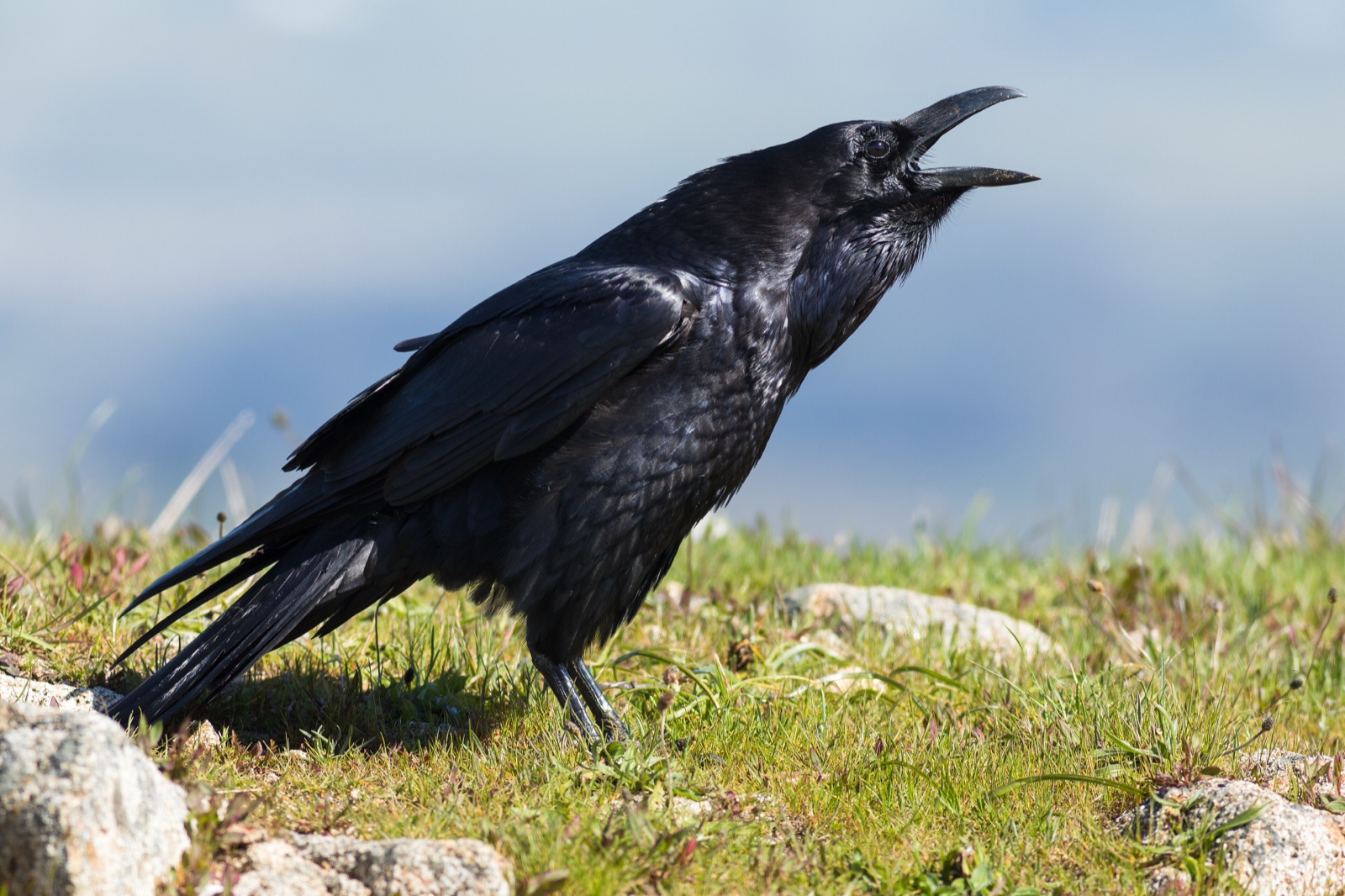
Frank Schulenburg · CC BY-SA 4.0 · Wikimedia Commons

The raven carries knowledge to the Gods of light. Hellas called it the attendant of Apollo, the Mithraists made it the herald of the Sun, and the North seated 2 ravens on the shoulders of Odin. The living bird plans hours ahead, hides its stores and remembers them.
| Realm | Birds of the Heavens |
|---|---|
| Greek | κόραξ (kórax) |
| Latin | corvus; Corax as the Mithraic grade |
| Other Names | Old Norse Huginn and Muninn, the ravens of Odin |
| Species | Corvus corax (common raven) and the crows of India |
| Gods | Apollo, Mithras, Odin, Shani, the Morrígan |
| Material Capacity | Planning, caching, problem-solving and mimicry |
| Spiritual Capacity | Thought and memory sent out and gathered; the herald of the Sun |
| Element and Sphere | Air and darkness bound to light; the shoulders and the Third Eye |
The Living Animal
The bird of the tradition is the common raven, Corvus corax. It measures 56 to 69 cm, spans 116 to 118 cm across the wings and weighs 689 to 1,625 g, about half again larger than an American crow, with a wedge-shaped tail and long, narrow wings[1]. It has lived beside people around the Northern Hemisphere for centuries, from the edges of towns and their landfills to foothill forest and scrub[2].
The raven eats almost anything it can hold: carrion, insects, fish, grain and human refuse. A raven that finds a large supply, such as a carcass or an unguarded seabird colony, often caches part of it for later[3]. Adults are often seen alone or in pairs that stay together all year; the large gatherings are mostly young birds not yet paired[3]. At the nest the male brings some sticks, but the female does most of the building, over about 9 days[3].
The raven flies like an acrobat, with rolls and somersaults, and young birds play with sticks, dropping them and diving to catch them in mid-air[2]. In winter a young raven that finds a carcass calls other ravens to it; the sound of a gunshot in the hunting season draws ravens in to look for a kill, and the bird can mimic the calls of other species[2]. Ravens can work together to solve new problems[3].
The raven plans. In experiments published in Science in 2017, Can Kabadayi and Mathias Osvath of Lund University let ravens choose a tool or a token from a set of objects for use in another place, after delays from 15 minutes to 17 hours[4]. The ravens planned for bartering more accurately than great apes, matched them in the tool tasks, and showed a level of self-control similar to theirs, though the last common ancestor of birds and apes lived some 320 million years ago[4].
The bird is long-lived. The oldest known wild common raven was at least 22 years and 7 months old[2].
The Spiritual Capacity: Thought and Memory
The raven is the messenger of the Sun and the mind of the Sky Father. Hellas called it the sacred attendant of Apollo[5]; the North set 2 ravens on the shoulders of Odin, who whisper into His ear all that they see and hear[6]. In Zevism the raven reveals the faculty that goes out and returns: perception sent forth over the world and knowledge carried back to the throne.
The Temple teaches that the shoulder chakras bolt wings, which give more power to the soul and symbolize spiritual freedom. Odin’s ravens sit exactly there. Huginn, Thought, and Muninn, Memory, are the 2 shoulder centres empowered: one carries the mind outward, the other keeps what it has gathered, and the God who holds both sees the world without leaving His seat (see The Chakras and The Third Eye).
Ovid says the raven was once silver-white and turned black for its tongue[7]. In the Temple’s teaching Light and Darkness are both positive when bound by Ma’at, and the raven’s black is darkness in the service of the Sun. Mithraic initiates made the Raven the first grade, the herald of the Sun[8]: the dark that carries light. The Temple’s page on Sacred Darkness and the Receptive Soul teaches the same receptive dark.
Pindar tells the story of Coronis without any raven: Apollo learns of her faithlessness through His own all-knowing mind[9], while the Hesiodic fragment, Apollodorus and Ovid give the news to a bird[10]. The Zevist reads both as one teaching. The raven is the outer form of the God’s own knowing, and the work of Theosis is to take the raven inward, until thought and memory serve the soul as they serve Apollo and Odin (see Becoming as the Gods).
The virtue the raven teaches is truthful speech ruled by judgement. Ovid’s raven told the truth and was ruined by his tongue[7]; Apollo’s raven of Aelian is a good omen to diviners[5]. The same bird is herald or ruin according to the measure of its speech.
Where Matter and Spirit Meet
The living raven’s gifts and the soul’s gifts are the same powers seen from 2 sides.
- Planning across 17 hours. Ravens chose the right tool or token for a task that lay up to 17 hours ahead[4]. This is foresight in the body of a bird, the faculty that the oracle of Apollo raises to prophecy, and the reason diviners watched the raven’s cries and flight[5].
- The cache. The raven hides food from a large find and returns to it[3]. This is Muninn, memory: the soul stores what it has gathered in practice and draws on it when the season is lean.
- The flight that goes out and returns. The raven rolls and somersaults in the air[2], and Odin’s ravens fly over the earth each day[11]. Thought ranges freely and comes home; the shoulder chakras are the wings of that flight.
- The call that gathers. A young raven that finds a carcass calls the others, and ravens mimic other birds[2]. This is the herald’s voice of the throat chakra, the voice of the Corax who announces the Sun[8].
- The long life. A wild raven has lived past 22 years[2]. Memory grows with years; the soul’s Muninn ripens through a long discipline rather than a single vision.
The Gods and Their Many Names
The raven keeps returning to one office: it carries knowledge to the God of light and to the Sky Father. In the Temple’s teaching Zeus has gone by many names over the aeons[12]; Apollo is Helios, Mithra, Utu and Shamash, and Odin, with Thor, is Zeus. Under these names the same powers hold the same bird.
| Civilization | God (and the Temple’s Identity) | The Bond with the Animal | Witness |
|---|---|---|---|
| Hellas | Apollo (Helios, Mithra) | The raven is a sacred bird and the attendant of Apollo, and a good sign in divination. | Aelian, On the Nature of Animals 1.48[5] |
| Hellas and Rome | Apollo and Coronis | The raven reports Coronis’ faithlessness and is turned from white to black. | Ovid, Metamorphoses 2.531-632[7]; Apollodorus 3.118[10] |
| Hellas | Apollo Loxias | No raven: the God learns the truth by His all-knowing mind. | Pindar, Pythian 3.27-30[9] |
| Roman Mithraism | Mithras (Apollo, Helios); Mercury (Hermes) as planet of the grade | Corax, the Raven, is the first grade, herald of the Sun, shown with a cup and a caduceus. | Mithraeum of Felicissimus, Ostia[8] |
| The North | Odin (Zeus) | Huginn and Muninn fly over the earth each day and report to Him at His shoulders. | Grímnismál 20[11]; Gylfaginning 38[6] |
| India | Shani, the planet Saturn | The crow is His vahana; crows also receive the rice offered to the ancestors. | CPREEC[13] |
| Ireland | The Morrígan (Badb, Macha, Anann) | Badb, first of the 3 sisters, is identified with the raven and with battle. | Jones[14] |
The thread is the office of the messenger. Apollo is the God of the oracle, Mithras the Sun’s champion, Odin the Sky Father who seeks wisdom; to each the raven brings what lies beyond the God’s immediate sight, and in Pindar the God needs no messenger at all because the knowing is already His.
Where the raven serves a dark power, Shani or the Morrígan, it still carries a verdict: the judgement of time and the judgement of battle. The bird belongs to knowledge, and knowledge belongs to the Gods of light.
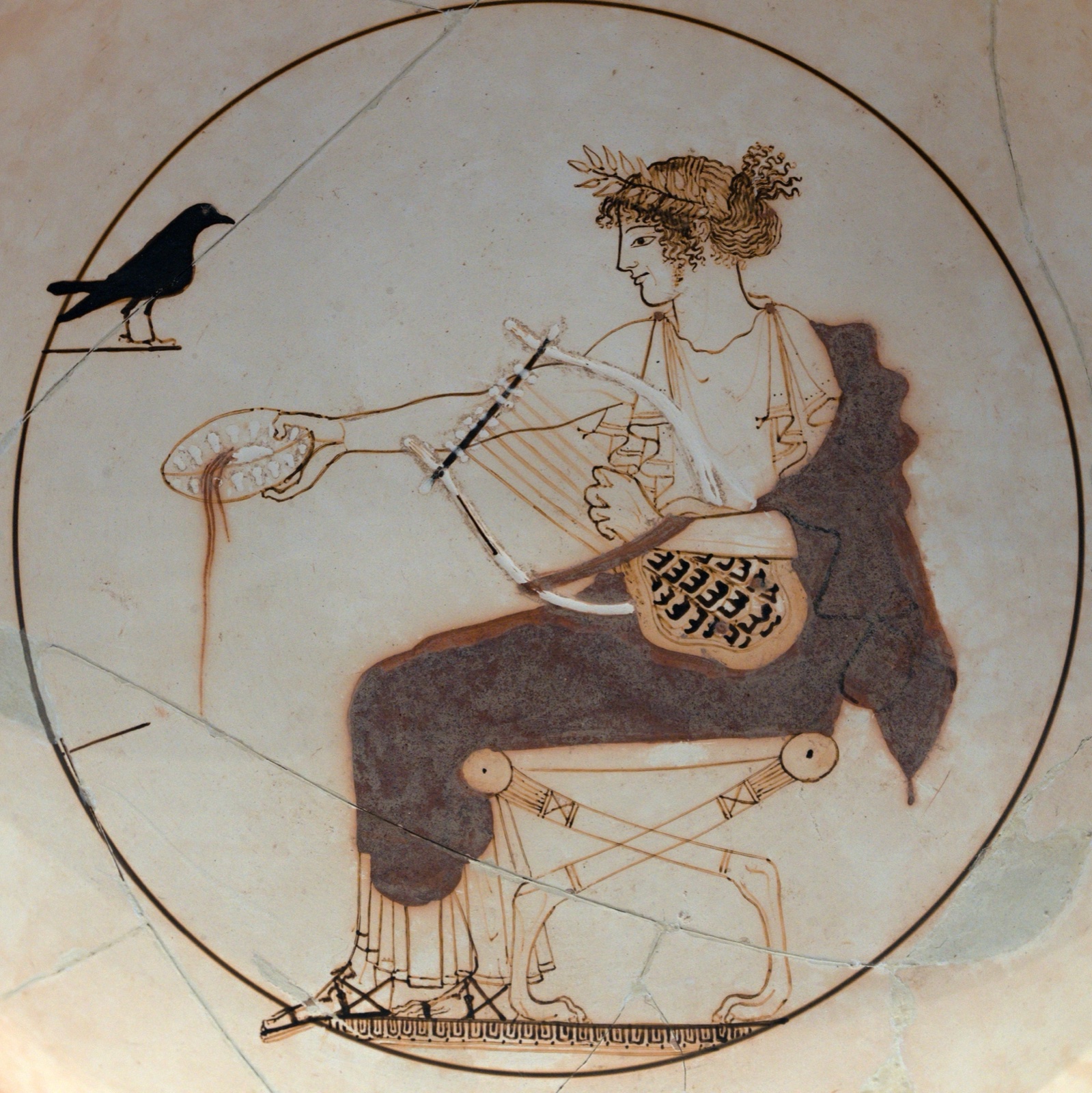
Zde · Public domain · Wikimedia Commons

Ancient Witnesses
4 witnesses, in Greek, Latin and Old Norse, give the raven as Apollo’s sacred attendant, the God who knows without it, the raven’s exile from the white birds, and the 2 ravens of Odin.
Aelian, On the Nature of Animals 1.48 [5]
ὁ κόραξ, ὄρνιν αὐτόν φασιν ἱερόν, καὶ Ἀπόλλωνος ἀκόλουθον εἶναι λέγουσι. ταῦτά τοι καὶ μαντικοῖς συμβόλοις ἀγαθὸν ὁμολογοῦσι τὸν αὐτόν
The raven: they say it is a sacred bird, and they call it the attendant of Apollo. For this reason they also agree that it is a good bird for the signs of divination.
Claudii Aeliani De Natura Animalium Libri XVII, ed. R. Hercher (Leipzig: Teubner, 1864) · Translation: Temple of Zeus.
οὐδʼ ἔλαθε σκοπόν· ἐν δʼ ἄρα μηλοδόκῳ Πυθῶνι τόσσαις ἄϊεν ναοῦ βασιλεὺς
Λοξίας, κοινᾶνι παρʼ εὐθυτάτῳ γνώμαν πιθών,
πάντα ἰσάντι νόῳ· ψευδέων δʼ οὐχ ἅπτεται· κλέπτει τέ νιν
οὐ θεὸς οὐ βροτὸς ἔργοις οὔτε βουλαῖς.But she did not escape the watcher. In Pytho, where the flocks are offered, the king of the temple, Loxias, heard of it, trusting His judgement to the straightest of confidants, His mind that knows all things. It does not touch falsehood, and neither God nor mortal deceives it by deed or by design.
The Odes of Pindar, ed. J. Sandys (Cambridge, MA: Harvard University Press, 1937) · Translation: Temple of Zeus. Pindar tells the story of Coronis without the raven.
Ovid, Metamorphoses 2.631-632 [7]
sperantemque sibi non falsae praemia linguae
inter aves albas vetuit consistere corvum.And the raven, who hoped for a reward for his truthful tongue, He forbade to stand any longer among the white birds.
P. Ovidius Naso, Metamorphoses, ed. H. Magnus (Gotha: F. A. Perthes, 1892) · Translation: Temple of Zeus. The subject is Phoebus Apollo.
Huginn ok Muninn fljúga hverjan dag Jörmungrund yfir;
óumk ek of Hugin, at hann aftr né komi-t, þó sjámk meir of Munin.Huginn and Muninn fly every day over the wide earth; I fear for Huginn, that he may not come back, yet I fear more for Muninn.
Sæmundar-Edda, ed. Guðni Jónsson · Translation: Temple of Zeus. The speaker is Odin.
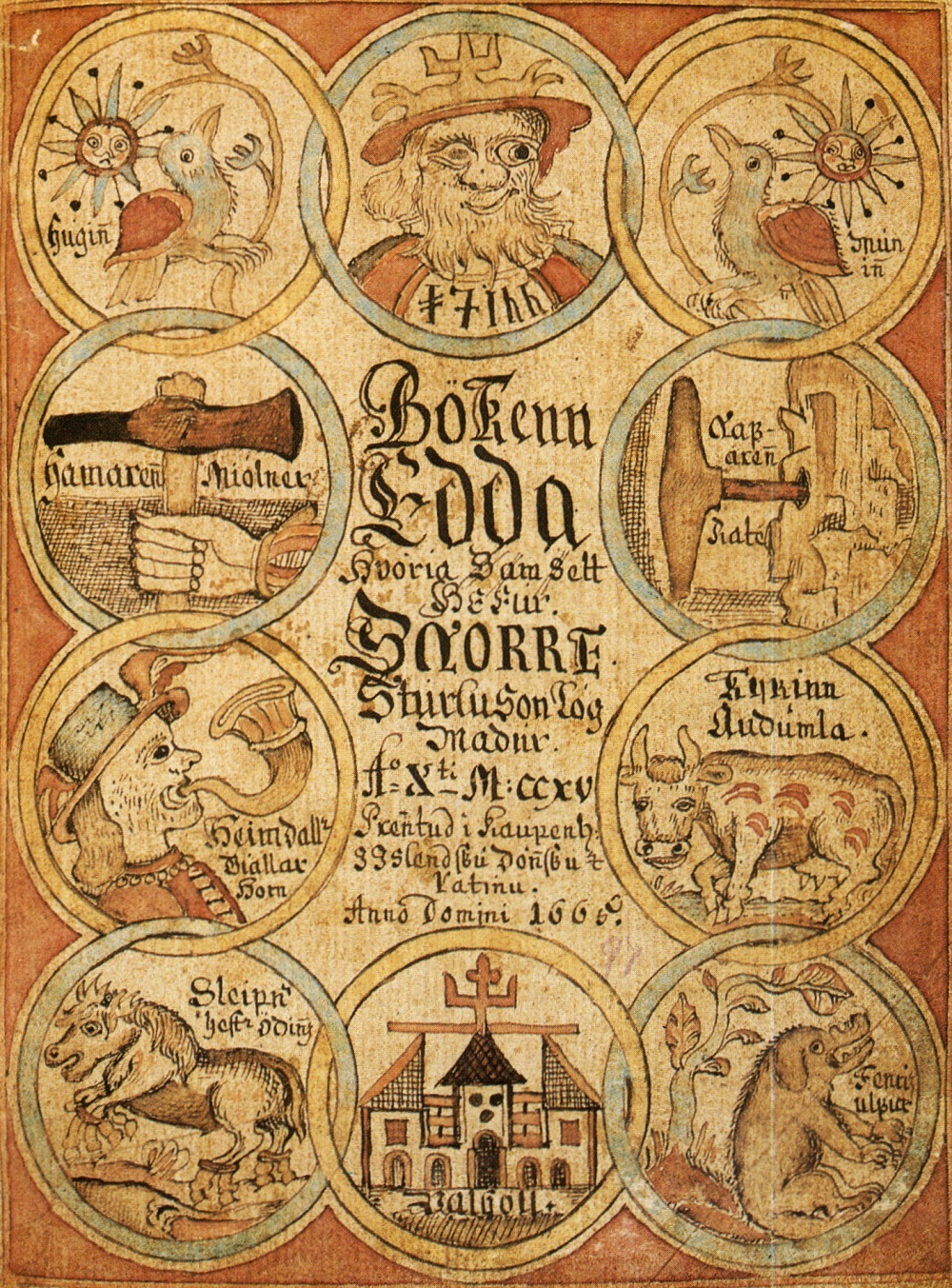
Unknown author · Public domain · Wikimedia Commons

Universal Significance
The raven flies through the oldest flood story in writing. On the Flood Tablet from the Library of Ashurbanipal, a 7th-century BC copy now in the British Museum, the hero sends out birds; the last, a raven, does not return, and so the waters have fallen[15]. When the tablet was read in the 19th century its likeness to the Flood of Genesis caused a sensation[15]; the raven of Genesis flew first from Mesopotamia. The other bird of that story has its own page (The Dove).
The Greek mythographers kept the raven’s change of colour. Apollodorus writes that when a raven told Apollo of Coronis, the God cursed it and turned it black in place of the white it had been before[10]. An Attic painter set a black bird before the seated Apollo on the white-ground kylix in the Delphi museum shown above.
In the Mithraeum of Felicissimus at Ostia, probably installed in the 2nd half of the 3rd century AD, a floor mosaic lays out the 7 grades of initiation. The first panel, near the entrance, shows a raven, a vessel and a caduceus for the grade Corax under the planet Mercury[8].
Iceland kept the myths of Odin in its manuscripts of the Edda, copied and illustrated into the 18th century, and the Gylfaginning names His ravens Thought and Memory[6]. In India the crow still receives the first handful of rice before the meal in traditional homes and the rice balls of the rites for the ancestors[13].
The Tower of London holds the best known living ravens. Legend says the kingdom and the Tower will fall if the ravens leave; Charles II is thought to have been the first to insist that they be protected and that at least 6 be kept at all times, and the current birds are Harris, Jubilee, Poppy, Edgar, Georgie, Chaos, Henry and Poe[16].
Modern science has turned toward the raven’s mind. The Lund experiments of 2017 placed the bird beside the great apes in flexible planning[4], and the Cornell Lab ranks the species among the smartest of all birds[3].
In Zevist Contemplation
The Zevist uses the raven to train the mind that goes out and returns, and to bind speech to judgement. These practices need no priest.
- The 2 ravens on the shoulders. Seated upright, breathe into the left and right shoulders in turn. On the in-breath call Muninn home with what the day has taught; on the out-breath send Huginn forward to the task ahead.
- The raven taken inward. In study, separate what is known directly from what has only been reported. Pindar’s Apollo knew without a messenger; the Zevist works to make knowledge first-hand, through the Third Eye and through patient reading of the sources.
- The dark that serves the Sun. Meditate on black as receptive ground, then let a point of gold appear at its centre. Darkness bound by Ma’at holds light; it does not swallow it.
- The measured tongue. In conduct, before carrying news, ask whether it is true, whether it is needed, and whether its hour has come. Ovid’s raven had only the first of the 3.
- The 17-hour choice. Each evening choose 1 tool for the next day’s work and keep it ready. The raven’s foresight is a discipline that can be learned.
The raven has no separate symbol page on the site; read it with the pages of Apollo and Mithras, whose herald it is.
Continue exploring
Related Pages
- The Gods: Apollo
- The Gods: Mithras
- The Gods: Our Eternal Head God: Zeus
- Symbol: Sacred Darkness and the Receptive Soul
- Sacred Animal: The Owl of Athena
- Sacred Animal: The Rooster of Helios
- Sacred Animal: The Eagle of Zeus
- Previous: The Peacock of Hera
- Next: The Rooster of Helios
- All 32 Sacred Animals
- All symbols