




13 min read
The Rooster of Helios
author: High Priest Zevios Metathronos
ἀλεκτρυών (alektryṓn)
Herald of Helios and Apollo, the cock owed to Asclepius, the head of Abraxas: the call that wakes the Sun.
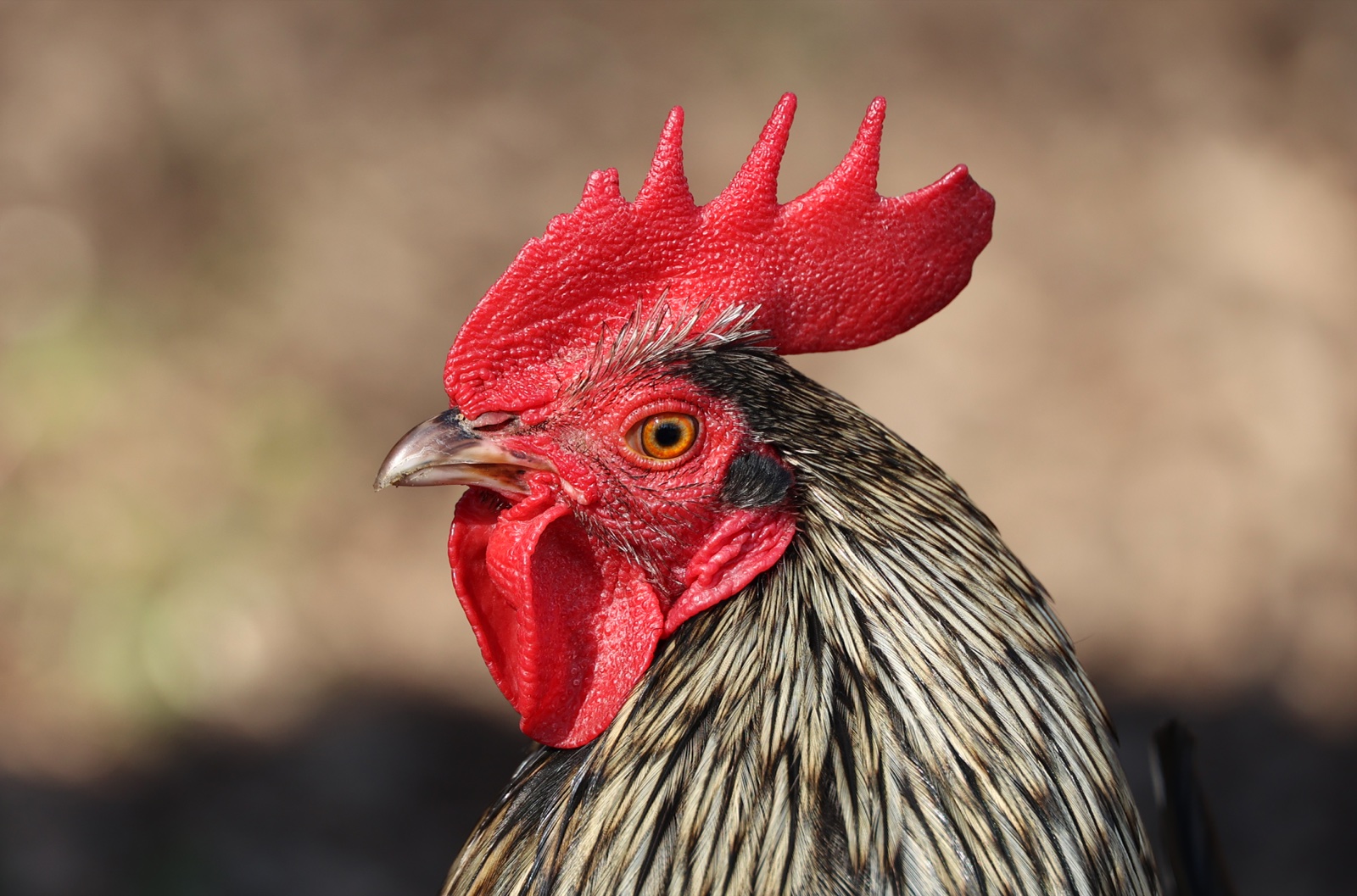
Clément Bardot · CC BY-SA 4.0 · Wikimedia Commons

The rooster calls the Sun. Greece held it sacred to Helios, Socrates died owing it to Asclepius, the Pythagoreans gave it to the Moon and the Sun, and Abraxas wears its head. Science has found the clock behind the crow, and the order of rank that decides who crows first.
| Realm | Birds of the Heavens |
|---|---|
| Greek | ἀλεκτρυών (alektryṓn) |
| Latin | gallus |
| Other Names | Greek ἀλέκτωρ; the Persian bird (Aristophanes); Avestan Parodarsh; Old Norse hani, Gullinkambi |
| Species | Gallus gallus domesticus, from the red junglefowl Gallus gallus |
| Gods | Helios, Apollo, Leto, Athena, Asclepius, Sraosha, Odin, Skanda, Abraxas |
| Material Capacity | A circadian clock that times the predawn crow; a strict order of rank |
| Spiritual Capacity | The waking of the solar chakra; vigilance, courage and the soul’s debt to the healer |
| Element and Sphere | Fire; the Sun at dawn; the threshold of night and day |
The Living Animal
The rooster is the male of the domestic chicken, Gallus gallus domesticus, which descends primarily from the wild red junglefowl, Gallus gallus[1]. A study of 863 genomes found that domestic chickens were first derived from the subspecies Gallus gallus spadiceus, whose present range lies mainly in southwestern China, northern Thailand and Myanmar, and that they later interbred with other junglefowl wherever they spread[2]. Breeders today count more than 60 breeds[1].
The wild ancestor is a bird of southern Asia, living in thick secondary forest and coming out into clearings and plantations. Its plumage runs through gold, red, brown, dark maroon and orange, with touches of metallic green and grey[3].
The junglefowl lives by rank. Its social system is a pecking order, with one bird dominating all and one submitting to all, and there is one order for the hens and another for the cocks[3].
The crow is timed from within. The rooster’s crowing is controlled by the circadian clock, and in small groups the top-ranking rooster always begins the predawn crowing, followed by the others in descending order of rank[4]. When the top bird was removed, the second-ranking rooster crowed first, and the presence of a dominant rooster sharply reduced the predawn crows of his subordinates[4].
Roosters have been kept for breeding, for meat and as fighting animals[1]. The Greek ear heard the same courage: Pausanias explains the cock on Athena’s helmet at Elis by saying that cocks are the readiest of all birds to fight[5].
The Spiritual Capacity: The Herald of the Sun
The rooster is the herald of the Sun. Pausanias records that the bird is sacred to Helios and announces that the sun is about to rise[5], and Aelian writes that the cock never misses the sunrise and sings most of all at that hour, and that it is dear to Leto, beside whom it stood when She bore Her twins[6]. In Zevism the crow at dawn is the waking of the solar chakra, the Grail, where the soul’s own Sun rises before the outer light.
The Pythagoreans saw both lights in the bird. Iamblichus gives the symbol "feed the cock, but do not sacrifice it, for it is consecrated to the Moon and the Sun"[7], and records the rule against killing a white cock, a suppliant sacred to Men, because the birds mark the hours[8][9]. Aelian adds that the cock is stirred and leaps when the moon rises[6]. The Temple reads the Moon and the Sun as Ida and Pingala, the lunar and solar currents of the spine, and the dawn between them as Sushumna, where the Kundalini rises.
The comb is a crown. Aristophanes says that the cock alone of the birds still wears his tiara upright, like the Great King of Persia[10]. In the soul this is the crown chakra, held upright by a sovereign will; the rooster stands for the soul that rules itself and calls the day to order.
At the hour of his death Socrates reminded Crito that a cock was owed to Asclepius, and charged him to pay it[11]. Asclepius, Imhotep in the Temple’s teaching, is the healer, and the Zevist reads the debt as the soul’s thanks for waking: death is a dawn, and the cock is owed to the God who heals the passage (see The Afterlife and Death).
The virtue is vigilance joined to courage and work. In the Temple’s teaching on Abraxas, the head of the rooster is the most important symbol of that God, the image of awakening and creative power[12].
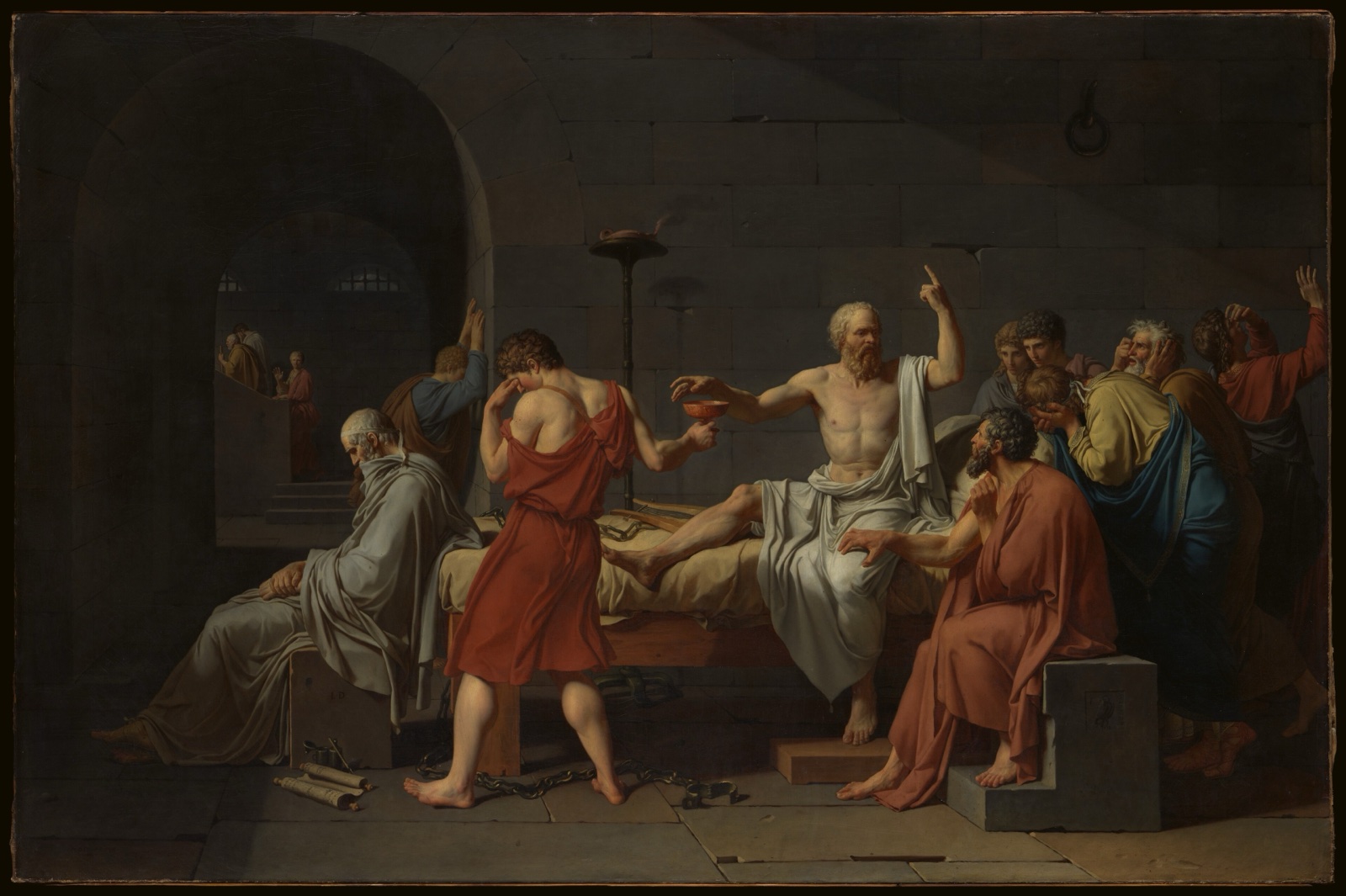
Jacques-Louis David · CC0 · Wikimedia Commons

Where Matter and Spirit Meet
The rooster’s body keeps the hours of the soul. Each point below joins a capacity of the living bird to a capacity of the Zevist.
- The inner clock. The crow is set by the circadian clock and comes before dawn[4]. The solar chakra keeps the same time: the empowered soul wakes its own Sun before the world is light, and the Zevist sets practice at that hour.
- Rank decides who speaks first. The highest-ranking rooster crows first and the others follow in order[4]. This is Ma’at in a farmyard: in the ordered soul the crown speaks first and the lower centres answer in their rank, never all at once.
- The wild bird brought into the house. The chicken came from the junglefowl of the forests of southern China, Thailand and Myanmar[2]. The solar fire of the wild was carried to every household, and the Zevist keeps the same fire at the hearth of the body.
- The readiness to fight. Roosters have been bred as fighting birds[1], and Athena wore the cock on Her helmet for that reason[5]. The soul’s Andreia is the same readiness: courage that does not wait to be provoked twice.
- Gold and red plumage. The junglefowl’s colours are gold, red and orange with metallic green[3]. They are the colours of the solar plexus fire, the outward sign of the Sun at the centre of the soul.
The Gods and Their Many Names
The rooster stays with the Gods of dawn, light and waking. In the Temple’s teaching Apollo is Helios, Mithra, Utu and Shamash, Athena is Minerva, Asclepius is Imhotep, and Odin, with Thor, is Zeus. Under every name the bird keeps one office: it calls the light.
| Civilization | God (and the Temple’s Identity) | The Bond with the Animal | Witness |
|---|---|---|---|
| Hellas | Helios (Apollo) | Sacred to Helios, it announces that the sun is about to rise; it stood on the shield of Idomeneus, descendant of Helios, at Olympia. | Pausanias 5.25.9[5] |
| Hellas | Leto, mother of Apollo | The cock stood beside Her in labour and is dear to Her; it sings most at sunrise. | Aelian, On the Nature of Animals 4.29[6] |
| Hellas: Elis | Athena Ergane (Minerva) | Phidias’ statue of ivory and gold wore a cock on its helmet. | Pausanias 6.26.3[5] |
| Athens | Asclepius (Imhotep) | Socrates’ last charge: a cock owed to Asclepius. | Plato, Phaedo 118a[11] |
| The Pythagoreans | Mene and Helios; Men | Feed the cock but do not sacrifice it, for it is consecrated to the Moon and the Sun. | Iamblichus, Protrepticus 21[7]; Life of Pythagoras 84[8] |
| Iran | Sraosha | Sraosha wakes the bird Parodarsh, which lifts its voice against the dawn. | Vendidad 18.15, 18.23[13] |
| The North | Odin, Herjaföðr (Zeus) | Gullinkambi crows over the Æsir and wakes the heroes at Odin’s hall. | Völuspá 43[14] |
| India | Skanda (Murugan) | His banner bore the emblem of a fowl; the rooster of His flag came out of the tree split by His spear. | Britannica[15]; CPREEC[16] |
| Late antiquity | Abraxas | The God is shown with the head of a rooster, over serpent feet, with whip and shield. | Temple of Zeus[12] |
The rows agree because the office is one. The Sun God, His mother, the Goddess of craft and war, the healer, holy Sraosha and the Sky Father of the North all receive the bird that ends the night; the Pythagoreans gave it to Moon and Sun together because it stands on the threshold between them. Abraxas gathers the meaning into one figure: the letters ΑΒΡΑΣΑΞ add up to 365[12], the days of the solar year, and the God who holds the whole year wears the head of the bird that opens each day.
Ancient Witnesses
5 witnesses, in Greek and Old Norse, give the cock of Asclepius, the herald of Helios, the Pythagorean rule, the Persian king of the birds, and the cocks that crow over the Gods and beneath the earth.
ὦ Κρίτων, ἔφη, τῷ Ἀσκληπιῷ ὀφείλομεν ἀλεκτρυόνα· ἀλλὰ ἀπόδοτε καὶ μὴ ἀμελήσητε.
“Crito,” he said, “a cock is owed to Asclepius. Pay the debt, and do not neglect it.”
Platonis Opera I, ed. J. Burnet (Oxford: Clarendon Press, 1905) · Translation: Temple of Zeus. The last words of Socrates.
Pausanias, Description of Greece 5.25.9 [5]
τῷ δὲ Ἰδομενεῖ γένος ἀπὸ Ἡλίου τοῦ πατρὸς Πασιφάης, Ἡλίου δὲ ἱερόν φασιν εἶναι τὸν ὄρνιθα καὶ ἀγγέλλειν ἀνιέναι μέλλοντος τοῦ ἡλίου.
Idomeneus descends from Helios, the father of Pasiphae; and they say that the bird is sacred to Helios and announces that the sun is about to rise.
Pausaniae Graeciae Descriptio, ed. F. Spiro (Leipzig: Teubner, 1903) · Translation: Temple of Zeus. Pausanias explains the cock on the shield of Idomeneus in the Achaean dedication at Olympia.
Iamblichus, On the Pythagorean Life 84 [8]
μηδὲ ἀλεκτρυόνα λευκὸν (θύειν)· ἱκέτης γὰρ ἱερὸς τοῦ Μηνός, διὸ καὶ σημαίνουσιν ὥραν.
Do not sacrifice a white cock; for it is a suppliant, sacred to Men, and for this reason they mark the hour.
Iamblichi De vita Pythagorica liber, ed. A. Nauck (St Petersburg, 1884) · Translation: Temple of Zeus. The verb in brackets is supplied by the editor; Men is the Moon God.
Aristophanes, Birds 483-485 [10]
αὐτίκα δʼ ὑμῖν πρῶτʼ ἐπιδείξω τὸν ἀλεκτρυόνʼ, ὡς ἐτυράννει
ἦρχέ τε Περσῶν πρῶτον πάντων Δαρείου καὶ Μεγαβάζου,
ὥστε καλεῖται Περσικὸς ὄρνις ἀπὸ τῆς ἀρχῆς ἔτʼ ἐκείνης.First, as proof, take the cock: how he was tyrant and ruled the Persians, first of them all, before Darius and Megabazus, so that he is still called the Persian bird from that reign of his.
Aristophanis Comoediae, ed. F. W. Hall and W. M. Geldart (Oxford: Clarendon Press, 1906) · Translation: Temple of Zeus. The speaker is Peisetaerus.
Gól of ásum Gullinkambi,
sá vekr hölða at Herjaföðrs;
en annarr gelr fyr jörð neðan
sótrauðr hani at sölum Heljar.Gullinkambi crowed over the Æsir; he wakes the heroes at Herjaföðr’s hall; and another crows beneath the earth, a soot-red cock, in the halls of Hel.
Sæmundar-Edda, ed. Guðni Jónsson · Translation: Temple of Zeus. Herjaföðr, Father of Hosts, is Odin. The short lines of the stanza are joined in pairs.
Universal Significance
The Greeks met the bird as a newcomer from the east. Aristophanes calls the cock the Persian bird and makes him king of the Persians before Darius[10], and Menodotus of Samos says that cocks first spread from Persia as peacocks spread from Samos[17]. Genetics carries the origin farther east, to the junglefowl of southwestern China, northern Thailand and Myanmar[2]. The peacock has its own page (The Peacock).
Iran gave the bird to the watcher of the dawn. The Vendidad names it Parodarsh, "which ill-speaking people call Kahrkatas", the bird that lifts its voice against the mighty dawn, and says that holy Sraosha wakes it; Darmesteter glosses the name as "he who foreshows the coming dawn; the cock"[13].
At Olympia the Achaeans set up a group of heroes with the inscription "To Zeus the Achaeans dedicated these statues"; the cock was the emblem on the shield of Idomeneus, and the sculptor was Onatas of Aegina[5]. The bird of Helios stood in the sanctuary of Zeus.
In 1787 Jacques Louis David painted The Death of Socrates, now in the Metropolitan Museum of Art; he set Plato at the foot of the bed as the author whose Phaedo preserved the story[18]. The painting shows the moment before the last words about the cock.
France made the bird a nation. The Latin word gallus means both "Gaul" and "cock", and the rooster appears on Gaulish coins in antiquity; it went into eclipse in the Middle Ages, revived in Germany in the 14th century and entered the imagery of the French kings in the Renaissance[19]. Napoleon refused it as an emblem, saying "Le coq n’a point de force, il ne peut être l’image d’un empire tel que la France"; an ordinance of 30 July 1830 put it on the buttons of the National Guard, and the Third Republic placed it on its seal, its gold coins and the gate of the Élysée park[19].
The banner of Murugan, chief God of the ancient Tamils, carried the emblem of a wild fowl[15], and the rooster remains His flag[16]. In the North the Völuspá keeps 3 cocks for the last day: Fjalarr, Gullinkambi among the Gods, and a soot-red cock in the halls of Hel[14].
In Zevist Contemplation
The Zevist uses the rooster to keep the hours of the soul and to wake the solar chakra. These practices need no priest.
- The dawn watch. Rise before the light and sit facing east. Breathe into the solar chakra and let a gold point brighten there before the sky changes, as the rooster’s clock calls the Sun before it is seen.
- Moon and Sun in the spine. Breathe in through the left nostril for the lunar current and out through the right for the solar, then reverse. At the turn of each breath hold the attention on the centre of the spine, the threshold where the Pythagoreans set the bird of Moon and Sun.
- The debt to the healer. At the close of each day name one thing owed and pay it before sleep. Socrates’ last thought was a debt to Asclepius; the Zevist keeps accounts clean so that each night, and the last night, finds nothing left undone.
- The crown held upright. In conduct, take rank seriously: speak first only where the duty is yours, and answer in order where it is not. The highest rooster crows first; the rest keep their turn.
The rooster has no separate symbol page on the site; read it with the pages of Apollo, Asclepius and Abraxas.
Continue exploring
Related Pages
- The Gods: Apollo
- The Gods: Asclepius
- The Gods: Abraxas
- The Gods: Athena
- Sacred Animal: The Raven of Apollo
- Sacred Animal: The Peacock of Hera
- Previous: The Raven of Apollo
- Next: The Ibis of Thoth
- All 32 Sacred Animals
- All symbols