













| LANGUAGE / CULTURE | NAME OF CERES | ATTESTATION |
|---|---|---|
| Faliscan (Falerii) | Ceres | The Ceres-urn of Civita Castellana, 7th–6th c. BCE; the earliest attestation of Ceres1,42 |
| Old Latin (Rome) | Ceres; masc. Cerus | Carmen Saliare (as quoted by Varro and Festus); the Twelve Tables tradition5,6,13 |
| Oscan (Samnium, Campania) | Kerres (adj. Kerríio-) | Tablet of Agnone, c. 250 BCE; a Capuan curse tablet2,3,42 |
| Classical Latin | Ceres, Ceres Mater | The whole of Latin literature, Ennius onward33 |
35 min read
CERES
author: High Priest Zevios Metathronos
co-author: Novice Priest Karnonnos
I. Names
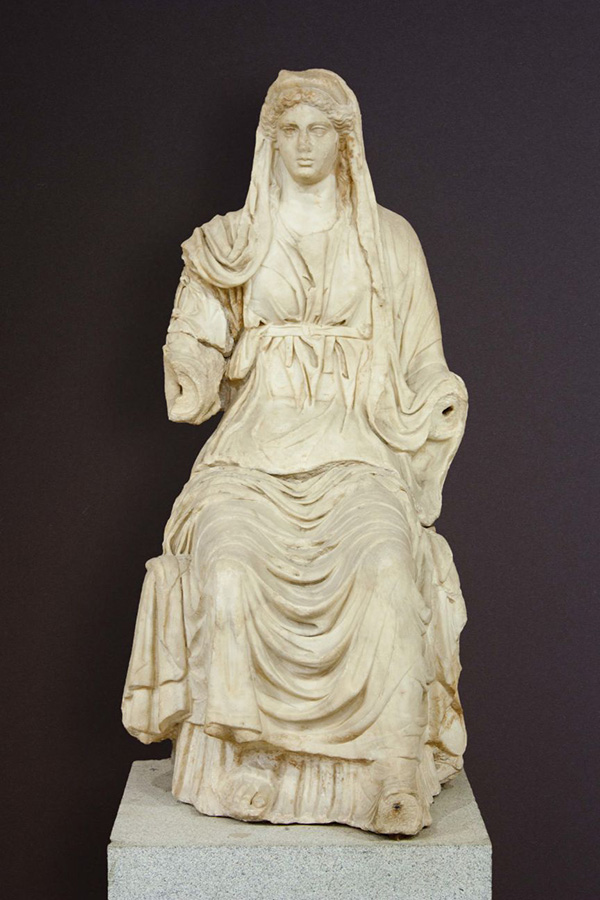
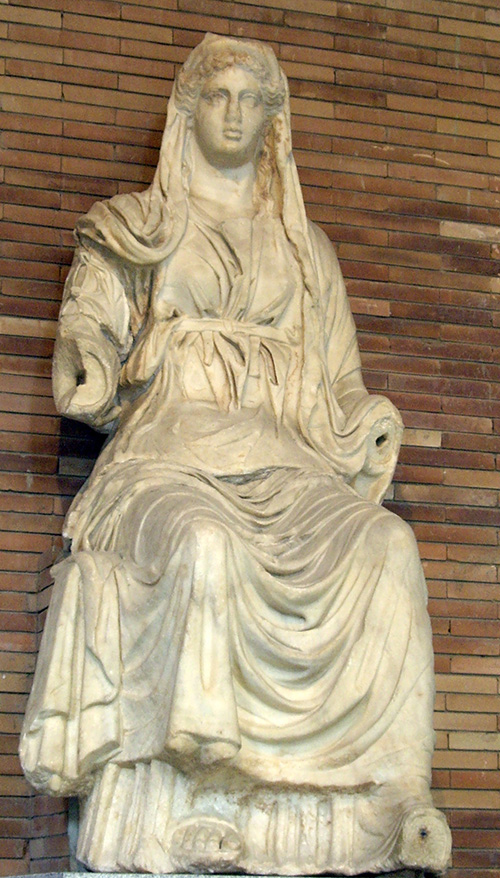
Seated Ceres from Emerita Augusta, present-day Mérida (National Museum of Roman Art)
Her name was being written well before Latin possessed the literature we know today. On an impasto urn from Civita Castellana (the ancient Falerii), a Faliscan hand of the seventh or sixth century BCE scratched a line that opens with the Goddess:
ceres : far . . .
"Ceres . . . spelt [far] . . ."
, the Ceres-inscription of Falerii (Bakkum EF 1 = CIE 8079 = Vetter 241 = Giacomelli 1)1,2
The definitive treatment of Faliscan states: "The sixth- or seventh-century 'Ceres-inscription' (EF 1) contains the earliest epigraphic attestation of Ceres"; the standard study of the Goddess calls it "the oldest written evidence we have of any Roman divinity."1,42 The broken opening joins her name to far, emmer wheat, the archaic staple from which Rome named its flour and its first offering-cake; the reading "let Ceres give spelt," received since the early editors, takes the line as an invocation, probable, though the shattered verb resists certainty.1,42 The secure truth is already enough: at the threshold of writing in Italy, her name stands beside the grain.
The Romans heard her name as a sacred sentence. Varro: "because she bears the crops (quod gerit fruges), Ceres."5 Cicero: "Ceres from the bearing of crops, as though 'Geres', just as among the Greeks she was named Demeter, as if Gē Mētēr."7 Servius: "Ceres is said from creare, to create."8 Modern philology speaks with its own voice, reconstructing the name from an Indo-European root of nourishment or growth (*ḱerh₃- "nourish," in one modern reconstruction; *ḱerh₂- "grow," whence crescere and creare, in another), a separate science arriving at the same field of meaning the Roman ear already heard, that is growth, creation, and sustenance.4 The root most notably survives in our common word "cereal." The archaic hymn of the Salian priests preserves the masculine name beside Janus: "duonus Cerus es," "thou art the good Cerus" (the hymn's text is corrupt), which the ancient lexicon glosses "Cerus manus: the good creator."5,6
Nor was the Great Goddess's name Rome's alone. The bronze Tablet of Agnone (c. 250 BCE), the fullest sacred document of the Oscan tongue, maps a sanctuary called the húrz (the hortus, the "Garden") of Ceres (Kerres), and lists the divine circle dwelling there, many bearing her name as epithet: the Daughter of Ceres (Futreí Kerríiaí, the Oscan Persephone), the Nurse of Ceres, the Rains of Ceres, the Lymphs of Ceres, a Flora of Ceres, a Hercules of Ceres (the renderings are scholarly and vary in detail).2,3 Among them, without the adjective, stands Líganakdíkeí Entraí, rendered by scholars "the Inner Law-Speaker"; if that reading holds, a law-power dwells in Ceres' own garden, kin in office to Demeter Thesmophoros. While the Greek rite was still new at Rome, Samnite Italy already knew the Mother enthroned at the centre of a divine family, on a cult-map assuredly older than the bronze that records it.
Sources: Bakkum, for the Faliscan urn; Vetter and Rix, for Agnone; Varro, Festus, Cicero, and Servius, for the Roman etymologies and Cerus; de Vaan, for the modern root; Pliny, for the Twelve Tables tradition; Ennius (in Apuleius), for her place among the Twelve.1,2,3,4,5,6,7,8,13,33,42
Demeter names what she is to us, Mother; Ceres names what she does in all things: she makes them grow. The fact that her first written word in Italy stands beside the word for grain, and that her name rests today inside "cereal," is the quiet proof of the Goddess's law of sustenance: the Gods are always present, and in things as humble as bread.
II. Roman Ceres
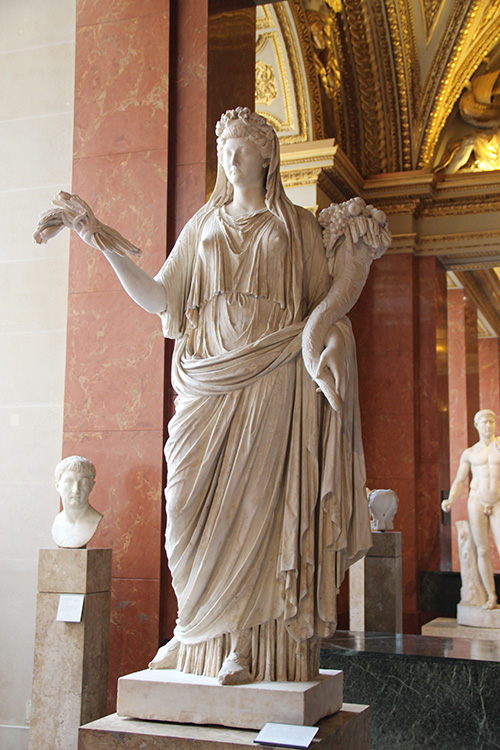
Empress Livia represented as Ceres-Ops, 15-45CE
The archaic city. Her Roman worship is older than the Republic. The regal city counted a flamen Cerialis among its archaic priests, and the CERIALIA of April 19 holds a fixed place in the oldest surviving calendars, written there in the large letters long taken for the archaic festival core (an inference now debated).42,45,53 On Le Bonniec's classic reconstruction, this Roman Ceres precedes every Greek importation; what stands beside her across Italy is a family of kindred local cults, not one uniform "Italic Ceres."45
The famine and the vow. In the crisis of the infant Republic, war and famine together, the dictator Aulus Postumius vowed a temple on the instruction of the Sibylline books, themselves Greek verse, whose guardians found "that these gods should be propitiated": Demeter, Dionysus, and Kore, as Dionysius names them. In 493 BCE the consul Spurius Cassius dedicated the temple of Ceres, Liber, and Libera at the foot of the Aventine, by the Circus Maximus.9 The same years saw the plebs secede and win their tribunes: by the tradition's own synchronism, the temple and the liberties of the plebs arose together (§VI).
The Republic's guardian. After Cannae (216 BCE) grief so filled the city that her annual rite fell silent, mourners may not keep it, and no matron was free of mourning. The Senate then capped mourning at thirty days, a measure remembered a generation later as passed for the sake of the rites of Ceres (§VII).10 In 191 BCE a fast, the ieiunium Cereris, was decreed from the Sibylline books.10 In 133 BCE, after the killing of Tiberius Gracchus, the books were opened again: "it was found there that the most ancient Ceres must be appeased," and the Senate sent its priests across the sea to her oldest sanctuary at Henna (§V).24,26,43
Empire and endurance. Her temple burned in 31 BCE;12 Augustus restored and Tiberius rededicated it, the historian noting it was the temple "which the dictator Aulus Postumius had vowed."11 The emperors took her crown: Augustus is portrayed in the corona spicea, Claudius struck CERES AVGVSTA, and the empresses wore her wheat-crown from Livia to Julia Domna (§XIII).40,41,42,50 Her cult outlasted the old order: the city calendar of 354 CE, deep in the Christian era, still lists for April 12 LVDI CERIALICI CM XXIIII, "Games of the Cerealia, twenty-four circus races."37
III. The Epithets of Ceres
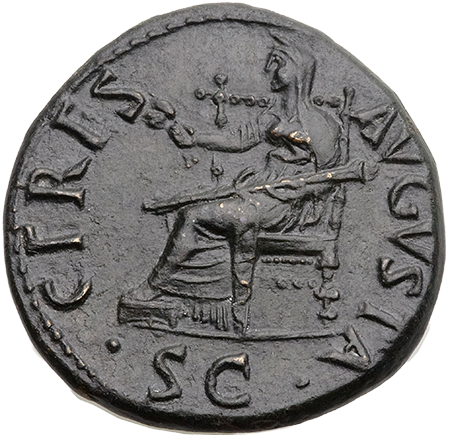
Dupondius of Tiberius, Ceres Augusta holding grain, 41-50CE
Some of her Roman names are formal cult titles, others the constant address of the poets; the table marks each.
| EPITHET | MEANING / REGISTER | DOMAIN |
|---|---|---|
| Ceres Mater | Ceres the Mother (her pervasive address) | Motherhood of the crops and of Proserpina42 |
| Ceres legifera | Law-Bearing Ceres (literary; the Latin of Demeter Thesmophoros) | Law and civilization18,8 |
| Flava Ceres | Golden Ceres (literary) | The colour of ripe wheat17,34 |
| Alma Ceres | Nourishing Ceres (literary) | Sustenance of all beings8 |
| Ceres antiquissima | The Most Ancient Ceres (Cicero's phrase for her of Henna) | The Sibylline expiation of 133 BCE24 |
| Ceres Augusta | Ceres of the August House (cult title) | Imperial cult; the grain-supply39,41 |
| The Cereres | The paired Mother and Daughter under one plural name (cult usage, above all African) | The Latin echo of "the Two Goddesses" of Eleusis36,55 |
Sources: Vergil and Servius, for legifera and alma; Ovid and Tibullus, for Flava; Cicero, for antiquissima; the Lepcis Magna dedication and Claudian coinage, for Augusta; Tertullian and the African epigraphy, for the Cereres; Spaeth, for Ceres Mater.8,17,18,24,34,36,39,41,42,55
IV. Temples and Sacred Sites
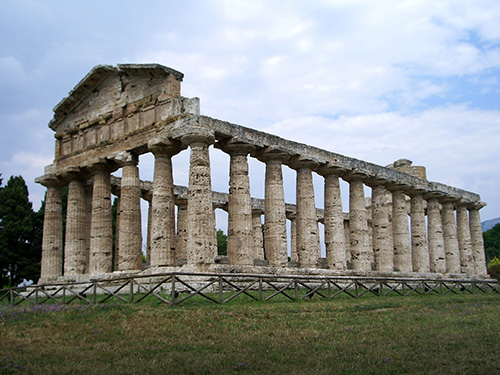
Temple of Ceres, Paestum
The Aventine temple. The house of the triad (its precise site never recovered, its plan inferred to hold a chamber for each of the three, Ceres' the central and greatest51,45) was the sacred citadel of the plebs (§VI). Vitruvius names it among his examples of the araeostyle, the archaic Italic manner: wide-set columns, timber architraves, pediments "usually ornamented with statues of clay or brass, gilt in the Tuscan fashion."14 Upon that Italic frame Rome set Greek art. Pliny records that Damophilus and Gorgasus adorned it "with both branches of their art," signing their work in Greek verses, and that before this temple "everything in temples was Tuscanic" an Italic body carrying the earliest signed Greek art Rome remembered.13
Henna. "There is an old belief, established from the most ancient writings and monuments of the Greeks, that the whole island of Sicily is consecrated to Ceres and Libera." At Henna, "the navel of Sicily," stood her most venerable shrine: the sanctuary of the Senate's expiation of 133, and of Cicero's prosecution of the man who stripped her image.24 The Demeter dossier tells Henna among the temples of Demeter, and this page adds only its Roman chapter.
Eleusis under Roman hands. In 54 BCE the consul Appius Claudius Pulcher vowed the Inner (Lesser) Propylaea of Eleusis; Cicero writes to Atticus, "I hear Appius is building a propylon at Eleusis."27 The architrave gives the Two Goddesses their Latin names: "Appius Claudius Pulcher... promised the propylon for Ceres and Proserpina as consul, and began the work as imperator. Pulcher Claudius and Rex Marcius completed it in accordance with his will."39 Its inner gate was borne by maidens carrying the cista mystica. Rome built at Eleusis, and set the Mother's Roman name on the gate of her sanctuary; two centuries later Marcus Aurelius, an initiate, raised the burned sanctuary again (§VII).30,52
Municipal Italy and the provinces. Her public priestesshood ranked among the highest honours of a Roman townswoman: at Pompeii the memorials of Clodia and Lassia, each sacerdos publica Cereris by decree of the councillors, and of Alleia Decimilla, who built her family's tomb.39 At Lepcis Magna in 35/36 CE the noblewoman Suphunibal raised the temple of Ceres Augusta above the theatre;39 across Roman Africa the Mother and Daughter reigned together as the Cereres, served by consecrated widows (§VII).36,55
V. The Law-Giver
The Demeter dossier teaches that the Law was among the Mother's first gifts, and crowns its Law chapter with Ovid's Roman verse: Ceres prima dedit leges, "Ceres first gave laws."15 When Vergil's Dido brings her marriage offerings, the first Goddess named is "legiferae Cereri, law-bearing Ceres,"18 and the ancient commentator explains:
"For she herself is said to have invented laws; indeed her rites are called Thesmophoria. . . [before her gift] men wandered everywhere without law; that savagery was broken off once the use of grain was discovered, after laws were born from the division of the fields."
Servius, on Aeneid 4.588
Rome bore the doctrine out in statute:
- The Twelve Tables, as Pliny reports them, made the adult who pastured on or reaped another's crop by night a capital offender, "hanged and put to death for Ceres (suspensum Cereri necari)"; in the Tables' scale of penalties, graver than homicide.13
- The lex sacrata made the tribunes inviolable: whoever harmed them, "let him be accursed (sacer) and let his goods be consecrated to Ceres" (sold at her temple); the homo sacer belonged to the Gods, his property to her house.6,9,10
- Spurius Cassius, the same consul who had dedicated her temple, was accused of aiming at kingship and put to death, whether justly, the tradition itself cannot say; the accounts differ, but agree that his forfeited goods were consecrated to Ceres, and a bronze statue inscribed "given from the Cassian family" stood from them.9,10
- The law attributed to Romulus on divorce gave half the wrongdoer's substance to the wife, "and the other half be consecrate to Ceres."22
- Tiberius Gracchus (133 BCE): Spaeth has argued that the tribune's killing was staged as a consecratio (the pontifex maximus leading with veiled head, in the manner of a solemn consecration) and that the embassy to Henna completed its logic, the appeasement of "the most ancient Ceres" justifying the killers.43,42
The Demeter dossier declares her laws iron-clad by the will of the Goddess. Rome, more than any nation we know, wrote that iron into civil code: the sanctity of the tribune, of the crop, of marriage. Each placed its sanction under Ceres, and the Senate's own decrees were laid in her temple to be kept true (§VI). Grain and law are one gift of hers, and Rome kept both in her house.
VI. The Goddess of the Plebs
No other Roman deity belonged to the common people as Ceres did: that judgment stands at the head of the theme.42 Her temple became their sacred centre step by step across the Republic:
- Archive. From the Valerian-Horatian laws of 449 BCE, "the decrees of the Senate should be delivered to the aediles of the plebs at the temple of Ceres"; until then, Livy says, the consuls had suppressed and falsified them.10
- Treasury. The fines of the plebeian aediles, the goods of the condemned under the leges sacratae, the forfeit of Cassius, the temple received them.9,10,42
- Refuge. Her precinct held the asylum Cereris of which Varro speaks: those who lacked wealth and fled there were given bread.5,42
- Magistracy. The plebeian aediles ("temple-men" in the old derivation of their name) made her temple their headquarters and rose to magistrates of the Roman people, charged with the grain-supply and her games; the moneyer C. Memmius still advertised on silver in 56 BCE, MEMMIVS AED CERIALIA PREIMVS FECIT, "Memmius as aedile first celebrated the Cerealia," Ceres seated on the reverse with torch, wheat, and serpent.40,42,45
The triad's Latin names speak the plebeian creed: the Mother; Liber, the Free One; and Libera, the Free (the Daughter dwelling under a Latin name). As the patricians held their triad on the Capitoline (Jupiter, Juno, Minerva), so the plebs held theirs at the foot of the Aventine.42 Bread and liberty stood under one roof; when the grain failed the plebs looked to her temple, her law guarded their tribunes (§V), and the answer for Gracchus was sought at her Sicilian hearth (§II). The initiate may see here what the Demeter dossier shows at Eleusis, where her sanctuary kept the law-inscriptions of the Mysteries: wherever she dwells, the record must be kept true and the lowly protected from the mighty, she makes a people as she makes a field.
VII. The Roman Mysteries
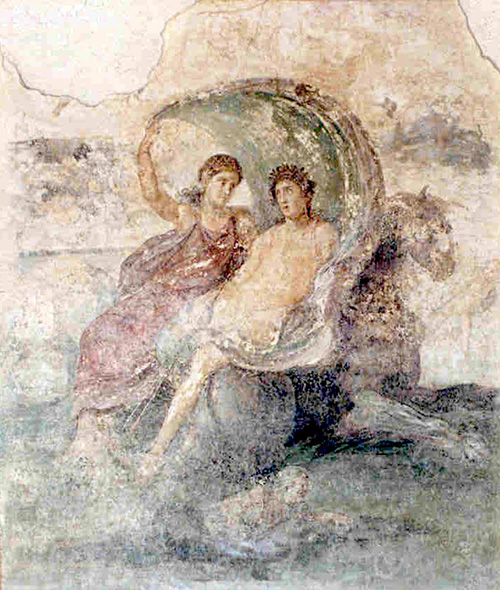
Fresco from Villa Carmiano, Stabiae, 1st century. Nude Greco-Roman deity Bacchus (right), god of wine, freedom and male fertility, identified with Greek Dionysus and Rome's native Liber. Ceres (left) is usually identified as his mother
Rome possessed initiation into the Mother, regulated by law, kept by women, and named with the Latin word for Eleusis itself. Varro's lexical witness: the rites dedicated to Ceres are those chiefly called initia, "beginnings," and the pig is their appointed offering.5,42 The witnesses that follow are historically distinct (a Roman statute, a Greek-rite priesthood, a matrons' annual mystery, the emperors at Eleusis), and this page holds them apart as history while affirming what the Temple knows: they face one Goddess.
The law of the rite. Cicero, legislating for his ideal republic, forbids women's nocturnal rites, except "Cereri Graeco sacro, to Ceres by the Greek rite," and "let them be initiated to Ceres by that rite by which they are initiated at Rome."23 Of the mysteries themselves he writes that "as they are called initia, so in truth we have learned in them the beginnings of life (principia vitae); and we have gained from them not only a way of living with joy, but also of dying with a better hope" his praise given to Athens' Eleusis, his statute written for Rome, the strict chaste rite he sets against the suppressed Bacchanalia.23
The women's rite. This is the sacrum anniversarium Cereris, the matrons' Greek-rite mystery of the Mother's loss and finding of the Daughter, the rite whose lapse in the year of Cannae moved the Senate to ration the city's mourning (§II).10 Ovid preserves its shape: the scene he paints is a legendary Cyprus, but the rite in which he dresses its queen is, on the modern reading, the Roman matrons' own: white-robed women who give garlands of wheat as first-fruits "and for nine nights count love and the touch of men among things forbidden," the queen attending "the secret rites (arcana sacra)";15,42 his elegy confirms it from the locked-out lover's side.17 The scholiast calls her rites by their Eleusinian family-name: "her rites are called Thesmophoria."8
The priestesses. The rite was served by Greek priestesses of Naples and Velia (the Elea of Parmenides), made Roman citizens "so that," as Cicero says, the immortal Gods should be prayed to "with a foreign and external knowledge, but with a domestic and civil intention"; the name kept is Calliphana of Velia.25,26 At Rome her public priestess remained a woman of Greek Italy: the stone survives naming Casponia Maxima, "sacerdos Cereris publica populi Romani, a Sicilian."39 In Africa, Tertullian bears grudging witness to the widows of the African Ceres, who "of their own accord renouncing marriage, grow old, shunning from then on the touch of males."36
The emperors and Eleusis. Augustus was initiated at Athens after Actium, Dio records.28,12 Claudius "even attempted (conatus est) to transfer the Eleusinian rites from Attica to Rome."28 The fourth-century historian Aurelius Victor writes that Hadrian "cultivated at Rome, in the Athenian manner, the initia of Ceres and Libera which are called Eleusina";29 Hadrian was initiated "after the example of Hercules and Philip," and Marcus Aurelius, rebuilder of the burned sanctuary, "approached the initia of Ceres... and entered the sanctuary alone."30 The line ran to the end of the pagan empire: Julian sought out the hierophant of the Goddesses and, as emperor, summoned him from Greece to perform, with his aid, rites known to them alone.52 Read with Appius' gate (§IV), the exchange ran both ways: Rome built at Eleusis, and Eleusis came, in some form, to Rome. Whether Rome's own initia were the Greek Mystery transplanted in the third century BCE (so Le Bonniec, with Boyancé and Spaeth) or the flowering of a native Italic mystery (so Wagenvoort), scholarship debates; on either reading the initiate's hope, to live with joy and die with better hope, is one hope, at Eleusis and at Rome.42,45,49
VIII. The Chthonic Ceres and the Mundus
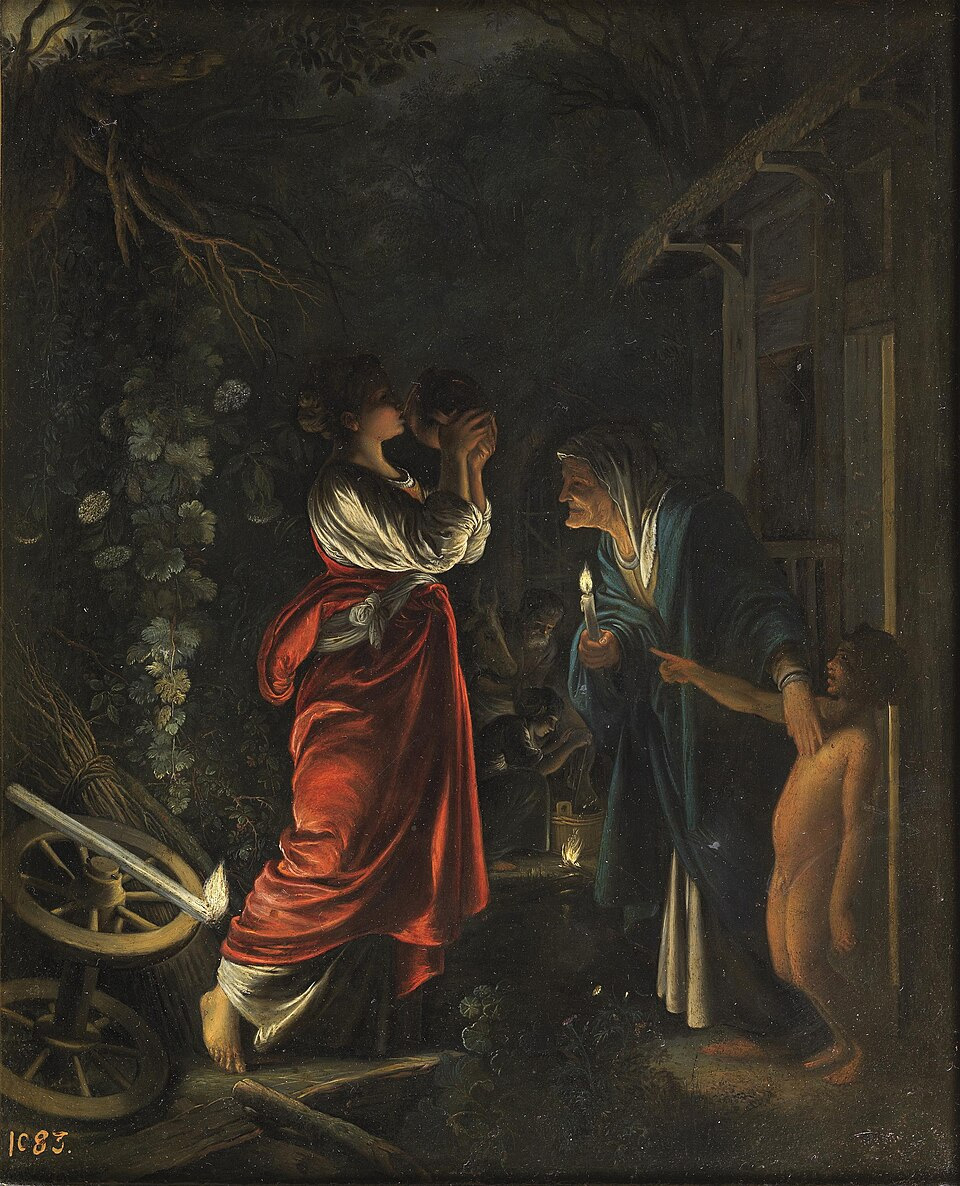
Ceres, Hecuba and the mocking Askalabos (Ovid). Oil-paint on copper, by Adam Elsheimer and workshop, copy circa 1605, held by the Museo Nacional del Prado. From an original in the collection of Alfred and Isabel Bader
Rome kept a door to the world below, and its name was hers. Festus preserves the broken entry: "of Ceres, which is called mundus (Cereris qui mundus appellatur), which customarily stands open three times in the year" August 24, October 5, November 8.6 Cato explains the awesome name: "the mundus is so named from that mundus which is above us" the pit below called by the name of the heavens.6 And Varro gives the doctrine of the opened door:
"Mundus cum patet, deorum tristium atque inferum quasi ianua patet. When the mundus is open, it is as though a door stands open for the sorrowful gods below."
Varro, in Macrobius, Saturnalia 1.1632
Varro's sentence continues: on those days it was religiosum to join battle, hold the levy, send a soldier out, cast off a ship, or take a wife.32 Macrobius himself dedicates the opened pit to Dis and Proserpina, the Daughter's realm; Festus alone preserves its possessive name, the mundus of Ceres, and Capua kept a sacerdos Cerialis mundalis, a priestess of Ceres of the mundus.6,32,39 Fowler observed that the three dates fall on the grain's own calendar (storing and the two sowings) and saw in the mundus the community's ancient seed-store, the door-of-the-dead doctrine growing over it in later belief; Le Bonniec, keeping the foundation pit apart, gave the pit's chthonic character priority; the megara of the Thesmophoria, the Mother's sacred pits in Greece, stand as the family parallel.48,45 These are modern reconstructions, and are named as such; to hold seed-vault and death-door as two faces of one pit is this page's own contemplation.
The founding question. Plutarch relates that at Rome's founding a circular pit was dug, first-fruits of all good and necessary things laid in, each settler casting in earth of his homeland: "they call this trench, as they do the heavens, by the name of mundus" and the city ploughed in a circle around it; Ovid tells of a trench filled with grain and earth, sealed beneath an altar.22,16 Neither names Ceres; whether the founding pit and the mundus of Ceres are one, scholars dispute (Coarelli affirming, Magdelain denying), and this page states it as a question.51 What the sources do say is arresting enough: a sealed pit of first-fruits and grain at the centre of the founding circle, named for the heavens, and the one deity whose own name antiquity attached to a mundus is Ceres.6,32
The Goddess of the dead. Her funerary law ran through every Roman death: the porca praesentanea was offered to Ceres in the presence of the corpse;6,42 no grave was complete until the due rites were done and the sow offered;23 an unexpiated death owed her the porca praecidanea before the new harvest might be touched.20,21 Death left unhealed pollutes the grain; the two ends of existence are one accounting, kept by one Goddess. Yet mark her boundary: in the terrible devotio the Gods invoked are Janus, Jupiter, Mars, Quirinus, the Manes, Tellus, among others, Ceres is absent.10 Her road to the underworld is the road of the seed: its descent, its keeping, its return. The Mysteries teach that the seed must go below to rise; the mundus holds the same doctrine at the centre of the city; and if the founding tradition is right, Rome itself was ploughed in a circle around buried seed.
IX. Ceres and Tellus
Roman theology paired the Mother with Tellus, the Earth, and Ovid states their relation exactly:
"officium commune Ceres et Terra tuentur: / haec praebet causam frugibus, illa locum. Ceres and Earth watch over a shared office: the one furnishes the crops their cause, the other their place."
Ovid, Fasti 1.673–67416
Tellus is the womb; Ceres is the life-power that quickens it, the causa of growth, as her name declares (§I). At the January Feriae Sementivae the two "mothers of the crops" received their offerings of spelt and of the sow for the seed sleeping under the frost;16,47 before harvest the porca praecidanea went to Ceres, Janus and Jupiter first invoked by Cato's own formula;20 and the farmer of the Georgics owed her the spring lustration: "let all your rustic youth worship Ceres... let the luck-bringing victim go three times round the new crops," no sickle put to the ripe ears until, wreathed in twisted oak, he had danced his artless steps and sung her the harvest songs.19 Tibullus keeps the same rule: "we purify the crops and the fields, the rite as handed down from our ancestors of old... and Ceres, wreathe your temples with wheat-ears."34 Varro could report the Great Mother of the Palatine held "to be the same as Ceres, whom they say is nothing other than the earth"35, the philosopher's flattening; the cult kept the altars apart. The initiate may hold both truths at once, as the Demeter dossier holds Demeter and Gaia.
X. The Flamen Cerialis and the Twelve Helpers
Rome's oldest priesthoods included a flamen of Ceres, and the prayer he spoke is a rare survival of pontifical liturgy. The antiquarian Fabius Pictor, writing on the pontifical law, preserved the invocation the flamen Cerialis chanted "when performing the Cereal rite for Tellus and Ceres," naming twelve helper-gods, one for each act of the farmer's year:
Vervactor (First-Plougher of the fallow), Reparator (Re-Plougher), Inporcitor (Maker of Furrows), Insitor (Sower), Obarator (Plougher-Over), Occator (Harrower), Sarritor (Hoer), Subruncinator (Weeder), Messor (Reaper), Convector (Carter), Conditor (Storer), Promitor (Bringer-Forth).
Fabius Pictor, in Servius auctus on Georgics 1.218
Every verb of the field is here made a god, and the agricultural year becomes a litany under her presidency. The list has been judged authentic pontifical liturgy, the priestly colleges' perfected ordering of her rite; and the Cerealia, though the judgment stops short of proof, its most fitting home.47 The Demeter dossier teaches that her presence governs the agricultural calendar; Rome answered with a rite that deified the labours of the year one by one, a ministering circle under the Mother, as Samnite Agnone had ringed her garden with the Rains and the Lymphs and the Nurse of Ceres (§I).2,3 No act of honest work is without its god; the Great Work is made of small works, each consecrated.
XI. Ceres in Roman Philosophy
The Stoic reading. Chrysippus taught "that the aether is that which men call Jupiter... and that the earth is that which is called Ceres"; Cicero's Stoic spokesman derives her name from the bearing of crops, and quotes the proverb of the stage: sine Cerere et Libero friget Venus, "without Ceres and Liber, Venus freezes."7
Varro's exegesis and its limit. Varro, reported through Augustine's polemic, read her whole Mystery as agriculture: in the rites of Ceres "those Eleusinia are celebrated which were most famous among the Athenians," and he interprets nothing there "except what concerns the grain, which Ceres discovered, and Proserpina... and he says that Proserpina signifies the fecundity of seeds"; "many things are handed down in her mysteries which pertain to nothing except the discovery of grain."35
The answer of the winnowing-fan. Servius, the fourth-century commentator, explaining Vergil's "mystic winnowing-fan of Iacchus" (set by the poet among the farmer's tools beside "the wicker-ware of Celeus," the Eleusinian king of the Demeter dossier) writes: "the rites of Father Liber pertained to the purification of the soul, and men were purified by his mysteries just as grain is purified by winnowing-fans."8,19 The rite named belongs to Liber, her temple-partner and fellow of the mysteries; the threshing-floor is hers. Homer had already set her there: it is fair-haired Demeter who, amid the winds, parts grain from chaff on the sacred threshing-floors.56 The initiate may read the law through the image, as the dossier's contemplation: what agriculture is to the body, initiation is to the soul; as Proclus, in the Demeter dossier, refuses the merely physical reading of the Mother, so the winnowing-fan answers Varro on Roman ground.
Survival. Isidore, compiling for the Christian Middle Ages, still writes: "Ceres, that is, the earth, is named from creating the crops... they call her also Ops, because the earth is bettered by work; Proserpina, because the crops creep forth from her; Vesta, because she is clothed" the old names of the Roman earth-power filed into a bishop's encyclopedia, with the late allegorists' confusion of Daughter and Mother preserved intact (a flattening the living cult never made).38 Her games were still on the calendar in 354 CE,37 and her name survives in our word for grain-food (§I). The philosophers reduced her and the allegorists disguised her; the Goddess outlasted both.
XII. Festivals and Ritual Observances
| OBSERVANCE | PLACE / DATE | DESCRIPTION | IMPORTANCE | DATE RECORDED |
|---|---|---|---|---|
| CERIALIA with the ludi Ceriales | Rome, Circus Maximus; festival April 19, games April 12–19 | Her great festival and games; on the final day the archaic fire-rite of the foxes (§XIII) | The oldest layer of her Roman cult; the plebeian aediles' festival; (so Bayet) the fire that warms the forming ear | Pre-Julian calendars (Degrassi); Ovid; still official in 354 CE16,37,40,46,53 |
| FERIAE SEMENTIVAE | Rome and countryside; January, movable | Offerings of spelt and of the sow to Ceres and Tellus for the sown seed | (So Bayet) germination-rite guarding the crop through winter's dead season | Ovid, Fasti 116,47 |
| SACRUM ANNIVERSARIUM CERERIS | Rome; annual (season not securely recorded) | The matrons' Greek-rite mystery: white robes, first-fruits of wheat, nine nights' chastity, secrecy | Rome's initiation into the Goddess; its lapse after Cannae moved the Senate to cap mourning | Livy 22.56 (216 BCE); Ovid; Festus10,15,17,6 |
| IEIUNIUM CERERIS | Rome; October (Oct 4 in later calendars) | A fast decreed from the Sibylline books, at first quinquennial, later annual | The Roman echo of the Mother's own fast (cf. the Demeter dossier on the kykeon) | Livy 36.37 (191 BCE); the imperial fasti10,53 |
| MUNDUS PATET (dies religiosi) | Rome; Aug 24, Oct 5, Nov 8 | The mundus stood open: "a door stands open for the sorrowful gods below"; battle, levy, sailing, marriage forbidden | Named for Ceres in Festus; assigned by Macrobius to Dis and Proserpina | Cato; Ateius Capito; Festus; Varro in Macrobius6,32,48 |
| PORCA PRAECIDANEA (rite) | Every Roman farm; before harvest | The expiatory offering of the sow to Ceres, Janus and Jupiter first invoked | Harvest bound to funerary law: no clean bread over an unclean death | Cato, De Agricultura 134; Gellius20,21 |
| THE SPRING LUSTRATION (rite) | The fields of Italy; at winter's end | The offering led three times round the young crops; the chorus crowned with oak; harvest songs | The countryside's own liturgy: "let all your rustic youth worship Ceres" | Vergil, Georgics 1; Tibullus19,34 |
Sources: the pre-Julian calendars and Ovid's Fasti and Metamorphoses; Livy; Cato, Festus, and Varro (in Macrobius); Vergil and Tibullus; the Calendar of 354; Bayet, for the modern analyses; Degrassi, for the fasti.6,10,15,16,17,19,20,21,32,34,37,40,46,47,48,53
XIII. The Symbolism of the Creating Power
The crown of wheat. Her sign above all others is the corona spicea. Tibullus hangs the wheat wreath at her temple door; Horace's Secular hymn prays that Tellus "present Ceres with a crown of wheat-ears"; the Republican moneyers set it on her head in silver.31,34,40 Under the Empire the crown passes to the imperial house: Augustus in marble, Claudius' CERES AVGVSTA in bronze, empress after empress from Livia to Julia Domna carved and struck in her crown. The most powerful women of the world put on the sign of the Goddess who feeds.41,42,50
Torch, serpent, sow, measure. Her torch, borne single or in pairs, burned also at every Roman wedding, "carried in honour of Ceres," so that each bride entered her house by the Mother's light.6,40 The serpent, yoked in pairs to her chariot on the coinage, is the earth-power that sleeps and renews; the serpent-car the Demeter dossier shows gifted to Triptolemus is, on Roman silver, the Mother's own.40,50 The sow is her offering at initiation and at the rites of the dead; Rome knew the same at peace-making and the old Etruscan weddings, the beast of every initium, every beginning.5,20,21 The modius, the grain-measure crowning her imperial images, is her whole Roman theology in one emblem: abundance under law.50 On the Ara Pacis sits a matronly goddess with two infants, grain and poppy at her side; scholars have called her Tellus, Pax, Venus; Spaeth has argued in detail that she is Ceres, and the panel is in any case the perfect image of what Rome believed peace to be: "Peace nourishes Ceres; Ceres is the nursling of Peace."44,16
The fox and the fire. At her oldest festival, foxes ran the Circus with fire bound to their backs; Ovid tells the tale of the fox of Carseoli that burned the fields and pays the penalty yearly.16 One modern reading finds the rite's deeper logic: the racing fire fortifies, at the critical forming of the ear, the warming forces the earth dispenses to her plants.46 Her festivals harness the burning power of the world to the harvest, as her Mysteries harness death to the soul's increase. And the torch burned to the end of antiquity: in Claudian's unfinished epic of the Rape, often called the last great pagan poem in Latin, the Mother kindles her pines at the crater of Etna to begin the search, a whole book of a mother's rage and love sung under a Christian emperor.54
Set beside the Demeter dossier, the teaching completes itself. Greece speaks most of the Mother's inwardness: the grief, the search, the Mystery, the nourishment of souls. Rome shows most clearly her outwardness: the earliest written prayer of the Italic tongues, her name in the statutes, the temple that guarded a people's liberty, the wheat crown on the head of the state. Demeter shows what the Goddess is. Ceres shows what a civilization looks like when it is built upon her.
Sources and Bibliography
- Bakkum, Gabriël C. L. M. The Latin Dialect of the Ager Faliscus: 150 Years of Scholarship. 2 vols. Amsterdam: Vossiuspers UvA, 2009. Part I, §12.2, on EF 1 (= CIE 8079 = Vetter 241 = Giacomelli 1). For the text, date, and history of readings of the Ceres-urn, and the judgment that it is the earliest epigraphic attestation of Ceres.
- Vetter, Emil. Handbuch der italischen Dialekte. Heidelberg: Winter, 1953. No. 147 (Agnone); no. 241 (the Faliscan urn). For the older editions and the received invocatory reading.
- Rix, Helmut. Sabellische Texte. Heidelberg: Winter, 2002. Sa 1. For the modern edition of the Agnone bronze and its deity-list.
- de Vaan, Michiel. Etymological Dictionary of Latin and the Other Italic Languages. Leiden: Brill, 2008. S.vv. Ceres, crescere, creare. For the Indo-European reconstructions and the Oscan adjective kerríio-.
- Varro. De Lingua Latina. Translated by Roland G. Kent. Loeb Classical Library 333–334. Cambridge, MA: Harvard University Press, 1938. 5.64; 7.26 (the Salian fragment; Goetz–Schoell print the running text undivided, the segmentation duonus Cerus es standing in their apparatus). With De Re Rustica (Loeb 283), 2.4.9 and 3.1.5, for the pig offered at the initia Cereris and the rites chiefly called initia; and the fragment preserved at Nonius 63 L, for the bread given to those who fled to the asylum Cereris.
- Festus and Paulus ex Festo. De Verborum Significatu. Edited by W. M. Lindsay. Leipzig: Teubner, 1913. S.vv. cerus manus (109 L), facem (77 L), Graeca sacra (86 L), mundus (126, 144–146 L), praecidanea (c. 250 L), praesentanea porca (296–298 L), sacer mons (424 L). For the Salian gloss, the wedding torch, the Greek rite, the mundus of Ceres, the expiatory and funerary sows, and the homo sacer.
- Cicero. De Natura Deorum. Translated by H. Rackham. Loeb Classical Library 268. Cambridge, MA: Harvard University Press, 1933. 1.40; 2.60; 2.67.
- Servius (and Servius auctus). In Vergilii Carmina Commentarii. Edited by G. Thilo and H. Hagen. Leipzig: Teubner, 1881–1902. On Aeneid 4.58 (legifera; Thesmophoria; law from the division of fields); on Georgics 1.7 ("Ceres a creando"), 1.21 (Fabius Pictor's twelve helper-gods), 1.166 (the winnowing-fan and the purification of souls).
- Dionysius of Halicarnassus. Roman Antiquities. Translated by Earnest Cary. Loeb Classical Library. Cambridge, MA: Harvard University Press, 1937–1950. 4.62 (the Sibylline Books acquired at Rome, Greek verses in the keeping of Roman priests); 6.17.2–4 (famine, Sibylline vow to Demeter, Dionysus, and Kore); 6.89.3 (the lex sacrata); 6.94.3 (the dedication of 493); 8.79.3 (Cassius' goods and the statues).
- Livy. Ab Urbe Condita. Loeb Classical Library. Cambridge, MA: Harvard University Press, 1919–. 2.41.10 (Cassius; "ex Cassia familia datum"); 3.55.7, 13 (the lex sacrata renewed; the Senate's decrees deposited at her temple); 8.9.6–8 (the devotio, Ceres absent); 22.56.4–5 (the rite interrupted after Cannae; mourning capped); 34.6.15 (the cap remembered as passed for the rites of Ceres); 36.37.4–5 (the ieiunium).
- Tacitus. Annals. Translated by John Jackson. Loeb Classical Library. Cambridge, MA: Harvard University Press, 1931–1937. 2.49 (Tiberius rededicates the temple vowed by Postumius).
- Cassius Dio. Roman History. Translated by Earnest Cary. Loeb Classical Library. Cambridge, MA: Harvard University Press, 1914–1927. 50.10.3 (the fire of 31 BCE); 51.4.1 (Octavian initiated at Athens after Actium).
- Pliny the Elder. Natural History. Loeb Classical Library. Cambridge, MA: Harvard University Press, 1938–1963. 18.3.12 (the Twelve Tables' crop sanction, as Pliny reports it); 35.154 (Damophilus and Gorgasus; "everything Tuscanic" before this temple).
- Vitruvius. De Architectura. Translated by Frank Granger. Loeb Classical Library 251. Cambridge, MA: Harvard University Press, 1931. 3.3.5 (the araeostyle; the English quoted follows Gwilt's rendering).
- Ovid. Metamorphoses. Translated by Frank Justus Miller, revised by G. P. Goold. Loeb Classical Library 42–43. Cambridge, MA: Harvard University Press, 1916/1977. 5.341–343 ("Ceres prima dedit leges," as quoted in the Demeter dossier); 10.431–436 (the matrons' festival: white robes, first-fruits, nine nights, arcana sacra, set at the court of Cinyras).
- Ovid. Fasti. Translated by James G. Frazer, revised by G. P. Goold. Loeb Classical Library 253. Cambridge, MA: Harvard University Press, 1931/1989. 1.657–704 (Sementivae; "haec praebet causam frugibus, illa locum"; "Pax Cererem nutrit"); 4.393–416 and 679–712 (Cerealia; the foxes); 4.819–836 (the founding trench).
- Ovid. Amores. In Heroides. Amores, translated by Grant Showerman, revised by G. P. Goold. Loeb Classical Library 41. Cambridge, MA: Harvard University Press, 1914/1977. 3.10 (the annual rite of Ceres and the lover shut out).
- Vergil. Aeneid. Translated by H. Rushton Fairclough, revised by G. P. Goold. Loeb Classical Library 63–64. Cambridge, MA: Harvard University Press, 1916/1999. 4.57–59 ("legiferae Cereri").
- Vergil. Georgics. In Loeb 63 (as above). 1.160–166 (the farmer's arms; "mystica vannus Iacchi" beside "Celei... supellex"); 1.338–350 (the spring rites of Ceres).
- Cato. De Agricultura. Translated by W. D. Hooper and H. B. Ash. Loeb Classical Library 283. Cambridge, MA: Harvard University Press, 1934. 134 (the porca praecidanea; Janus and Jupiter first).
- Aulus Gellius. Noctes Atticae. Translated by J. C. Rolfe. Loeb Classical Library. Cambridge, MA: Harvard University Press, 1927. 4.6.7–8 (the praecidanea owed for an unexpiated death).
- Plutarch. Romulus. In Lives, vol. 1, translated by Bernadotte Perrin. Loeb Classical Library 46. Cambridge, MA: Harvard University Press, 1914. 11.1–3 (the founding pit "called, as the heavens, mundus"); 22.3 (the divorce law attributed to Romulus).
- Cicero. De Legibus. In Loeb 213, translated by Clinton W. Keyes. Cambridge, MA: Harvard University Press, 1928. 2.21 (initiation "to Ceres by the Greek rite"); 2.35–37 (the initia as principia vitae; the Roman rule; the Bacchanalia contrast); 2.55–57 (the funerary pig).
- Cicero. In Verrem. Translated by L. H. G. Greenwood. Loeb Classical Library 221, 293. Cambridge, MA: Harvard University Press, 1928–1935. 2.4.106–112 (Sicily consecrated to Ceres and Libera; Henna; the embassy of 133 to "the most ancient Ceres"); 2.5.187 (the peroration).
- Cicero. Pro Balbo. Translated by R. Gardner. Loeb Classical Library 447. Cambridge, MA: Harvard University Press, 1958. 55 (the priestesses of Naples and Velia; citizenship; "a domestic and civil intention").
- Valerius Maximus. Memorable Doings and Sayings. Translated by D. R. Shackleton Bailey. Loeb Classical Library 492. Cambridge, MA: Harvard University Press, 2000. 1.1.1 (the Greek rite; Calliphana of Velia).
- Cicero. Letters to Atticus. Translated by D. R. Shackleton Bailey. 4 vols. Loeb Classical Library 7, 8, 97, 491. Cambridge, MA: Harvard University Press, 1999. 6.1.26 ("audio Appium propulon Eleusine facere").
- Suetonius. Lives of the Caesars. Translated by J. C. Rolfe. Loeb Classical Library 31, 38. Cambridge, MA: Harvard University Press, 1914. Augustus 93 (initiated at Athens); Claudius 25.5 ("sacra Eleusinia... transferre ex Attica Romam conatus est").
- Aurelius Victor. De Caesaribus. Edited by F. Pichlmayr. Leipzig: Teubner, 1911. 14.2–4 (Hadrian and the "initia Cereris Liberaeque... Roma"; a fourth-century witness).
- Scriptores Historiae Augustae. Translated by David Magie. Loeb Classical Library 139–140. Cambridge, MA: Harvard University Press, 1921–1924. Hadrian 13.1 ("after the example of Hercules and Philip"); Marcus 27.1 (the initia Cereris; the sanctuary entered alone).
- Horace. Carmen Saeculare. In Odes and Epodes, translated by Niall Rudd. Loeb Classical Library 33. Cambridge, MA: Harvard University Press, 2004. Lines 29–32 ("spicea donet Cererem corona").
- Macrobius. Saturnalia. Edited and translated by Robert A. Kaster. Loeb Classical Library 510. Cambridge, MA: Harvard University Press, 2011. 1.16.16–18 (Varro's door of the sorrowful gods; the prohibitions; the dedication to Dis and Proserpina).
- Ennius. Annales 240–241 Skutsch (Ceres among the Twelve), quoted by Apuleius, De Deo Socratis 2. In The Annals of Q. Ennius, edited by Otto Skutsch. Oxford: Clarendon Press, 1985.
- Tibullus. Elegies. In Loeb 6, translated by J. P. Postgate. Cambridge, MA: Harvard University Press, 1913. 1.1.15–16 (the wheat wreath at her door); 2.1.1–4 (the lustration).
- Augustine. De Civitate Dei. CCSL 47–48; translated by R. W. Dyson. Cambridge: Cambridge University Press, 1998. 7.16 (Varro: the Great Mother and Ceres as earth); 7.20 (Varro's exegesis of the Eleusinia); 7.24. Varro is reported here through Christian polemic.
- Tertullian. Ad Uxorem 1.6.4; De Exhortatione Castitatis 13. CCSL 1–2. Turnhout: Brepols, 1954. For the consecrated widows of the African Ceres.
- The Chronography of 354 (Calendar of Filocalus). Edited by Th. Mommsen, CIL I², pp. 254–279. April 12: "LVDI CERIALICI CM XXIIII." A city calendar preserved in a privately produced codex.
- Isidore of Seville. Etymologiae. Edited by W. M. Lindsay. Oxford: Clarendon Press, 1911. 8.11.59–62 (reception history: the earth-names, with Proserpina swept in).
- Inscriptions: CIL VI 2181 (= ILS 3343), Rome: Casponia Maxima, "sacerdos Cereris publica populi Romani, Sicula"; CIL X 1036 and 1074a–b, Pompeii: the public priestesses Alleia Decimilla, Clodia, Lassia; CIL X 3926 (= ILS 3348), Capua: the sacerdos Cerialis mundalis; I.Eleusis 290 (= CIL I² 775 = ILS 4041 = ILLRP 401), Eleusis: Appius Claudius Pulcher's dedication "for Ceres and Proserpina," translated by A. J. S. Spawforth and C. B. Mee; IRT 269, Lepcis Magna: "Cereri Augustae sacrum," the temple of Suphunibal (35/36 CE).
- Crawford, Michael H. Roman Republican Coinage. 2 vols. Cambridge: Cambridge University Press, 1974. Nos. 342/3a; 351/1 (the aediles); 427/2 ("MEMMIVS AED CERIALIA PREIMVS FECIT"); 449/2–3 (the torches; the serpent chariot); 467/1.
- Roman Imperial Coinage I², edited by C. H. V. Sutherland and R. A. G. Carson. London: Spink, 1984. Claudius no. 94 (CERES AVGVSTA); with the Neronian Annona–Ceres sestertii (Rome: RIC I² Nero 98–99 and 137–142; Lugdunum: 372, 389–391, 430–431, 493–497, 566–572).
- Spaeth, Barbette Stanley. The Roman Goddess Ceres. Austin: University of Texas Press, 1996. The standard monograph, drawn on throughout: the Italic evidence, the Aventine and the plebs, the women's cult, the imperial Ceres, the iconography.
- Spaeth, Barbette Stanley. "The Goddess Ceres and the Death of Tiberius Gracchus." Historia 39 (1990): 182–195.
- Spaeth, Barbette Stanley. "The Goddess Ceres in the Ara Pacis Augustae and the Carthage Relief." American Journal of Archaeology 98 (1994): 65–100.
- Le Bonniec, Henri. Le culte de Cérès à Rome des origines à la fin de la République. Paris: Klincksieck, 1958. The foundational study: the archaic Italic Ceres, the triad of 493, the Greek rite of the matrons. Consulted on the page for the loci cited here: pp. 30 and 425–430 (the initia attached to the women's Greek rite; "pas le moindre indice" for Wagenvoort's older sense); 66 (his spelling Cerialia); 178–184 (the mundus: the foundation pit distinguished, the chthonic character given priority); 262 and 305 (the three cellae, Ceres in the central and greatest); 368–369 and 459 (Henna; Rome's attachment "ne date que de 133 av. J.-C."). With Boyancé's review-essay (Revue des Études Anciennes 61 [1959]: 111–120 = Études sur la religion romaine [Rome, 1972], 53–63).
- Bayet, Jean. "Les 'Cerialia', altération d'un culte latin par le mythe grec." Revue belge de philologie et d'histoire 29 (1951): 5–32, 341–366. For the Cerealia and the fox-fire.
- Bayet, Jean. "Les 'Feriae Sementiuae' et les indigitations dans le culte de Cérès et de Tellus." Revue de l'histoire des religions 137 (1950): 172–206. For the Sementivae and the twelve helper-gods as pontifical liturgy.
- Fowler, W. Warde. "Mundus Patet." Journal of Roman Studies 2 (1912): 25–33; reprinted in Roman Essays and Interpretations (Oxford: Clarendon Press, 1920), 24–37. For the seed-store reading of the mundus and its three days.
- Wagenvoort, Hendrik. "Initia Cereris." In Studies in Roman Literature, Culture and Religion, 150–168. Leiden: Brill, 1956. For the thesis of a native Italic mystery.
- De Angeli, Stefano. "Demeter/Ceres." In Lexicon Iconographicum Mythologiae Classicae, vol. 4.1, 893–908. Zurich: Artemis, 1988. The catalogue of her Roman images and the empresses in her crown.
- Coarelli, Filippo. "Ceres, Liber, Liberaque, aedes." In Lexicon Topographicum Urbis Romae, vol. 1, 260–261. Rome: Quasar, 1993. With his Il Foro Romano I (Rome: Quasar, 1983), 208–226, for the Forum mundus, contra A. Magdelain, "Le pomerium archaïque et le mundus," Revue des Études Latines 54 (1976): 71–109.
- Mylonas, George E. Eleusis and the Eleusinian Mysteries. Princeton: Princeton University Press, 1961. Ch. VII, "Eleusis in Roman Times," 155–186. With Kevin Clinton, "The Eleusinian Mysteries: Roman Initiates and Benefactors," ANRW II.18.2 (1989): 1499–1539; and Eunapius, Lives of the Philosophers and Sophists, translated by Wilmer C. Wright, Loeb Classical Library 134 (Cambridge, MA: Harvard University Press, 1921), the life of Maximus, for Julian and the hierophant of the Goddesses.
- Degrassi, Attilio, ed. Inscriptiones Italiae 13.2, Fasti anni Numani et Iuliani. Rome, 1963. For the surviving calendars and the fasti dates. On the limits of the large-letter inference, see Claudia Moser, "Ritual Time," Journal of Roman Archaeology 37 (2024): 449–477, and Jörg Rüpke, The Roman Calendar from Numa to Constantine (Malden: Wiley-Blackwell, 2011), 64–66, 108 ("What we have before us is not a religious document extracted from the pontifical archive").
- Claudian. De Raptu Proserpinae. In Claudian, vol. 2, translated by Maurice Platnauer. Loeb Classical Library 136. Cambridge, MA: Harvard University Press, 1922. Book 3 (the torches at Etna); treated in full in the Libera dossier.
- Gascou, Jacques. "Les sacerdotes Cererum de Carthage." Antiquités africaines 23 (1987): 95–128. For the priestesses of the paired Cereres in Roman Africa.
- Homer. Iliad. Translated by A. T. Murray, revised by William F. Wyatt. Loeb Classical Library 170. Cambridge, MA: Harvard University Press, 1924/1999. 5.499–502 (the winnowing simile: fair-haired Demeter parting grain and chaff on the sacred threshing-floors).