













| Language / Culture | Name of Isis | Attestation |
|---|---|---|
| Old Egyptian | Ꜣs.t (𓊨𓏏) | Pyramid Texts (circa 2375–2345 BCE) |
| Old Coptic Egyptian | ⲏⲥⲉ (Ese) | Ms. Copt. 136 ll. 17–34 (fourth century CE) |
| Phoenician | 𐤎 ('s) | Ur Box (seventh century BCE) |
| Akkadian | Eshu/Esi | StAT 2 37 (666 BCE) |
| Classical Greek | Ἶσις (Isis) | Herodotus (later fifth century BCE) |
| Latin | Īsis | Cicero (referring to Ennius, before 169 BCE) |
| Meroitic | Wos (𓍯𓃾𓆷) | REM 1044 (150BCE) |
38 min read
ISIS
author: High Priest Zevios Metathronos
co-author: Novice Priest Karnonnos
Hieratic Information about Isis
| Divine Names | |
|---|---|
| Isis (Ἶσις) | the Hellenic name, held to be one of her most sacred. |
| Isidya | sacred name. |
| These hieratic names carry strong spiritual resonance and are recommended for summoning and invocation practices. | |
| Divine Symbols | |
| |
| Divine Numbers and Attributes | |
| Sacred Numbers | 40, 50, 60 |
| Runes | Thurisaz, Tiwaz, Sowilo (in order of importance) |
| Zodiac Sign of Power | Aries |
| Sacred Animals | The Great Eagle, the Bull, the Hawk, the Serpent |
| Element | Fire, Aether |
| Divine Forces | |
| |
| Important Titles | |
| |
| Names Across Civilizations | |
| Egyptian | Aset (𓊨𓏏) |
| Greek | Isis (Ἶσις) |
| Roman | Īsis |
| Phoenician | S' (𐤎) |
| Akkadian | Eshu |
| Meroitic | Wos (𓍯𓃾𓆷) |
I. The Double Name of Isis
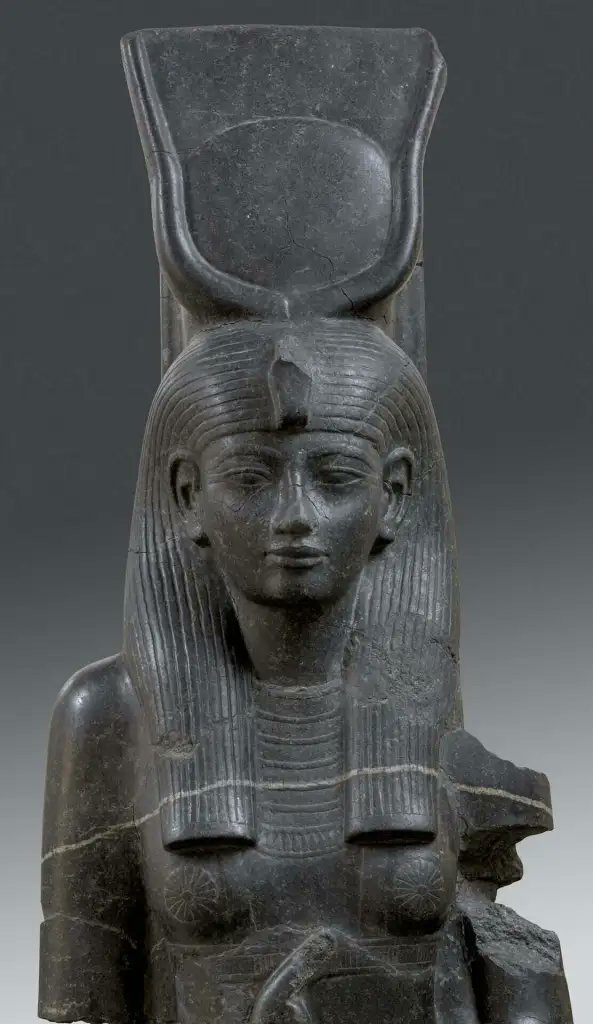
Isis of Coptos with Hathoric regalia, the 18th Dynasty (c. 1539–1292 BCE, Museo Egizio
It is disputed by Egyptologists whether the name Isis first appears in the Pyramid Texts of Unas at Saqqara (circa 2375–2345 BCE) or in the earlier sun temple of Nyuserre Ini (2458-2422 BCE). In any case, she and Nephthys appear as a dyad in the Pyramid Texts very securely.1,2,3
Isis in Egyptian appears to mean 'throne' or 'seat'. The sign of Isis in hieroglyphs is subsequently the block throne (Q1), commonly attached to the half bread symbol, among many other variations. The philology of the theonym Isis is disputed. Egyptologists have proposed a root theonym of 'Rusat', evolving into Usat and Eset, finally into Coptic ⲏⲥⲉ (Ese) in documents like the late Michigan Ms. Copt. 136 of the fourth century CE.3,4,5,6,7
Her name made its way into many languages. The Akkadians refer to her as Eshu or Esi; she is the subject of numerous theophoric names in state documents, while the Phoenicians name her as 's. Herodotus first attests to Ἶσις (Isis) in his dialect of Ionic Greek in the Histories where he discusses Egyptian civilization at length. Cicero shows the old Latin author Ennius already having an awareness of Isis. In Kush, her name was transcribed as Wos or Wusa.8,9,10,11,12,13
The only full etymology of the theonym is from the Greek priest, Plutarch, in his delineation of Egyptian religion. Plutarch calls the goddess wise (σοφή) and says she is a lover of wisdom (φιλόσοφος), and says her very name shows that knowing (τὸ εἰδέναι) and knowledge (ἐπιστήμη) belong to her. Most dramatically, he states flatly that Ἶσις is a Greek word (Ἑλληνικὸν ἡ Ἶσις).14
He derives Ἶσις παρὰ τὸ ἵεσθαι μετ' ἐπιστήμης καὶ φέρεσθαι, "from being sped with knowledge and borne along," so that Isis is κίνησις ἔμψυχος καὶ φρόνιμος, "an ensouled and intelligent motion." The root verb is ἵημι / ἵεσθαι, "to send, speed, rush." He insists the name is Greek and not barbarian (οὐ... βαρβαρικόν), and argues by analogy: just as the word θεός is common to all the gods and comes from two elements, τὸ θεατόν ("the seen") and τὸ θέον ("the running"), so this goddess takes her name from ἐπιστήμη (knowledge) together with κίνησις (motion). He then anchors the idea in Plato's Cratylus (401c), where the ancients supposedly called being or essence (οὐσία) by the form ἰσία (Isia), tying Isis to the flowing, moving character of the real, with νόησις and φρόνησις understood as the motion of mind that "speeds and is borne" (ἱεμένου καὶ φερομένου).14
Sources: Thesaurus Linguae Aegyptiae, Ꜣs.t; Tower Hollis, Five Egyptian Goddesses, 2019; Sabbahy, Isis, Pharaonic Egypt, 2013; Dosoo, Isis in Christian Egypt, 2021; Burrows, Phoenician Inscription from Ur., 1927; Donbaz et al., Neo-Assyrian Legal Texts in Istanbul, 2001; Herodotus, Histories, 1920; Cicero, De divinatione, 1923; Tormod et al. Fontes Historiae Nubiorum, 1996.4,7,8,10,11,12,13
II. Isis in the Egyptian World
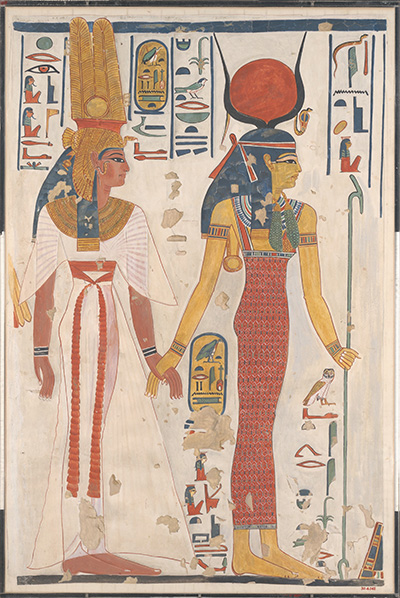
Royal Wife Nefertari being led by Isis, Tomb of Nefertari
The Old Kingdom
By some historians, the status of Isis in Egyptian early culture is seen as forming an oppositional pattern to that of the adjacent great goddess, Hathor. While Hathor is extraordinarily visible in the Old Kingdom's statuary and litany of identified physical objects, particularly standing next to the Pharaoh in life, Isis appears inside the Pyramid Texts around one hundred times to guide him in death. The sky goddess Nut even says to him:
"I have given to you your sister Isis, that she may lay hold of you."
Pyramid Texts, Utterance 4
Osiris, the beloved of Isis, is cut into pieces by the god Set. Her role in the Pyramid Texts is to search for the pieces of the body, to guard and anoint it, to reconstitute and bless the dead parts, to mourn with her sister Nephthys over it as the Two Kites in a ceremony that would be enacted throughout Egypt for millennia - the formula goes that Isis has seen it, while Nephthys has found it. The Pharaoh himself is clad in divine persona, given the akh by the grieving goddess in her use of magic, enabling him to live forever.
That is the defining and original role where Isis comes forth as the great maintainer of the entire Egyptian body in the cosmology, a role which corresponds roughly to Aphrodite's protective function in the Iliad and the esoteric path of Demeter in controlling life, death and decay. The Pyramid Texts clearly outline that as the mother of Horus, she also is the causative agent for the downfall of Set.3
Nonetheless, the apparent division between Hathor as royal goddess of the living Pharaoh and Isis as goddess of the decreased Pharaoh has to be treated with caution. Many Old Kingdom artefacts of goddesses are simply unidentified and lack clear visual clues pointing towards identification of being Hathor, Isis or Nephthys.
The Middle Kingdom
The emphasis of the Isian context spread to an intimate cult of mortuary theology among the Egyptian elites who sought her company after death from the surviving evidence. Scholars find passages indicating a more physical evidence in the Coffin Texts. For example, Coffin Text 74 reproduces the direct words of Isis as she finds Osiris and calls Nephthys to help raise his head, join his bones, and tend his limbs. Martin Bommas interprets this as evidence that the myth was ritually staged during actual funerals.15,16,17
The shifts in the texts show that Isis gains more of an active and magical role. Her words restore the functions of the body of Osiris. In Coffin Text 148, she announces with foresight that she is carrying the divine child Horus in her womb who will defeat iniquity and rule the land.
The theology of the Two Kites becomes more enshrined in imagery as the Isis–Nephthys pairing became materially visible in Middle Kingdom funerary equipment. A model funerary boat from the mid-Twelfth-Dynasty tomb of Djehuty at Lisht, for instance, shows the mummy of Osiris beneath a canopy tended by two women who play the roles of Isis and Nephthys.18,19
The New Kingdom
The transformation of the role of Isis began during the New Kingdom as the theology of Osiris becomes formal. She takes an active role in the Book of the Dead and the Contendings of Horus and Set, intervening in the divine tribunal, tricking Set and manipulating circumstances for the latter to condemn himself. At this point, the amount of contexts where the mourning Two Kites appear in art multiplies significantly. The sisters are also accompanied by Neith and Selket as guardians of the body in frequency, particularly in scenes where the Four Sons of Horus are depicted.16,20,21
Isis also increasingly takes on a form of being the divine force who assists women. Entrenchment in the royal cult is progressively stronger and she is indicated as being the guardian of elite ladies. Royal tombs like that of Nefertari show Isis leading her forth by the hand, while the wings of the kite shield an increasingly larger group of individuals of both sexes in mortuary scenes. To add to this, Isis is increasingly merged with Hathor, given the sun disk and horns, such as in the dedication of Siase at Asyut, a process that continues down to Roman times.22,23,24
It appears to be the New Kingdom contexts where Isis formally becomes the goddess who is "great of magic". The Twentieth-Dynasty Papyrus Turin Cat. 1993 preserves the Tale of Isis and the Name of Ra. Isis collects the saliva of the aged sun god, her father, mixes it with earth, and forms a serpent. After the serpent bites Ra, Isis alone can cure him, but she withholds the cure until he discloses his secret name. In the end, he transfers the name to her, with the condition that it may be shared with Horus.
The divine mother of the falcon is a role of hers that is given a higher and higher precedence. New Kingdom magical traditions increasingly used Horus as the archetypal endangered child and Isis in the form of a correspondingly protective mother. A sick, poisoned, feverish, or threatened human was equatable with Horus; the healer correspondingly assumes the role of Isis or invoked her intervention.25
Late, Ptolemaic and Roman Periods
In the same way as numerous Egyptian gods, Isis becomes most prevalent in material culture during the Third Intermediatae and Late period, or at least this is the period where the majority of her surviving contexts begin to survive to our time in the material record. In the main, the amount of amulets, statuettes and other tokens of Egyptian culture showing her nursing Horus as Isis Lactans are evident.26
The cosmological role of Isis in Egypt seemed to expand considerably in these centuries, particularly during the Roman period. She was identified with powers of changing nature and the weather, the aversion and enactment of fate, the creator of the world (a role she shares with Ptah), the essence of godhood (like Amun), the arbiter of the living world and all magic within the spheres. In many ways, Isis became the distinctly feminine equivalent of Amun-Ra-Ptah, paralleling perhaps the later Indian tendency of merging all goddesses in shakti.
In other ways, Isis and Hathor formed a dyad of two symbolic supreme goddesses, because the ancient and arcane cults of both were resurrected in grandiose form at Philae for Isis in the early Ptolemaic period and at Dendera for Hathor in the later period of the Greek dynasty, secondly because Ptolemaic queens like Arsinoe II and Cleopatra VII in relation to symbolic apotheosis drew on both goddesses, and ultimately both were tied to Horus, with Hathor having her own distinct mother cult for Ihy.17,27,28
The great goddess was identified with a litany of goddesses like Renenutet, Tyche and others. In a more visible sense, the mourning scenes of the Two Kites also continued to be enacted in public to prolific levels as shown in documents the Songs of Isis and Nephthys, while dawing on the formalization of this religious ideal, the pentadic theology around Osiris, Isis, Nephthys, Set in the form of Typhoneus and the avenging child Horus is precisely what Plutarch sought to explain.14
III. The Epithets of Isis
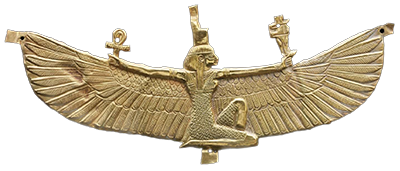
Winged Isis Pectoral, Nubia from King Amaninatakilebte's reign (538–519 BCE), Museum of Fine Arts (Boston)
| Epithet | Meaning | Domain |
|---|---|---|
| Ꜣs.t wr.t | Isis the Great | Supreme divine rank |
| mwt-nṯr | Mother of the God | Divine motherhood |
| Ꜣs.t wr.t ḥkꜣw | Isis, Great of Magic | Magic, healing |
| Ꜣs.t nb.t pt | Isis, Lady of Heaven | Sky-goddess, celestial sovereignty |
| ḥnw.t nṯr.w nb.w | Mistress of all the Gods | Pantheonic supremacy |
| Ꜣs.t nb.t tꜣ.wy | Isis, Lady of the Two Lands | Dominion over Egypt, kingship |
| Ꜣs.t nb.t Ḥbyt | Isis, Lady of Hebet (Behbeit) | Chief Lower Egyptian temple, the Iseum |
| Ꜣs.t-Spdt | Isis-Sothis | Sirius, inundation, the New Year |
| Ꜣs.t nb.t ꜥnḫ | Isis, Lady of Life | Vitality, funerary renewal |
| ir.t Rꜥ | The Eye of Ra | Solar and uraeus power, wrath, protection |
| ḥnw.t Iꜣt-wꜥbt | Mistress of the Abaton (the Pure Island) | Osirian mysteries; the tomb-island of Biggeh |
| Ꜣs.t-Rnnwtt | Isis-Renenutet | Harvest, nourishment, good fortune |
| Ꜣs.t nb.t imnt.t nfr.t | Isis, Mistress of the Beautiful West | Funerary guidance, the necropolis |
| Ꜣs.t m Ꜣḫ-bit | Isis in Akhbit (Khemmis) | The Delta marsh |
| Isis Regina | Isis the Queen | Roman sovereignty over the cosmos |
| Isis Augusta | Isis the August | Imperial cult; assimilation of the empress |
| Isis Myrionyma | Isis of the Ten Thousand Names | Universal syncretism, magic |
| Isis Pharia | Isis of the Pharos | Alexandria, the lighthouse, the grain fleet |
| Isis Pelagia | Isis of the Sea | Protection of sailors, invention of the sail |
| Isis Fortuna | Isis-Fortuna | Fortune above fate, dispenser of wealth |
| Isis Invicta | Isis the Unconquered | Invincibility, martial protection |
| Isis Frugifera | Isis the Fruit-Bearing | Agricultural abundance, the harvest |
Sources: British Museum, “statue, EA1162,”; British Museum, “figure, EA60756,”; Žabkar, Hymns to Isis in Her Temple at Philae, 1988; Griffiths, The Isis-Book, 1975; Bricault, Myrionymi, 1996; Bricault, Isis Pelagia, 2020; Favard-Meeks, Le temple de Behbeit el-Hagara, 1991.29,30,31,32,33,34,35,36
IV. The Temples and Sacred Sites of Isis
Mistress of the Pyramid
Her oldest site is also the most mysterious. The earliest discernable temple devoted principally to the great goddess in any Egyptian self-definition is the Temple of Isis, the Mistress of the Pyramid, at Giza, adjoining the eastern side of the queen’s pyramid G I-c, southeast of Khufu’s Great Pyramid.
Historians such as Selim Hassan tend to argue that the original building was a Fourth-Dynasty mortuary chapel that was converted for Isis worship in the eighteenth century BCE, not originally a temple for the goddess. Later Egyptian rulers, however, insisted that it formed an extremely ancient abode of hers, such as celebrated Inventory Stela found in this temple claiming that the ancient Khufu discovered and rebuilt a still earlier “House of Isis.” The Stela is, however, dated from the Saite Period of the 600s BCE.
The earliest segment explicitly devoted endlessly to Isis was built by Psusennes I and Amenemope in approximately the eleventh–tenth centuries BCE. This type of ambiguity is not exclusive to the goddess, because certain mortuary sites of Pharaohs were turned into places of worship for Osiris, Anubis and even the Bes group.37,38
Philae
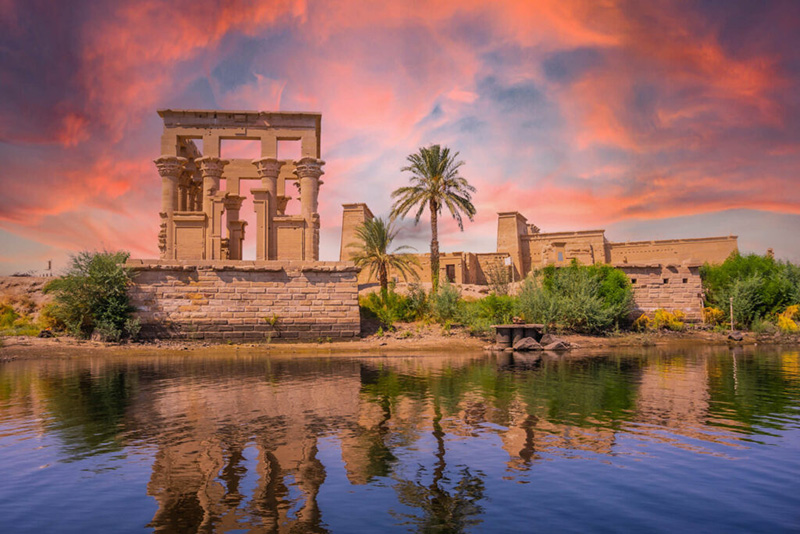
Temple of Isis at Philae
The island of Philae to the south of the Nile in Upper Egypt originated as an important site for her worship during the Saite Period, when elaborate gates and other pieces of architecture like its famous kiosk began to be built. It seems also that Philae developed from a shared complex of Osiris, Min, Horus and Isis to being oriented towards the goddess.
I have given you all life, all dominion, all health, all joy.
Isis addressing Ptolemy II Philadelphus, Philae inscription, trans. Žabkar39
After Alexander’s conquest and the establishment of the Ptolemaic dynasty, Philae was transformed into one of the greatest temple complexes of Egypt by the Ptolemies. Similar to the complex of Hathor at Dendera and the complex of Horus at Edfu, least two-thirds of its surviving buildings and decoration were produced during the Ptolemaic period, although later Roman emperors added further structures and reliefs. Cleopatra VII contributed strongly to the temple in wealth and dedications.
The importance of Philae shall never be understated. The temple’s theological status depended upon its relationship with the nearby sacred island of Bigeh, regarded as an abaton, a restricted holy place associated with the burial of Osiris. Her temple ritually was in service to this entire sacred landscape, facing the other island as a recepticle to it.40,41
Behbeit el-Hagar
Behbeit was a great northern sanctuary of Isis to the north, preceding the prevalence of Philae, but serving as its complement. The temple located on the Delta was enormous and made of black granite. Nectanebo II appears to have completed or decorated only part of the complex in the mid fourth century BCE before the Persian reconquest and Greek conquest of Egypt. Particularly important was the sanctuary associated with Osiris in his local form, Osiris Hemag.
Again, the Greek rulers did much to construct the temple in their promotion of Egyptian religion. Ptolemy II subsequently completed significant parts of the sanctuary and chapels. Ptolemy III added or decorated the hypostyle hall and western façade. The building later collapsed, leaving the enormous disordered granite blocks from which its reliefs and inscriptions are in the process of being interpreted.42,43
Khent-min
Khent-min or Akhmim (Khemmis, the fields of the child Horus) provided particularly strong evidence for the institutionalization of Isis’s cult during the New Kingdom. The great goddess was associated with the local god Min there. Under Ay, the official Nakhtmin held the office of high priest of Min and Isis and supervised royal works connected with his memorial establishment.44
Greek Islands and Cities
Isis was worshipped at the sacred island of Delos, at Athens and many other locales throughout the Greek world in numerous civic temples which were by no means meager. Some of these like the temple at Rhodes and probably locales at Naukratis appear to have preceded the conquest of Egypt by Alexander. Herodotus already assumes a Greek reader is familiar with Isis in his Histories.11,45,46,47
Rome
The greatest civic nexus of Isis worship, however, would be in the very capital of Cleopatra's enemy, the Roman Empire. The Iseum Capitolinum was the first large temple to her. It was already subject to removal in 58BCE, though it appears another was created in 43BCE. The Iseum Campense was the most famous and controversial site to Isis in Rome, facing its counterpart the Serapeum on the Campius Martius. Augustus restricted worship, while Tiberius destroyed it as a result of either scandal involving its priesthood (according to Josephus) or anti-Egyptian policies (according to Tacitus and Suetonius). The emperor Caligula, fond of Egyptian religion, returned it and restored its functions.48,49,50,51,52
The precinct was a double sanctuary. The Iseum proper lay to the north, east of the site of the later church of Santa Maria sopra Minerva, and the Serapeum stood to the south beneath what became Santo Stefano del Cacco, the two temples facing across an open plaza within a single walled enclosure. Monumental arches gave entry, among them the arch known in the Middle Ages as the Camigliano, and a long courtyard connected the complex to the surrounding streets. Around and within it stood a forest of Egyptian and Egyptianizing sculpture, much of it recovered piecemeal from the Renaissance onward and now dispersed through the museums and squares of Rome, such as the obelisks.53,54,55
quae de templi situ sumpto nomine Campensis summa cum veneratione
Apuleius, The Golden Ass (Metamorphoses) 11.2654
Her sanctuary was maintained and enlarged for more than two centuries after Domitian. A reorganization of the surrounding quarter under Hadrian, contemporary with the building of the nearby Pantheon and the temple of the deified Hadrian, reshaped the approach to the Iseum. The Severan dynasty also enlarged the Iseum and Serapeum.56
V. The Mother of the Divine Child
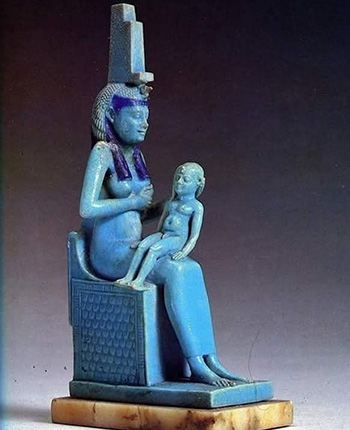
Isis nursing Horus, 332-30BCE
Isis even in myth touts herself as the great mother of Horus, the restorer of the land from chaos, before he is even born. Perhaps one of her most enduring images is in the endless objects shown nursing Horus at her breast, typically enthroned, which even individuals in the Renaissance remarked was evocative of the later hoax. 57,58
The roots of the cult of the Divine Child reached down to mothers based on evidence. One example is the wall painting from House B50 at Karanis in the Fayum. It occupied the back of a niche inside a private house and depicted Isis holding the infant Harpocrates, Horus the Child, to her breast. The excavators interpreted the nursing image as one whose maternal character would have appealed particularly to the town’s women. Other Isis images were found in Karanis houses and were probably displayed in household shrines.59,60
Another example is the House VIII at Bakchias. That building had a terracotta representation of Isis near the entrance, a head of Harpocrates, a domestic altar, amulets of the Bes creatures and a statuette of the birthing goddess Taweret. The rooms seemed to accomodate women in labor or who had given birth. Small images of Isis nursing Horus appeared on engraved gems and portable amulets, making them suitable for wearing against the body. Uterine amulets of Anubis and the Bes creatures seem to accomodate this. Freidin describes such miniature objects as “technologies of hope”: portable material means by which women or their caregivers attempted to manage reproductive danger.61,62
As stated above, the London Medical Papyrus of the New Kingdom shows a pattern of Isis healing a distressed Horus. The same power runs through the New Kingdom books of healing, where the line between medicine and magic was used with Isis over and over again: healing over the sick and burns, quenched by the milk of Isis as she cooled the burning of her child, and the perils of birth, where her name guarded the mother and the newborn. In these things we see the roots of what Apuleius attributes to Isis in his Metamorphoses, where she is hailed as the Mother of All.63,64
VI. The Queen of Magic, the Gate of Heaven
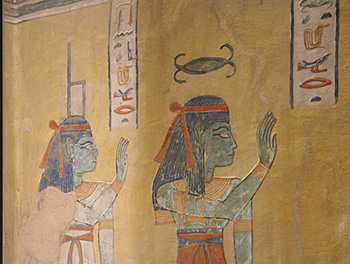
Isis with throne and Neith, Valley of the Queens
The Egyptian goddess is associated with the Upper Chakras above the Throat. Her essence in sound deals with prophecy and psychic powers. In the New Kingdom texts, however, Isis also gains the attribute of being she who makes magic altogether possible.
Weret-hekau (wrt-ḥkꜣw, Great of Magic) is the word that accompanies Isis from this point of inheritance from the eponymous lioness-serpent goddess up to great pronouncements of the Roman temples. It is her process that nurtures the gestation of the initiate of the gods into a new form, the Second Birth. Every part of the soul being accessed again is a bridge that her power renders possible.65
VII. Isiac Symbolism
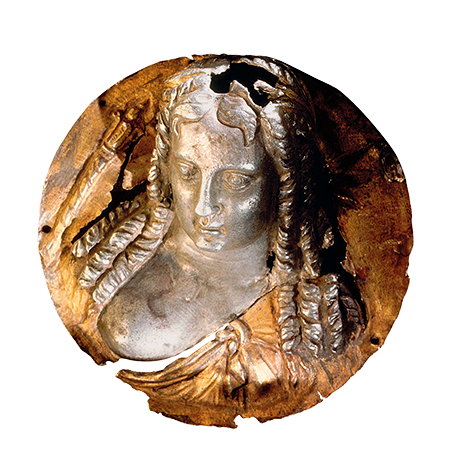
Medallion of Isis, Greco-Roman
The earliest and most enduring symbol of Isis is the throne she wears on her head, which, as with most Egyptian deities, also represented part of how her name was written. This distinguishes her from other major goddesses such as Hathor and Nephthys. Henri Frankfort turned these relationships into a more elaborate theory. At coronation, a prince who sat upon the royal throne arose as Pharaoh. Frankfort therefore argued that the throne “made” him and could figuratively be understood as his mother.
Later texts from Kush ask Isis to sit upon a throne so king Natakamani can continue to rule from it, never creating an apparent vacancy. Simply, the throne may mean she is the Queen of the Gods. There appears to be a relationship of Isis to legitimate government in later Egyptian and Greco-Roman texts.66
An extra major symbol of Isis that began to appear in the Old Kingdom was the tyet, a variation of the ankh of life with knots at its sides, though it is not directly associated with her until many years later. With time, the tyet began to be buried with the dead in the New Kingdom en masse. It was held to have magical properties protecting the body and soul from unwanted intrusion; the Book of the Dead rescensions from the New Kingdom make reference to its healing powers. They could be made of carnelian, red glass or faience.20
An alternative to the throne is her wearing the lotus, which particularly becomes more prolific in the Hellenistic period. The lotus represents the opening of the Higher Chakras and the flowering of higher wisdom from it. She also wields the sistrum like Hathor, Bastet and other goddesses.
The most major therian symbol of Isis is the kite, the bird she assumes the form of when searching for the body parts of Osiris. The kite distinguishes her from the falcon form of the solar gods and in some cases Nephthys is portrayed as a screecher. 67
In Rome, her two most distinctive symbols became the boat and the situla (a bucket shaped vessel), in addition to the sistrum, although the boat recalls much earlier Egyptian rituals related to Philae and other areas. The boat was part of her sacred procession in Rome, linking her strongly to the sea. The situla held to carry Egyptian water may be related to Plutarch linking her to the Platonic 'mixing bowl'; it was often breast shaped.
VIII. The Funerary Isis, She of the Kites
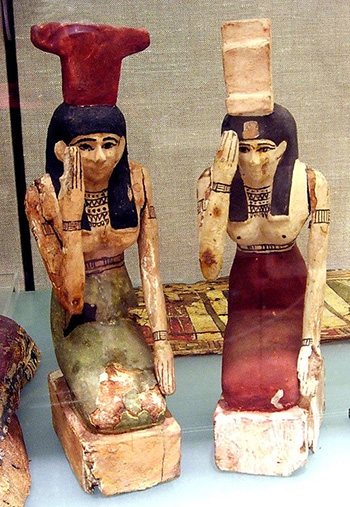
Isis and Nephthys in mourning poses, 332–30 BCE, the Met
The earliest context of Isis that predates anything else is in being the divine guide to the Pharaoh in death because, after all, she is the wife or lover of the god of death, Osiris. In this, she is always conjoined to by Nephthys in the grim search and reconstitution. The funerary god Anubis also frequently accompanies her in this retinue, one where he is portrayed as embalming Osiris in a sacred manner. 68
IX. The Spread of Isis in the Roman Empire
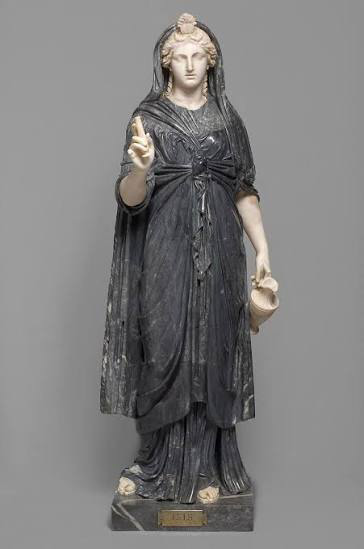
Isis, Greco-Roman statue of 1st century CE, Kunsthistorisches Museum
Isis strode across the borders of ancient empires in a way that seems remarkable. Enthusiasm among those receiving her rites led her temples to spread to Sicily from the mid third century BCE, and one came to Pompeii around 100BCE. As detailed above in regards to Rome, her initial reception in the city amist the political upheaval of the late Republic and the conservative period of early Empire was markedly controversial. Nonetheless, even during the harshest proscriptions against Egyptian worship, Isis was invariably one of the most popular goddesses of the city. Her original tie to Serapis and Anubis is sometimes even divested in the process.
Josephus reports that on the night before their joint triumph over Judaea in 71 CE, Vespasian and Titus rested near or within the Temple of Isis at Rome and emerged from that area at daybreak to begin the ceremonies. This is one of the reasons Josephus may be unreliable as a source: he treats Rome's military campaigns against Judaea as an extension of the goddess' malign influence over the two emperors.69,70
Domitian made the biggest difference; the fire of 80 CE damaged or destroyed the Isis–Sarapis complex in the Campus Martius. He subsequently reconstructed it on an immense scale, introducing Roman-period Egyptian sculpture, obelisks, water installations, colonnades, and Egyptianizing architectural decoration. The resulting complex became the largest and most prestigious Iseum in the western Mediterranean.53,56
The emperors Trajan and Hadrian also esteemed the Egyptian belief system. The archeological and epigraphic distribution assembled by Laurent Bricault shows her worship extending from the Iberian Peninsula and North Africa through Gaul, Italy, the Rhine and Danube regions, Greece, Asia Minor, the Black Sea, Syria, and, more sporadically, Britain. Soldiers, it appears, often spread her worship through military means. By the third century CE, her cult had spread everywhere. The Severan Dynasty went to great lengths to promote it.71
One of the many appeals of Isis to the Roman public was her universality. She was a mother of proper conduct, a worker of magic, a lamenting woman, the protector of her child and the protector of the weak, a wife who truly loved her husband, an agent of fortune when synthesized with Fortuna or Tyche. She had her own mystery cult and priesthood that was of a truly ancient lineage. The resistance to her foreign nature could only last a season.
X. Platonic Conceptions of the Contending
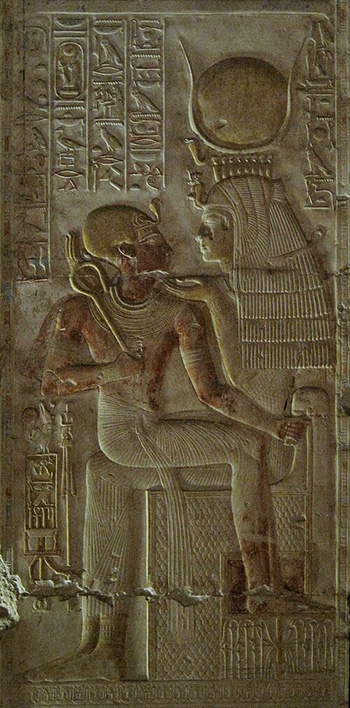
Isis nursing Pharaoh Seti, Temple of Seti I in Abydos (c. 1290–1279 BCE)
Plato names Isis the nurse and the all-receiving. Plutarch goes as far as to identify her with the recepticle that Plato speaks of. Within Plutarch's later exposition and understanding of Egyptian religion, Osiris is the divine intellect, and Typhoneus-Set is the disordered power set against him, the irrational motion in the soul of the world. Isis holds the place between them. She is the feminine principle of Nature and the recipient of all generation and whom the multitude calls the goddess of ten thousand names (μυριώνυμος), since she takes upon herself every shape and form.
The role that Plutarch gives Isis is, again, approximate to a median role between Demeter (Ceres), Aphrodite (Venus) and Persephone (Libera) in the Neoplatonic division of powers. The identification of these goddesses with Isis in Greco-Roman statuary, alongside Hecate, Diana and Tyche, has to be understood in this light. The point of the wise receiving her was hardly to give these Greek goddesses a foreign costume, nor was it a foreign subversion as some Romans understood it; it was to elaborate on a wider principle.
From this union comes Horus, the ordered cosmos, the perceptible image of the intelligible world. The Egyptian worldview hinges on the divine intellect, the median principle encompassing life and the order that is born from both.14
XI. Festivals of Isis
| Isis Ritual Days | Place | Description | Events | Date Recorded |
|---|---|---|---|---|
| The Mysteries of Osiris | Dendera and Abydos | Death and resurrection of Osiris | Isis and Nephthys mourn; the corn-mummy fashioned; the Djed pillar raised | Khoiak, days 12–30 (Ptolemaic) |
| The Songs of Isis and Nephthys | Abydos and Mendes | Liturgy of mourning and awakening | Two women as Isis and Nephthys recite over five days to recall Osiris | Khoiak, fourth month of Inundation (Bremner-Rhind papyrus) |
| The Festival of Isis at Busiris | Busiris | Great mourning festival | Sacrifice, then the whole multitude beat themselves in grief | Herodotus (5th century BCE) |
| The Decade Festival of the Abaton | Philae and Biggeh | Libation for the tomb of Osiris | Isis's image crosses to the Abaton with fresh milk every tenth day | Every decade (Ptolemaic–Roman Philae texts) |
| The Coming of Sothis | Reported for Egypt at large | Rising of Isis-Sopdet; the New Year | The star of Isis rises to herald the inundation and the year | New Year, at the rising of Sothis (Plutarch, 1st–2nd century CE) |
| The Birth of Isis | Reported for Egypt at large | Birthday of the goddess | The fourth of the five days added upon the year | 4th epagomenal day (Plutarch, 1st–2nd century CE) |
Sources: Herodotus, Histories; Plutarch, De Iside et Osiride; Chassinat, Le mystère d'Osiris au mois de Khoiak; Cauville, Le temple de Dendara: Les chapelles osiriennes; Faulkner, The Papyrus Bremner-Rhind; Junker, Das Götterdekret über das Abaton; Coppens, Temple Festivals of the Ptolemaic and Roman Periods.11,14,72,73,74,75,76
Numerous festivals also existed in Rome:
| Isis Ritual Days | Place | Description | Importance | Date Recorded |
|---|---|---|---|---|
| Navigium Isidis | Rome and Ports | Ship of Isis | Ship festival | Apuleius (2nd century CE) |
| Pelusia | Rome | Festival of Isis and Harpocrates | Rites for the divine child | Calendar of Philocalus (354 CE) |
| Lychnapsia | Rome | Festival of Lamps | 12 August; lamps for Isis birthday | Calendar of Philocalus (354 CE) |
| Isia | Rome | Mourning and Finding of Osiris | Four days of grief, joyful finding (Heuresis) | Calendar of Philocalus (354 CE) |
Sources: Apuleius, Metamorphoses, 1989; Salzman, On Roman Time, 1990; Firmicus Maternus, The Error of the Pagan Religions, 1970; Witt, Isis in the Ancient World, 1997.54,77,78,79
XII. The Priesthood and the Mystery
The priesthood of Isis was of both sexes. A male Isiac priest was known from sight. He shaved his head and often his whole body, wore white linen and never wool, and went barefoot or in sandals of papyrus, carrying the bronze sistrum whose rattle drove off harm and the situla of holy water. His commitment was life-long, only matching those of the Vestal Virgins in terms of time given. It is said these rites were ancient and thoroughly Egyptian.80
The male Isiac priesthood had grades which only otherwise seem to suit the pattern of Mithraic worship. At the head stood the prophet (prophetes), the senior priest who bore and interpreted the sacred books; it was such a prophet, named Mithras, who conducted Lucius through his initiation. Below him ranged the specialists: the stolist (stolistes), who robed and adorned the divine image; the sacred scribe (hierogrammateus), who carried the hieratic writings; the water-bearer (hydreiaphoros), who bore the vessel of Nile water; the warden (neokoros), who kept the temple; and the wearers of black (melanephoroi), who took the mourning of the goddess upon their dress. Beneath these came the pastophori, the shrine-carriers who bore the small naos of the god in procession, organized into companies of ten under a leader called the decurio, appointed for five years; it was into this college that Lucius was finally enrolled and made a decurio himself.81
Women held a larger place in the clergy of Isis than in most of the ancient world. They appear in the inscriptions as priestesses (sacerdotes Isidis), as ministrae, and as dedicators in great numbers, and the goddess who had gathered and restored her husband drew in female devotion in a way few gods did.82
The mysteries of Isis come down to us through the account of Apuleius. Like Demeter at Eleusis, Isis was by the Roman period understood as a guardian of secretive rites. Adding to her universality, however, unlike those of the Greek goddess fixed to one place at a specific part of the year, the secrets of Isis could be received in many temples across the Mediterranean and possibly beyond. It seems like applicants were beckoned by being called by the goddess from within a dream; it was a solitary, lonely rite and possibly psychologically aggressive rite compared to the mass ceremony of Eleusis, having a different type of emphasis despite the connections of Demeter and Isis as the same goddess.83
XIII. Isis in Other Locales
Nubia
The spread of her worship in Nubia accompanied its conquest by the New Kingdom. From that point, Nubia became a nexus of her worship that was particularly prolific. The temple cult at Buhen was particularly prolific. After Egyptian control weakened, the rulers of Kush established their political and religious centre around Napata and Gebel Barkal. By the eighth century BCE, the Kushite kings who formed Egypt’s Twenty-fifth Dynasty had extensively adopted Egyptian language, royal titulary, temple ritual, and funerary theology.84,85,86
Isis also became a recurrent figure on Napatan royal funerary equipment. In the pyramid of King Anlamani at Nuri, dating to the late seventh or early sixth century BCE, winged goddess appears as a protector of the royal dead. Comparable images occur in the tomb of Aspelta and on royal pectorals and other precious burial objects. In Meroe, at n the pyramid chapel of Queen Shanakdakhete, dating approximately to the second century BCE, the deceased royal figures are protected by the wings of Isis.
At Meroë itself, the strongest evidence for an organized cult of Isis in the Kushite heartland is Temple M 600 at the royal capital. The temple was probably established or substantially developed around the late first century BCE. Its location within Meroë and its cult objects demonstrate that Isis possessed an institutional cult in the political heart of the Meroitic kingdom. She was also associated strongly with the queens of the state.87,88
Carthage
In the Carthaginian Empire, Isis is present within this repertoire in her Egyptian guises: the Isis-lactans type (the goddess nursing the infant Horus), she is paired with Nephthys flanking Osiris, the tyet knot is present, the wedjat, and related protective signs. Their role in Punic tombs was apotropaic and regenerative, borrowed from Egyptian funerary magic. The winged figure on the female sarcophagus of Rabs is possibly related to Isis.89
Germania
The remote borders of the Roman Empire on both sides of the Rhine River and Danube River had traces of her worship. A discovery of a temple for the worship of Isis and Mater Magna in present-day Mainz, found in 1999, has generated great interest among scholars. According to one well-known text it appears she was able to take her cult beyond the border into Free Germany. In his book, "Germania", Tacitus writes that a portion of the Suebi performed sacrifices to Isis. He could not explain or where this strange rite came from; and he notes that her symbol resembles a small, fast sailing ship which suggests that she originated outside of Germany.
In addition, the Mainz sanctuary produced another rare find, a set of lead tablets containing curses (defixiones) placed inside the sanctified fire pits surrounding the sanctuary. These were first fully reported by Jürgen Blansdorf. On these tablets, regular people have turned over their complaints to Isis and Mater Magna, asking them to steal away a thief, harm a deceiver, bind up an enemy, using the harsh and rigid formality common to the defixion. To the north along the river, there is less evidence. In Germania Inferior, whose major cities included Cologne and the legions located at Bonn and Xanten, images and inscriptions of Isis and Serapis can be found in the Corpus Epigraphicum De Cultu, indicating the presence of the same military-mercantile trade networks that supported Mainz.90,91
Sources and Bibliography
- Tower Hollis, Susan. Five Egyptian Goddesses: Their Possible Beginnings, Actions, and Relationships in the Third Millennium BCE (London: Bloomsbury Academic, 2019), 1–3.
- Sabbahy, Lisa. “Isis, Pharaonic Egypt,” in The Encyclopedia of Ancient History, ed. Roger S. Bagnall et al. (Malden, MA: Wiley-Blackwell, 2013), 3518.
- Allen, James P. The Ancient Egyptian Pyramid Texts (Atlanta: Society of Biblical Literature, 2005), 33–34, Unas Spells 150–52; PT §§155a–166.
- Berlin-Brandenburg Academy of Sciences and Humanities and Saxon Academy of Sciences and Humanities, “Ꜣs.t,” lemma 271, and “s.t,” lemma 400492, Thesaurus Linguae Aegyptiae.
- Gardiner, Alan H. Egyptian Grammar: Being an Introduction to the Study of Hieroglyphs, 3rd rev. ed. (Oxford: Griffith Institute, 1957), 500, 531–33.
- Kuhlmann, Klaus P. “Throne,” in UCLA Encyclopedia of Egyptology, ed. Willeke Wendrich (Los Angeles: University of California, Los Angeles, 2011), 1–3, 8.
- Dosoo, Korshi. “Isis in Christian Egypt: The Cultural Context of Michigan Ms. Copt. 136 ll. 17–34.” In Hymnen und Aretalogien im antiken Mittelmeerraum: Von Inana bis Isis, edited by Laurent Bricault and Martin Andreas Stadler, 195–232. Philippika 154. Wiesbaden: Harrassowitz Verlag, 2021.
- Burrows, Eric. “Phoenician Inscription from Ur.” Journal of the Royal Asiatic Society of Great Britain and Ireland 59, no. 4 (1927): 791–94.
- Karlsson, Mattias. “Egyptian Hybrid Names in Cuneiform Texts from the First Millennium BCE.” Ägypten und Levante / Egypt and the Levant 33 (2023): 303–10.
- Donbaz, Veysel, and Simo Parpola. Neo-Assyrian Legal Texts in Istanbul. Studien zu den Assur-Texten 2. Saarbrücken: Saarbrücker Druckerei und Verlag, 2001. See StAT 2 37.
- Herodotus. Histories 2.50; ed. C. Hude, Oxford Classical Texts, 3rd ed., 1927; trans. A.D. Godley, Loeb Classical Library, 1920.
- Cicero, Marcus Tullius. De divinatione. Translated by William Armistead Falconer. Loeb Classical Library 154. Cambridge, MA: Harvard University Press, 1923. See 1.132.
- Eide, Tormod, Tomas Hägg, Richard Holton Pierce, and László Török, eds. Fontes Historiae Nubiorum: Textual Sources for the History of the Middle Nile Region between the Eighth Century BC and the Sixth Century AD. Vol. 2, From the Mid-Fifth to the First Century BC. Bergen: Klassisk Institutt, Universitetet i Bergen, 1996, 669–71.
- Plutarch. De Iside et Osiride. Edited and translated with an introduction and commentary by J. Gwyn Griffiths. Cardiff, University of Wales Press, 1970.
- de Buck, Adriaan. The Egyptian Coffin Texts. 7 vols. Oriental Institute Publications 34, 49, 64, 67, 73, 81, and 87. Chicago: University of Chicago Press, 1935–61.
- Faulkner, Raymond O. The Ancient Egyptian Coffin Texts. 3 vols. Warminster: Aris & Phillips, 1973–78.
- Bommas, Martin. “‘I Am Isis’: The Role of Speech in the Cult of Isis.” In Egypt and the Classical World: Cross-Cultural Encounters in Antiquity, edited by Jeffrey Spier and Sara E. Cole. Los Angeles: J. Paul Getty Museum, 2022.
- Assmann, Jan. Altägyptische Totenliturgien. Vol. 1, Totenliturgien in den Sargtexten des Mittleren Reiches. Heidelberg: Universitätsverlag C. Winter, 2002.
- Oppenheim, Adela, Dorothea Arnold, Dieter Arnold, and Kei Yamamoto, eds. Ancient Egypt Transformed: The Middle Kingdom. New York: Metropolitan Museum of Art; New Haven: Yale University Press, 2015.
- Scalf, Foy, ed. Book of the Dead: Becoming God in Ancient Egypt. Oriental Institute Museum Publications 39. Chicago: Oriental Institute of the University of Chicago, 2017.
- Gardiner, Alan H. The Library of A. Chester Beatty: Description of a Hieratic Papyrus with a Mythological Story, Love-Songs, and Other Miscellaneous Texts. Chester Beatty Papyri 1. Oxford: Oxford University Press, 1931.
- Troy, Lana. Patterns of Queenship in Ancient Egyptian Myth and History. Boreas 14. Uppsala: Acta Universitatis Upsaliensis, 1986.
- Wilkinson, Richard H. The Complete Gods and Goddesses of Ancient Egypt. London: Thames & Hudson, 2003.
- Metropolitan Museum of Art. “Queen Nefertari Being Led by Isis.” Facsimile by Charles K. Wilkinson after QV 66. Accession no. 30.4.142.
- Borghouts, J. F. Ancient Egyptian Magical Texts. Nisaba 9. Leiden: Brill, 1978.
- Metropolitan Museum of Art. “Statuette of Isis Nursing Horus, Inscribed for Hor Son of Padihorresnet.” Late Period, Dynasty 26, reign of Necho II, ca. 611–594 BCE. Bronze. Accession no. 45.4.3a, b.
- Kockelmann, Holger. Praising the Goddess: A Comparative and Annotated Re-Edition of Six Demotic Hymns and Praises Addressed to Isis. Archiv für Papyrusforschung und verwandte Gebiete, Beiheft 15. Berlin: Walter de Gruyter, 2008.
- Filip Coppens, “Creative Writing in Ptolemy II’s Time: Texts from the Temple of Isis at Philae,” in Current Research in Egyptology 2004, ed. Rachael J. Dann (Oxford: Oxbow Books, 2006), 34–42, especially 35–41;
- British Museum, “statue, EA1162,” Collection Online, https://www.britishmuseum.org/collection/object/Y_EA1162
- British Museum, “figure, EA60756,” Collection Online, https://www.britishmuseum.org/collection/object/Y_EA60756
- Louis V. Žabkar, Hymns to Isis in Her Temple at Philae (Hanover, NH: University Press of New England for Brandeis University Press, 1988)
- Barbara S. Lesko, The Great Goddesses of Egypt (Norman: University of Oklahoma Press, 1999).
- J. Gwyn Griffiths, Apuleius of Madauros, The Isis-Book (Metamorphoses, Book XI), Études préliminaires aux religions orientales dans l’Empire romain 39 (Leiden: E. J. Brill, 1975)
- Laurent Bricault, Myrionymi: Les épiclèses grecques et latines d’Isis, de Sarapis et d’Anubis, Beiträge zur Altertumskunde 82 (Stuttgart and Leipzig: B. G. Teubner, 1996)
- Laurent Bricault, Isis Pelagia: Images, Names and Cults of a Goddess of the Seas, Religions in the Graeco-Roman World 190 (Leiden: Brill, 2020)
- Christine Favard-Meeks, Le temple de Behbeit el-Hagara: essai de reconstitution et d’interprétation, Studien zur Altägyptischen Kultur, Beihefte 6 (Hamburg: Helmut Buske, 1991)
- El-Sadeek, Wafaa. Twenty-Sixth Dynasty Necropolis at Gizeh: An Analysis of the Tomb of Thery and Its Place in the Development of Saite Funerary Art and Architecture. Beiträge zur Ägyptologie 5. Vienna: Afro-Pub, 1984.
- Hassan, Selim. Excavations at Gîza, Vol. 8: 1936–1937: The Great Sphinx and Its Secrets: Historical Studies in the Light of Recent Excavations. Cairo: Government Press, 1953.
- Louis V. Žabkar, Hymns to Isis in Her Temple at Philae (Hanover, NH: University Press of New England for Brandeis University Press, 1988), 93–94.
- Kockelmann, Holger. “Philae.” In UCLA Encyclopedia of Egyptology, edited by Willeke Wendrich. Los Angeles: University of California, Los Angeles, 2012.
- Arnold, Dieter. Temples of the Last Pharaohs. New York: Oxford University Press, 1999.
- Favard-Meeks, Christine. Le temple de Behbeit el-Hagara: Essai de reconstitution et d’interprétation. Studien zur altägyptischen Kultur, Beiheft 6. Hamburg: Helmut Buske, 1991.
- Meeks, Dimitri. “The Great Temple of Isis at Behbeit el-Hagara.” In The Temples of Ancient Egypt, edited by Byron E. Shafer, 243–54. Ithaca, NY: Cornell University Press, 1997.
- Giorgio Rocco, Architecture and Monumentality in Hellenistic Rhodes (Athens: Scuola Archeologica Italiana di Atene, 2008).
- Françoise Dunand, Le culte d'Isis dans le bassin oriental de la Méditerranée, 3 vols. (Leiden: Brill, 1973).
- Laurent Bricault, Isis Pelagia: Images, Names and Cults of a Goddess of the Seas (Leiden: Brill, 2021).
- Robert A. Wild, Water in the Cultic Worship of Isis and Sarapis, Études préliminaires aux religions orientales dans l’Empire romain 87 (Leiden: E. J. Brill, 1981).
- Katja Lembke, “The Iseum Campense and Its Social, Religious and Political Impact,” in The Iseum Campense from the Roman Empire to the Modern Age: Temple, Monument, Lieu de Mémoire, ed. Miguel John Versluys, Kristine Bülow Clausen, and Giuseppina Capriotti Vittozzi (Rome: Edizioni Quasar, 2018),
- Filippo Coarelli, “Isis Capitolina e Isis Campensis: Il culto ufficiale delle divinità egiziane a Roma,” in The Iseum Campense from the Roman Empire to the Modern Age: Temple, Monument, Lieu de Mémoire, ed. Miguel John Versluys, Kristine Bülow Clausen, and Giuseppina Capriotti Vittozzi (Rome: Edizioni Quasar, 2018), 61–77;
- Sarolta A. Takács, Isis and Sarapis in the Roman World (Leiden: Brill, 1995),
- Josephus, Jewish Antiquities 18.65–80; Tacitus, Annals 2.85; Suetonius, Tiberius 36;
- Katja Lembke, Das Iseum Campense in Rom: Studie über den Isiskult unter Domitian (Heidelberg: Verlag Archäologie und Geschichte, 1994),
- Lembke, Das Iseum Campense in Rom, 18–64; Olga Lollio Barberi, Gabriele Parola, and Maria Pamela Toti, Le antichità egiziane di Roma imperiale (Rome: Istituto Poligrafico e Zecca dello Stato, 1995),
- Apuleius. The Golden Ass (Metamorphoses), Book 11, esp. 11.5, 11.16–17 (Navigium Isidis) and 11.26 (the Iseum Campense). Edited and translated by J. Arthur Hanson, 2 vols., Loeb Classical Library 44 and 453. Cambridge, MA: Harvard University Press, 1989.
- Anne Roullet, The Egyptian and Egyptianizing Monuments of Imperial Rome (Leiden: Brill, 1972), 23–65
- Stefan Pfeiffer, “Domitian’s Iseum Campense in Context,” in The Iseum Campense from the Roman Empire to the Modern Age: Temple, Monument, Lieu de Mémoire, ed. Miguel John Versluys, Kristine Bülow Clausen, and Giuseppina Capriotti Vittozzi (Rome: Edizioni Quasar, 2018),
- Sabrina Higgins, “Divine Mothers: The Influence of Isis on the Virgin Mary in Egyptian Lactans-Iconography,” Journal of the Canadian Society for Coptic Studies 3–4 (2012): 71–90.
- Stephanie Lynn Budin, Images of Woman and Child from the Bronze Age: Reconsidering Fertility, Maternity, and Gender in the Ancient World (Cambridge: Cambridge University Press, 2011).
- Elaine K. Gazda, ed., Karanis, an Egyptian Town in Roman Times: Discoveries of the University of Michigan Expedition to Egypt (1924–1935) (Ann Arbor: Kelsey Museum of Archaeology, 1983).
- Lynn Meskell, Private Life in New Kingdom Egypt (Princeton: Princeton University Press, 2002).
- Rachel Freidin, “Technologies of Hope: Isis, Reproduction, and Domestic Cult in Roman Egypt,” in Individuals and Materials in the Greco-Roman Cults of Isis, ed. Valentino Gasparini and Richard Veymiers, 2 vols., Religions in the Graeco-Roman World 187 (Leiden: Brill, 2018).
- Geraldine Pinch, Magic in Ancient Egypt (London: British Museum Press, 1994).
- Christian Leitz, Magical and Medical Papyri of the New Kingdom, Hieratic Papyri in the British Museum 7 (London: British Museum Press, 1999).
- Lana Troy, Patterns of Queenship in Ancient Egyptian Myth and History, Boreas 14 (Uppsala: Acta Universitatis Upsaliensis, 1986).
- Robert K. Ritner, The Mechanics of Ancient Egyptian Magical Practice, Studies in Ancient Oriental Civilization 54 (Chicago: Oriental Institute of the University of Chicago, 1993).
- Henri Frankfort, Kingship and the Gods: A Study of Ancient Near Eastern Religion as the Integration of Society and Nature (Chicago: University of Chicago Press, 1948).
- J. Gwyn Griffiths, The Conflict of Horus and Seth from Egyptian and Classical Sources (Liverpool: Liverpool University Press, 1960).
- John H. Taylor, Death and the Afterlife in Ancient Egypt (London: British Museum Press, 2001).
- Robert A. Wild, “The Known Isis-Sarapis Sanctuaries of the Roman Period,” in Aufstieg und Niedergang der römischen Welt II.17.4, ed. Wolfgang Haase (Berlin: Walter de Gruyter, 1984), 1739–1851.
- Josephus, The Jewish War, 7.123–124, trans. H. St. J. Thackeray, Loeb Classical Library 210 (Cambridge, MA: Harvard University Press, 1928).
- Laurent Bricault, Atlas de la diffusion des cultes isiaques (IVe s. av. J.-C.–IVe s. apr. J.-C.), Mémoires de l’Académie des Inscriptions et Belles-Lettres 23 (Paris: De Boccard, 2001).
- Chassinat, Émile. Le mystère d'Osiris au mois de Khoiak. 2 fascicules. Cairo: Institut français d'archéologie orientale, 1966–1968.
- Cauville, Sylvie. Le temple de Dendara: Les chapelles osiriennes. Dendara 10. Cairo: Institut français d'archéologie orientale, 1997.
- Faulkner, Raymond O. The Papyrus Bremner-Rhind (British Museum No. 10188). Bibliotheca Aegyptiaca 3. Brussels: Fondation Égyptologique Reine Élisabeth, 1933; and Faulkner, “The Bremner-Rhind Papyrus: I. A. The Songs of Isis and Nephthys,” Journal of Egyptian Archaeology 22 (1936): 121–140.
- Junker, Hermann. Das Götterdekret über das Abaton. Denkschriften der Kaiserlichen Akademie der Wissenschaften in Wien 56/4. Vienna: Alfred Hölder, 1913.
- Coppens, Filip. “Temple Festivals of the Ptolemaic and Roman Periods.” In UCLA Encyclopedia of Egyptology, edited by Willeke Wendrich. Los Angeles: UCLA, 2009.
- Salzman, Michele Renee. On Roman Time: The Codex-Calendar of 354 and the Rhythms of Urban Life in Late Antiquity. Berkeley: University of California Press, 1990. For the Isiac holidays of the Calendar of Filocalus (Pelusia, 20 March; Lychnapsia, 12 August; Isia, 28 October–1 November).
- Firmicus Maternus. The Error of the Pagan Religions. Translated and annotated by Clarence A. Forbes. Ancient Christian Writers 37. New York: Newman Press, 1970. For the ritual mourning and the finding of Osiris (the Heuresis) behind the Isia.
- Witt, R. E. Isis in the Ancient World. Baltimore: Johns Hopkins University Press, 1997. First published 1971 as Isis in the Graeco-Roman World. For the Roman festivals of Isis and the cult's public calendar.
- Michel Malaise, Pour une terminologie et une analyse des cultes isiaques, Mémoires de la Classe des Lettres, 3rd ser., 35 (Brussels: Académie royale de Belgique, 2005).
- Laurent Bricault, Recueil des inscriptions concernant les cultes isiaques (RICIS), 3 vols., Mémoires de l'Académie des Inscriptions et Belles-Lettres 31 (Paris: De Boccard, 2005)
- Sharon Kelly Heyob, The Cult of Isis among Women in the Graeco-Roman World (Leiden: E. J. Brill, 1975)
- Valentino Gasparini and Richard Veymiers, eds., Individuals and Materials in the Greco-Roman Cults of Isis: Agents, Images, and Practices, 2 vols., Religions in the Graeco-Roman World 187 (Leiden: Brill, 2018).
- Dunham, Dows. The Royal Cemeteries of Kush. Vol. 1, El Kurru. Boston: Museum of Fine Arts, 1950.
- Török, László. The Kingdom of Kush: Handbook of the Napatan-Meroitic Civilization. Handbuch der Orientalistik 31. Leiden: Brill, 1997
- Caminos, Ricardo A. The New-Kingdom Temples of Buhen. 2 vols. Archaeological Survey of Egypt 33–34. London: Egypt Exploration Society, 1974.
- Dunham, Dows. The Royal Cemeteries of Kush. Vol. 2, Nuri. Boston: Museum of Fine Arts, 1955.
- Baldi, Marco. “Isis in Kush, a Nubian Soul for an Egyptian Goddess.” Journal of Intercultural and Interdisciplinary Archaeology 2 (2015): 97–121.
- Vercoutter, Jean. Les objets égyptiens et égyptisants du mobilier funéraire carthaginois. Bibliothèque archéologique et historique 40. Paris: Paul Geuthner, 1945.
- Marion Witteyer, Das Heiligtum für Isis und Mater Magna: Texte und Bilder (Mainz: Landesamt für Denkmalpflege, 2004).
- Jürgen Blänsdorf, “The Defixiones from the Sanctuary of Isis and Mater Magna at Mainz,” in Magical Practice in the Latin West, ed. Richard L. Gordon and Francisco Marco Simón, Religions in the Graeco-Roman World 168 (Leiden: Brill, 2010), 141–89.