The welcome to the Temple of Zeus and Zevism: the Ancient faith behind all Ancient religions, its Head God and His many names, the practices for opening the chakras, freedom of belief, the Gods restored to Their true Names, and Initiation as the first step.
Magick & Theurgy: the powers of the mind and soul, built on power meditation. The Magick Section holds the Chthonic Powers and the Theurgy Section the Heavenly Powers, each from Beginning to Advanced with Divination and Information; General Information, Knowing the Powers, serves both.
These hieratic names carry strong spiritual resonance and are recommended for summoning and invocation practices.
Divine Symbols
The Grain Sheath
Diadem and Veil
The Torch
The Throne
Poppies
The Scythe
Cornucopia
Eleusinian Mysteries
Divine Numbers and Attributes
Sacred Numbers
40, 50, 60
Runes
Thurisaz, Tiwaz, Sowilo (in order of importance)
Zodiac Sign of Power
Aries
Sacred Animals
The Great Eagle, the Bull, the Hawk, the Serpent
Element
Fire, Aether
Divine Forces
Mystery
Life
Divine Law
Nurturing of All Things
Nourishment
Wealth
Nature
Important Titles
the Great Mother
of Eleusis
Law-Bringing
Giver of Wealth
Golden-Haired
Giver of Splendid Gifts
of the Earth
I. Names
Demeter as the great mother of the Greek pantheon was often equated with the word for mother in Greek. That fact is echoed strongly by Socrates in the Cratylus who simply says that Demeter's name is a reflection of the fact she gives food to all (διδοῦσα ὡς) as μήτηρ.1, 2
The Derveni Papyrus, alternatively, credits her name to Γῆ Μήτηρ (Ge Mitir, mother of the earth), linking her to Gaia, her grandmother. Diodorus Siculus, an early reference by Euripides to her being earth, plus the Roman Stoic authors Cicero and Cornutus back up that particular claim for it to have clearly been a common contention. The collection of myths by Diodorus also states the name is what the Greeks used to call her by in ancient times, and gives an Orphic formula:3, 4, 5, 6, 7
Γῆ μήτηρ πάντων, Δημήτηρ πλουτοδότειρα.
Earth, mother of all, Demeter giver of wealth.8
Cornutus also links her to the verb δήειν, to find, in light of her pursuit of Persephone. Both the Greek verbs to share and to feast (δατεῖσθαι, δαίνυσθαι) are also linked to her etymologically by him. Some modern etymologists connect her to the Ilyrian or Messapic goddess Damatura, or consider her a feminine form of Dies Pater (Dei-paturos). 6, 9
Another epithet of Demeter is Deo. The word may be connected to Cretan 'dea' or Ionic 'zeia', meaning spelt, rye or flour. The scholar Jane Ellen Harrison supports this view, believing that the de form refers to these and is either a deliberate substitution or an original name rather than simply being a corruption of Γῆ.9, 10, 11, 12
The possibility of Demeter's name being in Linear B materials from Myceanean Greece is strongly disputed by archeologists as a controversial topic. Older scholars often treated da-ma-te as being a possible form, but Yves Duhoux made the argument that it must mean a landholding claim. One goddess named si-to-po-ti-ni-ja (goddess of grain) may be one of her early titles, but this is inconclusive. The first attestation is therefore Homer.13, 14, 15
Language / Culture
Name of Demeter
Attestation
Classical Greek
Δημήτηρ (Demeter)
Homer, Hesiod, inscriptions (8th century BCE onwards)
Classical Greek
Δηώ (Deo)
Hesiod (8th century BCE onwards)
Sources: Plato, Cratylus, and the Derveni Papyrus, for the ancient etymologies of the name; Cicero, Cornutus, Euripides, and Diodorus Siculus, for the Gē Mētēr derivation; West, the Homeric Hymn, the Britannica, and Harrison, for Dēō and the grain-mother explanation; Duhoux and García Ramón, for the Linear B problem; and Homer, for the first secure attestation.1, 2, 3, 4, 5, 6, 7, 8, 9, 10, 11, 12, 13, 14, 15
II. Demeter
The Homeric Context
The role of the great nurturing goddess in the Iliad and Odyssey is minor. Much like Dionysus, she is not present among the heavenly host as they look over the Trojan War. Nonetheless, characters refer to her numerous times in the Iliad and once in the Odyssey.
In the Catalog of Ships, Δήμητρος τέμενος (the shrine of Demeter) is mentioned in Protesilaus's contingent. At 5.499–502 her threshing floor is described as deeply sacred, a place where 'fair-haired Demeter' resides to separate grain from chaff. The grain of Demeter is used as a synonym for mortality.
The only reference that occurs to her in the Odyssey is where Calypso protests to Hermes at the unfairness of how mortals who lie with goddesses invariably part or are separated compared to the many mortal loves of male deities; she cites Demeter's love of Iasion in the thrice-ploughed fallow (νειῷ ἔνι τριπόλῳ), leading to him being fatally struck by the thunderbolt of Zeus.15, 16
Homeric Hymn
Her Homeric Hymn outlines much of her mythological nature, tying her to the abduction of her daughter Persephone. In the hymn, Kore picks flowers with other maidens, including Athena and Artemis, in a verdant meadow. Struck by its beauty, she reaches for the flower esteemed by the gods, the hyacinth, and suddenly the Lord of the Underworld charges forth and snatches her, leading her to cry out. The cry is only heard by Hecate and Helios.
Demeter, her most beloved mother, wanders the earth in the form of a bird to seek her daughter. Seeing her rapt in despair, Hecate joins her, wielding dual torches. When she consults Helios, he explains that Kore has become Persephone, the bride of Hades; Demeter is put into deep despair. She avoids Olympus and the meetings of the gods, becoming like an old wandering woman.
"Je te cherche ma Fille, en ce piteux labeur,
Ne sçachant point (helas) si j’auray la faveur
De toucher quelque fois ta face delicate.
Ton beau tain resemblant à la rose incarnate.
Catherine des Roches (interpolation of De Raptu Proserpinae, Claudian)17
After the daughters of Celeus find Demeter sitting by the well at Eleusis in the form of an old woman, she gives the name Doso and claims to have escaped pirates. They bring her into the house of Celeus and Metaneira, where her grief is so heavy that she refuses comfort at first. The servant-woman Iambe finally makes her smile with jokes, and Demeter refuses wine but accepts a sacred drink of barley, water, and mint, the kykeon. Metaneira then entrusts her infant son Demophon to the mysterious old nurse.
Demeter secretly tries to make Demophon immortal: by day she anoints him with ambrosia, and by night she places him in the fire like a divine child being purified beyond mortality. Metaneira sees this and cries out in terror, interrupting the process. Angered, Demeter reveals herself in full divine form, rebukes the household for human ignorance, and declares that Demophon will still have lasting honor, though he has lost the immortality she intended for him and will die like all humans. She commands the Eleusinians to build her a temple and altar, promising to teach them rites by which they may appease her and have long life
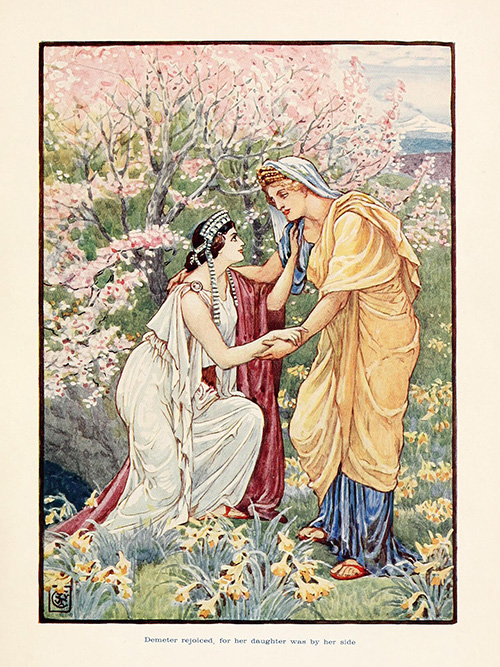
Once the temple is built, Demeter withdraws into it in despair and refuses to let the earth bear crops, causing a terrible famine that threatens gods and humans alike. Zeus sends messengers and finally orders Hermes to bring Persephone back from Hades. Her daughter returns with the overjoyed Demeter receiving her in her arms, but because she has eaten the pomegranate seed given by Hades, she must spend part of each year below with him and part above with Demeter. Reunited with her daughter, Demeter restores abundance to the earth and teaches the Eleusinian mysteries to chosen individuals, making Eleusis the sacred center of her worship.10
Hesiodic and Orphic Context
The Theogony repeats the genealogy of Demeter and Persephone, while giving more context to the Iasion story. From their union, the god of wealth Ploutos is produced. In the Works and Days, Demeter is seen as Hesiod as the sacred power behind grain, farming and subsistence. Stored food is “Demeter’s grain,” men must work to gather “Demeter’s fruits,” and the farmer must pray to Zeus Chthonios and pure Demeter when ploughing so that the crop will become heavy and sound. Her presence governs the agricultural calendar: sowing, harvesting, threshing.18, 19
Her Orphic Hymn iterates Demeter's attributes: youth-nurturing, the lovely harvest, charming and lovely, adding also that her presence is tied to the rule of law. Demeter is connected to the ecstatic rite of whirling, howling, dancing, an aspect that comes in tandem with Eleusis.20
III. The Epithets of the Great Mother
Epithet
Meaning
Domain
Demeter Eleusinia (Ἐλευσινία)
Demeter of Eleusis
Eleusinian Mysteries
Demeter Thesmophoros (Θεσμοφόρος)
Law-bringing Demeter
Thesmophoria, women’s rites
Demeter Chthonia (Χθονία)
Demeter of the Earth
Subterranean fertility
Demeter Chloe (Χλόη)
Demeter of the Green Shoot
Young grain, spring vegetation
Demeter Karpophoros (Καρποφόρος)
Fruit-bearing Demeter
Fruits of the earth
Demeter Sito (Σιτώ)
Demeter of Grain
Cereal food, bread
Demeter Malophoros (Μαλοφόρος)
Apple-bearer Demeter
Megarian and colonial cult
Anesidora (Ἀνησιδώρα)
She who Sends Up Gifts
Earth’s gifts
Demeter Ploutodoteira (Δημήτηρ Πλουτοδότειρα)
Giver of Wealth
Food wealth, Plouton
Demeter Erinys (Ἐρινύς)
Furious Demeter
Arcadian Chthonic title
Demeter Melaina (Μέλαινα)
Black Demeter
Phigalian Cave cult, mourning
Demeter Kabeiraia (Καβειραία)
Cabeirian Demeter
Theban mystery cult
Demeter Rharias (Ῥαριάς)
Demeter of the Rharian plain
Eleusinian Rite
Demeter Antaia (Ἀνταία)
Approachable-Opposing Demeter
Orphic-Eleusinian address
Demeter Kourotrophos (Κουροτρόφος)
Nurse of Children
Child-nurture
Demeter Dadouchos (Δᾳδοῦχος)
Torch-bearing Demeter
Search for Persephones
Demeter Hōrēphoros (Ὡρηφόρος)
Season-bringing Demeter
Seasonal return
Demeter Polyphorbos (Πολύφορβος)
All-nourishing Demeter
Nourishment, food abundance
Demeter Aglaodoros (Ἀγλαόδωρος)
Giver of Splendid Gifts
Harvest gifts, abundance, divine generosity, blessings of cultivated life
Demeter Kallistephanos (Καλλιστέφανος)
Beautiful-crowned Demeter
Wreaths, festival honour
Demeter Xanthē (Ξανθή)
Golden-haired Demeter
Epic beauty
Demeter Kyanopeplos (Κυανόπεπλος)
Dark-veiled Demeter
Veiling and mystery, mourning
Demeter Chrysaoros (Δημήτηρ Χρυσάορος)
Golden-bladed Demeter
Scythe
Sources: Homeric Hymns; Hesiod, Theogony; Athanassakis and Wolkow, the Orphic Hymns; Pausanias, Description of Greece; Athenaeus, The Deipnosophists; Hesychius, Lexicon; Lidell and Scott, A Greek-English Lexicon10, 18, 20, 21, 22, 23, 24, 25, 26
IV. The Temples of Demeter
Eleusis
Eleusis was the great holy site of Demeter and Persephone, the central hub of the Eleusinian Mysteries, the most important initiatory rite of the ancient world. It was a hilly presinct at the center of one of the most fertile plains in Greece, bordering the sea, just twenty two kilometes away from the great advanced metropolis of Athens on the so-called 'Sacred Way'. Caves of cliffs nearby had an ancient and arcane aura conducive to its mystery.21, 27
The site was wholly identified with the Homeric Hymn's story as the former site of the palace of king Celeus. The Telesterion, the great hall, was used as a place for initiation. The sacred objects of the mysteries were housed at the site and brought to Athens in an elaborate procession by ephebes.
During Roman times, a great court was built in front of the entrance, as did the Kallichoron Well and the Ploutonion on the north east side of the acropolis. In the fourth century BCE, the architect Philo added a Doric portico to the east façade of the Telesterion. This Portico of Philo had twelve columns across the front and two along the narrow sides, and its floor was paved with Eleusinian limestone. 27, 28
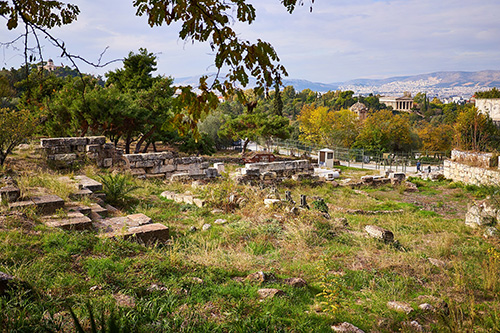
The City Eleusinion was located in Athens itself, located between the Agora and the north slope of the Acropolis. Visitors were not allowed to enter the inner sanctuary; an imposing display of inscriptions and decrees regulating the Mysteries were visible from the exterior. One fourth-century law-code concerning the cult was set up there, showing that it had an administrative and legal role.28, 29
Corinth
Another that was confimed by Pausanias was the Acrocorinth site of Demeter and Kore, near a monolithic rock that hovers above the ancient city of Corinth. Nearby was a temple of Hera Bunaea. According to Pausanias, the images inside the temple of the Acrocorinth were never exposed to human eyes.21, 30
Excavations of the site found a general visitor complex with numerous buildings and many rooms. A major point of the Corinthian nexus of Demeter worship appears to have been the large banquet hall accompanying the general rites to the goddess.30, 31
Sicily
Sicily was an island sacred to Demeter with numerous important sites for her worship, whether among the Greek colonists or Roman incomers later on. The temple of Enna near Mount Etna was in the ancient imagination the mythic heartland of the goddess as this is where Kore was said to have been abducted. Its grove was styled the umbilicus Siciliae, the navel of the island, and the temple was reputed to be of such antiquity and sanctity that Sicilians approached it in religious awe.32, 33
The divine tree bore her fruit in Selinus nearby, where her sanctuary as Demeter Malaphoros contributed to posterity hundred of figurines eating pomegranates. That area located about 800m west of the acropolis and across the Modione River was flanked by the holy zone of Hecate and Zeus Meilichios, often identified with Demeter in divine pairing.33, 34
An archaic temple was built int the seventh century BCE. In the later sixth and fifth centuries BCE, the sanctuary was expanded with a large altar, heavy stone temenos walls, stoa-like rooms, purification waterworks, and its monumental propylon. Miles calls the propylon exceptional because it is the only building of its type known in Sicily and due to the fact it combines local Sicilian features with forms borrowed from wider Greek, especially Athenian, architecture. She dates the propylon to about 420 BCE, before the Carthaginian sack of Selinus in 409 BCE.33, 34
Akragas in Sicily also hosted a chthonic cult to Demeter. The Doric temple usually called that of Demeter and Persephone (San Biagio) dates to the end of the Archaic period, around 480–470 BC, and it was converted into a Christian church.33, 35
Pergamon
The Sanctuary of Demeter and Kore at Pergamon was present in its presinct, Mysia. Archeologists such as Cornelie Piok Zanon stated that it is one of the best and most well-preserved artefacts from the great ancient city. The kings Philetairos and Eumenes, along with the later Queen Apollonis, built it.36, 37
Architecturally, the Pergamon sanctuary was arranged as a long rectangular sacred terrace, roughly 100/110 m by 50 m, with a temple, altar, stoas, propylon, seating, and other cult buildings. The advanced Hellenistic complex contained a temple and altar of Demeter, while later additions organized the area into a more dramatic ritual setting. But the temple itself was small compared to the prestinct's large area within the city, probably indicating a mysterious context. The sanctuary included theater-like seating that was conducive to viewing plays.36, 37
Arcadia
A cluster of archaic, deeply local Demeter cults with ties to Mycenean beliefs recorded chiefly by Pausanias existed in Arcadia. Phigaleia worshipped the horse-headed Demeter Melaina (the Black) in a mountain cave (8.42); Thelpousa honored Demeter Erinys (8.25); at Lykosoura Demeter shared the great sanctuary of her daughter Despoina (8.37); Pheneos maintained an Eleusinion (8.15). Jost's Sanctuaires et cultes d'Arcadie remains the standard treatment.21, 38
V. The Great Giving Goddess
Δηὼ … μητέρα καρποθάλειαν … ἡ πρώτη φερέπυρον … καρπὸν ἀνεῖσα
Deo … fruit-flourishing mother … first to send forth wheat-bearing crop.
Hexameter to Priestess of Demeter39
Above all else, Demeter was recognized as the harbinger of a good harvest. Her motherly grip was identified with the nurturing of the cultivated earth itself as her esteemed child, befittingly so, for her bestowal of gifts onto the farmer who himself nourished the golden fields with attention and care.10, 19
Authors like Isocrates also credited Demeter with giving humanity the instructions to begin agricultural work, as she taught the mysterious Triptolemus how to do this. That was another reason she was held in such high esteem, as the rural folk felt she overlooked their traditions. This also placed her in a general schematic of female deities like Athena who aided humans away from a daily agenda of survival. 10, 40
A good or bad harvest was said to be the result of her divine will. That factor alone probably rendered her the most important of all of the rustic and rural deities dotting the notoriously harsh landscapes of Greece. Feasts themselves were often consecrated in her name with large loaves of bread, showing her connection with food, sustenance and the intricacy of the agrarian lifestyle.41
Much like Hermes, Demeter was seen as the divine personification of charis, the favor of the divine upon humans, a distinctively feminine approach in blessing for her part. Her charis was less technical and more broadly based in anointing the community. 42
Demeter was often likened to fruit. The careful cultivation of the fruits of the earth tied into many of her mysteries, but at the same time wild fruit also held a certain resonance with her rites. Apples were considered a welcome gift from the goddess, an association leading to her epithets, Malaphoros and Klookarpe (χλοόκαρπε). When Demeter withdrew, fruits perished. 20
The oldest identification of Demeter is her Homeric role as being on the threshing floor, a flat surface used in agriculture to separate grain seeds from their stalks and husks. This pointed towards her cultivation not only of viable food but to her role in nurturing a divine humanity emerging from base impulses and the unremarkable mass.15
VI. The Mystery
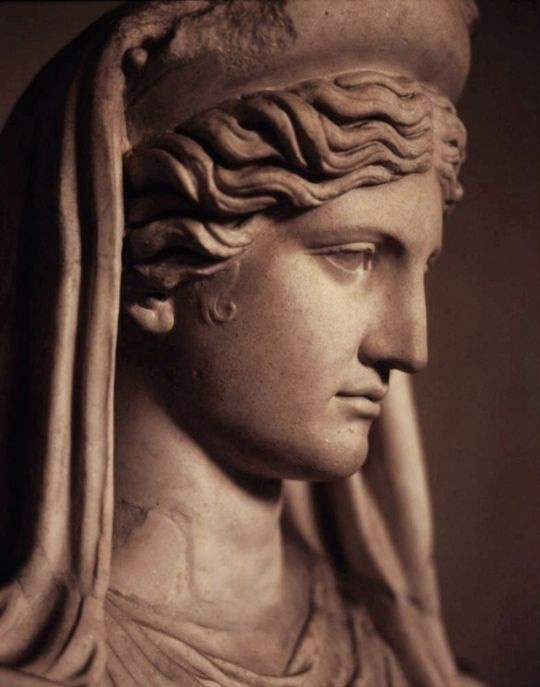
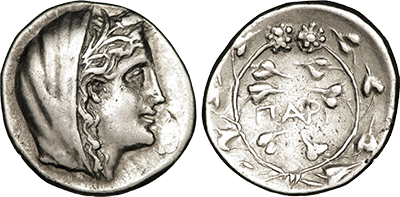
Demeter was the mystery goddess above all others. Dualism within her divine essence was the core of it; one Deo was the open, rural and visible goddess with a coiffed diadem, the other Deo was shrouded in mystery, consigned in blackness to the darkest part of a sacred presinct that no man's eye should fall upon. The ambiguity is perhaps best rooted in her Homeric Hymn where she takes the form of an illustrious goddess and anonymous crone.
The Eleusinian Mysteries were highly regarded for being deeply sacred rites. The purpose of the rites is shared in the Homeric hymn: a better and more privileged position in the afterlife, or so it was claimed. Again, Isocrates states that though Demeter's gift of farming rose people above a bestial state in life, the mysterious rites were said to do the same thing in the unseen realms. These were one of the great gifts of the goddess to those who could see them.40
Athenians even called the dead demetrioi in her honor. Pindar states that the Mysteries had an association with confronting death head on. That fact is more or less the sum of what we know about their expressly thematic contents.43
“Blessed is he who sees these things and goes beneath the earth; he knows the end of life and knows its Zeus-given beginning. , fragment of Pindar44
So the conventional view that Demeter is merely a goddess of life, abundance and grain is not necessarily the complete picture because ike her Egyptian equivalent, Isis, her functions related strongly to death and passing over, too. Nonetheless, there were other elements to the Mysteries; Cicero claimed that the Mysteries taught humans how to live well and to enjoy the present moment.45
As the goddess presiding over the mysteries as she did the floor of the thresh, the apex of the ritual was "an ear of grain cut in silence", which represented the force of the new life. Those accompanying the mystery were the initiates, those who had participated at least once, the epopteia attainers who had learned the greatest mystery of Demeter, and the clerical class.
The two overseers of the ritual were the High Priest and High Priestess of Demeter, equal in rank. Beyond them were the torch-bearing men, the Dadouchos, and the trainee priestess, the Dadouchousa. Two married priestesses called Hierophantides, representing Demeter and Persephone respectively, also attended, along with another group of priestess women called the panageis, a group who lived secluded from men.
VII. The Marriage
Unlike any of the other Olympian goddesses beyond Hera, Demeter was briefly at least one of the wives of Zeus. This gave her a unique placement in the pantheon. Her associations with Zeus Chthonios and Zeus Meilichios appear to have emerged superficially from this mythological contention.18
Her relationship with Zeus is sometimes portrayed as frayed; she produces the divine child Kore in being with him, but his thwarting of her relationship with Iasion and the granting of their daughter's hand to Hades through the order of Zeus makes her role often plagued with bitterness. It is the doleful sadness at fate that stands at the root of the Mysteries.
The black Demeter of Arcadia, usually portrayed as horse-headed, reflects perhaps earlier beliefs tying Demeter to an amorous Poseidon. These ideas about the divine likely mirror Mycenean ideas about the goddess. Here, she was said to have taken the form of a mare to escape his advances, but this failed as he transformed into numerous creatures. Mourning this, she withdrew into a cave wearing black to mourn.21
VIII. The Chthonic Demeter
The assault of Poseidon gave Demeter such a grim rage that she transformed into Erinys, the furious one, and caused a massive famine to plague the land where everything from livestock, crops and people all perished en masse. This side of Demeter's personality reflects an ancient and chthonic element to her worship.
There are other stories conveying an angry side to the goddess. A young boy mocked her in her wandering, aged form for chugging down corn-meal in a state of extreme exhaustion searching for Persephone. She threw the liquor onto his face, causing him to develop lizard-like limbs, spots where the viscous drink landed, making him the first gecko.46
The epithet 'Khthonie' reflects both the earth and of the underworld. The goddess resided over the farms and the harvest, but her presence also reflected many of the darker sides of the natural world too. The wrathful side of Demeter reflects her pessimistic omen to Metaneira, one that leads to the Mysteries as a hopeful beacon for a humanity often invested in animalistic drive.
Beyond Eleusis, other mystery cults of archaic form existed. The Amphictyonic League of Thebes and surrounding poleis made her their patron deity, centred around the chthonic cult of the archaic Demeter at Anthela.47
IX. The Law
Alongside her dual gifts of agriculture and the mysteries, there was another overlooked gift of Demeter that preceded both of them: the law. Multiple authors attribute to her the foundation of law and covenant to humanity, being the reason one of her epithets at Phenae in the sacred presinct of Hermes was Θεσμία, the Law-Giver. 8, 21
The Roman picture is similarly emphatic on the matter, as Ovid echoes the Greek authors starkly in attributing law among men to her:
Ceres... prima dedit leges.
Ceres first gave laws.
Ovid, Metamorphoses, 5.341-34346
Law is what protects the sustenance economy of agriculture on a basic level, preventing thefts and other outrages, while fair ordinance protects the mass from starving to death or succumbing to a man-eat-man world pushing man towards an animal status. For that reason too Demeter held the place of being the protectress of civilization.
The need of law can maybe be considered symbolically the sum total of all the mythological events concerning her. The abduction of her daughter causes despair. Demeter wandering the earth as an old woman saw and witnessed all things. Metanaira ignoring her instructions leads to needing the rites. The lifting of her despair creates the seasons, fashioning an orderly way of life.
Modern scholarship has suggested a tie between the ancient sources construing Demeter as the law-giver and the roots of her ancient mystery rites and sacred objects. The evidence at least points towards a kind of tandem relationship between the two; the latter leads invariably to the laws and civilization being established.28, 48
The above is ultimately too an allegory of the soul's need to follow a particular set of practices to pursue the Great Work. Each human must work within a framework to go towards the great mystery the veiled one points towards. These laws are necessary for ascent. These laws are not negotiable. These laws are iron-clad by the will of the goddess.
X. Demeter in Philosophy
The Neoplatonists held that Demeter's power holds the universal fullness of life as it goes from the unity of fullness that Rhea represents, starting to turn towards recognizable powers.
In On Plato’s Cratylus §§164–165, Proclus rejected an exclusively physical interpretation of the etymology of Demeter being “a mother who gives nourishment.” Corporeal food was only the final manifestation of a much greater divine activity. Nourishment is the intellectual fulfilment and perfection of lower beings by higher beings, aligning squarely with how law is supposed to work..49, 50
This pulls together the functions of Demeter: mystery-leader, giver of good harvest, seeker of what is lost, law-giver, queen in repose. Her nourishing function means bringing the living being to its proper perfection.
The reason Demeter comes earlier in sequence as the fourth wife of Zeus and Hera as the final is because Zeus 'looks back on her' as a zoogonic (life-generating) force, while he co-creates with Hera's power in the same sphere. The story of the procession of wives is a cosmological mystery about powers and how they come down as a chain.
Lower, in the encosmic order, she participates in a triad with Hera and Artemis. Here she presides over the fullness of life, but the other two goddesses stratify life into the forms of soul part of psychic life (Hera) and the physical presence of natural life (Artemis). 49, 50
The existence of bread on the absolute lowest level is an important symbol of Demeter. This fullness of life and intellectual nourishment in levels drifts down from the unity of Rhea to the form of the humble loaf in physical terms. Bread is impossible to have been created without the nourishment of the lowest beings by the highest.
XI. Demeter's Festivals
Demeter Ritual Days
Place
Description
Importance
Date Recorded
Greater Mysteries
Eleusis to Athens
Eleusinian Mysteries
Inner rites, procession of objects
Homeric Hymn (7th century BCE)
Lesser Mysteries
Agrai and Athens
Prelude to Mystery
Preliminary initiation
Plutarch (1st century CE)
Thesmophoria
Across Greece
Demeter and Kore
Women-only festival, sacrifices
Pausanias (2nd century CE)
Eleusinia
Eleusis
Athletic
Games and footraces
Pindar (6th century BCE)
Stenia
Athens
Preparation for Thesmophoria
Women only-festival, insults, rising
Aristophanes (5th century BCE)
Proerosia
Across Greece
Agricultural Festival
Pre-ploughing sacrifice
I Eleusis 175 (330 BCE)
Mysia
Mysia
Week Festival
Men withdraw on third day
Pausanias (2nd century CE)
Chthonia
Argolid
Solemn Rite
Priestly procession, white garment
Pausanias (2nd century CE)
Sources: Pausanias, Description of Greece, for the Thesmophoria, Chthonia, and Mysia;21 the Homeric Hymn to Demeter, for the Greater Mysteries;10 Plutarch, for the Lesser Mysteries;43 Pindar, for the Eleusinia;44I Eleusis 175, for the Proerosia;51 and Aristophanes, for the Stenia.52
XII. Triptolemus and Plouton
In variations of mythology, Demeter became the foster-mother of sorts to Triptolemus. It was through her instruction of him that the fabled art of agriculture and the mysteries directly passed down to humanity. The original Homeric Hymn, instead referring to him as a king of Eleusis, calls him her first priest who teaches the art of the mysteries to humanity, instructing further other men in its art.
Demeter gifted him a winged chariot laden with serpents that while striding across the air would dispense seeds for men to learn how to tend the field. Socrates showed Triptolemus as the sole judge of those initiated in the mysteries in the afterlife, a position perhaps indicating his immense status in the mystery rite itself. Many reliefs from Ancient Greece show the relationship of Triptolemus with the great goddess.10, 53
The child wealth god Ploutus, on the other hand, came from her union with Iasion in the thrice-ploudhed field. He is typically imagined to be a boy holding a cornucopia of plenty at Demeter's side in artwork, and often accompanied goddesses in their temples in statuary too. Sometimes he emerges from the cornucopia as it is delivered out of the earth by Persephone.
Ploutus's endowment to humanity is often treated with some ambivalence. In plays, his wealth often being the one thing mattering to human beings was a subject of comedy like the eponymous play by Aristophanes.18, 52
Demeter is often associated too with the god Dionysus whose rustic and mystical themes often overlap with hers. When torn apart by the fearsome Titans, it is often her action in myth to gather the shards of the heart of the first Dionysus, Zagreus, and to ensure his essence survives. She also accompanies the second Dionysus in his katabasis to retrieve his mother Semele from the heart of Hades. There are many visual representations of Demeter, Persephone and Dionysus in Greek art.8, 54
XIII. The Symbolism of Sustenance
Diadem
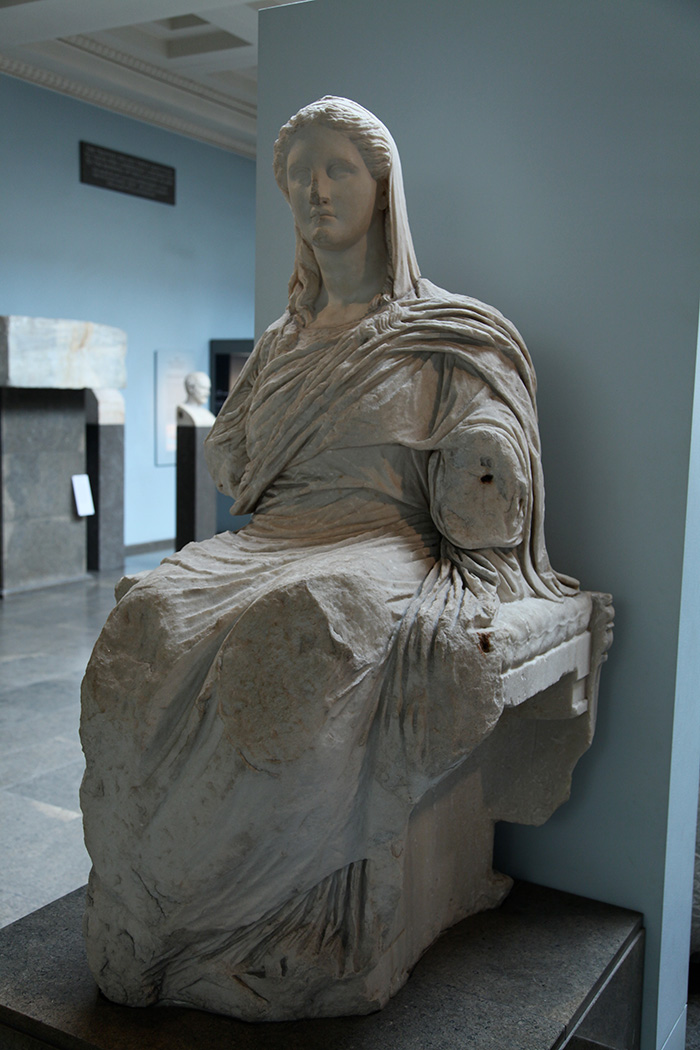
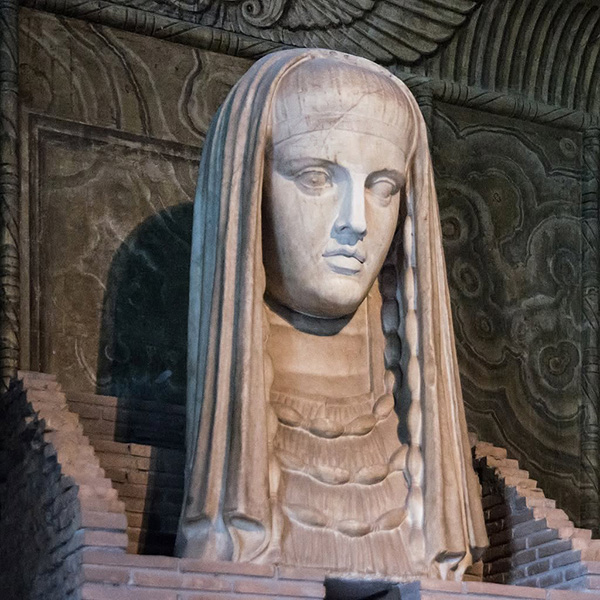
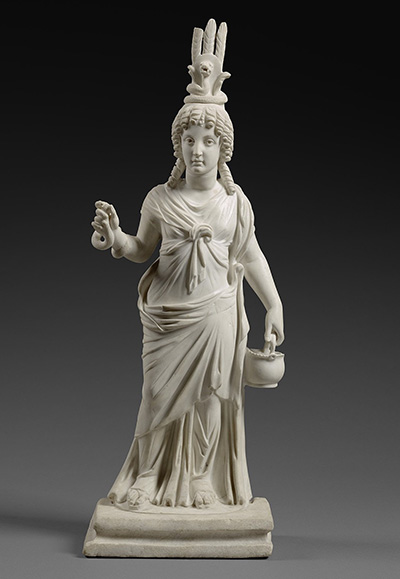
The great goddess is often represented in a mature guise evoking middle age. She wears either a diadem, ribbon or veil. A queenly raiment and a scepter is something that distinguishes images of Demeter from other goddesses, and occasionally distinguishing her attributes from those of Hera or Rhea for those reasons can be quite difficult. Unlike Aphrodite, she is always fully clothed. 54, 55
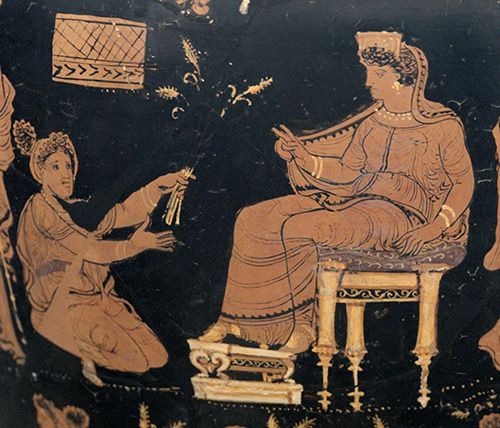
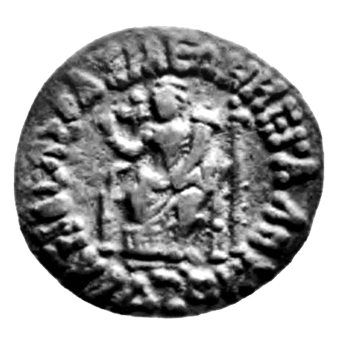
The main visual dissemination of her image in pottery shows that Demeter is often is seated on a throne, fixed and more static in role, sharing such an attribute with Hestia. Demeter can also be amalgamated frequently with Isis, her Egyptian equivalent, in the visual symbolism of that nation such as a throne on the head. In the archaic regions like Arcadia, Demeter was associated with mares and was given the head of one. She was often associated too with the piglet, opposed to the adult pig that Hestia had in her domain. 21, 41, 54
Mother and daughter in Demeter and Kore are frequent visual companions; they shared temples, they shared the great mystery of Eleusis, and of course Demeter was said to be inseparable from her beloved daughter in spirit. Frequently too she is paired for the reasons elaborated above with Triptolemus, Ploutos and Dionysus. Vases show her with Hermes and Hestia frequently also.54, 55, 56
Gesture and Grain
The two-fingered gesture connected to the mysteries is a common part of the language of her statuary and vase imagery. Sometimes Demeter is shown in this pose while clutching the sheath of grain between her fingers, her most important visual symbol that announced the end of the mystery, often she points towards Triptolemus in these depictions too, grounding the visual portrayal in the Eleusinian language. 54, 55
Otherwise, she can be shown gesturing towards herself with one finger knowingly, perhaps signifying she is the source of life, or the font of the great secret.55
Another gesture a typically veiled Demeter commonly makes is the gesture of mourning in Greece, a presentation of distress with the chin resting on top of the hand.
The mystical basket or kiste is another one of her symbols, a basket that was taken to hold all of her precious secrets and was one of the items used in the Eleusinian Mysteries.54, 55
Flowers, Fruits and Cornucopia
Demeter is often garlanded with flower even in the essence of the sculpture itself. It is known too that her statues were covered in fragrant gifts by worshippers, a great visual association with her being the font of life.54, 56
In particular, she was differentiated by the presence of the poppy flower, a flower which often appears folded into the sheaths of grain and wheat she carries because poppies tend to thrive in grain fields under the same conditions. Theocritus imagines Demeter at the threshing-floor smiling with “wheat sheaves and poppies” in both hands.54, 57
Sickle and Torch
The symbol of the sickle is something Demeter shares with Kronos, and the torch is something she shares with Hecate, though Hecate often wields dual torches and Demeter wields a single one in one hand. The torch-lit procession along the Sacred Way from Eleusis to Athens was one of the starker reminders of mystery in the ancient world. At Lykosura, Demeter was represented seated with a long folded veil over her head and a torch in her hand. It was obviously a major symbol of her quest for Persephone.21, 55
The sickle shows what is harvestable can be both refined and cut down perpetually. It is a most mysterious symbol tying Demeter to her father.
Sources and Bibliography
Plato. Cratylus. Translated by Harold N. Fowler. Loeb Classical Library 167. Cambridge, MA: Harvard University Press, 1926. Section 404b. For Socrates’s etymology of Demeter as the mother who gives food to all.
Plato. Cratylus. In Platonis Opera, vol. 1, edited by John Burnet. Oxford: Clarendon Press, 1900. Section 404b. For the Greek text of the same etymology.
Betegh, Gábor. The Derveni Papyrus: Cosmology, Theology and Interpretation. Cambridge: Cambridge University Press, 2004. For the commentary on the papyrus’s allegorical reading of Demeter.
Derveni Papyrus, col. XXII. For the Orphic-allegorical interpretation of Demeter as Gê Mêtêr.
Cicero. De Natura Deorum. Translated by H. Rackham. Loeb Classical Library 268. Cambridge, MA: Harvard University Press, 1933. 2.67. For Demeter explained as quasi Gê Mêtêr.
Cornutus. Greek Theology, Fragments, and Testimonia. Translated by George Boys-Stones. Writings from the Greco-Roman World. Atlanta: SBL Press, 2018. For the allegorical etymologies, γῆ μήτηρ, Δηὼ μήτηρ, and the derivations from finding, sharing, and feasting.
Euripides. Bacchae. In Euripidis Fabulae, vol. 3, edited by James Diggle. Oxford: Clarendon Press, 1994. 274–277. For Tiresias’s statement that Demeter “is earth” and nourishes mortals with dry food.
Diodorus Siculus. Library of History. Translated by C. H. Oldfather. Loeb Classical Library. Cambridge, MA: Harvard University Press, 1933–. 1.12.4; 3.62.6–7; 5.5.2. For Demeter derived from the older Gê Mêtêr and the Orphic formula; for her gathering the limbs of the dismembered Dionysus; and for her gift of laws.
West, Martin L. Indo-European Poetry and Myth. Oxford: Oxford University Press, 2007, 176, 182. For the Illyrian/Messapic Damatura and the Dei-paturos proposals.
Homeric Hymn to Demeter. In The Homeric Hymns and Homerica, translated by Hugh G. Evelyn-White. Loeb Classical Library 57. Cambridge, MA: Harvard University Press, 1914. For the abduction of Persephone, the Eleusinian narrative, Demeter as Δηώ, Triptolemus as her first priest, and the founding of the Mysteries.
“Demeter.” Encyclopædia Britannica. 11th ed. Cambridge: Cambridge University Press, 1911. For the older “grain-mother” etymology from δηαί, the Cretan form of ζειαί.
Harrison, Jane Ellen. Myths of Greece and Rome. Garden City, NY: Doubleday, Doran & Company, 1928, 64. For Harrison’s defence of the de- form as original rather than a corruption of Γῆ.
Duhoux, Yves. “LA > B da-ma-te = Déméter? Sur la langue du linéaire A.” Minos 29–30 (1994–1995): 289–94. For the argument that da-ma-te is not a secure Demeter attestation.
García Ramón, José L. “Mycenaean Onomastics.” In A Companion to Linear B: Mycenaean Greek Texts and Their World, vol. 2, edited by Yves Duhoux and Anna Morpurgo Davies, 213–51. Louvain-la-Neuve: Peeters, 2011. For the Mycenaean evidence and si-to-po-ti-ni-ja.
Homer. The Iliad. Translated by A. T. Murray, revised by William F. Wyatt. Cambridge, MA: Harvard University Press, 1999. 2.696, 5.499–502, 13.322, 14.326, 21.76. For the shrine of Demeter, the threshing floor, and “fair-haired Demeter.”
Homer. The Odyssey. Translated by A. T. Murray, revised by George E. Dimock. Cambridge, MA: Harvard University Press, 1995. 5.125–128. For Calypso’s complaint and Demeter’s love of Iasion in the thrice-ploughed fallow.
Catherine Des Roches, “Le Ravissement de Proserpine pris de Claude Clodian,” in Les Missives de Mesdames Des Roches de Poitiers, mere et fille: Avec le Ravissement de Proserpine prins du Latin de Clodian, et autres imitations et meslanges poëtiques (Paris: Abel L’Angelier, 1586), 66, bk. 3, lines 571–574.
Hesiod. Theogony. Translated by Hugh G. Evelyn-White. Loeb Classical Library 57. Cambridge, MA: Harvard University Press, 1914. 912, 969–974. For the genealogy of Demeter and Persephone, Demeter as consort of Zeus, and the birth of Ploutos from her union with Iasion.
Hesiod. Works and Days. In The Homeric Hymns and Homerica, translated by Hugh G. Evelyn-White. Loeb Classical Library 57. Cambridge, MA: Harvard University Press, 1914. Lines 383–617. For “Demeter’s grain,” the prayer to Zeus Chthonios and pure Demeter at the plough, and the agricultural calendar.
Athanassakis, Apostolos N., and Benjamin M. Wolkow, trans. The Orphic Hymns. Baltimore: Johns Hopkins University Press, 2013. Hymn 40, To Eleusinian Demeter; Hymn 41, To Mother Antaia. For her attributes, youth-nurturing, harvest-bringing, law-giving, and the epithets Antaia and Chloōkarpos.
Pausanias. Description of Greece. Translated by W. H. S. Jones. Loeb Classical Library. Cambridge, MA: Harvard University Press, 1918. 1.22.3; 1.31.1, 4; 1.38.6; 1.42.6; 1.44.3; 2.32.8; 2.35.4–8; 3.14.5; 8.15; 8.25.3–7; 8.37; 8.42.1–4; 9.25.5–26.1; 10.33.12. For the epithets and cult sites, the Acrocorinth sanctuary, the Arcadian cults (Demeter Melaina, Erinys, Despoina at Lykosoura, Demeter Thesmia at Pheneos), and the festivals.
Inscriptiones Graecae II² 4587, line 3; II² 4730, line 3; Die Inschriften von Ephesos 1228. Dedicatory evidence for Demeter Karpophoros.
Athenaeus. The Deipnosophists. 10.416b–c. Translated by Charles Burton Gulick. Loeb Classical Library. Cambridge, MA: Harvard University Press, 1927–1941. For the epithet Sitō.
Hesychius of Alexandria. Lexicon. Edited by Kurt Latte. Copenhagen: Ejnar Munksgaard, 1953–1966. S.vv. Ἀνησιδώρα, Ἀνταία. For the glosses of these epithets.
Smith, William, ed. A Dictionary of Greek and Roman Biography and Mythology. London: John Murray, 1873. S.v. “Rharias.” For the epithet Rharias.
Liddell, Henry George, and Robert Scott. A Greek-English Lexicon. Revised and augmented by Henry Stuart Jones. Oxford: Clarendon Press, 1940. S.vv. δᾳδοῦχος, χρυσάορος. For the lexical basis of these epithets.
Mylonas, George E. Eleusis and the Eleusinian Mysteries. Princeton: Princeton University Press, 1961. For the topography of the sanctuary, the Telesterion, the Kallichoron Well, the Ploutonion, and the Portico of Philo. Added because the article’s account of the site and its buildings needed the standard excavation-based treatment.
Clinton, Kevin. “The Sanctuary of Demeter and Kore at Eleusis.” In Greek Sanctuaries: New Approaches, edited by Nanno Marinatos and Robin Hägg, 110–124. London: Routledge, 1993. For the sanctuary’s development, the procession of the sacred objects, and the cult’s administration. Added to support the Roman-period building phases and the link between the Mysteries and civic regulation.
Miles, Margaret M. The City Eleusinion. The Athenian Agora 31. Princeton: American School of Classical Studies at Athens, 1998. For the Athenian Eleusinion between the Agora and the Acropolis, its inscriptions and decrees, and its administrative role. Added because no supplied source covered the City Eleusinion.
Bookidis, Nancy, and Ronald S. Stroud. The Sanctuary of Demeter and Kore: Topography and Architecture. Corinth XVIII.3. Princeton: American School of Classical Studies at Athens, 1997. For the excavation of the Acrocorinth sanctuary, its terraces, and its buildings. Added as the primary excavation report behind the Corinth section.
Bookidis, Nancy. “Ritual Dining at Corinth.” In Greek Sanctuaries: New Approaches, edited by Nanno Marinatos and Robin Hägg, 45–61. London: Routledge, 1993. For the dining rooms and the practice of sacred banqueting at the sanctuary. Added specifically to support the claim about the banquet hall.
Cicero. The Verrine Orations. Translated by L. H. G. Greenwood. Loeb Classical Library 293. Cambridge, MA: Harvard University Press, 1935. 2.4.106–108. For Enna as the mythic site of the abduction, the grove as umbilicus Siciliae, and the religious awe in which Sicilians held the shrine. Added because this is the ancient source for the article’s Enna claims.
Hinz, Valentina. Der Kult von Demeter und Kore auf Sizilien und in der Magna Graecia. Palilia 4. Wiesbaden: Reichert, 1998. For the Sicilian and South Italian cults of Demeter and Kore, including Enna, Selinus, and Akragas. Added as the standard synthetic treatment of the Sicilian material.
Miles, Margaret M. “The Propylon to the Sanctuary of Demeter Malophoros at Selinous.” American Journal of Archaeology 102, no. 1 (1998): 35–57. For the Malophoros sanctuary and its propylon, its combination of Sicilian and Athenian forms, and its date of about 420 BCE. Added because the article names Miles and her argument directly.
Mertens, Dieter. Städte und Bauten der Westgriechen: Von der Kolonisationszeit bis zur Krise um 400 vor Christus. Munich: Hirmer, 2006. For the architecture of the Western Greek cities, including the Doric temple at Akragas conventionally assigned to Demeter and Persephone (San Biagio). Added to support the Akragas dating.
Piok Zanon, Cornelie. “The Sanctuary of Demeter at Pergamon: Architecture and Dynasty in the Early Attalid Capital.” PhD diss., University of Pittsburgh, 2009. For the Pergamene sanctuary, its Attalid patrons (Philetairos, Eumenes, and Queen Apollonis), and its preservation. Added because the article names Piok Zanon directly.
Radt, Wolfgang. Pergamon: Geschichte und Bauten einer antiken Metropole. Darmstadt: Primus, 1999. For the terrace, temple, altar, stoas, propylon, and theatre-like seating of the sanctuary. Added to support the architectural description.
Jost, Madeleine. Sanctuaires et cultes d’Arcadie. Études Péloponnésiennes 9. Paris: Vrin, 1985. For the Arcadian cults of Demeter at Phigaleia, Thelpousa, Lykosoura, and Pheneos. Added because the article names Jost’s work as the standard treatment.
Rehm, Albert, ed. Didyma II: Die Inschriften. Berlin: Gebr. Mann, 1958. No. 496. For the hexameter honouring a priestess of Demeter, quoted in the article.
Isocrates. Panegyricus 28–29. In Isocrates, vol. 1, translated by George Norlin. Loeb Classical Library 209. Cambridge, MA: Harvard University Press, 1928. For Demeter’s twin gifts, agriculture, which raised humanity above the beasts, and the Mysteries, which offer hope for the afterlife. Added because the article names Isocrates directly and twice.
Burkert, Walter. Greek Religion. Translated by John Raffan. Cambridge, MA: Harvard University Press, 1985. For the sacrificial and festival practice surrounding Demeter, the loaves and first-fruits, and the piglets of the Thesmophoria. Added to ground the claims about feasting, bread, and the animals of her cult.
MacLachlan, Bonnie. The Age of Grace: Charis in Early Greek Poetry. Princeton: Princeton University Press, 1993. For charis as divine favour and reciprocity in Greek religious thought. Added to support the comparison of Demeter’s charis with that of Hermes.
Plutarch. “Concerning the Face Which Appears in the Orb of the Moon” (De facie in orbe lunae) 943b; and Demetrius 26. In Moralia, vol. 12, translated by Harold Cherniss and William C. Helmbold, Loeb Classical Library 406 (Cambridge, MA: Harvard University Press, 1957); and Lives, vol. 9, translated by Bernadotte Perrin, Loeb Classical Library 101 (1920). For the Athenian dead called dēmētrioi and for the Lesser Mysteries at Agrai.
Pindar. Nemean Odes, Isthmian Odes, Fragments, and Olympian Odes, Pythian Odes. Edited and translated by William H. Race. Loeb Classical Library 485 and 56. Cambridge, MA: Harvard University Press, 1997. Fragment 137 (from a threnos), for the blessedness of the initiate who has seen the Mysteries and knows the end of life; and Olympian 9.99, for the Eleusinian games.
Cicero. De Legibus 2.36. In On the Republic; On the Laws, translated by Clinton W. Keyes. Loeb Classical Library 213. Cambridge, MA: Harvard University Press, 1928. For the claim that the Mysteries taught men to live well and to die with better hope. Added because the article attributes this view to Cicero.
Ovid. Metamorphoses. Translated by Frank Justus Miller, revised by G. P. Goold. 2 vols. Loeb Classical Library 42–43. Cambridge, MA: Harvard University Press, 1916. 5.341–343 (Ceres first gave laws) and 5.446–461 (the boy Ascalabus turned into a gecko). Added for the Latin law-giving formula quoted in the article and for the gecko story.
Herodotus. Histories 7.200. Edited by C. Hude, Oxford Classical Texts, 3rd ed., 1927; translated by A. D. Godley, Loeb Classical Library, 1920. For the sanctuary of Demeter Amphiktyonis at Anthela and the seat of the Amphictyonic League.
Parker, Robert. Polytheism and Society at Athens. Oxford: Oxford University Press, 2005. For the civic and legal dimension of Demeter Thesmophoros and the relation of her rites to Athenian public order. Added to support the paragraph on modern scholarship linking the law-giving and the Mysteries.
Proclus. On Plato’s Cratylus. Translated by Brian Duvick. London: Duckworth, 2007. §§164–165. For Proclus’s rejection of a purely physical reading of Demeter’s nourishment and his account of intellectual perfection as her true gift.
Proclus. Platonic Theology. Edited and translated by H. D. Saffrey and L. G. Westerink. 6 vols. Paris: Les Belles Lettres, 1968–1997. Books V–VI. For the zoogonic order, Demeter’s place in the sequence of the consorts of Zeus, and the encosmic triad of Hera, Demeter, and Artemis. Added because the article’s Neoplatonic section requires the doctrinal source behind it.
Clinton, Kevin. Eleusis: The Inscriptions on Stone; Documents of the Sanctuary of the Two Goddesses and Public Documents of the Deme. 2 vols. Athens: Archaeological Society at Athens, 2005–2008. I Eleusis 175. For the epigraphic record of the Proerosia, the pre-ploughing sacrifice, dated 330 BCE in the article’s table.
Aristophanes. Thesmophoriazusae and Wealth (Plutus). Edited and translated by Jeffrey Henderson. Loeb Classical Library 179 and 180. Cambridge, MA: Harvard University Press, 2000–2002. For the women’s festivals of Demeter in comedy and for the ambivalent treatment of Ploutos and human greed in the Wealth.
Plato. Apology 41a. In Euthyphro, Apology, Crito, Phaedo, Phaedrus, translated by Harold North Fowler. Loeb Classical Library 36. Cambridge, MA: Harvard University Press, 1914. For Socrates naming Triptolemus among the judges of the dead in the afterlife.
Lexicon Iconographicum Mythologiae Classicae (LIMC). Vol. 4. Zurich: Artemis, 1988. S.v. “Demeter,” by Leon Beschi. For the standard catalogue of Demeter’s images, the diadem, veil, sceptre and throne, the grain and torch, and her pairings with Kore, Triptolemus, Ploutos, Dionysus, Hermes, and Hestia. Added because the iconographic sections required a reference catalogue of images.
Clinton, Kevin. Myth and Cult: The Iconography of the Eleusinian Mysteries. Skrifter utgivna av Svenska Institutet i Athen 8°, 11. Stockholm: Svenska Institutet i Athen, 1992. For the ritual gestures, the grain-ear, the kiste, the torch, and the visual language of the Eleusinian reliefs. Added as the standard study of Eleusinian iconography behind the gesture-and-grain section.
Peschlow-Bindokat, Anneliese. “Demeter und Persephone in der attischen Kunst des 6. bis 4. Jahrhunderts.” Jahrbuch des Deutschen Archäologischen Instituts 87 (1972): 60–157. For the Attic vase and relief tradition of Demeter and Persephone and their companions. Added to support the claims about the visual pairing of mother and daughter.
Theocritus. Idyll 7.155–157. In Theocritus, Moschus, Bion, edited and translated by Neil Hopkinson. Loeb Classical Library 28. Cambridge, MA: Harvard University Press, 2015. For Demeter smiling at the threshing floor with sheaves and poppies in both hands, as quoted in the article.