













| Language / Culture | Name | Attestation |
|---|---|---|
| Latin | Dis Pater; Dis | Ennius, Euhemerus (early 2nd c. BCE) |
| Proto-Indo-European | *Dyēus Ph&sub2;tēr (“Sky Father”) | Reconstructed |
22 min read
DIS PATER
author: High Priest Zevios Metathronos
co-author: Novice Priest Karnonnos
I. Names & Etymology
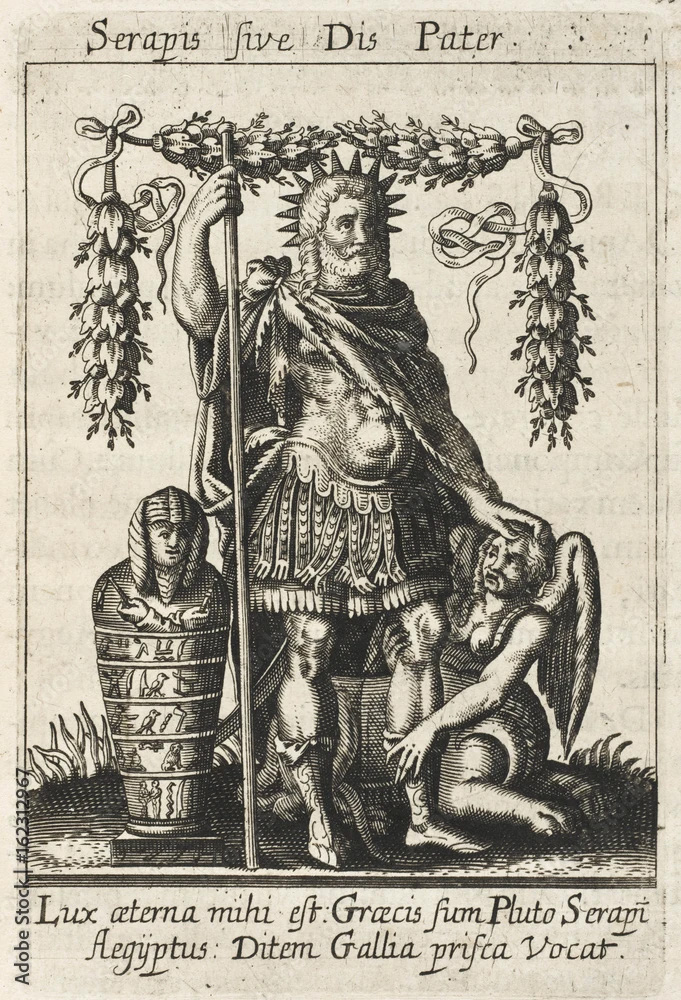
The Latin god of the underworld referred to on this page is best known as Dis Pater, which is how the ancients themselves interpreted "the Rich Father". The Latin word, Dis, is derived from the Latin word, dives, meaning "rich", or "wealthy". Therefore, the genitive case of the word, Ditis Patris, translates to "of the Wealthy Father". As Cicero describes the derivation in the De natura deorum, the name gives the sense of "father of riches" and juxtaposes the Greek term, Plouton ("the wealthy one") with Hades: the god is rich since he is the keeper of all the earth's metals and jewels, and therefore the seed corn that is returned to the earth each year. Modern etymologists follow the same line. Michiel de Vaan traces back the word, dives, to the Latin word, dius, divus ("divine", "god-like"), via an intermediate form implying roughly "one favored by the gods", since wealth is a sign of divine favor.1,2,3
The second element of the name Dis Pater is Pater, or "Father", a common Roman method of referring to a major god, such as Jupiter (Diespiter), Marspiter and Liber Pater. According to de Vaan, the combination of Dis with Pater may have been further reinforced by the similarity with Diespiter (the old name for Jupiter). This is also where confusion results about the name Dis Pater and its relationship to another reconstructed Proto-Indo-European deity, *Dyēus Ph&sub2;tēr ("Sky-Father"). This name can be seen in several languages today including Greek Zeus pater, Latin Iuppiter, Vedic Dyaus Pitar and Illyrian and Germanic derivatives. Both ancient and modern interpreters have inferred the presence of the sky-father in Dis Pater based on similarities in appearance and sound.2,4,5,6
However, some caution should be applied before accepting this connection as factual. While there does appear to be a relation between the two names, it is possibly circumstantial. The *Dyēus is formed using the Proto-Indo-European root *dyeu-, "to shine", "bright day sky", and connotes a shining sky god. On the other hand, Dis Pater refers to a chthonic power associated with the earth's darkness and therefore, his name comes from a different branch of the *deiw- word-family which includes divus. These two words are distant relatives within the *deiw- word-family due to their use of similar roots (*deiw-) that give them a superficial similarity. Nonetheless, despite these similarities in form and possibly even some degree of influence in interpretation (due to possible readings of Dis Pater as a "Dis-Pater" on the model of Diespiter), they represent two distinctly separate powers: one representing richness and wealth found under the earth and the other representing the shining sky-father.2,4,7,8
The confusion is given another layer when one considers that Hades himself is referred to as the 'Chthonic Zeus' and other adjectives even in the oldest Greek literature, thus the Latin names being similar in their apparent function may be a wordplay of this type.
In secure documented Latin usage, Dis Pater first appears in Ennius' Euhemerus during the early second century BCE. IT was there that the playwright Ennius established his position for later Roman usage: "Pluto Latine est Dis pater, alii Orcum vocant," or "Pluto in Latin is Dis Pater; others call him Orcus." After Ennius, the name becomes increasingly common in poetic works and among antiquarian writers, and by the imperial period it was commonly inscribed upon altars dedicated jointly to Proserpina. The name often took on a shorter form, simply Dis, which eventually became synonymous with hell itself from which Dante would derive the Inferno's city of Dis.3,9,10
Sources: Cicero, De natura deorum; de Vaan, Etymological Dictionary of Latin (2008); Ennius, Euhemerus (Warmington, Remains of Old Latin); West, Indo-European Poetry and Myth (2007); Caesar, De bello Gallico; CIL VI 137–139 and 32323 ff.1,2,3,4,8,10
II. History
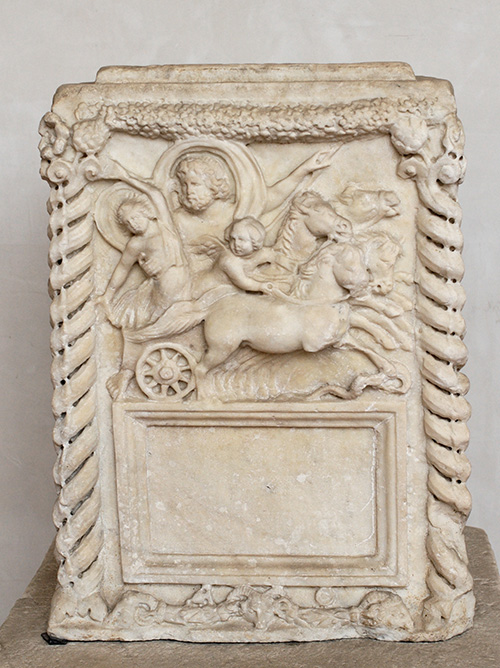
The mythology surrounding Dis Pater is extremely limited within Roman mythology. The majority of information concerning Dis Pater stems from the traditions and histories of cult practices in which he was worshipped. He was identified by the Romans as being one of the di inferi, those gods residing beneath the surface of the earth. By the time that the mythological cycle involving Dis Pater became well established, he was depicted as the son of Saturn and Ops, and as such the brother of Jupiter and Neptune. Each of them received a domain; Jupiter received the sky; Neptune received the sea; while Dis Pater received the underworld.
His wife, Proserpina, ruled the underworld alongside him. This is essentially a direct transfer of the mythology associated with the Greek Hades and Persephone to the native Italic god of wealth beneath the earth. Historians and antiquarians have primarily documented the rituals and ceremonies used by Rome to placate the spirits of the dead and those ruling over them.1,3,6,11,12,13
The greatest amount of historical documentation concerning his worship exists in relation to the Roman festival known as the Saecular Games (covered in detail below). Both Valerius Maximus and the Greek historian Zosimus attribute the origins of this ritual to the legendary Valesius and a buried altar dedicated to Dis Pater and Proserpina located in the Campus Martius. As Zosimus draws upon an earlier written account of ancient lore (one shared by all the Augustan-era antiquarians consulted by Dionysius of Halicarnassus) of events during the regal or early Republican era, he places the initial performance of the rite during times of war. He writes that there were three recorded performances in the crises of the Punic Wars.
Zosimus was able to report the date of each event due to prior written accounts. Festus documented another form of underworld games called the Ludi Taurii as having been instituted by king Tarquinius Superbus. These games were celebrated for two days in 186 BCE, according to Livy. The plague and dire omen would be the typical occasion when Rome sought to appease Death through her Lord.14,15,16,17,18
Dis Pater appears beyond Rome in what is arguably the most frequently referenced source documenting his presence outside Rome: Caesar states that the Gauls believed themselves to be descendants of Dis Pater.. During the imperial era, a paired cult practice between Dis Pater and Proserpina disseminated throughout Roman terrtories with Roman arms and settlements. Dedicatory inscriptions exist from Rome itself up to the Danube River bordering regions, where like in Rome, they assimilated local deities into their own cult practices.8,19,20
III. Epithets
Dis Pater is himself in large part an epithet, a Latin cult-title for the underworld god, and he stands at the centre of a cluster of names by which Rome spoke of the lord of the dead. The most important of these are set out below; several began as independent Italic or Etruscan powers and were drawn together under the single figure of the Roman Hades.1,3,21,22
| Epithet / Name | Meaning | Domain |
|---|---|---|
| Dis Pater | The Rich Father | Wealth of the earth; the underworld |
| Pluto (Pluton) | The Wealthy One | The Greek cult-name, taken into Latin |
| Orcus | (obscure; the Strangler / the god of death) | Death and punishment; the grave |
| Rex Infernus | King of the World Below | Sovereignty over the dead |
| Summanus (associated) | Lord of the Night Sky | Nocturnal thunder; sometimes equated with Dis |
Sources: Cicero, De natura deorum; Ennius, Euhemerus; Smith, Dictionary of Greek and Roman Biography and Mythology (1849); Varro, De lingua Latina.1,3,9,22
IV. Temples, Sanctuaries, and Sacred Sites
The Roman god Dis Pater had no typical large temple like many other Roman gods, and this characteristic of having little to no temples is representative of the gods below (the underworld), as they were worshipped at earth-buried altars and in the open air, rather than within a temple structure with a statue for the worshipper. Dis Pater’s main religious site was located at the Tarentum, a specific area located northwest in the Campus Martius near the river Tiber. At the Tarentum, a volcanic vent or smoking hole in the ground was believed to be an entry point to the underworld. A subterranean altar to both Dis Pater and Proserpina existed at the site and was covered in dirt and removed each time the rituals were held. The Tarentum was the spiritual center of the Saecular Games, and because of the numerous inscriptions that detail the history of the Saecular Games, we can locate it geographically.15,20,23,24
Within Rome, there were public altars dedicated to both Dis Pater and Proserpina, which can be identified from extant inscriptions. As with all Roman cults, the primary deity worshipped is usually depicted as being part of a pair; although Dis Pater is often shown separately in art and literature, Proserpina is typically displayed alongside him as his companion, indicating that both gods were considered equal in status.
The connection to the underworld can also be demonstrated by the fact that the Ludi Tauri (Taurian Games) were tied directly to the specific grounds upon which they took place, specifically the Flaminian Fields and Circus Flaminius. Although the venue was changed after it became part of the Circus Flaminius, it was always associated with the worship of Dis Pater and Proserpina, specifically through its horse racing events. These events were held exclusively for these underworld gods and never transferred to any other circus, suggesting that the event was deeply connected to that specific plot of land. In addition, there have been finds in various Roman provinces showing dedications and representations of both Dis Pater and Proserpina. One of the best examples of such evidence can be found in Roman Dacia, where a votive relief depicts a local Roman magistrate offering sacrifice to both Dis Pater and Proserpina.10,19,25,26
V. The God of Wealth
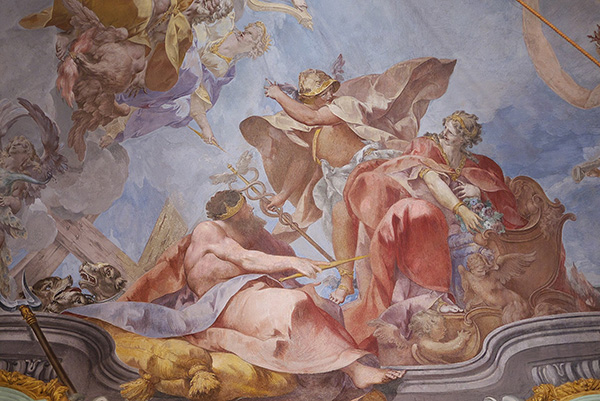
The earliest manifestation of Dis Pater is as a god of wealth. He represents to the Roman worldview, the source of all wealth: the veins of gold and silver in the mountains, the copper and iron deposits, the precious stones and salt lying beneath the surface of the earth, and indeed the seeds planted into the ground that ultimately produce crops. Therefore, he is also the god of the riches hidden in the earth. Cicero establishes this relationship when he states that Dis Pater is called “Dives,” or “the wealthy” because everything returns to the earth and rises from the earth. Similarly, Plouton/Pluto, his Greek counterpart whose name means simply “wealth”, also represented this principle. For this reason, the two gods easily merged into one.1,20,22,27,28
For this reason, Dis Pater is also a benefactor. The wealth he stores is that of the fertile soil and mines; similarly, when considering the entire Greco-Roman concept of the underworld god as Pluton/Dives (“the Rich”), sending forth abundance from beneath, this exact same reasoning applies to both.1,6,20
VI. The God of Agriculture
As a god of wealth is tied to fertility (the growth of crops), so too does his earlier Italian nature represent him as a force connected to fertile soil. The same earth that conceals metals produces grains and just as grain is sown into the earth and left to die before returning to life again, so too do we see Dis Pater as part of a larger group of agricultural Chthonic forces, deities representing fertility in soil and buried seed, honored by Romans for bringing about new harvests.6,20,29,30
This connection to earthly fields is evidenced by some of the Rites themselves. The Underworld Games were frequently scheduled due to plague or failure on behalf of farmers, a lack of bounty from Mother Earth, and thus they sought to provide healing for both earth and humans alike. Both leading to the Underworld Games is evident from archeological findings: the Taurian Games stemmed from plague in Italy, and similarly, the Saecular Games resulted from illness cured through water provided via a buried altar. Through appeasement of Lord of the Ground, Romans asked that their ability to either curse or bless earth be turned towards blessing, thereby equating god of death and harvest as one single entity viewed through two separate lenses.6,15,17
VII. Objects and Findings
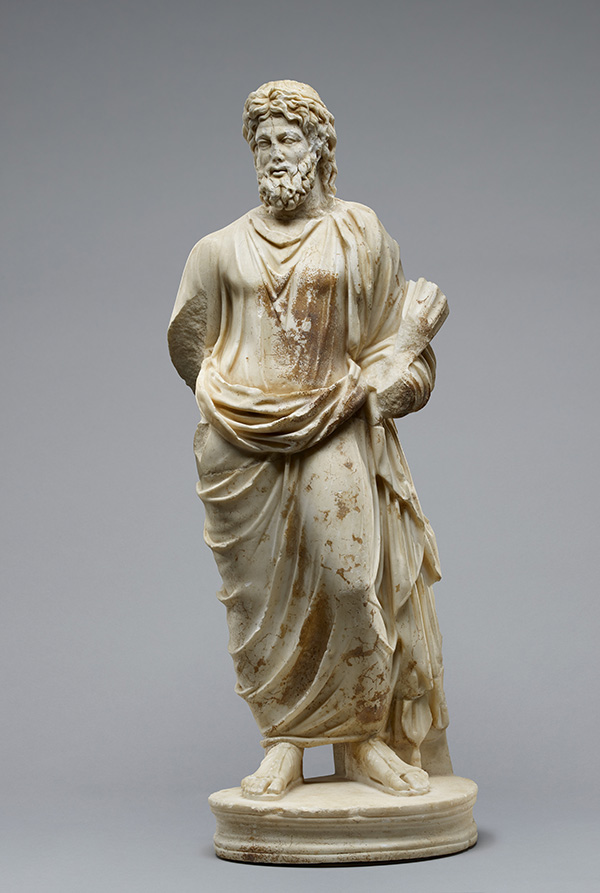
Dis Pater was worshipped at buried altars rather than within temples filled with artifacts, so finding physical proof of his cult is difficult. Most important is the Tarentum itself along with its monuments: in addition to several marble tablets detailing specifics regarding the Rites of Dis Pater and Proserpine, inscribed monuments discovered in the Campus Martius have allowed archeologists to pinpoint precisely where the sacred Tarentum was located, next to the River Tiber. Of greater significance is perhaps the recovered Acta detailing games celebrating Dis Pater andProserpina during 17 BCE (Augustan era) and during 204 CE (Severan era): lengthy inscriptions recording sacrifices, prayers to Dis Pater/Proserpina and list all participants performing rituals to underworld gods.10,20,31,32
Altars dedicated to Dis Pater and Proserpina in Rome are documented through dedicatory inscriptions; additionally, paired cult statues appear on monuments outside of Rome. In Roman Dacia, one votive reliefs depict a Roman colonial magistrate making offerings to the infernal couple.19,33,34,35
VIII. The God of Death
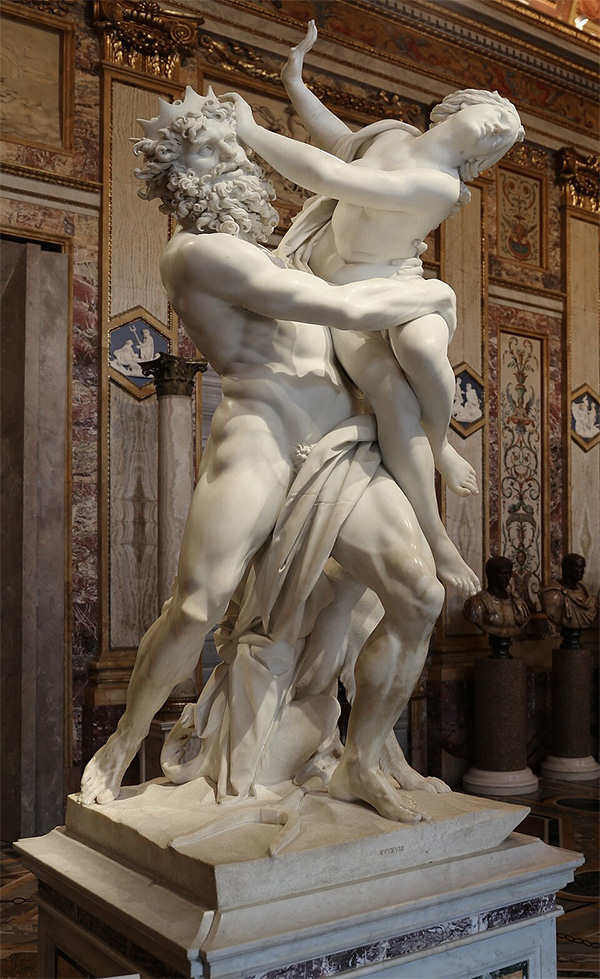
As his identity merged with that of the Greek Hades, Dis Pater evolved to become primarily the god of death, and the ruler of the dead. In his capacity as the ruler of the dead he is the husband of Proserpina and the sovereign of the shades, and therefore his name in the poets is used as a formal reference to death itself, e.g., a hero being said to be sent down to Dis. The Romans used many names for this force/power, and they considered all of these to be aspects of a single god of the world below.1,9,22,36
Orcus is the earlier, grimmer Italian name of the death-god. He represents a power of punishment, and of the grave. He is harsher and his name is probably connected to 'the strangler'. Where Dis Pater is the noble ruler of a Greek styled underworld; Orcus was the devouring monster who drags men down. His name still survives in the Italian word orco, and, via a long folklore, in the English ogre.3,9,22,37
IX. The Taurian Games
The Ludi Taurii, The Taurian Games, were celebrated in honor of the di inferi (the gods of the underworld) among whom Dis Pater and Proserpina ranked highest. They were a special expiatory ritual performed religio causa whenever fear of religious consequences demanded it. Festus identified their becoming an institution during the reign of the last king, Tarquinius Superbus, after a pestilence struck pregnant women which was attributed to selling sacrificial bull meat to the populace. To deflect this evil by appeasing those spirits beneath ground, the Taurian Games were established. There were other explanations for the origin of the name of the games. One explanation was based on the fact that the games featured bulls, another was based on a barren cow (taura) sacrificed to Proserpina. 17,22,38,39
Proceedings involved running horses racing around turning posts. They were always conducted in the Flaminian Fields, subsequently referred to as the location of the Circus Flaminius. These fields remained their exclusive venue as if some ritualistic bond had linked them forever to that land at the edge of the Campus Martius. Varro recorded races taking place there while Livy notes the games being held over a period of two days in 186 BCE as ordered by the Sibylline Books. The combination of horse racing with rituals for appeasing underground gods is an attribute of ancient Roman rites and one of the earliest forms of Roman worship. The Taurian Games fall within that same category of ancient rites preserved up until late antiquity through renewed interest in Roman religion during the Augustan and Antonine periods.9,18,26
X. The Gauls and Dis Pater
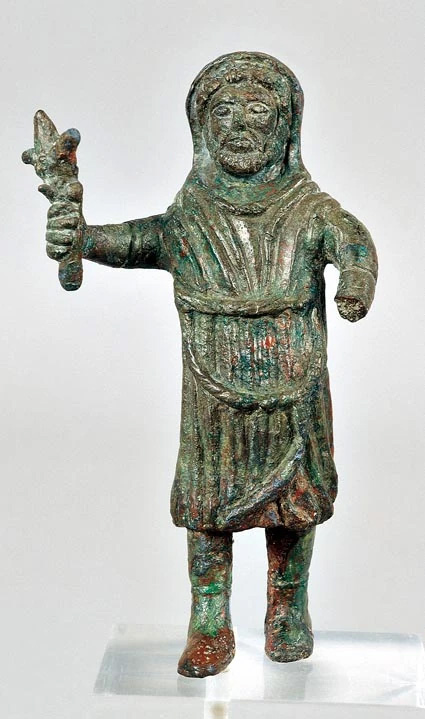
In Book VI of Commentarii de bello Gallico, Julius Caesar writes that all Gauls claim descent from a paternal-underworld-deity: "All Gauls affirm that they derive their origins from Dis Pater...and that this tradition has been transmitted through generations by the Druids." The Gauls calculated time by nights rather than days, recording birth-days and beginning months and years according to nights before days.8
Which specific native deity he referred to remains unknown and cannot be recovered with certainty. Later scholars have suggested possible ancestors including Cernunnos, Sucellus, Taranis or a Gaulish father-of-the-dead deity without achieving consensus. The link does establish why much of the Roman frontier seems to have indulged in Dis Pater's worship as an interpretation of Celtic belief.4,6,8
XI. The Hundred-Year Festival: the Ludi Saeculares
The most important rituals to be performed in honor of Dis Pater and Proserpina were the Ludi Saeculares (Secular Games) which were, strangely for Roman religion, celebrated every hundred years. It was noted that in that way, no individual would ever live through the same games twice. They originated as the Ludi Tarentini (Games at Tarentum), a private ritual of the gens Valeria associated with an underground altar located in the Campus Martius, and are described by both Valerius Maximus and Zosimus.15,16,20,40
A Sabine man of the Valerian line, Valesius, had three children, two sons and a daughter, stricken by plague. Praying at his hearth and drawing hot water for them, he heard a voice bidding him carry them down the Tiber to Tarentum and there give them water warmed at the altar of Dis Pater and Proserpina. Taking this for the Greek city of Tarentum in the south, he set out by river; but the voice halted him at a place on the Campus Martius that was also called the Tarentum, where the ground smoked, and there he warmed the river-water and gave it to his children, who were cured and fell asleep.
Waking, they told how a god had appeared to them in a dream and commanded sacrifice to Dis and Proserpina and three nights of games. Digging to build the altar, Valesius found one already buried on the spot, inscribed to the underworld couple; he sacrificed on it, held a lectisternium and games for three nights, one for each child saved, and so in the end hhe founded the rite.15,16,23
From this beginning, evolved the state-wide festival. Historical tradition attributed the festivals back to either the king or early republic era; however, the first recorded public festivals occurred during times of crisis due to the Punic Wars. Specifically, the first historical record of such festivals occurred in 249 BCE after the First Punic War and again around 146 BCE when such festivals were ordered to be performed by the Sibylline Books to calm down the forces of nature below when the Roman state faced dangers. During both of these performances, nighttime sacrifices of black victims were made to Dis Pater and Proserpina at the Tarentum.
In 17 BCE, Augustus transformed this rite into a day-long celebration of renewal of the ages while changing focus from the underworld gods of darkness and death to those representing light and life associated with Apollo, Diana, Jupiter, and Juno. The performance included daytime offerings to those gods, the recitation of Horace’s Carmen Saeculare by a chorus of young singers and retained elements of the older nighttime rites for Dis and Proserpina. Augustus’ inscriptions regarding his performances as well as inscribed documents from the Severan games of 204 CE have survived to describe all aspects of this type of festival.16,20,32,41,42
Sources and Bibliography
- Cicero. De natura deorum. Translated by H. Rackham. Loeb Classical Library 268. Cambridge, MA: Harvard University Press, 1933. 2.66 (Dis as Dives, “father of riches,” equated with the Greek Plouton; all things fall back into and arise from the earth).
- de Vaan, Michiel. Etymological Dictionary of Latin and the Other Italic Languages. Leiden Indo-European Etymological Dictionary Series 7. Leiden: Brill, 2008. 173–174, s.v. “dives / Dis”: Dis a contraction of dives (< divus, dius), the pairing with Pater reinforced by association with Di(e)spiter.
- Ennius, Quintus. Euhemerus (Sacra Historia). In Remains of Old Latin, edited and translated by E. H. Warmington, vol. 1, Ennius and Caecilius. Loeb Classical Library 294. Cambridge, MA: Harvard University Press, 1935. For the equation “Pluto Latine est Dis pater, alii Orcum vocant.”
- West, M. L. Indo-European Poetry and Myth. Oxford: Oxford University Press, 2007. 166–175, on *Dyēus Ph&sub2;tēr, the reconstructed sky-father, and the spread of the name and its reflexes; for the comparison and its limits.
- Mallory, J. P., and D. Q. Adams, eds. Encyclopedia of Indo-European Culture. London and Chicago: Fitzroy Dearborn, 1997. S.v. “Sky Father,” for *Dyēus Ph&sub2;tēr and the Indo-European reflexes of the name.
- Dumézil, Georges. Archaic Roman Religion. Translated by Philip Krapp. 2 vols. Chicago: University of Chicago Press, 1970. For Dis Pater, the di inferi, and the chthonic gods of the earth and its wealth in the structure of Roman religion.
- Ernout, Alfred, and Antoine Meillet. Dictionnaire étymologique de la langue latine: Histoire des mots. 4th ed. Paris: Klincksieck, 1959. S.vv. “dives, Dis” and “deus, divus,” for the derivation of Dis and its distance from *dyeu-.
- Caesar, Julius. The Gallic War. Translated by H. J. Edwards. Loeb Classical Library 72. Cambridge, MA: Harvard University Press, 1917. 6.18 (the Gauls claim descent from Dis Pater, handed down by the Druids, and reckon time by nights).
- Varro, Marcus Terentius. On the Latin Language. Translated by Roland G. Kent. Loeb Classical Library 333–334. Cambridge, MA: Harvard University Press, 1938. 5.154 (the horse-races of the Ludi Taurii in the Circus Flaminius); with the antiquarian notices of Orcus and the underworld names.
- Corpus Inscriptionum Latinarum, vol. 6, Inscriptiones urbis Romae Latinae. Berlin: Georg Reimer, 1876–. Nos. 137–139 (altars to Dis Pater and Proserpina at Rome); nos. 32323–32336 (the acta of the Saecular Games of 17 BCE and 204 CE).
- Hesiod. Theogony. In Theogony, Works and Days, Testimonia, edited and translated by Glenn W. Most. Loeb Classical Library 57. Cambridge, MA: Harvard University Press, 2006. Lines 453–506 (the children of Kronos and the division of the cosmos among the brothers).
- Wissowa, Georg. Religion und Kultus der Römer. 2nd ed. Handbuch der Altertumswissenschaft 5.4. Munich: C. H. Beck, 1912. For Dis Pater, the di inferi, Summanus, and the underworld cult in the Roman system.
- Latte, Kurt. Römische Religionsgeschichte. Handbuch der Altertumswissenschaft 5.4. Munich: C. H. Beck, 1960. For the chthonic gods of Rome and the character of the underworld cult.
- Dionysius of Halicarnassus. Roman Antiquities. Translated by Earnest Cary. Loeb Classical Library. Cambridge, MA: Harvard University Press, 1937–1950. For the antiquarian tradition on the archaic ludi and the cults of early Rome drawn on by later writers.
- Valerius Maximus. Memorable Doings and Sayings. Edited and translated by D. R. Shackleton Bailey. 2 vols. Loeb Classical Library 492–493. Cambridge, MA: Harvard University Press, 2000. 2.4.5 (Valesius, the sick children, and the altar of Dis Pater and Proserpina at the Tarentum; origin of the Saecular Games).
- Zosimus. New History. Translated by Ronald T. Ridley. Byzantina Australiensia 2. Canberra: Australian Association for Byzantine Studies, 1982. 2.1–5 (the legend of Valesius, the buried altar at the Tarentum, and the history of the ludi down to the Augustan revival).
- Festus, Sextus Pompeius. De verborum significatu quae supersunt cum Pauli epitome. Edited by Wallace M. Lindsay. Leipzig: Teubner, 1913. S.v. “Taurii ludi” (p. 478 L.): the games instituted under Tarquinius Superbus for the gods below, in a plague upon pregnant women.
- Livy. History of Rome. Translated by Evan T. Sage. Loeb Classical Library 313. Cambridge, MA: Harvard University Press, 1936. 39.22.1 (the Ludi Taurii held for two days, religionis causa, in 186 BCE).
- Schäfer, Alfred, and others. “Notes on the Cult of Dis Pater and Proserpina in Colonia Dacica Sarmizegetusa.” For the votive relief of Caius Valerius Zeno (AE 1908, 47 = IDR III/2, 199) dedicated to Dis Pater and Proserpina, and the provincial spread of the paired underworld cult.
- Beard, Mary, John North, and Simon Price. Religions of Rome. 2 vols. Cambridge: Cambridge University Press, 1998. For the di inferi, the Tarentum and the Saecular Games, the Ludi Taurii, and the propitiation of the underworld gods at moments of crisis.
- Macrobius. Saturnalia. Edited and translated by Robert A. Kaster. Loeb Classical Library 510–512. Cambridge, MA: Harvard University Press, 2011. 1.7 and 1.10–11, for the underworld gods and their several names in the antiquarian tradition.
- Smith, William, ed. A Dictionary of Greek and Roman Biography and Mythology. 3 vols. London: John Murray, 1849. S.vv. “Dis,” “Orcus,” and “Ludi Taurii,” for the Latin names of the underworld god and the underworld games.
- Platner, Samuel Ball, and Thomas Ashby. A Topographical Dictionary of Ancient Rome. London: Oxford University Press, 1929. S.v. “Terentum (Tarentum)”: the smoking cleft in the Campus Martius, the buried altar of Dis and Proserpina, and the site of the Saecular Games.
- Coarelli, Filippo. Il Campo Marzio: Dalle origini alla fine della Repubblica. Rome: Quasar, 1997. For the topography of the Campus Martius, the Tarentum, and the buried altar of Dis and Proserpina.
- Richardson, L., Jr. A New Topographical Dictionary of Ancient Rome. Baltimore: Johns Hopkins University Press, 1992. S.vv. “Terentum” and “Dis Pater,” for the sacred site and the altars of the underworld couple.
- Platner, Samuel Ball, and Thomas Ashby. A Topographical Dictionary of Ancient Rome. London: Oxford University Press, 1929. S.v. “Circus Flaminius”: the Flaminian Fields, the horse-races of the Ludi Taurii, and their fixity to that ground.
- Pliny the Elder. Natural History. Translated by H. Rackham. Loeb Classical Library. Cambridge, MA: Harvard University Press, 1938–1963. Books 33–34 (the metals of the earth) and 37 (gems), for the underground riches in the god’s keeping.
- Farnell, Lewis Richard. The Cults of the Greek States. 5 vols. Oxford: Clarendon Press, 1896–1909. Vol. 3, for Plouton, the wealth-giving underworld god behind the Roman equation with Dis.
- Ovid. Metamorphoses. Translated by Frank Justus Miller, revised by G. P. Goold. Loeb Classical Library 42–43. Cambridge, MA: Harvard University Press, 1916/1984. 5.341–571 (the rape of Proserpina and the bargain of the seasons).
- Spaeth, Barbette Stanley. The Roman Goddess Ceres. Austin: University of Texas Press, 1996. For Proserpina, the grain-daughter, and the chthonic agricultural background of the underworld cult.
- Feeney, Denis. Caesar’s Calendar: Ancient Time and the Beginnings of History. Berkeley: University of California Press, 2007. For the saeculum, the Saecular Games, and the reckoning of the ages.
- Pighi, Giovanni Battista. De ludis saecularibus populi Romani Quiritium libri sex. 2nd ed. Amsterdam: Schippers, 1965. The standard edition of the inscribed acta of the Saecular Games, including the celebrations of 17 BCE and 204 CE.
- Tertullian. Ad nationes 1.10 and Apologeticus 15. In Apology; De spectaculis, translated by T. R. Glover. Loeb Classical Library 250. Cambridge, MA: Harvard University Press, 1931. For the costumed Dis Pater with his mallet claiming the slain in the arena at Carthage.
- de Grummond, Nancy Thomson. Etruscan Myth, Sacred History, and Legend. Philadelphia: University of Pennsylvania Museum of Archaeology and Anthropology, 2006. For Charun and Vanth, the hammer-bearing Etruscan death-demons behind the arena figure.
- Kyle, Donald G. Spectacles of Death in Ancient Rome. London: Routledge, 1998. For the arena figures of Dis Pater and Mercury, the disposal of the dead, and the Etruscan Charun with his hammer behind them.
- Virgil. Aeneid. Translated by H. Rushton Fairclough, revised by G. P. Goold. Loeb Classical Library 63–64. Cambridge, MA: Harvard University Press, 1916/1999. Book 6 (the descent to the world of Dis) and 4.702 (Proserpina and the doomed soul).
- Glare, P. G. W., ed. Oxford Latin Dictionary. 2nd ed. Oxford: Oxford University Press, 2012. S.vv. “Dis,” “dives,” and “Orcus,” for the Latin lexical evidence and the sense-history of the names.
- Servius. In Vergilii carmina commentarii. Edited by Georg Thilo and Hermann Hagen. Leipzig: Teubner, 1881–1902. On Aeneid 2.140, for the alternative explanations of the Ludi Taurii and their institution against a pestilence.
- Scullard, H. H. Festivals and Ceremonies of the Roman Republic. London: Thames and Hudson, 1981. For the Ludi Taurii, the Ludi Saeculares, and the calendar of Roman public rites.
- Censorinus. The Birthday Book (De die natali). Translated by Holt N. Parker. Chicago: University of Chicago Press, 2007. Ch. 17, on the saeculum and the history and reckoning of the Saecular Games.
- Augustus. Res Gestae Divi Augusti. Edited and translated by Alison E. Cooley. Cambridge: Cambridge University Press, 2009. 22.2 (Augustus celebrates the Saecular Games as one of the fifteen for the performance of the rites, in 17 BCE).
- Horace. Carmen Saeculare. In Odes and Epodes, edited and translated by Niall Rudd. Loeb Classical Library 33. Cambridge, MA: Harvard University Press, 2004. The hymn sung by the choir of children at the Augustan Saecular Games of 17 BCE.