













| Language / Culture | Name of Yama | Attestation |
|---|---|---|
| Vedic Sanskrit | Yama (यम) | Rigveda (c. 1500–1200 BCE) |
| Avestan (Iranian) | Yima (𐬫𐬌𐬨𐬀) | Avesta, the Vendidad and Yasht literature |
| Old Norse (cognate) | Ymir | Poetic and Prose Edda |
| Latin (proposed cognate) | Remus (Geminus?) | Comparative reconstruction |
22 min read
YAMA
author: High Priest Zevios Metathronos
co-author: Novice Priest Karnonnos
I. The Name of Yama
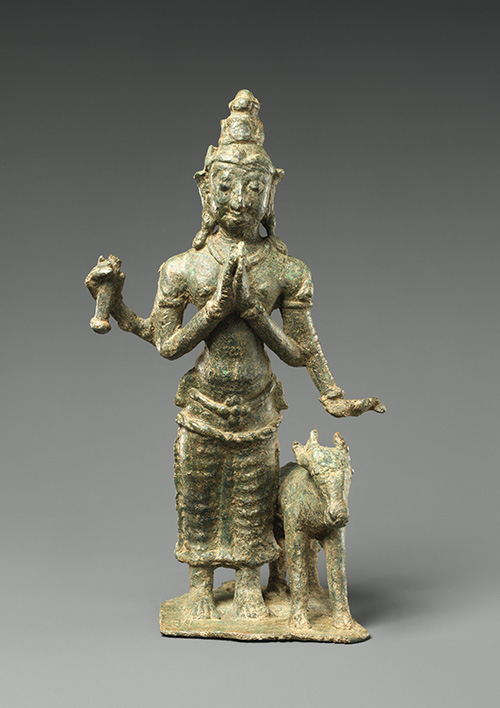
Yama, Lord of Death: Regent of the South, Sri Lanka, 9th century, the Met
Yama can be translated to mean "twin" because it comes from the Vedic Sanskrit for twin (yama) and also is the name of his sister Yami, the first pair of humans created in the earliest account. Etymologically, aside from referring to twins, there are two senses established by Indian scholars of the root verb yam which means to bind, or to curtail or restrain. This refers to the god that binds all the dead and guides moral order, while also having a reference to restraint. The ancient Indian treatise on etymology known as the Nirukta associates him to the root of self control, and these two senses run throughout all of the latter tradition. The liminality of twins has always been a symbol of life and death.1, 2
He is often referred to as Vaivasvata meaning "son of Vivasvat [Surya]" since he is the son of the radiant sun god, and this patronymic is found almost as frequently in the hymns as his actual name. He is born of Saranyu and his twin sister Yami becomes the goddess Yamuna, the river. Since the nomenclature identifies him as a member of the solar family, he represents the first of the sun's mortal offspring to pass into the darkness, and therefore represents an unbroken lineage within the poetry which follows.1, 3
Because, too, he is a figure of an era much farther back than the time when the Rigveda was written, his name shares many cognates with other languages across the Indo-Europeans. The Avestan equivalent, Yima (son of Vivant), is the first king and ruler of a heaven, whereas Ymir (primordial giant from whom the world is formed) is possibly the Norse equivalent. Comparative linguists have linked his name to the Latin twin Remus and to the word geminus ("twin"). As such, Yama is one of the most secure figures to be identified with an element of commonality among the shared Indo-European heritage, representing a primal twin and first mortal whose story was better recorded by the Indians than were those of any other branches.3, 4
In the Rigveda, his name is accented on the final syllable, yama, marking the sense "twin," and from that first attestation onward he is never a mere abstraction of death but a named person with a father, a sister, and a history. It is this personal and ancestral character, the first man who walked the road of death and now waits at its end, that the Vedic and Hindu traditions cultivate, and that sets their Yama apart from a bare personification of mortality.1, 5
Yama was also worshipped strongly in China and adjacent cultures influenced by it, but this variation has very strong differences colored by Buddhism.
Sources: Monier-Williams, A Sanskrit-English Dictionary (1899); Macdonell, Vedic Mythology (1897); Mallory and Adams, The Oxford Introduction to Proto-Indo-European and the Proto-Indo-European World (2006); the GRETIL/Aufrecht text of the Rigveda.1, 2, 3, 5
II. Yama in the Vedas
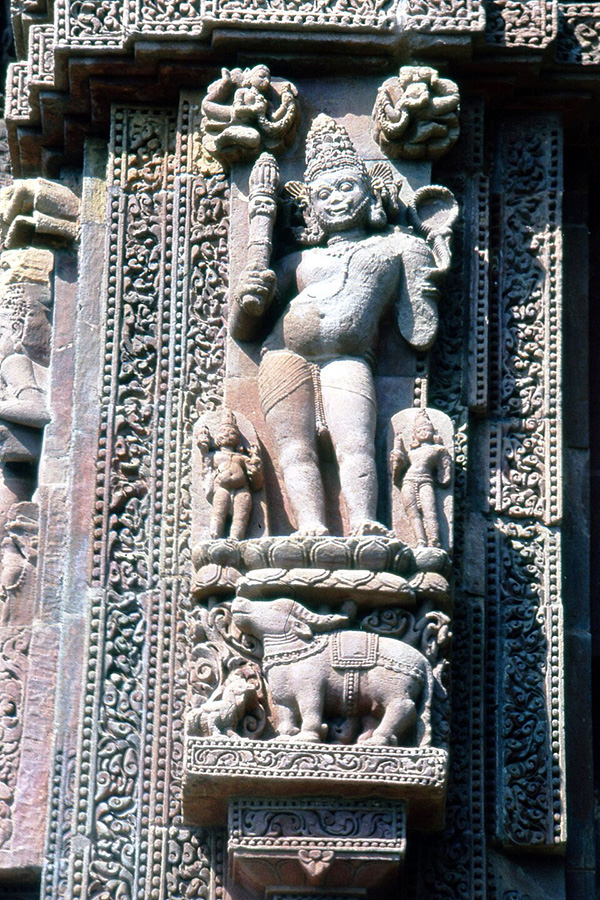
Detail of a sculpture of Yama, the Hindu god of death, who is depicted riding a bull while holding a danda (staff) in one hand, 11th century. Bhubaneswar, Orissa
Rigveda
The Rigveda does not portray Yama as a grim executioner. Instead, he is the first mortal to die and through death discovers the path to the home of the deceased, the path that all other humans must take. Poets describe Yama’s search for and finding of the road for many others, his travels along the great heights and discovery of the road to the home that can’t be lost, and how each of the new humans takes their own roads to the home of the old fathers. In this view, death is a journey that Yama made before the rest of humanity as an explorer, to lead the humans that followed after him in their journeys, rather than an external force. As such, Yama is offered sacrificial offerings as a king and a collector of men.5, 6, 7
In addition, the region that he discovered and ruled is described as a land of light and joyfulness. The major funeral hymn of Book Ten, Hymn Ten.14 requests the departing soul to journey along the ancient paths to where the fathers reside and pray for Yama to provide the traveler with a dwelling place decorated with light, beams of light and water. The prayer also petitions that the soul may reunite with the blessed fathers who delightfully dine with Yama in a pasture that can never be lost. This earliest concept of the afterlife was one of peace, reunion and continued existence; a location of reunification for all souls that have ever existed.5, 6, 7
Also guarding the entrance to this area are Yama’s two dogs that are descendants of Sarama and are four-eyed and broad-nosed with brindle and black coloring. The funeral hymn encourages the departing soul to hasten past them along the joyful path and reach out to meet the gracious fathers. Additionally, the poem requests that Yama entrust the departing soul to the care of these guardians so that they may provide good fortune and well-being for the soul. Although in later layers the dogs serve as agents of Yama to mark those souls whose time has come to pass from this world, in the oldest layer they served as guards of the path rather than instruments of punishment. 5, 8
One of the most interesting and discussed hymns is 10.10, which contains a conversation between Yama and his twin sister Yami. Yami urges that since she and Yama are the only twins and were created together in Tvashtr’s womb for this very reason, she implores her brother to join her in continuing their line. Yama rejects her proposal citing the bonds of kinship and law that prohibit siblings from reproducing. Ultimately, the hymn concludes without resolving the matter. Regardless of its intended meaning, the exchange demonstrates Yama as being the primal twinned ancestor at the beginning of humanity and establishes that even though he is urged by his own sister’s desires against his own desire, he adheres to law..5, 9
What is perhaps most important regarding the Vedic perception of Yama is what is lacking in the Rigvedic hymns. As John Muir noted in his observations about Yama within the Rigveda in the late Nineteenth Century, Yama is depicted in none of the Rigvedic hymns as administering punishments upon sinners. Furthermore, there are no prominent references to punitive judgments or retributions within his domain contained in any of the hymns contained within this Veda. The Rigvedic Yama is a jovial King of the Ancestral Dead, First Forefather and Lord of Fathers whose worship is directly related to honoring those members of one’s own lineage who passed prior to birth. There exists nearly entirely absent from his original characterization any form of mechanism designed to impose punishment/penalty upon those who live under his authority. 6, 10
Later Vedic Texts
As presented in both Atharvaveda and Brahmanas; however, there exists an emerging darkness and depth associated with Yama. He is increasingly tied to a group of powers that embody the end of human life, Antaka (“The End”) Mrityu (“Death”), Nirriti (“Disintegration”) and Slumber. The two canine messengers become progressively more ominous as they pursue their prey. However, even when his duties begin to take on a darker hue; nonetheless, Yama continues to perform his role as ruler of ancestral dead and protector of resting places. Thusly, funeral liturgies continue to request that the departing soul be entrusted into Yama’s care while offering prayers for safe haven among the fathers.1, 8
Vedic Literature also describes Yama as an integral component within both sacrifice and broader pantheon. His relationship with Agni (Fire-God), his friend/priest whom offers sacrifices to Yama, as well as his ties with Soma (Intoxicating Plant), Varuna (Cosmic Order) and Dharma (Order/Ritual), contribute toward a gradual transformation from his initial status as “First Mortal” toward an expanding cosmological position, namely Yama as that deity governing boundaries between worlds, ultimately preparing the foundation for Yama as a moral and philosophical figure in subsequent works such as Upanishads and epics.1, 7, 11
III. The Epithets of Yama
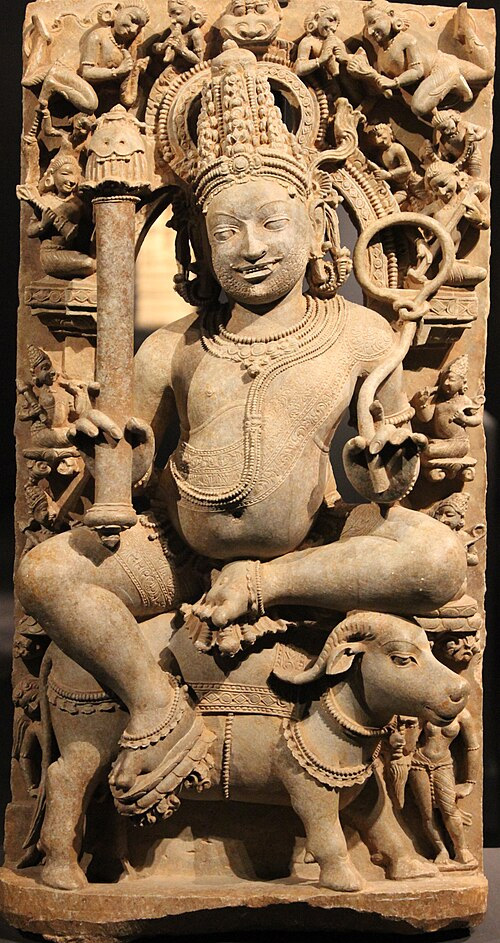
Yama as Guardian of the South, c. 13th century CE, Odisha State Museum
The titles of Yama trace his growth from the first mortal of the hymns into the lord of dharma and the ruler of the afterworld. Some name his descent, some his office as king of the dead, some his identity with the moral law, and some the instruments and aspects through which he governs the passage out of life. The most significant are gathered below.1, 12
| Epithet | Meaning | Domain |
|---|---|---|
| Dharmaraja (धर्मराज) | King of Dharma, Lord of Justice | Judge of cosmic law |
| Vaivasvata (वैवस्वत) | Son of Vivasvat (the Sun) | His solar descent and mortal origin |
| Pitripati (पितृपति) | Lord of the Fathers | His rule over the ancestral dead |
| Yamaraja (यमराज) | King Yama | His sovereignty over the realm of the dead |
| Antaka (अन्तक) | The Ender, the Finisher | The close he sets to every mortal life |
| Kala (काल) | Time | Time as the power that carries all beings to their end |
| Mrityu (मृत्यु) | Death | Death personified, his aspect and companion |
| Pashi / Pasha-hasta (पाशहस्त) | Bearer of the Noose | The noose with which he draws out the soul |
| Dandadhara (दण्डधर) | Bearer of the Rod | The rod of authority and chastisement |
| Pretaraja (प्रेतराज) | King of the Departed | His lordship over the spirits of the newly dead |
Sources: Monier-Williams, A Sanskrit-English Dictionary (1899); Mani, Puranic Encyclopaedia (1975); Dallapiccola, Dictionary of Hindu Lore and Legend (2002).1, 12, 13
IV. Where He Is Worshipped
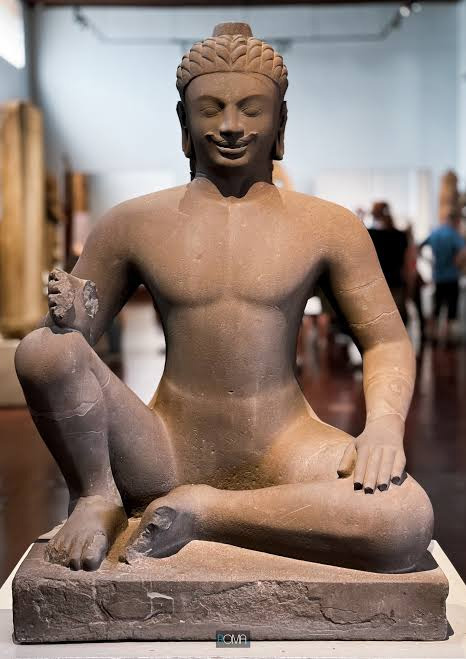
The Khmer Yama sandstone statue displayed at the National Museum in Phnom Penh
Yama is considered to be a major god. However, because of his role as Lord of Death, he generally does not have temples dedicated solely to him. Additionally, throughout most of Hinduism's history, he has primarily been worshiped through rituals and rites associated with funerals and honoring ancestors rather than being worshipped through statues in temples. When temples were built to honor Yama, they were typically few and cherished. These temples often represent Yama as Dharmaraja (the Just Ruler) and are believed to offer protection against premature death and bring both peace to the living and the dead.13, 14
One of the best-known temples of Yama is located at Dharmapuri, Telangana. At this temple, the ancient Lakshmi-Narasimha temple is said to be over 1,500 years old. In the temple complex, devotees put oil in the lamp called the Yamaganda Deepam to free themselves from their suffering and troubles. Those experiencing problems due to Shani are encouraged to make offerings to Yama to help alleviate their pain. Since the God of the South is worshipped in his aspect as the Lord of Righteousness at this temple site, visiting the temple represents making right moral accounts rather than simply avoiding death.14, 15
In Tamil Nadu, there is a relatively uncommon type of temple where Yama is the main deity. That temple is located at Thiruchitrambalam in the Thanjavur District. There are many other holy sites where people remember Yama through stories and reflections. At Thirukadaiyur, there is a story about the boy sage Markandeya who was fated to die at age sixteen. When Yama came to take Markandeya’s life with his noose while Markandeya was worshipping at the Shiva linga, Shiva burst forth in defense of the boy and supposedly humiliated Yama. People go to that shrine seeking enlightenment regarding overcoming the fear of death. At Narikudi, which means “the Place of the Way of Dharma,” people worship Yama along with the gGoddess as the lords of death-conquering powers. Regardless of where Yama is worshipped, his worship is always related to contemplating mortality and living a morally correct life, rather than fearing punishment.16, 17
V. The King of the Ancestors
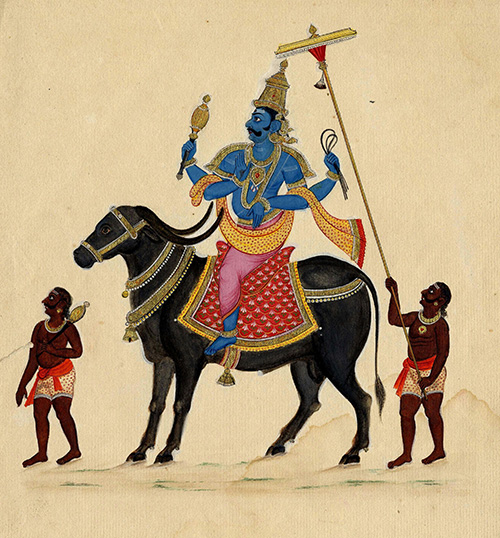
Yama on his Mount, 19th century Indian art
The oldest and longest lasting depiction of Yama has been that of Pitripati (Lord of Fathers), the first ancestor who gathers all of those who died before him into himself. In the Vedic view, the dead travel to the pasture of Yama and become the Pitrs (honored forefathers) who live in a state of happiness and continue to be connected to their living descendants by reciprocal obligations. Yama protects this entire line of souls as a father of all, the central point to which each line of ancestry converges and serves as a ruler who directs his kindred onto their final destination.5, 7
This character as the King of Ancestors provides Yama with a place of continuous reverence in Hindu practice through the rites for the deceased. The offerings made during shraddha ceremonies and the libations offered during pitr-tarpana ceremonies are intended for the Pitrs under Yama's care in order to sustain them on their journey and maintain their relationship with their generations. Through these practices households continuously acknowledge that their own dead are assembled in Yama's realm and that Yama, as God of Death, is simultaneously their guardian of memories and continuities.7, 11
As viewed in this manner, Yama's realm is an area for reflection and reunification rather than the perversion of being the place of burning punishment that later doctrines preached. The soul that arrives at Yama will be reunited with its ancestors instead of lost forever and takes its place in the never-ending procession of the dead waiting for them in the sunlit pastures of Yama. The Vedic prayer expressing the established expectation that the departed will enjoy a satisfactory existence there, viewing sunlight and peacefully living among their fathers, illustrates the settled expectation of this tradition: that death is a return home to Yama's care as the First Forefather, and that Yama's kingdom is the ultimate gathering place for everyone who ever lived.5, 6
VI. Yama and Nachiketa
There is no deeper consideration of Yama in Hindu literature than found in the Katha Upanishad. In this work, Yama evolves into the ultimate educator for the deathless. A young Brahmin named Nachiketa had gone to Yama's abode as requested by his angry father. After three days without sustenance at Yama's threshold, Yama finds that a worthy guest has stayed unfed at his doorstep. Therefore, he awards Nachiketa three wishes as compensation. For his first wish Nachiketa requests that his father's anger be placated; for his second wish he wants to learn about the fire ritual leading to heaven that Yama explains and calls by Nachiketa's name; and for his third wish he asks if he can determine if the individual self exists after death.18, 19
Initially, refusing to answer Nachiketa's third question, saying that even the old gods were confused about it, Yama attempts to distract Nachiketa with promises of wealth, extended lifespan, children and grandchildren, cattle and horses, and so on, all earthly delights that would ultimately fade away leaving nothing but fatigue of the senses, and therefore failing to fulfill Nachiketa's request for the truth of what lies beyond. Nachiketa rejects all of these alternatives citing that they only provide momentary pleasure until tomorrow morning and do not satisfy his quest for truth. Nachiketa's persistence demonstrates his worthiness to receive wisdom concerning what is beyond death. His refusal of worldly pleasures proves that he prefers goodness over pleasure.19, 20
Yama eventually discloses the central teachings of the Upanishads: that there is an Atman (immortal Self), uncreated and indestructible, larger than large and smaller than small, existing within the heart of every living thing. In addition to explaining what lies beyond death, Yama describes two roads available to every individual: the pleasant way (preyas) and the good way (shreyas). He praises Nachiketa for selecting the good way, moreover, he warns that traveling toward one's self is difficult to accomplish and sharper than a razor. As part of illustrating his description, he uses a metaphor comparing an individual's body to a chariot, his self to its driver, his intellect to its charioteer, and his senses to its horses; thereby enabling individuals with discipline to complete their journey toward self-realization. Herein lies transformation in which Yama comes to provide a wisdom enabling individuals to conquer death.19, 20, 21
न जायते म्रियते वा विपश्चिन्
नायं कुतश्चिन्न बभूव कश्चित्।
अजो नित्यः शाश्वतोऽयं पुराणो
न हन्यते हन्यमाने शरीरे॥
na jayate mriyate va vipashchin
nayam kutashchin na babhuva kashchit
ajo nityah shashvato 'yam purano
na hanyate hanyamane sharire
"The knowing Self is never born, nor does it die. It did not come from anywhere, nor did it become anyone. Unborn, eternal, everlasting, and ancient, it is not slain when the body is slain."
Katha Upanishad 1.2.18, Yama to Nachiketa19
VII. The Realm of Reflection
While the pasture of fathers developed into a very detailed afterlife of various hells and heavens in the Puranas, Yama's Kingdom (Yamaloka) evolved into an area in which an individual's soul encounters the implications of the life it has lived. In describing this progression in detail in the Garuda Purana, it states that once the funeral pyre has been lit (indicating that an individual has reached death), their soul embarks upon a lengthy journey through multiple domains to arrive at Yama's court. Initially staying awhile among their own people and in places they knew, the soul continues onward across multiple domains leading ultimately to his seat of judgement.22, 23
At Yama's Court, a soul encounters Chitragupta (the divine recorder), who then reads aloud from an accurate account of all deeds (both positive and negative) performed by the soul since birth. Based upon this account, Yama determines where he will send the soul next. The intent behind this reckoning is educationally oriented for the soul itself and not punitive for Yama as judge; for through witnessing what it has created for itself (good or evil) in this life, the soul comes to comprehend what governing laws guide creation itself.22, 24
The Hindu understanding is that the stations beyond Yama's court, whether the heavens of Swarga or the corrective realms of Naraka, are without exception temporary. The soul that has done well enjoys the fruits of its merit until that merit is spent, and the soul that has done ill undergoes a season of purification until its debt is paid; then, in either case, it returns to the world of the living to be born again. Naraka in this vision is a cleansing and transformative passage rather than an eternal prison, a hard schooling that prepares the soul for its next life rather than an endless torment. The whole apparatus of Yama's realm is thus a station within the circle of rebirth, a place of accounting and reflection from which the soul moves on.22, 24, 25
VIII. Lord of Dharma and Judge of Deeds
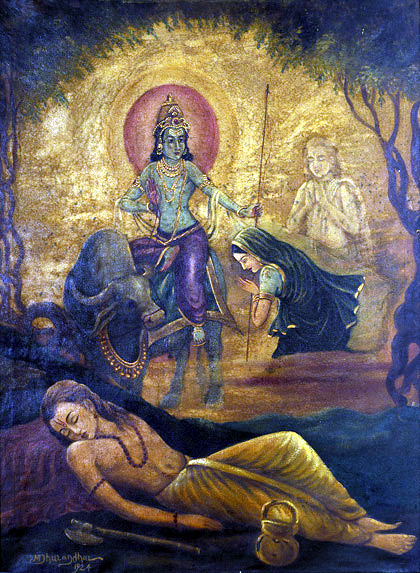
A depiction of Yama and Savitri from the Vana Parva
The title most descriptive of the mature Hindu Yama, is Dharmaraja - the King of Dharma, the ruler of justice who measures all souls by the standard of righteous actions. As such, he is honored as being extremely impartial. Each decision regarding where a soul goes upon death, he renders solely based upon the weight of their individual karma (actions). He demonstrates neither favoritism nor hatred towards anyone. Since he considers the total amount of both positive and negative actions performed by everyone throughout their lives, and awards each person exactly what they deserve, he represents the ultimate example of cosmic justice. And because he demonstrates complete fairness and impartiality in rendering his decisions, the tradition honors his fairness as the ideal model of unprejudiced judgement. .12, 25
As well as judging individuals' souls based upon their deeds, in many classical texts, he is often associated with Dharma itself, the personification of righteous actions. Not all authors agree that the god of death and the god of morality can be considered as one entity. Some believe that although the two gods have similar names, they were originally described separately in mythological accounts. These authors believe that while both gods have been referred to as Dharmaraja, they remain two separate deities. However, the fact that the name of the god of death was able to be used interchangeably with the name of righteousness illustrates how deeply rooted in the tradition Yama was seen to embody morality rather than destruction alone. The Great Epic makes this idea evident when it describes the oldest brother of the Pandavas, Yudhisthira, as having Dharma as his divine father. Yudhisthira is said to be so morally virtuous that he is also known as Dharmaraja. 12, 13
In the end, this sort of conception transforms the meaning of Yama's terror. His noose and his rod, and the fear his name inspires, express the strictness of a law that cannot be evaded rather than the cruelty of a tyrant.12, 25
IX. Yama and the Cycle of Rebirth
Yama presides judging at the center of samsara, which refers to the circular process of birth, death and rebirth that governs every embodied soul. Yama's courtroom serves as the dividing line between one lifetime and the beginning of the next lifetime. The outcome of the case Yama decides determines which reincarnation form a soul will take on, as well as the specific conditions surrounding its new life, all based upon the karmic effects from previous incarnations. He is therefore viewed as a transitional agent of existence, whereas he does not signify termination.24, 25
Seen from within that cycle, the work of the god of death is bound up with the soul's long moral evolution. Because he is charged with separating the soul from the body and directing it according to its deeds, later teachers describe his work as service to the soul's evolutionary path.24, 25
X. Yama and Other Death Gods
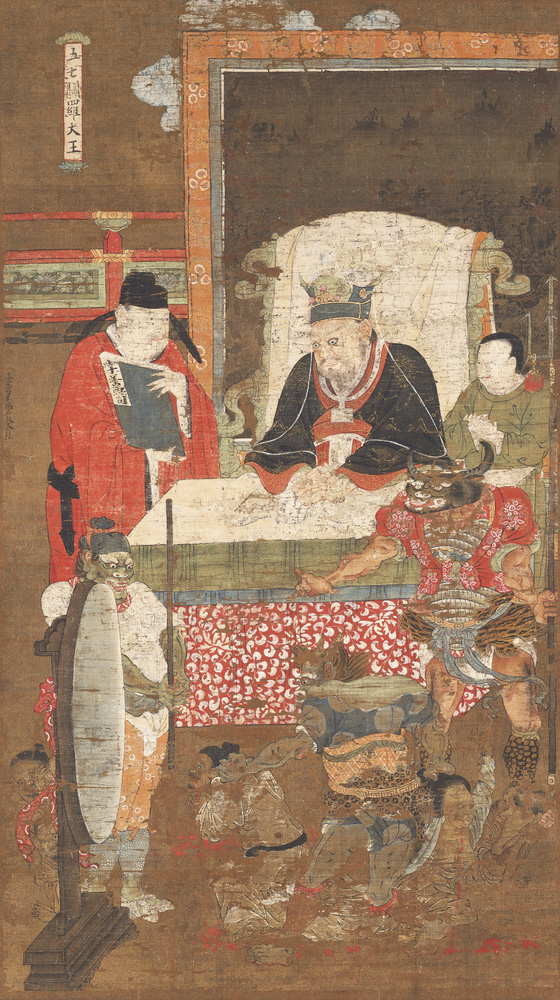
14th-century Chinese Yuan dynasty portrait of King Yama. One of a series of paintings of the "Ten Kings of Hell" by Lu Xinzhong
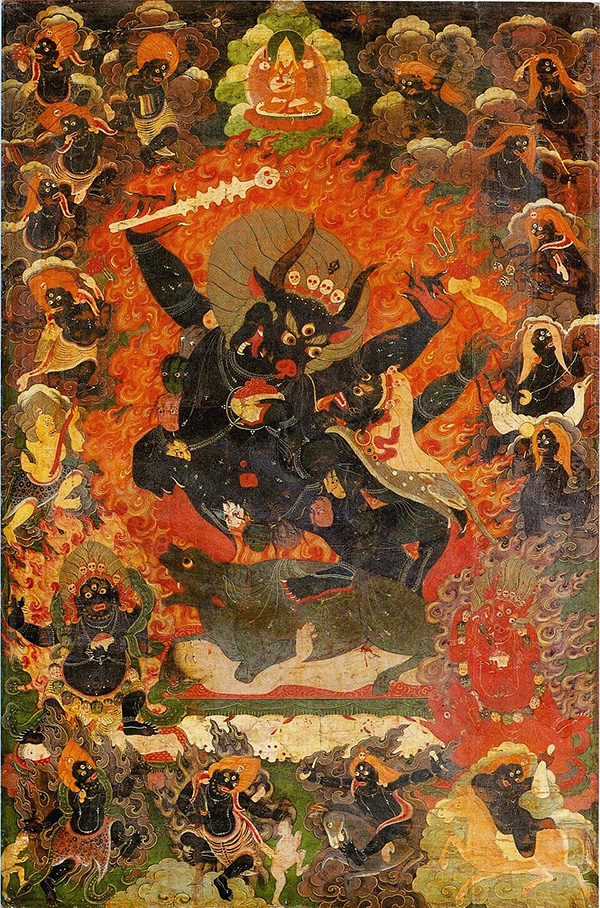
The Outer Yama Dharmaraja. Central region, Tibet. Mid 17th century, private collection
Yama remains one of the few surviving Indian members of an ancient heritage extending far beyond the Vedas. One of his closest relatives can be located in Iran. Both Yima (son of Vivanghvant) and Yama (son of Vivasvat) share identical names and fathers; however, the Iranian mythology bestowed upon Yima a totally different destiny. Instead of being the first mortal to die, Yima is a first king and hero of culture who reigns over a Golden Age and constructs a sacred precinct in which seeds capable of sustaining life survive a great winter. The Lord of Paradise vs. The Lord of the Dead. Two figures born from one source illustrate how a single primeval twin can become in one country the king of the afterlife and in another country a king of a lost Golden Age.3, 4
Further afield, the same stem appears in the Old Norse Ymir, the primordial giant from whose dismembered body the gods shape the world, preserving the motif of a first being whose death or division brings forth the ordered cosmos. Comparative scholars reconstruct behind these figures an Indo-European myth of primeval twins, one of them named simply "Twin," whose death or sacrifice founds the world and its order.3, 4
XI. Modern Festivals
Yama is remembered each year in a cluster of observances gathered around the autumn festival of Diwali revolving around protection.15, 26
| Festival | Time | Observance |
|---|---|---|
| Yama Deepam (Yama Deepdan) | Kartik, the eve of Naraka Chaturdashi | Southern kamp. |
| Dhanteras (Dhanatrayodashi) | Kartik Krishna Trayodashi | Yama and warding off death lamps |
| Naraka Chaturdashi | Kartik Krishna Chaturdashi | Release from Naraka, cleansing. |
| Yama Dwitiya (Bhai Dooj) | Kartik Shukla Dwitiya | Yama visits Yami (Yamuna) for a meal, sibling rite |
Sources: Dallapiccola, Dictionary of Hindu Lore and Legend (2002); HinduPad, "Dharmapuri Yama Dharmaraja Temple"; Sanatan Sanstha, "Bhai Dooj and Yama Dwitiya."13, 15, 26
Sources and Bibliography
- Monier-Williams, Monier. A Sanskrit-English Dictionary. Oxford: Clarendon Press, 1899. Entries cited: yama, yam, Vaivasvata, Antaka, Mrityu, Kala, Pasha, Danda, and the twin-sense of the name.
- Yaska. The Nighantu and the Nirukta. Edited and translated by Lakshman Sarup. Oxford: Oxford University Press, 1920–1927. Nirukta 10.19, on the derivation of Yama from the root yam, "to restrain."
- Mallory, J. P., and D. Q. Adams. The Oxford Introduction to Proto-Indo-European and the Proto-Indo-European World. Oxford: Oxford University Press, 2006. Sections cited: the Indo-European twin myth and the cognates Yima, Ymir, and the Latin twin.
- Lincoln, Bruce. "The Indo-European Myth of Creation." History of Religions 15, no. 2 (1975): 121–145. On the primeval twin (Yama, Yima, Ymir) whose death founds the world and its order.
- Macdonell, Arthur Anthony. Vedic Mythology. Grundriss der Indo-Arischen Philologie und Altertumskunde 3.1.A. Strassburg: Karl J. Truebner, 1897. Sections cited: Yama, the first mortal, the path of the fathers, and the two dogs of Sarama.
- Muir, John. Original Sanskrit Texts on the Origin and History of the People of India. Vol. 5, Contributions to a Knowledge of the Cosmogony, Mythology, Religious Ideas, Life and Manners of the Indians in the Vedic Age. London: Truebner, 1870. On Yama as the first man to die, king of the ancestors, and not a punisher of the wicked in the Rigveda.
- Griffith, Ralph T. H., trans. The Hymns of the Rigveda. 2nd ed. Benares: E. J. Lazarus, 1896. Hymns cited: Rigveda 10.14 (Yama), 10.10 (Yama and Yami), with the path of the fathers and the pasture of the dead.
- Whitney, William Dwight, trans. Atharva-Veda Samhita. Harvard Oriental Series 7–8. Cambridge, MA: Harvard University Press, 1905. On Yama, the two dogs, and his association with Mrityu and the powers of death in the later Vedic literature.
- Jamison, Stephanie W., and Joel P. Brereton, trans. The Rigveda: The Earliest Religious Poetry of India. 3 vols. Oxford: Oxford University Press, 2014. Hymn cited: the dialogue of Yama and Yami, Rigveda 10.10.
- Macdonell, Arthur Anthony. A Vedic Reader for Students. Oxford: Clarendon Press, 1917. Notes cited: the funeral hymn to Yama and the path of the dead.
- Keith, Arthur Berriedale. The Religion and Philosophy of the Veda and Upanishads. Harvard Oriental Series 31–32. Cambridge, MA: Harvard University Press, 1925. On Yama in the ritual, his links with Agni, Soma, and Varuna, and his development in the later Vedic period.
- Mani, Vettam. Puranic Encyclopaedia. Delhi: Motilal Banarsidass, 1975. Entries cited: Yama, Dharmaraja, and the identification with Dharmadeva.
- Dallapiccola, Anna L. Dictionary of Hindu Lore and Legend. London: Thames and Hudson, 2002. Entries cited: Yama, his iconography, temples, and the festivals of the Diwali season.
- Britannica, The Editors of Encyclopaedia. "Yama." Encyclopaedia Britannica. On Yama as the cheerful Vedic king of the ancestors and the later just judge Dharmaraja, his iconography and rare cult.
- HinduPad. "Dharmapuri Yama Dharmaraja Temple, Lord Yama Temple." Accessed 2026. On the worship of Yama Dharmaraja at Dharmapuri, the Yamaganda Deepam, and the propitiation of Shani.
- Religion World. "Yama Dweetheeya: A Visit to Yama's Temples." 2017. On the Yama Dharmaraja temple at Thiruchitrambalam and the Markandeya story at Thirukadaiyur.
- Agasthiar.Org. "Yama Deepam and the Narikudi Sacred Space." On the worship of Yama at Narikudi (Dharma Nerikudi) and the death-conquering aspect of the shrine.
- Nikhilananda, Swami, trans. The Katha Upanishad. In The Upanishads, vol. 1. New York: Harper and Brothers, 1949. For the frame of the Nachiketa story and the three boons.
- Olivelle, Patrick, trans. Upanisads. Oxford World's Classics. Oxford: Oxford University Press, 1996. The Katha Upanishad, cited for the dialogue of Yama and Nachiketa, the two paths, and the teaching of the Atman (Katha 1.2.18–23, 1.3.3–14).
- Radhakrishnan, Sarvepalli. The Principal Upanisads. London: George Allen and Unwin, 1953. On the shreyas and preyas teaching and the philosophical content of Yama's instruction.
- Easwaran, Eknath, trans. The Upanishads. 2nd ed. Tomales, CA: Nilgiri Press, 2007. The Katha Upanishad, cited for the chariot analogy and the razor's-edge path to the Self.
- Wood, Ernest, and S. V. Subrahmanyam, trans. The Garuda Purana (Saroddhara). Sacred Books of the Hindus 9. Allahabad: Panini Office, 1911. On the journey of the soul to the court of Yama and the account of its deeds.
- Shastri, J. L., ed. The Garuda Purana. Ancient Indian Tradition and Mythology 12–14. Delhi: Motilal Banarsidass, 1978–1980. On Yamaloka, Chitragupta the record-keeper, and the passage of the soul.
- Doniger O'Flaherty, Wendy. Karma and Rebirth in Classical Indian Traditions. Berkeley: University of California Press, 1980. On the temporary nature of the heavens and hells and the return of the soul to rebirth by the law of karma.
- Kane, P. V. History of Dharmasastra. Vol. 4. Poona: Bhandarkar Oriental Research Institute, 1953. On Yama as Dharmaraja, the doctrine of karma and rebirth, and the purificatory understanding of the afterworld.
- Sanatan Sanstha. "Bhai Dooj and Yama Dwitiya." Accessed 2026. On the worship of Yama at Dhanteras, Naraka Chaturdashi, and Yama Dwitiya, and the meeting of Yama and Yamuna.