













| Language / Culture | Name of Hades | Attestation |
|---|---|---|
| Classical Greek | Ἅιδης (Aides) | Homer, Hesiod, inscriptions (8th century BCE onwards) |
| Classical Greek | Πλούτων (Plouton) | Douris Phiale (490 BCE) |
| Classical Greek | Ἀϊδωνεύς (Aidoneus) | Homer, Hesiod, inscriptions (8th century BCE onwards) |
27 min read
HADES
author: High Priest Zevios Metathronos
co-author: Novice Priest Karnonnos
Hieratic Information about Hades
| Divine Names | |
|---|---|
| Hades (Ἅιδης) | the Unseen |
| Plouton (Πλούτων) | the Wealthy |
| Aidoneus (Ἀϊδωνεύς) | the honoured Unseen |
| These hieratic names carry strong spiritual resonance and are recommended for summoning and invocation practices. | |
| Divine Symbols | |
| |
| Divine Numbers and Attributes | |
| Sacred Numbers | 4, 40, 60 |
| Runes | Thurisaz, Ansuz, Perthro (in order of importance) |
| Zodiac Sign of Power | Scorpio |
| Sacred Animals | The Black Ram, the Screech-Owl, the Serpent, the Hound |
| Element | Earth, Aether |
| Divine Forces | |
| |
| Important Titles | |
| |
I. Names
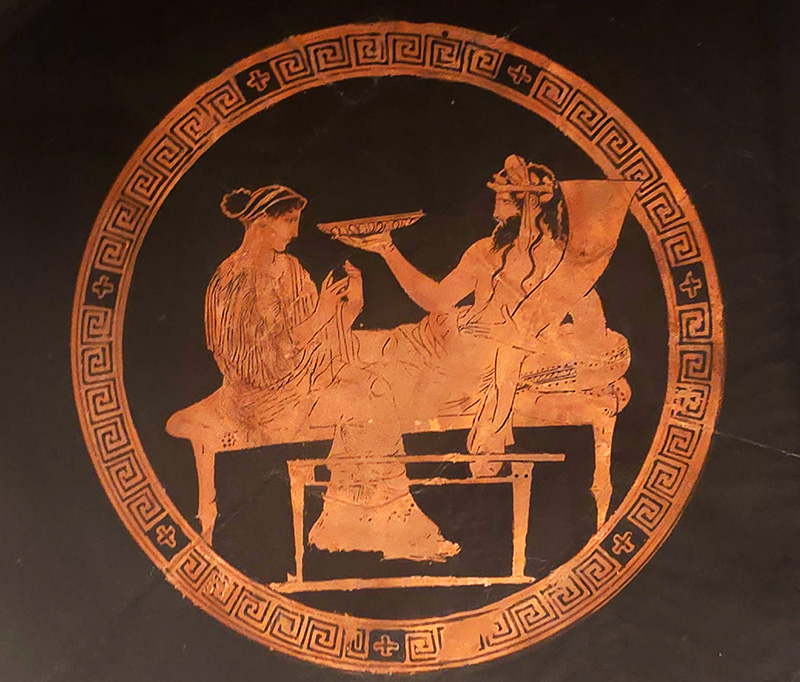
Red-figure kylix, created in Athens around 440–430 BCE, attributed to the Codrus Painter, British Museum
The traditional etymology takes Ἀΐδης as meaning "the unseen one" or "the invisible one." This connects the name with Greek ἀ- ("not / un-") plus the Indo-European root behind Greek ἰδεῖν ("to see"), from PIE *weid-, "see." It connects him also to the cap of invisibility and the unseen nature of his shadowy realm.1,2,3,4
He is first called by name by Homer in the Iliad as Aides (Ἅιδης), later shortened in other forms of Greek to ᾍδης by putting the iota beneath the alpha. The Doric Ἀΐδας and the Epic Ἀΐδης preserve the older shape of the name.3,4,5
Ancient etymology also played with the name. In Plato’s Cratylus, Socrates rejects in part the simple "unseen" explanation and instead derives Hades from eidenai (related to the PIE root *weid-), "to know," saying that the lawgiver called him Hades not from invisibility but from his knowledge of all noble things. The Phaedo, on the other hand, uses the "unseen" explanation more positively with regard to the realm itself. Proclus resolves the contradiction in part by saying that the name refers to the intelligibly hidden. There is no evidence that the word Hades was used in Linear B.1,6,7,8,9
Socrates also speaks of his second name, Plouton, cognate with the Greek word for wealth, ploutos, and with the son of Demeter who bears that name. He observes that many Greeks feared the name Hades and used Plouton as a euphemism, a practice Socrates finds mistaken. In the archaeological record the name is tied to the Ploutonia and other visible places of worship, and it is first securely used on a Doric phiale of about 490 BCE.7,10
The last of his three names, Aidoneus (Ἀϊδωνεύς), is a poetic and religious variation that uses an honorific suffix to lend esteem to the god, and it too originates in the Iliad.4,11
Sources: Homer, Iliad; Beekes, Etymological Dictionary of Greek (2010); Plato, Cratylus; Robertson, “A Fragmentary Phiale by Douris” (1991); Liddell, Scott, and Jones, A Greek–English Lexicon (1940).1,3,4,7,10
II. Hades in Myth
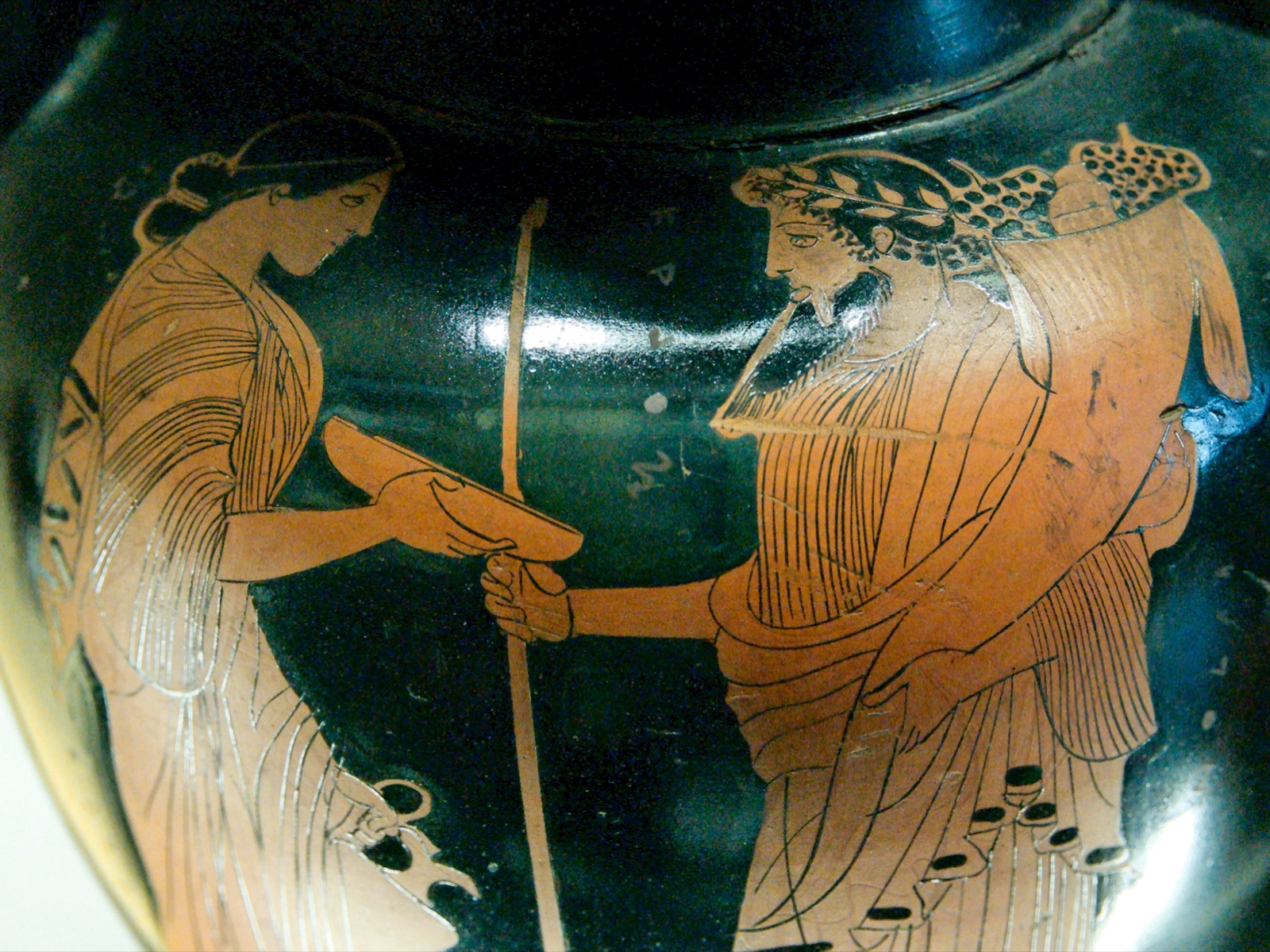
Hades (right-hand side) and Persephone (left-hand side). Detail from an Attic red-figure amphora, ca. 470 BC. Oionokles Painter, Department of Greek, Etruscan and Roman Antiquities
Homeric Context
Hades appears only briefly in the Iliad. The whole allusive context is that he keeps to his realm and scarcely, if ever, leaves it, aside from the one Herculean incident that Dione mentions. Consoling the wounded Aphrodite, she lists gods who have suffered at mortal hands: Heracles shot Hades with an arrow at Pylos among the corpses, and the god went up to Olympus in pain to be healed by Paieon.4,12
In pressing his own claim, Poseidon sets out in Book 15 the threefold inheritance of the three great sons of Kronos: Zeus received the sky, Poseidon the sea, and Hades the misty dark, while the earth and Olympus are common to all. In the Theomachy Poseidon’s earthquake terrifies Aidoneus below, who leaps from his throne with a cry, fearing that the earth will split and lay bare to gods and mortals the mouldering halls that even the gods abhor.4,13,14
Athena borrows the cap of Hades to hide herself from the raging Ares. Agamemnon remarks that Hades is the most hateful of all gods to mortals, unbending and unyielding; and when Phoenix tells the tale of Meleager’s curse, the god is invoked as Ζεὺς καταχθόνιος (Zeus Katachthonios), the Zeus beneath the earth.4,15
In the Odyssey, the directing role of the Nekyia, the book of the dead in which Odysseus confronts a succession of ghosts, is given to Persephone rather than to Hades. There it is said that Odysseus loathes the man who hides one thing in his heart and speaks another as he loathes the gates of Hades.16,17
Hades receives no Homeric Hymn of his own, but he figures largely in the Homeric Hymn to Demeter, where his abduction of Kore on his swift chariot as she gathers flowers stands at the centre. When Helios tells Demeter of her daughter’s new abode, the goddess is aghast, and her grief brings famine and the dying of the world; yet the Sun reminds her that Hades, ruler of many and her own brother, is no unseemly match.18
Hesiodic Context
The Theogony makes Hades a son of Kronos and Rhea, swallowed and later disgorged with his brothers and sisters. He is described as pitiless in spirit, dwelling in his halls beneath the earth. Again, as in the Iliad, the Titanomachy raises so vast a din above that it reaches even to Hades and to the Titans about Kronos in the depths of Tartarus.19
As in the Homeric Hymn to Demeter, the abduction is retold, but in briefer compass, with no mention of the return or of the other elements of the longer account.19
Orphic Hymns
The Orphic Hymns contain their own hymn to Plouton in their characteristic manner, an invocation of eighteen hexameters. The hymn names him again as a chthonic Zeus, in keeping with the rubric of the Iliad, and elsewhere he is identified with Eubouleus, the polymorphous Dionysus.20,21
Plouton is asked to grant the initiate a gracious end to a life of hard labour and struggle; it is among the most final of the Orphic collection. The hymn also recounts the abduction of Persephone, telling how she was carried to an "Attic cave" that is a gate to Hades, and it says that the god delights in the reverence and respect of the worshipper.20
The hymn gives another face to the god whom many dread: he is a protector of the initiate, one who ensures that death is not to be feared or hated, for the separation is a new beginning.20,21
III. The Epithets of the Abyssal God
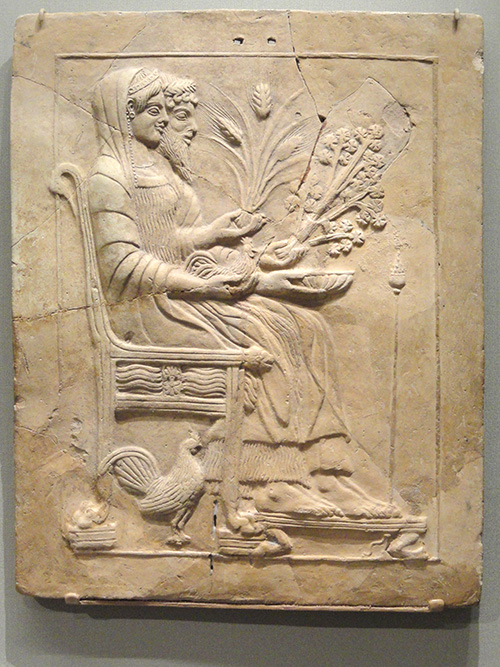
Pinax with Persephone and Hades Enthroned, 500–450 BCE, Greek, Locri Epizephirii, Mannella district, Sanctuary of Persephone, terracotta, Cleveland Museum of Art
Many titles gathered around him are in large part euphemisms, cult-names, and honorifics by which the Greeks named the unnameable. They range from the gracious Plouton and Eubouleus of the mysteries to the grim Ameilichos and Adamastos of the poets. Aeschlyus even called him nekrodegmōn, the receiver of the dead; several began as independent chthonic powers drawn into his figure.3,7,15,22
| Epithet | Meaning | Domain |
|---|---|---|
| Plouton (Πλούτων) | The Wealthy One | Wealth of the earth, agrarian abundance |
| Aïdoneus (Ἀϊδωνεύς) | The Unseen One | The veiled name of the god of the dead |
| Anax Enerôn (Ἄναξ Ἐνέρων) | Lord of the Dead | Sovereignty over the departed |
| Zeus Chthonios (Ζεὺς Χθόνιος) | The Subterranean Zeus | Chthonic kingship, agrarian and funerary cult |
| Zeus Katachthonios (Ζεὺς Καταχθόνιος) | The Zeus Beneath the Earth | Rule over the world below |
| Klymenos (Κλύμενος) | The Renowned | Euphemistic cult name (Hermione) |
| Eubouleus (Εὐβουλεύς) | Of Good Counsel | Eleusinian and Orphic mysteries |
| Eukles (Εὐκλῆς) | Of Good Fame | Orphic cult title of the gold tablets |
| Polydegmon (Πολυδέγμων) | Host of Many | Receiver of all the dead |
| Polydektes (Πολυδέκτης) | Receiver of Many | Welcomer of the departed |
| Pylartes (Πυλάρτης) | The Gate-Fastener | Warden of the gates of Hades |
| Nekrodegmon (Νεκροδέγμων) | Receiver of the Dead | Gatherer of the slain |
| Agesilaos (Ἀγεσίλαος) | Leader of the Peoples | He who leads all mortals below |
| Ameilichos (Ἀμείλιχος) | The Implacable | Unappeasable by prayer or offering |
| Adamastos (Ἀδάμαστος) | The Unyielding | Not to be tamed or turned aside |
Sources: Plato, Cratylus; Orphic Hymns; Farnell, The Cults of the Greek States (1907); Homer, Iliad; Homeric Hymn to Demeter; Pausanias, Description of Greece; Callimachus, Fragments; Graf and Johnston, Ritual Texts for the Afterlife (2007); Aeschylus, Prometheus Bound; Liddell, Scott, and Jones, A Greek–English Lexicon (1940).3,4,7,15,18,20,21,22,23,24
IV. The Temples and Sacred Sites of Hades
Hades had several holy sites, generally called Ploutonia. The euphemism perhaps reflects the taboo about his name, or marks an aspect of the god beyond the merely chthonic.15,23,25
The majority of these sites were shared. Most of the cult places of Persephone, usually under the name of Kore, were dedicated jointly to Demeter as distinctively shared complexes; other sites belonged to Hades and his bride, whose character there pointed toward her mature form. In Triphylia all three were worshipped at one place. There were, however, some sanctuaries dedicated to Persephone alone, where she held a role of the first importance.4,15,23
Eleusis
Naturally the great mystery-site of Demeter and Persephone held an area sacred to the great god of the abyss. Modern Greek archaeology located two caves at the north-eastern foot of the acropolis hill; before the larger of them stood a small temple of Plouton, a mere five by six metres, dating to about the fourth century BCE. Votive reliefs showing Plouton and Persephone mark it as at least a shared precinct.26,27,28,29
Within the Telesterion further points of access existed. At its heart stood the structure conventionally identified as the Anaktoron, the "royal chamber." On the usual reconstruction the Anaktoron was a smaller building set within the great hall, the repository of the most sacred Eleusinian objects, likely made so that they could be shown at the height of the rite.14,26,27
Acharaca
Between Tralleis and Nysa, in the town of Acharaca, Strabo describes a Plutonium with a costly sacred precinct and a shrine of Plouton and Kore beside a cave called the Charonium. He further records elaborate incubation and healing rites, a body of priests, and an annual festival at which a bull was led into the cave.25
Hierapolis
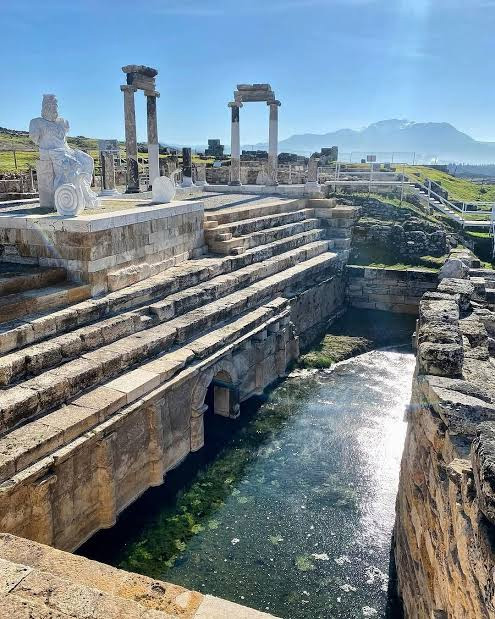
The Gate of Pluto at Hierapolis, the Ploutonion
Hierapolis in Phrygia was another site with a Ploutonion. A deep opening enclosed by a quadrilateral rail was filled with deadly vapours, so that any animal entering the enclosure died; only the eunuch priests of the goddess could stand it. The Attalid kings of Pergamon established the thermal spa there at the end of the second century BCE.25,30,31
According to a late account, torchbearers descended into an underground sacred chamber and brought up a naked wooden image seated on a litter; the image bore five gold-inlaid marks, one on the forehead, one on each hand, and one on each knee. It was carried seven times around the innermost sanctuary to the sound of flutes, tambourines, and hymns, and after the celebration was returned to its underground chamber.25,30
Elis
The most famous and most reserved temple of Hades was in Elis. Pausanias says the sanctuary was opened only once a year, and that even then none but the priest might enter. The date of its founding is wholly unknown. The Eleans, he adds, were the only Greeks he knew to worship Hades, and they did so because the god had fought on the side of the Pylians against Heracles.4,15,23,32
The tie of Hades to the Eleusinian sphere is confirmed elsewhere in the Peloponnese. Pausanias records wooden images of Kore, Plouton, and Demeter on the road from Mycenae to Argos, altars to the gods who rule below in the temple of Artemis at Troizen, and a temple of Klymenos, the "renowned" euphemism of Hades, at Hermione.23,24
V. Wealth
One of the strangest aspects of the dread god’s mythology is his association with the child-god of wealth, Ploutos, the son of Demeter. The mysteries at Eleusis brought the two nominally separate gods together, and the Ploutonion was regarded as the birthplace of Ploutos, so that their association is at least indirect.15,18,33
Otherwise Hades is the reigning deity of the metals beneath the earth. Everything hidden and precious lies within his remit, an association that later thought carried into the astrological houses that are multiples of four. His very name Plouton, "the wealthy," was explained by Cornutus from the fact that all things are at last consigned to him as his own.33,34
A piece of evidence for the association of Hades with wealth comes in the address to Zeus Chthonios and Demeter in Hesiod’s Works and Days, where the farmer prays to the Zeus of the earth and to holy Demeter for a heavy harvest. The most extreme form of the god’s wealth, however, is the forcible seizure of Cerberus by Heracles, which begins the chain of events leading to the hero’s apotheosis.35,36
VI. Intrusions to the Abyss
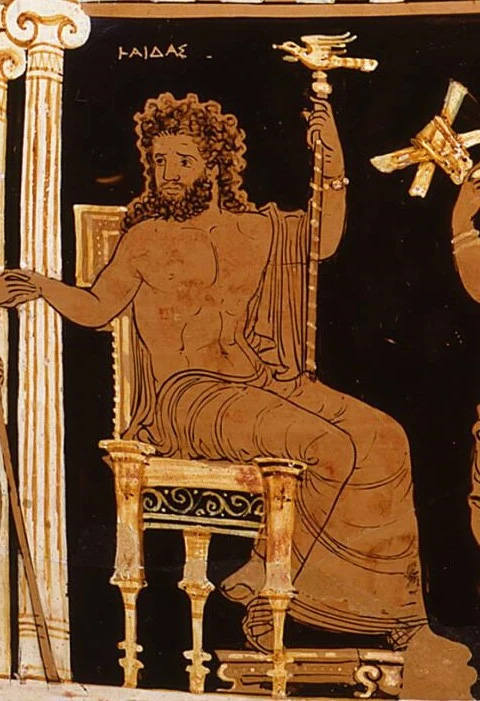
Apulian red-figure volute krater depicting Hades with Dionysus in the Underworld, c. 350–325 BCE, attributed to the Darius Painter, Toledo (Ohio) Museum of Art
The great compilation of Apollodorus, the Library, shows how Hades dealt with certain intrusions into the depths. At the approach of Heracles the shades scatter, all but the brave Meleager and the terrifying Medusa. Menoetes, the herdsman of Hades, challenges the hero to a wrestling-match and is released only at the entreaty of Persephone. When Heracles asks the king of the underworld whether he may take Cerberus, Hades consents on the condition that he master the dread hound without weapons.12,36
The hero then makes his way through the underworld and, after such preliminaries as the rescue of Theseus, faces Cerberus. He secures the creature by main strength and the protection of the Nemean lion’s skin, and after presenting the beast to Eurystheus he returns it to Hades.36
The story of Orpheus and Eurydice is less fortunate. In the Roman poems, the Georgics of Virgil and the Metamorphoses of Ovid, Hades is deeply moved and won over by the music of Orpheus. Ovid describes the whole underworld pausing in sympathy, Hades and Persephone moved to tears and granting the release of Eurydice, while Virgil dwells on the power of the music to soften the ruthless, unyielding realm and its king.37,38
In the Greek versions, such as that of Apollodorus, Hades grants the release of Eurydice on one strict condition: Orpheus must walk before her and not look back until he has left the vales of the underworld. If he turns his eyes toward her before reaching the world above, the gift of her life is wholly undone.12,36
VII. The Function of Hades as a Realm
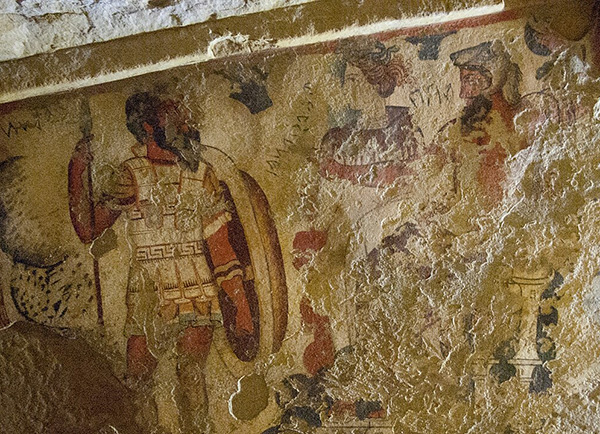
Etrsucan fresco of Hades and Persephone, Tomb of Orcus II, Montarozzi, Tarquinia, 4th century BCE
In the earliest Greek conceptions, Hades was both the ruler of the underworld and the place itself (the underworld), thus the same term applied to both king and domain. The realm is conceived of as a large household with gates situated in the gloomy darkness beneath the earth, surrounded by rivers (Styx, Acheron, Cocytus, Pyriphlegethon) across which the just deceased are transported. The underworld is not primarily a location of either reward or punishment in Homer, but rather the shared fate of all the deceased; there, their spirits live a faintly bloodless half-existence, recalling their past existence in the upper world.14,16,39,40
This image of the underworld gradually grows darker and more defined with time. The Odyssey already describes the Asphodel Meadows where ordinary deceased individuals roam, the Elysian Fields designated for the favored, and the punishment of certain notorious transgressors such as Tityos, Tantalos and Sisyphos, while the Nekyia part of the book under Persephone's watch has Odysseus cross many shades and ghosts of Hades that he knew. In the Classical Period, the underworld had developed its judges (Minos, Rhadamanthus, Aeacus) and its place of suffering (Tartarus) and its blissful dwelling-place for those who have been initiated; henceforth the neutral dwelling-place of the dead became an area of wandering, something already present in the Odyssey.16,40,41,42
Throughout this, Hades’ authority over his realm was absolute and unconditional. He is the only deity whose temples do not exist to enter freely and whose prayers of supplication are not heard in regular fashion because nothing may be regained from his possession. His epithets Ameilichos (“The Unyielding”) and Adamastos (“Unstoppable”) precisely describe this condition. His realm is his allotment of the tripartite universe as firmly established as Zeus’s control over the sky and Poseidon’s over the seas. And just as his realm has gates secured with gate-fasteners and opens inwardly alone, similarly the power of Hades is never able to be escaped.4,14,15
VIII. Hades in Funerary Culture
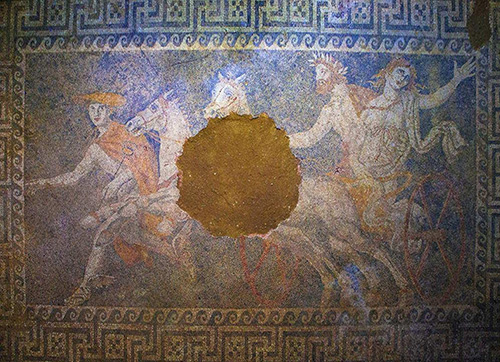
The Abduction of Persephone, Amphipolis, Greece
Hades appears less frequently in practices associated with death among the living as a subject to be represented than as the force to which the dead belong. Greek funereal practice essentially involves ensuring safe passage for the dead into Hades’s care, typically falling under the powers of Hermes with a view to pleasing Hades: cleansing and clothing the corpse, providing coins for Charon to transport them across the river Styx; making offerings at burial sites, and addressing the dead as being now part of the world below.14,40,43
Wherever possible, the most direct evidence available of how Hades entered into records concerning death is actually found in the binding spell as for centuries after 500BCE, throughout Greece, people created thin sheets of lead inscribed with binding spells and folded up to be placed into tombs or other chthonic cult places, committing enemies to the powers below. Such binding spells routinely called upon Hades, Persephone, Hermes Chthonios, and “the nameless dead,” entreating Hades to bind whatever person or ability was given to him. In these binding spells, the euphemistic names of the gods disappeared while Hades was referred to directly as the binder and owner of what he received.21,44,45,46
The Orphic Gold Tablets belonged to the same world of death as did the curses but turned its fears upside-down. They consisted of gold sheet that had been hammered into shape and folded over into small units to accompany corpses to their graves, lines of hexameter poetry intended for use by the spirit when leaving life behind and instructions for navigating the underworld such as the guidance for traversing rivers, passwords for wardens controlling access to various parts of the underworld, claims of kinship with deities and much more. In these tablets the Queen of Death (Persephone) and alongside her Hades (under his courtesy name Eukles), welcome initiates not as captives but as their returning kin. The ultimate destination described is a clean pastureland and sacred woods rather than a judgment chamber.20,21
IX. The Dread One in Neoplatonist Philosophy: The Threefold Division
In taking the tripartite view of Hades in the Iliad and the etymology of the word Hades in Plato's Cratylus seriously, the Neoplatonists developed a philosophically-based version of Hades. Specifically, Proclus was able to develop a three-tiered demiurgic system of creation by viewing the three sons of Cronus (Zeus, Poseidon, and Hades) not simply as divisions of heaven, earth, and Hades but as three aspects or levels of one process of creation that ordered the entire universe from its highest reaches to its lowest and most fragmented.8,33,47,48
In this scheme Hades-Plouton is the third and lowest of the demiurgic powers, the sublunar craftsman who governs the region below and presides over the final separation of soul from body. His work is a perfecting through separation rather than a mere destruction: he draws the soul out of the flux of generation and turns it back toward its divine cause, so that the god who seems only to take is in truth the one who completes the circuit of the soul’s descent and return.8,48
This is how the philosophers were able to take the feared name and turn it into a name of knowledge. In Proclus, the Hades of Plato's Cratylus, who has bound the souls of men to him through their desire for noble things they do not know, will become the intelligible term towards which the purified souls aspire. His realm, the "unseen", represents the intelligible that lies beyond what can be perceived by the senses; his union with Persephone represents the joining together of the force that divides with the force that brings forth new life into the lower worlds.7,8,48
X. Hades’ Festivals
The rites gathered below were mostly shared with his queen, and the few that name him directly, like the Lernaeam, stand at the edge of the calendar, at the mystery-sites and the gates to his realm.14,15,49,50,51
| Hades Ritual Days | Place | Description | Importance | Date Recorded |
|---|---|---|---|---|
| Annual Opening | Elis | The sanctuary of Hades opened | Opened once a year; only the priest may enter | Pausanias (2nd century CE) |
| Lernaea | Lerna (Argolis) | Nocturnal chthonic rite | Sacrifice cast into the chasm to Hades Pylaochos | Plutarch (1st–2nd century CE) |
| Greater Mysteries | Eleusis | Rites of Demeter, Kore, and Plouton | Plouton honoured in the shared sanctuary | Homeric Hymn (7th century BCE) |
| Festival at Acharaca | Acharaca (Caria) | Rite at the Plutonium and Charonium | A bull led into the cave; incubation and healing | Strabo (1st century BCE–1st CE) |
| Nemesia / Nekysia | Athens and elsewhere | Days of the dead | Offerings to the departed under the powers below | Attic usage (Classical period) |
Sources: Pausanias, Description of Greece, for the annual opening at Elis; Plutarch, On Isis and Osiris, for the Lernaea; the Homeric Hymn to Demeter, for the Mysteries; Strabo, Geography, for Acharaca; Farnell, The Cults of the Greek States (1907), for the days of the dead.15,18,23,25,50
XI. The Priesthood of Hades
In Greece, the dedication of a priesthood to Hades was unusual. The worship of Hades' rites were typically performed by the priest of Demeter and Kore and most notably by the Eleusinian clergy, hierophant and priestess. The hierophant would reveal the sacred objects, while the priestess would perform the duties for both goddesses. It appears that the sanctuary was honored to Plouton rather than having his own individual college of priests.15,26,27
The only exception is Elis. According to Pausanias, Hades was unique among the Greeks in that he had a temple and a single priest. Once a year, the priest would open the temple and enter alone. There were also a number of priests that attended the god at the Plutonia of Asia Minor. For example, Strabo described the priests at the Charonium of Acharaca who practiced incubation and healing, and the Galli who alone could withstand the lethal fumes of the ploutonion at Hieropolis.23,25,52
XII. The Symbolism of Hades
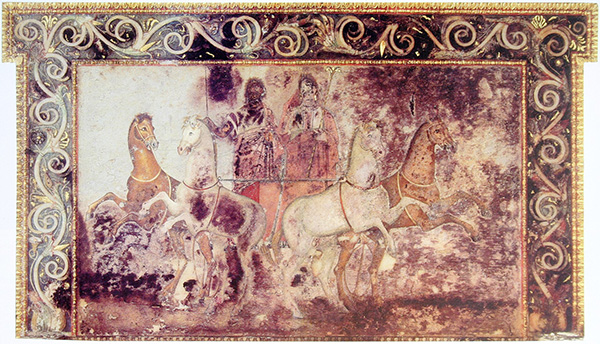
Hades is depicted in art as a mature, bearded king. He is depicted sitting still on a throne in the underworld with Persephone next to him. His depiction is identified based upon symbols associated with his kingdom rather than emotional or violent expressions. His stillness and presence of others conveys fear of the god. 15,53
His primary symbol is the bident, a two-pronged staff similar to Zeus's lightning bolt and Poseidon's trident, representing his equal division of the tripartite rulership. Alongside the bident are found the keys used to lock the gate-fasteners that seal the irreversibly sealed gates of his realm and the cap of invisibility; each represents aspects of Hades as the unseen-one and lend some of their powers to those whom he favors. At his feet rests Cerberus, the dog that protects his kingdom allowing for entry of the dead but preventing them from leaving.3,12,15,53
The milder symbolism related to Plouton is that of the wealthy ruler of Earth's riches. He carries a cornucopia, a horn filled with grains and fruits produced from under his control over earth's bounty and thus cannot be easily distinguished from Ploutos, the youth-god of Eleusis. Plants considered sacred to Plouton include cypress trees used for mourning, Narcissus flowers responsible for drawing Persephone to her death, mint leaves that transformed Minthe into a plant and black rams. Animals associated with Plouton include serpents associated with earth.15,38,53
Sources and Bibliography
- Beekes, Robert S. P., with the assistance of Lucien van Beek. Etymological Dictionary of Greek. 2 vols. Leiden Indo-European Etymological Dictionary Series 10. Leiden: Brill, 2010. S.v. “Ἅιδης.”
- West, M. L. Indo-European Poetry and Myth. Oxford: Oxford University Press, 2007. For the competing etymologies of the name and the Indo-European background of the chthonic powers.
- Liddell, Henry George, Robert Scott, and Henry Stuart Jones. A Greek–English Lexicon. 9th ed. Oxford: Clarendon Press, 1940. S.vv. “ᾍδης / Ἅιδης” (with Epic Ἀΐδης, Doric Ἀΐδας), ἀγεσίλαος, πυλάρτης, πολυδέγμων.
- Homer. Iliad. Edited and translated by A. T. Murray, revised by William F. Wyatt. 2 vols. Loeb Classical Library 170–171. Cambridge, MA: Harvard University Press, 1999. 5.395–404 (the wounding at Pylos); 8.367 (pylartēs); 9.158 (ameilichos, adamastos); 9.457 (Zeus Katachthonios); 15.187–193 (the threefold division); 20.61–65 (the terror of Aidoneus).
- Smyth, Herbert Weir. Greek Grammar. Revised by Gordon M. Messing. Cambridge, MA: Harvard University Press, 1956. For the contraction of Ἀΐδης to ᾍδης and the dialect forms of the name.
- Plato. Phaedo. Translated by Harold North Fowler. Loeb Classical Library 36. Cambridge, MA: Harvard University Press, 1914. For the “unseen” reading applied to the realm itself.
- Plato. Cratylus. 403a–404b (Ploutōn as a euphemism for the dreaded name of Hades; Hades from eidenai, “to know”). Translated by Harold North Fowler. Loeb Classical Library 167. Cambridge, MA: Harvard University Press, 1926.
- Proclus. On Plato’s Cratylus. Translated by Brian Duvick. London: Duckworth, 2007. For the resolution of the “unseen” and “knowing” etymologies as the intelligibly hidden, and the demiurgic reading of the god.
- Palaima, Thomas G. “Appendix One: Linear B Sources.” In Anthology of Classical Myth: Primary Sources in Translation, edited and translated by Stephen M. Trzaskoma, R. Scott Smith, and Stephen Brunet, 441–454. Indianapolis: Hackett, 2004. Hades is not among the theonyms attested in the Linear B tablets.
- Robertson, Martin. “A Fragmentary Phiale by Douris in the J. Paul Getty Museum.” In Greek Vases in the J. Paul Getty Museum, vol. 5, edited by Marion True, 75–98. Malibu, CA: J. Paul Getty Museum, 1991 (esp. 90, 92); with Albert Henrichs and Ellie Mackin Roberts, “Hades,” Oxford Classical Dictionary, updated May 24, 2023.
- Smith, William, ed. A Dictionary of Greek and Roman Biography and Mythology. 3 vols. London: John Murray, 1849. S.vv. “Hades” and “Pluto,” for the names and the ancient testimonia.
- Gantz, Timothy. Early Greek Myth: A Guide to Literary and Artistic Sources. 2 vols. Baltimore: Johns Hopkins University Press, 1993. For Hades in the cosmic division, the wounding at Pylos, the seizure of Cerberus, and the Orpheus tradition.
- Kirk, G. S., ed. The Iliad: A Commentary. 6 vols. Cambridge: Cambridge University Press, 1985–1993. On Iliad 15.187–193, for the threefold division of the cosmos among the sons of Kronos.
- Burkert, Walter. Greek Religion: Archaic and Classical. Translated by John Raffan. Oxford: Blackwell, 1985. For Hades and the chthonic powers, the underworld as realm, and the character of chthonic sacrifice.
- Farnell, Lewis Richard. The Cults of the Greek States. Vol. 3, chap. 5, “The Cults of Hades-Plouton.” Oxford: Clarendon Press, 1907.
- Homer. Odyssey. Translated by A. T. Murray, revised by George E. Dimock. 2 vols. Loeb Classical Library 104–105. Cambridge, MA: Harvard University Press, 1919/1995. Book 11 (the Nekyia, directed by Persephone; the fields of Asphodel and the great sinners); 14.156–158 (the gates of Hades and the hateful liar).
- Sourvinou-Inwood, Christiane. “Reading” Greek Death: To the End of the Classical Period. Oxford: Clarendon Press, 1995. For the development of the Greek picture of the underworld and the role of Persephone in the Nekyia.
- Homeric Hymn to Demeter. Lines 2, 9, 17, 79–87, 404 (Aïdoneus; “ruler of many”; Polydektēs; the abduction and the honourable match). In Homeric Hymns, Homeric Apocrypha, Lives of Homer, edited and translated by Martin L. West. Loeb Classical Library 496. Cambridge, MA: Harvard University Press, 2003.
- Hesiod. Theogony. In Theogony, Works and Days, Testimonia, edited and translated by Glenn W. Most. Loeb Classical Library 57. Cambridge, MA: Harvard University Press, 2006. Lines 453–506 (the children of Kronos), 767–774 (the halls of Hades), 850–852 (the shaking in the Titanomachy).
- The Orphic Hymns. Hymn 18, “To Plouton” (Ploutōn; Zeus Chthonios; Eubouleus; Pylartēs). Translated by Apostolos N. Athanassakis and Benjamin M. Wolkow. Baltimore: Johns Hopkins University Press, 2013.
- Graf, Fritz, and Sarah Iles Johnston. Ritual Texts for the Afterlife: Orpheus and the Bacchic Gold Tablets. London: Routledge, 2007. For Eukles identified with Hades and with the euphemistic Klymenos (p. 123), and the Orphic afterlife.
- Aeschylus. Prometheus Bound 152–153 (Hades as nekrodegmōn, “receiver of the dead”). Edited and translated by Alan H. Sommerstein. Loeb Classical Library 145. Cambridge, MA: Harvard University Press, 2008.
- Pausanias. Description of Greece. 2.35.9–10 (Klymenos at Hermione); 5.20.3 (Ploutōn with the key at Olympia); 6.25.2–3 (the annual sanctuary of Hades in Elis). Translated by W. H. S. Jones. Loeb Classical Library 188, 272, 297–298. Cambridge, MA: Harvard University Press, 1918–1935.
- Callimachus. Fr. 285 Pfeiffer (Persephone as consort of Klymenos, “host of many”). In Callimachus, vol. 1, Fragmenta, edited by Rudolf Pfeiffer. Oxford: Clarendon Press, 1949.
- Strabo. Geography. Translated by Horace Leonard Jones. Loeb Classical Library. Cambridge, MA: Harvard University Press, 1917–1932. 14.1.44 (the Plutonium and Charonium at Acharaca, with its incubation, healing, and the bull led into the cave); 13.4.14 (the deadly Ploutonion at Hierapolis).
- Mylonas, George E. Eleusis and the Eleusinian Mysteries. Princeton, NJ: Princeton University Press, 1961. For the Ploutonion and the two caves at the foot of the acropolis, the Telesterion, and the Anaktoron.
- Clinton, Kevin. Myth and Cult: The Iconography of the Eleusinian Mysteries. Stockholm: Svenska Institutet i Athen, 1992. For Plouton and the Eleusinian priesthood, and the sacred structures of the sanctuary.
- Bowden, Hugh. Mystery Cults of the Ancient World. Princeton, NJ: Princeton University Press, 2010. For the Ploutonion at Eleusis and the place of Plouton in the mysteries.
- Ephorate of Antiquities of West Attica. “Ploutonion.” Archaeological site documentation, Eleusis. For the small fourth-century-BCE temple of Plouton before the cave and its votive reliefs.
- Damascius. The Philosophical History (Life of Isidore). Edited and translated by Polymnia Athanassiadi. Athens: Apamea Cultural Association, 1999. Fr. 131 (the dream-incubation and the procession of the image at the Ploutonion of Hierapolis).
- Kaye, Noah. The Attalids of Pergamon and Anatolia: Money, Culture, and State Power. Cambridge: Cambridge University Press, 2022. For the Attalid foundation of the thermal spa at Hierapolis in the later second century BCE.
- Jost, Madeleine. Sanctuaires et cultes d’Arcadie. Paris: Vrin, 1985. For the Arcadian and Peloponnesian cults of the chthonic gods, including Kore Soteira and the underworld powers.
- Fontenrose, Joseph, and the entry “Pluto” in The Oxford Classical Dictionary. See also Farnell, Cults, vol. 3, for the merging of Plouton with the Eleusinian Ploutos, the god of wealth from below, and the acquisition of a priesthood.
- Cornutus, Lucius Annaeus. Greek Theology (Compendium of the Traditions of Greek Theology). Translated by George Boys-Stones. Atlanta: SBL Press, 2018. Ch. 5, on Ploutōn from ploutein, “to be wealthy,” all things being at last consigned to him.
- Hesiod. Works and Days. In Theogony, Works and Days, Testimonia, edited and translated by Glenn W. Most. Loeb Classical Library 57. Cambridge, MA: Harvard University Press, 2006. Lines 465–469 (prayer to Zeus Chthonios and Demeter for a heavy harvest).
- Apollodorus. The Library. Translated by James G. Frazer. 2 vols. Loeb Classical Library 121–122. Cambridge, MA: Harvard University Press, 1921. 2.5.12 (the descent for Cerberus, Menoetes, and the terms set by Hades); 1.3.2 (Orpheus and Eurydice).
- Virgil. Georgics 4.453–527 (Orpheus in the underworld). Translated by H. Rushton Fairclough, revised by G. P. Goold. Loeb Classical Library 63. Cambridge, MA: Harvard University Press, 1999.
- Ovid. Metamorphoses 10.1–77 (Orpheus before Hades and Persephone); 5.385–424 (the abduction; Minthe and the mint at 10.728–730). Translated by Frank Justus Miller, revised by G. P. Goold. Loeb Classical Library 42–43. Cambridge, MA: Harvard University Press, 1916/1984.
- Vermeule, Emily. Aspects of Death in Early Greek Art and Poetry. Berkeley: University of California Press, 1979. For the early Greek imagination of the house of the dead and its lord.
- Garland, Robert. The Greek Way of Death. 2nd ed. Ithaca, NY: Cornell University Press, 2001. For the realm of the dead, funerary ritual, and the passage of the dead into the keeping of Hades.
- Plato. Gorgias 523a–527a (the judgement of the dead by Minos, Rhadamanthys, and Aiakos, and the moralized underworld). Translated by W. R. M. Lamb. Loeb Classical Library 166. Cambridge, MA: Harvard University Press, 1925.
- Bremmer, Jan N. The Rise and Fall of the Afterlife. London: Routledge, 2002. For the moralization of the underworld and the emergence of judgement and reward.
- Kurtz, Donna C., and John Boardman. Greek Burial Customs. London: Thames and Hudson, 1971. For the ritual conduct of the dead into the keeping of the underworld powers.
- Wünsch, Richard, ed. Defixionum Tabellae Atticae. Inscriptiones Graecae III.3, Appendix. Berlin: Georg Reimer, 1897. The Attic curse tablets addressed to Hades, Persephone, and the powers below.
- Gager, John G., ed. Curse Tablets and Binding Spells from the Ancient World. Oxford: Oxford University Press, 1992. For the defixiones that consign an enemy to Hades and the chthonic gods.
- Ogden, Daniel. Magic, Witchcraft, and Ghosts in the Greek and Roman Worlds: A Sourcebook. Oxford: Oxford University Press, 2002. For the curse tablets addressed to Hades and the chthonic gods, and the Ploutonia.
- Chlup, Radek. Proclus: An Introduction. Cambridge: Cambridge University Press, 2012. For the demiurgic hierarchy and the place of the chthonic god within Proclus’ metaphysics.
- Brisson, Luc. “Proclus et l’Orphisme.” In Proclus: lecteur et interprète des anciens, edited by Jean Pépin and H. D. Saffrey, 43–104. Paris: CNRS, 1987. For the demiurgic triad of Zeus, Poseidon, and Hades, and Plouton as the sublunar demiurge.
- Parker, Robert. Polytheism and Society at Athens. Oxford: Oxford University Press, 2005. For the Attic days of the dead and the calendar of chthonic observance.
- Plutarch. On Isis and Osiris 364f (the Lernaea; the celebrants call up Dionysus from the water and sacrifice a ram to the Gate-Keeper, Hades Pylaochos). In Moralia, vol. 5, translated by Frank Cole Babbitt. Loeb Classical Library 306. Cambridge, MA: Harvard University Press, 1936.
- Scullion, Scott. “Olympian and Chthonian.” Classical Antiquity 13, no. 1 (1994): 75–119. For the character of chthonic sacrifice, nocturnal rites, and black victims offered to the powers below.
- Clinton, Kevin. The Sacred Officials of the Eleusinian Mysteries. Transactions of the American Philosophical Society 64.3. Philadelphia: American Philosophical Society, 1974. For the Eleusinian priesthood that served Plouton within the sanctuary.
- “Hades / Plouton.” In Lexicon Iconographicum Mythologiae Classicae, vol. 4. Zurich: Artemis, 1988. For the iconography of the enthroned god, the bident, the cornucopia, the key, and Cerberus.