













| Language or Culture | Name | Earliest Secure Attestation |
|---|---|---|
| Etruscan | 𐌚𐌖𐌚𐌋𐌖𐌍𐌔 (Fufluns) / 𐌐𐌖𐌘𐌋𐌖𐌍𐌔 (Puphluns) | Coins of Populonia (fifth century BCE) |
| Etruscan | 𐌐𐌀𐌢𐌀 (Pacha) | Coins of Populonia (mid-fifth century BCE) |
9 min read
FUFLUNS
author: High Priest Zevios Metathronos
co-author: Novice Priest Karnonnos
Hieratic Information about Fufluns
| Divine Symbols | |
|---|---|
|
I. The Name
Fufluns was the Etruscan god of the vine. He is the rare example of an Etruscan god whose name was given to a city by the Etruscans instead of just being borrowed from the Greeks. His name has appeared in two forms, Fufluns (the earlier spelling) and, in the older form prior to the adoption of the "f" sound, as Puphluns. It has also been suggested to be derived from a possible Etruscan term for growing or developing, which would have made Fufluns the god of the ripening grapevine rather than just the god of wine, and therefore fitting for the city bearing his name. 1,2
His second name Pacha or Pachies is Greek as in several inscriptions he appears as Fufluns Pacha or Fufluns Pachies, and in each case his Greek title Bacchus can be seen, The single word Pacha is one alone as an epithet, and the compound Fufluns Pachies clearly links Fufluns specifically to the Dionysian mysteries and to those aspects of them related to death. The double naming illustrates both sides of Fufluns' character.1,3
On some of the mirrors, he is said to be the child of two other gods: Tinia, the Etruscan sky-god and Semla, the Etruscan version of Semele. His mother's name is herself a translation of the Greek Semele into Etruscan, so that even Fufluns' family background includes the story of Dionysus. The first certain references to Fufluns' name date back to the fifth century BCE, where they appear on coins from his city and in inscriptions referring to wine cults.1,4
Sources: de Grummond, Etruscan Myth, Sacred History, and Legend (2006); Bonfante and Bonfante, The Etruscan Language: An Introduction (2006); Bonfante, Fufluns Pacha: The Etruscan Dionysus (1993); de Grummond, Semla (2006)1,2,3,4
II. The Youth on the Mirror
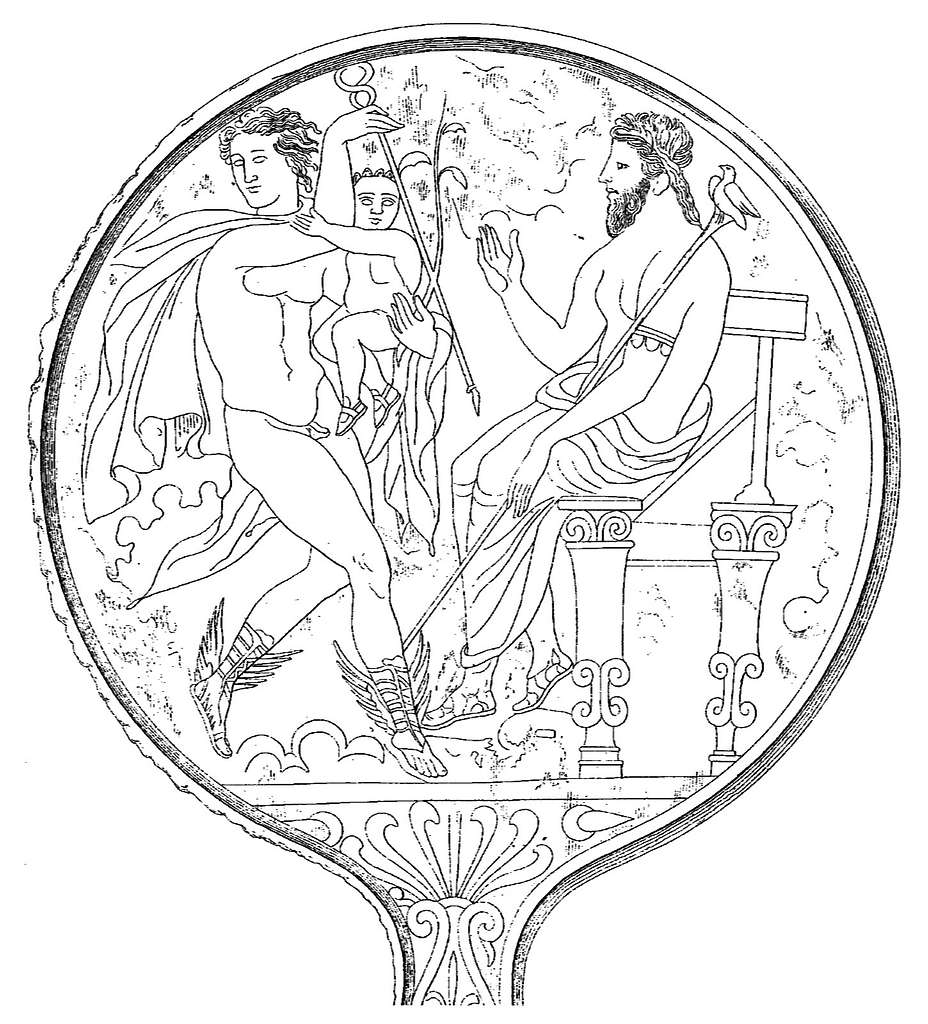
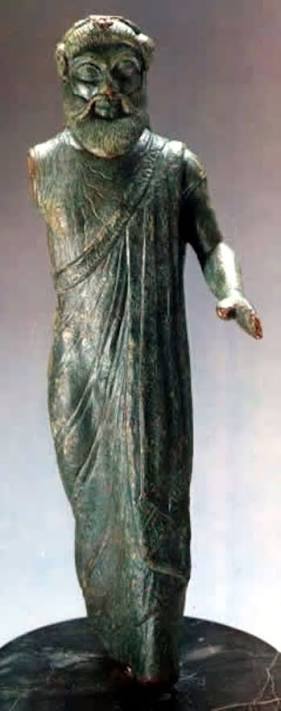
Fufluns' appearance, similar to that of other Etruscan deities, has been primarily defined through the many images of him as a young, beardless youth found in the etched bronze mirrors. On those mirrors, Fufluns is often depicted as being in the company of satyrs and the dancing women known as Maenads. While it is rarer for Fufluns to appear in the form of an older bearded man, this representation is not entirely absent, because certain Etruscan statuettes depict him this way with satyr-like characteristics.1,5
The Mother and the Kiss
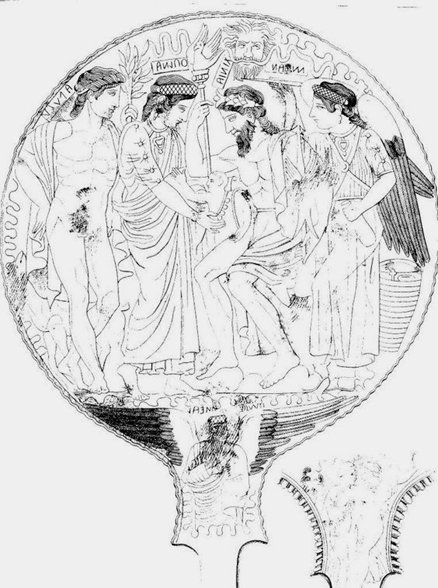
One of the most unique aspects of Fufluns, and also one of the least typical depictions of him relative to what has been recovered in Greek art, is that of Fufluns embracing or kissing his mother. As seen in a fourth-century mirror, Semla is shown in a scene with youthful Fufluns holding a thyrsus while kissing and embracing her. Aplu, his brother, is standing near with a laurel branch and Silenus, a juvenile companion to him, is playing a double-pipe. By comparison, the Greek version of the relationship between Semele and her son Dionysus would portray Semele as being destroyed by her own desire to see Zeus. Scenes of familial intimacy between Dionysus and Semele appear to be rare, with a few exceptions like that of the Kallias painter vase from 560-540 BCE. The fact that both of these moments represent different versions of the same mythology adds to their uniqueness and further defines the differences between Etruscan and what appears to survive of Greek artistic representations.4
In addition to the previously described scenes involving his mother, Fufluns may be seen accompanying Areatha (the Etruscan equivalent of Ariadne), participating in scenes depicting romantic relationships and revelries, and in conjunction with an even larger group which includes his brother Aplu and in certain contexts with the Etruscan goddess Catha. In general, there are no significant barriers to using the various mythological scenes that were derived from the depiction of Dionysus in Greek Art as representative of Fufluns. However, the local influences present in the depiction of the mother's kiss and his companions add additional characteristics to the image of an Etruscan deity who wears a Greek story versus a Greek deity with an Etruscan name..5
III. His Names and Aspects
| Aspect or Title | Sense | Basis in the Evidence |
|---|---|---|
| Fuflunsul Pachies | Dionysus Bakkhos | Tomb title |
Sources: de Grummond, Etruscan Myth, Sacred History, and Legend (2006)1
Most important among these factors however, will be the last and least apparent. Wine in Etruria was an enjoyment, it was a ritual, and therefore, all of the inscriptions naming Fufluns Pachies were discovered in tombs. Giovanni Colonna interpreted them to show the deceased had been named by Bacchus as one of his initiates (a Dionysian initiate), with the idea being that the Dionysian Mysteries would help their souls. Adriano Maggiani viewed the same items much more literally as mementos. Between Colonna's and Maggiani's views is where the inquiry begins regarding how deep the Etruscan Bacchic mystery cult existed, and this issue has yet to be resolved. One possibility is that Fufluns came to occupy a similar role to that of Osiris, or the Hadean symbolism of both Dionysus and Liber. The amount of Etruscan deities involved with tombs, however, makes this a difficult point to assert with any kind of confidence.3
IV. In the Rite, the Liver, and the City
Fufluns is better attested in cult than several of the gods treated elsewhere on this site, and the evidence stands at three points: the diviner's liver, the Bacchic inscriptions, and above all the city that bore his name.
Populonia, the City of His Name
Populonia, the Etruscan city of Fuflun's worship, lay directly on the coast and was the only major Etruscan city with direct access to the sea. It had a significant economy based upon the extraction of iron from the island of Elba and the extraction of metals from the mountains. This made it economically the most powerful city in Etruria. As such, it is also notable as being the first Etruscan city to issue its own coinage. 6,7
Pliny reported that at Populonia there was a statue of Jupiter sculpted from a vine stem (vinea) and this work suggests that the area had a thriving viticulture since a very early time. The god of the grapevine was the patron of such a hardworking industrial port is one of the pleasing contradictions (or not) of Etruscan religion.6,8
The Bacchic Cult
Many of the inscribed vessels that have been found at Velch (the city of Turan) and other locations (including Bacchic cults), describe the god with the local aspect of his worship. One broken vessel (a red clay cup) was interpreted to be a wine vessel dedicated to the use within the Temple of Bacchus in Velch; similar to the numerous examples of Etruscan locatives, which identify a specific site where a deity’s sanctum lies. Similar to whether there existed an organizational form of a mystery cult, or simply random acts of individual devotion, both are questions that can also be asked regarding the burial goods. However, this evidence places the worship of Fufluns, when referred to as Dionysos, clearly in the urban centers of south Etruria as well as at the location named after him in the north.3
Etruscan texts also feature related derivations to his name in worship contexts like paχana (pertaining to Pacha/a Bacchic temple) and paχasnaśie (referring to Bacchantes or maenads).
The Liver of Piacenza
Haruspicy and other forms of divination and magic were what the Etruscans were known for in Antiquity. The 1877 discovery of the bronze liver model of a sheep found near Gossolengo, an instrument for training the haruspices, bears the god’s name on its surface; two times. Fufluns is one of the sixteen gods that control the divisions of the Etruscan firmament and he holds the ninth position. Therefore, his presence in the celestial positions differentiates him from gods such as Turms and Aritimi which are numerous in the art trade but absent from the liver; Fufluns is represented and counted as one of the ruling powers of the divisible cosmos.1
Sources and Bibliography
- de Grummond, Nancy Thomson. Etruscan Myth, Sacred History, and Legend. Philadelphia: University of Pennsylvania Museum of Archaeology and Anthropology, 2006. Cited for Fufluns as the son of Tinia and Semla, his identification with Dionysus and Liber, the epithet Fufluns Pacha and Fufluns Pachies from Bacchus, his depiction as a beardless youth, and his place as the ninth of the sixteen gods on the Liver of Piacenza.
- Bonfante, Giuliano, and Larissa Bonfante. The Etruscan Language: An Introduction. Rev. ed. Manchester: Manchester University Press, 2002. Cited for the older spelling Puphluns before the adoption of the letter f, and for the derivation of the name from a native root associated with sprouting or plant growth, against the older view that the god was named from the city rather than the city from the god.
- Bonfante, Larissa. "Fufluns Pacha: The Etruscan Dionysus." In Masks of Dionysus, edited by Thomas H. Carpenter and Christopher A. Faraone, 221–35. Ithaca, NY: Cornell University Press, 1993. Cited for the inscriptions naming Fufluns Pachies, chiefly at Vulci, their funerary settings, the interpretation by Giovanni Colonna of the dead as Dionysiac initiates and by Adriano Maggiani as owners of souvenirs, and the reading of the damaged wine jug as marked for the temple of Bacchus at Vulci.
- de Grummond, Nancy Thomson. "Semla." In The Religion of the Etruscans, edited by Nancy Thomson de Grummond and Erika Simon, 63–64. Austin: University of Texas Press, 2006. Cited for the fourth-century BCE mirror on which Semla, holding a thyrsus, kisses the young Puphluns as he embraces her, with Aplu holding a laurel branch and a young silenus playing the aulos.
- Simon, Erika. "Gods in Harmony: The Etruscan Pantheon." In The Religion of the Etruscans, edited by Nancy Thomson de Grummond and Erika Simon, 45–65. Austin: University of Texas Press, 2006. Cited for the iconographic type of Fufluns as a beardless long-haired youth and rarely as a bearded man, his association with Areatha, Aplu, and Catha, the satyrs and maenads of his retinue, and the reshaping of his rites under Roman Dionysiac influence and his passage into Roman religion as Liber.
- Rix, Helmut, ed. "Populonia." In The Princeton Encyclopedia of Classical Sites, edited by Richard Stillwell, William L. MacDonald, and Marian Holland McAllister. Princeton: Princeton University Press, 1976. Cited for the Etruscan city Fufluna and Pupluna on the promontory of Monte Massoncello above the bay of Baratti, the theophoric toponym naming the city for the god, the p-spelling before the adoption of f, Pliny's notice of the vine-carved statue, and the city's coins.
- Jannot, Jean-René. Religion in Ancient Etruria. Translated by Jane K. Whitehead. Madison: University of Wisconsin Press, 2005. Cited for the reading of Pupluna and Fufluna as a theophoric toponym formed on the name of the god, in the manner of other Etruscan cities named for divinities.
- Haynes, Sybille. Etruscan Civilization: A Cultural History. Los Angeles: J. Paul Getty Museum, 2000. Cited for Populonia as the only large Etruscan city set directly on the sea, its wealth from the iron of Elba and the ore of the metal-bearing hills, and its place among the first Etruscan cities to strike coinage.