













| Language | Form | Attestation |
|---|---|---|
| Latin | Leiber | C1² 563 (late fourth century BCE) |
| Oscan | Lúvfreís | Genitive of the divine name in Oscan inscriptions |
| Paelignian | Loufir | Cognate of Latin liber |
| Faliscan | Loifirta | Cognate of Latin libertas |
| Proto-Italic | *louðero- | Reconstructed, from PIE *h₁leudʰ-ero- |
28 min read
LIBER
author: High Priest Zevios Metathronos
co-author: Novice Priest Karnonnos
I. The Name of the Free God
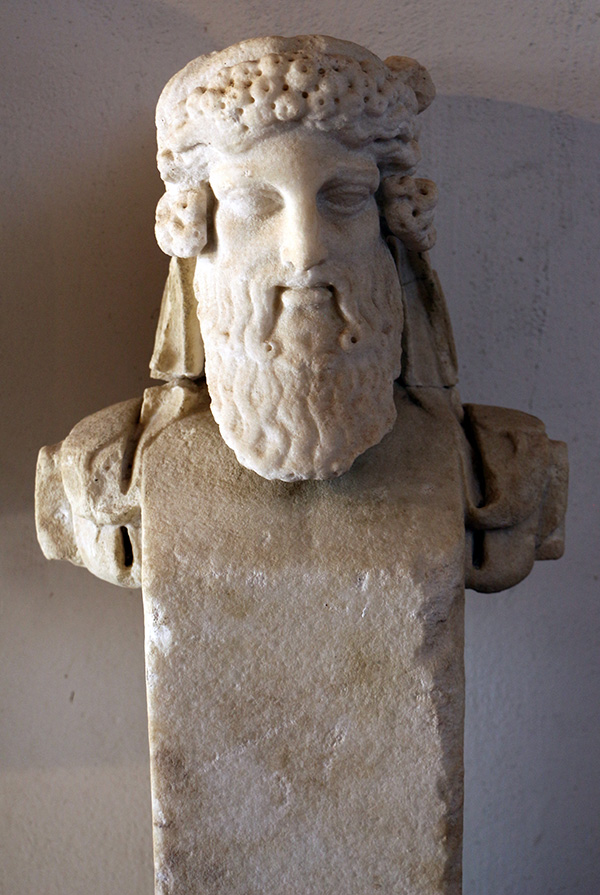
Roman marble herm bust of Dionysus (or Liber) with an Archaic-style beard and corkscrew curls, reused in the temple of Liber Pater in Cosa (1st century CE)
The name of Liber is the Latin adjective for a free man. Michiel de Vaan derives both from Proto-Italic *louðero- and from Proto-Indo-European *h₁leudʰ-ero-, “belonging to the people,” the same root that produced Greek ἐλεύθερος (eleutheros, “free”). The god and the political condition continued to have a synonymous notion for Roman writers.1
The Italic dialects preserve the god's name themselves: Faliscan had loifirta for libertas, Paelignian had loufir, and Oscan inscriptions supply the genitive lúvfreís for the divine name. The evidence is thin in quantity and unambiguous in direction.1
Roman etymologists offered other ideas. Ovid explains the toga libera of a boy's coming of age by the god's own name, and Seneca states that Liber is so called because he frees the mind from the servitude of its cares. Ancient etymology here is theology conducted by other means.2,3
The first known use of the name "Liber" in Latin that scholars agree with today does not have the spelling LIBER, it has the spelling LEIBER. This spelling appears on a bronze cista that was inscribed at Praeneste (modern-day Palestrina) which is typically dated to the final years of the 4th or the first years of the 3rd centuries before Christ; sometimes more specific than this to be the latter part of the 4th century B.C. It is listed in the Corpus Inscriptionum Latinarum as #1² 563 = #14 4105 = #11-19 1198.4,5
Varro, quoted at length and with hostility by Augustine, assigned to Liber the liquid seed of males and to Libera the corresponding power in females, which is why the phallus was carried in his rites.6,7
Cicero states the crucial distinction with complete clarity by separating the Liber born of Semele, meaning the Greek Dionysus, from the Liber whom Roman ancestors consecrated in solemn state ritual together with Ceres and Libera, and he insists that the two are distinctive gods.8
The distinction was scarcely to survive Roman literary practice. Alfred Bruhl traced the long fusion by which the Italic Liber acquired the mythology of Dionysus, and Fiachra Mac Góráin and his contributors have shown that the fusion was never total, since the Latin poets keep switching registers between an agrarian Italian god and an imported Greek one. Liber Pater is one name covering two histories.9,10
Sources: de Vaan, Etymological Dictionary of Latin and the Other Italic Languages (2008); Lommatzsch, Corpus Inscriptionum Latinarum (1918)1,4
II. Liber in Roman History
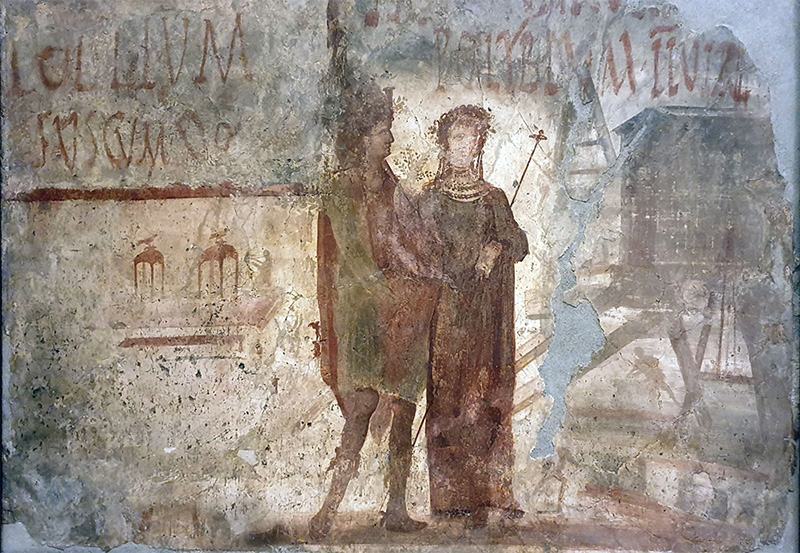
Liber and Libera
The Vow of the Famine
The Romans invited Liber to join the State religion during a period of famine and civil war (the Latin Wars) when they were fighting with the Latins (from 494-493 BCE). Dionysius of Halicarnassus tells us that the dictator Aulus Postumius Albus asked the Sibylline Books what should be done about the war and famine. He also promised to build a temple to Ceres, Liber and Libera. Three years after the battle, a temple was built to honor these gods by the consul Spurius Cassius.11
In contrast to Dionysius, Cicero insisted that the worship of Liber, Libera and Ceres was uniquely Roman because Liber was a Roman god, and dissimilar to that of the son of Semele's rites.
Some scholars have argued that Cicero's distinction between the god of wine and the other two members of the Triad is arbitrary. However, some scholars argue that the Triad was already depicted in art in a Greek style. Pliny noted that the terracotta decorations of the temple were created by two Greek artists, Damophilos and Gorgasos, who both signed their works. They survived in part until the renovations of the temple removed them.12,13
The Temple as an Instrument of the Plebs
By a generation or less, the temple had developed into an organ of governance. According to Livy, the Senate placed its decrees into the hands of the plebeian aediles at the temple of Ceres, therefore making it possible for the officials of the plebs to hold possession of the record of the decisions of the Council of Patricians. Historians view this as one of the strongest examples of how early on the plebs were able to establish themselves institutionally. Subsequently, his worship in Rome could weave in and out of controversy, such as in the suppression of 186 BCE.14,15,16,17
Empire
The Aventine temple burned in 31 BCE, was restored by Augustus and was dedicated at last by Tiberius in 17 CE, an event Tacitus records among the acts of the year. Under the Principate the god travelled outward rather than upward, and Africa made him her own. Mary Beard, John North and Simon Price note that the provinces frequently kept archaic Roman cults with a fidelity the capital had abandoned.18,19
III. Epithets
Liber Pater is another common name used by Romans to refer to Liber. Georg Wissowa noted that 'pater', in phrases like this means first-rank divine authority rather than mere fatherhood, just like Diespiter and Marspiter do. Therefore, it indicates a very important deity integrated with Zeus, in line with ancient Italian tradition. It is an indication of status.20
In the state cult of the Aventine, he needed no epithet at all. There, he is simply Liber; cult language is economical.6,11
Latin verse imported Greek titles that never reached a Roman altar. Virgil addresses him as Lenaeus, of the winepress, and Horace as Lyaeus, the loosener, Euhius, Bromius and Bacchus, each name a translation of a Greek cult title into Latin metre. Naturally the reader must distinguish an epithet in an ode from an epithet on a dedication.21,22
James Rives has described how much importance Liber Pater enjoyed as a Roman god in Roman Carthage. Anthony Birley has also illustrated how Liber Pater along with Hercules were Di Patrii of the city of Lepcis Magna (the Patron deity of the city); and thus as provincial gods became the dynastic patron of Septimius Severus whose lineage hailed from there, and became part of the imperial Roman Triumph. Robert Turcan describes this elevation within an overall imperial pattern by which local gods are elevated with their emperors Locally.23,24,25
| Epithet | Sense | Status |
|---|---|---|
| Liber Pater | Liber the Father, the lord | Standard cult title, Italy and the provinces |
| Liber (absolute) | The Free One | State formula of the Aventine triad |
| Liber Pater, di patrii of Lepcis | Ancestral god of the city | Severan dynastic cult |
| Liber Pater Augustus | Liber associated with the emperor | Provincial epigraphy, Africa above all |
| Bacchus | Latinised Βάκχος | Literary and, later, cultic |
| Lyaeus | The loosener of cares | Poetic import from Greek |
| Lenaeus | Of the winepress | Poetic import from Greek |
| Euhius / Bromius | Of the cry euhoe; the roarer | Poetic import from Greek |
IV. Temples
![Votive pillars to Liber. The one on the left reads Libero Patri Valerius Daphinus a[nimo] l[ibens] p[osuit]: "Valerius Daphinus erects [this monument] to Liber Pater of his free will."](/media/assets/img/Gods/liber-2.jpg)
Votive pillars to Liber. The one on the left reads Libero Patri Valerius Daphinus a[nimo] l[ibens] p[osuit]: "Valerius Daphinus erects [this monument] to Liber Pater of his free will."
The Aventine Temple of Ceres, Liber and Libera
Although there were other buildings of some importance in the neighborhood of the Circus Maximus, only one of these buildings stood at the base of the Aventine hill and the rest were situated above. The temple at the bottom of the Aventine Hill was consecrated in 496 BCE and completed in 493 BCE. It served as Vitruvius’ model for an araeostyle temple. This is the earliest known temple in Rome and the first temple dedicated to the gods by the plebs. The original temple consisted entirely of wood and terracotta. There were no stone lintels because the columns were spaced too far apart. Instead, wooden beams supported the entablatures.11,26
The exact location of the Aventine Temple of Ceres, Liber and Libera has never been identified. Both Lawrence Richardson and Filippo Coarelli believe that it lay somewhere between the Aventine hill and the Circus Maximus valley. The temple was destroyed in a fire during 31 BCE and then rebuilt on a grander scale during the reign of the emperor Augustus. The remains of its foundation are the most significant loss of an ancient Republican-era building in Rome.27,28
The Grove of Stimula
Livy states that the Bacchanalia held in 186 BCE took place in a grove sacred to Stimula located along the banks of the Tiber River near the Aventine Hill. Ovid also identifies the same grove with Semele under a Latin name. Although we know generally where this grove lay, we do not know specifically how large or small it was. Sacred woods were typical locations for night time rituals that would attract unwanted attention from the Roman Senate.2,16,27
Sant'Abbondio at Pompeii
Outside the walls of Pompeii sat the best-preserved Dionysiac sanctuary in all of Italy. The site is a small temple featuring the reclined figure of Dionysus with Ariadne carved into the pediment. An inscription discovered on-site lists an official magistrate of Oscan origin who restored or constructed this temple. As such, this inscription establishes that the cult existed prior to Roman influence in Pompeii. Alfred Bruhl utilized this sanctuary as a reference point in tracing Dionysus’s spread throughout Italy.9
Lepcis Magna and Roman Africa
In the Forum Vetus of Lepcis Magna, a town on the coast of modern-day Libya, stood three temples: those of Liber Pater (the father), the temple of Rome and Augustus, and the temple of Hercules. As Rives demonstrates, this placement of Liber Pater is consistent across other cities in Roman Africa, where he became a popular deity throughout the 2nd-3rd centuries CE. In fact, Liber Pater eventually became the patron deity of Lepcis Magna when Septimius Severus chose it as his hometown.23,24
V. Liber and the Anxiety of the Bacchanal
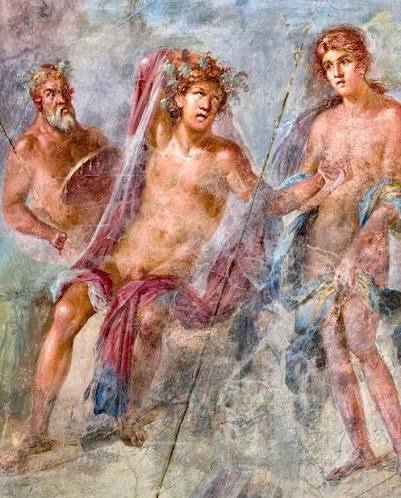
A fresco from Pompeii dating to the 1st century BC depicts the love story of Ariadne and Dionysus (known as Bacchus by the Romans), House of the Golden Bracelet
In 186 BCE, Consul Spurius Postumius Albinus and Consul Quintus Marcius Philippus presented to the Roman Senate evidence of a group operating secretly throughout Italy by night under the name of Bacchus. Livy documents this event through a combination of information provided by a slave woman named Hispala Faecenia regarding her lover Publius Aebutius, warning him against being initiated into the group, and through an excerpt from a speech delivered by the Consul to the population.16
The charges leveled against them include explicit violations of ritual purity and moral behavior; therefore, they can be described as crimes of impiety rather than merely crimes. According to Livy, members of this sect engaged in nightly initiations involving wine and darkness; they corrupted boys and women; they created fake seals and fake wills; they produced false witnesses; they used intoxication as a weapon for assault; they murdered individuals using mechanical devices designed to conceal their victims’ bodies; men swore loyalty to an organization that used Liber’s name as a cloak for perjuring themselves, and so on.16
All of those actions were profane with respect to Liber. The name of Liber refers to freedom; yet, if this group was as alleged, he was invoked by oaths binding members of the group together; he represented honesty as regards vines; but members of the group used his name as a reason for drunkenness that could be used as a means of assault; he represented boys coming-of-age as citizens; but he was used as an excuse for ruining boys. Licence masquerades as Liberty; thus, it was licence that the Roman Senate saw in the grove.2,16
As such, this incident shows what would occur when the meanings of a god were distorted: punishment.29
The Senate stated its position in its own words. The bronze of Tiriolo forbade any Bacchanalia without the approval of the Praetor and the Senate, limited the number of participants to five, prohibited contributions by the members, prohibited any male from being a priest without state oversight, and did not allow an oath or agreement to be entered into among the initiates. The law does not prohibit the worship of Liber but it eliminates all of the elements that would have made the organization a conspiracy.17
At this time scholarly caution is appropriate. Jean-Marie Pailler has framed the incident within broader Roman concerns regarding unregulated associations in Italy during the period following Hannibal, Erich Gruen has argued that the Senator's actions were motivated by a desire to protect senatorial power rather than to suppress religious practices, and Sarolta Takács views the episode as evidence of the Senate's control over matters that are sacred. One hundred fifty years after the events occurred Livy described them using conspiratorial language. However, the bronze tablet is dated contemporaneously and no political interpretation can explain why the tablet was inscribed to forbid what is a corrective of religion.30,31,32
A criminal sodality existed in Rome in 186 BCE which should never be confused with the Greek initiation into Bacchus. Fritz Graf and Sarah Iles Johnston demonstrate from gold tablets that Bacchic mysteries carried a very serious eschatology (a doctrine of the journey of the soul and of its memory) practiced for hundreds of years without scandal. There is a significant distinction between a mystery and a conspiracy - namely whether the name of the god is used to elevate humanity or buttress a criminal act.33
VI. Liber as Rustic God
An Italian farmer's god existed beneath the Greek guise, but the connection of Liber to Rome's archaic origins given the contradictory stories is difficult.
Varro (again via Augustine) describes a monthly ritual for Liber in the rural lands of Lavinium where a phallic object was transported on a wagon through the countryside and into town. At each stop, the most honored woman of the area placed a wreath around the phallic symbol. The intended goal was to protect the planted seeds from disease, and thus all of the equipment described is related to agriculture.6,7
Virgil describes the same religion from within. In describing the rituals of Liber, he provides details of the goat being sacrificed at the altar because it destroys the grapes; he illustrates the small masks of the god suspended from pine trees; he shows us the unrefined lyrics and the rural laughter; and he refers to the entire complex as an Ausonian ritual that had been passed down. Virgil says that the oldest form of Roman worship of the god involves a vineyard with a joke.21
Purcell has provided one of the most detailed reconstructions of the economic base of this religion. He demonstrated that the process of transitioning central Italy to grape cultivation was based on changes to land, labor and capital rather than taste preference. Additionally, Purcell stated that the wine trade supported much of the prosperity of the Roman republic. Thus, a god of grape cultivation is also a god of economics.34
Whether Dionysian forms arrived in Rome early or late has been debated as the primary controversy. T.P. Wiseman argued that satyrs, masks and Dionysian performances were represented in central Italy prior to the written records. Wiseman developed this argument further in The Myths of Rome, where Liber appears in some of the first Roman theater and civic mythology. This is a bold argument, and it is based on artifacts rather than literature.35,36
Georges Dumézil opposed reducing Liber to an importation of Dionysus and instead viewed him as an Italic deity of fertility. Alfred Bruhl, utilizing archaeological data from Italy, developed an intermediate view in which there was a gradual and dated syncretism between the two deities. These are two sides of what remains an unresolved debate, and an accurate statement regarding Liber is that we know of him as an Italic deity, however we do not understand his history well.9,37
VII. Free Speech
There is a single line of comedy which represents perhaps the best Roman account for understanding how these different religions connect.
Naevius wrote: “libera lingua loquemur ludis Liberalibus,” that at the Liberal Games, they will speak with a free tongue. There is no information about the context in which Naevius made this comment. However, since Naevius was later put into prison for making similar statements, and then died in exile, this line takes on an additional nuance, and yet it creates ambiguity about the nature of Rome as well.38
Horace illustrated both of those aspects and explained when this license was changed into law. He began by explaining the Fescennine verse used by peasants during harvest time, exchanging jokes back-and-forth using poetry until their joking became insults, at which point legislation was created threatening writers of insulting poems with physical punishment. Therefore, Roman free speech was a feted privilege with a precarious relationship to the law.39
This relationship continued until the end of the Roman Republic. After the murder of Julius Caesar, Cicero recalled that when the Senate met on Liber’s day, he asked sarcastically if any member of the Senate who were meeting with armed soldiers surrounding them would have felt safe speaking out. He uses Liber’s name against the state of politics throughout this letter.40
T.P. Wiseman still developed the most extensive arguments supporting viewing this connection between Liber and free speech as a cult practice rather than simply a play on words. Wiseman believed that since Liber was known by name and by nature as the god of freedom, that the people (pleb) saw him as their patron for their own freedom; therefore, freedom to make jokes or engage in satire at his festivals was part of a religious institution. While many support Wiseman’s interpretation, others contest it.42
Seneca’s philosophical interpretation takes this doctrine to the next level. The liber frees the mind from the slavery of its concerns, something wine cannot do, but the God can. The speech is free when the mind is free first.1
VIII. Liber as Guardian of Boys
A Roman boy became an adult on March 17, leading Ovid to question why the toga libera was used on his day. The name is the answer, corresponding too with the large crowd who made it a public event. The Roman Calendar set the timing for coming-of-age to be public.2
The ceremony consisted of several acts of removal. First the young boy removed his purple bordered toga praetexta and bulla (the amulet) he wore since birth and dedicated them to the Lares of the Household. Then, he donned the simple white toga virilis, and then walked through the forum and up to the Capitoline Hill accompanied by his father, relatives and his father’s clients. Persius describes the first time he was able to see freely without punishment through the subura.42
Fanny Dolansky warns about taking too narrow an approach to defining the Liberalia as a single statutory age. There was no one single statutory year in the Roman ceremony, families often chose the best date for themselves, and some boys received their togas at ages ranging from 14-17 years old. Most likely the family decided whether they wanted to take advantage of the festival day in order to promote their sons for any number of reasons.43
The theology behind this tradition is specific. The god referred to as “Free” presided over the moment a Roman male acquired the legal capacity to act, contract, vote and defend Rome with his life.2,41
IX. The Plebeian Context
Before it was anything else, the temple located on the Aventine Hill was the plebeian’s headquarters. According to Livy, it was here that the Plebeians’ Aediles got their names and stored all of the decrees passed down by the Patrician Council, thus keeping the Orders of the Council of Patricians under the watchful eye of officers of the commons..14
This sanctuary also protected the sacrosanctity of tribunes. By virtue of the Lex Sacrata, if anyone harmed a Tribune of the Plebs, their goods would be given to Ceres, thus transforming this temple into a treasury of political immunity.14,15
X. Aventine Triad and Cicero
The Aventine Triad was an idea created in Greece and practiced in Rome. The Sibylline oracle that led to the promise made by Rome in 496 BCE called for a group associated with Demeter, Dionysus and Kore, at least according to Dionysius and others. Henri Le Bonniec showed that the Roman formulary, Ceres, Liber, Libera is essentially a Latin cult-language version of that Greek trinity.11,45
Cicero still rejected the association at the level of the gods' identity. Cicero admits the Greek origin of the group but states that the Liber worshiped with Ceres and Libera by Roman ancestors is a distinct deity from the son of Semele; Roman priestly practice seems to concur with this, perhaps showing the phenomena of the many local Dionysi.8
The triad served as a deliberate counter-weight in the sense that Jupiter, Juno and Minerva controlled the Capitol, the patrician, augural and central; Liber, Ceres and Libera controlled the Aventine, the plebeian, agricultural and outside the boundary. Barbette Spaeth mapped the entire relationship between these groups throughout the Republic.12
In terms of the triad, Liber's role is that of the middle term, and he is also the most ambiguous. Libera is considered either his sister or his wife depending on the source utilized; Ceres controls the grain and thus the triad; and Liber controls the vine, seed and festival.12,45
XI. Festivals and Liberalia
The Seventeenth of March
Varro preserved the view of the celebration best of all authors. According to Varro, on that day elderly women wore wreaths of ivy while sitting about the city as priestesses of Liber who sold cakes and used a small portable brazier to sacrifice on behalf of those who bought a cake from them.6
Ovid describes the cakes as being related to Liber's discovery of honey and adds the sweetness of the offering to the sweetness of the god. Further on, Ovid provides four explanations for the "toga libera" and refuses to choose among them. Reverent uncertainty is a more Roman attitude than modern readers would anticipate.2
The day held a second rite that was quite separate from the first. H.H. Scullard observed that the seventeenth of March was also the Agonium Martiale on which the Rex Sacrorum offered up a ram to Mars; Attilio Degrassi's edition of the remaining Roman Calendars shows both entries against the same date.46,47
The Countryside
Outside of Rome, however, Liber's festival went on for a full month instead of just a day. The Lavinian Rites described by Varro lasted thirty days and involved processions through the fields with a cart carrying a phallos; and Virgil's vintage rituals using masks and goats belonged to the same rural cycle. While Rome celebrated for a day, Italy celebrated for a season.7,21
The Games of Ceres
As part of their shared spring festival, however, the Aventine Triad had another ritual. The ludi Ceriales ran from April 12-19th under the direction of the Plebeian Aediles and honored all three members of the Aventine Group with theatrical performances and racing events in the Circus Maximus. Thus Liber gained public honors through his sister-goddess' games.12,46
Late Antiquity & Beyond
By 300 CE, however, scholars began to assimilate him into a solar teology. Macrobius noted that Liber was identified with Apollo and with Sol, arguing that they represent one force operating under two different names..48,49
XII. The Renaissance and Bacchus
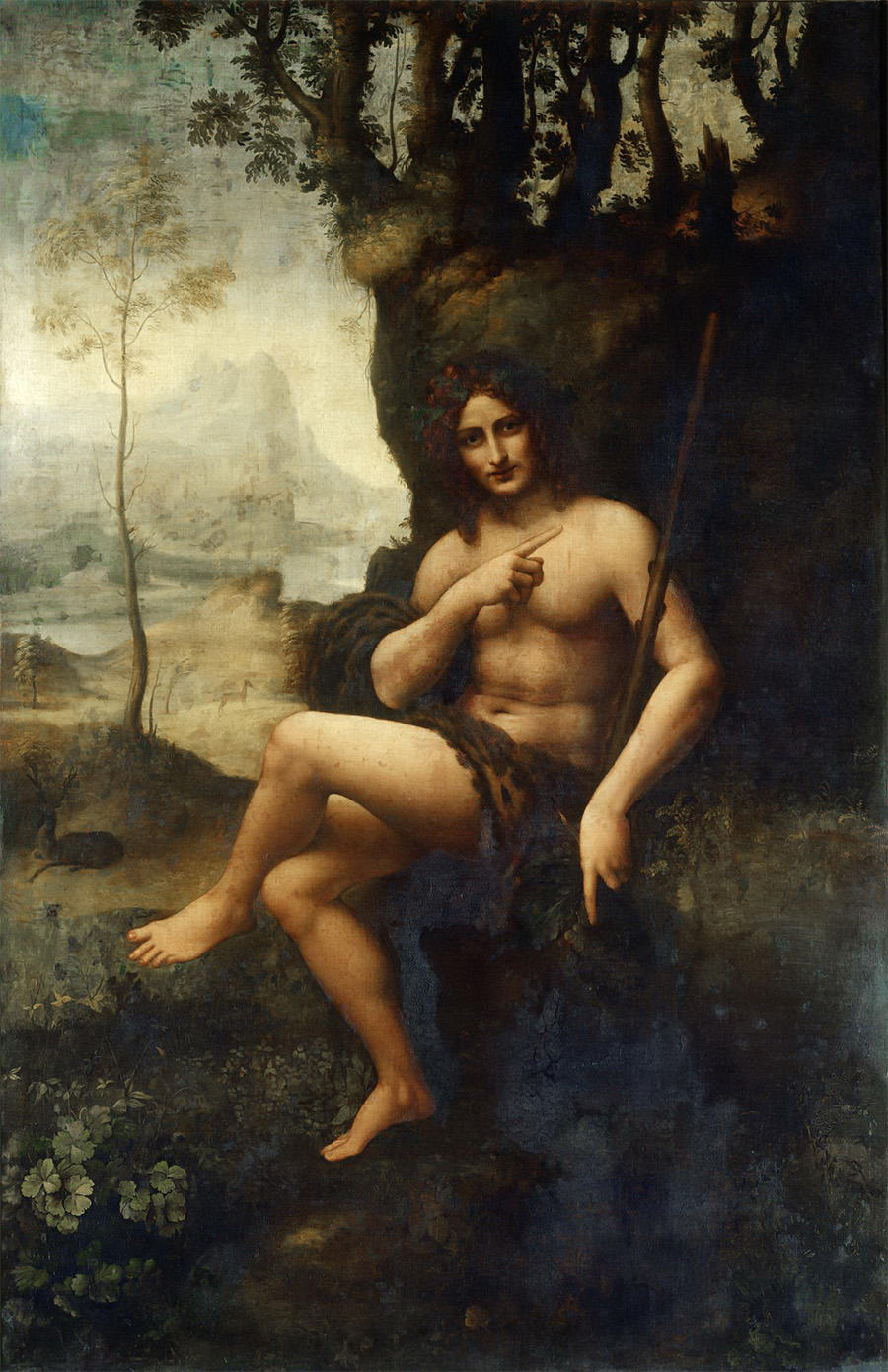
Saint John the Baptist in the Desert, later known as Bacchus, Leonardo da Vinci, 1510-1515, Louvre
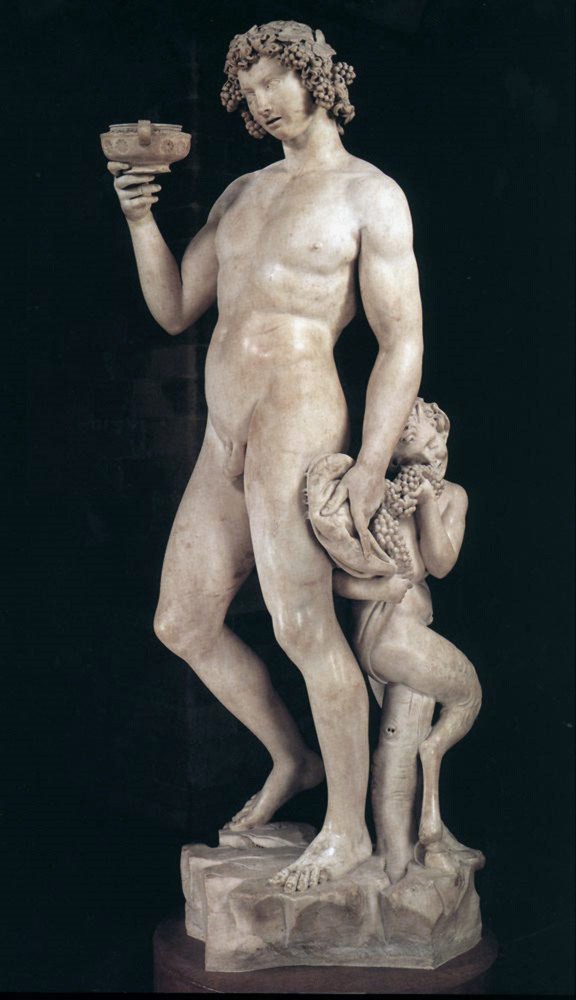
Bacchus (1496–1497), Michelangelo, 1496-97, Museo Nazionale del Bargello
The Renaissance produced another evolution in how Bacchus was viewed. This began with Petrus Berchorius’s Ovidius moralizatus in 1348, a the lavish Bolognese manuscript depicting the god in the cycles of Ovid. The circle of Donatello began to represent the god more generally in the 1450s with bronze plaguettes like Bacchus Discovering Ariadne on Naxos. Boccaccio interpreted the god's civic functions as “liberating” people from cares and giving the poor or downtrodden temporary relief, whether in conceit or not. Already in Boccaccio there survives an interpretation in which the scattered Bacchus can represent the world soul distributed throughout the cosmos and then restored to unity, although Boccaccio himself records rather than fully endorses that explanation50,51,52
Philosophical developments in Italian society began to change the view of Liber as merely being a demon presiding over drunkenness and orgy, such as, for example, Marsilio Ficino's extrapolations on the nature of Liber. He insisted there were two types of drunkenness: the ordinary corruptive kind and the intoxication of reason flowing upwards, the furor divinicus, where the mind is loosened from its ordinary bonds, and correctly stated that the imagery of the Bacchanal had a higher layer.53
The artistic craze for Dionysiac scenes, particularly with Ariadne and the satyrs, continued throughout the 15th and 16th centuries, an early watermark being Michelangelo's famous 1496–97 Bacchus. Vincenzo Cartari's enormously influential Le imagini de i dei de gli antichi (1531), a handbook on divine representation, systematized Bacchic imagery for artists and readers by taking from both the artistic conception and the philosophical one. Cartari explains Bacchus partly as the power responsible for vegetative productivity: the force through which plants bring forth mature fruit, and thought it belied his link to generation. The association with nature became more prominent, and many representations of the wandering John the Baptist took on increasingly androgynous, Bacchic imagery.54,55
One example of this curious process is the Saint John the Baptist by Leonardo da Vinci (1508). Even at the time, the portrayal of the saint in lithe, dramatic and youthful form, engaging in the mystery pose of the hands and with some of Liber's symbolism added proved controversial and drew comparisons to the god.56
The more faithful Saint John the Baptist in the Wilderness (1517) was even converted 160 years later into being a painting of Bacchus by overpainting the stick to be a thyrsus and the animal skin to be a leopard skin. Historians have noted that Raphael and Andrea del Sarto in Leonardo's stead also began to give John vine leaves and other Bacchic symbols in their depictions and have noted that Perino del Vaga, a student of Raphael, gave his depiction of St. John considerable the Dionysiac symbolism in his Holy Family with the Infant Saint John the Baptist (ca. 1524–26).57,58,59,60
Sources and Bibliography
- de Vaan, Michiel. Etymological Dictionary of Latin and the Other Italic Languages. Leiden Indo-European Etymological Dictionary Series 7. Leiden: Brill, 2008. S.vv. līber, Līber.
- Ovid. Fasti. Translated by James G. Frazer, revised by G. P. Goold. Loeb Classical Library 253. Cambridge, MA: Harvard University Press, 1931. 3.713–790.
- Seneca. De tranquillitate animi 17.8. In Moral Essays, Volume II, translated by John W. Basore. Loeb Classical Library 254. Cambridge, MA: Harvard University Press, 1932.
- Lommatzsch, Ernst, ed. Corpus Inscriptionum Latinarum. Vol. 1, 2nd ed., Inscriptiones Latinae antiquissimae ad C. Caesaris mortem. Berlin: Georg Reimer, 1918. No. 563 (= CIL XIV 4105; ILLRP 1198).
- Miano, Daniele. “Liber, Fufluns, and the Others: Rethinking Dionysus in Italy between the Fifth and the Third Centuries BCE.” In Dionysus and Rome: Religion and Literature, edited by Fiachra Mac Góráin, 111–132. Berlin and Boston: De Gruyter, 2020, esp. 125–26. Miano explicitly identifies Leiber on the Praenestine cista as the earliest appearance of the name Liber.
- Varro. On the Latin Language 6.14. Edited and translated by Roland G. Kent. Loeb Classical Library 333. Cambridge, MA: Harvard University Press, 1938.
- Augustine. The City of God against the Pagans, Volume II: Books 4–7. Translated by William M. Green. Loeb Classical Library 412. Cambridge, MA: Harvard University Press, 1963. 6.9, 7.2–3, 7.21.
- Cicero. De natura deorum 2.62. In On the Nature of the Gods. Academics, translated by H. Rackham. Loeb Classical Library 268. Cambridge, MA: Harvard University Press, 1933.
- Bruhl, Alfred. Liber Pater: Origine et expansion du culte dionysiaque à Rome et dans le monde romain. Bibliothèque des Écoles françaises d'Athènes et de Rome 175. Paris: de Boccard, 1953. 13–58.
- Mac Góráin, Fiachra, ed. Dionysus and Rome: Religion and Literature. Trends in Classics Supplementary Volume 93. Berlin: De Gruyter, 2020. 1–40.
- Dionysius of Halicarnassus. Roman Antiquities 6.17.2–4, 6.94.3. Translated by Earnest Cary. 7 vols. Loeb Classical Library. Cambridge, MA: Harvard University Press, 1937–1950.
- Spaeth, Barbette Stanley. The Roman Goddess Ceres. Austin: University of Texas Press, 1996. 6–13, 81–102.
- Pliny. Natural History, Volume IX: Books 33–35. 35.154. Translated by H. Rackham. Loeb Classical Library 394. Cambridge, MA: Harvard University Press, 1952.
- Livy. History of Rome, Volume II: Books 3–4. 3.55.7, 3.55.13. Translated by B. O. Foster. Loeb Classical Library 133. Cambridge, MA: Harvard University Press, 1922.
- Cornell, T. J. The Beginnings of Rome: Italy and Rome from the Bronze Age to the Punic Wars, c. 1000–264 BC. London: Routledge, 1995. 256–71.
- Livy. History of Rome, Volume XI: Books 38–39. 39.8–19. Translated by Evan T. Sage. Loeb Classical Library 313. Cambridge, MA: Harvard University Press, 1936.
- Degrassi, Attilio, ed. Inscriptiones Latinae Liberae Rei Publicae. 2 vols. Florence: La Nuova Italia, 1957–1963. No. 511 (= CIL I² 581).
- Tacitus. Annals 2.49. In Histories: Books 4–5. Annals: Books 1–3, translated by Clifford H. Moore and John Jackson. Loeb Classical Library 249. Cambridge, MA: Harvard University Press, 1931.
- Beard, Mary, John North, and Simon Price. Religions of Rome, Volume 1: A History. Cambridge: Cambridge University Press, 1998. 313–63.
- Wissowa, Georg. Religion und Kultus der Römer. 2nd ed. Handbuch der Altertumswissenschaft V.4. Munich: C. H. Beck, 1912. 297–304.
- Virgil. Georgics 2.4–8, 2.380–396. In Eclogues, Georgics, Aeneid: Books 1–6, translated by H. Rushton Fairclough, revised by G. P. Goold. Loeb Classical Library 63. Cambridge, MA: Harvard University Press, 1999.
- Horace. Odes 1.7.22–23, 2.19, 3.25. In Odes and Epodes, edited and translated by Niall Rudd. Loeb Classical Library 33. Cambridge, MA: Harvard University Press, 2004.
- Rives, J. B. Religion and Authority in Roman Carthage from Augustus to Constantine. Oxford: Clarendon Press, 1995. 187–95.
- Birley, Anthony R. Septimius Severus: The African Emperor. 2nd ed. London: Routledge, 1988. 1–14, 155–58.
- Turcan, Robert. The Cults of the Roman Empire. Translated by Antonia Nevill. Oxford: Blackwell, 1996. 291–327.
- Vitruvius. On Architecture, Volume I: Books 1–5. 3.3.5. Translated by Frank Granger. Loeb Classical Library 251. Cambridge, MA: Harvard University Press, 1931.
- Richardson, L., Jr. A New Topographical Dictionary of Ancient Rome. Baltimore: Johns Hopkins University Press, 1992. 80–81, 234.
- Coarelli, Filippo. Rome and Environs: An Archaeological Guide. Translated by James J. Clauss and Daniel P. Harmon. Berkeley: University of California Press, 2007. 320–24.
- Ovid. Metamorphoses, Volume I: Books 1–8. 3.511–733, 4.1–415. Translated by Frank Justus Miller, revised by G. P. Goold. Loeb Classical Library 42. Cambridge, MA: Harvard University Press, 1916.
- Pailler, Jean-Marie. Bacchanalia: La répression de 186 av. J.-C. à Rome et en Italie; Vestiges, images, tradition. Bibliothèque des Écoles françaises d'Athènes et de Rome 270. Rome: École française de Rome, 1988. 195–286.
- Gruen, Erich S. Studies in Greek Culture and Roman Policy. Cincinnati Classical Studies n.s. 7. Leiden: Brill, 1990. 34–78.
- Takács, Sarolta A. “Politics and Religion in the Bacchanalian Affair of 186 B.C.E.” Harvard Studies in Classical Philology 100 (2000): 301–10.
- Graf, Fritz, and Sarah Iles Johnston. Ritual Texts for the Afterlife: Orpheus and the Bacchic Gold Tablets. 2nd ed. London: Routledge, 2013. 137–66.
- Purcell, Nicholas. “Wine and Wealth in Ancient Italy.” Journal of Roman Studies 75 (1985): 1–19.
- Wiseman, T. P. “Satyrs in Rome? The Background to Horace's Ars Poetica.” Journal of Roman Studies 78 (1988): 1–13.
- Wiseman, T. P. The Myths of Rome. Exeter: University of Exeter Press, 2004. 63–89.
- Dumézil, Georges. Archaic Roman Religion. Translated by Philip Krapp. 2 vols. Chicago: University of Chicago Press, 1970. 2:377–85.
- Naevius. Comedies, fragment 113 Ribbeck. In Remains of Old Latin, Volume II: Livius Andronicus, Naevius, Pacuvius, Accius, edited and translated by E. H. Warmington. Loeb Classical Library 314. Cambridge, MA: Harvard University Press, 1936.
- Horace. Epistles 2.1.139–155. In Satires. Epistles. The Art of Poetry, translated by H. Rushton Fairclough. Loeb Classical Library 194. Cambridge, MA: Harvard University Press, 1926.
- Cicero. Letters to Atticus 14.14.2. Edited and translated by D. R. Shackleton Bailey. 4 vols. Loeb Classical Library. Cambridge, MA: Harvard University Press, 1999.
- Wiseman, T. P. “Liber: Myth, Drama and Ideology in Republican Rome.” In The Roman Middle Republic: Politics, Religion and Historiography c. 400–133 BC, edited by Christer Bruun, 265–99. Acta Instituti Romani Finlandiae 23. Rome: Institutum Romanum Finlandiae, 2000.
- Persius. Satires 5.30–33. In Juvenal and Persius, edited and translated by Susanna Morton Braund. Loeb Classical Library 91. Cambridge, MA: Harvard University Press, 2004.
- Dolansky, Fanny. “Togam virilem sumere: Coming of Age in the Roman World.” In Roman Dress and the Fabrics of Roman Culture, edited by Jonathan Edmondson and Alison Keith, 47–70. Toronto: University of Toronto Press, 2008.
- Raaflaub, Kurt A., ed. Social Struggles in Archaic Rome: New Perspectives on the Conflict of the Orders. 2nd ed. Malden, MA: Blackwell, 2005. 185–222.
- Le Bonniec, Henri. Le culte de Cérès à Rome des origines à la fin de la République. Études et Commentaires 27. Paris: Klincksieck, 1958. 277–341.
- Scullard, H. H. Festivals and Ceremonies of the Roman Republic. London: Thames and Hudson, 1981. 91–92, 101–3.
- Degrassi, Attilio, ed. Inscriptiones Italiae. Vol. 13, fasc. 2, Fasti anni Numani et Iuliani. Rome: Libreria dello Stato, 1963. 425–29.
- Macrobius. Saturnalia, Volume I: Books 1–2. 1.18.1–24. Edited and translated by Robert A. Kaster. Loeb Classical Library 510. Cambridge, MA: Harvard University Press, 2011.
- Scheid, John. An Introduction to Roman Religion. Translated by Janet Lloyd. Bloomington: Indiana University Press, 2003. 129–46.
- Blume, Dieter, and Christel Meier-Staubach, eds. Petrus Berchorius und der antike Mythos im 14. Jahrhundert: Bd. 1, Die Metamorphosen Ovids in der Deutung des Petrus Berchorius und in den italienischen Bildzyklen des 14. Jahrhunderts; Bd. 2, Der “Ovidius moralizatus: Ausgabe, Übersetzung, Kommentar. In collaboration with Anna Stenmans and Caroline Smout. Berlin and Boston: De Gruyter, 2021. https://doi.org/10.1515/9783110764918.
- Riddick, Michael. Donatello, the Birth of Renaissance Plaquettes and Their Representation in the Berlin Sculpture Collection. Predella: Journal of Visual Arts, no. 50 (2021): 31–41. Especially 35–36 and figs. 15, 17.
- Boccaccio, Giovanni. Genealogy of the Pagan Gods. Vol. 1, Books I–V. Edited and translated by Jon Solomon. I Tatti Renaissance Library 46. Cambridge, MA: Harvard University Press, 2011. Especially 4.25.
- Ficino, Marsilio. Commentary on Plato's Symposium on Love. Translated by Sears Reynolds Jayne. 2nd rev. ed. Dallas: Spring Publications, 1985.
- Christian, Kathleen W. Raffaele Riario, Jacopo Galli, and Michelangelo’s Bacchus, 1471–1572. All’Antica 2. London and Turnhout: Harvey Miller Publishers, 2024. Especially 234–35. https://doi.org/10.1484/M.HMANTICA-EB.5.135830
- Cartari, Vincenzo. Vincenzo Cartari's Images of the Gods of the Ancients: The First Italian Mythography. Translated and annotated by John Mulryan. Medieval and Renaissance Texts and Studies 396. Tempe: Arizona Center for Medieval and Renaissance Studies, 2012.
- Feinberg, Larry J. The Young Leonardo: Art and Life in Fifteenth-Century Florence. Cambridge: Cambridge University Press, 2011, 67–72. In particular, Feinberg discusses Leonardo's progressively androgynous representations of John and his feminization of male sacred figures. Cambridge University Press
- Musée du Louvre. “Saint Jean Baptiste.” Workshop of Leonardo da Vinci; attributed to Francesco Melzi. INV 780. Département des Peintures, Musée du Louvre, Paris. The catalogue records the original spotted skin and the later alteration of the Baptist into Bacchus through the addition of grapes and ivy and the conversion of his cross into a thyrsus.
- Gallerie degli Uffizi. St John the Baptist as a Boy. Raphael, ca. 1518. Florence: Gallerie degli Uffizi.
- Freedberg, Sydney J. A Recovered Work of Andrea del Sarto with Some Notes on a Leonardesque Connection. The Burlington Magazine 124, no. 950 (May 1982): 266, 281–88.
- Metropolitan Museum of Art. “The Holy Family with the Infant Saint John the Baptist.” Perino del Vaga, ca. 1524–26. New York: Metropolitan Museum of Art. The museum explicitly identifies John's grape-leaf crown and leopard skin as attributes of Bacchus and connects both figures with rebirth.